Published in 1947, Misty of Chincoteague was not only the book that changed Marguerite’s life and made her a bestselling author, but it was also the book that changed the fortunes of an entire island community, virtually overnight and seemingly forever.
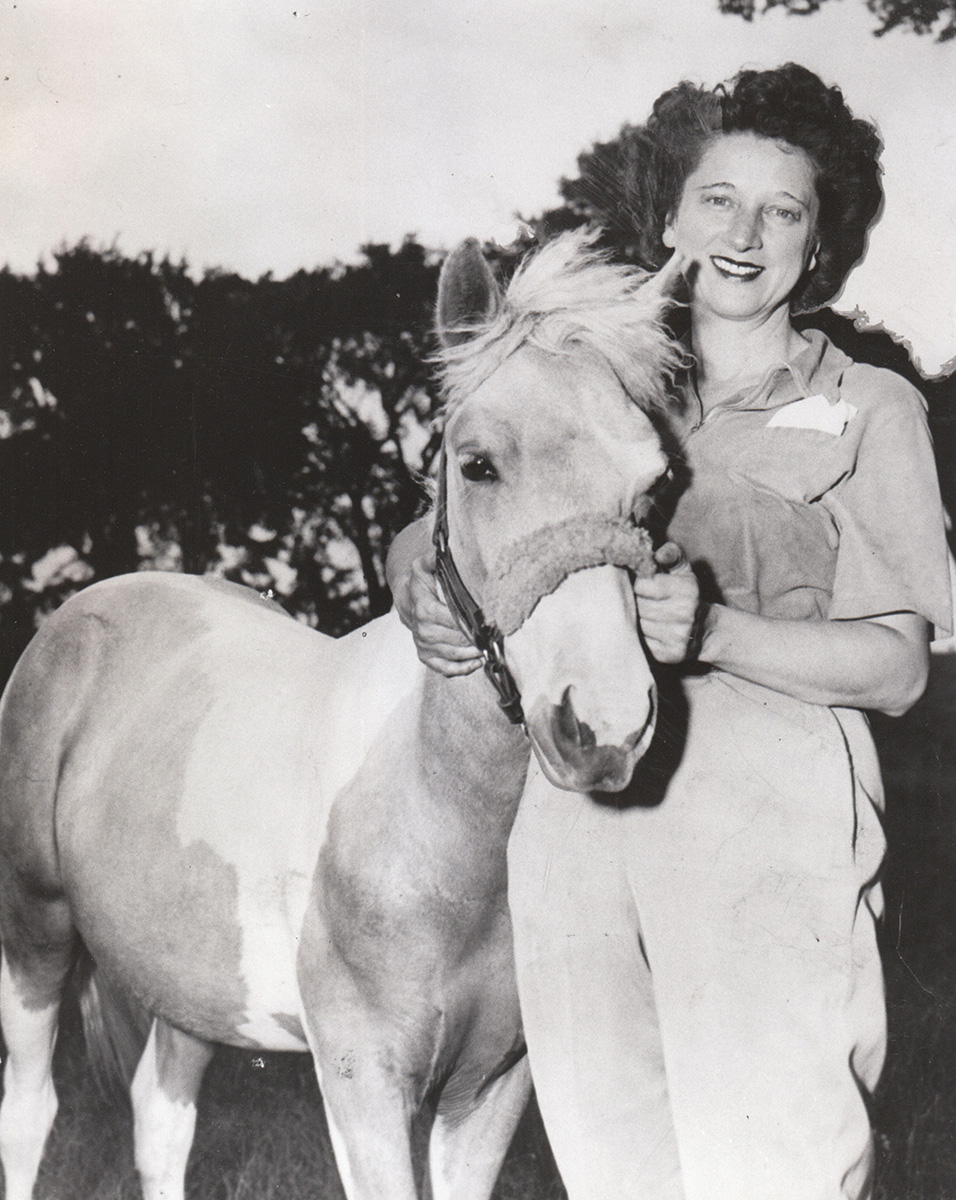
Misty and Marguerite Henry. Photo courtesy of the private collection of Marguerite Henry
Misty also influenced and informed countless generations of horse-loving children who pilgrimaged with their parents to Chincoteague Island, Va., hoping to come home with a pony just like Misty. The book still inspires great numbers of people to travel to Chincoteague and perhaps even buy a pony of their own during the now-famous Pony Penning Week.
An Idea Is Born
Misty of Chincoteague had a simple origin story. Dr. Mary Alice Jones of Rand McNally, Marguerite’s editor, overheard a conversation while attending a dinner party. Jones listened in as a fellow dinner guest talked about an annual roundup of wild ponies on an island off the coast of Virginia. The ponies were herded into the water from their home on Assateague Island and swum across the channel to neighboring Chincoteague Island each July. There they were auctioned off, with all proceeds benefiting the Chincoteague Volunteer Fire Department.
Jones shared the information with Marguerite, who was immediately enthusiastic about writing a story about the event. Marguerite planned to visit the island and take a local Wayne horsewoman along with her. She also decided to invite her illustrator, Dennis Wesley, as he had moved from New York to Virginia and could capture the possible story in pictures while they were on the island. Dennis was immediately game to join the expedition. Many of his drawings in the book were from their experiences during that trip.
Marguerite booked a room at Miss Molly’s Inn on Main Street in Chincoteague for her first exploration of the island. During that first visit, Marguerite took endless notes as she and her travel companions spent days looking for wild ponies and talked with Chincoteague residents.
While she was walking around town, interviewing local townspeople, Marguerite happened upon two attractive teenagers named Maureen and Paul. It turned out that they lived with their grandparents, Clarence and Ida Beebe, on a ranch not far from Miss Molly’s Inn.
Grandpa Beebe was not only the owner of a pony ranch on Chincoteague, but he proved to be an invaluable source of information on the island and the history of the wild ponies. Beebe’s grandchildren, Paul and Maureen, helped train the ponies that he later sold.
When Marguerite met Maureen and Paul, they were riding the same pony bareback. She told them that she had come to the island to write a book about the wild ponies and Chincoteague Island, and perhaps one pony in particular—a gold-and-white foal she had seen and worried might be auctioned off.
“Suppose some parent with a clumsy clod of a child bought Misty in the auction tomorrow and had no idea of waiting until she grew strong enough to be ridden,” Marguerite frets in A Pictorial Life Story of Misty.
It was Clarence and Ida Beebe who helped move Marguerite’s story along—and who turned out to be critical to the book’s success, especially Grandpa Beebe’s idea that Paul and Maureen should feature as characters. Grandpa Beebe and Marguerite shook hands on a deal for the gold-and-white foal.
“There was no bill of sale. No bargaining. Just $150 offered and accepted,” Marguerite wrote in Pictorial.
Grandpa Beebe—“wiry, spry-legged as a grasshopper,” proved to be a brilliant find, and as charming as he was knowledgeable about both ponies and life. His grandchildren were the characters Marguerite needed at the center of her book, and his words were what lit up the pages.
Misty on the Mainland
Grandpa Beebe kept his word, and a few months later he shipped 4-month-old Misty to Marguerite in Wayne by way of a railroad box car. It was an arrangement that they had both agreed would only be temporary. Misty would live with Marguerite for as long as necessary to finish her book. It was an odd deal to make, but Grandpa Beebe felt the money paid for Misty would be useful for his grandchildren’s education. And of course, the plan was that Misty would eventually be returned to the Beebes where she would be trained to be ridden and someday bred.
When it was time for Misty to be shipped to Wayne, there was one obstacle: Marguerite didn’t have a barn. But her neighbors the Quayles did, and they offered its use. The Quayle children and their friends even helped to clean up the two-stall structure, especially eager to lend a hand when they heard that a wild pony from Virginia was about to arrive.
But when the “wild pony” arrived looking ragged and sad on a cold rainy day in November 1946, Marguerite had some serious misgivings. Misty had traveled four days by train and looked very much worse for wear. Marguerite was truly shocked at the sight of the filly.
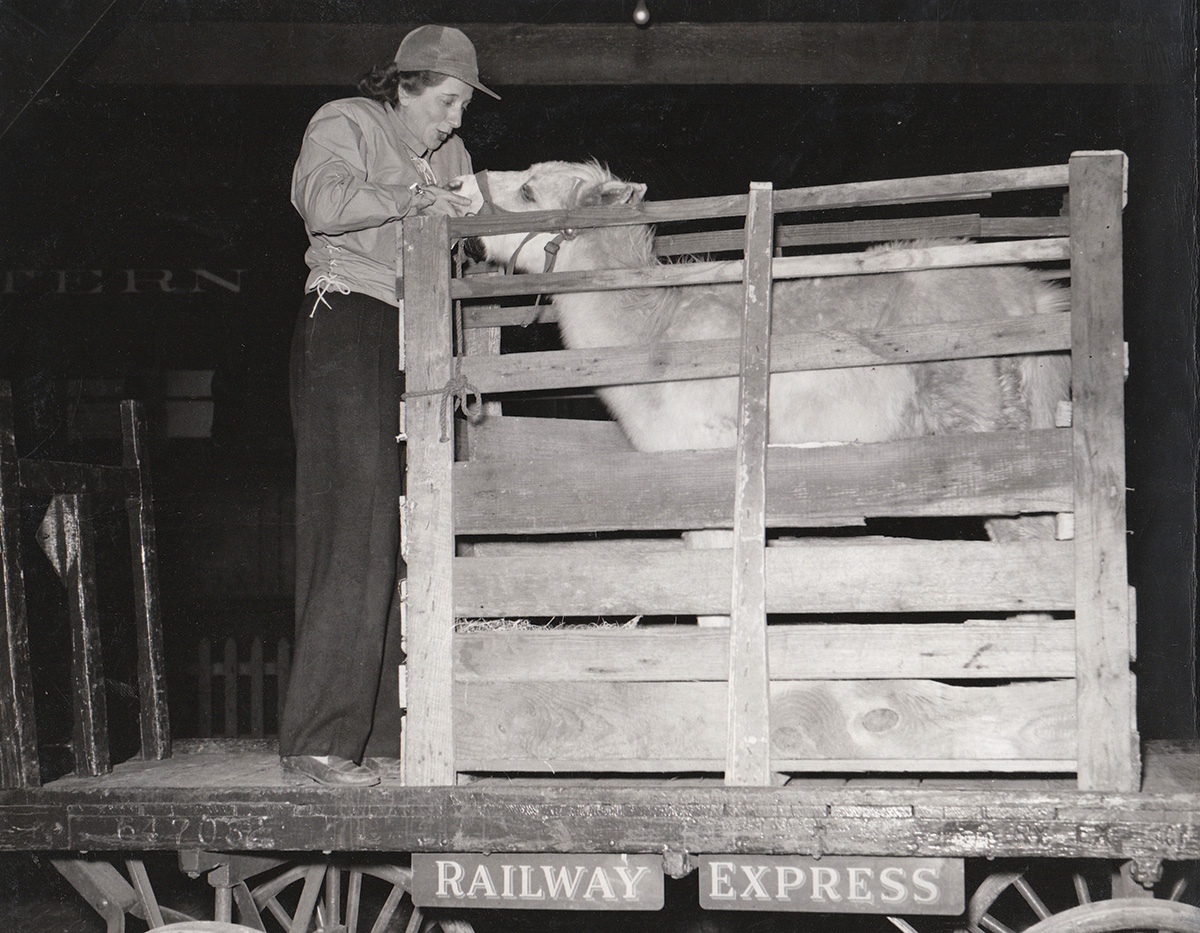
The real-life Misty with Marguerite Henry when she arrived via train in Wayne, Ill. Photo © Sid Wolfmann Studio originally appeared in A Pictorial Life Story of Misty (Rand McNally, 1976)
When Misty stepped out of the rough crate that Grandpa Beebe had made, Marguerite thought the sorry-looking foal looked nothing like the gold-and-white pony she recalled seeing just a few months earlier on the island. Marguerite felt sorry for the cold, lonely pony and a bit guilty as well.
What had she done, taking the tiny foal so far from home? The author ended up spending the night in the Quayles’ stable with Misty, keeping the pony company and hoping that somehow the story she’d had in mind might still work out.
The next day dawned on a more promising note. When Misty awoke in the strange little barn, she gave Marguerite a kick while being led her out of her stall. Marguerite took this as a good omen.
Misty’s arrival in Wayne created quite a stir among the neighborhood.
“Children appeared as if by magic to help get her ready for her arrival. There were sisters Susie with her mop of dark curly hair and Judy with her flaxen braids; Tex, with the deep-set eyes; Eddie and Arthur like roly-poly pups,” Marguerite wrote.
These budding young equestrians grew up to be accomplished riders: Judy Martin became a top pony breeder and an alternate on the Olympic equestrian team, and the young Mary Jon “Jonnie” Quayle Edwards took up eventing and remained a serious rider all her life.
Now in her 80s, Edwards still teaches and rides almost every day. And, in her stable of horses there is a pinto pony—named Misty, of course.
This excerpt from Dear Readers and Riders: A Biography (2024) is reprinted with permission from Trafalgar Square Books. For more information or to order the book, visit here.