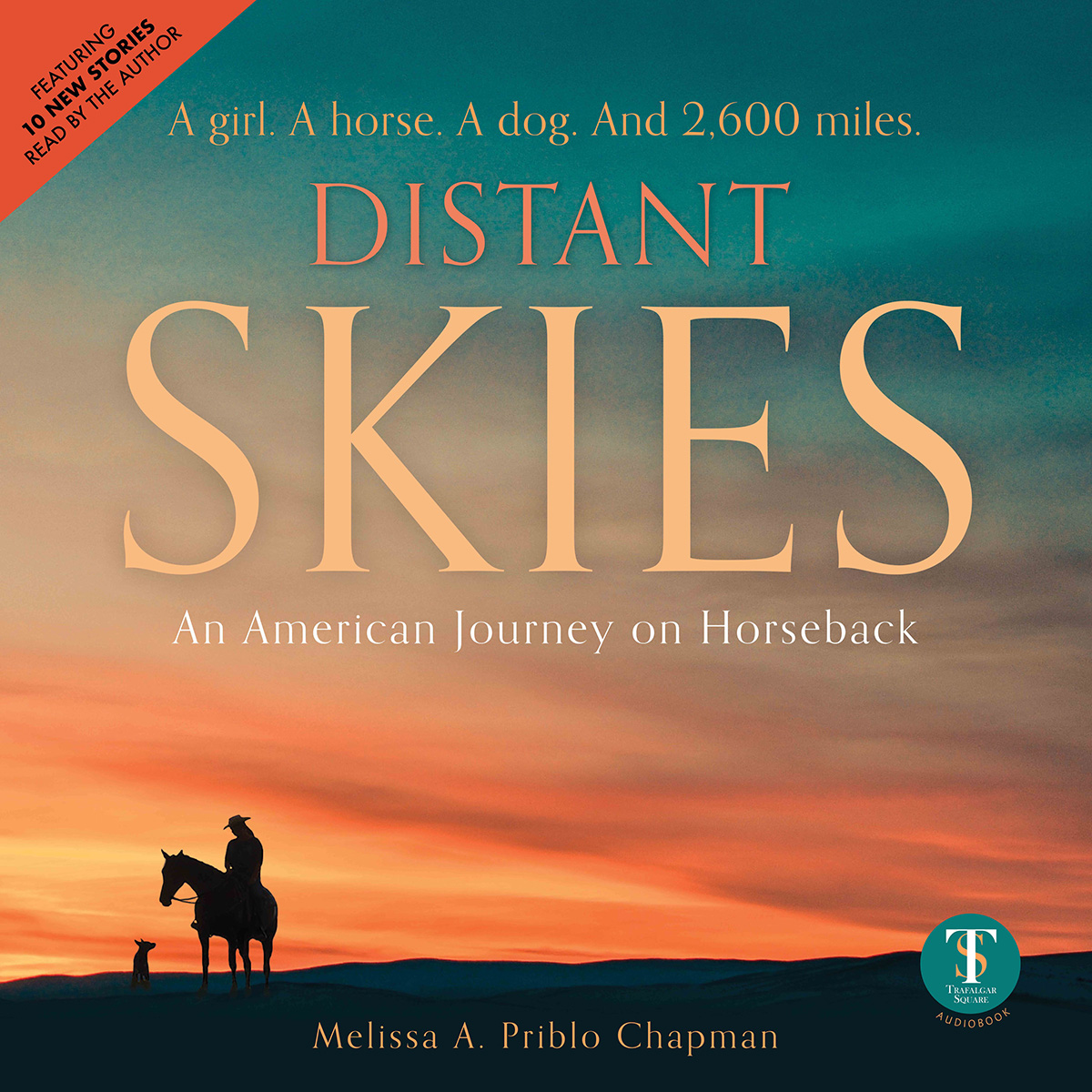
Enjoy this newly released excerpt from the Distant Skies audiobook, featuring 10 previously unpublished stories from the journey and read by the author. Melissa Chapman was 23 years old and part of a happy, loving family. She had a decent job, a boyfriend she cared about, and friends she enjoyed. Yet she said goodbye to all of it. Carrying a puppy named Gypsy, she climbed aboard a horse and rode away from everything, heading west.
Hidden Campsite
Whether it was my sense of direction, good luck, or a skill I’d developed, I usually was able to keep us true to the westerly direction I wanted to go in. But several factors over a few days had brought us a bit south of where I wanted to be. I’d perused my maps and talked it over with the Newtons, a ranching family we’d stayed with, and we had a route in mind that would angle us north and west. Following the directions Dave and Jeff Newton gave me had us sharing the road with traffic, and riding past car lots and fast-food restaurants. At a burger joint in Los Lunas, New Mexico, two reporters caught up to us, and I answered their questions while Rainy and Amanda, my horse and mule and Gypsy, my Collie-German_shepherd mix, and I took a break from the road. I held back a laugh when one reporter, nervously eyeing Rainy’s big head practically resting on the picnic table, asked “Uh, do they always stay right at the table with you when you eat?”
A few miles past Los Lunas the stores and commercial businesses dwindled. By late in the day, we’d completely left that world behind. My animals and I were back in the land of open space and sage brush, where there was no one around but us. The Newtons had described an old water tower to me, and I searched for it as we traveled along the lonely road. “Is it okay to camp there?” I’d asked, and they’d laughed. “Who’s going to bother you?” Mr. Newton had answered. “There’s no one out there.”
They’d spoken the truth. Right about when I began to feel the day should be winding down, I spied the top of the old water tower. We turned down a narrow path that led away from the road and down a sandy incline toward railroad tracks. There was a little hollow down the slope and the remains of an old fence leaned in along the tracks. I dismounted and began the little rituals that made a place feel like “our place” when we camped.
Like every day, the first thing I did was relieve Rainy and Amanda of their burdens. I wanted them to know their work was done and they could rest and relax. I took my saddle, the pack saddle, and the packs, and placed them around our camping spot. It created a curving boundary of sorts and became the outline of our home for the night. It made me feel less like we were small specks in the wide-open space. I fed the animals, opening little bags of sweet feed onto the ground. I stayed with them while they ate, scratching their itchy spots, and hugging their necks. I thanked them for all they’d done during the day.
Our spot was invisible from the road, and though that’s usually what I wanted, it somehow felt extra secluded by the water tank. I had that strange sensation that came with the feeling that not one person in the world knew where we were.
I slept restlessly and woke from a dream that involved a raft and a dark empty sea. I looked outside the tent and saw that Rainy and Amanda were near, staying close in the brushy area we’d claimed.
Late in the night, I woke again, this time to a noise that I should not have heard, tucked away in the desert gully by the unused railroad tracks. It was not wild animals or blowing wind that caused me to sit up and listen.
It was the unmistakable sound of revelry. The clink of bottles, the faint bass beat of music, the occasional smashing of glass and bursts of male laughter.
With a sharp intake of breath, I sat up and grasped the loose scruff of Gypsy’s neck in my hand. We both stayed still, straining our ears. I prayed, willing so hard that the partiers came no farther down the track. I prayed that Rainy wouldn’t neigh, that Amanda wouldn’t send her unusual bray/whinny out into the night. I listened to see if it sounded like those partiers were on the move. How many did it sound like? Were they a few innocent teens out for a clandestine six-pack, or a mob of nasty men, cruising the desert at night?
Gypsy and I sat that way, listening, for what seemed like a long while. My breath was shallow and my heart beat too fast.
Finally, there was the sound of a few more bottles breaking, the slap of a hand on a vehicle, and then the sound of car doors slamming and an engine starting up. At last, the noise faded into silence.
After a while, I allowed myself to lie back down. I dozed again, eventually, but it was the kind of sleep that had served my dog and horse companions and our ancient ancestors so well; sleep that was shallow, with senses still partly alert, tuned to catch the sound of danger in the night.
This excerpt from Distant Skies by Melissa Chapman is reprinted with permission from Trafalgar Square Books.