

Horse Illustrated editor in chief Holly Caccamise recently sat down with Karen Davison, Ph.D., director of equine technical sales for Purina Animal Nutrition, to chat about the changing nutritional needs of older horses and how technology has advanced as far as the feed formulations available today.
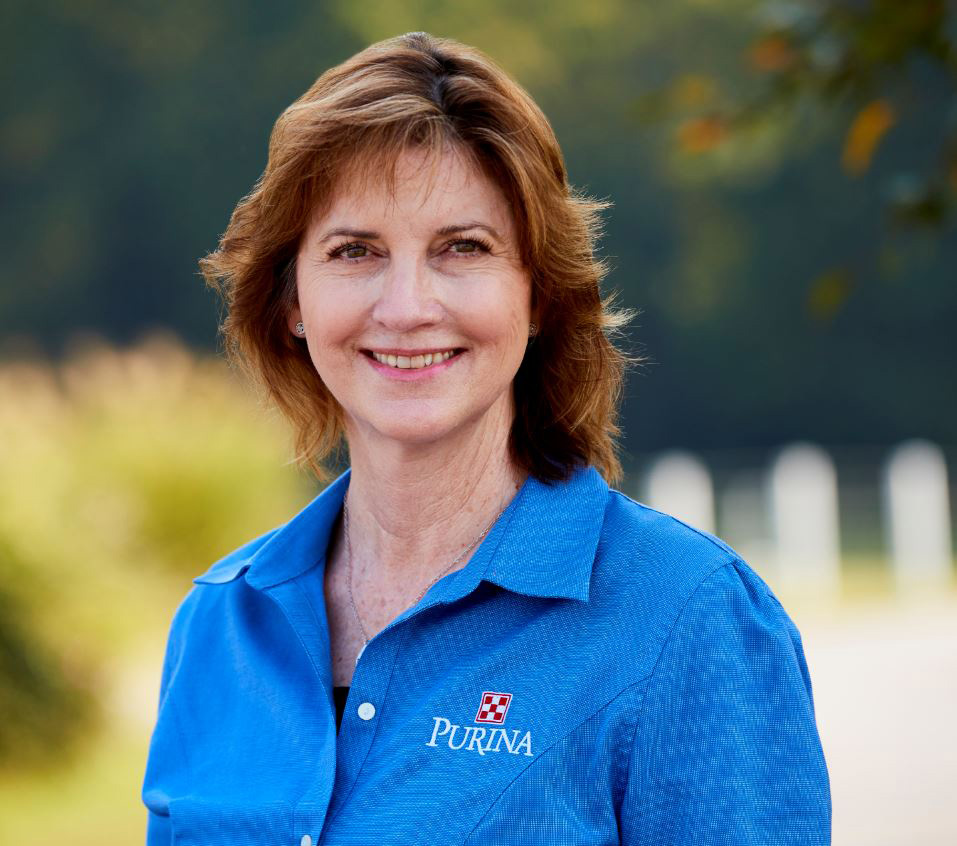
Karen Davison, Ph.D., director of equine technical sales for Purina Animal Nutrition.
Holly Caccamise: We’re starting to really get into the colder months. Do you recommend a change to the diet, or is it better to keep it consistent all year?
Dr. Davison: It depends a bit on how cold it gets, the ambient temperature stress, and the individual horse. A good general rule of thumb is that all animals, including horses, have what we call a lower critical temperature (LCT). Above that, they manage quite well. And for a horse that’s in good condition and has grown a winter coat, people may be surprised to know that the LCT is 15 degrees Fahrenheit—as long as it’s not wet and too windy (that changes it quite a bit).
A horse in lower body condition where their ribs can be seen or one that doesn’t have a winter hair coat, and especially if he’s older, can begin to have more trouble with thermal regulation and more trouble managing body condition. The general rule of thumb is for every 10 degrees it is below that LCT, the horse’s energy requirements go up 10 to 20 percent. But for a horse that’s thinner, younger, or older, or doesn’t have a winter hair coat, the LCT can be 40 degrees Fahrenheit or higher.
When cold weather comes in, extra hay helps horses produce a little internal furnace. The heat of digestion of hay builds heat to help them through those colder days and nights. But when horses eat more hay, they have to drink more water, so make sure that the water is clean and not frozen, and that horses can drink adequately. A tablespoon of salt [in the feed] will help encourage additional drinking.
As far as maintaining weight, the Henneke body condition scoring system is an excellent management tool. You can Google Henneke body condition scoring, or we have it on the PurinaMills.com website. But the short version is that if you can see your horse’s ribs at all, he’s going to struggle more in the winter to maintain body temperature than horses with rib cover. Coming into winter, get those ribs covered and get your horse in a good body condition score of 5 or 6 (out of 9).
Some of us who show through the winter want to keep those coats slick. Those horses need to have more support than a horse who’s grown winter hair.
Some people like to feed a mash. At Purina, we have our RepleniMash®. It has Outlast® Gastric Support Supplement, electrolytes, and is very tasty. You can mix it with warm water to give them additional water.
Holly: What defines a senior horse? Is it necessary to change the diet of a senior horse?
Dr. Davison: Just like us, horses all age differently. There’s genetics, and how well they’ve been managed and taken care of over their life. They live longer and healthier lives now than they did years ago. We just tell people to start paying attention when their horse gets into his mid-teens.
Nowadays you have 18- or 19-year-old horses completing the Kentucky Three-Day Event at the highest level of eventing. Horses in their 20s are competing at the National Finals Rodeo. So horses still competing at top levels in all disciplines are what we used to consider to be really old horses. Horses are no longer automatically considered to be “old” and retired at 18 and 19 years old anymore. Winter is a good time to pay attention, because there will be some point in time when you’ll begin to see your horse isn’t maintaining good body condition on the same diet he did OK on last year, or that his younger peers in the barn are doing fine on.
Every year at Purina we get calls in to our 800 number in March or April where somebody says, “All of a sudden my old horse lost 300 pounds,” but they didn’t really lose 300 pounds overnight. A lot of times what happens is they put a blanket on when it got cold and then take the blanket off when it got warm again and didn’t realize that the hay that was keeping all the younger horses in good condition was not working for that older horse anymore.
So that’s one of the biggest signs of aging—when you think their teeth are in good shape and they can still chew hay they’re OK, but the aging digestive tract begins to struggle with extracting nutrition out of hay as well as they did when they were younger.
That’s when it’s important to use something like Purina’s original Equine Senior® horse feed in the red bag. It’s a complete feed that has hay built in, and needs to be fed in amounts recommended to replace hay when horses can’t properly chew or digest hay anymore.
There are also senior horses who can still adequately chew and digest hay but are still facing the aging process.
We know from research that aging horses have a reduced immune response to vaccine and an increase in systemic inflammation. The ACTH test for PPID (Cushing’s) is not recommended to be done in the fall because values tend to elevate seasonally. ActiveAge® technology, a unique yeast-derived prebiotic included in many of Purina’s senior formulations, helps aging horses maintain proper immune function as they age. Some horse owners might say, “I’m going to be proactive, and I know my horse is getting older, so I’m going to feed as much technology as I can that helps senior horses through the aging process.” That’s where the Purina Senior feeds can be helpful. You can’t make them stop aging, but you can help them age more gracefully.
For example, as they get older, they produce less saliva, especially if they’re not chewing hay as well. (Equine saliva contains sodium bicarbonate that helps buffer stomach pH.) Then you start looking at gastric health and want something in the feed to support gastric pH, such as Purina’s Outlast Gastric Support Supplement.
Holly: What can we do to give horses’ joints a little extra TLC in the winter when cold can mean extra stiffness and reduced mobility?
Dr. Davison: Older performance horses start to get wear and tear on their joints, and working with your veterinarian to help preserve those joints as long as possible will help keep that horse comfortable so he can continue to perform at a high level. And your veterinarian is the best resource to advise a plan for your horse.
From a nutritional standpoint, there are some things that we know have joint comfort benefits, such as specific omega-3 fatty acids. Purina’s ActiveAge technology has been shown to support mobility in aging horses.
Holly: Speaking of ingredients, what makes senior formulas important for aging horses? Can you explain what and how ingredients in feed support senior horses?
Dr. Davison: Over 30 years ago, the research was the basis for the formula of original Equine Senior. And back then, it was finding ways to replace those long-stem fibers that horses could no longer digest, and having the right types of fibers that can replace hay and function like hay in the digestive tract, but that are easier to digest and utilize.
High-quality, highly digestible fibers are important, but you still need to have the right amount of indigestible residue to actually replace hay. On the other hand, older horses can become sensitive to hay quality and develop loose stools when hay is more mature and less digestible.
High-quality protein is also important. One of the things you see with age is a loss of muscle mass. Being able to support that muscle for as long as you can requires a high-quality protein. This isn’t just about protein percentage, it is about the amino acid makeup of the protein. Amino acids are the building blocks for protein, and having high-quality amino acids in the diet is important to help maintain muscle mass in older horses.
We weren’t as up to date on insulin resistance and metabolic syndrome 35 years ago when we started doing this research, but in that early data, we saw that older horses had higher blood glucose levels than younger horses. And since that time, there have been several studies to show that regardless of what the calorie source is in the diet, older horses will tend to have a higher insulin response.
It’s important to work with your veterinarian on these health issues as these horses get older. Not all Cushing’s horses are insulin resistant. And I’ve seen some cases where people were so concerned that their horse had Cushing’s that they restricted the starch and sugar so much that they were also restricting other nutrients. And essentially, these horses aren’t getting nutritionally supported.
I’m a big fan of diagnostics. You don’t just look at your horse and think, “That looks like a Cushing’s horse.” Get your veterinarian involved and let them do the appropriate diagnostics because it really affects how we recommend nutrition for those horses. I don’t think anybody wants to be out soaking hay in the winter if their horse isn’t insulin resistant after all.
Aging is ultimately a medical process on some levels, and having a team that includes your veterinarian and a nutritionist can help you and your horse navigate better.
Holly: If you and your vet or nutritionist decide it’s time for a change to your horse’s diet, how do you recommend transitioning horses onto senior feed safely and effectively?
Dr. Davison: Always make changes slowly. Horses are creatures of habit. They thrive with consistency. Most horse owners know not to change feed overnight; do it gradually and blend new and old.
Usually that change can be made over four or five days.
The forage, though, is more important. I hear a lot of times, “I have hay from the same supplier, from the same field. It’s the same hay.” But it’s not. Hay grown in the same field will be different from cutting to cutting, depending on how Mother Nature cooperated and how you harvest that hay. So changing hay is a bigger part of changing the horse’s diet. Depending on the horse, it’s somewhere between 80 and 100 percent of the diet. So when you change hay, it really should be gradual. Plan ahead.
There was a study done back in the ‘80s at Texas A&M where they looked at risk factors for colic, and changing hay increased the risk of colic by 9 times whereas a change in feed increased the risk of colic by 2.5 times. If you’re replacing hay with Equine Senior® horse feed, you may want to take it slower, maybe a week to 10 days to gradually replace both the hay and feed.
Holly: What types of feed does Purina offer for the senior horse?
We have devoted research to senior horses for over 35 years. It’s not a one size fits all, so we have Equine Senior® Horse Feed for horses who can’t chew and digest hay properly. We have Equine Senior® Active Horse Feed for horses who can chew hay but need a little more help maintaining condition.
A couple of years ago, we came out with our Enrich Plus® Senior Ration Balancing Horse Feed, which is for those really easy-keeper older horses who can stay in good condition eating hay or pasture and don’t need significant additional calories. Over the years, Equine Senior® horse feed got used incorrectly as much as any product out there. People sometimes feed only a pound or two a day, and it was not designed to be fed that way—it has the forage built in, so it needs to be fed in higher volume. So, one pound of Enrich Plus® Senior does a really nice job on those horses who can stay fat enough on hay or pasture.
And then most recently, our newest product is Ultium® Senior Horse Feed, which is designed for that higher-performance senior horse and that harder-keeper senior horse. It’s got the highest calories of any senior feed we have, but keep in mind, Ultium® Senior is intended to be fed with hay or pasture, whereas Equine Senior® can be fed without hay or pasture since it has the fibers that can replace hay built in.
The Purina Senior feeds with Outlast® Gastric Support Supplement and ActiveAge Prebiotic technology are designed to provide the best support we know to help horses manage through the aging process. Our website at PurinaMills.com is a good place to go—just click on Senior Horses and it shows you all the options.
At our website, you can also search for our retailers in your area, who can help you with the choices. They can also put you in touch with your local Purina rep who can help you make some of these decisions.