
Not so long ago, riding lessons were almost solely under the purview of riding instructors via in-person lessons. Today, with advances in technology, you can improve your riding proficiency with expert instruction between lessons, or in some cases, without ever leaving your home farm. Betsy Chandler is a Certified Horsemanship Association (CHA) certified instructor and the manager of Heatherfield Horse Park in Trenton, Ga. While Chandler does not feel that riding apps will ever replace or even take business away from traditional riding instructors, she does acknowledge that these types of apps could be of benefit for between-lesson riding.
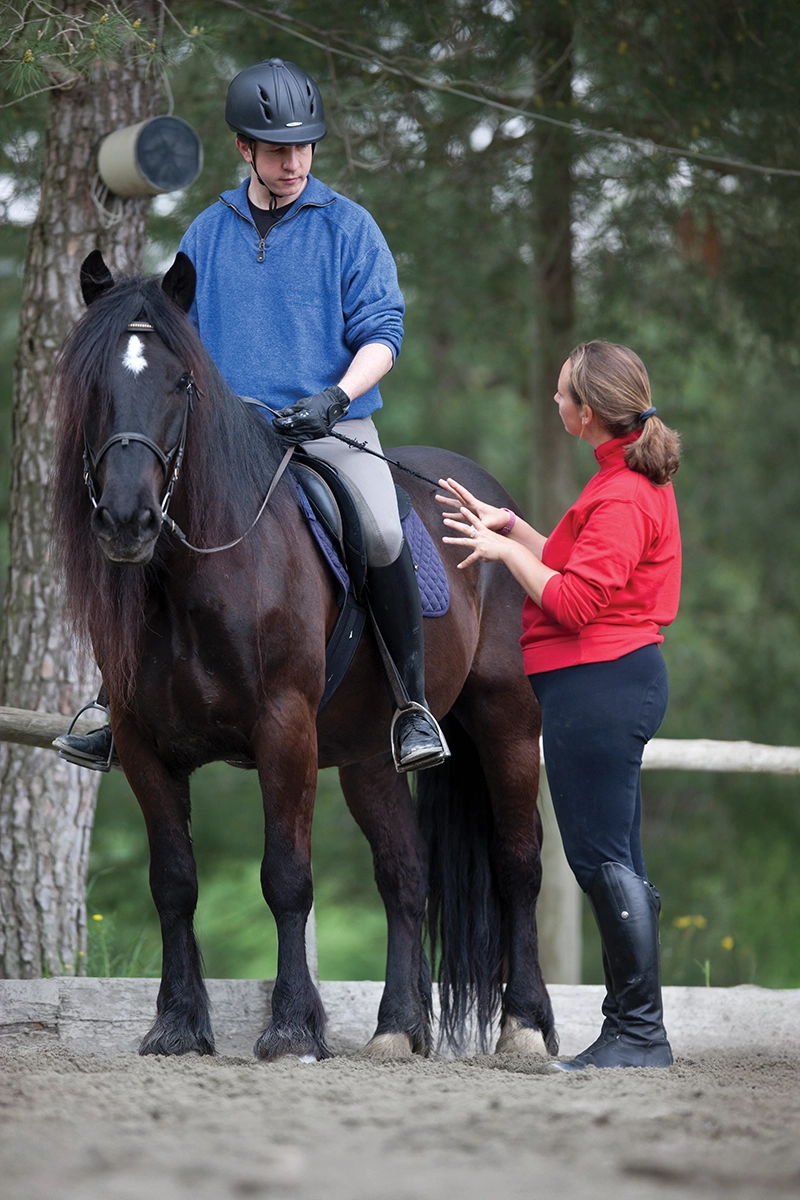
Photo by Christiane Slawik
In-Person Benefits
Chandler, whose experience with off-site instruction comes from virtual, video camera-based lessons, says that one benefit of continuing in-person instruction is that you have a real person standing there who can see more than you can see on a camera. As evidence, Chandler points to an issue with virtual lessons that a former client experienced.
“The instructor was missing some things because she could not see the whole picture all the time,” she says. “She could just see what the camera was focused on. The feedback from that was very limited.”
According to Chandler, safety is another drawback. “What if someone falls off their horse and the only other person present is a virtual riding instructor?”
She adds that the experienced eyes of a riding instructor, because they know the horse well, may also be able to detect a slight lameness that an inexperienced rider is not yet able to feel.
Finally, some riding instructors offer valuable insight into more than just riding technique, which Chandler feels may be lacking when taking lessons via an app. Helpful tips, such as changing to a different bit or advising clients to have their saddle fit checked, are just two examples of such feedback that you might get from an instructor versus an app.

Valuable feedback, such as checking saddle fit or changing bits, are an important part of in-person instruction. Photo by Christiane Slawik
Ridely App
But riding apps come with their own set of benefits. Ridely is one of today’s popular riding and education-based apps that seeks to fill the gap between riding lessons, or, in the absence of a regular instructor, provide riders with an opportunity to level up their riding skills from home.
“Ridely is a video-based educational platform app that can be accessed through the app or on your browser,” says Ridely’s U.S. Country Manager, Nicole Graf.
“It’s not master classes,” she says. “With our bite-sized content, you can learn a lot more in a smaller amount of time. Ridely’s approach helps riders learn easily—it’s a mobile-friendly educational app that fits seamlessly into your day.”
Graf says that no matter where you are, you can easily learn in short, two- to 10-minute videos that are designed to be quick and practical, meaning that you don’t need to spend hours in front of a computer to get valuable insights. She adds that the idea is that you can get specific information by watching a section on shoulder-in or on whatever it is you need.
“We’ve got dressage, jumping, hunter/jumper with some equitation, western, western dressage, and eventing,” says Graf. “We also have groundwork, horsemanship in-hand work, horse bodywork, sports psychology, and rider fitness.”
She adds that Ridely now has over 500 videos, which are all self-made by Ridely, and they are continually adding more content. To provide this amount of content, the app has partnered with 10 Olympians and 65+ trainers so far, including such experts as Carl Hester, Henrik von Eckermann, Lillie Keenan, Stacie Madden, Meredith Michaels-Beerbaum, Lendon Gray, William Fox Pitt, Andrew Hoy, and more.
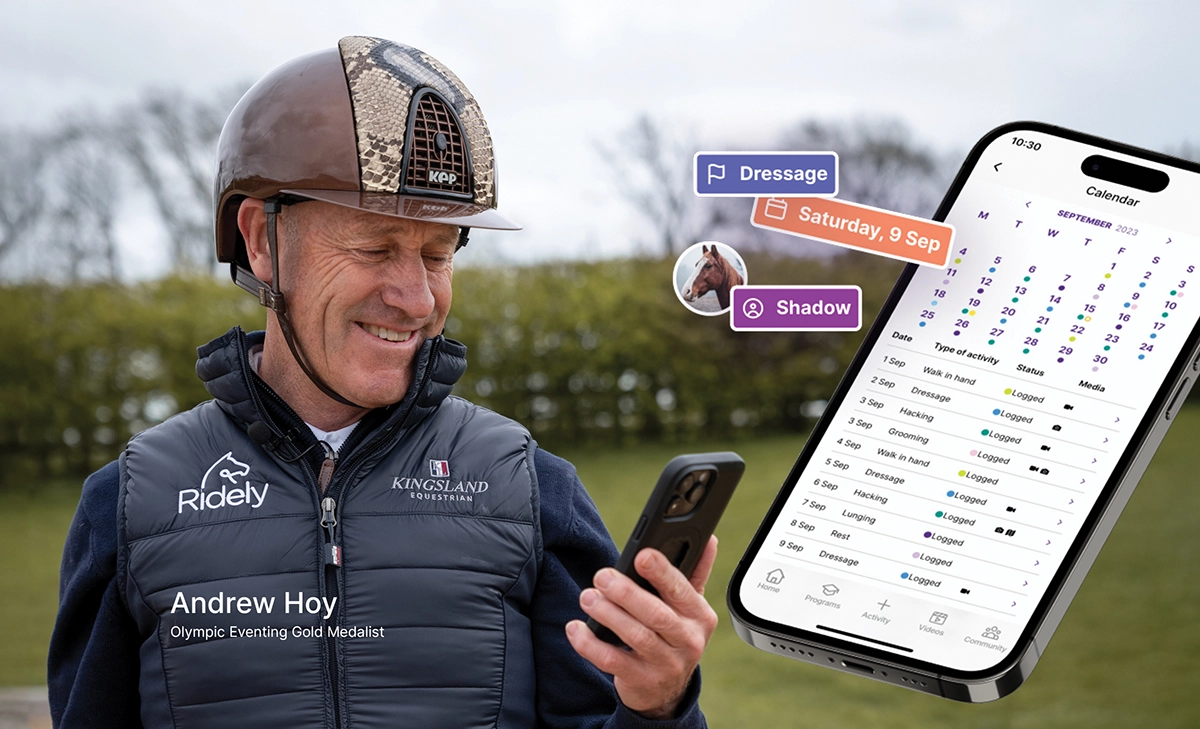
Ridely has partnered with 65+ trainers, including 10 Olympians, to create its video content. Photo courtesy Ridely
Despite their vast offerings, Graf does not feel that riding apps will replace in-person lessons.
“We feel that we complement [your] trainer’s lessons,” she says. “We are not a substitute. But for those people who don’t have access to a trainer, don’t live near one, or can’t afford to take weekly lessons, we can educate people like a trainer.”
Graf says that within the Ridely app, there is also an AI coach. The AI coach helps riders put together a lesson based on what they want to work on. A digital calendar in the app allows riders to track what they do with their horse every day, along with uploading photos, videos, and comments; a beneficial feature that allows riders and trainers alike to track progress.
This information can also be shared with anyone you wish who may be involved with your horse. Trainers can also use the app to assign videos and more as homework between lessons and track their student’s progress.
To address the need for feedback, there is a feature within the app called community groups.
“We have community groups of people with general topics,” says Graf. She says that you can create a private group that could include just you and your trainer, or you and people from your barn, where you can share feedback.
Ride iQ App
While taking a slightly different approach than Ridely, Ride iQ is another popular riding app seeking to fill the gap between in-person and technology-based riding lessons.
“At its core, Ride iQ is listen-while-you-ride audio lessons taught by the world’s best coaches,” says Ride iQ Co-Founder Kinsey Lux. “The reason behind building Ride iQ was to give riders all over the world access to quality education and quality coaching during their independent schooling rides. An important clarification that we always make is that Ride iQ is not meant to replace in-person coaching. It is meant to support you when you are riding alone.”

Ride iQ was founded by sisters Kinsey and Jessa Lux. Photo by courtesy Ride iQ
Even as their current offerings continue to grow, Ride iQ has over 500 audio lessons and hundreds of exclusive podcasts through partnerships with 26 coaches, including six Olympians, across the disciplines of eventing, dressage, and hunter/jumper. They also offer rider fitness lessons, sports psychology, conditioning, natural horsemanship, and more. (Rider fitness lessons are video rather than strictly audio-based.)
Like Ridely, students often find their in-person instructors assigning lessons from the app as homework.
“Coaches love it because the riders are making progress,” says Lux. “They are showing up to their lessons more prepared.”
For riders that have little or no access to regular instruction, Lux says that the app can also help riders continue to improve between clinics or even be used independently.
“We also have a number of coaches who are members,” she says. “They use Ride iQ not only when they are riding their horses and training client horses, but also to inspire their training. It gives them a different vocabulary and different ways of teaching concepts.”
Lux explains that some of the podcasts available within the app are particularly complementary of the riding lessons. One of these podcasts is Riders Unscripted.
“It’s all adult amateurs,” she says. “You don’t know who the adult amateur is, but these are one-on-one sessions with sports psychology coach Natalie Hummel. You get to hear [the adult amateur’s] full, raw story, and it’s really powerful.”
Ride iQ also hosts weekly question-and-answer sessions with experts in the equine community.
“When you’re trailering out to a competition for the first time, we want to be there so you can go into the Ride iQ app and search for trailering,” says Lux. “You have a whole wealth of options of things to learn, safety tips, and more. We’re trying to support every level of rider and every aspect of the journey.”
Currently, the app is adding e-book content and launching a beta for a coach’s program within the app.
How to Try a Riding App
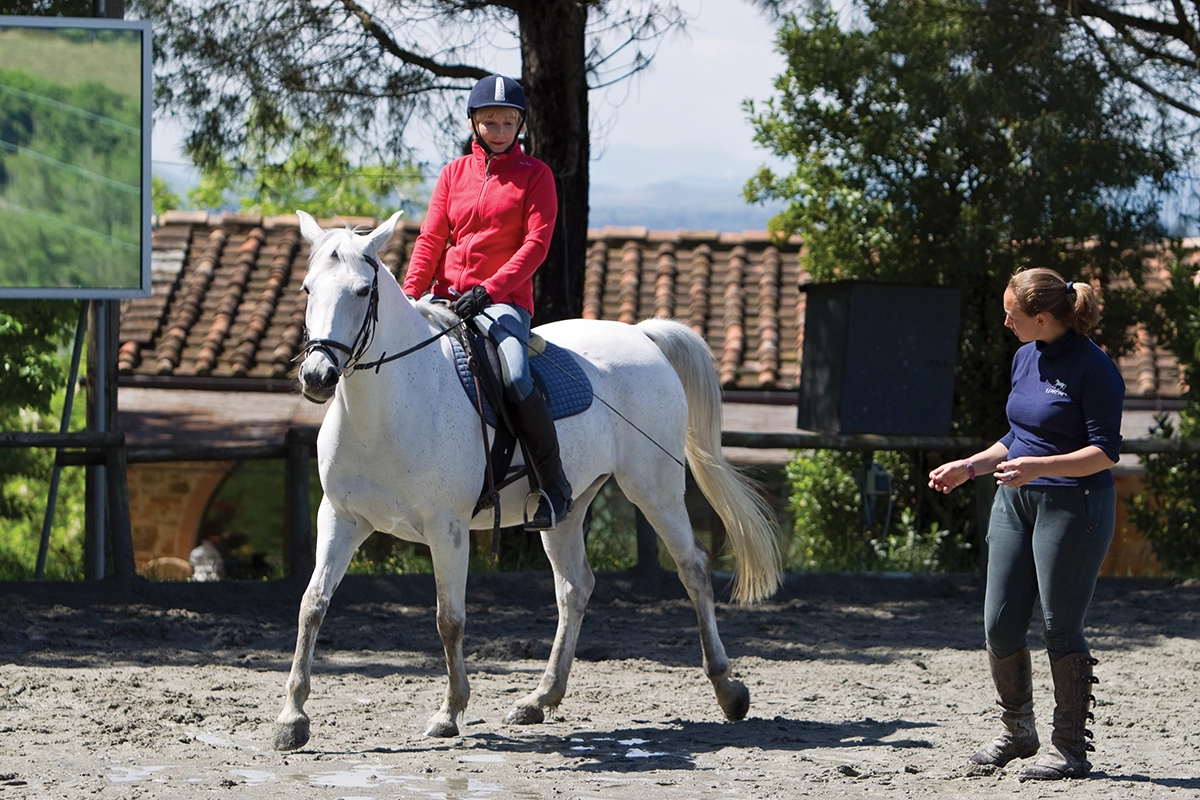
Training via app can be a great supplement between in-person lessons. Photo by Christiane Slawik
Both apps offer affordable subscription fees, access to coaches that you may not otherwise be able to schedule a lesson with, and—should you seek to change up your daily routine—easy access to experiment with a new discipline.
The trial periods offered by both apps can help you decide which one is the best fit for you.
Chandler says that despite the growing popularity and appeal of riding apps, she has seen no decrease in the number of in-person riding lessons being scheduled at Heatherfield Horse Park.
“My phone rings a lot,” she says. “The area where we live is growing and there is still a demand for them.”
This article about riding apps appeared in the March/April 2025 issue of Horse Illustrated magazine. Click here to subscribe!