Horseback riding offers an unmatched sense of freedom, where you can connect deeply with your horse’s strength—whether galloping through fields, launching over oxers or being asked to perform precision moves in the arena. However, traditional horse shows often conjure images of able-bodied riders showcasing polished skills and luxurious gear, creating an aura of exclusivity. Para-Reining and Equestrians With Disabilities classes challenge this perception, offering opportunities for riders of all abilities to experience the empowerment of riding and compete on a level playing field, redefining inclusivity in equestrian competition.
Equestrians With Disabilities
When therapeutic riding centers wanted to find a way to recognize and celebrate their riders outside of their own arenas, they started looking for horse shows so their riders could experience the thrill of taking home a ribbon and their name called over the speakers.
In the early 2000s, the head of one such center approached the National Snaffle Bit Association (NSBA) with a need for a national platform and standardized rules for equestrian competition for riders with physical or cognitive disabilities. It didn’t take long for the NSBA to organize a task force of equine professionals, judges, and therapeutic riding professionals to develop rules and standards for these classes. With that, Equestrians With Disabilities (EWD) was born.
“(The NSBA) began to promote the classes and encourage shows to include these classes in their showbills,” says Elise Sheard with the NSBA Foundation. The NSBA World Championship Show first hosted EWD classes in 2009.
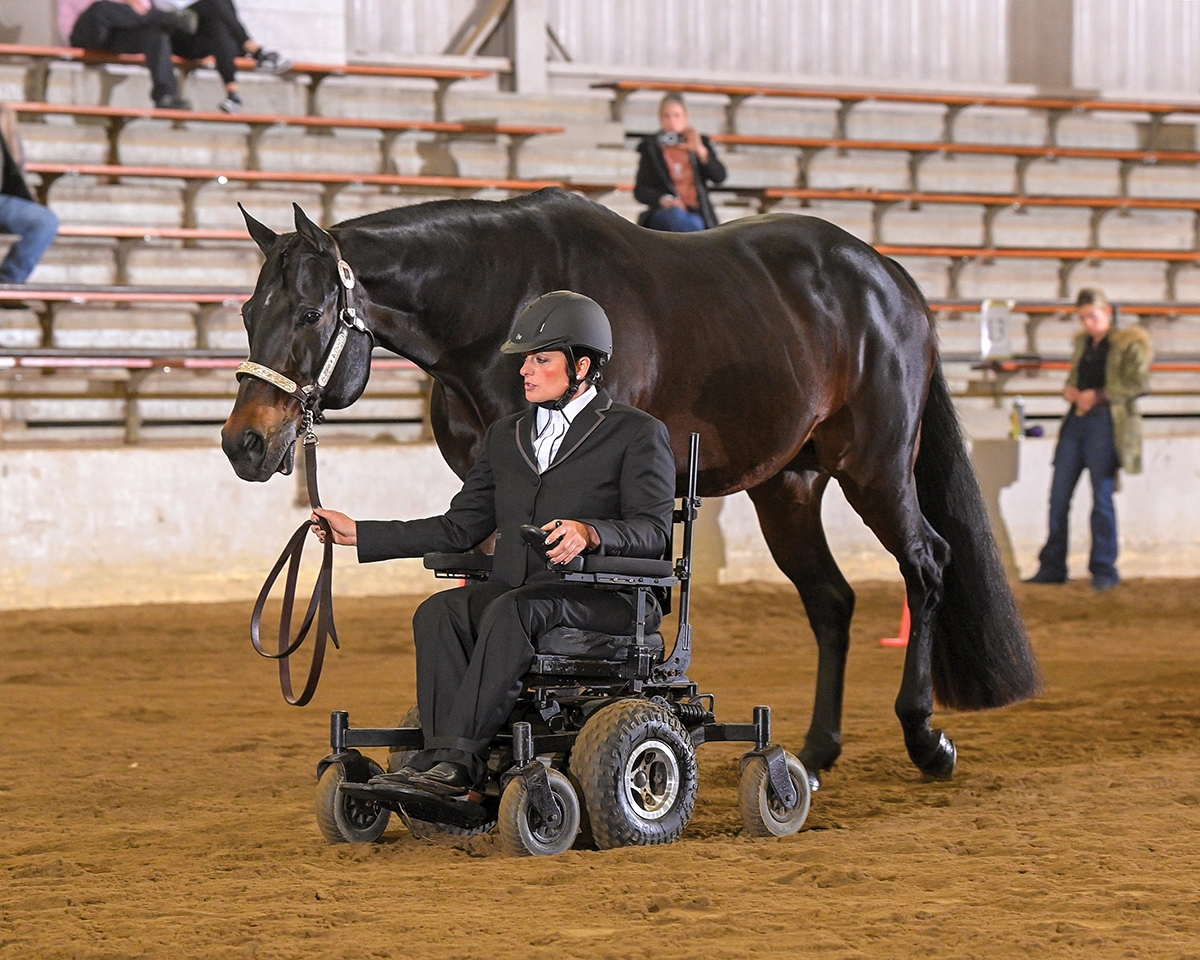
EWD classes have grown tremendously since debuting in 2009, and are now held at major shows across the country. Photo courtesy Shane Rux
Since then, there has been tremendous growth in EWD, with classes held at horse shows across the country. Many major shows now host classes, including The All American Quarter Horse Congress, Palomino World Show, Appaloosa National and World Championship Show, and the Dixie Nationals.
“There has also been significant growth on a more local level beyond the above major circuits,” says Sheard. “State Quarter Horse affiliates such as Illinois, Wisconsin, West Virginia, and many more regularly offer EWD classes at all of their shows. Any NSBA show can add EWD classes to their show approval.”
There are two divisions for EWD classes: Independent and Supported. The Supported division allows for a person at the head of the horse to lead and one or two individuals walking alongside the rider. There are specific rules regarding the roles of handlers, leaders and sidewalkers for the Supported division. Horses used in the EWD classes do not have to be owned by the exhibitor or their immediate family, and any breed of horse may be shown.
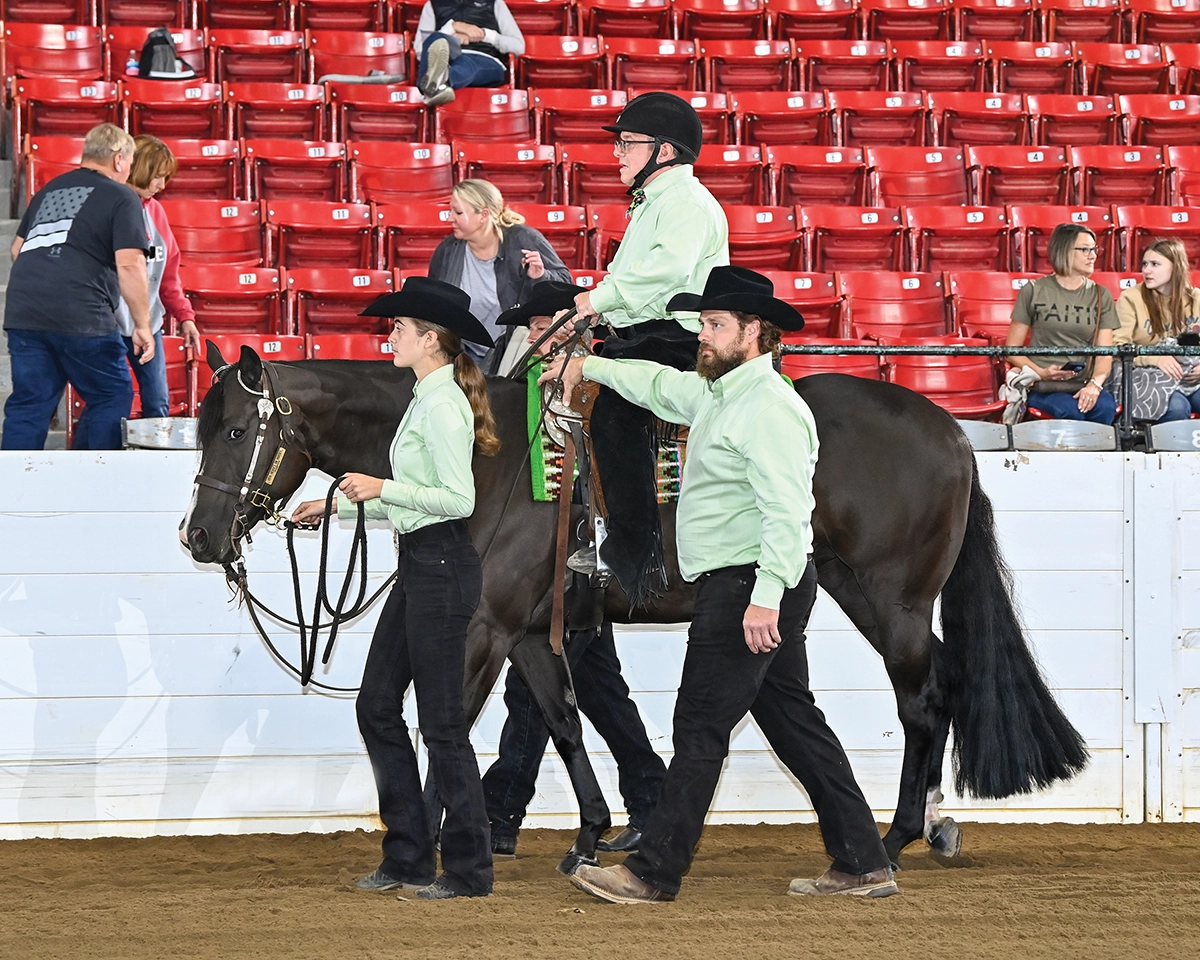
The EWD Supported division allows for a person at the head of the horse to lead and one or two individuals walking alongside the rider. Photo courtesy Shane Rux
EWD: Who Can Compete?
According to the NSBA’s Rulebook for Equestrians with Disabilities:
“In order to participate an exhibitor must have a physical and/or cognitive medically diagnosed condition that causes a permanent impairment that can be measured objectively. Examples of conditions, diseases or disorders that may lead to permanent impairment are: paresis, amputation (partial to full joint), ankylosis, upper motor neuron lesions, vision impairment, and intellectual disability. Eligible conditions include: amputation, arthrogryposis, Asperger syndrome, autism spectrum disorder, Batten disease, cerebrovascular accident (stroke), cerebellar ataxia, cerebral palsy, Coffin-Lowry syndrome, cystic fibrosis, Down syndrome, dwarfism, fragile X syndrome, Friedreich’s ataxia, Guillain-Barre syndrome, hearing impairment, Hunter syndrome, microcephaly, multiple sclerosis, muscular dystrophy, Prader-Willi syndrome, Rett syndrome, spina bifida, spinal cord injury, traumatic brain injury, trisomy disorders and visual impairment. Additional diagnosis will be considered upon request.”
In order to compete in EWD classes, exhibitors must submit an official diagnosis form, a membership form to the corresponding national organization, an acceptable adaptive equipment form, and a riding ability form. The last two are completed and signed by a certified instructor or coach with PATH International, the Special Olympics, U.S. Para-Equestrian, Certified Horsemanship Association, or a certified instructor who is also in good standing with the host organization.
Classes available for EWD include showmanship, hunt seat equitation on the flat, hunter under saddle, trail, western horsemanship, and western pleasure.
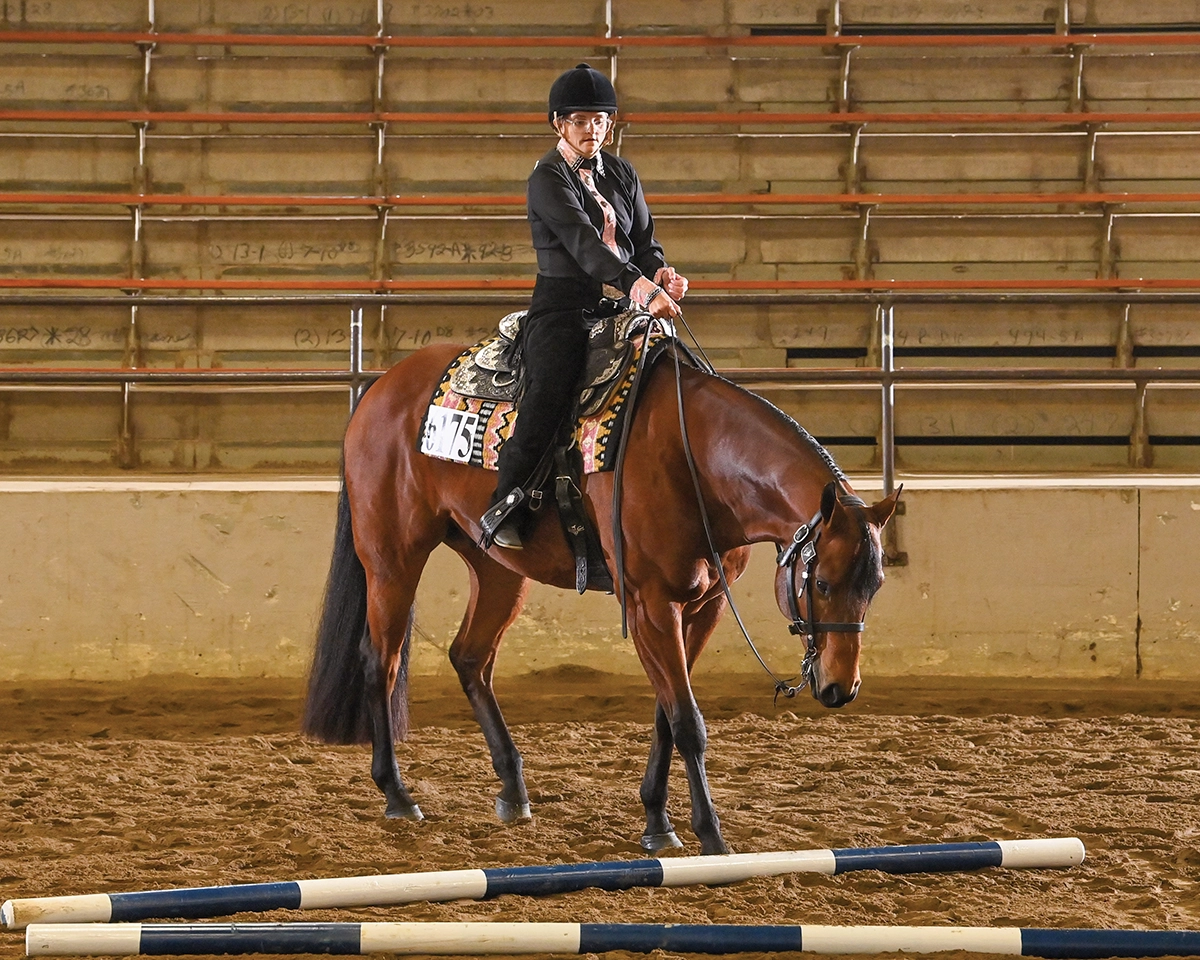
Classes available for EWD include showmanship, hunt seat equitation on the flat, hunter under saddle, trail, western horsemanship, and western pleasure. Photo courtesy Shane Rux
Para-Reining
When Para-Reining was first held as a class at a National Reining Horse Association (NRHA) event, it was first called “adaptive reining.” NRHA Professional Jennifer Hoyt has been at the helm of the division since its debut in 2014.
“I had a young man that started to ride with me that had some disabilities,” explains Hoyt. “I was so impressed with how well our horses were broke to handle any rider.”
The intrigue of the brokeness of the reiner inspired Hoyt to see how well her horses handled riders with disabilities.
“It’s not that horses of other breeds or disciplines aren’t broke, but there’s just a way that reiners are settled and calm that makes them easier to ride, in general,” she says. “I knew NRHA needed to have a place for people with disabilities and to be all-inclusive.”
The difference between Para-Reining and EWD is that Para-Reiners must ride independently.
“With Equestrians With Disabilities, you may have individuals that need to be led or have support,” explains Hoyt. “When we created Para-Reining, we were adamant that this was an independently ridden event and the riders must be able to control the horse by themselves.”
The disabilities for riders in Para-Reining are more physical—riders might be missing a lower limb, or suffer some paralysis or another physical ailment such as cerebral palsy, multiple sclerosis, et cetera. Rider Holly Jacobson, for example, was injured in a car fire when she was 23.
“My right arm was amputated above the elbow, and I lost all of the fingers on my left hand,” she says. “I had several burns that required years of reconstructive surgery.”
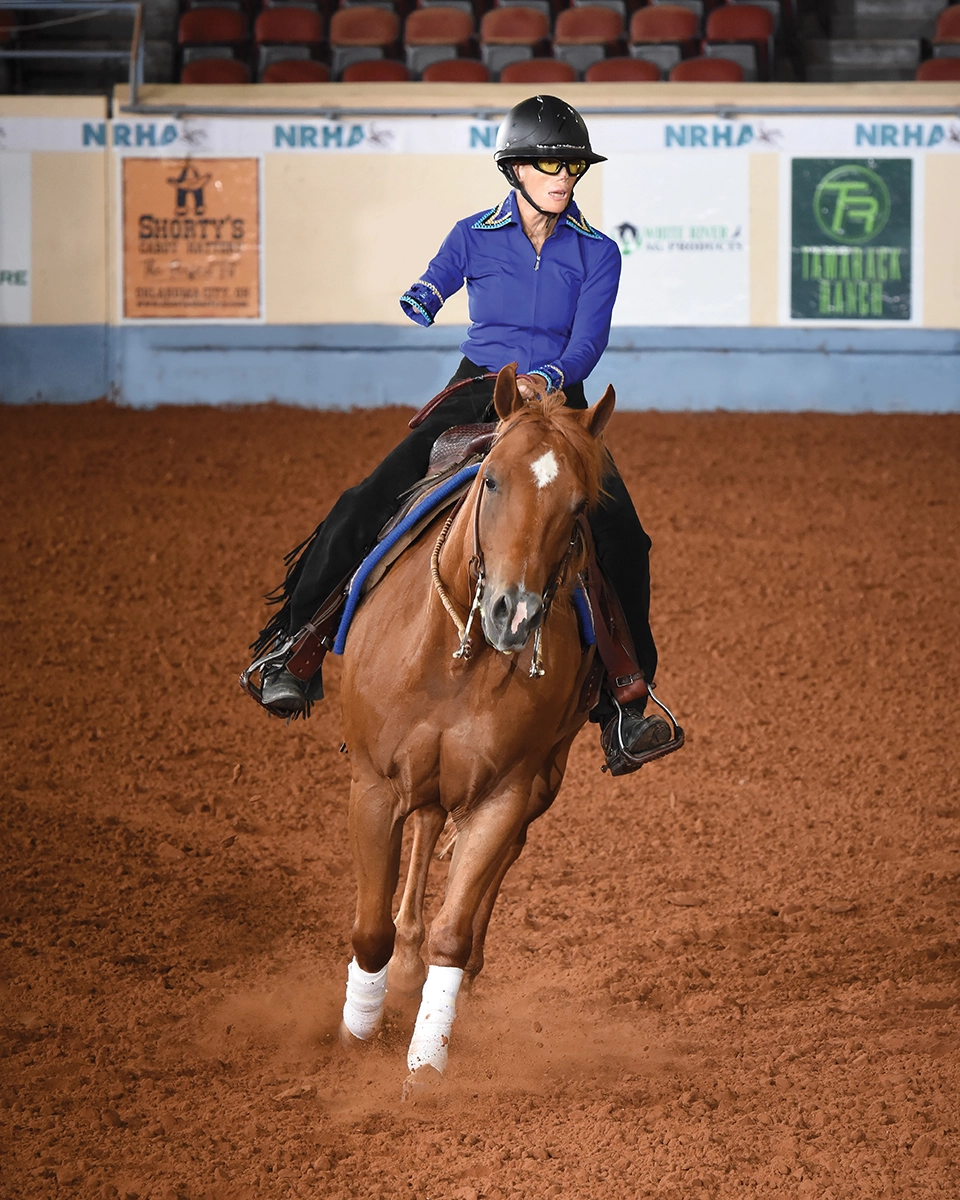
The EWD Supported division allows for a person at the head of the horse to lead and one or two individuals walking alongside the rider. Photo courtesy Shane Rux
Jacobson grew up riding horses and became involved in Para-Dressage after her accident before she discovered Para-Reining.
“When Para-Reining started, I migrated with a bunch of other dressage riders to help promote the sport, and several of us got hooked,” she says.
As with all reining, patterns for Para-Reiners are dictated in the NRHA Handbook, and they can be adjusted for specified grades of riders. However, like all reining patterns, there are some required maneuvers for Para-Reining. These include at least one sliding stop, one circle in each direction, a minimum of two spins to the left and two spins to the right.
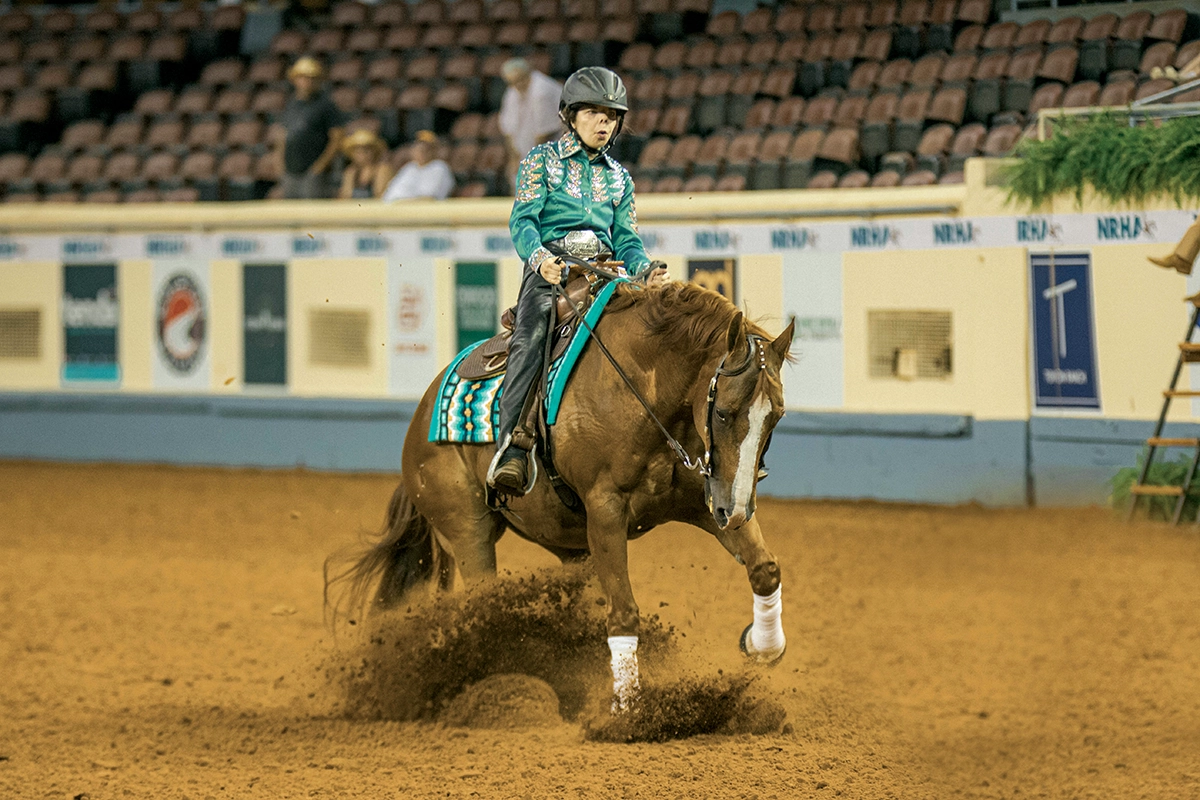
Like all reining patterns, there are some required maneuvers for Para-Reining, such as at least one sliding stop. Photo courtesy NRHA
Riders don’t need to own their horse, but the horse does have to have a competition license through the NRHA.
Riders can use the following provisions when competing:
◆ Specialty braces and/or belts
◆ Audio communication equipment
◆ Trainer/handler present in the arena
◆ Boot adaptations
◆ Rein hand holds
◆ Rubber bands
◆ Saddle blocks
◆ Wedges and/or cushions
◆ Safety stirrups
◆ Seat savers
◆ Whips
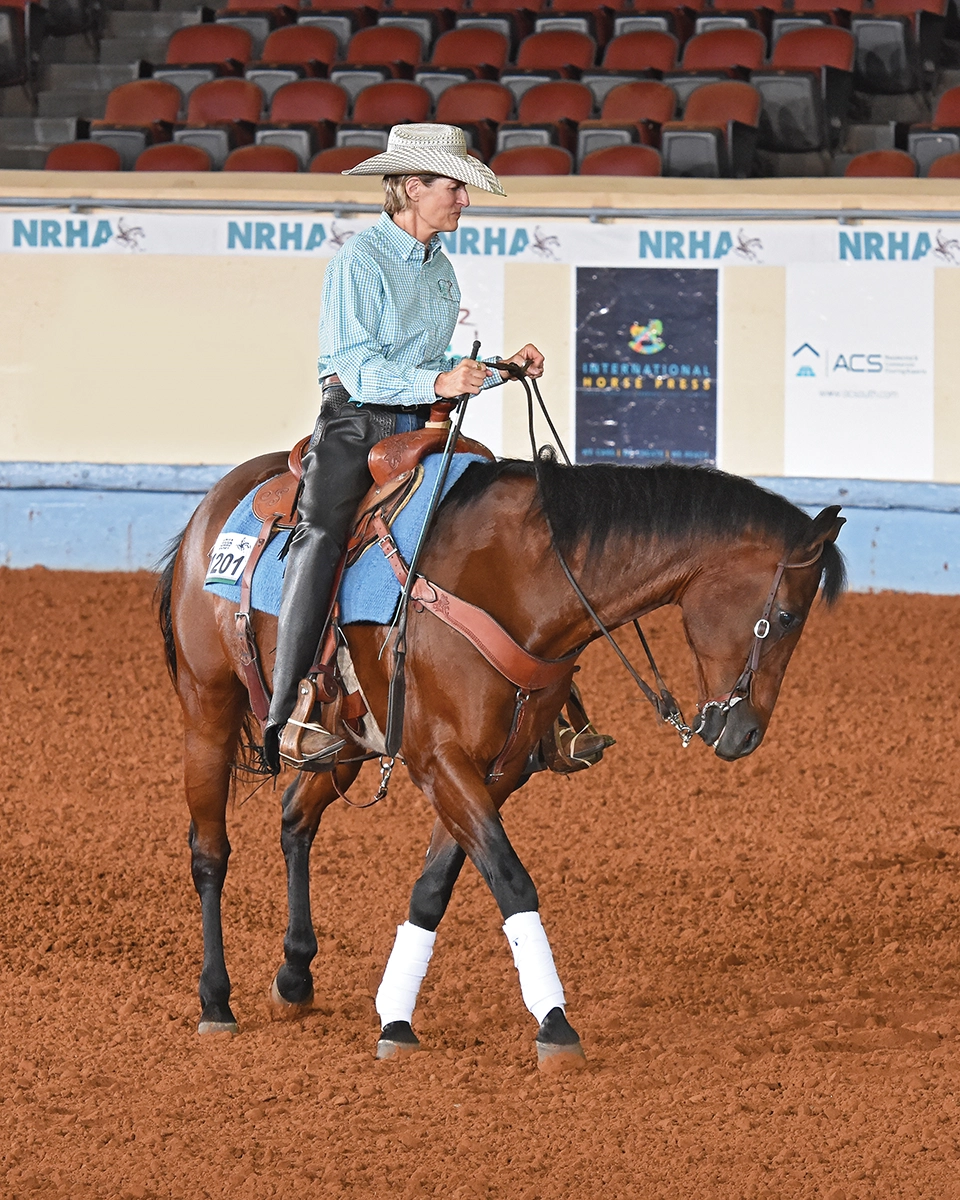
Para-Reining competitors must ride independently, but provisions such as rubber bands, safety stirrups, and more are permitted. Photo by Waltenberry
The growth of Para-Reining has been organic, thanks to the passion of the exhibitors and professionals such as Hoyt. Any NRHA show can add the classes to their show bill if there is a request, but Hoyt has seen some hesitation between show managers and trainers due to concerns for safety for the rider.
“Trainers tend to be afraid if a rider with a disability asks about lessons,” she says. “They can ask the rider what their disability is; people with disabilities aren’t afraid to tell you. You just have to find them the right horse, or adapt to how a horse is trained, or any other necessity for that rider to be successful. But our horses are fully capable of being a suitable mount for Para-Reiners.”
Jacobson agrees.
“My talented, kind horse, Shiney Juice, is my heart horse,” she says. “He’s carried me to two Para-National Reserve Championships and the Dechra Championship title in 2021.”
A Horse for Everyone
Both programs are helping open the world of horses and competition to a larger audience. Approximately 22 million adults ages 18 to 64 have a disability (according to Humanity & Inclusion), giving both EWD and Para-Reining important roles among this special sector of American horse enthusiasts.
“Equestrians With Disabilities is awesome, Para-Reining is awesome,” says Hoyt. “They’re both great offerings for people to become involved. They just need to have someone take a chance with them.”
Jacobson sees it as a huge win.
“Anytime a sport opens up to disabled athletes, [it shows] how people adapt using some modifications to live a fully engaged life and what’s possible,” she says. “The horse is the ultimate equalizer between men and women, able-bodied and para.”
Heroes on Horses ProgramThe National Snaffle Bit Association (NSBA) has since added another branch to the Equestrians With Disabilities division with the NSBA Foundation’s Heroes on Horses program. Heroes on Horses are classes in which riders who are disabled veterans or active-duty wounded warriors can compete. The one caveat is that these riders must also participate in PATH International Equine Services for Heroes or have a Department of Veteran Affairs disability rating to be eligible to compete. |