Just as you need a proper nutrition plan to be healthy, your horse also needs one to maintain his health. In order to do that, you need to know what you are feeding your horse, from grain and hay to supplements — which means you’ll need to learn how to read horse feed labels.
Nutrition labels are the key to knowing the amount of vitamins, minerals, and other nutrients you are feeding your horse. Unknowingly feeding too little—or too much—can be detrimental to your horse’s health. Since it’s important to know more about that small tab of paper for a healthier, happier horse, we’ve answered your top questions with input from two horse feed experts.
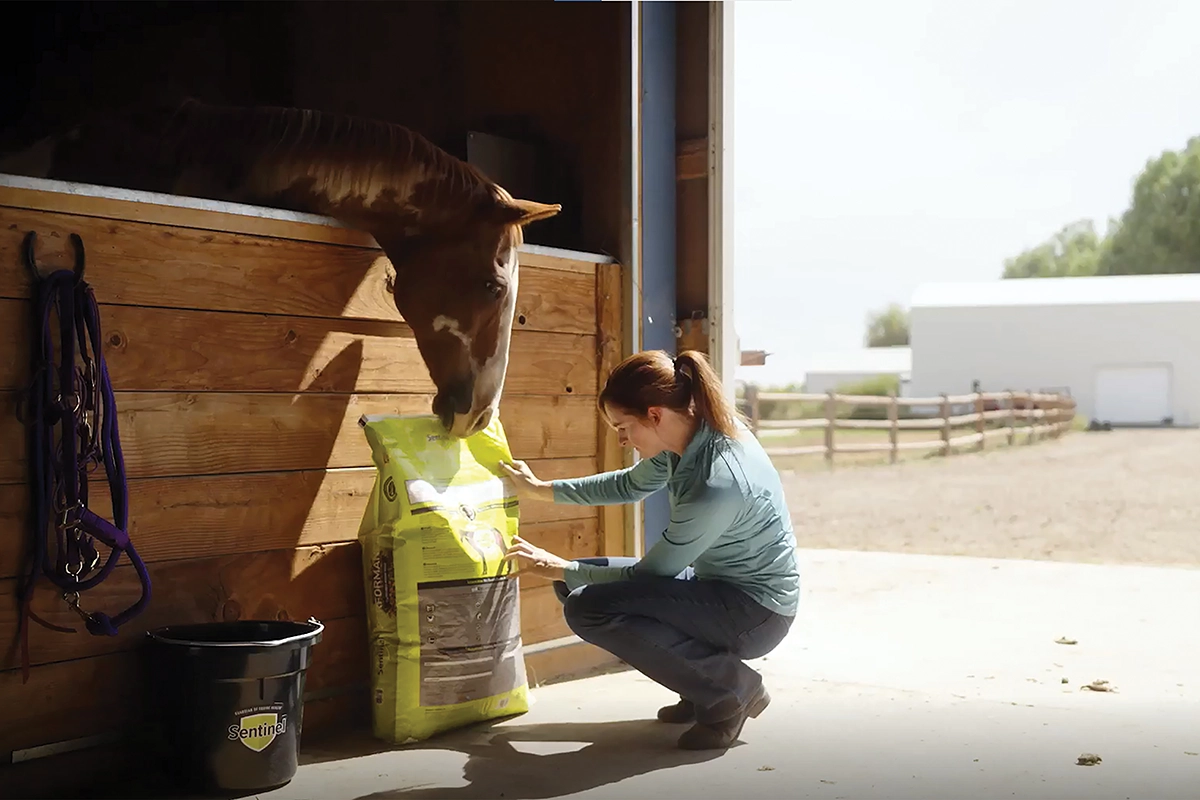
Photo by MyNewHorse.com
1. Where is the nutrition label located?
The nutrition label on bagged feeds is typically sewn on to the bottom of the bag. Another location for the label may be on the back of the bag itself. If the feed or supplement is in another type of packaging, such as a bucket, the label information is right on the bucket or tub. It may be printed on the bucket, or a sticker may be applied.
2. Do nutrition labels have regulations?
Yes, there are certain things that need to be included on the label to help horse owners make the best decisions possible. The required items include:
- Name of product, manufacturer of product, location of manufacturer.
- Guaranteed analysis of feed or supplement. For horse feed, guarantees must include crude protein, crude fat, crude fiber, acid detergent fiber (ADF), neutral detergent fiber (NDF), calcium, phosphorus, copper, zinc, selenium, and vitamin A.
- Ingredients and nutrients are expressed as a minimum or maximum noted in the Guaranteed Analysis, and do not specify an exact amount.
- Directions for feeding must be included.
- Purpose that states who the product is for.
- An ingredient listing in order of inclusion, from most to least.
3. Why is the label important?
As horse owners, we like to compare feed tags; we want to know which feed might have more or less of a certain nutrient or ingredient. However, Mieke Holder, Ph.D., senior research scientist at Alltech, reminds horse owners that it’s important to also consider the amount of grain that you need to feed, which you can usually find printed on the back of the bag.
“Taking that into consideration, together with the concentration of nutrients listed, you get a much better idea of how much your horse will be getting from each nutrient,” says Holder. “Remember, more is not always better!”
4. How can horse owners better use the nutrition label?
Experts urge owners to take a look at the ingredient list.
“The ingredient list will contain everything that is in the feed, so here you can see if it contains a yeast or enzyme or organic minerals that you may want in your feed,” says Holder. “Some owners have strong feelings about specific ingredients. For example, let’s say corn is something you don’t like your horse to eat, that will be an easy thing to look for to decide if the feed is for you or not.”
Due to regulations, some feed ingredients have to be listed in a particular way.
Kristyn Sturken, a product manager at Sentinel Horse Nutrition, reminds owners that it’s important to feed by weight, not volume, which is noted on the label.
“A scoop of pellets weighs differently than a scoop of extruded feed or textured feed,” she cautions. “In addition, feeding recommendations and feeding rates should be used as a guideline and sometimes are in ranges. All horses are different and require different amounts of grain.”
5. Are there regulations in place for manufacturing feed?
Yes. In terms of regulations and the manufacturing process, there are “good manufacturing practices” published by the Code of Federal Regulations. These are in place for all facilities that manufacture, process and package commercial animal feeds.
These facilities are inspected to ensure that they comply, and samples of feeds are also taken during these inspections. These samples are then tested to determine if they meet the specifications printed on the feed label.
There are different certifications manufacturing plants can obtain. For example, horses are very sensitive to ionophores, a class of antibiotic-like compounds that do not include drugs that are medically important for humans and can be found in beef cattle feed.
Holder says it’s therefore preferred to have horse feed products manufactured in antibiotic/medication-free facilities. However, if unavoidable, multi-species production facilities that make medicated feeds need to have strict protocols in place to ensure absolute safety.
6. What else should horse owners be aware of?
“There are many things you can learn about a product by studying the label,” says Sturken. “A fixed-ingredient formula uses a particular set of quality ingredients limited to a precise range to ensure the product always meets nutrient specifications while providing a consistent diet supporting healthy digestive function.
“In a fixed-ingredient formula, you’ll typically see specific ingredient names (alfalfa meal, oats, soybean hulls), ensuring your horse is getting consistent feed bag after bag. Least-cost formulas typically use non-specific grouped ingredient names (grain products, plant products, grain by-products), and the order of the ingredients tends to change.”
Other questions you should ask when reading the feed label:
- Does the feed incorporate specialty ingredients like prebiotics, probiotics, omega-3 fatty acids, marine-sourced calcium, and other premium ingredients?
- Does the feed use complexed or chelated minerals that are more bioavailable? You can identify these organic sources of minerals that have been bonded to an amino acid by looking at the ingredients and looking for proteinates or amino acid complexes such as “zinc amino acid complex.”
If you have any questions, don’t hesitate to ask the people working at the feed store or contact the manufacturer. Discussing your nutritional plans for your horse with your veterinarian or nutritionist will help you move a step in the right direction for your horse’s health.
This article about how to read horse feed labels appeared in the July/August 2025 issue of Horse Illustrated magazine. Click here to subscribe!