Imagine you just purchased a brand-new truck. It’s shiny. It has that beautiful new car smell. It even turns on and accelerates great! The only problem is the braking system is inconsistent. Sometimes it slows down and stops just fine, but not when the environment is energetic, it’s away from its buddies, or something is spooky.
It sounds ridiculous. But consider for a moment: Could we be describing your horse?
Of course, you wouldn’t drive a truck whose brakes are malfunctioning. Similarly, you shouldn’t ride a horse who relies on the reins to stop. Read that again. It’s the relying on the reins to stop that’s the problem. Horses are masters at reading and understanding body language. If phases of energy can create forward motion, then a change in energy can also mean “slow down and stop.”
To put it bluntly, relying solely on pulling the reins to stop a horse is dangerous and ineffective. In my previous article, I taught that one of the greatest keys to riding success is to replace kicking to go forward with fair and effective phases of pressure in your body language and in your legs.
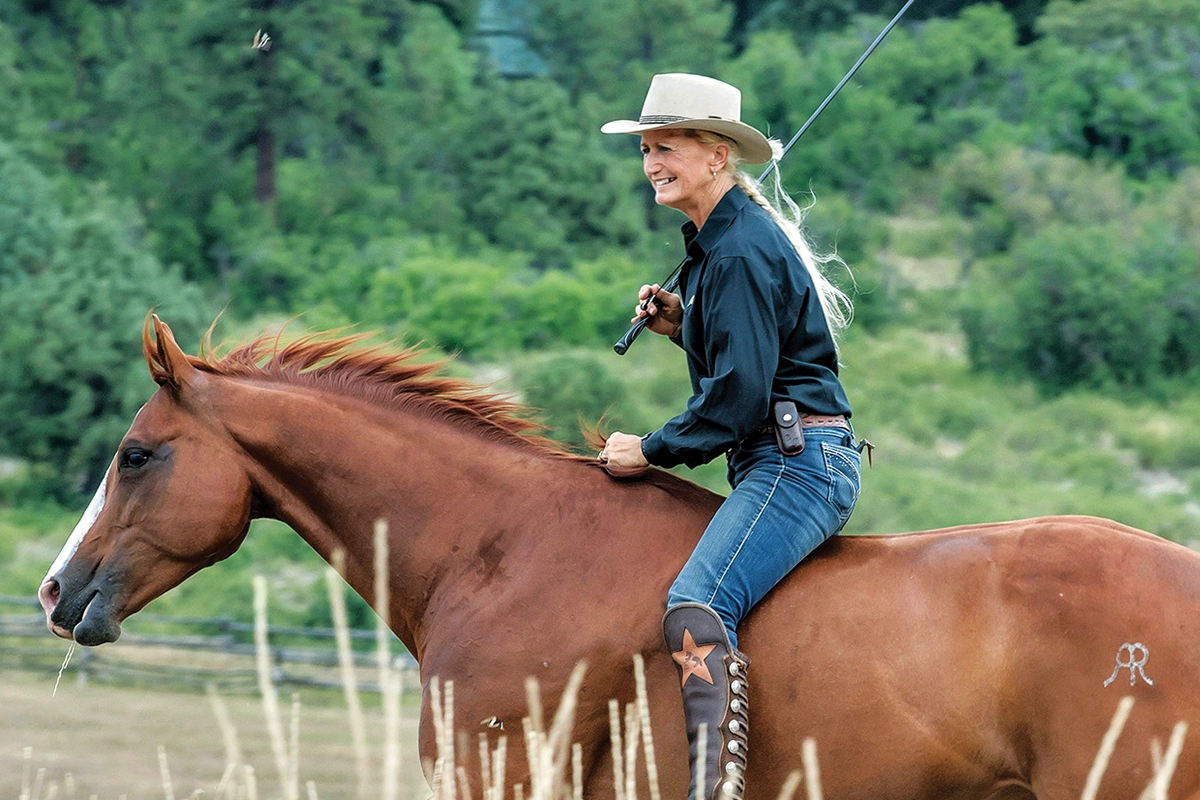
If it works for acceleration, it should also work for deceleration.
Energy and life up in our body means go forward—so taking the life away or slowing down our energy can cause a horse to slow down, naturally.
This works with horses because it works for them in nature. Horses are born innately knowing to synchronize with their mamas. When mama moves, the baby better get up and run. When mama stops, the baby learns to mirror her energy and slow down, too.
To ensure our horses recognize this communication in our world as well, we must first establish this synchronization on the ground. This reinforces our role as leaders and simplifies the transition to the saddle. By teaching the horse to mirror our energy, first on the ground and then riding, the reins become the final phase of the stop, only if needed, rather than the primary means of control.
This shift in sequence allows the reins to become so much more about communication than about control. When we put a bit in our horse’s mouth and begin to communicate with him in that zone of his body, it becomes what the great dressage master Walter Zettl taught me to call “a matter of trust.”
Teaching your horse to respond to your seat and energy first creates true understanding and a soft, balanced stop. This leaves the reins available as a communication tool to shape the horse and refine—rather than just control—the movement. Sequence is the secret: Synchronize on the ground, carry that harmony into the saddle, and for the safety of both horse and rider, always check your “brakes” before heading out on your ride.
Our goal is to teach you how to train your horse safely and effectively at home so that both you and your horse can have more fun and achieve excellence together, creating a true partnership based on trust and mutual understanding
Learn more about our digital home-study curriculum, the Levels Program, at Parelli.com and take your riding to the next level of communication and understanding.
Pat Parelli’s Horsemanship Myth Series
◆ Debunking 5 Common Horsemanship Myths
◆ Horsemanship Myth 1: “Catch your horse any way you can.”
◆ Horsemanship Myth 2: “Saddle them up and get on.”
◆ Horsemanship Myth 3: “Kick them to go.”
◆ Horsemanship Myth 4: “Pull them to stop.”
This article appeared in the September/October 2026 issue of Horse Illustrated magazine. Click here to subscribe!