When you think “farrier,” you probably immediately imagine a man. However, times are changing, as more and more women have decided to pursue this physically demanding career path in a notably male-dominated field. But there is a lot of art and science to balancing and supporting hooves and getting horses to perform with maximum comfort, and women are now excelling in this field in higher numbers.
According to the 2024 American Farriers Journal Business Practice Survey, one in five farriers is female, an 8 percent increase from 2021. Also, the median age of full-time horseshoers—both men and women—is nearly a decade younger than in 2021, meaning many have recently retired, creating a strong need in this field for new young farriers.
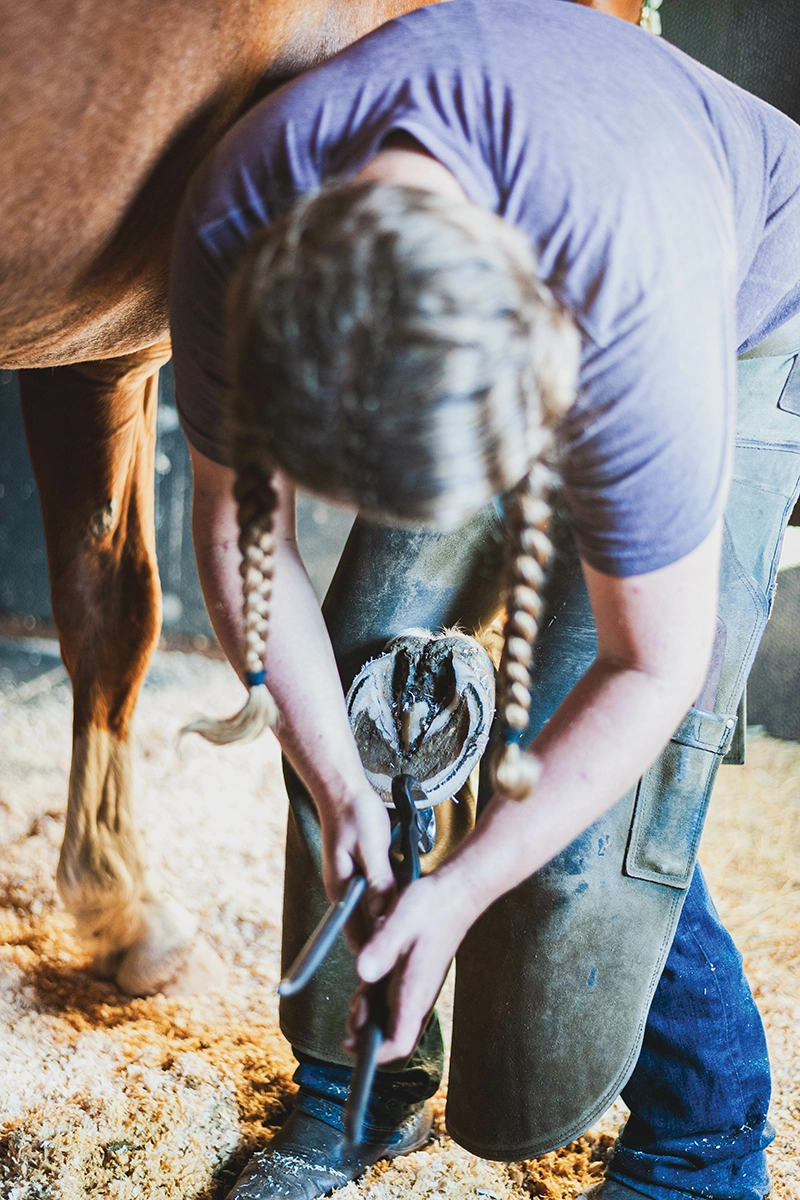
Female farriers are starting to enter the profession in droves. In recent farrier courses, 50 percent or more of enrollees were women. Photo by Dustin/Adobe Stock
The commitment to education, business acumen, and skilled horsemanship of women farriers is leaving an indelible mark on more than horse hooves. Indeed, the grit, skill, and passion they bring to the industry craft a new narrative in this profession.
Pony Club Roots
Sarah Coltrin’s membership in the St. James Pony Club, beginning at age 10, laid the groundwork for her knowledge and commitment to well-rounded horsemanship. She fell in love with eventing, but recognized that becoming a professional rider would be tough.
Though she had imagined a career as a veterinarian, Coltrin learned that handling competition schedules with the rigors and realities of the profession was unrealistic. A campus tour of Iowa State University confirmed that the traditional college path and dormitory life weren’t for her either.
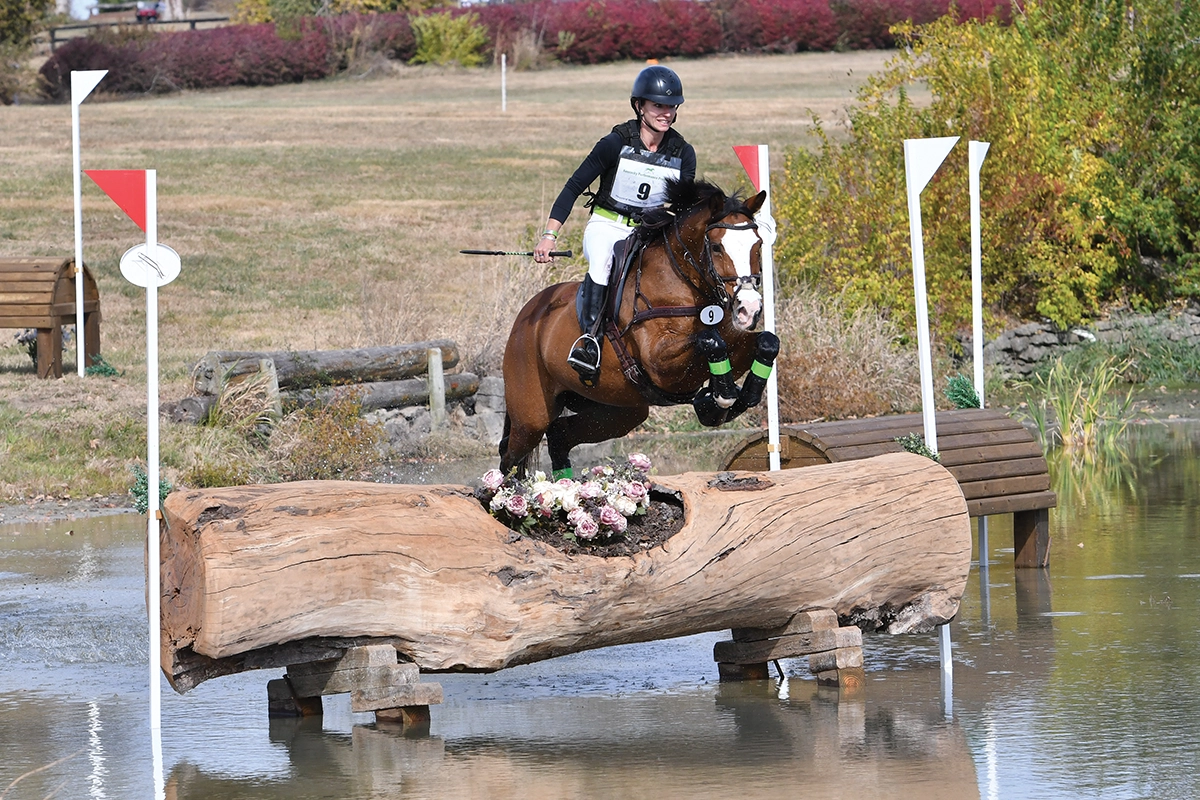
Sarah Coltrin grew up in Pony Club and wanted to continue competing in eventing while pursuing a career with hands-on horsemanship. Photo courtesy Sarah Coltrin
Growing up on a farm, Coltrin craved an outdoor lifestyle and a career that integrated her two goals of competition and working with horses. The family’s farrier taught her how to trim hooves, leading her to investigate schools.
She graduated from high school early and set off for Midwest Horseshoeing School, now owned by the University of Illinois-Urbana Champaign. Coltrin graduated from the 16-week program before the ink dried on her high school classmates’ diplomas.
A two-year apprenticeship with Alan Dryg followed before she decided to strike out on her own.
“Pony Club was a huge benefit for me in horseshoeing school,” she recalls. “I already knew all the anatomy and was very comfortable taking tests and speaking in front of classes.”
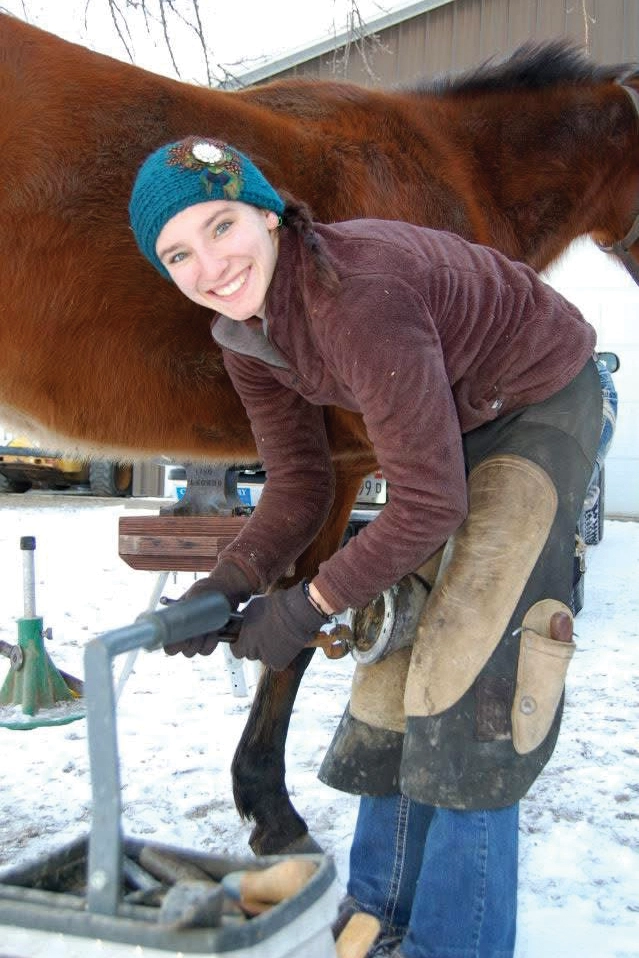
Rain or shine, snow or heat, Sarah Coltrin works in all kinds of weather. Photo courtesy Sarah Coltrin
To become a certified farrier, Coltrin was required to pass a written test, demonstrate her forging skills, and shoe a horse in front of American Farriers Association examiners.
Pursuing educational advancement is a factor in Coltrin’s success, too. Noting that the structure of the American Farriers Association programming mirrored that of Pony Club, Coltrin thrived, passing the AFA Certified Farrier test two weeks after completing the Midwest program and starting her career as a farrier.
“The International Hoof Care Summit is such a benefit. I learn a ton with all the classroom work and the seminars. It’s an advantage, too, because so often we work alone. I follow different farriers on social media. If there’s a CF (certified farrier) after their name, or I’ve seen their work, I add them as friends. It creates a good network,” Coltrin states.
Learning and Teaching
Born in Costa Rica and raised in Switzerland, farrier Amanda Smith (now based in Sacramento, Calif.) comes from a family of equestrians. When she moved to the United States, she pursued an undergraduate degree in agricultural business management and earned additional certification in equine behavior.
“I started working as a behavior specialist, but found the environment too depressing,” says Smith. “While working at a large equine rescue, I met their local farrier, who mentioned that in this country, you can attend farrier schools that are only a few months long. In Switzerland, becoming a farrier requires a multiple-year apprenticeship. That pushed me to change careers and move from the behavior science side of things to becoming a farrier.”
Smith attended the Pacific Coast Horseshoeing School in Plymouth, Calif. (outside of Sacramento) before launching her career. Building a client list of 250 horses, Smith scaled back when she began teaching at her alma mater.
“I love studying and the academic side of things,” she says. “That’s why I enjoy teaching. Our school covers anatomy, conformation, and lameness as the foundation for all our decisions as farriers. The trim and the shoe must be based on the anatomical and mechanical understanding of the foot. You can’t make the right decisions if you lack academic knowledge.”
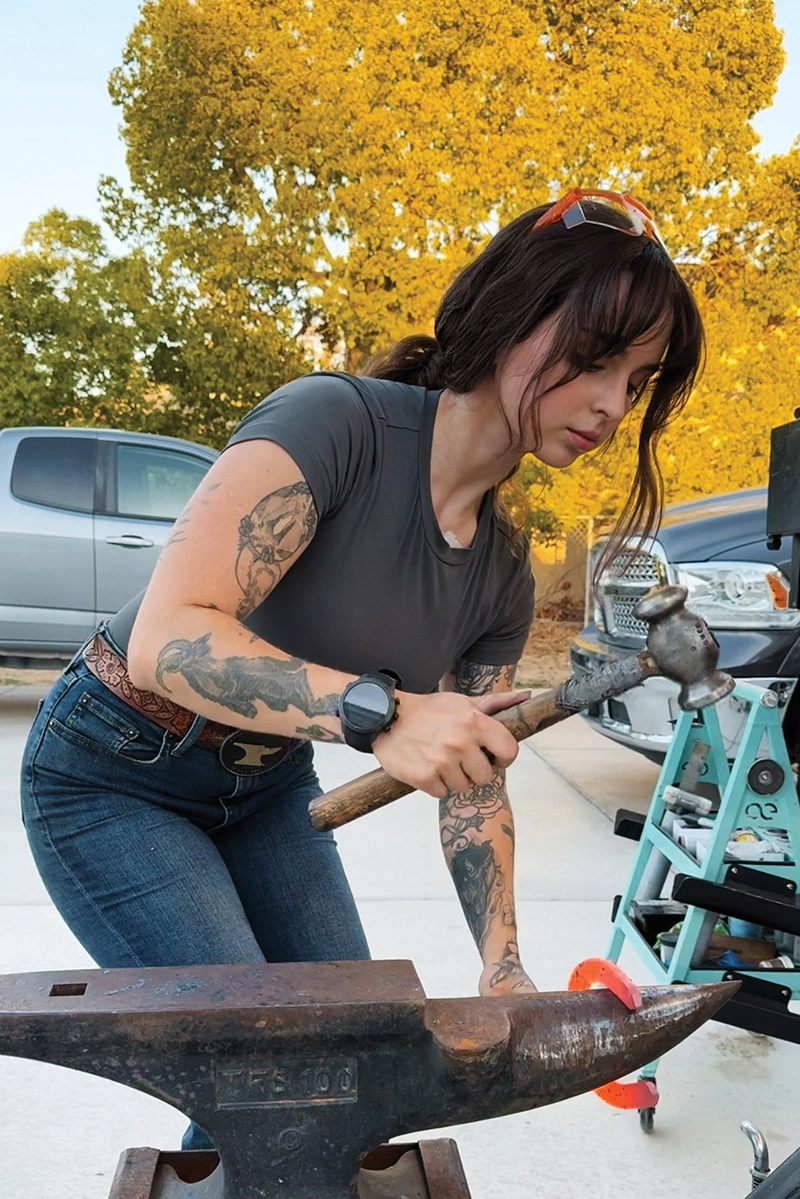
Amanda Smith brings her knowledge and skill on the job to the classroom four days a week. Photo courtesy Amanda Smith
The pool of students Smith teaches may already run their own business, express an interest in the academic curriculum, or be new to horseshoeing. All students, regardless of their background, complete the eight-week program. In every class Smith teaches, half of the students are women.
“An average day at the school starts in the morning with two to three hours of classroom time,” she explains. “We may go on a field trip, trim and shoe horses, or spend time in the forge in the afternoon. Students learn how to modify shoes, shape pre-made shoes, or hand-make a particular kind of shoe that requires more skill.”
A self-described bookworm, Smith encourages the students she teaches to join and be active in professional associations for horseshoers.
“We are a non-regulated industry,” she says. “It’s up to us as professionals to take control of our education, have pride in our work, and improve. Association membership keeps you accountable, helps you set goals, and keeps you motivated. By participating in these environments, you create a community. You meet people who are better than you and can inspire and work with you. Everybody who joins these associations is like-minded.”
A Mind for Business
Longevity as a farrier requires more than knowing how to shape a shoe, according to Lexington, Ky., farrier Sarah Azbill.
“I was one of 14 in the last graduating class at Oklahoma Farriers College,” she says. “Out of the 14, I am the only one still practicing.”
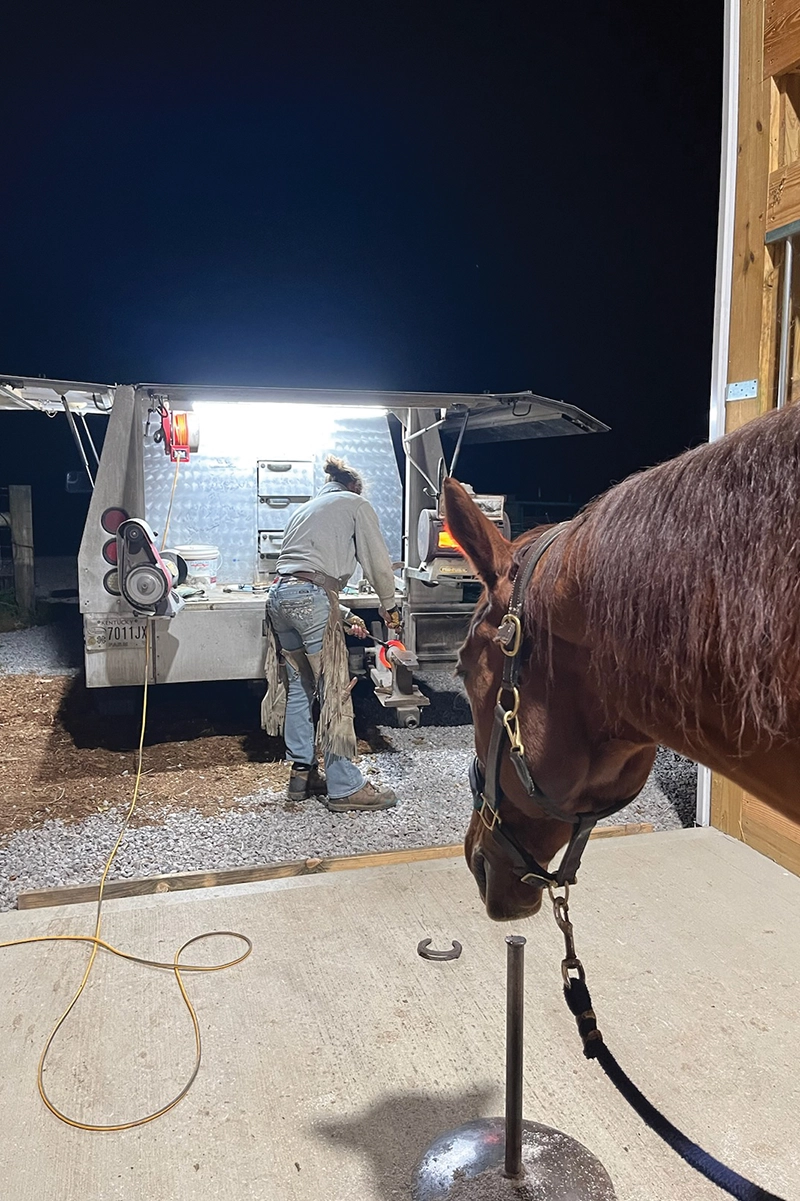
Putting in the hours long into the evening defines a farrier like Sarah Azbill’s job. Photo courtesy Sarah Azbill
In addition to earning a master’s degree in Farrier Science, Azbill holds a bachelor’s degree in Equine Science from Michigan State University. Her client list in the bluegrass country of Kentucky numbers 400 to 500 horses every six weeks, including eventers, FEI driving and endurance horses, and Grand Prix jumpers.
However, 26 years of working as a farrier have taught her more than how to trim a foot and hammer a shoe.
“In school, you’re not prepped on establishing your business and having enough capital to run it,” she cautions. “You must figure out how to schedule clients and manage your income and expenses. It’s a feast or famine industry. Everyone gets their horses done in spring because they go to horse shows and trail rides. That’s your feast. During the winter, riders will go down to Aiken or Ocala. That’s your famine. You must know how to budget your money.”
Coltrin agrees that good scheduling is crucial for maintaining a consistent income and a thriving business.
“I always make sure that I look ahead at my shoeing and show schedules,” she says. “That way, I can say that in this six-week period, I’m leaving on Thursday to go to a horse show, which means I’ll either have to move a client up one week or back a week. I never leave an appointment without making the next appointment.”
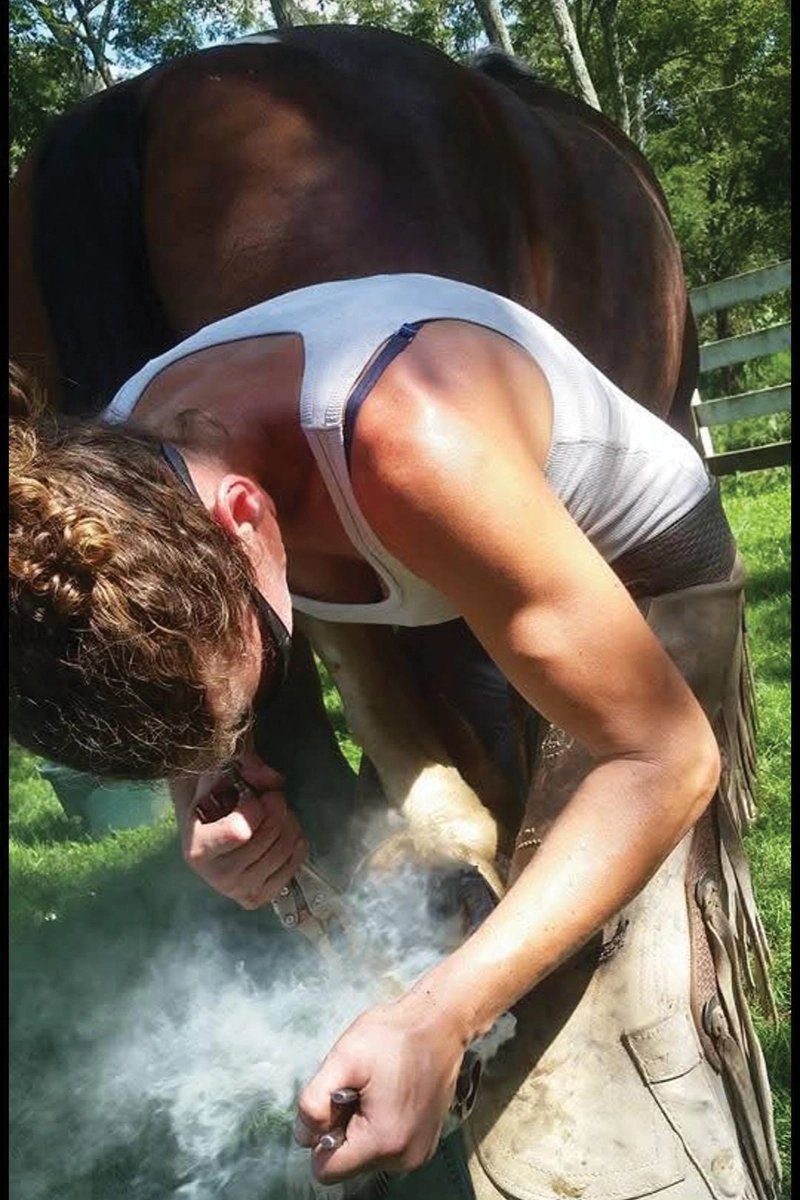
Sarah Azbill can take the heat of her grueling schedule. Photo courtesy Sarah Azbill
Coltrin suggests that the drive for instant gratification also affects a shoer’s long-term success.
“In today’s day and age, there’s a lot of job hopping,” she says. “When new farriers don’t make money or build their clientele quickly, they quit. Once they’re out on their own, it’s hard work. It’s hard to go shoe horses when it’s 10 degrees and snowing, or when it’s 90 degrees and the sun is baking. You must be determined to go out and do the job every day.”
Modeling Good Horsemanship
According to Azbill, skilled horsemanship creates a work environment where horses and humans are respected. Any horse handler, including an owner lacking proficient horsemanship, compromises safety.
“We don’t have skilled owners anymore,” she says. “I grew up in a training barn. You learned how to work with horses, train them properly, and when to reward behavior. People don’t understand why their horse is biting them or square dancing in the cross-ties. Nothing gets me more fired up than when someone is on their cell phone when they should be holding their horse. I might be working on a hind foot, and if someone bumps into the horse, I might be blasted into the next county. I have a firm rule with my clients. They haven’t earned their shoes if their horse isn’t trained to stand for the farrier.”
Coltrin also fears the waning of good horsemanship, partly because of time-pressed and distracted owners.
“So many horses are in commercial boarding barns, and their care is left to whoever’s managing the facility,” she says. “I see horses rubbing their tails or trying to find relief in the hind end. The number of horses I work with who have sore hamstrings and hip flexors is incredible. The majority of these problems come from spending too much time in stalls. When you spend time with your horse, you learn their body language and when they are uncomfortable.”
Coltrin believes this lack of owner interaction negatively impacts a horse’s behavior.
“They don’t see if their horse stands well for the farrier,” she says. “I’ve had nails put through my leg and fingers. I’ve been bitten. I’ve been kicked. None of this is appropriate behavior, whether from a horse’s pain or how an owner treats them. I’m at a point where I want well-behaved horses.”
According to Smith, good horsemanship will allow her to become an old farrier who can still stand up straight. Farriers also have an old saying: There are only so many horses you can crawl under in your lifetime.
“You want your last horse to be the one you choose,” she says. “Not because your back gave out, or because you were injured. My background in equine behavior allows me to be safe and approach horses in a way that doesn’t exacerbate the animal’s physical or psychological issues. Safety ensures the longevity of my career.”
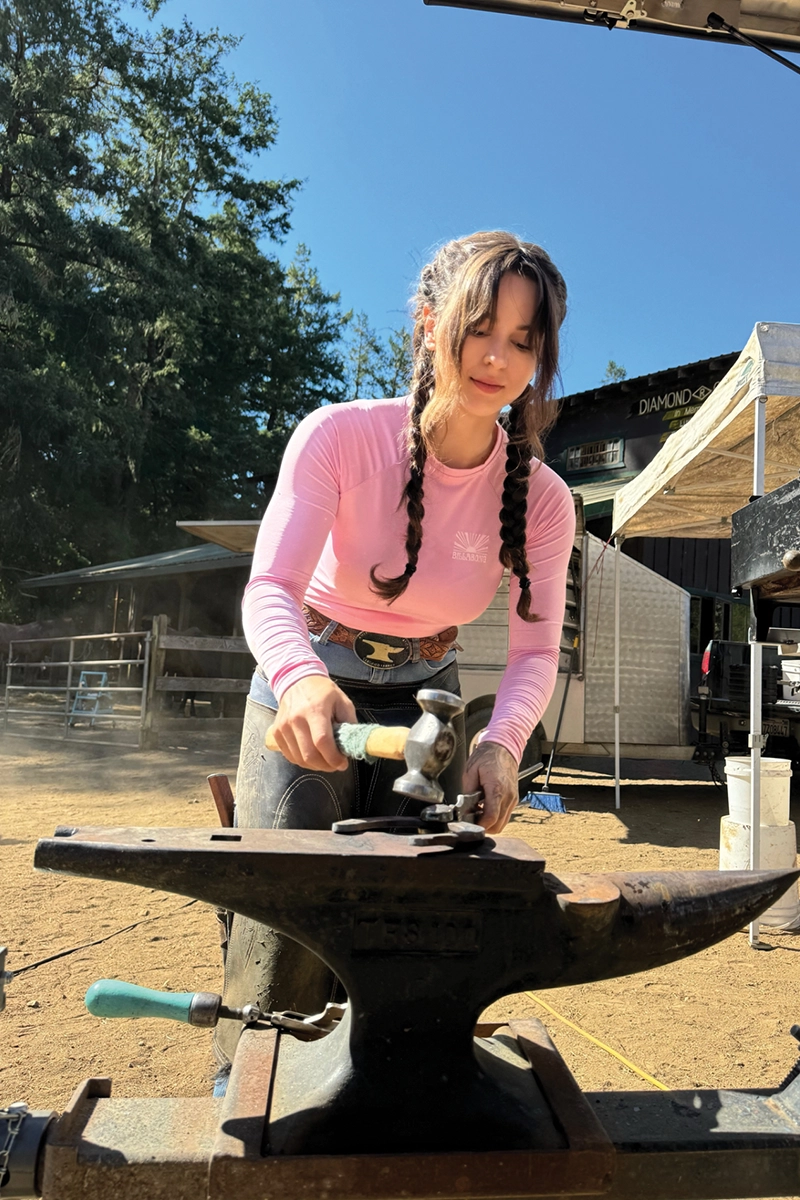
Good horsemanship and skill mean longevity as a farrier in Amanda Smith’s view. Photo courtesy Amanda Smith
Pros and Cons of the Career
While farriers face demanding hours, challenging clients (both human and equine), and financial ups and downs, they also have rewarding careers with freedom, flexibility, and job satisfaction.
“I can’t imagine a better life than the life of a farrier,” says Smith. “I’ve had other jobs. I’ve worked in a factory and retail. My career as a farrier has granted me a freedom that is very difficult to come by in today’s world. I don’t have a boss telling me what to do. I can make my own schedule. I can make as little or as much money as I want for the day. I work seven days a week between teaching and shoeing.”
As a mother of two teenage girls, Azbill also cautions that lifestyle compromises exist. Striking a harmonious balance between work and family life is possible, but understanding the challenges of juggling crazy schedules and soccer games requires discipline and a healthy dose of humor.
A Changing Landscape
While Smith acknowledges past barriers may still exist, farriers should be hired based on their work and horsemanship skills.
“In a class I teach, there are nine women and four men,” she says. “I see more women entering the industry.”
Smith suggests that being a woman may also be an advantage. Client perceptions that women are kinder and gentler toward horses and exhibit better horsemanship influences their hiring decisions.
“Many people hire me because they are looking for a female farrier,” she says.
This article about female farriers appeared in the September/October 2025 issue of Horse Illustrated magazine. Click here to subscribe!