
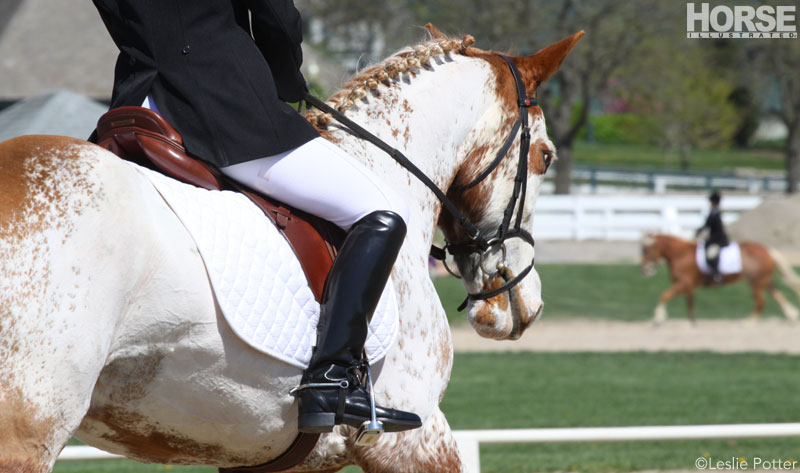
Q. I’m just getting started in the lower levels of eventing and am wondering about the best saddle to buy for the sport. Do I really need two or three different saddles, or can I get by with one for now?
A. Lower-level event riders commonly compete with one saddle. I’d suggest using a deep-seated jumping saddle. For eventing’s first three levels—Beginner Novice through Training—one saddle will work just fine for all three required disciplines. It’s true that many upper-level eventers choose to own two jumping saddles: a padded saddle with an extra-forward flap for cross-country, and a traditional close-contact saddle for show jumping. The demands of a dressage test in the upper levels of eventing, which corresponds to the United States Dressage Federation’s Second and Third-Level tests, also make a dressage saddle a practical necessity.
However, dressage tests for lower-level eventers don’t require sitting trot, so you can manage quite comfortably in a jumping saddle. Although cross-country courses offer appropriate challenges at each level, Beginner Novice through Training level tracks are relatively straightforward and lack the steep drop jumps and high speeds you’d need a cross-country saddle for.
Choose a deep-seated jumping saddle with some padding or cushioning in the knee rolls or flaps. The deep seat will allow you to sit correctly for dressage. The forward flap, deeper seat and cushioning affords more cross-country stability than a flat-seated close contact saddle. Even at Training level the show jumping fences reach only 3’3” so a deep-seated jumping saddle allows you to stay light enough in the tack to achieve a clear round.
Steer clear of the so-called “all-purpose” saddles. These hybrids offer a straight flap that, although useful for dressage, prevents the closed hip-to-knee angle you need for cross-country jumping, since you’ll ride with a shorter stirrup for this phase. The straight flap also impairs your upper body balance for jumping.
Liked this article? Here are others you’ll enjoy:
Entry-Level Eventing
Eventing Topiclist
Annie Eldridge is an event rider who trains out of her Setters’ Run Farm in Duxbury, Mass., and is one of HI’s regular English Training Talk columnists.


That was something I didn’t know!
I would suggest a Hoy eventing saddles or a southern stars evnt saddle.
Thanks