
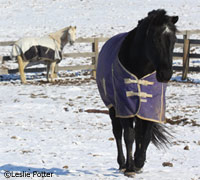
 Riding in the snow can present shoeing challenges. What shoes, if any, you choose for your horse is a decision made with your farrier. But if you’re looking at options, consider these tips from Dallas Morgan, a Certified Journeyman Farrier and Diplomate of the Worshipful Company of Farriers (a U.K. certification), who has practiced farriery around the world, including a 6-year-stint as attending farrier at Kansas State University College of Veterinary Medicine. He now operates out of Morgan Equine Veterinary & Farrier Hospital in Locke, N.Y., which is headed by his wife, Jessica, a DVM.
Dallas says that a standard keg shoe with a crease (where the nails go) is an option, but concave is better. The concave inside rim is slightly more angled and shallow, forming a “cup” that releases the snow.
Snowball pads are a good choice too. One type is a pad with an outward bulging bubble in the center that expands and contracts as the hoof sets down. “It’s good for a horse with a thin sole, but be sure there is good quality hoof packing under the pad to keep mud out,” Dallas warns. Another type is a snow rim pad that leaves the sole open and incorporates a hollow inner tube that expands and contracts as the hoof hits the ground. Dallas cautions that the ends of the inner tube may need to be capped, so they don’t fill with water and freeze. If they freeze it creates sole pressure and may bruise the soles, he says.
Studs can provide traction in slippery footing. Stud types include drive-ins, which are good for smoother riding conditions, and road pins, for slick concrete and roads. Screw-in studs work well too, but aren’t as user friendly in Dallas’ opinion.
Borium (a metal alloy) can be applied to horseshoes to roughen the surface for improved grip, but Dallas says the application requires a very competent farrier. “Borium is difficult to apply evenly and, even when done correctly, can inhibit breakover, which is very hard on joints, tendons and ligaments.”
Other options? Dallas explains that regular flat pads are better than nothing, and barefoot can be a very good option for some horses.


Barefoot sounds the best if your horse has a good food.
If snow packs into your horse’s hooves try smearing the bottom with petroleum jelly.
Good article. Most of our horses go barefoot year-round.
We use borium to add traction on the icy roads.