
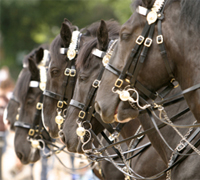
 Parades are exciting. Children are delighted at all the sights, sounds, and the opportunity to do something different. Parents are lulled into peaceful reverie by the distraction the winding procession creates for their offspring. Organizers are frazzled by the last minute changes, conflicts, and inevitable problems. Participants, both human and animal, are energized and sometimes agitated by the crowd, noises, and unexpected events.
It is vitally important that coordinators have an understanding of basic horse behavior and techniques to minimize the stress on equine participants. The KHC guidelines for parade organizers and equine parade entries can be a starting point for successful integration of horses, riders, and drivers into parades but are not a substitute for the exercise of reasonable care.
Event organizers should be mindful to design parade routes and organize participants so that the animals in the parade are as far as possible from the bands, fire trucks, and other extremely noisy and quickly moving entrants.
The Kentucky Horse Council recommends all equine parade entries be accompanied by side walkers, at least one per every four horses and one for every carriage or hitch. The side walker is placed between the horse and the spectators, so that they can intercede if a horse acts up, in an act to protect spectators. Side walkers should be supplied by the equine participants, not the parade management. The side walker is a qualified horse handler, assigned to specific horses and responsible for monitoring safety. Special attention should be given to safe tack and handling equipment.
“Horses continue to be an exciting component of parades, and the public, adults and children alike, look forward to seeing equine entries. Advanced communication and pre-planning are keys to ensuring that everyone is safe while enjoying horses in a parade,” emphasized Madelyn Millard, KHC Board President. “Simple considerations and accommodations can make a world of difference in the parade experience for planners, participants, and the public.
A webpage dedicated to information on equine parade protocol is available from the Kentucky Horse Council at www.kentuckyhorse.org/parade/. The KHC guidelines are recommendations only and may not be appropriate for all events. Parade hosts must comply with all applicable government regulations, should always purchase event liability insurance, and should follow all event protocols required by their insurance carriers.
Liked this article? Here’s more on horses and parades:
Video: Horse Parade
Parade Primping


I didn’t know that..
Never been in a parade with my horse, but I would love to.
Look at those beauties.