The Mongol Derby—the longest horse race in the world—is undeniably an adventure of a lifetime. Riders cover over 1,000 kilometers as they gallop across the Mongolian steppe, changing steeds every 40 km, relying on sheer determination, riding skills, and a GPS navigator to cover the remote course.
The Gaucho Derby—deemed the “greatest test of horsemanship on Earth”—challenges riders’ wilderness survival and navigational skills as they race through of a network of estancias in the wilds of Patagonia (not to mention the test of camping outside each night).
And for those brave enough to attempt it, these races are life-changing.
How Jessie Dowling’s Derby Preparation Began
In 2022, 40-year-old Jessie Dowling, an industrious cheesemaker and dairy farmer in Whitefield, Maine, was listening to a podcast while milking sheep and goats—unaware that soon she would embark on her own life-changing adventure, competing in the 2023 Mongol Derby.
As president of the Maine Cheese Guild and owner of Fuzzy Udder Creamery, Dowling’s schedule was grueling. The pandemic forced her to think about where her life was going as a farmer and her happiness. She began spending more time with her horses—riding, training, attending clinics—and listening to podcasts.
“I had heard of the Mongol Derby but thought it was for professional riders—I’m a backyard rider” Dowling says. “But on Warwick Schiller’s podcast, Stevie Delahunt talked about signing up for her Mongol Derby boot camp in Oregon—and I decided to do it.”
Dowling applied for the Mongol Derby, trained with endurance riders in Maine, completed her first limited-distance ride in 2022, and interviewed for the Mongol Derby the following day. “I told them I completed my first distance ride, was signed up for the Mongol boot camp, and they said I was in.”
“I had zero endurance riding experience,” Dowling says. “I arrive at boot camp in Oregon; Warwick Schiller is there training for the Gaucho Derby. I went from listening to his podcasts in my milking parlor to riding Arabians with him.”
Falling in love with Arabians in the process, Dowling immediately acquired an Arabian gelding, Jelly Bean, as her new Mongol Derby training partner. “He has taught me so much about staying present, reading a horse’s energy, and regulating my energy.”
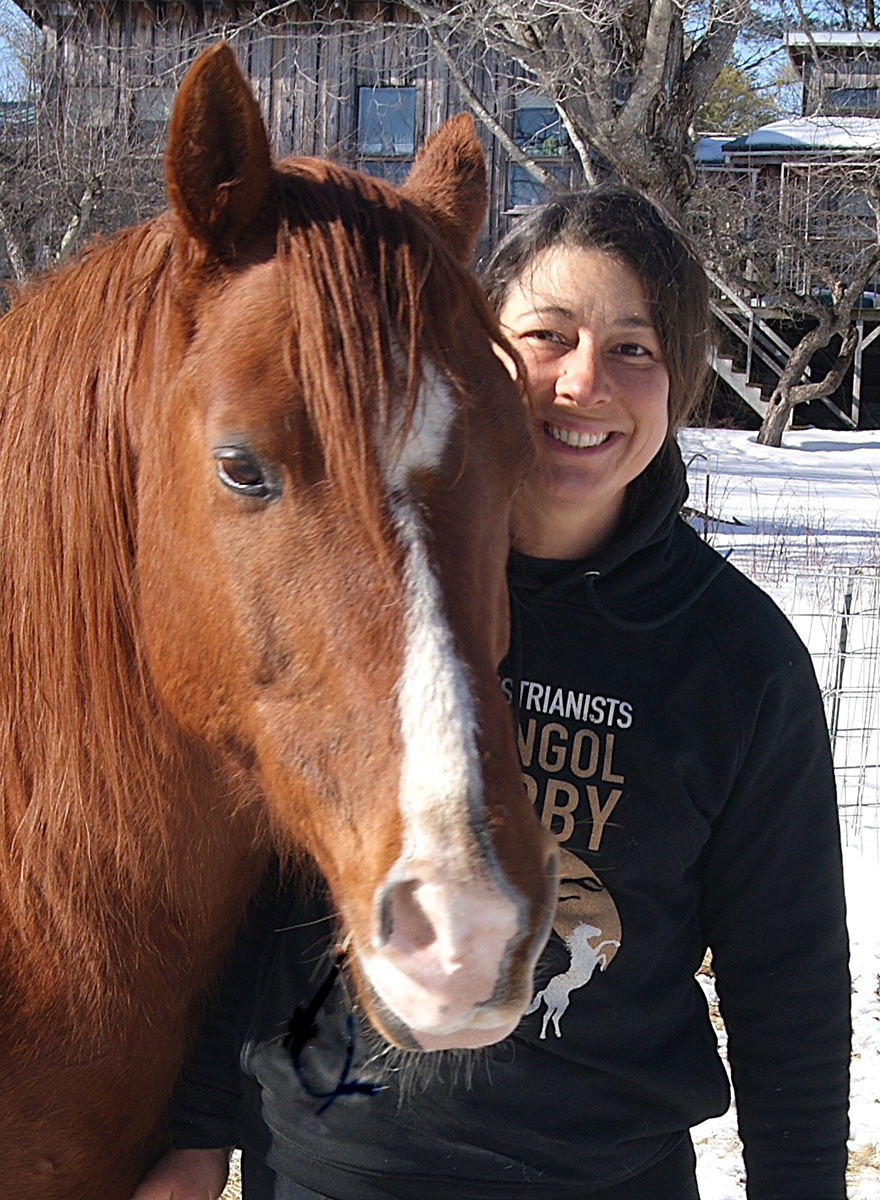
Jessie Dowling and Jelly Bean. Photo by Julie Maddock
Her year-long Derby preparation included running, yoga, completing farm chores wearing a hydration pack, using a balance board to strengthen muscles, and a three-day intensive riding clinic with Solange Ellis. “She totally changed how I ride with biomechanic adjustments—sitting a gallop and riding in stable positions for long periods.”
The Mongolian steppe is covered with little marmot holes. “I learned how to sit back as the horse falls into a marmot hole, picks themselves up, and keeps going,” Dowling says. She also learned to ride Western and fast over all terrain. “You’re galloping for miles at a time.”
In addition to improving these various riding skills, Dowling took Mongolian language lessons and carefully planned her gear.
“You’re only allowed 11 pounds,” Dowling says. “I had a little saddle bag, a hydration pack, med kit, water purification tablets, snacks, two sets of clothes, rain gear, and comfortable hiking shoes.” She traveled to Mongolia and arrived at the starting line.
The Adventure Begins
“On an average day, the topography changes a lot—mountains, lakes, rivers, rolling hills, grasslands,” Dowling says. “You pass freely roaming cows, sheep, goats, horses, a herd of camels.”
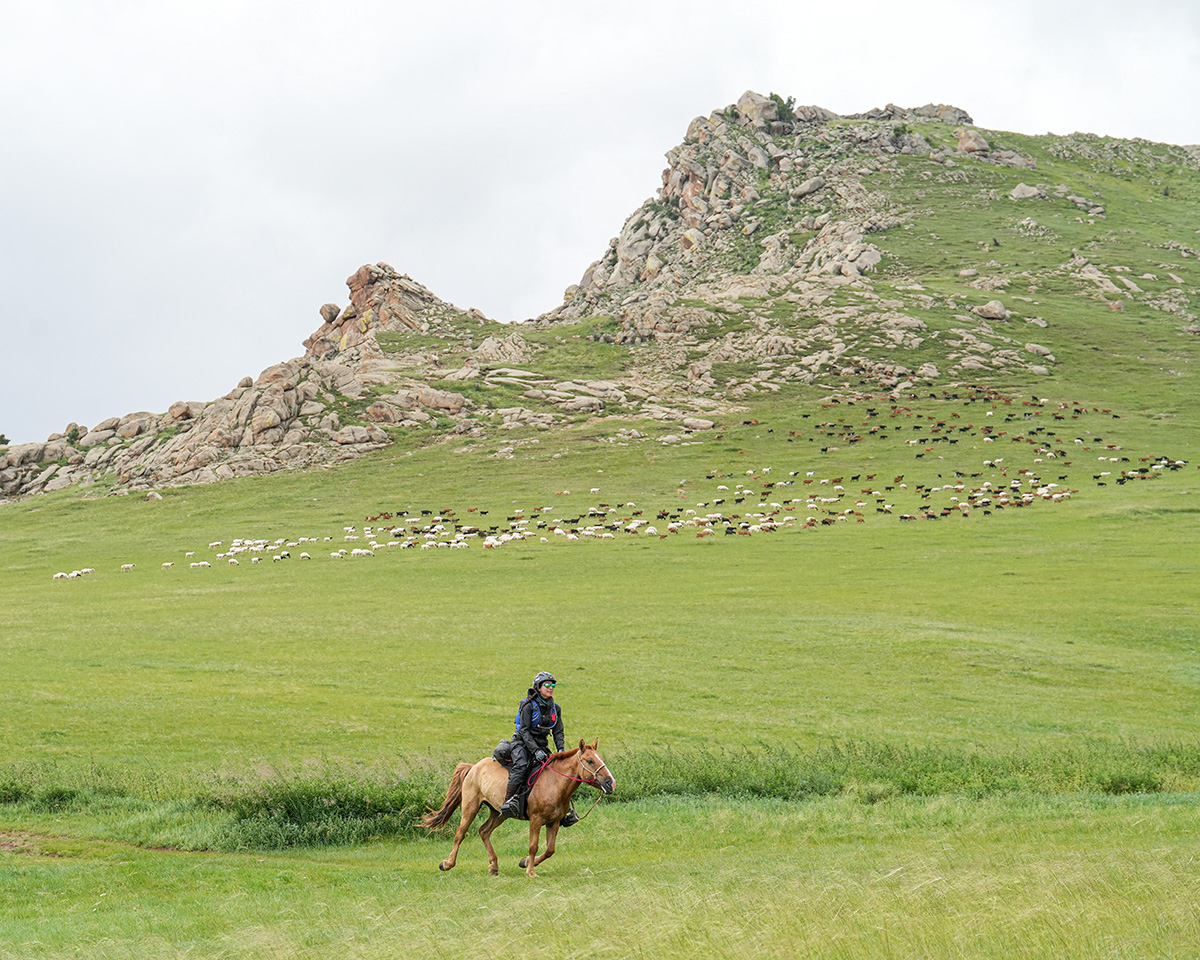
Dowling gallops past a herd of sheep and goats. Photo courtesy The Equestrianists
Riding 12 hours a day works up an appetite. There’s no Panera along the route; Dowling quickly adapted to the local food provided by host families at the urtuu—the horse stations. “The diet is one of the hardest parts,” Dowling says. “They eat parts of the sheep that we don’t normally eat—intestines or sheep face.” She often snacked on traditional meat pies throughout the day.
The race rules are strictly enforced, prioritizing the horses’ well-being and the riders’ safety. “Race hours start at 7 a.m. and end at 7 p.m. If you arrive at a horse station by 7 p.m., you give your horse back to the herder, enjoy some food, and sleep in a ger. But if it’s 5 p.m. and you realize you can’t make it to the next station by 7 p.m., you must find a random ger to stay in. But hospitality is huge in Mongolian culture—they usually invite you to stay and feed you if you show up at a ger.”
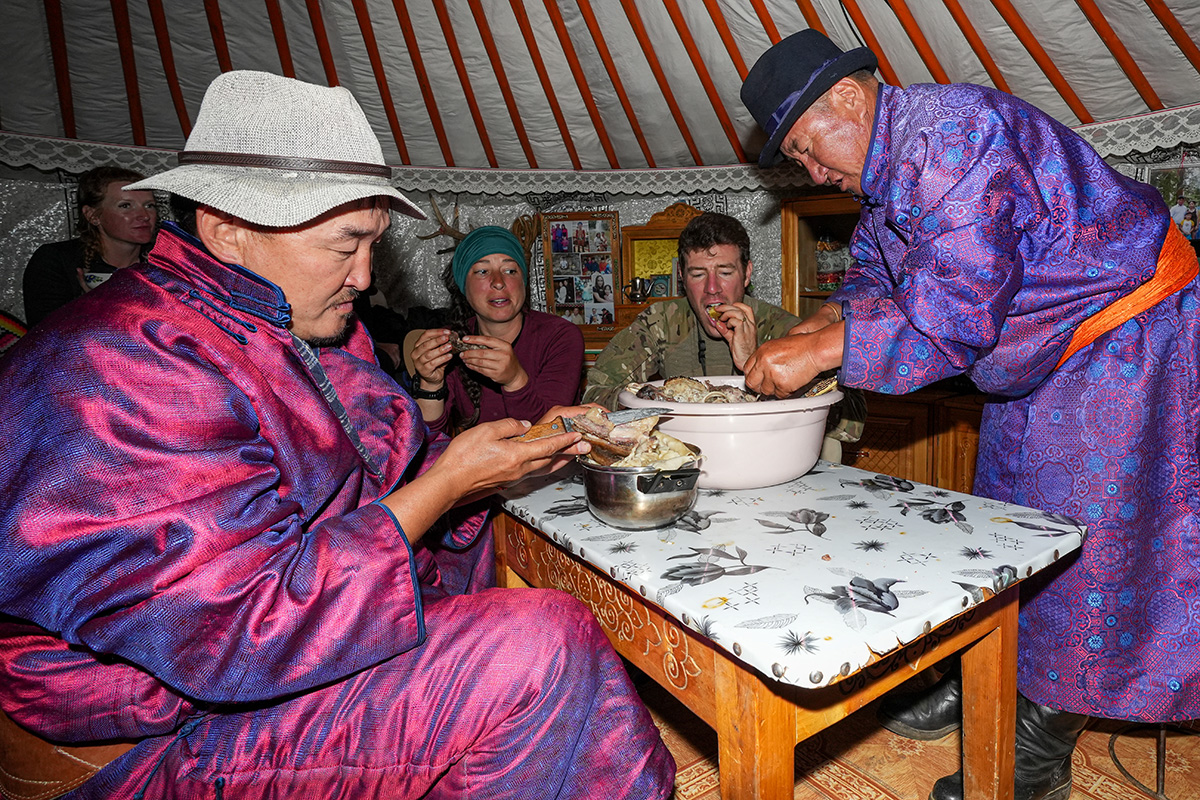
Dowling and fellow riders enjoy dinner with a Mongolian family in a traditional ger. Photo courtesy The Equestrianists
On day five, Dowling came off her horse while attempting to put on a rain jacket. She was unable to get back on her flighty mount. “We were walking and walking; I couldn’t find a ger,” Dowling says. “I had to stop at 7 p.m. or else get penalized. So I watched the sunset with my horse; it was beautiful.” She messaged the vet who came to complete the required check on her horse, who she helped Dowling get water and find a ger to stay in that night. Per race rules, Dowling incurred a 2-hour penalty for receiving assistance.
You Get the Derby You Need
A network of Mongolian herders provide hundreds of horses for the race.
“You ride 29 different horses during the race,” Dowling says. “It’s a lottery which horse you get. Each horse goes 40 km (25 miles). At each horse station, a vet checks the horse’s heart rate. It must come down to 56 bpm within a half hour. They have the highest standards of ethical welfare for a horse. The vet checks the horse’s gut sounds and gait. A rider gets penalized if there’s any problem with the horse. You can’t override your horse. The race taught me how to rate a horse—a horse will help you know its fitness if you really listen to it.”
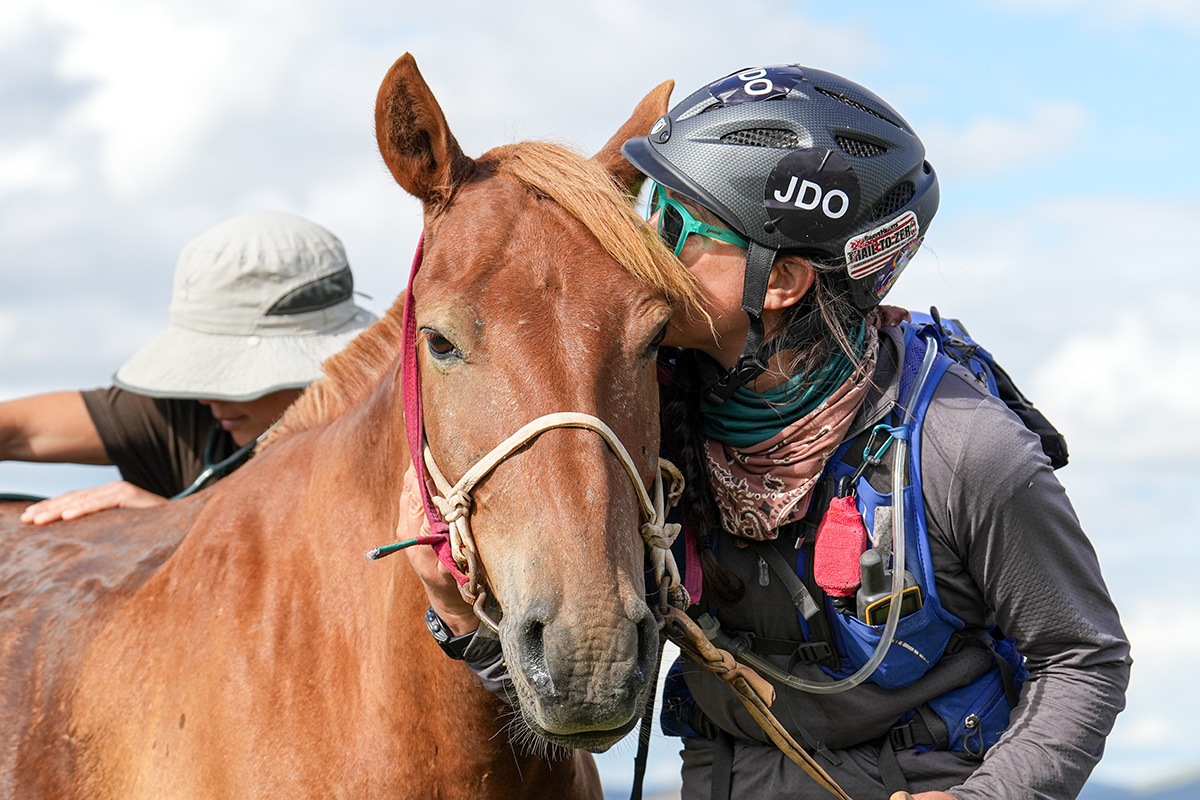
At horse station 2, Dowling kisses her horse goodbye, returning him to his proud owner. Photo courtesy The Equestrianists
Horse’s temperaments are another challenge many riders face during the journey, but this was an area in which Dowling shined.
“Some had trouble with their horse being spicy, but my superpower is that I love every horse I come across” Dowling says. “So, I would just take a deep breath, tell them that I loved them, find the spot they liked to be scratched, and connect with them.”
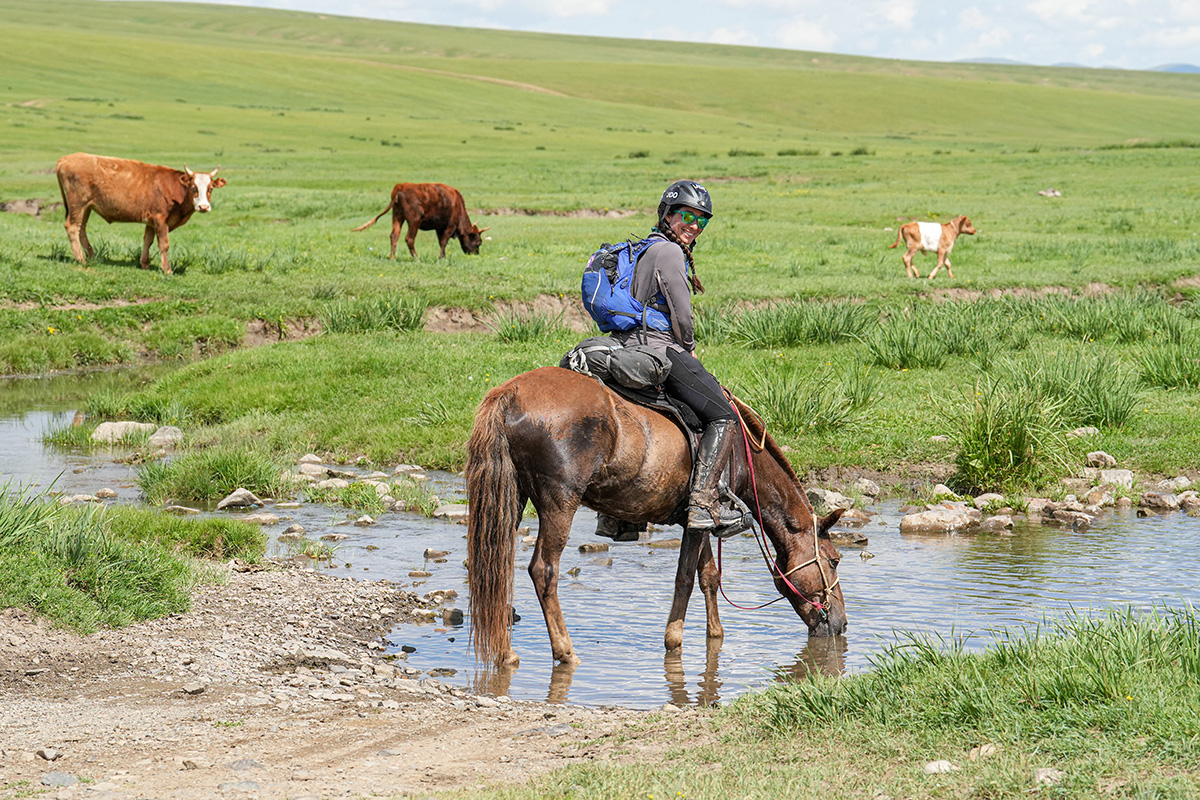
Dowling lets her horse stop for a drink on day three. Photo courtesy The Equestrianists
As for expectations, be prepared to be humbled.
“People say you don’t get the Derby you want—you get the Derby you need,” Dowling says. Although she never reached her breaking point, day eight came close. “It’s mostly geldings—just a handful of stallions. On day eight, I pulled a stallion. Never riding a stallion before, I was a bit nervous. I headed out with other riders, tried to keep up, but he kept going slower. It was like he had never cantered before. Then we were down to a slow trot. Then a walk. I’m now the last rider. And if you get too far behind, you’ll get kicked out of the race.
“So I arrive at the only town on the race, and after eating boiled mutton face for a week, I had hopes of joining other riders at a café for chips and a beer… no other riders were there. Then my stallion would not walk over the bridge leaving town. An interpreter nearby helped by leading me across the bridge like I was on a pony ride. And he takes a picture. It was so embarrassing.
“At the next station, my horse checks out fine. I check the hospitality ger—all the food is gone. I just burst into tears. I took a deep breath, headed out to the horse line, and I picked number five. The herder had been waiting for someone to pick his prized horse all day. And I end up getting on the fastest horse! And that boy and I went straight out, galloping across the desert steppe, passed other riders, arrived at the next station less than two hours later, and I was back in the race.”
Talk about getting the Derby you need.
“That day was the worst and best part of the race,” Dowling says. “I was hungry, demoralized, tired—but never gave up.”

Leaving station 28, Jessie gallops across the Mongolian steppe towards the finish line. Photo courtesy The Equestrianists
Forty-three riders started the race, only 25 finished, and Dowling placed 13th. She says the experience was life-changing. “I went from an intermediate rider to an advanced rider. Spending 12 hours a day in the saddle on difficult horses, I feel light years ahead in my riding,” Dowling says. “So I got home. The next week, our farm’s cheese wins Best in Show at the Maine Cheese Festival, but I felt hollow inside. I realized this wasn’t what I wanted to do anymore.”
She promptly sold her business to pursue an equestrian career full-time—with zero regrets.
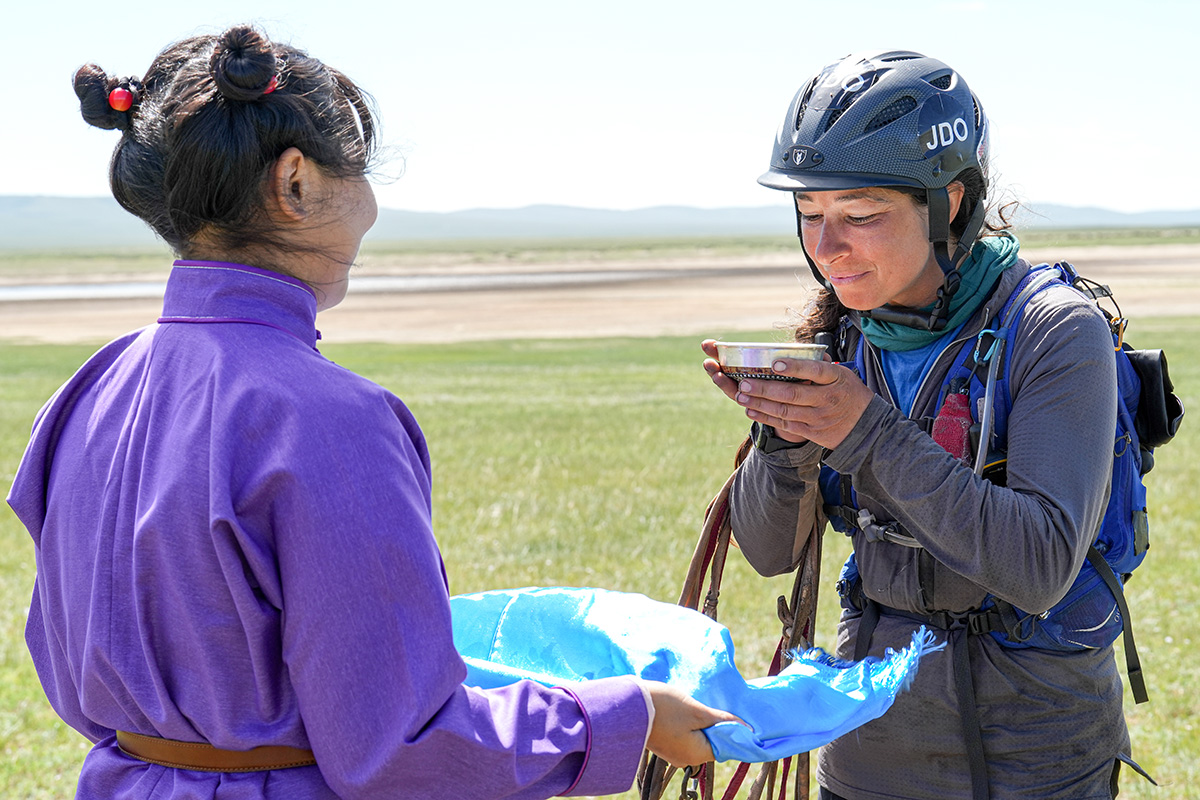
Dowling accepts ceremonial milk at the finish line. Photo courtesy The Equestrianists
Dowling celebrated by riding the Tevis Cup—a 100-mile, one-day race in California. She opened Iron Ledge Farm, offering lessons and endurance training. Dowling visited Argentina to start training for her next adventure—the Gaucho Derby, which runs from February 18 to 28, 2026. Because the Gaucho Derby involves camping along the route, Dowling is figuring out how to pack a tent, stove, camping gear, and riding essentials in a saddle bag weighing no more than 22 pounds. “The Mongol Derby is the longest race in the world, but the Gaucho Derby has been called the toughest.”
And if anyone is up for the challenge, it’s Jessie Dowling.
Learn more about Jessie Dowling and her equine adventures by visiting ironledgefarm.com and following her on Facebook.
This article about Jessie Dowling’s Mongol Derby is a web exclusive for Horse Illustrated magazine. Click here to subscribe!