Mounted police and their equine companions inspire awe and curiosity among Kentucky Horse Park visitors. Silent guardians of the park, the teams preserve tranquility and elicit emotions in children and adults alike.
Cloaked in history and tradition, cadres of mounted police flourished in Europe and the United Kingdom in the 1700s before being embraced by other Western countries in the mid-1850s. The legacy of mounted police work, forged in steel and spirit, lives on today at the Kentucky Horse Park.
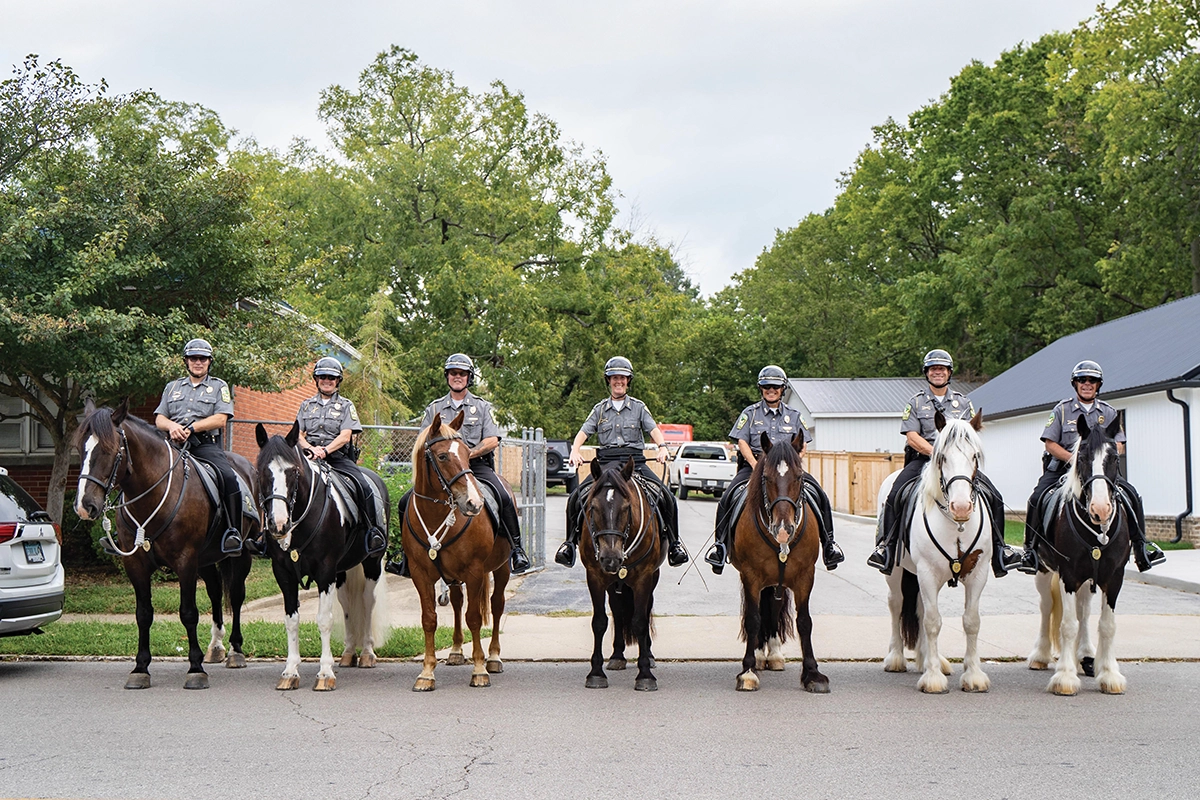
Officers of the Kentucky Horse Park mounted police unit embrace responsibilities far beyond security with a focus on community engagement. Photo courtesy Kentucky Horse Park
Patrolling with a Purpose
The role of mounted police units evolved over centuries from helping wagons and carriages navigate poor roads to modern-day crowd control for parades, state fairs, and music events.
Officers patrolling on foot or behind the wheel of a squad car need help navigating tight turns or traversing wooded areas, mountainous terrain, or waterways. Mounted police officers accomplish challenging assignments because of their perch on the back of a horse. The ace for a mounted police officer is their range of vision 10 feet off the ground, allowing them to respond more quickly in cases of emergency.
The Kentucky Horse Park (KHP) mounted police unit assumed responsibility for the 1,032-acre park from the Kentucky State Police in 1987. Still, like other mounted horse departments, it bore the brunt of budget cutbacks.
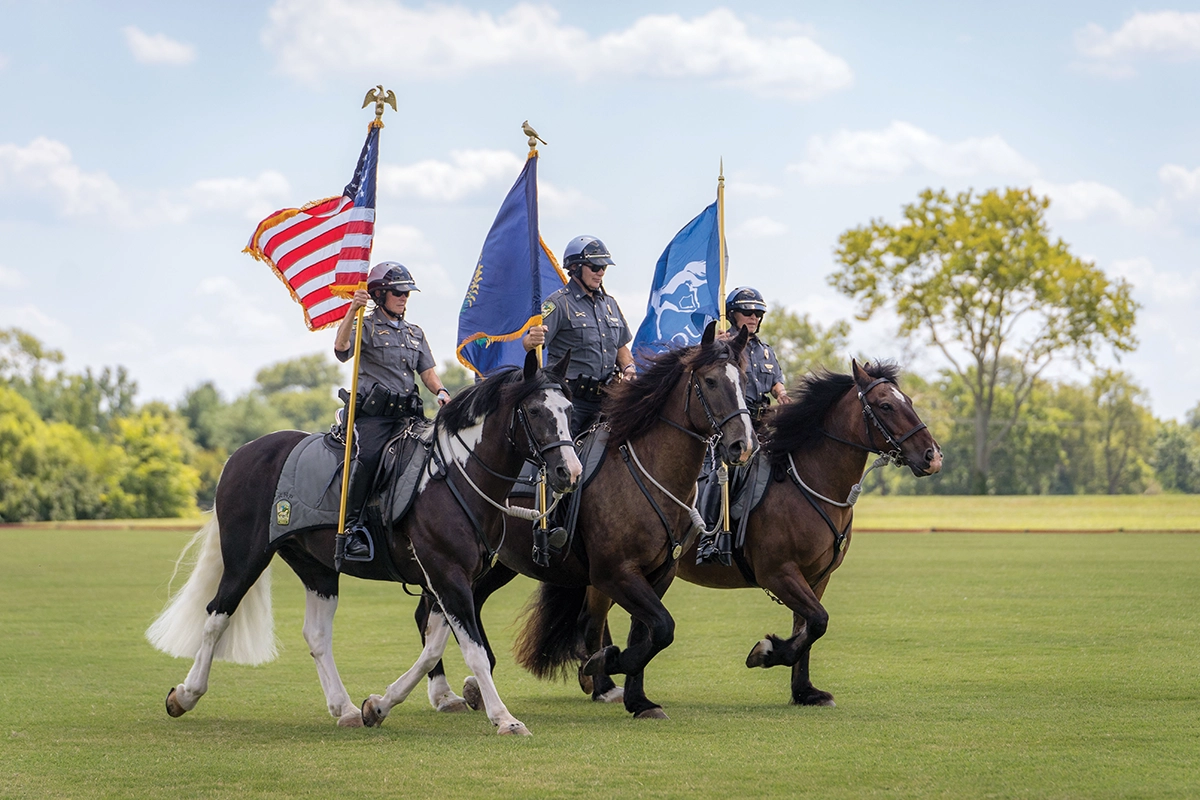
Presentation of the flags before the start of all major events embodies the legacy of mounted police officers. (L-R: Captain Lisa Rakes on Oliver; Sergeant David Johnson riding Koda; and Officer Heather Geer aboard Mackenzie.) Photo courtesy Kentucky Horse Park
The functions of the KHP mounted police encompass everything from search and rescue, patrolling high-crime areas, or monitoring and responding to security breaches. Most of the unit’s activities are related to crowd control at major events, like the National Horse Show, which features top hunter/jumper competition; the U.S. Dressage Finals; the two-week-long Alltech FEI World Equestrian Games in 2010; plus ceremonial and high-visibility patrols at parades, the Kentucky State Fair, and significant music events.
However, the KHP’s Mounted Police Division Captain, Lisa Rakes, believes deepening relationships with the community is the most critical aspect of mounted police officers.
“The horse brings so much to help with community bonding,” says Rakes. “A good example of that would be if I’m doing traffic. If I’m not on my horse, people will be honking their horns at me because they’re tired of waiting. If I’m sitting on my horse, it’s a completely different ballgame. People are taking pictures, they’re smiling. They’re engaging in a conversation with me. Interaction between the police and the community is so much better.”
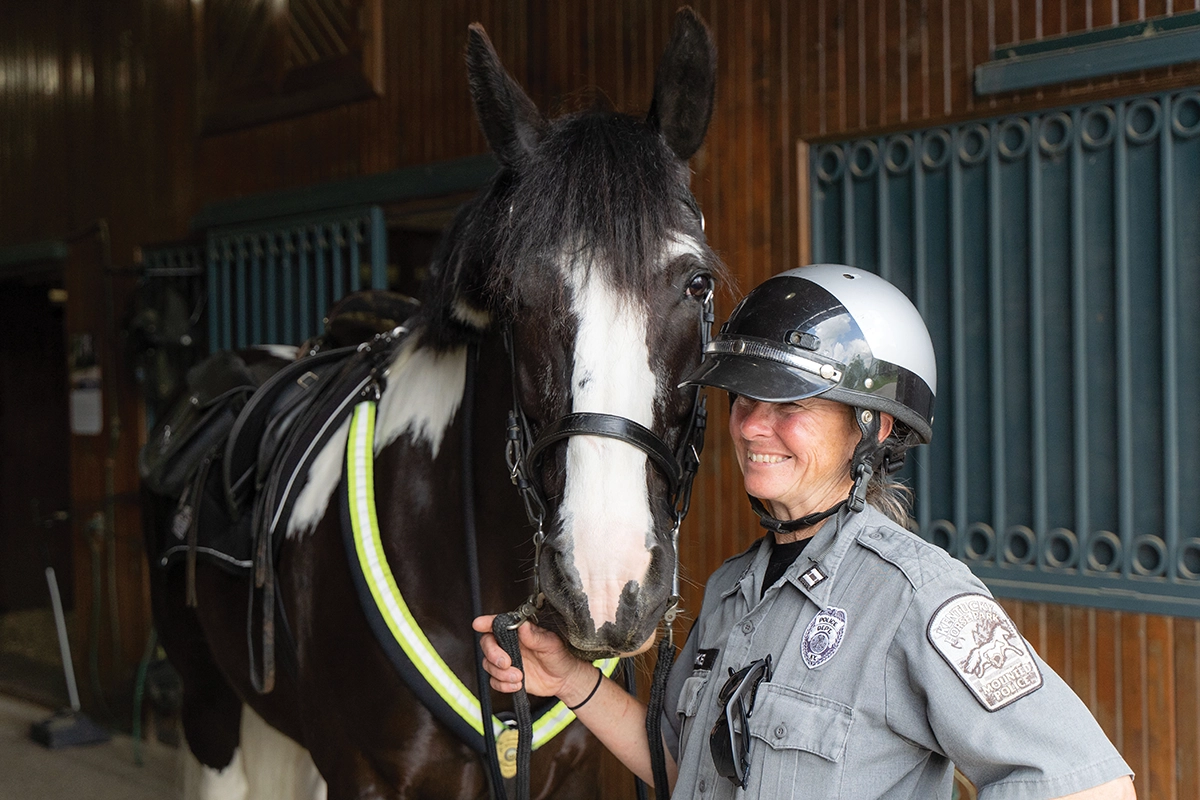
Captain Lisa Rakes beams with pride next to her mount Oliver, a 17-year-old Paint/Shire cross. Photo courtesy Kentucky Horse Park
Rakes considers the KHP a sliver of paradise for its officers and horses and believes the role of mounted police officers goes far beyond public relations. Visitors to the park experience unexpected emotional connections with the horses—maybe for the first time.
“It truly is all about the horse,” says Rakes. “Our visitors want to have an experience with horses. They may have seen a horse, but they’ve never touched one. When they come and ask if they can pet the horse, it’s a bucket list moment. Little kids grab a horse’s leg. The horse will nuzzle a person. A wave of emotion comes over them, which is cool to experience.”
Beyond the Saddle
Born on a dairy farm employing horses for both work and play, Rakes went to college, later serving in the military, before starting a career in law enforcement that lasted 23 years. After retirement from the Lexington Police Department, the KHP hired Rakes in 2013 to lead the on-site mounted police division.
Rakes moved quickly to bring in new officers, pledging to create a cadre of professionally trained officers and horses. Though Rakes prioritized the need for excellent equitation skills, recruiting officers capable of riding initially presented a significant issue.
“Most police officers across the country have zero riding experience, which is the case here as well,” she says. “The majority of officers we hire are retired from larger agencies. That means that most don’t know how to ride a horse. We have to teach people in their 40s or 50s how to ride. That’s a challenging task. Riding horses requires agility, physical fitness, and balance, among other things. We take equitation or dressage lessons because when it comes to riding, if your equitation skills are not there, you’re not going to be a good rider or an effective officer.”
Rakes and her sergeant, David Johnson, start all new horses and riders, putting them through a specialized training program before assigning teams. Training for both officers and horses is a daily part of their jobs, especially for officers new to the unit like Eric Radow.
“Every day, you work on training and equitation with the horse,” he says. “You can practice a lesson and then immediately go and implement it while you’re working. We train throughout the year to become better riders.”
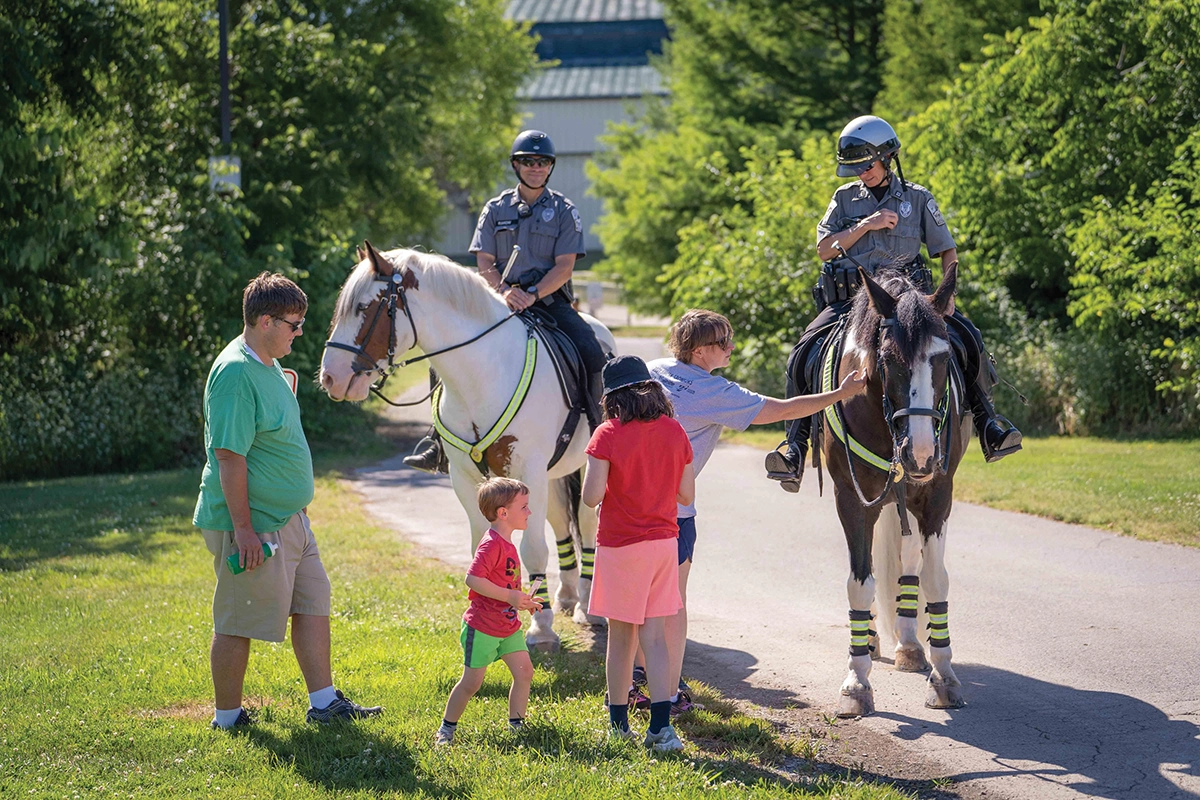
Officer Eric Radow’s horse, Legend (left), was recently made into a Breyer model. Along with Rakes and Oliver, the officers pause to chat with a family visiting the park. Photo courtesy Kentucky Horse Park
Officer Heather Geer was an accomplished hunter/jumper competitor who moved to Lexington from Long Island, N.Y. Retiring after five years on the street, eight and a half years with crime scene investigation, and 12 years as a helicopter pilot, Geer emphasizes that even with her equestrian experience, she learned much more as a mounted police officer.
“I’ve learned to be a lot calmer,” she says. “There are things that I’ve never done on a horse, even though I had a lot of experience. I’ve had to learn here. I learned more in five years here than I did in 30 years at home.”
All officers and horses are required to pass a riding exam, a dressage test, and an obstacle assessment annually. Training is year-round, continuing during the winter months to ensure team skills shine by the time tourist season arrives.
When Rakes assumed leadership of the park’s mounted police unit 11 years ago, it began with two officers and three horses. Today, 10 horses and the ability to field eight riders are a legacy of service on the rise.
Innovation on Horseback
Innovative ideas arise with questions, and answers arise when people connect across states and countries. The KHP annual consortium emerged from mounted police unit supervisors in Ohio, Michigan, Tennessee, and Kentucky phoning each other with questions about policies, procedures, and training approaches.
What began with intra-state phone conversations developed into a roundtable discussion hosted by the KHP in 1983. Good ideas spread when participants ignited the match of community connections. Since its inauguration, the KHP Mounted Police Colloquium has annually hosted officers and their horses from across the country and Canada to learn, train, and network.
“The colloquium grew from an event with no horses to our largest turnout of 149 in 2023, and 138 in 2024,” says Rakes. “Officers come from across the country, including representation from Toronto, Canada. The U.S. Border Patrol brought 30 officers to the training. The colloquium is a week-long experience that consists of two days of training and two days of competition. They come for the training, the camaraderie, and the networking. They take new skills back to their own police department and their own community and start incorporating some of the things they learned.”
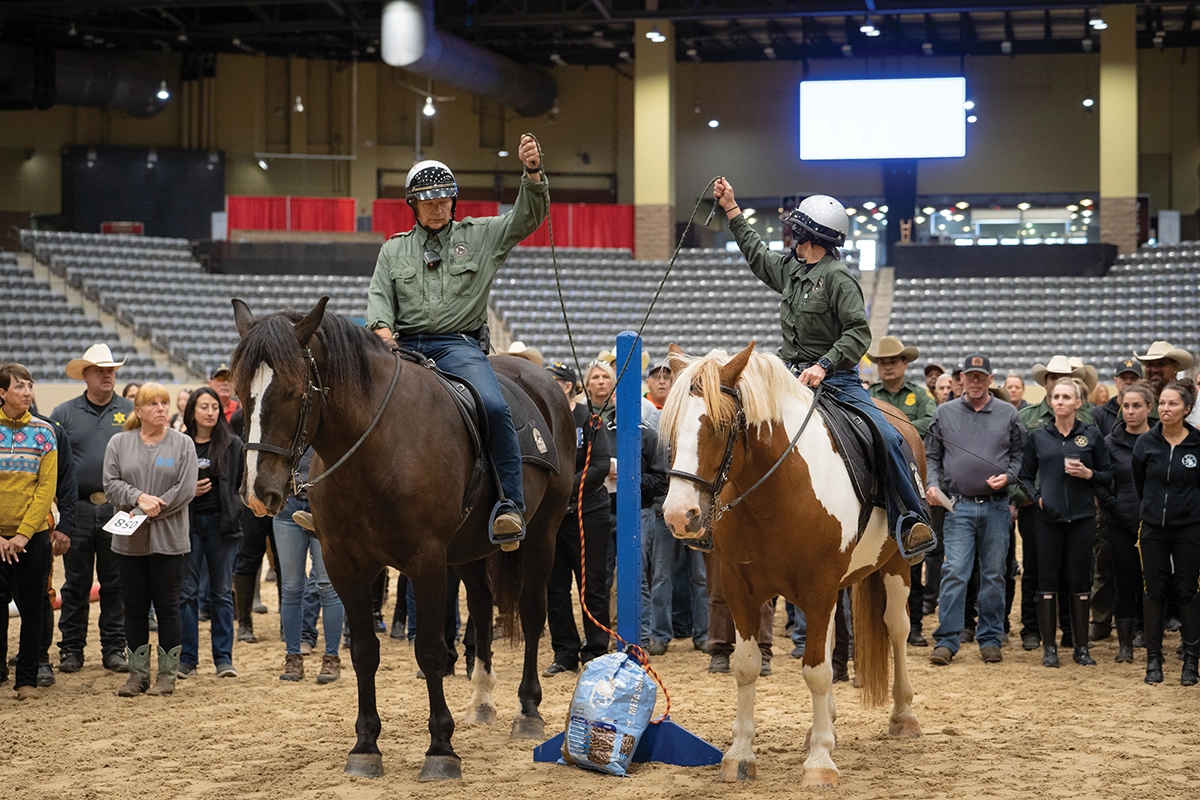
Teams of officers exhibit varying levels of skill attend the annual KHP Colloquium Training and Competition to train, learn, and network. Photo courtesy Kentucky Horse Park
Colloquium organizers invite trainers from around the country to present material that exposes officers to best practices from departments skilled in various aspects of mounted police responsibilities, like crowd control and management.
“Officers from Toronto, Canada teach aspects of crowd control and management because they do a great job,” says Rakes. “The U.S. Border Patrol has much to offer with the variety of terrain they encounter. They’re not working in one community, but in lots of communities, because they’re patrolling the borders. A trainer from Maryland with a dressage background gives equitation lessons. Another trainer has a jumping background. We focus on working equitation because that’s essentially what we are doing. We are moving from point A to point B and want to do it in harmony with the horse.”
As part of the colloquium, the event sponsors a variety of competitions, including a uniform inspection class where officers are judged on their appearance, how their tack fits, how the team is turned out; a team obstacle course; and a more police-oriented dressage test, which includes tasks officers accomplish on patrol.
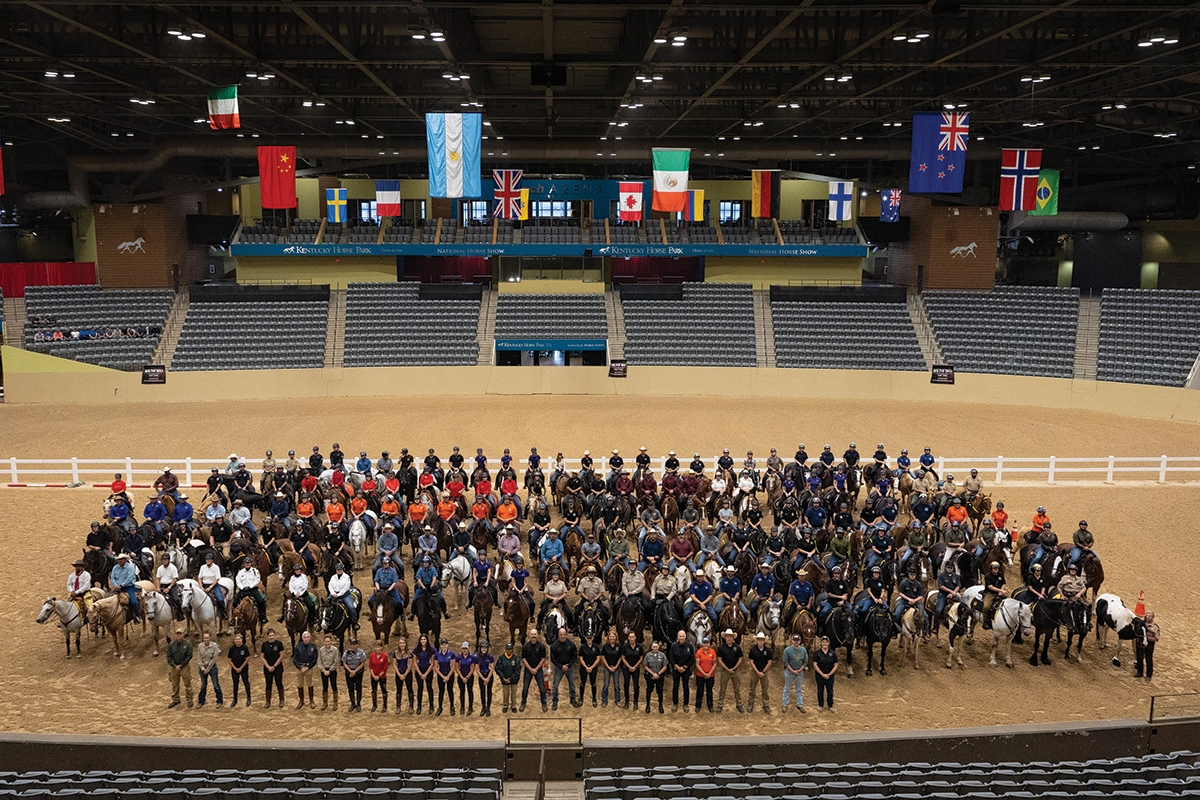
Representatives from multiple countries converge of the KHP to attend the annual colloquium. Photo courtesy Kentucky Horse Park
Bonding Beyond the Bit
The role of the KHP’s mounted police officers goes far beyond security and the visibility of law enforcement. Rakes emphasizes that officers and their horses serve as ambassadors of goodwill.
With close to one million people visiting the KHP each year, Rakes believes that the best part of the job is engaging with people every day.
“We get a lot of people who are seeing a horse for the first time,” she says. “We also get horse experts, people who ride, compete, and see horses daily, who say our horses are amazing. Sometimes you lose sight of this, but we get compliments from experts in all sorts of disciplines. I like talking to people who don’t know anything about horses—and to the experts who know everything.”
From Captain Rakes’ perspective, mounted police officers and their horses bring love and build positive relationship with local communities far beyond the KHP.
“These days, everything on TV and social media is being scrutinized,” she says. “At the park, people are able to have a relationship with an officer and their horse. You’re doing a disservice to your community by not having a horse patrol unit.”
This article about Kentucky Horse Park mounted police appeared in the March/April 2025 issue of Horse Illustrated magazine. Click here to subscribe!