New World screwworm is a not an unknown pest in the United States. It was first found here in 1842, but became an increasing issue in the 1930s and 40s, when livestock producers in the southeast began experiencing losses up to $10 to $20 million per year from New World screwworm infestations.
A destructive parasitic fly, New World screwworm larvae burrow into and consume living tissue, causing deep, painful wounds and even death if not properly treated. All warm-blooded animals are susceptible to a New World screwworm infestation, including livestock, wildlife, companion animals and humans.
New World screwworm larvae do not feed off dead or decaying surface tissue like other species of fly larvae; screwworm larvae feed on living tissue in an already-injured area of the body. Horses that have injuries like cuts or scrapes, those who have had surgery and have incision areas (such as castration or colic surgeries), and a foal’s umbilical stump can all be hospitable areas where the female fly may lay eggs. Also at-risk are sites where the horse has received vaccines, been microchipped or been branded, as well as areas like the nostrils, eyes and genitals, which are thin-skinned and moist. Tick and insect bites are also susceptible to New World screwworm larvae infestation.
Native to warm, humid areas like Mexico, Central America, most of South America and the Caribbean, the warming climate in the United States has made it more-hospitable than in decades past. Thankfully, NWS larvae cannot live in soil temperatures below 46 degrees F, so many areas of the country cannot support the insect during fall and winter months.
It’s not just the climate that has made the United States more welcoming to New World screwworm; the international movement of livestock allows once-contained pathogens, parasites and diseases the opportunity to spread beyond country borders.
NWS was successfully eradicated from the United States in the 1966. The elimination efforts utilized a three-pronged approach that cost $32 million to complete. They included:
1. Farmer education: the United States Department of Agriculture urged producers to examine their animals and showed them what to be on the lookout for.
2. The development of Smear 62, a pesticide targeted at New World screwworm.
3. The laboratory creation of sterile male New World screwworm flies. The USDA mass-produced millions of male screwworm flies in laboratories and sterilized them using gamma radiation before releasing them into infested areas. Female screwworms mate only once in their lifetime, so the population plummeted rapidly when they did not become pregnant.
The sterile-fly efforts have continued since the 60s, but the eradication from the United States was not permanent. There have been multiple breaches of the eradication zone, requiring continued diligence on the part of livestock owners as well as the USDA.
Signs of a New World Screwworm Infestation
Currently, only Texas and New Mexico have found New World screwworm larvae on animals in their state, and none of those cases have been in horses (as of August 19, 2026). They have been found in sheep, a goat and a livestock guardian dog protecting a flock of sheep.
A screwworm infestation in horses looks like:
◆ Severe pain that warrants veterinary intervention
◆ Wounds that don’t heal
◆ Maggots that are visible to the naked eye (the eggs are difficult to see)
◆ Foul odor
A female New World screwworm can lay 200 to 300 eggs in a wound and screwworm eggs hatch within about 12 to 24 hours, so a minor wound can escalate rapidly over a matter of days as larvae begin feeding on living tissue. “Left untreated, severe infestations can become life-threatening within about a week, particularly in young, debilitated or heavily infested animals,” says Dr. Katie Flynn, Senior Staff Veterinarian, Equine Health and Biosecurity at US Equestrian. “That’s why even a seemingly minor wound in an at-risk area should be taken seriously and checked promptly.”
If you suspect your horse has a screwworm infestation, isolate your horse and call your veterinarian. You will need to tell him or her if the larvae are eating live or dead tissue as this will help them determine a diagnosis even before they come out to your horse. They may ask for photos before they come out to see you, so be prepared to take focused images in good lighting of the wound and area surrounding it.
New World screwworm can only be confirmed by a laboratory; your vet will submit the larvae to the lab, and if it is confirmed as New World screwworm, the state animal health veterinarian and USDA officials will be alerted. They will draw a 12-mile radius around the positive case and call that area the “infested zone.” All animals inside that zone except the infested animal are able to move, but may have some restrictions on where and how they can travel placed on them. These restrictions vary by state. Equine activities within these infested zones may be prohibited by the state veterinarian.
Treatment
A New World Screwworm infestation isn’t a death knell, but it does take diligent care to ensure that every last larvae is removed from the wound. In severe cases, debridement by a vet may be necessary to expose all the injured tissue.
Examining your horse daily is good horsekeeping practice, but it’s especially imperative in infested zones, in areas bordering infested zones and whenever your horse is co-mingling in areas with horses from other regions, like at trail rides and competitions. “Just because a wound looks small does not mean the risk is small,” Dr. Flynn reiterates. Special care should be taken to look closely around wounds, surgical sites, insect bites, eyes, ears, nose and sheath or vulval areas.
Horse owners should also:
◆ Clean wounds daily and apply protective barriers like bandages or creams to prevent fly access.
◆ Use fly spray liberally on horses and consider using fly masks and sheets as additional barriers.
◆ Follow veterinarian guidance. If you’re in an infested zone, your veterinarian may recommend proactively using drugs on a wound that have been issued Emergency Use Authorizations to prevent New World screwworm infestation, including injections, powders, ointments, tablet, liquids and solutions. Find those drugs here.
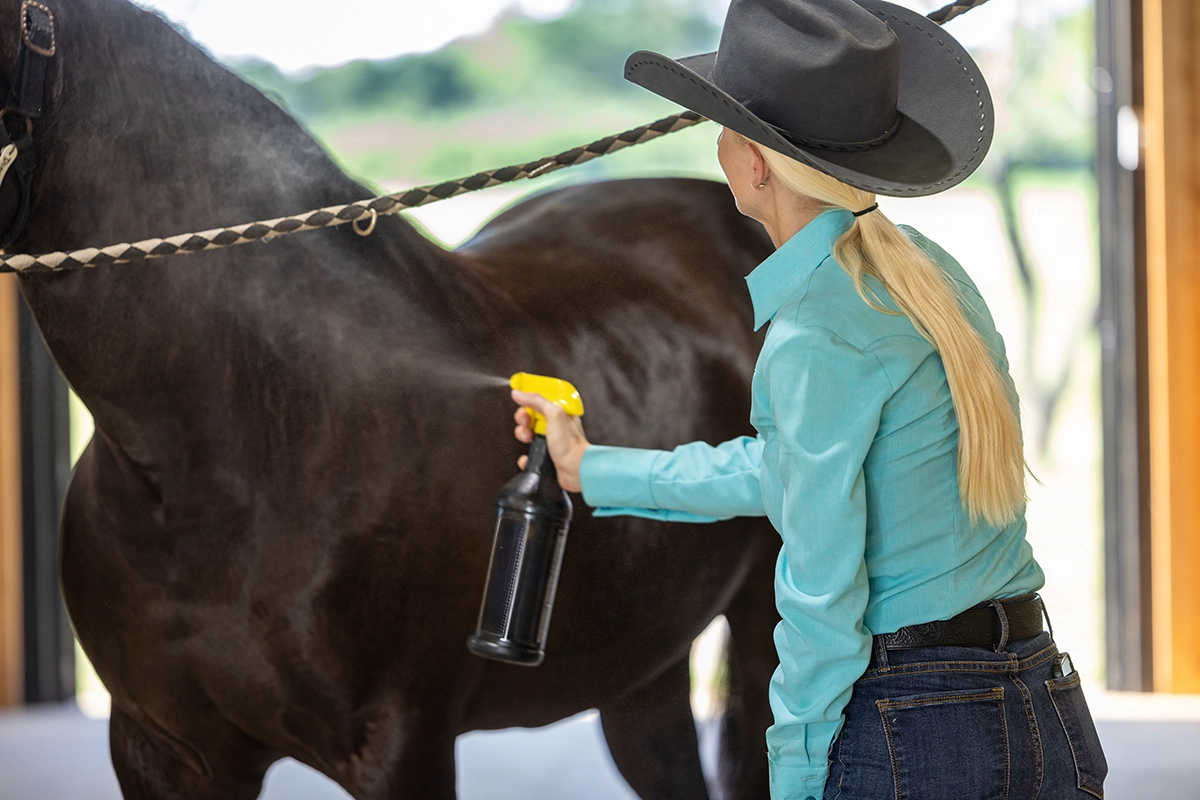
Photo by Terri Cage/Adobe Stock
Travel Information
If you intend to travel with your horse from a state impacted by NWS (Texas and New Mexico as of August 19, 2026), your horse will need to be examined for screwworm by a veterinarian before leaving the state and a form must be completed indicating that the vet deems the horse free of New World screwworm. The horse may be required to be inspected by a veterinarian for wounds upon arrival at its destination (depending on the state into which it is shipping) and a report must be filed with the state vet of origin’s office. If any other animals made the journey, like a dog, they may also be inspected.
The end goal of any additional inspections is to try to continue to keep as many livestock activities as close to normal as possible, including transportation, recreation and sales – but due diligence is imperative. The very best ways to combat New World screwworm, are to inspect your animal for wounds, report suspect larvae and protect wounds with topical treatments.
It’s important to understand that New World screwworm isn’t just a threat to horses and other livestock that live in or near the infected zones. As livestock readily travel throughout the U.S. and around the globe, a localized infestation can quickly escalate into a multi-state issue. Owner diligence is the first and best line of defense in safeguarding horses and the entire equine industry.
For up-to-date NWS outbreak information, visit screwworm.gov.
For a list of approved drugs for NWS, check out this FDA list and this USDA list.
This article is a web exclusive for Horse Illustrated magazine. Click here to subscribe!