Learn how to set and achieve your New Year riding goals with this excerpt, adapted from Fit & Focused in 52 by Coach Daniel Stewart, which has been reprinted with permission from Trafalgar Square Books.
Inside you is a great rider—a rider who’s full of possibilities, potential, courage, and confidence. All you need to do is figure out how to let that inner greatness out.
Your ability to release your inner greatness depends on a series of important physical and mental skill sets. For example, you might have the world’s best leg, seat, position, and posture, but if you’re constantly freaking out, panicking, hyperventilating, and worrying before every ride, there’s a pretty good chance your brain is going to hold your body back.
Building a Complete Rider
If you’re like most equestrians, you’ve probably spent years developing your hips, heels, and hands because you know they’re a major key to your success as a rider. You’ve probably also spent countless hours developing your horse because you know that without a confident partner, there’s little chance you’ll succeed.
But I want to remind you that your puzzle is still missing a few important pieces—your head, health, and heart. Your head is where confidence, courage, self-belief, and resiliency are born. Your health is how you prepare for (and protect your body against) the physical demands of our sport. And your heart is where your ability to forgive yourself after making a mistake—or finish strong after a slow start—resides.
Combine them all together and they create the ability to turn setbacks into comebacks—to hold it together when it would be easier to let it fall apart. This is what it means to be a complete rider.
A Map for Your Riding Destination
If you want to get somewhere important, you’re going to need some pretty solid step-by-step directions to get you there. After all, when you don’t know where you’re going, you’ll probably end up somewhere else!
Maps are what you use to ensure you’ll arrive where you want to go—physically. Likewise, goals are the maps you use to ensure you’ll arrive where you want to go—mentally.
There are many different kinds of goals. Right now, I’m just going to talk about these three:
◆ Immediate goals: Goals you can complete in minutes or hours. These often act as the spark that lights the fire of desire to accomplish your goal.
◆ Progress goals: Often called “short-term” goals, these goals can be completed in days or weeks and are what allow you to achieve your final goal, one step at a time.
◆ Product goals: Often called “long-term” goals, these can be completed in months or years and will ultimately be the product of all your progress goals.
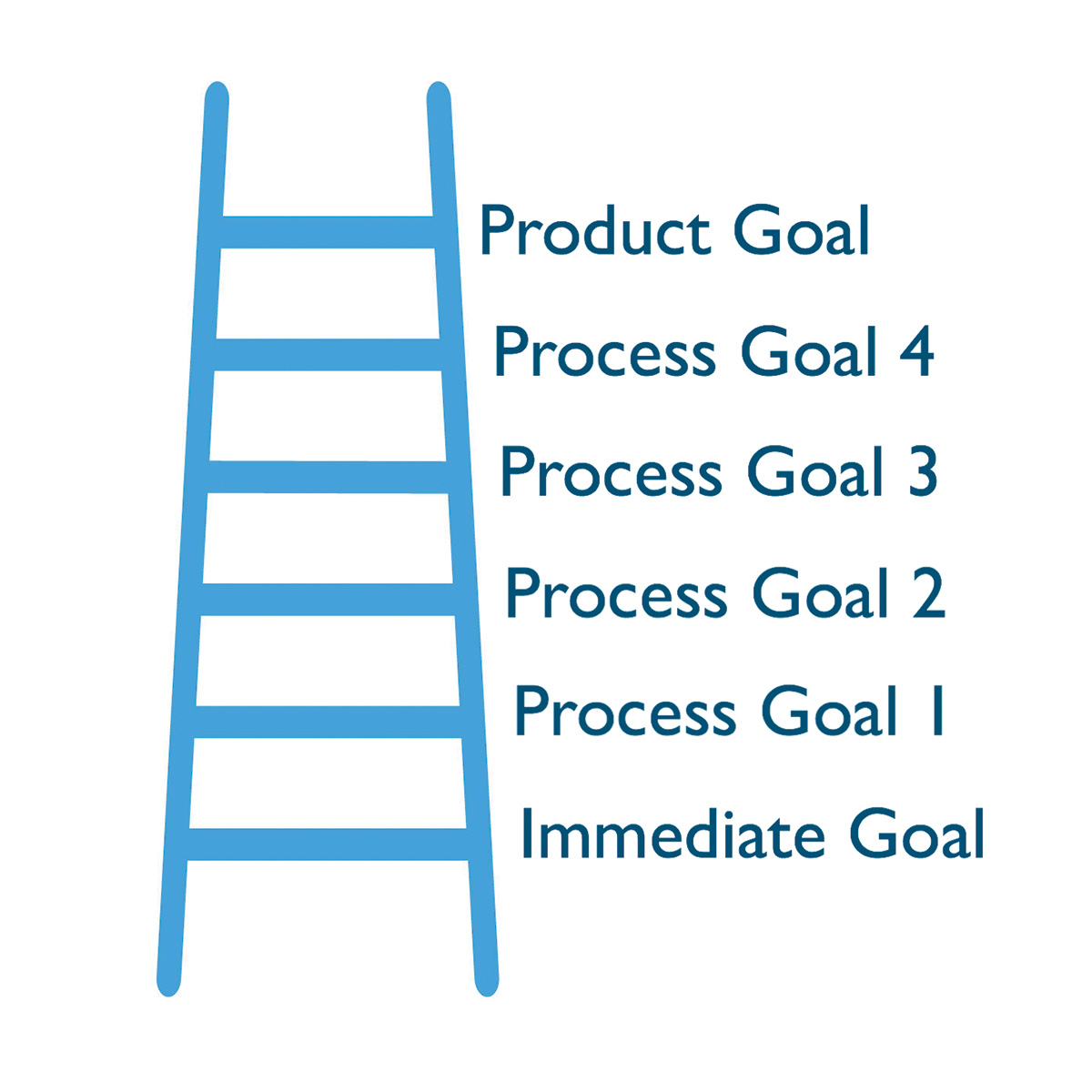
For example, say you’re a flat rider with a product goal of learning to jump. Your immediate goal might be to simply read a chapter in a jumping book by the end of the day; and your process goals might be to learn to (1) trot over poles; (2) canter over poles; (3) trot over cross-rails; and finally (4) canter over cross-rails.
Your product goal is the result of all your progress goals.
Put Your Pen Away
Setbacks are a common, and even important, part of the goal-setting process because each time you experience one, you’ll learn something you didn’t know before.
With this in mind, consider writing your goals in pencil so that each time a setback occurs, you can simply erase the original goal and replace it with a new and improved one.
Get Your Pen Back Out!
Achieving your goals can be wonderfully motivating, so each time you accomplish one, pull out a big colorful marker and cross it off.
Make Your Goals SMART
You may have heard of “SMART” goals before, but here’s a refresher on what SMART stands for.
◆ Specific: A goal like leaning to ride without stirrups is better than a goal of becoming a better rider because it’s more specific.
◆ Measurable: A goal like learning to canter is measurable because you know when you’ve accomplished it (or not).
◆ Attainable: When you identify goals that are most important to you, you begin to figure out ways you can make them come true.
◆ Realistic: To be realistic, a goal must be an objective that you’re both willing—and able—to accomplish. If it’s beyond your reach, your motivation might take a big hit.
◆ Timely: Goals need a time frame. Without one there’s no sense of urgency. When you have a complete-by date, you’ll have the motivation to chase after it. But you’d better hurry!
Try This
Create something called a goal-setting ladder. Start by drawing a six-step ladder with a product goal written on the top step and an immediate goal on the bottom step. Next, fill in the remaining four steps with a series of achievable process goals.
The purpose of this ladder is to show you how to reach your goals, one step at a time.
This excerpt from Fit & Focused in 52 by Coach Daniel Stewart appeared in the January/February 2025 issue of Horse Illustrated magazine. Click here to subscribe!