Thoroughbred aftercare has come a long way since Horse Illustrated first began regularly tackling the topic of retraining after racing in 2010. Programs such as the Retired Racehorse Project (RRP) and the Thoroughbred Incentive Program (TIP) give horse owners incentives to give horses second careers after they are finished racing, and the versatility of the breed shines through in their ability to be anything: pasture pets, trail horses, show jumpers, barrel racers, eventers, therapy horses, and more. Being aware of how an OTTB’s first career on the track influences their shift into their “retirement” helps create a smooth transition.
As awareness of aftercare has grown, so has industry support. Major racing organizations, including The Jockey Club and Thoroughbred Charities of America, now allocate substantial funding to aftercare efforts, helping to ensure that more horses find safe and meaningful second careers.
Thoroughbred aftercare programs have an increasingly large focus on retraining, so that horses can be adopted ready to go in their new discipline. Photo courtesy Retired Racehorse Project
The Initial Transition
Amanda Tucker, trainer at the Lexington, Ky., branch of the New Vocations Racehorse Adoption Program, likes to use the facility’s round pens to transition the horses into turnout. After they are comfortable in the round pen, she buddies them up with another horse in a smaller paddock before eventually adding them into a larger herd. The end goal is to be able to have them go outside all night, or even 24/7, but Tucker emphasizes the importance of taking an OTTB’s transition slowly.
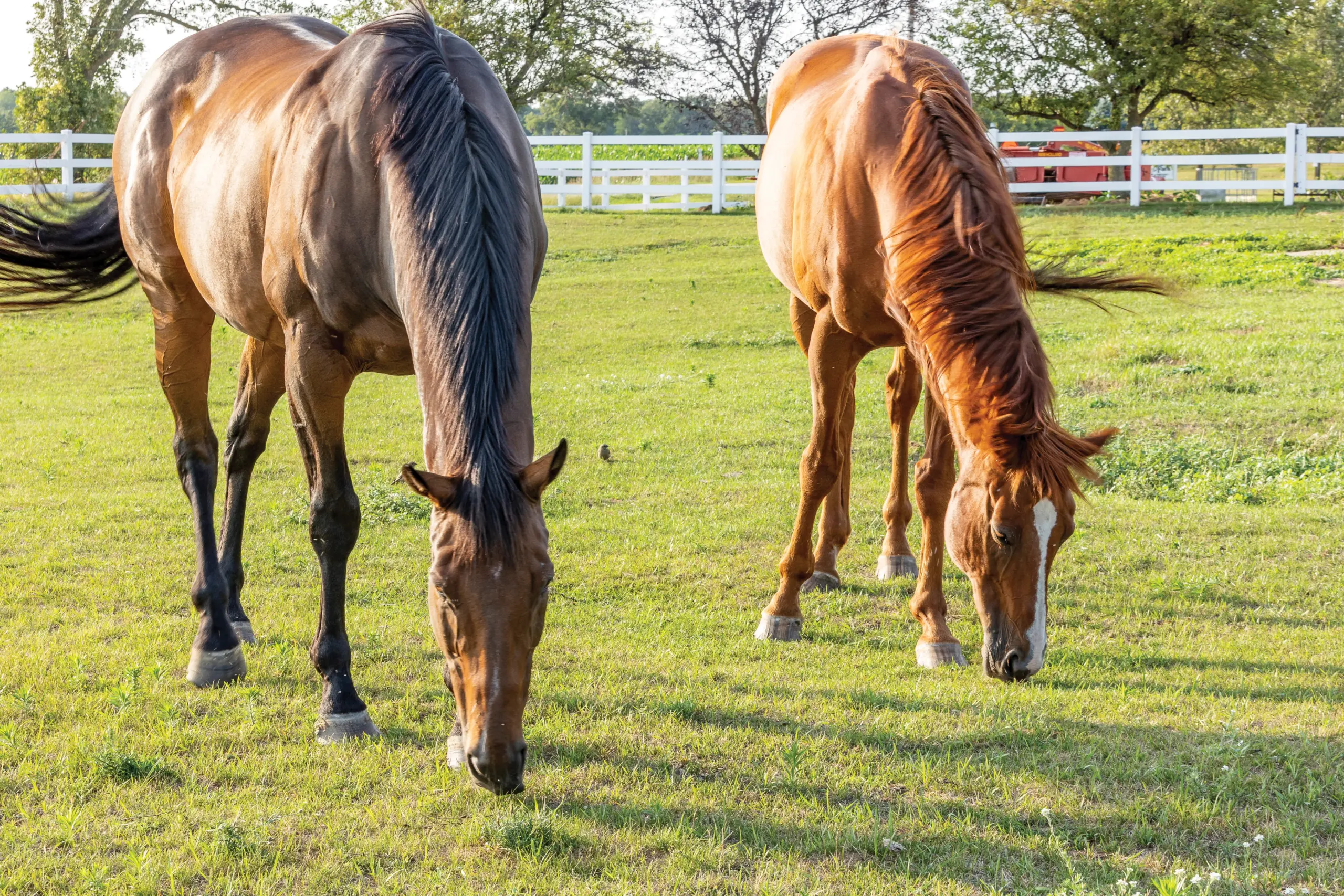
New Vocations Racehorse Adoption Program buddies up horses freshly off the track with a babysitter horse in a smaller paddock before adding them to the larger herds. Photo by Margaret Burlingham/Adobe Stock
Layne Schaffer is the farm manager at Arrowwood Farm in York Springs, Penn. While Arrowwood raises Thoroughbreds to race, they are committed to finding new homes for those that don’t show talent racing or are ready to retire. Schaffer has competed at the RRP Thoroughbred Makeover and barrel races her own Thoroughbred, Floo Powder.
Like Tucker, Schaffer uses a transitional turnout system. She says that each horse’s personality and what he did previously on the track makes a difference. If she knows the horse is more laid-back, she transitions him to a regular turnout situation more quickly.
“I think a quiet buddy is also ideal,” says Schaffer. New Vocations has a similar strategy, with an older, permanent resident “babysitter” named Ranger, whose job is to help make the transition more seamless.
While some horses need down time after retiring due to an injury or to unwind mentally, many do better staying in a program.
“The racetrack is a hard job, and whatever job you give them is likely going to be a walk in the park compared to that,” says Schaffer. “They are used to their people and routine and getting to do something.”
Often, too much time off can backfire and cause unnecessary stress and change in routine for the horses.
Feed First
Nutritionally, a lot of factors go into making the best gameplan.
“Once they leave race training, their nutritional demands depend on a few factors,” says Amy Parker, M.S., a nutritionist at McCauley Bros. “Does he need some sort of rehabilitation due to an injury? If he’s going to be on stall rest or very restricted turnout, you may not feed him as much as a horse that immediately starts to train for his next career.”
Parker adds that for most horses, caloric needs decrease when they finish racing. However, the change in routine can cause some horses to develop ulcers or not want to eat.
“For 99 percent of the horses coming off the track, that first three months is a big transitional period with a whole lot of changes going on,” she says. “They are now in a new environment with a new routine and new people and new horses. In this way, horses are a bit like people. Some people handle change fantastically and some don’t.”
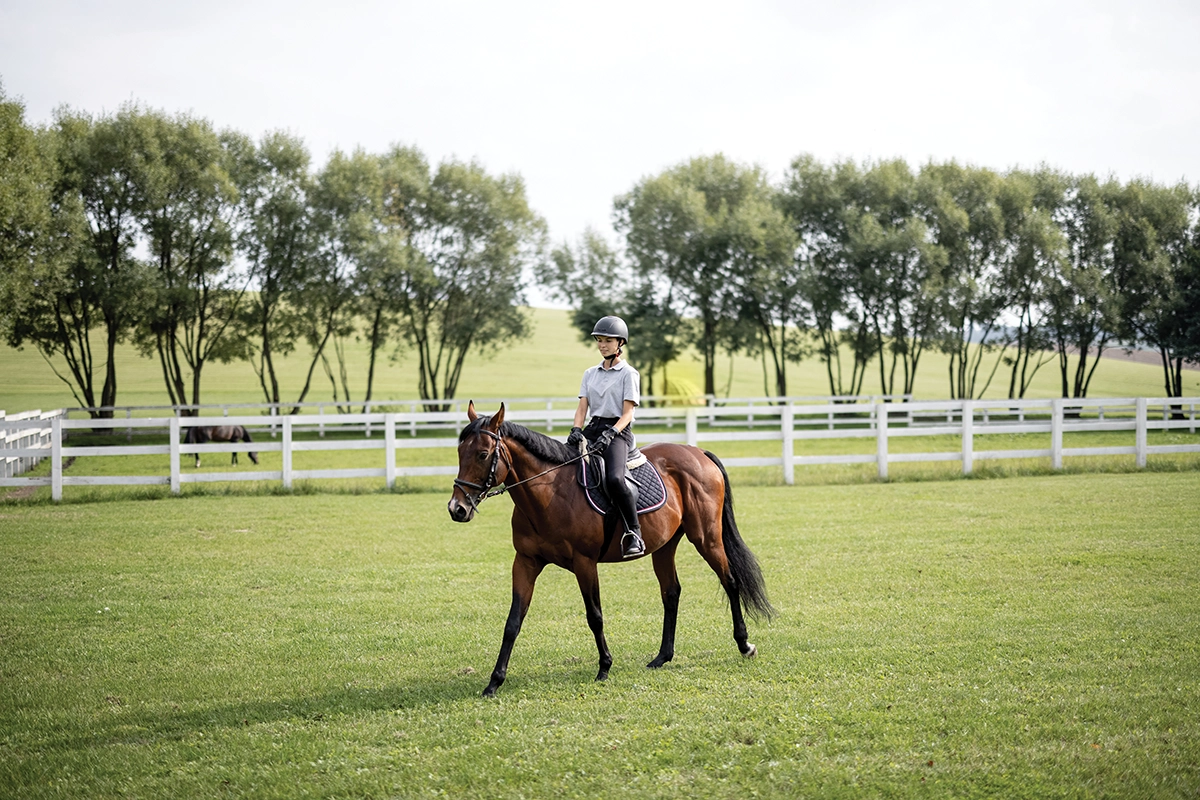
At three months off the track, Amanda Tucker of New Vocations is focusing on walk/trot/canter, both inside and outside of the ring, and not much more yet. Photo by RH2010/Adobe Stock
Choosing a feed is an important part of this change.
“If the horse is 2 or older and not pregnant or lactating, a good 10 or 12 percent protein feed is going to more than meet his protein requirements,” says Parker. “Protein will not necessarily put weight on a horse. Calories will.”
The time of year the horse comes off the track also makes a difference.
“We often see a lot of horses, especially in the Thoroughbred world, get retired following the fall race meets,” says Parker.
This often coincides with pasture quality declining, and horses are often being asked to adjust with minimal winter coats in colder weather.
“A horse that retires at, say, the end of October, versus a horse that’s being retired at the end of April, will have different nutritional demands simply because of Mother Nature,” she explains.
Although there is a lot you can’t control during the horse’s transition, trying to minimize the stress as much as possible will help in the long run.
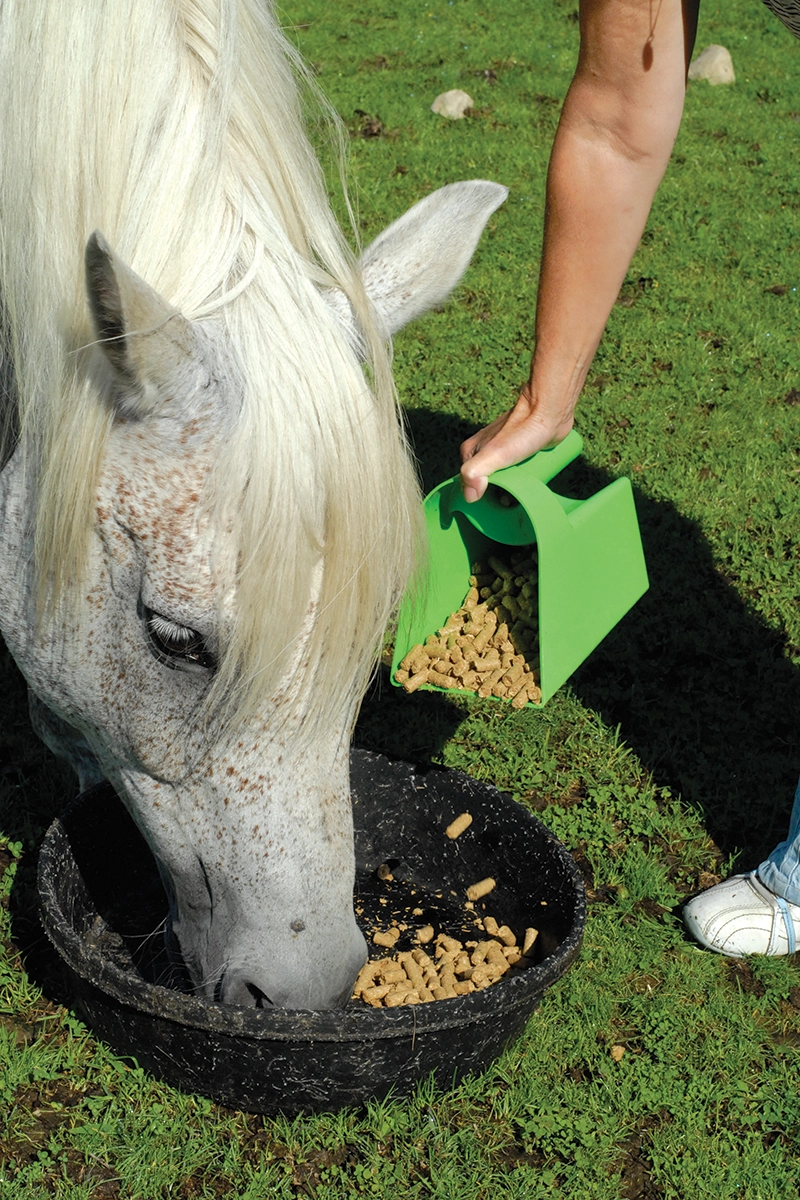
Pelleted feeds can seem foreign to a horse freshly off the track, so you may need to start with what he is used to before gradually introducing something new. Photo by Dusty Perin
“Instead of trying to force the horse into whatever pigeonhole you’ve got in your situation, work with the horse,” says Parker. “If he was on an alfalfa/grass mix hay at the track and on a sweet feed, and you feed pelleted feed and grass hay, maybe get some alfalfa/grass mix and use that for a few weeks. You might want to start with a sweet feed and transition to a pellet, because if he’s never seen a pellet, he might have no idea what it is.
“There’s no cookie-cutter [solution] for this, because we have to treat every horse as an individual,” she adds. “That’s the one thing that I can’t stress enough.”
Restarting Under Saddle
Tucker’s first time riding a horse off the track greatly depends on his personality. Taking the time to get to know him as an individual is critical for making sure the first ride is productive. This can look different for every horse.
“I read their vibes as I’m tacking them up to see if I think they need to be longed or not,” she says. “We have gotten to know them for a couple weeks at that point, so if they seem calm, cool, and collected, I sometimes skip longeing and just hop right on. If they are giving any signs of anxiety, we start with longing or more ground work.”
Schaffer agrees.
“The first few months have looked different for all my OTTBs that I’ve taken to be riding horses,” she says.
Her gelding, Floo, needed time to rehab from a slab fracture in a knee, while her 2018 Retired Racehorse Project Thoroughbred Makeover mount retired sound and went right into his new job.
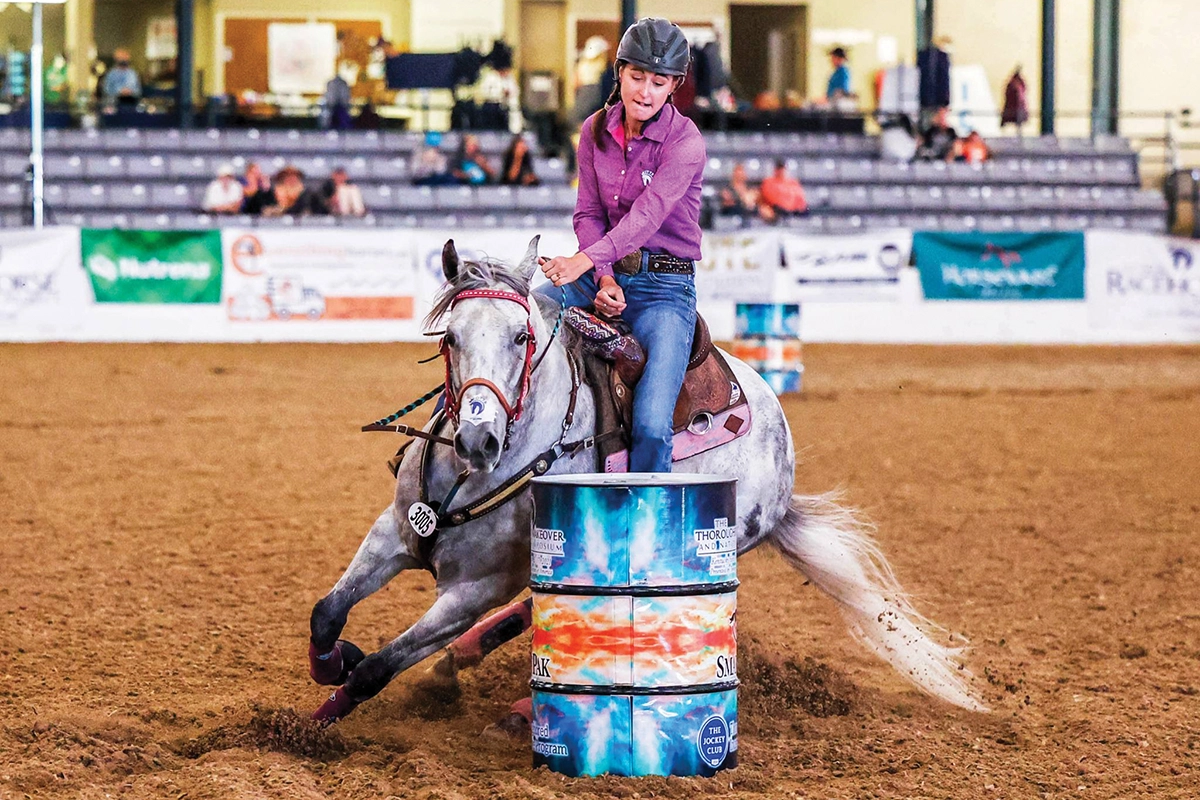
Although he came off the track in 2015, it wasn’t until 2019 that Floo hit his stride running barrels, winning a year-end buckle from a local series. Photo courtesy Layne Schaffer
Not all horses retire from racing already knowing how to longe, so taking the time before the first ride to establish ground work routines helps build the horse’s understanding of what he’s being asked to do.
The first few months off the track are all about establishing the foundation, according to Tucker.
“At three-ish months, at least with most of the babies, I focus on walk/trot/canter, both inside and outside of the ring, and not pushing them much more than that,” she says.
Tucker uses the facility’s trail course, including bridges, logs, and a small bank, to give the horses more to think about and test how ready their brains and bodies are for larger questions.
Next Career
Once the fundamentals are established, the horse can start to focus on his next career.
Deciding on the direction a horse will thrive is not an exact science. At New Vocations, Tucker and her team keep an open mind about what makes sense for each horse. Just because a horse can physically do a job doesn’t always equate to it being the best path for him. Similarly, a physically limited horse can likely still do a lot of different jobs.
Schaffer urges people to think outside the box.
“People don’t think big horses can run barrels, and really it’s about so much more than sheer size,” she says. “For just about any western sport, you want a horse that moves efficiently and that has the right conformation to do the job you want. Yes, I want a bit of a lower set hock and a shorter back, but that’s not much different than what a jumper wants. You still need that quickness and efficiency. The ranch rider is still going to want that fluid, easy movement that a hunter requires. I think every discipline can learn something from the others.”
Tucker hopes to know which direction to take her OTTBs in after six months of retraining.
“If we’re going to be eventing or jumping, we should be at least doing baby jumps and baby courses and baby cross-country,” she explains.
Some horses catch onto their new jobs a lot quicker than others.
“Six months in for some people could look the same as three months in does for others,” says Schaffer. “Things are so dependent on each individual horse and how they adjust and how they train.”
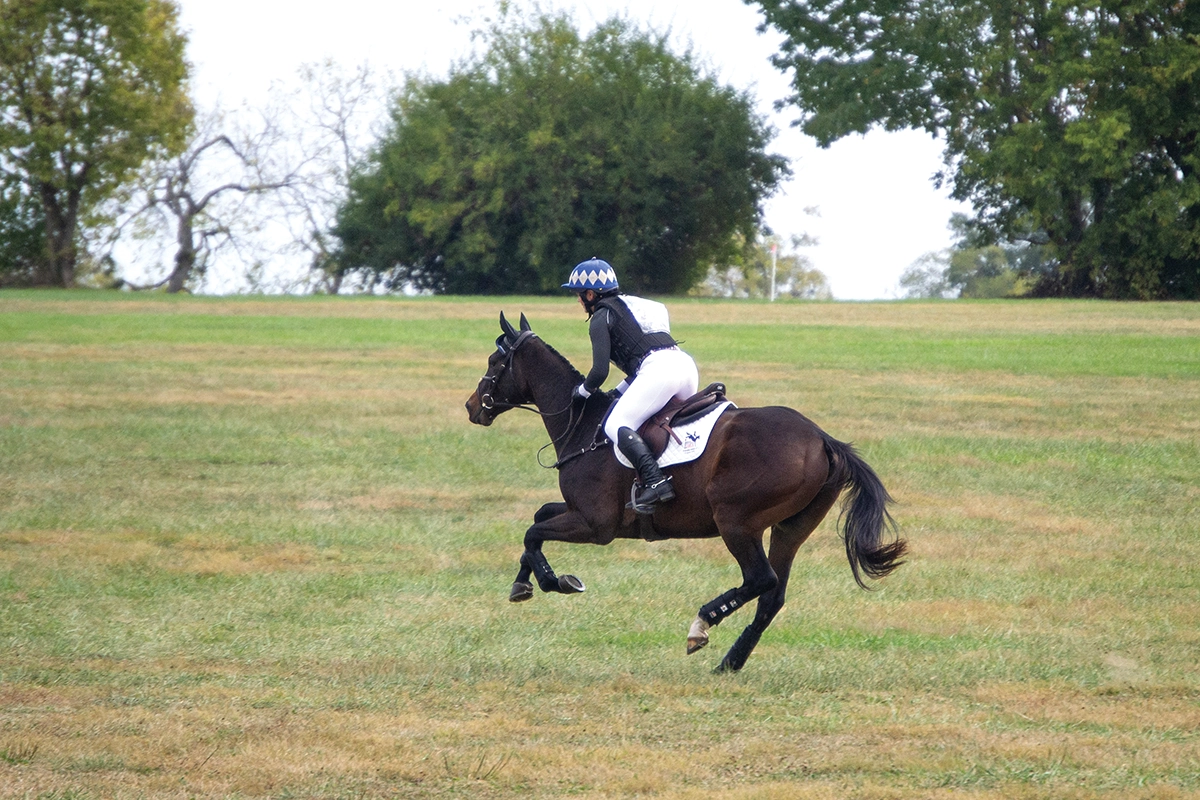
Six months after restarting under saddle, Tucker hopes to have the horse starting his new career—a jumper can do baby jumps or an eventer can start going around baby cross-country courses. Photo courtesy Retired Racehorse Project
Nutritionally, Parker says at this point it’s a matter of feeding them to meet the demands of their next career.
“The demands of a horse that’s being trail ridden once or twice a week versus a horse that’s going to be a barrel racer or an eventer changes a lot of his nutritional needs,” she notes.
Past that, it’s a lot of sorting out what makes the horse tick and building on those skills. Some horses thrive in competitive disciplines, while others flourish in quieter roles. The ultimate goal is not to force them into a specific mold, but to find a career path that suits each horse’s temperament and physical abilities.
Makeover Success
For Schaffer, it took several years for her and Floo to truly get going in her planned career path of barrel racing. Floo retired from the track in 2015, but he didn’t do his first barrel race until 2018. She said that in 2019, it finally started to all come together.
“He won a year-end buckle from a local series,” she recalls. “[Then] in 2020, we qualified as a Top Dog (top 5 in any division) for the IBRA National Finals. After a really great year in 2021, we went to the inaugural TIP Barrel Racing Championships, and he was the 1D Average Champion. He placed second in both rounds, but because he stayed so consistent, he won the average. That was such a huge moment for him because a horse that’s tough and looky—and hot—doesn’t always translate to a horse that stays super consistent. I was honored for him to be the one that won it because he’s such a cool, weird, silly little horse and the ultimate underdog, and he deserved it.”
Tucker had a similar experience with her 2018 RRP Thoroughbred Makeover horse, Wavemaker, known around the barn as Shakespeare. After the makeover, she continued eventing with him before deciding to sell him in 2024. She is now aiming for the 2025 Makeover with her current OTTB, Greyes Creek.
Both trainers think it’s crucial to remember that horses coming off the track are simply moving from one career to the next, and that their education on the track is important to remember during an OTTB’s transition.
“Just because you don’t speak that language doesn’t mean it’s wrong,” says Schaffer. “Thoroughbreds are truly the horseman’s horse. The people that raise them love them dearly!”
This article about the transition of OTTBs appeared in the September/October 2025 issue of Horse Illustrated magazine. Click here to subscribe!