Tourists from all over the world descend on the Hawaiian Islands each year to enjoy the breathtaking scenery and expansive ocean views. But few visitors realize that the Big Island of Hawaii is home to the largest contiguous cattle ranch in the United States and one of the oldest: the 130,000-acre Parker Ranch. Although down from its heyday, nearly 150,000 head of cattle still live on the Hawaiian Islands. There’s nothing more picturesque than seeing a paniolo, the Hawaiian term for cowboy, herding cattle in the lush hills, the Pacific Ocean shining in the distance. Paniolo carry a rich tradition of horsemanship, equipment, and culture that few on the mainland are familiar with.
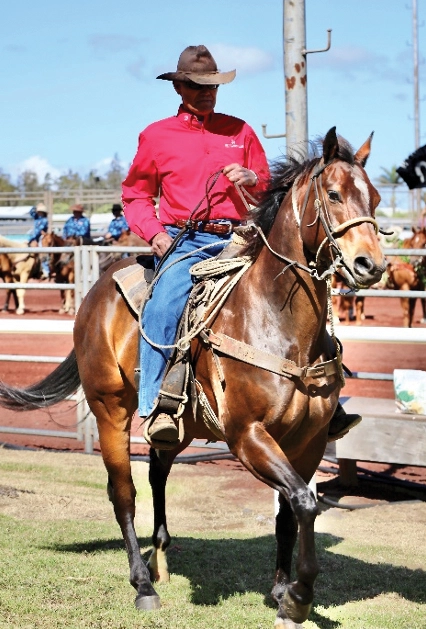
Paniolo carry a rich tradition of horsemanship, equipment, and culture that few on the mainland are familiar with. Photo courtesy of Nancy Erger, Waimea, Hawai`i Island
Paniolo History
Cattle first arrived on the islands in 1793, when British Navy Officer Captain George Vancouver gifted Hawaii’s King Kamehameha with six cows and a bull. The king prohibited their slaughter, and their numbers soared.
These wild cattle became a nuisance, destroying crops and charging residents. With the cattle presenting a growing problem, Kamehameha permitted their capture, beginning around 1812. Horses had arrived on the islands about a decade earlier, also as gifts.
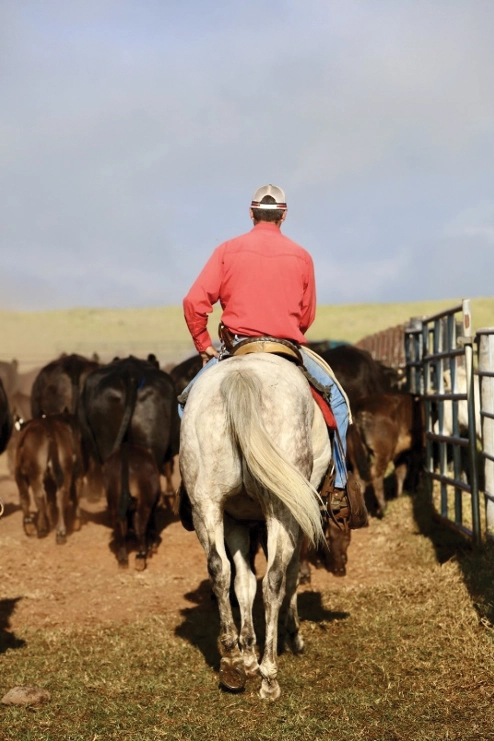
Although down from its heyday, nearly 150,000 head of cattle still live on the Hawaiian Islands. Photo courtesy of Nancy Erger, Waimea, Hawai`i Island
In the 1830s, Hawaiians hired vaqueros to teach them how to work with the cattle on horseback. The history of vaqueros dates back to the 1500s, when the Spaniards arrived in Mexico and began to train Indigenous Mesoamerican men in cattle and horsemanship.
Derived from the word vaca (Spanish for cow), the vaqueros became legendary horseman. The vaqueros spread into what is now the Western United States, bringing with them their unique horsemanship, equipment and culture, which they eventually shared with the Hawaiian people.
“Our people are gifted with great hand-eye coordination; they took very quickly to horses, cattle and equipment,” explains Billy Bergin, DVM, a retired veterinarian, founder of the Paniolo Preservation Society and co-author of the book The Hawaiian Horse, as well as a series of books on Parker Ranch. “It was quick learning for the native Hawaiian people to learn to work cattle and use a lariat.”
Working cattle on the islands came with unusual challenges, including dense terrain. Before refrigeration was available, the cattle had to be shipped live. This required the paniolo to swim their horses and cattle out to longboats. The cattle were then tied to the sides of boats before being hoisted up to the awaiting steamers.
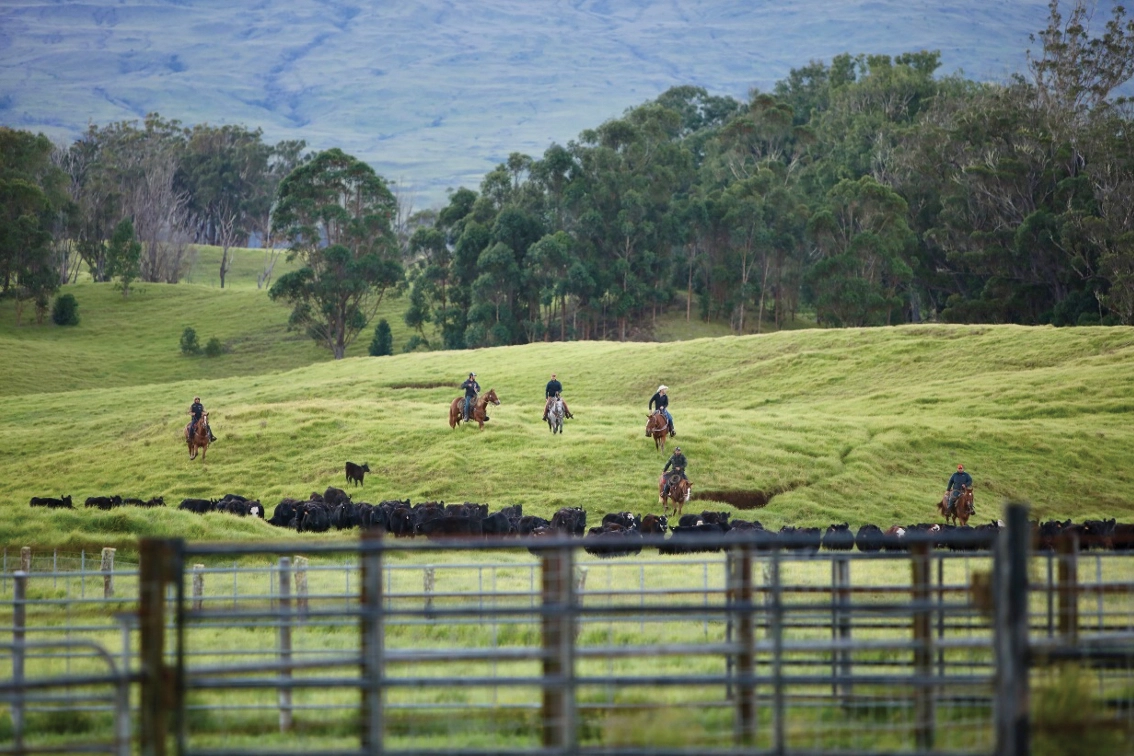
Few visitors realize that the Big Island of Hawaii is home to the largest contiguous cattle ranch in the United States and one of the oldest, Parker Ranch. Photo courtesy of Nancy Erger, Waimea, Hawai`i Island
Paniolo Equipment
Paniolo retained the vaqueros’ wide-brimmed hats and leather boots but used lighter fabrics for clothing and more colorful prints. The ladies would wear large, colorful skirts to protect their clothing. This skirt is known as pa`u, and in modern-day parades, the pa`u is still worn with different colors representing different islands.
Hawaii’s rich canoe-building tradition helped them quickly adapt to creating lariats, bridles and saddles.
“In the Pacific, canoes were launched with different knots, braids and cords, so we already had those skills in our makeup,” Bergin says. “Hawaiians quickly learned how to build their own lariats and bridles, whips, and whatever else they needed.”
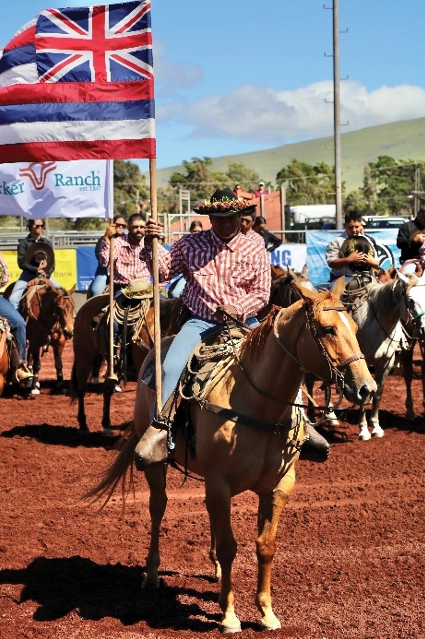
A paniolo holds the state flag of Hawaii at a rodeo. Photo courtesy of Nancy Erger, Waimea, Hawai`i Island
A native tree called the neneleau made the perfect material for saddle trees with its light weight and tight grain.
“It takes the hand of a good woodworker to build a saddle tree,” Bergin says. “Those same woodworkers’ grandfathers probably built sea vessels.”
Paniolo saddles feature more rawhide than traditional western saddles because rawhide is less expensive and stands up to the wet climate more effectively. Cured rawhide also allows some movement, making it more comfortable for horses. Another unique aspect of Hawaiian saddles is the aweawe, which refers to the braided rawhide strapping and rigging.
“Aweawe is very distinct piece in the identity of the Hawaiian tree saddle, which also differs from island to island and sometimes even within the islands between ranches,” says DeeDee Bertelmann, a multi-generational employee of Parker Ranch who serves as the livestock administrator.
Hawaiian saddle makers use personal leaf brand stamps to decorate the leather. The stamps were traditionally made from horse molars.
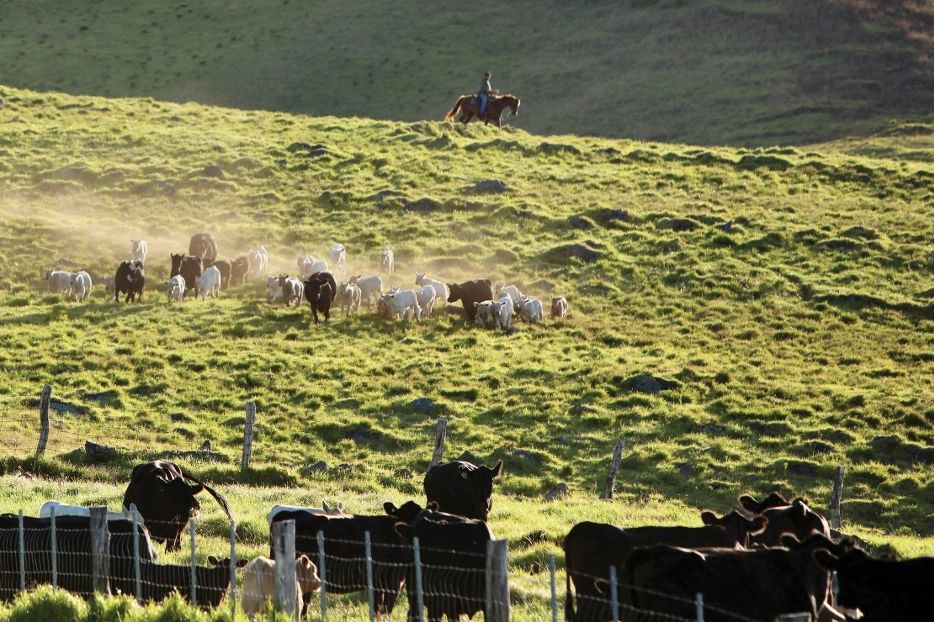
There’s nothing more picturesque than seeing a paniolo herding cattle in the lush hills, the Pacific Ocean shining in the distance. Photo courtesy of Nancy Erger, Waimea, Hawai`i Island
Paniolo Culture
“The most important culture around our paniolo lifestyle is family—ohana—and our values,” Bertelmann says. “First and foremost is respect and responsibility to our `aina (land) and to each other. Then the kuleana to care for the animals we raise.”
As Bertelmann demonstrates, the language itself is another key aspect of the culture.
“The Hawaiian language is still used today on working ranches,” Bergin explains. “They have young men and women who grew up in that culture, and a lot of their communication in the field is in the Hawaiian language.”
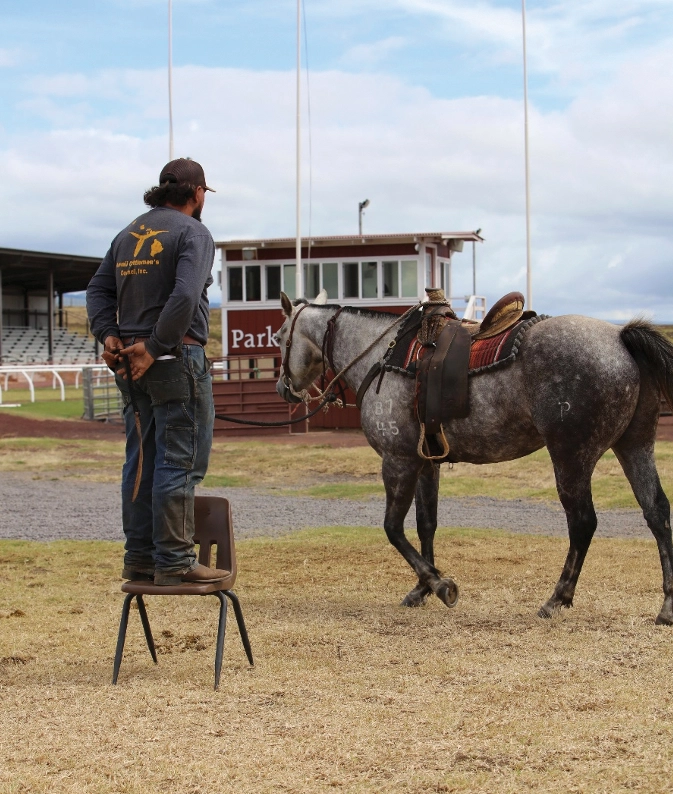
Hawaii’s rich canoe-building tradition helped them quickly adapt to creating lariats, bridles and saddles. Photo courtesy of Nancy Erger, Waimea, Hawai`i Island
Music is another pillar of paniolo culture, just as country music is associated with mainland cowboys. One aspect of paniolo music is the use of classic Hawaiian slack-key guitar, ukuleles and vocals.
“The famous guitar artists of Hawaii trace back to paniolo,” Bergin shares.
Bertelmann agrees.
“Mo`olelo, or storytelling, is also a tradition not only in our Hawaiian way of life but in our paniolo way of life,” she says. “Knowledge is transferred from one generation to another by way of our storytelling as well as a vessel to hold close our ancestors’ teachings and knowledge.”
Bergin shares that cooking is another important aspect of paniolo culture. Men are often the chefs, and meat is made jerk-style or smoked.
Paniolo spending long days working cattle in the hills and fields would often stop for a late lunch, he says. A few men would break off to gather herbs and other edibles in the forest and return with sticks to use as chopsticks, a true blending of cultures.
Paniolo Horsemanship
Rodeo has long played a role in paniolo culture. In fact, in 1908, three Hawaiians traveled to Wyoming’s Cheyenne Frontier Days, the world’s largest outdoor rodeo. To everyone’s surprise, Ikua Purdy won the steer-roping contest in 56 seconds, his cousin Archie Ka`au`a came in second, and another cousin, Jack Low, placed sixth despite having an asthma attack.
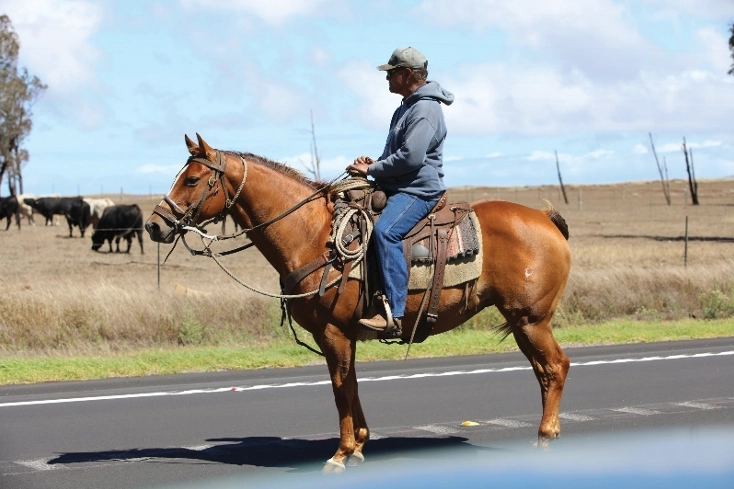
Photo courtesy of Nancy Erger, Waimea, Hawai`i Island
Many years later, rodeo is helping to reinvigorate Hawaii’s paniolo culture.
“When Hawaii joined the National High School Rodeo Association in 1988, that helped preserve the tradition,” Bergin says, adding that it also helped motivate youth to keep their grades up and go on to college.
The islands also host their own rodeos and parades to keep traditions alive. However, the culture is under threat.
“Today we are fighting for way of life in many different aspects, and one of the hardest is living on an island that is being bought out by foreigners and development,” Bertelmann shares.
This is one reason Bergin helped launch the Paniolo Preservation Society in 1998.
He says the paniolo’s gentle style of horsemanship is a thing of beauty, built on working in harmony with the animals.
“The mishandling of animals is looked upon very, very harshly by the population,” he says. “The more humane you handle animals and each other, the better.”
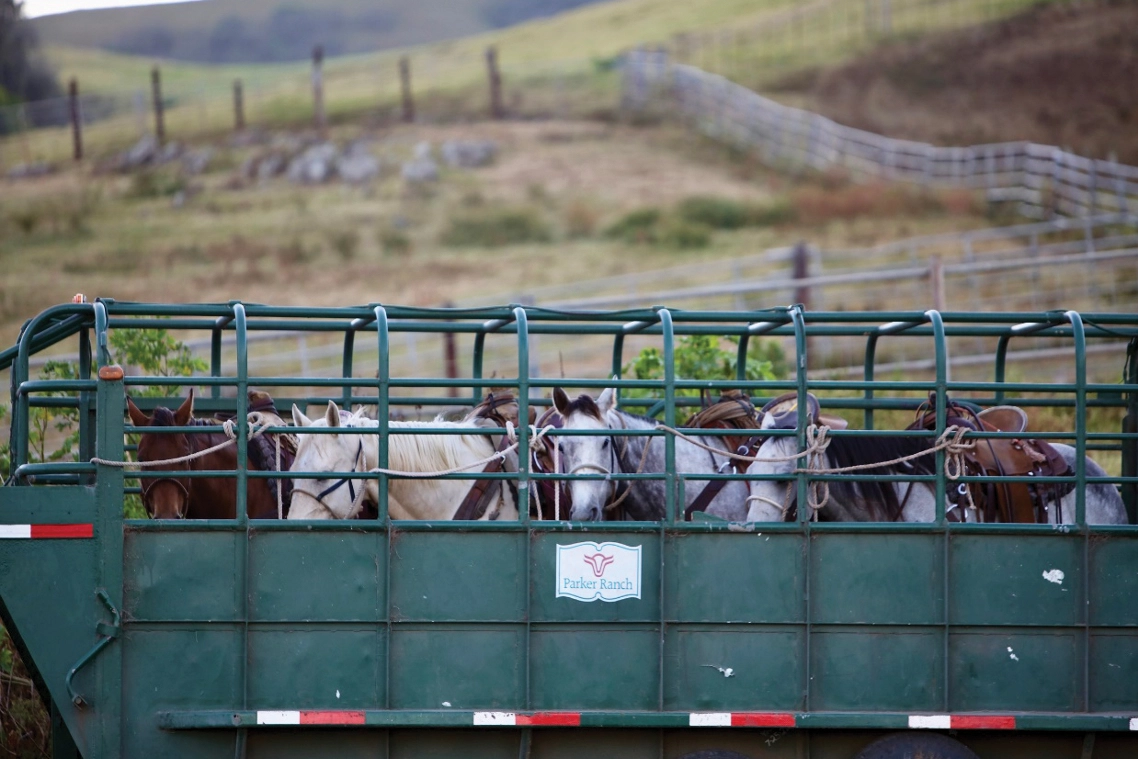
“The mishandling of animals is looked upon very, very harshly by the population,” says Billy Bergin. Photo courtesy of Nancy Erger, Waimea, Hawai`i Island
For example, during herding, paniolo keep their lariats low, spinning slowly beside the horse rather than high overhead, causing as little disruption as possible.
“It’s very smooth and melodic,” Bergin explains.
Visitors to the islands can find their own horseback riding adventures at a number of stables. They can also learn more about paniolo by visiting Parker Ranch and the Paniolo Preservation Society, both located on the Big Island of Hawaii.
This article about the paniolo of Hawaii appeared in the July/August 2025 issue of Horse Illustrated magazine. Click here to subscribe!