Well-trained and safe barn dogs can add a lot to the barn atmosphere. But with additional animals around comes increased risk for accidents and liability concerns for farm owners and their clients. Horses inherently come with a level of risk, and so do barn dogs, but prioritizing safety and being on top of their care and training can help minimize the risk.
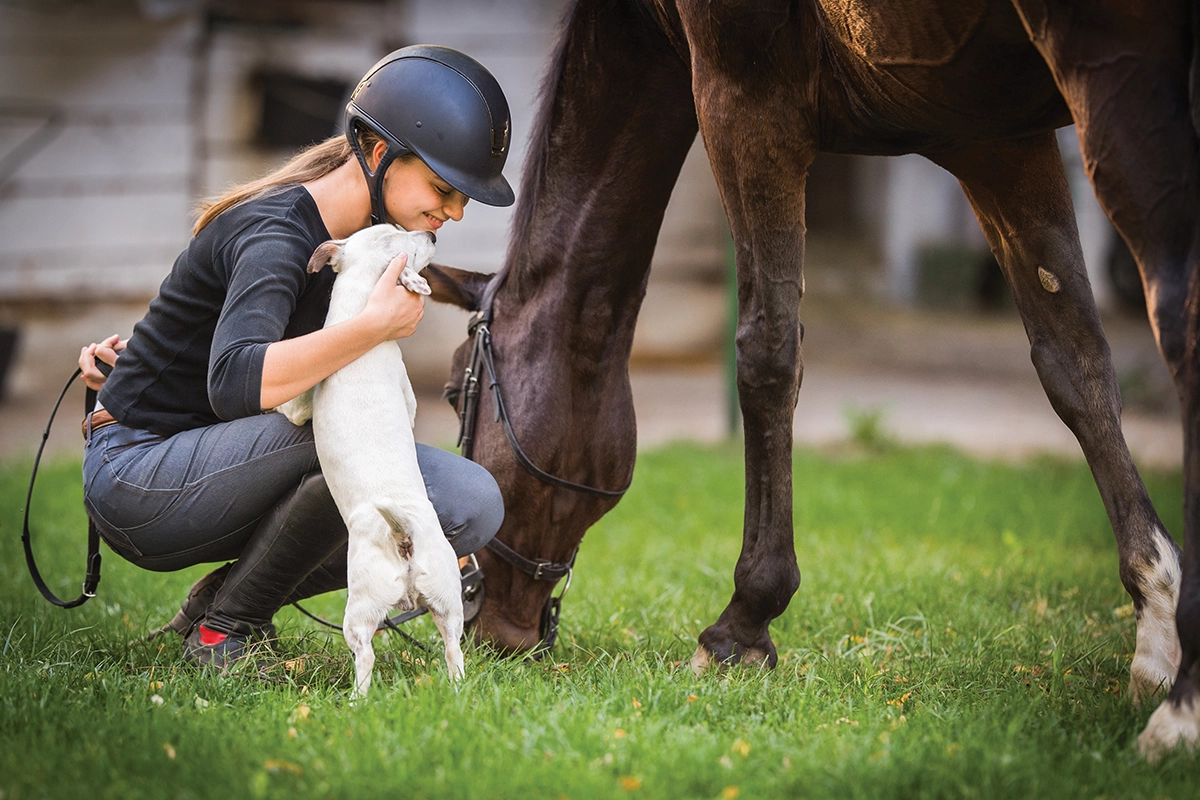
Photo by Dusan Kostic/Adobe Stock
Start With a Vet Visit
Catherine Donworth, DVM, is a small animal veterinarian in Lexington, Ky. She has two dogs that come to the boarding farm where she keeps her dressage and fox hunting horse. In addition to her own dogs, over a dozen other farm dogs are regulars on the property.
According to Donworth, before you consider introducing your dog to farm life, it’s critical to have a parasite control plan in place.
“You have your internal parasites and your external parasites,” she says. “You want to control fleas, ticks, heartworms, roundworms, hookworms, whipworms, and tapeworms. There are three-month flea and tick products, which you can pair with a heartworm preventative. You can also get a 12-month heartworm preventative injection that takes care of most of your intestinal parasites. Find one you like and stick with it—don’t chop and change.”
In addition to parasites, Donworth says it’s critical to make sure your dogs are properly vaccinated. The No. 1 priority is a rabies vaccine, just in case the dog bites a horse or human. But as with horses, there’s a list of core vaccines that all dogs should receive.
“You’ve got your core vaccines that every dog should have regardless of their lifestyle,” she says. “A kennel cough vaccine is also important for barn dogs because there are going to be lots of dogs at the barn, and kennel cough (Bordetella) is highly infectious between dogs. If one dog comes in coughing, they’re all going to start coughing. It’s not life-threatening unless they’re very old, very young, or have lung disease, but you want to make sure that all your barn dogs are up to date. And depending on where you are in the country, vaccinating against Lyme disease is important.”
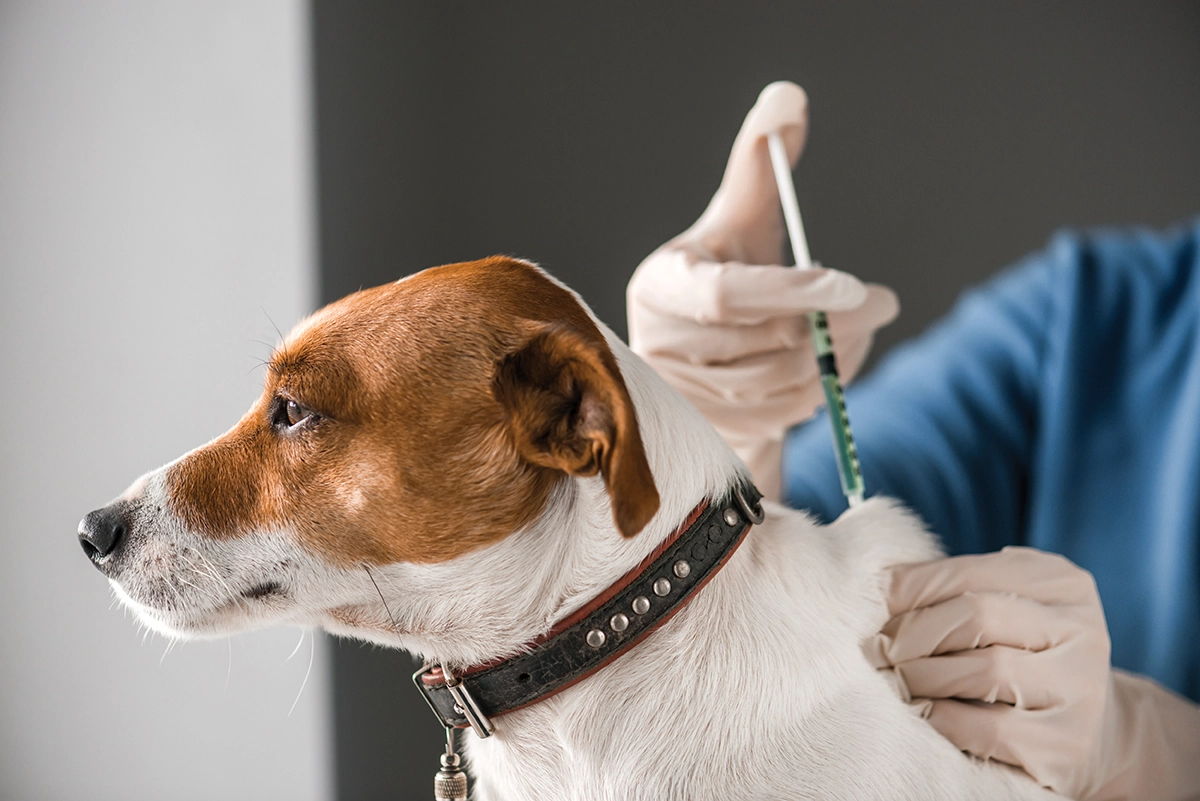
In addition to the core vaccines, barn dogs should be vaccinated against kennel cough, and in certain locations, Lyme disease. Photo by Ivan Kmit/Adobe Stock
Injury Preparation
Just like horses come in from the field with new scrapes and bumps, barn dogs may also get occasional injuries.
“The most common injuries are lacerations and dog bites,” says Donworth. “You can’t always stop dogs from being kicked by a horse, and a lot of people have run over their dogs with a small farm vehicle.”
Donworth recommends having a first-aid kit on hand for your dog, similar to the one you have for your horse.
“You should have something to flush out a wound, like sterile saline or dilute chlorhexidine, or a very dilute iodine, like what you would have for a horse,” she advises. “You also need a topical antibacterial wound ointment.”
When wrapping a wound, Donworth recommends a non-stick layer covered by padding, then covered by Vetrap.
Not all wounds can be dealt with on the farm, and Donworth sees a lot of barn dogs at her clinic. She says that if your dog has a full-thickness wound, it’s time for him to go to the vet.
An injury may also require antibiotics. While it might be tempting, you shouldn’t improvise with your horse’s medications.
“You should not give your dog SMZs out of your horse’s stash,” says Donworth. “Talk to your vet before you start administering equine drugs to your dog, and that goes for dewormers, too. I’ve seen dogs have terminal neurological effects from owners treating them with equine dewormer. There are some drugs, such as Previcox, that you can use in both species, but the milligram per kilogram dose is vastly different, so seek advice from your vet first.”
Some barn dog injuries end up being more complicated than simple lacerations. Just like a horse can injure his suspensory ligament or have other soft tissue trauma, so can dogs. While it is tricky to use crate rest (like stall rest for dogs) or keep your canine at home, Donworth says that following your vet’s instructions is crucial to healing.
“If your dog gets diagnosed with a soft tissue injury, like a pulled biceps tendon, and the vet tells you to rest the dog, rest the dog,” she says. “Running around the barn is not resting your dog. A dog is like a horse—if you’re told or horse has a tendon injury and to stall rest him and you don’t, he isn’t going to get better. The same goes for dogs.”
Introducing a New Dog to the Barn
When introducing new horses into a herd, it’s important to consider potential personality clashes and introduce them under supervision. The same goes for barn dogs.
At the farm where Donworth boards her horse, almost everyone has a barn dog, meaning there are new additions regularly. She says that the best way to introduce the dogs varies.
“In general, I would say that the lower key you keep it, the better,” she advises. “Most dogs will be more anxious on a leash with their owner.”
She adds that while it can be tricky for owners to stand back and let their dogs sort out the dynamic, squabbles are somewhat normal.
“It’s a little bit of live and let live—the bigger deal you make of it, the bigger deal the dogs will make out of,” Donworth explains. “Don’t intervene at every opportunity, but do be careful, because there may be reactive dogs or aggressive dogs—who shouldn’t be taken to the barn in the first place.”
Basic Training
To help keep yourself, your dogs, and the horses safe, dogs should have good recall and be able to follow basic commands before coming to the barn. If your dog can’t focus on you and stop when he is told to stop, he likely isn’t ready for barn dog life.
A large risk to both horses and dogs is dogs in fields with horses, where they might be tempted to chase or play with the horses. If your dog can’t follow directions well enough to stay out of fields or listen to you when the temptation of chasing a horse’s tail gets the better of him, it’s best to leave him at home.
“Under no circumstances can you let your dog chase horses in the paddocks,” says Donworth. “The dog is going to get hurt or the horse is going to run through a fence. Don’t bring a dog to the barn that doesn’t have basic fundamental recall and some level of obedience.”
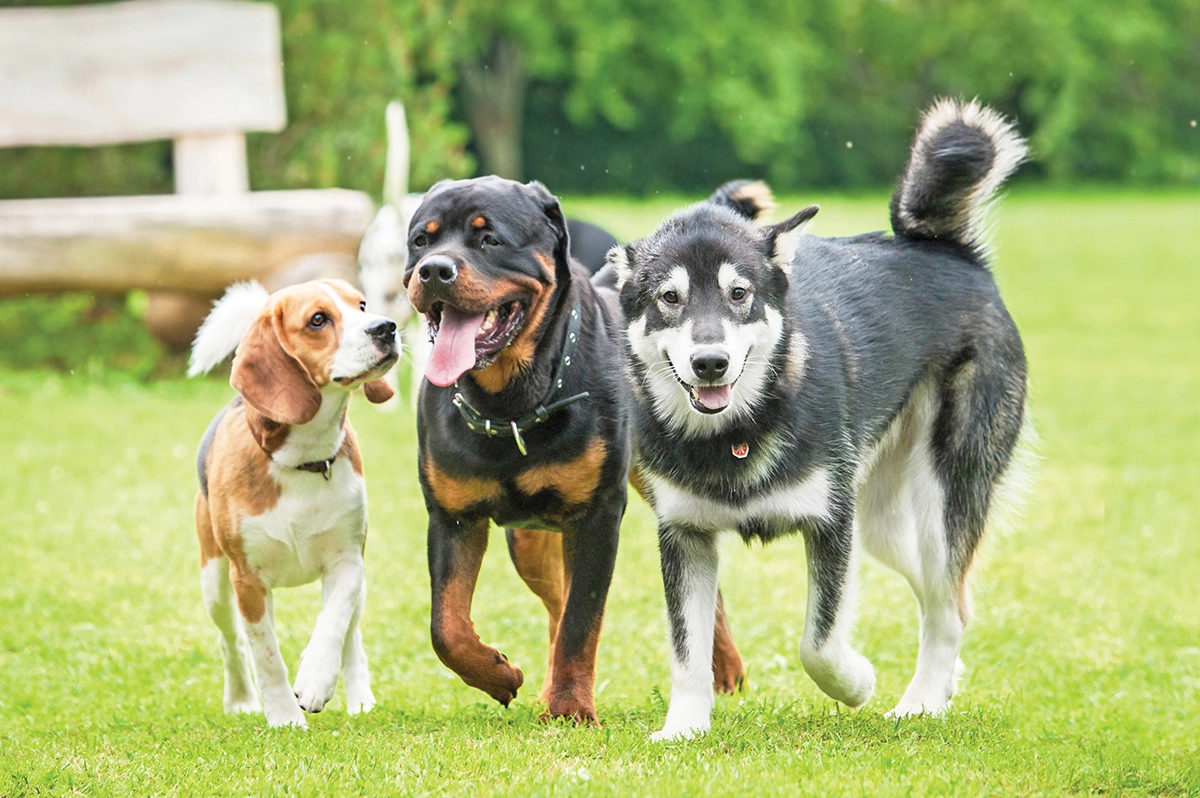
Don’t bring a dog to the barn unless he has a solid recall and is not aggressive toward other dogs, people, or horses. Photo by Rita Kochmarjova/Adobe Stock
Marty Whitehouse, DVM, owns and runs Red Gate Equestrian Center in Nicholasville, Ky., and is also a small-animal veterinarian. She agrees that barn dogs need to have appropriate manners and training.
“There are good barn dogs and there are not-so-good barn dogs,” says Whitehouse. “Even my dog has limitations. He gets tied up because he’s not allowed to run around while I ride.”
Responsible Dog Owners
While some breeds, such as cattle dogs, are common in barns, the makings of a good barn dog are not necessarily breed specific.
“It’s not all about breed,” says Whitehouse. “It’s about demeanor.”
Not every dog is a barn dog, and that’s OK. Some dogs might require additional oversight at the barn, and others are simply inappropriate to have around horses.
“If you have an aggressive dog, he’s probably better left at home,” says Whitehouse. “It’s not fair to everyone else at the barn to have that type of stressor, especially if your dog isn’t friendly with other dogs or barks at horses. It’s hard for everyone to ride when that’s happening.”
When it comes to training, Whitehouse says that other boarders, the barn owner, manager, et cetera can’t be responsible for your dog. Just like you put in time training your own horse, it’s your job to train your own dog.
Most barns that allow dogs have rules outlining what barn dogs are and aren’t allowed to do.
“You have to respect the owner or barn manager’s rules on where dogs are allowed, and if they are allowed to be free when people are riding,” says Whitehouse. “Especially if there is jumping and other ring work going on, it can be really distracting if dogs are running around.”
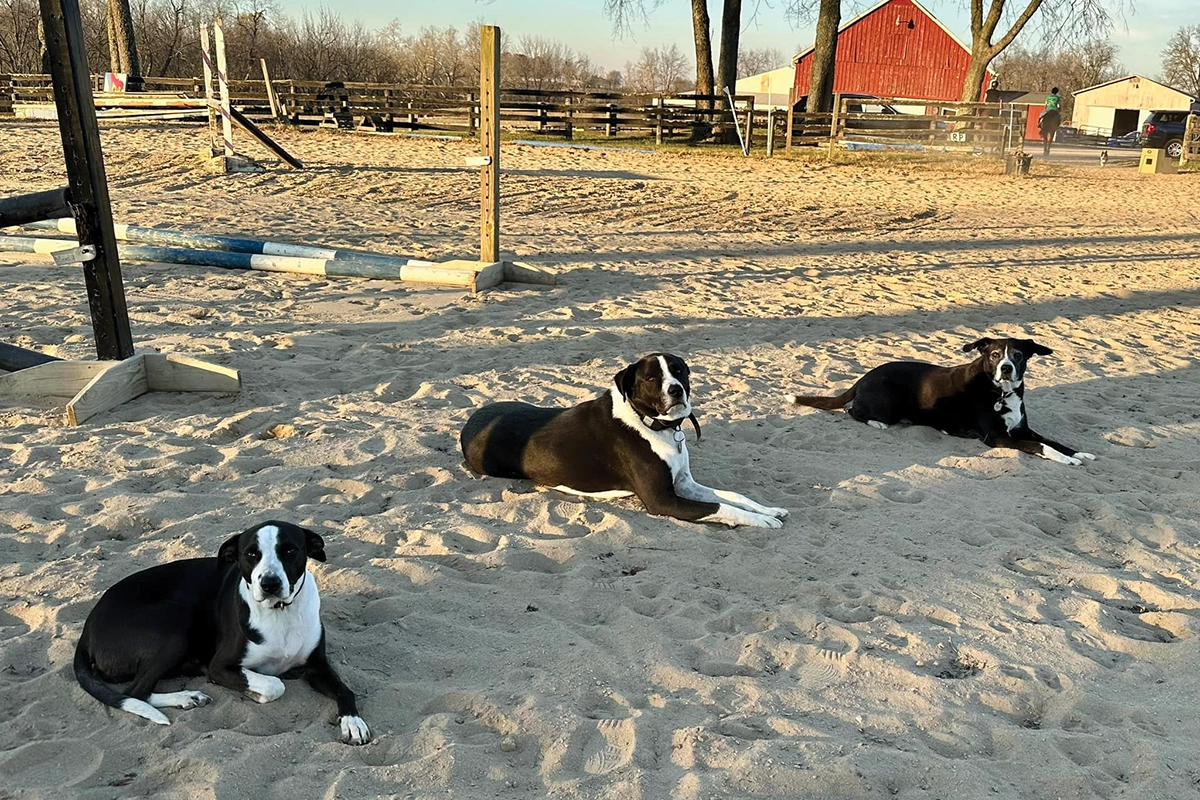
Does your barn allow dogs in the ring? Make sure to follow all facility rules to avoid unnecessary accidents. Photo by Shoshana Rudski
Even if you have a dog that can’t behave while you are riding, that doesn’t necessarily mean that barn life is entirely out of the question for him. You might just have to adjust your game plan. Whitehouse suggests that trickier dogs only come out to the barn on days when you are cleaning your tack and not riding to help keep everyone safe.
If the farm requires or requests that dogs be contained while people are riding, it’s critical to come up with a plan that works for your dog.
“I’ve seen things happen when people tie up dogs around horses,” says Whitehouse. “I had a friend’s puppy get its neck snapped at a horse show. It was awful.”
She advises not to tie your dog anywhere a horse could reach him due to risk of getting tangled up.
“This could hurt the horse or the dog and cause major injury or mortality,” says Whitehouse.
Riding with Dogs
Part of the fun of bringing your dog to the barn is getting to ride with him, whether on trails or just hacking around the farm.
Introducing dogs to riding with horses is easier with a younger dog, according to Donworth.
“It’s important to start a dog at a young age, and there is a risk to that,” she says. “He has to learn to stay away from the horse’s feet and will probably get stepped on a couple of times, hopefully not severely, but you have to accept that if it’s what you want to do with your dog.”
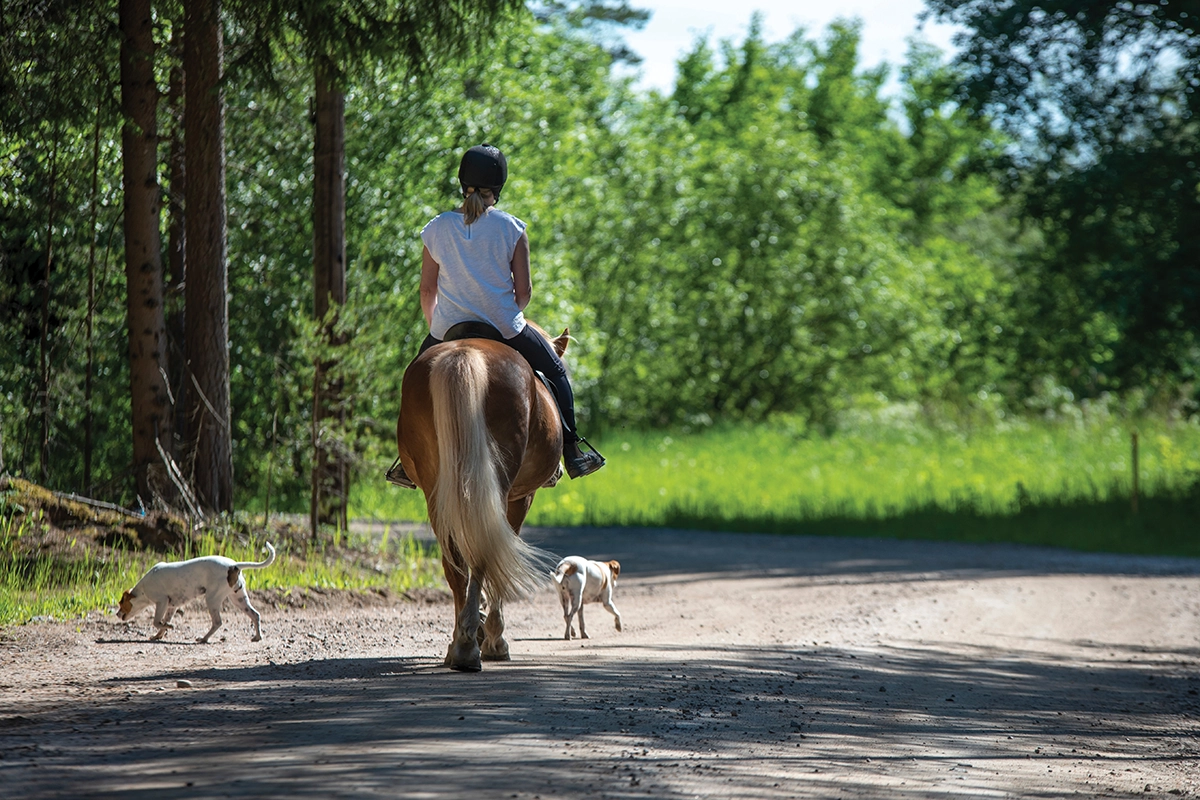
It may be easier to introduce a younger dog to life as a riding companion as they learn to keep up and stay out from underfoot. Photo by citikka/Adobe Stock
Whitehouse adds that not all horses react well to even the best-trained dogs. This even goes for fox hunting horses, who are accustomed to hounds working around them.
Essentially, choosing to ride with your dog comes with risk, and while the risk can be minimized, it cannot be entirely avoided.
Other Safety Considerations for Barn Dogs
In addition to having a solid training base and keeping a close watch on your dog at the barn, some other precautions can keep your dog safe and comfortable.
“Tracking devices, such as Fi collars, are great,” says Donworth. “Air tags are also good. Your dog should also have a low-tech ID tag with your phone number. It’s simple, but it can result in you getting your dog back. All barn dogs should also be microchipped.”
In addition to tracking devices, she says a light-up collar can keep your dog safer.
“Light-up collars are great on dark evenings and can keep your dog safe from cars and people coming in and out of a busy barn,”
says Donworth.
And while it might be cute to dress your dog up in fun sweaters and coats, Donworth thinks that dog jackets are overused. You don’t want your dog to overheat.
Minimizing Liability
Accidents happen, but taking your dog to the barn can put you at risk for liability concerns. The barn’s rules might be based on their liability insurance requirements, but that doesn’t leave you entirely risk-free.
“It’s your dog, so responsibility will come down to you,” cautions Whitehouse. “If you aren’t paying attention or an accident happens, you’re going to be liable for veterinary payments or for property damage.”
With proper planning, health care, and training, your dog can be an integral part of your barn time. It’s well worth investing the time to keep your dog, horse, and other horse owners safe at the stable.
This article about barn dog safety appeared in the March/April 2025 issue of Horse Illustrated magazine. Click here to subscribe!