Here, two trainers provide their under-saddle communication tips for a better horse-rider relationship.
Have you ever wondered if your actions could be influencing your horse’s progress? Subtle changes can help promote the best possible partnership with your horse.Kim Walnes is one such expert on the subject—you may remember her name as individual and team bronze medal winner at the 1982 World Three-Day Event Championships in Germany and the Rolex Kentucky Three-Day Event winner the same year.
But even more so, she’s known for her incredible bond with her mount, The Gray Goose, during their banner years from 1980 to 1986 as members of the United States Equestrian Team.

You might assume their star-studded career began as a walk in the park, but that’s not the case.
“When I started riding Gray, he already had a bad reputation. He bit, kicked, and threw people off. He also bolted. I could see in his eyes and in his attitude toward life that, in his mind, the best defense was a good offense,” recalls Walnes, who also is a coach and clinician with The Way of the Horse.
Channeling Compassion
Horses are excellent teachers. Before Walnes acquired the legendary Gray, she had a 3/4 Arabian named Hunraff (“Raffy”). Raffy taught her to recognize the signs of fear in a horse. Due to early life experiences, both Raffy and Gray started out distrustful of humans.
“I stopped trying to control [Gray’s] behavior and began letting him know I was a safe space to be around,” says Walnes. Channeling earlier learnings from Raffy, she understood that aggression can come from a base of fear. “I was compassionate toward [Gray], and everything shifted. The cool thing with horses is they forgive us once we understand.
“Listening ensures understanding,” Walnes continues. “What I see a lot is, ‘My horse has to be disciplined.’ He can’t stop when he says he needs to—it’s ‘one more lap.’ When we listen to the horse and say, ‘Sure, I understand how you might be more tired than I thought, let’s stop here,’ they will start working with us.”

Fear & Confidence
“If you’re anxious in any way, for any reason, all the horse will feel is fear,” says Walnes. “Safety is his No. 1 priority. We’re supposed to be their leaders and protecting them, and if they feel fear from us, they will be looking for what’s wrong in their environment. The horse picks up on your emotions immediately.”
Walnes recommends taking a moment to ground yourself with reassurance.
Try these steps:
1. Calm your nervous system by putting a hand on your heart or stomach.
2. Observe your surroundings to confirm there is no danger.
3. Reassure yourself by voicing, “In this moment, we’re safe.”
4. Express your desire to work together when approaching your horse. Voice your anxiety and request mutual patience.
“Explaining things to a horse is like a miracle,” says Walnes. “Because they’re like, ‘Oh, OK.’ Horses are highly intelligent, sentient beings; we just don’t speak their language. In order for your horse to trust you, he must know you trust yourself.”
Acknowledgement & Presence
Try to be aware of common under-saddle errors, says Esther Kuhlmann, coach at Northland Equine Lessons and Training just outside Kansas City, Mo.

“A horse is a flight animal,” explains Kuhlmann, who was part of the Danish Team as a young rider. “The more you pull on the reins, the more the horse pulls against you. And when he goes faster, you [grip with] your knees because you are nervous—that is just human reflex. If you come forward in your shoulders and you hang on your knees, then the horse is just gone. You have to remember to let go.”
To help, Kuhlmann suggests groundwork and longe line lessons. Longe lessons help you concentrate on your riding form. She also recommends a lesson on a schoolmaster to teach you how the horse is supposed to feel.
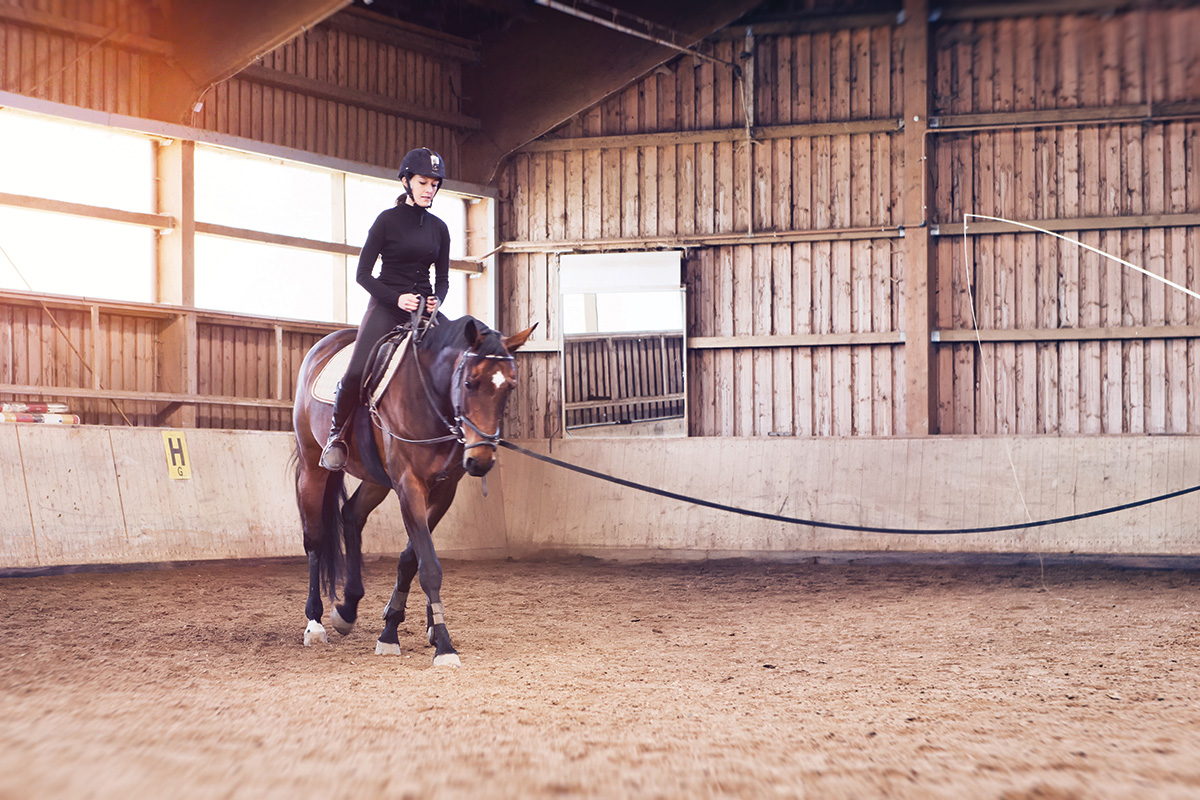
Riding with tension can contribute to a horse’s stiffness and tension.
“I always go to the horse first to make sure there is nothing wrong with him,” says Kuhlmann. “Ninety-nine percent of the time, it is the rider.”
For a more fluid connection with your horse, she recommends practicing yoga and Pilates.
Riding with clarity is important for horses, “rather than going out vaguely and riding circles,” says Walnes.
“Training is like playing ‘hotter or colder,’” she continues. “It’s helpful to have a clear yes/no signal with the horse. You need to give the horse signals that he is on the right track, such as using a word like ‘good’ or a rolled ‘R’ sound, rather than the old paradigm that no punishment means he’s doing great.”
Tone & Behavior
“Horses understand us and what we say,” says Walnes. “They pick up the thoughts behind your words. When we label them or call them demeaning names, they feel the same as a human would feel in that situation. They tend to live up to expectations, and it builds resentment.”
Do your best to speak kindly and to be mindful of your emotions and bad days, such as an off day at work. On such days, Kuhlmann asks that students opt for a trail ride or longeing instead of a lesson.
“Otherwise, the horse feels it immediately,” she says. “Horses are sensitive and can read your heartbeat from 5 feet away.”
Consider this guidance when looking to improve the bond with your horse.