If you’ve ever tuned in to the Kentucky Derby or Breeders’ Cup broadcasts, then you’ve seen NBC Sports trackside commentator Donna Barton Brothers on horseback, microphone in hand, interviewing the winning jockey just seconds after crossing the finish line. Donna makes her multifaceted job look easy—asking questions on the spot to recap the race, while riding shoulder to shoulder with the victorious duo.
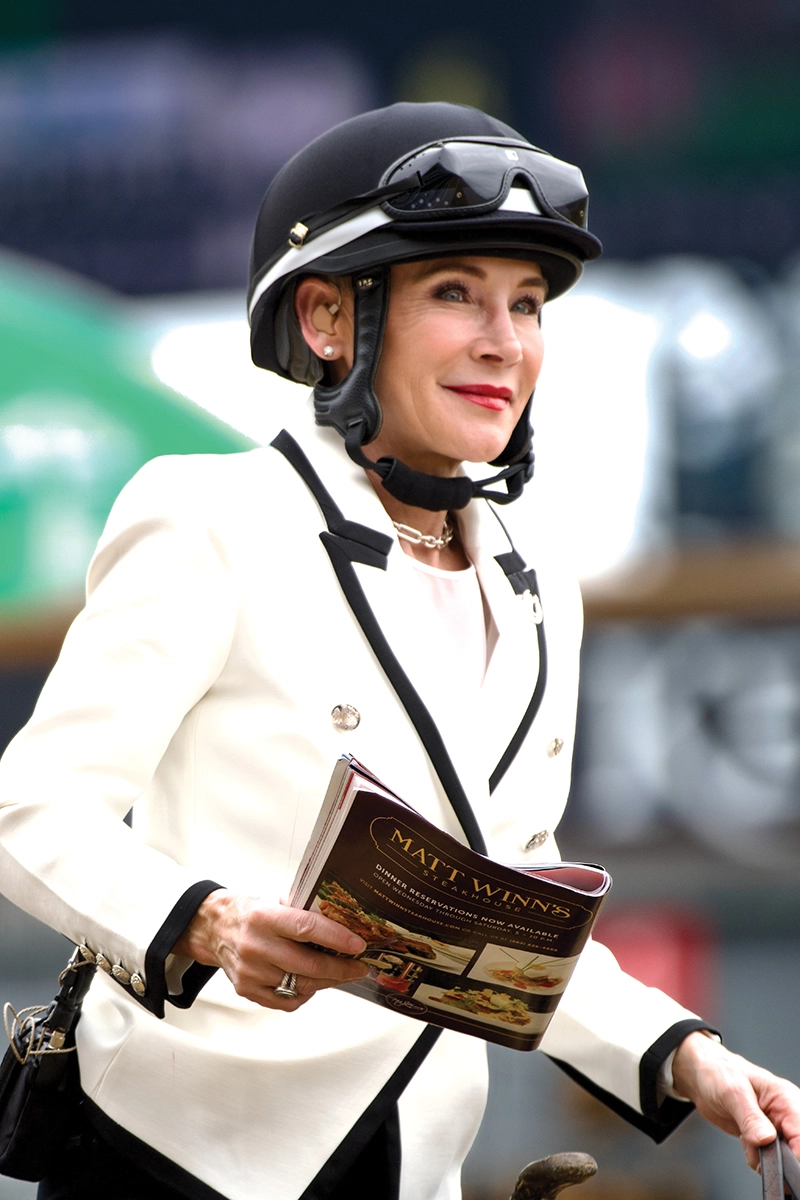
Photo courtesy Donna Barton Brothers
Racing Shetlands
Before Donna began race reporting, she carved out a jockey career that spanned 12 years and 1,130 wins. In the 1990s, she regularly rode for Hall of Fame trainer D. Wayne Lukas, piloting numerous stakes winners. Although she retired in 1998, Donna is still one of the top female jockeys of all time in purse earnings, at $18 million.
Growing up in Chester, W. Va., Donna’s first “races” were ridden bareback on Shetland ponies against her little brother Jerry and older sister Leah. The pasture where the ponies lived served as their track.
“At some point, we would end up in a race,” she recalls. “I think the ponies’ goal was to get into the woods, and the first one that could jump a log while going under a low-hanging branch and get rid of us won.”
The three Barton siblings, who would all later become jockeys, did what came naturally: ride at speed. Horse racing is part of Donna’s family’s DNA. Patti Barton, Donna’s mother, was one of the first six licensed female jockeys in the United States. Patti raced from 1969 until 1984, amassing just over 1,200 wins.
Donna is married to Frank Brothers, a retired Thoroughbred racehorse trainer who won two of the three Triple Crown races in 1991 with the colt Hansel. The couple splits their time between Louisville, Ky., and Saratoga Springs, N.Y., with their dogs Molly and Jackson.
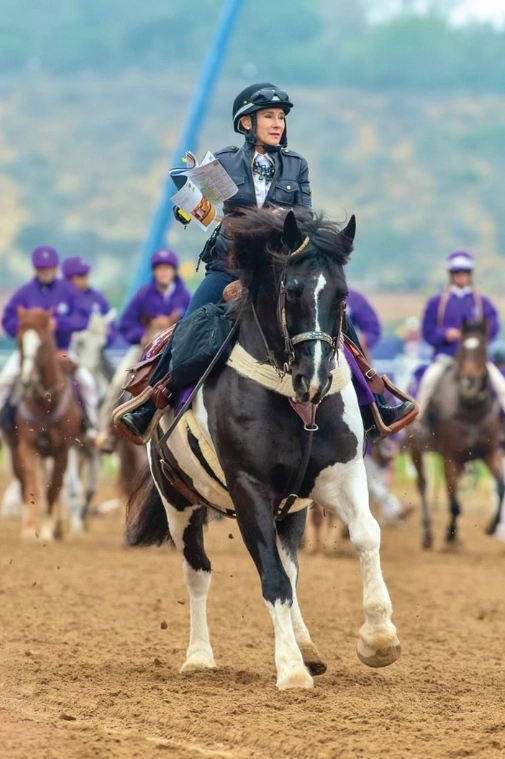
Juggling a mic and race program in front of the cameras while galloping on a horse is no easy feat. Photo courtesy Donna Barton Brothers
Race Day Reporting
In the three months leading up to the Triple Crown or Breeders’ Cup, Donna spends six to eight hours a day on her computer.
“I’m reading articles, researching horses, and watching races,” says Donna. “[I’m] reading about those races beforehand, and reading the comments after.”
On race day, she multitasks.
“I’m riding a horse, and I’m trying to make sure that the horse and I don’t part ways,” she says. “And at the [Kentucky] Derby, there’s people on the outside fence who are banging on the fence, because they’re excited that the Derby’s running. That could spook my horse. So I’m paying attention to my horse and what my horse is paying attention to, and I’m listening to the call of the race in my ear … I’m listening to see who’s in the lead. I’m listening to see how fast they went in the first quarter [mile], how fast they went to [the] half.”
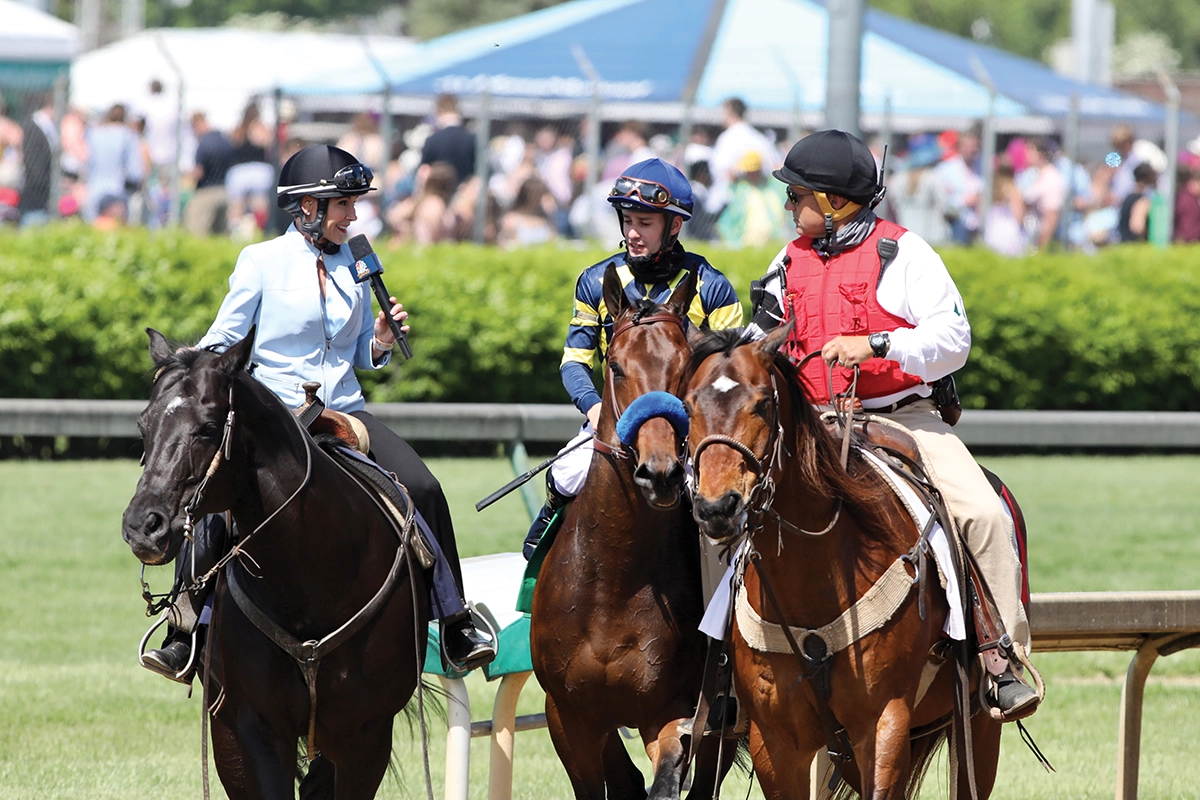
Donna Barton Brothers is instantly recognized by equestrians as she interviews winning jockeys after the biggest races in the country. Photo courtesy Donna Barton Brothers
Despite being on the track, positioned behind the starting gate, Donna can’t see the races from her saddle’s vantage point. Once the gate’s latch is sprung, she gallops behind the field. In longer races, she gallops away from the field.
“In a race like the Kentucky Derby where the distance is a mile and a quarter, that wouldn’t give me enough time to get to them,” she explains. “I’ll wait until they spring the latch, and then I take off galloping [in] the opposite direction. So I’m going around the turn that’s going to be their second turn, headed in the opposite direction. And then I’ll get to about the half-mile pole and stop and let the field run by me. And I get a glimpse of the field. Then I take off galloping again down the backstretch, so that I’m in position to interview them after the race.
“For the most part, I have no idea where the winning horse came from, unless it was in the lead the whole way,” she continues. “At first, I saw that as a liability, because I’m going to interview the winning rider, and I don’t know anything about their ride. Then I realized that unless the horse is in the lead the whole way, 90 percent of our viewers also have no idea where that horse came from. It puts me in a position to be able to say to the rider, ‘It looked like your horse didn’t get away from the gate cleanly. Can you tell me about your trip from the start of the race?’ It allows the rider to tell us about the trip.”
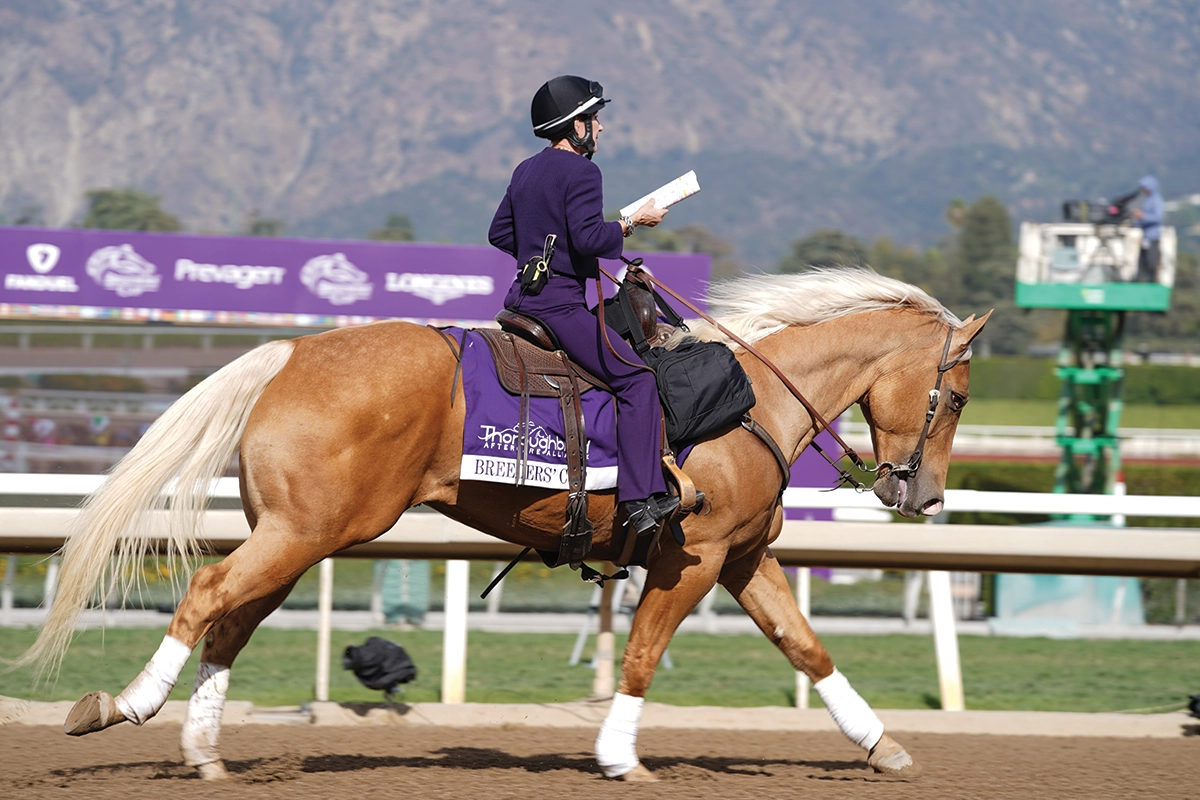
Donna rides past the scenic mountains at Santa Anita during the Breeders’ Cup Championships. Photo courtesy Donna Barton Brothers
Triple Crown History
In 2015, Donna covered the Belmont Stakes when American Pharoah and Victor Espinoza ended horse racing’s 37-year Triple Crown drought. When the bay colt crossed the finish line to cacophonous celebration, Donna kept her emotions in check.
The next day, she called her brother and sister and discovered they’d both watched the race from their respective homes with tears in their eyes. Donna reflected on the magnitude of the winning moment and captured the emotion of the moment by writing an essay for the New York Times entitled “Holding Back Tears After American Pharoah’s Triple Crown.”
Just three years later, Donna witnessed history again when Justify won the Triple Crown in 2018. She recalls her first impression of the chestnut colt.
“As soon as he walked out of the barn, I thought I was looking at a Greek Adonis of a horse. He was just a magnificent specimen, and I thought, ‘This horse is going to win the Kentucky Derby.’” When Justify clinched the Triple Crown title, Donna was elated for jockey Mike Smith.
“He had paid his dues, and he is a good, good person, and he’s a great rider.”
Donna’s last interview question with Smith was almost never asked. The cameras were about to switch to winning trainer Bob Baffert, but Donna insisted on one more question.
“My last question was, ‘Mike, we talked some months ago, and I asked you about how you felt about being inducted into the Hall of Fame, and you told me that you didn’t really feel like you deserved it at the time. Do you feel like you deserve it now?’ And he said, ‘Yeah, I feel like I belong now.’ That was special. It was nice to see him come full circle on his accomplishments, and he had such a deep appreciation for the horse that if I hadn’t asked that question, he wouldn’t have taken a second to look back on what he had done.”
Donna and Mike Smith’s historic exchange is now part of a reel at the National Racing Museum and Hall of Fame in Saratoga Springs, N.Y.
A Close Call
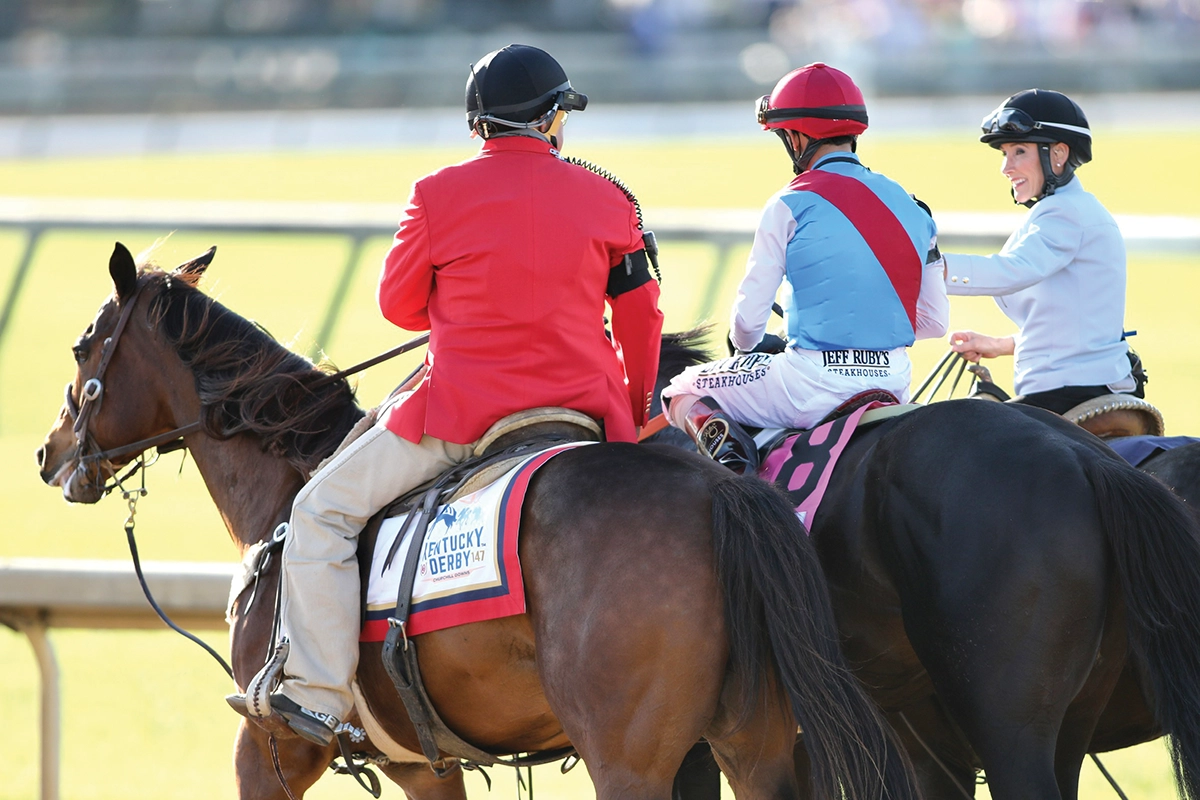
Coming up with insightful on-the-spot reporting is part of what has made Brothers a staple on race day. Photo courtesy Donna Barton Brothers
Donna remembers one race at Keeneland Racecourse in Lexington, Ky., as “a little too exciting.”
“As soon as the [starting gate’s] latch was sprung, a horse dropped its rider,” she says. “So I turn up the backside, and the outrider’s standing there, and he knew full well there was a loose horse. Now I have to stay out of his way, and he’s on the outside. The BATCAM [a camera mounted to a wire that runs along the backstretch] is going to come running toward me when the field comes toward me, and Sherman, the horse I was riding, doesn’t like the BATCAM. He spooks at it every time.
“The field is running toward me on the inside fence, and the loose horse is running toward us in the middle of the racetrack,” she continues. “We had to run directly under the BATCAM, as it was headed straight for us—that was the only place I could avoid the outrider, the loose horse, and the field.”
Donna cued to the gelding that they needed to dart directly under the aerial camera. Sherman rose to the occasion, and the two ran directly under it. She continued commentating, making her job look effortless once again.
Follow Donna on Facebook @BartonBrothers or Instagram @brothers.donna.
This article about Donna Barton Brothers appeared in the May/June 2025 issue of Horse Illustrated magazine. Click here to subscribe!