0 ITEMS
  • My Account
  • Holiday Gift Guide
  • Podcast
  • Webinar
Subscribe Combo
Enable cache13
Home Blog Page 11

An Overview of Working Equitation

0

Many equestrian sports trace their origins to horses’ practical uses. The need for fast horses as transportation led to racing. Ranch work begat rodeo. The multipurpose training of cavalry mounts led to eventing. More recently, the diverse traditional duties of several old European breeds have given rise to a discipline that’s garnering a lot of interest. It’s called working equitation (WE)—and if you think you and your horse would enjoy doing a bit of dressage, jumping, obstacle navigation, and maybe even cattle work all at one show, then read on, because this sport might be for you!

What is Working Equitation?

WE was developed in Europe in the mid-1990s as a fun pastime as well as a means of preserving the equestrian traditions in Spain, Portugal, Italy, and France, where Iberian horses and other breeds served as hardy, nimble, brave mounts to work cattle. The horses’ ability to collect also made them natural choices for classical dressage.

“I describe [WE] as dressage with obstacles, or a trail course with dressage,” says Taylor Lindsten, of Taylor Made Sport Horses in Scottsdale, Ariz. Primarily a dressage trainer, Lindsten is a newer WE enthusiast—and her success proves that some horses can excel in both sports: A current mount, the Georgian Grande stallion Wallace G, not only notches wins in WE, but also competes at the FEI levels in dressage, earning the Intermediate I Open championship title at the 2023 U.S. Dressage Finals.

As Lindsten explains, WE consists of three “trials”: dressage, ease of handling, and speed, typically ridden all in one day. An optional fourth element, the cattle trial, is mandatory in more advanced competition, and entails working with other horse/rider combinations as a team to cut a designated cow from the herd and move it to a holding pen.
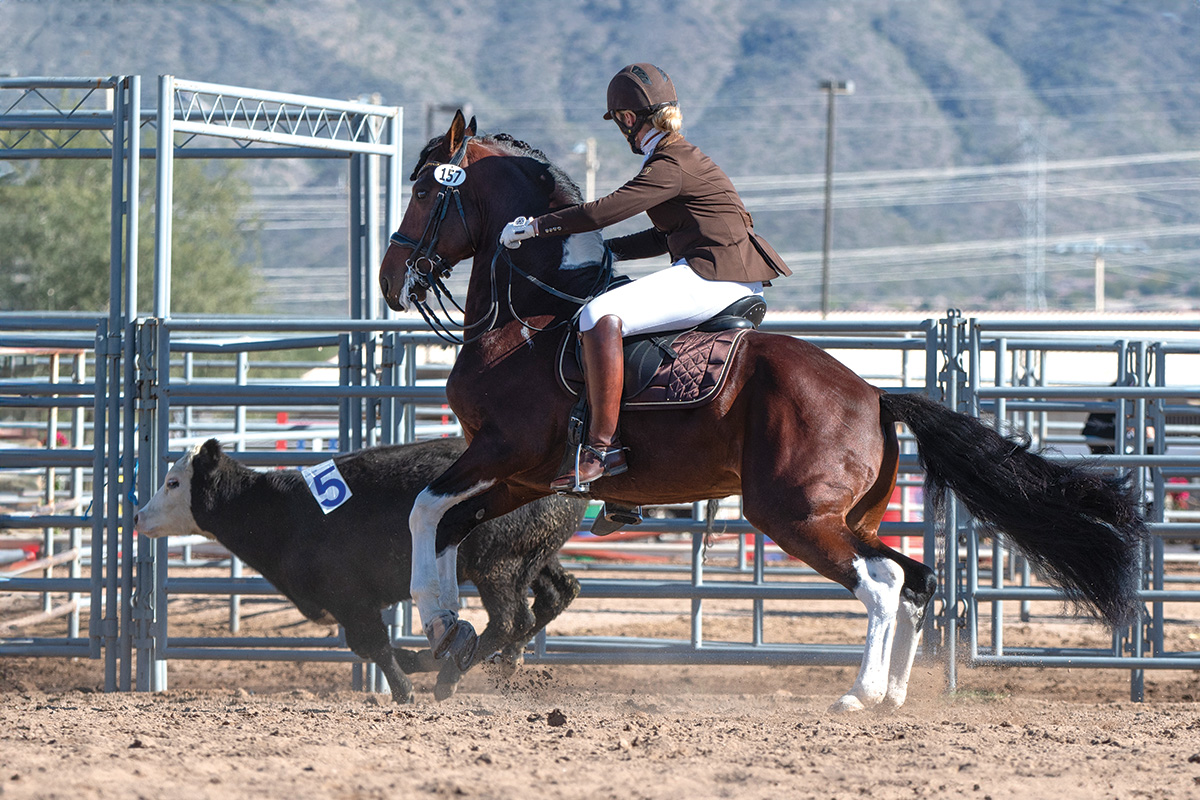
A more advanced working equitation (WE) competition featuring a cattle trial.
A cattle trial is required in more advanced competition, as Taylor Lindsten and Wallace G show here. Photo by Steed & Hound Photography

The Three Trials

Dressage

Modeled after the U.S. Equestrian/U.S. Dressage Federation’s tests and competition structure, WE dressage is ridden in a small dressage arena measuring 20×40 meters, the size often used for dressage tests in lower-level eventing (regulation size for dressage and upper-level eventing dressage tests is 20×60 meters).

The seven tests range in difficulty from Introductory (walk, trot, halt, and rein-back) to Masters (a test executed to music that includes canter work, pirouettes, extended gaits, and flying lead changes—all ridden one-handed!). Tests are judged using the established 0-10 scale of marks.

Ease of Handling

Horse and rider navigate an obstacle course that combines elements of several disciplines, including crossing a bridge, opening and closing a gate, hopping over a small jump, sidepassing over a pole, bending around poles or barrels, reining back through an “L,” and others.

Elements and required gaits increase in number and difficulty through the levels, and judges want to see competitors negotiate the obstacles “in a stylish and organized way,” Lindsten says.
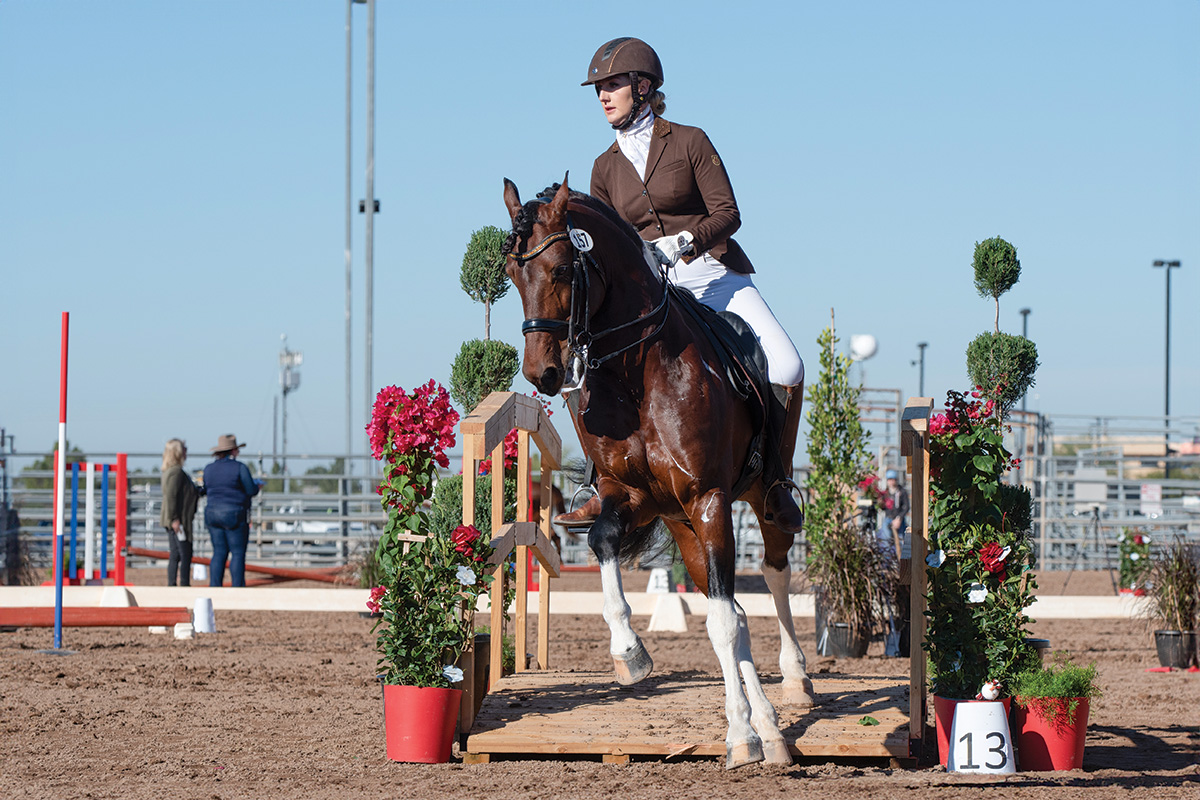
The Ease of Handling trial of working equitation (WE).
Ease of Handling may include a small bridge, opening and closing a gate, backing in an “L”, sidepassing over a pole, and more. Photo by Steed & Hound Photography

Speed

The clock is the only thing that matters on this final obstacle course. Like jumping faults, riders are penalized for such errors as going off course, refusals, or even switching the hand used to handle an obstacle. In a nod to the sport’s origins, WE obstacle courses require riders to spear a ring with a long pole—shades of the garrocha that vaqueros use to maneuver cattle.
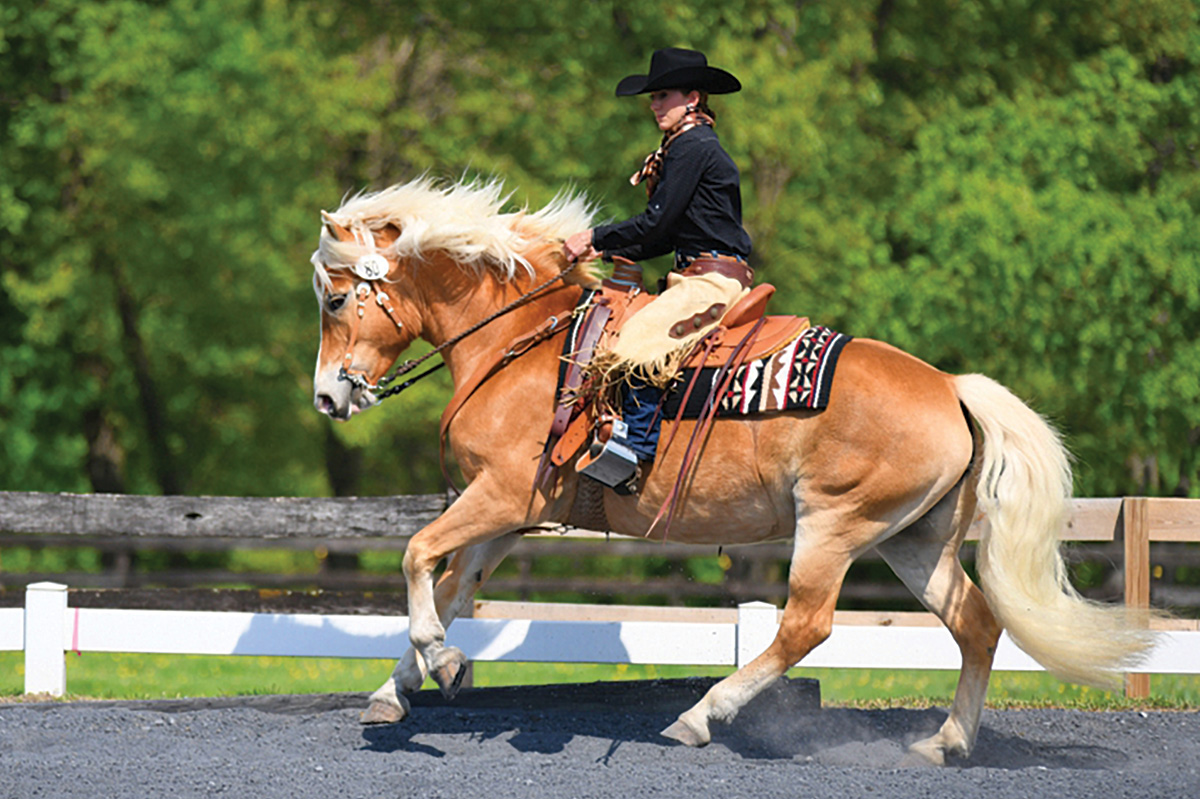
The speed portion.
In a nod to the sport’s origins, WE obstacle courses require riders to spear a ring with a long pole—shades of the garrocha that vaqueros use to maneuver cattle. Photo courtesy Emily Kemp

The Ideal Horse for Working Equitation

Dressage basics underlie WE, but the sport “develops a horse that is extremely versatile,” says USA Working Equitation (USAWE) Professional Instructor, technical delegate, and “L” judge Emily Kemp, who operates Kemp Horsemanship in Newton, Wisc.

A “smaller, handier” mount may have an advantage given the speed and agility requirements—Kemp successfully showed a 14.2-hand Haflinger, which she calls “an ideal size”—but all breeds are welcome. Even gaited horses may participate, substituting their gait for the trot. But a dressage background remains a competitive advantage because “balance is huge,” she says.

The reverse may also hold true: As Lindsten discovered, WE can actually be a boon to dressage training. While teaching Wallace G the flying changes a few years ago, she found that “he had a lot more interest in his work when we were working with the obstacles.”

She rode turns around barrels and poles to help teach him to bend and yield to her leg aids, and the obstacles provided “a purpose in what I was asking him to do, and a purpose for the lead changes.”

Who Can Ride It?

In WE, rider backgrounds are similarly varied. Kemp’s wheelhouses are natural horsemanship, cutting, and reining.

Competitors may show in any discipline’s tack and apparel: Kemp goes western, while Lindsten enters at A in full dressage garb. (Just don’t mix and match, Lindsten says; ride in the apparel that your tack denotes.)
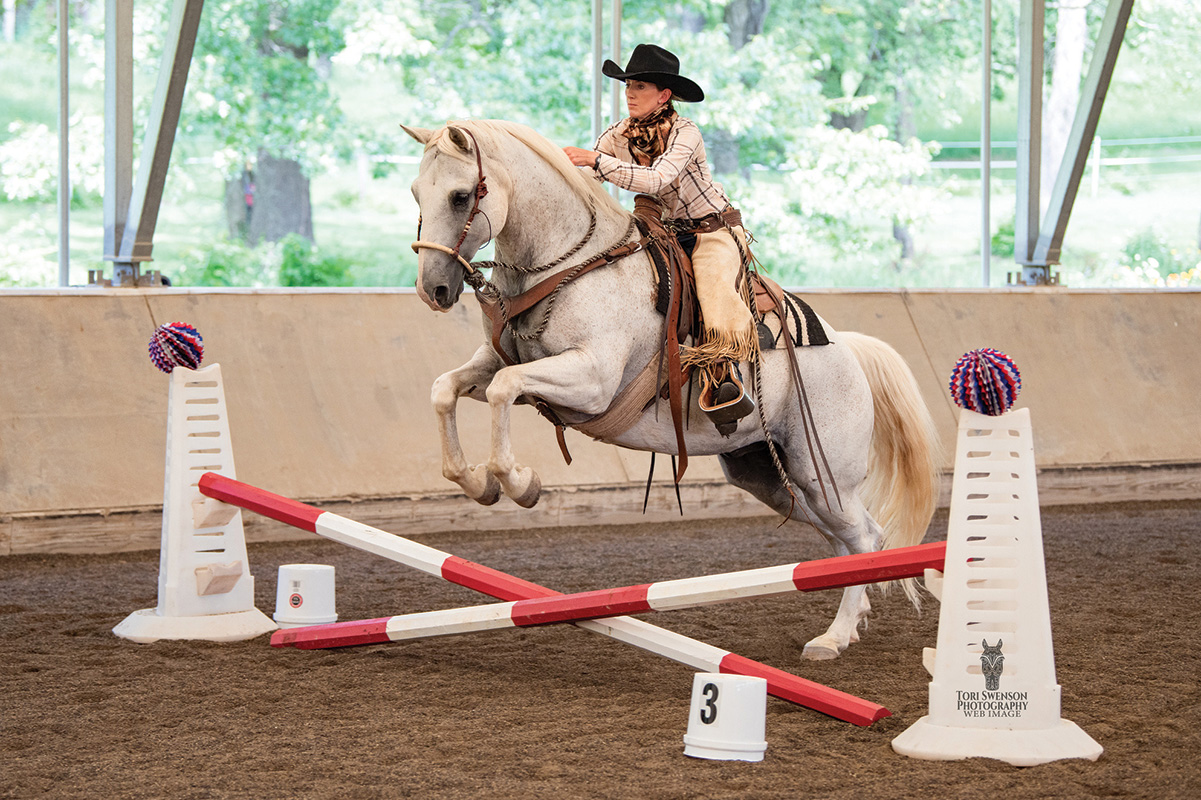
Jumping in western tack.
English or western riders can compete, as long as your apparel matches your tack of choice. Shown is Ease of Handling phase, which can include a small jump. Photo courtesy Emily Kemp

Riders with physical disabilities may apply for dispensations to compete using adaptive equipment or allowances, as well.

Kemp says that most U.S. WE enthusiasts are adults, but USAWE is “trying to grow youth participation” by reaching out to Pony Club members and other youth-oriented groups. Currently “especially popular” in California and the Pacific Northwest, the sport is working to expand nationwide, she says.

Ambitious competitors may strive to reach the sport’s international levels. The World Association of Working Equitation, the sport’s international federation, holds a World Championships every four years. The U.S. hopes to send a team in 2026—and Lindsten, for one, hopes to be on it.

Ready to Try Working Equitation?

Want to learn more about WE? Both Lindsten and Kemp recommend starting out by watching shows or clinics in your area. Find a calendar of events, rules, dressage tests, and a directory of instructors and officials on the USAWE’s website.

Kemp enthuses about the “great show environment” at WE competitions. Besides the friendly people, WE “has a way of leveling the playing field. You just keep competing until it’s done.”

The variety of skills required “takes out that super-competitive edge” found in some singular disciplines, Kemp adds, and the WE arena is one in which all breeds can compete as equals.

This article about working equitation appeared in the July 2024 issue of Horse Illustrated magazine. Click here to subscribe!
Selling My Heart Horse

0

We’ve all seen—and laughed at—the equestrians memes that poke fun at our lack of money. Our horse goes to the vet while we can’t afford to go to the doctor. Our bodies are broken and yet we still ride. The list goes on. But when those memes are no longer funny, but sad and true, it can make you question the equestrian lifestyle.

A Monumental Decision

For me, it was a phone call with my dentist. I couldn’t afford the yearly X-rays they were requiring before I could have a cleaning (I hadn’t had a proper dental cleaning in longer than I care to admit). I started to cry on the phone because they wouldn’t make an exception for me.

When I hung up the phone, I stared at my budget on my computer and thought, “I am 40 years old, what am I doing?” I had no savings, no retirement plan. Thankfully no kids depend on me and my husband, but I am not super healthy. I was diagnosed with arthritis in my 20s and was told I was already halfway to osteoporosis due to low bone density. I haven’t seen a regular doctor since then.

I spent the last several years showing a Gypsy Vanner mare—my heart horse. I loved her more than anything else, except for my husband. My only friends were those I saw at horse shows and events. But all that money, along with Covid and a series of things breaking, including needing to replace all three of our cars, had led to mountains of debt. Those memes weren’t funny anymore—they were heartbreaking and stress-inducing.

It was that day that I made the decision to get out of horses. The amount of money we had invested in a truck and trailer, tack, and the horses themselves was enough to completely pay off all our debt, except for my student loan. But also because—if I was honest with myself—it was very hard on my body and caused a lot of pain.

Saying Goodbye

I feel like there are two types of riders. The ones that ride occasionally for the fun of it. They can ride or not ride; it’s not a big deal. My husband is that type. Then there are the ones where “equestrian” defines who they are. I am in the latter group. Getting out of horses was like removing my identity.

Selling my heart horse meant saying goodbye to my best friend. I cried as if she had died. Non-horse people offered unhelpful statements like, “You’ll get another one someday when money is better.” Only those who have owned a heart horse understand; they are not replaceable.

Months passed and I wasn’t getting better. Tears flowed whenever anything triggered me: a photo, a memory on Facebook, a song we did a freestyle to, or her namesake Disney character on someone else’s feed. Since all my friends were horse people, I was suddenly alone, which didn’t help the depression that was stifling me.

I hit rock bottom when I sent a text to an old high school friend in another state: “I cried most the day, had a fight with the husband, contemplated why I’m even alive, then cried more. Life sucks right now. Selling the horse was the worst … and I have no friends.”

At this point you may be judging me, thinking my reaction was a bit extreme. But when you don’t have friends, and your horse was your sole means of socialization, losing everything at once can have serious effects on your mental health. That’s the spot I was in.

Mini Steps

When you start to think about not living, something needs to change. We had paid off all our debt and took a good look at the budget, deciding how much we wanted to save to finally have a safety net. We decided we could still meet our goals while owning a couple of Miniature Horses to “mow” the pastures and provide me with a horse fix.

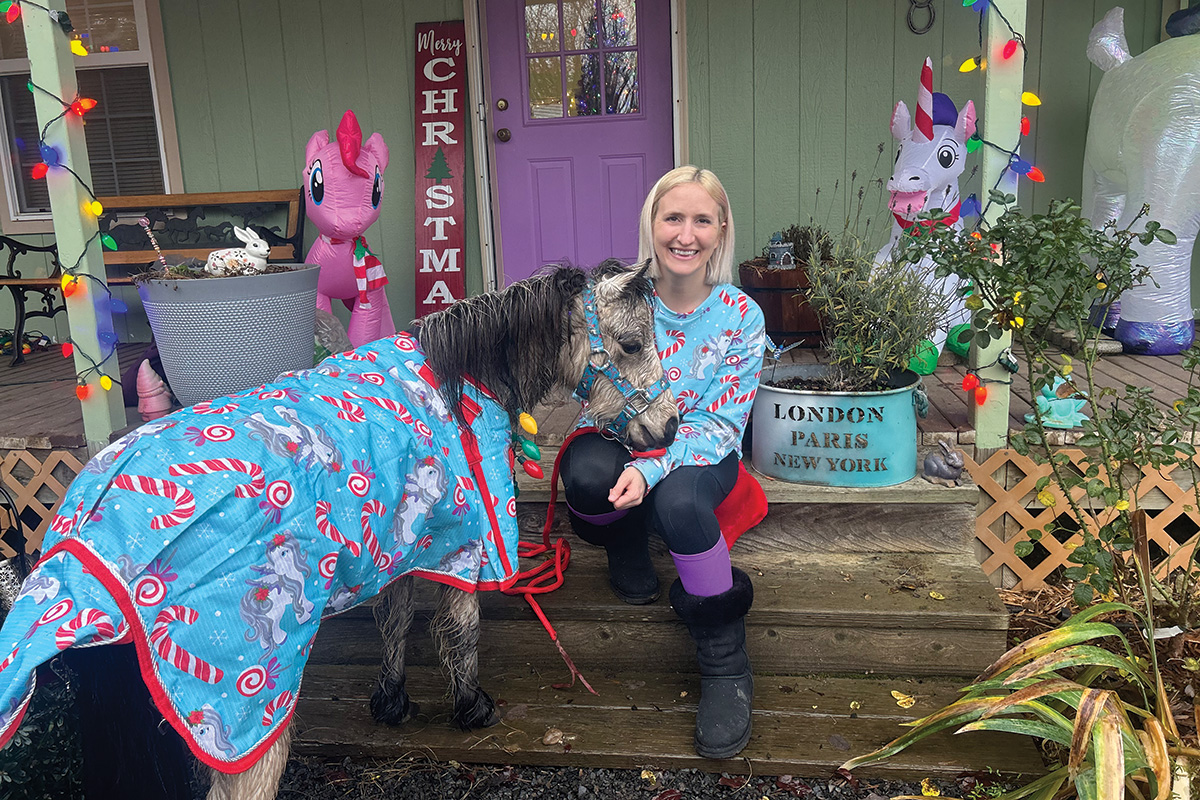
I am not going to lie and say it was an overnight fix. It wasn’t, and still isn’t. I haven’t bonded with Argyll—my 2-year-old Mini—like I did with my heart horse. Will I in the future? I hope so. But he provides me with a reason to get outside.

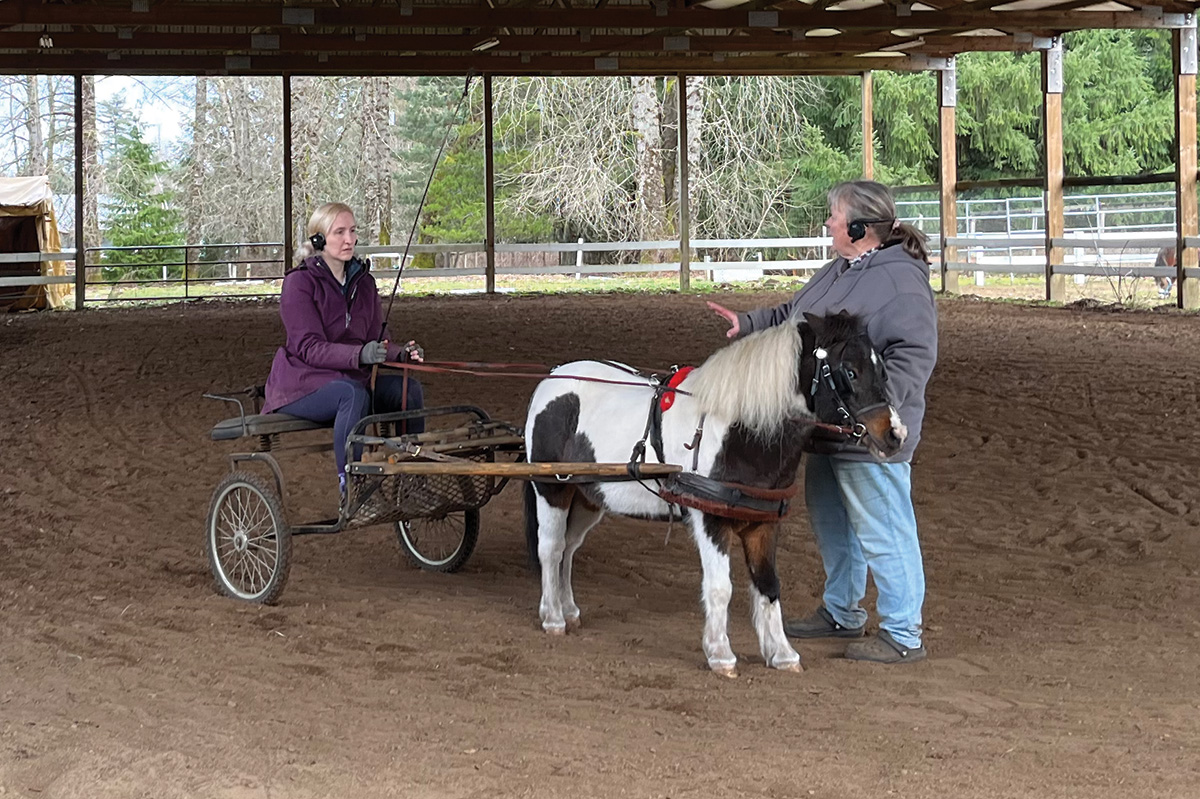
Kristina and Argyll, her new mini horse after paying for her heart horse.
Kristina and Argyll. Photo by Brent Lotz

I am taking driving lessons with a lesson Mini to see if my body can handle it. If not, we can do in-hand things like tricks and trail. Showing is still not in the budget, but there are many free things like parades, walks on trails, and even the International Horse Agility Club offers reasonably priced online competition.

As for my heart horse? We still don’t say her name in the house. She has become a proper noun, “Her,” that is implicitly understood.

I still cry sometimes, and I think I always will, but my heart is not heavy as it was. I can walk into the barn and hear whinnies again. I can smell a horse and feel his sweet nose on my face—Argyll loves to give kisses.

Kristina in a lesson learning to drive Minis.

I hope those of you in my position take heart. How you interact with horses may change due to finances or getting older, but there is always a way to have them in your life, even if it means volunteering at a riding center or downsizing.

If you need horses in your life, find a way, because they are truly irreplaceable and the world’s best therapy.

This article appeared in the July 2024 issue of Horse Illustrated magazine. Click here to subscribe!
ASPCA Right Horse Adoptable Horse of the Week: Twix

0

Welcome to Horse Illustrated’s weekly installment of the Right Horse Adoptable Horse of the Week, offered in partnership with the ASPCA’s Right Horse program. This week’s adoptable horse is Twix! Check back weekly for a new featured horse so you can find your Right Horse.

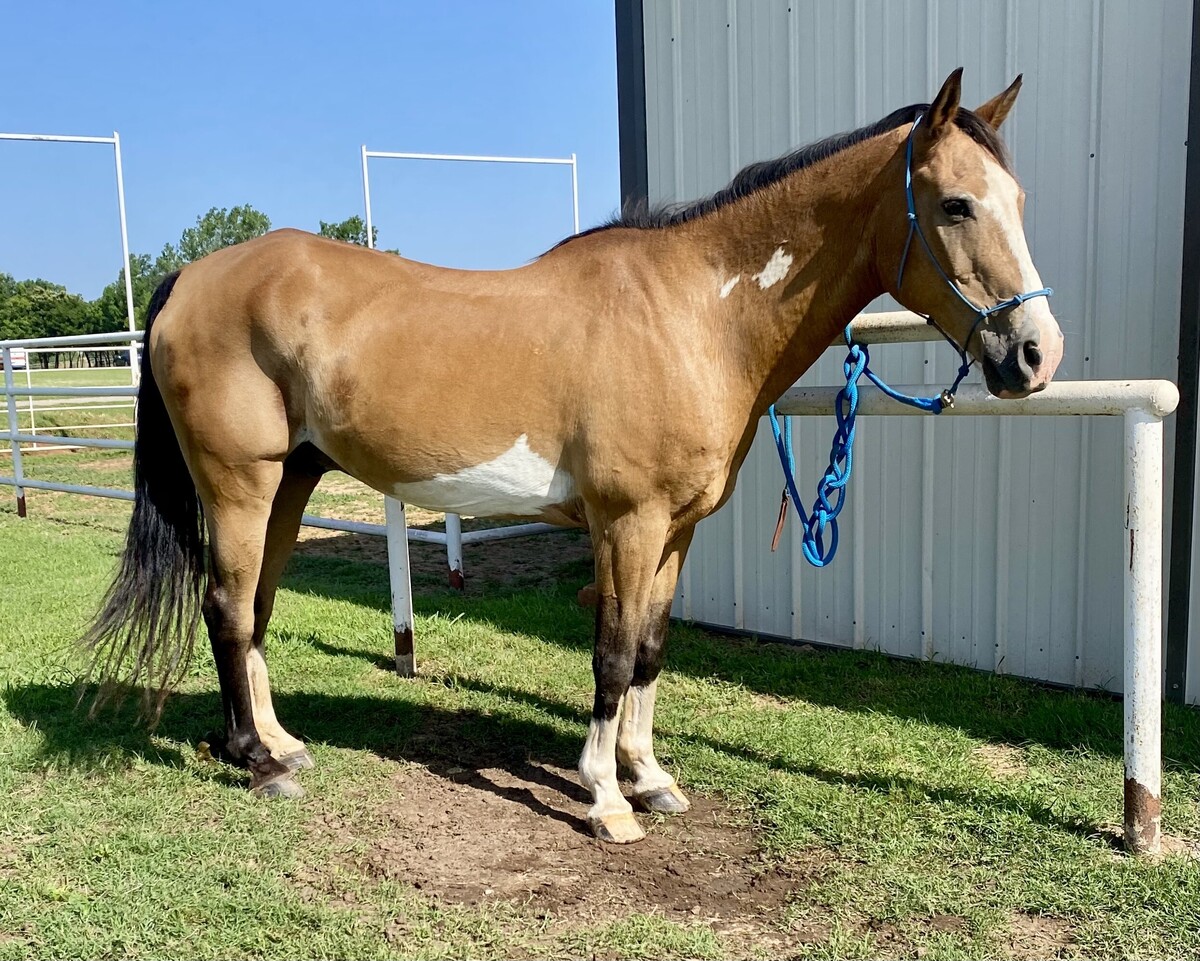
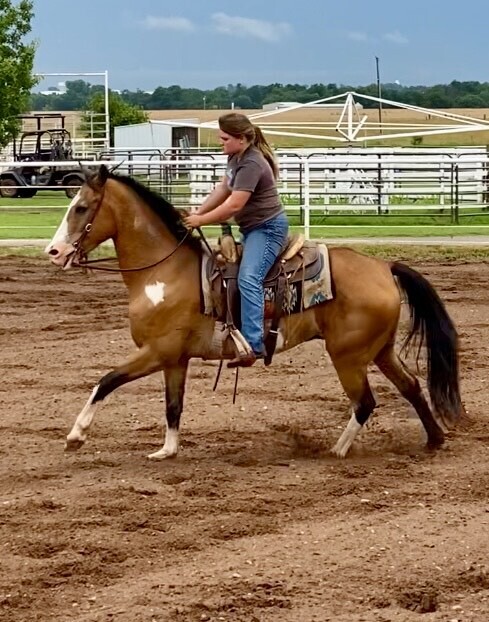
Adoptable horse Twix.
Photo courtesy Nexus Equine

Adoptable Horse: Dawson City, a 27-year-old, 14.2hh American Paint Horse gelding
Organization: Nexus Equine, El Reno, Okla.

Get to Know Adoptable Horse Twix

Looking for a horse that’s got fire in his heart, sparkle in his eye, and absolutely zero time for slowpokes? Say hello to Twix, the flashy, fiery gelding who thinks he’s the main event — and honestly, we’re not going to argue.

Twix is not your average pasture ornament. He’s a full-throttle, arena-loving, pole-bending, barrel-blasting machine with a confidence level that should honestly be studied by scientists. He doesn’t just run patterns — he owns them. Walk into a new arena? He’ll strut in like he’s been crowned champion three years running (whether or not he has is beside the point).

Now, let’s be honest, Twix knows he’s got it going on. He’s got the looks, the moves, and the attitude to match. He’s not here for cuddles and small talk. He’s here to go fast and be fabulous. And while he may occasionally under saddle be, well… let’s say “selectively cooperative,” it’s all part of his charm. Twix isn’t here to people-please. He’s here to find someone who can keep up.

But here’s the twist: for all his turbo-charged ego in the saddle, Twix is a total gentleman on the ground. He’s easy to handle, enjoys attention (on his terms, of course), and is happy to hang out with humans who can appreciate the depth of his self-delusion. Respect his royal status, and he’ll meet you halfway — maybe even three-quarters if snacks are involved.

He needs a rider who loves speed, thrives on big energy, and won’t flinch when he turns on the turbo. If you like ‘em with a little extra spice, Twix might just be your kind of horse. He’s got a light gas pedal and heavy brake pedal — and he will demand a generous dinner afterward. Flashy, fun, and full of personality, Twix is a four-legged firecracker ready to light up your world.

This isn’t a horse who’s counting his years — he’s too busy living them. So if you’re looking for a steady trail plodder, you might want to pass. But if you’re up for a thrilling ride with a whole lot of personality and a horse who genuinely believes he’s a legend, then saddle up and come meet Twix.

Twix is current on: Coggins, vaccines, worming, farrier and dental care and is microchipped. Twix has Cushing’s and will sent to his new home with a 30-day supply of Prascend.

Contact Nexus Equine today about ASPCA Right Horse Adoptable Horse of the Week, Twix!

A buckskin Paint gelding.
Photo courtesy Nexus Equine

ASPCA Right Horse

My Right HorseASPCA Right Horse is the online adoption platform of The Right Horse Initiative, a collection of equine industry and welfare professionals and advocates working together to improve the lives of horses in transition. A program of the ASPCA, their goal is to massively increase horse adoption in the United States. To find more adoptable horses and foster horses, visit www.myrighthorse.org. To learn more about The Right Horse, a program of the ASPCA, visit www.aspcarighthorse.org.

How to Start Training a Horse for Liberty

0

Working a horse at liberty is one of the most fun and rewarding ways to train them. When a horse is free to do whatever he wants, but he chooses to stick with you, it gives a certain thrill that’s sometimes hard to find in other areas of horsemanship.

There are several ways to get started with liberty. Everyone has their own style, but I am going to explain how I start training a horse for liberty. What makes liberty work is to make the horse’s favorite place in the world with you.

I basically want to turn you into a giant magnet for your horse so that he is either with you, or if he is away from you, he will be thinking about getting back to you. This is the invisible connection that keeps a liberty horse attached to the trainer—his desire to be with that person.

However, even though the goal is to work at liberty, I like to begin the early liberty training with a halter and lead rope attached instead of turning the horse loose. With the rope attached, I can teach the liberty cues much easier, because I can help the horse more and keep things slower than I could if the horse was free in the very beginning.

One last point before you start: make sure your horse has good ground manners before you begin this training. If your horse is pushy and doesn’t have good ground manners, that’s going to cause problems.

In the early stages of liberty training, you are going to be bringing your horse to you a lot, which teaches him to want to be with you. However, if your horse is rude, then he will likely end up pushing into you, which isn’t safe.

To get started, you will need a halter, lead rope, and a longe whip.

Watch our webinar with Jason & Bronwyn Irwin.

Step 1

Pick a voice cue to call your horse. It can be any word or a whistle or just about any other sound.

If you ever watched old Westerns, you have probably seen at least a few where the hero whistles or calls out and the horse comes running to save the day—usually just in the nick of time. This is the same idea. I usually say the word “here!”

Step 2

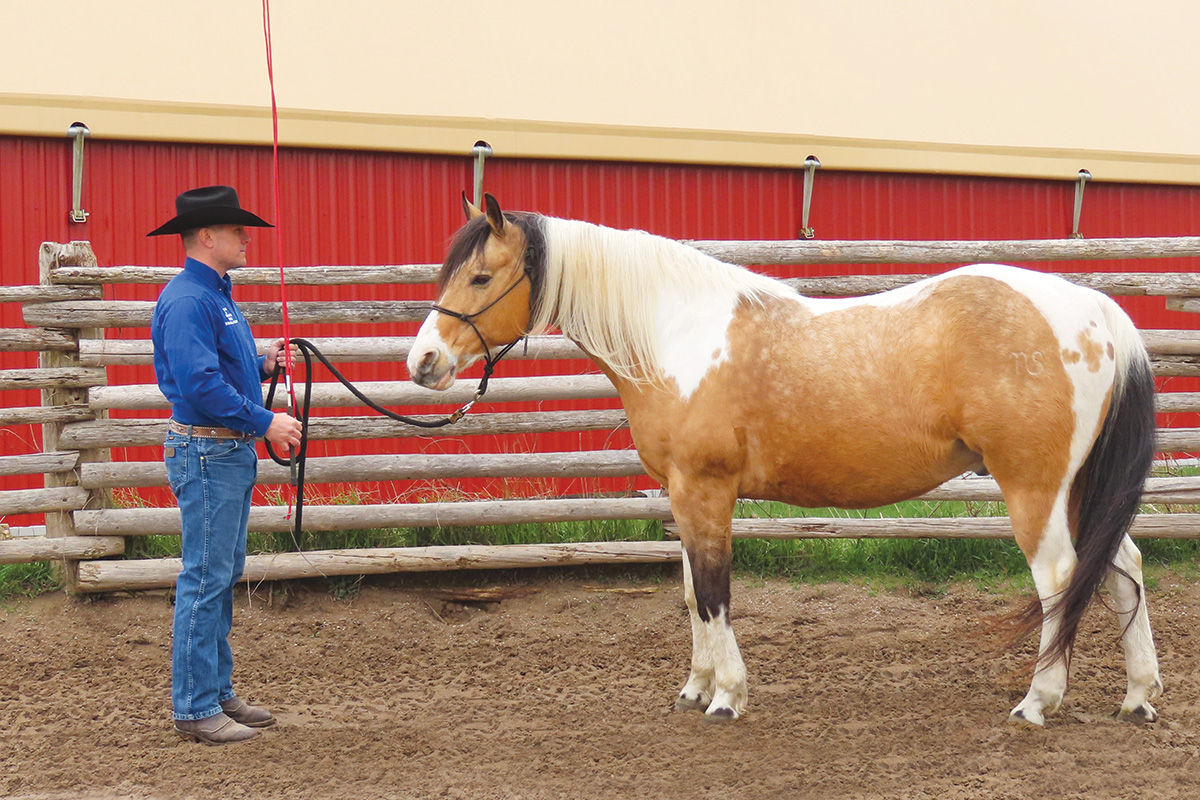
Stand your horse beside the arena wall or a good fence. Start out with the fence on your horse’s right side.

Stand in front of the horse holding the lead rope in your left hand and the longe whip in your right hand.

Step 3

Back away from your horse, and at the same time lower your whip. Give the voice cue to come to you, and then tap very lightly on the horse’s left shoulder.

If your horse starts walking toward you when you tap him, that’s great. However, if he doesn’t, it’s OK. As you back up, the lead rope will tighten, which will give the halter a tug and bring the horse to you anyway.

What is important is to give the voice cue before the tap on the shoulder; the horse needs a chance to respond to the verbal cue before feeling the tap.

Getting started in training a horse in liberty work.
Step back and tap the horse on the shoulder to call him to you. Photo by Bronwyn Irwin

Step 4

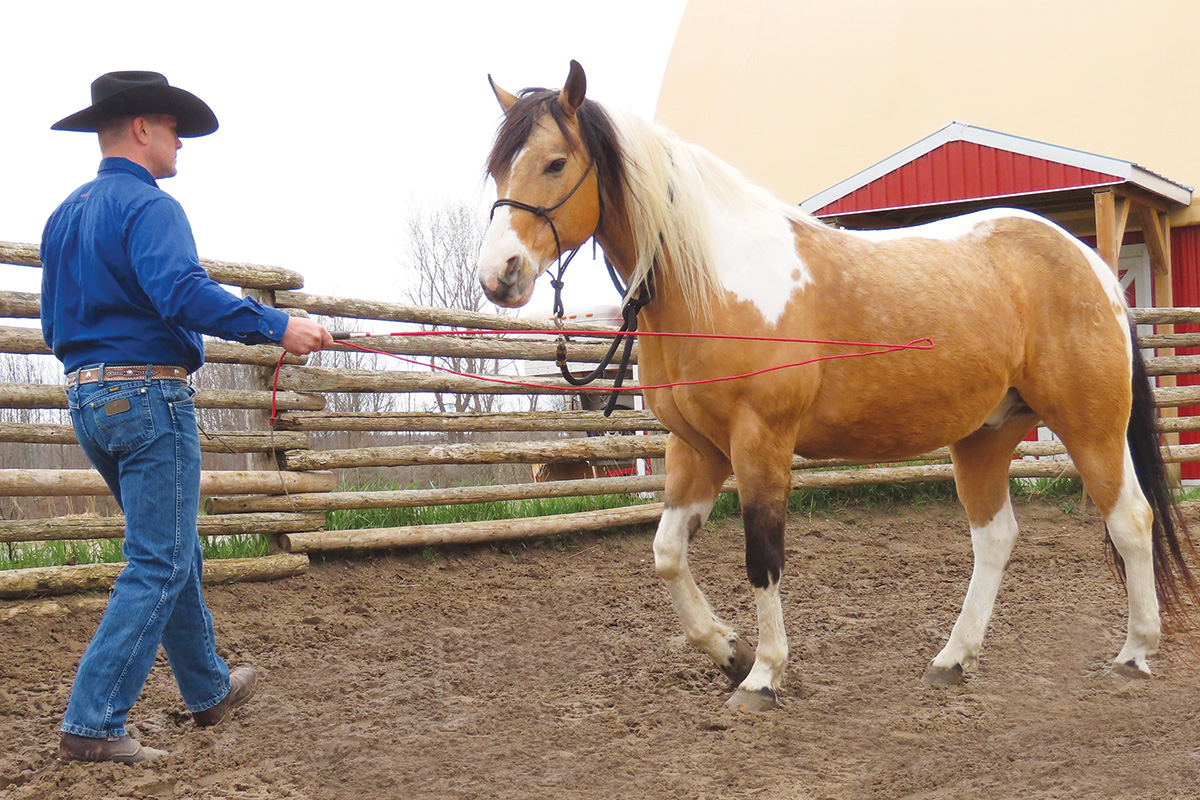
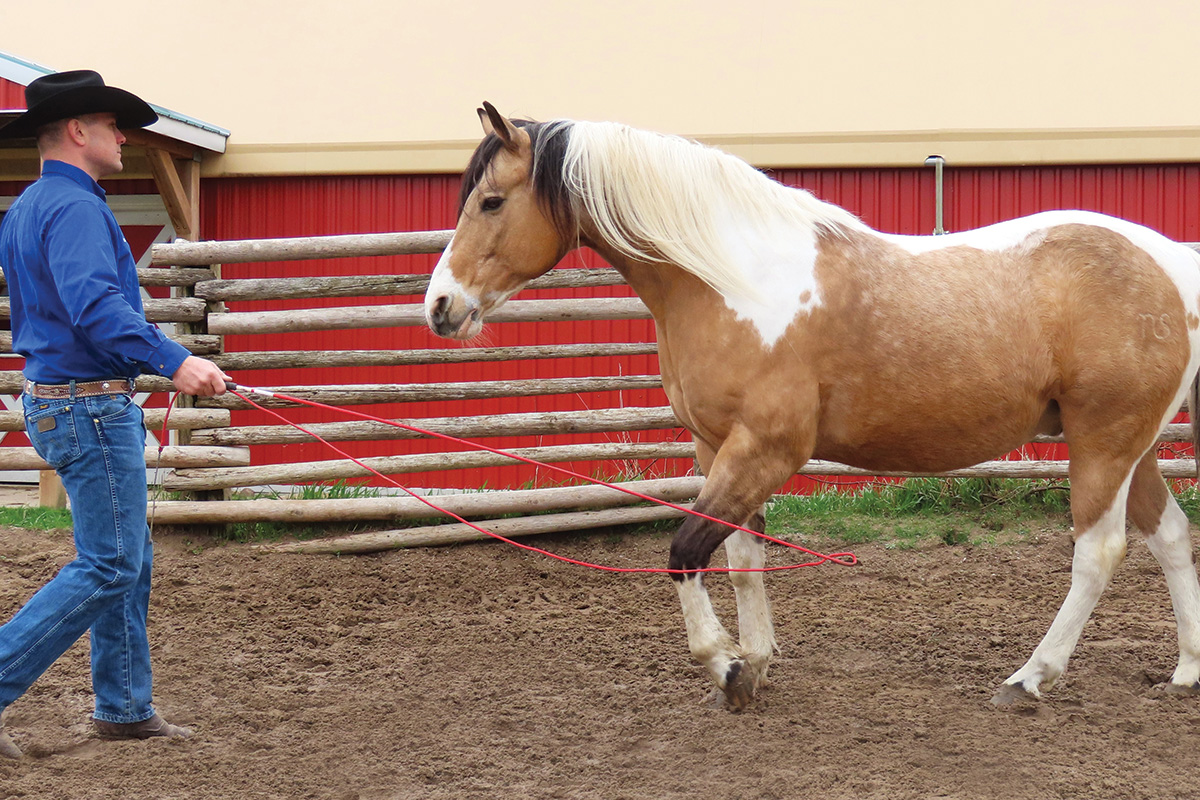
As the horse is walking toward you, keep backing up. When you’re ready to stop, say “whoa” and lift your whip straight into the air.

Jason Irwin and a buckskin pinto in a round pen.
Keep backing up once the horse moves and have him follow you. Photo by Bronwyn Irwin

The whip going up like this encourages the horse to stop, and later on, the whip being held up can be the cue for the horse to stand still, no matter how far away you are.

Repeat these steps several times. Once your horse is coming to you willingly, just motion toward him, but don’t tap as often.

Jason Irwin and a buckskin pinto in a round pen.
Stop and hold the whip straight up to signal the horse to stop. Photo by Bronwyn Irwin

Step 5

Turn your horse around so that the fence is now on his left side. Stand in front of him holding the lead rope in your right hand and the longe whip in your left hand, then repeat all the same steps tapping on his left shoulder.

Repeat until your horse is walking toward you as soon as you motion with the whip and begin backing away. Be sure to be very inviting to the horse with your posture and expression.

When the horse comes to me, I pet him (usually using the whip) to teach him that all pressure goes away as soon as he comes to me.

Step 6

The idea behind using the fence and tools as described is to make coming to you the easiest thing for the horse to do.

The horse is held in on one side because the fence is there; he likely won’t go the other way because the longe whip is there, and he can’t go backward because of the lead rope attached to him. Coming to you, therefore, becomes the most logical thing for him to do.

However, we don’t want to be stuck at the fence forever, so now it’s time to get away from it and move around in the middle of the arena. Sometimes I will hold a second whip (such as a dressage whip) in my other hand. This way I can gently guide the horse back toward me if he veers off to either side. If you’re holding two whips, you would lower both to bring the horse to you and raise both to ask for the stop.

Step 7

If your horse is coming to you the moment you call him and is following you around willingly, it’s time to get rid of the physical connection. Take off the lead rope or put it around the horse’s neck. Practice calling the horse to you and stopping him, and if it’s going really well, you can get rid of the halter and lead rope completely.

Getting started in training a horse in liberty work.
Put the lead rope around the horse’s neck. Now practice calling him to you without the physical connection. Photo by Bronwyn Irwin
Getting started in training a horse in liberty work.
Get rid of the halter and lead rope entirely and call the horse to you with nothing on his head. Photo by Bronwyn Irwin

You’re now working at liberty! To learn the next steps, stay tuned for Part 2 of this liberty training series.

This article about how to start training a horse for liberty appeared in the July 2024 issue of Horse Illustrated magazine. Click here to subscribe!
Barn Banter – Episode 33

0

Barn Banter Episode 30 banner

Welcome to Barn Banter, the official podcast of Horse Illustrated. In Barn Banter episode 33, hosts Susan Friedland and Horse Illustrated Editor In Chief Holly Caccamise chat with Sarah Boudreau, a writer, artist, and Chincoteague Pony enthusiast.

To end the episode, Holly chats with the Hooved Animal Humane Society about William, this month’s ASPCA Right Horse adoptable horse.

Click here to listen on mobile.

Sarah Boudreau, Author and Chincoteague Pony Historian

Barn Banter episode 33 guest Sarah Boudreau.

Sarah Boudreau is a writer, artist, and Chincoteague Pony historian. She manages the Chincoteague Pony History project, which she calls a passion of love. Through this project, she endeavors to tell the story of the Chincoteague Pony breed. She also creates and sells art through her business, Chincoteague Pony Art. Her new book, Before Misty: Early Chincoteague Pony History, is now available.

Adoptable Horse of the Month, William

Photo courtesy Hooved Animal Humane Society

As of 2025, William is 19 years old and has returned to Hooved Animal Humane Society in Woodstock, Ill., where he was born all those years ago. He is a beautiful bay Saddlebred cross gelding with a rich past as a competitive endurance horse. After some time as a pasture pal, we’ve discovered that with regular care, William is light-riding, sound, and ready to work!

Under saddle, William is incredibly attentive and eager to please, always looking to his handler for guidance and confidence. He thrives in environments where his handler is calm and consistent and quickly builds trust with those who give him clear direction. William is a versatile horse, comfortable living in either a pasture setting or a stall with a run-out, but most of all, he would love to have a gelding friend to enjoy companionship with. He does well with both the vet and farrier and is a reliable and loving partner.

Are you looking for an affectionate, hard-working, and loyal horse? William is ready to share his heart and talents with the right person and create many wonderful memories together.

Learn more about William here. 

In addition to Barn Banter episode 33, you can check out all previous episodes of Horse Illustrated’s podcasts here.

Proper Hydration Maximizes Your Horse’s Nutrient Intake

0

Horses require a precise balance of nutrients to maintain health and performance, but the one that’s often easiest to access—water—is required for every physiological process. It cannot be overlooked. 

Horses drinking water for hydration and proper absorption of nutrients.
Photo by Александр Ульман/Adobe Stock

Ignoring any part of a horse’s nutrient intake can threaten digestive health, immune system support and overall wellness, but a lack of water for even a short amount of time will quickly lead to significant health risks.  

With water intake, however, it’s not just about drinking. A horse’s hydration needs will vary according to diet, nutrition needs and performance demands. 

“The right nutritional balance starts with high-quality hay and pasture. That essential fiber supports proper digestive function and sustains hydration and electrolytes that a horse needs, especially a performance horse,” said Kristyn Sturken, Sentinel® Product Manager. 

Though using diet to influence hydration starts with hay and forage, it doesn’t end there. The type of feed you provide can also positively impact your performance horse’s water intake. 

Guidance for Keeping a Horse Hydrated 

Simply giving access to water does not guarantee a horse will drink enough. Water taste, smell and temperature all affect a horse’s desire to drink, and diet must also be considered. For example, a horse that is eating a lot of pasture, with a high moisture content, may drink less than if he’s consuming primarily hay, which is drier and could induce thirst. 

With that in mind, here are some tips for making sure a horse stays properly hydrated: 

  • Offer water: Encouraging a horse to drink can help stimulate thirst. 
  • Monitor sweat loss: High temperatures, humidity and intense exercise make a horse sweat, which might require adjusting electrolyte supplementation to offset what’s been lost. 
      • A horse that is sweating normally will have a lightly moist, shiny coat, particularly under the saddle. 
      • Sweat will spread to the neck, chest and legs in a horse that is exercising harder. 
  • Supplement with electrolytes: Giving a horse a well-balanced electrolyte supplement can help replenish minerals lost during exercise. 
  • Forage: Forage provides a significant source of potassium, which can help horses maintain water balance.  

Additionally, it’s essential to know the signs of dehydration. While fatigue, illness or reduced performance are worrying, if dehydration is not tended to promptly, it could result in grave health issues. 

Look for these signs of dehydration and take action immediately if found:

  • Elevated heart rate or pulse exceeding 40 beats per minute  
  • Changes in gum color or loss of moisture on the gums 
  • Loss of skin elasticity; pinch along the neck in front of the shoulder to test—it should retract without delay 

Helping a Horse by Soaking Extruded Feed 

Extruded feed is different from pelleted feed; it is pressure cooked with moisture, which produces light, airy nuggets that encourage more chewing and, subsequently, more saliva production. Slower chewing and increased saliva production help maintain the precise nutrient balance healthy horses require and can support hydration. 

In addition to easy digestibility making nutrients more accessible to the horse, extruded feeds can be easily soaked and prepared as a mash. This can be done much quicker than it takes to soak pellets and can provide extra hydration in horses who are not drinking enough water, which can also help prevent choke. 

Getting a horse to drink more water may help prevent certain digestive upsets associated with high-stress, high-intensity conditions performance horses might experience. 

High-Quality H2O and Electrolytes 

Performance horses are particularly susceptible to electrolyte imbalances because of significant fluid losses from sweat. Electrolytes are minerals that, when dissolved in water, are vital for a multitude of bodily functions, including nerve transmission, muscle contraction and fluid balance.  

Competitive horses face an increased risk of fatigue, reduced muscle efficiency and worsened nerve function if their electrolytes are not replenished. In severe cases, serious health complications can arise. 

Key electrolytes and their function: 

  • Sodium (Na): Regulates fluid balance and is essential for nerve impulse transmission. 
  • Chloride (Cl): Works alongside sodium to maintain fluid balance and is a component of stomach acid, aiding digestion. 
  • Potassium (K): Crucial for muscle function and helps maintain the body’s acid-base balance. 
  • Calcium (Ca²): Necessary for muscle contractions, nerve function and blood clotting. 
  • Magnesium (Mg²): Involved in muscle relaxation and energy production. 

Supplementing Electrolyte Intake 

You can buy supplements to help restore your horse’s electrolyte balance. These are available as additives for your horse’s water, or even as an oral gel or paste. When using, always follow the label instructions. 

Providing salt is another way to help maintain electrolyte balance. In addition to acting like an electrolyte, salt can also stimulate thirst and encourage a horse to drink more water. 

Whichever method you choose, your horse needs free access to water. Electrolytes can encourage your horse to drink water. 

Also keep in mind that some horses do not like water with additives in it, so when adding electrolytes to their drinking supply, make sure to have a separate, fresh water source available. 

Keep a Horse Hydrated for His Health and Wellness 

A horse must stay well-hydrated to maintain proper nutrient balance and support his diet, workload and lifestyle needs. It’s important to recognize the signs of dehydration and understand what behaviors and conditions increase the risk. There are many effective strategies to help keep your horse hydrated. By actively managing your horse’s water intake, you can help prevent serious health issues and ensure they stay healthy, comfortable and performing at their best.  

This article is a web exclusive for Horse Illustrated magazine. Click here to subscribe!
ASPCA Right Horse Adoptable Horse of the Week: Corazon

0

Welcome to Horse Illustrated’s weekly installment of the Right Horse Adoptable Horse of the Week, offered in partnership with the ASPCA’s Right Horse program. This week’s adoptable horse is Corazon! Check back weekly for a new featured horse so you can find your Right Horse.

Adoptable horse Corazon.
Photo courtesy Longmeadow Rescue Ranch

Adoptable Horse: Corazon, a 16-year-old, 14.0hh Appaloosa gelding
Organization: Longmeadow Rescue Ranch, Union, Mo.

Get to Know Adoptable Horse Corazon

Corazon is a handsome Appaloosa gelding who was returned to Longmeadow in September 2024 when his owner could no longer care for him. After his routine 30-day quarantine ended, this stunning gelding was able to be reevaluated by their training team.

Upon evaluation, Longmeadow’s trainer found that Corazon was more of a forward ride. He had no problem moving fast — in fact, she spent a lot of time trying to hold Corazon back. The man just wants to go! He is soft in the bridle and rides off leg. Although he tends to have moments of stubbornness under saddle, Corazon can be easily redirected by a confident, knowledgeable rider who isn’t afraid to send him forward during his little “temper tantrums.”

Corazon truly enjoys having a job and is an intelligent horse. He will need a handler and rider who isn’t afraid to correct certain behaviors, such as pushiness on the ground. He will also need an adopter who can work with him through the occasional spook. Although mighty, this gaited gelding can be a scaredy cat sometimes. At the Ranch, Corazon has been ridden both outside and in the indoor arena. He has been ridden both alone and with others. He tends to need a little more confidence from his rider when being ridden alone.

Corazon is good for grooming, tacking up, and standing tied. He also stands well for the farrier and vet. He is not a fan of fly spray or trailer loading. Corazon has a silly, endearing personality. While he also isn’t the biggest fan of getting bathed, he does like being sprayed in the mouth and playing with the hose. He also loves to eat. Because of this, he will need a grazing muzzle or dry lot at his future home. At the Ranch, he is on a daily dose of Thyro-L to maintain a healthy weight.

Contact Longmeadow Rescue Ranch today about ASPCA Right Horse Adoptable Horse of the Week, Corazon!

An Appaloosa gelding.
Photo courtesy Longmeadow Rescue Ranch

ASPCA Right Horse

My Right HorseASPCA Right Horse is the online adoption platform of The Right Horse Initiative, a collection of equine industry and welfare professionals and advocates working together to improve the lives of horses in transition. A program of the ASPCA, their goal is to massively increase horse adoption in the United States. To find more adoptable horses and foster horses, visit www.myrighthorse.org. To learn more about The Right Horse, a program of the ASPCA, visit www.aspcarighthorse.org.

The Importance of Horse Rescue Volunteers

0

Horses are a lot of work, so you can imagine why horse rescue and adoption groups welcome a helping hand. But it’s so much more than the actual labor­—although preparing 200+ buckets of daily feed or hauling water through 3 feet of snow is not insignificant. It’s the commitment these volunteers make to helping horses, and the organizations doing this work, that is so meaningful.

“Without our volunteers, we wouldn’t be able to do all that we do today,” says Brittney Vallot, Operations Director at Days End Farm Horse Rescue (Days End Farm or DEFHR) in Woodbine, Md.

A Critical Contribution

Established in 1989, Days End Farm shelters an average of 130 equines a year in need of rescue, rehabilitation and rehoming. Volunteers contribute an estimated 55,000 hours of time each year caring for the horses, as well as helping with administrative tasks, facility maintenance, and assisting with the community outreach and education that is part of the organization’s mission.

Volunteers working with a horse at a rescue organization.
Days End Farm volunteers contribute an average of 55,000 hours a year to caring for horses, administrative tasks, outreach and facility maintenance. Photo courtesy Days End Farm Horse Rescue

“Our volunteers enable us to provide hands-on interaction with each horse every single day, providing them with important care, handling and socialization that absolutely gives them a better shot at adoption,” says Vallot. “Not a day goes by that a horse goes untouched or unseen at our facility, and that’s all thanks to the help of our volunteers.”

In Methuen, Mass., the Massachusetts Society for Prevention of Cruelty to Animals (MSPCA) at Nevins Farm houses not only horses, but a barn full of creatures great and small. The multi-species facility relies on over 300 volunteers, with 49 of them being barn volunteers. A summer intern program brings in additional assistance in caring for the organization’s annual intake of just over 3,000 animals.

“I always say we could not do what we do without our volunteers, and I really mean that,” says Shyre Lancia, senior volunteer coordinator for the MSPCA at Nevins Farm. “Our volunteers are essential with day-to-day operations, as well as with assistance during adoption events and some vet visits. From a financial perspective, they allow more funds to be used directly for the animals, but it’s more than that. It’s the range of people and skills that contributes to flexibility: the experienced volunteers guiding the new volunteers, the community that is built in pursuit of a common goal. I think the community that is built among our volunteers and staff is beautiful.”

A volunteer interacting with a horse at a rescue organization.
Volunteers allow more funds to be used directly for the animals, and their range of skills contributes to flexibility within each organization. Photo courtesy Days End Farm Horse Rescue

Time and Talent

When it comes to equine adoption organization volunteers, there’s no such thing as typical. While volunteers come in all ages, skill sets, and experience levels, the one thing they have in common is that they want to help and make a difference, says Vallot.

“Everyone is unique and brings something to the table,” she says. “We take volunteers of all ages, some as young as 5 years old. We are also an entry-level organization, taking in absolute beginners with open arms and giving them the education and opportunity to grow as horse advocates. Our minimal requirements for being able to volunteer means that we get a wide variety of individuals from all walks of life who share one ‘typical’ trait: they want to help the horses.”

Grooming a pony.
While volunteers come in all ages, skill sets, and experience levels, the one thing they have in common is that they want to help and make a difference. Photo courtesy Days End Farm Horse Rescue

Kristin Showalter and her 12-year-old daughter, Ava Smith, were not equestrians when they began volunteering at Days End Farm. Today, they are known as the dynamic duo around DEFHR, where they have been regular volunteers for two years and now often lead the orientation for new volunteers.

“We love coming out to help in whatever ways we can, but our personal favorite aspects of volunteering include community education and outreach opportunities and, always, one-on-one horse time and hands-on horse care,” says Showalter.

For daughter Ava, Days End Farm has become a huge part of her life, bringing both horse and human friendships. She met one of her best friends while volunteering at the farm and loves being part of the “Equidopting” program that Days End Farm offers.

“I sponsor Rodgers Regent, my best horse friend at the farm, and I love the special time I get to spend with him every week,” she says. “I am so thankful that DEFHR was able to rehabilitate him and give him the life he has now! I also love the chance to learn from the trainers and staff at DEFHR, which has helped me learn everything I know about horse handling, care, and rescue.”

Dick Heiger is a longtime farm operations team volunteer at Days End Farm who has found his own way to contribute his time and talents to the organization.

“He is now in his 80s and continues to amaze us all with all that he does for us,” says Vallot. “He’s our trusty, weekly front lawn mower every spring through fall. He’s a master gardener and has planted one of the most beautiful gardens along our front driveway. He’s also painter-extraordinaire when the colder months make indoor tasks more appealing. He’s never been one to want to work in the barn, but his love of our mission and the horses is just as strong as any other volunteer.”

Finding the Why

Lancia sees a fair number of people who had some horse or farm experience in their youth circling back to reconnect when they find themselves with time to volunteer. Others volunteer to gain experience, whether they want to prepare for future animal ownership, or are looking to acquire skills and knowledge that will be helpful in applying to veterinary school.

Petting a chestnut gelding's face.
Some volunteers had horse or farm experience in their youth and want to reconnect with their interests when they have more time to do so. Photo courtesy Days End Farm Horse Rescue

“Farm animal interaction is something of a novelty around here,” says Lancia of their location, some 30 miles from downtown Boston. “Riding lessons are quite expensive in this part of the country, so unless someone had a family farming connection or the financial means, they may never have had the opportunity to interact with a horse.”

For MSPCA volunteer Kristen Oleson, watching people connect with these animals for the first time is what stands out the most.

“I grew up around horses in a family who knew their way around a farm,” she says. “The MSPCA is in a far more urban area than you will find most horse stables. In my time volunteering, I have seen countless children, and more than a few adults, experience their first interaction with a horse or goat, chicken, emu—the list goes on. I was too young to remember the first time I touched a horse or had one blow in my face. Having had the opportunity to share that with so many people has been an absolute pleasure.”

The opportunity to volunteer is a two-way street, says Showalter.

“We love volunteering, and we choose to come out each weekend—sometimes a weekday here and there, too—to help with the variety of jobs needed for the horses in Days End’s care,” she says. “But also important is the fact that the experience of caring for horses is therapeutic for us, as well as for them. Learning each of our horses’ individual stories and backgrounds provides a window into who they are and what challenges they may be working through in their equine rehabilitation process. Being a small part of that process, helping them to regain their health, confidence, and trust in humans, is a very powerful thing to be a part of.”

Getting Started with Volunteering

There are hundreds of equine rehoming, shelter, and rescue organizations across the country, many of which rely daily on volunteer assistance to get essential jobs done. Here are some tips for anyone wanting to volunteer with an equine rescue group to get started.

1. Research Nearby Organizations

A good first step for those interested in volunteering is to identify what facilities are within a convenient distance and visit their website for volunteer information, says Lancia.

“The priority is to meet the need of that rescue, but of course it should be in a way that is achievable for the person,” she says.

2. Understand the Volunteer Requirements

Most facilities have information on their websites that will make it clear what they need help with, including any requirements applicants should meet, and Lancia encourages people to pay attention to the required skills and experience, if any are listed.

“Trust that the organization is looking for specific skills or experience for good reason,” says Lancia. “For barns especially, some of the tasks are very physically demanding, and you’ll be outdoors no matter the weather. This is obvious to equestrians, but I get a fair number of applications from new-to-barn people who don’t realize they’ll be outside in the snow!”

3. Get to Know the Organization

Most will have some sort of orientation, which is a great way to get to know their organization a bit more and decide if you want to commit, says Vallot.

Lancia also advises making sure the role is a good fit and being honest with yourself about that.

“There’s so many ways people can volunteer, and different facilities may have different roles available—don’t be discouraged if the first one you look at isn’t a good match,” she says. “Keeping an eye on the websites over time may result in something opening up that wasn’t there when you originally looked, too.”

4. Get Involved

Once you get started at a place, Vallot encourages getting involved.

“The more you do, the more you seek out ways to participate, the more you will learn and grow as a horse person.”

Lancia advises thinking outside the box and being open to helping organizations in different ways.

“We get a lot of applications for dog and barn volunteers, but very needed and helpful positions such as those handling phones and email are often bypassed,” she says.

Don’t assume you have nothing to offer, adds Vallot. Many times, obstacles can be overcome.

“Have limited time or lack of transportation? Ask the organization if there’s a way you could help them remotely. Have a physical limitation that keeps you from working in the barn? Maybe you can help them in the office or man a booth at an event. There’s always a way you can get involved and help.”

To find an organization in your area to support, please visit myrighthorse.org, the ASPCA’s online adoption platform for equines.

Further Reading
Getting Started with Volunteering at Horse Rescues
The State of Equine Nonprofits

Ways to Volunteer in the Equestrian World

This article about horse rescue volunteers appeared in the July 2024 issue of Horse Illustrated magazine. Click here to subscribe!
Training Horses with Positive Reinforcement

0

Animal behaviorist and equine welfare expert Emily Weiss, Ph.D., reveals the key to solving any equine behavior challenge: positive reinforcement.

If you’ve ever wondered why your horse behaves a certain way, or why you’re having trouble solving an equine behavior challenge—from trailer loading to simply catching your horse in the pasture—you are not alone. According to Emily Weiss, Ph.D., an applied animal behaviorist, it’s the top question she hears all the time, and it all boils down to one simple thing.

“The answer to all behavior, whether you’re a flatworm, a human, a horse, orangutan, or dog is the same: why we behave the way that we do is because it feels good,” she says. “Or, it feels less bad than the alternative.”

Weiss should know—she has worked with species of all kinds, including lions, orangutans, elephants and Komodo dragons, as well as many dogs, cats and horses. While it all comes down to “feeling good,” we have to first figure out what that means.

Think Like a Horse

Sometimes this requires an objective look at the situation, and being observant to best understand why an animal is behaving a certain way, says Weiss.

“Oftentimes we can’t help but think like humans about the things that we would like or what feels good to us,” she says. “We have to be able to take that hat off and think a bit like a horse.”

For example, consider trailer loading.

“Walking up into a horse trailer, for a lot of reasons, doesn’t feel good for horses,” says Weiss. “One thing we often don’t think about is the change in light. Going from a very light area into a horse trailer, which is quite dark, can be incredibly off-putting and frightening because horses can’t see it very well. To set up a horse [for success] while you’re training him to get on a horse trailer, one of the things you might start with is getting the trailer [well] lit so there isn’t that change in light.

“Thinking like a horse can be really helpful to figure out what might be motivating this particular animal to behave in this way at this time,” says Weiss. “And then, what do I have in my toolbox to be able to modify and change that?”

A Trainer’s Toolbox

As a behaviorist, Weiss’ preferred tool is positive reinforcement, which means you give a reward, or something that feels good, when the desired behavior happens.

Typically for horses this is food, but other rewards may include touch, such as scratching a favorite spot. By giving the reward, you increase the likelihood of the horse repeating the behavior.

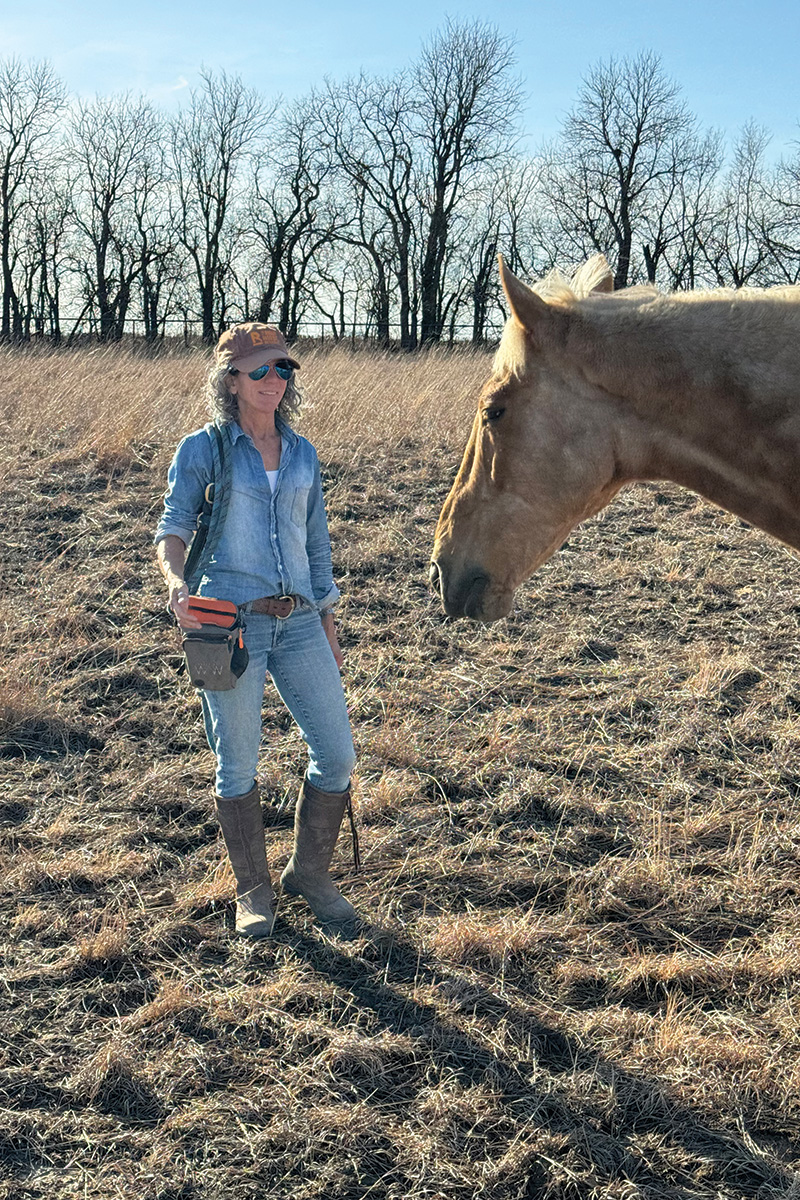
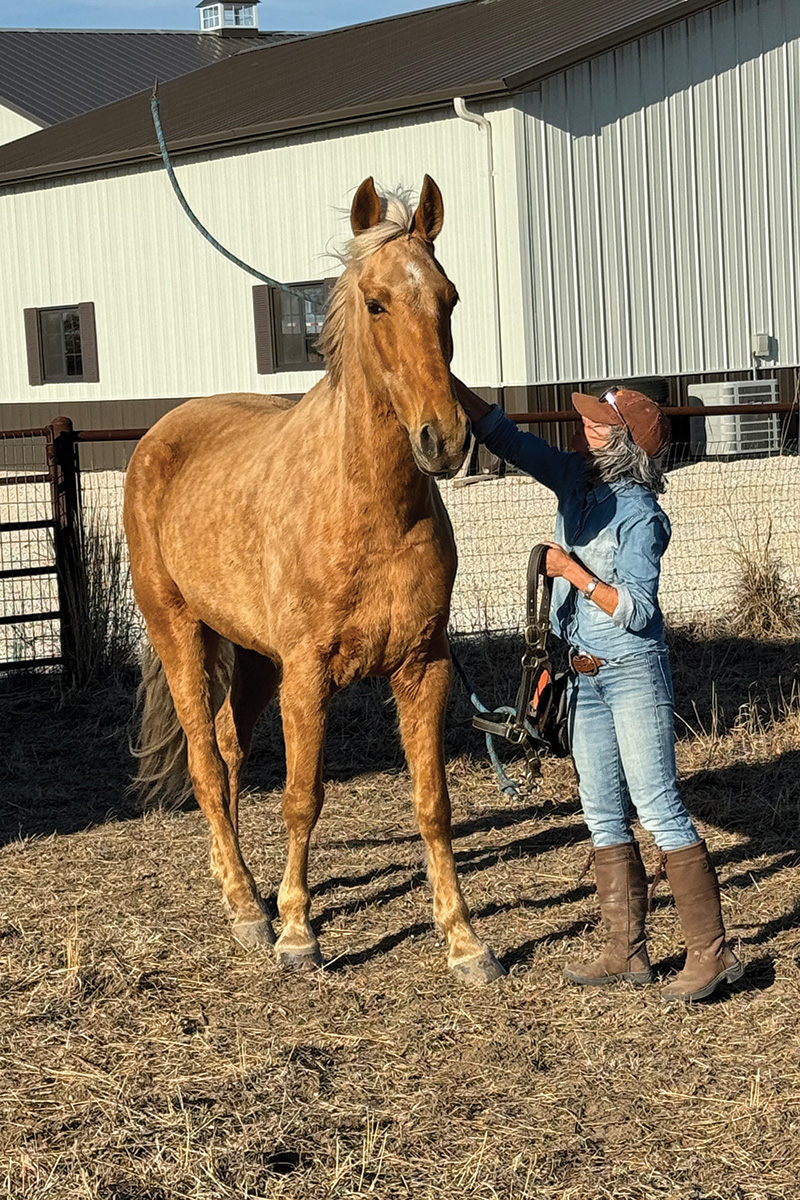
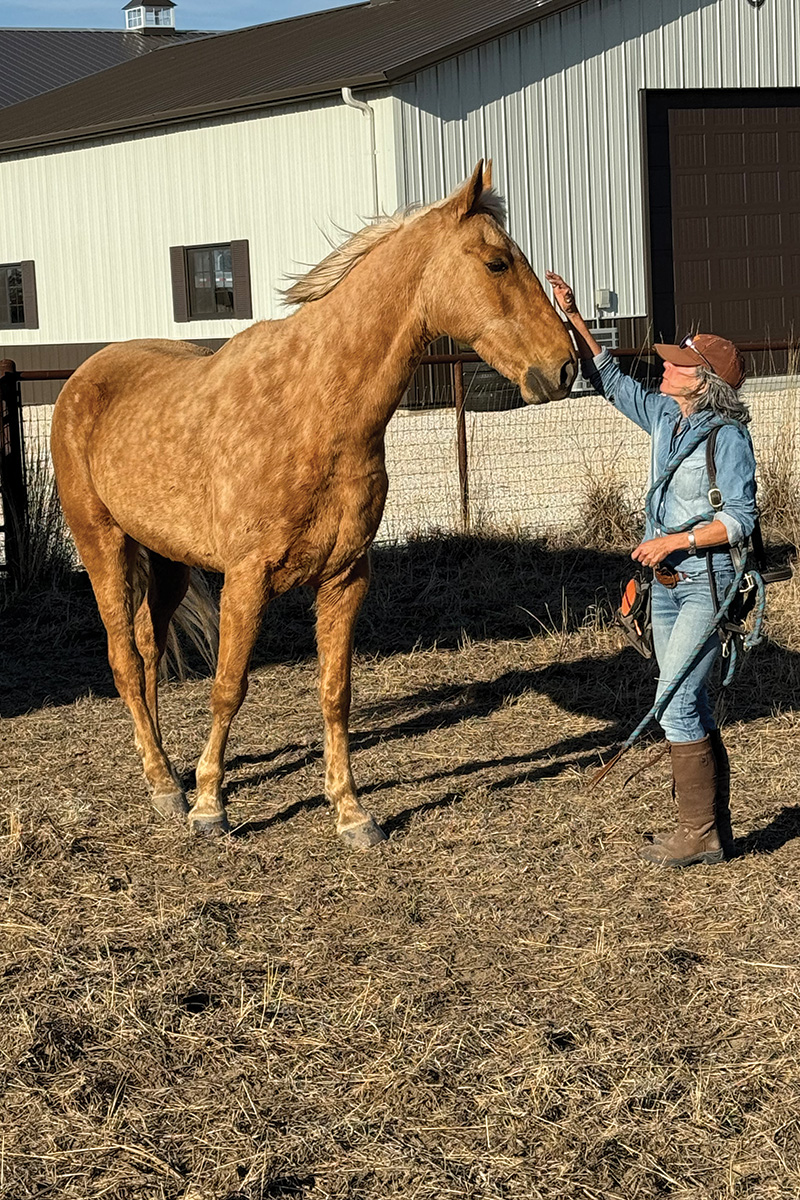
A woman approaching a palomino in a field.
Coming in from the pasture reliably and willingly begins by pairing the behavior of approaching you in the pasture with a food reward. Photo courtesy Emily Weiss, Ph.D.

Traditional horse training, using the concept of pressure and release that most equestrians are familiar with, is known in learning theory terms as negative reinforcement. Folks associate the term “positive” as good and “negative” as bad, but the terms here are referring to giving and taking away, says Weiss.

“Negative reinforcement just means you remove something when the desired behavior happens: I apply pressure, my horse moves to the left, and I release that pressure,” explains Weiss.

One of the benefits of positive reinforcement is that it can increase confidence (in both horse and human) and trust. Many routine horse care and handling tasks can be easily trained using this technique.

Both methods require good timing.

“When you apply pressure, you need to release it at the right time for the horse to learn ‘this is the behavior you want me to do,’” says Weiss.

Tweet & Treat

Thankfully, Weiss says, most domesticated horses are incredibly food-motivated, and some animals, including the horse, can be incredibly touch-motivated. Even the ones that are not comfortable with humans are pretty food-motivated, and that can serve as a powerful starting point.

When working with positive reinforcement using food, it’s important to have a signal that says “food is coming,” says Weiss.

This is typically a sound and is often called a “bridge,” or a marker, because it marks the moment a behavior occurs, and bridges the gap until you can deliver the reward.

A woman training a horse with positive reinforcement.
Use a sound to bridge the desired behavior with the delivery of food for behaviors you teach; this is called a secondary reinforcer. This allows you to mark the correct behavior without having to deliver food in the moment. Photo courtesy Emily Weiss, Ph.D.

At the moment the desired behavior occurs it tells the horse, “Yes, that’s what I want you to do, food will be coming,” and then gives you time to be able to take the food from your pocket or wherever it is and give it to your horse.

“I use a whistle, so I call it ‘tweet and treat,’” says Weiss.

Step one is to pair the sound with the delivery of food. Tweet (or whatever sound you use) followed quickly by treat. Pair the delivery several times and then observe what happens when you tweet. If the horse looks toward the food location, you have successfully paired your sound!

There should be no food visible during the training process, says Weiss. You’re teaching the horse “If I do X (behavior), I get Y (reward).”

A woman training a horse with positive reinforcement.
This is not a bait and switch. Your halter and lead should be visible to the horse and the food should not be visible until you are ready to reward. Photo courtesy Emily Weiss, Ph.D.

How to Use Positive and Negative Reinforcement

There are lots of different ways you can train a horse to pick up his feet. The traditional method uses negative reinforcement, where you run your hand down the leg, apply pressure when you’re closer to the hoof, and then increase that pressure until the horse lifts his foot. Once the horse lifts his foot, you release the pressure. You then have to shape the behavior from there.

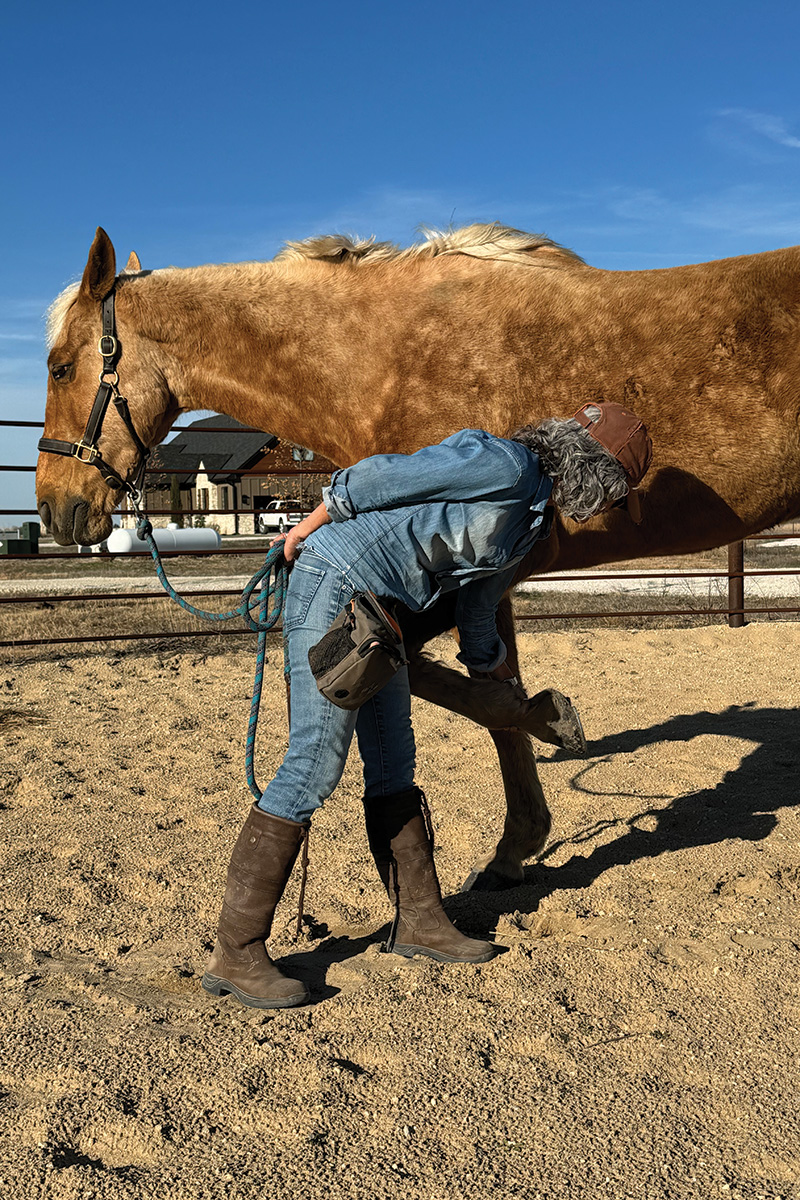
A woman training a horse to lift its hoof with positive reinforcement.
Using positive reinforcement to teach a horse to lift his hooves and stand quietly can be very helpful, especially for horses that are a bit fearful. Begin by placing your hand low on the horse’s leg. Wait until he shifts weight off that hoof, then tweet and treat. Photo courtesy Emily Weiss, Ph.D.

Using positive reinforcement can take a little bit of patience in the beginning, but it’s quick and quite effective, as Weiss outlines:

Begin by bringing the horse into the space in which you’d normally work with his feet, placing either a stick or your finger on his leg, waiting for any movement at all and then reinforcing that, using Weiss’ “tweet and treat” method or similar, so that the horse understands that when he moves his foot, he gets a reward.

“Once the horse now understands that touch means ‘move my foot,’ you can progress from shifting the weight and moving the foot to holding the foot for a second (tweet and treat); lifting that hoof (tweet and treat); and then holding that hoof and doing what you need to do,” says Weiss.

Weiss adds the pairing of a verbal cue so that the horse lifts without the handler having to first touch the leg.

“Done correctly, this takes a couple of sessions for most horses to learn to hold their feet,” she says. “For horses that have had a lot of negative experiences, it can take longer.”

Techniques of positive and negative reinforcement can also be used in combination, adds Weiss. The use of positive reinforcement is just one tool in the toolbox, and can be woven into more traditional pressure-and-release training.

The Pushy Horse

Many horse people have concerns about using food as a reward and believe their horse may become pushy or aggressive about the treats. To explain why this happens, Weiss always goes back to the “why” behind horses and all organisms doing what they do.

“They do it because it feels good,” she says, which means that if a horse is pushy, they must have been getting a treat at least every once and a while.

The horse thinks, “If the behavior results in the thing that feels good, I push, and occasionally I get a treat,” then that behavior will persist.

Typically, it’s a case of user error; horse handlers just give in, or they’re not paying attention and inadvertently reward pushiness. While some horses are more persistent than others, every horse is susceptible to this inadvertent training, says Weiss.

“Food needs to be delivered very purposefully and never should be delivered when it is the horse pushing or touching you to receive a treat,” she adds.

Variable Reinforcement

If you’re worried about what happens when you run out of cookies and carrots, or becoming a nonstop treat dispenser, Weiss says that’s where variable reinforcement comes into the process: the horse gets a treat for the behavior sometimes, but not every time.

“When we’re first teaching the behavior, the horse gets a treat every time because he needs to learn it and is trying to figure it out,” says Weiss. “We have to make it consistent so that the horse understands if I do X, and I get Y.”

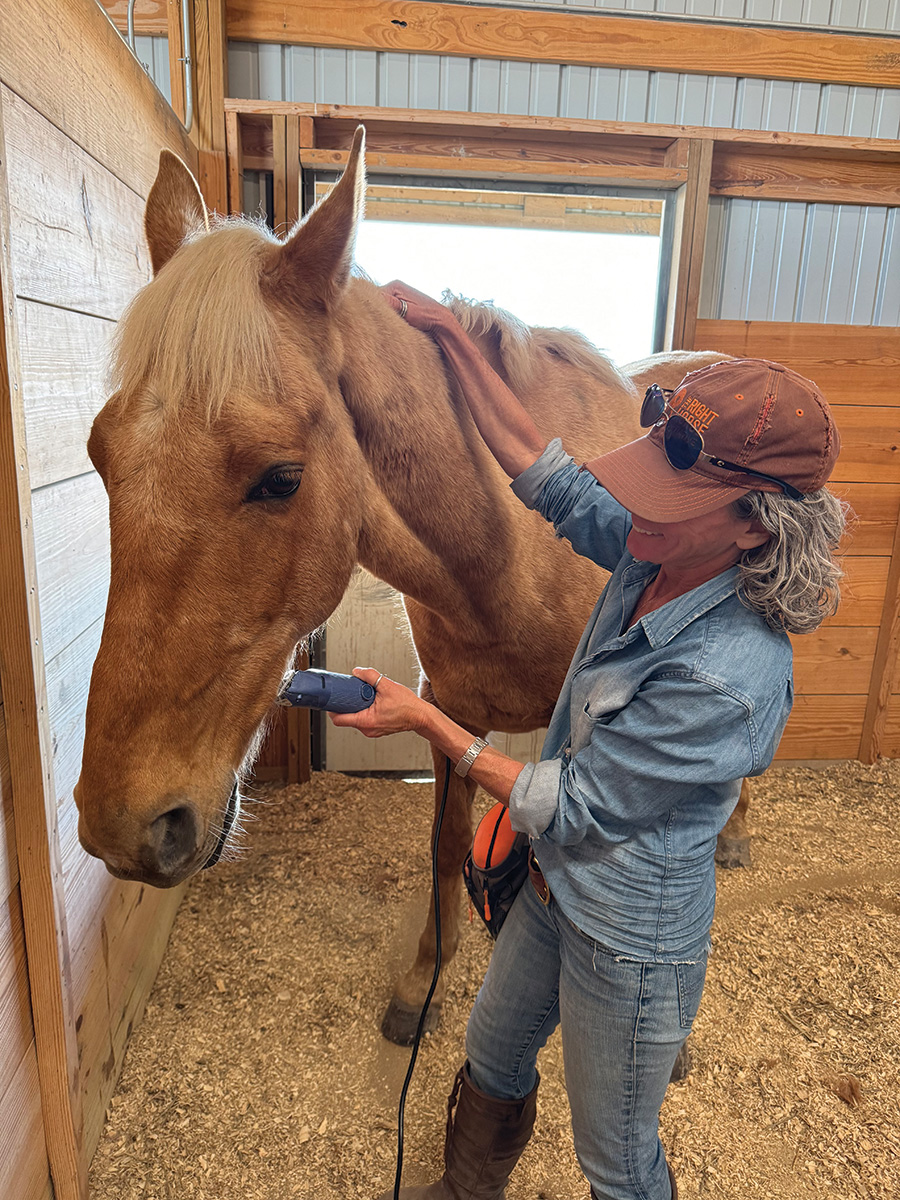
A woman clips a palomino gelding in a stall.
Many husbandry tasks can be easily trained to occur voluntarily and without any drama. Here, Bird approaches and stands for a little cleanup with the clippers. Photo courtesy Emily Weiss, Ph.D.

Once established, you can move on to variable reinforcement to make the behavior “stick.” You might use a little scratch or a verbal reinforcer if he finds that to be something that feels good to him, but he doesn’t have to get food every time.

“If he doesn’t expect to get the reward every time, he’s going to continue to do that behavior and it will remain consistent so long as he gets reinforced every once in a while,” says Weiss. “Think about playing the slot machines in a casino. Most of the time, people don’t win anything. But every once in a while, they do, and this keeps them coming back and pulling the lever.”

Mistakes to Avoid & Pasture Catching

If you’re looking to incorporate positive reinforcement in general interactions with your horse, which could include being on his back, Weiss recommends finding a sound you can make on your own as the bridge or marker, without relying on a clicker or other device.

“Holding a clicker, you can fumble a lot and you can end up missing [the moment],” says Weiss. “Timing is so important with any kind of training, and with positive reinforcement, you’re capturing the behavior as it happens.”

Another pitfall can be using food as a lure, such as getting your horse from a pasture, where many people bring out a bucket of grain and shake it to get their horse to come. This often results in the horse grabbing a mouthful and dashing off when you try to get the lead rope over his neck.

“It becomes a trick, and nobody likes to be tricked,” says Weiss. “The difference between going out with a bucket and getting that lead rope on really quick and a true positive reinforcement training where I’m teaching the horse to come to me, is that he is learning the contingency of ‘I get a halter on or rope around my neck and I get something good.’

“If the horse stood still as I approached, I’m going to whistle and give him a treat, and then I’m going to walk away,” she continues. “And very quickly that horse is going to just want to be with me. This isn’t that I’m tricking him to come be with me. He’s learning, ‘I approach her, I get a food reward. I approach her, she puts the lead rope over me, I get a food reward. I approach her, she put the lead rope over me, puts the halter on me, I get a food reward.’

“Ultimately, it will take less time to teach the horse to come on cue, rather than tricking him with the bucket,” says Weiss. “Because over time, tricking is not going to work, and it may be eroding the trust between you and your horse. And I guarantee you if there’s an emergency and you’ve got to grab him fast, it’s going to go much faster if he’s trained to reliably come on cue, as opposed to hoping a shake of the bucket will break through the stress of the situation.”

Next time you are finding yourself frustrated because your horse just won’t stop X or do Y, pause and observe what is happening before and after the behavior so that you can set him up for success by understanding what feels good (or less bad) to him.

Key Takeaway

Positive reinforcement is a valuable addition for any horse handler.

“It’s all about finding the right tools in your toolbox for a particular situation,” says Weiss. “And for a lot of horses there’s a frustration point, where you haven’t quite been able to get the behavior that you want. Removing the negative reinforcer and replacing it with a positive reinforcer can be just the ticket to completely change the horse’s perspective and make it much easier for you to get the training done.

About the Expert

As an applied animal behaviorist, Weiss has worked with species as varied as lions, orangutans, elephants and Komodo dragons, as well as many dogs, cats and horses.

Weiss is a lifelong horse owner and trainer and served as the ASPCA’s Vice President of Equine Welfare, working to increase rehoming of horses, as well as VP of Research & Development, overseeing research related to the animal sheltering field and developing assessment tools for shelter animals.

Prior to that, she created training programs to improve husbandry and decrease stress for many zoo animals.

This article about training horses with positive reinforcement appeared in the July 2024 issue of Horse Illustrated magazine. Click here to subscribe!

ASPCA Right Horse Adoptable Horse of the Week: Fancy

0

Welcome to Horse Illustrated’s weekly installment of the Right Horse Adoptable Horse of the Week, offered in partnership with the ASPCA’s Right Horse program. This week’s adoptable horse is Fancy! Check back weekly for a new featured horse so you can find your Right Horse.

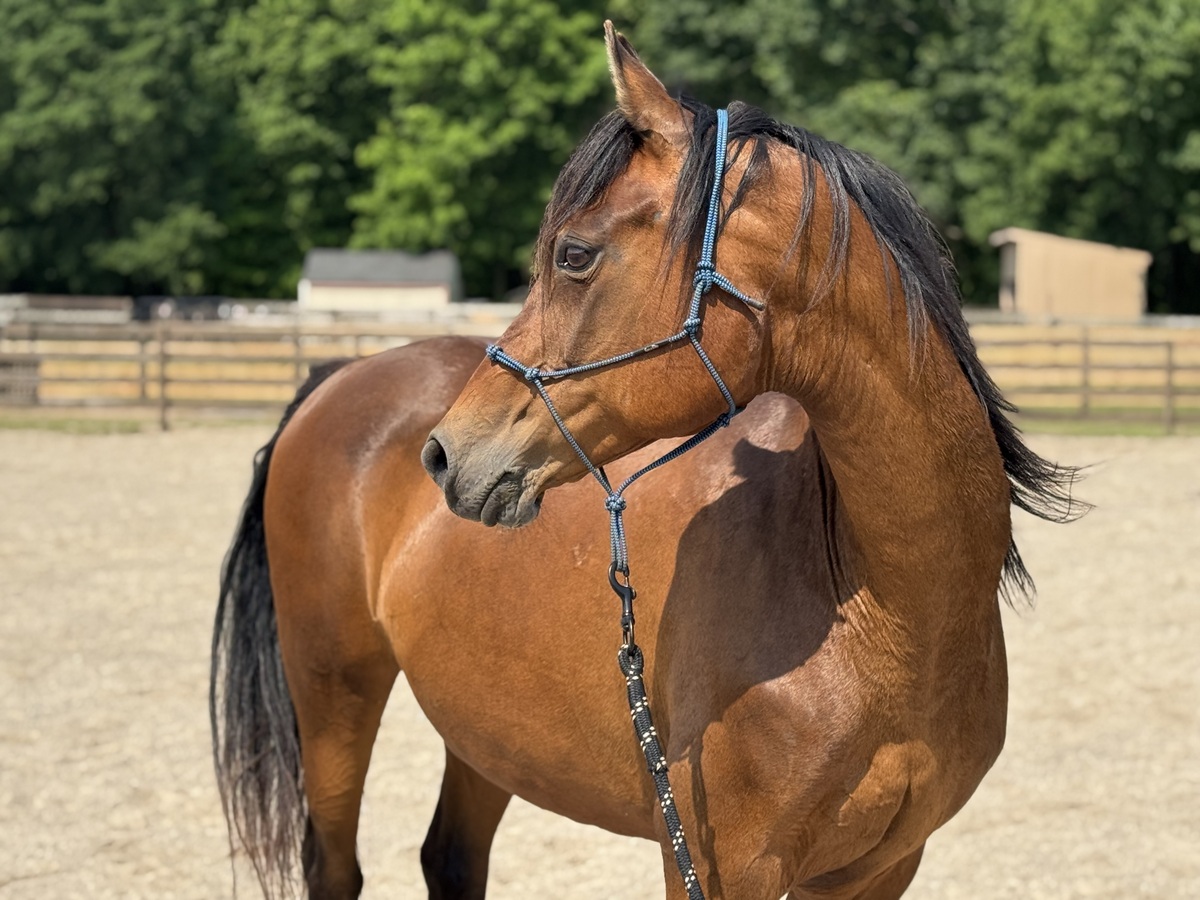
Adoptable horse Fancy.
Photo courtesy Horses’ Haven

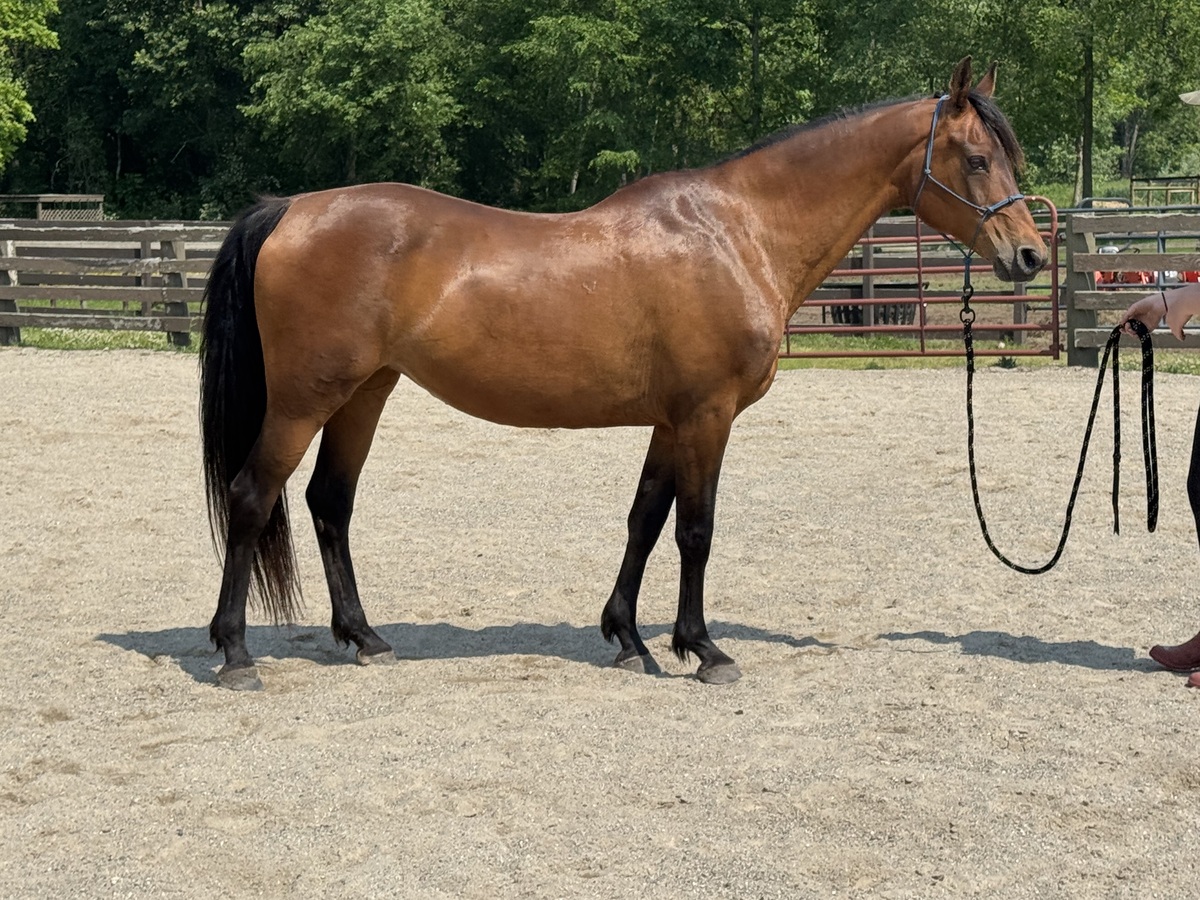
Adoptable Horse: Fancy, an 18-year-old, 15.1hh Arabian/Dutch Harness Horse mare
Organization: Horses’ Haven, Howell, Mich.

Get to Know Adoptable Horse Fancy

If you’re looking for a truly breathtaking equine partner to share your days with, look no further than Fancy. This regal, registered Arabian/Dutch Harness Horse is the definition of equine elegance. With her refined features, expressive eyes, and proud carriage, she turns heads wherever she goes.

Fancy has a riding history, but also a known tendency to rear, which she has demonstrated with Horses’ Haven. Because of this, she is available as-is and is not currently recommended for riding.

She is currently participating in Horses’ Haven’s training program, where she is working on ground-driving, longeing, and property walks. Intelligent and expressive, she’s an ideal match for someone interested in liberty work, groundwork, or simply enjoying time together in a low-pressure, positive environment.

Fancy’s beauty, presence, and unique character make her an exceptional companion for someone who appreciates the artistry and soul of horses. Whether you’re an experienced horse person looking for a pasture ornament, a liberty enthusiast, or simply someone wanting a majestic friend to share your property, she may be just the one to steal your heart.

She would thrive in a calm, patient environment with someone who understands complex horses and values them for who they are—not just what they do.

Contact Horses’ Haven today about ASPCA Right Horse Adoptable Horse of the Week, Fancy!

A conformation photo of a bay Arabian mare.
Photo courtesy Horses’ Haven

ASPCA Right Horse

My Right HorseASPCA Right Horse is the online adoption platform of The Right Horse Initiative, a collection of equine industry and welfare professionals and advocates working together to improve the lives of horses in transition. A program of the ASPCA, their goal is to massively increase horse adoption in the United States. To find more adoptable horses and foster horses, visit www.myrighthorse.org. To learn more about The Right Horse, a program of the ASPCA, visit www.aspcarighthorse.org.

0FansLike
0SubscribersSubscribe
We use cookies to help personalize content, tailor and measure ads, and provide a safer experience. By navigating the site, you agree to the use of cookies to collect information. Read our Cookie Policy.
OK