0 ITEMS
  • My Account
  • Holiday Gift Guide
  • Podcast
  • Webinar
Subscribe Combo
Enable cache13
Home Blog Page 116

German Warmbloods

0
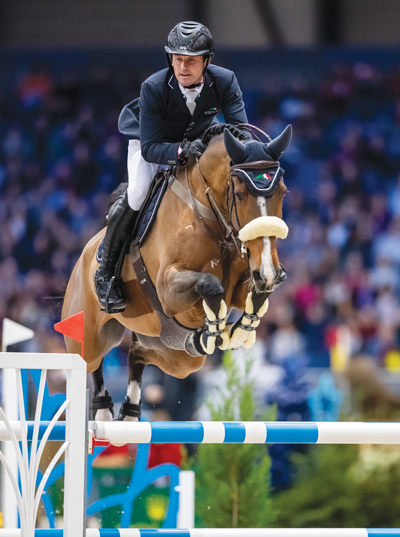
Oldenburg gelding Cassini Z and Darragh Kenny - German Warmblood
The Oldenburg gelding Cassini Z, ridden by Darragh Kenny from Ireland, competes in the Grand Prix jumpers. Photo by Lafrentz

Despite fighting a number of regional conflicts over the past millennium and ultimately losing two World Wars, Germany has managed to produce four of the finest warmbloods in the world. And while the conflicts took a toll on all horse breeds throughout Europe, the skill and dedication of breeders in Germany not only saved these German warmbloods from near extinction, but actually improved them.

German Warmbloods are known throughout the world for their exceptional athleticism. Whether it’s the FEI World Equestrian Games, the Olympic Games or a USEF rated show, you’ll almost always see German Warmbloods among the top contenders.

Although the Hanoverian, Holsteiner, Oldenburg and Trakehner all have firm German roots, each has its own unique history and tale of survival.

Oldenburg
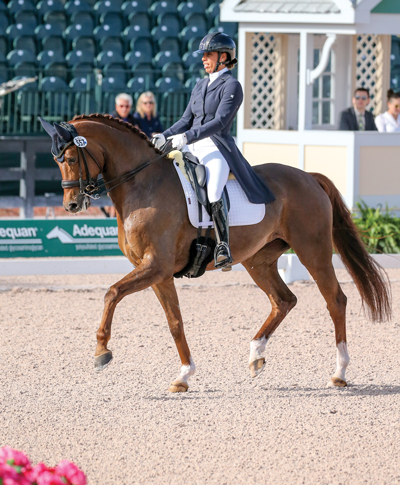
Oldenburg mare Ravenna and Andrea Woodard - German Warmblood
Ravenna, an Oldenburg mare owned by Andrea Woodard, is very successful under her owner at Intermediate I dressage. Photo by Susan J. Stickle

First bred in the Lower Saxony region of northern Germany in the former kingdom of Oldenburg, the Oldenburg breed was started in the 16th century from mares used as carriage horses and for farm work. Stallions of Andalusian, Turkish and Danish breeding were bred to these mares with the goal of creating a horse suitable for war. Over the next two centuries, they became favored by royalty, and were popular as carriage horses for nobility.

As with other European breeds, the Oldenburg began to be replaced by mechanized vehicles in the early 20th century. In the 1960s, German Oldenburg breeders began producing a modern version of the breed with the goal of creating a marketable sport horse. Thoroughbred stallions were bred to Oldenburg mares, and the resulting mares were then bred to Trakehners, Anglo-Arabians, Hanoverians, Holsteiners and other warmblood breeds.

The outcome is a breed known for its athletic abilities, particularly in the international world of show jumping. The breed is also making itself known in dressage at the upper levels.

Oldenburgs can vary in type depending on their breeding. They generally have long legs, a moderately sloped pelvis, and stand between 16 to 17 hands in height. They are most often seen in black, brown, chestnut, bay and gray.

Hanoverian

The Hanoverian was first developed in northern Germany in the medieval city of Hanover. The breed was created by King George II, the ruler of England and elector of Hanover, who used local mares and stallions of Spanish, Oriental and Neapolitan breeding. The Hanoverian was originally meant to be a carriage horse, a farm worker and, when needed, a warhorse.
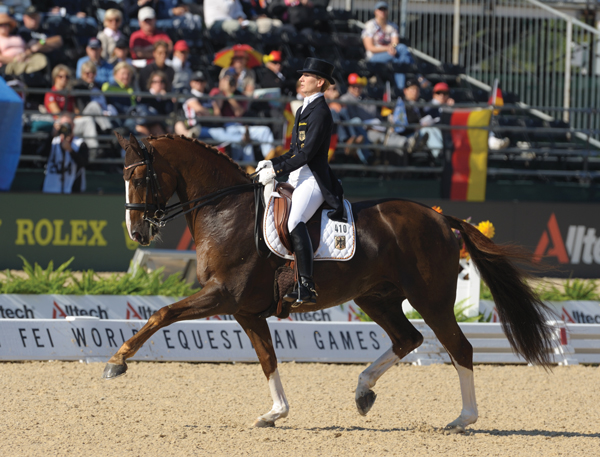
Anabel Balkenhol and the Hanoverian Dablino - German Warmblood
Anabel Balkenhol and the Hanoverian Dablino won team bronze at the 2010 Alltech FEI World Equestrian Games in Lexington, Ky. Photo by Clix/Shawn Hamilton

The Napoleonic Wars of the early 1800s took a toll on the European horse population, and the Stud at Celle, the state-sponsored Hanoverian breeding farm, was decimated during the conflict. Just before Napolean’s wars, 100 stallions lived at the Stud at Celle. When the fighting started, all had to be evacuated. After the wars were over, only 30 horses returned to the farm.

The breed slowly began making a comeback, but then suffered again during the two World Wars. The state breeding program miraculously survived both of the international struggles, and many of the horses that remained became the founding horses of the Hanoverian breed.

Standing 15.3 to 17 hands high, modern Hanoverians are strong, sturdy horses of large stature, and come in black, bay, chestnut, and gray. Today they are famous for their abilities as dressage horses and show jumpers, and they’ve made a name for themselves in the Olympics in both of these sports.

Holsteiner
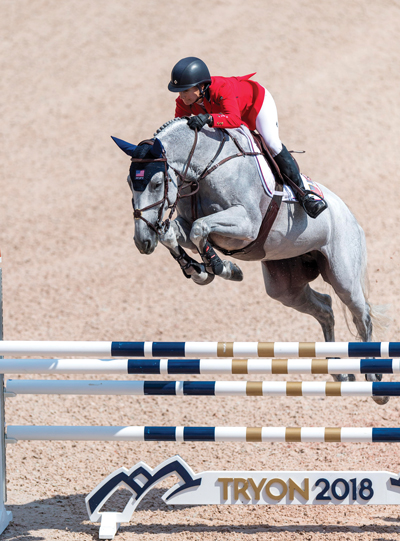
Laura Kraut and the Holsteiner mare Zeremonie - German Warmblood
Laura Kraut and the Holsteiner mare Zeremonie won team gold at the 2018 FEI World Equestrian Games in Tryon, N.C. Photo by Arnd Bronkhorst

Considered the oldest breed in Germany, the Holsteiner began in the north German region of Schleswig-Holstein more than 700 years ago. First bred by monks, the Holsteiner was designed to be an elegant riding and carriage horse that also had the ability to work in the fields and carry soldiers into war.

After the Reformation of the 1500s, official breeding of the Holsteiner became a state operation. Individual breeders also contributed to the breed’s bloodlines and continued this work for centuries. The Holsteiner was valued throughout Germany for centuries and was used in the 1700s to create the Hanoverian breed.
As the need for more elegant driving horses took hold in Europe during the 1800s, Cleveland Bays and Yorkshire Coach Horses were introduced to the bloodlines. After World War II ended, Thoroughbred, Arabian and Selle Français blood was added to help breeders market the Holsteiner as a modern-day sport horse.
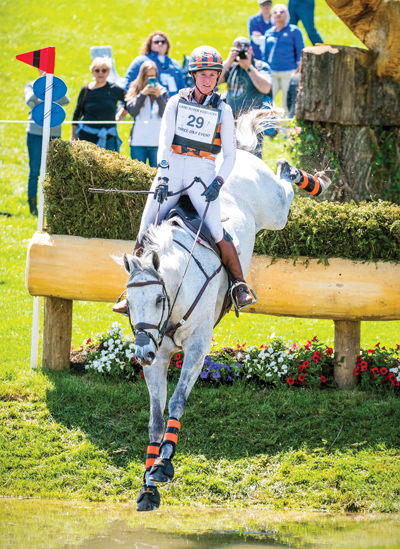
Lauren Kieffer and the Holsteiner gelding Paramount Importance
Lauren Kieffer and the Holsteiner gelding Paramount Importance had a top-10 finish at the 2019 Land Rover Kentucky Three-Day Event CCI5*. Photo by Arnd Bronkhorst

Today, Holsteiners are known for their exceptional talents in the international show jumping ring. In the U.S., they are also sought-after hunt seat and dressage mounts. They stand 16 to 17 hands in height, and have arched, high-set necks; powerful hindquarters; and strong backs. They come in brown, black, bay, gray and chestnut.

Trakehner

The Trakehner is closely associated with West Germany, and its roots go back to the 6th century B.C. The ancestors of today’s Trakehners were the mounts of the Scythians, great horse warriors who lived in what is now Eastern Europe. The breed as it stands today was created by the King of Prussia in the early 18th century from a local East Prussian breed called the Schwaike, a descendant of those Scythian horses.

The Trakehner was bred to be a military mount with great athleticism and endurance. The breed nearly perished during World War II when the Russian army began advancing on the Prussian village of Trakehnen in October 1944. The official government Trakehnen stud farm was seized by the Red Army, and the horses were shipped to Russia.
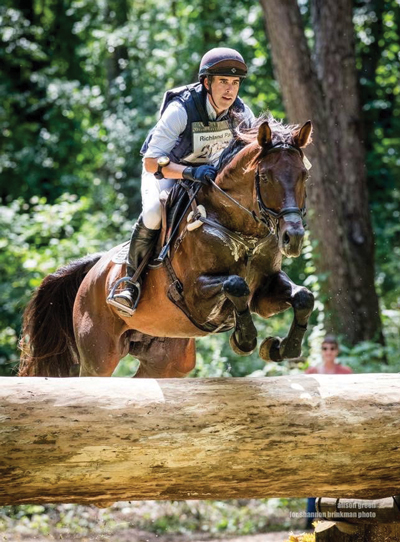
Trakehner stallion Tatendrang, ridden by Andrew Palmer
Trakehner stallion Tatendrang, ridden by Andrew Palmer and owned by Anissa Cottongim, eventing at Advanced at the Richland Park Horse Trials. Photo by Alison Green for Shannon Brinkman

A few months later, the Russians broke through the last of the German lines, and private Trakehner breeders began to flee toward Allied-occupied West Germany in an attempt to escape Russian rule. Taking 800 of their horses with them, they embarked on what is known as “The Trek.” Men, women and children of all ages struggled through the deep snow and freezing temperatures with Trakehners pulling wagons filled with supplies.

The Trek lasted two-and-a-half months and covered more than 600 miles. By the time the surviving Prussians and their Trakehners reached West Germany, only 100 horses were left. Only the hardiest ones had survived.

Dedicated breeders began working to revive the Trakehner’s numbers after the war ended. It took decades, but by the 1980s, three state-supported Trakehner stud farms were operating. Thoroughbred and Arabian blood was added to help refine the breed and expand the gene pool.
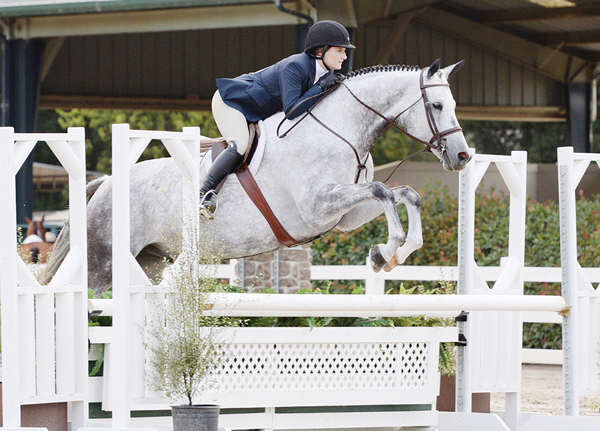
Linus, a Trakehner gelding
Linus, a Trakehner gelding, competing in the hunters at Menlo Charity Horse Show. Photo Courtesy Deb Dawson

Today, the Trakehner is an elegant German warmblood, large and well-muscled. Standing from 16 to 17 hands in height and coming in all solid horse colors, Trakehners are best known for their talents in Olympic-level jumping and dressage.

This article about German Warmbloods appeared in the June 2020 issue of Horse Illustrated magazine. Click here to subscribe!
Breed Associations

American Hanoverian Society
Holsteiner Verband North American Breeding District
Oldenburg Horse Breeders’ Society
Oldenburg Registry of North America
American Trakehner Association


My Right Horse Adoptable Horse of the Week: Lexie — September 13, 2021

0
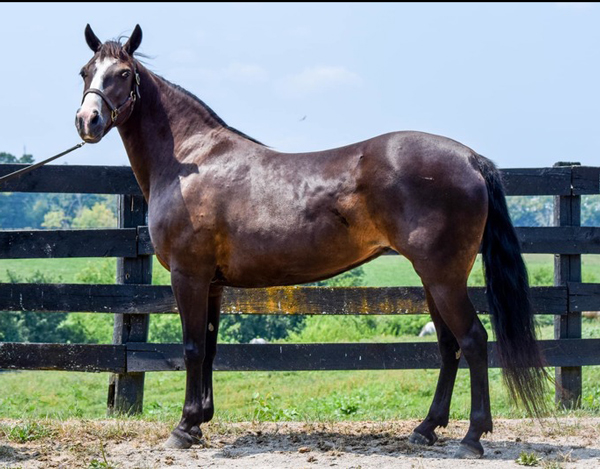
My Right Horse Adoptable Horse of the Week - Lexie
Photo Courtesy Kentucky Humane Society

Welcome to Horse Illustrated’s weekly installment of the My Right Horse Adoptable Horse of the Week, offered in partnership with The Right Horse. Lexie is this week’s adoptable horse. Check back weekly for a new featured horse so you can find your #righthorse.

My Right Horse Adoptable Horse of the Week - Lexie
Photo Courtesy Kentucky Humane Society

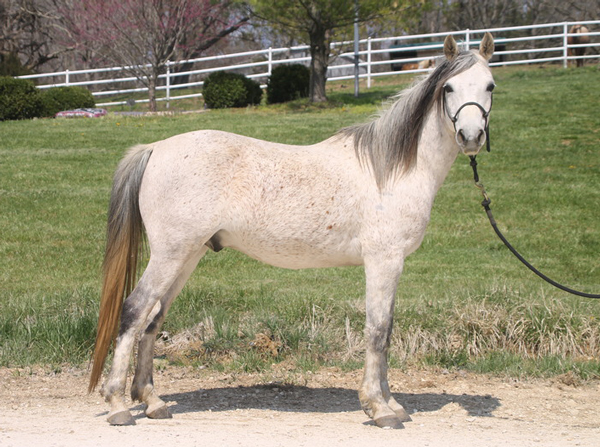
Horse: Lexie, a black six-year-old 13.3-hand pony mare in Simpsonville, Ky.
Organization: Kentucky Humane Society

Lexie is an approximately 13.3hh grade pony mare who is a new arrival. She is an adorable pony with a sturdy build who is ready to start the rest of her life and training journey. She has been handled by humans most of her life (not a feral horse) but does best with a confident handler at the moment to establish expectations and boundaries. She appears sound and is ready for training. She looks to be a great size for a future games pony or small eventer. She also would likely make a great trail partner one day for a can-do trail rider but may not be the slow plodder type due to a sometimes busy personality. Lexie is looking for someone with the ability or the plans to have her started under saddle and trained to ride. Lexie is ready for a job and a purpose. Please check back for updates and photos. Could she be your #righthorse?

Click here for questions about Lexie, the My Right Horse Adoptable Horse of the Week

My Right HorseMy Right Horse is the online adoption platform of The Right Horse Initiative, a collection of equine industry and welfare professionals and advocates working together to improve the lives of horses in transition. A program of the ASPCA, their goal is to massively increase horse adoption in the United States. To find more adoptable horses and foster horses, visit www.myrighthorse.org. To learn more about The Right Horse, a program of the ASPCA, visit www.therighthorse.org.

Flies, Worms and Yucky Things

0
Horse has flies on nose
Photo by Patrick Lefebvre/Shutterstock

Things that fly, bite and bother your horse are in the air, and in the gut. Whether you board your horse or have your pony at home, now is the time to think about parasite control for horses to protect your equine friend from pesky pests like worms and flies before they cause problems.

Fly Control

Fly spraying a horse to prevent flies
Spray your horse daily and before riding to get the most out of your fly repellent. Photo by Shelley Paulson

As the weather warms, flying insects of all kinds start to emerge at the barn. You may notice your horse start to swish his tail on a calm day in the pasture or nip at his flank while you’re on a trail ride. Not only are flies annoying, but they can also irritate your horse’s skin and spread disease. Learning how to manage flies early in the season means you’ll be a pro at fly control by summer when they are even more of a menace.

The first step in effective fly control is good barn hygiene. Make sure manure is picked up in the barn aisles and stalls are cleaned daily. Also keep fresh water in your horse’s buckets. Manure and stagnant water are prime breeding grounds for bugs that bite, including mosquitoes.

Next, don’t fear the fly spray. As a horse sweats, sprays wear off, so a good routine is to spray your horse in the morning and in the evening, and before you ride. Don’t forget to re-apply if you bathe your horse.

Hold the spray about 6 inches away from your horse’s body and apply up and down his legs and under his belly and up the neck. Face application is important, too, but be careful. Many horses don’t like to be sprayed in the face, so applying spray to a clean cloth and wiping your horse’s ears and around his eyes is better, especially so spray doesn’t accidentally get in the horse’s eyes. There are also fly wipes specifically made for this. A fly sheet and fly mask may also be a solution if your horse has sensitive skin.

Preventing flies using a mask
Physical barriers like fly masks are a great way to create a no-fly zone. Photo by JFJacobsz/Shutterstock

Finally, don’t forget about the secret weapon against flying insects: a good breeze. Wind makes it impossible for flies (and mosquitoes) to land on your horse, and no landing means no biting. If your horse’s stall has a window, open it when possible. A fan in the stall or in the barn aisle can also be a huge help in preventing pests from bothering your horse (make sure to use a fan rated for farm or industrial use so the motor is sealed off from dust and there is less risk of fire).

Parasites

Internal parasites, also called worms, are common in horses because immature worms (larvae) live on blades of grass and are passively eaten when a horse grazes. Larvae emerge in pastures in the spring. These larvae then develop into adult worms within the horse’s intestines.

While this sounds gross, it’s really important to realize that a small number of worms typically does not harm a healthy adult horse. However, large worm infections can cause problems, like diarrhea, weight loss and sometimes colic.
Equine parasite control can be done with one of several deworming drugs made for this purpose, but not all horses need to be treated. So how do you know if your horse needs a dewormer?

Using paste to prevent worms in a horse
Your vet can help you select a dewormer after doing a fecal egg count. Photo by Gina Cioli

In the spring, ask your vet to do a test called a fecal egg count. To do this, your vet will take a sample of your horse’s manure, mix it with a special liquid, and look at the sample under a microscope. Parasite eggs are shed in your horse’s manure, so if your horse has worms, their eggs are seen as small oval shapes under the microscope.

Don’t worry if your horse’s manure is positive for eggs; this is very common. What’s most important is the number of eggs. Your vet will count them and tell you how many she finds. If there are many eggs—typically over 200—your vet may recommend treating your horse with a dewormer.

If there are fewer eggs, this indicates a mild infection, and your horse typically won’t need treatment unless he is young or otherwise sick. Not overusing dewormers helps prevent the development of resistance by the parasite to these important drugs.

To help control worms on the farm, remove manure piles in small pastures and paddocks to prevent the spread of worm eggs. Not allowing your horse to overgraze a pasture is important, too. Grass should be kept about 3 to 4 inches tall—shorter than that and it’s time to move your horse to another field, if possible, to allow the grass to re-grow.

With a little planning and awareness, you and your horse can be worry-free from worms and flies this spring!

This article about flies, worms, and more appeared in the Spring 2020 issue of Young Rider magazine. Click here to subscribe!


Vet Adventures: Angel or Demon? One Pony’s Very Bad Habit

0
Pony Bad Habit - Gray pony
Photo by Jane Stanley/Shutterstock

Marvin the pony was a rare find, and his owners knew it. When young Lucas went for a ride, Marvin always brought him home safely. You’d never catch Marvin ducking and weaving around an arena as his rider held on for dear life. Marvin would never drop his head and come to a screeching halt, launching the unsuspecting child headfirst into a small cross-rail jump. He would never buck furiously as though demons were pursuing him, and then prick his ears innocently at his unhappy rider sprawled on the ground. In a world full of children terrorized by devil-minded ponies, Marvin was pretty much a saint. Or so he seemed. But this pony held one very bad habit.

A Very Good Boy

One day when I was working on the farm, I saw Lucas climbing Marvin like a tree, his coattails flapping as he struggled sideways into the saddle. The gray pony never moved a muscle, but the saddle did, rotating 180 degrees and dumping the child into the dirt under Marvin’s legs. I gasped as the boy struggled to his feet, and his helmeted head thudded into Marvin’s belly, but all Marvin did was nose Lucas’ side and stand patiently while his saddle was fixed.

Another time, Marvin and Lucas were jogging around the arena during a lesson, and an out-of-control horse charged past them, kicking out viciously. Marvin dodged the kick, unseating Lucas, who ended up straddling the back of the pony’s neck.

Marvin came to a stop immediately, and Lucas, who was apparently part monkey, was able to scramble back into his saddle without ever hitting the ground. He straightened his tweed coat, and they trotted off with dignity.

Needle-Shy

The only time Marvin was less than perfect was when I had to give him his shots. Lucas’ mother, Daphne, would take a firm grip on Marvin’s halter, walk him off, and I’d follow, syringes uncapped and ready.

When I first started doing Marvin’s shots, I’d give the pony a chance to behave and would try giving the shots in the usual manner. I’d take hold of the skin on his neck and ease the needle in, but when Marvin felt the first poke, all hell broke loose.

While he usually bolted forward, sometimes he’d rear, and sometimes he’d spin into me. He was powerful and fast and was instantly enraged by the pokes. We had found the bad habit of this pony.

By then, I’d either dropped the syringe into the dirt or bent the needle, and Daphne would be panting, hauling on the halter and scolding the pony. Lucas would hide behind a nearby stall door, chanting, “Come on now, Marvin. Marvin stop that! Marvin, you behave yourself! Marvin, you bad boy!”

Successful Tactics

On one memorable visit, the full syringe was left dangling from Marvin’s neck after he exploded, driving him into a frenzy of charging and rearing until he’d managed to shake it loose and trample it into the ground.

I retrieved the broken pieces of the syringe but never did find the needle. Daphne found it the next day, wedged in the sole of her muck boot. Clearly different tactics were needed to get the shots into this pony, and after some dramatic mishaps with a rope twitch, which I quickly abandoned, I’d discovered an approach that sort of worked.

Daphne would walk Marvin briskly along the gravel path, rattling a feed bucket and distracting him. I’d sidle up to him with my heart pounding and syringes uncapped and tucked between my fingers. I’d rapidly shoot them into the gray neck without any warning, and—if I was lucky—I was in and out before Marvin had a chance to react.

Daphne would swiftly distract him with the grain, and all was well. If I messed up, it was war, so I made a point to get it right.

New On the Black

One spring, there was a new vet sniffing around the barn, and while I normally
welcomed new colleagues, it was clear that this woman had no interest in any sort of a professional relationship with me.

She wanted my clients and was doing everything in her power to lure them, launching direct email campaigns, hanging posters, and offering discounted vaccine and Coggins clinics to all new clients. It was a free country, and horse owners had a right to use whichever vet they wanted, but it still stung a little when I didn’t hear from Daphne and Lucas that season.

I was very busy with my regular barns, so I put Marvin out of my mind and focused on my work. But one day in late spring my phone rang, and Daphne’s number popped up on the screen.

“Dr. Diehl, I’m embarrassed. We decided to use another vet this spring to save money, but things didn’t go so well.”

“I’m sorry to hear that,” I said. “What happened?”

“Well, as you know, Marvin’s a little tricky with shots. He kind of outdid himself this time.”

I hid a grin at the pony’s probable display of his only bad habit..

“Oh?”

“Yes,” Daphne said. “The vet wouldn’t listen when I told her how you do it. They tried giving the shots the usual way, and he knocked the tech down and ran away. Then they tried to twitch him when I said not to, and he struck the twitch off, and it hit the vet in the face and broke her nose. I feel absolutely awful. We’ve arranged for a trainer to work with him, but can you please come vaccinate him?”

Back to Business

I said that I would, and we got Marvin vaccinated, barely. After his experience at the vaccine clinic, he was worse than usual, but my old trick eventually worked, and soon he was munching his handful of grain, and I was shakily capping my empty syringes. Lucas emerged from his hiding place, wideeyed, and marched up to Marvin, shaking a small finger.

“Marvin, you’re naughty, and I’m very, very mad at you.”

Then he produced a carrot from his coat pocket. Marvin crunched the carrot adoringly, and Lucas stroked the lowered gray head. “But you sure showed that other vet, didn’t you!”

This Vet Adventure column about a pony’s very bad habit appeared in the July 2020 issue of Horse Illustrated magazine. Click here to subscribe!
My Right Horse Adoptable Horse of the Week: Fantasy — September 6, 2021

0
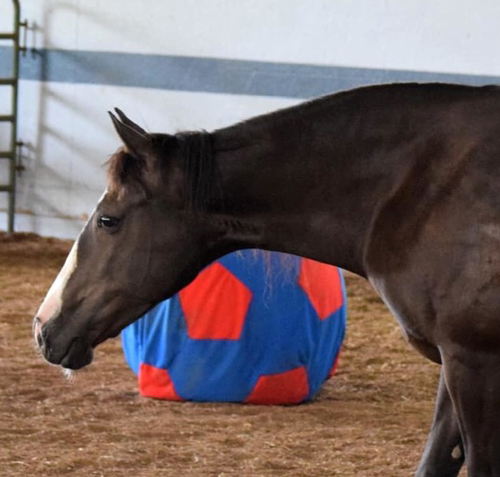
My Right Horse Adoptable Horse of the Week - Fantasy
Photo Courtesy Humane Society of North Texas

Welcome to Horse Illustrated’s weekly installment of the My Right Horse Adoptable Horse of the Week, offered in partnership with The Right Horse. Fantasy is this week’s adoptable horse. Check back weekly for a new featured horse so you can find your #righthorse.

Horse: Fantasy, a gray 14.3-hand 31-year-old American Quarter Horse mare in Fort Worth, Texas
Organization: Humane Society of North Texas

Meet the Fantasy of your wildest dreams. This sweet old girl is as steady as it gets. She has excellent ground manners and would be safe for any people, pets, or kids to learn to be around horses. At 31, she is no longer able to be ridden, but that doesn’t mean she doesn’t have a lot of life and love to give still. She loves to bury her head into your chest for a snuggle session any time, anywhere. Another great perk of this distinguished gal, since she has very few teeth left, she is done with teeth floats for life! How awesome is that?! It is a good thing she loves mash and soup, too. Fantasy stands at about 15 hands and is up to date on vaccinations, Coggins, farrier and dental care, deworming, and is microchipped. If you have a place to let this girl retire and live out her golden years, please fill out the Interest in Adoption Form on the Humane Society of North Texas website to learn more or schedule an appointment to meet her. Could she be your #righthorse?

Click here for questions about Fantasy, the My Right Horse Adoptable Horse of the Week

My Right HorseMy Right Horse is the online adoption platform of The Right Horse Initiative, a collection of equine industry and welfare professionals and advocates working together to improve the lives of horses in transition. A program of the ASPCA, their goal is to massively increase horse adoption in the United States. To find more adoptable horses and foster horses, visit www.myrighthorse.org. To learn more about The Right Horse, a program of the ASPCA, visit www.therighthorse.org.

Western Lesson: Introduce Your Horse to a Baby Pool

0
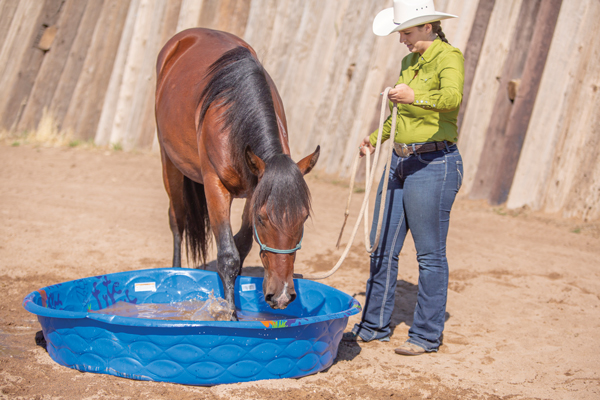
Introduce a Horse to a Baby Pool
Photo by Heidi Nyland Melocco

Baby pool water obstacles are common in trail classes. Plus, splashing in a baby pool is a great way to introduce your horse to water crossings if you’re surrounded by dry land. (Plastic pools should only be used with barefoot horses. If your horse wears shoes, opt for a low wooden box with an industrial-grade canvas tarp liner. Either way, always put water in the pool so it doesn’t shift.)

Young Rider Magazine LogoHere, trainer Jessica Dabkowski of Pony Peak Stangmanship in Laporte, Colo., guides her student Hannah through the water obstacle for the first time. Jessica focuses on natural horsemanship techniques while training Mustangs and all breeds of horses. In just 10 minutes, Junior walked through water—stepping in with all four hooves.

“This is a tough obstacle because the pool is round,” Jessica says. “It invites horses to go around instead of through the water. It’s important to approach with straightness.”

To master this obstacle, make sure your horse will first move forward on your command. Make sure you can “send” him straight over a log or tarp before you add the complexity of water.

Water Time

To start, outfit your horse in a rope halter and long lead and work in an enclosed environment where you’ve set up your baby pool and filled it with water.

You’ll ask your horse to move forward with as little pressure as possible, then escalate your cues, if needed. First, walk your horse close to the pool, but don’t ask him to walk through quite yet. Stand at your horse’s left side and face him. Holding the lead line with two hands, raise your “directing” hand (left hand)—the hand closest to your horse’s nose—and point him toward the pool.

If your horse doesn’t look or move forward, raise your “driving” hand (right hand) to apply mental pressure. Your driving hand holds the leadline portion that’s closest to your horse’s tail. You can simply raise your driving hand or choose to gently swing the rope to apply more pressure. Start with as little pressure as possible, and only escalate your body language and cues if your horse needs extra motivation.

Horse and Water
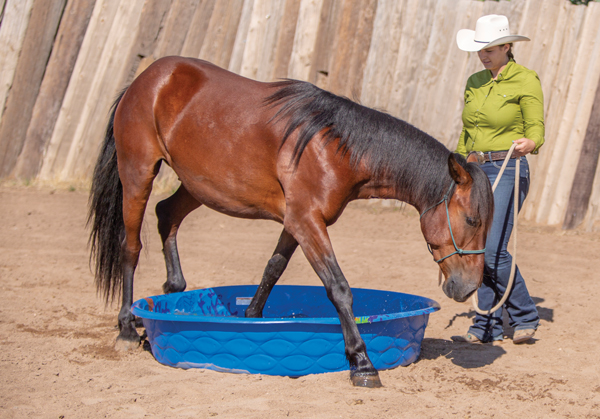
Eventually your horse should be comfortable stepping right through the pool. Photo by Heidi Nyland Melocco

Soaking Time

Allow your horse to stop and investigate the pool. If your horse mentally or physically approaches the obstacle, relax and allow him to take time. He may just look interested (mental approach) or step forward (physical approach).

Encourage your horse to put his nose on the pool or start to play with the water. Allow that investigation! Take a breath, slow down and allow him plenty of time to think through every stage. If he is allowed to pause and investigate, he won’t feel rushed or fearful.

If your horse stops, moves away or looks disinterested, raise your directing hand and ask him to move forward again. If he moves close to you, do your best not to step backward (unless he spooks and it’s a safety issue—in that case move out of the way fast). If your horse moves slowly into your space, he could learn that he can control your movements. Don’t allow that!

If your horse moves to the side or steps away, move him back into position and ask him to move forward again. Be careful not to circle him. Instead, switch sides and switch hands and direct his feet back to the middle of the pool.

If your horse stops and licks and chews, he’s releasing tension and taking time to think. Allow him to do this. Once he places one foot in, pause, relax and allow him to feel the water. Then ask him to move forward again.

Introduce a Horse to a Baby Pool
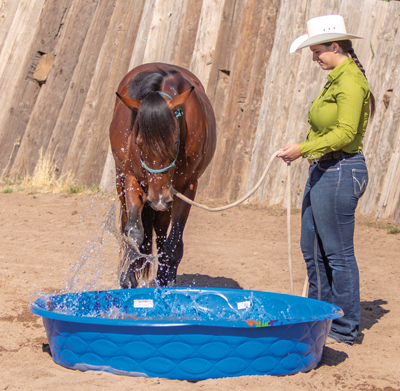
Let your horse splash in the water while he’s getting used to it. Photo by Heidi Nyland Melocco

Move on Through

When introducing your horse to a baby pool, he may rush through the water the first time he moves through. He may also step on the side of the pool and make a big noise with the plastic. Don’t let his rushing or worry make you rush! Slow down, reset and try again. If he does tense, make sure not to pull him toward you. Send him straight through—safely out of your space.

Once your horse reaches the other side, move with him. Then switch hands and ask him to move back through the pool. Keep working until he has placed all four feet into the pool.

If your horse is relaxed and willing to move through slowly and places all (or most of) his hooves in the water, go practice something else. You may want to revisit the training after a short break or just stop your training day on a good note.

Special thanks to our models, Hannah Eddy and Junior.

This article about how to introduce your horse to a baby pool appeared in the Spring 2020 issue of Young Rider magazine. Click here to subscribe!

Convert Your Bumper Pull Horse Trailer Tack Room into DIY Living Quarters

1
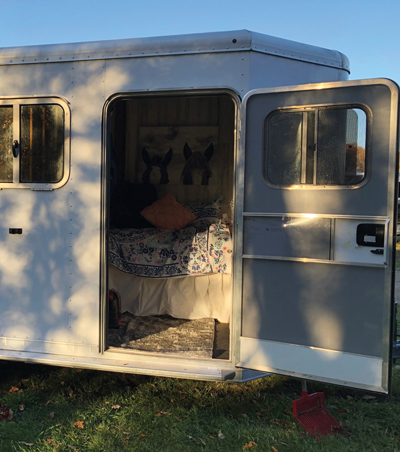
DIY Horse Trailer Living Quarters
Photo Courtesy Vonda Davison

Whether for competition or pleasure, often our horse adventures take us far from home for several days. Hotels can really add up, and horse trailer living quarters are expensive. Inventive equestrians have solved this problem by converting their horse trailer tack rooms into camping spaces.

There are infinite possibilities when it comes to creating a sleeping area. Here are some modified trailers to help inspire your own creativity.

Modern Aluminum Frame Horse Trailer

Vonda Davison says she did a lot of researching and planning before converting her 2013 Featherlite Perfect Fit two-horse straight-load.

Living area in trailer with bed under under manger
Vonda Davison moved one of the under-manger saddle racks to make room for a bed. Photo Courtesy Vonda Davison

“It’s important to know the best insulation to use and also what type of screws you’ll need when drilling into aluminum or steel,” she says. “For instance, you do not use steel screws when screwing into aluminum.”

Since her horse trailer had saddle racks under the feeding areas, she moved one to the other side to make room for a bed in her living quarters. She added insulation, furred it out, and finished with paneling and trim. “Furring out” refers to expanding a wall’s construction, either by depth or width, usually by using metal or wood to make a level surface. Since most trailers have framing on the inside so you don’t have a smooth wall, the “furring” would make the wall flush with the framing so it’s smooth, like the wall of a house.

Living area in trailer with sink
Vonda Davison added a sink with 5 gallons of water that drains into a bucket. Photo Courtesy Vonda Davison

She made a cabinet to fit the front of the trailer and installed a USB-charged faucet with a 5-gallon water container and a sink that drains into a bucket. Her bed is made of two-by-fours with foam cushioning. For lighting, she uses a battery-charged lamp.

“The hardest part was drilling the furring strips to the aluminum ribs,” she says. “I had to pre-drill all the holes.”

Super Storage in DIY Living Quarters

Lisa Parkhurst had 2 feet of extra length added to the dressing room of her 2011 Double D Safetack bumper pull when she had it built because she knew she wanted to fit a bed in it.

“I knew I was going to camp in the trailer, so I wanted the dressing room big enough for a cot,” she says.

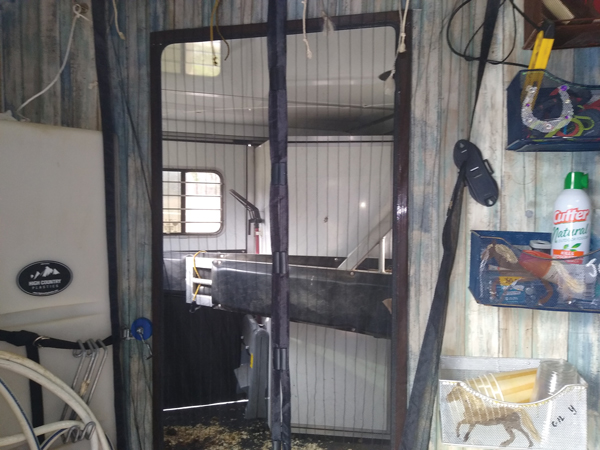
Door Between Stalls and Tack Area in trailer
Lisa Parkhurst had her trailer built with a door between the horse stalls and sleeping area. Photo Courtesy Lisa Parkhurst

She also had them add a walk-through door to connect the stalls to the sleeping area, a vent with a 12-volt fan, and a 12-volt battery wired to trickle charge from her truck when towing.

Finally, she had a 25-gallon water tank and an awning installed in her DIY horse trailer living quarters. Even then, she ended up making some changes.

“It was very cramped,” she says. “Eventually, I put a bed in the front part of the dressing room over the spare tire and battery, high enough that I could take advantage of the windows in the nose of my trailer.”

Due to weight, she couldn’t add cabinets, but found another way to have storage.

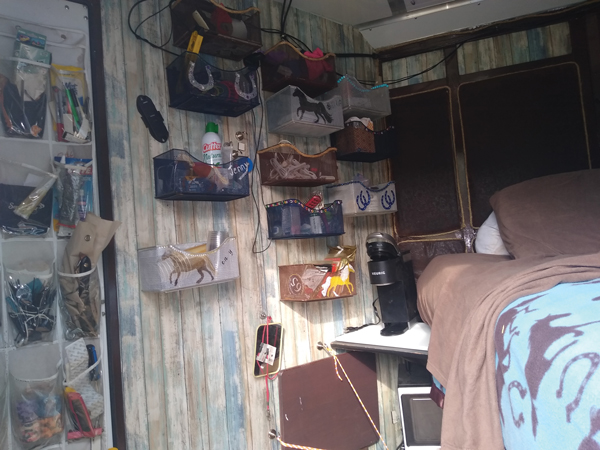
“My trailer is made from Z composite, which means it’s not as heavy as a steel trailer, but it is magnetic,” Parkhurst says. “I took full advantage of that and put in magnetic baskets on the wall for storage. I glued a shoe holder to the pass-through door, and then under the bed, I have two aluminum wire shelves.”

Under the bed, she ran a heavy-duty extension cord through the floor, so she can plug in if hook-ups are available. Parkhurst used foam puzzle mats for her flooring, because they were easy to install herself.

Magnetic Storage Baskets
Lisa Parkhurst added magnetic storage baskets to the walls to make use of vertical space. Photo Courtesy Lisa Parkhurst

For insulation, she used leftover bubble insulation from her barn.

“I covered the part around the bed with soundproofing foam and fabric,” she says. “I knew I would be bumping into it as I slept, and it really does cut down on noise from other campers. On the rest, I used a peel-and-stick wallpaper, and either covered the wall directly [over the insulation] or covered foam craft boards cut to fit.

“New in the past year was adding a 100-watt solar panel and solar generator,” she adds. “This has allowed me to use a microwave, coffee pot, and 12-volt cooler, and really covers all of my power needs except for electric heat and air conditioning.”

Creative Sleep Space in Horse Trailer Living Quarters

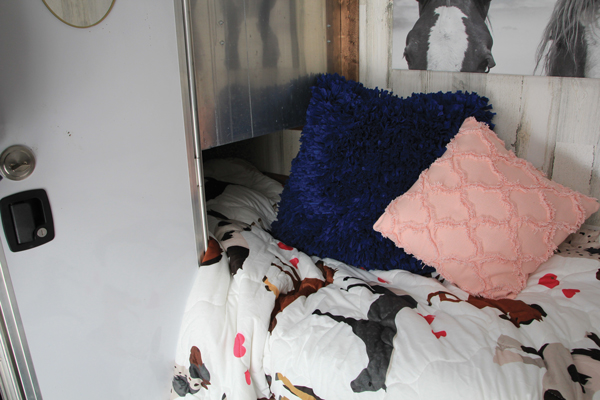
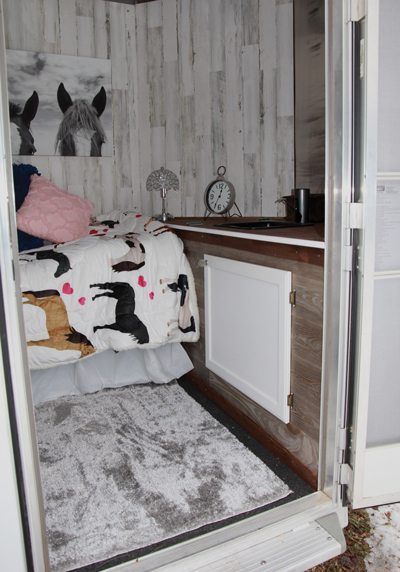
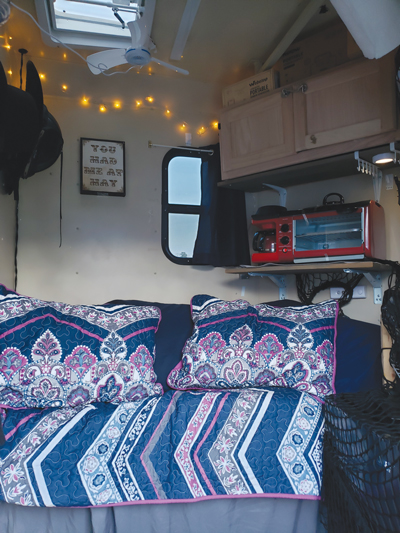
Joanie Carter purchased a 1997 Midsouth two-horse trailer with enough room for a bed in the dressing room, knowing she would convert to add some living quarters. But just putting a bed in proved to be more work than she thought.

Bed inside mobile tack room
Joanie Carter added a small cabinet, USB lights and fan, as well as a breakfast center. Photo Courtesy Joanie Carter

“There have been some ups and some downs,” she says. “I started with a fold-out foam sofa as my bed on the floor. That was too low. I used a coffee table to elevate the bed. That was too hard and not long enough to stretch out. I finally realized that I could remove the saddle rack under the manger and place my bed along the side. Now I can fully stretch out by sticking my feet under the manger.

“I then added shelves to store the three-in-one breakfast center, microwave and utensils,” she continues. “I added a small cabinet to house the lights and USB fans.”

She also added a vent and, with the help of her son, a window for cross-ventilation. She uses a solar generator and two 100-watt solar panels for power.

There was no extra tack space, so she made a rack out of PVC pipe and put it in the rear of her trailer, taking up one of the two stalls. She also put the spare tire, chairs and table in this area, plus a solid divider. On the trailer door, she added a caddy to hold grooming supplies.

DIY Horse Trailer Living Quarters
She had the extra space to make her living quarters look just like an RV. Photo Courtesy Kelly Dickson

RV Living

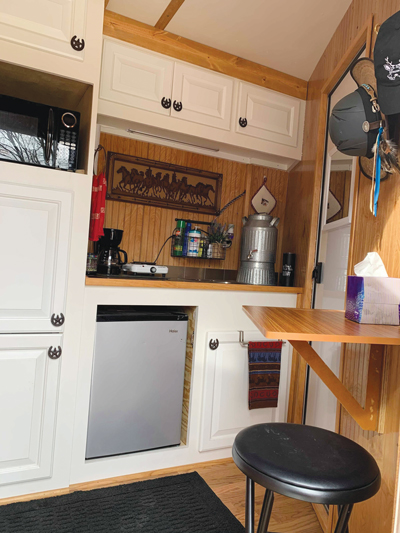
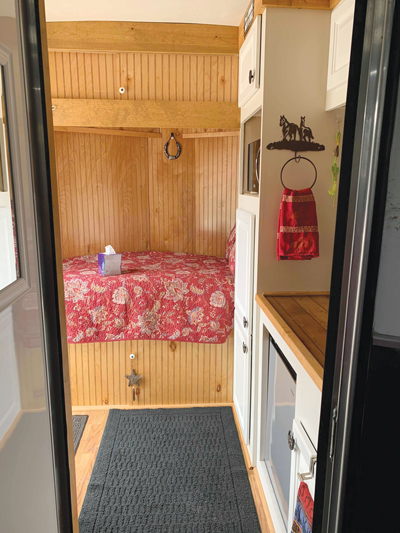
Kelly Dickson had lots of space for her conversion, since her 2004 Featherlite two-horse slant load is the same size as a three-horse trailer, but instead of a third stall, she has an enlarged dressing room and a rear tack. Because of this, she was able to create a mini-living quarters area that looks just like a small RV.

She had a pass-through door installed, then had the entire area insulated with closed-cell rigid foam and sealed with HVAC tape. Furring strips were used to prevent condensation.

She had 30-amp electric installed for a camping hookup, interior lights and electrical outlets. She has a bed at the nose of the trailer with storage above and below it. She has a closet, microwave, counter, sink, collapsible table, electric heater and mini fridge.

DIY Horse Trailer Living Quarters
Kelly Dickson put her bed in the nose of the trailer with storage above and below it. Photo Courtesy Kelly Dickson

“The most difficult decision in my conversion was where to anchor the spare tire,” she says. She ended up bolting it to the wall of the rear tack, which she says makes it easily accessible.

New Life in an Older Trailer

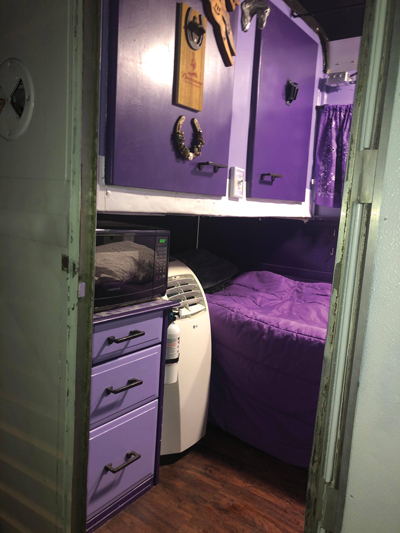
Bridget Hayes converted a 1984 WW two-horse straight-load trailer into an adorable camping set up. She cut an opening at each manger and installed cabinet doors. She used part of an old desk to make a table for her microwave.

A portable air conditioner is vented out into the horse compartment through a hole in the back wall with a drain tube in the floor. She built cabinets along the front with a bar sink and a fridge.

DIY Horse Trailer Living Quarters
Bridget Hayes cut openings in the mangers and installed cabinet doors. Photo by Bridget Hayes

Hayes uses a cot for a bed, with her portable toilet underneath. She plans on replacing the cot with a folding shelf so she can lift up her bed and store items underneath.

“My biggest issue was getting rid of the rust and maintaining the metal,” she says.

Since her trailer didn’t have a rear tack, she uses a portable saddle rack on wheels that sits in the living space while traveling. The rack is then moved to the horse compartment when camping.

With endless ideas, you are sure to find something that will work in your trailer, regardless of its age or size.

Tips and Tricks

THE NO. 1 THING MOST DIY’ERS AGREE ABOUT IS INSULATION: you will want it! It not only helps with the cold and heat, but also noise.

BE SURE TO GET A PROFESSIONAL’S HELP when it comes to electricity, water or cutting into your trailer, which may compromise the integrity of the frame. Adding things like vents or solar panels can cause leaks.

KEEP WEIGHT IN MIND. Everything you add to your living space adds weight to your trailer that your vehicle has to pull. Make sure you stay under your vehicle’s maximum pull weight when you add your horses and tack.

DON’T FORGET TO SECURE EVERYTHING. Trailers vibrate quite a bit, and many DIYers have found they had to go back and use stronger fasteners to keep things in place. Aside from bolting things down, cargo nets can help.

FOR MORE INSPIRATION AND HELP from fellow DIYers, check out the Horse Trailer Bumper Pull Conversion to LQ group on Facebook for plenty of tips for first-timers.


This article on how to create DIY living quarters in your horse trailer appeared in the June 2020 issue of 
Horse Illustrated magazine. Click here to subscribe!
English Lesson: How to Get Started in Dressage

0
Get Started in Dressage
Photo by Leslie Potter

Young Rider Magazine LogoDressage is all about being in tune with and riding your horse in a way that helps him build proper muscle and improve your communication. While it might seem intimidating to watch grand prix superstars float around the dressage ring, learning how to get started in dressage is possible for every horse and rider, especially when you apply the ABCs below!

“A” is for Accuracy

A lot of riding is based on being accurate. Remembering your jump course and nailing your strides is a test of accuracy and uses very similar skills to accuracy in the dressage ring. Dressage tests are a series of movements that are performed in a certain order at certain letters (markers) in the ring. Being accurate is essential.

While the long-term goal is to have your horse round and on the bit, accuracy is step one for mastering your first dressage tests. If your test says to trot at A, you should start preparing your horse a few strides before the letter for your transition. Sit up tall, half-halt to let your horse know that something is coming, and when his shoulder reaches the letter, make your transition.

You can practice this at home with some simple exercises. Try trotting a circle and picking a specific point in your circle to ask for the walk. Once you get super accurate at doing that, try asking for the canter. If you really want to challenge yourself, try cantering a quarter of the circle, trotting a quarter, walking a quarter, moving back up to the trot and then cantering again.

Working on sharpening up your transitions will not only greatly improve your dressage scores but also how well you communicate with your horse—on the trail, over fences, and doing all other horsey activities!

Kid riding dressage
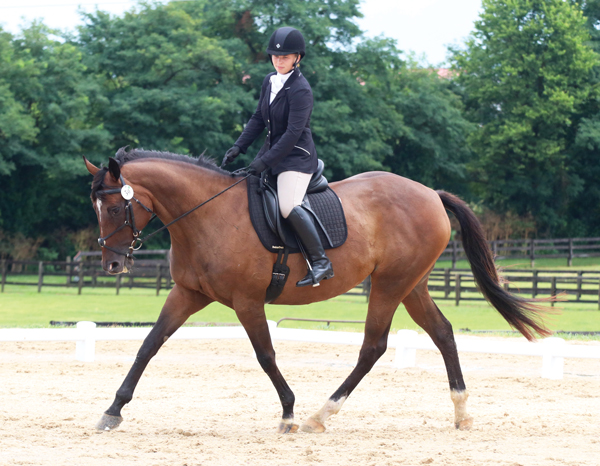
Bend your horse around your inside leg so his body follows the arc of the circle. Photo by Leslie Potter

“B” is for Bend

You might have heard someone say to “bend the horse around your leg,” but what does that mean? You want the horse to be bent in the direction you are traveling while making circles and turns.

The perfect way to get a feel for this when you are getting started in dressage is by spiraling in on a circle, starting large and gradually making your circle as small as you feel comfortable. While spiraling in, keep your inside leg solidly on your horse’s side for support, and keep a gentle contact on your outside rein. Think about pushing your horse’s barrel over with your inside leg while creating a wall with your outside rein to keep them balanced.

When you start making your circle bigger, try to not direct your horse with your reins. Push his body out with your inside leg, and you’ll start to feel him step over and bend around your leg.

However, you don’t want to have him over-bent, either. You should be able to see your horse’s eye on the inside, but if you see much more than that, work on straightening your horse by adding a little more contact with your outside rein.

“C” is for Circles and Centerline

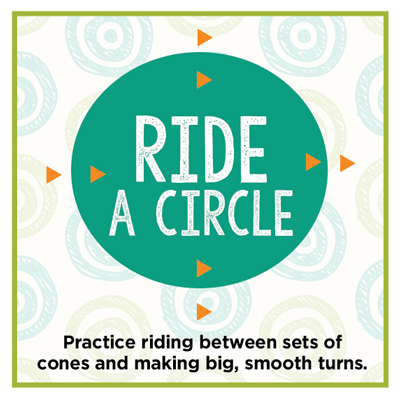
Circle Diagram - Started in dressageEvery single dressage test has two “C” things in it: circles and a centerline. Making the perfect circle takes lots of practice for both you and your horse. It helps to set up four sets of cones in a circle, one set in each quarter of the circle, to help you perfect your geometry.

Practice riding between the cones and work on making a big, smooth turn. In addition, remember that circles don’t have corners! You should touch the walls when you circle, but only for a stride.

When it comes to the centerline, it takes a lot of practice to nail your turn. First, start by riding straight lines down the long side of the ring. It’s easy to rely on the wall to keep going straight, so try turning a few strides before the wall and keeping a consistent distance between your horse and the wall all the way down.

Once you master that, try turning up the center of the ring. It’s helpful to think of your turn as a half circle. Head down the long side like usual, and then make a smooth half-circle to the center of the ring and head straight.

Kid riding dressage
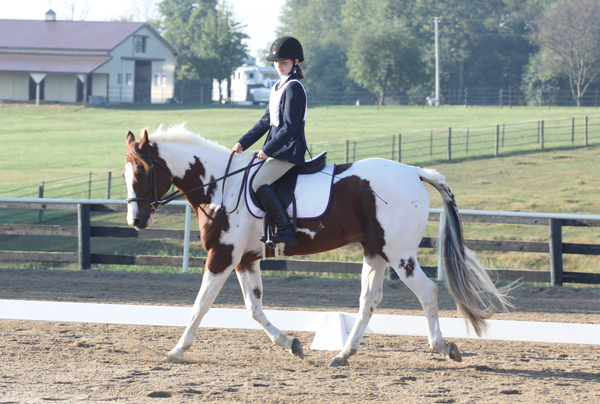
Keep your eye on the letters and make transitions as your horse’s shoulder passes them. Photo by Leslie Potter

It will also help to find a marker to practice. You can put a cone at the end of the ring, right in the middle, or find a tree or other object to focus on. It’s super easy to accidentally over-adjust or wander way over, so get comfortable making small adjustments to ride a perfectly straight centerline.

Once you get the ABCs down when you get started in dressage, you are well on your way to becoming a dressage rider!

What to Wear to a Dressage Schooling Show

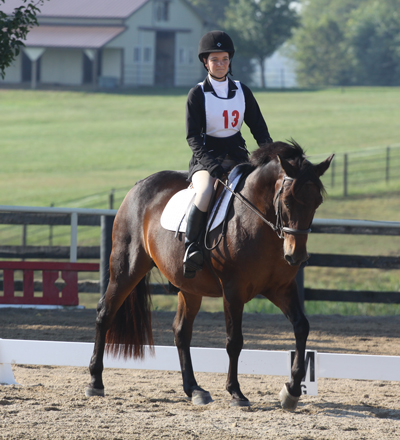
You’ve practiced and are ready to head to your first dressage show! Maybe you’ve wondered, “What do I need to wear?” Most schooling shows are pretty casual. Check the official rules about clothing beforehand. Below are the basic dressage clothing essentials.

A HELMET: A dark-colored helmet is required, but if you don’t have one, you can find a helmet cover to put over yours.

BREECHES: Light tan or white breeches are correct in the dressage show ring.

TALL BOOTS OR HALF CHAPS: Half chaps made of smooth leather with matching paddock boots are acceptable, or leather tall boots in brown or black. Be sure to wipe off the dust after you mount!

A POLO OR SHOW SHIRT: You won’t need to wear a jacket for most schooling shows, but double-check the show bill or local association’s rulebook. Any white or light show shirt with short or long sleeves can transition to a more formal show later (but leave off the neckwear—ratcatcher or stock tie—if not wearing a jacket).

A BELT: Tuck in your shirt and put on a belt to polish off your look!


This article about how to get started in dressage appeared in the Spring 2020 issue of
Young Rider magazine. Click here to subscribe!

Funky Feet: 5 Serious Hoof Conditions

0
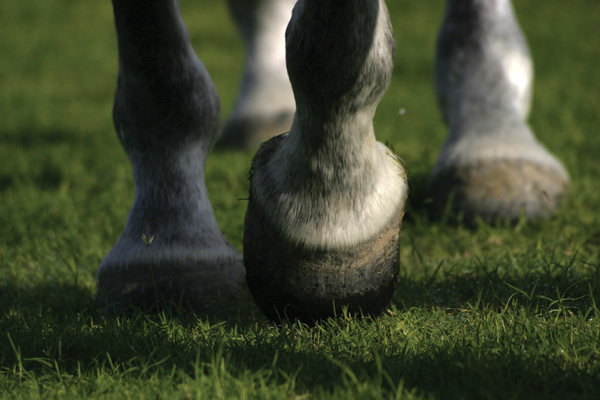
Horse Feet
Photo by Sonja Rasche/Shutterstock

The hooves of horses are a remarkable thing. Strong and tough, yet also delicate, their health affects your entire horse’s wellbeing. That’s why it’s a good idea to keep a close eye on your horse’s feet. Craig Lesser, DVM, a podiatry veterinarian at Rood & Riddle Equine Hospital in Lexington, Ky., shares with us 5 serious hoof conditions to look out for. While some are more common than others, all require a conversation with your veterinarian for diagnosis and treatment.

Keratoma

Hoof condition - Keratoma before surgery
The conical keratoma in this hoof has caused an indentation in the sole of the foot. Courtesy Craig Lesser, DVM

WHAT IT LOOKS LIKE: There are two types of keratomas: conical and spherical. The conical keratoma is a tumor that begins at the coronary band and grows out all the way out to the sole of the foot. The spherical keratoma grows from the sole, causing a defect in the hoof as it grows into a large sphere within the foot.

EFFECT: This outsized tumor causes pressure necrosis, according to Lesser.

“As the keratoma grows, it puts pressure on the bone and will cause the bone to remodel,” says Lesser. “With time, it can cause lameness.”

The first sign of this hoof condition is often a chronic abscess on the affected foot or lameness.

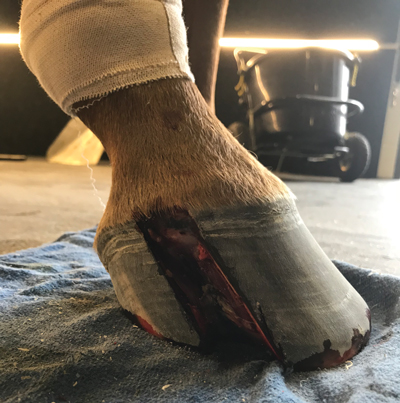
Hoof condition - Keratoma after surgery
Just after surgery to remove the keratoma, you can see where the tumor affected this horse. Courtesy Craig Lesser, DVM

“A lot of times, especially with a conical keratoma, you’ll see a change in the white line of the foot, which can be an indication,” says Lesser. “With a spherical one, there aren’t always changes on the outside of the sole. We usually see it as an abscess, but the actual pressure itself from bone remodeling can cause lameness.”

DIAGNOSIS: Radiographs can show the defect on the bone, and Lesser says this is the most common way veterinarians diagnose this hoof condition. They can also be diagnosed after an MRI or CT scan.

TREATMENT: Lesser says the only real option is surgical removal. Depending on the type of lesion, surgery can result in a significant layup time ranging from two or three months to up to a full year for a hoof to grow out if the lesion was removed from the coronary band.

Quittor

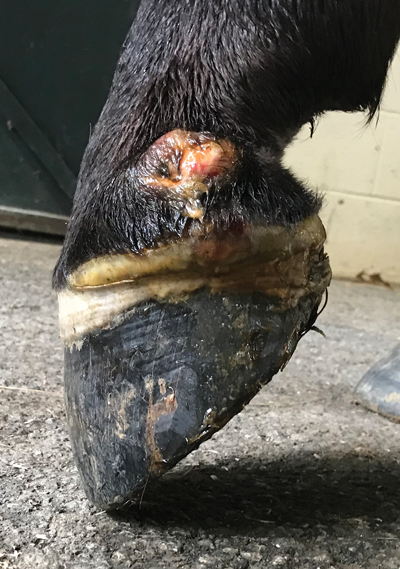
Hoof condition - Quittor
Quittor is known by its location just above the coronary band, but it’s a stubborn infection to eradicate. Courtesy Craig Lesser, DVM

WHAT IT LOOKS LIKE: A bacterial infection that embeds behind collateral cartilage in the hoof, resulting in what looks like an abscess that has blown out of the coronary band, except it’s about a finger’s width higher than the coronary band, where the collateral cartilage ends. This cartilage is the firm-yet-elastic portion of the back half of the hoof that helps give it shape.

Lesser explains that quittor is very hard to clear up.

“It’s a tough infection to get rid of because drainage isn’t as easy as with a normal abscess,” he says.

EFFECT: The horse will usually be lame from the abscess, and once the quittor ruptures, there will be residual lameness.

DIAGNOSIS: The telltale abscess a thumbs-width above the coronary band is the first indication. X-rays with a contrast study will confirm, or an MRI will reveal the extent of the infection.

TREATMENT: A range of options are available for this hoof condition, including systemic and regional antibiotics. If the condition is bad enough, your veterinarian may put in a drain behind the collateral cartilage to allow for drainage. Lesser has also used larval therapy—incorporating fly maggots—and surgical debridement of the area as needed.

Canker

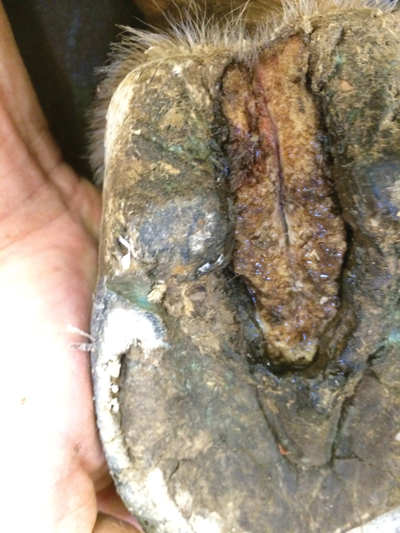
Hoof conditions - canker
Canker looks like a bad case of thrush, but can evolve to envelop the entire sole of the foot and cause permanent damage to the hoof capsule. Courtesy Craig Lesser, DVM

WHAT IT LOOKS LIKE: Canker looks like a really bad case of thrush at the onset.

“It forms a cauliflower-looking structure as it grows,” says Lesser. “When it gets scraped, it bleeds easily.”

It usually starts in the center of the foot and will then envelop the entire frog and sometimes the sole of the foot, in time.

“It’s a hyper-proliferation of keratin,” says Lesser.

EFFECT: Lameness is sometimes present, but if left untreated, it can cause permanent structural damage to the hoof capsule.

DIAGNOSIS: Canker is diagnosed off gross evaluation. Because the cause of the disease hasn’t been identified—it has been suggested that it comes from viruses or bacteria, and it’s also been called a cancer—it’s difficult to get a solid diagnosis.

“Canker is one of the most frustrating diseases of the foot that I deal with, because we don’t quite know what causes it,” says Lesser.

Veterinarians diagnose canker from a growth evaluation and visual examination.

TREATMENT: Lesser typically starts by blocking the hoof and doing a gross debridement to take the hoof back to healthy tissue. He will then cauterize the remaining tissue to make sure the infected tissue has been killed. He’s also used cryotherapy, laser surgical debridement, and a variety of other methods to debride the material as needed.

“The after-care is really what makes treatment successful or not,” says Lesser. “That involves months of bandaging, with or without shoes and treatment plates to make sure the disease does not come back in the future.”

Coffin Bone Infection

WHAT IT LOOKS LIKE: A coffin bone infection can affect horses of all ages. It usually starts as chronic abscesses or an abscess that has gone into the bone, causing an infection. If it worsens, it can form a sequestrum.

“A sequestrum is when a piece of the bone actually breaks off and the body starts fighting it as if it’s a foreign object,” says Lesser.

EFFECT: Severe lameness.

“It’s like an abscess that won’t go away, even if you have it open and draining,” adds Lesser.

Coffin bone infection and abscess to sequestrum x-ray
A coffin bone infection may start as a chronic abscess, but can worsen to form a sequestrum (right), which is a piece of bone broken loose in the hoof. Courtesy Craig Lesser, DVM

DIAGNOSIS: Radiographs are the most common method.

TREATMENT: If the coffin bone infection creates a sequestrum, your veterinarian will surgically remove the dead piece of bone. If the coffin bone itself is affected and it’s not too bad, Lesser will treat the infection with antibiotics and larval therapy.

“If caught early and it’s fairly minor, once we get the infection under control, the horses don’t look back,” says Lesser. “But we do hit them very hard with treatment because it can be a such a bad disease.”

If a large piece of the coffin bone is removed that destabilizes the bone, it may take longer to heal. But with a smaller piece, Lesser says horses can heal nicely with no further issues.

Puncture Wound

Puncture wound x-ray
Before removing a nail, it’s important to have a veterinarian examine the hoof to make sure no vital structures will be damaged. Courtesy Craig Lesser, DVM

WHAT IT LOOKS LIKE: If your horse steps on a sharp object like a nail, the nail may embed in the hoof. This is a serious injury that should be handled by your veterinarian.

EFFECT: “If the nail goes into certain structures in the hoof, it could be life-threatening for the horse,” says Lesser. “Don’t pull the nail out before the vet shows up. Make sure you call a vet right away. It’s very important.”

DIAGNOSIS: Lesser prefers to take radiographs before making a move to see what the nail is affecting inside the hoof.

TREATMENT: Lesser says the most important thing is not to pull the nail out without waiting for your veterinarian.

“If it’s sticking out of the hoof quite a bit and your horse is moving around, you can build a donut around it until your veterinarian can get out to your place,” says Lesser. You can build that donut with material at your barn—leg wraps are a great option.

If the nail isn’t touching an important structure, the veterinarian will carefully remove it, treat the horse with antibiotics and all should be well. It can be much worse—if the nail punctures the coffin bone, it can fracture the bone.

An equine veterinarian performing an exam
Photo by Wavebreakmedia/Shutterstock

“Worst-case scenario, if it’s involving a joint or tendon sheath, those structures will need to be flushed out and [the horse given] systemic antibiotics, possibly regional limb perfusions, to treat that infection,” says Lesser.

If the puncture wound is mild, the horse could be back to work within a week. If it’s deeper or has hit a sensitive structure, it could be two to three weeks of recovery. If the nail has gotten into a joint, it could require at least a month of recovery for this hoof condition.

This article about hoof conditions appeared in the June 2020 issue of Horse Illustrated magazine. Click here to subscribe!
Further Reading

My Right Horse Adoptable Horse of the Week: Mendora — September 4, 2021

0
My Right Horse Adoptable Horse of the Week - Mendora
Photo Courtesy Longmeadow Rescue Ranch

Welcome to Horse Illustrated’s weekly installment of the My Right Horse Adoptable Horse of the Week, offered in partnership with The Right Horse. Mendora is this week’s adoptable horse. Check back weekly for a new featured horse so you can find your #righthorse.

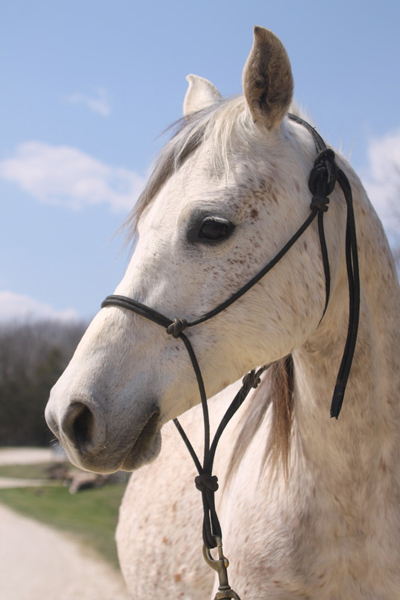
Horse: Mendora, a gray 11-year-old 13.3-hand Arabian/Quarter Horse-cross gelding in Union, Mo.
Organization: Longmeadow Rescue Ranch

My Right Horse Adoptable Horse of the Week - Mendora
Photo Courtesy Longmeadow Rescue Ranch

An Arabian and Quarter Horse mix, Mendora is a sweet, baby faced gelding who has completed extensive groundwork training and has now begun the next step of his journey, under saddle training! A teenage lesson student at Longmeadow Rescue Ranch has taken Mendora on as a project, and with the help of a trainer there, he has become an enjoyable ride. He is currently being ridden at all three gaits in the arena and has even begun riding around the ranch. We have found that Mendora can be anxious under saddle and needs a rider who is confident enough to keep his mind at ease. Conformation wise, Mendora is a very short-backed horse and therefore will not fit most western saddles. Thus he will likely be an ideal match for English disciplines. He will require an advanced rider at this time to continue his training and build his confidence. His maximum carrying weight, including tack and a rider, is 150 lbs. Could he be your #righthorse?

Click here for questions about Mendora, the My Right Horse Adoptable Horse of the Week

My Right HorseMy Right Horse is the online adoption platform of The Right Horse Initiative, a collection of equine industry and welfare professionals and advocates working together to improve the lives of horses in transition. A program of the ASPCA, their goal is to massively increase horse adoption in the United States. To find more adoptable horses and foster horses, visit www.myrighthorse.org. To learn more about The Right Horse, a program of the ASPCA, visit www.therighthorse.org.

0FansLike
0SubscribersSubscribe
We use cookies to help personalize content, tailor and measure ads, and provide a safer experience. By navigating the site, you agree to the use of cookies to collect information. Read our Cookie Policy.
OK