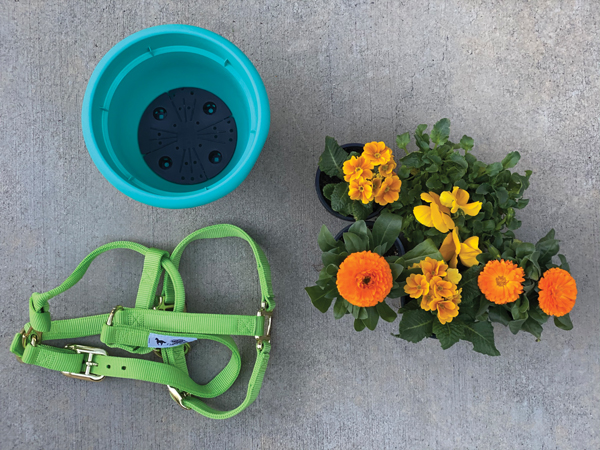
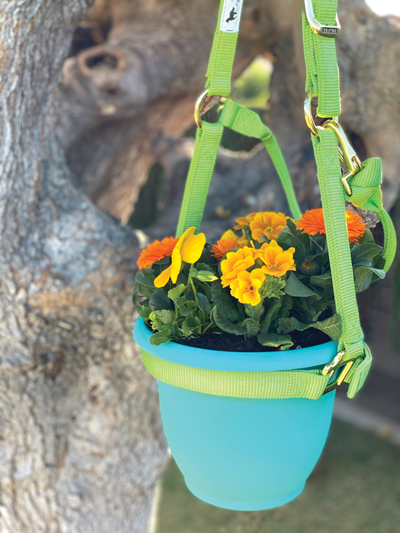
The sun is shining and the flowers are blooming—it’s the perfect time to create your very own horse halter planter! This year, use your green thumb to plant some beautiful blooms in a fun, festive pot set inside a halter. You can repurpose an old halter or buy a new one. Either way, your new horsey planter is sure to brighten someone’s day.
Important: Make sure to measure your halter and flower pot so the flower pot will fit nicely inside the halter. For reference, we used an 8″ garden pot and a large halter measuring 11.5″ around the nose.
Photo by Danica Leigh
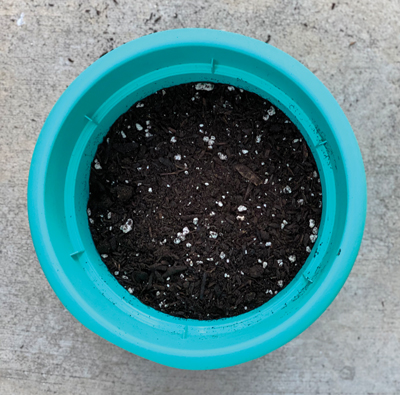
Step 1: Fill your flower pot a little more than halfway with potting soil.
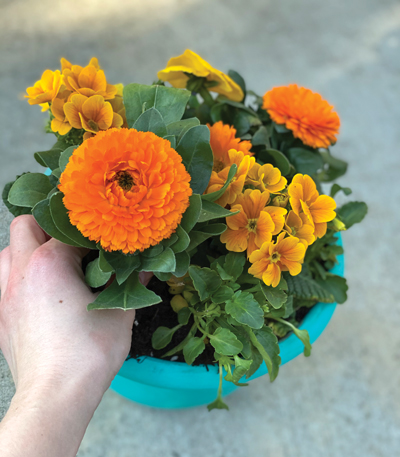
Step 2: Place your flowers in your pot and arrange them how you would like. We used prim-roses, calendulas, and pan-sies, but any of your favorite flowers will work perfectly.
Step 3: Fill the remaining space around the garden pot with potting soil. Don’t forget to give your flowers a little water!
Photo by Danica Leigh
Step 4: Fasten your halter (the part that normally goes around your horse’s nose) around the garden pot, making sure it’s secure when hanging.
Step 5: Hang your horsey halter planter at home or at the barn so all your barn buddies can enjoy the bright, beautiful blooms of color.
This article about how to make a DIY horse halter planter appeared in the Spring 2021 issue of Young Rider magazine. Click here to subscribe!
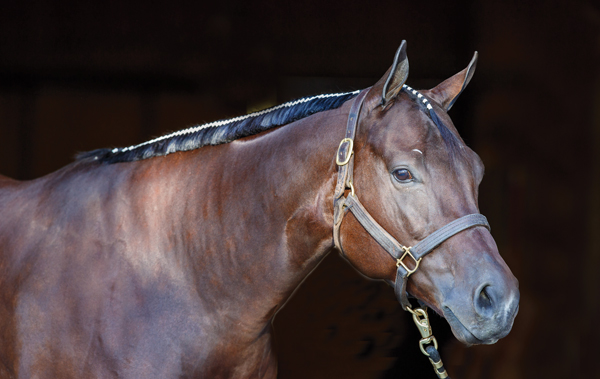
Banding your horse’s mane can be a challenge. But you don’t have to resign yourself to a messily banded mane or having to pay someone else to do the job. Jess Duffy, assistant trainer at Aaron Moses Show Horses in Pilot Point, Texas, shares tips to make your horse’s banded mane look neat and uniform. With some practice, you can make your horse’s mane look professionally banded—and maybe even offer your services to other riders for extra cash.
Why Band a Mane?
Most horses showing in western judged events step into the pen with an expertly banded mane. A few reiners today are sporting bands with their long manes. Duffy says this helps the mane stay put and flatters the horse’s neck.
“A good banding job gives a finished look, especially if you have white bands and they’re all in a nice line,” says Duffy. “It just gives an edge over your competition.”
Duffy says halter horses are often banded with rubber bands that match the mane. These days, white bands are king in the other events.
Photo by Abigail Boatwright
Getting Started with Mane Banding
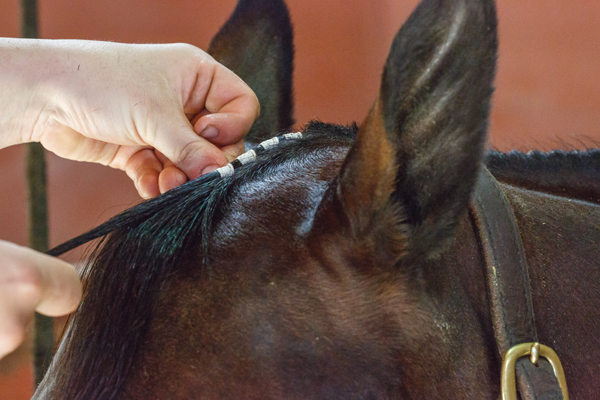
Before you start, wash your horse’s mane and allow it to dry; no conditioner needed. Your horse’s mane should ideally be about 4 to 5 inches long. You’ll be trimming it to about 2 inches long after you band, so don’t worry about making it the perfect length just yet. Duffy doesn’t thin the mane.
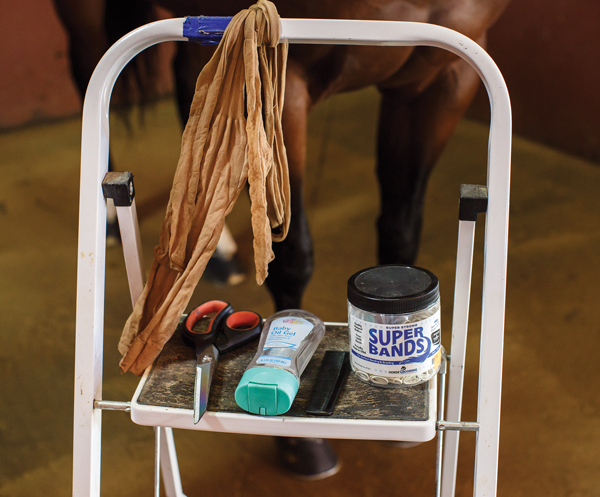
Then assemble your tools. Duffy uses Super Band white bands, a small comb, baby oil gel, a very sharp pair of scissors and a pair of pantyhose.
The Process of Mane Banding
Duffy starts at the base of the neck at the withers, rather than by the head. “Sometimes if the horse is a bit touchy around the ears, by the time I get up there they’re used to it,” she says.
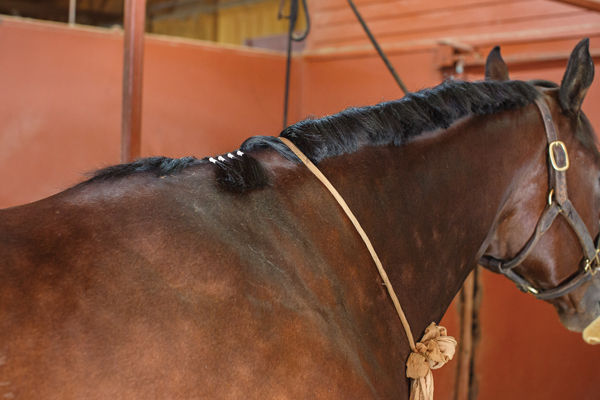
Duffy learned how to band from her mom, Vicky Gough, who also used pantyhose as a secret tool. She ties the pantyhose around the horse’s neck to help hold back the mane she’s not working with while she bands. “Pantyhose keeps the hair out of the way better than a hairclip would,” she explains.
A set of pantyhose will be your secret weapon for holding back the mane that you’re not working on. Photo by Abigail Boatwright
Sectioning off about an inch-wide piece of mane with her comb—making sure the part is perfectly perpendicular to the ground, and each section is the same size as the one previously banded—she’ll dab a bit of baby oil gel on the hair to protect her hands from the friction of the band.
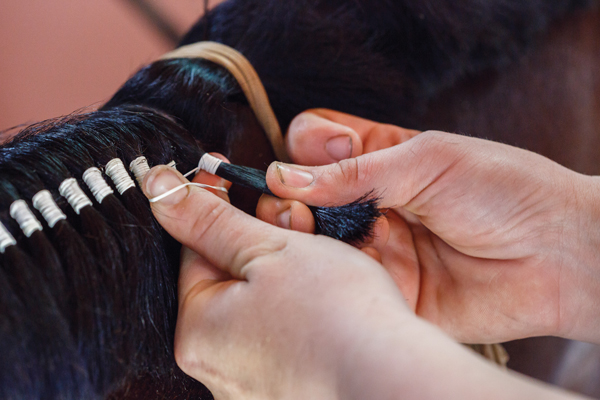
Start wrapping from the bottom, keeping sections of mane equally sized and flat against the neck. Photo by Abigail Boatwright
She will then begin twisting the band around from the bottom of where she wants it to lay on the hair to the top, ending closest to the mane after about 12 wraps. As she wraps, she keeps her hands close to the horse’s neck to pull the section down and avoid it sticking up.
“Even if the band isn’t extremely tight, it’s more important to have them in a straight line when you’re done rather than have them all super tight against the neck,” says Duffy. “As you’re working, step back frequently and make sure it’s even.”
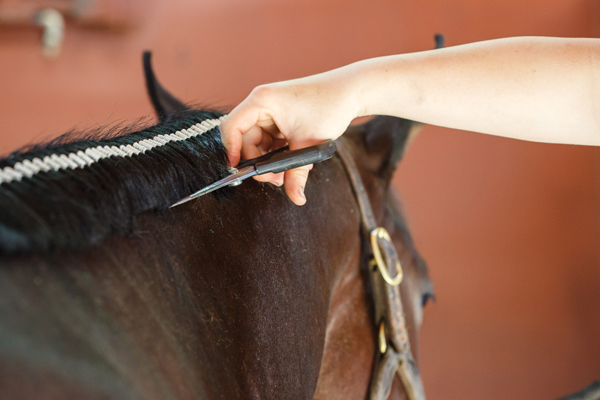
When you’re all done banding, go back with your scissors and trim the ends of the mane so that they’re perfectly even. Make sure to stand back and check your progress, and cut the hair underneath as well.
When you’re done, trim the mane to one length with very sharp scissors. Photo by Abigail Boatwright
The Forelock
Don’t forget the forelock! Duffy bands down the base of the forelock.
Starting at the top of the poll, make a part so the section is a square of hair. Band just as you did with the mane.
Moving down the forelock at equal intervals, make a part to form a section and band it. Once you’ve reached the end of where the hair grows from the head, make one last section and band it, pulling the back pieces of hair to hold the forelock down to avoid it sticking out.
Troubleshooting
For a multi-colored mane, Duffy would pick one color to band the whole mane. If your horse has a white mane, consider using black bands for contrast.
If your horse has a thick mane, you can make each section slightly smaller. In the thinner part of the mane, avoid making sections too wide.
“You’re better off keeping the width of your sections the same,” says Duffy.
Starting at the top of the forelock, band a small section before moving down to band the next section. Photo by Abigail Boatwright
Preserving Your Work
Ideally, you’ll band your horse the day you’ll be showing, leaving little time for your horse to mess it up. Duffy sprays a banded mane with hairspray, then covers it with a slinky hood to protect the bands. A good banding job can last a day or so if the horse doesn’t rub.
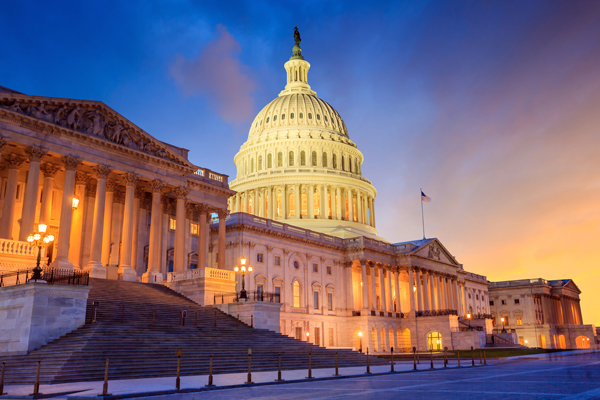
In 2007, 59 slaughter-bound horses were en route from Indiana through Illinois to a sale barn in Minnesota when the double-deck tractor trailer in which they were traveling overturned in Wadsworth, Ill. A total of 17 animals perished due to accident-related injuries, either on the scene or within days of the incident. The surviving animals were placed in the care of the Hooved Animal Rescue and Protection Society (HARPS) in Barrington, Ill. Shortly thereafter, the United States Department of Agriculture (USDA) issued a rule prohibiting the transport of horses to slaughter in double-deckers, but publishing the rule was sidetracked. In response several pieces of horse legislation with both Democratic and Republic support were introduced in to Congress repeatedly all the way up to 2019. Some of those bills made it out of the U.S. House of Representatives, but never got far enough in the process to be signed into law.
This year though, the horse transport legislation got a boost when the so-called Carter-Fitzpatrick Amendment prohibiting double-decker horse transport became attached to H.R. 3684, the House’s version of the massive infrastructure bill called “Investing in a New Vision for the Environment and Surface Transportation in America Act (INVEST).” That bill was passed by the U.S. House of Representatives on July 1, 2021.
Even before the INVEST Act passed the House, several pieces of horse welfare-related legislation were introduced into both the U.S. House and Senate. In May, U.S. Reps. Vern Buchanan (R-FL) who co-chairs the bi-partisan Congressional Animal Protection Caucus and Jan Schakowsky (D-IL) introduced The Save America’s Forgotten Equines (SAFE) Act (H.R. 3355) of 2021 that would permanently ban slaughter of horses for human consumption and forbid the export of live horses to processing plants in Mexico and Canada.
In June, Senators Mike Crapo (R-ID) and Mark Warner (D-VA) reintroduced the Prevent All Soring Tactics Act (PAST) Act (H.R. 693). That legislation would forbid soring and the use of action devices on Tennessee Walking Horses and other gaited horses. Soring is the deliberate injury to a horse’s feet and legs to achieve an overly exaggerated gait.
Both pieces of legislation represent legislators’ latest versions of the SAFE and PAST Acts. Previous versions have been introduced and re-introduced into Congress for years, but despite bi-partisan support, they either died in their respective committees or never reached the floors of the House or Senate for an up or down vote. Now, at a time when the balance of power in both Congress and the Oval Office has shifted toward the Democratic side of the aisle, some lawmakers say that the time may be right to bring the legislation forward. Among them is Sen. Warner.
“The House of Representatives recognized the need for action last Congress by passing this bill, and it’s my hope that the Senate will follow suit, with both houses passing this legislation this Congress,” Warner said. “I look forward to (working) with the Biden Administration this Congress to protect horses from abusive show practices.”
Meanwhile, GOP Senate Minority Leader Mitch McConnell said that the tradition of bi-partisan equine welfare legislation figured significantly when both the House and the Senate passed the Horseracing Integrity and Safety Act (HISA) of 2020 (H.R. 1754).
That Act, which was signed into law by President Donald Trump in December 2020, established the Horseracing Integrity and Safety Authority, a conflict-free, self-regulatory organization to create and implement an anti-doping policy for the entire horse racing industry.
“That legislation earned broad support,” said McConnell spokesperson Stephanie Penn in a written statement.
Penn did not indicate that other pieces of equine legislation would have the same kind of success from both houses of Congress or from the Biden Administration.
In any case, Matt Sonneborn, the communications director for Rep. Paul Tonko (D-NY) said that that measure’s success has more to do with the legislative process than with which party controls the House, the Senate or the Oval office. Tonko, along with Republican Andy Barr (R-KY) co-chairs the Congressional Horse Caucus. He also introduced HISA.
“Good legislation just takes time,” Sonneborn said. “The Horseracing Integrity (and Safety) Act took five years of working with other members of Congress and with the industry and with equine welfare advocates.”
More recently, the inclusion of the Carter-Fitzgerald Amendment to the House’s infrastructure bill, may help get horse transport legislation finally signed into law.
“One of the interesting things is that the inclusion of the amendment means that the transport of horses is now considered an infrastructure issue,” Sonneborn said.
As a result, other horse-friendly legislation may also find success by becoming amendments attached to larger bills in this Democratic-majority Congress. Still, there are ways long-languishing equine welfare stand-alone legislation may also find their way on to President Biden’s desk.
“For example, there are messaging bills in which members are saying, ‘I’m for this,’” Sonneborn explained.
According to Sonneborn, some bills begin as messaging bills, and in either one or a series of hearings, could move through the House and eventually get a vote on the floor. The strength of the legislation makes the difference, he said.
“There have been many bills that began as messaging bills but moved through the (legislative) process because they were good legislation,” he said.
Another way is including the measure in a group of bills offered at the beginning of the House’s legislative session.
“Those bills are generally not controversial—they have made the rounds of committees and can be voted on by House members when they first arrive for a new session,” Sonneborn said.
Finally though, when it comes to moving horse legislation, even bi-partisan legislation, through the lawmaking process in this Democratic-majority Congress, it’s the quality of the proposed law that counts the most.
“Of course, the support of the President also certainly helps,” Sonneborn said.
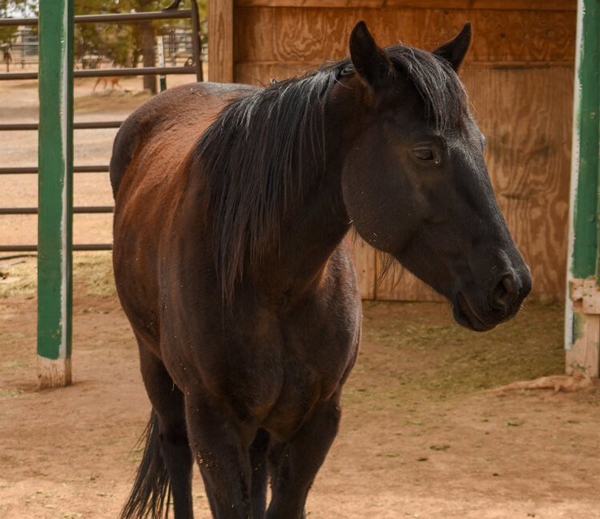
Welcome to Horse Illustrated’s weekly installment of the My Right Horse Adoptable Horse of the Week, offered in partnership with The Right Horse. Blue Jay is this week’s adoptable horse. Check back weekly for a new featured horse so you can find your #righthorse.
Blue Jay is a gentle, registered American Quarter Horse gelding who was started as a ranch horse. Unfortunately, he was later found to have a congenital defect—a hole in his cannon bone—so his owner surrendered him to New Mexico Horse Rescue so he can enjoy a more relaxed life with a new owner. The defect does not cause pain, and he does not need medication. To keep Blue Jay pain-free, he should be considered as a non-riding companion for another horse, because his condition could worsen or become painful if ridden. Because of his calm demeanor, he would make the perfect pasture pal for another horse or herd. Could he be your #righthorse?
My Right Horse is the online adoption platform of The Right Horse Initiative, a collection of equine industry and welfare professionals and advocates working together to improve the lives of horses in transition. A program of the ASPCA, their goal is to massively increase horse adoption in the United States. To find more adoptable horses and foster horses, visit www.myrighthorse.org. To learn more about The Right Horse, a program of the ASPCA, visit www.therighthorse.org.
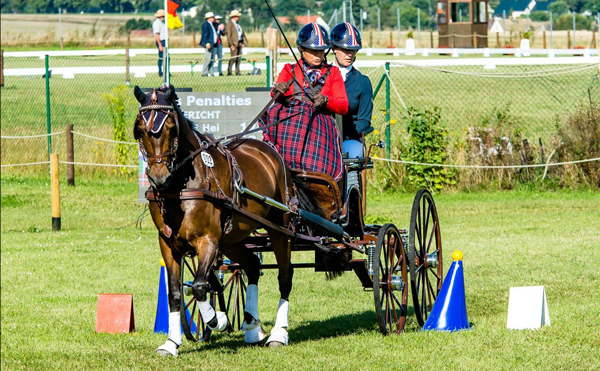
Tracy Bowman and Albrecht’s Hoeve’s Lars. Photo by Jürgen Sendel/Pictureblind.de
U.S. driver Tracy Bowman, of Martinez, Calif., and her Welsh Pony gelding, Albrecht’s Hoeve’s Lars, had a golden week in Schildau, Germany, at the 2021 FEI Para Driving World Championship. The pair had three exceptional phases to win the championship title for Grade I at the conclusion of competition on Aug. 8.
Bowman and “Lars” started off strong, landing in third place after their dressage test. They put in a masterful marathon phase on Saturday, moving into first place, and held on to it through the cones on Sunday.
Bowman and Lars got their start together on the recommendation of the world-class father and son driving athletes, Bram and Ijsbrand Chardon of The Netherlands. Bowman purchased the gelding with the aim of competing him at the World Championship in August of 2020, but plans changed when that event was cancelled due to COVID-19, and she brought him home to California instead.
“I only competed in one unrecognized CDE and one recognized event in California this past winter before we came to Schildau,” said Bowman. “There was no other option due to COVID. This was our first big show together. He had experience prior to me at the last World Championship in Kronenberg, so I put my total trust in him and my unbelievable team. I was not ever in doubt of being safe and capable because of those people and my fabulous pony. But to win was not an expectation, since I have nearly no experience at that level.”
Bowman spent the unexpected off-season in 2020 mostly self-training at her Kismet Farms in California, but credits Lars’ solid training and demeanor for a positive result in 2021.
“My partner in the farm and best of all friends, Jolie Wentworth, would assist me in the ground,” Bowman said. “She sees everything and is the only one that would have no equal for the flat work. Together, I think we kept the dressage improving. [Lars] is a great mover, very uphill, was already well schooled, and has a lot of talent. Added to that, he is very drivable in the court. He does not tend to spook and keeps a cool head—except in prize-givings!”
With the return of competition and news that the World Championship was back on for 2021, Lars and Bowman returned to training under the Chardons.
“The team in The Netherlands made it very simple to feel secure and comfortable when we returned,” said Bowman. “Bram and the whole Chardon family is nothing but warm. Bram demands total focus and great attention to detail, which is expected at this level. He also lets you know right from wrong without apology. This makes you feel very assured of the reality of your skills, good or bad; when you keep it honest, it works better for everyone involved. No false hope or inflated ideas—only down to earth hard work to improve and understand where you need to focus. It was very correct for me.”
Of her experience in Schildau at the 2021 FEI Para Driving World Championship, Bowman says the competition got better and better each day.
“The best groom in the world, Quint van Rijswijk, was able to get Lars feeling and looking his best,” said Bowman “This really helped in the dressage phase, but he took such good care of him the whole show. Winning the marathon was such a great feeling. The obstacles were amazing and so well built. The area they were in made it great for spectators and also made it easy for my obligatory extra safety grooms to get from one to the other with no effort. Since my carriage is adapted for me by the use of a five-point harness, it is required to have safety grooms at gates in case we turn over or have some sort of mishap.
“The whole venue of Schildau is a horse Disneyland,” Bowman continued. “It could not have been nicer, especially for wheelchair users like myself—it was very level and accessible. The USEF chef Marcie Quist was also pleased. She has been to quite a few of these now and is such a great problem solver and a great help to the USA drivers. Bram and Jolie made me feel they had my back, and I never felt on my own. I was free to concentrate on my job. They held my proverbial hand and also kicked me when I needed it. It was a perfect group.”
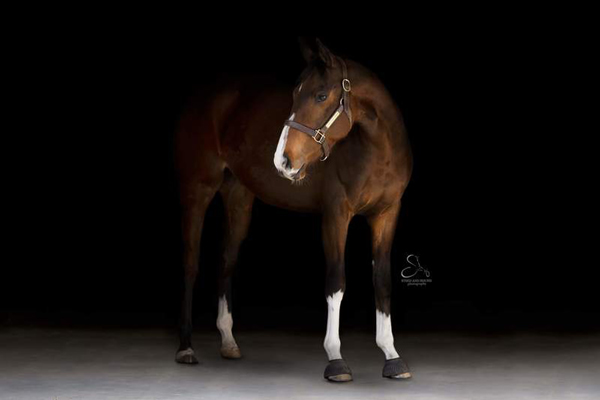
Welcome to Horse Illustrated’s weekly installment of the My Right Horse Adoptable Horse of the Week, offered in partnership with The Right Horse. Taco is this week’s adoptable horse. Check back weekly for a new featured horse so you can find your #righthorse.
Horse:Taco, a 4-year-old 17.1-hand bay Thoroughbred gelding in Canyon Country, Calif. Organization:Win Place Home
Taco is beautiful, playful, and engaging. He would make an amazing flat or trail horse. He is all about the bling! Taco retired from racing due to two broken sesamoids in his left front. He is cleared to become a walk/trot pleasure or trail horse. He will be the fanciest trail horse you’ll ever see! Adoption price is negotiable. The home is what is most important! Could he be your #righthorse?
My Right Horse is the online adoption platform of The Right Horse Initiative, a collection of equine industry and welfare professionals and advocates working together to improve the lives of horses in transition. A program of the ASPCA, their goal is to massively increase horse adoption in the United States. To find more adoptable horses and foster horses, visit www.myrighthorse.org. To learn more about The Right Horse, a program of the ASPCA, visit www.therighthorse.org.
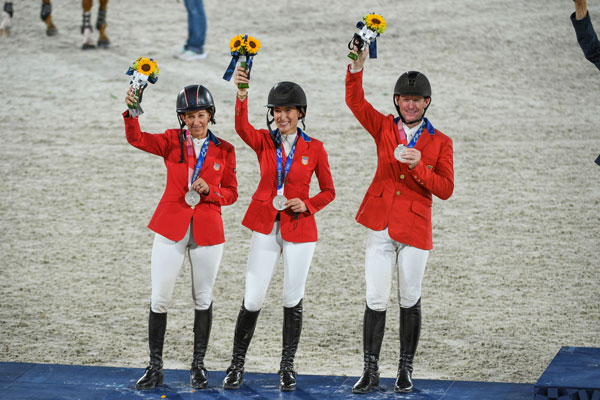
Team USA celebrates their silver medals on the Tokyo Olympic podium. MacMillan Photography & Media Services
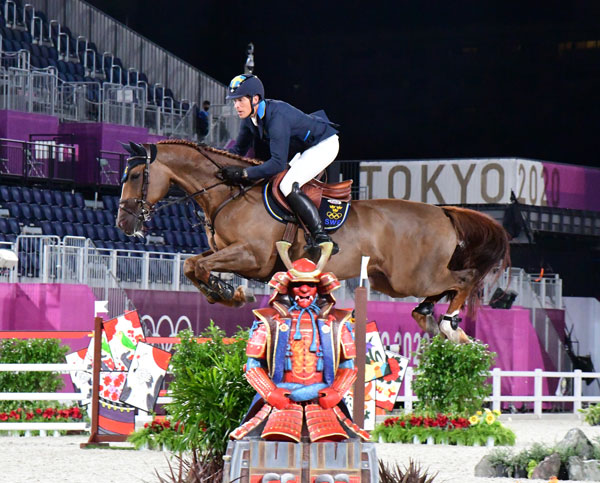
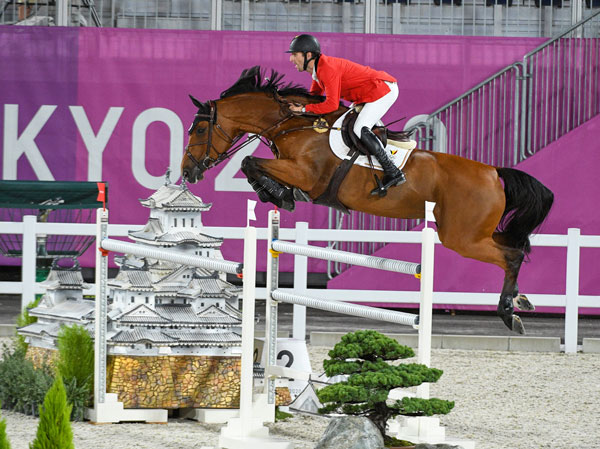
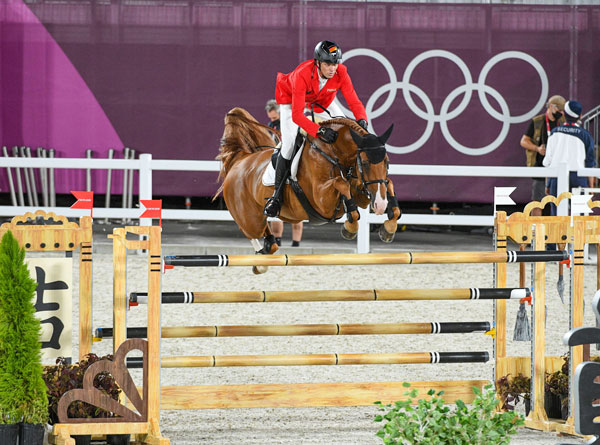
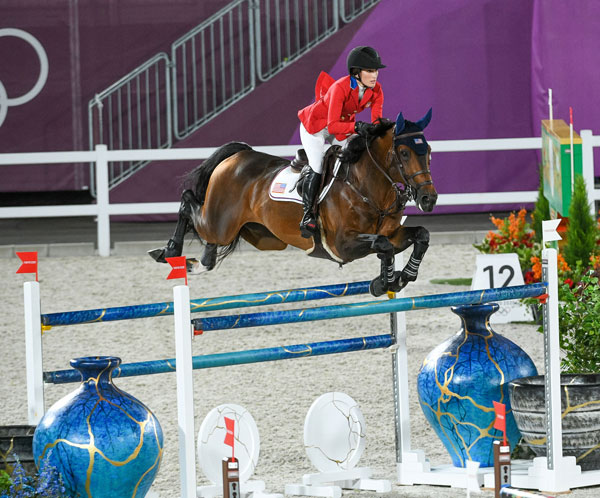
Ten national teams took to the arena to take their turn around Santiago Varela’s colorful course in the team jumping team medal final to wrap the final day of equestrian competition in the Tokyo Olympics. The teams competing in the final were: Argentina, Belgium, Brazil, France, Germany, Great Britain, Sweden, Switzerland, the Netherlands, and the United States of America.
All teams started the final round with a clean slate (previous faults from the qualifier did not carry forward). However, the team scores from the qualifying round determined the order of go.
If there was one team with a clear lead on faults after the third rider from each team jumped, then that nation would be the winner. If two or more teams were tied for the top spot, then there would be a jump off.
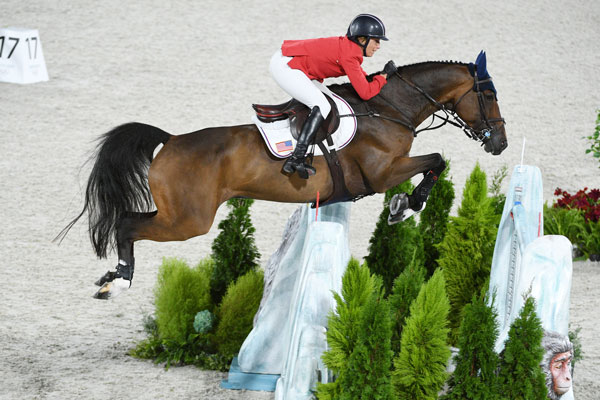
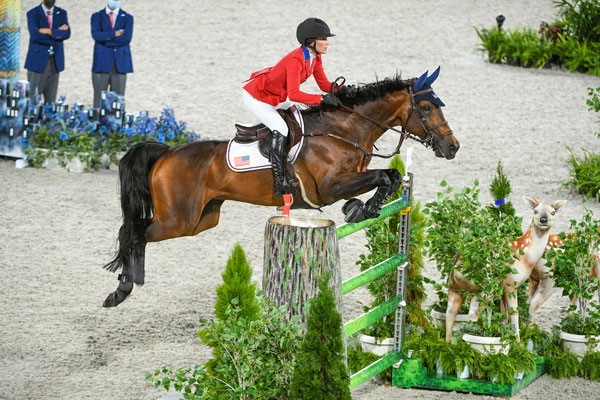
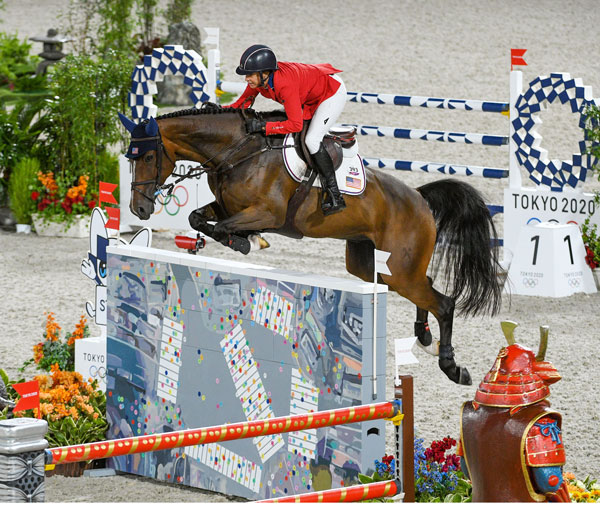
Riding last for the USA, McLain Ward riding Contagious jumped a clear round after Laura Kraut riding Baloutinue and Jessica Springsteen on Don Juan van de Donkhoeve had 0 and 4 faults, respectively. Ward had a clear round in the final section of riders. The USA and Sweden finished their final rounds with team scores tied at 4 faults each.
McLain Ward torched the jump-off track for team USA, putting all the pressure on Sweden. MacMillan Photography & Media Services
France was last to go, with only 2 time faults against the team score after two riders had gone. A clear round would mean gold. Unfortunately, two refusals at the triple combination for France’s final horse and rider, Penelope Leprevost and Vancouver de Lanlore, resulted in elimination and dropped their team completely out of the running.
This meant the USA and Swedish teams returned to jump off for gold and silver. Belgium had already secured the bronze and did not need to jump any further rounds.
The jump off provided the best stretch of faultless competition seen all week. Kraut from the U.S. was first to go and set the mark to beat with her second clear round of the night. Sweden’s Henrick Eckermann and King Edward answered with another clear round that was slightly faster.
Laura Kraut laid down the first clear jump-off round for team USA. MacMillan Photography & Media Services
Springsteen demonstrated her skill in timed jump-offs with a clear round and another fast time. Then, Sweden’s Malin Baryard-Johnsson and Indiana also had a clear round, but with a speed that gave Sweden a slight edge on cumulative time.
Jessica Springsteen delivered a clear round under pressure in the jump off for team USA. MacMillan Photography & Media Services
Next up was Ward in the anchor (final) round for the USA. He and Contagious made a crisp and tight route with all of the shortcuts and ground speed needed to push the competition to another level. It was a clear round with the fastest of the five rides in the jump-off up to that point. The USA was in the lead based on time.
Finally, Sweden’s Fredricson and All In entered the ring and needed to put in a clear round and a blistering time faster than the 40.3 seconds to claim the best cumulative team time. All week the Swedish team had shown they could jump clear, but Ward had given them a high bar on the time to beat.
Fredrickson and All In delivered exactly the trip they needed over the jump-off. They clinched the gold for Sweden with a breathtaking clear round, barely beating the time needed for the win by less than 1 second.
Peder Fredricson blazed the final clear jump-off round to win team gold for Sweden. MacMillan Photography & Media Services
Six clear rounds in the jump off was a spectacular way to finish the competition. Sweden got the gold, the USA the silver, and Belgium the bronze.
The organizing committee for the Tokyo Olympic Games deserves much praise for pulling off this event during such a difficult time during a worldwide pandemic. The volunteers and staff did a great job and the competition was sensational. Next stop, Paris 2024!
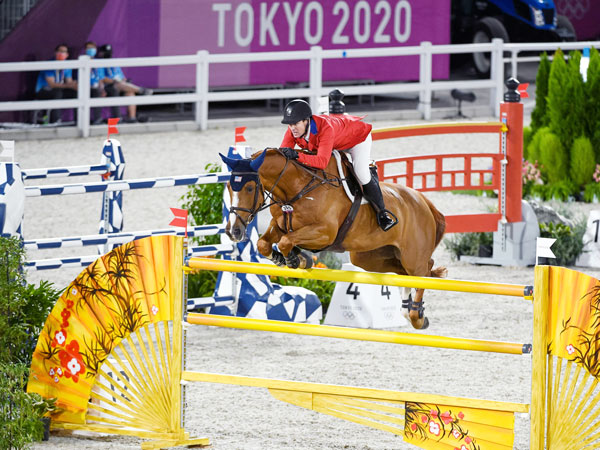
Riding anchor for the USA, McLain Ward and Contagious have one rail down and 1 time penalty to keep the American team medal hopes alive. MacMillan Photography & Media Services
During the qualifier for the Olympic Team Jumping medals in Tokyo, the air was “so thick you could cut it with a knife,” as the old saying goes. Not only was the weather extremely hot and humid (the high was 92, with the temp down to 89 by the time the jumpers started, and still extremely humid), but the tension in the stadium was also palpable.
Everything was on the line for the 19 nations hoping to perform well enough to be among the top 10 to move on to the team final competition, which will be the final day of equestrian competition at the Tokyo Olympic Games. The nations competing were Argentina, Belgium, Brazil, China, Egypt, France, Germany, Israel, Ireland, Japan, Great Britain, Mexico, Morocco, New Zealand, Sweden, Switzerland, the Czech Republic, the Netherlands, and the United States of America.
Henrik Von Eckermann and King Edward keep Sweden’s perfect round streak alive to boost them into first place going into the team final. MacMillan Photography & Media Services
Sweden’s team was foot perfect again after stellar performances in the individual competition. All three of their riders, Peder Fredricson, Malin Baryard-Johnsson and Henrik von Eckermann, jumped clear and within the time. Notable for Sweden was that their individual silver medalist from two nights ago, Fredricson and his horse All In, have now put in 10 clean rounds over two successive Olympic Games, which is really an amazing feat!
Pieter Devos and Claire Z jump clear with 1 time penalty to help secure Belgium’s second-place slot after the first round of team competition. MacMillan Photography & Media Services
Following close behind Sweden is the team from Belgium with all three of their riders (Pieter DeVos, Jerome Guery and Gregory Wathelet) jumping clear, but two having a few time faults. Germany’s team of Andre Thieme, Maurice Tebbel and Daniel Deusser all jumped clean as well, but all three also incurred a few time faults so they are a less than point behind Belgium. Switzerland’s team is in fourth.
Andre Thieme and DSP Chakaria jump clear with 1 time fault to put Germany in third place going into the team jumping final. MacMillan Photography & Media Services
The USA lies in fifth. They swapped out Kent Farrington and Gazelle and put in McLain Ward and Contagious in their roster for the team competition, while Jessica Springsteen and Don Juan van De Donkhoeve and Laura Kraut and Baloutinue remain on the squad with Ward. All three U.S. horse and rider pairs had one rail down, plus Ward had a time fault with Contagious. Still, the effort was good enough for fifth place, qualifying them for the team medal finals.
Jessica Springsteen and Don Juan Van De Donkhoeve have one rail down for the USA to put the team in fifth after the first qualifying round. MacMillan Photography & Media Services
The other teams who qualified for the team final are France, Great Britain, Brazil, the Netherlands and Argentina. When the team medal final begins, all the scores start back at zero for the 10 teams that qualified.
Laura Kraut and Baloutinue give a steady ride with one rail down to put the USA in fifth after the first round of team competition. MacMillan Photography & Media Services
The night ended up not going as planned for the home team, Japan, as well as Ireland, Israel and Mexico. After the first Japanese rider, Diasuke Fukushimi riding Chanyon, laid down a good trip with only one rail down, the next rider up for Japan was Koki Saito with Chilensky. However, in the warm-up arena Chilensky sustained a minor cut, but deep enough to bleed and cause concern so they had to drop out. The third Japanese rider, Eiken Sato, chose not to ride Saphyr des Lacs since their team score with only two riders would have not been enough to qualify in the top ten to move on. So, sadly for Japanese Team the Games were over.
The first rider out for Ireland tonight, Shane Sweetnam, had a very rough go when his horse, the big grey Alejandro, seemed quite rattled in the ring, met a fence awkwardly and got his feet tangled up in the rails causing both horse and rider to fall. The horse popped up and trotted around the arena and was caught by his groom. Sweetnam appeared uninjured as well, but again, the Irish Team’s hopes for a medal were dashed too.
Perhaps the scariest moment of the evening was when Israel’s second rider Teddy Vlock and Amsterdam 27 had a face-plant fall of both horse and rider at fence number 8. They took off from a very long spot, then the horse’s legs became tangled between the rails of the oxer. After a few minutes for medical personnel to check over Vlock and for grooms to attend Amsterdam, both walked out of the arena on their own. Thus the Israeli Team was out, too, since they chose not to send in their third rider.
Mexico’s team was looking stellar after Enrique Gonzalez and Chacna jumped clear and incurred only 1 time fault. Their second pair, Eugenio Garza Perez and Armani SL Z, had two refusals on course at fence number seven and were eliminated. In this case, the final Mexican rider Patricio Pasquel and Babel, did indeed choose to compete, and they had one rail and a time fault. So, they received a team score for Mexico, but it was not enough to qualify for the finals.
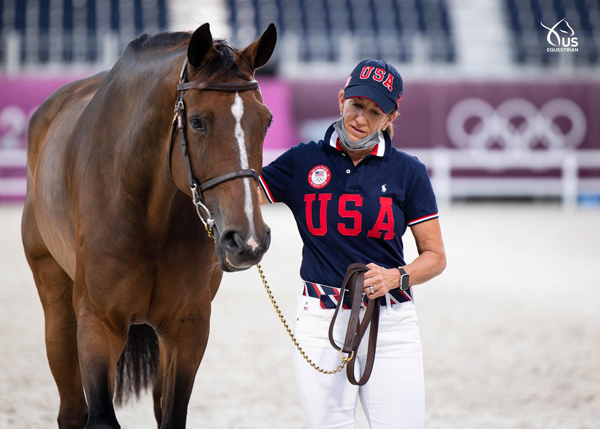
Laura Kraut and Baloutinue during the second horse inspection. Photo Courtesy U.S. Equestrian
All four combinations of the U.S. Jumping Team passed the Second Horse Inspection at Equestrian Park in Tokyo, Japan, as they prepare for the Jumping Team Qualifier tomorrow night under the lights, beginning at 7:00 p.m. JST/6:00 a.m. EDT.
Tomorrow’s team competition will see Laura Kraut, of Royal Palm Beach, Fla., and Baloutinue lead off as the pathfinding combination for the team, while Jessica Springsteen, of Colts Neck, N.J., and Don Juan van de Donkhoeve will go second in the team order. The anchor combination of McLain Ward, and Brewster, N.Y., and Contagious will look to cement the team’s placing in the top ten teams that will move forward to Saturday’s Jumping Team Final competition for medals. The U.S. Jumping Team will go 13th in the order of 19 total teams.
“There’s been incredible team spirit internally. All the decisions have been made jointly, and McLain coming in fresh for the team has always been the plan. Fortunately, all the horses are sound, and the riders are feeling great, and we can do exactly what we were planning on doing,” said Chef d’Equipe Robert Ridland after the second horse inspection for jumping at the Olympic Games Tokyo 2020. “That’s our strategy, and our expectations, of course, are to live another day and move on to the final on Saturday and we all feel prepared and well-positioned to do that.”
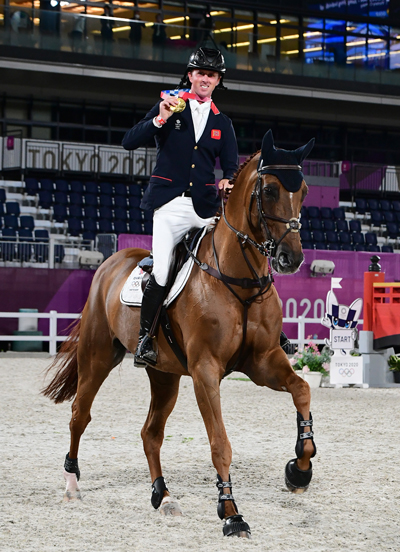
Ben Maher of Great Britain captured the individual gold medal in show jumping at the Olympic Games Tokyo 2020. Photo by MacMillan Photography and Media Services
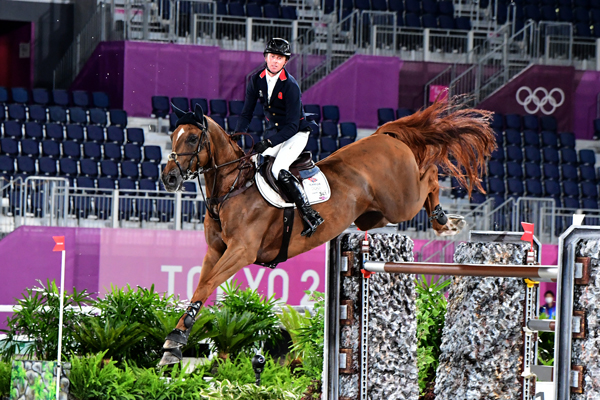
Five years ago in Rio de Janeiro, decorated British rider Nick Skelton stepped onto the podium and accepted an individual Olympic gold medal. He had earned bundles of other accolades in his long career, including team gold in London in 2012, but the individual medal had eluded him until that day when he and the stallion Big Star triumphed. Shortly after that, both Skelton and Big Star retired. But today at the Tokyo Olympics, it was Skelton’s countryman and former teammate Ben Maher’s turn at the individual medals in jumping. Maher piloted the powerful chestnut 12-year-old Dutch Warmblood gelding Explosion W around the jump-off course to capture his own individual gold medal.
The Tokyo Olympic individual show jumping final started with 30 horse-and-rider combinations taking a turn around Santiago Varela’s beefed-up championship course. Six pairs jumped cleanly to return for a jump-off to determine the medals: Maher from Great Britain; Diasuke Fukushima from Japan; Maikel van der Vleuten from The Netherlands, and Peder Fredricson, Henrik von Eckermann and Malin Baryard-Johnsson, all from Sweden.
Fukushima was first to go in the jump-off on the 13-year-old Oldenburg gelding Chanyon. and they turned in a flowing, clear round in 43.76 seconds which was, as one would expect, met with cheers. Next in was the only female rider in the jump-off, Baryard-Johnsson, and she and H&M Indiana, a 13-year-old Belgian Warmblood mare, also jumped clear, stopping the clock at 40.76 seconds. Then, Fredricson guided his long-time equine partner H&M All In, a 15-year-old Belgian Sport Horse, in a clean, fast round, crossing the finish in 38.02 seconds.
Fredrickson was followed in the order by Maher and Explosion W who blazed around and promptly lowered the time to 37.85. Following that, von Eckermann and King Edward, an 11-year-old Belgian Warmblood gelding, left the jumps up but could not get the time, finishing in 39.71. The final combination in the jump-off was van der Vleuten and Beauville Z, an 11-year-old German Sport Horse; they made a grand effort, jumping clear in 38.90.
When the dust had settled, Maher had his gold, Fredricson the silver and van der Vleuten the bronze. The lone North American representative in the final, Mario Deslauriers of Canada riding Bandolina 2, finished in 22nd place on 12 faults.
Maher, who is to be married in two weeks, was full of praise for his horse and gratitude to the owners of Explosion. “The short version is that there’s nothing like him,” he said. “Starting from nine years old, he was winning five-star grand prix. And then, at 10 years old, last year, we had quite a long break in America. I had an operation earlier in the year, and then with COVID, we decided to just stay there and not come back to Europe. He did one grand prix in New York, which he won. And then, we started a little later this year in order to try to peak at this time. Never again in my lifetime will I ride a horse like Explosion. I’ve had some incredible horses and some support from some amazing owners over the years, and they still support me. Charlotte Rossetter and Pamela Wright made it possible to keep him for me. It’s a special bond that we have. I really know what he’s feeling. He’s a phenomenal horse; he’s more of an athlete than a horse. And, the speed that he can go to the jumps is just on another level.”
The second jumper horse inspection will be tomorrow evening for those horses moving on to team competition. Then the show jumping team qualifier is Friday evening, August 6, followed by the team finals and medal ceremonies on Saturday evening, August 7.
In the new FEI team competition format, 20 teams will start on the team qualifier day and the top ten will move on to the final. As with the individual medal competition, the scores will be wiped after the team qualifier and scores will start at zero again on team final day.
The first two riders for each team in the final will start in reverse of how their team did in the qualifying round. Then the starting order for the third rider out for each team in the finals will be re-done based on the standings after the first two rounds. So, determining the winning team will go down to the final ride.
Tokyo Olympic Show Jumping Final by the Numbers
◆ Number of horses: 30
◆ Number of geldings: 19
◆ Number of stallions: 5
◆ Number of mares: 6
◆ Breeds represented in the finals: Belgian Sport Horses, 2; Belgian Warmboods, 5; Dutch Warmbloods, 3; Estonian Sport Horses, 1; Holsteiners, 4; Irish Sport Horses, 2; Luxembourger Sport Horses, 1; Oldenburgs, 2; Polish Sport Horses, 1; Selle Français, 4; Westphalians, 3, and Zangersheide (German Sport Horses), 2.
◆ Number of female riders: 3
◆ Number of male riders: 27
◆ Number of nations represented: 17
Ben Maher does a victory gallop with Explosion W after winning gold. Photo by MacMillan Photography and Media Services
3. Individual Show Jumping Medalists
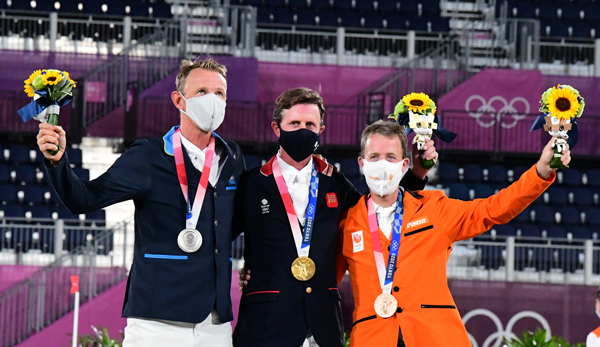
(l-r) Peder Fredricson (silver) of Sweden, Ben Maher of Great Britain(gold), and Maikel van der Vleuten of The Netherlands (bronze). Photo by MacMillan Photography and Media Services
4. Silver Medalist Peder Fredricson
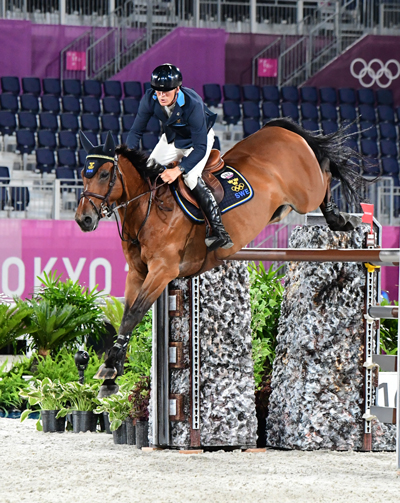
Peder Fredrickson and H&M All-In. Photo by MacMillan Photography and Media Services
5. Bronze Medalist Maikel van der Vleuten
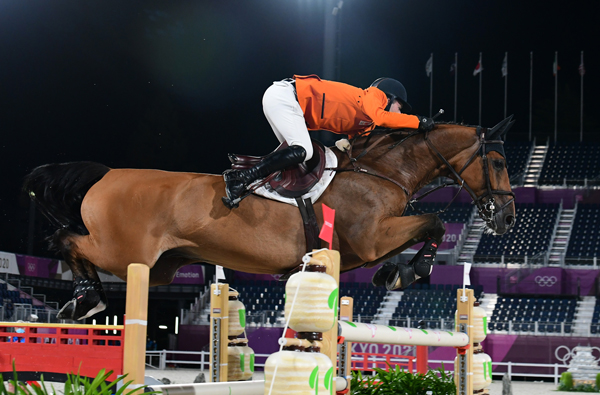
Maikel van der Vleuten aboard Beauville Z. Photo by MacMillan Photography and Media Services
We use cookies to help personalize content, tailor and measure ads, and provide a safer experience. By navigating the site, you agree to the use of cookies to collect information. Read our Cookie Policy.



 The sun is shining and the flowers are blooming—it’s the perfect time to create your very own horse halter planter! This year, use your green thumb to plant some beautiful blooms in a fun, festive pot set inside a halter. You can repurpose an old halter or buy a new one. Either way, your new horsey planter is sure to brighten someone’s day.