0 ITEMS
  • My Account
  • Holiday Gift Guide
  • Podcast
  • Webinar
Subscribe Combo
Enable cache13
Home Blog Page 20

Riding a New Horse Later in Life

0

Four equestrians found themselves ready for a new horse after a lifetime of riding. Here are their stories.

After years as a rider and horse owner, we hold on to that identity for ourselves. It may not have been a steady journey, and it was probably interrupted by work and family changes. Or maybe it started late. At some point, we begin to define ourselves as horse owners.

After I lost my last horse, these thoughts were on my mind:

Do I need another horse?

Am I ready for that?

Who am I now?

Here, we dive into four stories of horse women who are now investing their time and energy into a new horse. Their excitement and sense of good fortune are inspiring.

Meet Lois

Lois Pienkos and her husband live on a picturesque farm near a small town in Eastern Iowa. There are barns, an arena, a jump field, pastures, and a lovely white house with a wraparound enclosed porch full of plants.

Lois is a quilter and paints bright barn quilts that hang on the buildings. When her daughter began riding in Pony Club, Lois got involved and then became a rider herself. She bred her mare and raised two dressage horses that she took to clinics and shows. Now retired, she and her husband spend most of the year on their farm in Iowa with their horses and four to five months in Wellington, Fla., where her trainer lives.

Lois and her trainer decided it was time to find a smaller horse for Lois to move up the levels. They found a great match for her in Florida in 2021, a 10-year-old Lusitano gelding named Heroi. Once home, she easily, but with sadness, sold her bigger Second Level dressage horse and started on a new adventure.
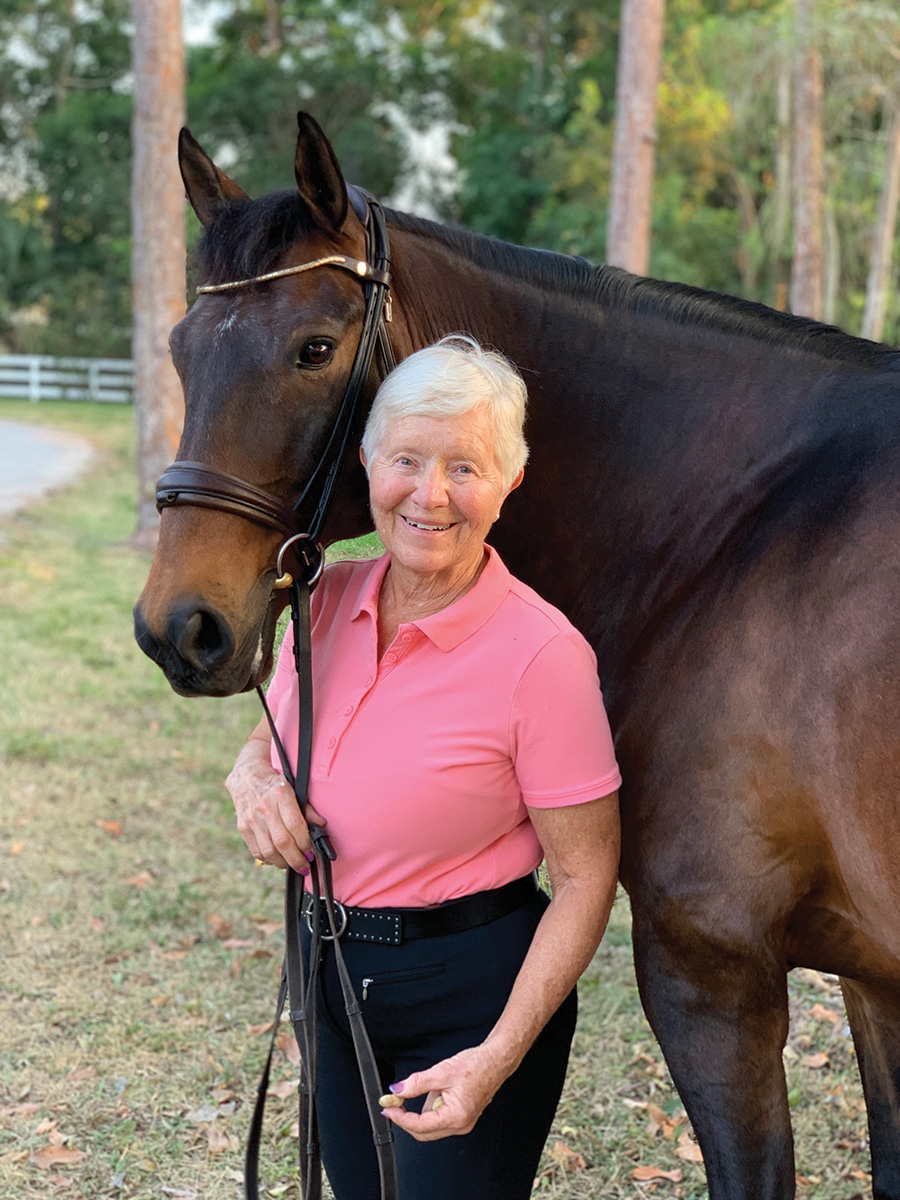
Lois Pienkos with her new horse Heroi.
Lois Pienkos was looking for a smaller horse to continue moving up the levels in dressage. Heroi, a 10-year-old Lusitano gelding, was just the ticket. Photo Jean Rude/Fresh Ink

“Heroi is being trained in dressage,” Lois says. “I’m also beginning to try working equitation. He and I are playing with some of the props and plan to attend a clinic or two in 2023 in Iowa. We started him on trails while we were in Florida this past season. At home and at the barn in Florida, we hack around the property regularly. We do hope to show Heroi, hopefully in the next year.”

The summer fills with clinics and lessons, working on what they learned the past winter in Florida. They travel to Loxahatchee, Fla., in November, where they stable with friends from around the country and train. Lois says her horse’s progress keeps her going, as she “is living the dream.”

Meet Celesta

Celesta Albonetti has ridden since she was a young woman, beginning with hunters, jumpers and eventing before committing to dressage. Celesta loved her small farm in eastern Iowa, surrounded by creeks, woods and farm fields. Her two Trakehner mares loved it, too.

After 16 years there, she retired and returned to Memphis, Tenn., and her family. Her older mare with exquisite gaits and flash had passed away a few years earlier.

Celesta brought the younger mare, Angie, to Tennessee. She found a suitable dressage barn and became friends with riders at the barn who were able to ride Angie for her. Celesta spent hours there, as she has always cared for her horses in this way. Tragically, Angie later became ill and passed away. Most of us can empathize with the grief this brought to Celesta.

When she was ready for another horse, Celesta purchased another Trakehner mare, a 6-year-old she found in Kentucky. Baroness III, called “Aliza” in the barn, was foaled in 2015 and spent two years as a broodmare prior to Celesta purchasing her in August 2021.
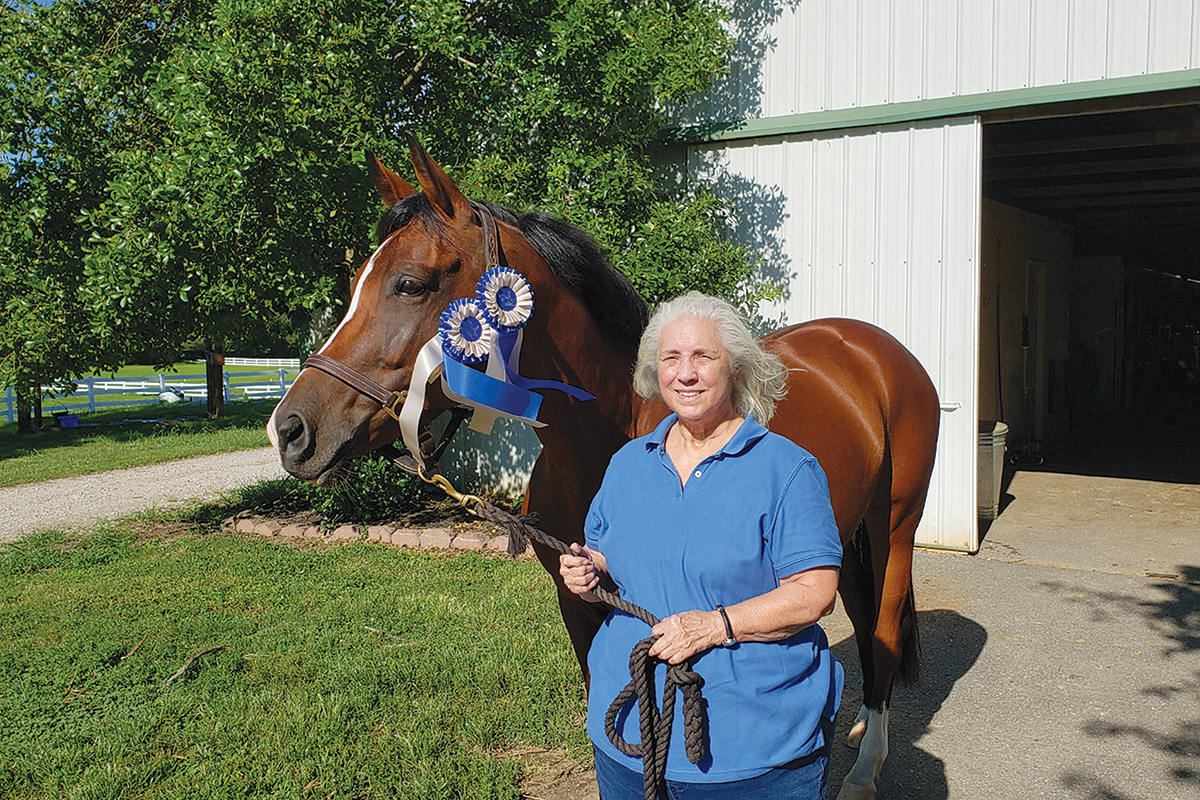
Celesta and her mare Aliza.
Celesta Albonetti purchased her 6-year-old Trakehner mare, Aliza, to get back into her favorite past time. Photo by Landon Stocks

“I felt alive again,” she says. “I go out every day, and I love it.”

After a stall became available in her trainer’s barn in Eads, Tenn., Celesta moved her mare there. The trainer works with Aliza each week, and her progress makes all three very happy. Celesta’s trainer, Macy, has started to show Aliza, and the three share the excitement of their progress. Their plans are to show at Training and First Level during the summer and fall.

Meet Ellen

Ellen Spector has spent her lifetime riding. After years of working, raising children, and boarding her horses, she settled in Iowa, where she and her husband bought a large acreage and put up a 12-stall boarding barn, West Branch Horse Farm. She moved from hunter/jumpers into dressage. She bought mares and started to raise her own dressage horses. Ellen prided her barn as having the best care in the area.

The years passed with many beautiful horses and many devoted boarders. As Ellen’s horses aged and passed away, she found herself without a horse of her own and began to think about the next one—a horse she would keep even after eventually selling the property.

With her husband’s encouragement, Ellen traveled to Denmark with a Danish boarder, Susanne. Susanne’s sister drove them from barn to barn, searching for the right horse. The three dressage riders found a lovely young mare for Ellen, who has always loved mares.

She bought home the 5-year-old Danish Warmblood mare Kokkedals Heroine, barn name “Heroine,” in 2016. With some help from professional trainers, they have begun to compete at recognized dressage shows, a long-time goal.
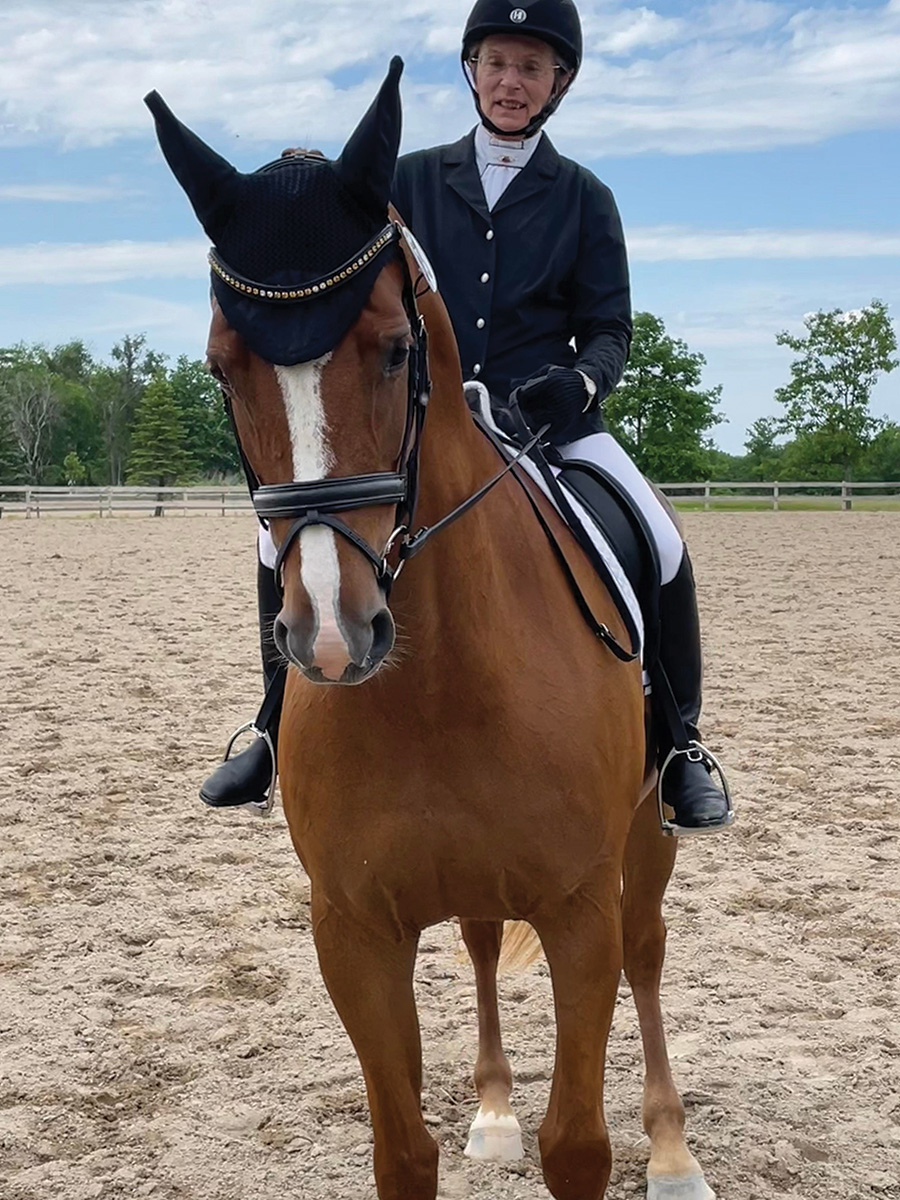
Ellen riding her new horse Heroine.
Ellen Spector was horseless for a time before importing her 5-year-old Danish Warmblood, Heroine, in 2016. Photo by Amy Wilkinson

“We plan to go to three show this summer at Maffit Lake [near Des Moines, Iowa],” she says. “I can’t do without her.” They spend time together every day as Ellen is doing chores and riding.

Meet Judy, the Author

As for me, I adopted a rescued yearling in 2004 named Coach, a Hackney. In 2021 he had a pasture accident and had to be put down, which was very traumatic for me.

The mare that shared the pasture with him left, so no horses remained on my property. I decided I needed to find a quiet horse for myself, my kids, and my friends. I found Nellie at a small farm 90 minutes away; her teenage owner had outgrown her.
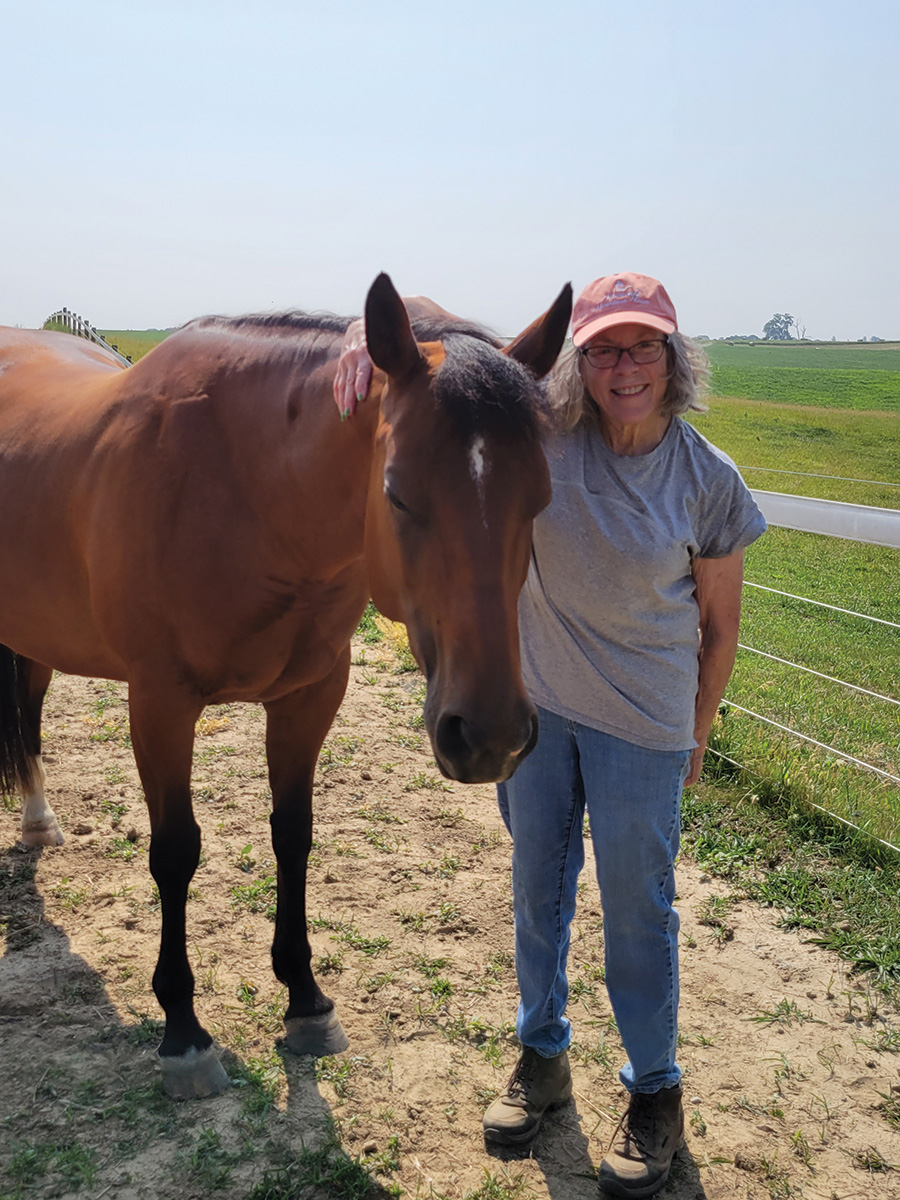
The author, Judy, with her mare Nellie.
After her Hackney Pony’s unexpected passing in 2021, Judy took some time off from horse ownership before deciding she was ready to purchase her new horse, Nellie. Photo by Ariel Zimmerman

I made two trips with friends to meet and ride Nellie before trailering her home. Her age was uncertain, maybe 10 or 11. They never got papers, but called her a Quarter Horse, which seems correct. She’d had a healthy foal that year. She is pretty and quiet.

She and the older Percheron-cross we board for a friend got along from the beginning. Gracie is huge but sweet. Nellie and I connected during the first year. She calls to me from the pasture when I am in the house. She was ridden with western and English saddles.

I’m not riding now and have not been able to find someone to ride her, but she is a happy horse. These two are the quietest horses we have ever had. I put on their masks, groom and spray them in our large dry lot with no halters or lead ropes. They don’t spook or run from crop dusters or large farm equipment. They come for dinner when called.

Getting Back into Horse Ownership

All four women, including four myself, have gone through the process of asking difficult questions.

Why buy a horse now? We found ourselves with room in our hearts to fill after losing or selling our previous horses. Two decided on young horses, knowing their needed training would be long and costly.

Three met trainers who could ride their horses for them. As long-time owners, we already knew the realities of horse ownership, how much help was needed, and where to find it.

If you’re thinking of getting back into horse ownership, think first of the horse’s wellbeing. You need a safe and well-maintained barn, whether at home or a boarding facility.

If at home, you’ll need a backup person to provide the horse care when you can’t. You must have a budget that will accommodate the numerous additional expenses that come with adding a horse to the family.

We all need to have plans for our horses and pets when we are no longer present. If you’re at the beginning of your riding life, you may not have thought of a future after you’re gone. Longtime horse owners tend to be more prepared and plan for this step. This is important to consider before jumping into horse ownership—for horse lovers of any age.

But as you look out into the pasture and feel that space in your heart has been filled, all of the time, financial and organizational challenges seem worth it.

This article about riding a new horse later in life appeared in the October 2023 issue of Horse Illustrated magazine. Click here to subscribe!
ASPCA Right Horse Adoptable Horse of the Week: Brew

0

Welcome to Horse Illustrated’s weekly installment of the Right Horse Adoptable Horse of the Week, offered in partnership with the ASPCA’s Right Horse program. This week’s adoptable horse is Brew! Check back weekly for a new featured horse so you can find your Right Horse.

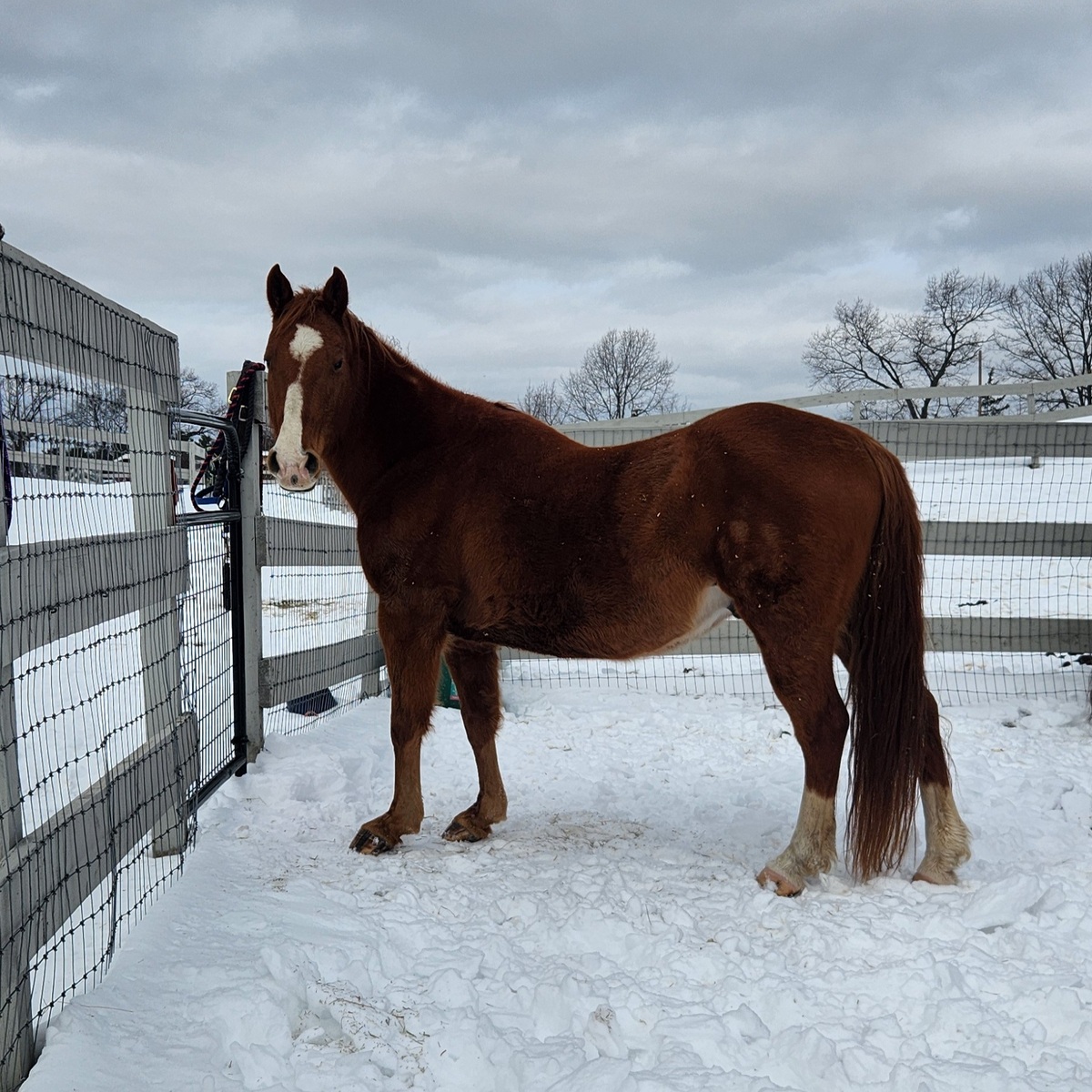
Adoptable horse Brew.
Photo courtesy MSPCA at Nevins Farm

Adoptable Horse: Brew, a 17-year-old, 13.3hh grade gelding
Organization: MSPCA at Nevins Farm, Methuen, Mass.

Get to Know Adoptable Horse Brew

If you ever wanted a horse-sized Bulldog, Brew is your guy! This stocky gentleman is looking for his new digs. Due to his conformation, Brew is adoptable as companion only and should not be ridden. His legs are quite short for his body and his front fetlock joints are both dropped. This does not stop this boy from kicking up his heels while out in the paddock, though! After reviewing with MSPCA’s vets, they have determined he is not painful and has most likely been this way his whole life. Upon ultrasound, we were able to rule out Degenerative Suspensory Ligament Disease (DSLD), as his ligaments looked quite healthy.

Brew is a pretty easygoing guy and is able to turn out with both mares and geldings. He leads well, though sometimes thinks he is a bulldozer and needs a quick little reminder that he is, in fact, attached to a human. He is very responsive and very sweet; he just needs a little tune-up. Brew is up to date on all vet and farrier care and is a pretty easy keeper, maintaining on just a bit of balancer and first-cut hay.

If you are looking for a big hunk of a gelding to love on, or if your current horse is lonely, please submit an adoption inquiry for ASPCA Right Horse Adoptable Horse of the Week Brew and a staff member from MSPCA at Nevins Farm will be in touch.

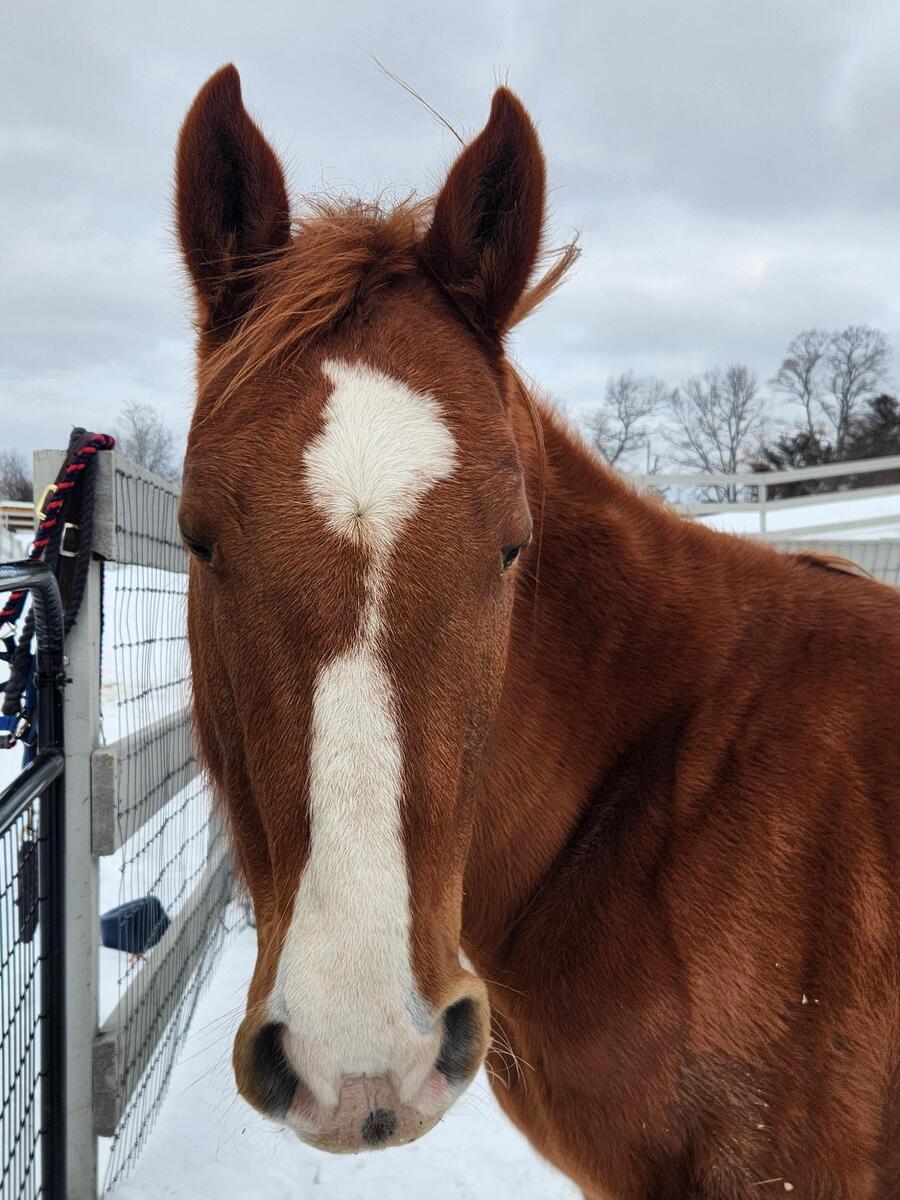
A chestnut gelding in the snow with his eyes closed.
Photo courtesy MSPCA at Nevins Farm

ASPCA Right Horse

My Right HorseASPCA Right Horse is the online adoption platform of The Right Horse Initiative, a collection of equine industry and welfare professionals and advocates working together to improve the lives of horses in transition. A program of the ASPCA, their goal is to massively increase horse adoption in the United States. To find more adoptable horses and foster horses, visit www.myrighthorse.org. To learn more about The Right Horse, a program of the ASPCA, visit www.aspcarighthorse.org.

Botulism in Horses

0

Though you may not have thought much about it, botulism is a very real threat to the wellbeing of a horse. However, it is preventable with good husbandry and routine vaccination.

What is Botulism in Horses?

A disease caused by a neurotoxin released from Clostridium botulinum bacteria, botulism neurotoxin is one of the most lethal natural substances. Botulism attacks the nervous system of infected mammals, binding to nerves and impairing their function. In extreme cases, the cardiac and respiratory systems can be affected, rending the animal unable to breathe or maintain a regular cardiac rhythm.

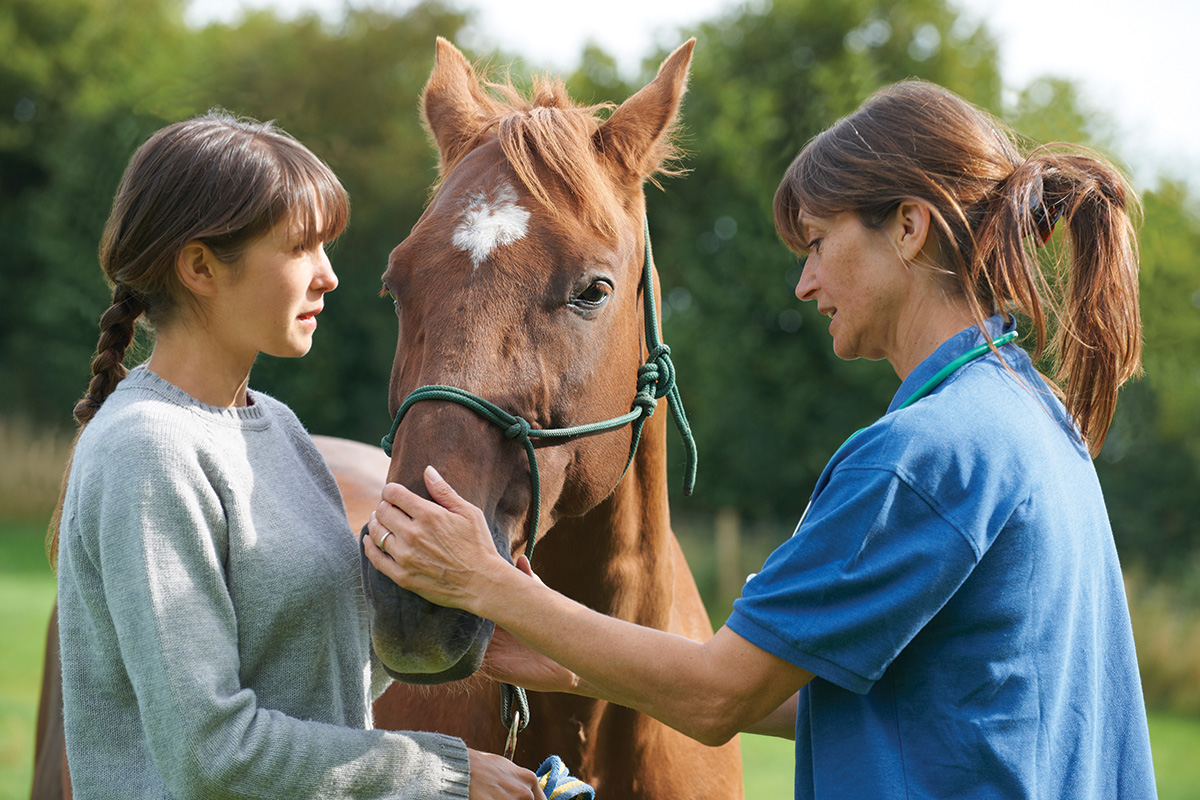
A vet and an owner assess a horse with botulism.
Photo by highwaystarz/Adobe Stock

Though there are seven types of botulism—A, B, Ca, Cb, D, E, F and G—the one of most concern to horse health is type B, which causes more than 80 percent of equine botulism cases.

Botulism is a naturally occurring toxin found in the environment that is harmful to mammals.

“Horses are exquisitely sensitive to botulism,” says Rachel Blakey, VMD, of Maryland Equine Center in Reisterstown, Md. “The amount of botulism that can kill a horse may not impair a mouse; horses are simply that susceptible.”

Botulism bacteria are very hardy and live without oxygen and sunlight. They can be found in the soil, in the sediment of lakes and streams, and in the intestinal tracts of mammals.

How Botulism is Transmitted in Horses

A horse can get botulism in three ways, though ingestion of the preformed bacteria is the most common.

1. By eating hay or feed that has botulism toxin already in it (ingestion of preformed bacteria). This is the means most often associated with feed-based poisonings, like the contaminated alfalfa cubes that killed 45 horses in late 2022.

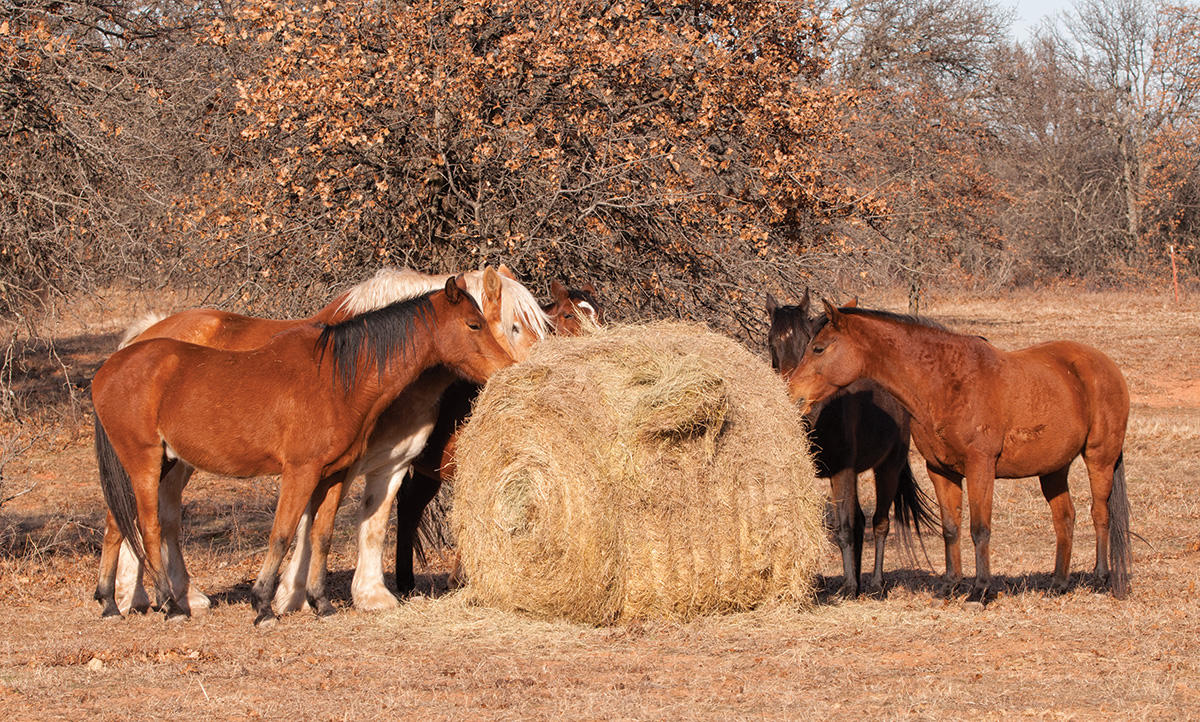
Animals that are accidentally baled into hay can release the toxin from their intestinal tract when they begin to decay, contaminating the hay that surrounds them. Large round bales are particularly susceptible to botulism contamination because their mass allows for more room for contamination than small square bales.

A herd eating off a round bale.
Due to their size, large round bales are particularly susceptible to contamination by small animals with the toxin in their intestinal tract. Photo by pimmimemom/Adobe Stock

2. By ingesting feed, hay or other organic matter that contain botulism bacteria, which then multiply in the intestinal tract and release neurotoxins (transmission in this manner is most common in foals).

Botulism bacteria favors dark, moist environments, like piles of wet feed or tree roots that aren’t exposed to sunlight. In these environmental conditions, botulism is not accessible. However, when a tree falls over and a horse chews on the roots or when the pile of feed is discovered and ingested, the bacteria can become harmful as it multiplies in the intestinal tract and releases the neurotoxin.

Botulism in foals is also called “shaker foal syndrome” or “barker foal syndrome,” as the foal’s vocal cords are paralyzed, making them sound as if they’re barking when they vocalize.

3. By the introduction of bacteria through wounds. Wounds that encapsulate bacteria while healing provide an anaerobic environment where the bacteria flourish.

It’s important to note that botulism is not a disease that spreads between horses. If one horse on the property gets botulism, he is not “contagious”; in other words, he cannot give botulism to other horses via nasal secretions, shared tack, or in any of the other ways equine viral diseases spread.

Clinical Signs of Botulism

The extent to which a horse is affected by the botulism toxin depends on how much they have ingested, says Blakey. No matter if the illness comes on rapidly or more gradually, the initial symptom is always the same: muscle weakness.

The first muscles in horses that lose tone (meaning they are not able to hold themselves as needed to function properly) include the eyelids, tongue, tail and anus. This means that a horse with botulism will have problems eating, chewing and swallowing, and his muscles will fatigue quickly; he may drool or have upper eyelids that droop.

A horse with muscle loss, which can be a sign of botulism.
Losing muscle tone, such as drooping eyelids, is one of the early signs of botulism. Photo by pimmimemom/Adobe Stock

A horse with botulism will also experience muscle tremors. Progressive paralysis occurs in more severe cases, often affecting the horse’s ability to stand; it can also affect a horse’s respiratory and cardiac systems, causing death.

The biggest predictor of whether a horse will survive a bout of botulism is if he can stand.

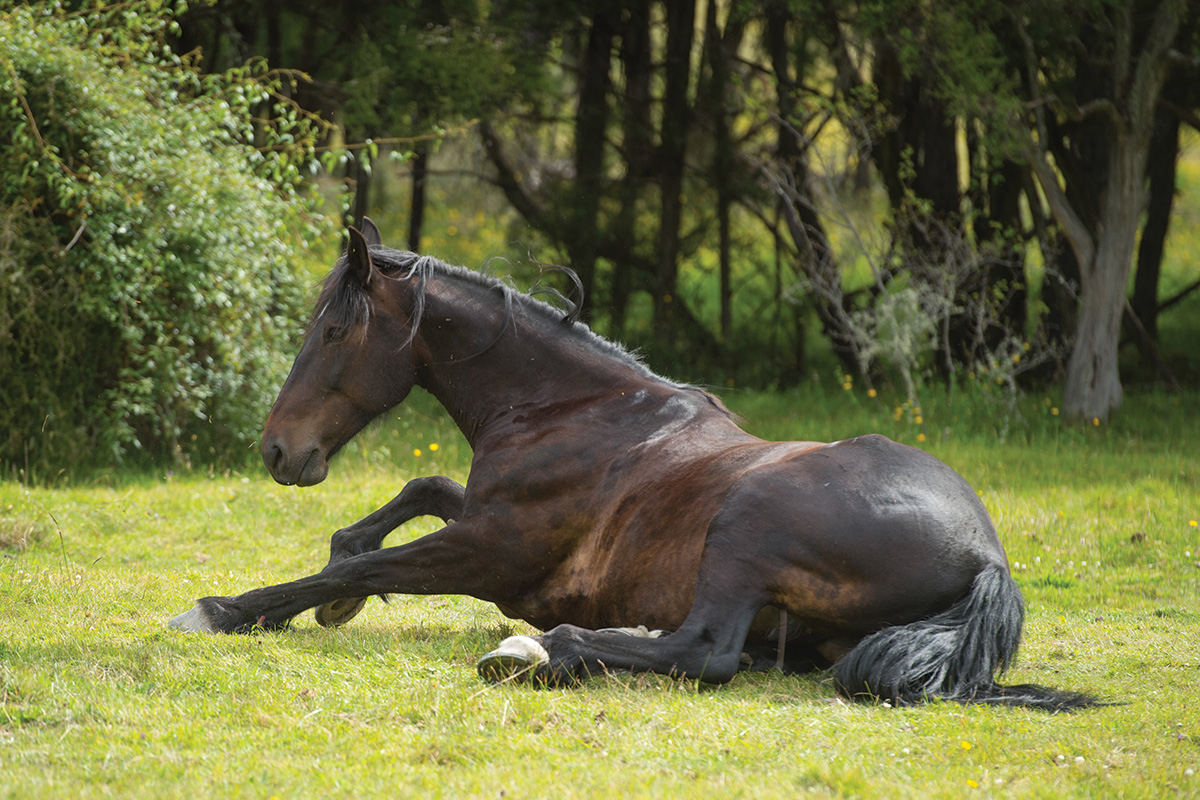
“If a horse can stay up, they often survive,” says Blakey. “Sixty percent of horses that go down, but can rise, survive.” A horse that is recumbent and unable to rise without assistance has a poorer prognosis.

A gelding getting up from lying down.
One of the biggest predictors of whether a horse will survive infection is whether he can rise from a recumbent position. Photo by Shawn Hamilton CliX/Adobe Stock

So how does a vet determine if a horse has botulism and not another issue with similar clinical signs, such as equine protozoal myeloencephalitis (EPM)?

“The very first thing I ask when I see any signs like this is, ‘Is your horse vaccinated against botulism?’” says Blakey. Knowing if a horse has been vaccinated against botulism allows her to immediately rule out botulism as the cause of illness, saving time (and money!) while drilling down to a diagnosis.

Time is of the essence in botulism treatment, but treatment can be delayed as horse owners and veterinarians work to determine exactly what is happening with the horse’s health. Some horses may lie down more as their muscles fatigue, which can be misdiagnosed as colic, says Blakey.

One telltale sign that the horse has botulism and not another disease is that the muscle weakness the horse is experiencing is symmetrical, says Blakey. Horses with botulism have flaccid, floppy muscles, while horses with tetanus have hard, rigid muscles.

Additionally, one of the biggest things to rule out is trauma, says Blakey.

Treatment and Prevention

Early recognition and prompt treatment is imperative in giving a horse the best chance at a full recovery. If botulism toxicity is suspected, the horse can be treated with plasma containing an antitoxin, which binds to free toxin molecules in the blood, preventing them from attaching to nerve cells. This treatment is not cheap (often running between $1,500 and $3,000), and the antitoxin cannot reverse the effects of the toxin that has already bound to nerve cells.

Eventually the toxin degrades, however. If the horse survives, all muscular deficits he experienced while the disease was active will fade; botulism has no lasting effects on a horse. However, muscling and physical aptitude may take weeks or months to return to normal as new nerve endings grow.

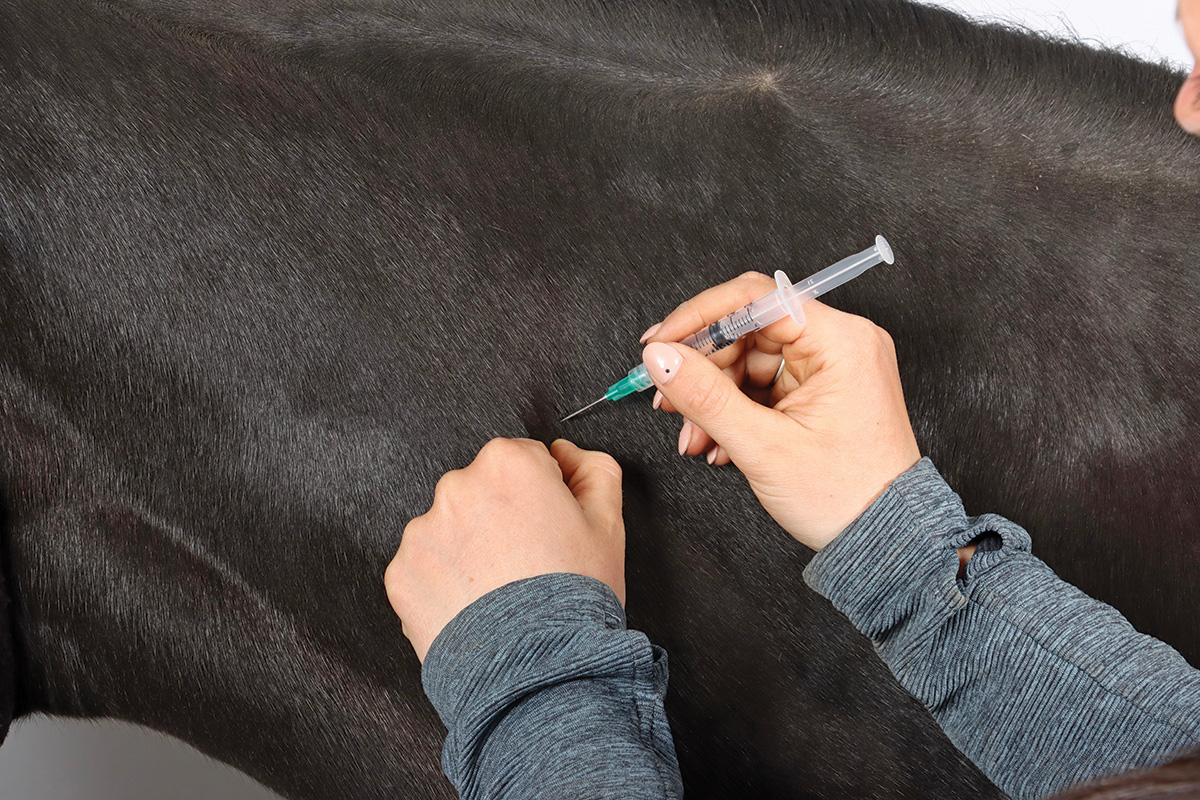
The best preventative measure for ensuring a horse doesn’t contract botulism? Vaccination.

“The botulism vaccine is very effective,” says Blakey. “I insist all my broodmares be vaccinated, so I haven’t seen a shaker [foal] in years,” says Blakey. “And I encourage everyone to vaccinate for botulism. The cost of the vaccine is a pittance compared to the cost of antitoxin treatment for affected horses. I also push hard for those who feed round bales to vaccinate their horses again.”

A horse receiving the botulism vaccination.
Vaccination is the best way to prevent botulism infection. Photo by eds30129/Adobe Stock

There is no downside to botulism vaccination and there is not a population of horses that could not benefit from the protection. While there is a chance that the horse may become sore around the injection site (as with any vaccination), the minor soreness is a minimal price to pay for the safeguard from the toxin the vaccination provides.

Are Vaccinations Effective for Everything?

There are multiple types of botulism that can affect horses, including types A, B and C, though type A is uncommon. Equine botulism vaccines are effective against type B, but don’t provide protection against the other types.

Though a botulism vaccine is not considered a “core vaccine” by the American Association of Equine Practitioners (meaning these vaccines should be given to every horse, no matter where they reside), there are specific populations of horses that should be vaccinated against the disease:

Broodmares

Horses that live in areas of the United States where botulism is endemic: The disease is most prevalent in California, Kentucky, Maryland, Ohio, Pennsylvania and Tennessee, though it can occur in any state.

Horses that eat from round bales

Botulism vaccination begins with three doses given at four-week intervals, with boosters given annually. After the initial series, pregnant mares should be vaccinated yearly (two to four weeks before foaling).

Foals in high-risk situations can start the series of botulism vaccines as early as two weeks old. Foals born to unvaccinated mares or those that have not ingested enough quality colostrum from the mare (failure of passive transfer) can have botulism vaccination initiated early in life.

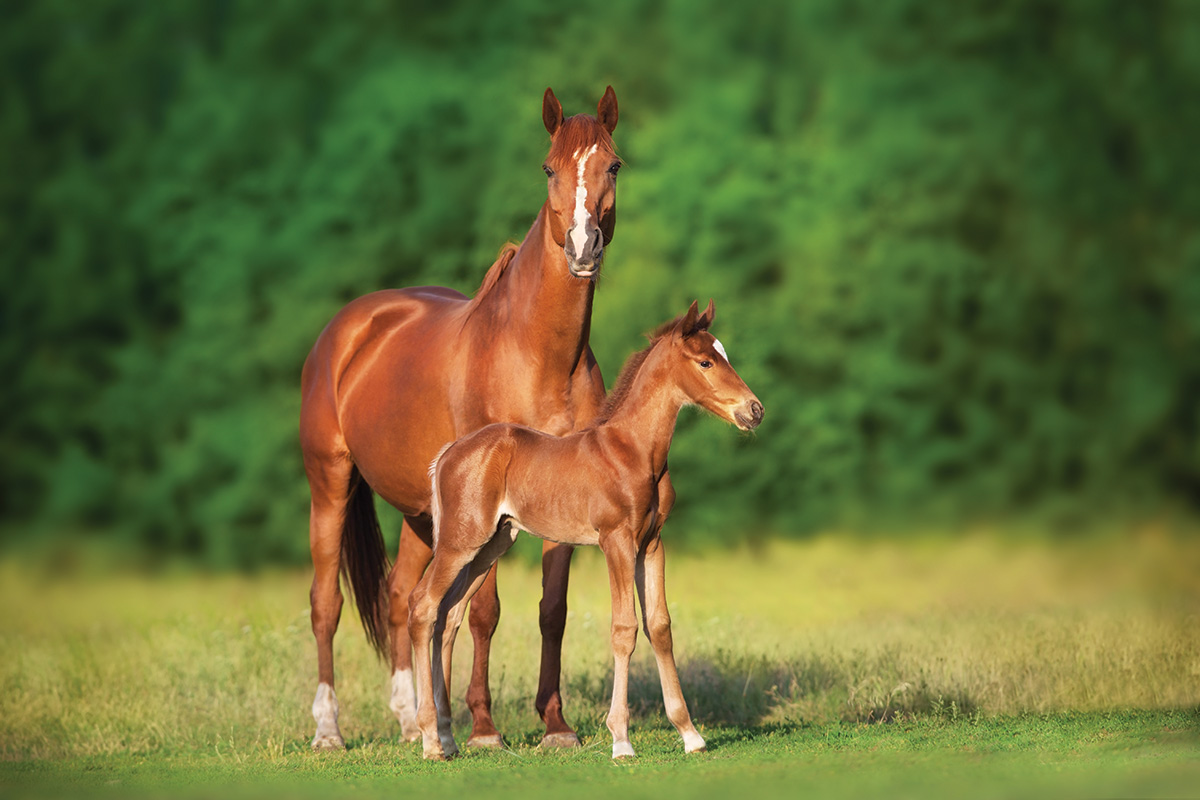
A mare and foal.
High-risk foals can start the botulism vaccine series as young as two weeks old. Photo by wadrat70/Adobe Stock

Botulism protection provided by the mare’s colostrum generally wanes by about 5 months of age, and vaccination should be considered at this time.


Key Takeaway

“Botulism is a normal part of our environment,” says Blakey. “It’s not some weird threat, and it doesn’t happen because a horse owner isn’t ‘clean.’”

However, like many other equine-related health concerns, good husbandry can minimize the incidence of disease. This includes not feeding moldy hay or grain or hay that has been baled with a high moisture content, plus keeping pastures and barns free from dead rodents and animals.

If horses live in an area where botulism occurs or if they’re fed round bales, vaccination is the most-recommended route of prevention.

This article about botulism in horses appeared in the March 2024 issue of Horse Illustrated magazine. Click here to subscribe!
Breed Portrait: Trote y Galope

0

While the Paso Fino—a breed well known for its smooth, animated gait—was gaining notoriety in the U.S., another closely related breed was being developed back in the country of Colombia. Called the Trote y Galope, this horse started as a cross between the Paso Fino and the Lusitano, and eventually developed into its own breed.

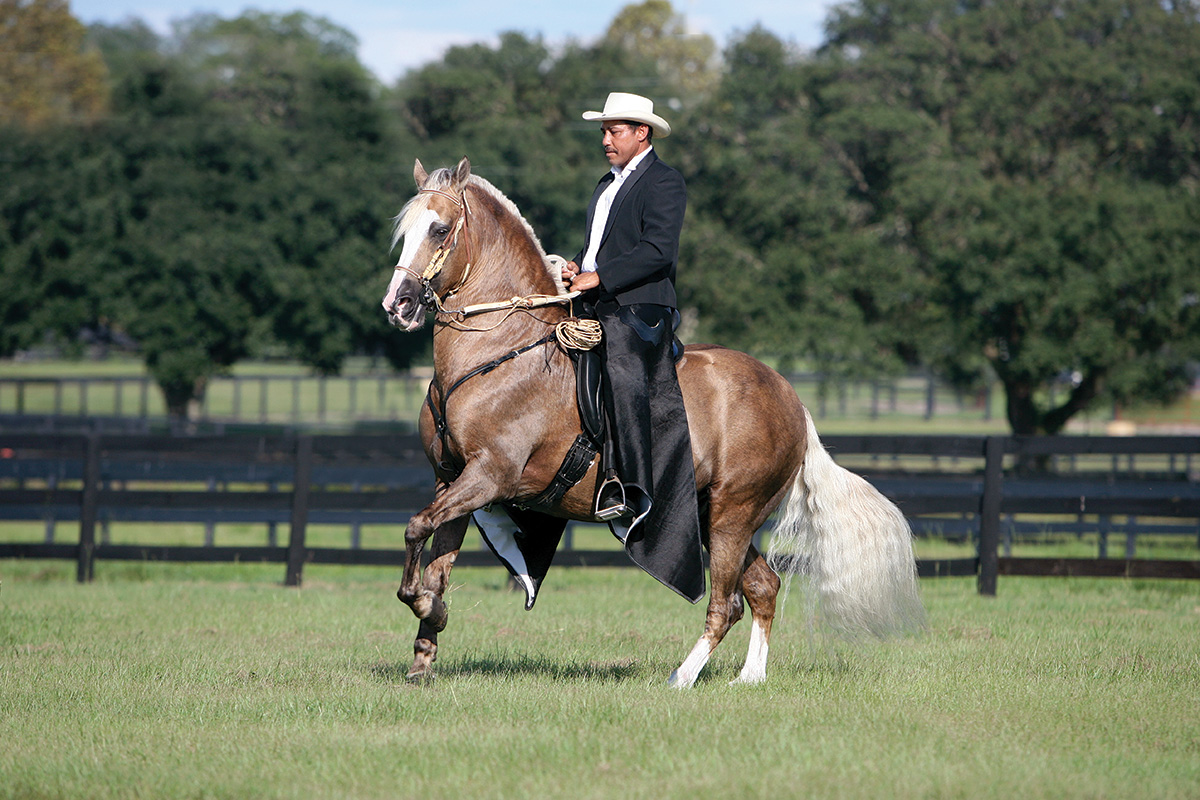
A man riding a gaited palomino stallion.
Photo by Stunning Steeds Photography

The Trote y Galope inherited the spirit and sensitivity of the Paso Fino with the height and power of the Lusitano. And as a bonus, the Paso Fino and Lusitano gaits managed to combine to create something truly unique in the Trote y Galope: a smooth diagonal gait

Common History of the Trote y Galope

As a close cousin to the Paso Fino, the Trote y Galope has its roots in Colombia. The Paso Fino was developed there in the 1500s from horses brought to the Dominican Republic, Cuba and Jamaica by Spanish conquerors.

Christopher Columbus helped establish a breeding program there with the goal of supplying Spanish soldiers with horses. These carefully bred horses were then brought to both Puerto Rico and Colombia.

The horses in this breeding program carried the DNA of the Jennet, a now-extinct gaited Spanish horse. The Jennet passed along its gaits to early Paso Finos, who were also the result of crossings with Barbs and Andalusians.

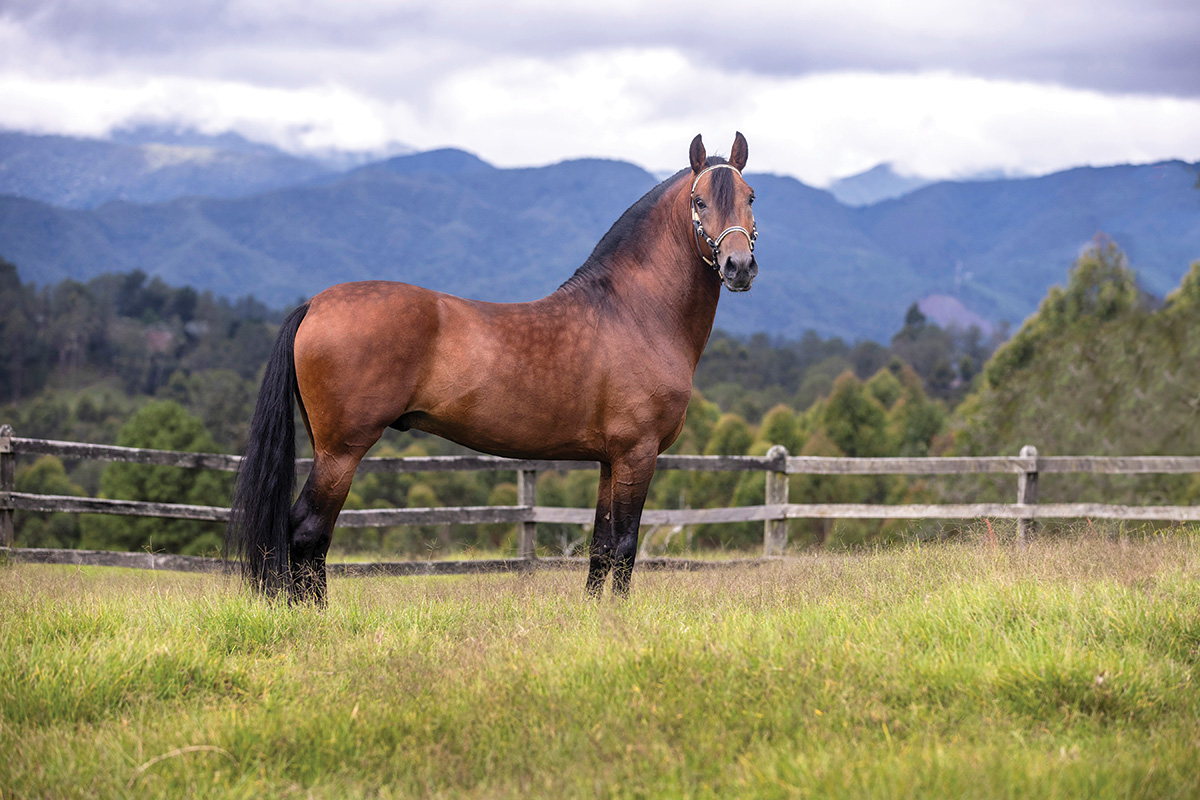
A profile shot of a Trote y Galope horse with mountains in the background.
The Trote y Galope inherited the spirit and sensitivity of the Paso Fino with the height and power of the Lusitano. Photo by Stunning Steeds Photography

The Lusitano, the other breed that provided the foundation to the Trote y Galope, is descended from early Spanish horses that lived on the Iberian Peninsula during prehistoric times. The blood of these Spanish horses became mixed with that of breeds that arrived from other parts of Europe during times of war and migration. The Lusitano descended from this mix of bloodlines and continued its development in Portugal.

Because of their strength and agility, Lusitanos became the favored breed of Spanish and Portuguese bullfighters.

Diagonal vs. Four-Beat

The Paso Fino is famous for its lateral, four-beat gaits: the classic fino, the paso corto and the paso largo. Each of these gaits results when the horse places one hoof down at a time in a four-beat rhythm. The Trote y Galope also provides a smooth ride, but they do it differently: with diagonal footfalls.

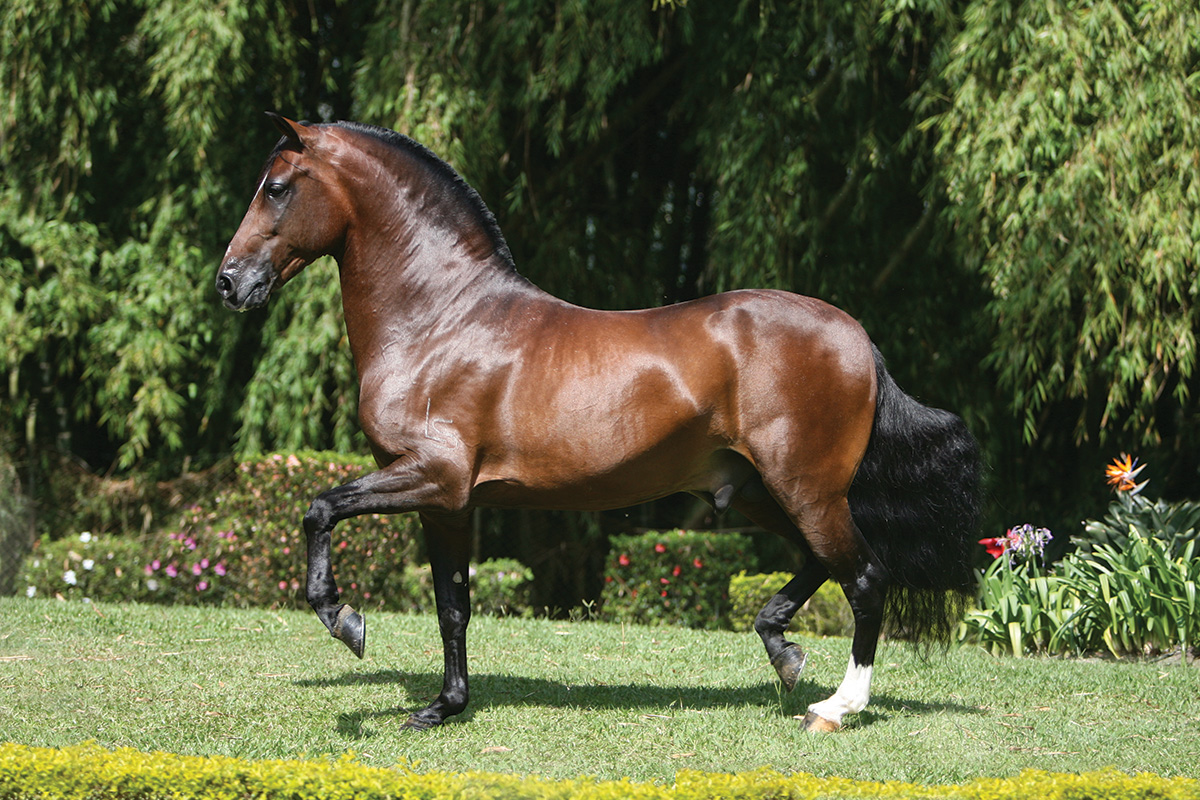
The Trote y Galope gets its name from its signature gaits: the trote and the galope. The trote is a diagonal two-beat gait without the suspension present in a standard trot. Even though it’s not a four-beat gait, it is comfortable to sit because there is no suspension. When watching performance of this gait, it looks as if the horse is marching. A 1-2, 1-2 rhythm is created when this gait is performed.

A Trote y Galope horse performing its signature gait, the trote.
The trote is a diagonal two-beat gait without the suspension present in a standard trot. Even though it’s not a four-beat gait, it is comfortable to sit because there is no suspension. Photo by Stunning Steeds Photography

The breed’s other signature gait is the galope, which is essentially a canter with diagonal propulsion in three beats. First one hind leg strikes the ground, followed by the other hind leg and the foreleg that is diagonal to that hind leg. Finally, the other foreleg hits the ground. The sound of this movement creates a 1-2-3, 1-2-3 rhythm.

The Trote y Galope in America

The Trote y Galope is popular in Colombia and can be seen at Paso Fino shows throughout the nation. But in America, the breed is still growing.

The small numbers of Trote y Galopes here in the U.S. are being shown in western, English, jumping, trail obstacle, dressage and Paso Fino events. They also make great mounts for recreational trail riding.

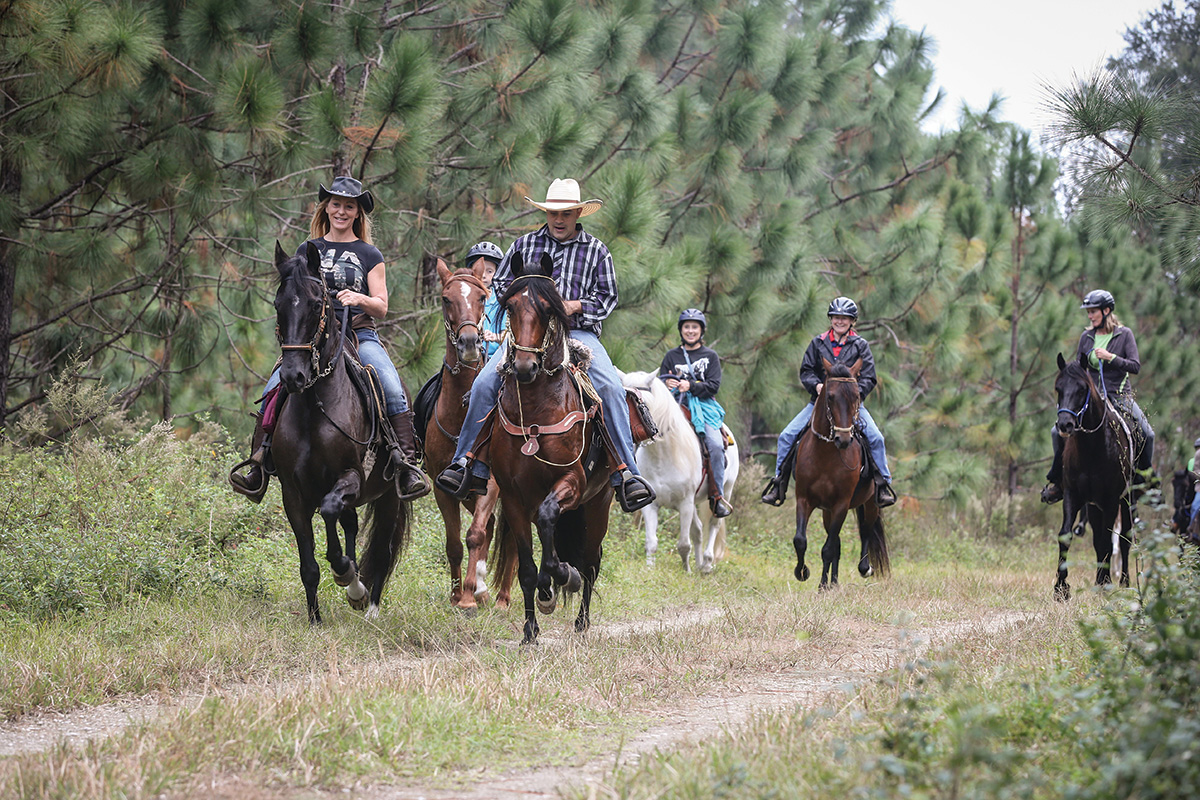
A group out on a trail ride aboard gaited equines.
Thanks to its smooth gait, the breed is often used for recreational trail riding. Photo by Stunning Steeds Photography

The Paso Fino Horse Association considers Trote y Galope horses a separate breed from laterally gaited Paso Finos, grouping them with two other diagonally gaited breeds related to the Paso Fino: the Trocha Pura and the Trocha y Galope.

Horses registered as Paso Finos have only Paso Fino horses in their pedigrees, while the diagonally gaited horses have other breeds mixed with Paso Fino blood.

Trote y Galope Fast Facts

Height: 14 to 15 hands

Color: All solid horse colors

Overall Appearance: Compact body with a sloping croup and muscular chest. Neck is thick, heavily-crested, arched and held at a high angle; mane is traditionally roached.

Association: Paso Fino Horse Association


Key Takeaway

Next time you visit a gaited horse show, keep an eye out for a laterally gaited Trote y Galope. Thanks to their dramatic stature and fascinating way of going, it won’t be long before these horses are a common site in the gaited horse world.

This article about the Trote y Galope appeared in the March 2024 issue of Horse Illustrated magazine. Click here to subscribe!
Vet Adventures: Night of Terror

0
A spooky picture of a horse that fits the theme of this edition of Vet Adventures.
Photo by NaletovaAdobe Stock

I had just flopped onto my couch, remote in hand. Sunny, one of my teenage daughters, breezed through the front door, phone against her ear, and gave the door a careless slam. The windows rattled, and I raised my head.

“I think one of my teenagers must have just walked in,” I said to my daughter’s back as she disappeared down the hall. The door to her room slammed shut.

“Hi, Sunny!” I said to no one, then started my movie.

I was happily munching my popcorn when my daughter reappeared and flopped onto the couch next to me. She was now wearing her favorite huge pajamas and hoodie, and she snatched a handful of my popcorn.

“Whatcha watching, Mom?”

Interrupted

I started to answer, but my phone rang. It was one of my good friends, but I wanted to watch my movie, and debated letting it go to voicemail. My daughter snatched the phone from my hand and gave me an evil smile.

“Hey, Annie. Yes, she’s right here—hold on!”

I sighed and took the phone, but the panic in my friend’s voice got me off the couch, fast. I was half dressed before she’d finished telling me what was going on, and my daughter watched me run back and forth, grabbing my muck boots, coat, hat, headlamp, and vet bag.

“Mom, what’s going on?”

“Annie’s watching Libby’s horses, and one is down. I’ve got to go help her.” Libby was also a good friend, and she’d given my daughters riding lessons since they were small.

To my surprise, Sunny leaped off the couch and pulled on her muck boots and Carhartt coat. “I’m going with you!”

This was nice. Sunny didn’t come on calls with me very often, and I pointed at her pajamas, bagging over the tops of her boots.

“You might want your coveralls, kiddo.” Sunny shrugged, and followed me out to the truck, and we roared out of the driveway, headlights slicing into the dark night.

Down for the Count

We scanned the field as we pulled up to Libby’s place, and a dark figure waved a flashlight at us frantically. I parked as close as I could, and we ducked through the wire fence and hurried over to a small group of people huddled around a dark shape on the ground.

It was Libby’s favorite mare, Annabelle, and her head moved weakly as I approached. Her eyes were wide as she struggled desperately for a minute, then lay still.

I rapidly checked her vitals and gum color and listened to her belly, but everything seemed normal. I noticed some bloody tissue under her tail when I took her temperature, and the muddy ground was torn up around her.

We were on a gently sloping hill, and Annabelle’s body lay slightly downhill from her legs. I suspected that she was cast (unable to get to her feet). When a horse is in the same position for too long, the weight of their body can injure muscles and they can become paralyzed in one or more limbs.

There was no way to know how long the mare had been stuck like this, but the blood under her tail told me that the magpies had been pecking at her, so it had probably been quite a while. Would we even be able to get her back up?

Annie and the others had brought several long ropes, and I tied slip knots around both of the mare’s down legs. Sunny was darting around us, anxious to help, and she held the light for me as I secured the ropes.

“Now Sunny, I want you to stay far away from Annabelle when we flip her over!” I said sternly. “She may thrash and struggle, and I don’t want you getting hurt.”

Sunny nodded and I chuckled at her billowing pajamas and tall boots.

“You look like a pirate,” I told her. She grinned at me and saluted, then ducked out of the way as I called to the others holding the ropes.

We stood in a line just downhill of Annabelle. “One! Two! And THREE!”

A Big Scare

We all heaved as hard as we could. Annabelle slowly rocked onto her back, then rolled completely over. We scrambled back as she lunged to her feet, staggered, began to fall, and briefly caught herself, shaking the ropes free.

Annabelle rocked violently in place, then tumbled forward, lurching rapidly down a steeper section of the hill. To my dismay, Sunny was directly below her, running for dear life in her flapping pajamas and coat, knees almost to her chest as the mare plunged and scrambled and staggered barely 3 inches behind her.

The scene seemed to go on forever. Annie and I watched helplessly as the figures careened wildly down the hill.

Sunny finally had the presence of mind to duck behind a thick bush, and mercifully Annabelle came to a stop above her. The mare wobbled in place but stayed on her feet. I made sure Sunny was OK, then haltered the mare and coaxed her up the hill. Annie coaxed a shaken Sunny along behind us.

Annabelle and Sunny both recovered quickly, and the mare took some hay from my daughter’s hands after drinking half a bucket of water. Sunny helped rub Annabelle down with a thick, soft towel.

Sweet Relief

On the drive home, I kept picturing Sunny fleeing through the dark in her huge pajamas with the horse right behind her, and I laughed until my sides cramped.

“Nice, Mom,” Sunny said indignantly. “I almost die, and you’re laughing about it?”

I gave her a one-armed hug. “I’m very glad you’re OK, sweetie. Maybe next time, run across the hill, not down it?”

She glared at me.

“Maybe next time, tell me that before the horse gets up!”

This edition of Vet Adventures appeared in the March 2024 issue of Horse Illustrated magazine. Click here to subscribe!
Is Your Saddle Making You Ride Badly?

0

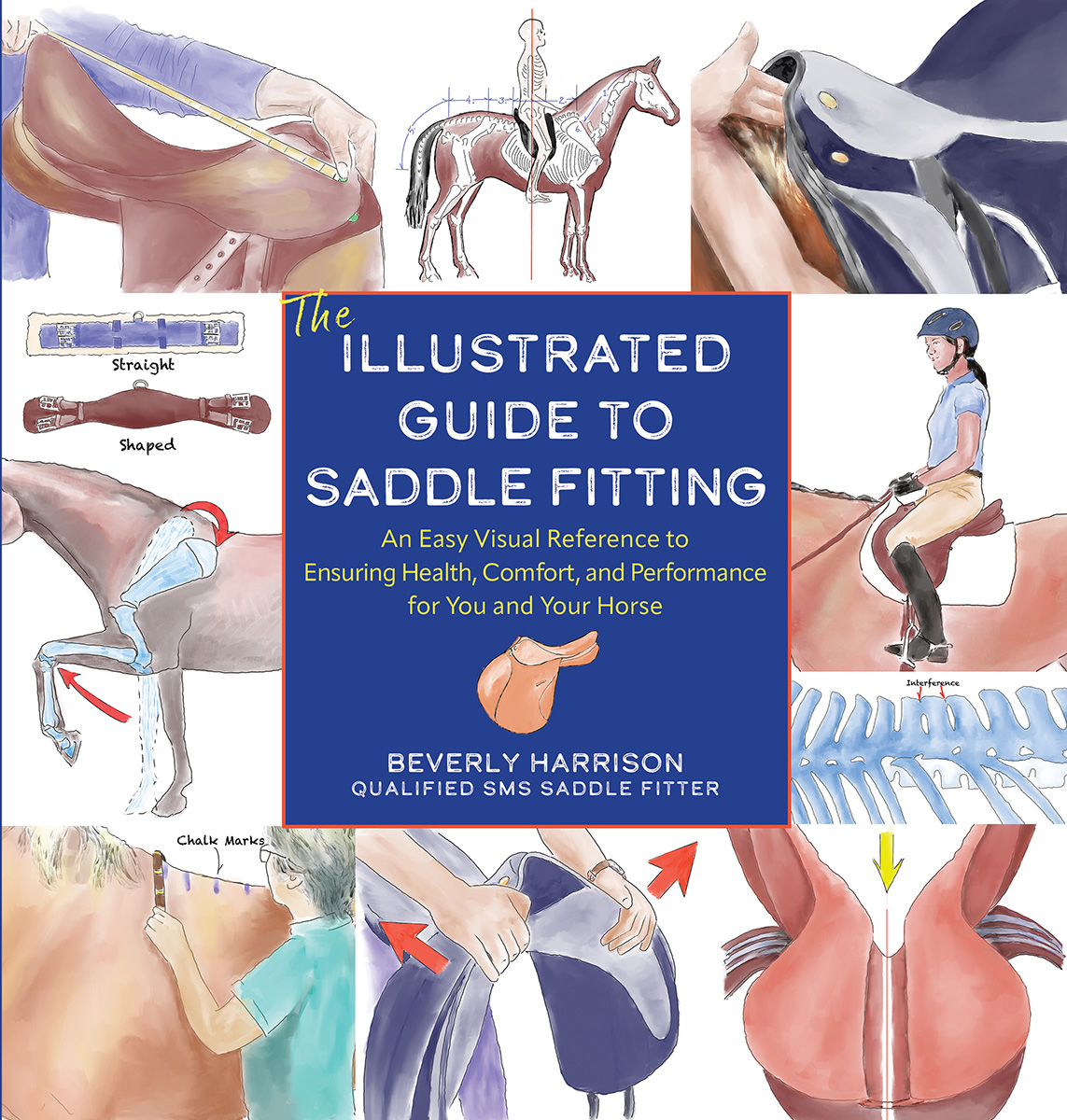
The cover of Illustrated Guide to Saddle Fitting.

For successful saddle fitting, it is as important to address the dynamic stability of the rider as it is the horse. A horse should be able to perform at his best without discomfort. The same is true for a rider.

Some elements make it more challenging when evaluating a rider’s fit in the saddle in any English discipline, whether it is dressage, jumping, trail riding, or another activity. The following are just a few tricky issues that saddle fitters run across:

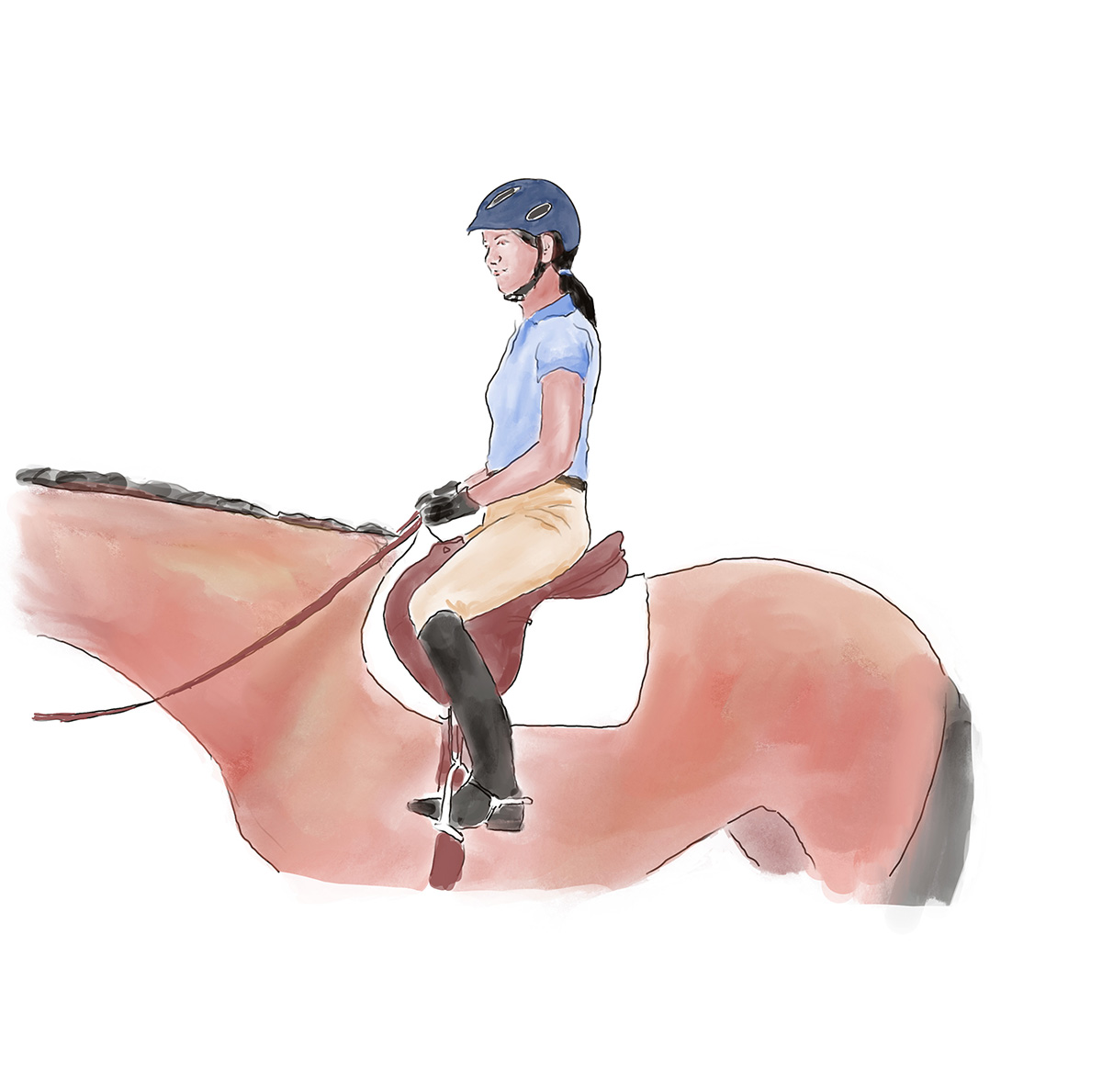
There is often a mismatch between a rider’s perception and reality because human cognitive sensory information relies on patterns. As an example, if a rider regularly sits to the right side of the horse whenever mounted, the brain believes this position is correct and straight. In brief, the rider’s perception of her position and actions in the saddle is frequently inaccurate! As a result of this perception, when asked what kind of saddle fit a rider “likes,” the rider will usually “like what she knows,” versus “knowing what she likes.” We humans like familiarity, even when it is damaging.

A rider may believe her horse’s lameness or movement issue is due to a problem with the horse, even though the horse doesn’t appear lame until the rider mounts up. Rider-influenced causes tend to go unnoticed, and instead we focus on the horse when we should be addressing the rider’s issues, or a problem with the fit of the equipment used.

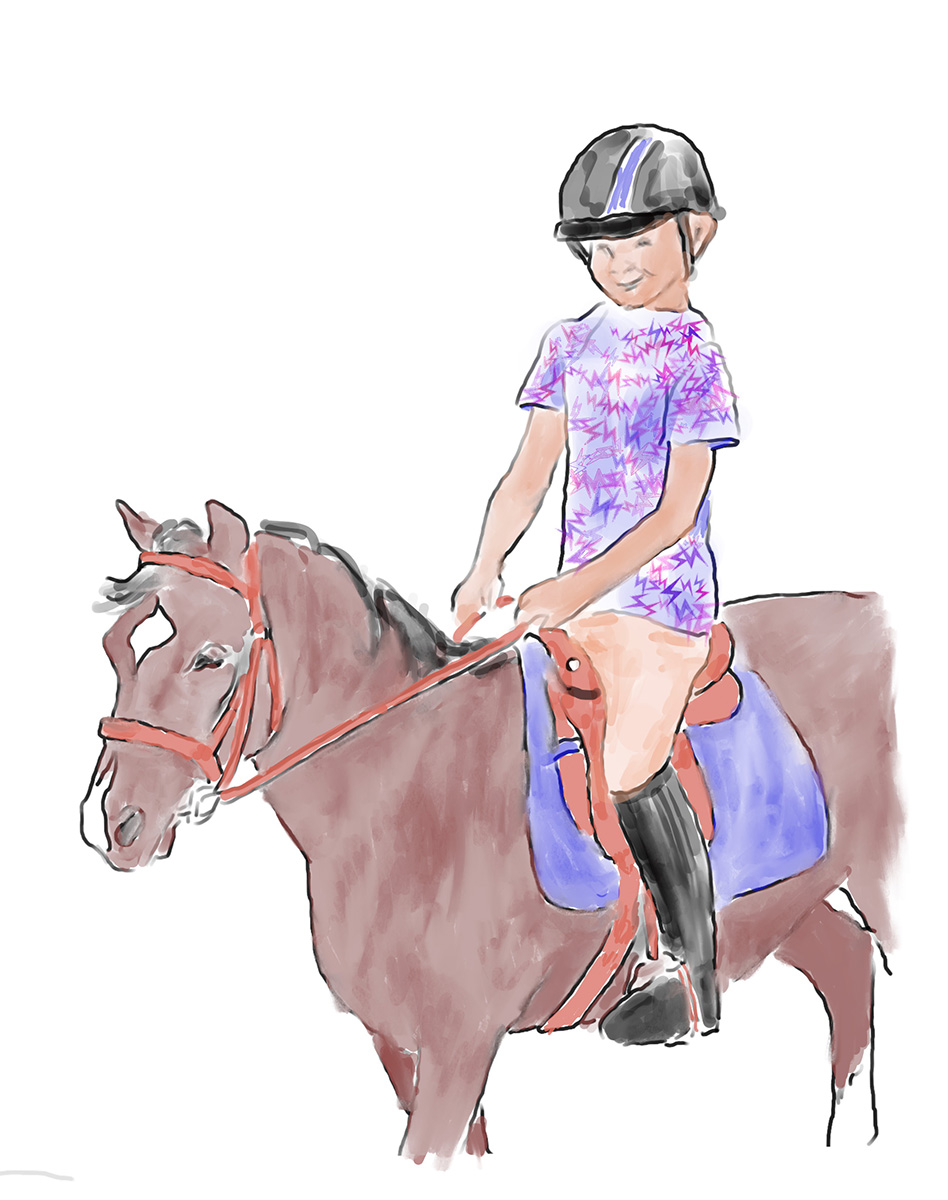
An illustration of a young equestrian.
Art by Beverly Harrison

Riders, particularly more advanced riders, regularly ride through physical pain. That pain causes distortion of their position and compensatory movement. Rider compensations, often enacted unconsciously, occur to maximize the rider’s own comfort and effectiveness, but they typically affect the movement of the horse in a detrimental way.

There is not much consistency in the education of riders today, particularly in the United States, where a standardized curriculum does not exist. Theories and techniques are mostly up to individual trainers, with little commonality between trainers, and we do not have a precise standardized terminology with which to teach riders.

Amateur riders generally spend most of their time in non-riding activities. Many of those activities undermine the symmetry that is so important to riding. For example, static positions assumed while driving a car or sitting at a computer all day create stiffness and asymmetry in the body, and weakness of the core muscles. It is clear that horses develop a locomotor strategy to compensate for such inconsistency and rigidity in the rider. The outcome of rider asymmetry, such as significantly weighting one stirrup more than the other, pulling on one rein (thus using one seat bone more than the other), or collapsing through one side all causes the saddle to compress more on the weighted side and shift to the weighted side compromising the horse’s spine, and can deform the shape of the panels, as well as cause compensatory movement in the horse.

A sketch of an equestrian.
Art by Beverly Harrison

All the rider considerations just listed come into play when addressing saddle fit. Ground reaction force (GRF) from the horse’s hooves contacting the ground come up through his limbs while the pressure of the rider pushes downward on the horse’s back. The saddle sits in the middle. Consider a right-hand-dominant rider—that rider is likely stronger throughout her right side. In response, her horse may then brace through his ribcage on the right side, causing the saddle to collapse and deform on that side, or push sideways and shift more to the left. Either way, the result is crooked.

The amount of pressure from the rider on the horse’s back increases with speed of locomotion:

Walk: Pressure is equal to the weight of the rider.

Trot: Pressure is two to three times the weight of the rider.

Canter: Pressure is three to four times the weight of the rider.

With these numbers in mind, it is clear that at the walk, a crooked rider has less negative impact on a horse’s back than at the trot and canter. Forces from the rider are increased in those faster gaits, as well as when jumping. The more suspension the horse has—the more bounce in the gaits—the greater the pressure from the rider. And it is also increased when the rider is stiff, unbalanced, or uncoordinated.

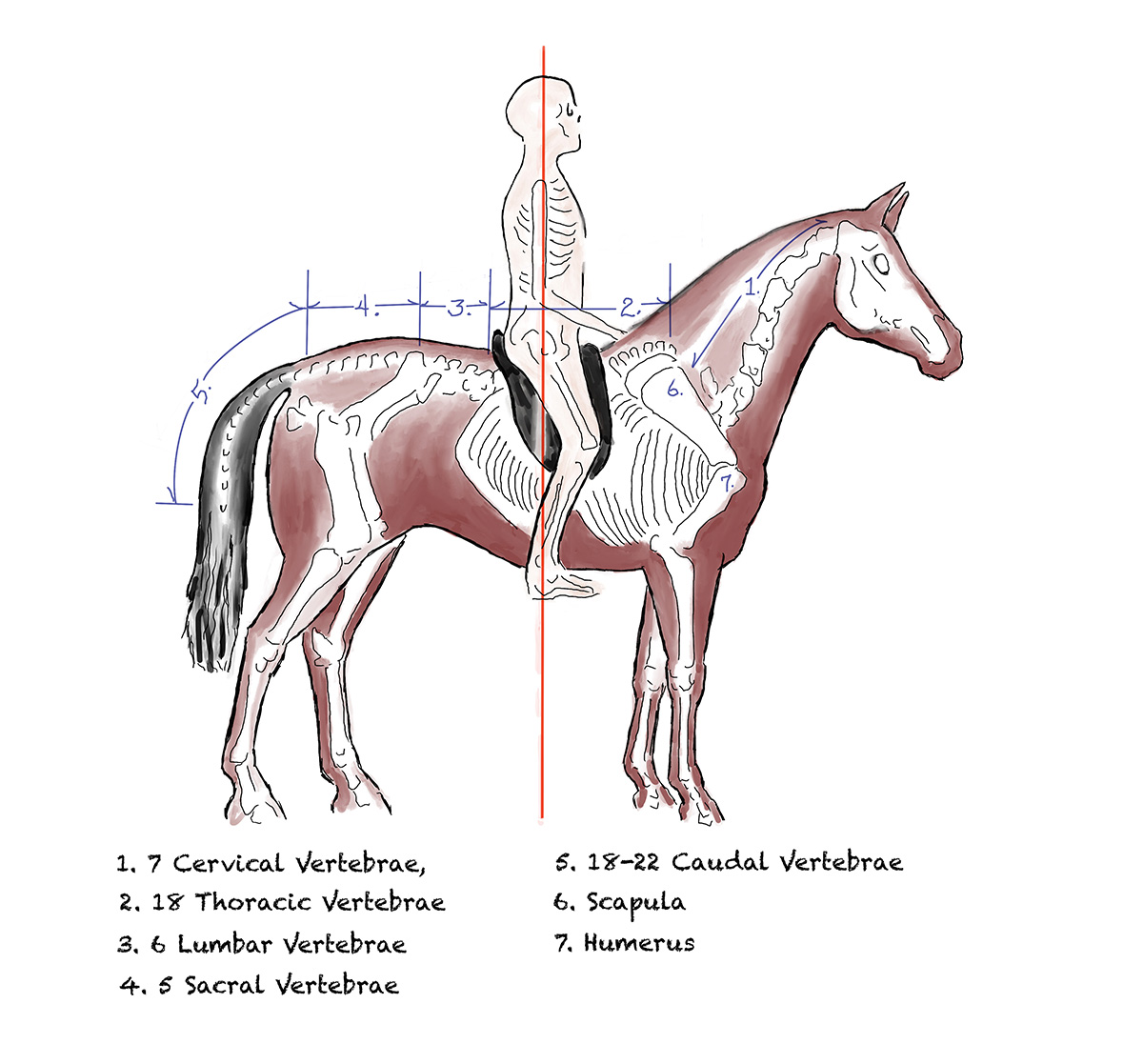
A sketch of the parts of the horse and rider body that saddle fit affects.
Art by Beverly Harrison

As equine athleticism increases through selective breeding, effective and balanced riding is much more challenging. It follows that there must be a change in the style of modern saddles to address the needs of the rider. As little as 30 to 40 years ago, jumping, dressage, and English-style trail saddles were essentially flat in the seat with very little, if any, knee roll. Now, saddles tend to have a deeper seat, larger knee rolls, sticky leather, and everything but a seat belt to keep riders more secure. This is particularly influenced by the number of amateur riders entering the market with a healthy budget for saddles with attributes that will help them achieve their goals on expensive, athletic horses.

When the seat of the saddle becomes deeper, with defined spots for the seat bones and knee rolls that control rider leg position, it is very easy to damage the rider if the saddle is not fit correctly—to both her and her horse. Anatomical features of each rider have to be recognized and understood when choosing a new saddle, or when achieving and maintaining balance in an existing saddle.

This excerpt from The Illustrated Guide to Saddle Fitting by Beverly Harrison is reprinted with permission from Trafalgar Square Books.

The State of Equine Nonprofits

0

Economically speaking, 2023 was a less than banner year for most Americans, and charitable organizations that rely on public donations to keep their operations alive and healthy were not immune to these financial realities. Hardest hit were nonprofits like equine welfare organizations, which were challenged to think outside the box in order to hold onto existing donors, attract new ones, and compensate for those who fell by the wayside.

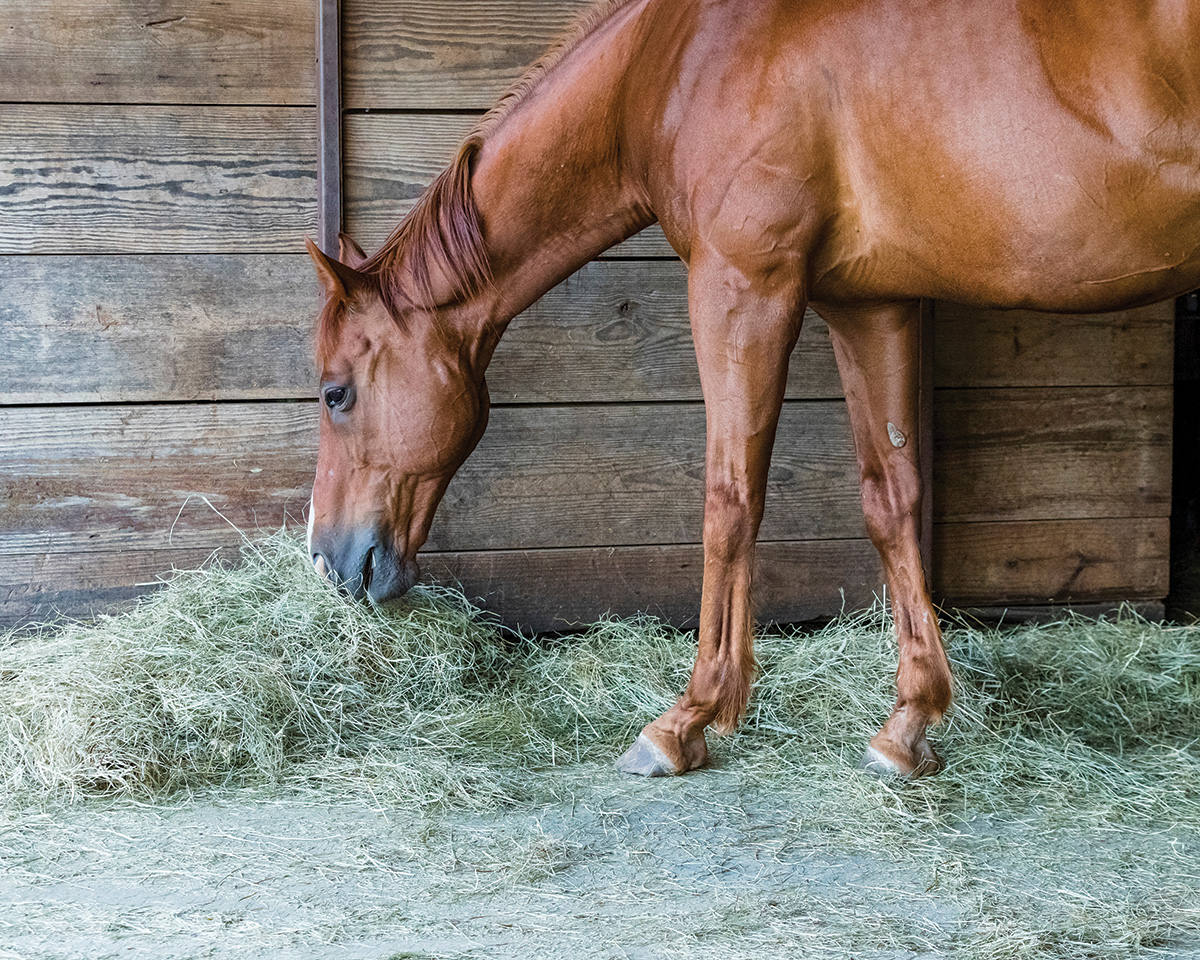
A chestnut gelding eating hay.
Photo by Margaret Burlingham/Adobe Stock

How Equine Nonprofits Have Gotten Creative

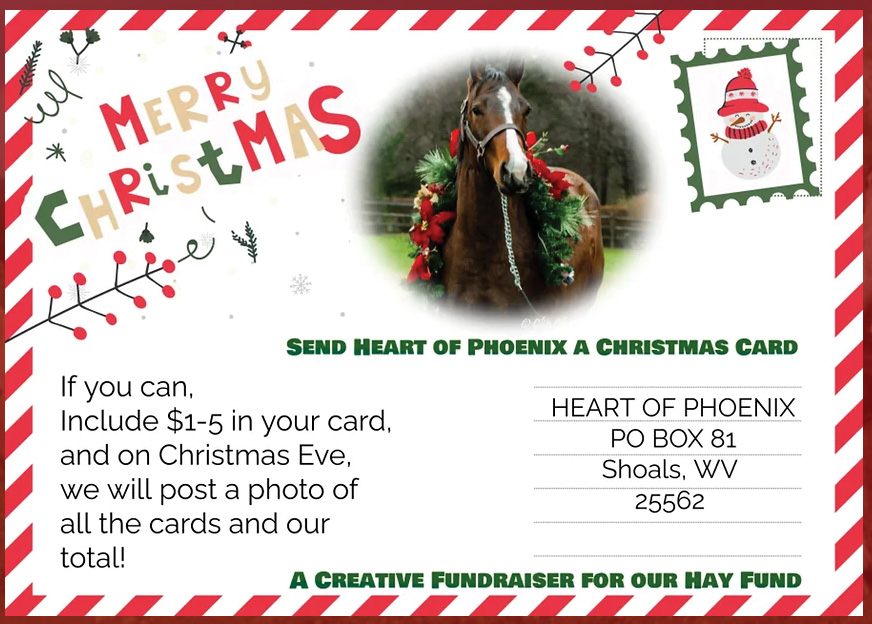
In December 2023, the Heart of Phoenix Equine Rescue of West Virginia came up with a creative plan to appeal to existing donors and attract new ones without breaking the contributor bank.

The campaign asked donors to send the organization a Christmas card containing between $1 and $5. In response, photos of all the cards and the collective amount of the donations they contained were to be posted on the organization’s website.

A Christmas card from equine nonprofit Heart of Phoenix.
Heart of Phoenix launched a Christmas card campaign as a creative way to fundraise for their hay fund.

As of press time, the rescue had received dozens of cards in the days leading up to Christmas, with more pouring in.

“They have been coming in every day, and they all contained between $1 and $5,” says Suzanna Johnson, Heart of Phoenix education officer. “This was a way to appeal to people who don’t have a lot of money, but everybody likes to send Christmas cards.”

Covid and Inflation

According to the website of the RKD Group, Dallas-based consultants who use data-driven strategies to help animal welfare nonprofits find connections with donors, 2023 donation revenue is down over the past 12 to 18 months largely because givers have been hard hit by inflation.

Meanwhile, the organization predicts that continued inflation and rising interest rates will stifle efforts to attract new donors this spring.

That’s not news to Grace Purdom, president of the California-based Hope 4 Horses.

“We have been in the horse business a long time, both the nonprofit and for-profit parts,” says Purdom, whose husband Scott is a trainer and clinician. “We’ve traveled all over the country and seen horse rescue after horse rescue close—not just in the east, but in the west, too.”

Adoptable off-track Thoroughbred Moon from equine nonprofit Hope 4 Horses at his first show with Grace Purdum and a youth rider. He now teaches lessons and volunteer orientations.
Hope 4 Horses adoptable off-track Thoroughbred Moon at his first show with Grace Purdum and a youth rider. He now teaches lessons and volunteer orientations. Photo courtesy Hope 4 Horses

According to Purdom, some of those organizations folded after Covid-connected business grants dried up.

“Some never came back,” she says.

More recently, as financial support has deteriorated, the cost of keeping horses has escalated.

“The same night we had a board meeting and were told that private funding was down between $30,000 and $40,000, we had just gotten a $25,000 hay bill,” Purdom recalls.

She adds that farrier and veterinarian fees have gone up this year as well.

The rise in operational costs all threaten horses’ chances of getting the rehabilitation and aftercare they need.

“We see horses in need from owner surrenders, and there still is indiscriminate breeding out there,” Purdom says. “There were 140 horses from one animal control [agency] out there—where do you put 140 horses?”

Failure Is Not An Option

As a result, rescues have been forced to re-evaluate their own criteria for helping horses in need.

“It has made us focus more on ‘desperate need’ cases, where in years before we could help before things [got] bad,” explains Heart of Phoenix Founder and Executive director Tinia Creamer. “As it is now, if a horse isn’t in dire shape, donors do not step forward, so we have had to get more creative.”

A volunteer working with a horse at an equine nonprofit.
By helping the horses in greatest need, rescues are focusing precious resources where they can make the most difference. Photo by Cavan for Adobe/Adobe Stock

Altogether, the circumstances have created a perfect storm for equine welfare organizations who have adopted whatever tactic they could to meet the challenges.

Most are taking to social media to share the journeys of individual horses as they transition from rescue through rehabilitation to readiness for adoption. They are also engaging the local and online communities to assume a stake in the organization’s success, and they’re cultivating a pool of volunteers to do everything from handling horses to office work.

Volunteers working with a horse at an equine nonprofit.
Inquire about volunteer opportunities at local nonprofits, even if you can’t adopt. Photo by JackF/Adobe Stock

Whether the current economic circumstances challenging equine welfare nonprofits will subside any time soon is anybody’s guess. But even if the economic picture changes, Creamer says equine welfare organizations will always be challenged to make the most of existing or potential resources at their disposal because failure is not an option.

“I don’t see the economy improving in the short term, and a rescue has to adapt to the world we have,” says Creamer. “Having said that, we’ve made changes and continue to make them to try to be here next year and the year after. Horses depend on us here, and we owe it to them to be here.”

Successes in the Face of Challenges

We reached out to the ASPCA Right Horse program to ask how their equine adoption partner network has fared despite recent economic conditions, and asked for some suggested action items you can do to help.

Multiple factors are converging simultaneously, impacting shelter and rescues’ ability to provide care. Despite challenges, partner organizations of the ASPCA Right Horse program saw more than a 5 percent increase in adoptions in 2023 compared to 2022.

Data from ASPCA’s adoption site shows there is a demand for adoptable horses, including older horses, as evidenced by more than 2 million page views for adoptable horses in 2023 and over 4,000 adoption inquiries.

Additionally, the ASPCA, alongside a rising number of other animal welfare organizations, are focused on services, including subsidized veterinary care and resources, to help keep equines safely in their homes and out of shelters and rescues.

The ASPCA encourages anyone interested to support their local animal welfare organizations by adopting, volunteering their time, donating supplies, or becoming foster caregivers. To find an organization in your area to support, visit myrighthorse.org.

Equine Nonprofits That Help People

For equine assisted services (EAS) nonprofits, humans depend on the horses, too.

The Connected Horse launched in 2015 as pilot projects at Stanford University and the University of California at Davis. It pairs senior horses, some rescued or surrendered, with people living with Alzheimer’s disease and other dementias and their caregivers to help them manage stress and navigate the flood of physical and emotional ramifications connected with the conditions.

A senior woman interacting with a bay gelding.
In spite of the economy, important work like that of Connected Horse goes on. At CH, horses are paired with people living with Alzheimer’s disease as they brush, walk, and visit with them under the watchful eyes of program personnel. Photo courtesy Connected Horse

Through the program, human participants connect with the horses as they brush, walk, and visit with them under the watchful eyes of program personnel.

“The horse is really the teacher,” says Paula Hertel, Connected Horse co-founder.

More than 60 pairs of patients and caregivers connected with equines during the first three years of the university pilot programs. Another 186 people took part in Connect Horse programs at private partner barns, including those that rescue, receive surrenders and place adoptable horses.

According to co-founder Nancy Schier Anzelmo, Connected Horse programs are supported by grants, donations from program participants and their families, and private supporters. And while she admits that the recent economy has affected the fundraising outlook for almost all nonprofits, the mission of equine-focused organizations is critical for the horses and for the humans involved.

“Horses, especially older horses, need purpose just as people do,” she says. “Our country needs to support programs to serve [people] in need right now as well as older horses, or horses who cannot be used for sport anymore. It’s very personal, and making connections in nature and with others is a key to building a community that serves each other.”

Make the Most of Your Donation to Equine Nonprofits

This year a simple trip to the supermarket was an economic shock for many across the country. At the same time, the nonprofit organizations that help horses are experiencing the same trauma every time they order hay, purchase grain, or call for the services of farriers and veterinarians.

But many of those who are challenged by the economy themselves still want to support horses in need however they can.

Grace Purdom, executive director of Hope 4 Horses, shares her best advice for doing that.

“First, we always recommend that people donate locally,” she says. “Visit a local rescue organization and learn about what that organization does and how it does it.”

For that, Purdom recommends that prospective donors sit in on an orientation session that many organizations host for new volunteers, new donors, and members of the public.

“Operators use orientation sessions to talk about the organization’s mission, its facility, how many horses they have, who they have on staff, and how many volunteers it has,” she says.

Then take a tour of the facility. Horses onsite at effective rescues should appear to be in various stages of rehabilitation and look happy and healthy under the staff’s care.

During the tour, ask the staff guide lots of questions, especially if a horse appears to be thin.

“The staff could say that the horse just arrived 30 days ago and is in rehab,” says Purdom. “The point is to ask open questions and expect honest answers; a legitimate rescue is an open book.”

Finally, do a bit more research before making that donation. First, make sure that the organization is a legitimate 501(c)(3) under federal tax rules. That designation recognizes the organization as a nonprofit, which means it is exempt from federal income tax. As a result, contributions to 501(c)(3) organizations are tax-deductible for donors.

Finally, just before writing that donation check, visit charity evaluation websites, such as GuideStar, which allows nonprofits to share information such as address, mission, key leadership, employee identification numbers, tax status and Return of Organization Exempt From Income Tax (IRS form 990) forms for three fiscal years.

“No matter how large or small they are, donations are very important to all of us,” says Purdom.

Further Reading: Dealing with Inflation as an Equestrian

This article about the state of equine traffics appeared in the March 2024 issue of Horse Illustrated magazine. Click here to subscribe!
ASPCA Right Horse Adoptable Horse of the Week: Nyssa

0

Welcome to Horse Illustrated’s weekly installment of the Right Horse Adoptable Horse of the Week, offered in partnership with the ASPCA’s Right Horse program. This week’s adoptable horse is Nyssa! Check back weekly for a new featured horse so you can find your Right Horse.

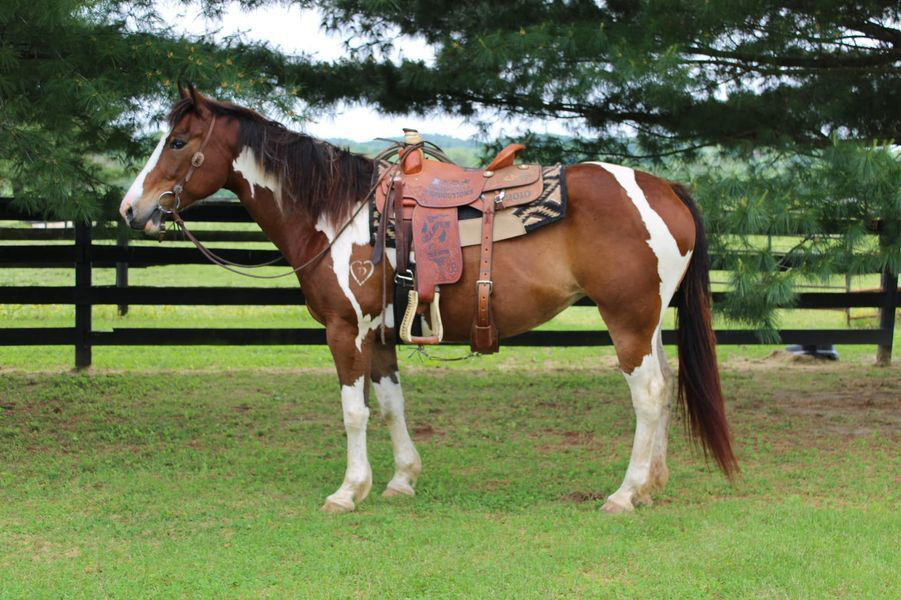
A bay Paint mare in western tack.
Photo courtesy Heart of Phoenix Equine Rescue

Adoptable Horse: Nyssa, a 12-year-old, 15.0hh American Paint Horse mare
Organization: Heart of Phoenix Equine Rescue, Shoals, W.Va. (now in training at MB Equine in Indiana)

Get to Know Adoptable Horse Nyssa

Nyssa is a stock-type Paint mare who requires an upper level rider and will need someone with a good trainer as a resource for lessons and potentially additional training.

Nyssa has pushed and sorted cattle at the stockyards, gone on a weekend overnight camping trip, packed saddle bags, ridden double, ponied other horses, worked on obstacles, and successfully ridden in a back cinch. Nyssa will walk, trot, lope, stop, and back. She has the prettiest little jog and all of her gaits are smooth as can be. She has potential to be a playday horse or even a western pleasure horse.

She is great in the field with mares and geldings, and low in the pecking order. She is easy to catch and also content being in a stall. Nyssa stands for bathing, grooming, saddling, mounting, and dismounting. She loads and unloads in the trailer with ease. She hauls well with zero problems. She has all the brains, size, and looks you can ask for!

Nyssa headed to training in February and will be adoptable soon from MB Equine in Indiana.

If you are interested in adopting ASPCA Right Horse Adoptable Horse of the Week Nyssa, apply here.

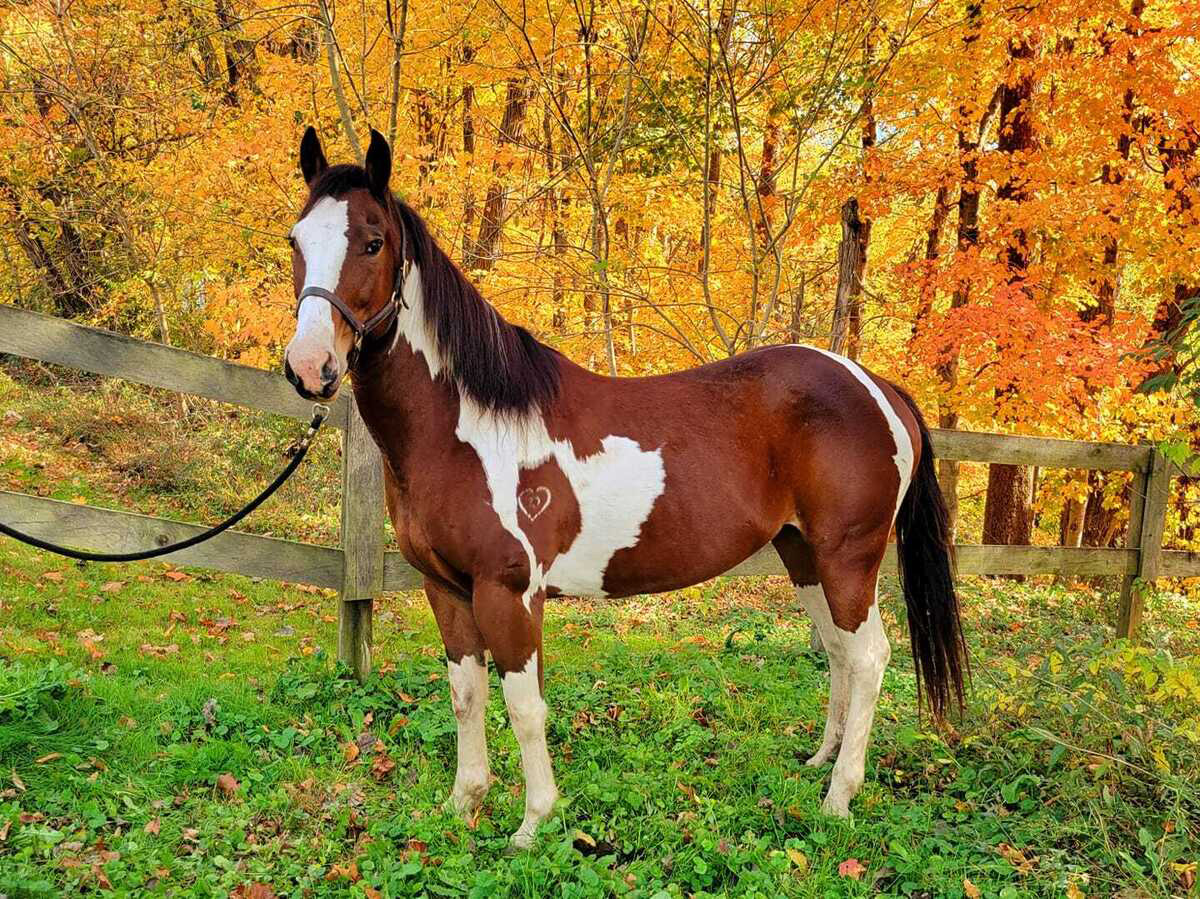
Adoptable horse Nyssa.
Photo courtesy Heart of Phoenix Equine Rescue

ASPCA Right Horse

My Right HorseASPCA Right Horse is the online adoption platform of The Right Horse Initiative, a collection of equine industry and welfare professionals and advocates working together to improve the lives of horses in transition. A program of the ASPCA, their goal is to massively increase horse adoption in the United States. To find more adoptable horses and foster horses, visit www.myrighthorse.org. To learn more about The Right Horse, a program of the ASPCA, visit www.aspcarighthorse.org.

How a Horse Girl Stayed Horsey Despite Not Riding for Years

0

After growing up horsey, Nancy still held on to her identity as a “horse girl” even when she hadn’t ridden in years.

I could feel her staring at my boots, caked with mud from some last-minute yardwork before my flight. Now at the airport gate, I looked up and caught her eye. She was well-dressed, probably in her 70s, waiting, like me, for our turn to board the plane.

“Do you ride?” she asked.

She wasn’t judging me. She recognized a fellow horse girl. Though it had been decades since I last seriously rode, my fashion preference for paddock boots gave me away.

“Oh,” I said. “Not for years. I gave it up when I went to college, and then, well, life took over.”

Two grown women, sharing a common bond in an unlikely place.

Growing up as a Horse Girl

Rooted in our childhood and adolescence, this connection between horsewomen is weighted with the understanding of what it means to work tirelessly and care for something unconditionally. It empowered us, built our confidence, and continues to define us.

And yet, in adulthood, many of us rarely speak of it. “Horse girls” are openly mocked as oddballs in American culture. Society forgives us our childhood obsessions but expects us to put away our youthful passions and grow up.

As an adolescent, horses and ponies offered an escape from my complicated relationship with my mother. When things got tense in the house, I sought refuge in the barn, grooming our family horse, Pridey, and tacking him up to hit the trails.

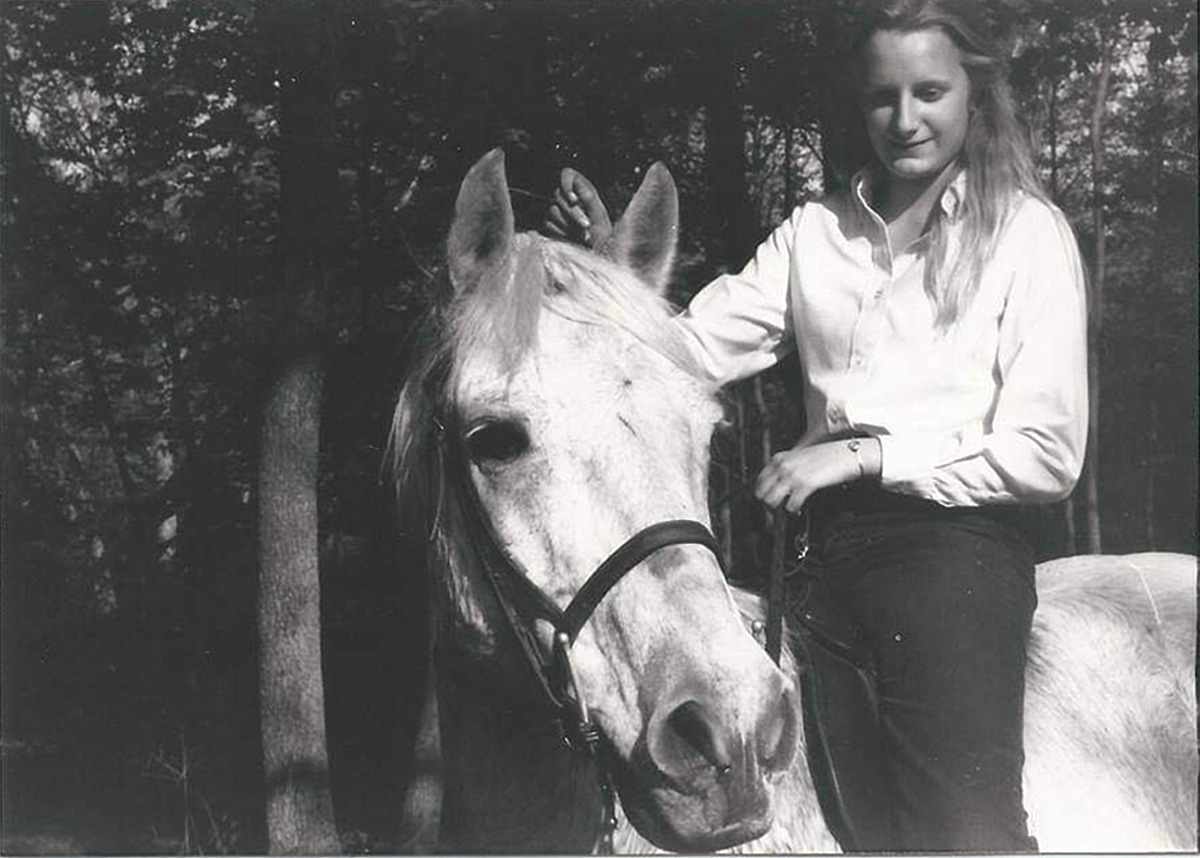
A black and white photo of Nancy during her "horse girl" phase with Pridey.
While growing up, Nancy’s family horse, Pridey, was her best friend, her protector, and her guide.

Steady and fearless, Pridey taught my two older sisters to ride before me. The three of us were raised around horses, a lifestyle rooted in our mother’s obsession. We rose early every morning to feed and turn them out before school. On weekends, we worked with trainers and rode competitively.

By the time I hit my teens, I was done with the pressure, both from competition and in particular, my mother. But I was not done with horses.

On the trails, I often dropped my reins and let Pridey lead the way, taking me far from my teenage troubles into our own special world. Pridey was my best friend, my protector, and my guide.

Pure Determination

It was on one of my trail rides that I met Kendra Hansis. Turning a corner, Pridey’s ears pricked up and there they were: Kendra and her pony, Butterball. We were both trespassing on land owned by a local farmer, and I immediately understood that it was Kendra who had been pulling tree branches over the dirt-bike paths to make jumps.

Unlike me, a horse girl by circumstance, Kendra got there through sheer will and determination. She read every book about horses and riding that she got her hands on. Her parents discouraged her, saying they could not afford a horse, and definitely didn’t have the money for vet bills, farriers, trainers, grain, and boarding costs.

As riders, we were taught back then that if you fall off, you must get back on. Kendra applied that lesson in every aspect of her life.

A friend of her aunt’s let Kendra groom her backyard pony whenever she wanted. That turned into a daily habit, and the woman eventually gifted the pony, Butterball, to her. That woman’s friend later offered Kendra another horse, Katy, knowing the mare would receive far better care under Kendra’s supervision.

In time, Kendra essentially became part of my family, joining me in my weekend chores, mucking stalls, filling water buckets, and lugging hay bales. Together, we hit the trails, where Kendra took chances and pushed the limits, racing over makeshift jumps and dodging branches and trees along the way.

Girl to Woman

“When you’re riding, you’re literally above everyone,” Kendra shared with me recently. “I remember hearing women say they lived in fear of men attacking them when they were out. I grew up on a horse. No one could catch me.”

The sense of independence that’s so empowering to horse girls can be a threat to others. A quick search on TikTok found a meme about a girl with “horse girl vibes,” which the voiceover describes as “quirky, like bizarre, like unhinged.”

That stigma starts to stick as girls become young women, when society expects us to trade in our obsession for horses for a more traditional path.

I was no different. I was 18 when I last saw Pridey. It was time to “get serious” and go away to school. Time to think about my career. Fall in love. Have babies. Pridey was sold so he could teach another little girl to ride.

Kendra took a different path. She entered the University of Connecticut in pre-vet, but she switched her major to English after one semester.

She fell off.

She ended up working in the school’s horse barns, rising at 5 a.m. to clean stalls before class. In time, the barn manager sent her to work at the breeding barn, where she said she “kind of got the bug.”

She got back on.

Despite meeting skeptics along the way, she studied horse breeding and bloodlines, learning the science of selecting the right stallions for the right mares. In 2001, she started Runningwater Warmbloods, her breeding operation, with a goal “to make better horses.”

Twenty years later, the only horse she could afford to breed in 2015, Fortunato H2O, was named grand champion at the prestigious Dressage at Devon Breed Show.

“When they called champion, I’m bawling,” Kendra said. “Me, a middle-aged lady doing her best with the one horse she bred in 2015. You hope you have a day like that in your life.”

Horses Are Still a Part of Me

Though I left that life behind, it’s still a part of me—the part that’s OK with a little dirt on my boots; the part that, in other aspects of my life, keeps getting up, even after I fall.

Like Kendra, the woman in the airport didn’t give up her horse girl days. She told me she made sure her kids rode, and then her grandchildren.

“Nothing is more important than learning how to be responsible for something, for having something that relies on you every day,” she said before we boarded our plane.

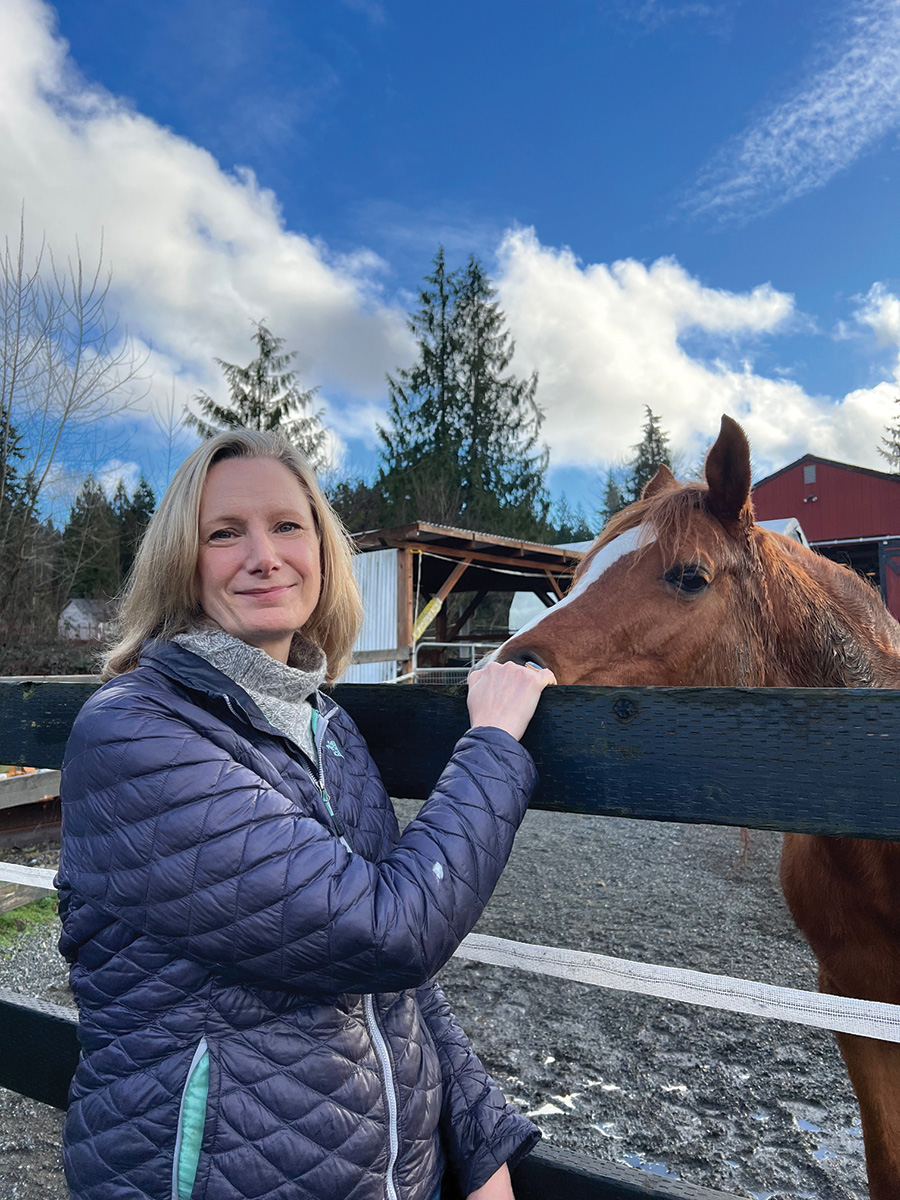
Nancy at the barn where her daughter rides.
These days, Nancy is back at the barn with her daughter, who is learning to ride.

Today, my daughter is learning how to ride. Back in the barn, I listen to her trainer from the sidelines, watching the different personalities of the school horses, admiring their grace and power as they patiently support my daughter.

Just like Pridey did for me.

This article about Nancy’s “horse girl” journey appeared in the April 2024 issue of Horse Illustrated magazine. Click here to subscribe!
Barn Banter – Episode 29

0

Barn Banter Episode 29 banner

Welcome to Barn Banter, the official podcast of Horse Illustrated. In Barn Banter episode 29, hosts Susan Friedland and Horse Illustrated Editor In Chief Holly Caccamise chat with horse trainer and TV personality Julie Goodnight. Plus, tune in as they talk with sponsored guest Stoney Stamper, National Sales Director for Hart Trailer.

To end the episode, Susan and Holly chat with the Humane Society of Ventura County about Ariana, this month’s ASPCA Right Horse adoptable horse.

Click listen to mobile.

Barn Banter Episode 29 Sponsor

For over 30 years, Adequan® i.m. (polysulfated glycosaminoglycan) has been trusted by veterinarians, trainers and horse owners. Ask your veterinarian if Adequan® is right for your horse. Visit Adequan.com to learn more. Adequan®. Start with it. Stay with it®.

Learn more about Adequan® here.

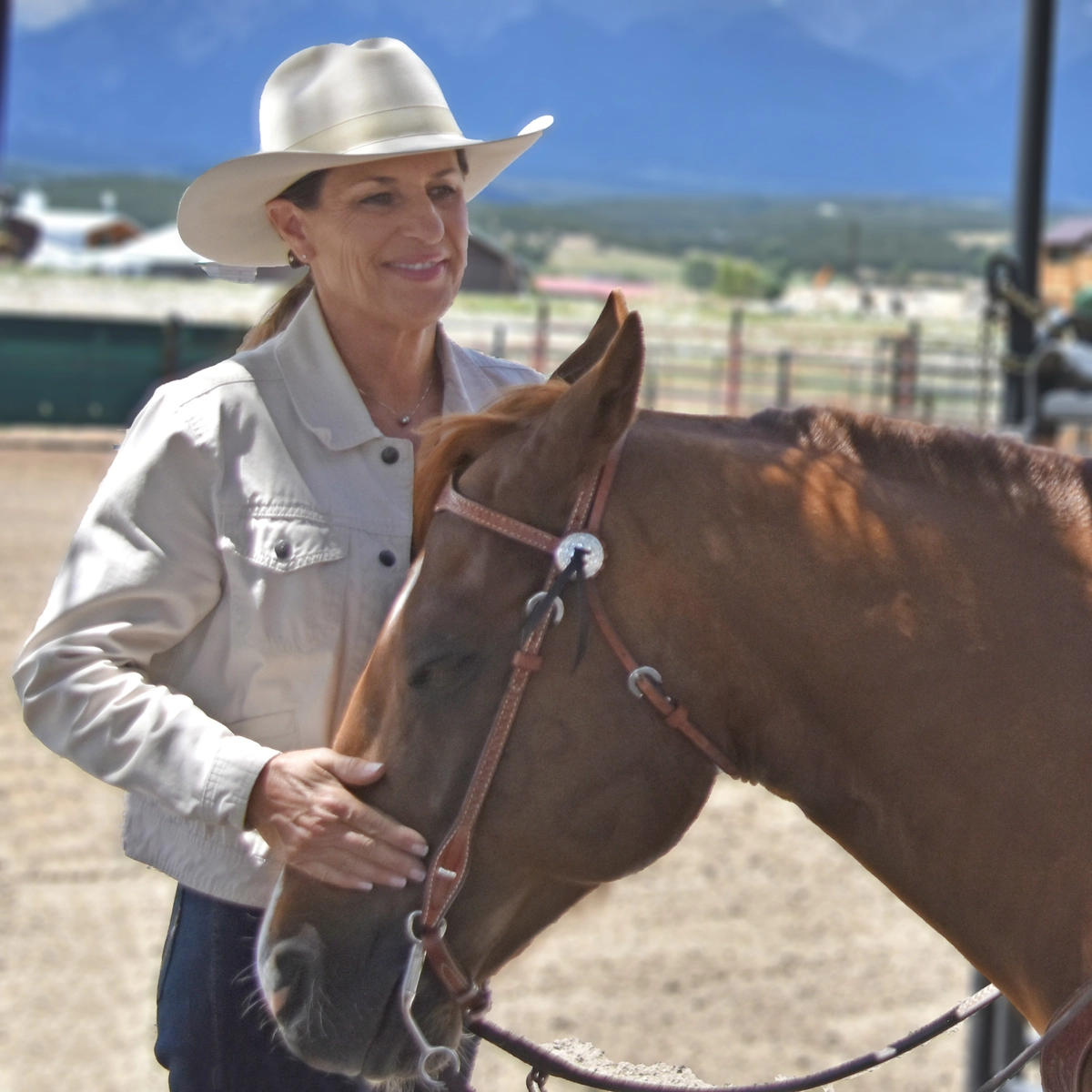
Julie Goodnight, Horse Trainer and TV Personality

Barn Banter episode 29 guest Julie Goodnight.
Barn Banter episode 29 guest Julie Goodnight. Photo by Megan Fischer

Julie Goodnight established a connection with horses at a young age, and after a successful run as a youth rider on jumping horses, she galloped her way through college riding racehorses. For nearly four decades, she’s been at home in the Colorado Rockies, pursuing wilderness sports and riding cow horses. Founding her training business in 1985, Julie’s reputation as a horse trainer grew far and wide. In 2008, she began producing Horse Master with Julie Goodnight, a popular how-to horse training series that aired weekly for more than a decade, with 260 episodes. She now travels the world to produce compelling horse TV, and educates horse owners everywhere through her online training programs at JulieGoodnight.com/Academy.

Sponsored Guest: Stoney Stamper, National Sales Director for Hart Trailer

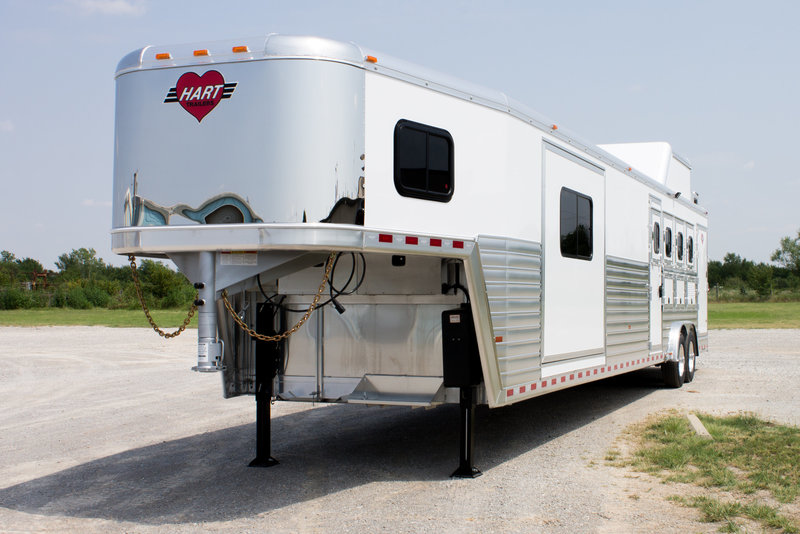
A Hart horse trailer.
Photo courtesy Hart Trailer

Established in 1968, Hart Trailer LLC remains privately owned and operated by the Hart family. Over the years, Hart has maintained a reputation for manufacturing quality trailers while becoming friends with our customers. Safety, reliability, convenience, eye appeal and excellence are engineered into every feature of a Hart Trailer.

Adoptable Horse of the Month, Ariana

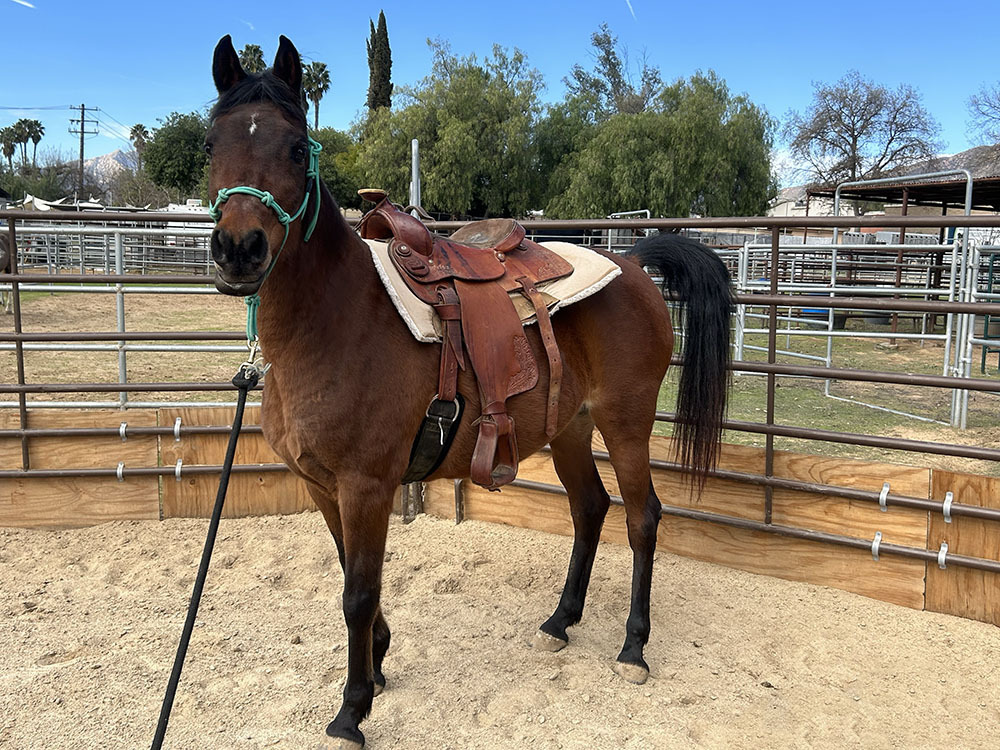
Ariana, the featured adoptable horse in Barn Banter episode 29.
Photo courtesy Humane Society of Ventura County

Ariana is a gorgeous 16-year-old Arabian mare who was surrendered to the Humane Society of Venture County in late December of 2023 after her previous owner could no longer care for her. The HSVC staff adores her sweet face and even sweeter personality. She’s a very special girl due to her lack of teeth, but that doesn’t stop her from doing the things she loves.

Though she is not trained to ride, Ariana has great ground manners and aims to please her handler. Ariana has had a saddle on before, but she is not broke to ride. However, this pretty girl knows how to longe in the round pen and gets along with most other horses. HSVC thinks she would make a great pasture buddy and could also do well as a therapy horse, where she would bring joy to everyone.

Learn more about Ariana here.

In addition to Barn Banter episode 29, you can check out all previous episodes of Horse Illustrated’s podcasts here.

0FansLike
0SubscribersSubscribe
We use cookies to help personalize content, tailor and measure ads, and provide a safer experience. By navigating the site, you agree to the use of cookies to collect information. Read our Cookie Policy.
OK