Insurance. It’s a fact of life for most adults. We insure our vehicles, homes, businesses—even our smartphones. We buy life and health insurance. Horses can also be insured. Equine insurance coverage policies are available for almost any horse or pony, whether grade or registered.
Unfortunately, much of what happens in life is out of our control. Insurance can’t prevent bad things from happening, but it offers a financial buffer when they do.
Here, we’ll review the most common equine policies, what they entail, and different circumstances to consider.
Most Common Equine Insurance Policies
Restricted Perils
Also called Specified or Named Perils, Restriced Perils is the least expensive option and covers only what is listed in the policy, such as death by wind, fire and/or smoke, lightning, collision, or overturn in vehicular transit. Depending on the company, it may include theft.
Full Mortality
A full mortality insurance policy covers death due to any cause, except for willful neglect or destruction. It covers the insured horse in the event that he dies or must be humanely destroyed due to illness, accident, injury, disease, fire, smoke, lightning or theft.
Think of Restricted Perils and Full Mortality policies as “life insurance.”
Major Medical
Major Medical protects the horse owner against covered medical, veterinary, and surgical costs up to a specified amount per policy year.
Major Medical typically covers issues like lameness, gastric ulcers, eye injuries, clinic costs, MRIs, et cetera, plus surgical costs, such as colic surgery. Photo by Shelley Paulson
Surgical
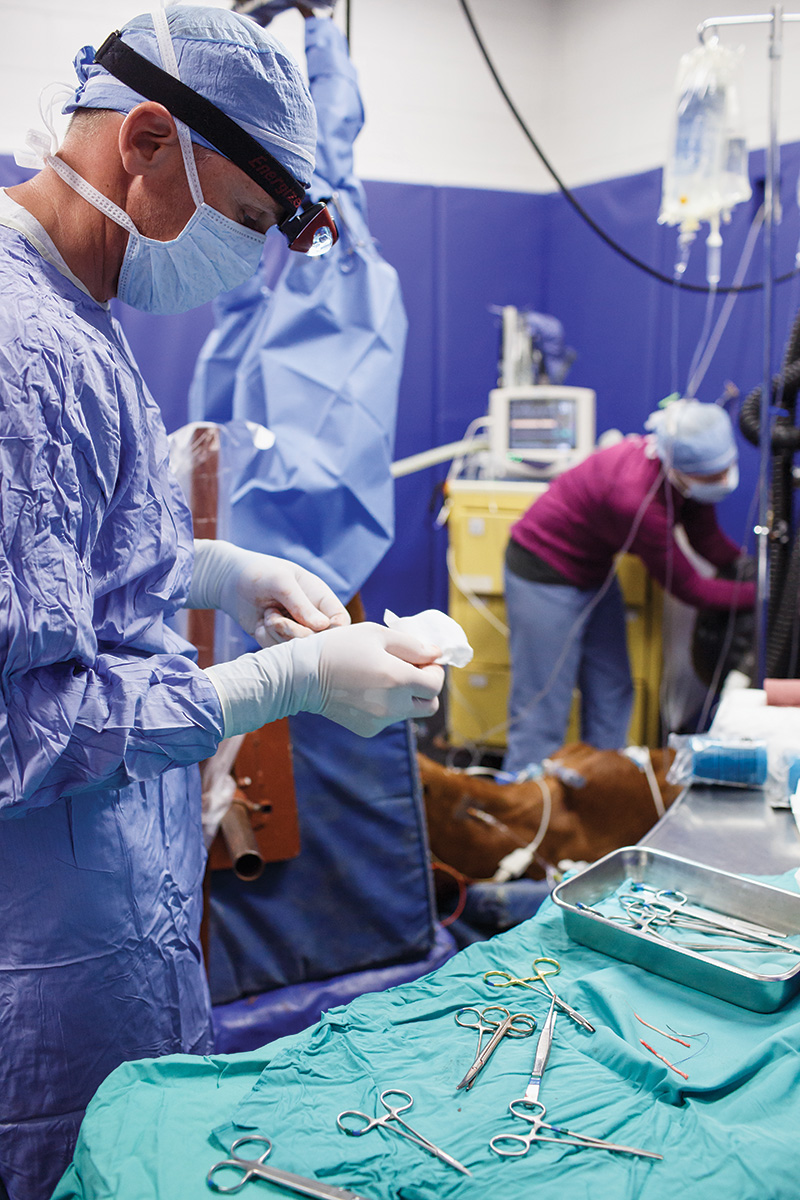
This policy reimburses for covered surgical expenses up to a specified amount per policy year. Surgical coverage applies to necessary procedures performed under general anesthesia, not elective surgeries, like castration.
A surgical policy covers necessary procedures performed under general anesthesia. Photo by Shelley Paulson
Colic
This equine insurance policy reimburses for a medical or surgical colic.
Major Medical, Surgical and Colic endorsements aren’t available on their own, but can be added to a Full Mortalitypolicy. Think of these policies as “health insurance.”
Equine Insurance Policy Details
“Full Mortality is the base policy, and then you can add to it,” says Rhonda Mack, an agent in the Ocala, Fla., office of EPIC Insurance, a nationwide company.
“Most insurance companies include a colic surgery endorsement with Full Mortality, but you can add additional coverage on top of that,” says Mack, noting that some companies allow “stacking” of endorsements.
A colic endorsement has a $10,000 limit and will reimburse the owner for medical or surgical colic expenses for an insured horse.
Major Medicaltypically covers issues like lameness, gastric ulcers, eye injuries, clinic costs, MRIs, et cetera, plus surgical costs, such as colic surgery. Some insurance companies include acupuncture and chiropractic in their Major Medical policy, but coverage varies with each company, so read your policy carefully.
The decision to purchase equine insurance is both financial and emotional.
“It’s based on your comfort level and what you worry about happening to your horse,” says Mack. “If your horse is facing a $12,000 colic surgery and you have to make a decision based on if you can afford it or not, insurance can give you peace of mind, knowing you have help with veterinary expenses.”
Horse Value
The premium for Full Mortality coverage is determined by the price you paid for the horse and his use (pleasure, show, racing, or breeding). If you bred the horse, your insurance agent can help determine a value based on stud fee, bloodlines, sales averages, et cetera.
“Most carriers now require a minimum Full Mortality insurance amount of $15,000 to be eligible for Major Medical,” says Mack.
The following examples are based on December 2023 policy prices.
An 8-year-old dressage horse insured for $25,000 under Full Mortality with a $10,000 major medical policy would have an annual premium of approximately $1,375.
A 10-year-old Quarter Horse trail horse insured for $5,500 with a $10,000 surgical endorsement and $5,000 free colic surgery would have an annual premium of approximately $350.
Reimbursement
Major Medical already includes surgical expenses up to a specified amount. For a relatively low price (usually under $200), owners can add a $10,000 surgical endorsement to their Full Mortality coverage.
Endorsements function by reimbursement, rather than paying the veterinarian directly. The horse owner pays the veterinarian and then turns in the invoices and veterinary report to be reimbursed for the covered expenses, less any deductible and copay.
For example, if the insured horse required a $9,000 colic surgery, after the deductible and co-pay are applied, the owner would be reimbursed about $8,000.
Horse Age
Age comes into play when insuring horses.
“After age 15, premiums get higher,” says Mack. “Most companies will insure to age 18, some to age 20. We consider all horses’ birthdays to be January 1, even if they’re born in June.”
Even though full mortality and surgical coverage aren’t usually available after age 20, Restricted Perils coverage is still offered.
Individual Horse Owner’s (IHO) Liability Coverage
Individual Horse Owner’s (IHO) liability coverage has nothing to do with the health of the horse. This policy protects the owner in the event their horse causes damage to a person or property.
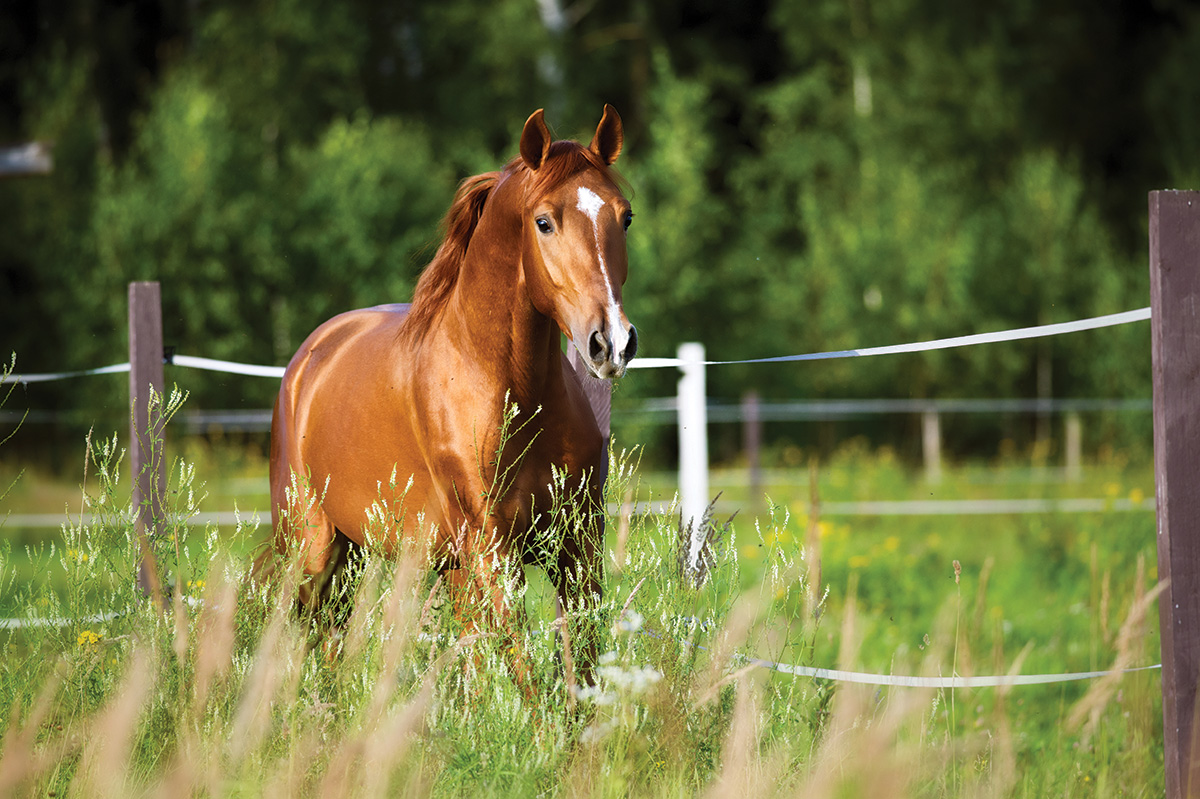
Individual Horse Owner’s liability covers accidents resulting from your horse injuring someone, for example if he gets loose on a road. Photo by Victoria Makarova/Adobe Stock
“Equine liability is recommended,” says Mack. “Any time you own a horse, you have risk exposure.”
Coverage provides liability protection in many situations, such as if your horse gets loose at a show and injures someone.
You don’t need to own property to purchase this coverage, and it’s for those who don’t derive income from their horses. With IHO liability, the premium is based on the number of horses owned.
Mack says that an IHO liability policy with $1 million coverage covering a few horses generally costs less than $400 a year.
Many people mistakenly assume their personal homeowner’s policy extends to cover damage or injury caused by horses.
Insurance for Equine Businesses
People who own breeding and training farms or boarding stables should have a commercial liability or farm package policy, which includes the residence on the property as well as equine owner’s liability coverage. Care, custody & control is another option if you board horses you don’t own.
Let’s say your horse breaks through the fence and ends up on the road, causing an auto accident. If there is damage to the car and/or an injury or death of the car’s occupant(s), a resulting claim would not be covered under most homeowner’s policies.
However, if found negligent, it would be covered under a commercial farm owner’s policy or IHO liability policy. (Equine liability policies also cover defense costs).
An Example
Pandora Driscoll, an emergency room nurse who lives in north central Florida, purchased a Full Mortality policy and added Major Medical and Surgical endorsements for her 15-year-old KWPN (Dutch Warmblood) gelding. When the horse was imported from Europe last year, she added a coverage territory extension for that period of time.
Her 12-year-old warmblood mare is enrolled in the complimentary colic coverage programs offered by both SmartPak and Platinum Performance (see below).
“I’m already using their supplements, so I might as well sign up for the coverage,” says Driscoll, who competes in FEI-level dressage.
She’s never had any claims on a horse, but she’s relieved to have insurance.
“Colic or a major medical issue are my biggest concerns, which is why I have coverage,” says Driscoll. “It’s peace of mind to have that protection and extra comfort that they’re insured.”
Complimentary Colic Programs
Platinum Performance and SmartPak both offer complimentary programs providing colic surgery reimbursement for eligible horses enrolled in their program and using their qualifying supplements.
◆ Platinum Performance’s FAQ section
◆ SmartPak’s FAQ section
Key Takeaway
If you decide to consider insurance coverage, don’t be afraid to talk to more than one provider, get multiple quotes, and ask plenty of questions.
In the end, your peace of mind is worth every penny.
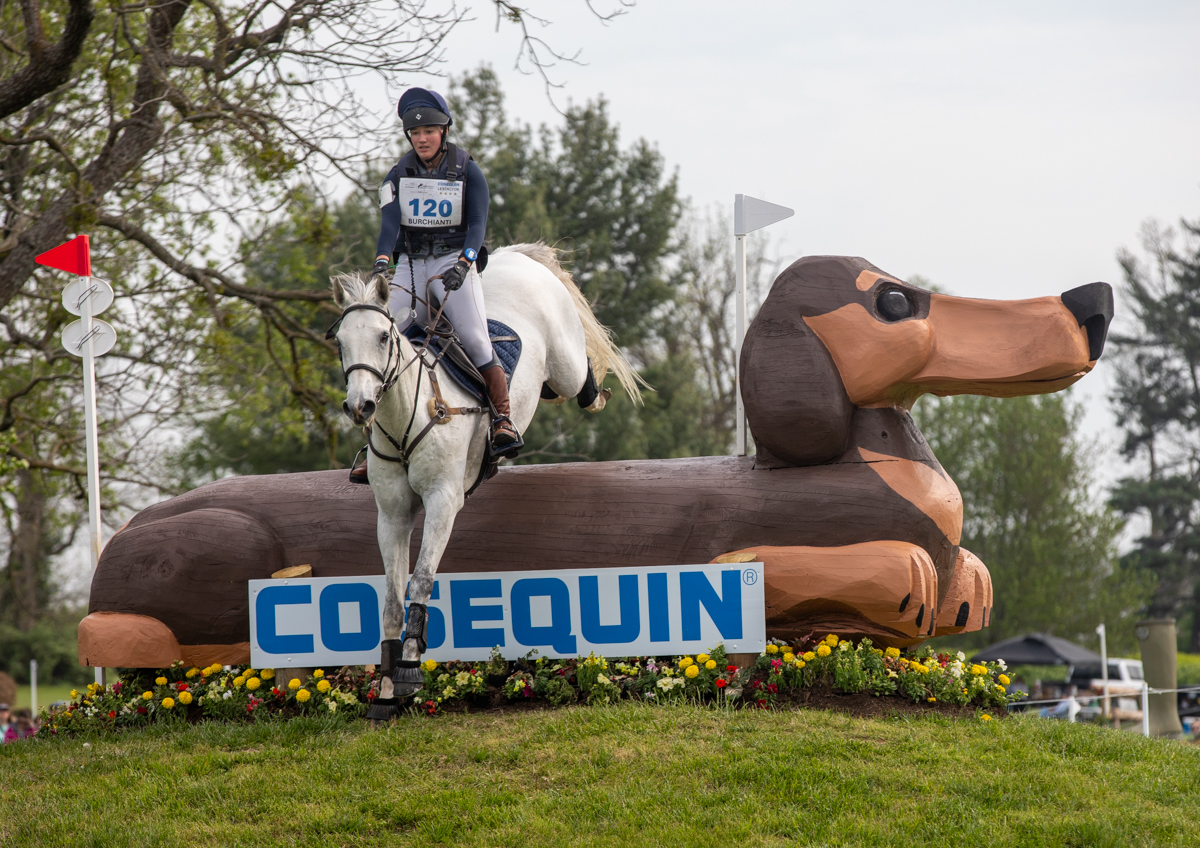
Lexington, Ky. — This year’s Cosequin® Lexington 4*-S will serve as a US Equestrian Open Eventing Series Qualifier when the Defender Kentucky Three-Day Event presented by MARS Equestrian™ returns to the Kentucky Horse Park, April 24-27. Equestrian Events, Inc. (EEI), producer of the world-renowned event, is thrilled to welcome back Cosequin® as the Title Sponsor of the Four Star competition.
Introduced in 2021, the Cosequin® Lexington 4*-S runs concurrently with the Defender Kentucky Three-Day Event presented by MARS Equestrian (K3DE), one of only seven annual Five Star three-day events in the world. Known as “The Best Weekend All Year,” K3DE annually attracts nearly 90,000 spectators who also enjoy extensive shopping, a variety of hospitality experiences and a wide array of demonstrations. The event also features the Kentucky International CSI5* presented by Hagyard Equine Medical Institute.
This year, the Cosequin® Lexington 4*-S is a US Equestrian Open Eventing Series Qualifier. The inaugural US Equestrian Open Eventing Series consists of 20 qualifying events around the country leading into the Series Final, to be hosted as a CCI4*-L at the Morven Park International in Leesburg, VA, October 9-12. The Series will award $50,000 in prize money to the three highest-placed combinations following the conclusion of the qualifying period, as well as $200,000 in prize money at the Final in October. The Series was created to further invest in future eventing athletes and showcase the sport to a broader audience. Additional information is available here.
Photo by Mary Cage
“We are thrilled to welcome Cosequin® back as a cherished partner of our event and as Title Sponsor of the Cosequin® Lexington 4*,” said Molly Day, Executive Director of EEI. “Without the generous support of our sponsors, we would not be able to produce our incredible event. We are excited about being part of the new US Equestrian Open Eventing Series and look forward to another great year of world-class competition.”
“As the #1 veterinarian recommended joint health supplement brand, Cosequin® is committed to supporting the well-being of equine athletes. We are thrilled that the Cosequin® Lexington 4* will serve as a qualifier for the US Equestrian Open Eventing Series, further strengthening the future of eventing in the United States,” said Dr. Ethan Sutherland of Cosequin®.
Tickets for viewing the Cosequin® Lexington 4*-S are included when purchasing K3DE tickets and can be purchased at kentuckythreedayevent.com/tickets.
Much like the cream center of an Oreo cookie, there is a sweet spot in the middle of Ocala winter equestrian schedule in Florida where lots of great things happen. In a span of 10 days in March, horse sports enthusiasts can witness top international jumper and combined driving competition along with national hunter classes, an open mixed-breed show, as well as a Pony Club Rally and polo matches. The Ocala equestrian bliss continues with local farm tours, trail riding and dining in horse-themed restaurants.
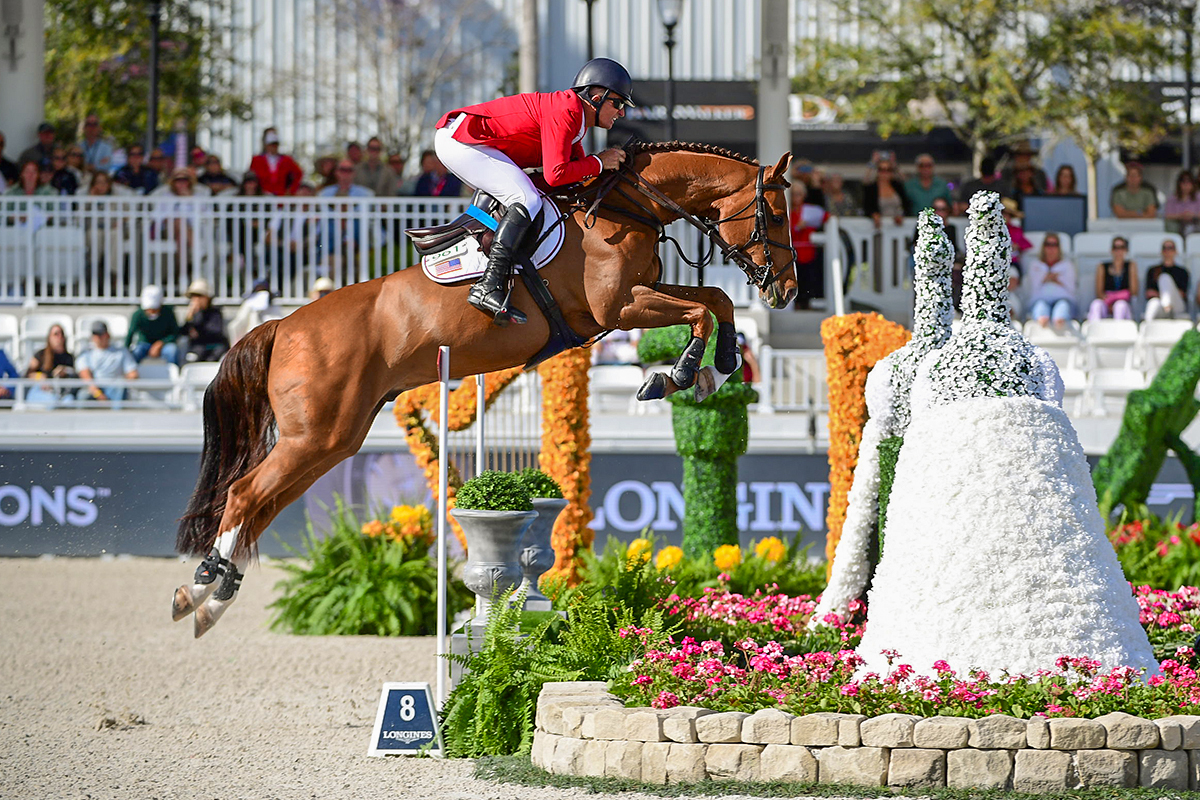
The bookends to this 10-day equestrian extravaganza are the Live Oak International Combined Driving and Show Jumping Tournament held at the beautiful 5,000-acre Weber family Thoroughbred breeding farm (this year March 13-16), and the FEI Longines League of Nations week of 5* international show jumping held at the impressively massive, bright-and-shiny World Equestrian Center (this year March 19-23). At both events, fans can see elite human and equine athletes from around the world under stately live oaks, waving palm trees and the glorious Florida sun.
Mark your calendars for these events in March 2026 and get ready to immerse yourself in the equestrian scene in the Horse Capital of the World®. (Yes, Ocala, and surrounding Marion County, Fla., have registered this title with the United States Patent and Trademark Office.) The county boasts more horses and ponies than any other in the USA with over 15,000 Thoroughbreds among them and over 600 Thoroughbred breeding farms. But, beyond that, Arabians, Quarter Horses, Gypsy Vanners, Clydesdales, European Warmbloods, and many other equine breeds call the county home, too.
2025 Live Oak International Report
It’s difficult to beat the ambience of the Weber family estate with huge, Spanish-moss-bedecked live oaks and grassy-green fields as far as the eye can see. Attendees of the Live Oak International Tournament have the rare opportunity to visit the private estate during the annual event. This year was the 34th renewal of the competition which features four days of international-level (2* and 3*) and national-level combined driving, plus three days of international-level (CSI4*) show jumping―the only event in North America showcasing the two sports together.
Hosted by the Weber family with champion driver Chester Weber and his niece and FEI show jumper Chloe Reid (daughter of Chester’s sister Juliette) as co-presidents of the tournament, there is much to do and see for sports fans and families alike. Find a great introductory video about the history of the Live Oak Tournament here.
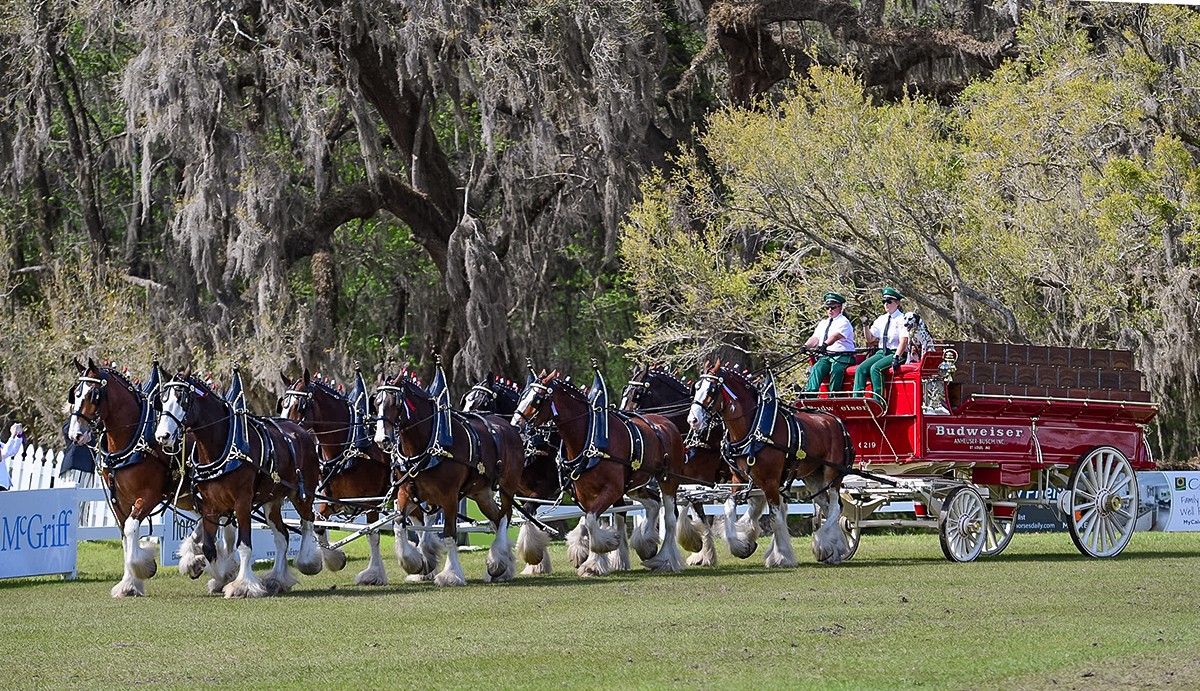
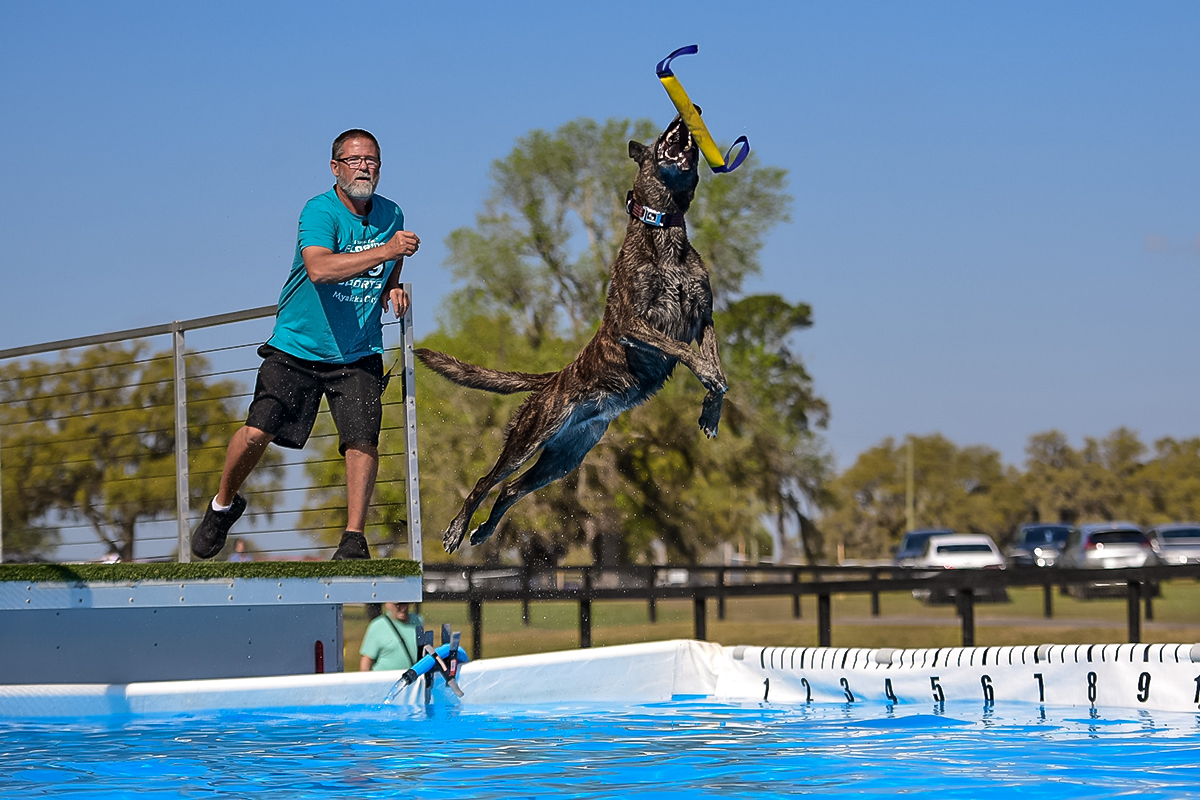
In addition to the driving and jumping competition, Live Oak featured an appearance by the Budweiser Clydesdale eight-horse hitch on Saturday afternoon, and daily performances by enthusiastic dock-diving dogs who launched into a specially-constructed pool chasing their favorite toys. The NetJets airplane simulator was also available for walkthroughs and the children’s play area with huge white sand pile and a bouncy house was a hit. A host of shopping tents, a food court featuring barbecue, wood-fired oven pizzas, Cuban food and more, and a beer garden, rounded out the fun. Event organizers reported record crowds of more than 15,000 over the four days.
1 of 3
One of the Budweiser Clydesdales eight-horse hitches made an appearance at Live Oak International on Saturday afternoon with the support of event sponsor Tri-Eagle Sales. Photo by Allen MacMillan
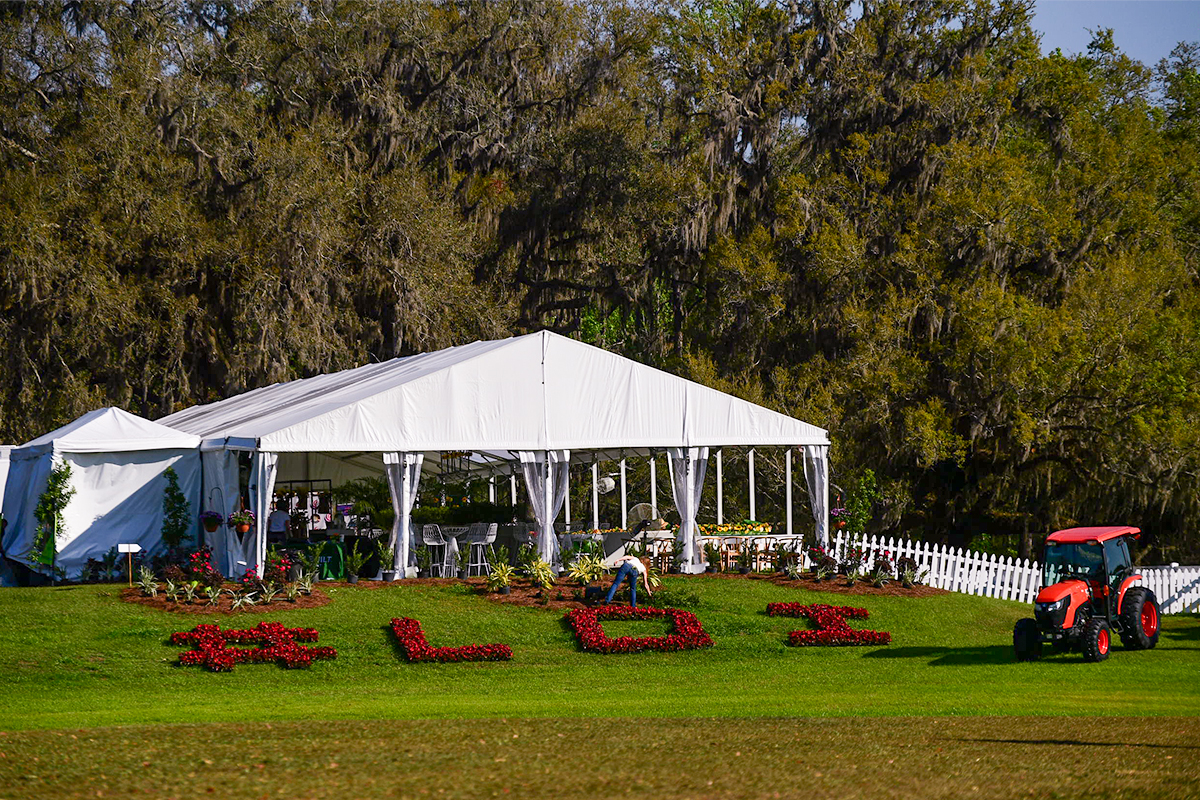
A view of VIP seating along the main arena at the 2025 Live Oak International. Photo by Kim MacMillan
Eager dock-diving dogs were part of the action each day at the 2025 Live Oak International. Photo by Kim MacMillan
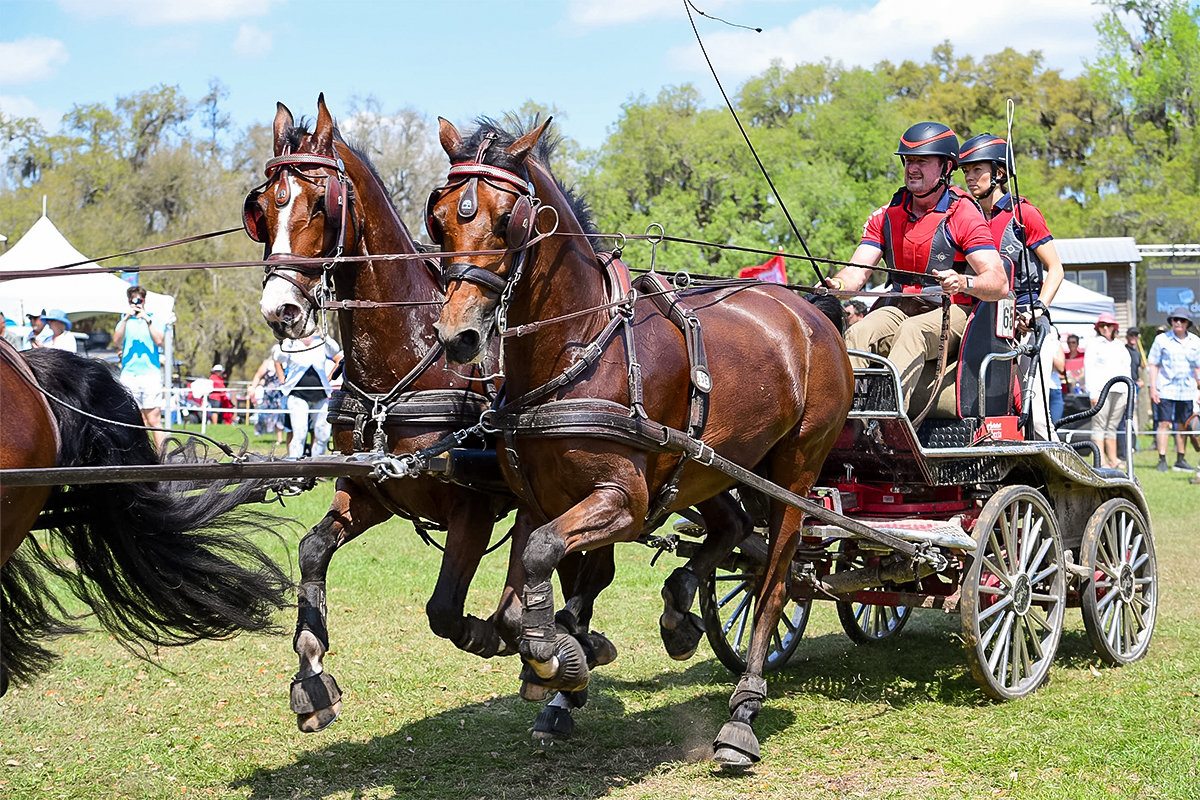
The Live Oak combined driving drew participants from five countries (Australia, Belgium, Canada, the Netherlands, and United States) and 18 U.S. states (California, Colorado, Florida, Georgia, Iowa, Kentucky, Maryland, Massachusetts, Michigan, New Jersey, New York, North Carolina, Pennsylvania, Rhode Island, South Carolina, Vermont, Virginia, and Wisconsin). Live Oak has become a circle-the-date event for many drivers, because it offers more atmosphere with the large crowds, a world-class venue much like those encountered in Europe, and both national and international divisions including additional classes for youth and para drivers. Many of the drivers in the international divisions were also striving to qualify for the World Championships later this year.
Two days of driven dressage tests on Thursday and Friday opened the Live Oak combined driving event, followed by the marathon phase on Saturday and then the cones class concluded the competition on Sunday.
Winners of the Live Oak international driving classes were: FEI2* Pony Single, Tina England, Odessa, Ontario, Canada; FEI2*Horse Single, Marcus Holzinger, Metamora, Mich.; FEI3* Pony Single, Janelle Marshall, Australia (now based in South Carolina); FEI3* Pony Team, Bram Chardon of the Netherlands driving American Mary Phelps’ four pinto ponies; FEI3* Horse Single, Raymond Helmuth, Cambridge, Iowa; FEI3* Horse Pair, Jacob Arnold, Paris, Ky., and FEI3* Horse Teams, Chester Weber driving his own four-in-hand, Ocala, Fla.
1 of 5
Live Oak International host Chester C. Weber won the 3* Horse Teams class on home turf. Photos by Allen MacMillan
Winner of the Live Oak 3* Pony Teams class was Bram Chardon of the Netherlands with American Mary Phelps’ team of pinto ponies. Photo by Allen MacMillan
Jacob Arnold, Paris, Ky., won the 3* Horse Pairs at Live Oak International. Photo by Allen MacMillan
Australian Janelle Marshall, now based in Windsor, S.C., topped the large Live Oak 3* Pony Single division. Photo by Allen MacMillan
Winner of the Live Oak 3* Horse Single class was Raymond Helmuth, Cambridge, Iowa. Photo by Allen MacMillan
The Live Oak international FEI5* show jumping classes ran Friday through Sunday with the CSI5* $190,000 Live Oak International Grand Prix, presented by Lugano Diamonds, capping the long weekend. Competitors from at least nine countries entered the jumping classes. The winner of the Lugano Grand Prix was Ireland’s Christian Coyle riding Extravaganza Semilly owned by Alexis Bodo. His brother Daniel Coyle rode Canadian owner Ariel Grange’s Farrel to second and the USA’s Will Simpson guided Imar, owned by Elizabeth Phillips, to third. The Live Oak jumping series Leading Rider Award went to Ireland’s Jordan Coyle, the Leading Lady Rider Award to Jenny Rankin (IRL), and the Leading Owner Award to Aaron Vale (USA).
1 of 3
Winner of the CSI4* $190,000 Live Oak Grand Prix presented by Lugano Diamonds, was Christian Coyle from Ireland on Extravaganza Semilly owned by Alexis Bodo. Photo by Allen MacMillan
Runner-up in the CSI4* $190,000 Live Oak Grand Prix presented by Lugano Diamonds, was Daniel Coyle of Ireland riding Farrel for Ariel Grange. Photo by Allen MacMillan
Will Simpson, USA, took third in the CSI4* $190,000 Live Oak Grand Prix presented by Lugano Diamonds, with Elizabeth Phillips’ Imar. Photo by Allen MacMillan
During Sunday’s Grand Prix with only five riders out of 21 starters left to go, the skies opened up and over two inches of rain fell in a little over an hour. Since lightning was also present, for the safety of all, the show committee called a pause in the competition and sent competitors back to the barn to wait out the weather. The organizers and FEI ground jury, along with several competitors, walked out into the arena as the rain slowed and talked at length about options as water covered the arena surface. The decision was made to wait another hour, which paid off since the arena surface drained incredibly well and it was safe to continue, a real testament to the construction and maintenance of the ring surface there.
“This was an exceptional day of competition, proving once again that when tested, Live Oak International is equipped to thrive,” said Weber. “Despite the weather challenges, we came together as a community of competitors and organizers to ensure the safety and success of the event. I couldn’t be prouder of our arena and our team.”
Simpson spoke of his admiration for the Live Oak show, “The organizing committee did an amazing job managing the weather and the footing. It was an incredible day of sport, and the grass fields here are second to none. I’ve always loved this show; we really have to keep these grass fields.”
For a complete list of all of the 2025 Live Oak International combined driving and show jumping participants, course maps, and results, visit here.
To watch replays of the 2025 Live Oak International Tournament go to FEI.TV on ClipMyHorse. (A paid subscription is required, but you may be eligible for a trial period. Some events are available through USEF Network via ClipMyHorse, so if you are a USEF member, check to see if you are eligible to view through that membership.)
The 2026 Live Oak International Combined Driving and Show Jumping Tournament will return for the 35th year on March 12-15, 2026. For more information, click here.
USA Wins: 2025 Longines League of Nations Ocala Synopsis
Just a couple of days after the Live Oak competition ended, international jumper riders and horses took center stage just a few miles down the road at World Equestrian Center (WEC). The current 387-acre WEC facility, completed in 2020, is designed as an equestrian community onto itself with two major hotels, a general store and other vendors, restaurants, a chapel, a huge gas station, feed and bedding suppliers, medical facilities for horses and humans, more than 15 outdoor arenas, six indoor arenas, 20 barns with over 3,000 stalls and more. The Roberts family, owners of the WEC facilities in both Florida and Ohio, actually own 6,000 acres in Florida with plans for more expansion.
This year was the second for WEC Ocala to host a leg of the FEI Longines League of Nations (LLN) show jumping series. The FEI (Fédération Equestre Internationale or International Equestrian Federation) created this new Nations’ Cup competition in 2024. Riders on teams from 10 nations compete at four qualifiers in 2025: Abu Dhabi (UAE) in February; Ocala (USA) in March; Rotterdam (NED) in June, and St. Tropez-Gassin (FRA) in September.
Of the ten competing in the four qualifiers, only eight teams will ultimately qualify for the Longines League of Nations Finals in Barcelona (ESP) this October. The winner of the LLN Final of last year’s season (Germany) was automatically qualified for this year’s season series regardless of their ranking on the relevant qualification list. The remaining nine places were allocated to the nine best-ranked teams in the LLN Ranking list (excluding last year’s winner). Qualified nations for 2025 are: Belgium; France; Germany; Great Britain; Ireland; Italy; the Netherlands; Sweden; Switzerland, and the USA.
As with the other older Nations’ Cup formats, the LLN competition is run over two rounds, with identical courses. Both rounds are run according to FEI jumper rules Table A, against the clock. The ten competing nations’ teams (four riders each) all jump in the first round, followed by a rest period. Then, three riders each from the top eight teams from the first round return to compete in the second round. The team with the lowest combined score (faults) wins. The LLN competition rules can be found here.
For more information on the FEI Longines League of Nations competition, including information about each leg of the series, competitor photos, news, statistics, current standings, dates for the remainder of 2025 and the 2026 series, and more, go to their website here.
While the March 22 Ocala FEI Longines League of Nations two-round competition was a standalone event, there was a week of international 2* and 5* show jumping classes at WEC designed to augment the show for both competitors and spectators. After the first horse inspection on Tuesday, March 18, international jumper classes kicked off on Wednesday, March 19 and finished on Sunday, March 23. To find starting orders, results and course maps for the entire week of 2* and 5* jumping at the WEC, including the LLN Ocala competition, visit here.
On Thursday, March 20, a CSIO5* $350,000 Lugano Grand Prix featured many of the same riders who would compete in the LLN on Saturday. The top three finishers in that Grand Prix were Germany’s Christian Kukuk on Just Be Gentle in first, Ireland’s Cian O’ Connor riding Iron Man second and Nina Mallevaey from France on Nikka vd Bisschop third.
Kukuk talked about Just Be Gentle (an 11-year-old Dutch Warmblood mare owned by Ludger Beerbaum Stables in Germany) who he has been riding for two years after the Grand Prix, “She’s a sharp lion and, in the ring, she wants to go fast. The more you ask of her, the more ability she gets. I am very, very happy to have her in my stable. She will step up in the Nations Cup on Saturday, and I’m excited for the rest of the year.”
Germany’s Christian Kukuk and Just Be Gentle won the CSIO5* $350,000 Lugano Grand Prix held on March 20 during the Longines League of Nations show jumping week at the World Equestrian Center in Ocala, Fla. Photo by Allen MacMillan
The course designer for this year’s Ocala LLN leg was Alan Wade from Ireland. His courses showed his knowledge of the sport and the teams involved, and were designed with the welfare of equine and human athletes in mind. The arena was also visually appealing with gorgeous aesthetic design including jumps featuring Florida attractions as well as event sponsors.
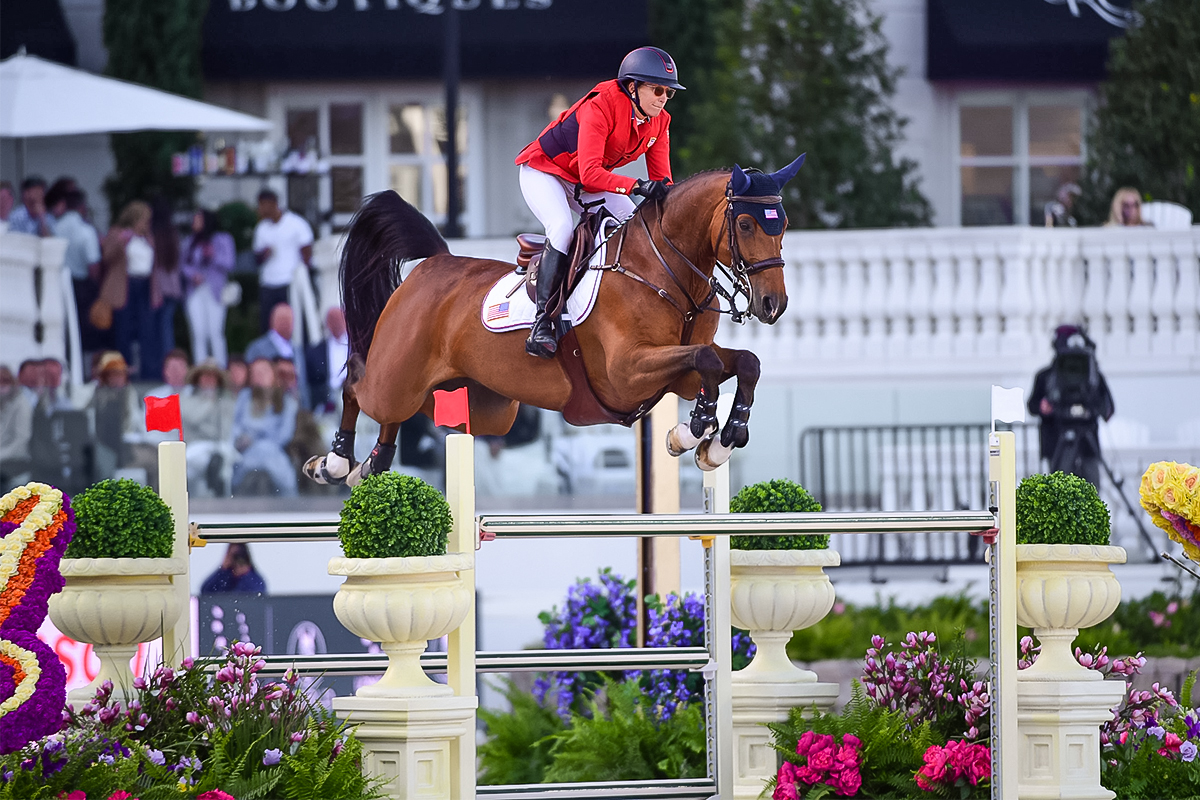
Saturday’s Longines League of Nations main event played out in front of packed stands with spectators cheering for all competing, but cheering even louder for their home teams, of course. Riders for the U.S. team, coached by Chef d’Equipe Robert Ridland, were Lillie Keenan on Argan de Beliard (a 15-year-old Selle Français gelding by Mylord Carthago owned by her family’s Chansonette Farm) going first, Aaron Vale on Carissimo 25 (a 12-year-old Holsteiner gelding by Cascadello owned by the Carissimo Group) second to go for the USA, Laura Kraut on Dorado 212 (a 12-year-old Oldenburg gelding by Diarado’s Boy owned by St. Bride’s Farm) in the third spot, and anchor U.S. rider McLain Ward on Ilex (a 12-year-old Dutch Warmblood gelding by Baltic VDL that he owns in partnership with Bonne Chance Farm and was his 2024 Paris Olympic Games mount).
1 of 4
Lillie Keenan riding Argan de Beliard was the first team member to compete for the USA in the 2025 FEI Longines League of Nations Ocala. They laid down flawless trips in both rounds of competition. Photo by Allen MacMillan
U.S. team member Aaron Vale rode Carissimo 25 in the 2025 FEI Longines League of Nations Ocala. Photo by Allen MacMillan
Laura Kraut and Dorado 212 turned in a clear first round, and dropped only one rail in round two, to contribute to the USA’s win in the 2025 FEI Longines League of Nations Ocala. Photo by Allen MacMillan
Anchor rider for the U.S. team at the 2025 FEI Longines League of Nations Ocala was McLain Ward riding Ilex. They turned in two clear rounds to cement the USA’s win. Photo by Allen MacMillan
They all jumped very well in round one, with only Vale and Carissimo having one rail down and the other three clear and within the time. So, the U.S. team was sitting of a low score of only four faults after round one and in the lead by just one point over Germany. The pressure was on and the U.S. riders really stepped up in round two, with Keenan, Kraut and Ward returning to jump a second time (Vale and Carissimo were the team’s drop score from round one so didn’t return for round two).
Keenan was first again to jump for the USA in round two; she and Argan de Beliard put in another flawless round. Eight rides later, Kraut and Dorado 212 entered the ring and started off beautifully, but as Kraut worried about making the tight time allowed, she decided on a sharp turn back to the big wall (fence number 10) and Dorado unfortunately knocked some blocks off the top for four faults.
The USA and Germany remained neck and neck in the competition when Germany’s Sophie Hinners and Iron Dames Singclair, going next to last in the order, turned in their second clear round of the day. So, it was all up to veteran rider Ward and Ilex to clinch the win for the USA as they entered as last to go in round two. That’s just what they did, turning in a perfect round for the USA to remain one point ahead of Germany to win the Ocala Longines League of Nations.
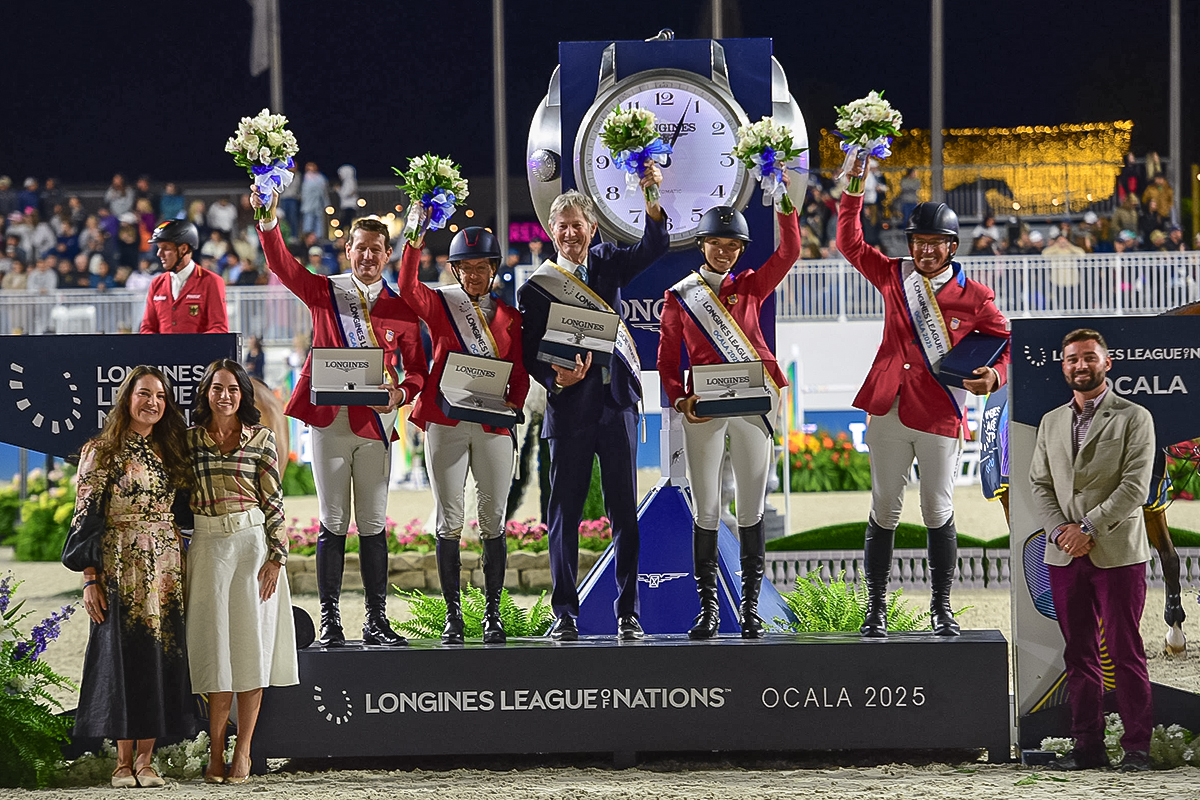
The U.S. team on the winner’s podium at the 2025 FEI Longines League of Nations Ocala, left to right: McLain Ward; Laura Kraut; Chef d’Equipe Robert Ridland; Lillie Keenan, and Aaron Vale. Photo by Allen MacMillan
In a press conference after the League of Nations competition, U.S. riders and Chef d’Equipe Ridland commented on the competition and the win. Ridland praised the LLN and his team, “I’ve said it many times before, I love the format that the League of Nations has, specifically for the excitement. Of course, it’s always nice to be on the right end of the excitement. It was great that Laura added to that [when she and Dorado dropped fence 10] just to make sure McLain had some real pressure on him going out there. How things can change in that second round. We have a veteran team here and these are horses that have done it before. There’s a reason why we picked the team we have here. It’s our home Nations’ Cup, and we had some incredible competition that we had to beat. It doesn’t get any better than that.”
Keenan, 28, who trains with Ward and is currently ranked number 25 in the Longines World Rankings, reflected on being the newest rider on the Team, “Anytime I get to ride alongside these riders who I have looked up to for as long as I’ve ridden a horse is pretty special. To win on home soil and to have everyone see one of the best venues in the world, and the best venue in America, is so special because we all share an incredible sport. It’s wonderful to be able to celebrate it here and with a home win.”
Ward, 49, said he also loves the new LLN competition design, “I think the drama at the end is a testament to the format; it makes for excellent sport and competition. I don’t know how many times now I’ve been in that position of having to jump clear. I’d be lying to tell you it isn’t filled with some nerves and anxiety. I was going down the ramp, and when Sophie [Hinners from Germany] jumped clear, I got a smile on my face and my thought was, ‘Okay, game on. This is what we do.’ You focus. That’s what you live for.”
The win gave USA 100 points to add to the 40 they accrued in Abu Dhabi during the first leg of the 2025 LLN. This moved them up to fourth in the LLN order after the first two competitions. Ireland and Germany are currently leading the series tied on 170 points each and France is in third with 150. To see the current LLN standings after these, visit here.
All legs of the League of Nations competition may be viewed (both live and on-demand replays) on FEI.TV via Clip My Horse (paid subscription required, although a free 30-day trial is available).
View replays of the 2025 LLN Ocala competition here.
More Horsing Around Ocala
Additional equestrian competition venues in Ocala include the Florida Horse Park, and the HITS (Horse Shows in the Sun) circuit. The Florida Horse Park features a large eventing course, outdoor and indoor show arenas and lots of stabling. The Park hosts virtually any kind of equestrian competition you can think of from Western to English and everything in between. These include, but are not limited to, a large draft horse show in February (the Grandview Invitational), trail and ranch horse classes, eventing, dressage, hunter-jumper, breed shows, cutting, contest classes, mounted games, polo, United States Pony Clubs rallies, and more. The HITS circuit specializes in hunter-jumper competition.
For more equestrian fun stuff in the Horse Capital of the World, consider scheduling a trail ride at one of several farms in the area or touring local farms, then cap the day with meal at one of several equestrian-branded eateries (these include places like Horse & Hounds Restaurant, Stirrups Restaurant and Yellow Pony Pub & Garden to name few). Outdoor activities, museums and cultural events abound to round out the agenda for a trip to Ocala. Find ideas for planning these activities at the Ocala-Marion County Visitor’s’ Center website or call them at (352) 438-2800, as well as the Visit Florida website section on Ocala.
One other tip for animal lovers visiting Ocala―for great wildlife viewing, check out the Crystal River National Wildlife Refuge, and its Three Sisters Springs, located near the town of Crystal River, Fla. The refuge is located less than an hour’s drive from WEC. It is one of the best places in the world to see the endangered West Indian manatee, especially during the months of mid-November through about the end of March.
To get more nature and outdoor fun packed into your travel itinerary, Rainbow Springs State Park and Silver Springs State Park are both located near Ocala, too. Find these and more through Florida State Parks resources.
It was two days after the 4th of July when I decided to take my horse Milagro for a ride alone on the trail. We live in an equestrian community with well-groomed bridle paths, and I planned to have him out for about an hour. We were only about half a block from home when it happened.
I heard a car coming down the street we had just turned off. One minute I heard the motor, and the next minute, a loud pop. Someone had thrown a firecracker out of the car window in our direction.
In an effort to stop him, I turned his head and pushed him with my leg into a tight circle. But the bridle path that once seemed wide and safe was not big enough for a terrified, runaway horse.
As I turned him, his back hoof landed on the sloped driveway of one of the homes adjacent to the trail. I felt his back end going down. He scrambled and got his feet under him, but not before he let out a horrible scream.
I jumped off and examined his back legs. I didn’t see anything obvious, even as I led him home. His adrenaline was racing, and he was practically dragging me.
An hour later in his paddock, he had calmed down. It was then that I noticed he was dragging his left hind toe. I called out the vet, who examined him by lifting the affected leg and stretching it out behind him. Instead of bending at the hock, the leg extended straight out in a way that turned my stomach.
“He’s got a rupture of the peroneus tertius tendon,” my veterinarian said.
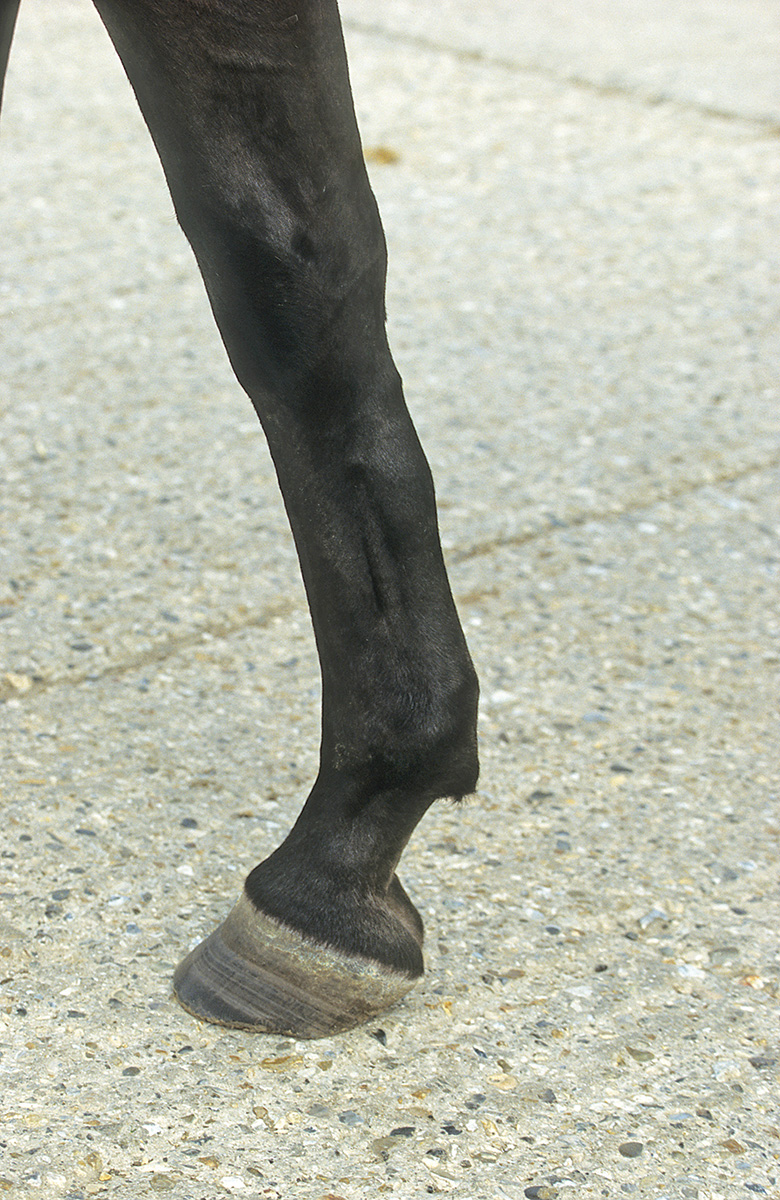
A “bowed tendon” is so named for the bowed appearance along the back of the leg usually visible after the injury. Photo by Bob Langrish
How Tendon Injuries Happen
Tendon injuries can occur in two ways: through chronic overuse, or through trauma. Because horses’ legs are made up of a number of tendons, they are prone to stress and injury.
“Tendon injuries result from sudden tears or ruptures from a single overloading event, or chronic strains from overuse,” says Annette McCoy, DVM, M.S., Ph.D., Dipl. ACVS, associate professor of Equine Surgery at the University of Illinois College of Veterinary Medicine.
Tendon injuries can result from sudden tears or ruptures from a single overloading event, or chronic strains from overuse, according to Dr. McCoy. Photo by Clarence Alford/Adobe Stock
“The former are usually recognized right away after an athletic episode, and usually have the hallmarks of heat, focal pain when touched, and obvious swelling,” she explains. “The latter can result in low-grade chronic lameness that can be difficult to diagnose.”
The most commonly injured tendons and collateral ligaments that support joint stability in non-racing horses are the suspensory ligament, deep digital flexor tendon, the check ligament and the superficial digital flexor tendon, according to Jennifer G. Barrett, DVM, Ph.D., DACVS-LA, DACVSMR-EQ, Theodora Ayer Randolph professor of Equine Surgery at Marion duPont Scott Equine Medical Center at the Virginia Maryland College of Veterinary Medicine.
Varied Treatment of Tendon Injuries
The way a tendon injury is handled right after it’s discovered can make a big difference in the ultimate outcome.
“Right after an injury happens, we are trying to combat inflammation and swelling,” says McCoy. “This is accomplished with a combination of cold therapy like icing or cold-hosing, compression with bandaging, systemic medications like a non-steroidal anti-inflammatory drug [NSAID] such as phenylbutazone [bute], and stall rest.”
Immediately after the injury, inflammation and swelling can be helped by icing, cold-hosing, compression bandaging, and NSAID medication (such as bute). Photo by Margaret Burlingham/Adobe Stock
Although scarring of the tendon as it heals cannot be prevented, making the scar tissue as functional as possible is the goal.
“Controlled exercise in a rehabilitation program helps us to do that,” says McCoy. “Periodic re-evaluation with ultrasound helps us determine the healing progress. A rehab program might need to be altered, depending on how the tendon is healing.”
Periodic re-evaluation with ultrasound by your vet helps determine how healing is progressing. Photo by Terri Cage/Adobe Stock
A number of adjunct therapies can also be used to help tendons heal, including extracorporeal shock-wave therapy, therapeutic ultrasound, and low-level laser and magnetic therapy, although not all of these therapies have been studied in clinical research.
“Biological therapies such as platelet rich plasma [PRP], autologous conditioned serum, and mesenchymal stem cells injected directly into a tendon injury under ultrasound guidance have shown some promise at either speeding healing, improving the quality of the healed tissue, or helping to reduce the incidence of re-injury,” says McCoy.
“More work is needed to understand exactly how these treatments work, and what injuries are best addressed by using them,” she adds. “This is a very active area of ongoing research.”
There are some tendon and ligament injuries that can benefit from surgical treatment, according to Barrett.
“Examples include the suspensory ligament in hind limbs, the deep digital flexor tendon, and superficial digital flexor tendon when they are injured in a tendon sheath or bursa,” she says.
Slow Recovery
When a horse injures a tendon, the issue can require a temporary layup or permanent retirement.
“Prognosis is entirely dependent on the severity and location of the injury, but typically ranges from fair to guarded for future athletic use,” says McCoy. “An owner should expect that their horse will be out of full work for nine to 12 months while the injury heals. Unfortunately, horses that have had a tendon injury are highly prone to re-injury.”
After a tendon injury, expect your horse to be out of work for 9-12 months. Slow, controlled movement will be introduced under guidance from your vet. Photo by Visual Production/Adobe Stock
The way the layup and rehabilitation are handled can make a huge difference in whether the horse is able to return to his previous activity.
“The hardest thing for owners to understand is that healing takes a very long time for tendons and ligaments,” says Barrett. “Humans can rest by taking the weight off the limb completely. This is not possible for horses, so we rely on reducing exercise as much as possible during healing.”
Stall rest is the best we can do to limit trotting and overuse of a healing tendon, but stall rest is hard for owners, and is often seen as hard for horses too, according to Barrett.
“The same way you need to be on crutches to heal a tendon, horses need stall rest and very controlled exercise once your veterinarian determines it appropriate,” she says. “All of the difficult and expensive care your veterinarian provides [might] be wasted if the exercise recommendations are not followed.”
Stall rest is an important part of recovery from tendon injuries if you want your equine to have the best possible outcome. Photo by Mary Cage
The length of stall rest and the limited exercise needed to help the horse recover depends on the injury. Extensive stall rest is usually prescribed early in recovery, with a gradual return to gentle exercise as the tendon heals.
“Early loading—exercise—of the tissue is the most essential aspect of healing, but we can’t load too much, otherwise it breaks again,” says Henk Offereins, DVM, of equinetendon.com, an Ireland-based equine management service specializing in the area of tendon injuries. “Getting that balance right [is the difference between] success and failure in rehabilitation.”
Update on Milagro
Milagro made a full recovery after rupturing his peroneus tertius tendon, but only after a one-year layup that required three straight months of stall rest with physical therapy on the affected leg. He eventually graduated to hand-walking, slowly building up the amount of time he could be walked over a period of months.
Milagro and Audrey at a NATRC competitive trail ride. Photo courtesy Audrey Pavia
Today, he is back to trail riding around our community as well as competing in NATRC events. He is so sound these days, I often forget he ever suffered this horrible injury. I believe the long layup and following my veterinarian’s instructions on rehabilitation made all the difference.
Key Takeaway
Tendon injuries are as complicated as equine injuries come—and certainly time-consuming to recover from. Understanding treatment options and the recovery timeframe can help horse owners and caretakers to better manage any future tendon injuries.
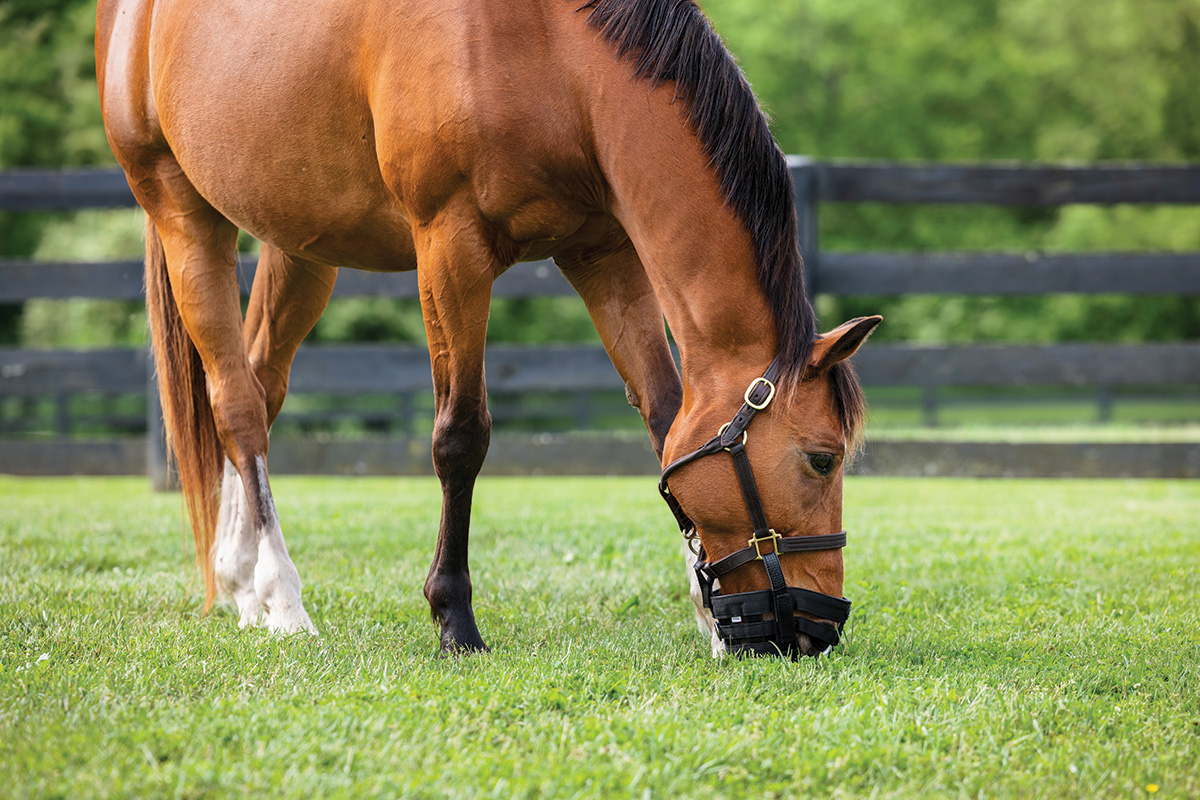
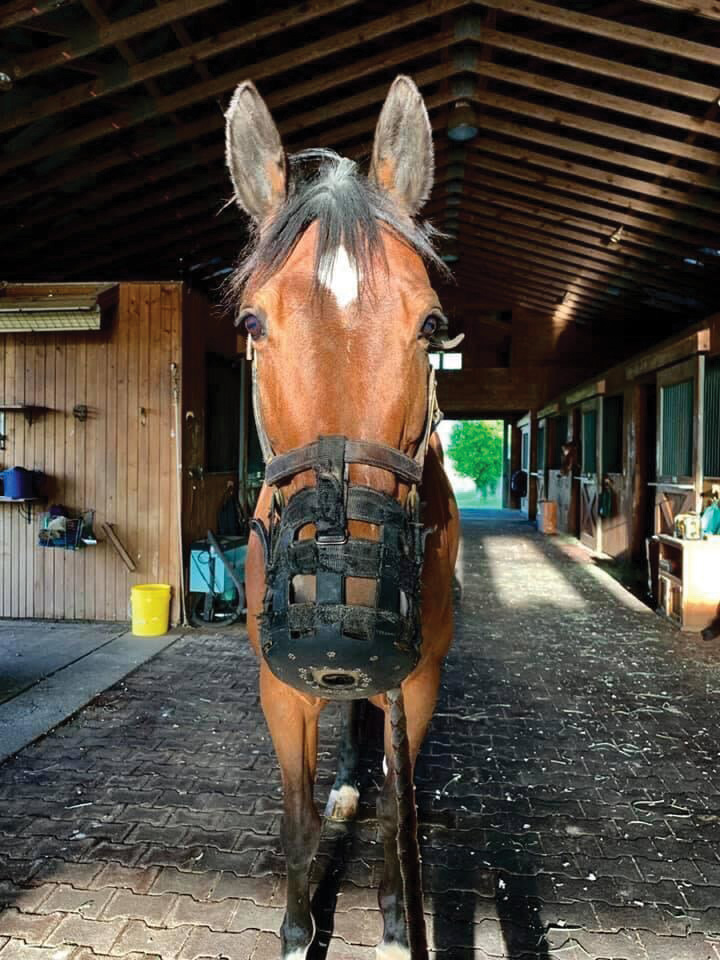
Over the years, I’ve owned multiple horses that required a grazing muzzle, including my current two. I consider myself a bit of a grazing muzzle aficionado, but as with any management tool, it’s important to stay current on updates and recommendations.Photo by Shelley Paulson
What Makes a Horse a Candidate for a Grazing Muzzle?
“[The best candidates are horses that] can graze without the negative health complications, but we don’t want them to gain excessive amounts of weight, or we would like them to lose some weight,” she says.
The best candidates for grazing muzzles are horses that are clinically healthy but overweight. Photo by Nigel Bake/Adobe Stock
In these situations, using a grazing muzzle can help horse owners manage their easy keepers with their herd, while still allowing them to exercise and continue to be herd animals.
Rhonda Hoffman, Ph.D., Professor and Director of Horse Science at Middle Tennessee State University, further elaborates that horses with a body condition score of 7, 8, or 9 (on the 1-9 Henneke Body Condition Scoring system) as those that would benefit most from the use of a grazing muzzle to lose weight and decrease the risk of developing insulin dysregulation.
While other types of horses can benefit from a grazing muzzle, such as those who have been diagnosed with equine metabolic syndrome or those who have had laminitis, both experts agree this is not always an ideal management practice.
“These horses require a diet low in nonstructural carbohydrates,” says Martinson. “Our predominately cool-season grasses in most parts of the U.S. are not a great forage source for these horses. A grazing muzzle will slow their consumption and reduce how much they can take in, but it does not remove the nonstructural carbohydrates. I think that is an important distinction.”
Hoffman advises that even if they haven’t been formally diagnosed, horses with a cresty neck could have insulin dysregulation or metabolic issues, as can horses who have previously foundered, even if their current body condition score is good. She recommends that you consult with your veterinarian to determine if limited grazing using a muzzle is OK, or if these horses should be completely restricted from pasture.
When to Use a Grazing Muzzle
As useful a tool as grazing muzzles are to help your horse maintain a healthy weight or lose weight, he does not need to wear a grazing muzzle year-round.
“It depends on location and rainfall,” says Hoffman. She explains that grass has little nutritional value during times of drought and in freezing temperatures. Wearing a grazing muzzle during these times is not going to make a discernible difference, she says.
Similarly, Martinson advises their use during the growing season.
“Depending upon your location in the U.S., your growing season is going to be different,” she says. She elaborates that for approximately two-thirds of the U.S., the growing season is from mid-May to mid-October. It is during these months that she advises their use for horses that are clinically healthy but need to maintain or lose weight.
Introductory Period
“When we have done research using grazing muzzles, or anything that restricts or slows down foraging [even a hay net], it takes horses time to acclimate and learn how to use the barrier put in front of them,” says Martinson. “My recommendation while they are out on pasture is to put the grazing muzzle on and watch them carefully.”
To make sure that your horse is consuming enough calories, especially during the first two to three days of use, Martinson advises placing the horse in a stall or dry lot overnight and feeding a small amount of hay to keep his digestive system moving. Also check that the grazing muzzle fits into your horse’s water source.
“But in my experience, and in our research, every single horse that we fitted with a grazing muzzle has figured out how to graze with it on fairly quickly,” she says.
The Proper Fit of a Grazing Muzzle
Ensuring a proper fit for your horse’s grazing muzzle can be a very individualized experience, and it plays a critical role in the grazing muzzle’s use. But with a variety of styles to choose from and a little ingenuity, it is possible to maintain your horse’s comfort.
All styles of grazing muzzles form a basket designed to fit over the horse’s muzzle, and the materials from which they are constructed range from a poly/nylon mix to both firm and flexible plastic.
The original and most budget-friendly grazing muzzle is a nylon basket with plastic or hard rubber bottom. Photo by Shoshana Rudski
The method of attachment differs depending upon the style of muzzle you choose, with options that include a continuous, single-piece style; a four-point leather attachment; and Velcro or plastic ties that can be attached to a standard or custom halter.
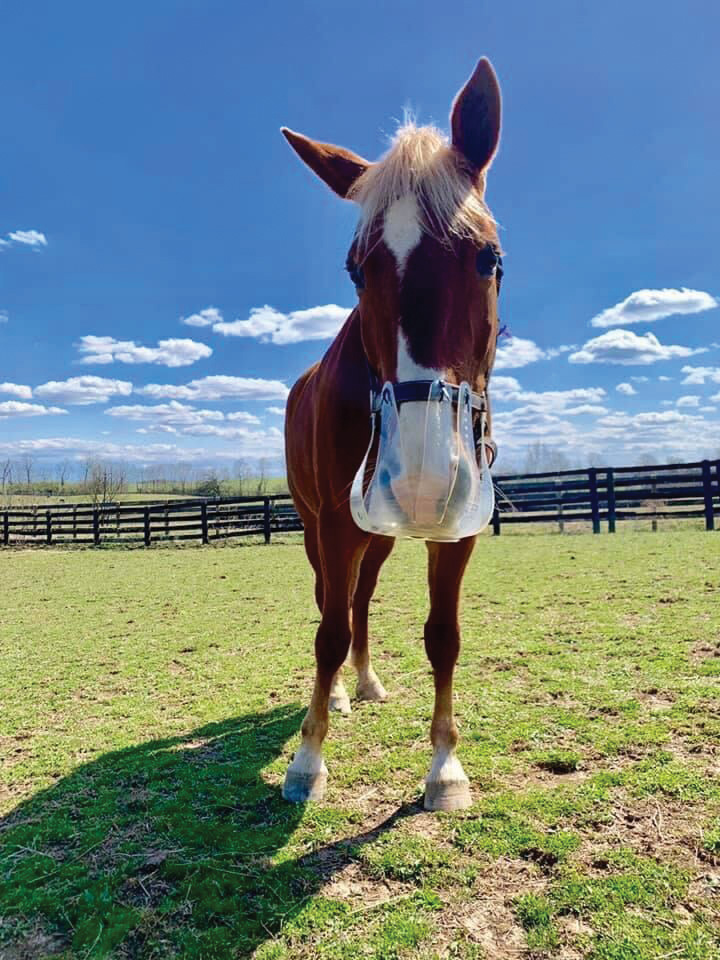
The ThinLine Flexible Filly grazing muzzle offers a well-ventilated option that is more soft and pliable than heavier basket styles. Photo by Shoshana Rudski
Within these styles, you are likely to find one that your horse is both likely to keep on and that will also stand up to his particular methods of wear and tear, while minimizing or even eliminating rubbing.
But even if the grazing muzzle you choose checks most of your boxes, there may still be areas of friction. Experimenting with different materials such as fleece, duct tape, Vetrap, slinky-material fly masks worn underneath the halter, and more can help minimize rubbing at pressure points.
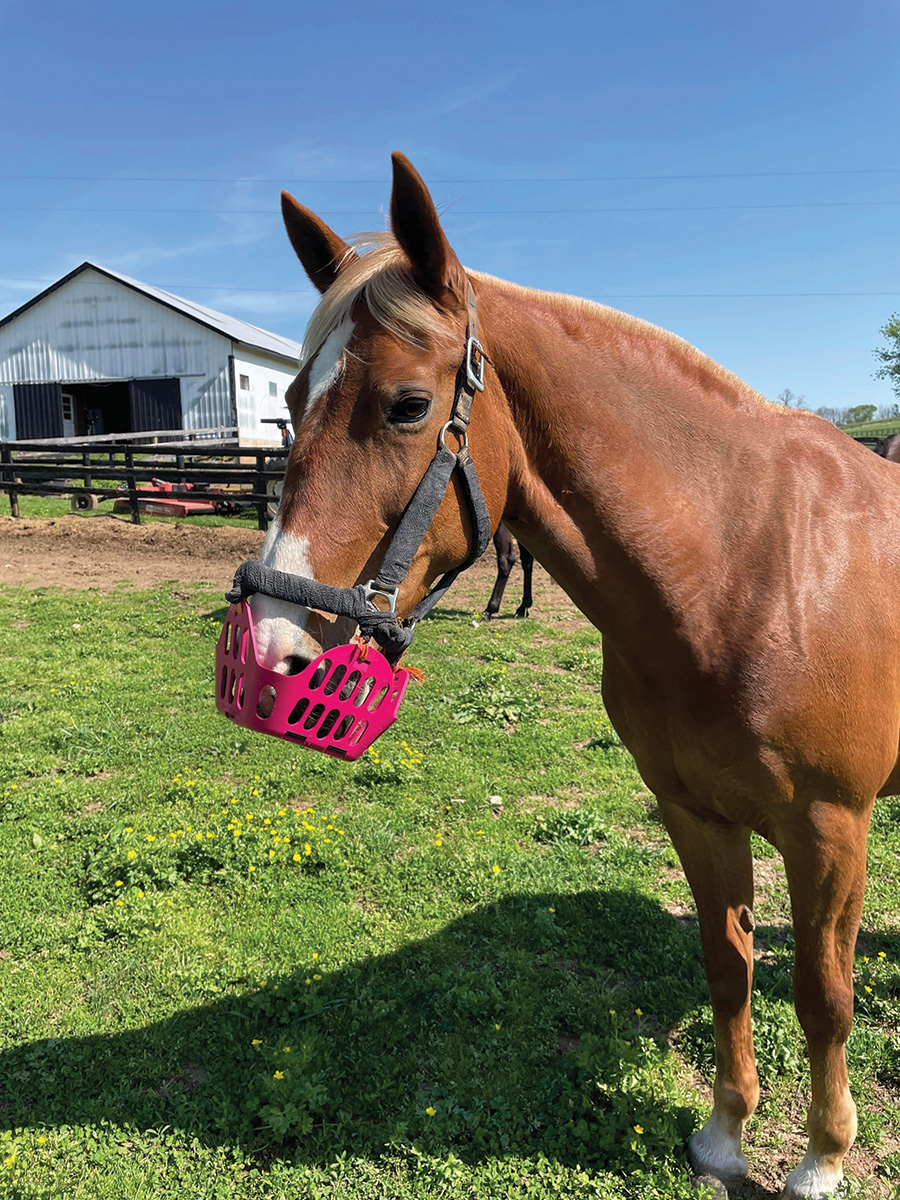
The Green Guard grazing muzzle is lightweight and purported to rub less than other styles. Photo by Shoshana Rudski
No matter which style you choose, both experts agree that safety should be at the core of choosing and fitting a grazing muzzle. Any product, whether it is the method used to affix the muzzle to the halter or the halter itself, should be designed to break away if the horse becomes entangled.
Beyond that, choosing a muzzle that is not so loose-fitting that it encourages excessive rubbing can help cut down on any potential issues your horse may experience.
No matter how daunting your choice of grazing muzzles may seem, the good news, according to Martinson, is that any grazing muzzle you choose will reduce forage intake by approximately 30 percent, with some of the more restrictive designs reducing intake still more.
Almost any grazing muzzle is a good choice if it meets the above criteria for safety and fit.
Regular Inspections
Once you have made your selection, both Hoffman and Martinson recommend continuous evaluation of your grazing muzzle.
“Every single time your horse goes out or comes in, pay attention to [not only fit] but also wear on the grazing muzzle itself,” says Hoffman.
She advises paying particular attention to whether the grazing muzzle was damaged during turnout and for areas of excessive wear that may be developing over time.
Tip: As a longtime user of grazing muzzles, one pro tip that I highly recommend is tying one or two pieces of colorful surveyor’s tape to your grazing muzzle. Doing so can save countless hours looking for your grazing muzzle if it comes off in the pasture.
A Daily Break
The method in which you use a grazing muzzle is another important aspect. According to Martinson, research out of North Carolina done by Paul Siciliano, Ph.D., shows that when horses are restricted from pasture—for example, if they are only turned out for two hours or if a grazing muzzle is applied for two hours and then removed—horses will learn that schedule.
So in those two hours they are allowed to graze, horses will consume calories significantly faster than normal grazing speed. Siciliano’s research indicates that in as little as three hours of grazing, horses can consume up to two-thirds of their calories for the day.
This research has led to various recommendations about how grazing muzzles should be used. In a perfect world, each day your horse would be allowed an extended break from wearing the grazing muzzle. For example, to further encourage maintenance of weight or weight loss, the horse could be brought into the barn or placed on a dry lot at night, during which time he would be fed lower-quality (more mature/lower calorie) hay.
“Any time you leave a horse out 24/7, even with a halter on, it is going to create rubs,” says Hoffman. “With a grazing muzzle, they are pushing their nose against the bottom to force grass through the holes. A break helps to avoid skin conditions and rubs.”
Allowing for a daily break from wearing a grazing muzzle can also help to preserve the muzzle’s longevity. During the hot summer months, Hoffman says removing the muzzles for a period keeps the horse cooler.
But allowing for a break while at the same time keeping the horse off pasture is not always possible. In those cases, it’s best to increase your monitoring of the horse to ensure continued proper fit and watch for rubs and wear patterns.
Weight Loss Outcomes
Just one benefit of using grazing muzzles is that they can allow for a slow, safe weight reduction.
“If you reduce calories by about a third, your horse should be able to lose one body condition score [number] per month,” says Martinson. “This is considered a safe amount.”
She further explains that the body condition score amount is going to vary depending on whether you have a draft horse, a light horse, a pony, or a Miniature Horse.
“It could be as little as 10 pounds or as much as 50 pounds, depending on the size of the horse,” says Martinson.
She cautions that adding feed and treats to your horse’s diet can be counterproductive to achieving your loss goals, while exercise, when possible, can enhance your efforts.
Grass Height and Type
You may have read conflicting reports about appropriate pasture grass height and types, perhaps finding that your pasture situation is not ideal for a horse wearing a grazing muzzle. However, Martinson’s research has led to some interesting discoveries.
“We would like to see our cool-season grass pastures between 3 and 8 inches in height,” she says. “Never lower than 3 inches.”
Regardless of whether your horse wears a grazing muzzle, this practice prevents overgrazing. Further, she says, horses prefer different types of grasses. Some of these different grasses grow straight up, while others grow along the ground.
It used to be thought that a grass that grows straight up would be more accessible by horses wearing a grazing muzzle. Instead, she says, research found that how the grass grows made no difference to the horses, and their ability to successfully graze through the muzzle remained unchanged, regardless of grass type.
Stress Levels
Martinson says that a common misconception about grazing muzzles is that they cause an increase in the stress levels of the horses wearing them. However, she says that in recent years, research conducted by Amy Burk, Ph.D., at the University of Maryland measured levels of the stress hormone cortisol, comparing levels in horses wearing a grazing muzzle and those without.
Not only were the stress levels similar, but the herd hierarchy remained unchanged. The only change noted was a reduction in bite marks and a reduced ability for horses to groom themselves or others.
Key Takeaway
While there is a lot of information to take in, with these researched-based recommendations in mind, you too can make the best choices for your horse in all aspects of grazing muzzle use.
It’s been said that watching good horse training is like watching paint dry. This is because horses communicate through the smallest movements, and the best trainers are able to quiet themselves enough to listen to these subtleties. And sometimes those subtleties are as granular as the correct timing of riding aids.
Proper timing of the aids allows Taylor to communicate with her horse in harmony. Photo by Rachel Korthals
Humans have built an entire language with horses upon the concept that the answer to pressure is to give, so we must tune in and notice when they are giving—or at least trying to. This smooths the communication between horse and rider by providing the horse’s reward—the release of pressure—in sync with his efforts to respond to our cues.
If the timing of the release continues to be precise and in unison (or at least in quick succession) with the effort, then the horse’s responses will happen more and more readily.
The Ultimate Goal of Riding Aids
The most obvious examples of this are while riding. You use leg pressure to ask your horse to move forward, then release it when he walks off. You use rein pressure to ask your horse to slow down or stop, then release it when he reaches the desired speed.
Riders at the top of every discipline make their sport look effortless due to seamless communication, which is all properly timed pressure and release at the micro level. Their timing of riding aids has been so accurate for so long that their horse has become a finely tuned instrument, ready to listen to the smallest suggestion, therefore any adjustments are nearly invisible.
Improving Response
When it comes to speaking the language of pressure and release, there are plenty of opportunities to improve your communication and timing while handling your horse on the ground as you work with him in daily interactions.
Taylor applies pressure to Sheldon’s side to ask him to move laterally in the wash rack. Photo by Rachel Korthals
Practice noticing how much pressure from the halter and lead rope it takes to get a reaction from your horse, walking forward and then halting. See if you can observe that first moment he rocks forward to give to the pressure, and soften as quickly as you can.
Notice how as your timing improves, so does your horse’s response. The same can be done in the wash rack when asking your horse to step to the side to give you more space. Begin with light pressure, and find the exact moment that your horse leans away from it.
Be Aware of the Pressure Level
Although most riders need to bring more awareness to noting exactly when their horse begins to move forward off the leg or slow down in response to the rein, they are at least aware of the pressure they are applying.
However, there are many other daily scenarios where you may be unaware of the pressure you are applying, therefore asking a question that has no answer and that your horse must learn to ignore. This leads to your horse also ignoring aids that you did intend to give.
For example, many riders sit heavily in the saddle without enough weight in their legs and stirrups, which creates pressure from the seat, especially when that becomes a driving and pumping seat in an unorganized effort to ask the horse to move forward. With all that seat pressure as a distraction, it’s no surprise that the horse becomes dull to leg pressure.
1 of 2
Taylor applies pressure to Lola’s side with her calf and is ready to ...
... release the pressure at the first inclination of forward motion. Photos by Rachel Korthals
It’s also important to note that use of the voice counts as pressure, too. Just like other aids, vocal cues begin to lose meaning to horses when used without the direct reward of release of pressure. If a cluck is supposed to mean trot, then you should stop clucking when the horse steps into a trot.
Releasing Tension
If pressure and release is the language of horses, then tension (in the horse or rider) is the main obstruction to the use of that language.
Many riders begin applying pressure when all the horse truly needs is some time to think and process.
1 of 2
Pressure on the corner of Lolas’s mouth from the bit asks her to move her head to the right. Photo by Rachel Korthals
The release of that pressure rewards her for doing so. Photos by Rachel Korthals
A horse may start out with his ears pricked, heart rate up, snorting, or flight behavior, but as he comes around to the idea that he’s most likely not in danger, he will start to show some signs that he’s releasing his tension and ready for you to apply some pressure and ask questions again. These signs include licking, chewing, blinking, ear flicking, stretching, and giving a neck or body shake.
This is when you can ask your horse to move closer to whatever was causing his concern. When signs of tension return, take all the pressure off so he can focus on regulating himself again.
Key Takeaway
Of course, there are moments when you will miss the timing of when to give a release, but luckily horses are forgiving creatures. If you improve your timing of riding aids and work to communicate more clearly, your horse will improve as well. Everybody wins!
A horse that confidently and obediently backs up on command is a joy to have around. Whether you’re maneuvering to close a gate, positioning your horse for farrier work, or just need to take a couple steps back to reach the bottle of fly spray, backing is an all-important skill for convenience.
It’s also a safety benefit while working in the barn. When other people and horses are coming in and out of stalls, the wash rack, or aisle, it’s important to be able to move your horse wherever you need to—including in reverse.
The good news is you can use simple ground training to teach your horse to back up. While a young green horse will clearly benefit from this type of training, older horses may also lack solid backing skills, or they may have become lazy about the process.
In either case, teaching or reteaching the skill is straightforward.
There are different methods for teaching a horse to back up from the ground, and individual horses may benefit from different techniques; what works for one may not work as well for another.
The pressure-and-release technique for backing up your horse in hand described below is simple, safe, and easy for both horse and handler to understand.
1. Turn to Face Your Horse
Begin in the normal position that you would use to lead your horse: on his near side, next to his shoulder.
The first step to backing is to turn and face your horse so that you’re looking in the direction you want him to back. Photo by Shoshana Rudski
The first step to backing is to turn and face your horse so that you’re looking in the direction you want him to back. Try to visualize exactly where you want your horse’s feet to go; this can help you assist him in backing as straight as possible. It may also help to work next to an arena rail or wall to aid him in backing straight while he’s learning.
2. Add a Tiny Amount of Pressure
Next, give your horse a tiny cue that he should move backward. Start with a small amount of pressure on the front of his chest by his near shoulder. You can use your hand to gently apply a bit of pressure, but it may be easier to use the tip of a short riding crop.
Start by applying a small amount of pressure to your horse’s near shoulder while taking a half step toward him. You may also want to use a vocal cue. Photo by Shoshana Rudski
At the same time, take just a half step toward your horse. This may eventually be quite beneficial, as he will begin to predict what you want when he sees you take a step.
Also, a vocal cue or clicker can be used in combination with the pressure cue to help him understand that you’d like him to do something.
3. Increase Pressure As Needed
If your horse is completely green to this process, odds are you won’t get much of a response, if any. That’s OK! Starting out slow is fine.
The next step is to incrementally add more pressure until your horse performs the desired behavior. If steady pressure isn’t working, you can always change to a light repetitive tapping.
If there’s still no response, continue to incrementally make the cue stronger, all while moving toward your horse slightly.
4. Stop and Reward
As the cue increases in strength, most horses will naturally take a step back and yield to your prompting. As soon as that happens, stop applying pressure—this is your horse’s reward for yielding. You can add vocal praise as well.
As soon as your horse yields by stepping back, remove the pressure and praise him. Photo by Shoshana Rudski
The benefit of slowly adding additional pressure and then releasing ensures that you’re never over-cueing your horse. Repeat steps 2 to 4 a couple of times, and then let your horse take a break until the next day’s lesson.
5. Use Repetition
As with any type of horse training, short sessions that repeat the same steps reinforce the concept to your horse quickly. It’s amazing how quickly a horse can learn a skill if you do it every day.
You can certainly do this type of groundwork in a formal training setting like a round pen or indoor arena, but a couple of minutes while your horse is on his way to daily turnout can work as well. It’s simply backing up, so it doesn’t need to be elaborate.
6. Watch Him Improve
Eventually, your horse will understand the very first moments of your cue. In time, he should start to back up when he feels even the slightest bit of pressure or tapping on his shoulder.
Ideally, you’ll even get to the point where you can back your horse without touching him at all—he’ll just be attuned to your movements and start to back up as soon as you turn around and begin to walk toward him.
Congratulations! You have a horse that is well-trained to back up and easy to work with.
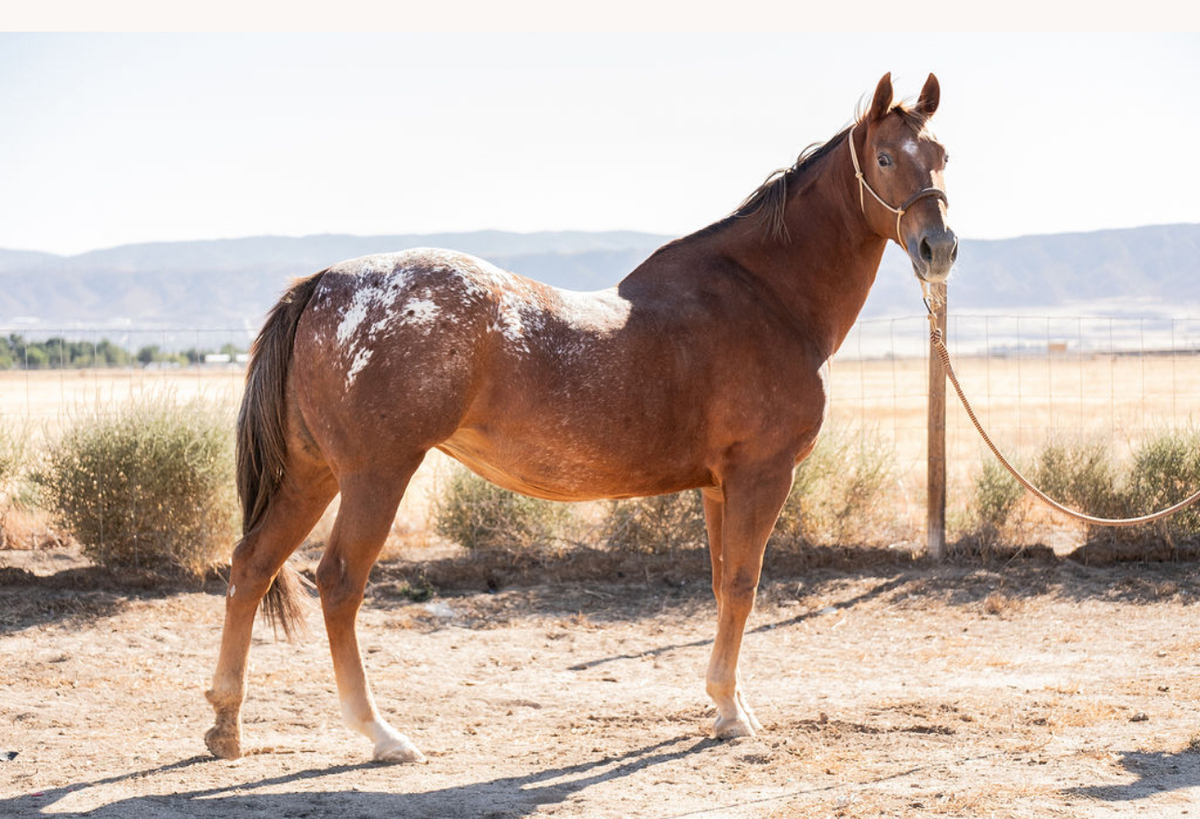
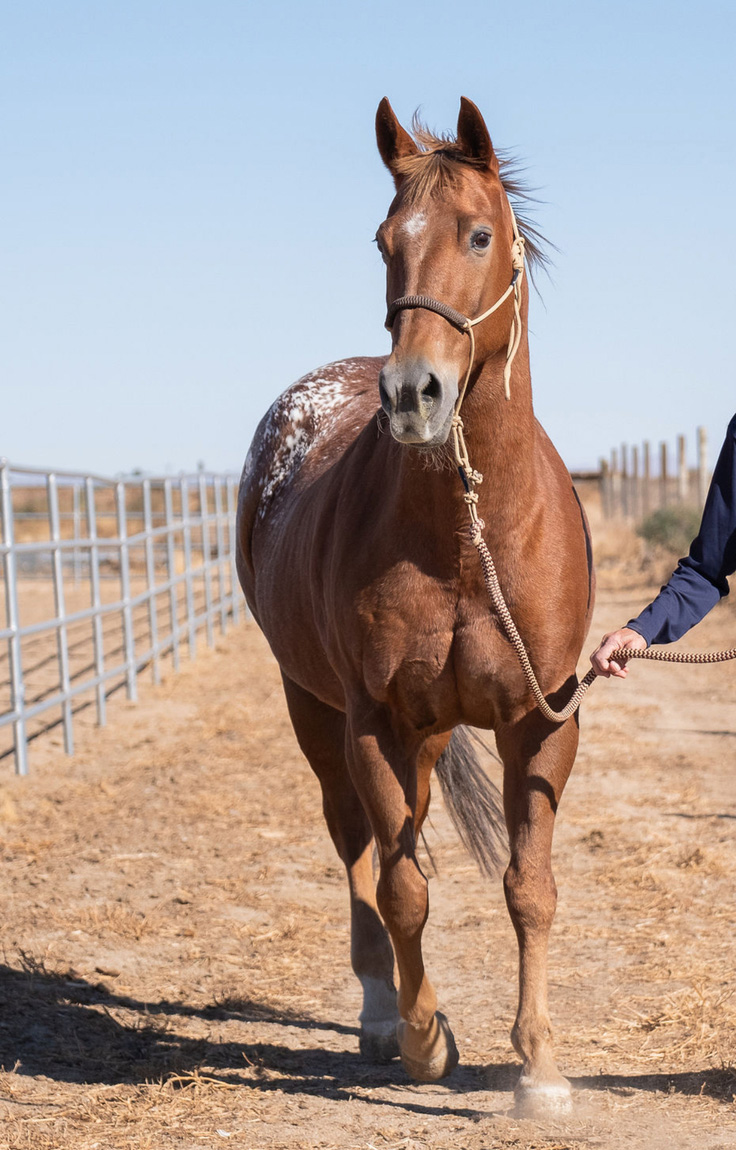
Meet Perfectly Peppy, a 2008 registered Appaloosa mare with a sweet personality and a lot of potential. Peppy has been trained to be ridden and, while she’s a little out of practice, she’s currently in Wild at Heart’s training program and making great progress. She does have a sway back, but with the proper pad under her saddle, she rides beautifully. Peppy is the perfect partner for someone looking to bond with a horse and help her shine. If you’re ready for a fun and rewarding journey, Peppy is waiting to meet you.
Contact Wild at Heart Horse Rescue today about ASPCA Right Horse Adoptable Horse of the Week, Perfectly Peppy!
Photo courtesy Wild at Heart Horse Rescue
ASPCA Right Horse
ASPCA Right Horse is the online adoption platform of The Right Horse Initiative, a collection of equine industry and welfare professionals and advocates working together to improve the lives of horses in transition. A program of the ASPCA, their goal is to massively increase horse adoption in the United States. To find more adoptable horses and foster horses, visit www.myrighthorse.org. To learn more about The Right Horse, a program of the ASPCA, visit www.aspcarighthorse.org.
Like many horsewomen, I started as a young girl obsessed with horses. Nights would bring dreams of riding across fields with a galloping horse underneath me. Growing up in the hunter/jumper world, that dream became reality, and for several years, I focused on fine-tuning my riding skills.
That was until trainers began to always assign me the “difficult” horses and I burned out, abandoning horses completely.
Heather still rides, but finds it’s not the only way to spend quality time with her horses. Photo by Gold Horse Photography
When I returned to the horse world almost two decades later, it was because, once again, I dreamed of riding horses. I’d wake in the morning, remembering the feeling of freedom and connection and think, “I have to ride again.”
I took lessons, finding that muscle memory quickly kicked in. I remembered diagonals, how to cue the trot, and how to pick up the correct canter lead.
It was exhilarating and terrifying all at once, because as an adult returning to the barn after time off, I had a completely different mindset than when I was a teenager.
When someone asked me to tack up my lesson horse myself, I couldn’t. Growing up at a performance barn in the 1980s taught me to ride, but none of the accompanying horsemanship skills. We had grooms to tack our horses.
I felt embarrassed at my lack of knowledge and ability on the ground. While I still loved riding, I changed my focus to becoming a horsewoman, not just a rider. I took a job as a working student at age 35 in exchange for riding time at my barn. I learned basic horse handling and care, and the reward was time in the saddle.
The Love for Riding
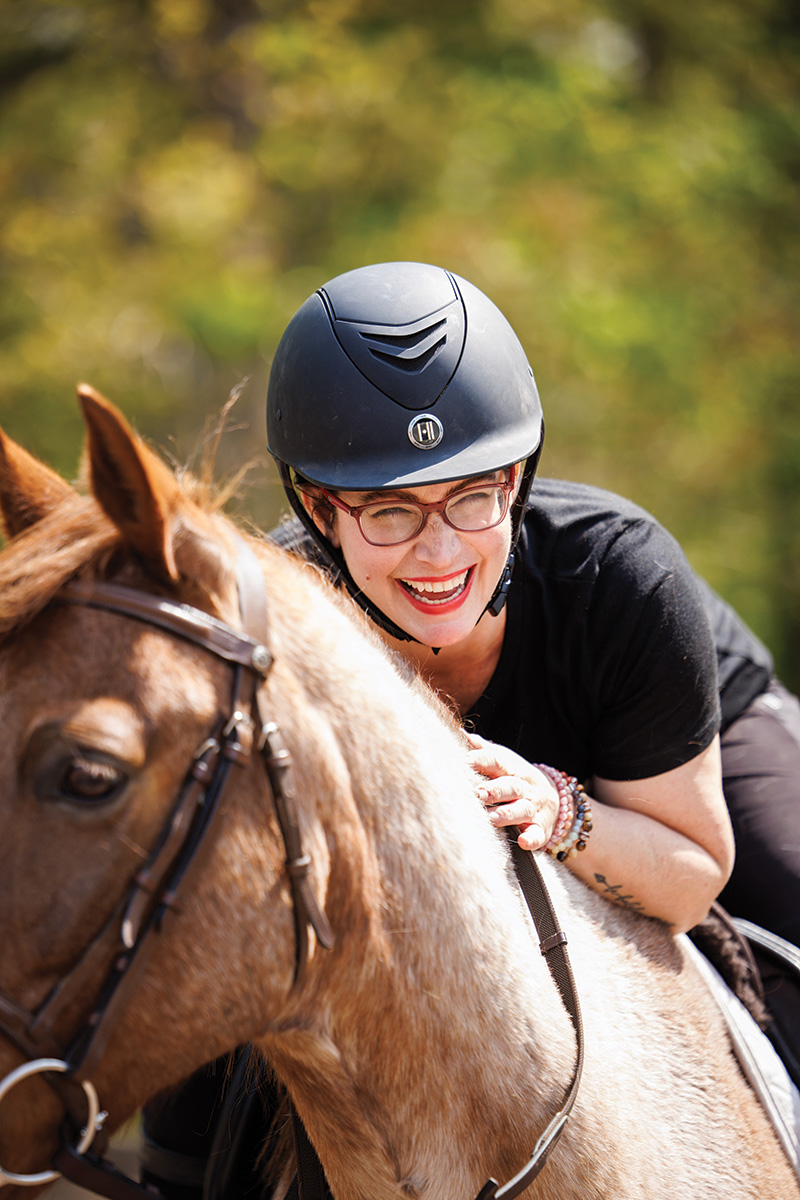
One of the most wonderful perks of working with horses is the ability to mount up and spend time together in the arena or on the trail. There is no better feeling when you are on a horse, communicating without words.
I spent some of the best times of my life in the saddle. For years, I tried to find something that could replace that euphoria, but I drifted back to the mounting block each time.
My trainer is always after me to ride more often, but as a working mom, my barn time is limited. As a result, my trainer is always asking me to get on my pony and give him some exercise.
“He’s bored,” or “He wants a job” are common refrains. I constantly feel guilty if I don’t tack him up and get on for 30 minutes. After all, it’s healthy for him, and no one wants a spicy pony who has been sitting too long.
Getting proper exercise is important for both horse and rider. My pony has lived with EPM for almost 10 years, and keeping him ridden and properly muscled has been a huge part of his wellness program. He has less inflammation, more stability, and a healthier life when he is ridden regularly. For us, riding is one of the most important things we can do together.
Time Out of the Saddle is Important
Riding is only one aspect of horses, and one that perhaps has overshadowed all the others. As a timid rider, I found that the more time I spent working with my horses on the ground or even just hanging out in the paddock, the more my confidence improved.
My Thoroughbred, Delight, was diagnosed with kissing spine. Despite being only 11 years old, I retired him from riding after trying many therapies and discussing it with my wellness team. In fact, his dangerous and aggressive behavior under saddle with a previous owner was how he came into my life.
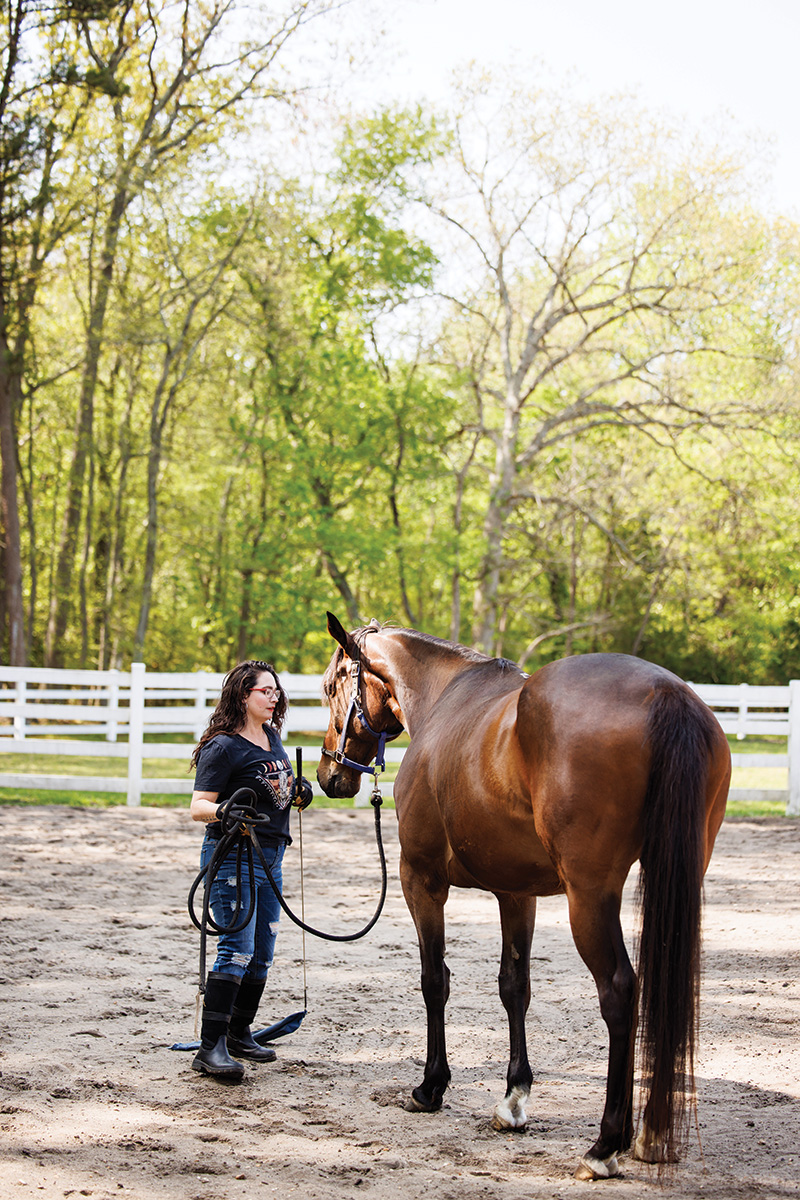
Heather’s Thoroughbred had to be retired from riding at age 11 due to kissing spine, but now they both enjoy focusing training time on groundwork. Photo by Gold Horse Photography
I dedicated all my time with him to groundwork, earning his trust again and keeping his brain and body busy, all without being on his back. Turns out there’s a lot we can do to have fun and give them a wonderful quality of life that doesn’t involve putting a saddle on their backs.
The Most Important Goal with Horses
One day, I may be too arthritic to ride comfortably. My horses may all be too old to carry a rider successfully. They will still be valuable in my eyes and worthy of my attention.
For me, learning to tack, longe, and do liberty and groundwork helped improve my communication with my horses and gave me a more enjoyable experience in the saddle. The focus on riding was the reason for my burnout so many years ago. Incorporating other methods of connecting and spending time with horses taught me how to listen better, be a more effective communicator, and enjoy the time spent with these animals.
Now with one riding horse and another retired, I can enjoy both animals equally because they require different things for exercise. Whether you choose to focus on riding or unmounted time with your horse, remember that showing up for your horse and spending time with them is the most important goal.
Four equestrians found themselves ready for a new horse after a lifetime of riding. Here are their stories.
After years as a rider and horse owner, we hold on to that identity for ourselves. It may not have been a steady journey, and it was probably interrupted by work and family changes. Or maybe it started late. At some point, we begin to define ourselves as horse owners.
After I lost my last horse, these thoughts were on my mind:
Do I need another horse?
Am I ready for that?
Who am I now?
Here, we dive into four stories of horse women who are now investing their time and energy into a new horse. Their excitement and sense of good fortune are inspiring.
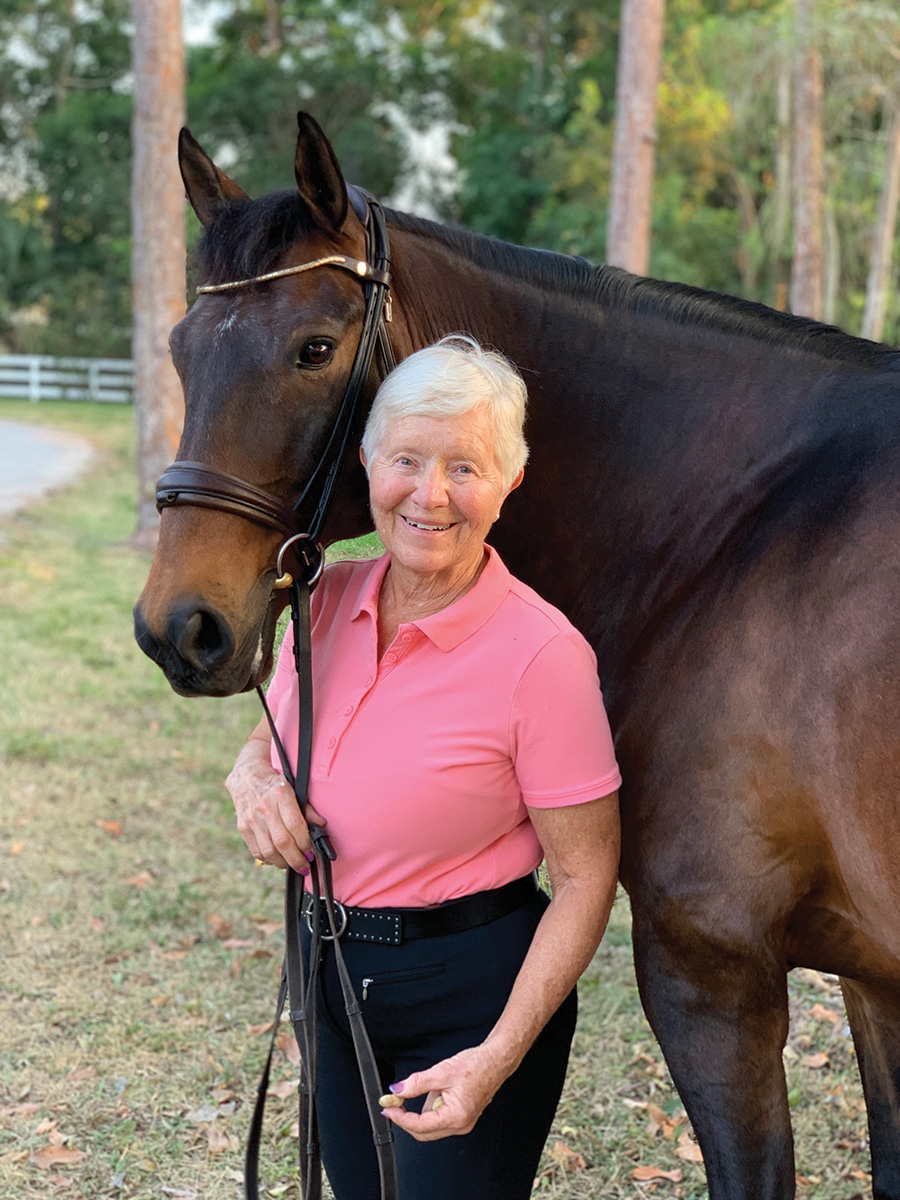
Meet Lois
Lois Pienkos and her husband live on a picturesque farm near a small town in Eastern Iowa. There are barns, an arena, a jump field, pastures, and a lovely white house with a wraparound enclosed porch full of plants.
Lois is a quilter and paints bright barn quilts that hang on the buildings. When her daughter began riding in Pony Club, Lois got involved and then became a rider herself. She bred her mare and raised two dressage horses that she took to clinics and shows. Now retired, she and her husband spend most of the year on their farm in Iowa with their horses and four to five months in Wellington, Fla., where her trainer lives.
Lois and her trainer decided it was time to find a smaller horse for Lois to move up the levels. They found a great match for her in Florida in 2021, a 10-year-old Lusitano gelding named Heroi. Once home, she easily, but with sadness, sold her bigger Second Level dressage horse and started on a new adventure.
Lois Pienkos was looking for a smaller horse to continue moving up the levels in dressage. Heroi, a 10-year-old Lusitano gelding, was just the ticket. Photo Jean Rude/Fresh Ink
“Heroi is being trained in dressage,” Lois says. “I’m also beginning to try working equitation. He and I are playing with some of the props and plan to attend a clinic or two in 2023 in Iowa. We started him on trails while we were in Florida this past season. At home and at the barn in Florida, we hack around the property regularly. We do hope to show Heroi, hopefully in the next year.”
The summer fills with clinics and lessons, working on what they learned the past winter in Florida. They travel to Loxahatchee, Fla., in November, where they stable with friends from around the country and train. Lois says her horse’s progress keeps her going, as she “is living the dream.”
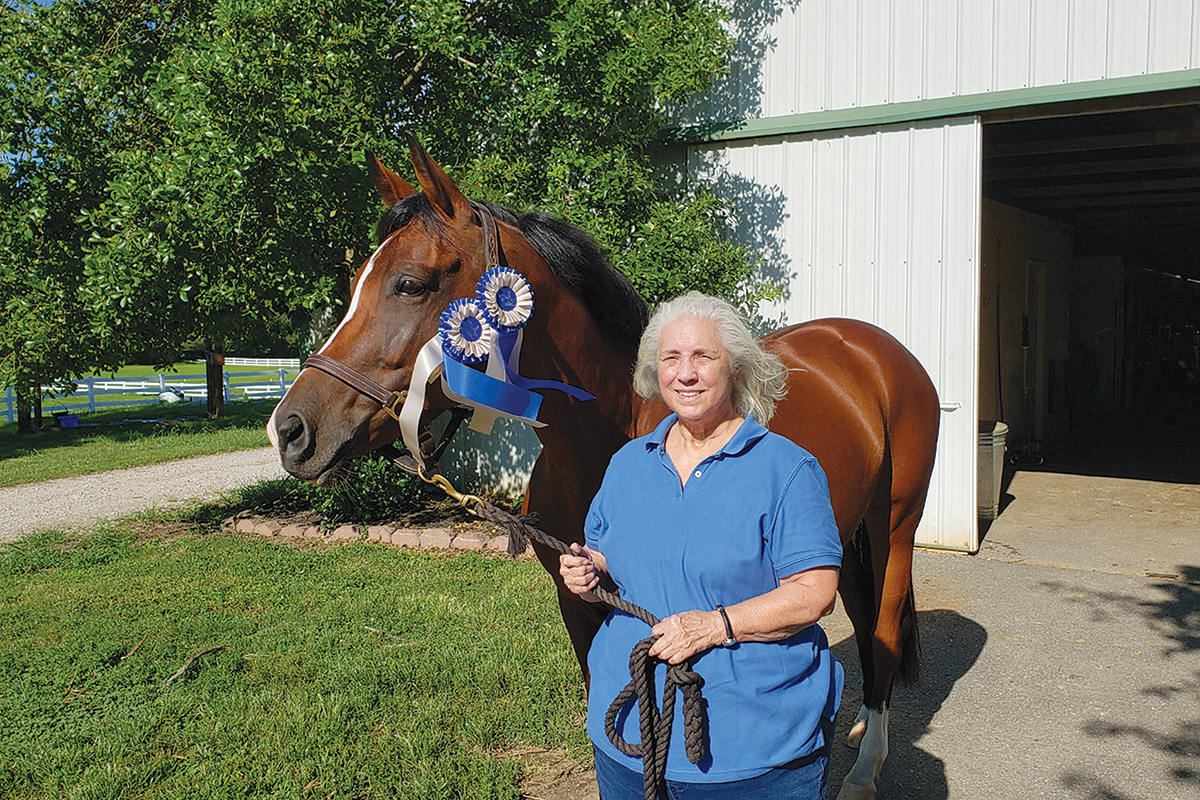
Meet Celesta
Celesta Albonetti has ridden since she was a young woman, beginning with hunters, jumpers and eventing before committing to dressage. Celesta loved her small farm in eastern Iowa, surrounded by creeks, woods and farm fields. Her two Trakehner mares loved it, too.
After 16 years there, she retired and returned to Memphis, Tenn., and her family. Her older mare with exquisite gaits and flash had passed away a few years earlier.
Celesta brought the younger mare, Angie, to Tennessee. She found a suitable dressage barn and became friends with riders at the barn who were able to ride Angie for her. Celesta spent hours there, as she has always cared for her horses in this way. Tragically, Angie later became ill and passed away. Most of us can empathize with the grief this brought to Celesta.
When she was ready for another horse, Celesta purchased another Trakehner mare, a 6-year-old she found in Kentucky. Baroness III, called “Aliza” in the barn, was foaled in 2015 and spent two years as a broodmare prior to Celesta purchasing her in August 2021.
Celesta Albonetti purchased her 6-year-old Trakehner mare, Aliza, to get back into her favorite past time. Photo by Landon Stocks
“I felt alive again,” she says. “I go out every day, and I love it.”
After a stall became available in her trainer’s barn in Eads, Tenn., Celesta moved her mare there. The trainer works with Aliza each week, and her progress makes all three very happy. Celesta’s trainer, Macy, has started to show Aliza, and the three share the excitement of their progress. Their plans are to show at Training and First Level during the summer and fall.
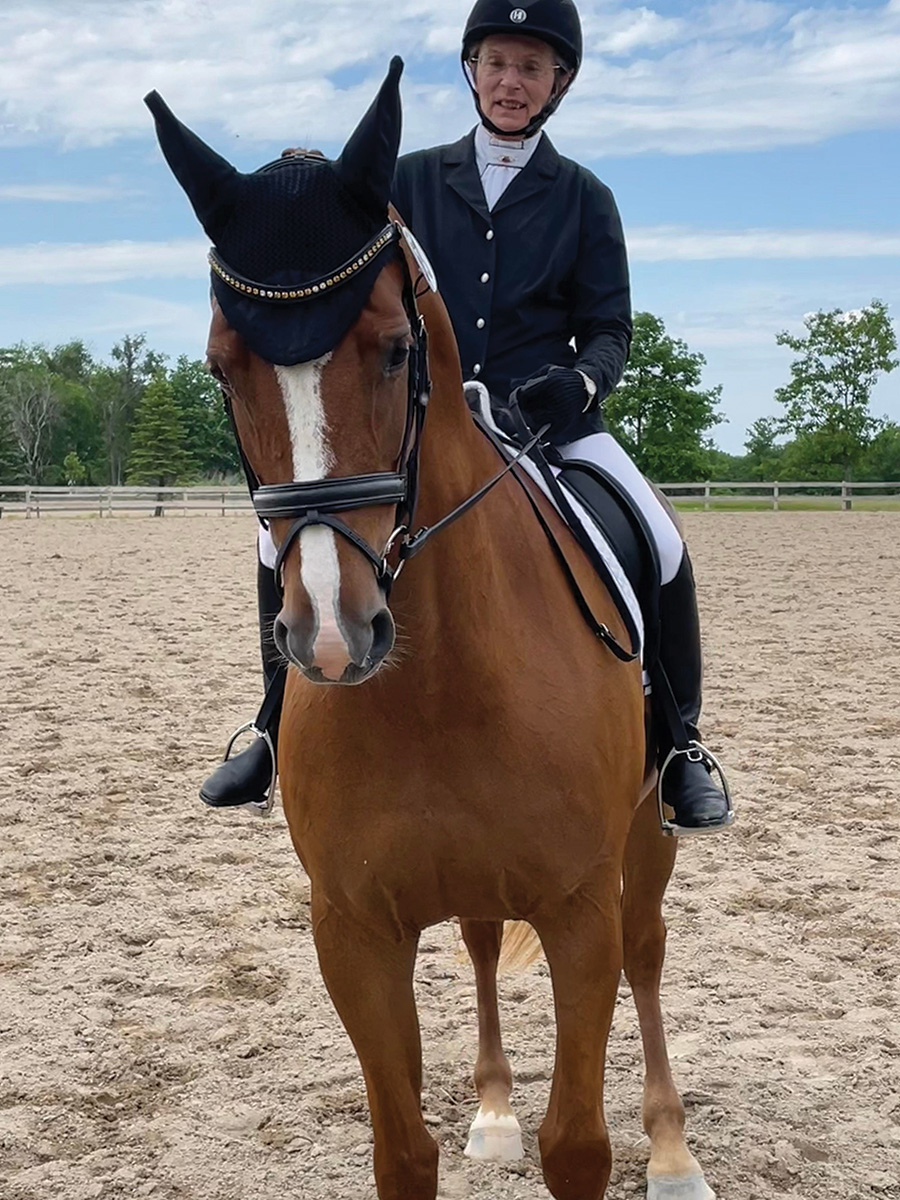
Meet Ellen
Ellen Spector has spent her lifetime riding. After years of working, raising children, and boarding her horses, she settled in Iowa, where she and her husband bought a large acreage and put up a 12-stall boarding barn, West Branch Horse Farm. She moved from hunter/jumpers into dressage. She bought mares and started to raise her own dressage horses. Ellen prided her barn as having the best care in the area.
The years passed with many beautiful horses and many devoted boarders. As Ellen’s horses aged and passed away, she found herself without a horse of her own and began to think about the next one—a horse she would keep even after eventually selling the property.
With her husband’s encouragement, Ellen traveled to Denmark with a Danish boarder, Susanne. Susanne’s sister drove them from barn to barn, searching for the right horse. The three dressage riders found a lovely young mare for Ellen, who has always loved mares.
She bought home the 5-year-old Danish Warmblood mare Kokkedals Heroine, barn name “Heroine,” in 2016. With some help from professional trainers, they have begun to compete at recognized dressage shows, a long-time goal.
Ellen Spector was horseless for a time before importing her 5-year-old Danish Warmblood, Heroine, in 2016. Photo by Amy Wilkinson
“We plan to go to three show this summer at Maffit Lake [near Des Moines, Iowa],” she says. “I can’t do without her.” They spend time together every day as Ellen is doing chores and riding.
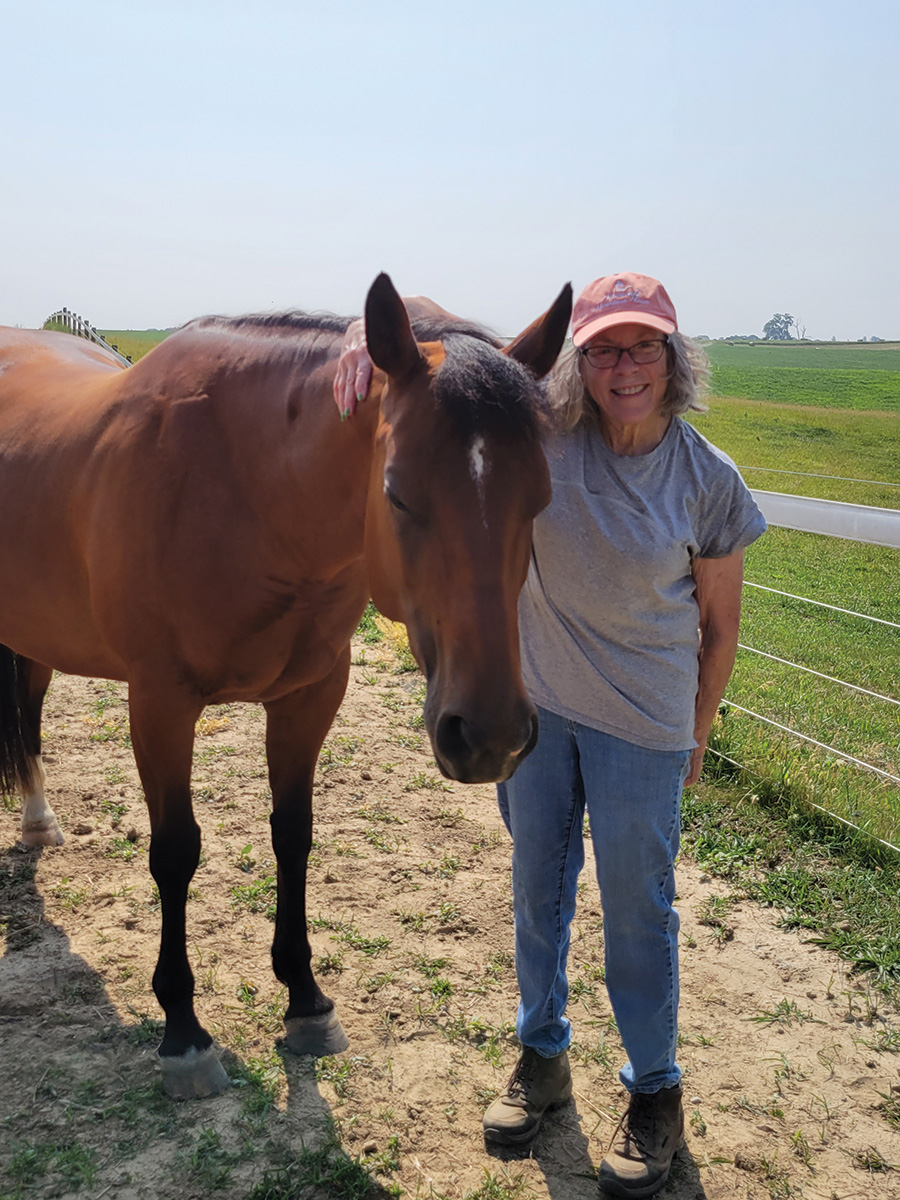
Meet Judy, the Author
As for me, I adopted a rescued yearling in 2004 named Coach, a Hackney. In 2021 he had a pasture accident and had to be put down, which was very traumatic for me.
The mare that shared the pasture with him left, so no horses remained on my property. I decided I needed to find a quiet horse for myself, my kids, and my friends. I found Nellie at a small farm 90 minutes away; her teenage owner had outgrown her.
After her Hackney Pony’s unexpected passing in 2021, Judy took some time off from horse ownership before deciding she was ready to purchase her new horse, Nellie. Photo by Ariel Zimmerman
I made two trips with friends to meet and ride Nellie before trailering her home. Her age was uncertain, maybe 10 or 11. They never got papers, but called her a Quarter Horse, which seems correct. She’d had a healthy foal that year. She is pretty and quiet.
She and the older Percheron-cross we board for a friend got along from the beginning. Gracie is huge but sweet. Nellie and I connected during the first year. She calls to me from the pasture when I am in the house. She was ridden with western and English saddles.
I’m not riding now and have not been able to find someone to ride her, but she is a happy horse. These two are the quietest horses we have ever had. I put on their masks, groom and spray them in our large dry lot with no halters or lead ropes. They don’t spook or run from crop dusters or large farm equipment. They come for dinner when called.
Getting Back into Horse Ownership
All four women, including four myself, have gone through the process of asking difficult questions.
Why buy a horse now? We found ourselves with room in our hearts to fill after losing or selling our previous horses. Two decided on young horses, knowing their needed training would be long and costly.
Three met trainers who could ride their horses for them. As long-time owners, we already knew the realities of horse ownership, how much help was needed, and where to find it.
If you’re thinking of getting back into horse ownership, think first of the horse’s wellbeing. You need a safe and well-maintained barn, whether at home or a boarding facility.
If at home, you’ll need a backup person to provide the horse care when you can’t. You must have a budget that will accommodate the numerous additional expenses that come with adding a horse to the family.
We all need to have plans for our horses and pets when we are no longer present. If you’re at the beginning of your riding life, you may not have thought of a future after you’re gone. Longtime horse owners tend to be more prepared and plan for this step. This is important to consider before jumping into horse ownership—for horse lovers of any age.
But as you look out into the pasture and feel that space in your heart has been filled, all of the time, financial and organizational challenges seem worth it.
We use cookies to help personalize content, tailor and measure ads, and provide a safer experience. By navigating the site, you agree to the use of cookies to collect information. Read our Cookie Policy.