We hear a lot about “burnout” these days when it comes to work, but it can also happen when it comes to our horses. Depending on how you approach your time with horses, both humans and horses can feel burnout. It’s something we want to avoid, though; no one wants to end up feeling like they don’t want to visit the barn. Enter energy intelligence.
What is Energy Intelligence?
You may have heard of emotional intelligence and the soft skills required to build great relationships, such as trust, connection and kindness. All of these are crucial in horsemanship, but the next level work is “energy intelligence.”
Simply put, energy intelligence is the awareness of your own energy resources and the ability to influence your energy output in life and work.
As Nikola Tesla said, “If you want to find the secrets of the universe, think in terms of energy, frequency and vibration.” While emotional intelligence is mostly about relationships and communication, energy intelligence is often about how we each govern ourselves and show up for life.
When you have more energy, you are often clearer and have more motivation, which then creates better relationships and performance. Your energy doesn’t just impact communication, it’s a form of communication.
Applying to Horses
In the horse world, other people assume that you love your equines all the time. Most of us do until we don’t—and then we need a break from mucking, riding, showing, or working with clients as trainers or instructors.
This can be an unspoken issue. Many can suffer in silence because of these expectations that a “horse girl” always wants to live and breathe riding. Yet when you’re exhausted and depleted, your interest can become diminished and—more importantly—your safety as well.
You’ve probably heard stories of people who rode when they shouldn’t have and paid the price in some way. When you’re too tired, it’s a signpost that you need to respect your own energy resources so burnout can be prevented.
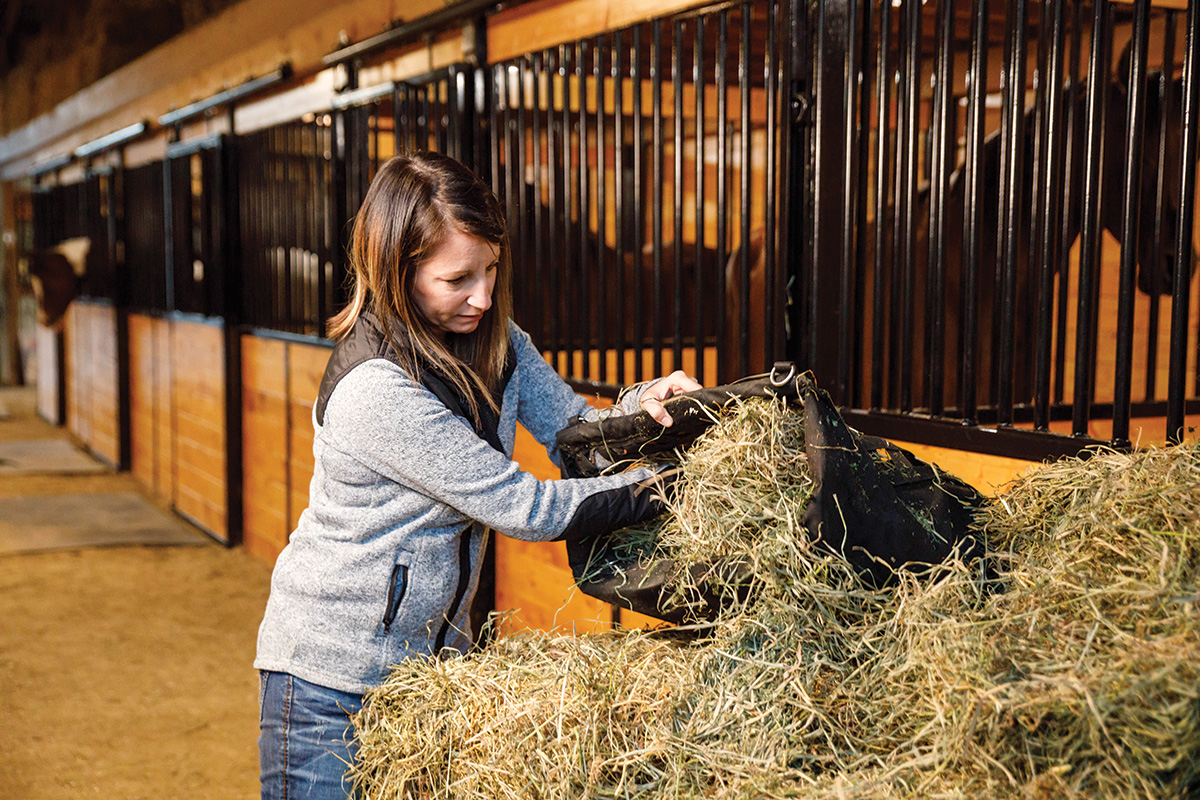
No matter how much you love horses, it’s still possible to need a rest from endless feeding, mucking, riding or showing to prevent burnout. Photo by Shelley Paulson
It’s the same for your horse. You probably know not to push him, but are still tempted to push yourself—and horses feel this as well.
They can sense and feel your physical state as well as your emotional, mental, and spiritual states. They know and read your energy, but do you? Ultimately, the goal is more connection with your horse, and that comes down to energy intelligence.
Happier and Healthier
Brene Brown says: “I define connection as the energy that exists between people when they feel seen, heard, and valued; when they can give and receive without judgment; and when they derive sustenance and strength from the relationship.”
This is true for horses as well, and when they are happier and healthier, they’re more productive and connected. One of the ways you can value them is to adjust your energy when you are with them to be authentic, congruent and joyful. However, it’s much easier to do this when you are rested, clear, and present, which is when you are managing your energy well.
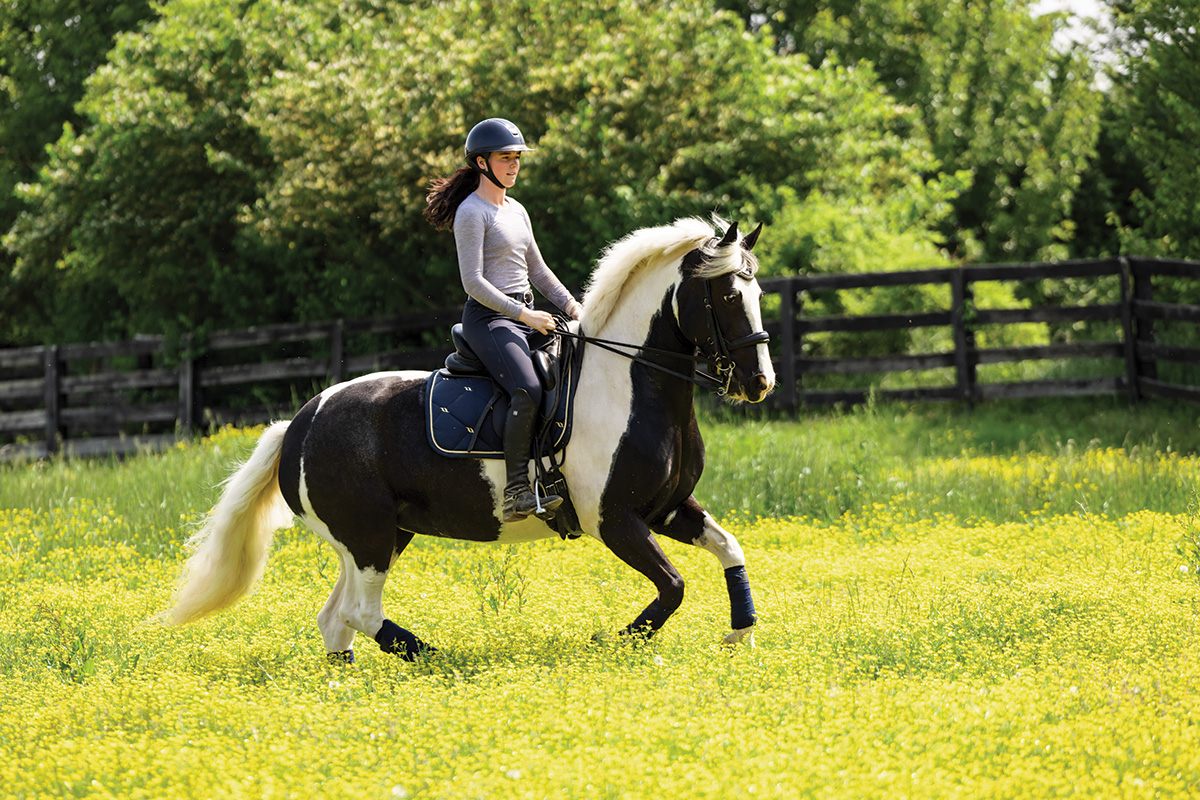
One way you can value your horse is to be rested and present, which happens when you are managing your energy well. Photo by Shelley Paulson
You can also note when your horse exhibits enjoyment and engagement and has a healthy flow of energy in his work and with his herd. Often making adjustments to his basic needs, such as friends, food, water, shelter, and exercise can help him feel safer, more rested, and content. This will improve his energy and leads to him to being a better version of himself, which in turn helps your relationship with him.
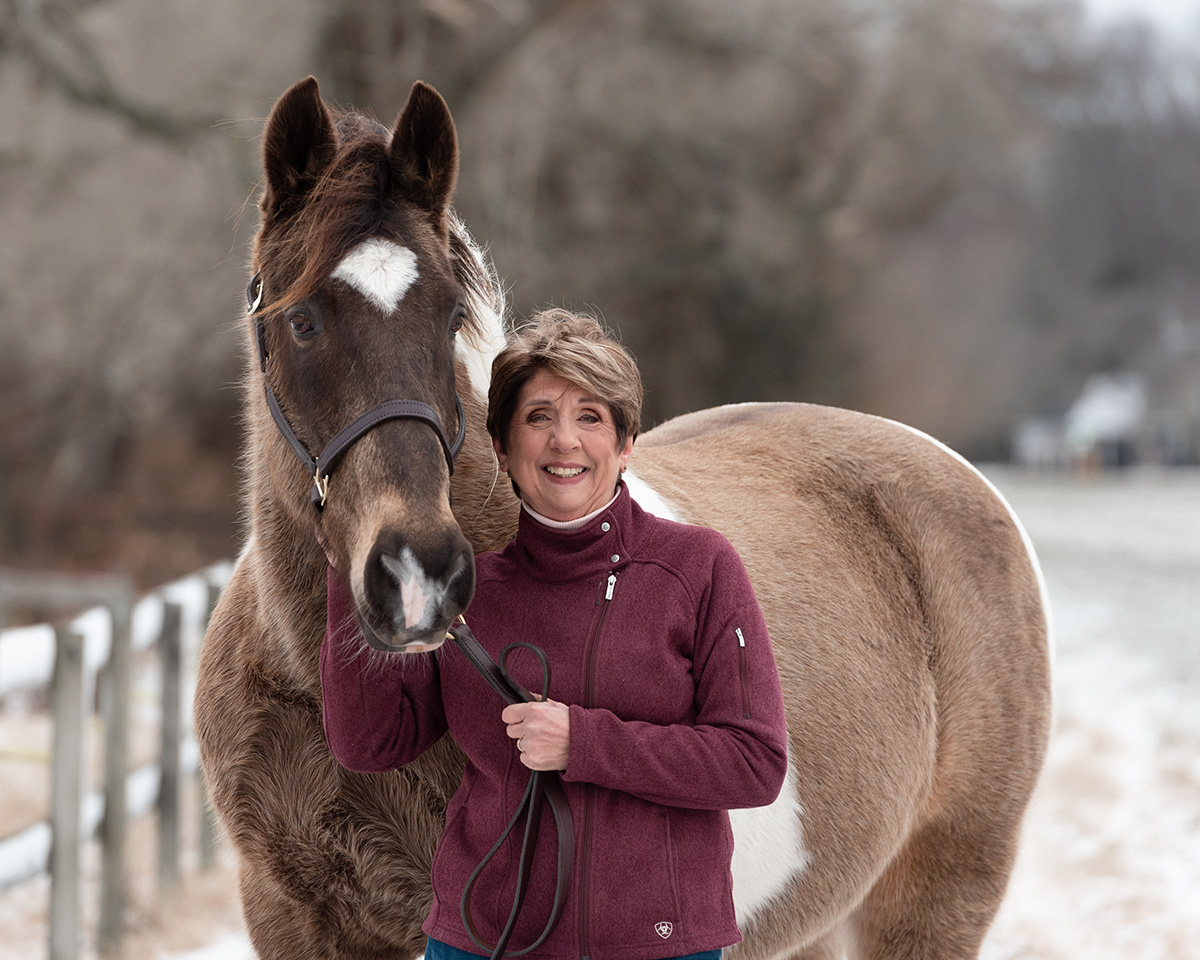
Ensure your horse’s healthy flow of energy through such things as careful herdmate selection, which help him feel safe and content. Photo by Shelley Paulson
Becoming Aware
Energy intelligence begins with awareness. We all need to take conscious pauses to reflect.
Ideally, you do this each day at some point, whether in meditation or through journaling. It’s also especially important before you enter physical space with your horse.
Some questions you can ask during this reflection are below; you can ask these about both yourself and your horse.
◆ What does it feel like to have energy? When do I have the most or the least?
◆ How do I know when my energy is flowing well? How do I know when it’s stuck?
◆ What gives me energy?
◆ What depletes or drains my energy?
◆ How do I replenish when my energy is gone?
Plentiful food and water throughout the day helps both people and animals gain energy, as opposed to draining it. Photo by ccestep/Adobe Stock
After this reflection, you can list specifics about your gains and drains for you and your horse. Here are some examples.
Gains:
◆ Healthy food
◆ Restful sleep
◆ Enough water throughout the day
◆ Time spent with loved ones
◆ Main love language is met (see the book The Five Love Languages for more)
Drains:
◆ Being interrupted
◆ Fights and disagreement
◆ Lifting too much and over-working
◆ Feeling ignored or not seen
◆ Not being asked permission
Key Takeaway
There is still much more to explore in this space, so I’ve created an energy intelligence assessment tool for horse lovers/equestrians. If you’d like the document, email me through my website and I’d be happy to provide it.
Until then, remember that increasing your fulfillment through energy intelligence will create sustainable success for you and your horse. You can prevent burnout and grow your deep love for these majestic creatures.
Welcome to Barn Banter, the official podcast of Horse Illustrated. In Barn Banter episode 30, hosts Susan Friedland and Horse Illustrated Editor In Chief Holly Caccamise chat with writer Fran Severn, author of Riders of a Certain Age and a frequent Horse Illustrated contributor. Plus, tune in as they talk with sponsored guest Sara Goldsmith, a therapist with extensive equestrian knowledge who specializes in helping children and adolescents.
To end the episode, Susan and Holly chat with Nicky Walters, founder and president of West Virginia Horse Network, about Wilma, this month’s ASPCA Right Horse adoptable horse.
Fran Severn grew up in the city but was determined to get horses in her life. Working as a reporter in Louisville, Ky., she covered the Kentucky Derby, events at the Kentucky Horse Park, and bought her first horse. She’s written about the exclusive ‘tailgate’ party at the Royal Enclosure at the Ascot races, shipping horses to the Olympics, riding on Civil War battlefields, and the chuckwagon races at the Calgary Stampede. Her first book, Riders of a Certain Age, came about as she looked for information about the challenges for older women riders. Her new book, The Riders of a Certain Age Book of Barn Hacks, is the result of her near-obsession for collecting tips and ideas for making life easier around the barn.
Sara is a dedicated therapist specializing in helping children and adolescents navigate mental health challenges. With nearly two decades of experience working with children, she combines her expertise in therapy with a deep personal understanding of competitive equestrian sports. As a licensed clinical social worker in both New York and Florida, Sara provides individual therapy, family therapy, and on-site support at horse shows to help young athletes manage anxiety, build confidence, and reach their full potential.
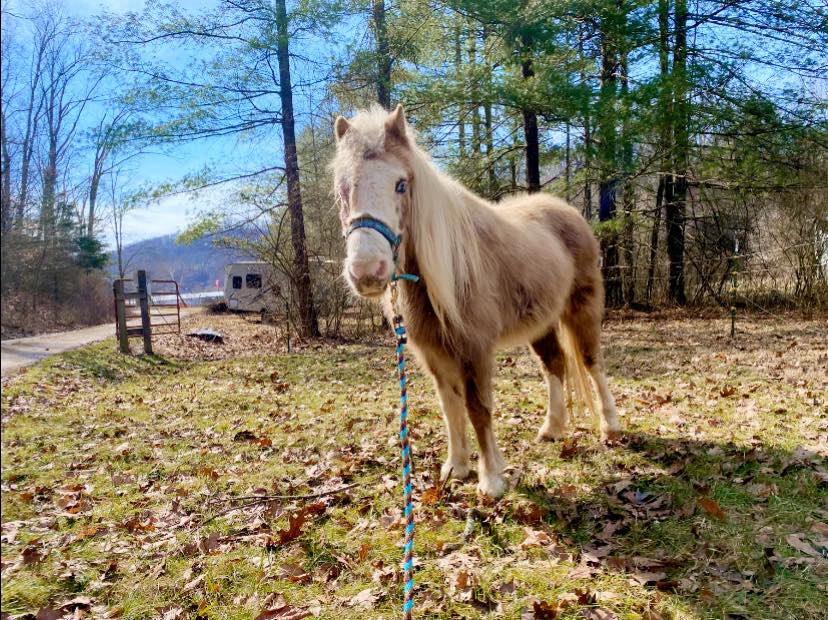
Wilma is a plucky 31-year-old pony mare with a zest for life. She was dumped at an auction, emaciated and close to completely blind. Thankfully, a follower of West Virginia Horse Network was at the auction and was able to intercept her and get her to them..
Wilma is in her later years and has been slow to regain weight. But with a good diet she is getting better every day. Wilma is not on any medications but does need a consistent diet that is appropriate for a senior horse poor dental health. She did have an eye removed last month that was causing her discomfort, but is healing well.
She is nervous at first because of her limited vision but can be handled once she gets to know you. She is otherwise quite happy and likes to run and play.
Wilma is not for someone with smaller children. An adopter absolutely must be willing to stick to the feeding protocol that WVHN’s vet recommends for Wilma.
WHVN realizes that Wilma’s life may be in the sunset versus the sunrise, but we know there are plenty of kind and loving people out there who would love to be the ones to give her the glorious life she deserves. You will get the chance to continue righting the wrongs she suffered before coming to WHVN and when it is time to give her a great send off surrounded by love. Once you meet her, though, you’ll see there’s plenty of good life waiting to be lived.
The board of directors of Grayson-Jockey Club Research Foundation announced that it has authorized expenditure of $2,693,312 to fund 16 new projects and 10 continuing projects at 17 universities as well as two career development awards. The 2025 slate of research brings Grayson’s totals since 1940 to more than $44.4 million to underwrite more than 450 projects at 48 universities.
“I’m very proud of Grayson’s commitment to furthering the research and development of projects that affect all horses, no matter their breed or discipline,” said Jamie Haydon, president of Grayson. “We are equally ecstatic that we could offer our two career development awards to this year’s recipients, continuing to cultivate a future for young researchers.”
Below is an alphabetical list by school of the new projects:
Can Smartphone-Based Sensors Provide Reliable And Repeat able Lameness Data
Melissa King, Colorado State University
This project will test the reliability and repeatability of body-mounted and smartphone IMU sensors with machine learning and computational algorithms in lame and non-lame horses.
Chimeric VP7-VP4 MVA-Vectored Equine Rotavirus Vaccines
Mariano Carossino, Louisiana State University
In this study novel chimeric vaccinia-vectored vaccines against equine rotavirus A G3 and G14, the leading cause of foal diarrhea, will be designed and evaluated in mice (proof-of-concept) and mares.
Ex Vivo DFTS Adhesion Model To Evaluate Therapies
Lauren Schnabel, North Carolina State University
This project will advance our understanding and treatment of adhesions that occur in the digital flexor tendon sheath of horses following injury and result in improved prognosis for performance.
Effects Of SGLT2i On Triamcinolone-Induced Equine ID
Teresa Burns, The Ohio State University
This proposal will evaluate the degree to which joint injections with triamcinolone worsen insulin dysregulation in horses with ID and if use of canagliflozin at time of injection mitigates it.
Finite Element Analysis Of SDFT Microdamage
Sushmitha Durgam, The Ohio State University
This proposal will study the multi-scale finite element models (FEM) that predict equine superficial digital flexor tendon (SDFT) mechanical behavior that are essential to delineate microdamage mechanisms preceding clinical injury.
A Molecular Study On Hemorrhagic Anovulatory Follicles
Eduardo Gastal, Southern Illinois University-Carbondale
This study investigates gene and hormone levels in HAFs, the leading cause of ovulation failure in mares, using a novel technique (Follicle Wall Biopsy-Trinity) to collect multiple follicular samples.
Improving a VapA mRNA Vaccine For R. Equi In Foals
Noah Cohen, Texas A&M University
The aim of this study is to improve the design of a mRNA vaccine for foals to provide stronger, longer immunity against Rhodococcus equi, a leading cause of disease and death in foals worldwide.
Organoid Model For Equine Placentitis Research
Pouya Dini, University of California-Davis
This project’s aim is to develop an in vitro model of equine placentitis to advance the study of this condition, ultimately improving diagnostics, treatments, and pregnancy outcomes.
Genetics Of Cervical Spine Malformations In The Horse
Carrie Finno, University of California-Davis
This study will identify genetic causes for abnormal formation of the cervical spine in horses.
Pharmacokinetics And Efficacy Of Pregabalin In Horses
Heather Knych, University of California-Davis
The study seeks to investigate the behavior of an analgesic agent approved for use in humans for the treatment of persistent pain, as a first step in assessing the utility of this drug for pain control in horses.
Characterization Of Antibodies Against Equine IL-31
Rosanna Marsela, University of Florida
This proposal aims to develop a new treatment for equine insect bite hypersensitivity (IBH) by targeting a key itch mediator, providing an alternative to steroids.
Characterization Of Laminitis Using PET
Dianne McFarlane, University of Florida
This study will validate the use of PET scans for identifying disease pathology and progression in insulin associated laminitis in horses.
Effects Of Inflammatory Cytokines On MSC Homing
John Peroni, University of Georgia
This study will investigate how mesenchymal stem cells traffic to injuries after delivery to the bloodstream to inform the best time to deliver cells relative to initial injury in future animal models.
Racehorse Stride Changes And Workload During Training
Peta Hitchens, University of Melbourne
By determining whether the workload and changes in stride characteristics associated with injury during racing are also present during training, this project may identify injuries prior to race day.
Synthetic Proteoglycan Replacement For Osteoarthritis
Kyla Ortved, University of Pennsylvania
This proposal seeks to establish a new class of injectable, cartilage-penetrating compounds made from synthetic polyelectrolytes that replace proteoglycans that are critically lost in osteoarthritis.
Wearable Biometric Sensor Development American Association of Equine Practitioners
Provide funding for the epidemiological work associated with the data gathered through the field testing of the selected biomechanical sensors.
Career Development Awards
The Storm Cat Career Development Award, inaugurated in 2006, grants $20,000 to an individual considering a career in equine research. This year, Grayson awarded Dr. Erica Secor, Cornell University.
Dr. Secor is a class of 2013 graduate from Cornell University College of Veterinary Medicine and is attending Cornell as a Ph.D. student. Dr. Secor is an equine surgeon whose knowledge is growing readily under the supervision of Dr. Heidi Reesink, a former Storm Cat Award winner.
The proposed study, defining the immune cell populations present in naturally occurring equine Osteoarthritis and the response to intra-articular therapeutics, expands on the limited knowledge regarding immune cell populations within equine joints with osteoarthritis.
The Elaine and Bertram Klein Career Development Award was first awarded in 2015 and grants $20,000 to a prospective equine researcher. This year’s recipient is Dr. Shannon Connard, North Carolina State University.
After Dr. Connard received her Doctor of Veterinary Medicine in 2017 from the University of Georgia, she went on to pursue an internship at Louisiana State University followed by a large animal internship and residency at the University of Pennsylvania’s School of Veterinary Medicine. Through this, Dr. Connard achieved board certification with the American College of Veterinary Surgeons in 2023. She is a postdoctoral fellow / Ph.D. candidate in the Comparative Medicine and Translational Research Training Program at North Carolina State University. Dr. Connard’s current research is dedicated to the advancement of regenerative therapies for equine musculoskeletal injuries.
Dr. Connard’s project, harnessing stem cells licensing to enhance tendon healing, aims to further the understanding of intralesional mesenchymal stem cell (MSC) therapy in treating equine tendon injuries, under the supervision of Dr. Lauren Schnabel.
Details on the new projects are available at the following link here.
Grayson-Jockey Club Research Foundation is traditionally the nation’s leading source of private funding for equine medical research that benefits all breeds of horses. Since 1940, Grayson has provided nearly $44.4 million to underwrite more than 450 projects at 48 universities. Additional information about the foundation is available at grayson-jockeyclub.org.
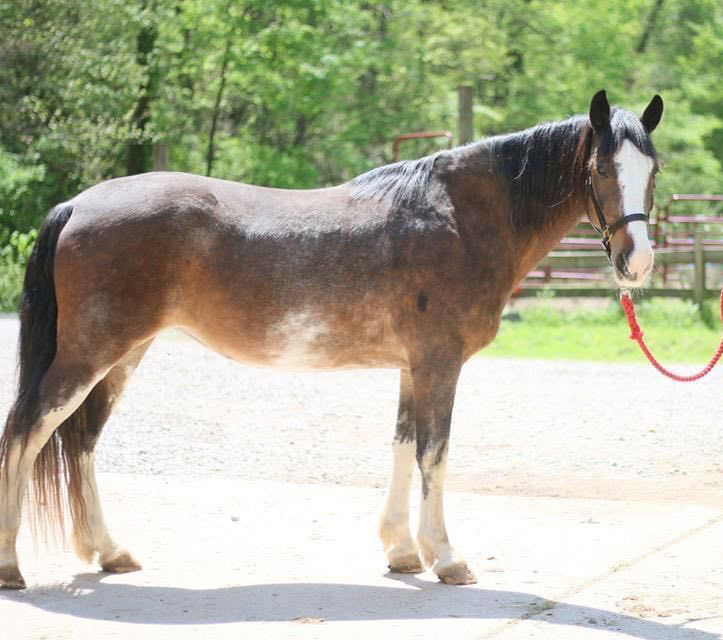
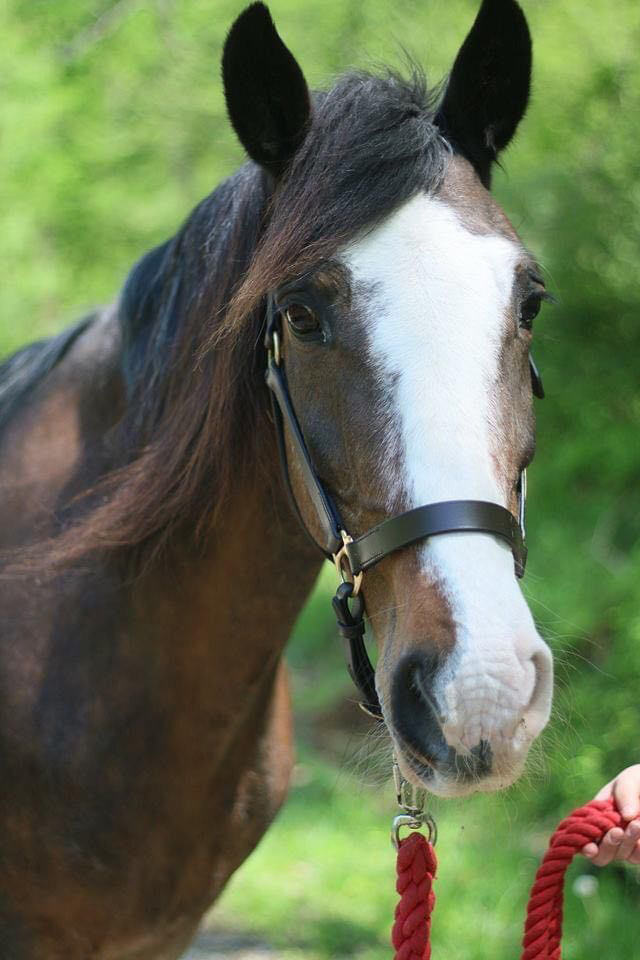
Lucille, also known as Keepsake, is looking for the perfect home where she can live her best life munching treats, hanging out with friends and looking beautiful. West Virginia Horse Network’s veterinarian believes her ideal career is being a pet or pasture puff because of an old injury. She is fully pasture sound without any additional supplements or extra care. She also does excellent being led through obstacles and playing games on the ground. She’d do fine with in-hand obstacles at a local show or in a therapy program.
Lucille has been adopted and returned several times now, due to no fault whatsoever of her own. It has just been a string of unfortunate luck. We’d love to find a new and long term placement for her quickly, with a new friend.
ASPCA Right Horse is the online adoption platform of The Right Horse Initiative, a collection of equine industry and welfare professionals and advocates working together to improve the lives of horses in transition. A program of the ASPCA, their goal is to massively increase horse adoption in the United States. To find more adoptable horses and foster horses, visit www.myrighthorse.org. To learn more about The Right Horse, a program of the ASPCA, visit www.aspcarighthorse.org.
As you brush your horse’s lower legs, you spy something curious. There’s a little patch of hair that’s ruffled, like a 5-year-old’s bed head after a deep night’s sleep. Or it looks shaved, like crushed velvet. But there’s nothing else wrong, so you shrug it off. Maybe you just never noticed it before. But these innocuous little patches of disturbed hair on your horse’s fetlocks, knees and hocks can be the first sign of the potentially heartbreaking cycle of bed sores.
Also known as pressure sores, pressure ulcers, paddock sores or stall sores, they are not something you want your horse to experience. Why? Because horses that develop them seem to be prone to them in the future, and once the cycle of injury begins, healing bed sores can take a long time.
What Are Bed Sores?
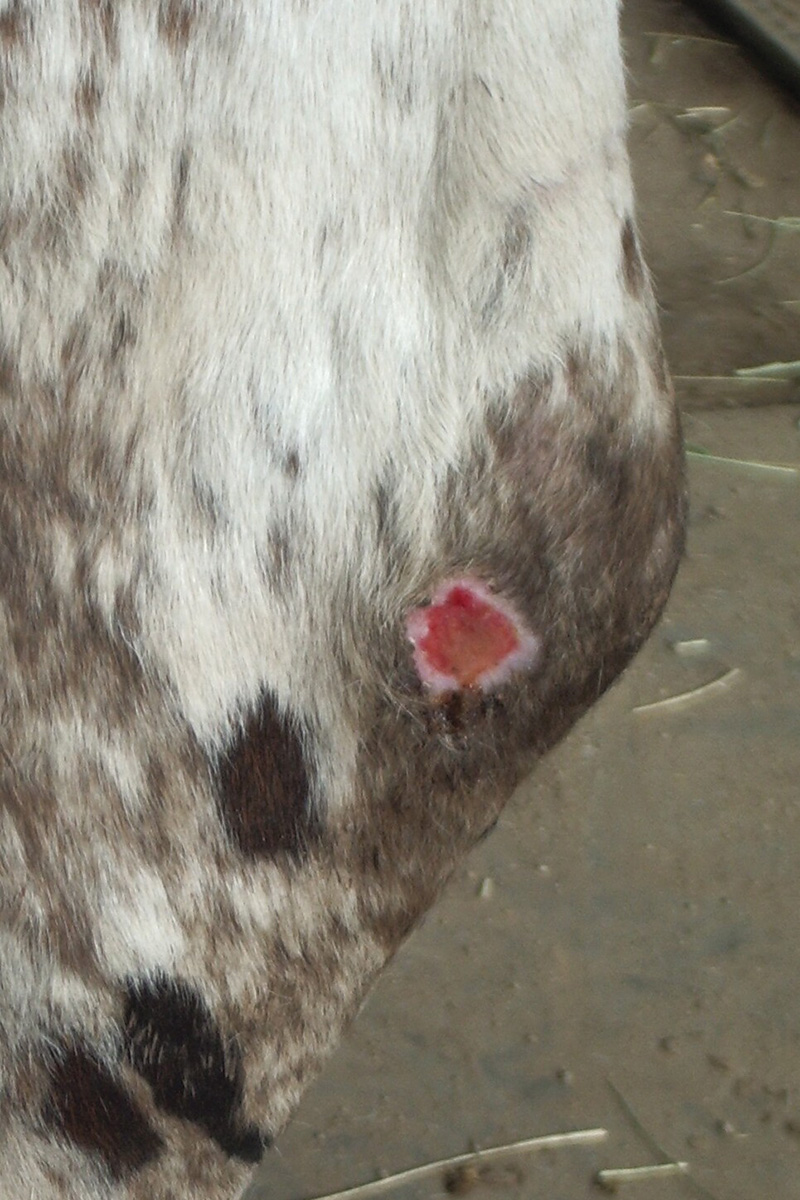
They are open wounds caused by friction or unrelieved pressure on the bony joints: fetlocks, knees, hocks, and even the point of the hip—anywhere there is little muscle or padding.
Bed sores occur on bony areas with little muscle or padding.
What Causes Them?
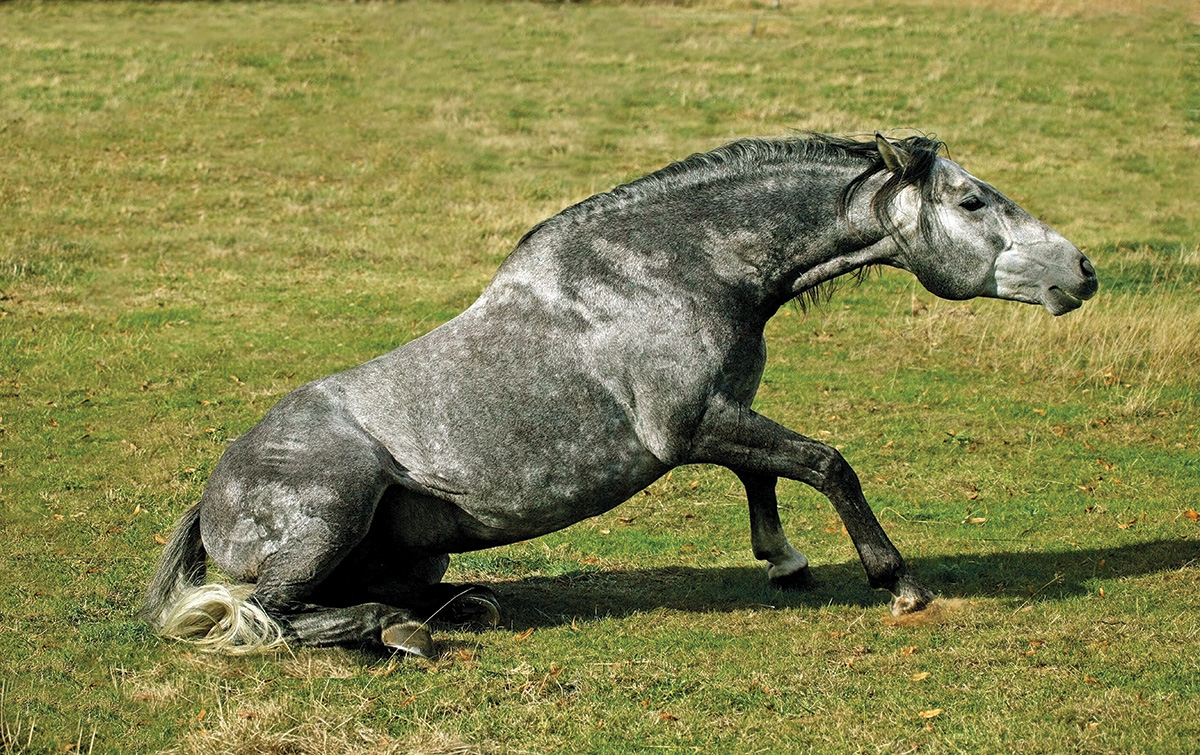
Pressure or friction from lying down and getting up from hard ground or bare stall mats can start the cycle of bed sores.
Pressure or friction from lying down and getting up from hard ground or bare stall mats can start the cycle of bed sores. Photo by slowmotiongli/Adobe Stock
Why Are Some Horses More Susceptible to Bed Sores?
Horses on stall rest for illness or injury can be prone to bed sores if they lie down a lot, as well as horses stabled on dry lots that lie down on hard, compacted ground.
Older horses and those with weakened immune systems seem to be more prone to them, and to have them develop into more significant wounds.
Horses that have lost strength in their hindquarters and struggle to get up easily after lying down can be more prone to developing bed sores. Another cause is narcolepsy: sudden episodes of a horse falling asleep while standing, which collapses the horse onto his fetlocks without warning.
How Can You Prevent Them?
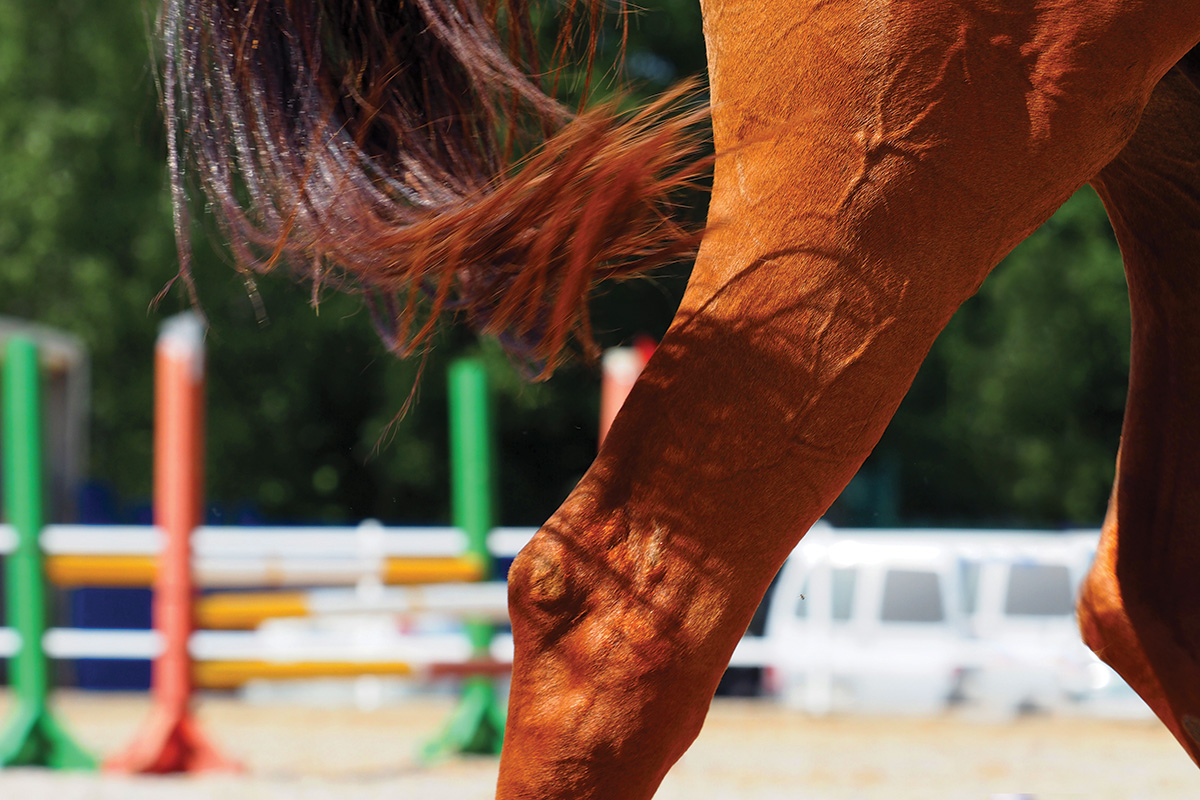
Preventing bed sores is key. During daily grooming, pay attention to the front of the fetlocks and knees and the outside points of the hocks. Be on the lookout for ruffled hair or hair that’s starting to rub away or looks crushed.
Photo by ANGHI/Adobe Stock
Now is the time to apply preventive treatments—before the skin develops a small, open wound. The time you take now may save agonizing days, and potentially weeks, of frustration in healing an open sore.
Here are a few ideas:
1. Apply boots or other protection.
Several manufacturers make a range of boot styles, from cushy and fleece-lined to more utilitarian rubber.
Some horse owners have success preventing bed sores by putting on a rubber bell boot upside down. Instead of the boot covering the coronet band and the hoof, it’s turned upward, covering the fetlock.
Whichever protective option you choose, be sure to monitor and remove it often to brush out any collected gravel, hay and other potential irritants. The goal is to keep dirt from collecting under the boot, causing even more abrasion and increasing the possibility for a sore to develop. While the boots are removed, you can monitor any potential wounds developing.
Tip: If your budget allows, buy two pairs of boots. This way, your horse can always wear a clean pair while the other is washed and allowed to air dry. See below for product options.
2. Add soft bedding.
If your horse in stabled on a dry lot, adding an area of soft bedding to lie down can go a long way in preventing bed sores. If your horse is stalled, adding deeper bedding can do the same.
Depending on the environment and your horse’s sensitivity, he may need to wear protective boots continually. That said, it’s important to remove them when possible, and especially during exercise, to allow airflow so the skin can dry. Days in a moist boot can weaken the skin.
Prevention Products
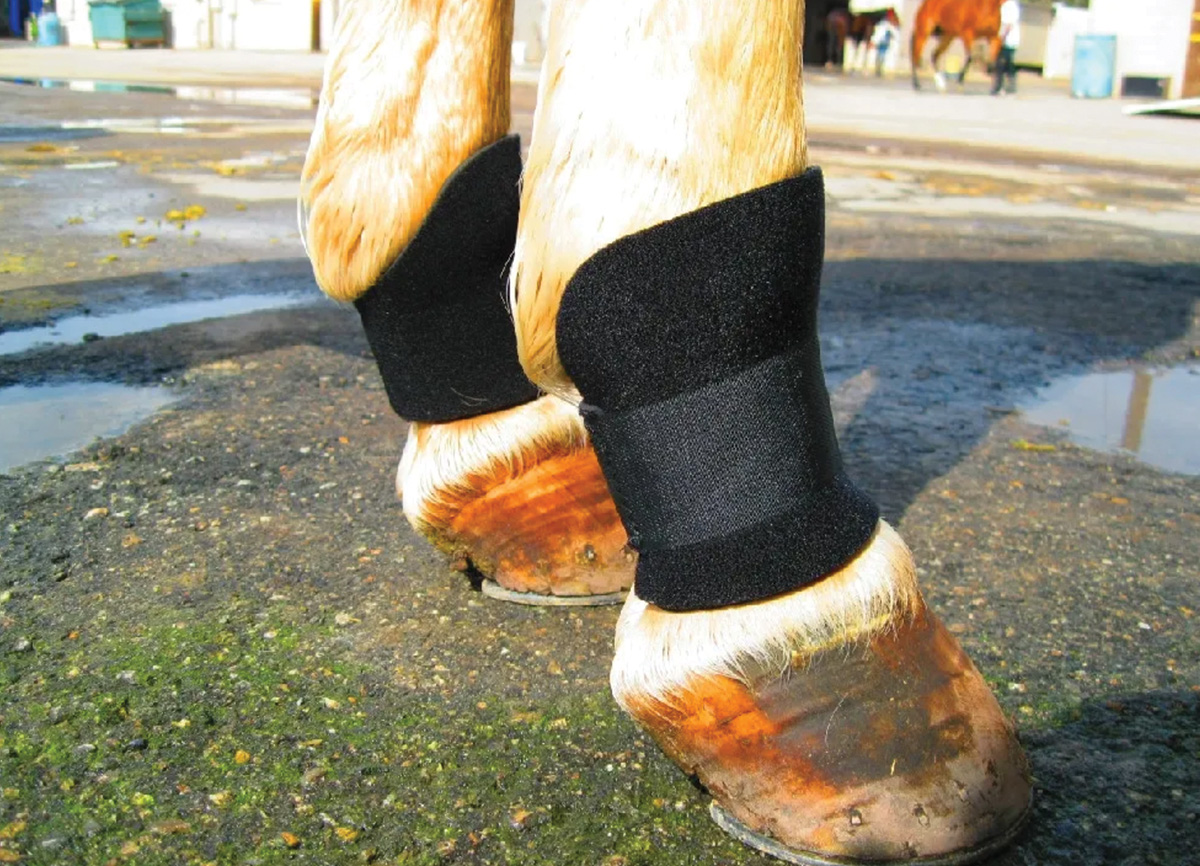
Equipro Bedsore Boots
Equipro Bedsore Boots
These boots feature synthetic sheepskin lining and are easy to put on (yes, really!). They won’t shift when put on correctly, protecting the fetlock from sores. Promotes faster healing of existing bed sores and pressure sores while protecting against re-injury of existing sores. Shop for $41.50 at equipro.com.
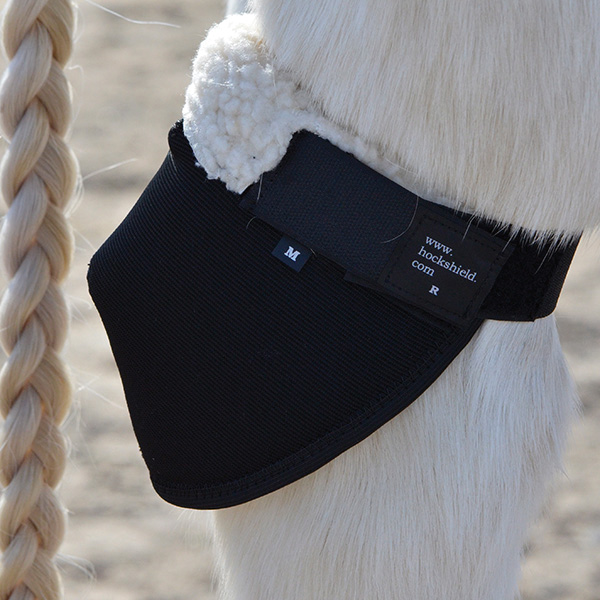
Click Hock Shield
Click Hock Shield
The low-profile design offers full coverage in the area where horses develop sores. The soft, flexible pocket in the center back of the Hock Shield provides comfort in the delicate area where the tendons pass just under the skin. This is the perfect solution for the majority of horses with hock sores. Now available in two adjustable sizes. Shop for $49.99 at hockshield.com.
Silver Whinnys
Silver Whinnys
An alternative to bandaging and fly protection or a barrier used to protect legs while scratches, mud fever, summer sores, and wounds heal. The socks breathe, allowing air to reach the skin surface, while moisture-managing yarns keep skin tissue dry. High-performance yarn continuously protects the socks from playing host to bacteria, fungus, mold and mildew. Shop for $90.00 at soxforhorses.com.
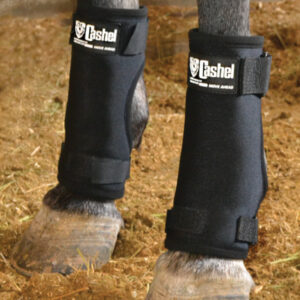
Cashel Stall Sore Boots
Cashel Stall Sore Boots
A simple solution for horses bruising and developing pressure sores on the foreleg as a result of being down with medical conditions or stalled on hard surfaces. Helps protect existing sores from further aggravation for faster healing. Neoprene exterior, soft fleece lining, and open back for added comfort. Adjustable straps allow the boot to fit a wide range of leg sizes. Shop for $43.99 at cashelcompany.com.
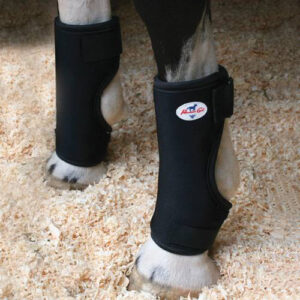
Professional’s Choice Bed Sore Boots
Professional’s Choice Bed Sore Boots
These boots help to protect the front of the fetlock joint from developing bed sores and shield existing sores from insects and debris while they heal. Made of a breathable fleece interior and a neoprene exterior with long-lasting hook and loop closures. Shop for $42.95 at profchoice.com.
How Do You Treat a Horse’s Bed Sores?
If you see a small sore developing, take aggressive action! Waiting to see if it heals on its own is risky, as the sore can quickly get bigger, deeper, and harder to heal.
In horses with compromised immunity, the sores can also become infected easily. If you live in an area with Habronema larvae, flies will deposit these nasty critters in the smallest wound and turn it from a dime-sized minor abrasion to an ugly, open sore double or triple the size in a few days. You don’t want this.
◆Treating small sores: Dab on a bit of antibiotic ointment and cover with a nonstick sterile pad. Cover with sheet cotton and wrap the area with red gauze, then finish with Vetrap. Consult your veterinarian for proper wrapping technique, as too-tight bandaging can cause serious damage.
Once the wrap is in place, cover it with a boot. Fleece-lined boots are great at this stage, as they fit snugly and keep the wrap clean and in place for several days.
Remove the wrap in a few days and check the progress of healing. If the sore is closed and healed, you can put the clean boot back on.
Monitor frequently and carefully, as this area is now much more prone to future sores.
◆Treating large sores: You’ll need keep up the wrapping and booting, with frequent changes of dressing, until the wound is healed.
Be on the lookout for fluid oozing through the bandage and soaking into the boot. If this happens, clean and dry the wound, then re-wrap and re-boot with a clean boot.
Key Takeaway
Bed sores can turn from tiny to gaping craters in a short time, requiring weeks of diligent care. The old adage “an ounce of prevention is worth a pound of cure” definitely applies here.
Here’s to a bed sore-free life for you and your horse!
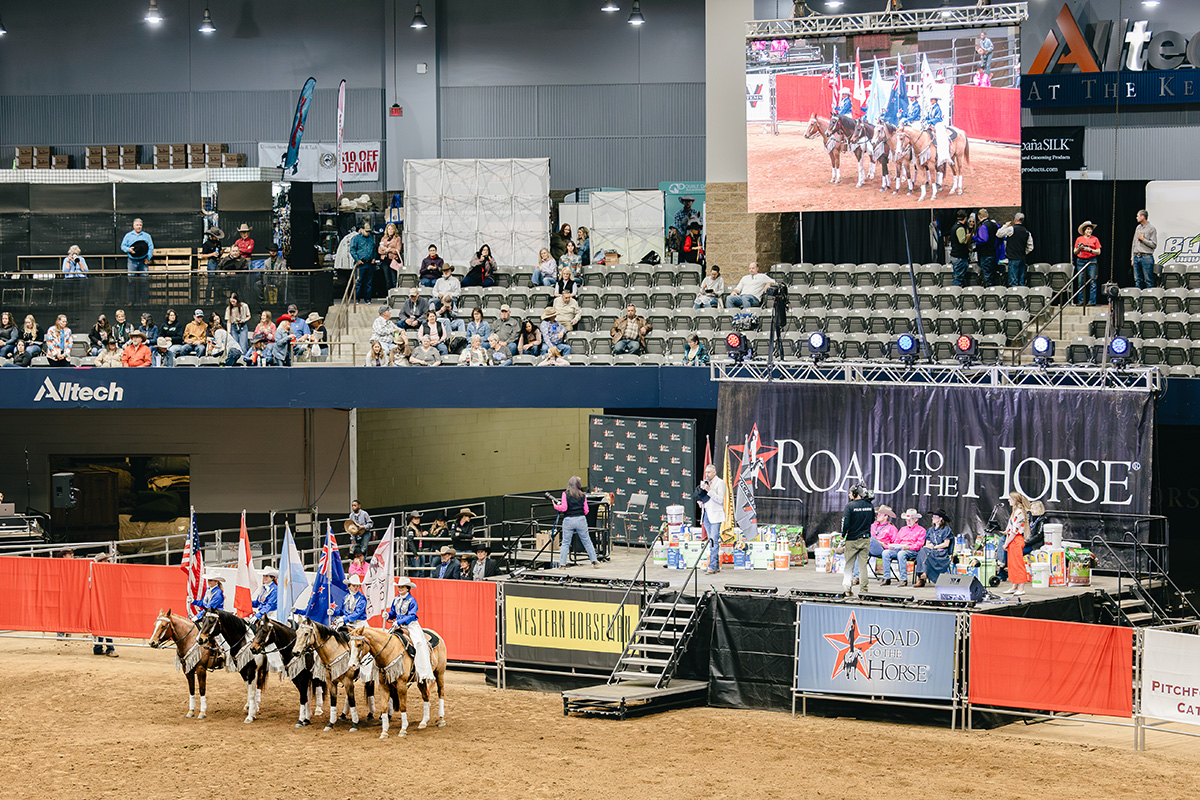
Road to the Horse is an exciting, unique colt-starting event, dedicated to changing people’s ideas and creating a better world for the horse. From March 27-30, 2025, in the prestigious Alltech Arena at the Kentucky Horse Park in Lexington, Ky., spectators got to watch some of the world’s finest colt starters compete for a world championship title and over $100,000 in prizes. This year’s competition boasted competitors from the United States, Argentina, Canada, and New Zealand, and showcased a wide range of horsemanship types and styles.
The format of the competition is simple: the first two days, four Wild Card competitors compete for a spot in the Championship Competition. These competitors choose a filly from the remuda provided by the Pitchfork Ranch. They are then given two days to work with their respective fillies, each session awarding points based on twenty different categories, including Catching & Haltering, Overall Horsemanship – Reading of Colt, and Colt’s Demeanor at End of Session. Once a Wild Card winner is crowned, they move on to the Championship Competition, to compete against the other three chosen trainers.
The Championship Competition is set up very similarly: the scoring system is the same, but they get more time with their colt, split up into three days.
The Wild Card Competition
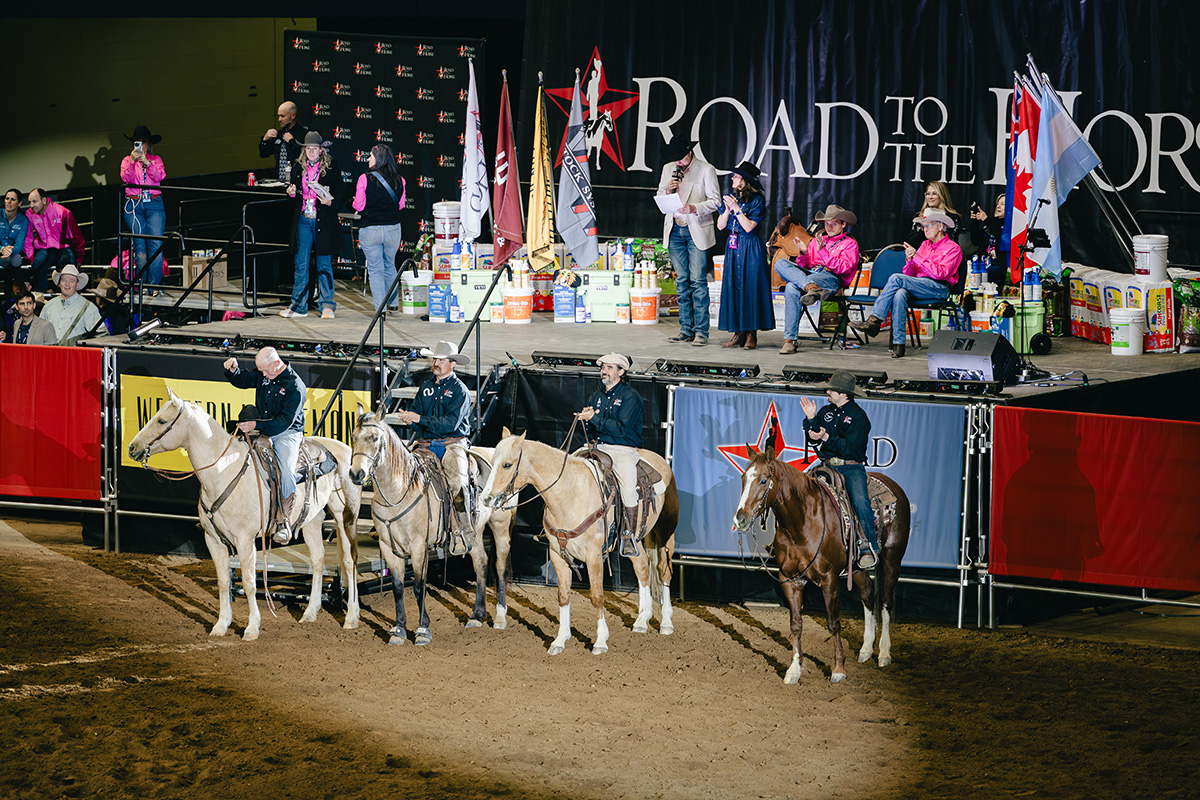
This year’s Wild Card competitors were Joseph Bentz of the United States, Dustin Sippola of Canada, Cristobal Scarpati of Argentina, and Buster McLaury of the United States. After choosing their Pitchfork Ranch fillies, they got right to work on round 1.
The Road to the Horse 2025 Wild Card competitors. From left to right: Buster McLaury, Dustin Sippola, Cristobal Scarpati, and Joseph Bentz. Photo by Madison Wintrich
From the start, the Wild Card competition was going to be a close one. Sippola led the competition after the first session with a score of 256.5, with McLaury a close second with a score of 253, and Bentz right behind him with a 246.5. Scarpati trailed behind with a score of 159.5.
In round 2, McLaury pulled ahead with a score of 276, in front of Bentz with a score of 256. Sippola was just barely behind with a 255, and Scarpati finished up with a score of 174. Round 3 was no less exciting; Sippola took the round with a score of 382, Bentz was just behind with a score of 379.5, and McLaury was just behind them with a score of 368. Scarpati took home a score of 70 after a tough last session with his filly.
After the conclusion of round 3, the scores were tallied up and the results were in. Buster McLaury clinched the Wild Card competition with a total score of 897 and would move on to the Championship Competition. Dustin Sippola took second place with a score of 893.5, Joseph Bentz took third with a score of 882, and Cristobal Scarpati was fourth with a score of 403.5.
“I was so impressed by the Wild Card competitors,” said Road to the Horse judge Jesse Westfall. “The Wild Card Competition was excellent. It was so close. We honestly did not know who was going to win.”
Horse Illustrated had the wonderful opportunity to interview Cristobal Scarpati after the conclusion of the Wild Card Competition. “It was a whole new experience for me,” he said. “I came here very confident. I was very encouraged to come here and do my best and share with the audience what I do, my philosophy, my method, everything.”
Scarpati found out very quickly that his filly would be a challenge, and he struggled a bit with changing his game plan to something totally different. However, in the spirit of Road to the Horse, he found a way to put her first. “The philosophy of this event is doing the best for the horse. I tried to get the goals for every session, but I tried to put her first overall. I am not struggling with any guilt because I did my best and I tried my hardest to make it easier for her. Everything I did aligned with who I am, and that is why I am so happy. I didn’t win anything, but I met so many great friends and the feedback from the audience was very generous and beautiful.”
View our full interview with Scarpati below.
The Championship Competition
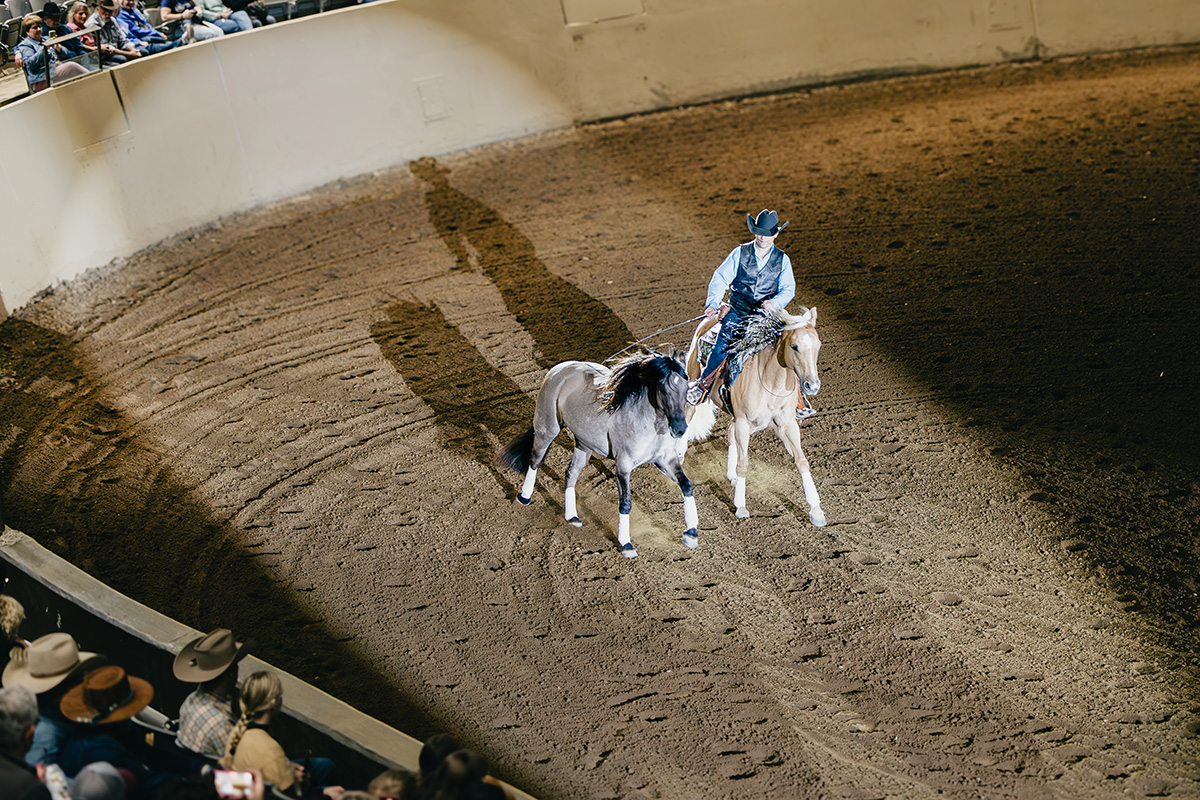
Following the conclusion of the Wild Card Competition, the incredible opening ceremonies took place. The audience was treated to impressive performances by Luke Gingerich, Dan James, Broken Spoke Clydesdales, the Wranglers Drill Team, and many other incredible talents.
A performance from Luke Gingerich during the opening ceremonies. Photo by Madison Wintrich
Now, it was time to meet our competitors and horses. Vicki Wilson was first up. A New Zealand native, Wilson is a heavily decorated show jumper who has won Road to the Horse twice—in 2017 and 2018. Her holistic training approach focuses on horses’ mental and physical wellbeing, as well as providing them with proper education and instilling a love for their job. After meeting the Pitchfork Ranch remuda, Wilson decided to work with #9, Lil Smart Cattack, a gorgeous red roan.
Next up was Tik Maynard, a Canadian eventer who found great success in the 2024 Road to the Horse competition, taking home the Championship title. He has a huge focus on educating others, teaching clinics, writing books, joining podcasts, and even becoming an instructor for The Horseman’s University and NOËLLE FLOYD Equestrian Masterclass. Maynard decided to choose #5, a stunning buckskin named Goodluck Suncat.
Finally, we met our third competitor, Phil Haugen, a classic All-American cowboy from the mountains of North Dakota. He successfully competed in calf roping, team roping, and saddle bronc riding for 20 years, and in 2021 was inducted into the North Dakota Cowboy Hall of Fame. Haugen’s training methods focus deeply on meaningful communication with the horse and allowing them time to think through situations and understand what is being asked. This was his first time at Road to the Horse, and he chose the lovely #8, Starrin Miss Bamacat, to be his colt.
Buster McLaury, who joined the Championship Competition after his win in the Wild Card, decided to work with #7, a flashy red roan named Sugar Cattack.
Round 1 started soon after the competitors chose their horses. McLaury very quickly got his horse haltered and began working with him off of his saddle horse. Wilson wasn’t too far behind, and opted to work on giving in to pressure from the ground. It was clear that Haugen had quite a sensitive horse, so he opted to slow down a bit and work through those issues in a thoughtful manner.
By the end of round 1, everyone had saddled their horses and had an overall good day. Wilson took the lead with 265. She had several lovely moments with her colt, including some incredible cantering. Overall, her colt seemed to be the most in-tune with what was happening, and that definitely reflected in her score. McLaury took a close second with 262.5 points, with Maynard in third with 258.5 points, and Haugen bringing up the rear with a score of 191.
Round 2 brought success to every competitor. Each horseman got the opportunity to ride outside of their round pen and felt confident enough to do so. Everyone also took the time to begin introducing their colts to obstacles and scarier items they had probably never seen before, such as a tarp and a ball. Phil’s colt seemed to have a much easier time this round and ended up bringing in a score of 206.5. Buster stayed very consistent and brought in a score of 260, with Vicki trailing behind with a score of 200.5. Tik blew away the competition and brought in a very impressive score of 275.
In round 3, competitors individually worked with their horses in the round pen, on the rail, and through an obstacle course. As the lowest scorer, Phil Haugen went first. He remarked about how good the horse had been, especially considering the huge environment they were competing in. His horse laid down some lovely rail work and showed impressive confidence through the obstacles. Haugen was able to have fun with this last round and even showed off with an expressive victory lap that riled up the audience.
Wilson went next. After a good start in the round pen, her colt was a superstar through the obstacles, tackling the tarp, jumps, and pool noodles with ease. He was able to show off his personality a bit, as he got very playful with many of the obstacles. As with most of the colts, there were a few moments of being overwhelmed with the environment, but he recovered quickly, and they were a very entertaining pair to watch.
Next up, we had our Wild Card winner, McLaury. His colt had a bit of sass in the round pen that he handled well. He also had a great rail work section, maneuvering each requirement with relative ease. His colt handled the first few obstacles confidently, but got a bit insecure with the tarp, pool noodles, and rope. Overall, he had a wonderful round.
Finally, we had the 2024 champ, Tik Maynard. He had a great round pen session, as his horse was clearly very relaxed and receiving his trainer’s input well. His rail work went equally well, with some very expressive canter from his colt. He had a few anxious moments with the obstacles, including the tarp and pool noodles, but overall navigated the course well. For his finale, Maynard stood on top of his horse while the crowd went wild — the most perfect ending to a wonderful competition.
Final Scores
After an exceptionally exciting weekend, it was time to learn the scores. For round 3, Phil Haugen scored a 484.5, bringing his final score up to 882. Vicki Wilson scored a 507.5, leaving her with a final score of 973. Buster McLaury brought home a score of 487.5, bumping his final score up to 1010. However, nobody could touch Tik Maynard after he scored an impressive 538.5, making his final score 1072. For the second year in a row, Tik Maynard was crowned the Road to the Horse World Champion.
The 2025 Road to the Horse Competition was nothing short of exciting, educational, and inspiring. People from all over joined together to celebrate these trainers, horses, and the spirit of horsemanship. One thing is for certain — we can’t wait to see who will get to compete next year.
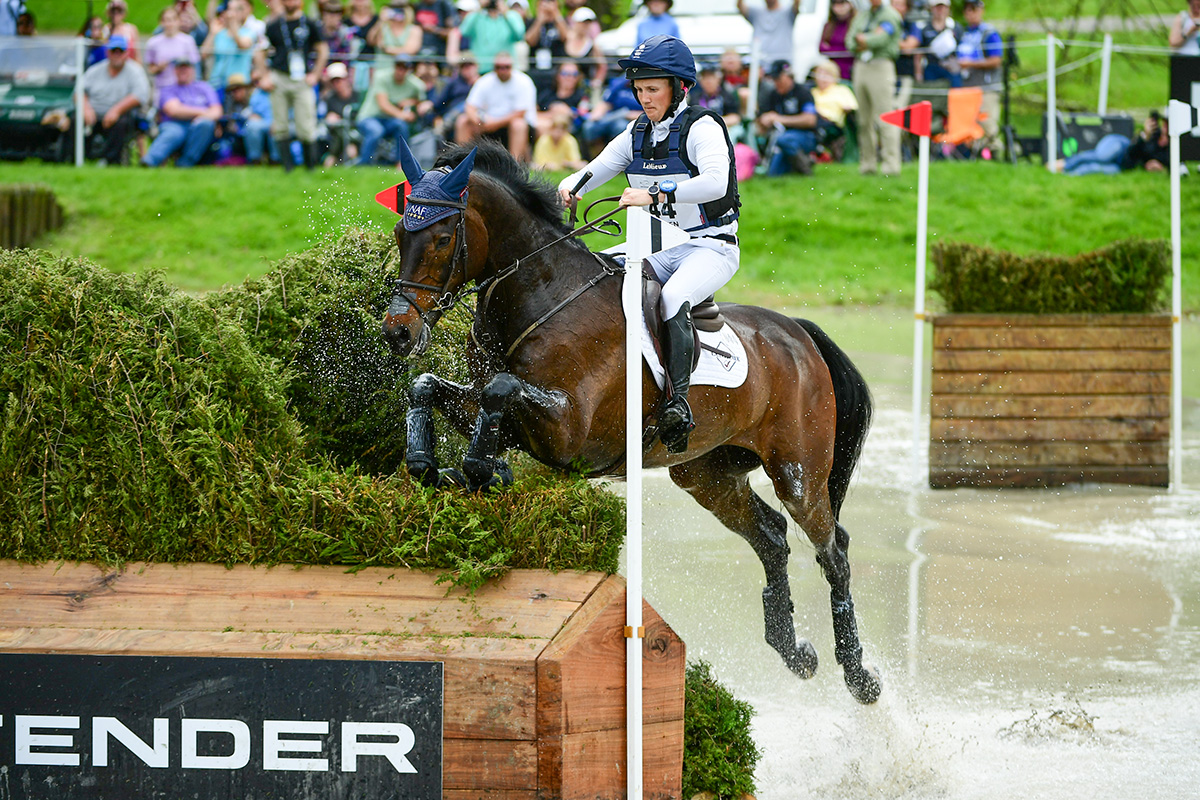
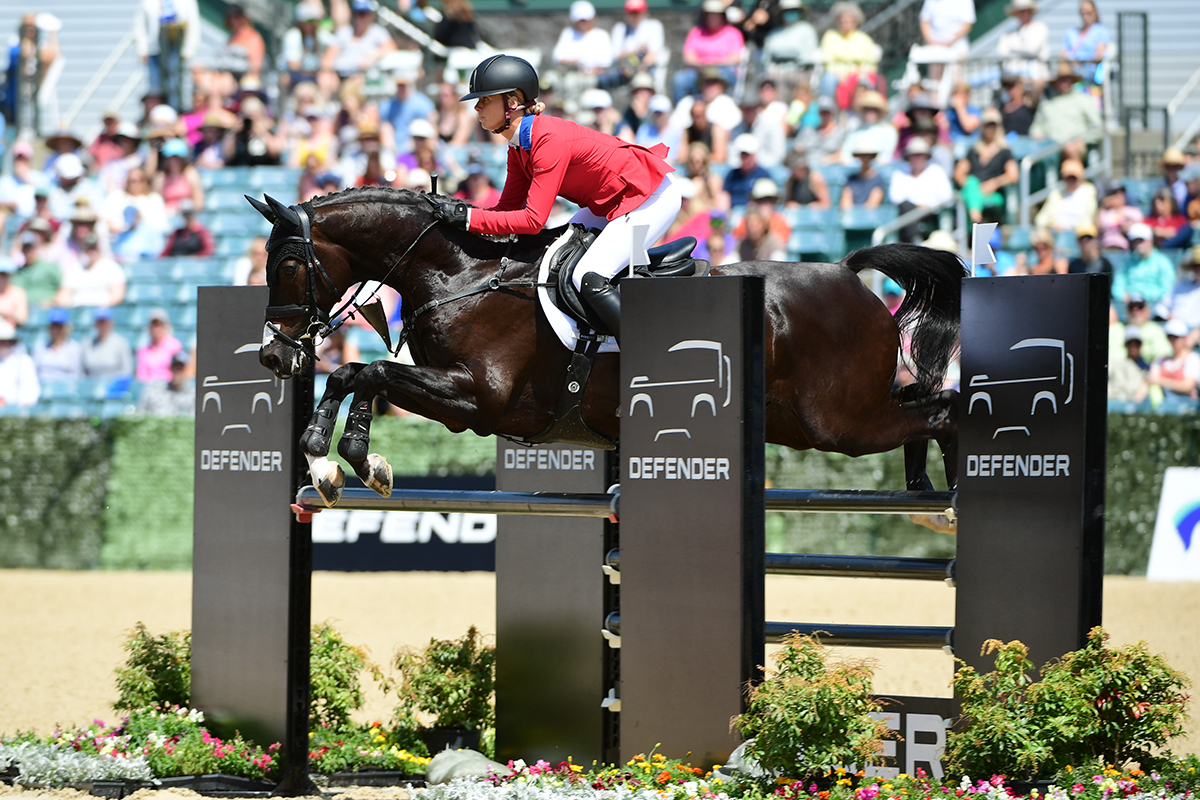
Lexington, Ky. — Six of the world’s top 12 eventing riders, including World #1 Tom McEwen (GBR) and World #2 Tim Price (NZL), head an impressive list of entries for the 2025 Defender Kentucky Three-Day Event presented by MARS Equestrian™. The event will feature 11 Olympians and athletes from seven countries when it returns to the Kentucky Horse Park, April 24-27.
Produced by Equestrian Events, Inc. (EEI), a non-profit, charitable organization that supports the development of equestrian sports by staging sporting events at the highest level, the Defender Kentucky Three-Day Event presented by MARS Equestrian features one of only seven annual 5* three-day events in the world. Known as “The Best Weekend All Year,” the event annually attracts nearly 90,000 spectators who also enjoy extensive shopping, a variety of hospitality experiences and a wide array of demonstrations. In addition to the traditional CCI5*-L, the event also features the Cosequin® Lexington CCI4*-S and the Kentucky International CSI5* presented by Hagyard Equine Medical Institute.
Tom McEwen and JL Dublin. Photo by Allen MacMillan/MacMillan Photography
McEwen, a two-time British Olympic team gold medalist and current World #1, has his sights set on the top of the Kentucky podium after finishing second in both 2023 and 2024 with his talented mount, JL Dublin. “Dubs” will be making his return for the third consecutive year alongside McEwen’s other entry, Brookfield Quality.
Also vying for the win are international veterans Tim Price, World #2, and his wife, Jonelle Price, who were the first husband-and-wife team to represent New Zealand at the Olympics. They were teammates on three consecutive teams (2016, 2021, 2024). Jonelle also rode on the Olympic team in 2012. They are joined at Kentucky by World #7 Harry Meade (GBR); World #10 Boyd Martin (USA), a four-time Olympian; World #11 Lara De Liedekerke-Meier (BEL), a two-time Olympian; and World #12 Michael Jung (GER), a four-time Olympian and four-time Kentucky champion. Jung is entered with his 2024 Olympic Gold Medal partner, fischerChipmunk FRH, who helped him secure his fourth victory in Kentucky in 2022. Jung also won at Kentucky in 2015, 2016, and 2017.
In addition to Martin, the star-studded U.S. contingent includes 2016 Olympian Lauren Nicholson, 2024 Olympian Caroline Pamukcu, and seven-time Olympian Phillip Dutton, whose horses are entered in the Cosequin® Lexington 4*. Dutton won the Kentucky title in 2008.
Other Olympians entered to compete include two-time Olympic veteran Clarke Johnstone of New Zealand and three-time Olympic veteran Jessica Phoenix of Canada.
The full list of CCI5*-L entries can be found here.
Cosequin® Lexington 4*-S Entries Are In: Top Riders Set to Compete
A field of top veteran riders is entered in this year’s Cosequin® Lexington 4*-S, a US Equestrian Open Eventing Series Qualifier, at the Defender Kentucky Three-Day Event presented by MARS Equestrian™ which returns to the Kentucky Horse Park, April 24-27.
Heading the list of entries are defending champion and U.S. Olympic veteran Will Coleman, 2024 U.S. Olympian Caroline Pamukcu, 2023 Kentucky 5* champion Tamie Smith, and seven-time Olympic veteran Phillip Dutton, whose daughter Olivia is also entered. Coleman placed first and third in last year’s event, Smith placed second in both 2021 and 2023, and Dutton placed second in 2022.
Caroline Pamukcu and HSH Blake. Photo by Sarah Miller/MacMillan Photography
Other U.S. veterans who are entered include Jennie Brannigan, Jan Byyny, Buck Davidson, Ali Knowles, Allison Springer, Lynn Symansky, Alyssa Phillips, who won the inaugural Cosequin ® Lexington 4*-S in 2021, and James Alliston, who placed third in 2022.
Produced by Equestrian Events, Inc. (EEI), a non-profit, charitable organization that supports the development of equestrian sports by staging sporting events at the highest level, the Defender Kentucky Three-Day Event presented by MARS Equestrian features one of only seven annual 5* three-day events in the world. Known as “The Best Weekend All Year,” the event annually attracts nearly 90,000 spectators who also enjoy extensive shopping, a variety of hospitality experiences and a wide array of demonstrations. In addition to the traditional CCI5*-L, the event also features the Cosequin® Lexington 4* and the Kentucky International CSI5* presented by Hagyard Equine Medical Institute.
Introduced in 2021, the Cosequin® Lexington 4*-S is a US Equestrian Open Eventing Series Qualifier. The inaugural US Equestrian Open Eventing Series consists of 20 qualifying events around the country leading into the Series Final, to be hosted as a CCI4*-L at the Morven Park International in Leesburg, VA, October 9-12.
The Series awards $50,000 in prize money to the three highest-placed combinations following the conclusion of the qualifying period, as well as $200,000 in prize money at the Final in October. The Series was created to further invest in future eventing athletes and showcase the sport to a broader audience. Additional information is available here.
“The Cosequin® Lexington 4* couples with our traditional CCI5* competition to give eventing fans a full day of world-class competition,” said Molly Day, EEI Executive Director. “As part of the new US Equestrian Open Eventing Series, the Cosequin® Lexington 4* has more meaning than ever before, assuring us an even more thrilling competition.”
The full list of Cosequin® Lexington 4* entries can be found here.
Tickets for viewing the Cosequin® Lexington 4* are included when purchasing K3DE tickets and can be purchased at kentuckythreedayevent.com/tickets.
Ryan Rose got bit by the cowboy bug early in life.
“My love of horses started when I was a little kid,” says Rose. “I was obsessed with horses. At 12, my parents signed me up for riding lessons, and I was hooked. Shortly after that, we bought a horse. And I loved cowboy movies! I’ve worked with some fantastic cowboys and am deeply impressed with their grittiness and commitment to the animals in their care. When it comes to the animal, cowboys don’t quit until the job is done . . . I admire their courage.”
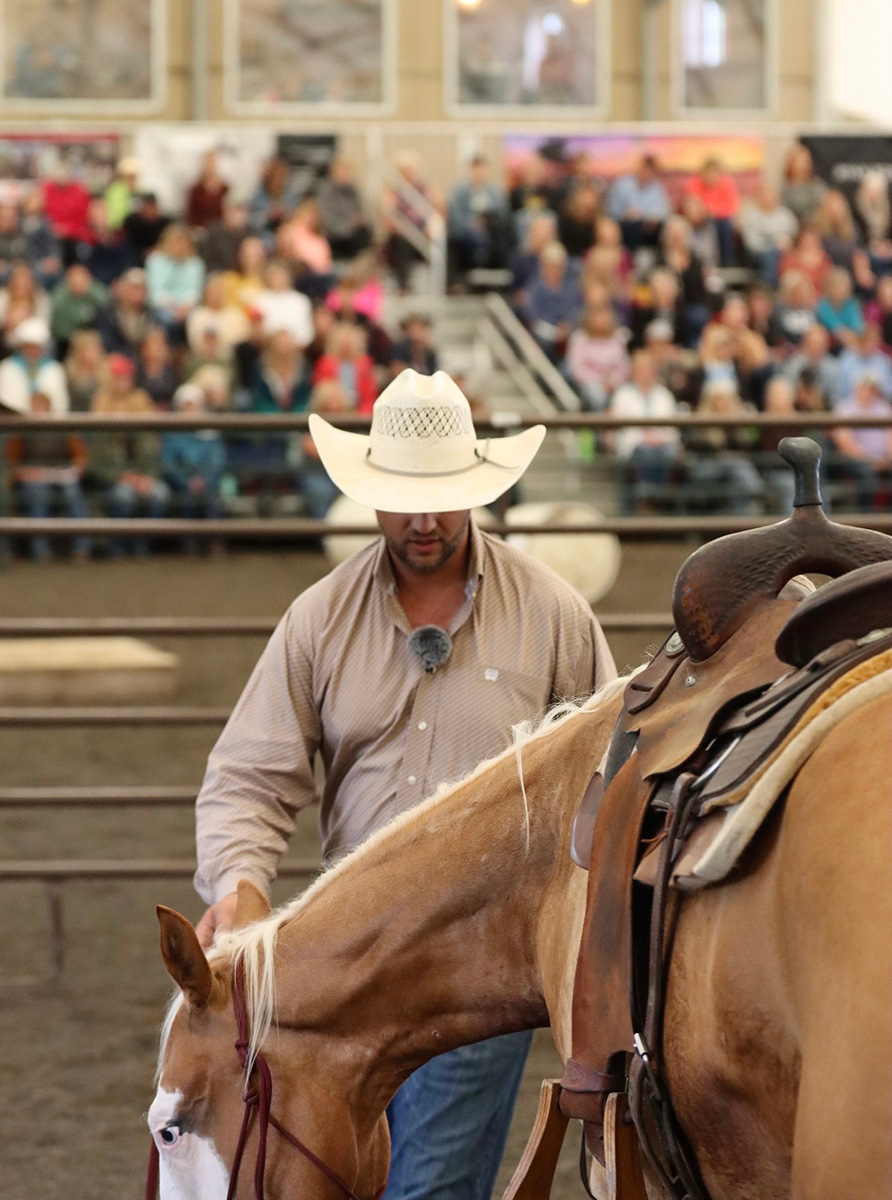
And although he’s the first to admit he’s not a true cowboy, Rose still “loves the idea of being a cowboy.” His deep understanding of horses and their behavior allows him to help horses and their owners to truly connect, demonstrate mutual respect, and build strong partnerships. Rose’s skills in colt starting, problem-solving difficult behaviors, and training horses in ranch versatility have bolstered his resumé.
Ryan Rose with Circle Bar Pistol and Jasper. Photo by Shea Ackman
Becoming a Horseman
Rose began working as a professional horse trainer in 2005. He quickly recognized the connection between having a successful horse trainer/clinician career and understanding what it takes to be a true horseman. He studied with world-class instructors, including Pat Parelli and Doug Jordan. Whether presenting at a small clinic or entertaining huge audiences at Equine Affaire or Road to the Horse, his engaging personality and passion for teaching shines through. Rose has a comprehensive training program based from his home in Wisconsin and an impressive following on his YouTube channel @ryanrosehorsemanship.
Rose finds immense satisfaction in teaching the fundamentals of horsemanship. “I started as a horse trainer, but I soon realized that I needed to educate the owners as well so they could reproduce the results I was achieving.”
Explaining the nuances between being a horseman and a horse trainer, Rose says, “I think they are separate skills—but there is value in both. A horseman focuses on giving the horse a really good deal—it’s more about the horse, helping him feel more comfortable. When I think of a horse trainer, they may feel pressure to provide a result for the owner. Trainers are very disciplined—in a good way—regularly working the horse, getting them conditioned and prepared for a show, but sometimes the horse can get sacrificed a little bit in that process.”
Rose believes that being able to intertwine these skillsets can make a difference.
“I think there is value in being a good trainer, in being a good horseman, and in being a good cowboy,” Rose says. “You need to add each of those skills at different times.”
Ryan Rose teaching groundwork at a clinic. Photo by Shea Ackman
Determining where to apply these skills requires a process of observation.
“One of the first principles of horsemanship that I follow is that I work with a horse at where they are,” says Rose. “Is the horse scared of people? Learned to dominate people? Is he spoiled? Or highly trained but done in a way that the horse felt forced through it?” Rose takes time to observe the horse and owner to see the level of connection, trust, and confidence the horse has for the person.
To understand the horse fully, Rose stresses this process might take hours, days, or weeks. He watches for any signs that the horse is uncomfortable. “They give subtle tells—with their head, neck, ears, eyes, mouth, muscle tension, what direction they are facing . . . It’s all signals as to where the horse is at. There’s also an intuitive feel to it. It’s like if I’m having a bad day, I could probably fool you and hide it, but I couldn’t fool my wife. She would know. You can develop that with a horse and just feel something is bothering them.”
Rose’s approach to working with a reactive or spooky horse plays out in his YouTube videos. “Both humans and horses must have levels of exposure to a challenging situation in order to overcome it,” says Rose. “So it starts with the person deciding they want to make a change. When someone shows up at my clinic, I try to figure out if they are ready to face their fear or simply want an enjoyable weekend with their horse. If they are open to change, my job is to find out where they’re at—and then challenge them out of their comfort zone safely. Horses are dangerous, so I carefully read the horse and person. I try to understand why the person is afraid. Is their fear valid? Is their horse dangerous? Is the person on the verge of getting hurt? Or, did they have a bad experience in the past and are bringing that into the present?
“If that’s the case, I’m going to coach them, challenging them through exposure to whatever is causing the fear—riding down a steep hill, cantering, riding bareback, or just being on a loose rein. I’ve seen unbelievable changes in people when you put them in a difficult situation and help them work through it—they become empowered. Their confidence level on the other side is just through the roof. I think it’s a more meaningful approach versus just visualizing it . . . A level of toughness and confidence comes through having to actually do it.”
Teaming Up As Husband and Wife
In addition to focusing on the mental aspects, Rose helps riders grasp how vital correct body position is to progress and the well-being of your horse. “You could ride lameness into a horse with incorrect body position,” says Rose. Although not an expert in the field of rider biomechanics, he is married to one—his wife, Emily Rose, is a Certified Equine Rehabilitation Practitioner at Reaching Strides Equine Rehabilitation and an integral part of the Rose Horsemanship Center team.
“I make sure the horse is safe, but if the rider is struggling to sit the canter or feeling pain while trotting, Emily and I work together to get that sorted out for the rider and horse’s sake,” says Rose.
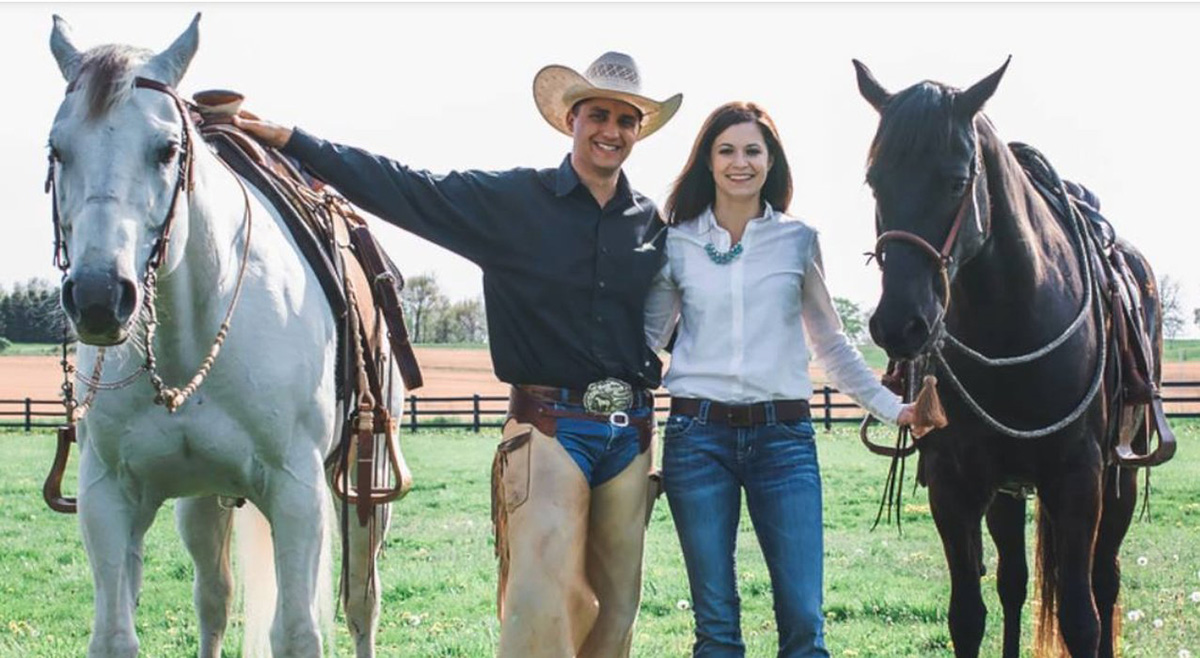
Photo courtesy of Ryan and Emily Rose
Emily actively competes in dressage and is Rose’s business partner. “One of the things I enjoy most about working with my wife is our ability to help people—whether horse health issues or rider biomechanics. I can troubleshoot issues with Emily. It’s all in-house; I don’t have to outsource for that expertise. Emily is such a high-level professional, I have one hundred percent trust in what she recommends. And if Emily sees a horse for a physical issue and it turns out to be a behavioral issue, she can refer to me, and I can quickly step in to help. The response time is so much quicker because we are working together.”
For Ryan and Emily Rose, it’s all about creating lasting connections between horses and the people who love them.
Learn more about Ryan and Emily Rose and view upcoming clinics and events at rosehorsemanship.com.
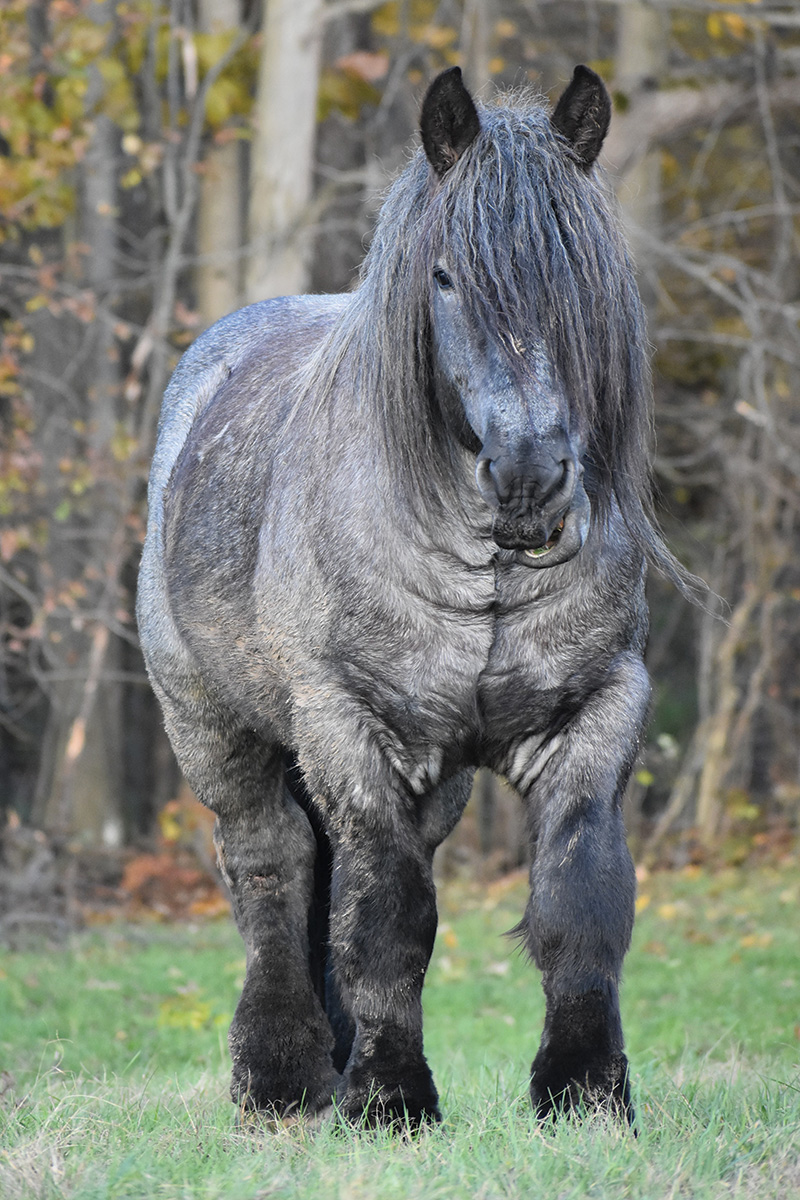
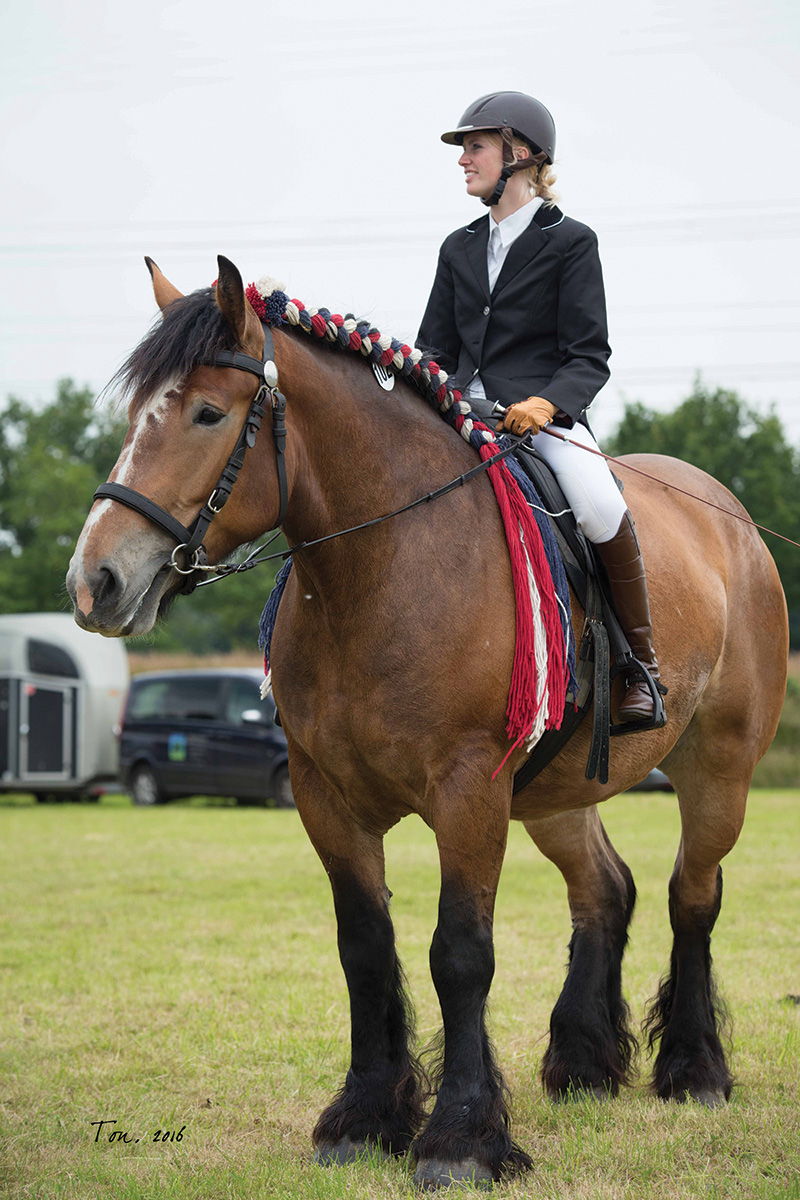
While draft horses come in many shapes and sizes, from the gigantic Shire to the smaller Haflinger, most have something very important in common. Each owes its existence to the magnificent European Brabant.Photo by Stacy Pearsall
The oldest of all draft breeds, the European Brabant has been known by many names over the centuries. Once called the Flanders Horse, Dutch Draft and Brabander, the horse known today as the European Brabant has the same basic personality and physical characteristics as it did 2,000 years ago when Julius Caesar mentioned the breed in his diaries and when King John of England imported 100 studs to his private livery in 1199 AD.
Thanks to the efforts of those who cherish this breed, the European Brabant is still part of the horse world. Though rare (the Livestock Conservancy is currently studying them for possible inclusion on its critical list), the breed is still valued by those who appreciate its massive strength, kind disposition and fascinating history.
U.S. Preservation
Known in Europe as the Belgian Draft Horse, the European Brabant was first imported to America in the 1880s. Over time, American breeders began breeding for a lighter draft horse, and the American Belgian became distinctly different from the European strain. Today in the U.S., the Belgian and the European Brabant are two completely separate breeds.
In an effort to preserve the ancient European Brabant, breeders and enthusiasts in the U.S. and Canada recently banded together to form the European Brabant Registry of America (EBRA). Since its founding in October 2021, the EBRA has concentrated its efforts on preservation by establishing the European Brabant and Brabant Stock Studbooks, as well as the critical “Breed Up” Program, which is designed to expand the breed’s gene pool.
The EBRA also offers draft horse educational clinics to the general public as a means of promoting the positive attributes of all heavy horse breeds. Ultimately, the EBRA wants to ensure the original gentle giant—the European Brabant—and its descendants remain intact for future generations.
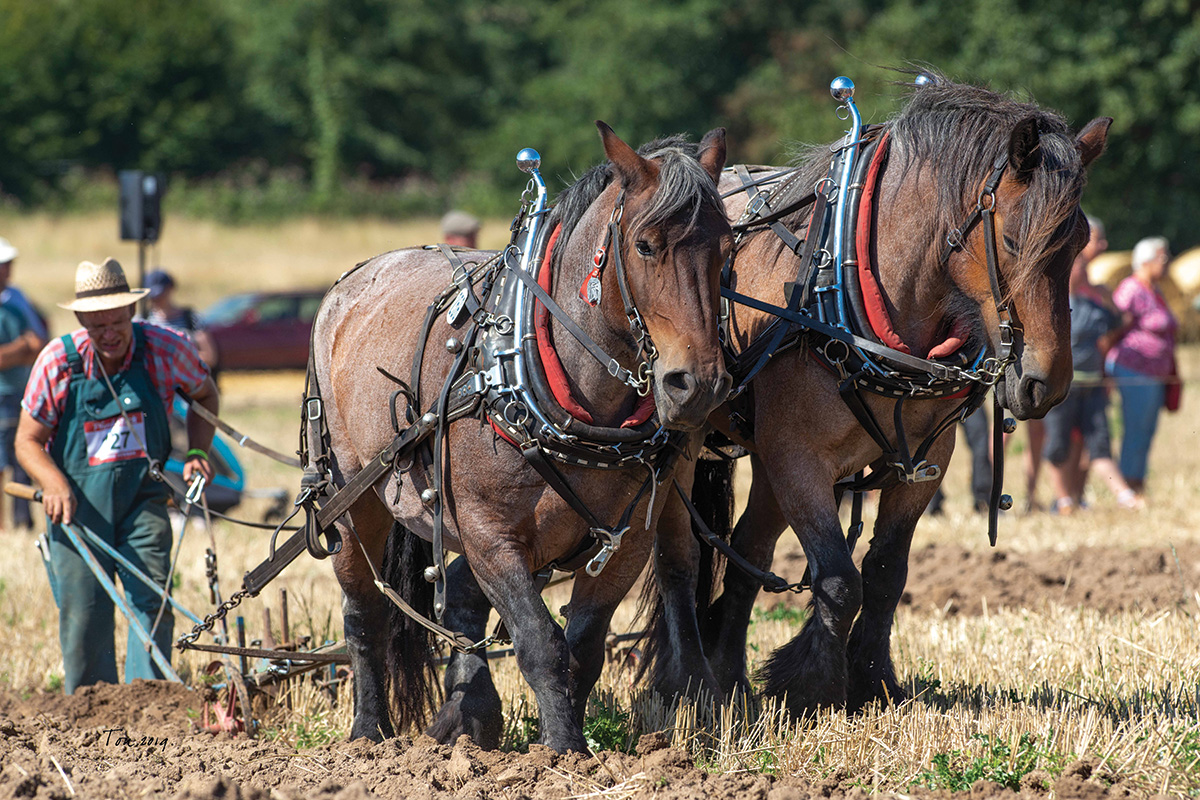
Because they are such strong and tractable work horses, European Brabants are still active in the timber and farming industries. Photo by Ton van der Weerden
Across the globe, European Brabants are still hard at work in a myriad of jobs. Because they are such strong and tractable work horses, they are still active in the timber and farming industries. They also work chest-deep in water, dragging fishing nets and pulling barges next to canals in Europe.
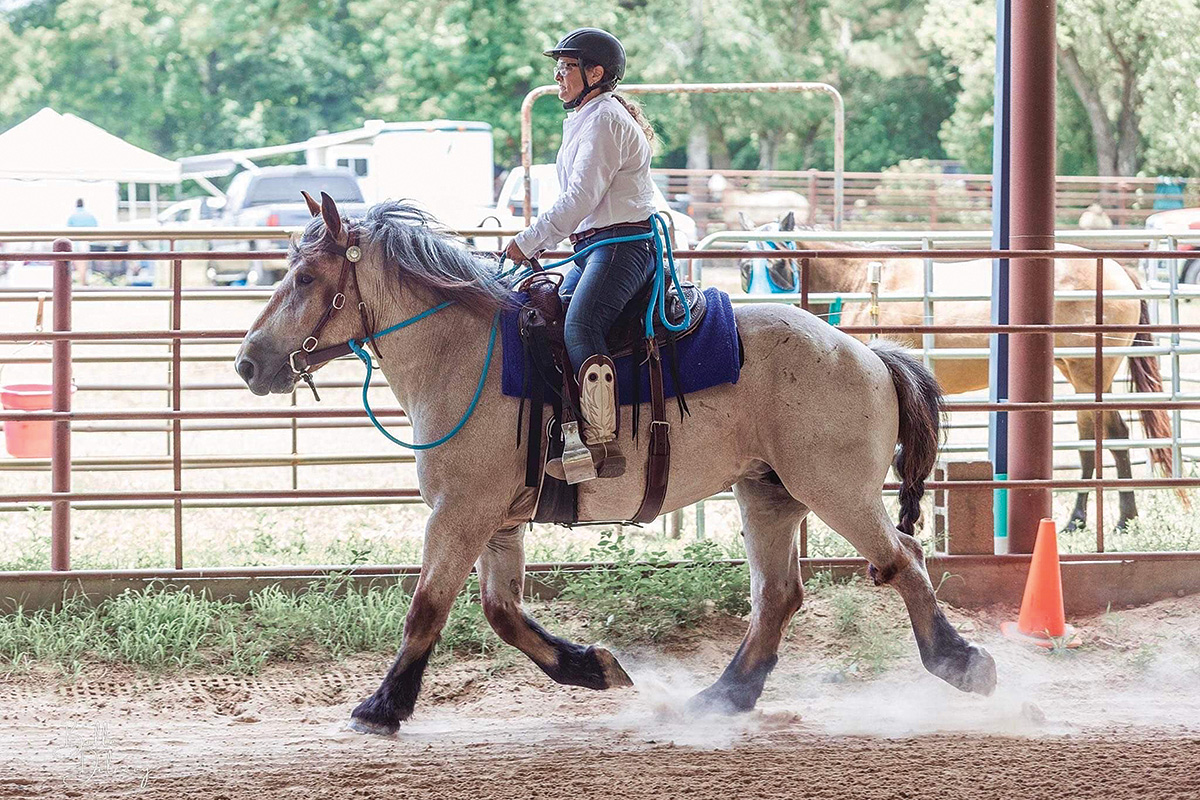
In the U.S., European Brabants are often ridden. They are used in equine therapy programs, backcountry packing and trekking outfits, as school horses, and in dressage and show jumping. They also compete in single and teams driving, vaulting and circus acts.
In the U.S., European Brabants are often ridden. Photo by Ton van der Weerden
European Brabant Breed Facts
◆ Height: 15 to 18 hands; average is 16.2 hands
◆ Color: Chestnut, bay, black, blue roan, red roan, strawberry roan, bay roan and gray. Some white markings on the face and legs are permitted.
Colors include chestnut, bay, black, blue roan, red roan, strawberry roan, bay roan and gray. Photo by Stacy Pearsall
◆ Overall Appearance: Balanced and slightly rectangular in shape; ample, robust leg bone and a double-muscled hindquarter with a wide, long, slightly sloped croup. Well-muscled neck and a straight profile with a proud head carriage. The head should appear slightly smaller and refined for a horse of such large proportions. The eye is large and kind.
In the U.S. draft horse world, two different “Brabants” can be found: the European Brabant and the American Brabant. Despite the similarity in their names, these are two very different breeds.
According to the American Brabant Association, American Brabants are a cross between European Belgians and American Belgians, plus select Percheron and Suffolk mares. Registered American Brabants have 25 to 99 percent European Belgian bloodlines.
American Brabants present with a variety of appearances, but are typically shorter in stature, short-coupled and thick-boned, with a good head and kind eye. Their calm, willing disposition makes them suitable for a wide range of jobs. They are most commonly found performing farm work, logging and pulling wagons.
American Brabants stand 15.2 to 17 hands and come in bay, black, and sorrel/chestnut. These base colors can be roaned, resulting in bay roan, blue roan, red roan and strawberry roan colorations. The rarest color is gray.
According to those who love this breed, European Brabants are much more than draft animals; they are loving companions who want nothing more than to be with their humans, whether it’s on the trail under saddle or cuddling in the pasture.
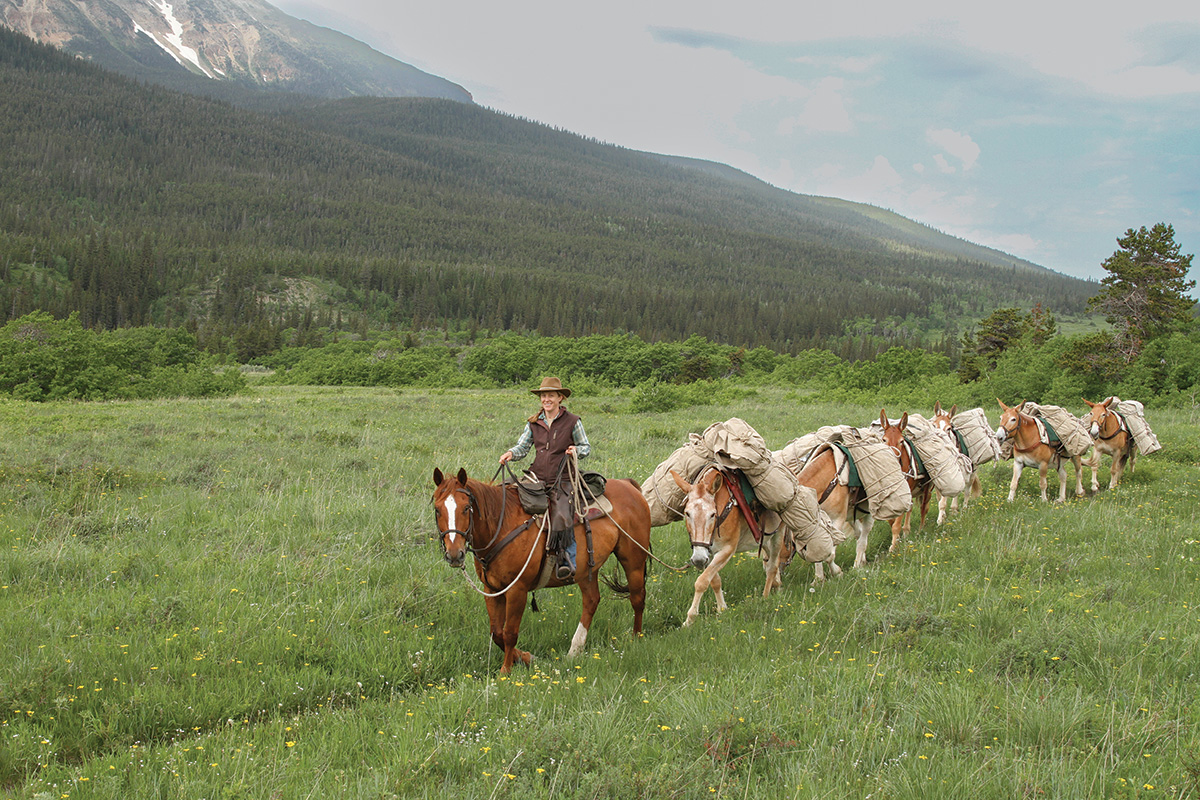
Flopping ears bounce with every step down the trail as a string of six mules begin the trek from the Glacier National Park trailhead at the Canadian border to the Belly River Ranger Station two hours southwest.
The mules each carry two packs loaded with carpentry supplies that will aid the restoration and upkeep of the historic ranger station during the park’s summer months when park crews work to repair or create trails, cabins, and complete other projects before the winter returns to the northern Montana park.
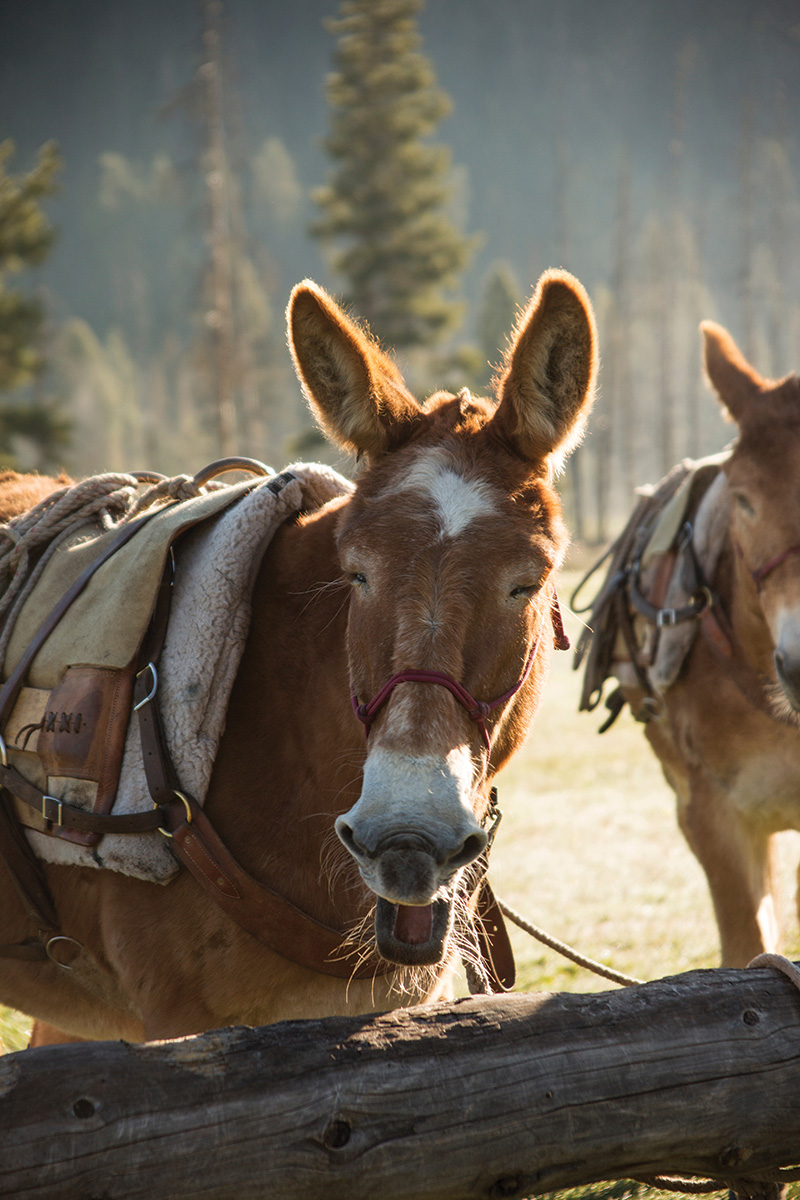
Mules are curious, intelligent and dedicated workers. However, hauling loads miles into the backcountry of public lands can be tiring, as this mule agrees. Photo by Kate Bradley Byars
Trail Crew
Leading the string of mules is Jill Michalak, who began working at Glacier in 2017. A member of the trails crew, Michalak’s job is to take care of and work with the mules and pack supplies as needed into and out of the park.
“The mules allow us to preserve and access the wilderness,” says Michalak. “Many of these areas not only don’t allow motorized vehicles, but don’t allow chainsaws. The mules have lots of different jobs. They work for the trail crew.”
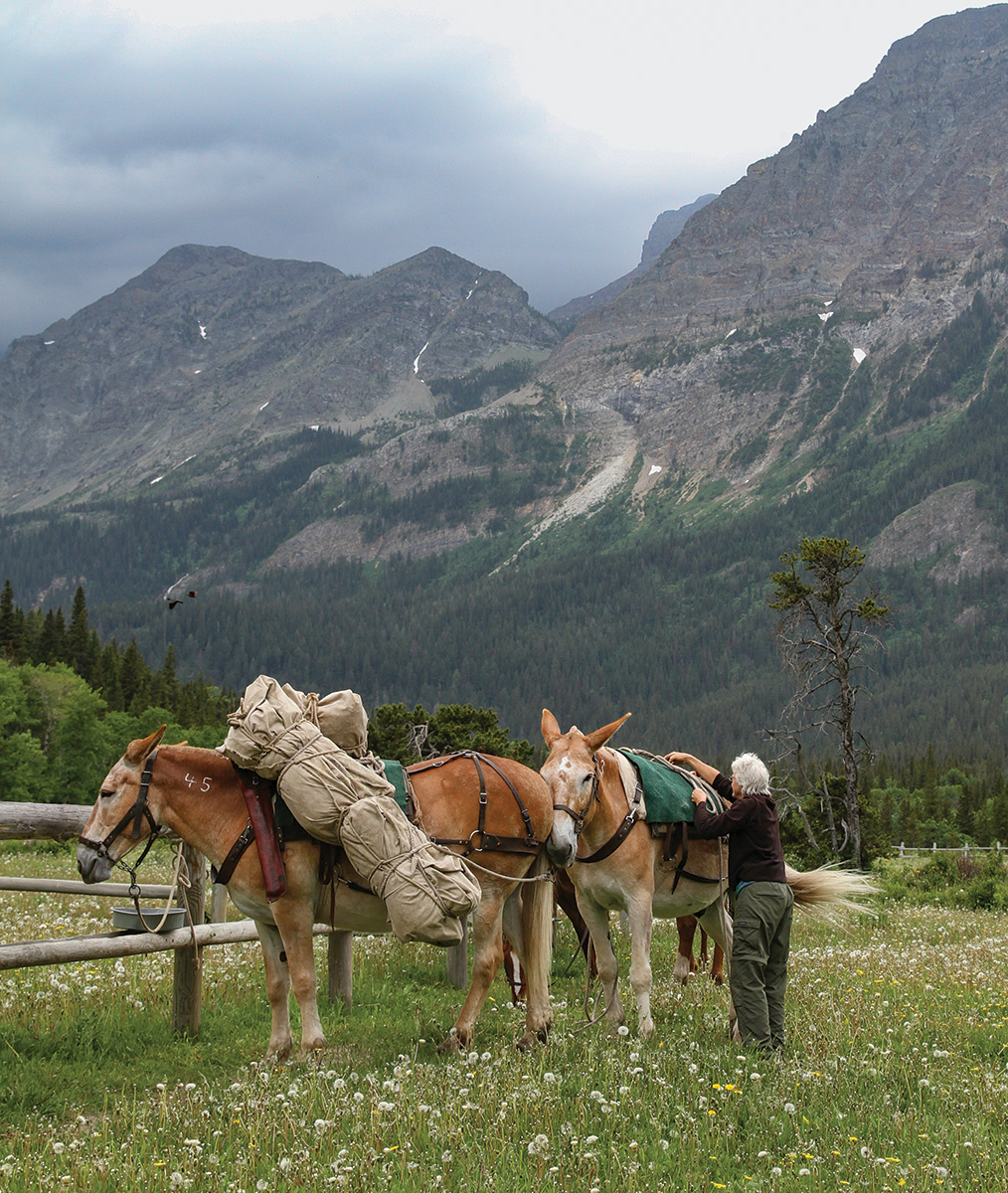
Rangers often aid packers like Jill Michalak with securing the mules when they arrive at a destination, or help unload a pack if needed. There is a kindred spirit within those that travel the backcountry. Photo by Kate Bradley Byars
Further south, contract packer Chris Eyer leads his own team of mules into the Bob Marshall Wilderness Complex (BMWC) out of his home base in Ovando, Mont. While Michalak works for the National Park Service, Eyer is employed by whichever licensed outfitter or arm of the United States Forest Service (USFS) needs him and his mules to move loads.
“I’ve packed boats for people going on rafting trips, mattresses, lumber, and things like that,” says Eyer. “As a contract packer, I also get hired by contractors who are not outfitters but work for the Forest Service, [for example] rebuilding a dam or bridge that is too big or specialized for the Forest Service.”
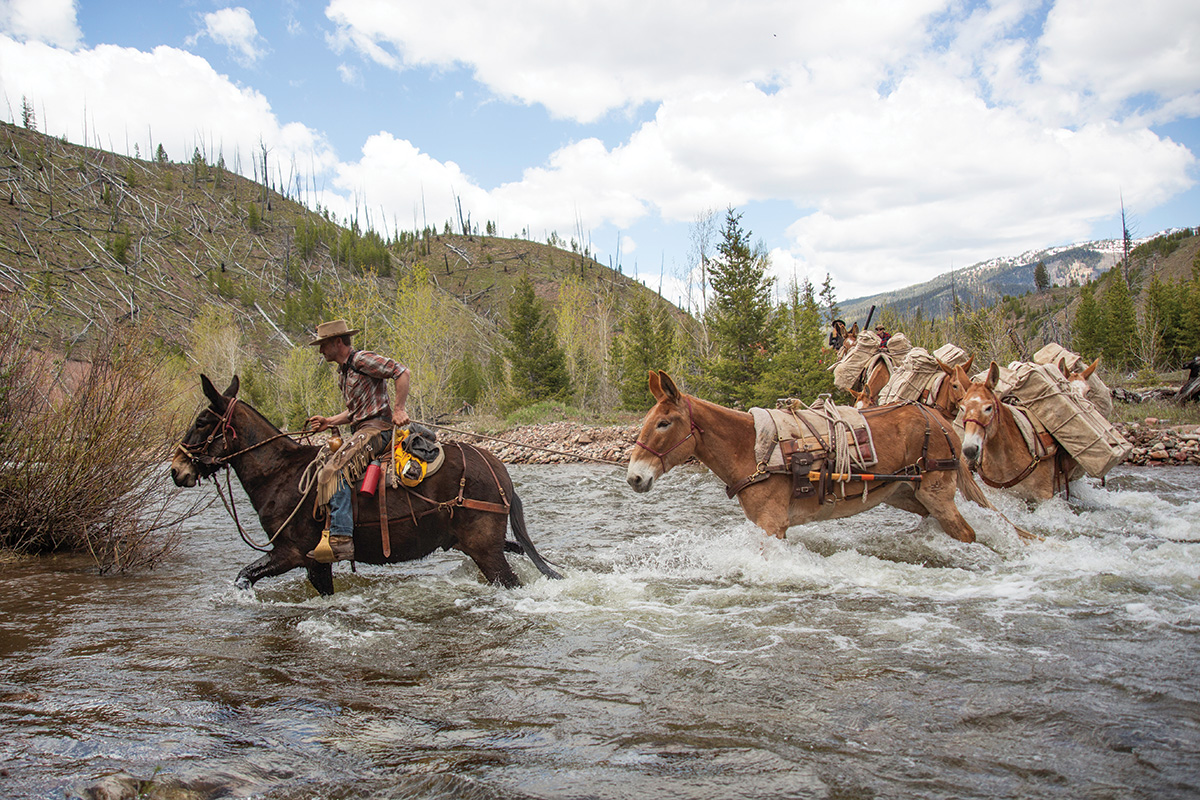
Chris Eyer leads a string of mules into the Bob Marshall Wilderness Complex, which requires crossing several rivers. Photo by Kate Bradley Byars
When hikers, mountain bikers, trail runners, and other equestrians use a trail system in America’s National Park System, public lands, or designated wilderness area, it’s more than likely that a mule carted in the equipment necessary to maintain that trail or build the outhouse they use that’s far back from the roadway.
Mules have carried the load for decades, aiding building, maintaining, exploring and surviving in the wilderness.
Packing with Purpose
Americans visited National Parks 312 million times in 2022, more than 15 million more visits than in 2021, according to the National Park Service. Most of those visitors never venture more than a mile into the park along a well-used and easily accessed trail. Yet there is a segment that opts to dig deeper into the National Park and wilderness areas considered public lands.
There are 63 National Parks, but more than 250 million acres of other public lands all managed by the U.S. Department of the Interior. Within that, the U.S. Forest Service facilitates work to ensure that public lands, like the Bob Marshall Wilderness Complex, is accessible to users.
At Glacier National Park in Montana, Jill Michalak and the mule string she cares for are necessary for moving items around the park. Photo by Kate Bradley Byars
That’s where packers like Eyer step in. Since 2006, he’s made a living packing cargo and other items for the USFS, the Bob Marshall Wilderness Foundation, and other contracted outfitters.
“The backcountry is for all users, from hikers and horses to skiers and runners,” he explains. “Mules bring in gear to keep the land open for all of these groups.”
Along with recreation, the wilderness areas provide opportunity to study many ecosystems and species without interacting with human population centers. Both Eyer and Michalak have packed in biologists completing research projects. Eyer has even brought in insects to the Big Prairie Ranger Station in the Flathead National Forest within BMWC.
“Packing in bugs is super complicated,” he says. “Never has more labor gone into a load that is as small as those bugs. The day before I leave to go in, there are people out in a field, on hands and knees collecting bugs to put into a canister. The bugs then go into a cooler to be kept from overheating. That is loaded onto a mule in the center of a load where they won’t be baked in the sun. As soon as I get to where I’m going, I unload mules and turn them out, then immediately head out with the USFS crew to release the weevils to a certain area where they go to attack an invasive weed species.”
For Michalak, who has worked as a packer in Alaska and at Olympic National Park, the most interesting project she packed equipment for was one conducted there by NASA.
“They were doing a project where they were ground truthing for a Doppler radar system,” she recalls. “We packed 15 miles into Enchanted Valley, packing lasers and solar panels. If you look at Olympic Peninsula, there is no other way to get into there except for mules, because there are no motorized options.” The project was projecting weather for a massive population center 200 miles away, in Seattle.
“In this day in age, mules were the way we got $30,000 laser equipment into the research area,” she adds.
Knowing which of the mules in a string is going to be more careful with a load and not apt to bump trees is important when carting expensive equipment. But most often, the loads carried are more common items, such as lumber, gravel, tools and food supplies.
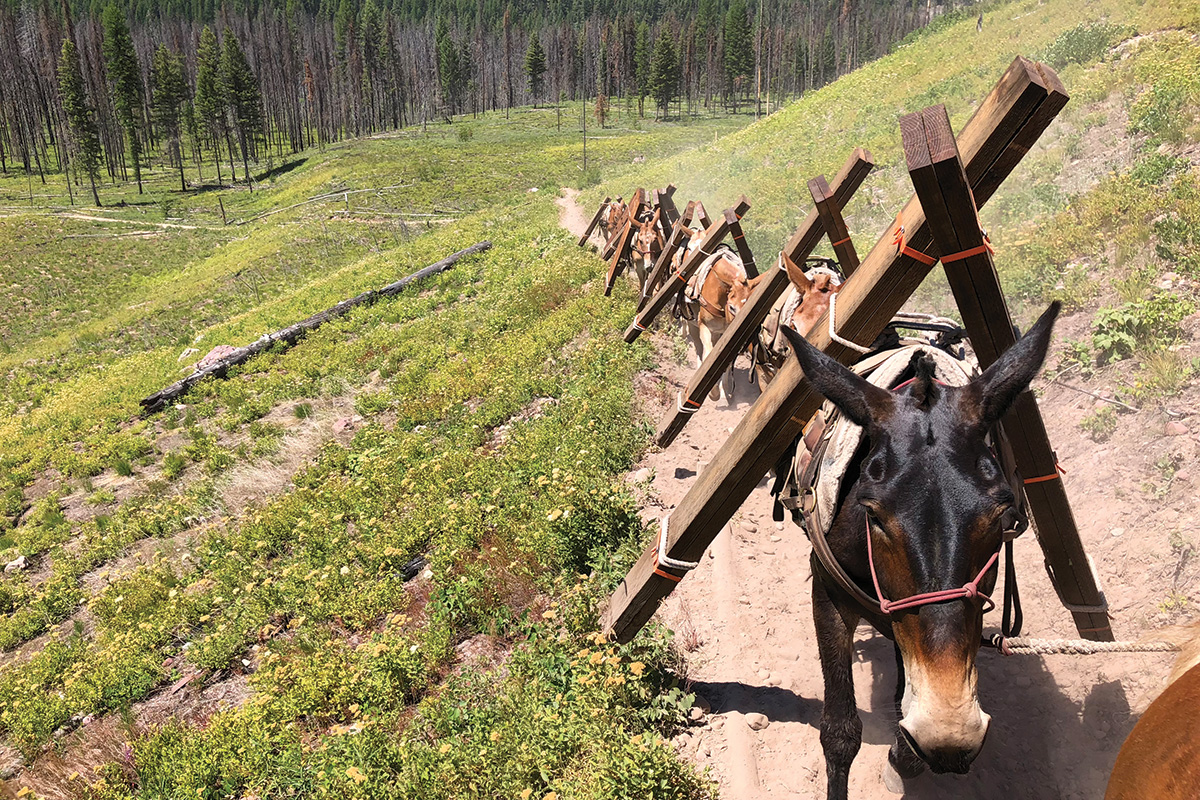
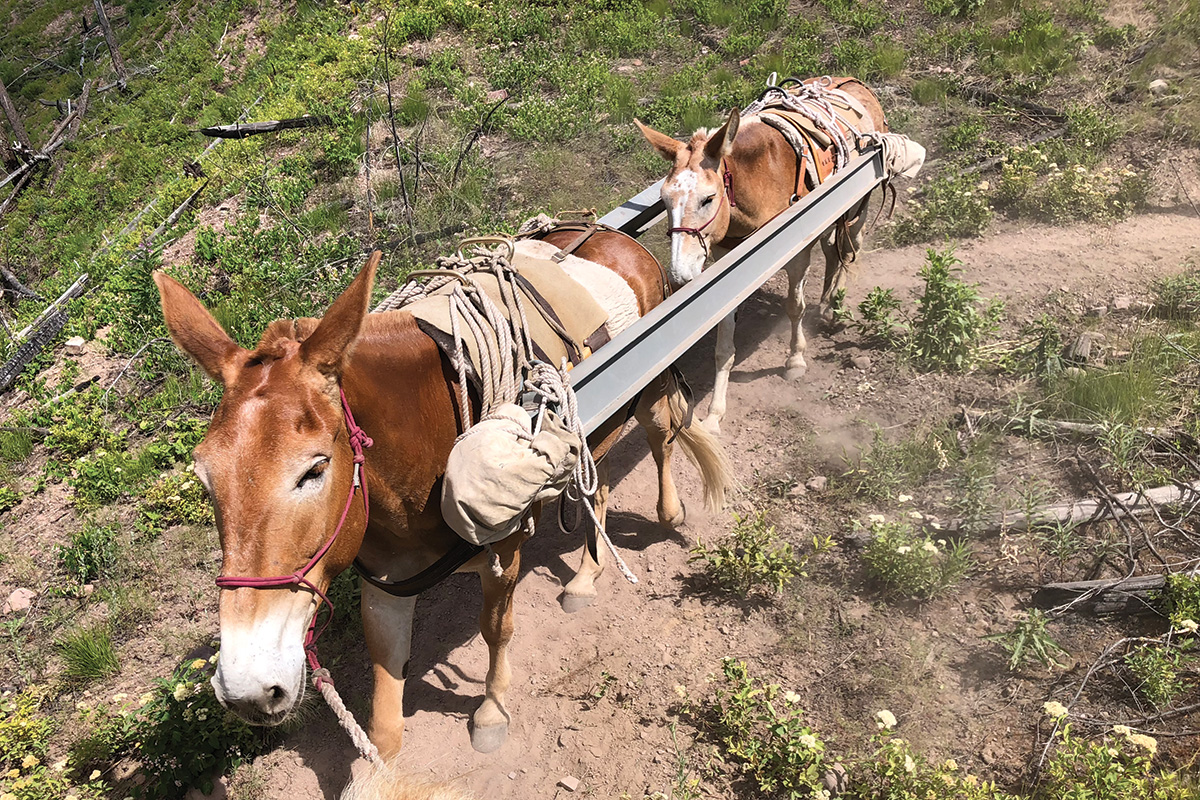
Loads like the lumber shown here that are heavy, awkward or time-sensitive are not common, but mules handle them with ease. Photo by Chris Eyer
Pack It On
Boxes wrapped in canvas are a typical scene if you’re hiking and encounter a mule string on the trail. Those boxes usually include food, tents and other items to make camp, or supplies to help restore a cabin. Restoration projects and construction are some of the most frequent loads for mules to make, especially into National Parks.
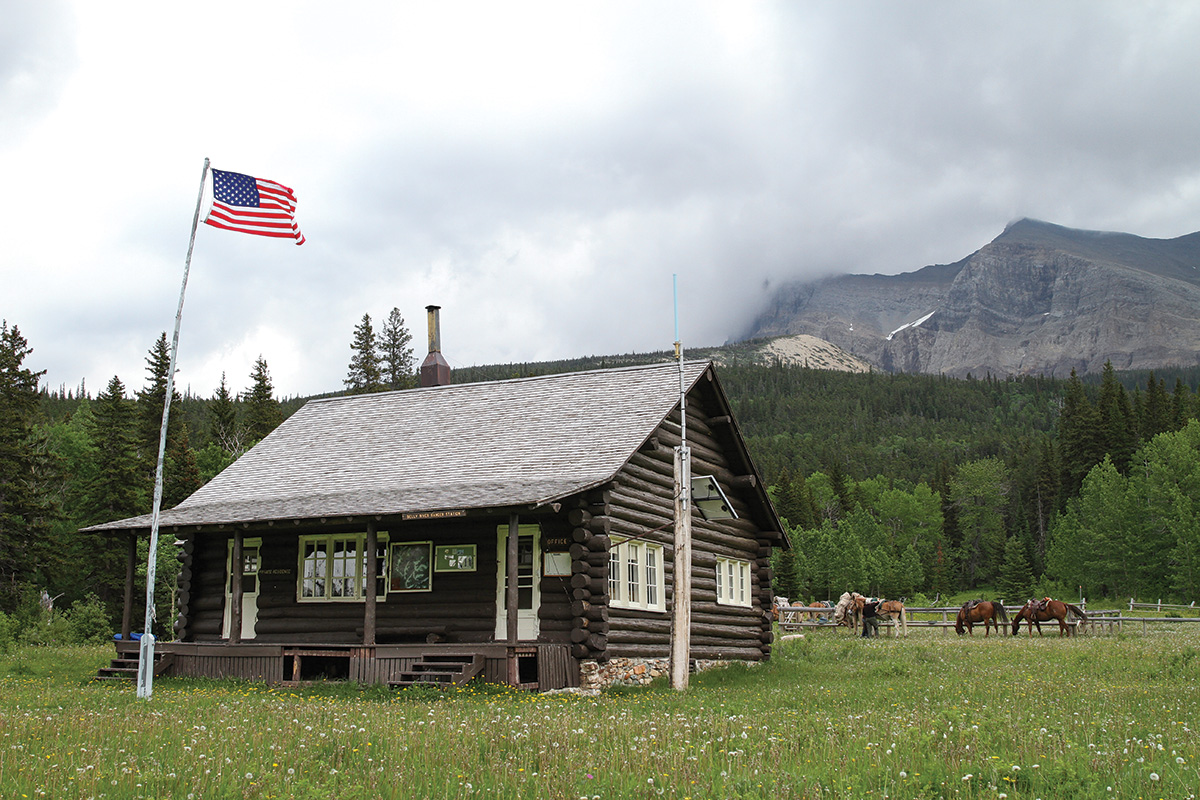
“The Park Service maintains a standard that anything older than 50 years is considered historic and must be maintained to those standards,” says Michalak. “When we packed into the Belly River Ranger Station, they were updating that cabin. [Carpenters] sourced the lumber for the flooring from the surrounding forest, but the lumber for the porch, we packed in. People wonder why we don’t use a helicopter, and there are a few reasons. First, they didn’t historically bring those items in by helicopter. Second, a lot of the National Parks have regulations as to how much aircraft traffic can go over the park.”
At the Belly River Ranger Station, deep into Glacier National Park, pack mules help supply a carpentry crew who will restore the historic cabin. Photo by Kate Bradley Byars
From Beams to Outhouses
The same goes for building or repairing a bridge or constructing a new dam, both of which are projects Eyer has packed materials for into the BMWC.
“Anything that is associated with the wilderness that requires heavy equipment or more than people can carry relies on mules,” he says. “The most challenging project was a bridge project where I packed tandem loads of steel columns that attached to two mules at the same time. It was a seven-week project.” Each pair packed two 186-pound steel beams.
Two mules worked in tandem to carry steel beams to complete a bridge project that Eyer worked on. Photo by Chris Eyer
From dams to outhouses, all the projects constructed in the backcountry rely on mule power to bring the items in or take them out.
“It’s common for bears to tear apart outhouses, and the park doesn’t leave those pieces out there,” says Michalak. “We pack those items—anything that won’t naturally decompose—out of the backcountry. Things like outhouses don’t just appear. While it would take a trail crew half a summer to haul those materials in, it takes a mule string one trip.”
Mules on a Mission
It can seem like a peaceful job, with the quiet of the wilderness all around, the echo of hooves ringing on the trails and the wide-open spaces. But there are many dangers associated with working in the backcountry, and they’re not only bear-related. Annually, fires ravage the land within national parks and designated public lands.
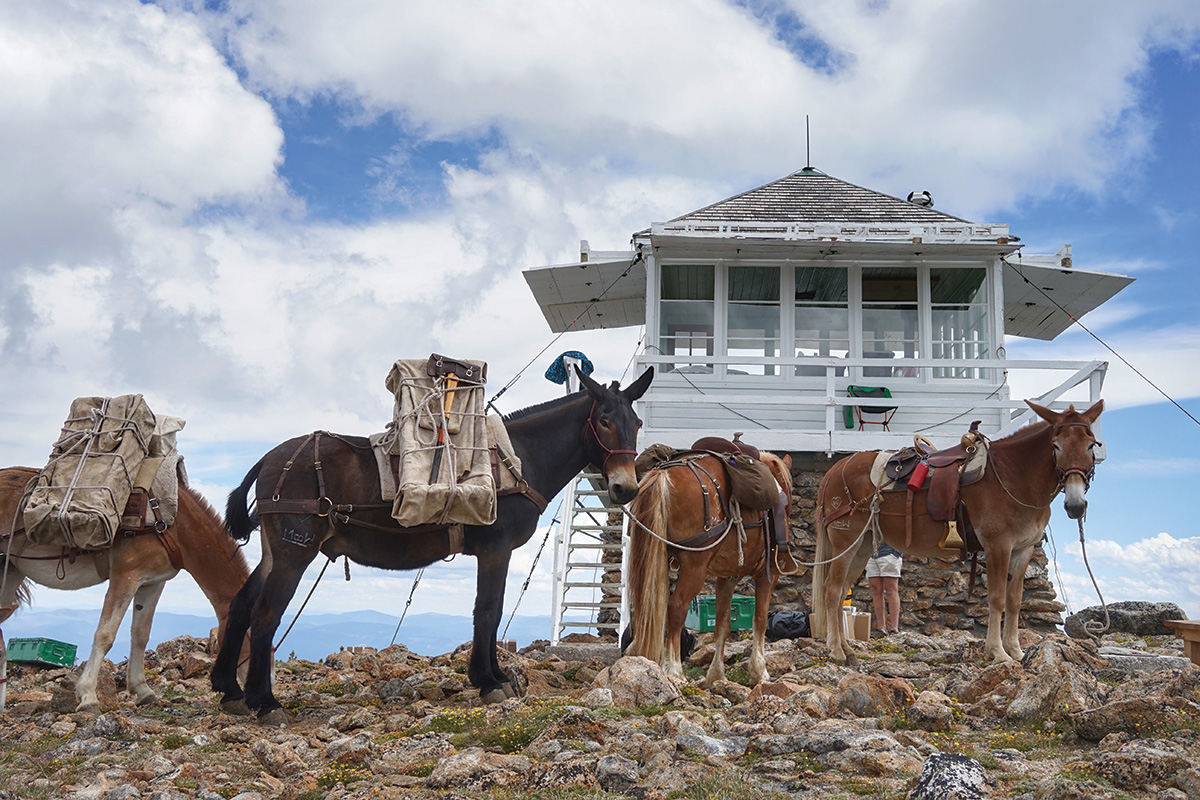
“There is an entire segment of packing that is focused on fire work,” says Eyer. “There are fire lookouts, fire crews, and a lot of work to keep the wilderness from burning, even though much of the wilderness has a ‘let it burn’ policy. Supplies have to be given to the people living in the lookouts for the fire season—food, water and all supplies.”
Chris Eyer’s string brings supplies to the people living at a fire lookout in the Bob Marshall Wilderness. Photo by Chris Eyer
The parks also have to bring search and rescue crews to an injured person, but rarely airlift them out to decrease the mechanized noise. However, Michalak recalls one incident where her mules were used as Medivac, and not only to pack in supplies to those rescuing Backcountry Rangers.
“Once, at Olympic National Park, a woman broke her ankle about 11 miles down the trail,” she says. “There was a huge team of people looking for her, and the weather was really, really bad. I went in with a string of mules and packed the search and rescue team and EMT team’s food and tents in so they could focus on patient care. That was the only [person] I’ve ever packed out on a mule. She was a rare case because she grew up cowboying and had experience riding. Otherwise, the search and rescue team was going to carry her those 11 miles on a [stretcher].”
A Thank You to Backcountry Mules
Whether carting in tools and food to ensure that the park rangers get through a summer season or hauling in new lumber to build a bridge for access to the wilderness, mules are the ultimate cargo crew in the backcountry.
Without four legs to help build and maintain the infrastructure, America’s public lands wouldn’t be so easily accessed.
We use cookies to help personalize content, tailor and measure ads, and provide a safer experience. By navigating the site, you agree to the use of cookies to collect information. Read our Cookie Policy.