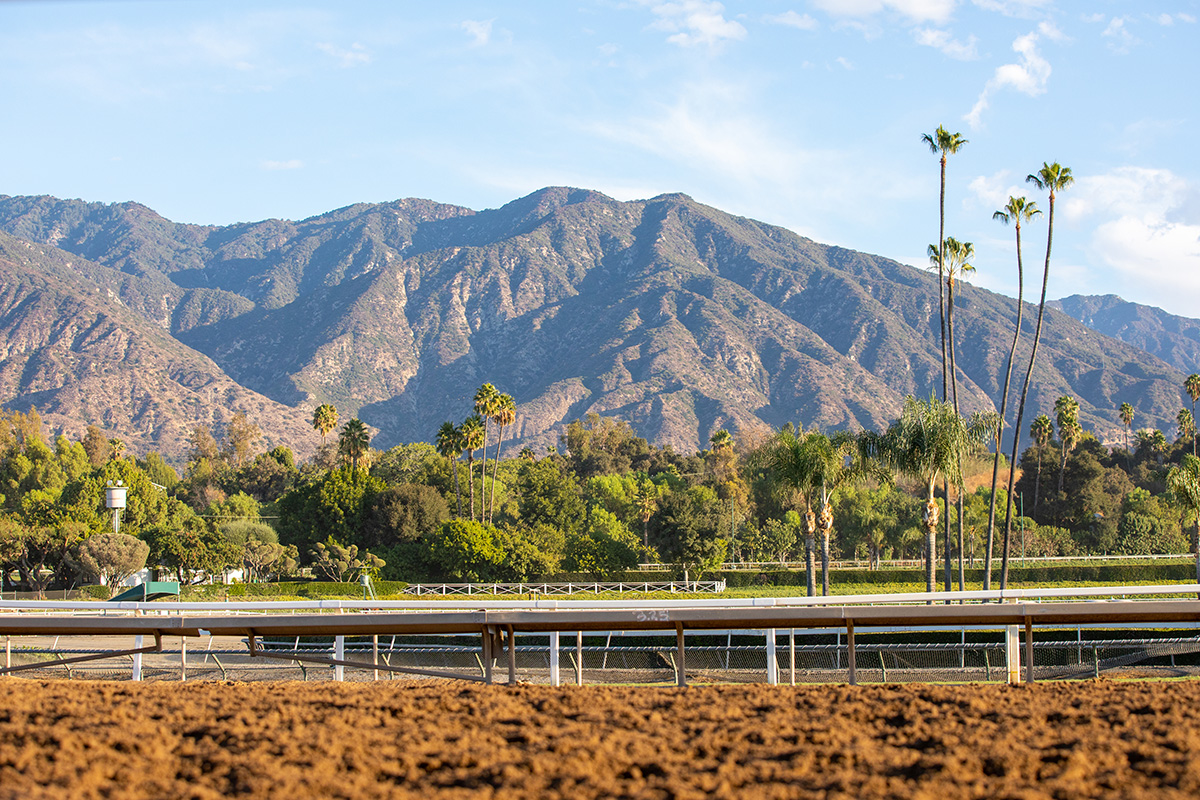
Santa Anita’s iconic backdrop of the San Gabriel Mountains. Photo by Terri Cage
After a long wait, accompanied by much speculation and a final dramatic turn, the official equestrian sports venue for the 2028 Los Angeles Olympic Games (LA28) was finally announced by the International Olympic Committee and LA28 Organizing Committee today. Santa Anita Park in Arcadia, Calif., will be the site of Olympic equestrian action for all three sports (dressage, eventing and show jumping), and likely also for the para-dressage during the 2028 Paralympics. The LA28 Olympic Games are slated for July 14-30, 2028, followed by the Paralympic Games August 15 to August 27, 2028.
Arcadia is located in Los Angeles County about 13 miles (21 km) northeast of downtown Los Angeles in the San Gabriel Valley and at the base of the San Gabriel Mountains. Santa Anita Park, a prestigious Thoroughbred racetrack, also hosted equestrian sports during the 1984 Los Angeles Olympic Games.
“Santa Anita Park will be a spectacular venue for the LA28 Olympic equestrian events,” said Fédération Equestre Internationale (FEI) President Ingmar De Vos. “The FEI has very fond memories of Santa Anita, which had hosted the equestrian events at the 1984 Olympic Games. The venue is set to offer a breathtaking stage for all the Olympic equestrian competitions and the proximity to LA City will undoubtedly attract many spectators to Santa Anita. We look forward to continuing our cooperation with LA28 to deliver spectacular equestrian events at the 2028 Games in Los Angeles.”
The Santa Anita property covers 320 acres (about 129.5 hectares) and already has grandstands that can hold 26,000 people, in addition to a park-like infield which can accommodate approximately 50,000 more. Sixty-one existing barns at the facility can house up to 2,000 horses, far more than needed for the Olympics and Paralympics.
Unlike 1984, when the eventing cross-country was held off site on a then-brand-new golf course, for LA28 the cross-country course is planned to be staged on ground surrounding the racetrack. This will necessitate the construction of a new cross-country track.
The announcement of the selection of Santa Anita came to big surprise to the owners of Galway Downs (Temecula, Calif.), and local and state officials who supported Galway Downs, as the previously nominated and expected venue for LA28 equestrian sports. As recently as March 28, the Los Angeles City Council had voted to accept Galway Downs as the venue.
Two weeks later, the International Olympic Committee (IOC) and the LA28 Organizing Committee announced the selection of Santa Anita instead. They notified Galway Downs representatives on April 11 that they were no longer in consideration as an Olympic venue before announcing the new venue selection on April 15.
Galway Downs owner Ken Smith issued this statement after being notified, “We are extremely surprised that we were suddenly removed from consideration. We don’t understand how, based on the March 28 City Council’s vote of approval, that this could happen. When we started this process more than four years ago, we understood the equestrian venue selection for LA28 would be a highly competitive, evolving process. Being selected as the proposed equestrian venue put Galway Downs and Temecula Valley on the world stage. We’re very proud of that, and we’re just getting started. Galway Downs will continue to host elite national and international competitions as well as additional sporting events.”
When the 2028 Olympics were awarded to Los Angeles, the first venue for equestrian sports put forward was Sepulveda Basin Recreation Area, but that would have required an entirely new equestrian sports facility be built. In June 2024, plans to use Sepulveda for LA28 equestrian sports were abandoned in favor of Galway Downs. A few other facilities were also considered briefly.
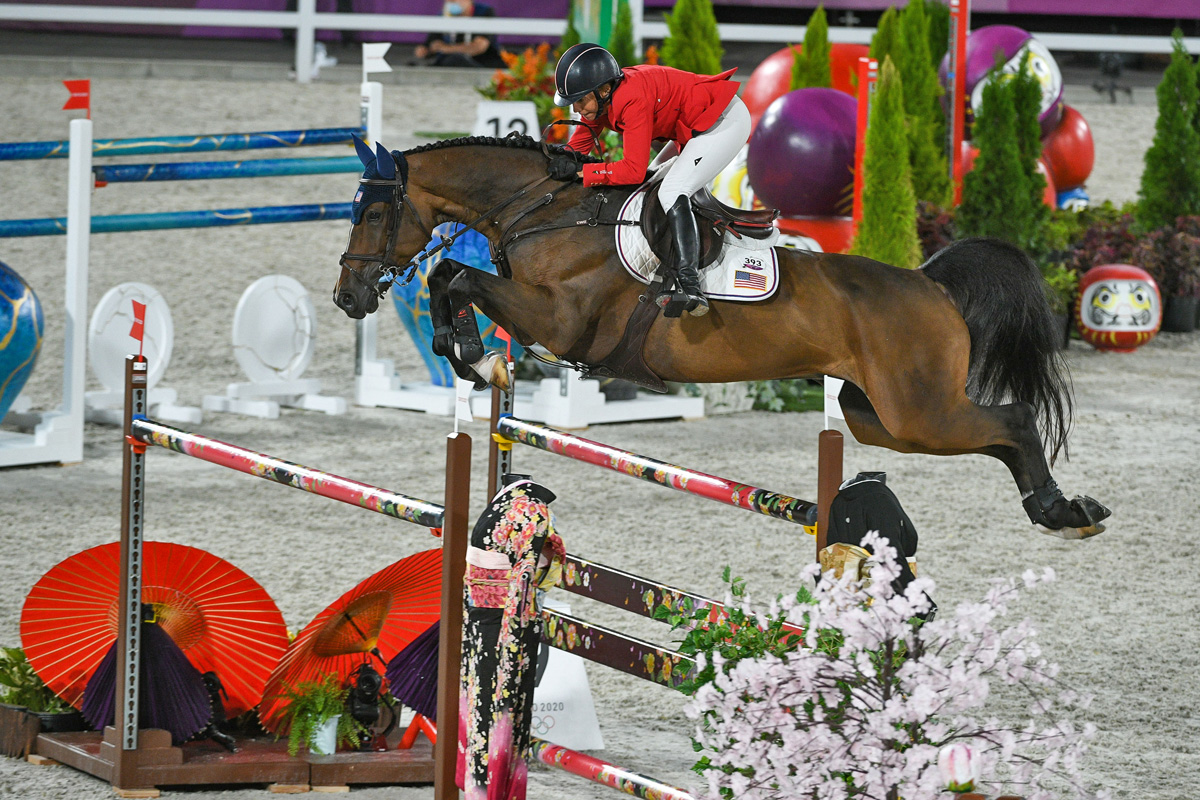
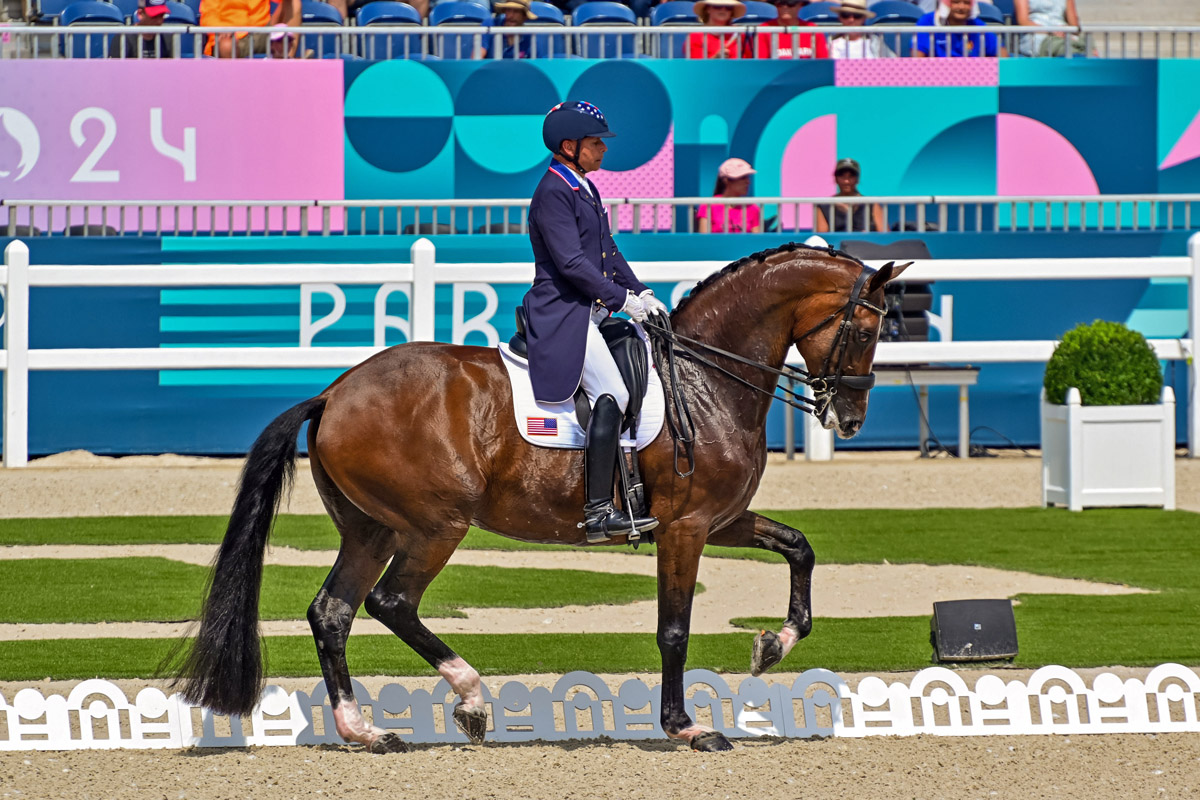
The LA28 equestrian venue will have big shoes to fill after the splendor of the Palace of Versailles as a backdrop for the 2024 Paris Olympics equestrian sports. But, Santa Anita has sunshine, palm trees and the eye-catching San Gabriel Mountains as scenery, as well as a long history of legendary racehorses like Seabiscuit and Zenyatta—plus Hollywood movie stars attending races and investing in the track. It certainly fits the bill for iconic horse sports in the land of stars.
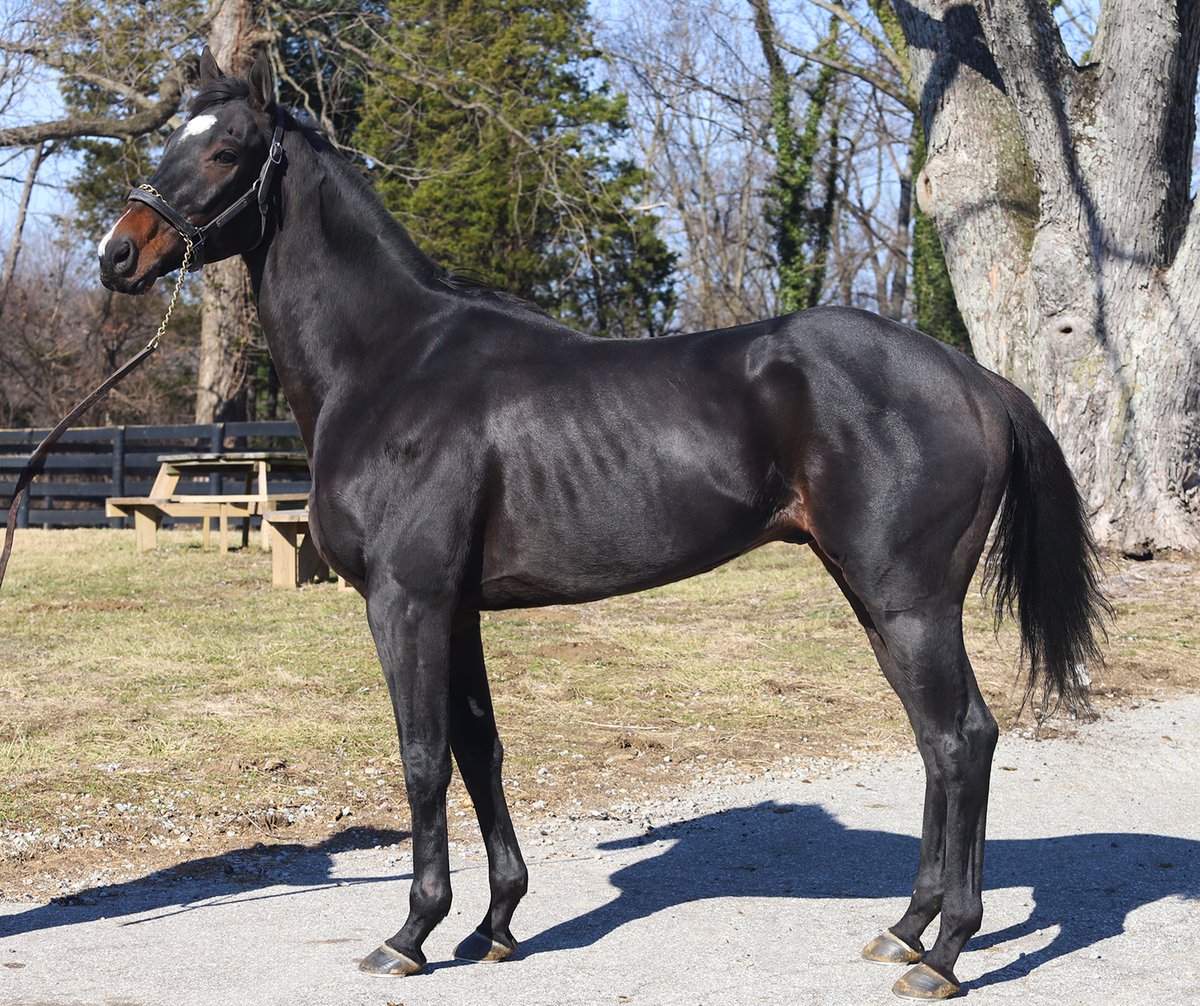
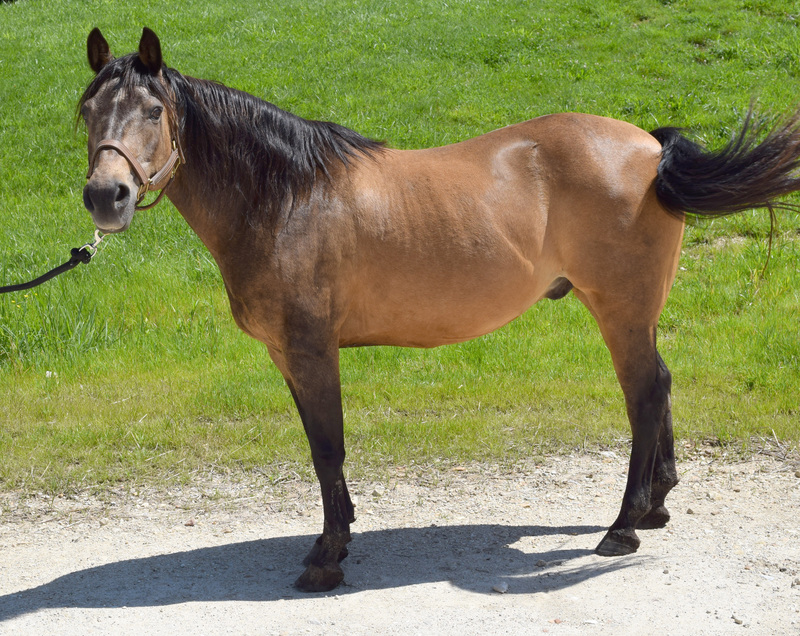
Adoptable Horse: Camp Hope, a 7-year-old, 16.1hh Thoroughbred gelding Organization: Second Stride, Prospect, Ky.
Get to Know Adoptable Horse Camp Hope
Meet Camp Hope, a son of Summer Front (by War Front) and out of Praising (by Pulpit). A stakes winner of $473,346 on the track, Hope is eligible for the Retired Racehorse Project’s Thoroughbred Makeover Competition.
Hope last worked on December 11, 2024 and retired with a left front suspensory tear. He also has a left front ankle chip that can be taken out if used for an athletic career. Additionally, he has an old splint fracture in the same leg. He can start under saddle at the walk only for no more than 20 minutes at a time through May 2, 2025. At this point, if he is sound in hand, he can begin no more than 5 minutes of jogging. He is still on round pen turnout for 60 days ending on June 2, 2025. An ultrasound will be needed at that point to determine his full turnout options if the suspensory has healed.
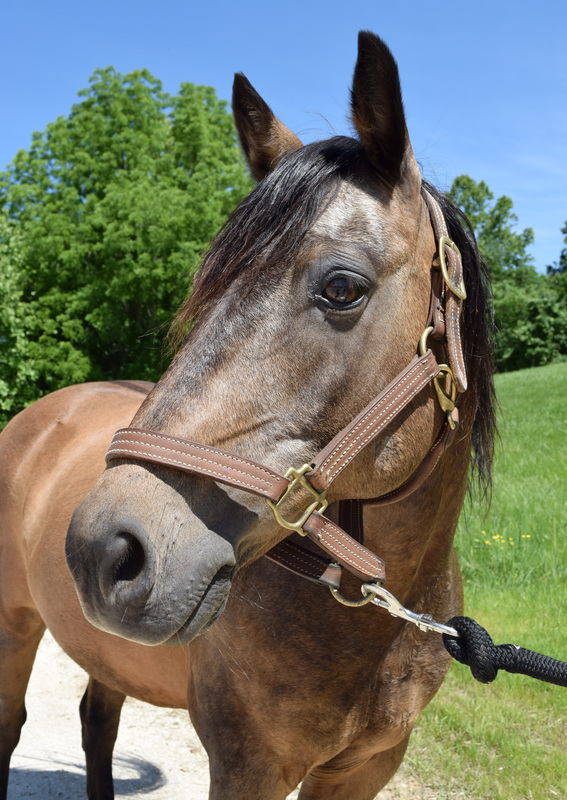
Hope is absolutely stunning with his almost black coat, diamond shaped star and beautiful, big, brown eyes. He is as kind as he is handsome. He does like to take things in and took about a day to settle into the farm at Second Stride; he seems intelligent and inquisitive. He is respectful of his handlers and is good for grooming and blanketing. He behaves well when being led but can be reactive to sounds. Second Stride expects this to improve as he settles in and gets turnout.
Hope is available to anyone now who can accommodate his rehab needs and will follow the recommended vet requirements.
Second Stride is hopeful he will be suitable for any discipline; however, this will be determined in June once the suspensory has healed fully.
Hope is very well-behaved under saddle. Even though he was nervous on his first ride, he kept his cool and listened to and trusted his rider and eased into his ride. This guy is just the sweetest, quietest, most intelligent guy you could ever want.
Contact Second Stride today about ASPCA Right Horse Adoptable Horse of the Week, Camp Hope!
ASPCA Right Horse
ASPCA Right Horse is the online adoption platform of The Right Horse Initiative, a collection of equine industry and welfare professionals and advocates working together to improve the lives of horses in transition. A program of the ASPCA, their goal is to massively increase horse adoption in the United States. To find more adoptable horses and foster horses, visit www.myrighthorse.org. To learn more about The Right Horse, a program of the ASPCA, visit www.aspcarighthorse.org.
As U.S. athletes look back on valuable experience gained at the 2025 FEI World Cup Finals in Switzerland, the next stop on the World Cup journey is on home soil, in the Lone Star State―Texas. Mark your calendars for April 8-12, 2026!
Americans in Switzerland doing the “planes, trains and automobiles” whirlwind tour of a beautiful country filled with mountains, lakes, rivers, farms, and some pretty cool towns and cities―that’s what we were. The scenery was breathtaking looking through the windows of our Eurostar train from Amsterdam in the Netherlands, through Belgium and France where we changed trains in Paris, and finally on a national SBS train to Lausanne, Switzerland.
Honored to be working on assignment for Horse Illustrated magazine and website, I was accompanied on the trip by colleague Alan Whinery who helped me tote the luggage and equipment, planned our train routes and hotel stops, and assisted with photos and notes at the World Cup Finals. A huge thanks to him for keeping the trip running smoothly, and to my editors at Horse Illustrated, Mary Cage and Holly Caccamise!
1 of 2
Journalist Kim MacMillan, with her Horse Illustrated tote in hand, in front of the FEI Headquarters in Lausanne, Switzerland, where she attended the FEI Sports Forum. Photo by Alan Whinery/MacMillan Photography
The traveling Horse Illustrated tote bag in front of the Olympic Museum in Lausanne, Switzerland. Photo by Alan Whinery/MacMillan Photography
Swiss Stop #1: The FEI Sports Forum
In Lausanne I had the opportunity to attend the Fédération Equestre Internationale (FEI, the international governing body for equestrian sports) Sports Forum for two days before going on to Basel for the FEI World Cup Finals. Staged by the FEI staff and committee members, and attended by various stakeholders from around the world, the Forum is held annually in the spring. It provides a platform for presentation of current equestrian sports topics with time for open discussion from the audience. It was great to see the FEI encouraging their members to offer their thoughts and opinions for the betterment of our sport.
The Forum gives the FEI Board of Directors valuable feedback from members before they meet again later in the year to conduct the business of the organization. Topics of discussion from this year’s Forum included equine welfare, a strategic plan going forward for dressage, athlete quotas for equestrian sports at the Los Angeles 2028 Olympic Games, the process to elect a new FEI president, a plan for FEI officials development and retention, and rule changes for show jumping, eventing, and driving and para-driving.
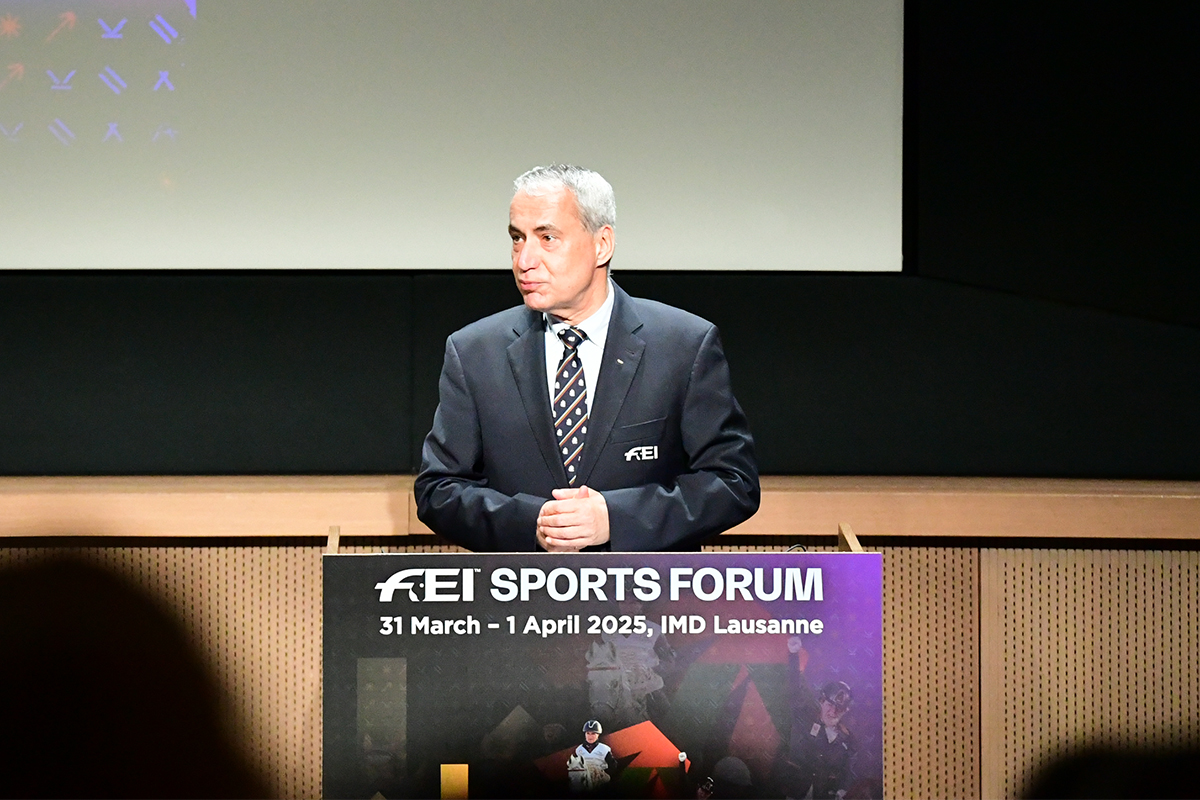
FEI President Ingmar de Vos addresses attendees at the start of the 2025 FEI Sports Forum in Lausanne, Switzerland, on March 31. Photo by Kim MacMillan/MacMillan Photography
During the breaks I had the chance to interact with not only helpful FEI staff members, but also equestrians from around the globe. For instance, I met a lady from Algeria who was representing the African Equestrian Federation at the Forum. She was quite interested in knowing more about our show hunter divisions as they don’t have that competition discipline in Africa.
Located in the French speaking part of Switzerland, and situated on scenic Lake Geneva, which is bordered by snowcapped mountains, Lausanne is known as “the Olympic city” because it is the home of both the International Olympic Committee headquarters as well as the Olympic Museum. Strategically, it is also the location of the FEI headquarters in the HM King Hussein Building (sold to the FEI for 1 Euro by King Hussein’s daughter and former FEI President Princess Haya bint Al Hussein of Jordan). Alan and I made time to take photos (with my Horse Illustrated tote bag in hand, of course!) in front of the FEI building and the Olympic Museum.
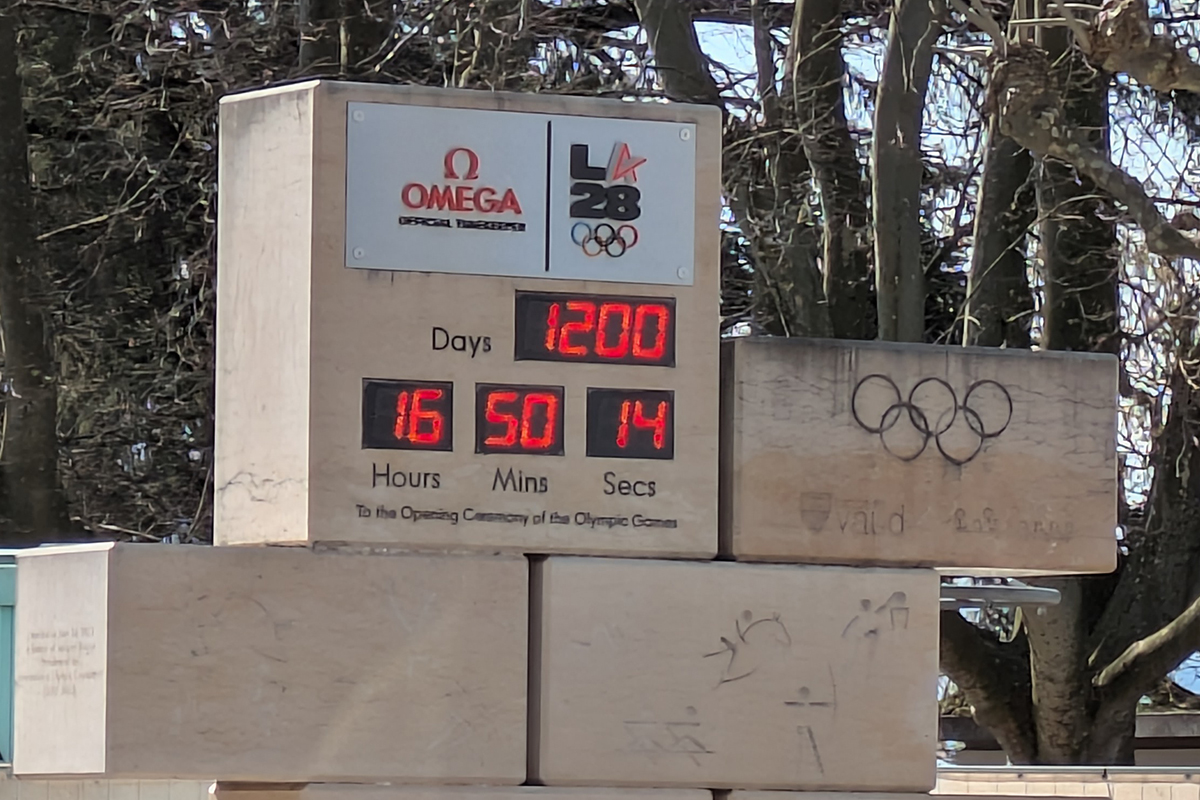
As we strolled around town in the evening, we saw several LA28 Olympic countdown clocks. One displayed “1200 days, 16 hours, 50 minutes and 14 seconds” as we passed it, hinting that it won’t be long until the world’s best athletes gather in California for another Olympic and Paralympic Games. As one of the speakers at the Forum said regarding the work ahead to be done in a relatively short time before LA28, “The days are long, but the years short.”
An Olympic countdown clock along Lake Geneva in Lausanne, Switzerland, marks the days until the opening of the 2028 Los Angeles Olympic Games. Photo by Alan Whinery/MacMillan Photography
Swiss Stop #2: The 2025 FEI World Cup Finals
After two nights in Lausanne, it was time to board another train for Basel, Switzerland, and get settled in to report on the 2025 FEI World Cup Finals for dressage, show jumping and vaulting for the next five days. The sun was setting as we boarded the train so we didn’t get much sightseeing in as the train made its way from the French-speaking section of Switzerland to the German-speaking area. (There is also an Italian-speaking region in Switzerland, and although we didn’t get there, our hotel offered television stations in all three languages as well as a few in English.)
Basel is Switzerland’s third most populous city behind Zurich and Geneva, with roughly 177,500 residents. The Rhine River runs through the city which boasts both large and small “old city” historic sections as well as many museums featuring art, history, natural history, antique and classic automobiles, toys, and other interesting things. There are also many beautiful cathedrals, one of which is the Basel Münster that has a particularly interesting history (once a Catholic cathedral, it is now Reformed Protestant church). Offered in restaurants there were Swiss specialties such as fondue, raclette (a hands-on dish where they bring you a burner to melt slices of cheese to use to smother accompanying potatoes) and, of course, Swiss chocolate.
The large, modern multi-use St. Jakobshalle (St. Jakob’s Hall) was the venue for the 2025 FEI World Cup Finals. Two short tram rides (free to visitors staying in local hotels via a “Basel Pass” you receive at check in) took us to the venue each day. St. Jakobshalle hosts a big horse show each year in January, which is one reason it was selected for the World Cup Finals this year.
The indoor main arena was bordered by seating on two sides, with VIP dining tables overlooking the arena on both ends. Quite steep stairs filed spectators up and out of the seating areas and made it seem to the competitors that the audience was right on top of them. This factor contributed to the heightened “atmosphere” and affected some of the horses’ performances, U.S. riders Adrienne Lyle’s Helix and Geñay Vaughn’s Gino among them. Riders warmed up their horses in outside arenas, then entered the hall to compete.
During the World Cup Finals, for the most part the stands were packed with knowledgeable fans (except for the dressage Grand Prix held during the work/school day on Friday afternoon when the seats were about half-empty). We noticed a surprisingly large group of U.S. fans in the audience who made the long trip to support our athletes. Many shopping booths and food vendors both inside and outside the building offered attendees many choices.
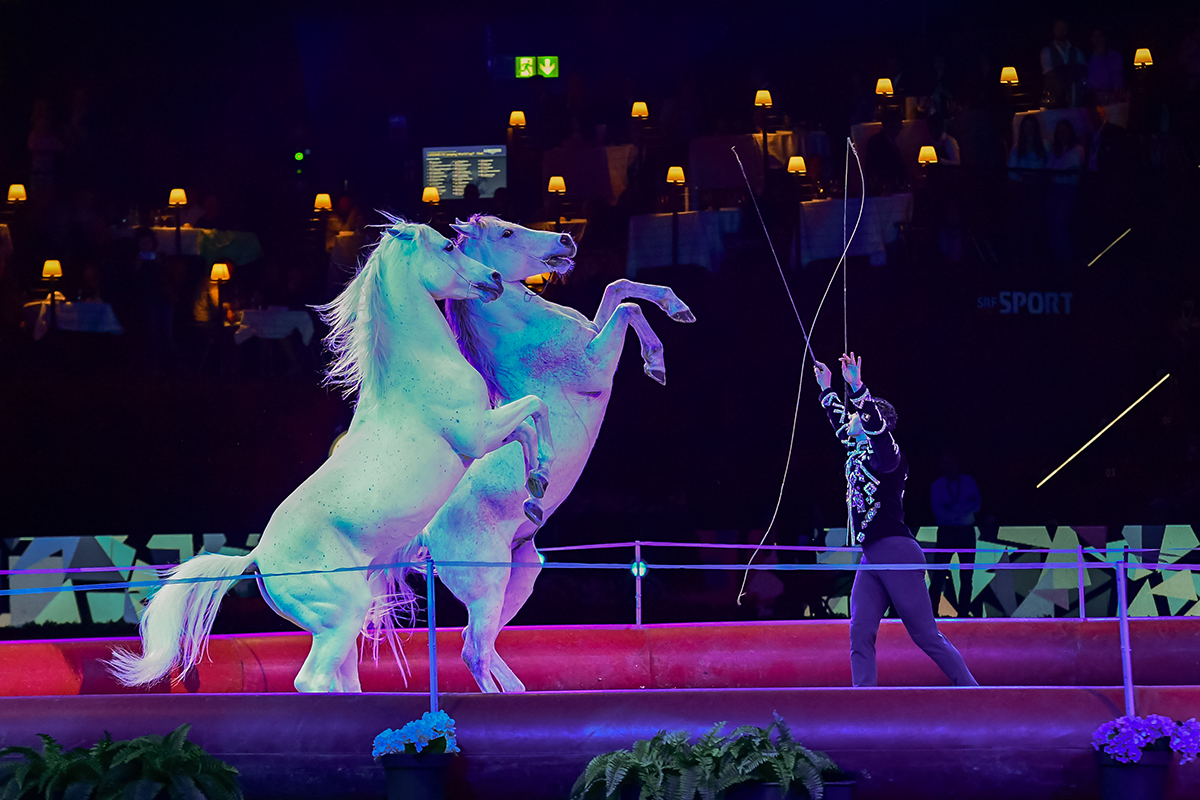
Each day, Swiss musicians and trainers from a Swiss equestrian act, staged a “Swiss Show” performance in between competition sessions. A band, complete with an Alpenhorn soloist, played traditional music and a Swiss choir belted out perfectly pitched a cappella yodels and songs. National-Circus Knie presented an at-liberty 28-horse carousel using Arabian, Andalusian, Friesian, and Lusitano stallions. The Swiss Show was capped with rhythmical beats of the Basel-based Top Secret Drum Corps, a group so impressive that actor Tom Cruise recruited them to appear in his Mission: Impossible – Dead Reckoning movie. It will be interesting to see what entertainment offerings the organizers in Texas will have in store for us for next April.
Two Arabian stallions rear on cue from trainer Ivan Knie in the World Cup Swiss Show. Photo by Kim MacMillan/MacMillan Photography
As journalists, we were lucky to be included in the complimentary meals offered in a large dining hall inside the building where other credentialed individuals also took their meals. The group dining there included athletes, coaches, grooms, volunteers, costumed entertainers and others―a rare opportunity to see them all interacting in the same space.
2025 FEI World Cup Finals: U.S. Athletes & Their Results
Though not a team event, U.S. athletes at the World Cup Finals are selected to compete representing the USA as individuals. This year, US Equestrian supported athletes in all three sports competing in Basel. They are listed in alphabetical order below along with their placings.
In a year with no major games (no Olympics or Pan American Games or World Championships), the 2025 FEI World Cup Finals was a chance for our U.S. athletes to gain valuable international experience to build our ranks for the Aachen (Germany) 2026 World Championships, the 2027 Pan American Games in Peru, and the 2028 Los Angeles Olympics. Our riders and coaches took full advantage of the opportunity and glimpses of great things to come shined through from our U.S. contingent.
U.S. Dressage Competitors:
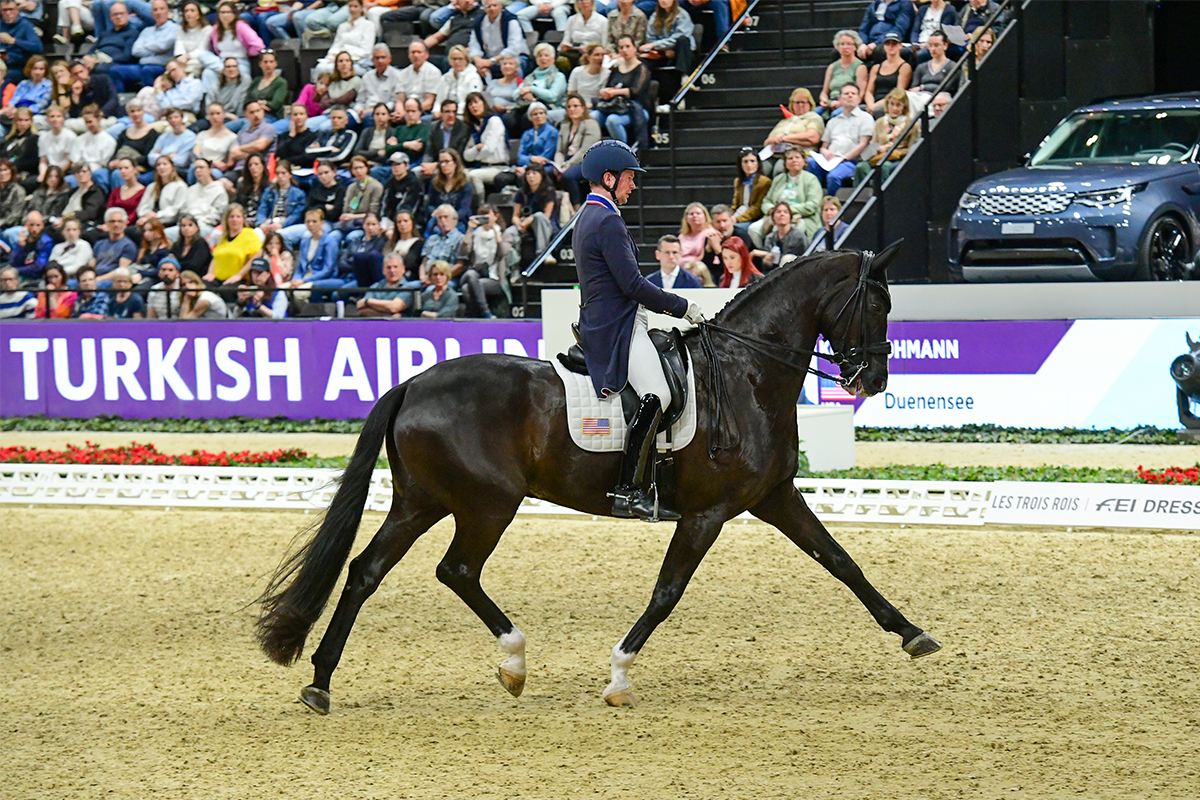
◆ Kevin Kohmann (Wellington, Fla.) and Duenensee, a 2009 KWPN gelding (Dancier x Davignon I) owned by Diamante Farms and cared for by German Rodriguez, 14th in the Grand Prix (69.130%), 10th in Grand Prix Freestyle (75.535%)
◆ Adrienne Lyle (Wellington, Fla.) and Helix, a 2012 KWPN gelding (Apache x Jazz) owned by Zen Elite Equestrian Center and cared for by Marina Lemay, 9th in the Grand Prix (72.565%), 16th in the Grand Prix Freestyle (71.255%)
◆ Geñay Vaughn (Elk Grove, Calif.) and Gino, a 2011 KWPN gelding (Bretton Woods x Haarlem) owned by Michele Vaughn and cared for by Alex Levine-Nevel, 17th in the Grand Prix (62.978%), 14th in the Grand Prix Freestyle, (73.765%)
Kevin Kohmann and Duenensee from the USA in their Freestyle. Photo by Kim MacMillan/MacMillan Photography
Lyle’s top-ten finish with Helix in the Grand Prix on day one, and all three U.S. combinations scoring above 70% in the Freestyle (with Kohmann and Duenensee in the top ten) on the second day were highlights for the USA.
“It was amazing walking into the arena. I had so many people here to support me―it meant a lot,” said Kohmann after their Freestyle. “Our relationship together [with Duenensee, a.k.a. Denzel] has grown so much over the past few years. I’ve never had a horse that I thought could ever take me to the places Denzel has and it’s really an honor to be able to experience moments like this with my best friend in the ring. He’s given me everything, and while tonight may not have been our most perfect performance, I could still feel him enjoying every movement and feeding off the energy of the crowd.”
U.S. Jumping Competitors:
◆ Kaitlin Campbell (Temecula, Calif.) and Castlefield Cornelious, a 2011 Oldenburg stallion (Cornet Obolensky x Contender) owned by Mirasol Equestrian LLC and cared for by Erick Garcia, 24th in Class I (Speed & Handiness), 25th in Class II, Clear in Round A of Class III, but eliminated in Round B due to a rider fall, Final result of 20th overall
◆ Shawn Casady (Harriman, Tenn.) and Cool Quarz, 2012 Holsteiner gelding (Quarz x San Patrignano Cassini) owned by Morning-Star Sporthorses, LLC and cared for Cristofer Mendoza, 28th in Class I (Speed & Handiness), 30th in Class II, Did not compete in Class III, Final result of 30th overall
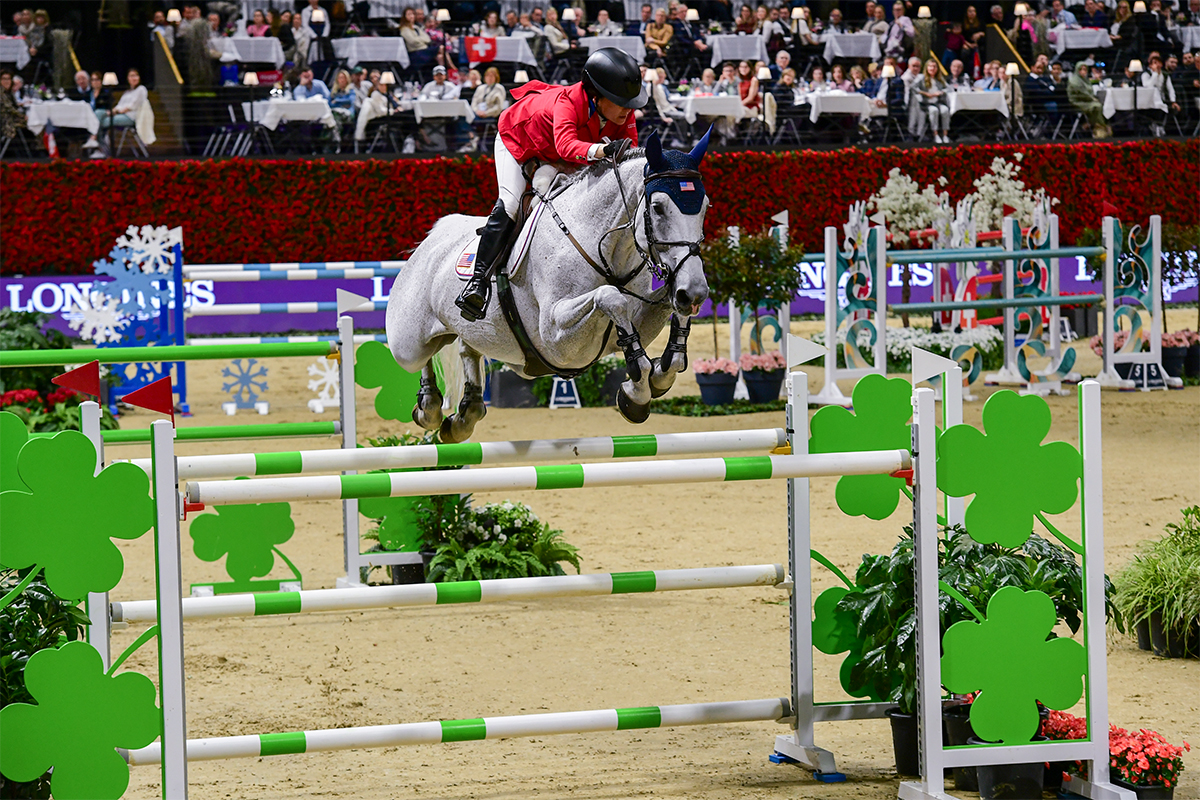
◆ Katie Dinan (New York, N.Y.) and Out of the Blue SCF, an American-bred 2014 Belgian Warmblood mare (Verdi TN x San Patrignano Cassini) owned by Grant Road Partners LLC and cared for by Lou Beudin, 11th in Class I (Speed & Handiness), 21st in Class II, Only combination to go clear in both Round A and B of Class III to finish 1st in that class, Final result of 8th overall and best US finish
◆ Lillie Keenan (New York, N.Y.) and Kick On, a 2014 British Sport Horse stallion (Warrior x Caretino Glory) owned by Chansonette Farm and cared for by Kelly Rohe, 3rd in Class I (Speed & Handiness), 9th in Class II, Clear in Round A of Class III and 12 faults in Round B for a tie of 17th in that class, Final result of 15th overall
◆ McKayla Langmeier (Wellington, Fla.) and Mimosa vd Rollebeek, a 2012 Belgian Warmblood mare (Castelino van de Helle x Toulon) owned by Rafferty Farm LLC and cared for Beth McGranahan, 35th in Class I (Speed & Handiness), 29th in Class II, Did not compete in Class III, Final result of 31st overall
◆ Alise Oken (Charlotte, N.C.) and Gelvera, a 2011 KWPN mare (Quality Time TN x Numero Uno) owned by Hi Hopes Farm LLC and cared for by Gail Sheperd and Lucile Thomas, 25th in Class I (Speed & Handiness), Eliminated in Class II for refusals, Did not compete in Class III, Final result of 33rd overall
◆ Kristen Vanderveen (Wellington, Fla.) and Bull Run’s Jireh, a 2014 Holsteiner gelding (Uriko x Colman) owned by Bull Run Jumpers, Inc. and cared for by herself, 21stin Class I (Speed & Handiness), 23rd in Class II, Clear in Round A of Class III and 12 faults in Round B to finish in a tie for 17th in that class, Final result of 19th overall
◆ Alessandra Volpi (Woodside Calif.) and Gipsy Love, a 2014 Silesian Warmblood mare (Guidam Sohn x L’Espirit) owned by Cedar Fox Farm and cared for by Yuliya Pachtsennay, 12th in Class I (Speed & Handiness), 3rd in Class II, Did not compete in Class III due to mare sustaining a heal grab injury during schooling, Final result of 26th overall
U.S. rider Laura Kraut was nominated to compete on Baloutinue, but pulled out at the last minute, stating that Baloutinue had a minor injury that was already on the mend, but said that she wanted to allow him full time to heal before the rest of the upcoming 2025 outdoor European circuit.
Katie Dinan (USA) and the American-bred Out of the Blue SCF put in two clear rounds on the final day of World Cup competition to finish 8th as the highest-placed U.S. pair. Photo by Alan Whinery/MacMillan Photography
Notable among the U.S. jumper performances were Keenan and Kick On finishing third on the first day, Volpi and Gipsy Love taking third on day two, and Dinan’s two clear rounds (the only combination from any country to achieve that) on the final day with American-bred Out of the Blue SCF (bred by Spy Coast Farm in Kentucky).
U.S. Jumper Chef d’Equipe Robert Ridland commented on the week in Basel after the final round on Sunday, “We had some really great results this week in Basel, and a few of our younger combinations really stepped up and showed off some class riding. I was really impressed today in the first round when all four of our combinations laid down clear rounds. For Katie to finish the way she did with Out of the Blue SCF was very impressive, considering none of the other combinations in the whole class delivered two consecutive clear rounds today.”
U.S. Vaulting Competitors:
◆ Daniel Janes (Stanwood, Wash.) and Caretes Auhoern, a 2009 Holsteiner gelding (Caretino 2 x Colman), owned and lunged by Jana Leib, and cared for by Leona Schreiner, 8th in the Tech Test (7.294), 8th in the Free Test (7.798), 8th overall
◆ Caroline Morse (Los Gatos, Calif.) and Rey Rubino, a 2017 Hanoverian gelding, (Rotspon x Christ 3) owned by Claire Bartell, cared for by Isabell Nowak, and lunged by Lars Hansen, 8th in the Tech Test (5.846), 7th in the Free Test (7.397), 8th overall
◆ Kimberly Palmer (Half Moon Bay, Calif.) and Rosenstolz 99, a 2007 Rheinlander gelding (Rosencharmeur x Fidermark), owned by Club Ippico Monzese A.S.D., cared for by Kevine Moneuse, and lunged by Laura Carnabuci, 5th in the Tech Test (7.419), 5th in the Free Test (8.765), 5th overall
There was also a vaulting Pas de Deux (pairs) division, but the USA didn’t send a pair to compete.
The U.S. vaulters were really just starting their competition season, so for them the World Cup comes early in the calendar. All three vaulters improved their scores significantly on day two in the Free Test.
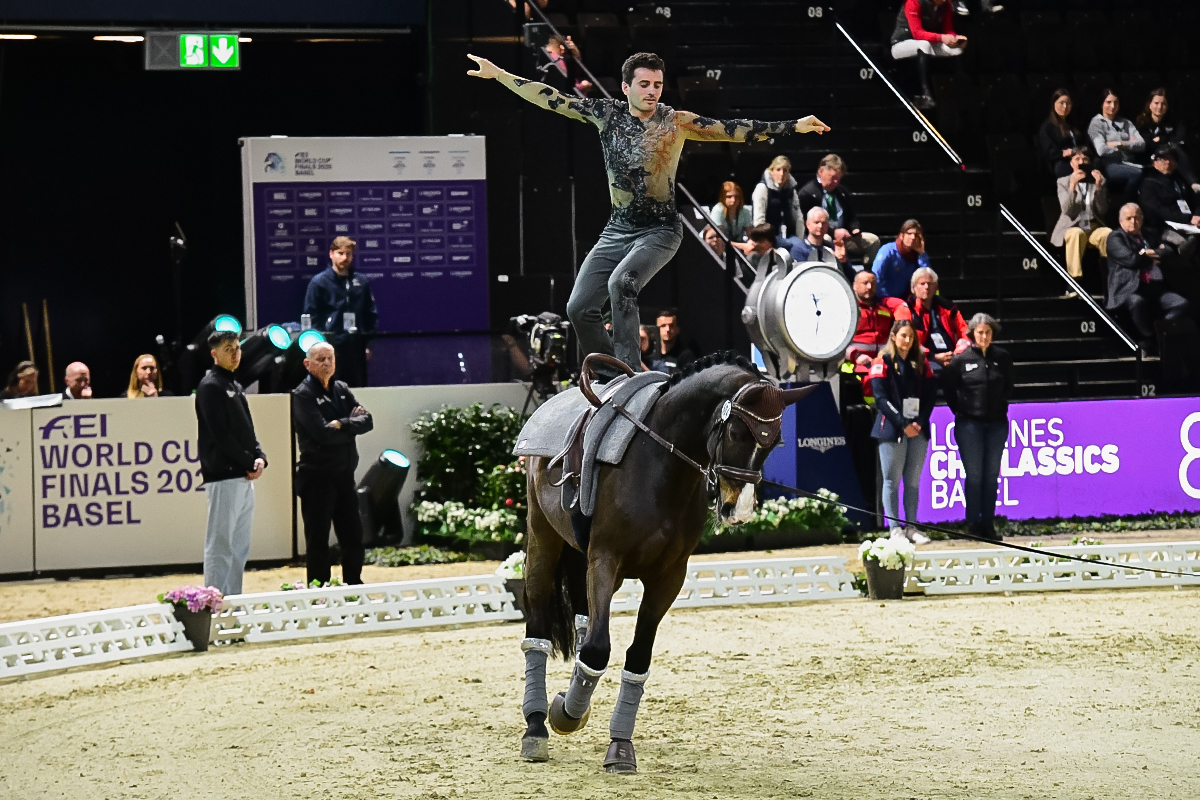
The USA’s Daniel Janes performing at the World Cup Vaulting Finals on Caretes Auhoern. Photo by Kim MacMillan/MacMillan Photography
Janes was chosen by the FEI for an interview for an upcoming video production called RIDE. While photographing action in the main arena, I stood near the FEI videographer who spoke with him. When she learned that I was from the USA, she told me how much he impressed her as one of her favorite interviewees and praised him for his articulate comments and his regard for and rapport with his horse.
Winners from Basel
The top three in dressage at the World Cup were Charlotte Fry and Glamourdale of Great Britain, first; Isabell Werth and DSP Quantaz of Germany, second; and Isabel Freese and Total Hope OLD of Norway, third. It was the first top-three finish in Dressage World Cup Finals history for a rider from Norway. Read more here.
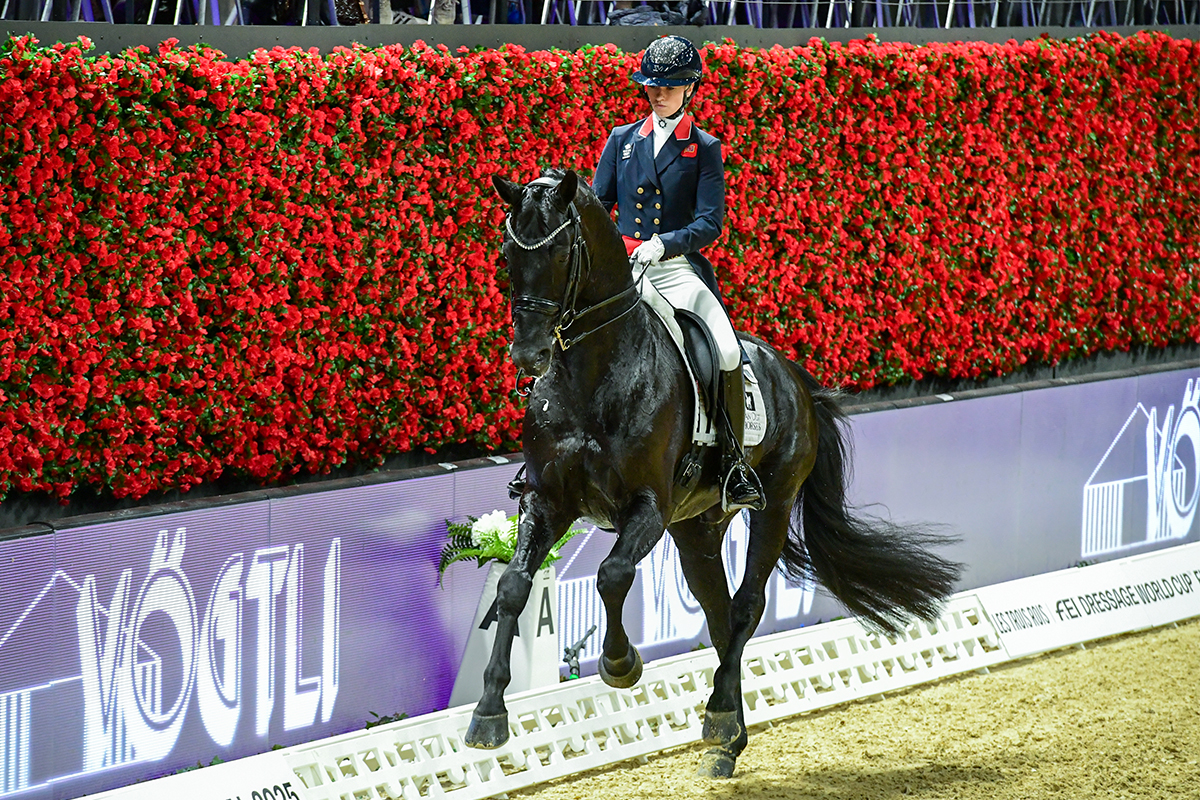
Winner of the Basel World Cup Dressage Final, Charlotte Fry (GBR) on Glamourdale. Photo by Kim MacMillan/MacMillan Photography
Winners in the jumping were Julien Epaillard of France riding his home-bred Selle Français gelding Donatello d’Auge. Second was Ben Maher (despite competing with a broken foot) of Great Britain who guided Point Break to that great finish. Third was another Frenchman Kevin Staut on yet another Selle Français gelding Visconti du Telman. Read more here.
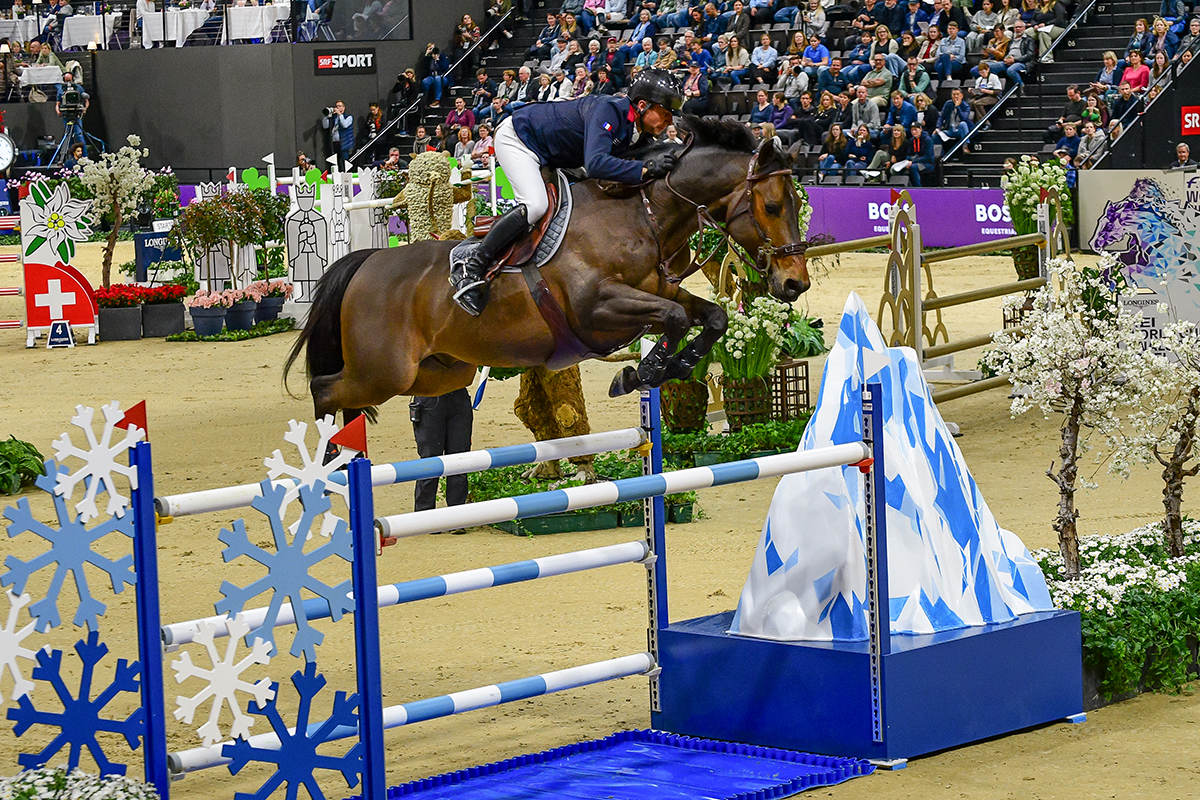
Winners of the World Cup Jumping Finals, Julien Epaillard and Donatello d’Auge. Photo by Alan Whinery/MacMillan Photography
German vaulter Kathrin Meyer captured first in Individual Female Vaulting with Capitain Claus OLD, her third consecutive World Cup title. Topping the Individual Male Vaulting division was France’s Quentin Jabet with Goldjunge. Italian vaulting pair Rebecca Greggio and Davide Zanella proved they were the best in the Pas de Deux performing their routines aboard Orlando Tancredi. Read more here.
1 of 3
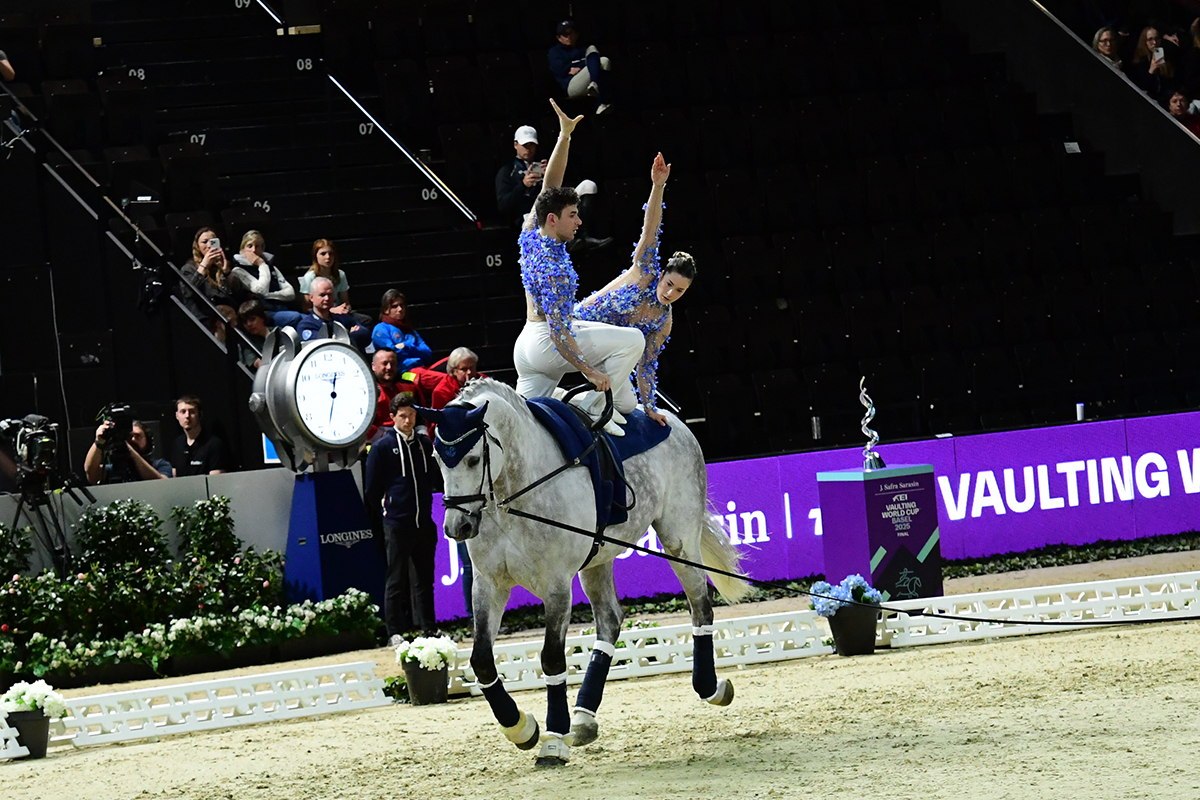
The pair from Italy, Rebecca Greggio and Davide Zanella, won the World Cup Pas de Deux division. Photo by Kim MacMillan/MacMillan Photography
Topping the Individual Male Vaulting was Quentin Jabet of France with Goldjunge. Photo by Kim MacMillan/MacMillan Photography
Germany’s Kathrin Meyer won her third consecutive World Cup Final vaulting from Capitain Claus OLD. Photo by Kim MacMillan/MacMillan Photography
Find all of the competitor lists, orders of go, results and jumping course maps from the 2025 Basel FEI World Cup Finals here.
View replays of all of the Basel World Cup action on FEI TV via the ClipMyHorse platform (premium subscription required, but a free trial may be possible) here.
On To Fort Worth 2026
Dickies Arena in Fort Worth, Texas, will host the 2026 FEI World Cup Dressage and Jumping Finals in April. Photo by Stephanie Apodaca/Courtesy Dickies Arena
So, now it’s our turn―on to Fort Worth, Texas a year from now, April 8-12, 2026, when they will host the FEI World Cup Dressage and Jumping Finals. Derek Braun, of the Fort Worth 2026 World Cup Organizing Committee and founder of Slit Rock Jumping Tour, was in Basel.
He participated in the closing ceremony there, where the FEI flag was handed off from the Basel organizers to him. In his acceptance speech he invited the world to Fort Worth to experience the Finals “Texas style.” We can only guess that means bigger than life!
“Our Split Rock team and the City of Fort Worth have been hard at work planning a world-class event unlike anything the sport has ever seen,” said Braun. “My team and I are deeply honored to be able to organize a championship like this, and we look forward to showcasing the best in jumping and dressage in one of the most impressive cities anywhere in the world! We are fully committed to making this World Cup Final the best one ever.”
Tickets and hospitality packages are already on sale. For more information, visit here.
As the 2025 FEI World Cup Finals wrapped, we packed up and hopped yet another train for our final Swiss stop, Zurich. From there it was a day’s worth of airport layovers and airplane rides before we touched down again in the USA. While we enjoyed the journey and the competition very much, it was great to be home. Now, we look forward to reporting on all of the action from Texas next spring!
If you’ve never cleaned a horse’s sheath, you probably have questions. First and foremost, is it really necessary? And more importantly, how exactly do you clean a horse’s sheath?
You’ll be glad to know once-a-year sheath cleaning is sufficient for most male horses. This not only keeps them comfortable, but also allows anything abnormal to be found and addressed.
As for the how, we’ve got you covered step by step, so read on.
Quick Anatomy Lesson
Whether gelding or stallion, every male horse has a penis and sheath. Unless he “lets down” to urinate or is sexually aroused, his penis is retracted inside the sheath.
Muscles keep the retracted penis protected by a loose double fold of skin called the prepuce. The external part of the prepuce is known as the sheath.
To reduce skin-on-skin friction when the penis extends and retracts, lubrication is provided by an oily substance called sebum, which is secreted by the sebaceous glands.
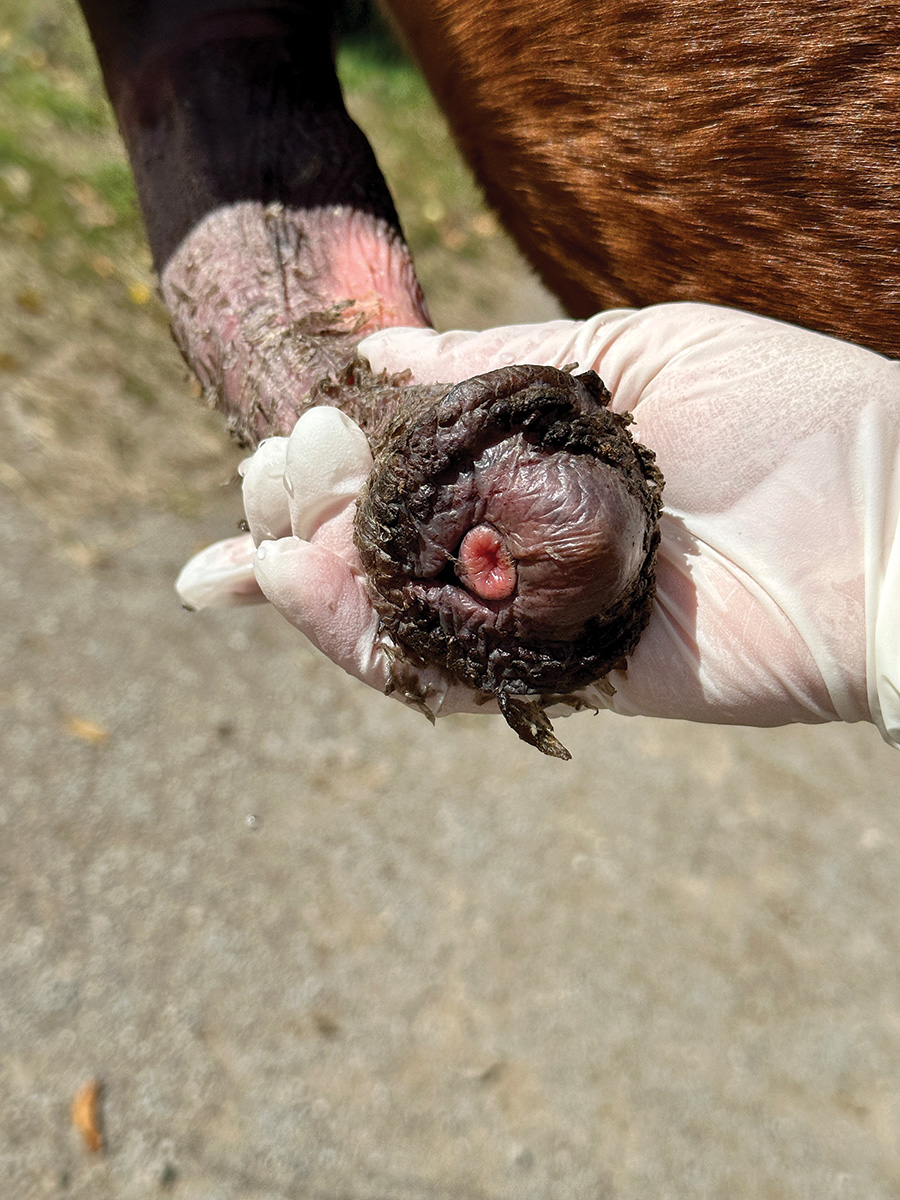
As sebum combines with dirt, exfoliated skin cells, dirt, natural bacteria, and moisture, it forms a thick, waxy substance known as smegma. It can vary in color from creamy to gray or black.
Why Do You Need to Clean a Horse’s Sheath?
If you never know the normal appearance of your horse’s sheath and penis, you may not realize if something changes.
Male horses can develop cancers—sarcoids, melanomas, and squamous cell carcinoma—on the penis and sheath. Habronemiasis, aka summer sores, can also occur in this area.
“The majority of the time, horses aren’t walking around with the penis extended, so unless you make it a point to clean the sheath, you won’t see if there are any changes,” says Melissa J. Prell, DVM, M.S., DACT, director of the Advanced Fertility Center at Peterson Smith Equine Hospital in Summerfield, Fla. “Even more important than cleaning is monitoring the overall health of the horse, and this includes the reproductive tract.”
Signs a Sheath Cleaning is Needed
“People often associate the existence of smegma as unhygienic, but it’s a normal process for horses to have smegma,” says Prell. “Some horses are dirtier than others; it doesn’t necessarily mean something’s wrong. Horses roll in dirt, sand, and shavings, and skin sheds naturally, so all of this accumulates in the dark, waxy appearance of smegma.”
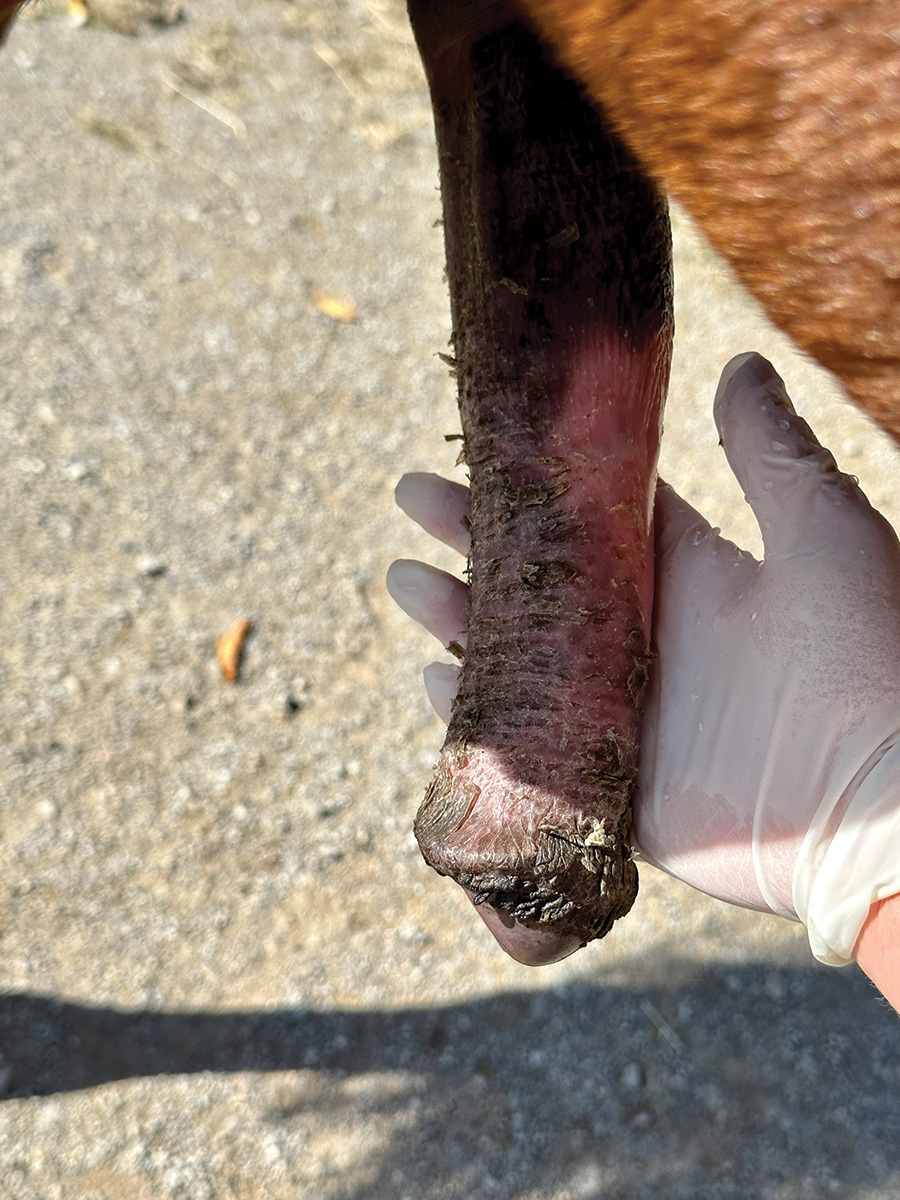
Visible smegma or an interrupted urine stream are possible signs that it’s time to clean your horse’s sheath. Photo by Shoshana Rudski
The following signs may indicate your horse has excess smegma and needs his sheath cleaned:
◆ Visible smegma on the outside of the sheath, hind legs or belly near the sheath
◆ Penis looks dirty when visible
◆ Change in urine stream
A Heads-Up for Mare Owners
Smegma isn’t a concern with mares, but dirt, sweat and dead skin cells can still build up between the teats and around the udder. To keep your mare from becoming irritated or harboring bacteria, you’ll want to periodically use warm water and mild dish soap to gently clean this area when grooming or bathing.
What is a “Bean?”
Beans can range in size from tiny to walnut-sized, and some of the larger ones may cause discomfort. Photo by FastHorsePhotography/Adobe Stock
Sheath cleaning and beans are often mentioned together.
A bean is the firm accumulation of smegma that can form at the end of the penis near the urethral opening in a depression known as the urethral fossa.
So named because of their shape, beans can vary from the size of a pencil eraser or lima bean to as large as a walnut.
“Some horses form more of a bean than others, depending on how dirty and waxy their smegma is,” says Prell.
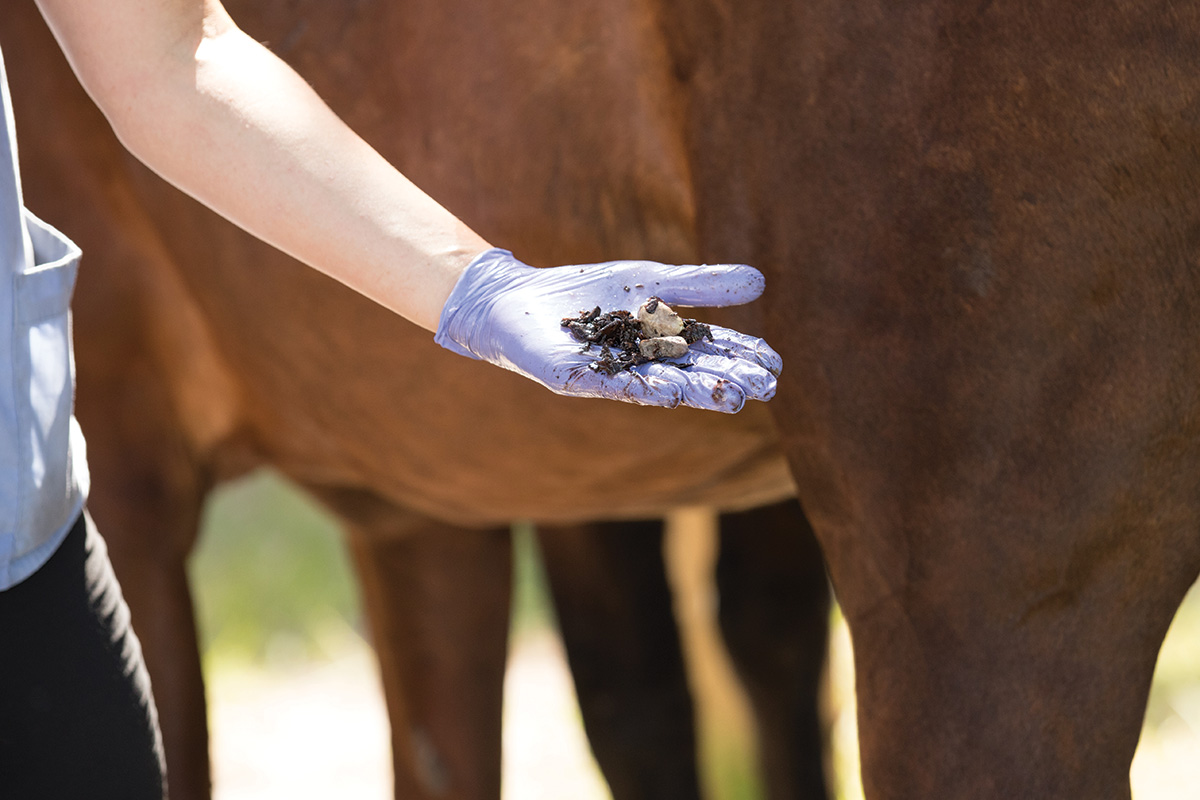
A bean can form from smegma accumulation at the end of the penis near the urethral opening in a depression known as the urethral fossa. Photo by Shoshana Rudski
What if you never clean the sheath?
Some horses will develop massive beans that can make them uncomfortable. But one of the biggest concerns is not catching potential pathology, such as cancer.
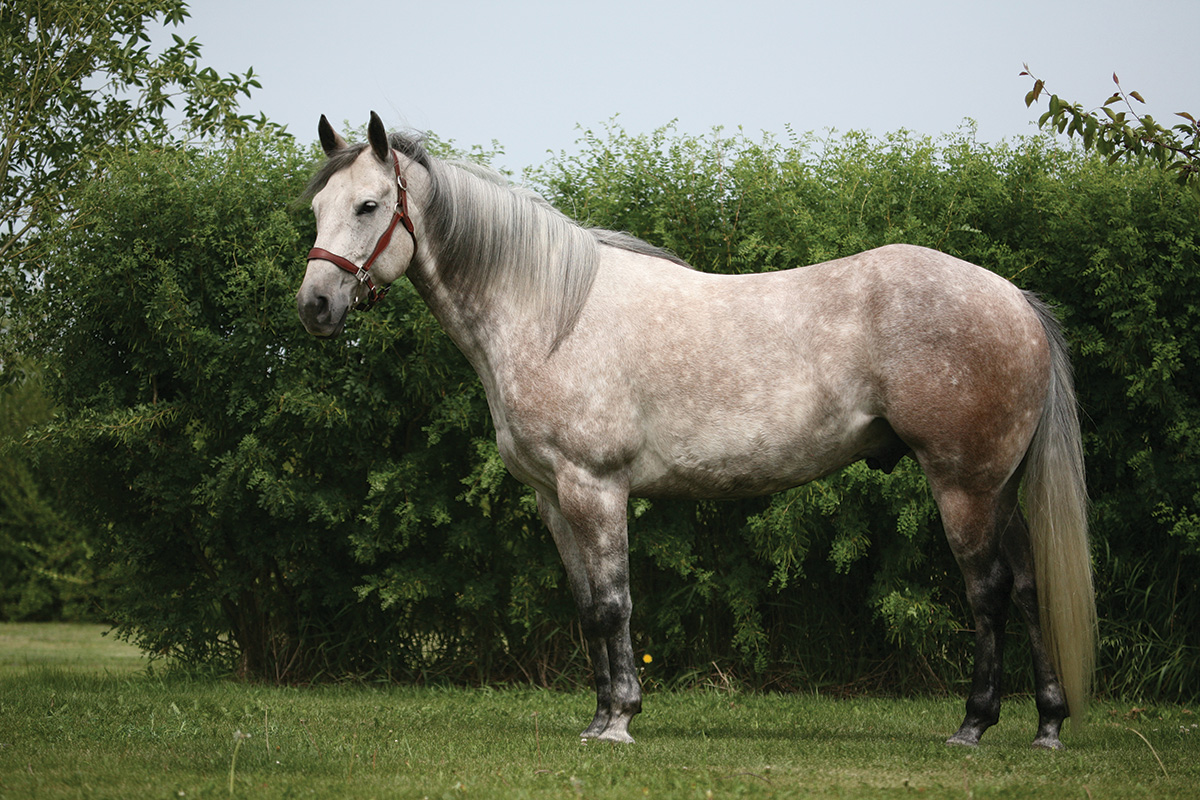
Gray horses are particularly vulnerable to cancers on the penis and sheath, so taking the time to examine and clean the area is even more important. Photo by Cody/Adobe Stock
Fortunately, by cleaning the sheath once a year, you should spot any issues that can then be addressed as needed by your veterinarian.
Sheath Abnormalities to Look For
While cleaning the sheath, look for anything different or unusual on the penis or sheath. If you spot any of the following, notify your veterinarian promptly and schedule a visit so any issues can be addressed:
◆ Abnormal discolorations in skin
◆ Red, ulcerated, or raised areas
◆ Firm nodules
◆ Lesions or sores
Be Prepared
Some horses relax so much during a thorough grooming session that they drop their penis, but in most cases, sheath cleaning is easier to do if the horse is sedated.
If you feel uncertain about the “how-to,” schedule a visit with your veterinarian. Prell suggests adding sheath cleaning to the agenda when your veterinarian comes for the annual dental exam, since the horse will likely be sedated for that.
If you’ve never cleaned a sheath before, watching the veterinarian do it provides a great opportunity for you to learn. Ask them to explain the process in detail so you’ll know how to do it the next time.
Horse owners may also opt to ask their veterinarian for a prescription for Dormosedan Gel®. Unlike sedation drugs administered intravenously, this product is given under the tongue, lasting long enough to sedate the horse for sheath cleaning.
Supplies you’ll need:
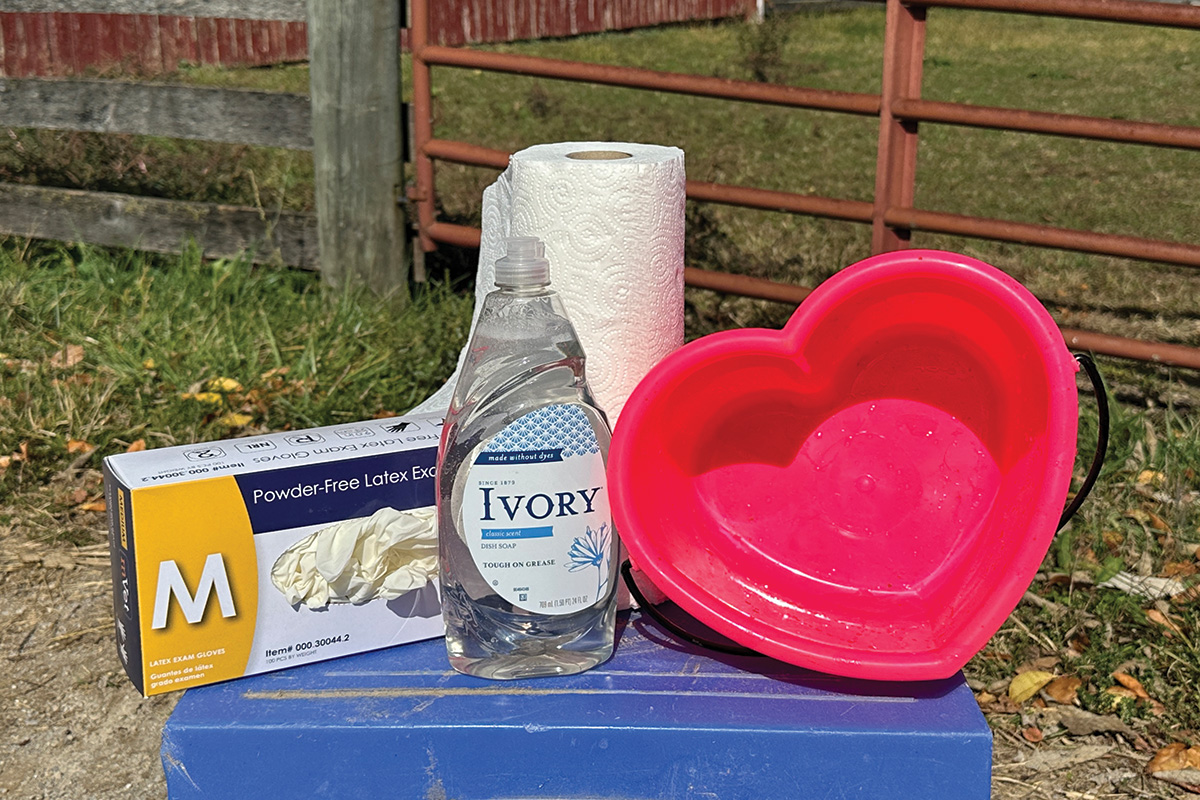
Disposable gloves, a bucket of warm water, cotton squares, paper towels and a gentle sheath cleanser or dish soap are all you’ll need. Photo by Shoshana Rudski
◆ Disposable gloves (obstetric exam gloves, which are longer than standard gloves, are even better)
◆ Bucket of warm water
◆ Commercial sheath cleaner or mild dish soap, like Ivory
◆ Cotton squares
◆ Paper towels
Prell explains that most smegma can be removed with warm water and cotton. If you want to use a product, she recommends a commercial sheath cleaner or mild dish soap, like unscented Ivory.
“Don’t use chlorhexidine, betadine, or any anti-bacterial soap,” she cautions. “Those can kill the good bacteria, and you can end up with a problem.”
Step-by-Step Sheath Cleaning
To keep the horse from moving around, tie him securely or have someone hold him.
Some horses can still react when sedated. Stay safe by standing well in front of his hind legs, and monitor his attitude throughout the process.
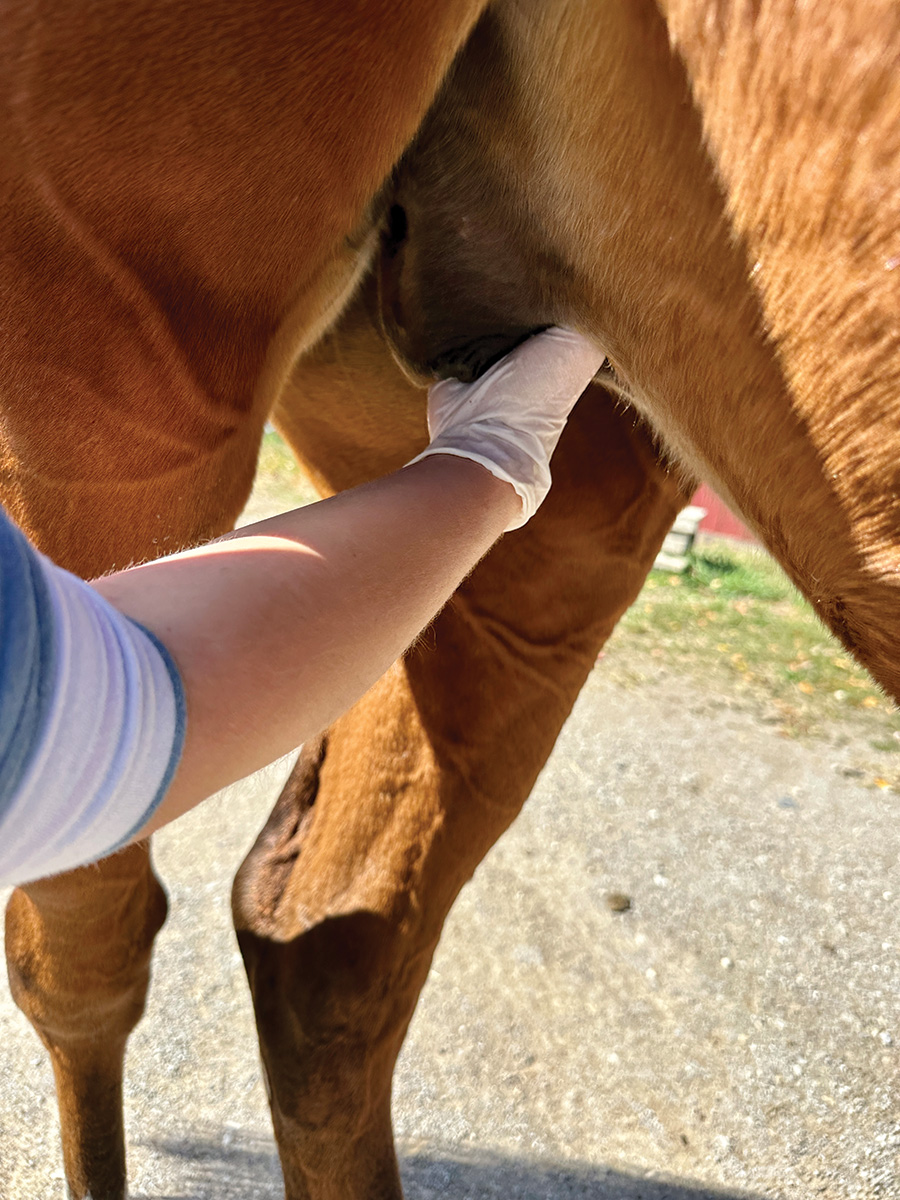
Dr. Prell recommends cleaning the penis first and saving the inside of the sheath for last, since you can still do this even if the horse retracts his penis. Photo by Shoshana Rudski
Let’s get started:
◆ Roll up your sleeves. Put on gloves.
◆ Apply a small amount of cleaner in one gloved hand.
◆ Pick up a cotton square dampened with warm water.
◆ Gently hold the extended penis with one hand and run the hand holding the cotton along the shaft of the penis to remove any flaky, peeling skin and loosen the smegma.
◆ Examine penis for any abnormalities (sores, lumps, et cetera).
◆ Once you’ve removed any loose skin and debris along the penis, check for a bean in the urethral fossa (the depression at the tip).
◆ If a bean is present, gently dislodge it with the tip of your gloved finger.
◆ After cleaning the penis, use additional damp cotton square(s) to remove any smegma or debris (dirt or shavings) inside the sheath.
◆ Use a paper towel to pat the penis dry.
◆ Discard used cotton, paper towels, and gloves in a lidded trash can.
Prell recommends cleaning the penis first and saving the inside of the sheath for last, since you can still do this even if the horse retracts his penis.
“You can still clean inside the sheath even if you don’t get a good view,” she notes.
Sheath Cleaning Don’ts
The following should never be part of cleaning the sheath:
◆ Spraying high pressure water into the sheath
◆ Grabbing the penis or handling it firmly
◆ “Scrubbing” the penis
◆ Disrupting normal bacteria by using harsh cleaners
◆ Cleaning too often (once a year should be enough)
All done! You can now cross this task off your to-do list until next year.
After a nail-biting two years of speculation about the inclusion of equestrian sports in the next Olympic Games, it was announced yesterday, April 9, by the International Equestrian Federation (FEI) that the International Olympic Committee (IOC) had approved all three equestrian sports (dressage, eventing and show jumping) for Los Angeles in 2028 (LA28). These three equestrian disciplines have been part of the Olympic program since 1912.
Dates for the LA28 Olympic Games are July 14-30, 2028. The total quota of equestrian athletes for LA28 remains the same as for the Paris Olympic Games last year, 200 (75 for jumping, 65 for eventing and 60 for dressage). For countries who qualify to send teams, each of the three sports will have three athletes per team. And beyond that, some other countries will earn the right to send individual athletes.
The USA’s Laura Kraut and Baloutinue at the 2020/21 Tokyo Olympic Games. Photo by Allen MacMillan/MacMillan Photography
FEI President Ingmar De Vos welcomed the announcement, citing the success of the equestrian events at the Paris 2024 Games. “We are extremely pleased with today’s IOC decision. The Paris 2024 Olympic and Paralympic Games were a historic success for equestrian sport, which proved very popular with the live crowds and TV and online viewers worldwide. It’s great news that our numbers remain unchanged, and we are looking forward to delivering exciting sport at the same level of excellence.”
The qualification systems for the LA28 Olympic and Paralympic Games were just discussed at the recent FEI Sports Forum in Lausanne, Switzerland, on March 31 and April 1. The resulting proposals by the FEI General Assembly will be put forward to the IOC for discussion, and hopefully approval, later this year. A summary of FEI Sports Forum discussions, and the presentation made during the session dedicated to the LA28 Olympic qualification systems, are available here.
U.S. eventer Caroline Pamuku riding HSH Blake in her first Olympic Games in Paris last year. Photo by Kim MacMillan/MacMillan Photography
In 2026, the FEI will discuss and put forward to the IOC the rules for equestrian sports at the LA28 Games. Any day now, the IOC should confirm the equestrian venue for LA28. The Galway Downs facility just outside Temecula, Calif., and an equestrian venue in Moor Park, Calif., are being considered.
Similar confirmation announcements will be forthcoming for the LA28 Paralympics soon. The dates for the LA28 Paralympic Games will be August 15 to August 27, 2028.
Decorated U.S. Olympic veteran Steffen Peters riding Suppenkasper at the 2024 Paris Olympics. Photo by Sarah E. Miller/MacMillan Photography
Key Olympic Facts & Figures From The FEI
Equestrian will be one of the 31 sports on the program of the LA28 Olympic Games. The six medal equestrian events (3 team and 3 individual competitions, one for each sport) will be part of the 25 mixed events across all sports and the 351 events overall in LA28.
The LA28 program maintains the core athlete quota of 10,500, with an extra 698 allocated for the five new sports proposed by the LA28 Organizing Committee (baseball/softball, cricket, flag football, lacrosse, and squash).
A record-breaking 50 nations participated in equestrian at the Tokyo 2020 Olympic Games. The number of nations at Paris 2024 was 49. The number of nations competing in equestrian in Los Angeles in 1984 was 30.
Equestrian sport is the only Olympic sport in which men and women compete as equals from grass roots all the way up to Olympic level.
With the completion of the 2028 Games, Los Angeles will have hosted the Olympics three times (1932, 1984, 2028). The only other three-time hosts are Paris (1900, 1924 and 2024) and London (1908, 1948 and 2012).
Xanthus caught the eyes of many when he arrived as a surrender back in 2022. This adorable, 13.2hh buckskin was full of spunk and personality from the beginning. He loved attention from humans and was very intelligent, two qualities that still hold true today. It didn’t take long for him to become a favorite amongst the staff and volunteers at Longmeadow. After some time at the ranch, he was evaluated by their trainers under saddle.
Upon evaluation, Longmeadow’s trainers found that Xanthus had a hyper-sensitivity to poor saddle fit. They believe he has a history of ill-fitting equipment, which has now led to this sensitivity. After some training and a lot of patience from both their trainers and Xanthus alike, Longmeadow found that this pony does best in English saddles with a seat size of 15” and under. When being ridden under a saddle that fits him comfortably, Xanthus shows his true potential. He has gone on multiple trail rides at the ranch and does best with confident, balanced riders. His maximum carrying weight (including both tack and rider) is 165 pounds.
Xanthus is a mighty little pony and tends to be at the top of the pecking order in his herd. With our staff members and trainers, he is extremely personable and sweet. Since he has been known to test new people and handlers, he will require an adopter confident enough to be his leader. Xanthus has a “wants to please” attitude and would make the perfect pony for that perfect person.
Contact Longmeadow Rescue Ranch today about ASPCA Right Horse Adoptable Horse of the Week, Xanthus!
Photo courtesy Longmeadow Rescue Ranch
Could this week’s adoptable horse be the Right Horse you have been waiting for? Click here for more information about Xanthus, the ASPCA Right Horse Adoptable Horse of the Week.
ASPCA Right Horse
ASPCA Right Horse is the online adoption platform of The Right Horse Initiative, a collection of equine industry and welfare professionals and advocates working together to improve the lives of horses in transition. A program of the ASPCA, their goal is to massively increase horse adoption in the United States. To find more adoptable horses and foster horses, visit www.myrighthorse.org. To learn more about The Right Horse, a program of the ASPCA, visit www.aspcarighthorse.org.
Equine arthritis can affect horses of all disciplines and ages, and early intervention is crucial for maintaining comfort and performance. Your ability to recognize subtle changes and collaborate with your veterinarian makes you your horse’s most important joint health advocate.
No one knows your horse better than you. The bond you share allows you to see when they’re at their best, when they’re at their worst and even when something is slightly off. Subtle things like changes in stride, reluctance to collect, or hesitation before familiar jumps are things you notice.
These quiet signals of potential lameness speak volumes to an attentive and informed rider. As your horse’s trusted partner, you’re in the perfect position to notice the earliest signs of a form of arthritis called degenerative joint disease (DJD), a condition responsible for 60% of equine lameness cases.1 Your ability to recognize these quiet warnings, before they become serious problems, creates the opportunity for early intervention that can help preserve your horse’s athletic ability and comfort for years to come.
Your watchful eye matters
The close relationship you have with your horse puts you in the best position to notice things that even a veterinarian might not pick up on. Your horse might be telling you something’s wrong, but not in the way you expect. Poor performance, unwillingness to respond to commands, or even an uncharacteristically bad attitude could all be early warning signs of arthritis.
When you’re familiar with the common signs of joint disease, you can take action at the first hint of trouble. Watch for:
Swelling and/or heat in a limb
Limping or reduced performance
Decreased range of motion
Stiffness when leaving the stall or beginning work
Subtle changes in overall demeanor
Catching these signs early means you can take action promptly, which is important to help slow the effects of arthritis. Your observations could mean the difference between managing a minor issue and dealing with a career-limiting condition.
The power of regular soundness exams
Veterinarians agree that regular soundness examinations are one of the best ways to identify problems before they significantly impact your horse. Regular examinations with your veterinarian, paired with your observations, help establish your horse’s “normal,” making it easier to identify changes that might indicate developing joint problems. During these checkups, your veterinarian will conduct specialized assessments that can reveal joint sensitivity that may not be apparent during normal movement.
When communicating with your veterinarian about your horse’s joint health, be specific about when you noticed changes, what activities cause discomfort, and any recent adjustments to your horse’s routine. This detailed information helps your veterinarian arrive at an accurate diagnosis and devise an effective treatment plan. Be prepared to discuss:
Your horse’s regular exercise regimen
Diet and supplement use
Changes in housing or environment
Other therapies your horse is receiving
Any past lameness issues
This information supports the diagnostic procedures your veterinarian may recommend, which could include radiographs, nerve blocks, ultrasounds and more.
Every horse deserves protection
One truth every horse owner needs to understand? Arthritis doesn’t discriminate. It can happen to any horse despite their age, breed or discipline. They are all vulnerable, but proactive joint health management can make all the difference.
While elite athletes certainly face intense joint demands, your trail horse or pasture companion is just as susceptible to joint deterioration. Every collected canter or simple trot across the pasture generates forces that, over time, can affect joint health.
Similarly, arthritis isn’t just a concern for aging horses—the process often begins silently in younger years, long before obvious symptoms appear. When arthritis is identified early, you have a better chance to effectively manage the condition and maintain your horse’s mobility.
The best way to help prevent joint disease? Take precautions and help your horse live a healthy lifestyle through:
Healthy weight management
Regular movement and exercise
Providing a balanced diet
Allowing time for a proper cool down after exercise
Understanding the signs of potential joint problems
Regular soundness exams
Working with your veterinarian to diagnose and treat joint disease early
What do I do if my horse is diagnosed with arthritis?
Don’t panic—an arthritis diagnosis isn’t always career-ending and in some cases doesn’t have to be life-changing. It’s all about working with your veterinarian to find the right treatment plan for your horse. Managing joint disease effectively requires collaboration with your veterinarian to find the right multimodal approach, and communication with your trainer to adjust training schedules and intensity accordingly. Your veterinarian’s expertise is key when designing a plan that addresses joint health from multiple angles, giving your horse the best chance for comfort and continued performance.
When creating a management protocol for your horse’s arthritis, ask about treatment options that target the disease itself rather than just addressing the signs. Adequan i.m.® (polysulfated glycosaminoglycan) stands out as the only FDA-approved PSGAG that treats the disease itself as well as the symptoms, working at the molecular level to interrupt the cycle of joint deterioration.2-4
Adequan i.m. complements other management practices by addressing several aspects of joint health simultaneously. It reduces inflammation, inhibits cartilage-damaging enzymes, stimulates repair of joint components, and improves synovial fluid viscosity for better cushioning.4This multifaceted action makes it a valuable part of your horse’s complete arthritis care. See below for Indications and a Brief Summary of Important Safety Information for Adequan i.m.
Safety should always be a top priority for any arthritis treatment you and your veterinarian choose. With millions of doses administered and an established safety profile, Adequan i.m. has earned the trust of veterinarians and horse owners. For over 30 years, veterinarians have given Adequan i.m. to help horses of every discipline and activity level enjoy greater mobility over their lifetimes.2-4
It’s suitable for horses of various ages and activity levels, offering practical flexibility for your arthritis management plan. The safe use of Adequan i.m. in horses used for breeding purposes, during pregnancy or in lactating mares has not been evaluated. Competition horses benefit from treatment continuity, and Adequan i.m. can sometimes be used during competition periods. This allows your horse to receive necessary care without disrupting their performance schedule—an important consideration that helps maintain both joint health and competitive readiness.
Early intervention with the right treatment approach gives your horse the best chance of maintaining joint function and slowing disease progression. Open, detailed discussions with your veterinarian about your horse’s symptoms, history and lifestyle can help when designing an effective treatment plan. Your vet can help determine if Adequan i.e. is appropriate for your horse’s specific condition and how it fits within a complete management strategy.
By working closely with your veterinarian to implement a multimodal approach that includes treatments like Adequan i.e. when appropriate, you’re acting as your horse’s joint health champion. Schedule regular check-ins with your vet to monitor progress and adjust treatments as needed—because this ongoing partnership is key to your horse’s long-term joint health. See below for Indications and a Brief Summary of Important Safety Information for Adequan i.e.
Talk to your veterinarian about Adequan i.e. and how it can be part of your horse’s joint health management plan. For more information, visit www.adequan.com.
BRIEF SUMMARY: Prior to use please consult the product insert, a summary of which follows: CAUTION: Federal law restricts this drug to use by or on the order of a licensed veterinarian. INDICATIONS: Adequan® i.m. is recommended for the intramuscular treatment of non-infectious degenerative and/or traumatic joint dysfunction and associated lameness of the carpal and hock joints in horses. CONTRAINDICATIONS: There are no known contraindications to the use of intramuscular Polysulfated Glycosaminoglycan. WARNINGS: Do not use in horses intended for human consumption. Not for use in humans. Keep this and all medications out of the reach of children. PRECAUTIONS: The safe use of Adequan® i.m. in horses used for breeding purposes, during pregnancy, or in lactating mares has not been evaluated. For customer care, or to obtain product information, visit www.adequan.com. To report an adverse event please contact American Regent, Inc. at 1-888-354-4857 or email pv@americanregent.com.
[references]
McIlwraith CW, Frisbie DD, Kawcak CE, van Weeren PR. Joint Disease in the Horse. St. Louis, MO: Elsevier, 2016;33-48.
Kim DY, Taylor HW, Moore RM, Paulsen DB, Cho DY. Articular chondrocyte apoptosis in equine osteoarthritis. The Veterinary Journal 2003; 166: 52-57.
Burba DJ, Collier MA, DeBault LE, Hanson-Painton O, Thompson HC, Holder CL: In vivo kinetic study on uptake and distribution of intramuscular tritium-labeled polysulfated glycosaminoglycan in equine body fluid compartments and articular cartilage in an osteochondral defect model. Journal of Equine Veterinary Science 1993; 13: 696-703.
Adequan® i.m. (polysulfated glycosaminoglycan), Package Insert. American Regent, Inc.
[copyright and disclaimers]
All trademarks are the property of American Regent, Inc.
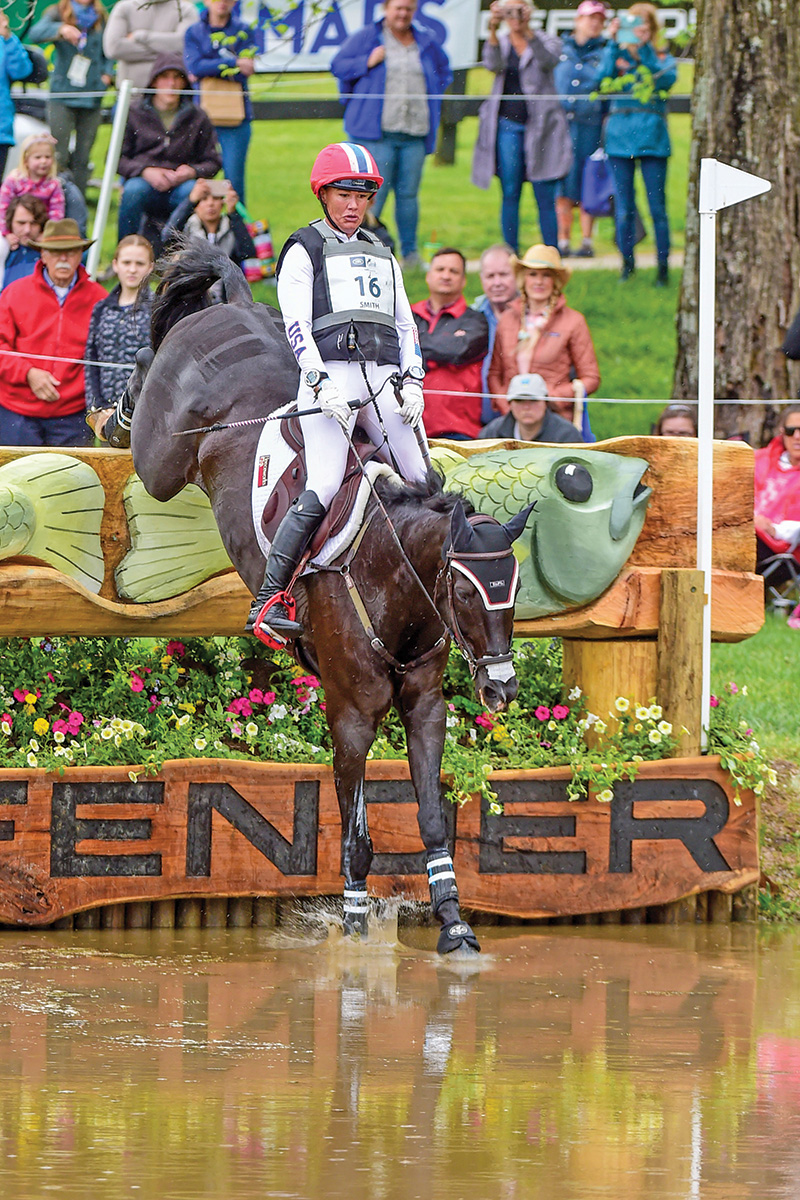
Mother, grandmother, and winning 5* eventing rider—these three titles don’t typically go together. However, Tamie Smith, 49, is all of the above.
Based in Temecula, Calif., out of her Next Level Eventing barn, Tamie became the first American rider in 15 years to win the Kentucky Three-Day Event CCI 5* when she claimed victory aboard Mai Baum in 2023. Held the last weekend in April every year, the Kentucky 5* represents the highest level of eventing, with only seven 5* competitions held per year in the entire world.
She accomplished this feat aboard her long-time partner, a then-18-year-old German Sport Horse gelding named Mai Baum, owned by Ellen Ahearn, Eric Markell, and their daughter, Alex Ahearn. Tamie was also the first woman since 2011 to win this internationally prestigious event.
Tamie Smith and Mai Baum make easy work of the log drop into the Head of the Lake on their way to winning the 2023 Kentucky Three-Day Event CCI 5*. Photo by Sarah Miller/MacMillan Photography
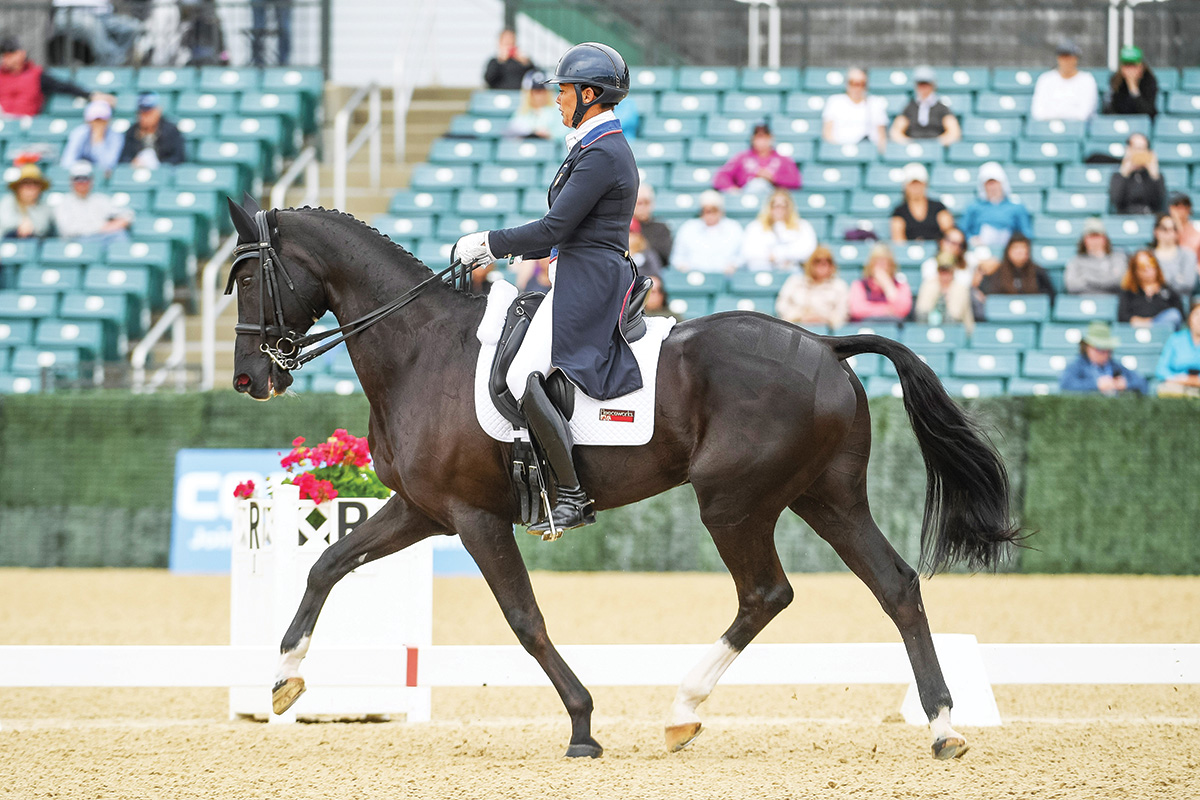
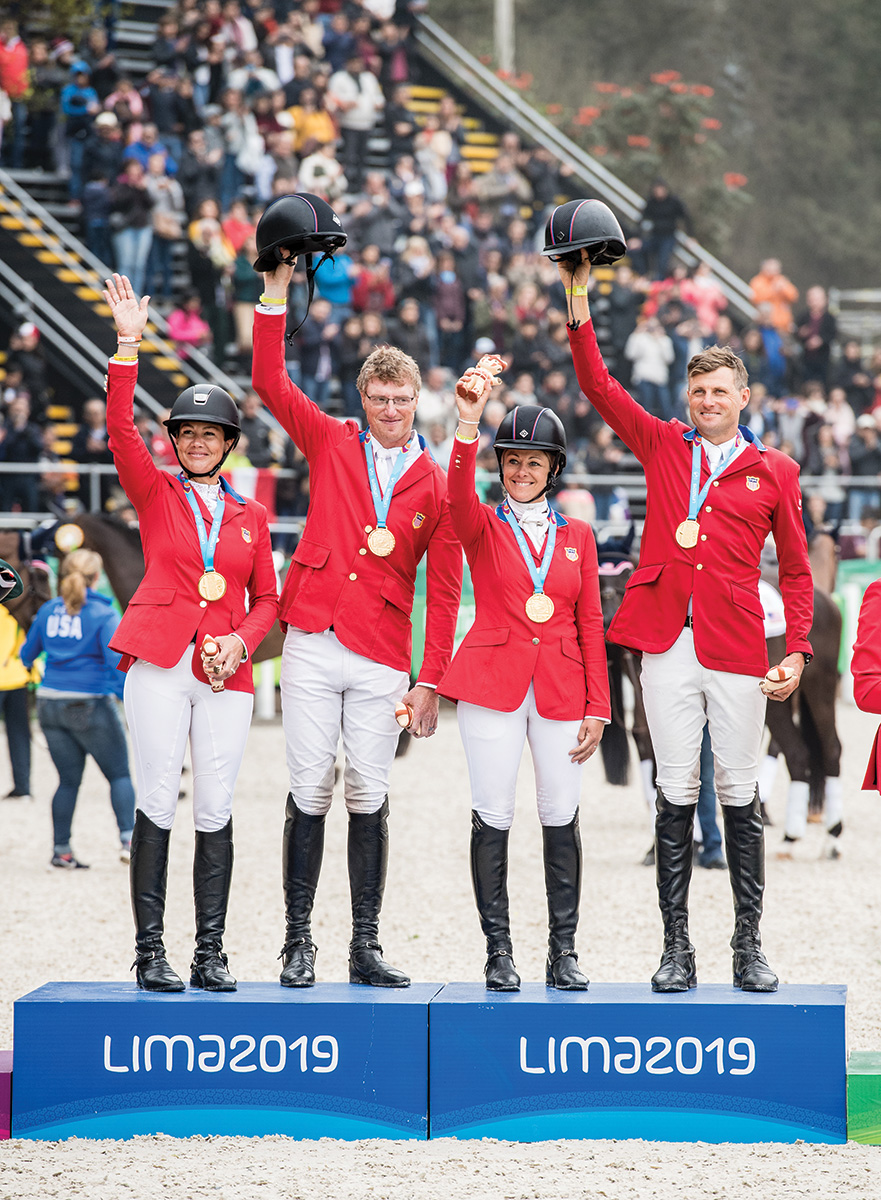
The eventing world has had a keen eye on Tamie and Mai Baum for years as their eye-popping dressage scores and top finishes at major events gained notice. The pair won eventing team gold at the 2019 PanAm games in Lima, Peru, team silver at the 2022 FEI World Championships, and they were selected as reserves for the 2020 Tokyo Olympic Games (held in 2021).
We sat down with Tamie to learn more about what keeps her motivated, the perks of being a mother in the horse world, and the horse that made the big win possible.
Tamie and Mai Baum display a stellar talent in the dressage ring, and often come out of the first phase of competition at the top of the leaderboard. Photo by Allen MacMillan/MacMillan Photography
On Mai Baum
Mai Baum, or “Lexus” as he’s known around the barn, started off as Alex Ahearn’s ride when she took a post as one of Tamie’s working students. Alex had imported Lexus from Munich, Germany.
“I’m not certain if everybody thought that he would be what he is today,” says Tamie.
Alex Ahearn and Mai Baum after Tamie’s big win at Kentucky. Alex was Tamie’s working student before giving her the ride on “Lexus.” Photo by Shannon Brinkman
Alex competed Lexus through his first Intermediate (3’9″) before coming to ride with Tamie.
“She’d had trouble at Lexus’s first Intermediate, and we worked her through that,” says Tamie. “We got her competing well at [that] level. She was winning.”
After competing Lexus at the 3* event at Fair Hill in Maryland and making the U25 list (a selective list of upcoming young American riders aged 25 and under), Alex decided she wanted to pursue further academic education instead of continuing her riding career.
“After a training session that winter, I remember her coming to me and saying, ‘I want to meet you for dinner and talk,’” Tamie recalls. “She said, ‘I want you to take the ride on Lexus.’ I remember being a little surprised. I said, ‘No, you don’t. You don’t know what you’re saying. You have to do this.’”
Despite Tamie trying to talk Alex out of it, she insisted that Tamie was the right rider for Lexus.
“I remember her saying, ‘America needs a good horse. And you need a good horse,’” Tamie says. “And it was quite emotional, because I knew what she was saying.”
For a while, Tamie thought that Alex might decide to take Lexus back and start riding him again herself.
“I thought I would start riding him, and a few months later she would say, ‘I’m just kidding, I want to ride him,’” Tamie remembers. “But here we are eight years later, and it’s been so incredible to see her vision and what she wanted for me and Lexus actually come to fruition.”
At 20, Lexus is still going strong. Tamie isn’t sure if or when he will be ready to slow down, but thinks he will tell her when that time comes.
“I am really careful every time I get on,” she says. “I feel like I have a good gut instinct and know my horses. It’s a possibility that he could just drop down a level. He absolutely loves the crowd. After he’s done at the top level, maybe Alex could take him and compete him again. It would be an icing-on-the-cake kind of thing.”
Of course, if Lexus tells Tamie that he needs to stop competing, she will happily retire him.
“If he needs to be fully retired, he will be,” she says. “But I don’t know that he’ll want to just stand in a field.”
On Being a Mother
In addition to raising sport horses, Tamie has also raised two children, son Tyler, 21, and daughter Kaylawna, 29.
“[Being a mother] definitely has its struggles,” she says. “You go through guilt because you’re spending time doing something [not family-related] that you have a goal towards. When I travel, it’s been hard to cope with being away and missing a water polo or basketball game for my kids. That was not always easy.”
Tamie’s daughter, Kaylawna, is also a high-level eventing rider with a coaching business and a young daughter of her own. Photo by Shannon Brinkman
However, Tamie feels the guilt she and other riders might experience as mothers isn’t specific to her sport.
“Any woman or man in high level careers—doctors, lawyers, and elite athletes—all battle the same struggles,” she says.
To help with any guilt, Tamie tries to look at her time away from her family as a way of setting an example to her kids to go after what they want and to have big goals and expectations of themselves, even if it gets in the way of what tradition might want them to focus on.
In addition to being a mother, Tamie is now a grandmother. When her daughter, Kaylawna, married several years ago and then had a daughter of her own, Tamie says Kaylawna also struggled with her confidence and guilt. Of course, mom was there to help coach her through it. Other professional riders who became mothers have also turned to Tamie for advice on how to keep a healthy balance.
When it comes to coaching her clients and training the horses, Tamie says that she views being a parent as an advantage.
“I feel like being a mother helps with your level of compassion and your level of empathy,” she says.
On Managing Goals
Tamie says that she initially planned to also take Dutch Warmblood gelding Elliot V to the 5* at Kentucky in 2023—the division that Mai Baum ended up winning. She felt he was on track to meet that goal, but in their last preparatory competition, she decided to rethink her game plan, since he didn’t feel quite ready.
“I’ve learned throughout the years that you can never keep a goal set in stone,” she says. “The slow way is always the fast way, and you only get one good shot at doing this at the top level. I’ve learned that if it doesn’t seem ideal—if I’m going into a 5* and don’t feel like I’ve done absolutely everything I possibly could to prepare for it, or any competition for that matter—I typically err on the side of caution.”
Left to right: Tamie Smith, Doug Payne, Lynn Symanski, and Boyd Martin won team gold at the 2019 Pan American Games in Lima, Peru. Photo by Shannon Brinkman
She moves her horses up the levels at the rate she feels is best by staying true to her morals and trusting her program.
“I have a pretty solid opinion about what I think horses are ready to do [and] when,” Tamie says. “I don’t feel like taking a 5-year-old Preliminary [3’7″] is appropriate. I have had 5-year-olds that are probably ready—they’re bored at Training level [3’3″]—but I don’t feel like it’s always in the best interest of their overall development and their minds, and to me it always ends up catching up [to you], so I try to keep things more on a conservative basis.”
On Being a West-Coaster
Tamie says that living in Southern California also helps her to not be influenced by others’ timelines.
“It’s a different atmosphere out here than it is on the East Coast, where everything is showcased in the public eye, whatever you do,” she says. “[Here] I leave the barn and never see anyone that I know, and I’ve found that I really like it that way. Once I leave the barn, I’m just Tamie, and not Tamie Smith-who-is-doing-this-or-that.”
However, sometimes Tamie’s competitive nature does make things a little tricky.
“It’s difficult sometimes to see what other people are doing and then not get caught up,” she says. “But it’s been nice to be focused on my program, believing in it, and then making sure that I’m doing the right thing by my horses.”
On Education
“I’m a big supporter of going to [college],” says Tamie. “I think it’s super important. I know that there are a lot of top riders that don’t believe it’s necessary, so my answer might be a bit controversial. Education is super important for learning how to communicate, navigate through life, and deal with conflict.”
She says that her formal education has helped her navigate relationships with her horses’ owners and all of the different personalities she meets.
“[My education has] enabled me to learn how to communicate and to understand what it’s like in the real world, and working in corporate America,” she says.
Before turning to horses as her full-time profession, Tamie worked in the intake department of a mental health facility.
“I have always been intrigued by mental health,” she shares. “My original plan was to get my degree in psychology.”
However, a mentor encouraged Tamie to pursue other avenues toward her goal of helping people when the flaws of the healthcare system began to wear on her.
Initially, she was a little “bummed about that, because I thought if I went down that avenue [I could] help people navigate through their trials and tribulations.”
Tamie decided that she would strive to help people in other ways, no matter what career path she went down. Now, as a professional rider and coach, Tamie says that her time working in mental health has given her a unique perspective.
“It gave me a different perspective as far as learning what works for different types of people when I’m coaching,” she says. “I bring in an old-school approach where I think it’s very important to be empathetic to your horses. I mean, they don’t choose to do what we ask them to do. They do it because they love us.They love the sport as well, but they would be fine and happy to be eating grass in a field, too.”
Tamie doesn’t have a lot of tolerance for impatient riders.
“That’s something that all of us have to learn as we grow in the sport,” she says. “It can be frustrating, especially where we have to master three different disciplines. You have to treat your horse with respect, the way you would want to be treated.”
From a competitive standpoint, Tamie adds that the mental element is almost more important than physical talent, and that a lot of counseling goes into producing good riders and horses.
Clearly her background has been perfect preparation for reaching the top of her sport. It takes nerves of steel to put the pressure aside and perform at your best at a 5* event like Kentucky, but Tamie showed the world she is more than capable.
Tamie Smith’s Likes and Dislikes
Favorite Cross-Country Jump:
“Something that gets you up in the air. A big brush jump into water. Going across Kentucky and jumping any of those jumps has been the most thrilling experience ever.”
Least Favorite Cross-Country Jump:
“A frangible hanging vertical into a coffin [ditch]. Definitely my least favorite.”
Favorite Stadium Jump:
“I really like jumping triple bars.”
Least Favorite Stadium Jump:
“A plain, natural-looking jump. Maybe a vertical because I feel like that is more likely to be knocked down.”
Favorite Dressage Movement:
“I love flying changes. I love half-pass and lateral-type movements.”
Least favorite Dressage Movement:
“I hate halting and going up the center line. I’m not very good at that.”
Organize and customizer your new horse trailer by adding a few simple storage items.
I’ve been on the search for a new (to me) horse trailer for years. Growing up, I’ve gone from having a four-horse bumper-pull livestock trailer to a five-horse aluminum gooseneck trailer. We’ve hauled our trailers with vans, gas trucks, diesel trucks, and back to gas.
While I had my “dream trailer” in mind, I also knew what my budget could handle and what our honest needs were, which set me on the course of constantly perusing the trailer selling groups on Facebook and talking with many different contacts to learn what to buy and what not to buy.
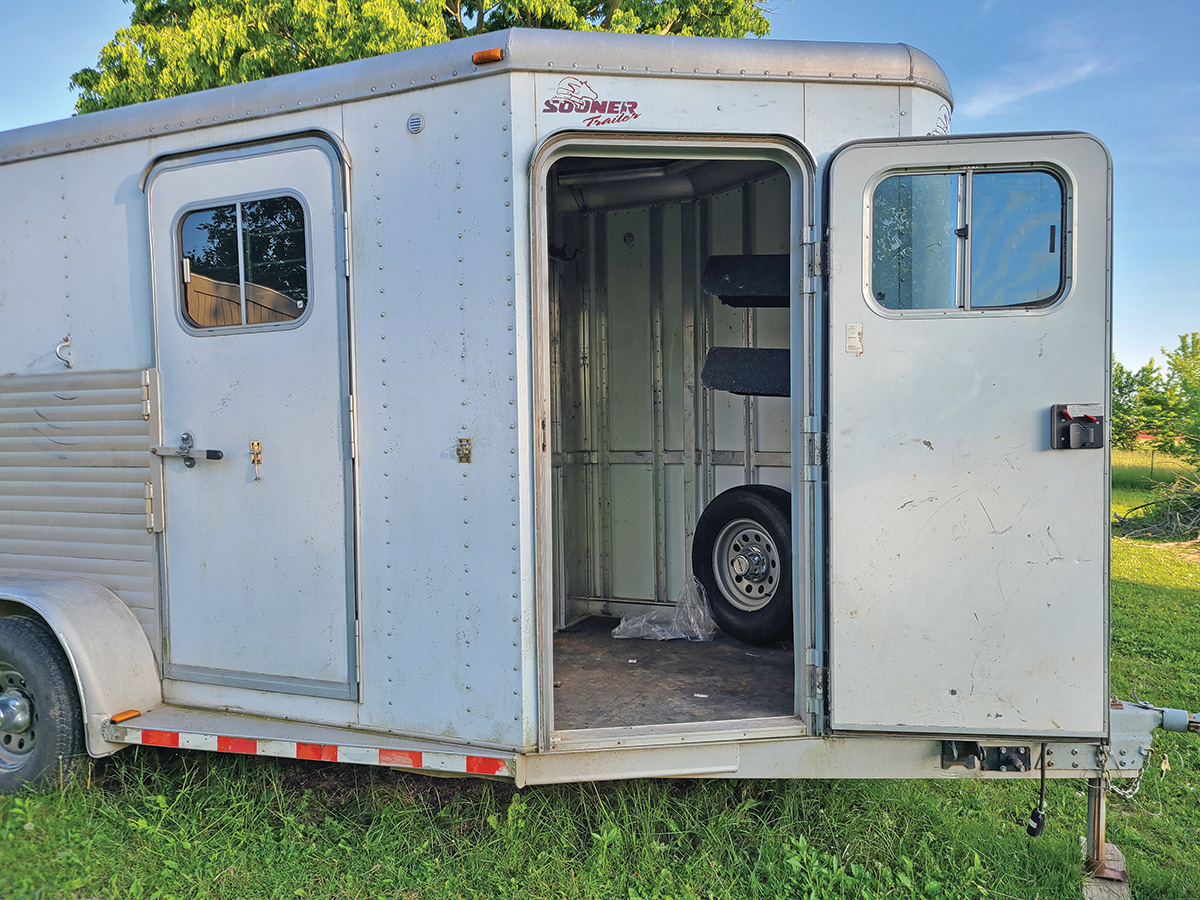
I finally found a trailer that checked most of the boxes on my list. It’s an early 2000s Sooner two-horse straight-load bumper-pull trailer with a small dressing/tack room in the front. The 7’6″ height was more than I was looking for, but I also know that the resale value on this trailer is amazing, especially being a warmblood trailer. So what if my stocky Quarter Horses and chubby Miniature Horse are a little dwarfed when they’re inside? Plenty of head room!
I’ll share a little about what I did to make this trailer mine.
BEFORE: Most dressing/tack rooms look huge when empty, but once you start adding your tack and equipment, they can become cluttered very quickly. Photo by Megan Arszman
Cleaning the Back of a Horse Trailer
There’s not too much you can do to change up things in the back of the trailer where the horses are hauled. Within the first day, even though the previous owner had cleaned it out, I dragged out my pressure washer to clean the inside from top to bottom; you can never be too careful with biosecurity.
The butt and chest bar padding on the inside of the trailer was original—so it was stained, faded and not as soft as it once was. Did you know that you can replace these pads?
What I Did
I purchased replacement padding (without the pipe inside) from my local trailer shop for the chest and butt bars. These are generally affordable and easy to replace.
The protective pads on the sides of the trailer and dividers are a little more difficult and expensive to replace. These are also made from vinyl and foam, but they require screwing into the trailer sides. This isn’t something I’m looking to do right now, unless I decide to sell my trailer down the road, but I was happy to find that I could replace those pads if I wanted.
With a straight load, I have a decent size empty space in the front of the trailer, where you might see a grain manger. The previous owner installed 1-inch-thick plywood at the bottom of her horse divider and the front divider to use the second stall and front for more storage. I removed both dividers, but I may later reinstall the front just to protect anything from potentially falling or moving into the stalls and getting tangled in their legs. For now, the front will hold a bale of hay and cooler, two objects that won’t easily move on the rubber flooring.
Organize the Dressing/Tack Room
My wish list was to have a rear tack and front dressing room, but for my family’s needs right now, we are OK with the lack of rear tack. Two horses shouldn’t require that much equipment, and if you store things properly, you’re able to fit quite a bit in small spaces.
What Storage Exists There Already
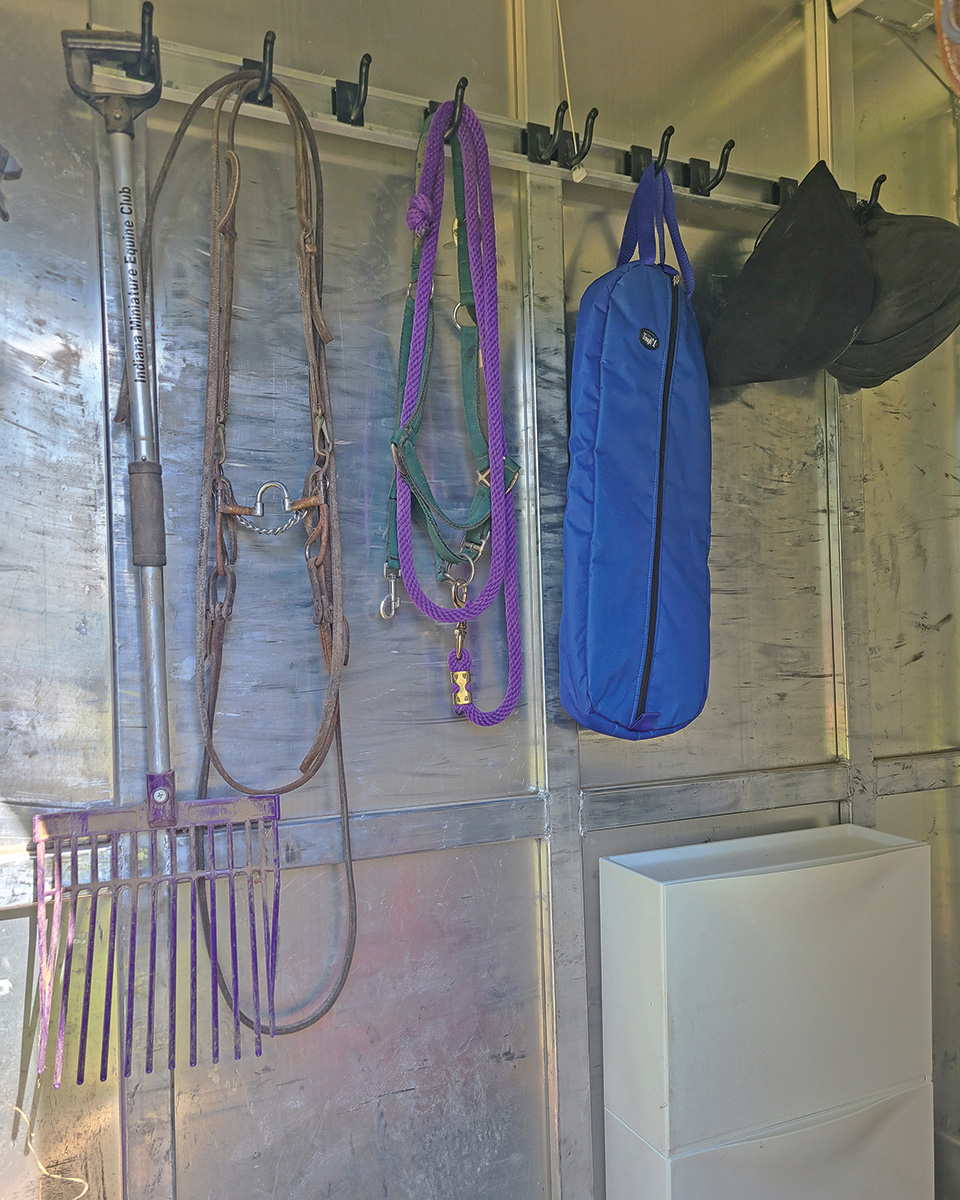
My trailer has a saddle rack for two saddles, nicely spaced out for my western saddle and my daughter’s western saddle. It already had rubber-coated hooks for hanging bags, tack and equipment. There’s also a small area in the back where you can slide clothing hangers for show clothes—however, you must use thinner wire hangers, not plastic or wooden hangers.
The rubber-coated hooks that came with Megan’s trailer hang a small pitchfork for traveling that comes apart and can be hung by its handle. She always packs an extra halter and lead rope, and a color-coded bridle bag keeps her show bridle clean. Photo by Megan Arszman
What I Added
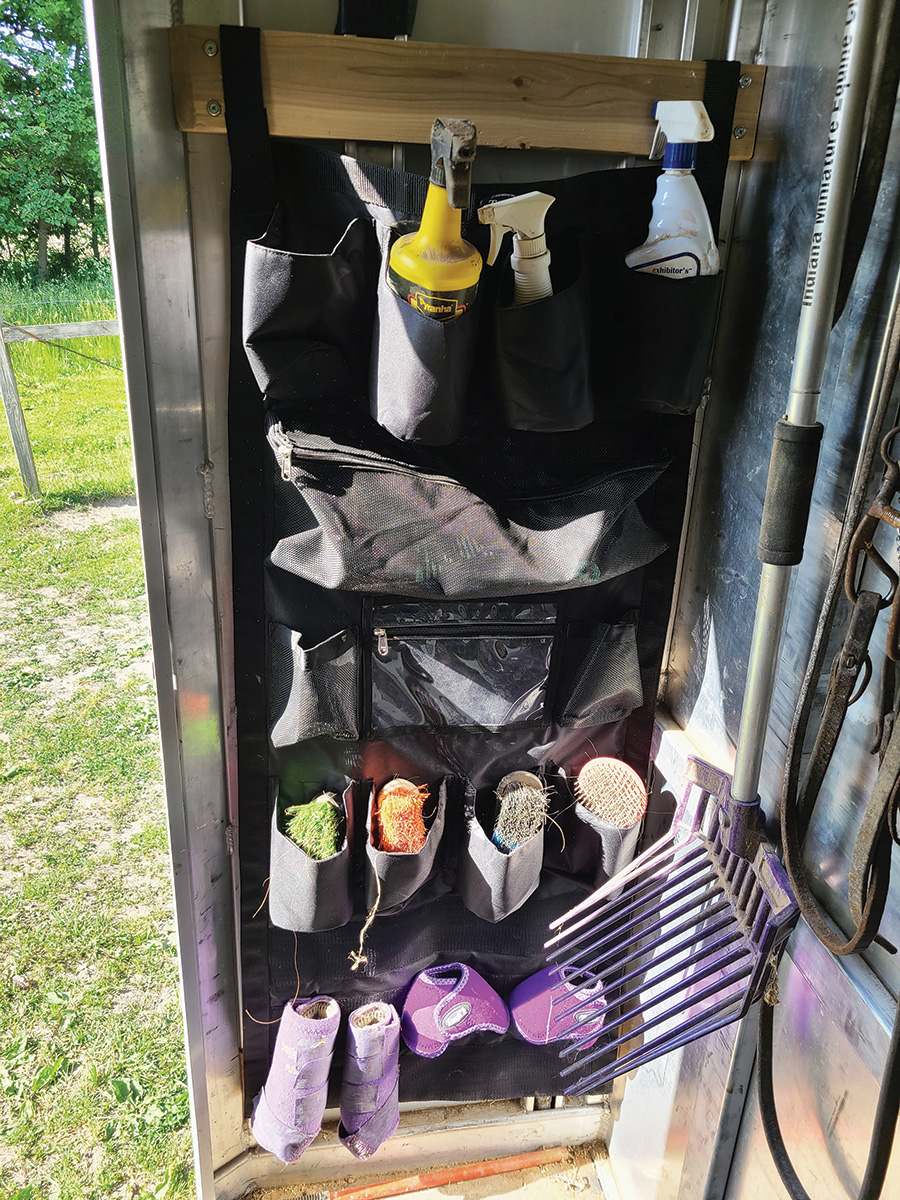
1.I installed a couple of two-by-fours so I could hang a grooming caddy from the short wall by the door. One of the worst things you can have in a small space is clutter—not only is it an eyesore, but it can be unsafe if you’re trying to move around inside, and it’s easy to lose things.
Wooden two-by-fours installed aftermarket make this a not-so-wasted space. A trailer caddy allows Megan to hang up brushes and spray bottles. Photo by Megan Arszman
I love the grooming caddy I’m using because it has so many pockets, including a mesh zipper pocket and clear plastic zippered pocket, and it can hang up in the trailer or at the stalls if we were to show out of stalls. It allows me to store my grooming and sport boots off the floor.
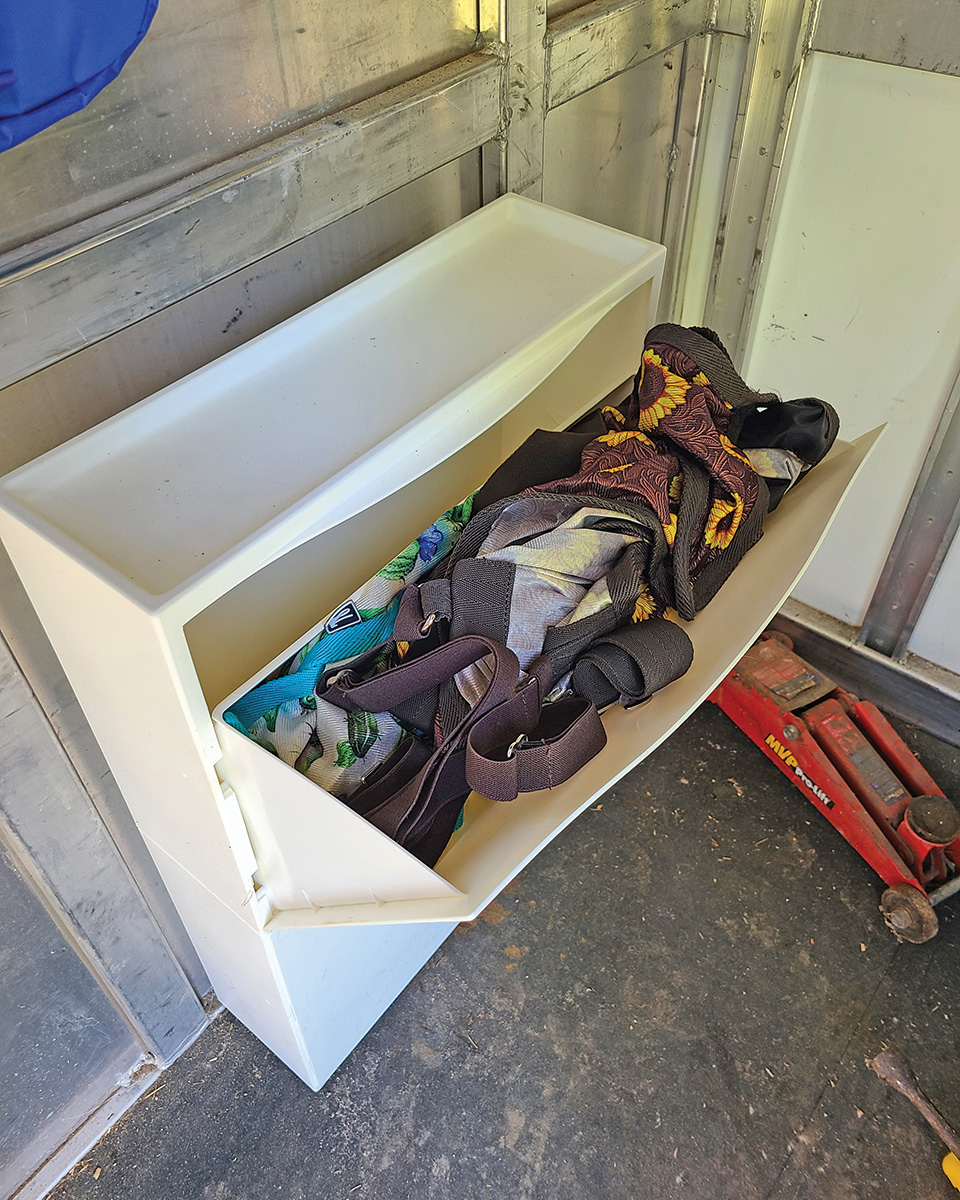
2. I purchased a white plastic shoe storage cabinet from IKEA; the two drawers stack on top of each other or next to each other, or you can use just one. I’m using it to store my mesh sheets, small spray bottles and sport boots. I love it because it’s thin, easy to keep clean, and can be moved around if needed. (I keep the cabinets in place with strong hook-and-loop fasteners.)
Shoe cabinets easily hold two mesh coolers in the top door. The bottom holds shampoo and conditioner bottles and brushes to keep them upright without making a mess. Photo by Megan Arszman
3. To keep the original flooring clean, plus add a little comfort, I purchased interlocking fitness flooring. The flooring is cheap ($5/square at Five Below) and easy to cut to fit into the corners. Plus, if something is spilled or I just need to replace a square, it’s easy and affordable!
4. Finally, make your trailer your own by outfitting it in matching travel gear. What’s more fun than accessorizing your saddle carrier, bridle bags and hay bags in a fun matching pattern? It’s the best way to protect your many investments, makes it easy for identification (I have one color and my daughter will have her own color), and they make your storage look neater.
Key Takeaway
With these DIY hacks, you can affordably organize and customize your horse trailer to optimize storage. This will make for easier trips to horse shows and other hauling adventures. Take photos of your DIY horse trailer projects and tag us in them on Instagram (@horseillustrated)!
This article about tips to organize and customize your horse trailer storage appeared in the November/December 2023 issue of Horse Illustrated magazine. Click here to subscribe!
Learn about the Gypsy Vanner, a versatile and gentle small draft horse breed for equestrians of all types.
Photo by Mark J. Barrett/Adobe Stock
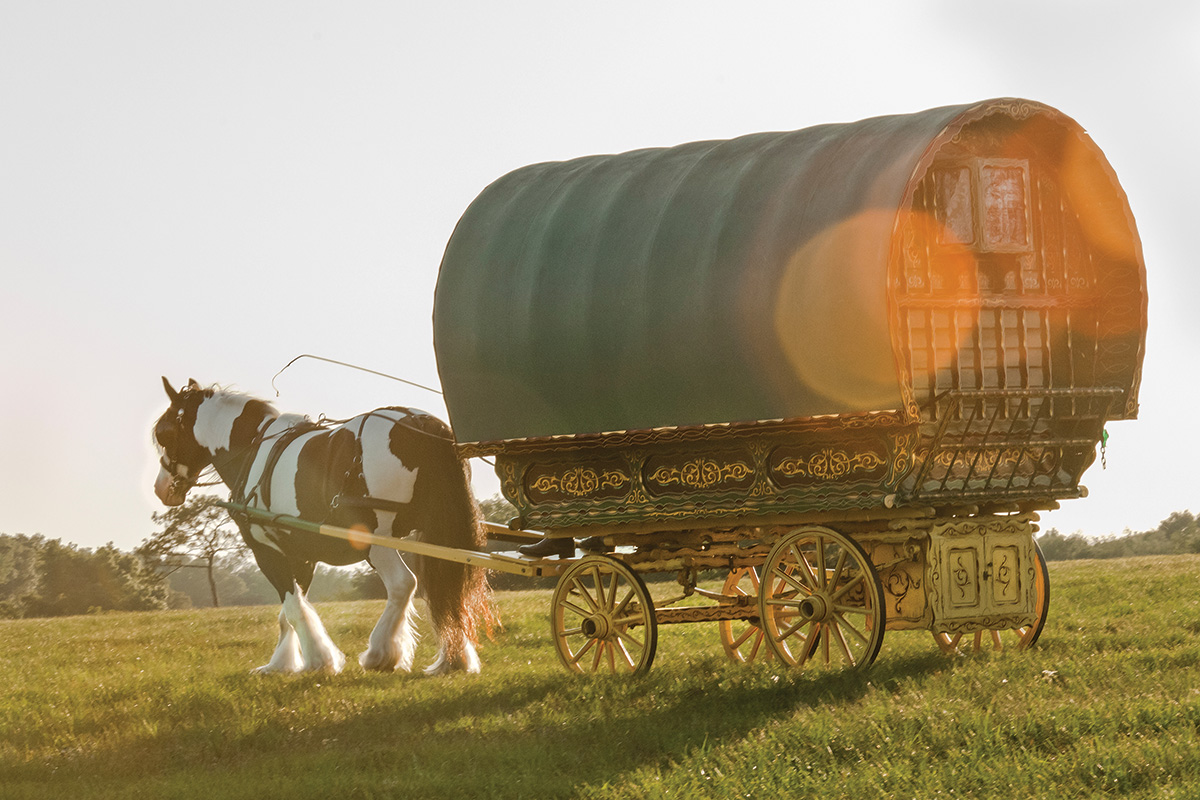
After World War II, the travelers (also called Gypsies) of the United Kingdom and Ireland needed a horse that could do everything: be strong enough to pull their ornate vardos, the wagons the families live in; gentle enough for the children to lead and look after, and comfortable enough to ride when needed.
The travelers used their horses to pull ornate vardos, or wagons, that their families lived in. Photo by Mark J. Barrett/Adobe Stock
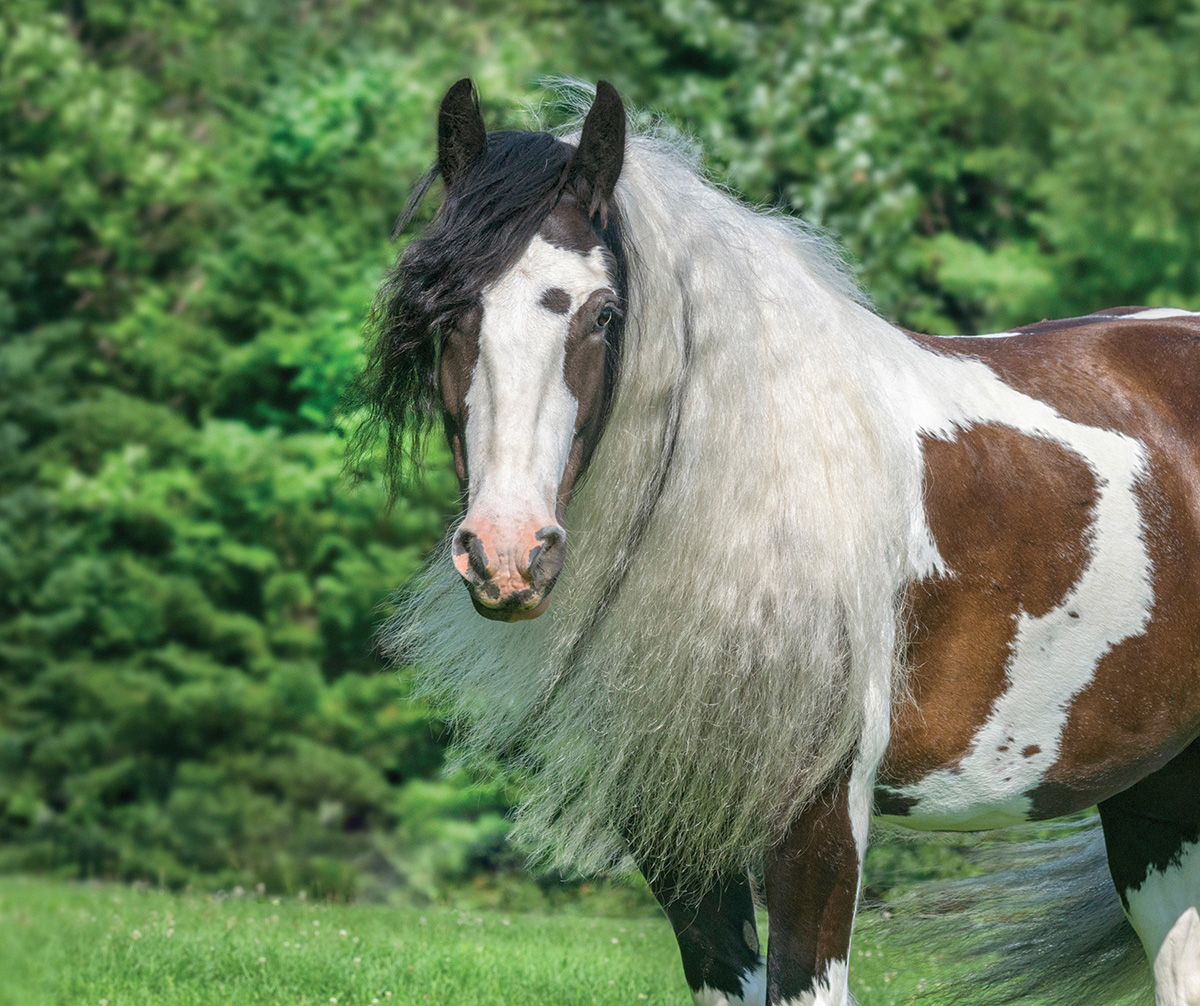
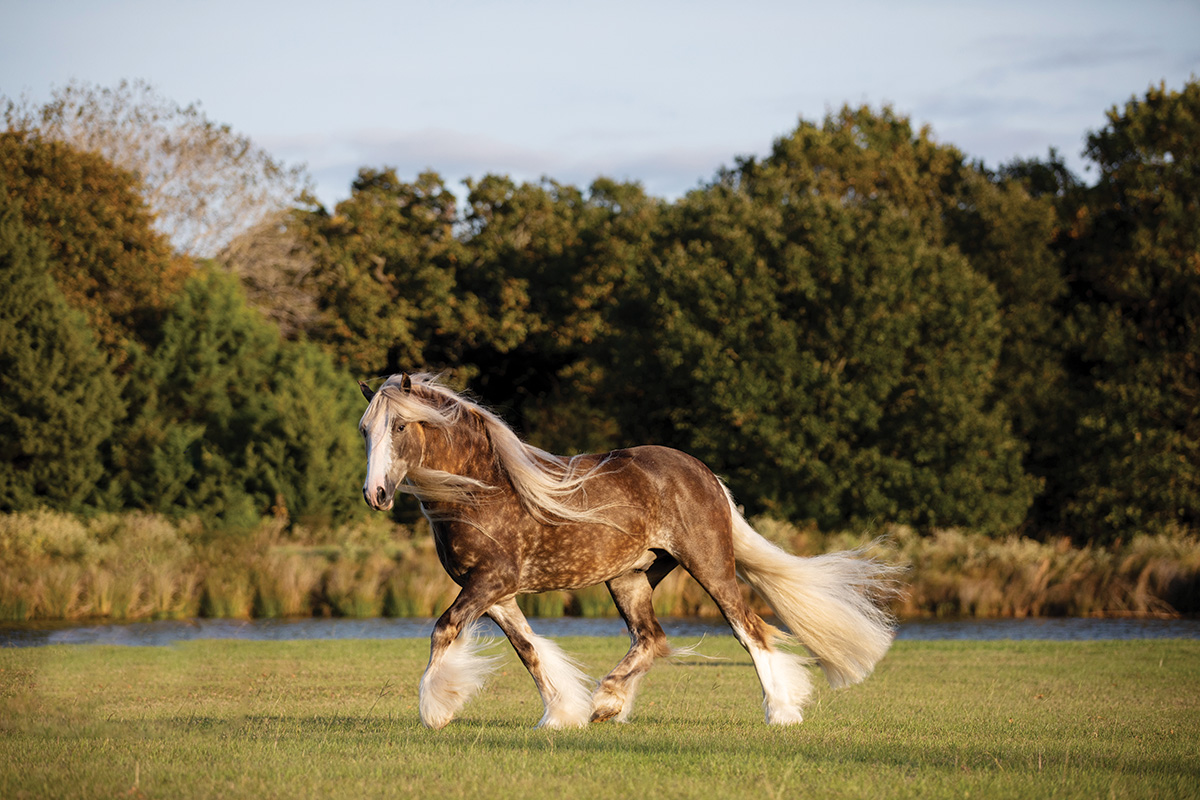
Decades of mixing native breeds like the Clydesdale and Shire with various native ponies, including the Dales and Fell, created a small, colorful draft horse with a sound mind and willing nature.
The cob-type horses went unnamed for decades until Americans Dennis and Cindy Thompson fell in love with them. After much research, they imported the first ones to the U.S. in the mid-1990s.
The Clydesdale, Shire, Dales and Fell are among the draft and pony breeds influential in Gypsy bloodlines. Photo by Terri Cage/Adobe Stock
In 1996, with input from the travelers in Europe, they named the breed the Gypsy Vanner as a nod to the families who had created the breed. The Thompsons then founded the Gypsy Vanner Horse Society.
Today, the breed continues to grow in popularity throughout the world for its beauty, versatility, good mind and gentle temperament.
Meet GG Kiss Me Kate
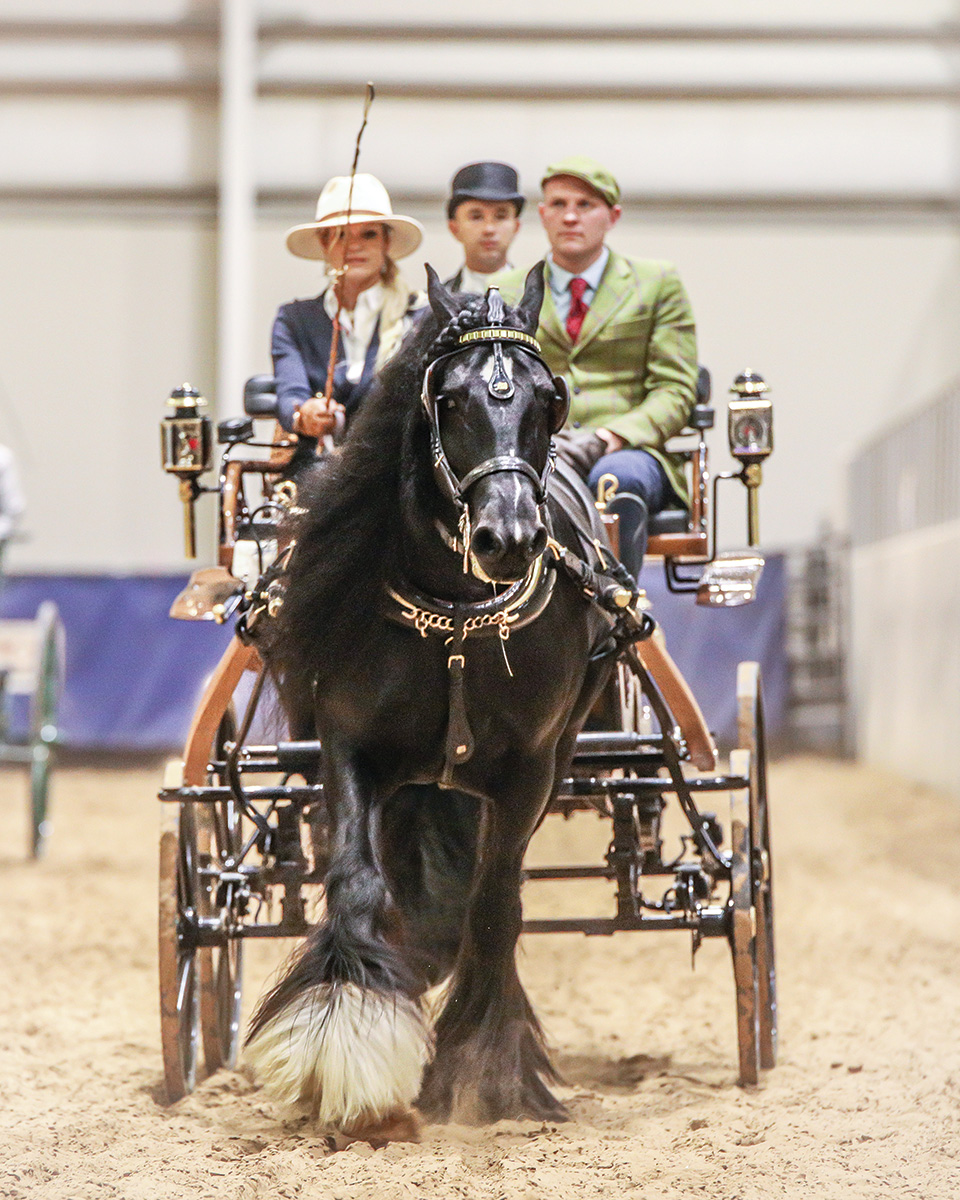
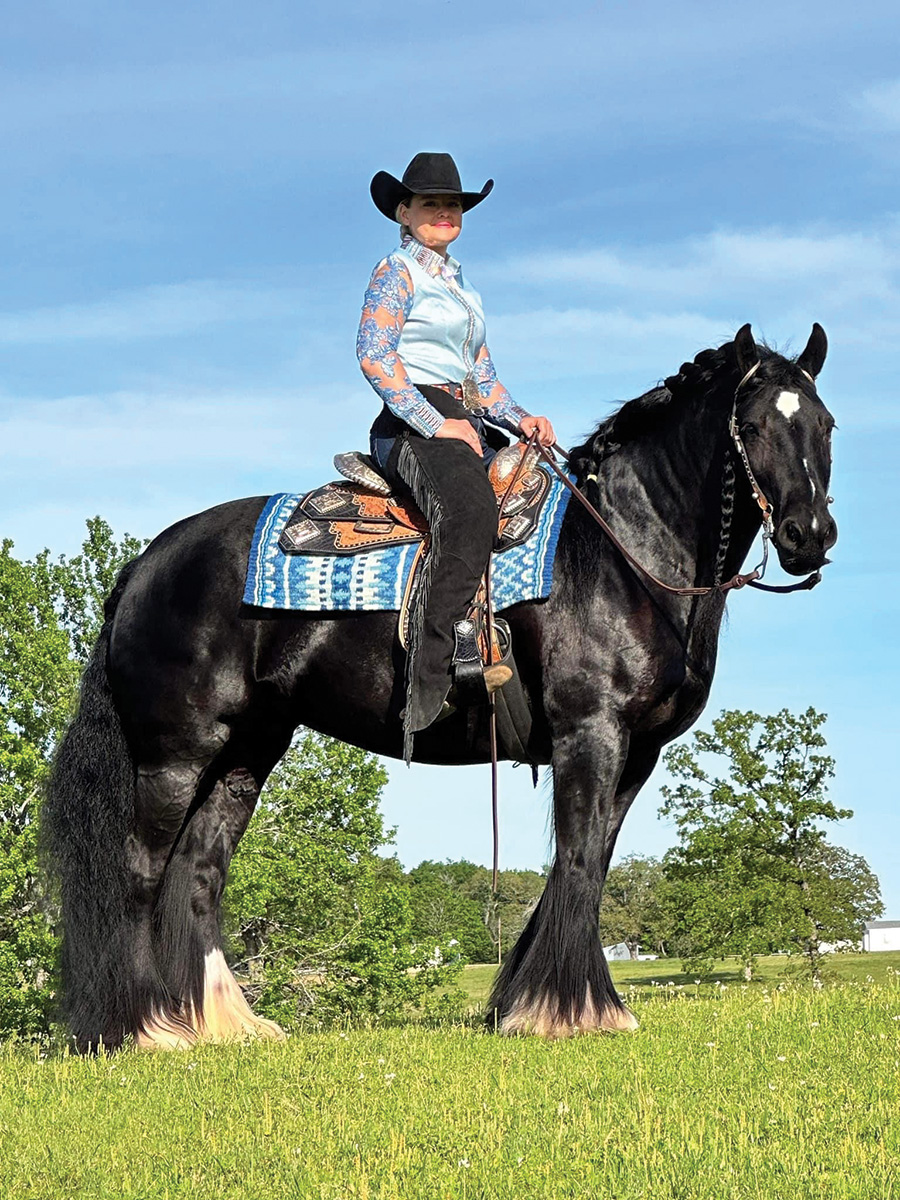
Born in May 2013, GG Kiss Me Kate (aka “Kate”) is a black and white Gypsy mare owned by David and Samantha Crook of Ardmore, Okla. After purchasing her as a 3-year-old, they brought her along slowly, showing her in-hand at first.
Gypsy Vanners are small drafts that make great driving horses, as shown by GG Kiss Me Kate. Photo courtesy Samantha Crook
“We were committed to letting her grow and mature before we began riding her,” Samantha says.
Their plan worked. As Kate matured, she flourished in the show ring. Her title of “Winningest Gypsy Vanner in the History of the Breed” means that in her 10 years of showing, she has won more titles than any other registered Gypsy horse in the U.S.
In her 10 years of showing, GG Kiss Me Kate has won more titles than any other registered Gypsy horse in the U.S. Photo courtesy Samantha Crook
“Since it’s difficult for a mare to compete against a stallion, we are extra blessed to have a mare that can prove her character again and again against all sexes and all ages in all divisions,” Samantha shares.
When not showing, Kate loves a relaxing trail ride, to boss and groom her gelding pasture mate, or a good head hug and a peppermint from her people.
“What I love most about the Gypsy Vanner breed is their heart,” Samantha says. “Whether you have a pet or a world class show horse, they simply give you all they have. A Gypsy Vanner would rather be with you and share your affection than anything else. Yes, Kate is pretty special, but the Gypsy Vanner breed is special, too.”
A Gypsy Vanner as a 4-H Dream Horse
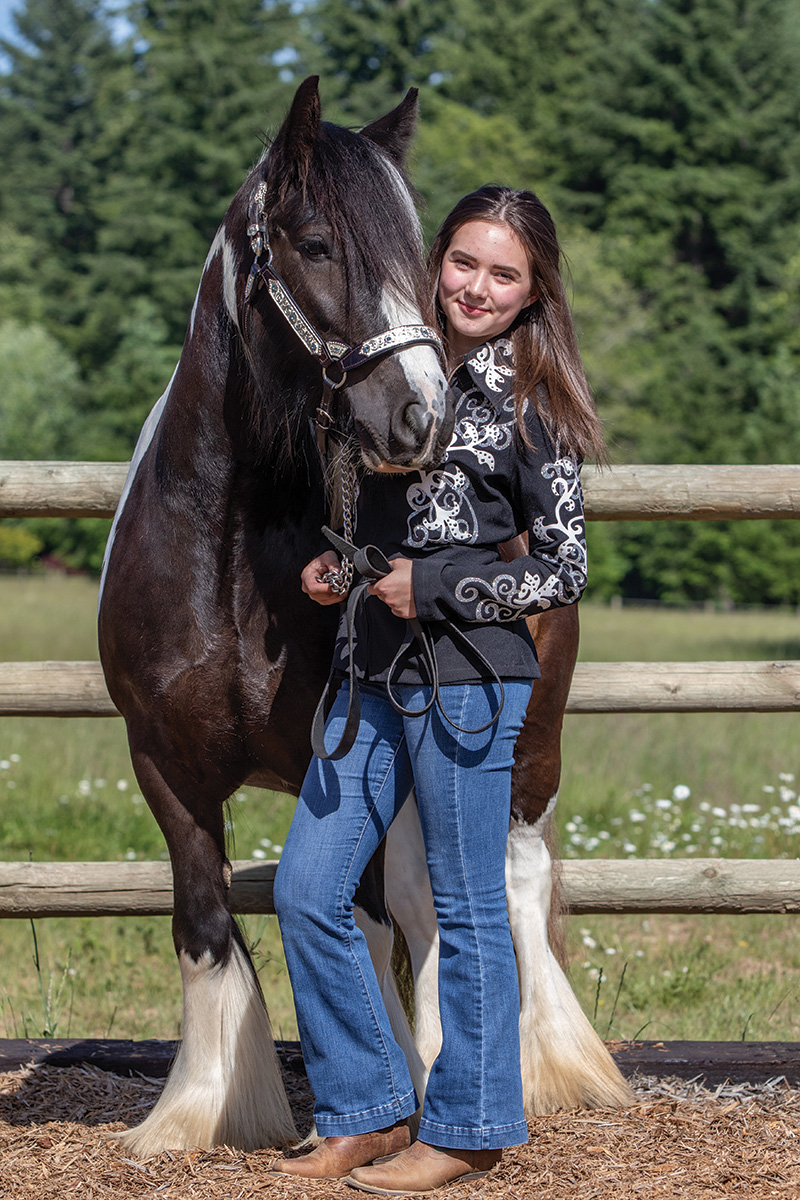
Amanda Ableidinger is the 4-H leader of the Ravenna Riders in Clark County, Wash. Her unique 4-H program is made up almost entirely of Gypsies. She provides free lessons to members of her 4-H group, who show her Gypsies, including Hopkin’s Infinite Perfection (“Infinity”), a 2015 black tobiano mare. Infinity began her journey as a 4-H horse at the age of 2 with in-hand competitions.
“From a very young age, Infinity’s ability to quickly pick up new concepts and her love for learning was astounding,” says Ableidinger. Due to growth spurts, Infinity really wasn’t trained under saddle until she was 4.
“Once again, she picked up the training so quickly that she entered into the riding part of our youth 4-H program only a few short months later.”
Amanda Ableidinger provides free lessons to members of her 4-H group. The kids show her Gypsies, including Hopkin’s Infinite Perfection (“Infinity”). Photo courtesy Amanda Ableidinger
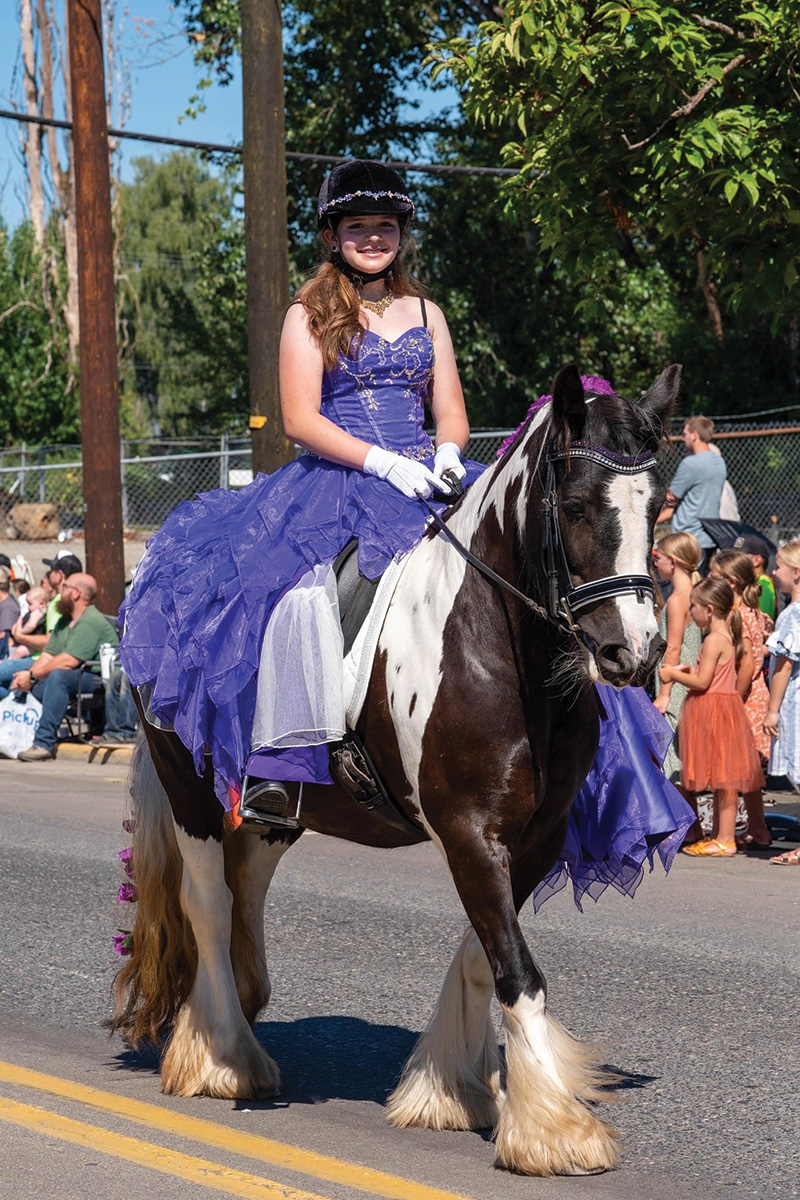
Since then, Infinity has been ridden by several members of the 4-H club, finding success in whatever discipline the kids want to try, from dressage freestyle and drill team to hunt seat and western.
“Over time, we’ve introduced several other new riders/handlers to her life,” says Ableidinger. “Not many other young horses could be patient enough to work with the newest beginner rider all the way through to the advanced. She is the type of horse that caters to each of their individual skill levels and allows her rider to learn and advance in their skills with confidence.”
Infinity and her main rider Evie Schubach at the Battle Ground, Wash., Harvest Days Parade. Photo courtesy Amanda Ableidinger
True to the Gypsy breed, Infinity can take four youth riders to the same show, compete in their different age divisions, and earn high points for each of them.
“Without breaking a sweat,” adds Ableidinger.
These two Gypsies demonstrate the rule, not the exception, when it comes to the versatility and willingness of the Gypsy Vanner breed.
Gypsy Vanner Registries
If you’re looking for an all-around horse that is safe and sane, learn more by visiting the registry websites:
We use cookies to help personalize content, tailor and measure ads, and provide a safer experience. By navigating the site, you agree to the use of cookies to collect information. Read our Cookie Policy.