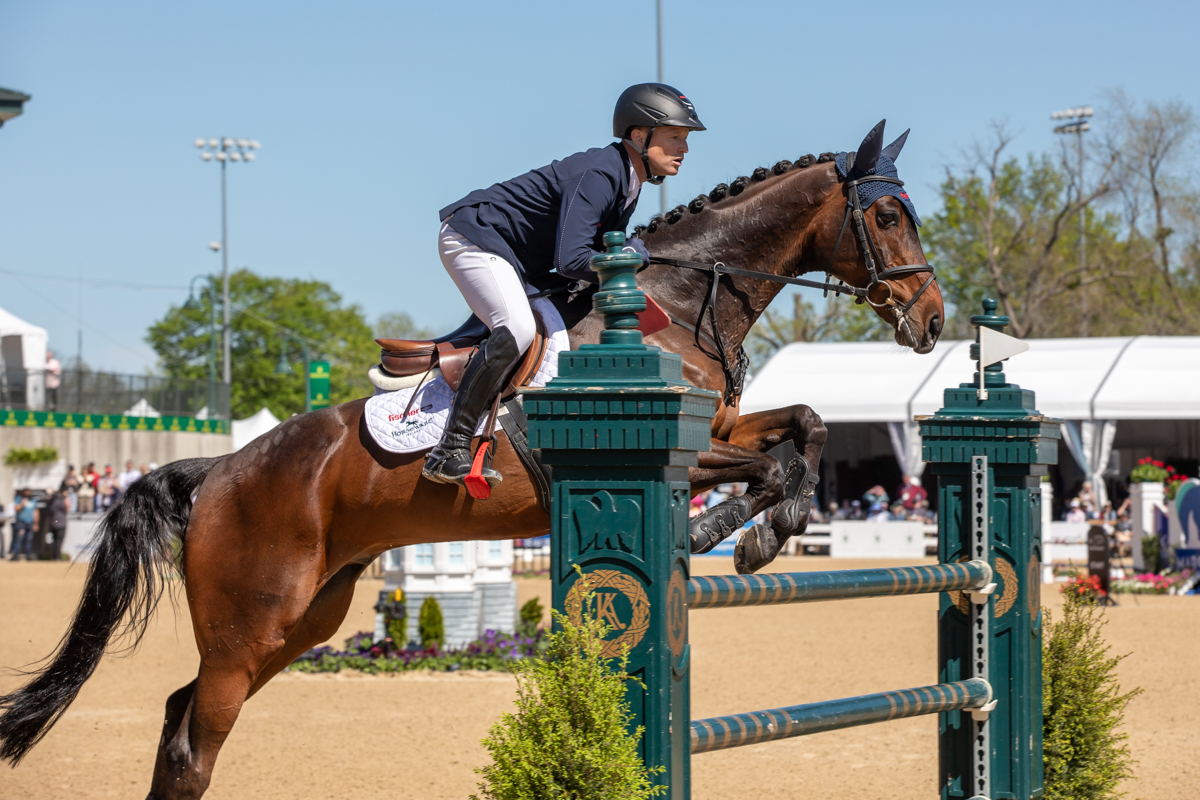
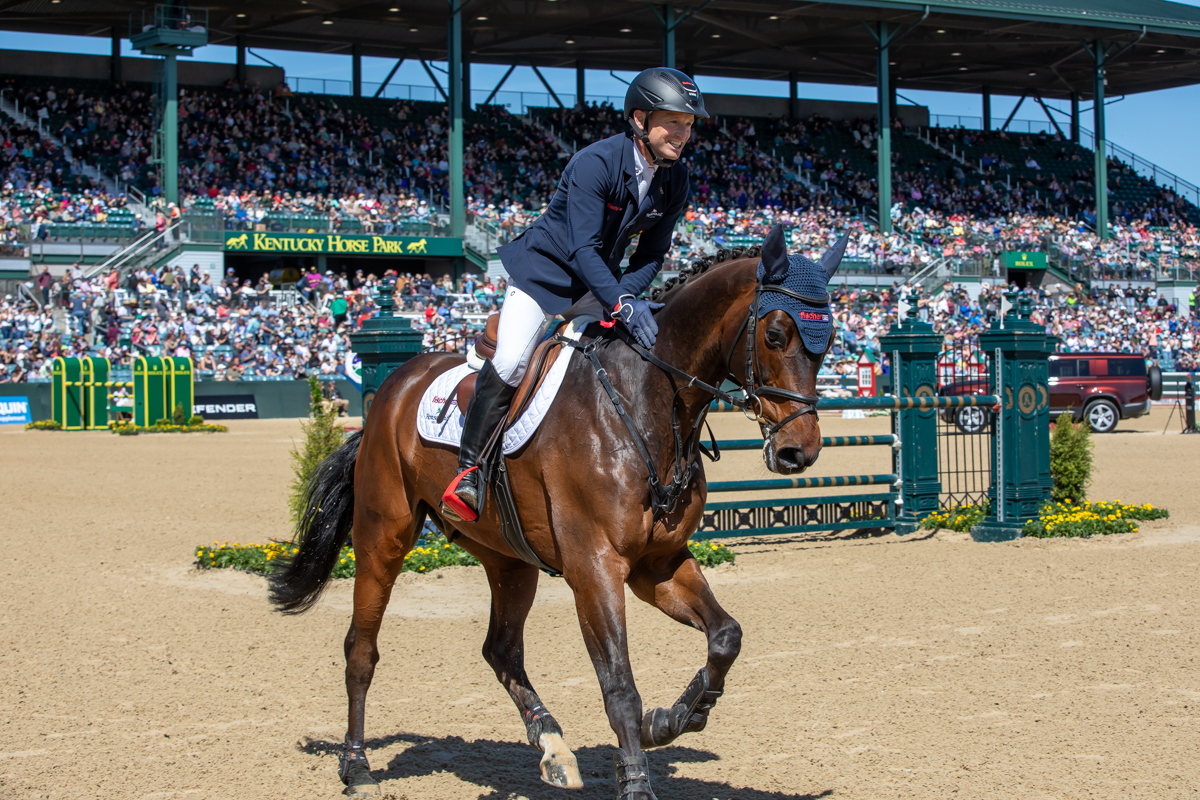
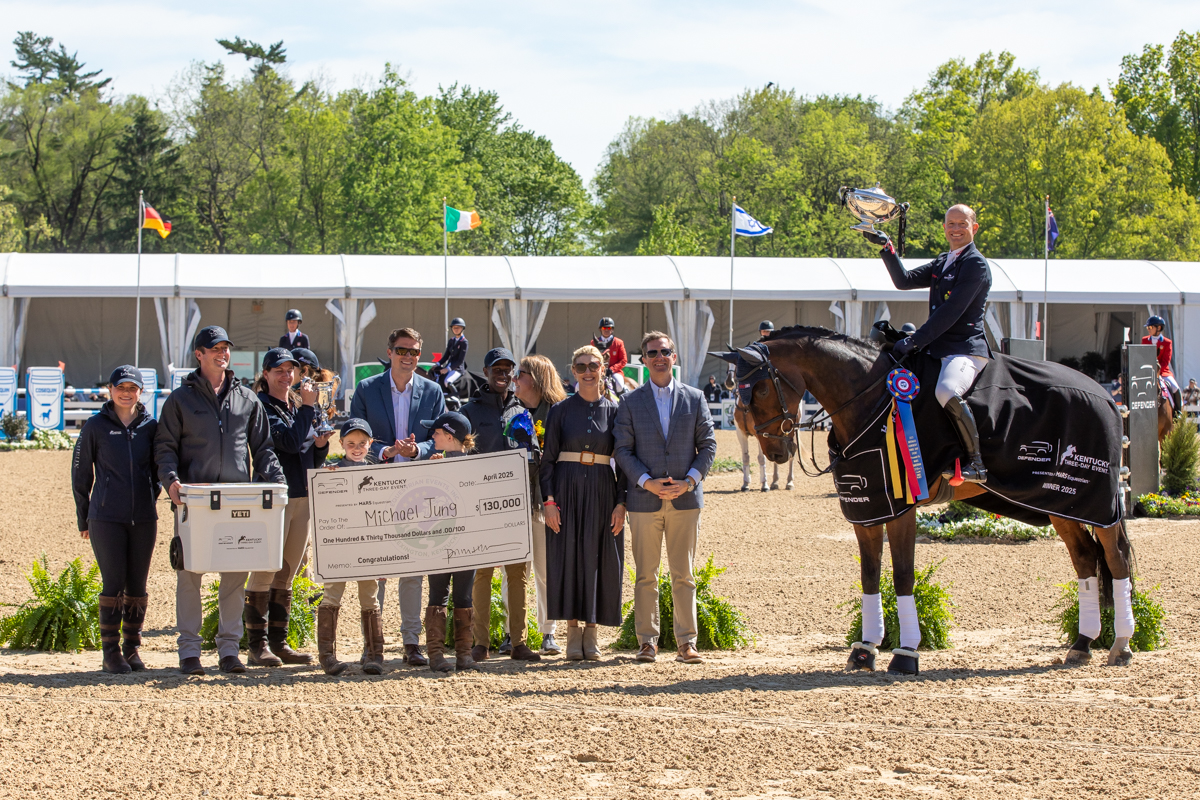
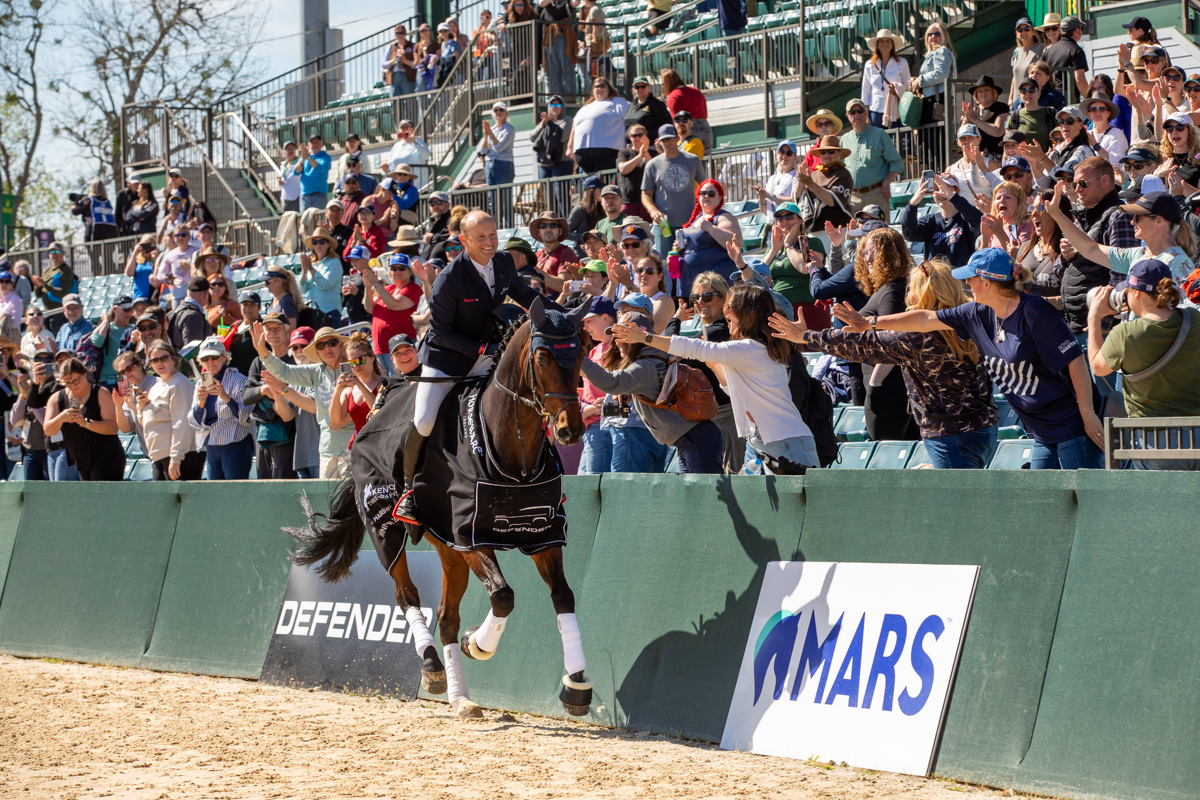
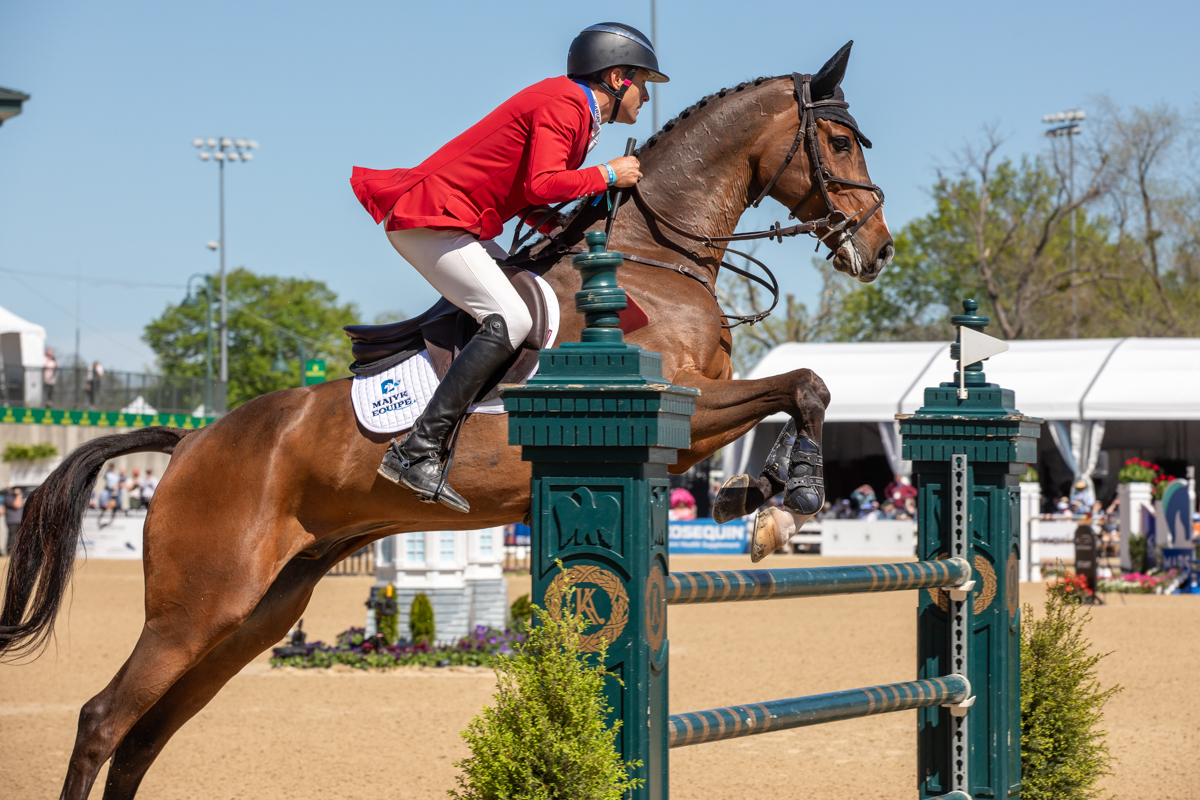
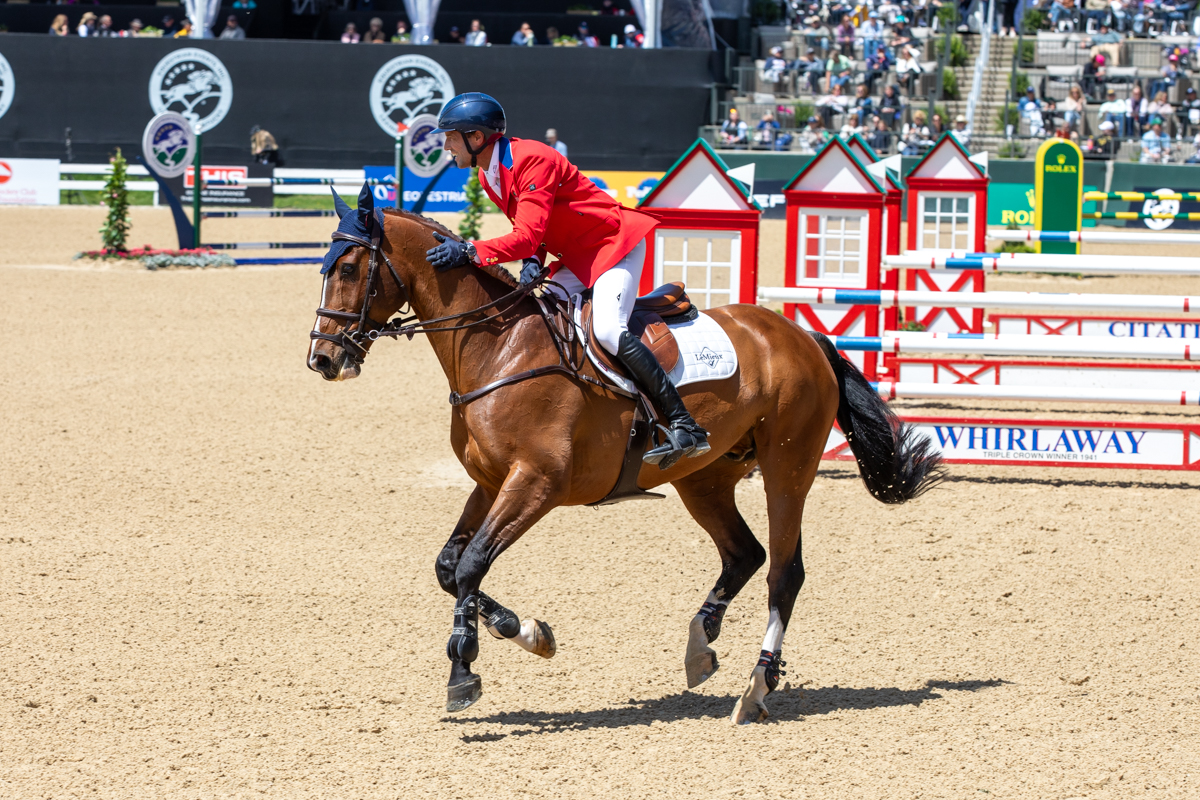
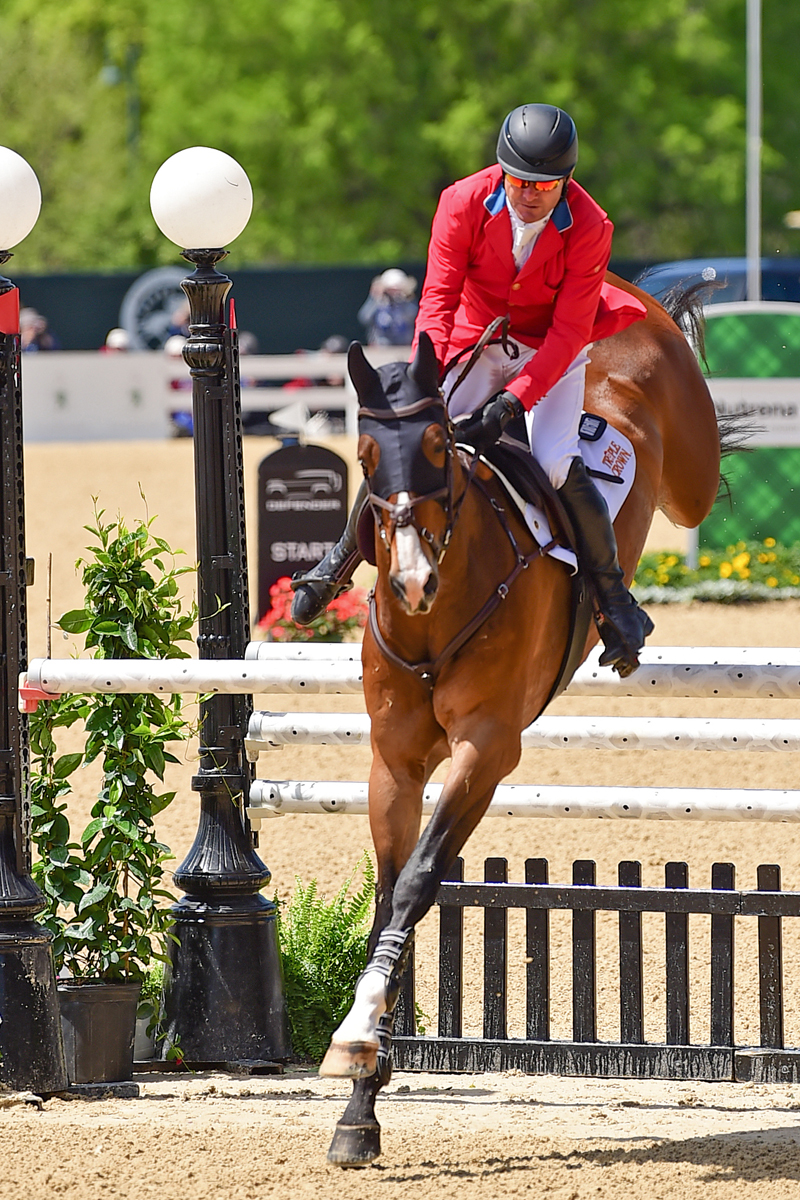
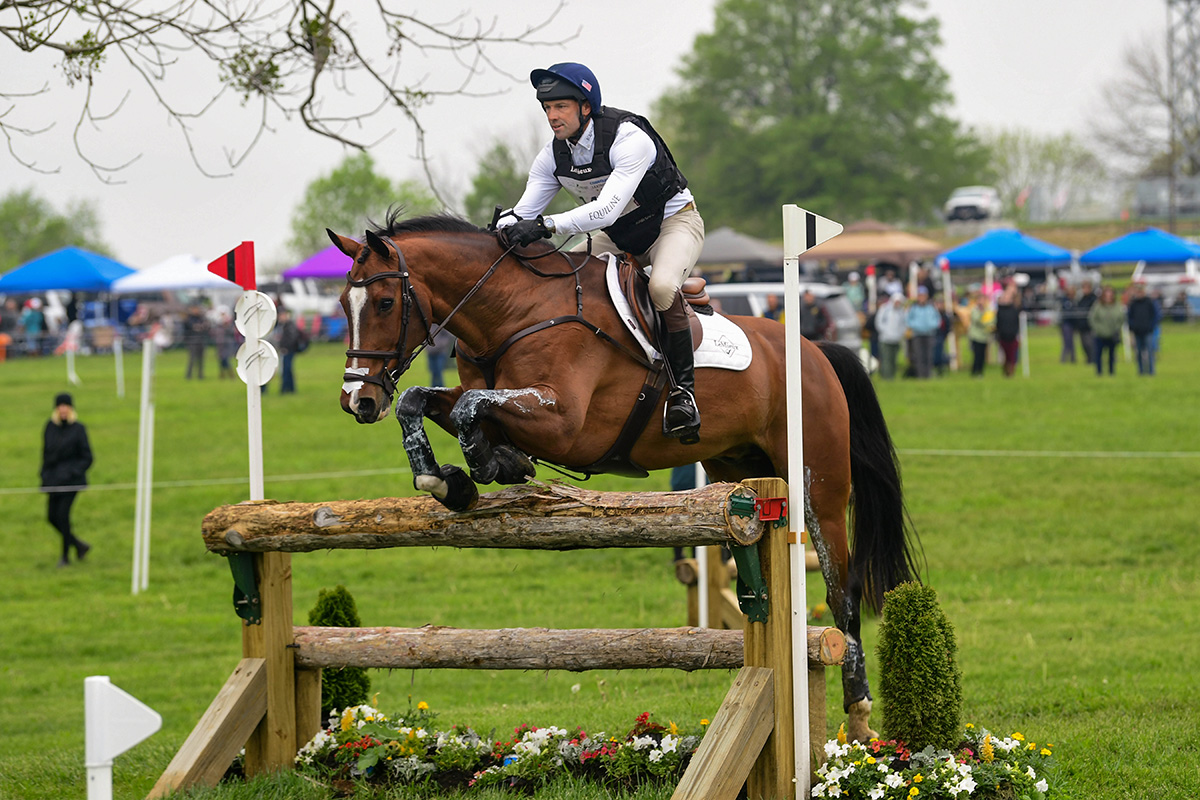
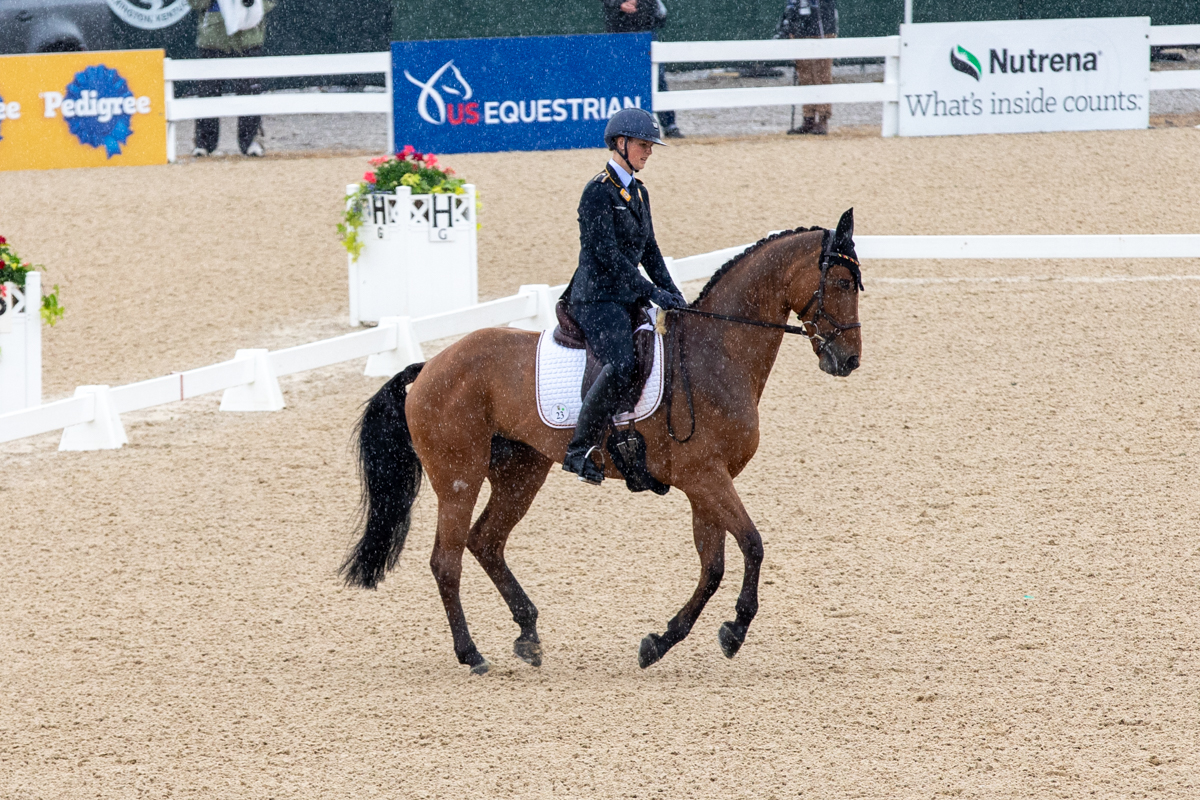
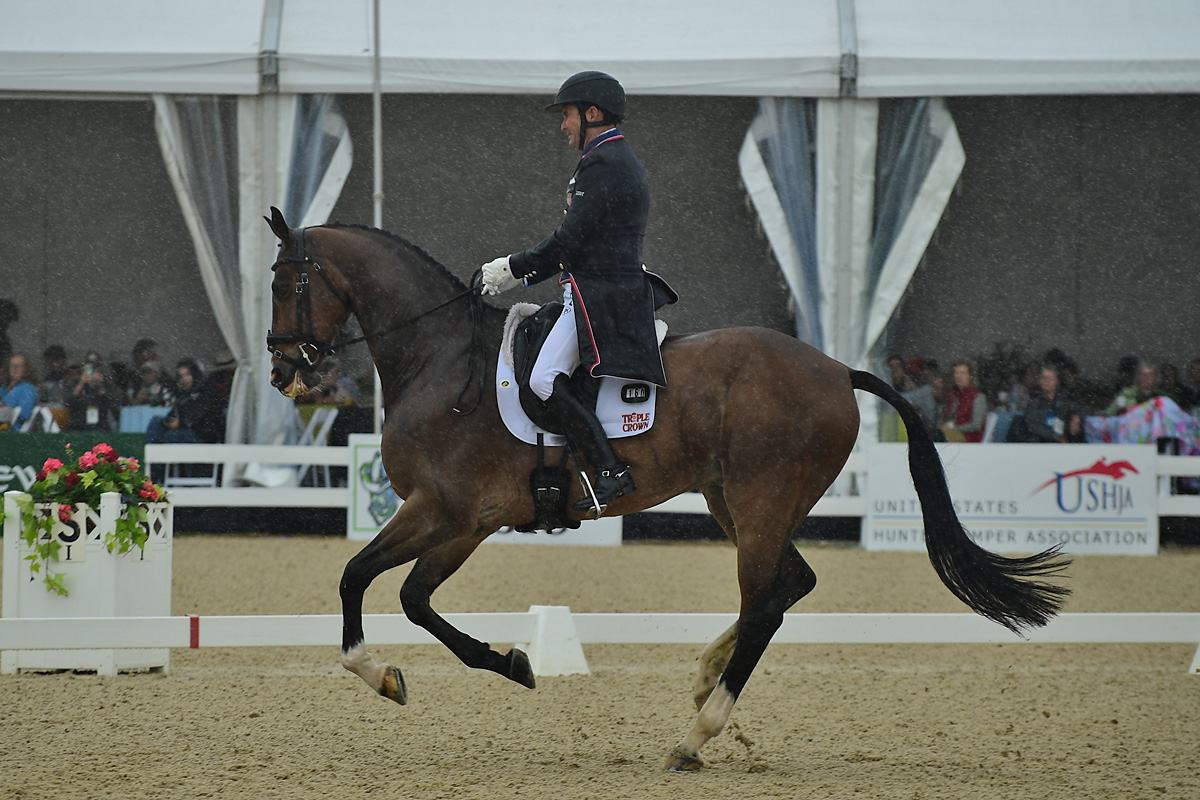
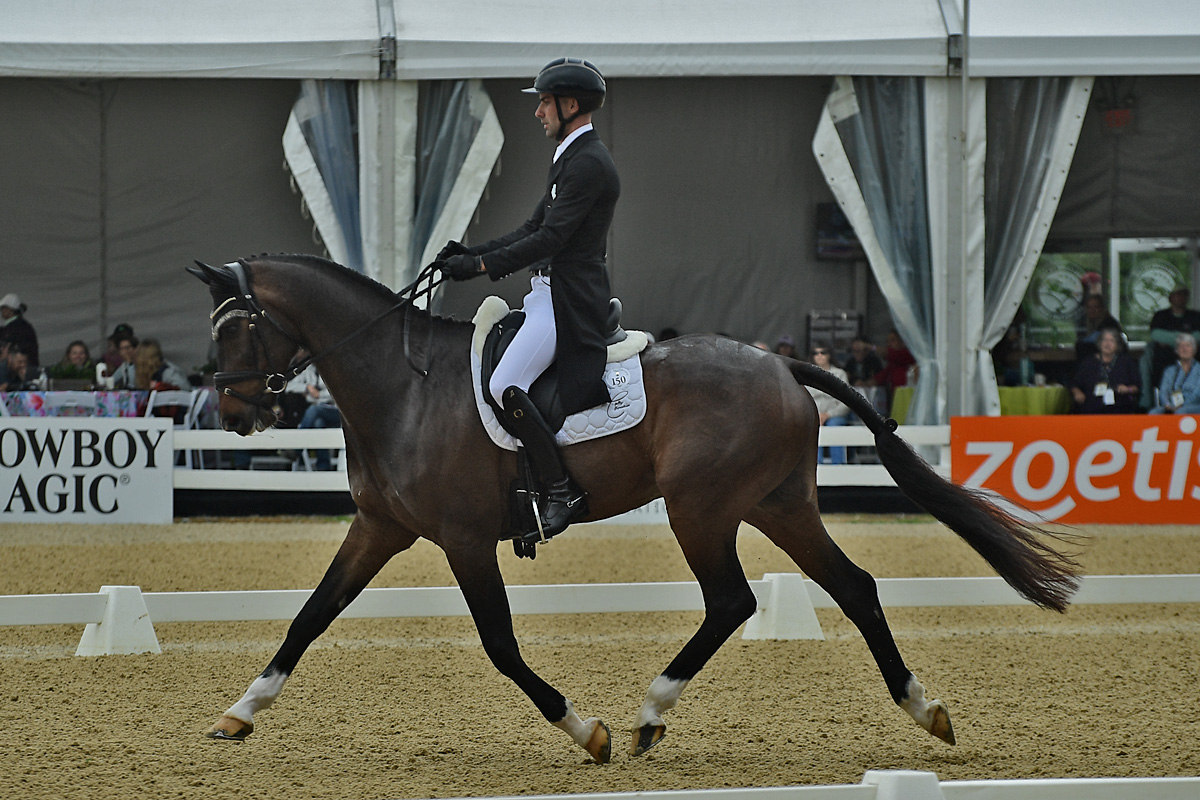
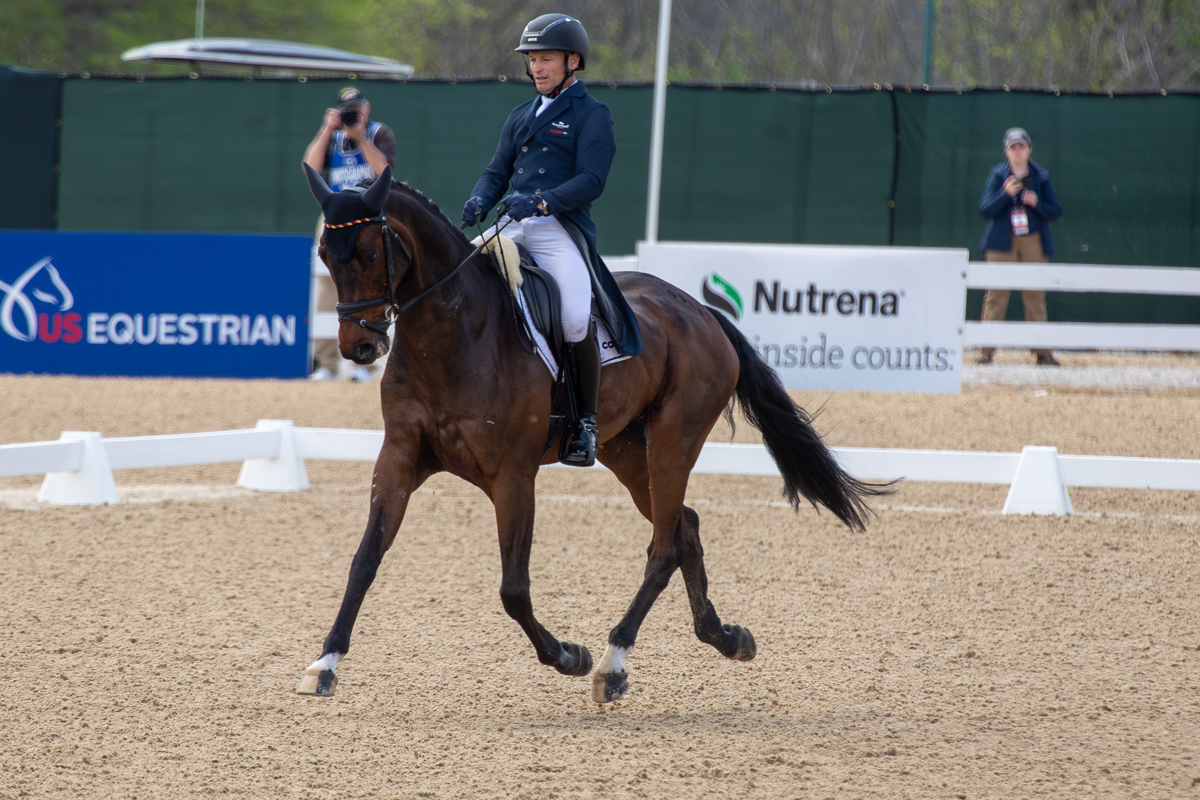
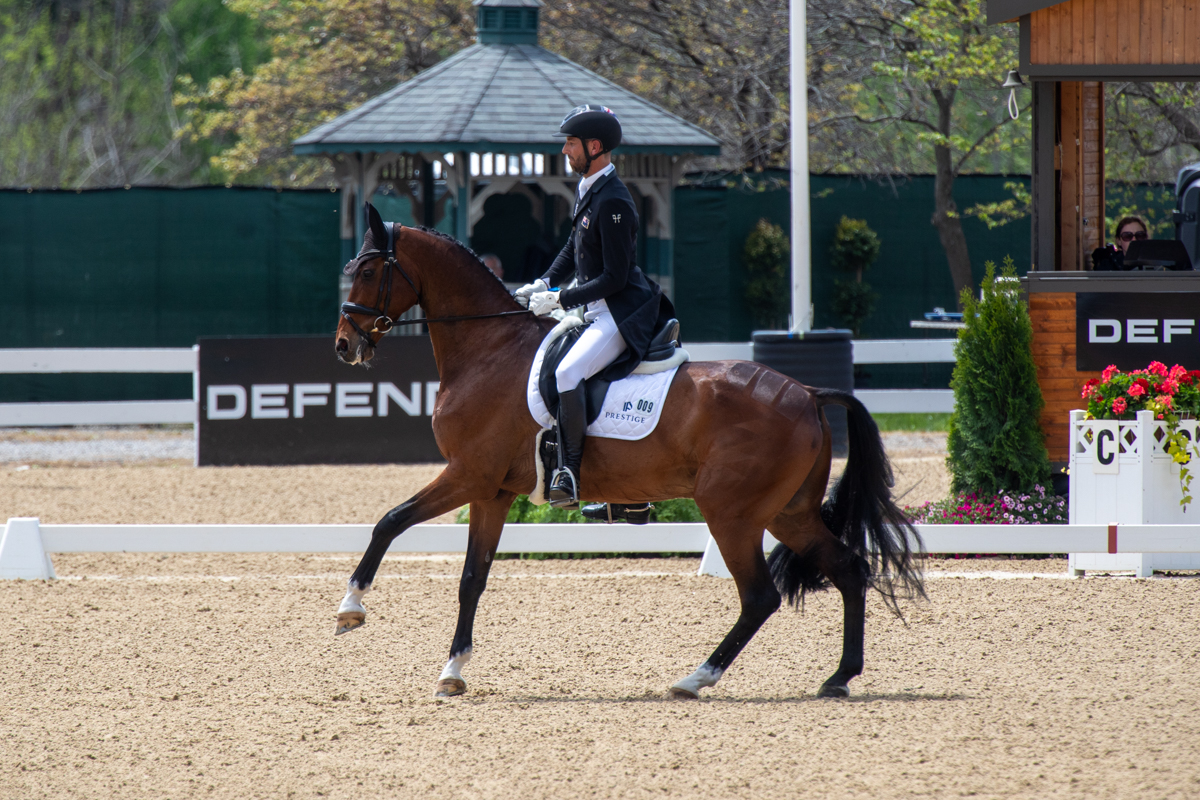
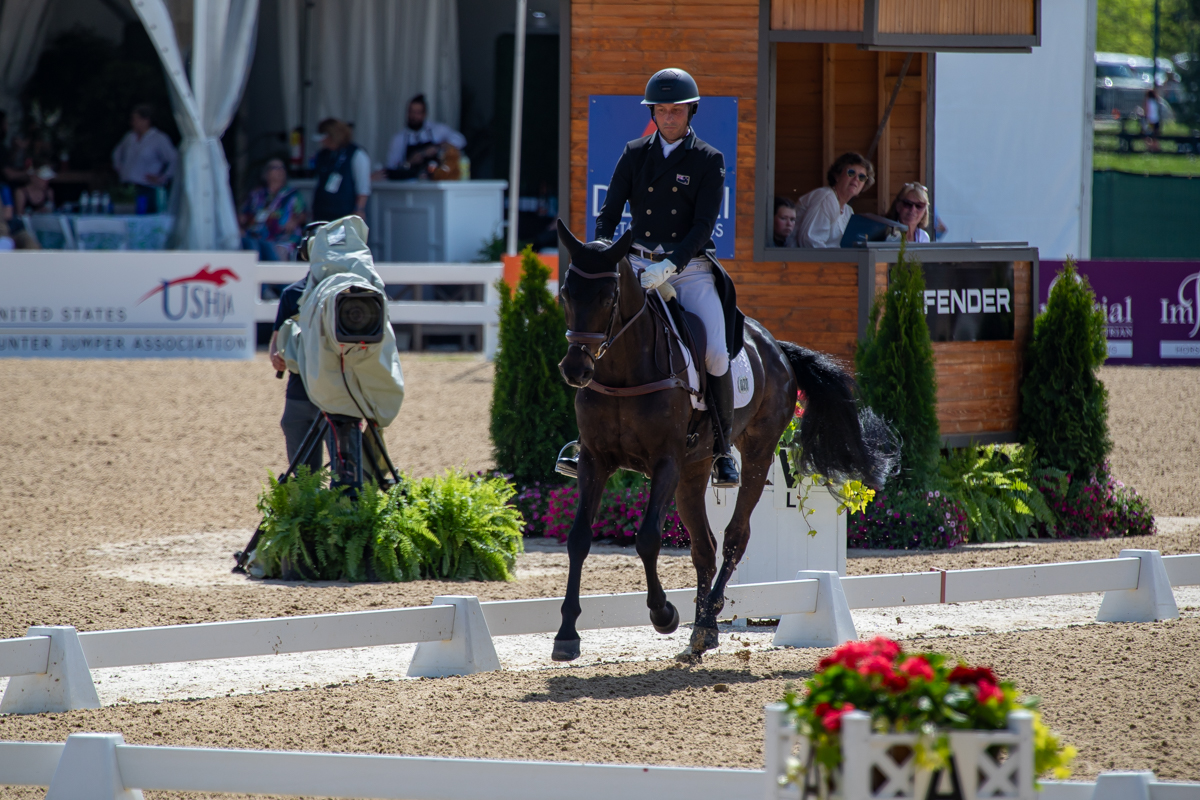
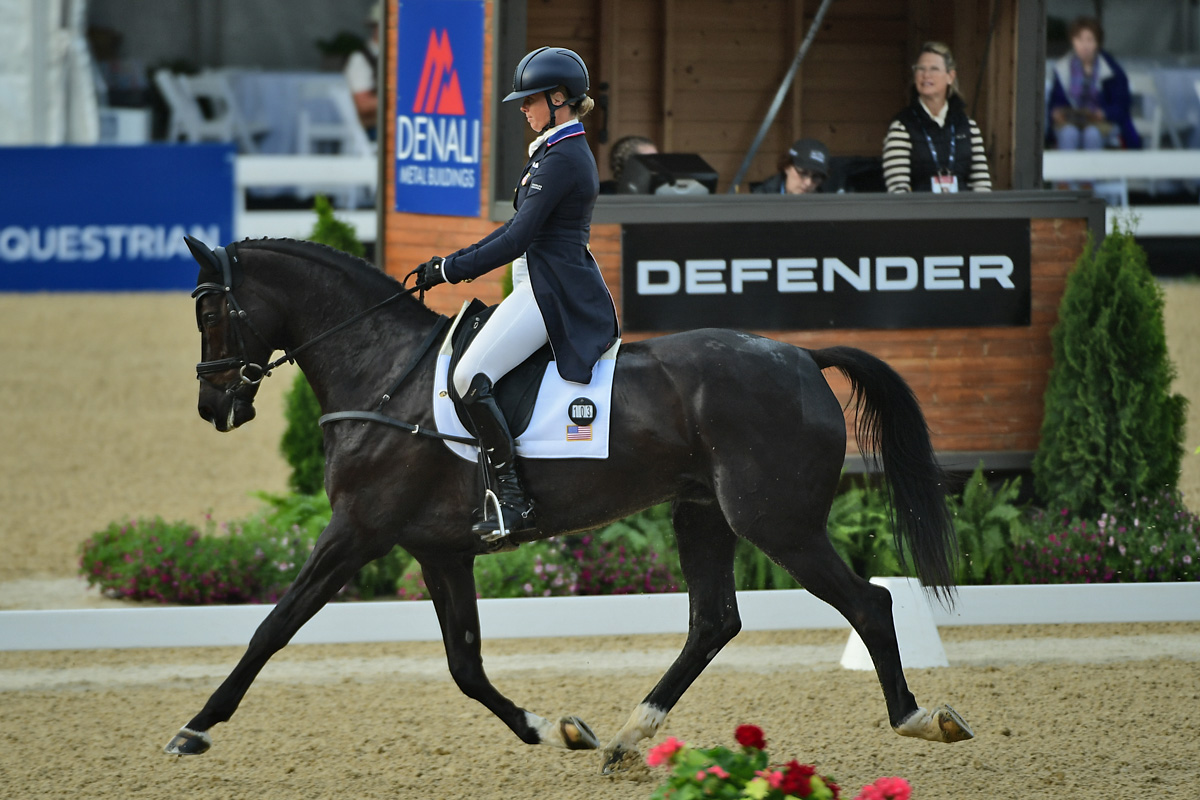
Kentucky skies were finally blessed with bright sunshine all day for the conclusion of the Defender Kentucky Three Day Event CCI5*-L. With two rails in hand for the show jumping phase, Michael Jung (GER) and Fischerchipmunk FRH dropped only one to finish on a score of 25.0, granting Jung a record fifth Kentucky 5* win—the others came in 2015, 2016, 2017, and 2022.
Always modest and soft-spoken, Jung refused to tout his obvious and spectacular talent.
“It’s definitely luck,” he said afterward. “So many things can go wrong. I believe in my horse and this place, and I always have a lot of luck here. We had a pole down very early and had a long way to go. I gave him more balance it worked very well.”
Michael Jung and FischerChipmunk FRH on their way to winning the 2025 Defender Kentucky Three-Day Event. Photo by Mary Cage
Asked about his 17-year-old horse’s future, Jung was very positive.
“He’s looking super strong and getting better and better. Hopefully he stays like this, ears in front when cross-country starts. He loves jumping, and you can feel the horse is motivated in what he’s doing. Hopefully a few more years!”
1 of 3
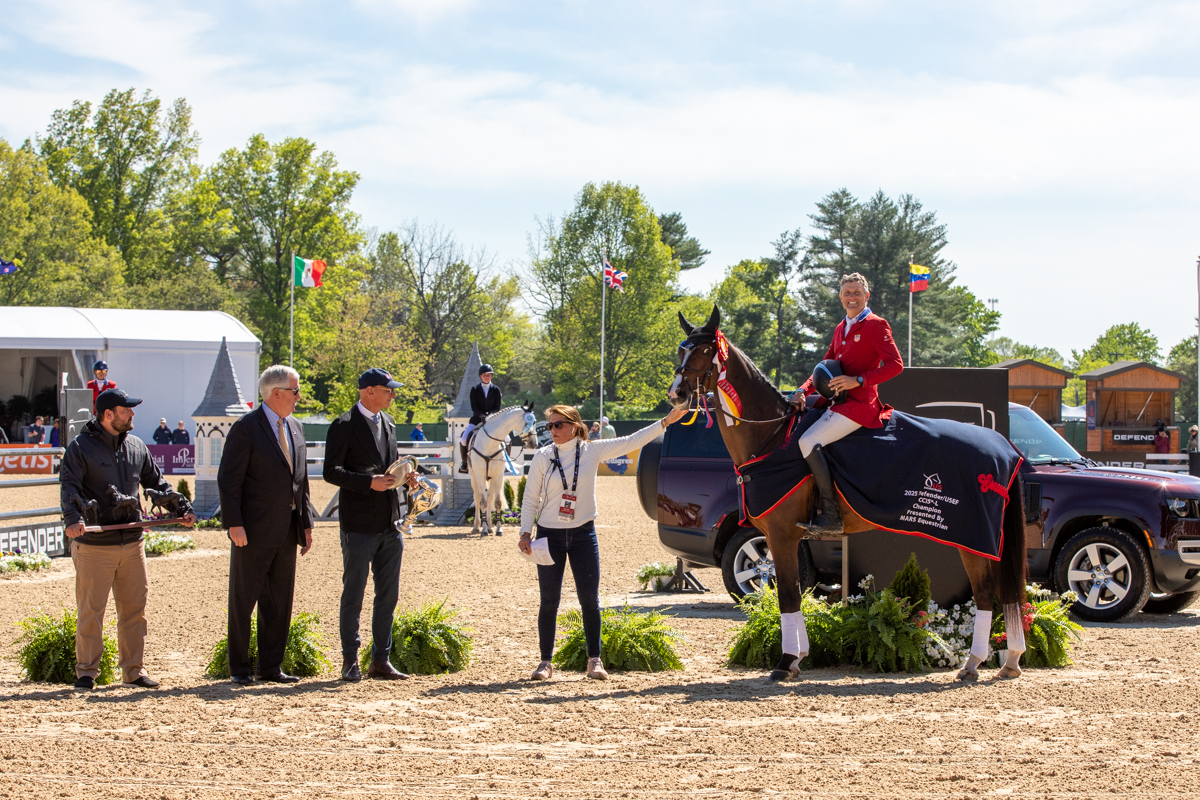
Michael Jung smiles aboard FischerChipmunk FRH after their winning round. Photo by Mary Cage
Michael Jung accepts his awards aboard FischerChipmunk FRH. Photo by Mary Cage
Michael Jung and FischerChipmunk FRH delight the crowd on their victory lap. Photo by Mary Cage
Finishing in second after a double-clear round on a score of 32.8 was Boyd Martin (USA) on Commando 3. His other two 5* mounts, Fedarman B and Luke 140, finished in sixth and seventh, respectively. As the highest-place rider for the U.S., Martin was named USEF 5* National Champion for a fourth time.
“I’m very blessed at the moment to have a group of incredible horses,”said Martin. “Michael [Jung] is an inspiration to my riding; I watch videos and try to copy him in my riding. He’ll be remembered as one of the greatest-ever eventing riders. I was just hoping for second place.”
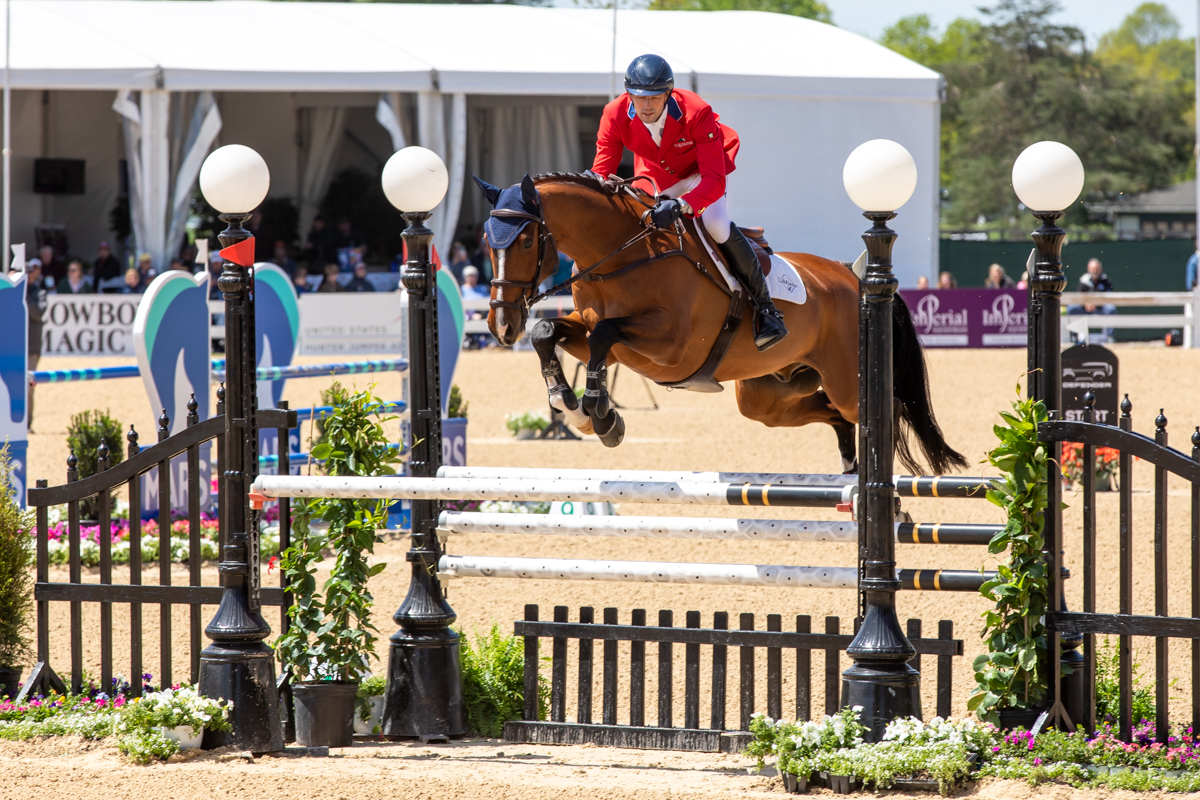
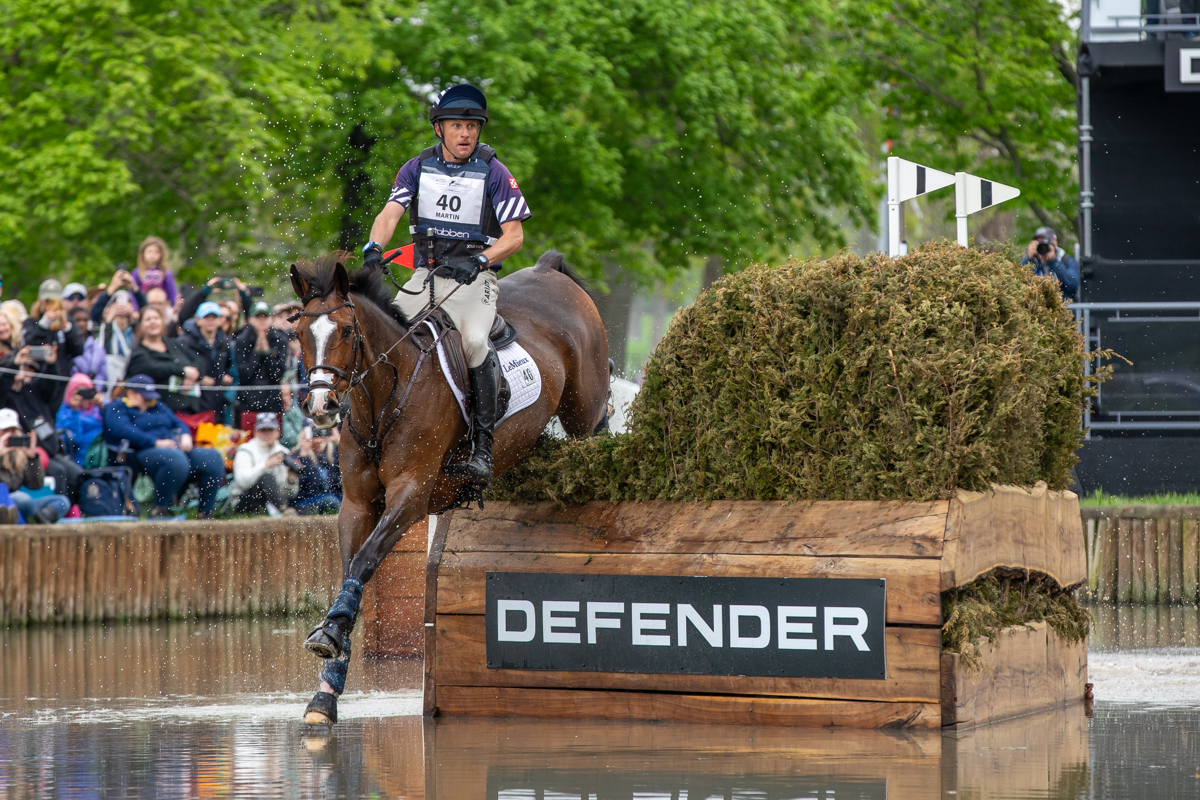
Boyd Martin and Commando 3 complete a double-clear round. Photo by Mary Cage
For a little background on Commando 3, Martin told an interesting story of how he found him.
“I tried him when I went to a friend of [Jung’s] in Germany to try another horse and liked the other horse, who turned out to be a lemon! Six months later, [Commando] was still for sale. He hasn’t been easy—he’s spooky and sharp, but he has amazing quality and plenty of Thoroughbred and I knew right from the get-go that he was a special horse. He took a while to get there, but he’s arrived now.”
Boyd Martin accepts the award for the USEF CCI5*-L Eventing National Championship. Photo by Mary Cage
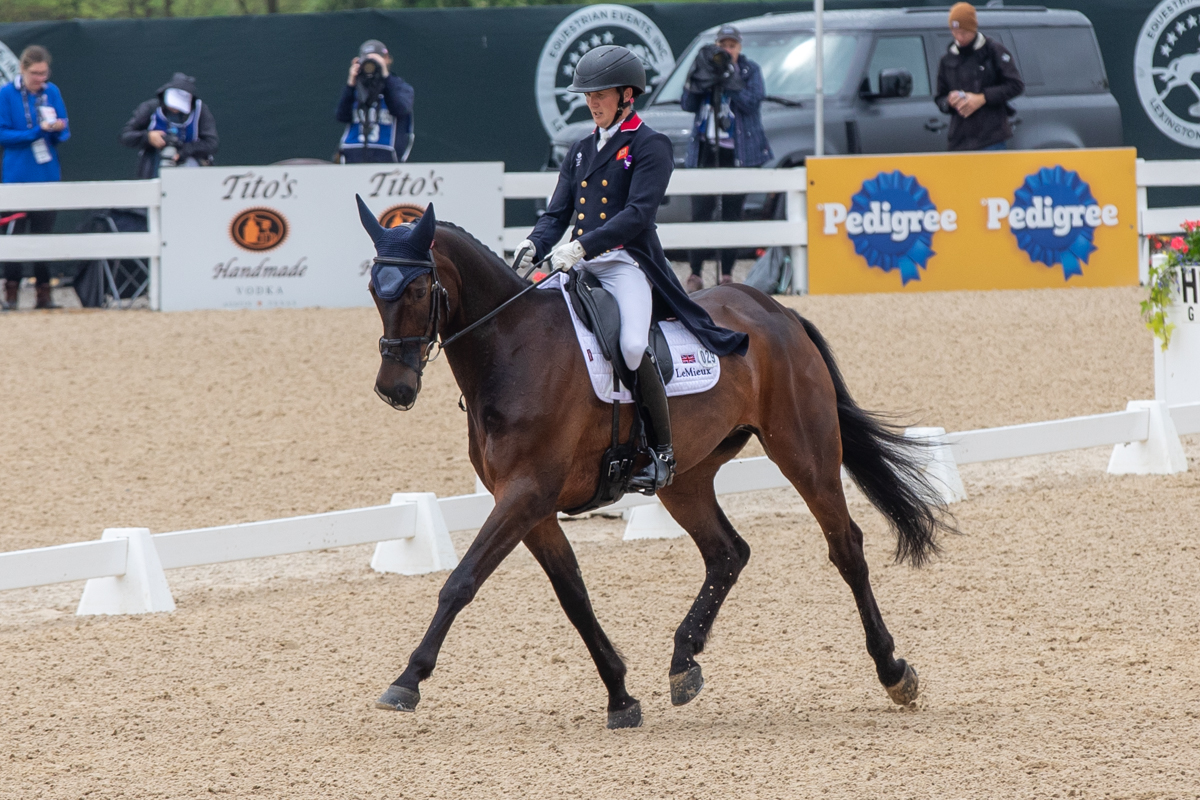
Finishing in third and fourth was Harry Meade of Great Britain, finishing on a 34.2 with Et Hop du Matz and 39.6 on Grafennacht.
“The horses here have been brilliant,” said Mead. “It’s a wonderful feeling when they go well. It’s really about the pride you feel in the horses.”
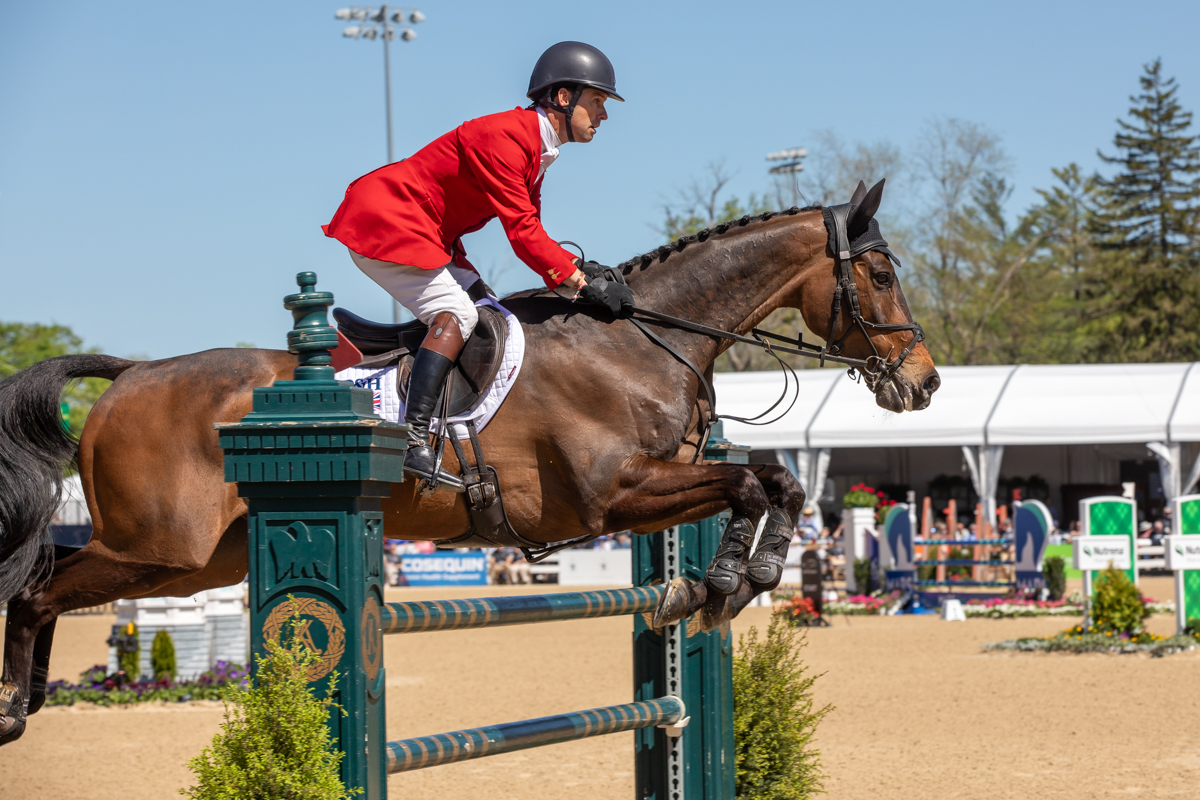
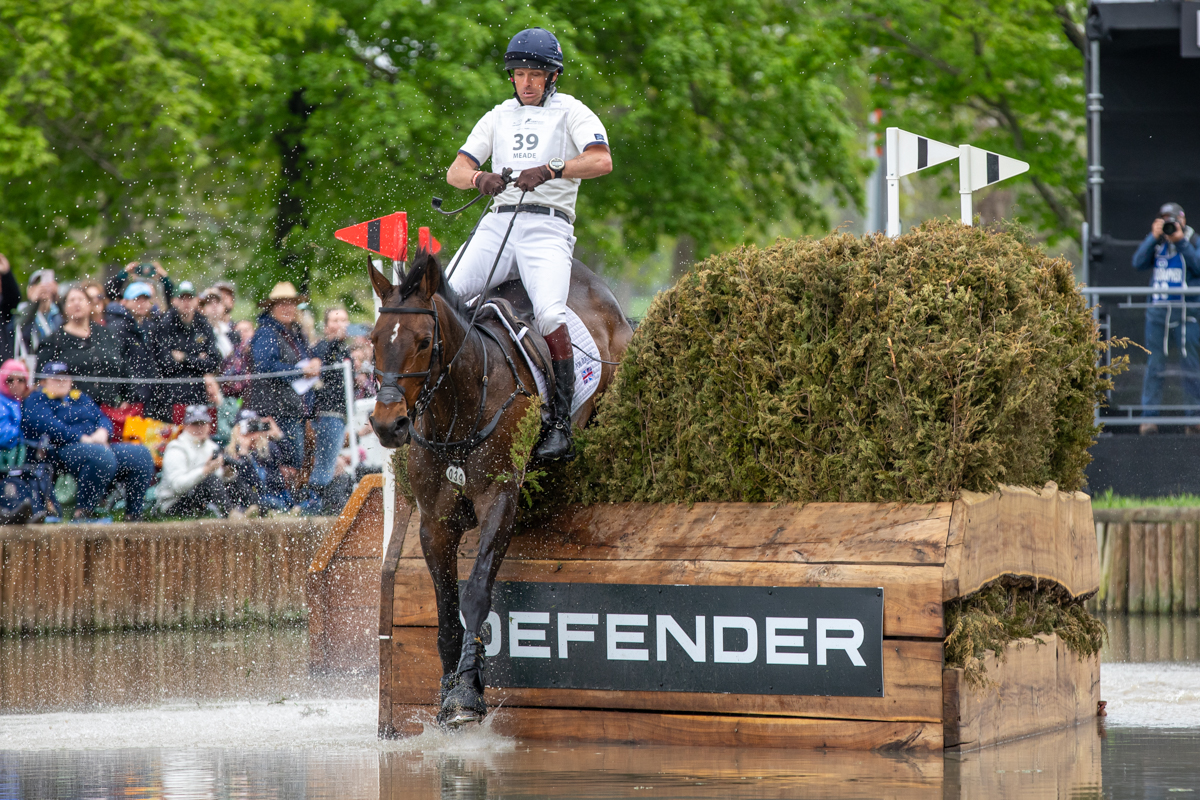
Harry Meade and Et Hop du Matz jump double-clear. Photo by Mary Cage
He wrapped the press conference with some very kind words about Jung, calling him the greatest eventing rider that ever lived—a statement that is indeed hard to refute for someone with four Olympic gold medals (three as an individual), three World Championship gold medals, and seven European Championship gold medals.
Cosequin® Lexington CCI4*-S
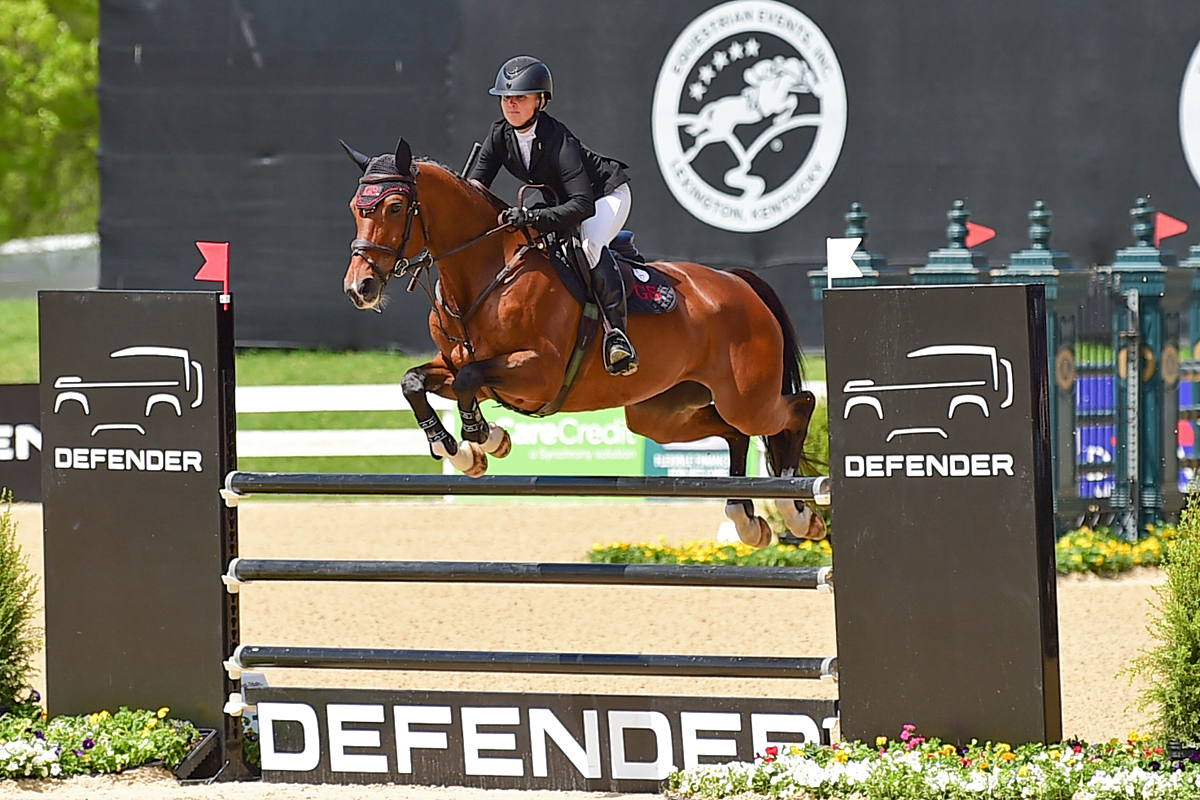
In the 4* division, Will Coleman (USA) and Off The Record dropped one rail but stayed in the lead, finishing on a score of 33.0. He won the 4* here last year, too.
“[The rail down] made me think a little more about the time allowed, but I stuck to my plan,” said Coleman. “He kept the last three jumps up—I got a bit lucky there. He’s always displayed a real knack for cross-country; that’s why we kept going with him. He’s not the most natural in the other two phases. He has his own style; his character is what makes him a good horse. He has a conscience about him, trying to do the right thing, especially in competition.”
1 of 2
Will Coleman and Off The Record on their way to winning the Cosequin® Lexington CCI4*-S. Photo by Mary Cage
Will Coleman giving Off The Record a well-deserved pat on the neck after securing the win. Photo by Mary Cage
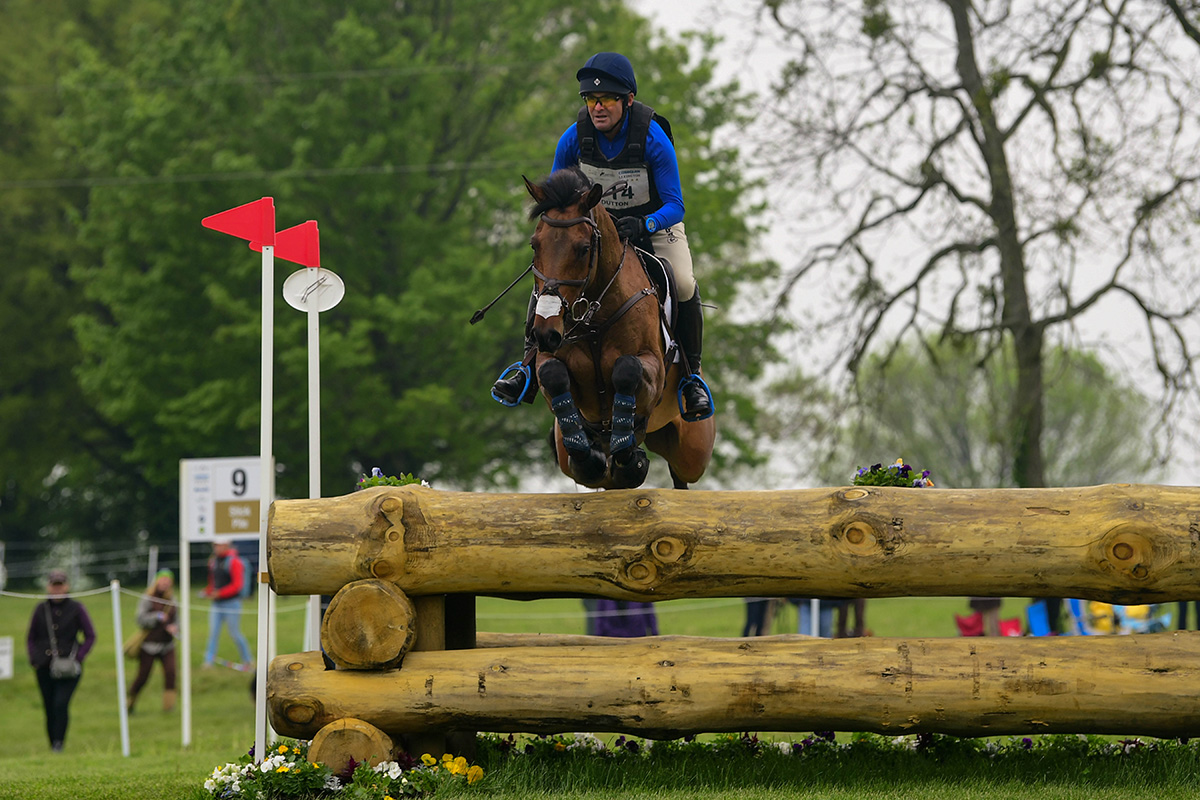
Finishing in second place was Phillip Dutton (USA) and Possante, who wrapped the day on a score of 33.9. Dutton also finished in fourth with Denim on a 38.8.
“We all earmark this event early in the year,” said Dutton. “It’s a relief to be sitting up here and have a good result. It’s ironic, my best jumper is Denim!”
Phillip Dutton and Possante. Photo by Sarah Miller/MacMillan Photography
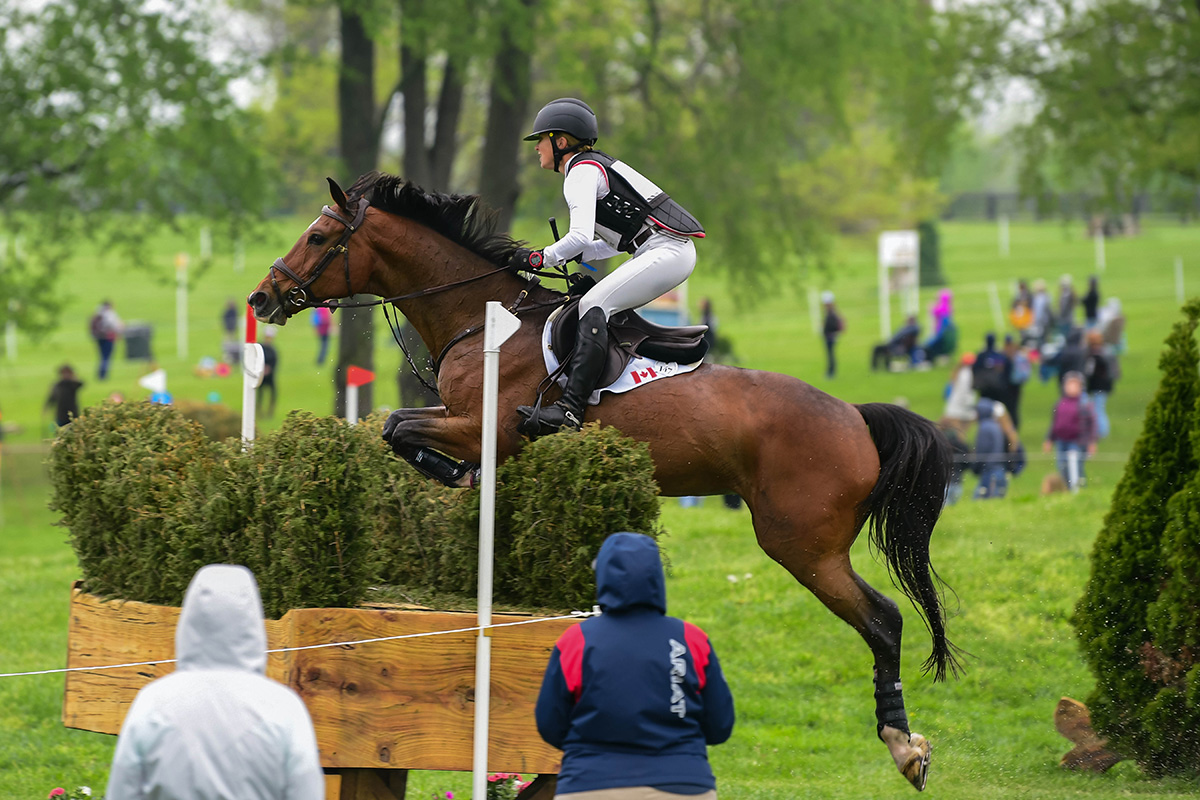
Rounding out the top three was Jessica Phoenix (CAN) and Freedom GS, her Paris 2024 Olympic mount. The pair went double clear around the tricky show jumping course and finished on a 38.0.
“It’s been an amazing spring season,” she said. “I came away from Paris feeling I needed to get the horses stronger and get more confident with where I need to sit with my body type. [Freedom] has always been strong in the jumping phases, but I’ve had to work more with her dressage. It’s pure joy to go out with her and see the fruits of our hard work all winter.”
Jessica Phoenix and Freedom GS. Photo by Sarah Miller/MacMillan Photography
Join us again next year for more coverage of “The Best Weekend All Year!”
2025 Defender Kentucky Three-Day Event CCI5*-L Final Results
1. Michael Jung (GER) and FischerChipmunk FRH (25.0) 2. Boyd Martin (USA) and Commando 3 (32.8) 3. Harry Meade (GBR) and Et Hop du Matz (34.2) 4. Harry Meade (GBR) and Grafennacht (39.6) 5. Tom McEwen (GBR) and Brookfield Quality (40.6) 6. Boyd Martin (USA) and Fedarman B (40.6) 7. Boyd Martin (USA) and Luke 140 (44.7) 8. Monica Spencer (NZL) and Artist (50.9) 9. James Alliston (USA) and Karma (50.9) 9. James Alliston (USA) and Karma (50.9) 10. Libussa Lübbeke (GER) and Caramia 34 (53.1)
2025 Cosequin® Lexington 4*-S Final Results
1. Will Coleman (USA) and Off The Record (33.0) 2. Phillip Dutton (USA) and Possante (33.9) 3. Jessica Phoenix (CAN) and Freedom GS (38.0) 4. Phillip Dutton (USA) and Denim (38.8) 5. Allison Springer (USA) and No May Moon (40.4) 6. Mia Farley (USA) and Invictus (42.9) 7. James Alliston (USA) and Nemesis (44.3) 8. Tamie Smith (USA) and Kynan (46.0) 9. Ema Klugman (AUS) and Chiraz (48.2) 9. Jan Byyny (USA) and Beautiful Storm (49.9)
Stay up to date on the action from the 2025 Defender Kentucky Three-Day Event. Find information about the event, including a recap from each day of the competition below, and follow links to the full stories.
Kentucky skies were finally blessed with bright sunshine all day for the conclusion of the Defender Kentucky Three Day Event CCI5*-L. With two rails in hand for the show jumping phase, Michael Jung (GER) and Fischerchipmunk FRH dropped only one to finish on a score of 25.0, granting Jung a record fifth Kentucky 5* win—the others came in 2015, 2016, 2017, and 2022.
After a day of deluges on Friday, cross-country day dawned dry, gray, and very cold for late April, with a “feels like” temperature of 45 degrees that persisted all day. The ground was still holding a lot of water, which turned out to be very deep and tiring for the horses, with scads of time penalties in both the 4* and 5* divisions.
Reigning Paris Olympic Champion and four-time winner of this event, Michael Jung (GER) rode his Paris mount, FischerChipmunk FRH, to an exceptionally fast round, with just 2.4 time penalties to stay in a comfortable lead. In fact, he has now set a 5* record for biggest lead margins after dressage and cross-country.
Under threatening skies that provided on and off downpours and even some lightning, nobody could catch Germany’s Michael Jung on the second day of dressage at the 2025 Defender Kentucky Three Day Event CCI5*-L at the Kentucky Horse Park in Lexington, Ky.
It was the last rider to go, Boyd Martin (USA) on Commando 3 who bore the brunt of a downpour that had held off for the rest of the 5* riders—yet he scored the best mark of the day from the judges, a 26.0, putting them into second place going into cross-country day.
Day one of the 2025 Defender Kentucky Three-Day Event CCI5*-L kicked off today at the Kentucky Horse Park in picturesque Lexington, Ky. with the first day of dressage tests. Under mostly cloudy skies—apart from a handful of short-lived, light rain showers—many of the top horses and riders in the world took to Rolex Stadium for the first phase of the event.
A Defender Kentucky Three-Day Event dressage record was broken when reigning Paris 2024 Olympic gold medalists Michael Jung (GER) and FischerChipmunk FRH effortlessly danced across the ring to score a remarkably low 18.6.
Six of the world’s top 12 eventing riders, including World #1 Tom McEwen (GBR) and World #2 Tim Price (NZL), head an impressive list of entries for the 2025 Defender Kentucky Three-Day Event presented by MARS Equestrian™. The event will feature 11 Olympians and athletes from seven countries when it returns to the Kentucky Horse Park, April 24-27.
This year’s Cosequin® Lexington 4*-S will serve as a US Equestrian Open Eventing Series Qualifier when the Defender Kentucky Three-Day Event presented by MARS Equestrian™ returns to the Kentucky Horse Park, April 24-27. Equestrian Events, Inc. (EEI), producer of the world-renowned event, is thrilled to welcome back Cosequin® as the Title Sponsor of the Four Star competition.
After a day of deluges on Friday, cross-country day dawned dry, gray, and very cold for late April, with a “feels like” temperature of 45 degrees that persisted all day. The ground was still holding a lot of water, which turned out to be very deep and tiring for the horses, with scads of time penalties in both the 4* and 5* divisions.
Defender Kentucky Three Day Event CCI5*-L
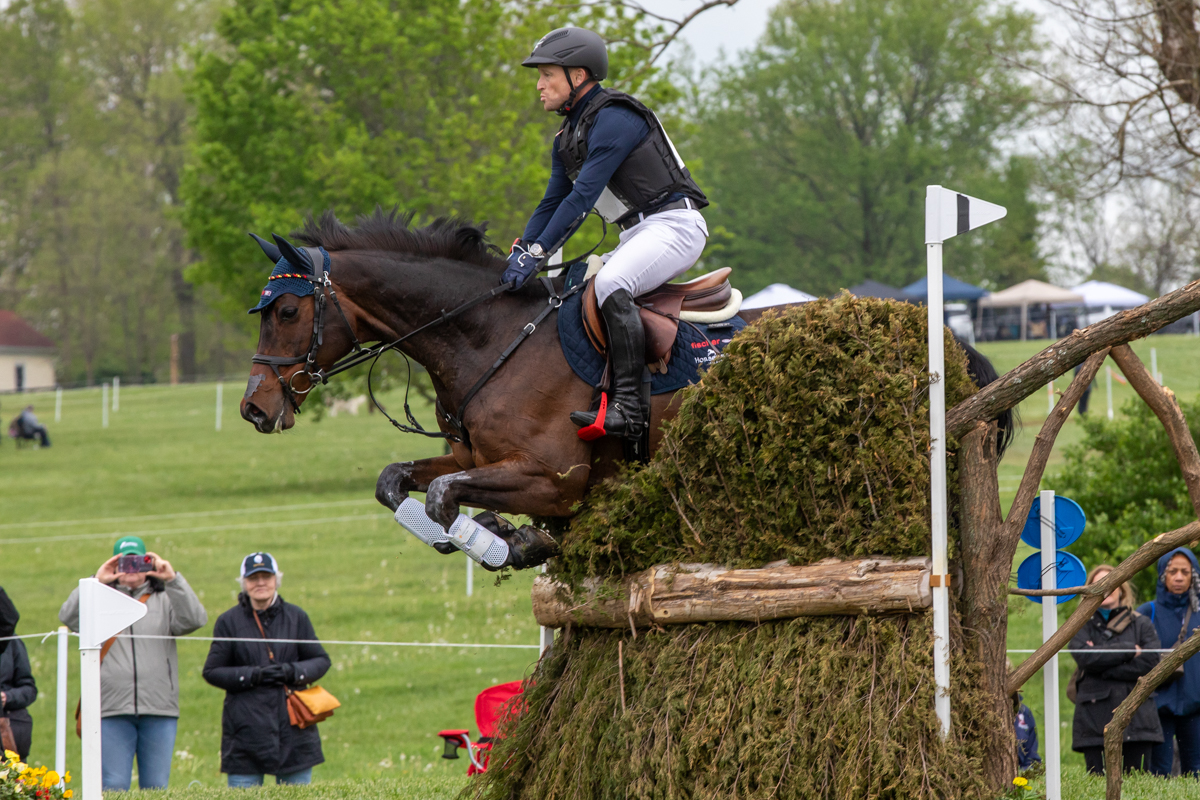
Reigning Paris Olympic Champion and four-time winner of this event, Michael Jung (GER) rode his Paris mount, FischerChipmunk FRH, to an exceptionally fast round, with just 2.4 time penalties to stay in a comfortable lead. In fact, he has now set a 5* record for biggest lead margins after dressage and cross-country.
“I had a super ride,” said Jung at the press conference after cross-country. “He’s an amazing horse in the cross-country—he’s full of energy with very big strides, very honest. I can trust him. We get better together. We’re still learning, but a great partnership is very important for the cross-country. He felt a bit tired some places. I knew I was behind the time, but he kept galloping to the end of the course. He was really fit.”
Michael Jung and FischerChipmunk FRH continue to lead the way after cross-country. Photo by Mary Cage
Holding on to second place with 6.8 time penalties was Boyd Martin (USA) on Commando 3, one of his three mounts in the 5* division. Always one to provide entertainment, Martin spoke at the press conference with his baby on his lap (who didn’t want to stay in the back with Mom), and his older son briefly joined them on the stage as well.
“It was a bloody tiring day, every ride I was huffing and puffing!” said Martin. “I went quick on [Commando]—he’s young and fit and gave me a great round, but the ground was a bit tiring.”
Boyd Martin and Commando 3 make their way through the Defender Head of the Lake complex, an iconic part of the Defender Kentucky Three-Day Event cross-country course. Photo by Mary Cage
Harry Meade of Great Britain made an eye-popping climb up the leaderboard with the day’s only two double-clear rides (no jumping or time penalties), moving from 17th to third with ET Hop du Matz and 18th to fourth with Grafennacht. Meade is ranked No. 4 in the world eventing standings.
“I was confident they were fit,” he said. “I thought I’d get out there and see how they felt. The first horse [ET Hop du Matz] I know really well, and hoped he’d be a good 5* horse. He’s very adjustable and has a long stride. The mare, Grafennacht, I don’t know as well; I had this spring to get to know her and wasn’t thinking about coming here. Then she won an event by 24 points, so it was a no-brainer to bring her here. I was disappointed with her dressage test; she got a bit tight in the atmosphere—it was her first time in [a big crowd]. I was questioning whether to run her [cross-country] at 11:30 or 12 today, then thought I’d just start out and see how she goes.” Apparently, the answer was VERY well!
1 of 2
Harry Meade and Et Hop du Matz. Photo by Mary Cage
Harry Meade and Grafennacht. Photo by Mary Cage
Course designer Derek di Grazia was pleased with the safety of the course this year.
“You never know at the beginning the day what’s going to happen,” he said. “You hope it’s going to provide a good competition. I’m happy every horse walked home—there were only two rider falls in the 4* and one in the 5* class—beyond that, there were some great rides that were really enjoyable to watch. Their time management is so good; at the end they are right where they need to be. We had lots of little runouts here and there all over the course, but it provided a good competition.”
Cosequin® Lexington CCI4*-S
Holding first place aboard Off the Record with the least time penalties in the division (7.2) was Olympic veteran and defending Kentucky 4* champion, Will Coleman (USA). Optimum time was 6 minutes and 37 seconds, compared to the 5*-L division at 11 minutes and 20 seconds.
“The roping and way the [jumps] were strung together made it tough to get the speed needed for time allowed,” he said. “It wasn’t surprising at all that nobody got close to it.”
As far as how his mount handled the course, he gives him all the credit it the world.
“When you have an older horse and they come out inspired to do it, it’s a rewarding feeling. I have nothing but admiration for that horse.”
Will Coleman and Off the Record continue to hold the lead in the 4* after cross-country. Photo by Allen MacMillan/MacMillan Photograhy
Remaining in second and third with Possante (10.4 time penalties) and Denim (11.6 time penalties), respectively, was Phillip Dutton (USA).
“I feel a bit relieved,” he laughed. “It was a lot of hard work. I tried to have a crack at it. They both tried hard and will come out of it better.”
1 of 2
Phillip Dutton and Possante. Photo by Allen MacMillan/MacMillan Photograhy
Phillip Dutton and Denim. Photo by Allen MacMillan/MacMillan Photography
Climbing from 14th to fourth with just 8 time penalties was Canadian Olympian Jessica Phoenix.
“Freedom GS is pure class,” she said of her mount. “She’s a fun horse to ride cross-country. She looks for the flags. The way they roped it, she was fast and efficient. She was pretty green when we took her to the Olympics. The first time she did the 4* was last season, but she was unaffected by the crowds. At Paris [2024 Olympic Games] it would’ve been nice to have one more year of experience under her belt, because this year she feels so confident.”
Jessica Phoenix and Freedom GS. Photo by Allen MacMillan/MacMillan Photography
Stay tuned for tomorrow’s show jumping phase to see who takes tops the final standings in both prestigious divisions.
2025 Defender Kentucky Three-Day Event CCI5*-L Standings After Cross-Country
1. Michael Jung (GER) and FischerChipmunk FRH (21.0) 2. Boyd Martin (USA) and Commando 3 (32.8) 3. Harry Meade (GBR) and Et Hop du Matz (34.2) 4. Harry Meade (GBR) and Grafennacht (35.2) 5. Tom McEwen (GBR) and Brookfield Quality (36.6) 6. Tim Price (NZL) and Jarillo (40.0) 7. Monica Spencer (NZL) and Artist (41.7) 8. Boyd Martin (USA) and Luke 140 (44.7) 9. Libussa Lübbeke (GER) and Caramia 34 (49.1) 10. Emily Hamel (USA) and Corvett (49.4)
2025 Cosequin® Lexington 4*-S Standings After Cross-Country
1. Will Coleman (USA) and Off The Record (29.0) 2. Phillip Dutton (USA) and Possante (33.5) 3. Phillip Dutton (USA) and Denim (37.2) 4. Jessica Phoenix (CAN) and Freedom GS (38.0) 5. Allison Springer (USA) and No May Moon (40.4) 6. Mia Farley (USA) and Invictus (42.9) =7. Alexander O’Neal (USA) and Redtail Penumbra (43.4) =7. Ema Klugman (AUS) and Chiraz (43.4) 9. James Alliston (USA) and Nemesis (44.3) 10. Dana Cooke (CAN) and FE Quatro (45.1)
Under threatening skies that provided on and off downpours and even some lightning, nobody could catch Germany’s Michael Jung on the second day of dressage at the 2025 Defender Kentucky Three Day Event CCI5*-L at the Kentucky Horse Park in Lexington, Ky.
Jung has four Olympic gold medals and four Kentucky 5* titles. He continued his almost super-human roll by breaking his own record yesterday with an all-time event low score of 18.6 in the dressage aboard FischerChipmunk FRH, his individual gold medal-winning 2024 Paris Olympics mount.
It was the last rider to go, Boyd Martin (USA) on Commando 3 who bore the brunt of a downpour that had held off for the rest of the 5* riders—yet he scored the best mark of the day from the judges, a 26.0, putting them into second place going into cross-country day.
“I glanced up at the skies in the warmup, and it wasn’t looking good,” said Martin at the press conference after his ride. “It was like a Louisiana typhoon!”
Despite a torrential downpour during their test, Boyd Martin and Commando 3 scored a 26.0 to move into second. Photo by Mary Cage
Admitting weather is something eventers have no control over, he thought the rain may have actually helped the horse keep his head low, even if it was an added distraction. When asked how he felt after his ride, he said, “Relieved that I could put some dry underwear on!”
All three of Martin’s 5* mounts had excellent scores below 30 (Luke 140 with 27.9 for sixth place, and Fedarman B with 29.8 for eleventh).
“I’ve been working hard with their dressage,” he said. “To have three horses in the 20s been a huge amount of work—not just for me, but my wife [dressage rider Silva Martin], who rides them when I’m away.”
In third place after a strong ride today going into cross-country was Great Britain’s Tom McEwen, who rode Brookfield Quality to a 26.2. McEwen won Olympic team gold medals at both Tokyo 2020 and Paris 2024.
Tom McEwen rode Brookfield Quality to a 26.2. Photo by Mary Cage
Kentucky first-timer Libussa Lübbeke (GER) finished fourth after dressage on Caramia 34 with a score of 27.1 on Friday.
“The horse is bred by my parents,” she said. “It was wonderful to ride in that arena. She was listening and trying her best.”
Libussa Lübbeke and Caramia 34 had a beautiful test, scoring a 27.1. Photo by Mary Cage
Cosequin® Lexington CCI4*-S
Sitting in the lead in the Cosequin® Lexington CCI4*-S after dressage is Will Coleman (USA) riding Off the Record, who scored a 21.8—a new Cosequin® Lexington CCI4*-S record.
“He’s at the tail end of his career at 16 years old,” said Coleman after the day wrapped. “He’s kind of like me—he thrives on progress and trying to get a little bit better. He still has remarkable work ethic and has proven to be a very trainable horse, even at this ‘old dog’ age.”
Will Coleman and Off the Record. Photo by Cindy Lee/MacMillan Photography
Coleman plans to see how he feels after this weekend with the possibility of targeting a 5* in the future.
In both second and third place after two days of dressage is Phillip Dutton (USA), who rode Possante today to a 23.1 and Denim yesterday to a 25.6.
“[Possante is] a pretty stunning horse to have,” said Dutton. “There’s not too much to do in the dressage; he does it all for me. I was pleased with the way he settled during the last few minutes of the warmup. He took a deep breath and held it all together. He has tons of potential for years to come.”
Phillip Dutton and Possante. Photo by Cindy Lee/MacMillan Photography
In fourth place going into cross-country is Chris Talley (USA) riding FE Marco Polo. The pair scored a 26.8, placing them above dozens of more experienced riders. Talley gives all the credit to this special horse.
“My horse is 9,” said Talley. “His owner sent him to me just over two years ago. He went from Training to 4* in just over a year. He’s incredibly special, [and also] kind of emotional like me. This is his first time at Kentucky, [although] I came in 2019. There’s a little bit of pressure with him being young. I was hoping he’d reward me, and he did. I wasn’t expecting to be sitting up here!”
Chris Talley and FE Marco Polo. Photo by Cindy Lee/MacMillan Photography
2025 Defender Kentucky Three-Day Event CCI5*-L Standings After Dressage
1. Michael Jung (GER) and FischerChipmunk FRH (18.6) 2. Boyd Martin (USA) and Commando 3 (26.0) 3. Tom McEwen (GBR) and Brookfield Quality (26.2) 4. Libussa Lübbeke (GER) and Caramia 34 (27.1) 5. Tim Price (NZL) and Falco (27.8 ) 6. Boyd Martin (USA) and Luke 140 (27.9) =7. Clarke Johnstone (NZL) and Menlo Park (28.4) =7. Tim Price (NZL) and Jarillo (28.4) 9. Tim Price (NZL) and Happy Boy (29.1) 10. Monica Spencer (NZL) and Artist (29.3)
2025 Cosequin® Lexington 4*-S Standings After Dressage
1. Will Coleman (USA) and Off The Record (21.8) 2. Phillip Dutton (USA) and Possante (23.1) 3. Phillip Dutton (USA) and Denim (25.6) 4. Chris Talley (USA) and FE Marco Polo (26.8) 5. Ariel Grald (USA) and Diara (27.3) 6. Molly Duda (USA) and Disco Traveler (27.7) 7. Caroline Pamukcu (USA) and HSH Blake (27.9) 8. Will Coleman (USA) and Very Dignified (28.0) 9. Dana Cooke (CAN) and FE Quatro (28.3) 10. Sarah Kuhn (USA) and Mr. Cash van de Start (28.4)
Day one of the 2025 Defender Kentucky Three-Day Event CCI5*-L kicked off today at the Kentucky Horse Park in picturesque Lexington, Ky. with the first day of dressage tests. Under mostly cloudy skies—apart from a handful of short-lived, light rain showers—many of the top horses and riders in the world took to Rolex Stadium for the first phase of the event.
A Defender Kentucky Three-Day Event dressage record was broken when reigning Paris 2024 Olympic gold medalists Michael Jung (GER) and FischerChipmunk FRH effortlessly danced across the ring to score a remarkably low 18.6. In doing so, Jung eclipsed his own standing record from 2022.
“I’m very happy to be here again,” Jung said. “I really love this place, this show. . . I had a great feeling with FischerChipmunk. Everything went well; I’m super happy.”
Michael Jung and FischerChimpunk FRH break Jung’s own record. Photo by Mary Cage
New Zealand riders rounded out the rest of the top four. Tied for second after the first dressage session are Clarke Johnstone (NZL) aboard Menlo Park, and Tim Price (NZL) aboard Jarillo. Both scored a 28.4.
“It’s been a very long time that I was here at the World Championships in 2010 and I’ve really wanted to come back,” Johnstone said. “It’s really the most beautiful setting and people are all so welcoming and wonderful. It’s great to be back here after all these years.”
Clarke Johnstone and Menlo Park. Photo by Mary Cage
Price, currently second in the world, also sits fourth with 13-year-old KWPN gelding Happy Boy. One of the last horses to go Thursday, Happy Boy and Price landed a 29.1 to give Price two horses in the top four so far.
“It was a good day with my two horses,” Price said. “Happy Boy tried really hard; same for [Jarillo]. We really want them to come and do their best and show what they’re capable of doing.”
1 of 2
Tim Price and Jarillo. Photo by Mary Cage
Tim Price and Happy Boy. Photo by Mary Cage
2025 Defender Kentucky Three-Day Event CCI5*-L Standings After Dressage Day One
1. Michael Jung (GER) and FischerChipmunk FRH (18.6) =2. Clarke Johnstone (NZL) and Menlo Park (28.4) =2. Tim Price (NZL) and Jarillo (28.4) 4. Tim Price (NZL) and Happy Boy (29.1) 5. Boyd Martin (USA) and Fedarman B (29.8) 6. Jonelle Price (NZL) and Hiarado (30.0) 7. Calvin Böckmann (GER) and Phantom of the Opera (30.2) 8. Sharon White (USA) and Claus 63 (32.3) 9. Jennie Brannigan (USA) and FE Lifestyle (34.0) 10. Harry Meade (GBR) and Et Hop du Matz (34.2)
2025 Cosequin® Lexington 4*-S Standings After Dressage Day One
During the first half of the day, Cosequin® Lexington 4*-S competitors took to the dressage ring under beautiful, sunny morning skies. The competitive field of horses and riders, featuring several Olympians, did not disappoint. After the first day of dressage, these are the current standings in the Cosequin® Lexington 4*-S:
1. Phillip Dutton (USA) and Denim (25.6) 2. Molly Duda (USA) and Disco Traveler (27.7) 3. Caroline Pamukcu (USA) and HSH Blake (27.9) 4. William Coleman (USA) and Very Dignified (28.0) 5. Robin Walker (USA) and SBT Barolo (29.8) 6. Alexandra Knowles (USA) and Morswood (30.3) 7. Bruce (Buck) Davidson Jr (USA) and Cooley Candyman (31.3) 8. Hannah Sue Hollberg (USA) and Carsonstown (31.7) =9. Allison Springer (USA) and No May Moon (32.8) =9. Olivia Dutton (USA) and Sea of Clouds (32.8)
1 of 3
Phillip Dutton and Denim. Photo by Allen MacMillan/MacMillan
Molly Duda and Disco Traveler. Photo by Allen MacMillan/MacMillan Photography
Caroline Pamukcu and HSH Blake. Photo by Allen MacMillan/MacMillan Photography
Adoptable Horse: Stella, a 18-year-old, 14.2hh grade Appaloosa mare Organization: Susquehanna SPCA, Cooperstown, N.Y.
Get to Know Adoptable Horse Stella
Stella is an 18-year-old mare that came into Susquehanna SPCA’s care after her previous owner fell upon hard times. Stella is short, sweet, and very food-motivated. She is completely blind, but it doesn’t slow her down. This pint-sized lady confidently navigates the world around her and adapts to change in stride. For instance, Stella is very comfortable with being led, trailering, entering new spaces, and locating her food and water sources. When out to pasture, Stella utilizes her remaining senses and the guidance of her companion, Matilda, to learn where boundaries lie. These best friends would love to find a home together!
Contact Susquehanna SPCA today about ASPCA Right Horse Adoptable Horse of the Week, Stella!
ASPCA Right Horse
ASPCA Right Horse is the online adoption platform of The Right Horse Initiative, a collection of equine industry and welfare professionals and advocates working together to improve the lives of horses in transition. A program of the ASPCA, their goal is to massively increase horse adoption in the United States. To find more adoptable horses and foster horses, visit www.myrighthorse.org. To learn more about The Right Horse, a program of the ASPCA, visit www.aspcarighthorse.org.
I’ve known Connie DeMaio and Allison Malenfant, the two co-founders behind Redingote equestrian coveralls, for years. In fact, I was the first to preorder when we met at Jersey Fresh International 2017. Since then, I’ve watched these women grow an empire. They are boss babes in every sense of the word. I recently sat down with Malenfant for a deep dive into how they manage it all.
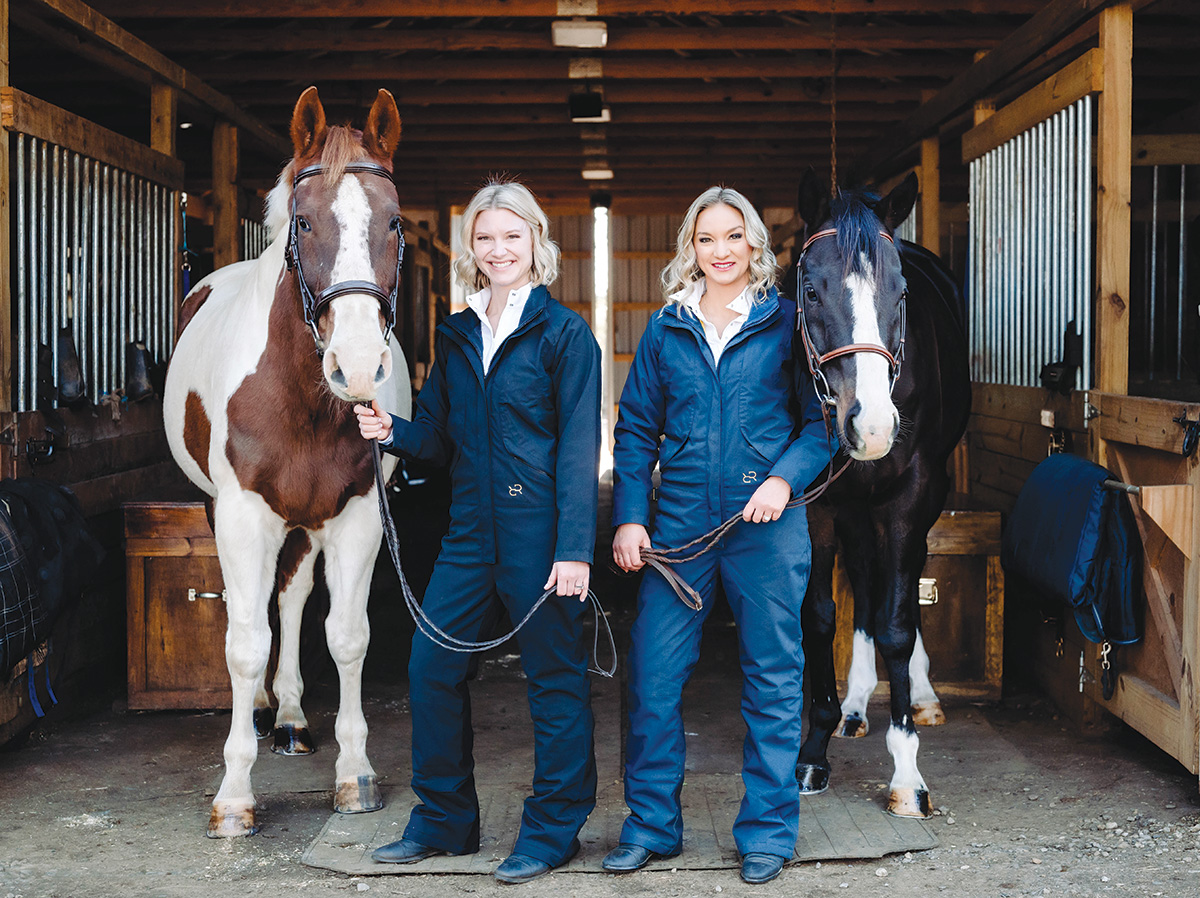
Allison Malenfant (left) and Connie De Maio (right), founders of Redingote. Photo by Tara Moore
Heather Wallace: Tell me about the first time you and Connie met.
Allison Malenfant: Our husbands work in the New York entertainment industry and often collaborate. We met occasionally, and Connie told me about her equestrian background. I always wanted to ride, but had no exposure. Connie agreed to teach me, and we became friends through weekly lessons in Brooklyn. And double dates!
HW: Were horses a childhood obsession or an adult passion?
AM: I took one lesson a week while working a corporate job in the athletic retail industry. Once I left to start Redingote, I increased my riding two days a week. It’s a slippery slope, of course. I bought my first horse in 2020 and now have two. I hunter pace and fox hunt, but also travel and compete. It has become a lifestyle.
Connie has horses in her blood. Her father was a Standardbred trainer in Monmouth County, New Jersey. She started hunter/jumper lessons and eventually had her own horses at home. She was very successful in riding and competing by age 16. She now owns and runs a small private facility in Colts Neck, N.J.
HW: What sparked the idea of Redingote?
AM: Connie owned a vintage men’s insulated coverall she found at a yard sale. She loved the functionality of a one-piece. She could wear it while teaching or working in the barn, and then take it off to ride. However, it lacked waterproofing and enough pockets. Plus, the men’s shape didn’t flatter.
People asked her about it wherever she went, loving the practicality or thinking she looked like a mechanic. There was an untapped market for a similar product that was warm, waterproof, and designed for a woman’s body. She shared her idea with me. I knew about the retail industry and the development of products, so I suggested a partnership.
HW: How did you come up with the name Redingote for your business?
AM: A redingote is a fitted outer coat with a cutaway front. It’s a French derivative of the English phrase “riding coat” from the 18th century. We came across this word while trying to name our brand, and it was a perfect fit, since we were reinventing the riding coat for the 21st century rider!
HW: What was the first step in launching your brand?
AM: Nailing a product we believed in was the first step. There was no brand if the idea didn’t work!
We started working on the idea in early 2017, sourcing an outerwear manufacturer that would work with a niche startup brand and develop prototypes for a year. There were many changes with the focus on flattering style but offering warmth and movement. We tested several levels of insulation to find the happy place between staying warm without bulk.
HW: What is the biggest challenge you’ve had to overcome?
AM: The horse industry is traditional, and people are skeptical about new products. A technical performance coverall for women was a completely new idea.
We are a small, self-funded business. Marketing was and is very grassroots. We wear our jumpsuits, driving to barns and horse shows to pass out flyers. It was fun to see the idea catching on. We’d sell one to somebody in one barn, and then their barn mates would order.
Marketing a business our size in a niche market is still a challenge, but our brand recognition has grown wonderfully!
HW: How do you work as successful partners?
AM: Business partnerships are like marriages, and each person has different strengths. I think this has been the foundation of our partnership. We’re very different. I am hyper-organized with a retail background. Connie is a dreamer with an equestrian background. I am better at project management. Connie has a sales and marketing brain.
We agree with a lot of things, but we navigate any disagreements. I think we’ve learned a lot about each other over the years—just like a marriage!
HW: Have the challenges changed over the years?
AM: They just get bigger! I say that with a sense of humor, but it’s true. The bigger the business, the bigger the challenges. The challenges stay the same (i.e. marketing, staying competitive in a growing industry, funding, supply chain, et cetera) but the scale grows.
HW: How has your business evolved?
AM: It’s amazing to look back on the way Redingote has grown. Our winter insulated jumpsuit is still our No. 1 product, and new customers are discovering it all the time. We are always innovating. Redingote has launched winter outerwear separates, a schooling collection, rainwear, and our signature one-piece for men and kids. We have a new scrim jacket coming out this spring so we can stay protected in the summer while still enjoying short sleeves.
We’ve even added another brand to our portfolio, acquiring FITS Riding, a beloved breeches company, in November 2022.
HW: Where do you see Redingote going?
AM: We have a big vision! Our highest concentration of customers is the Northeast U.S. English market, where we live. Ultimately, we have some exciting projects and collaborations in development. We plan to expand across all equestrian disciplines, markets, locations, and into other sports—we have many clients who use our outerwear for skiing, sailing, fishing, hiking, camping and more.
Emotions play a crucial role in social species, helping regulate interactions. In animals, emotions can be assessed based on physiological, behavioral, and cognitive changes. In a study published in BMC Biology, scientists from the University of Copenhagen and ETH Zurich set out to find how animals react emotionally to positive and negative sounds made by both humans and members of their own species. Their discoveries, particularly in regards to how we speak to animals, were quite interesting.Photo by Laurie/Adobe Stock
How the Study Worked
Using hidden speakers, the researchers played recordings of animal sounds and human voices talking gibberish to four species: domestic horses (Equus caballus), Przewalski’s horses (Equus przewalskii), domestic pigs (Sus scrofa domestica), and wild boars (Sus scrofa).
The study tested 12 pairs of domestic horses from 14 different breeds and 12 pairs of domestic pigs of the same breed in Switzerland, along with 12 groups of Przewalski’s horses and 10 groups of wild boars in various wildlife parks throughout France and Switzerland.
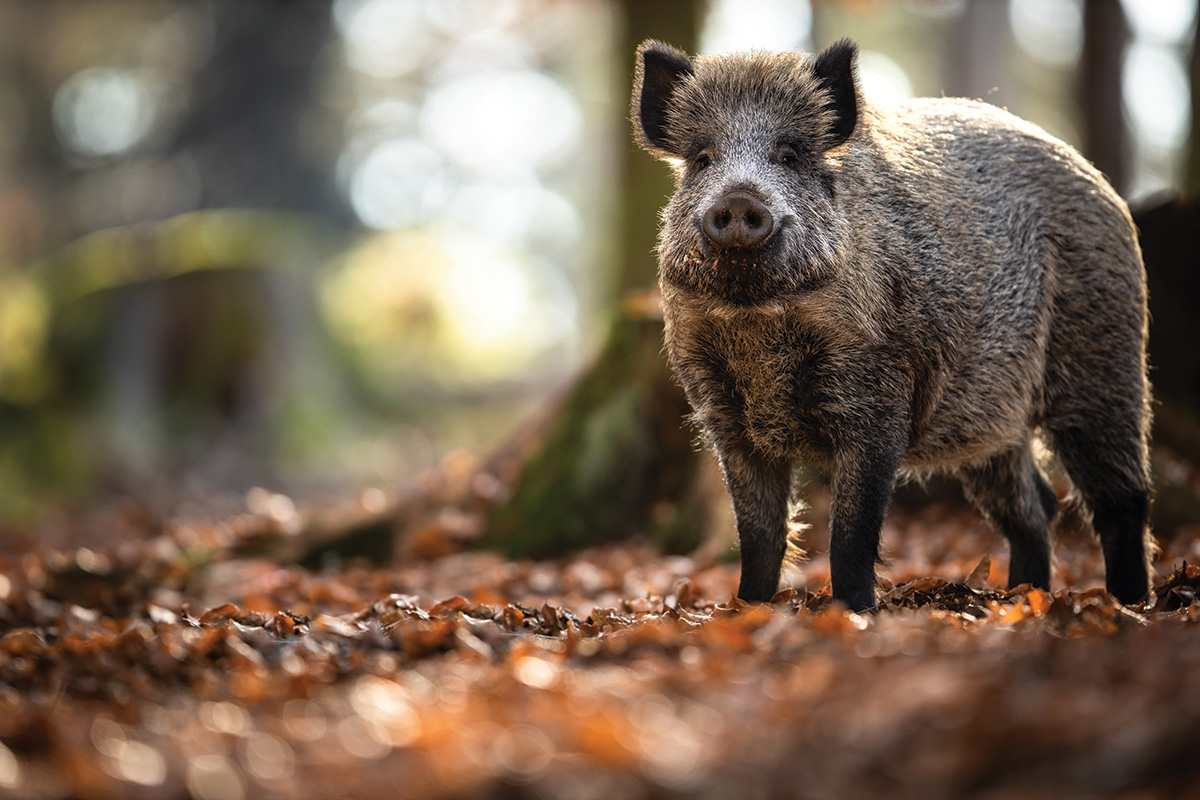
Ten groups of wild boars in wilderness areas were studied to compare with domesticated pigs. Photo by lightpoet/Adobe Stock
To prevent domesticated animals from reacting to specific words they had previously learned, the researchers hired professional voice actors to mimic positive and negative emotions by talking in a nonsensical way.
They would first play positively charged sounds (two to six sounds, depending on the species and the sound duration), pause for 1 minute, and then play negatively charged ones, or vice versa (in a random order).
Two important measurements of the animals’ reactions were valence (ranging from negative to positive) and arousal (ranging from calm to excited levels).
All sounds were played at the same intensity, ensuring that the differences were only in terms of species, valence, and the order of valence (positive or negative sounds played first).
To determine whether the animals had the ability to distinguish between positive and negative sounds, researchers recorded their behavioral reactions, including ear position and body movement.
How We Speak to Horses
Their results showed that both horse species had a stronger reaction to negative sounds than to positive ones; domestic horses would respond faster, and Przewalski’s horses would spend more time walking and less time standing. Such reactions were the same, regardless of the playbacks produced by their species, closely related species, or humans.
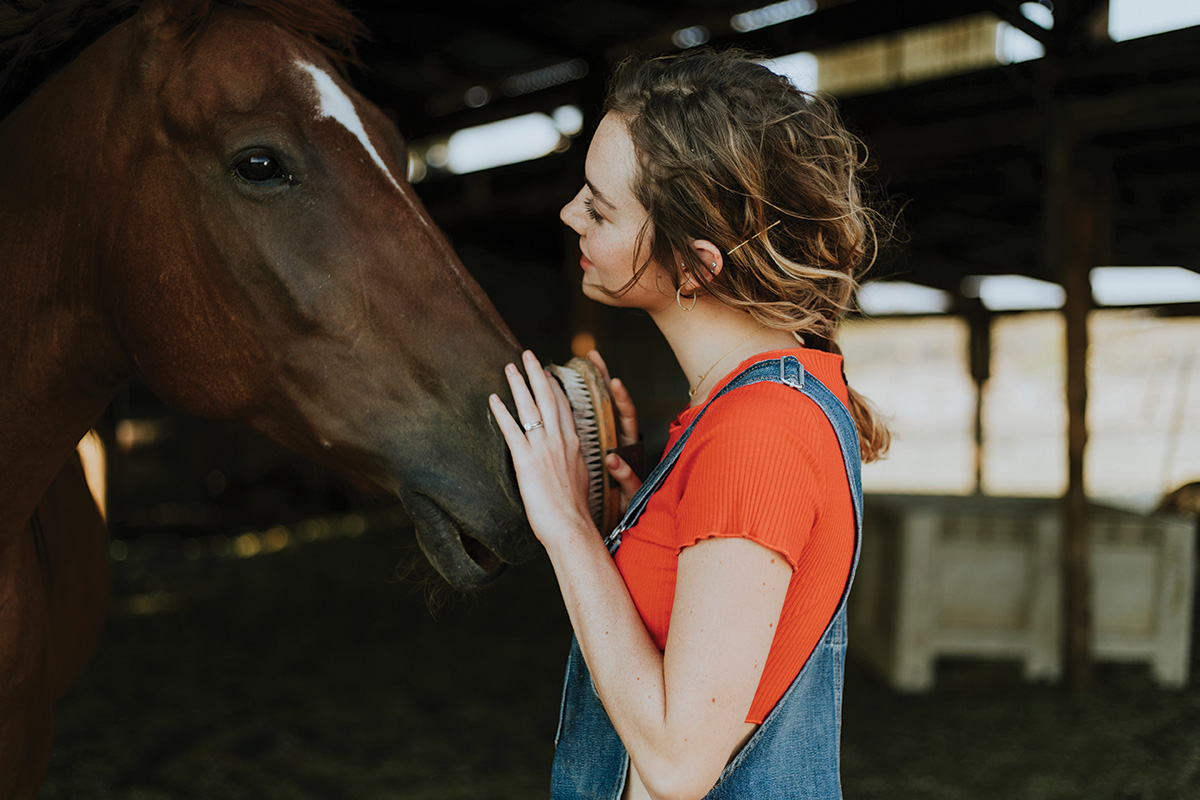
Approaching horses in a positive and friendly way makes them less reactive and more calm and relaxed. Photo by Rawpixel.com/Adobe Stock
Speaking to Pigs
Pigs, just like domestic and Przewalski’s horses, could tell the difference between positive and negative sounds from their own kind, closely related species, and humans. However, wild boars reacted more to positive and negative pig calls than to human voices or calls from other wild boars.
Domestic pigs were able to tell the difference between positive and negative sounds from their own kind, wild boars, and humans. Photo by dusanpetkovic1/Adobe Stock
Although all four species reacted less and were less attentive when human voices were played compared to calls of their species, they still showed some response. This might suggest that horses have some ability to distinguish whether you are talking positively or negatively to them.
The findings here also indicate that the evolutionary history and domestication of animals may have influenced their ability to understand and respond to emotions.
A Similar Study
This study ties well with another one from 2019, which showed that horses associate individual human voices with previous experiences they’ve had with them.
For example, when hearing voices they had positive previous experiences with, horses would react with increased attention and indicate a positive emotional state (hold their ears forward; their left brain hemisphere would get activated).
When they heard voices associated with previous negative experiences, horses would react negatively (hold their ears backward; their right hemisphere would get activated).
Such reactions are the result of the way horse brains work. Using the left eye and left ear activates the right brain hemisphere, which is responsible for processing sounds expressing negative emotions (like sadness or fear). Similarly, horses will use their right eye and activate the left hemisphere to process vocalizations expressing positive emotions (for example, happiness).
This research not only showed that horses can recognize different human voices, but can also remember the valence of past experiences with these voices. So, when they hear a human voice, their reaction is also influenced by the valence (positive or negative) of their prior interactions with that person.
The Takeaways
Both of these studies show that positive interactions with horses create positive expectations and a favorable attitude in animals. In contrast, negative experiences result in negative emotional states, and horses become less willing to interact.
If you approach and speak to animals in a more positive, friendly way, they should react less and become calmer and more relaxed around you.
This, of course, should be everyday practice, but these studies still provide an intriguing insight into the emotional intelligence of horses and gives interesting perspectives on communication between humans and animals that affects their welfare.
Without therapy horses, there would be no equine-assisted activities for helping humans. They’ve been referred to as “angels with four legs and a tail” and priced at “worth their weight in gold.” But where do these equine miracle workers come from, and what makes a great one? Horse Illustrated shines a light on these special animals by visiting with program directors at two PATH International Premier Accredited Equestrian Centers.
Finding Connection with Therapy Horses
Horses possess a remarkable ability to connect with humans: to comfort, teach and heal. A wide variety of people are helped through equine-assisted activities at centers across North America. Special needs children and adults, veterans recovering from physical and emotional trauma, and abused women and children are just a few examples of those who benefit from spending time with these exceptional equines.
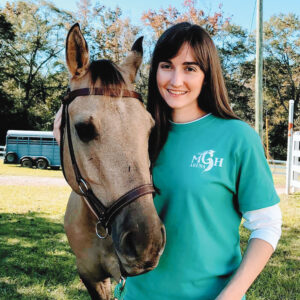
Kate Storjohann is lead instructor at the Marianna Greene Henry Special Equestrian Program (MGHSE) in Talladega, Ala., where she works with deaf, blind and multi-disabled students. She has witnessed many examples of the healing power of horses, but one story stands out. She was teaching a blind, autistic student who in the three years she had been going to MGHSE, had not spoken to anyone there.
“I was working with her one-on-one about how to groom horses when something wonderful happened,” shares Storjohann. “As we brushed, I started to guide her hand over different parts of the horse and tell her what she was feeling. After a few minutes, she started reaching out on her own. I could tell she was beginning to take an interest, so I repeated the parts of the horse. Then she said, ‘Mane?’ I had never heard her speak before. Since that day, I can ask her to find the ear, eye, nose, mane, tail, and many other parts, and she can show me where they are.”
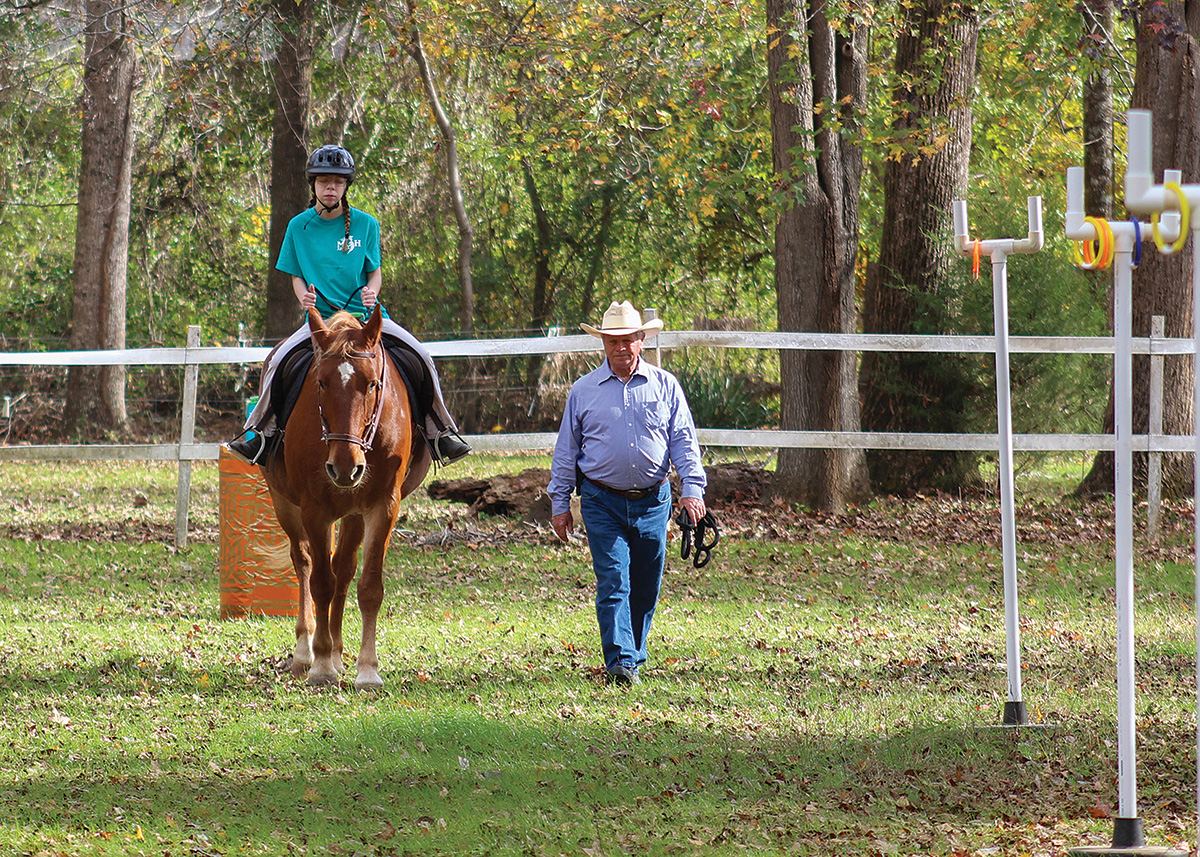
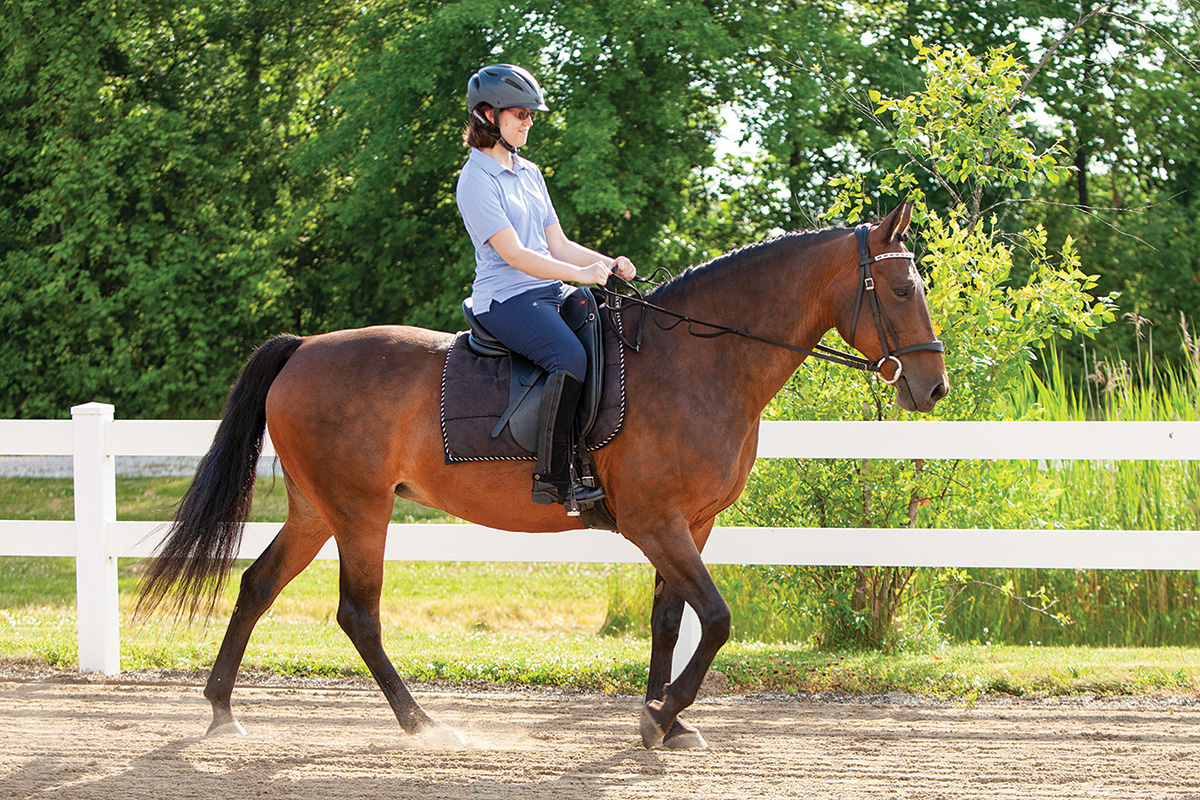
MGHSE student Erin Paulson aboard Reba with volunteer David Vought walking alongside. Reba is an 18-year-old Tennessee Walking Horse/Belgian Draft mare. According to their website, “She is the favorite of many of our students and volunteers due to her impressive size and calm demeanor.” Photo by J.D. Haun
That student has progressed to using voice commands to her therapy horse when riding as volunteers lead and walk alongside. Storjohann says that students at MGHSE learn much more than horsemanship: they gain confidence and independence, learn teamwork, refine balance and motor skills, develop character, and discover that all things are possible.
Smiling Again
At Therapeutic Riding Incorporated (TRI) in Ann Arbor, Mich., Program Director Jennifer Beyer has seen her share of miracles worked by their horses. The TRI program offers mounted adaptive horsemanship classes, work-from-the-ground wellness sessions, and para-dressage lessons, to name just a few of their activities.
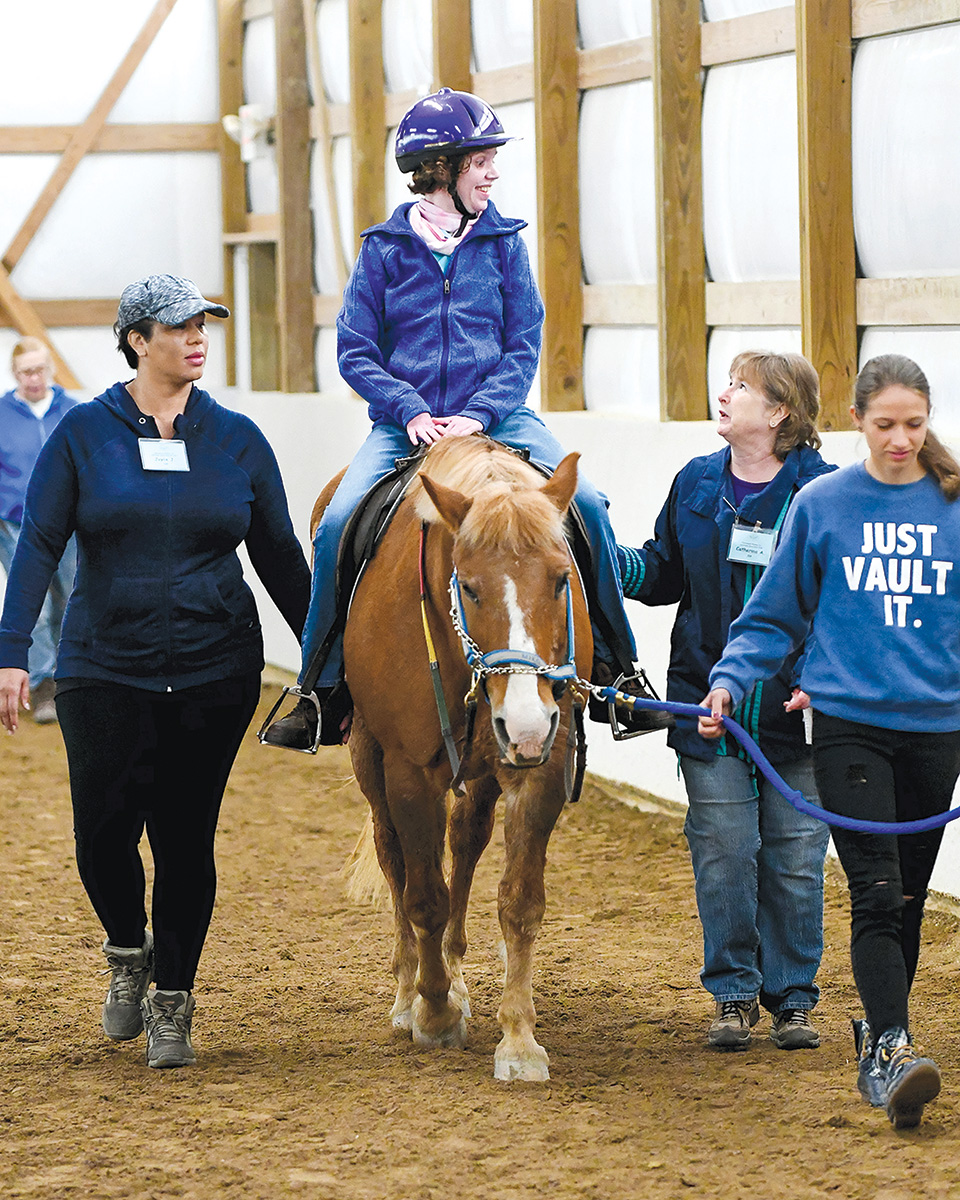
At Therapeutic Riding Incorporated, a program horse is used in equine-assisted therapy with sidewalkers. Photo courtesy Therapeutic Riding Inc.
Beyer recalls many examples, but the story of one young man and his bond with TRI’s Quarter Horse gelding, B Smiley, illustrates the restorative abilities of an equine companion.
Liam had been a student at TRI for several years when ongoing neurological issues caused him to be hospitalized for weeks at a time, diminishing his strength and balance.
“With every hospital stay, Liam looked forward to time at TRI,” recalls Beyer. “Coming to the barn to see ‘his’ horse, B Smiley, became his motivation to get better and stick with physical therapy. Smiley has impeccable ground manners and loves attention. When the doctors gave him the ‘all clear,’ Liam wasn’t strong enough to ride, but he came to every lesson to groom and walk Smiley. Fast forward a year, and Liam is now strong enough to ride and has made great strides with improved balance. He and Smiley are still a team, both in and out of the saddle.”
Meet the Experts
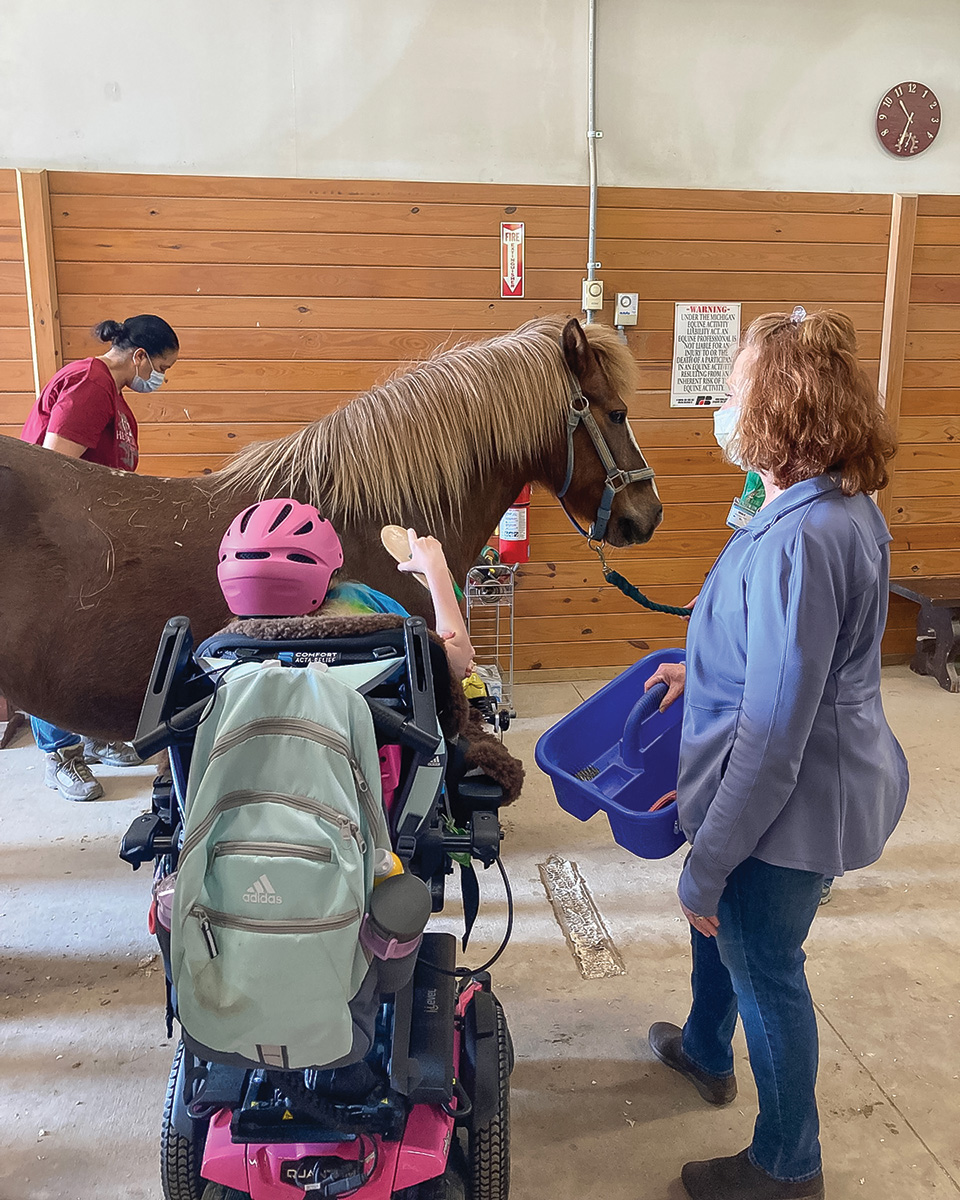
Sweet Pea, a 27-year-old Icelandic mare, stands for grooming and interaction from the ground. “She loves people and has worked with numerous children at summer camps and as a family mount,” says TRI’s website. Photo courtesy Therapeutic Riding Inc.
Jennifer Beyer is the Program Director for Therapeutic Riding Incorporated (TRI) in Ann Arbor, Mich., where she has been on staff since 2010. She is a PATH Intl. Certified Therapeutic Riding Instructor (CTRI); a bronze-level United States Equestrian Federation Para -Dressage Coach, and a Level 3 Certified Horsemanship Association Instructor of Riders with Disabilities (CHA-IRD).
Kate Storjohann, MGHSE lead program instructor, and her 9-year-old Quarter Horse gelding, Danny. She has had Danny since he was 9 months old, and he is used for lessons at MGHSE. Photo courtesy MGHSE
Kate Storjohann has been the Lead Program Instructor at the Marianna Greene Henry Special Equestrian Program in Talladega, Ala., since 2015. She first volunteered there as a high school senior, then was hired as an assistant instructor. She is a PATH Intl. CTRI, a PATH Intl. Equine Specialist in Mental Health and Learning, and a CHA-IRD.
What It Takes to Be a Therapy Horse
Beyer and Storjohann explain that their program horses come from various walks of life, but most often they hail from show, lesson barn and trail riding backgrounds. Both emphasize that to be considered, a horse needs to be sound and in current work because the job is both mentally and physically challenging. These equines work with a variety of students on any given day, and their gaits need to be even, their minds calm and willing, and their bodies able to hold up to the work.
Sweet Pea, a 27-year-old Icelandic mare, stands for grooming and interaction from the ground. “She loves people and has worked with numerous children at summer camps and as a family mount,” says TRI’s website. Photo courtesy Therapeutic Riding Inc.
Beyer says that there is a misconception that adaptive riding horses simply give glorified pony rides.
“This is not a cushy retirement opportunity, but a rewarding assignment for sturdy, patient and well-loved horses,” she says. “Above all else, we seek horses that have friendly, people-pleasing personalities.”
A great therapy horse is sound at the walk, trot and canter, and the quality of the horse’s movement is what benefits the participants the most, according to Storjohann.
“We utilize a wide range of input [from the] movement from our horses,” she says. “With some of our students, it is preferred that the horse have a low amount of movement as they learn to ride and acquire a proper seat. In other cases, more exaggerated movement is needed to stimulate a rider and meet their sensory needs.”
Other qualities that Beyer and Storjohann look for in ideal horses for their therapy programs:
◆ Trained, adult horses (ages 5-18 for TRI and 8-20 for MGHSE)
◆ Height range between 14-16 hands, with some exceptions
◆ Rhythmic gaits; able to smoothly transition from one gait to another
◆ Comfortable being handled and ridden by a wide variety of people
◆ Good ground manners; leads, ties and stands well
◆ Stands quietly for mounting and dismounting
◆ Respects human leader’s personal space, and tolerant of multiple sidewalkers
◆ Accepting of beginner riders; tolerant and even-tempered so a student riding may be safely led around an arena
◆ Obedient to both voice and leg aids
◆ Accepting of assistive devices and equipment (wheelchairs, walkers, et cetera)
◆ Able to calmly deal with new sights, sudden sounds, and unexpected/uneven movement by the rider
◆ Must display “therapy heart” and show enjoyment in their work.
Other selection criteria may vary from program to program. For example, TRI uses some gaited horses with good results, whereas MGHSE does not accept gaited horses.
They both advise that horses with dangerous habits (i.e. bucking, kicking, biting, rearing, bolting, spooking) or horses that stumble regularly are not well-suited to this job.
Para dressage rider and TRI Social Media and Content Creator Megan Braun riding Serena, a 15-year-old Morgan mare. “Serena will take care of the most fragile of our riders and is also a proven Para Dressage horse,” according to TRI’s website. Photo courtesy Therapeutic Riding Inc.
It’s important to note that the qualities that make a great therapeutic riding horse may differ from a winning para-equestrian competition horse. To win nationally and internationally in para-dressage, for example, may require bigger, flashier gaits and more contact.
Donation & Training
Both MGHSE and TRI accept donated horses, and also purchase a few horses, but ask for a trial period in each case. Visit their websites for more information.
“Donating a horse to a therapeutic or adaptive riding program will change the lives of people with disabilities,” says Beyer.
Program horses go through training and desensitization exercises once they arrive, as well as refresher courses as needed. They are regularly conditioned and also get “vacation time” to decompress.
English actress Pam Brown said, “Horses lend us the wings we lack.” Talking about her students, Storjohann puts this in perspective.
“They are no longer restricted by their disabilities,” she says. “There is a freedom that can only be experienced on the back of a horse. Our students understand it best.”
Learn More
◆ The Professional Association of Therapeutic Horsemanship International (PATH Intl.), formerly known as North American Riding for the Handicapped Association (NARHA), is an organization for individuals in the field of equine-assisted activities. They offer personnel training and certification and facility accreditation. Learn more at PATHintl.org.
◆ The American Hippotherapy Association, Inc. (AHA, Inc.) offers education for licensed therapists, an informational video, and resources for families looking for hippotherapy. Learn more at AmericanHippotherapyAssociation.org.
◆ The Marianna Greene Henry Special Equestrian Program (MGHSE) is a PATH Intl. Premier Center. Their Talladega, Ala., facility provides equine-assisted therapy and learning programs for the Alabama Institute for the Deaf and Blind (AIDB). They serve between 300-400 deaf, blind, and multi-disabled children per year. Learn more at AIDB.org/mgh.
◆ The Certified Horsemanship Association (CHA) certifies equine professionals, accredits equine facilities, and provides resources to equine professionals. They offer an Instructor of Riders with Disabilities Certification (IRD). Learn more at CHA.horse/cha-certifications.
◆ The United States Para-Equestrian Association (USPEA) runs para-equestrian sports in the USA and provides information for riders who wish to make the jump from therapeutic riding to competition. Learn more at USPEA.org.
◆ Therapeutic Riding Incorporated (TRI) is a PATH Intl. Premier Accredited Center and a United States Equestrian Federation Para-Dressage Center of Excellence. They offer an adaptive horsemanship curriculum using mounted and unmounted activities with the potential for therapeutic benefits and serve around 250 people per year in the Ann Arbor/Detroit, Mich., area. Learn more at TherapeuticRidingInc.org.
Through the Vet Direct Safety Net Program, a Kentucky horse lover helped her veterinarian get funds to help during her financial hardship, and made sure they were available to others who might need them.
Good horse owners try to do the best they can for their horses—often to a fault. But what happens when a good owner finds themselves in a potentially perilous financial situation when their horse has an emergency?
In the past, some of these horses would have been relinquished to adoption or rescue organizations or even sent through auctions out of sheer desperation as the owner tried to give the horse a shot at getting the care they could not afford.
The Vet Direct Safety Net Program was created with one goal in mind: To help keep owned horses in homes. The program does this by providing owners with a stipend of up to $600 to assist with a horse’s emergent welfare need. The funds are available on a per-horse—not per-owner—basis, allowing owners to receive even more assistance should they find themselves with multiple horses in need.
Timing is Everything
Lizz Ficara of Louisville, Ky., has always taken impeccable care of her horses. In 2023, Ficara had major back surgery that prevented her from working as an equine dental tech. Like most horses, Ficara’s Quarter Horse gelding, Tony, had incredible timing (sarcasm intended) and needed emergent medical care while she was out of work and funds were short. But for Ficara, foregoing his care wasn’t an option.
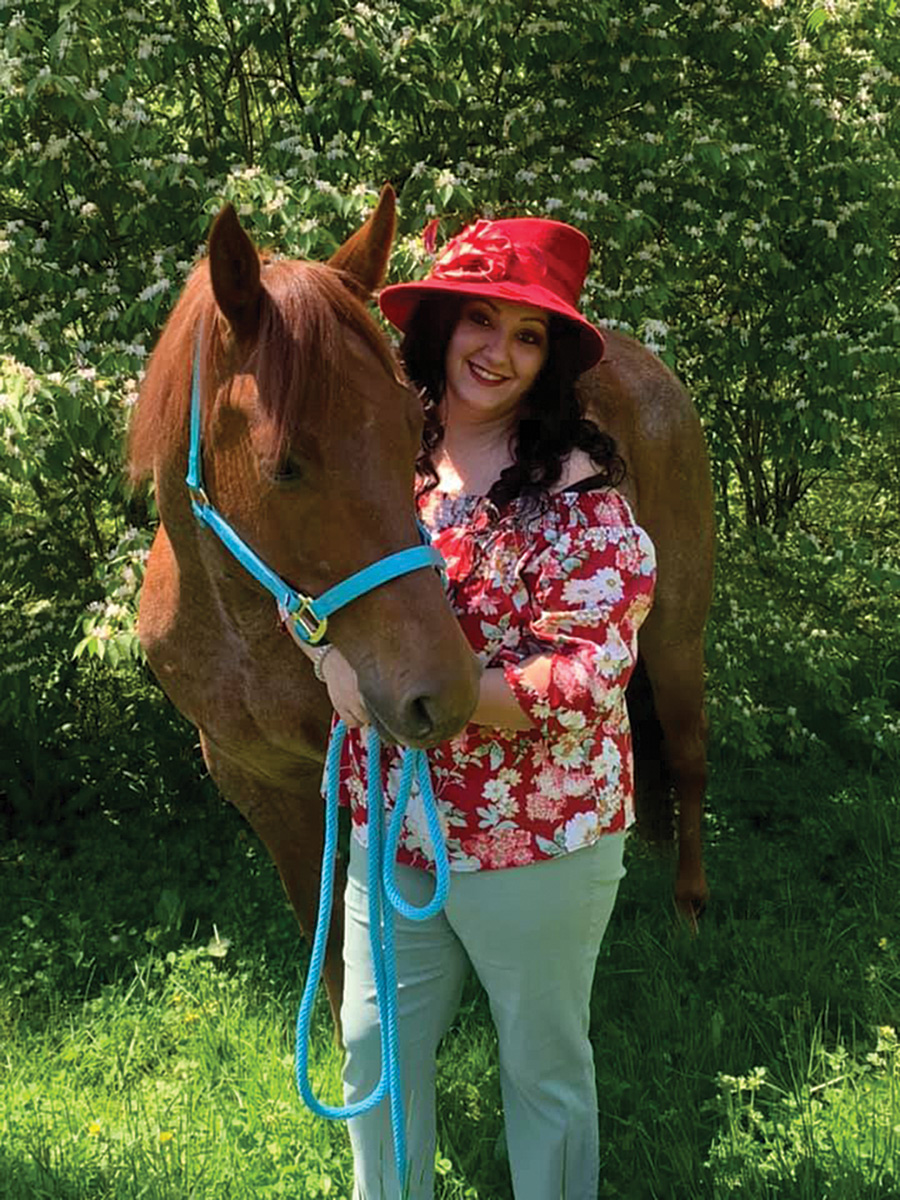
Lizz Ficara and Tony.
She began searching for programs or grants she could apply for to help offset the medical bills her horse was about to incur. During one conversation, the Vet Direct Safety Net program was mentioned, and she began coordinating efforts between the program and her veterinarian so funding would be available to her horse—and to other horses in similar situations.
Medical Attention Needed
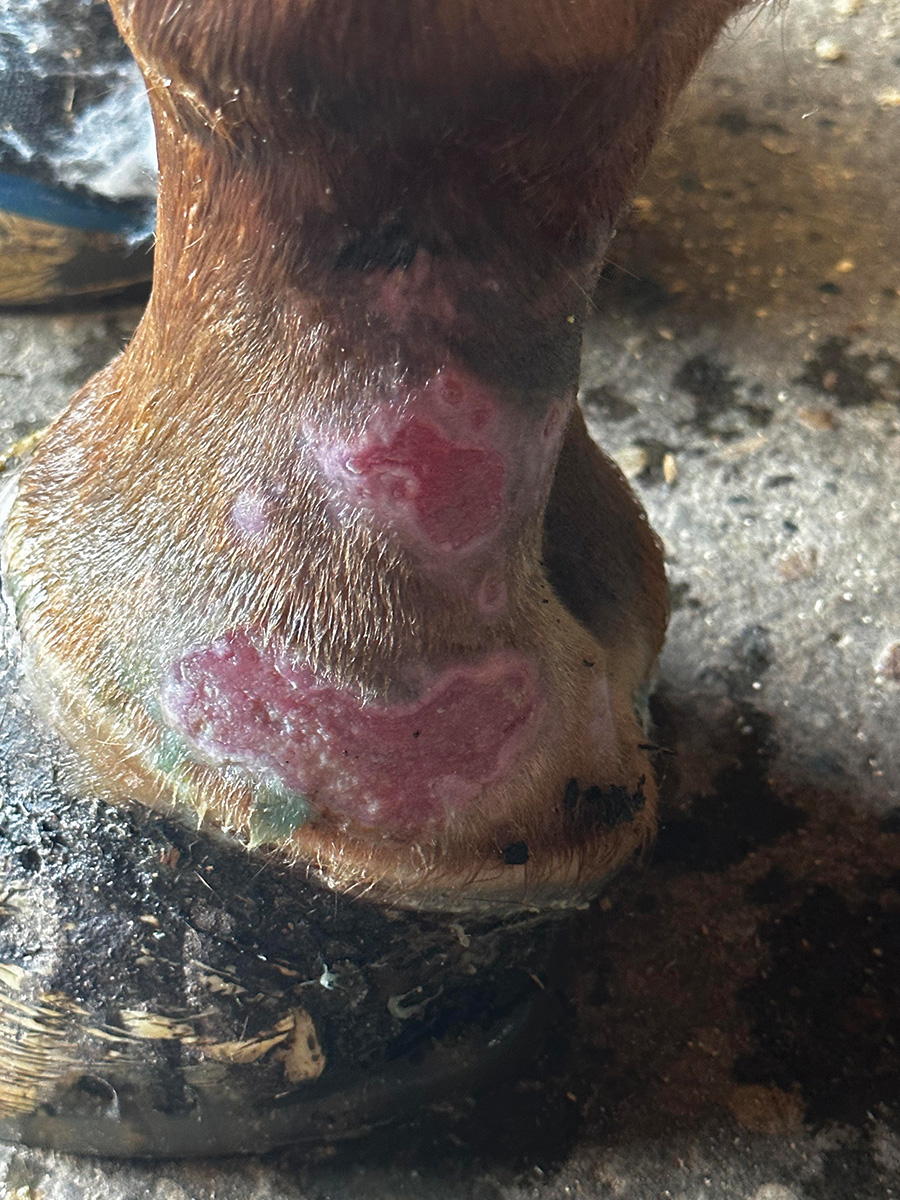
While Ficara was out of work, Tony had developed open, oozing sores on three of his four pasterns. He had significant granulation tissue that was incredibly painful and itchy. After trying to resolve it herself with myriad salves and creams, Ficara called her vet, as Tony was clearly uncomfortable and the wounds were not healing.
Sarah Grigoleit, DVM, of Kentucky Equine Hospital in Simpsonville, Ky., diagnosed Tony with significant suspected summer sores on three of his four legs. A parasitic disease linked to the life cycles of stomach worms, summer sores are caused by larvae deposited in areas where they cannot complete their life cycle (often around the nose, lips or genitals), causing inflammation and ulceration where they are laid—in Tony’s case, on his legs.
Unfortunately, summer sores are notoriously stubborn to heal. Treatment often requires a veterinarian to debride the wound multiple times, as well as administer ivermectin, corticosteroids and topical products. In addition, Tony had to have his legs wrapped to keep them as clean as possible.
Getting the Funding
In total, Tony received three months of at-home treatment for his legs, including bi-weekly granulation debridement treatment that was essential to his healing and well-being. All the vet visits added up in a hurry, and Ficara was thankful for the financial breathing room Vet Direct funding offered her.
“The program funding was not hard to access,” says Ficara. “The only caveat was that my vet—or someone with her clinic—had to be a current AAEP member. As long as one vet is a member, the whole clinic has access to Vet Direct funds for their clients.”
Tony’s sores well on their way to healing.
Though veterinarians are often enrolled in the program first and then offer it to their clients in need, in this case, Ficara reached out to the Vet Direct team directly and encouraged her vet clinic to become enrolled.
Her persistence and insistence that the program could assist not only horse owners but the clinic itself by helping to offset open invoices will no doubt have positive ramifications for years to come.
Today, Tony is summer sore-free and enjoying his life, and Ficara is looking forward to the day when she’s comfortable enough to ride again.
Today, Tony is healed up and feeling great.
“I am deeply thankful for the Vet Direct Safety Net Program,” she says. “The funding applied toward my invoices was incredible and allowed me a bit of peace of mind during an already stressful time. We all love our horses and want to do the best for them. The Vet Direct program allowed me to continue to offer Tony the type of care he was used to receiving even though I was in a tough spot financially.”
We use cookies to help personalize content, tailor and measure ads, and provide a safer experience. By navigating the site, you agree to the use of cookies to collect information. Read our Cookie Policy.