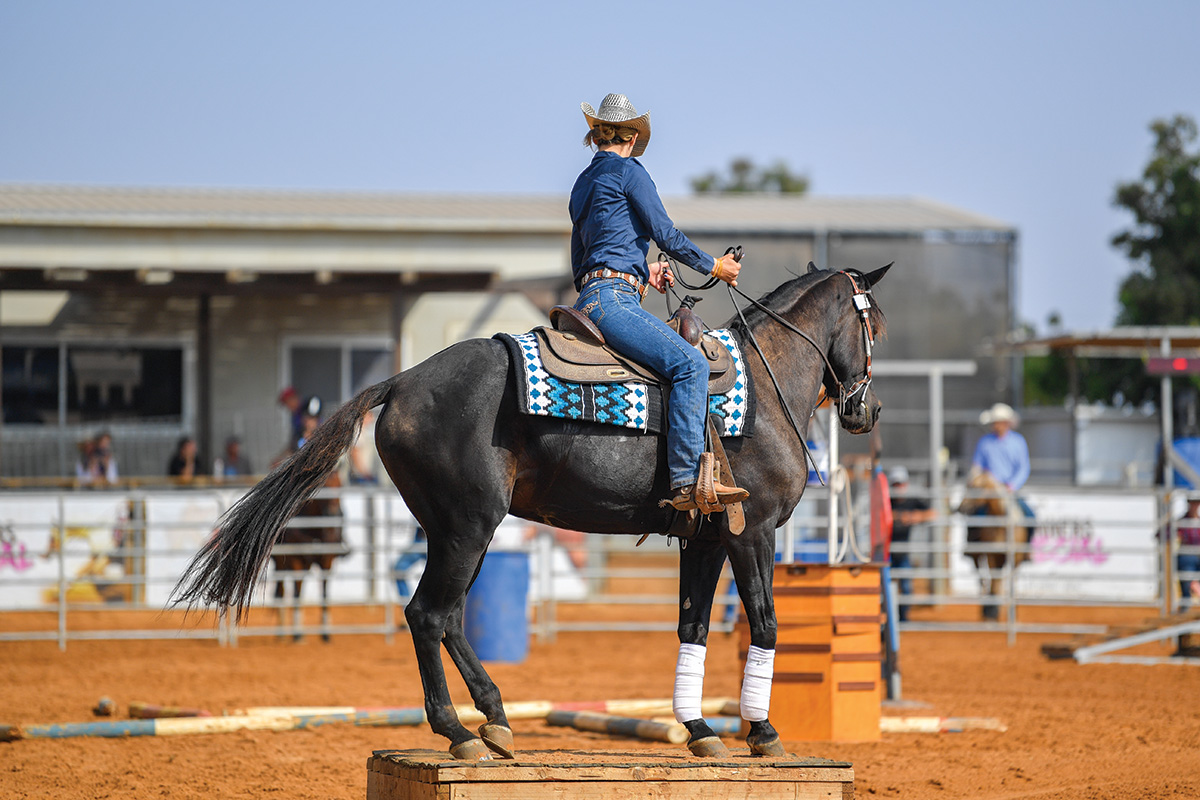
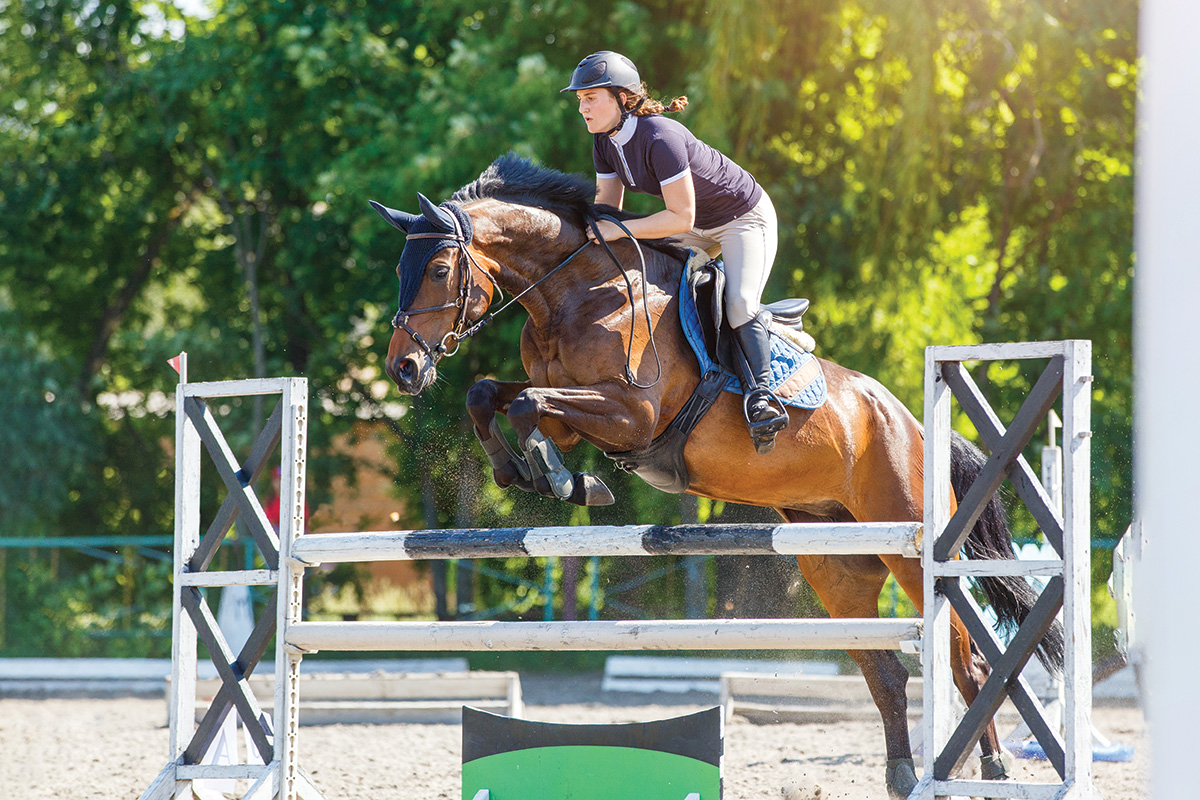
Working over ground poles has more uses in training horses than just being the predecessor to jumping. They can mix up your dressage horse’s routine, strengthen your trail horse’s hocks, and work as an easy check-in to see how rideable your horse is.
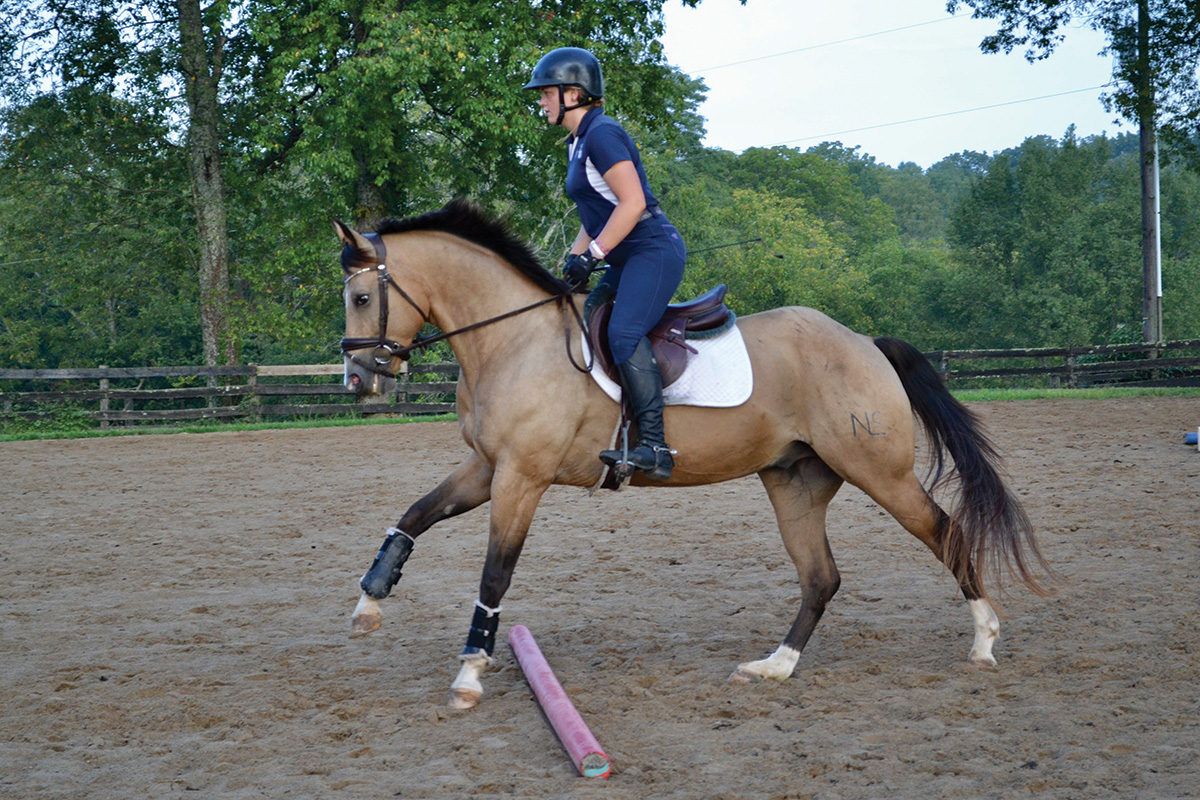
“Not only do they help your horse become stronger, but they get the horse to a place where he’s super rideable,” she says. “You can start off super simple, just trotting over one pole.”
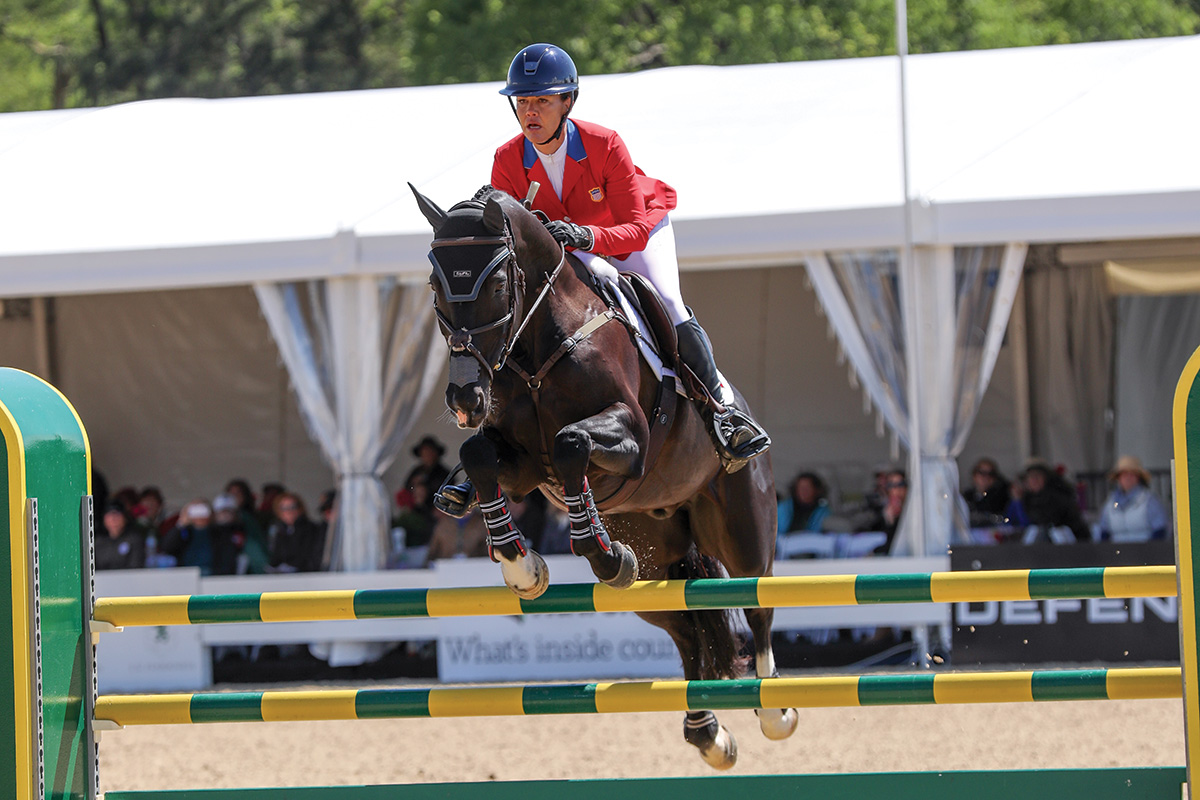
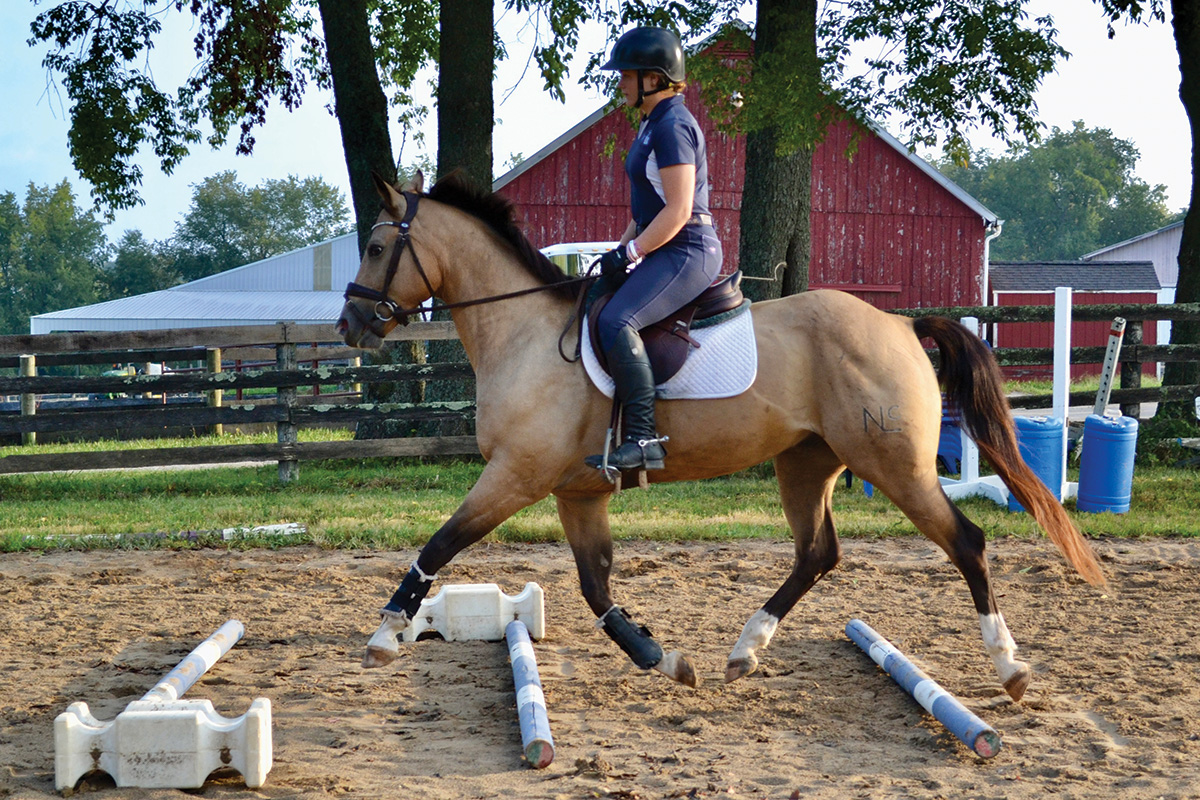
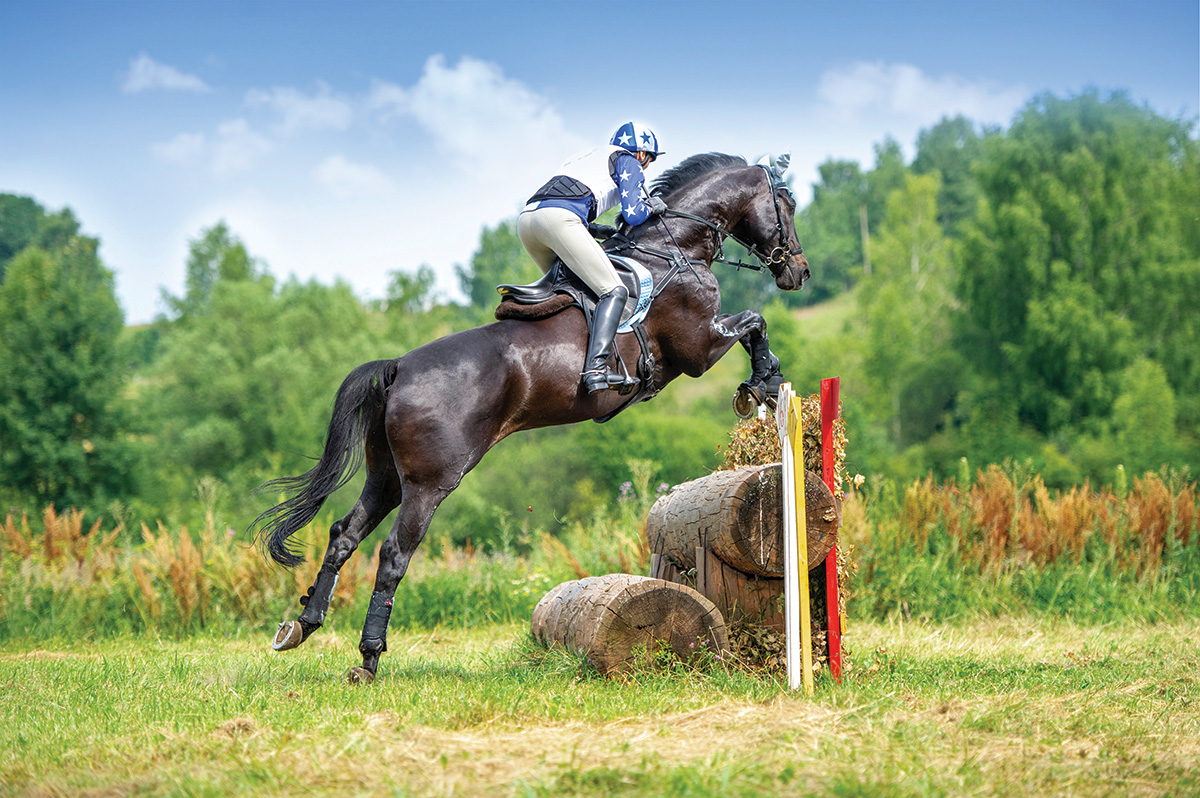
Tamie Smith, winner of the 2023 Land Rover Kentucky Three-Day Event 5*, regularly uses ground poles to check in on her horses’ adjustability and relaxation. Photo by Mary Cage
Smith emphasizes that setting up pole exercises doesn’t need to be complicated.
“In my ring, I just have random poles out,” she says. “It’s a really good exercise for the horses to learn where their feet are and for them to let go of their bodies because they have to push over their back when they trot over them.”
Relaxation & Rideability
Additionally, Smith uses poles as a check-in for riders to see if their horses are adjustable and listening. Instead of passively riding over the poles, Smith encourages her riders to think about how their horse is completing the exercises and what holes in their training the poles bring into focus.
Smith says to ask yourself the following: “Do the trot poles create more tension and make your horse stiffen? Do they create anxiety?”
The more trot pole work the horses do, the more comfortable they get and the more rideable they become.
“I always err on the side of making sure that the horse isn’t feeling overwhelmed by the trot poles,” says Smith. “If he’s struggling, I’ll take away multiple poles and only use one until he gets really confident with it.”
Fresh Footwork with Ground Poles
Catherine Donworth has spent most of her riding career focusing on fox hunting. When her long-time partner, Skippy, was ready to retire, she got a ranch horse named Doolin Banjos. She began prepping Doolin to be her next fox hunting mount, but quickly discovered that he might be destined for a dual career, so Donworth began her dressage journey.
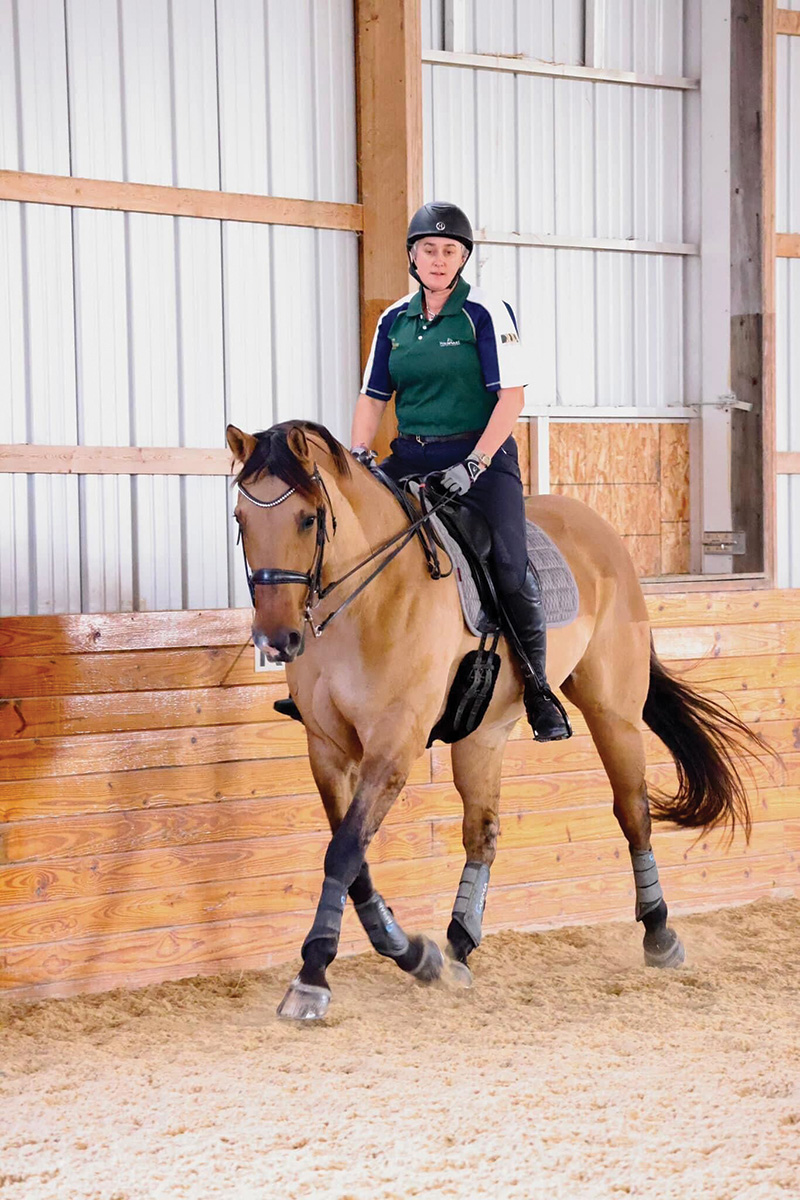
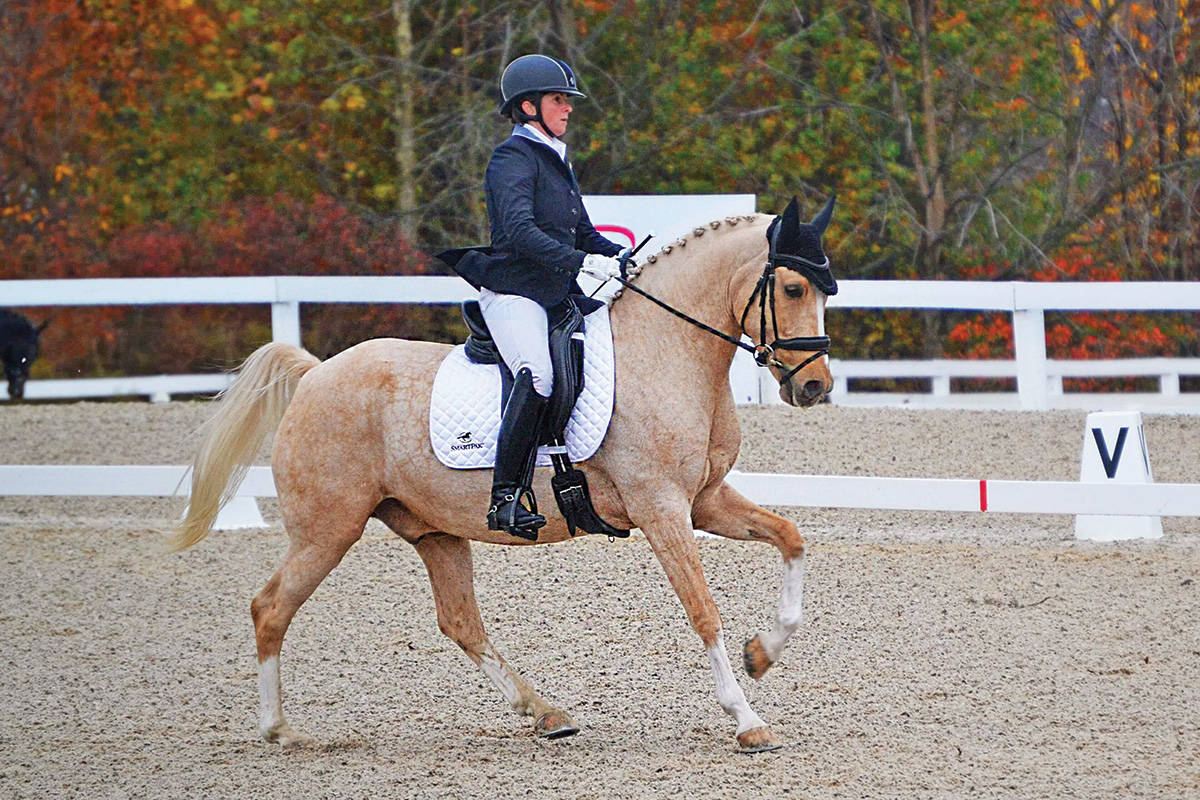
Catherine Donworth began doing more dressage after getting her former ranch horse, Doolin Banjos. Ground poles add variety to their riding, especially in the winter. Photo by Samantha Clark
She uses ground pole exercises to keep things fresh for both herself and her horse in training.
“When you have a dressage horse that doesn’t jump, or doesn’t jump very often, poles are a huge way to introduce variety into your schooling,” says Donworth.
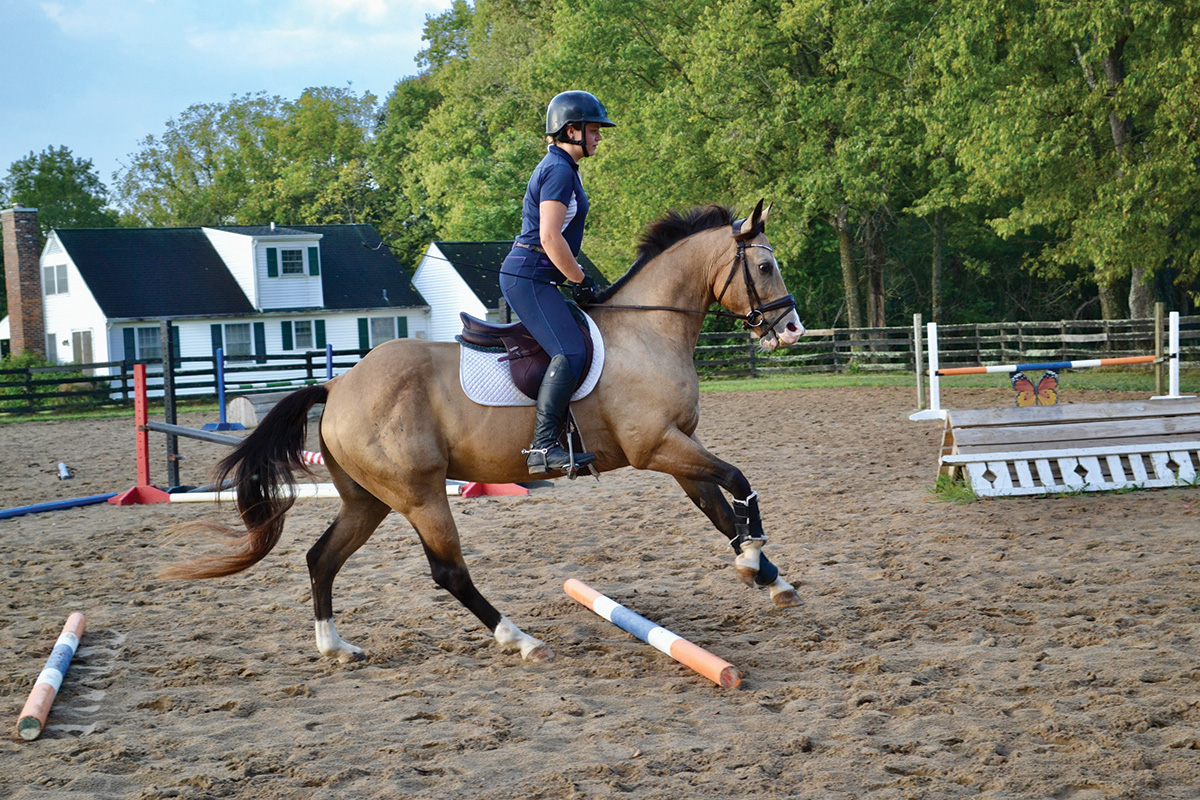
Pole work breaks up the monotony of ring work, especially when the weather doesn’t permit trail riding or other activities. Photo by Shoshana Rudski
She regularly sets up different pole exercises in the ring year-round and finds new creative ways to use the smaller space of the indoor arena in the winter to keep training going, especially in colder weather when hacking and hill work aren’t an option. When Donworth sets up an exercise, she tries to leave it up for others at the barn to benefit from.
“You can tailor the exercises to whatever level your horse needs very easily, depending on his level of collection or how quickly he can do transitions or how much he can lift his hocks,” she says. “You can easily lay out a pole exercise, and with tiny alterations, work several horses at different levels without needing to set the whole thing up differently again.”
For Doolin, Donworth has found that the main benefit has been that poles keep him thinking.
“It’s helped sharpen up his feet,” she says. “It sharpened his reflexes, and he has to think for himself about where he puts his feet.”
In addition to the mental benefits, Donworth has also seen physical perks.
“It’s good from a physiological standpoint,” she says. “It keeps their hocks and back moving in a way that plain flatwork might not. It strengthens their bodies and can increase range of motion without putting extra pressure on their joints.
“Even walking over small, raised poles gets them to lift their hocks. If a horse has hock problems or arthritis in his hocks, just even walking over poles can loosen, flex, and extend his hocks. It’s like us stretching as part of our warmup.”
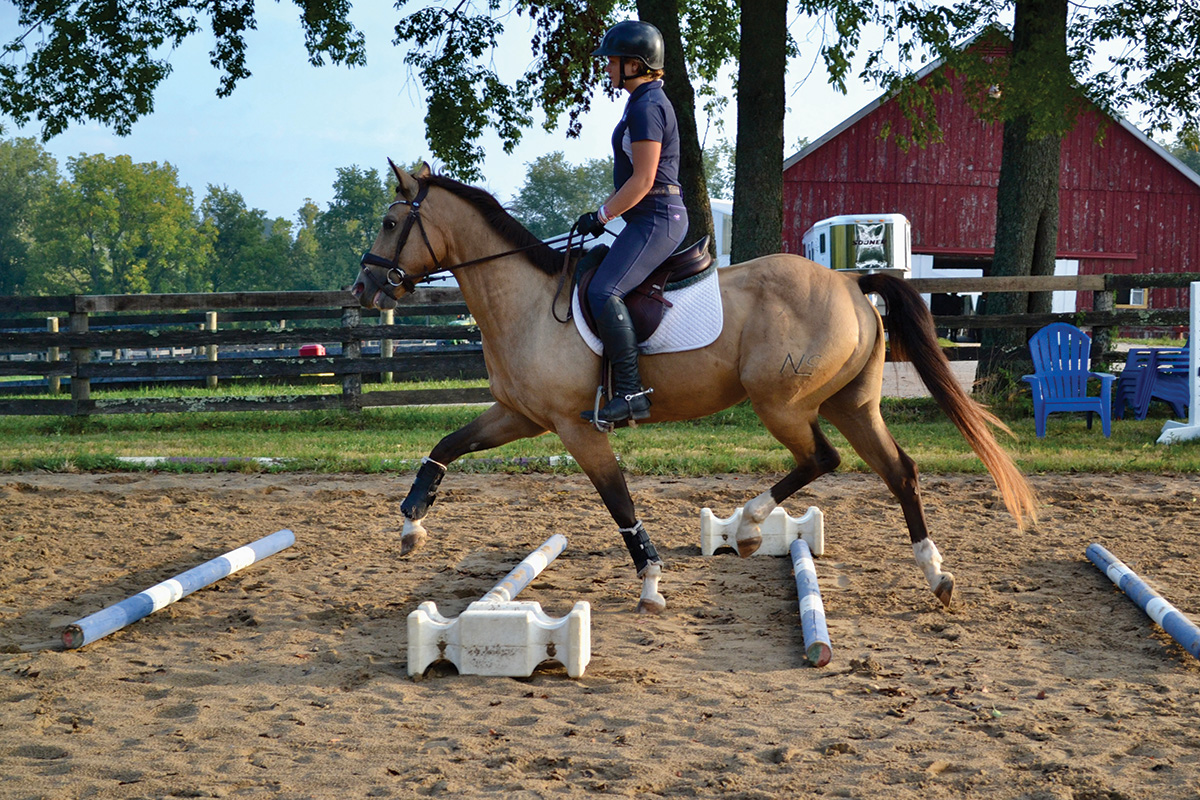
Pole work can act like physical therapy, encouraging horses to flex and extend their hocks. Photo by Shoshana Rudski
Ground Pole Set Up
How to Set Up Distances
Walking poles: Set 2.5 feet apart for most horses.
Trot poles: Set around 4 to 4.5 feet apart. Smaller-strided horses may need closer-set poles, while horses with a longer stride may need poles a little farther apart. Adjusting the distance between the poles can help your horse learn to collect or lengthen his stride. Try to avoid having only two trot poles in a row; your horse might think he is supposed to jump both in one go.
Canter poles: Set around 9 to 11 feet. Like trot poles, the length of your horse’s stride can influence your placement.
Increasing or decreasing the space between trot poles can teach your horse to collect or extend his stride. Photo by Shoshana Rudski
Simple Eight-Pole Set Up
Place four trot poles and four canter poles on either end of a circle. Begin by trotting the whole loop.
Then ask your horse to canter through the canter poles and come back to a trot before the trot poles, and then canter again before the canter poles. See how accurate you can get your transitions.
Once your horse gets comfortable, try raising some of the trot poles to add difficulty.
Benefits of a Single Pole
Whether you jump or not, finding a distance to a single pole will help you learn your horse’s canter stride length and increase his adjustability. Sometimes it feels easier to find a distance to a larger jump, so breaking it back down to a single pole makes you check in on the details.
Cantering over a single pole will help you learn about your horse’s stride length and aid in adjustability. Photo by Shoshana Rudski
For greener horses, trotting a single pole helps build confidence and get them trusting their footwork.
Key Takeaway
Integrating ground poles into your horse’s training program can increase strength and flexibility, add variety, and sharpen response time. A useful tool for riders and trainers at level, pole work is worth adding to your routine.
Being an equestrian and a horse owner is a time-consuming and expensive lifestyle. Because of this, it can be easy to lose sight of the fact that riding, horse ownership, and your time at the barn is only one section of the fulfilling life that you lead. This is why goal setting is crucial as an equestrian.
Because so much time, energy, and money is invested into these creatures we love, frustration may creep in when the reality of other life responsibilities interferes. It’s important not to internalize these restraints and allow them to make you feel discouraged. Instead, you must recognize and include them as part of your goal setting in order to make your goals more attainable from the start.
Get Started with Goal Setting by Gaining Perspective
A helpful exercise that I use for horse owners and riders is to ask them to write down all the important sections of their life. Examples might be work, family, relationship, other pets, hobbies/sports outside of riding, et cetera. Oftentimes when you see how many things are on the page, you realize that there are quite a few people, animals, and other commitments vying for your attention.
There are a lot more things than horses vying for your attention; this can help put your goals in perspective. Photo by Virgonira/Adobe Stock
This is a great way to put it all in perspective. When you’re at the barn, nailing those flying changes may feel like all that matters, but no matter how much you love riding, it’s just one piece of your much larger existence.
Most things in life end up needing to be a compromise. You may want to participate in all of the shows on the local circuit, purchase a competitive horse for the division or class you want to show in, master the sitting trot, or ride the perfect pattern, but all of those things require an investment of some kind. You must be honest with yourself about what resources you have available.
This situation also becomes difficult for the professionals guiding your equestrian journey. We never want to tell anyone they can’t do something; good trainers will build you up and encourage you every step of the way. But it’s also our job to manage expectations when a client mentions goals that we know to be outside of their scope of resources.
Setting Goals for Ownership and Showing
Goals can be set in any sector of equestrian sport. A common one is horse ownership. Other than buying a horse, there are many options available, including leasing, half-leasing, care leases, or riding school horses.
Just as horse ownership causes you to compromise by allocating resources (i.e. time and money), choosing one of the other options may take less resources, but requires compromise on how many times you ride per week, how high you jump, what movements you school, et cetera. However, all of the above options will help you continue to grow as a rider.
Other common goals center around showing. Rated horse shows can be extremely costly, plus paying your trainer and your own travel expenses.
I find the best way to get the most out of show season isn’t to only commit to one show at a time, but rather to present your trainer with a show budget for the year that is reasonable to you.
From there, the two of you can brainstorm and put together a calendar of shows that fit your schedule, finances, and goals. This way you can also plan to use those shows to build to some sort of “peak.”
Work with your trainer before the season begins to determine the best flow of competitions for your budget. Photo by Lynn Schwab/Adobe Stock
For example, if you can afford six shows for the year, your trainer may decide it would be better to do a cluster of three in the spring and three in the fall so that you get into a rhythm rather than just showing once every other month.
It’s also important to mention that not every rider enjoys showing, and that is totally fine. No one should ever make you feel “less than” for that.
Setting Smaller Goals as an Equestrian
The secret to equestrian goal setting is to use the time you have in the saddle to work on the basics that need brushing up. Rather than having a grandiose goal such as “I want to show in X class,” break down what would be needed to be successful in that class: A better sense of canter rhythm, tighter turns, cleaner lead changes—whatever it is, all of these things are achievable with basic exercises that can be done both inside and outside of a lesson.
Instead of setting a goal of showing in X class, try a more controllable sub-goal, such as spending 15 minutes of each ride improving your basics. Photo by Proma/Adobe Stock
Dedicating even 15 minutes of each ride to improving the basics you have targeted will result in reaching the next level. As your foundation builds and your basics and communication with your horse improve, more and more doors will open.
From a sports psychology standpoint, achieving lots of smaller goals on the way to the larger goal will make the journey much more rewarding!
Potential and Comparison
Another common occurrence when setting goals is feeling “I’m not using my horse to his full potential.”The horse has no idea if he was born with fantastic bloodlines, perfect conformation, or great aptitude for a certain discipline. The only thing he knows is whether he has food, water and shelter, and whether his handlers treat him kindly or roughly.
Your horse doesn’t understand the significance of Finals or the World Show, the difficulty level of the exercise at home or class at the show, the color of a ribbon, nor the concept of what could be. Equines are very lucky to live in the now, and we humans could learn a thing or two!
Your horse doesn’t know if he’s “living up to his potential,” only whether he has food and water and if his handlers treat him kindly. Photo by Amanda/Adobe Stock
Where do we as humans get these ideas of what we should be doing? Usually by looking around and comparing ourselves to friends, barn mates, and social media influencers. What they say about social media is true, though: people tend to only post the good.
This is also the case for what people tend to allow others to see in real life. Generally, only a person’s immediate family and closest friends will know about all of their fears, struggles, and hard work. The rest of the world tends to only see the very biggest failures and triumphs, and even those fade from the collective memory of society very quickly.
Social media just happens to be a place where all the happy and colorful win photos are curated and posted, whether you as a viewer have had the best day or the worst day. However, what you don’t know is what the other person gave up to be at the show, to buy the horse, or to finally be able to execute that upper-level movement.
It’s hard not to compare to the social media highlight reels of others, but you never know what someone gave up to get there. Photo by Skumer/Adobe Stock
The person posting could have sold their car, missed important family events, cried driving home from the barn for six months after tough lessons, or endured injuries and layups for their horse. Just because those parts of the journey are kept quiet doesn’t mean we don’t all go through them.
Key Takeaway
Overall, as an equestrian, it’s crucial to set goals that fit into the big picture of your life. Riding is supposed to be fun, and our relationship with horses should bring joy. If the time we have at the barn is spent stressing or rushing, then something needs to be adjusted. Throughout all of it, take comfort from your horsey friends and your trainer to help guide you through this balancing act that is the equestrian experience.
Keep in perspective that riding should be fun and horses are in your life to bring you joy. Photo by Dotana/Adobe Stock
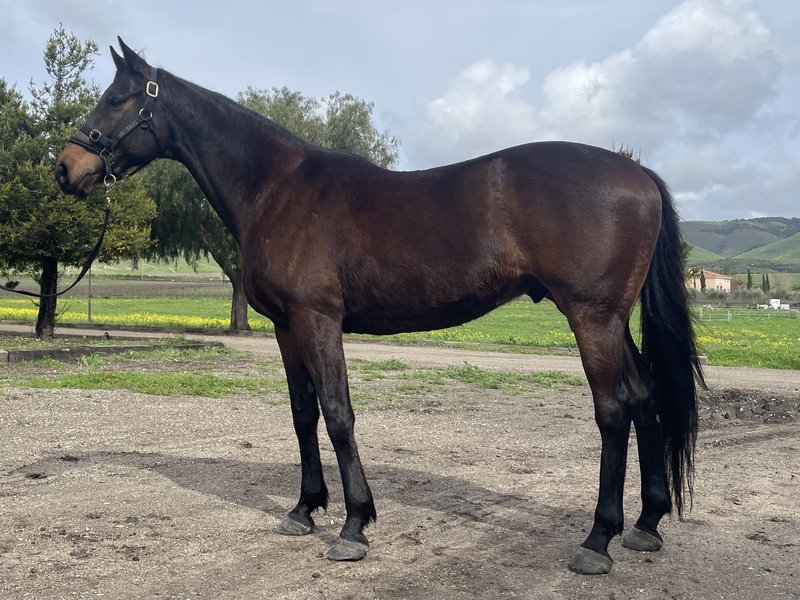
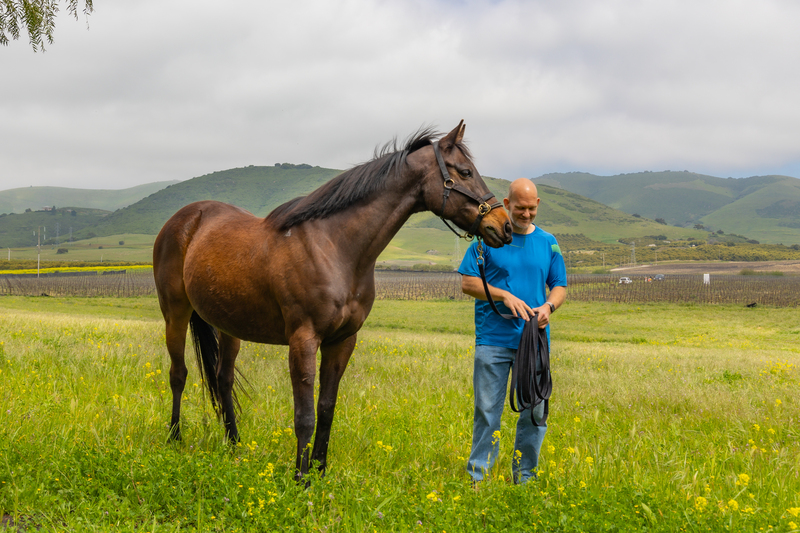
Meet Beignet (Jockey Club name French Getaway), foaled March 8, 2013. Beignet exudes charisma and warmth, captivating everyone he meets with his sweet and sensitive nature. Successfully adopted in May 2022, he honed his skills in jumping and dressage with a dedicated trainer before returning to Healing Heroes Through Horsemanship in September 2023 (through no fault of his own), ready for new adventures. Beignet shows great promise as a hunter and/or dressage prospect, demonstrating his ability to excel in these disciplines with his graceful movement and eagerness to engage.
Beignet is a pleasure to work with, forming strong bonds with both humans and horses. He is well-mannered, cross ties easily, enjoys being bathed, and loads like a dream. Beignet stands quietly for the farrier, reflecting his calm demeanor.
Under saddle, Beignet displays confidence with graceful movement and collects well. He loves arena work and is eager to please, demonstrating a smart and level-headed approach. He is responsive and in tune with your body and cues, listening well to your seat.
Beignet thrives when given a job to do, making him an ideal partner for someone who can provide him with the engagement he craves. He is super responsive and does need a strong, confident rider, as he is a bold and strong horse. Forward yet steady, he holds his pace and is ready for his next adventure.
All of Healing Heroes Through Horsemanship’s retired racehorses participate in their equine-assisted interventions and Veterans vocational horsemanship education programs. They work with each horse on the ground and under saddle (English and western) before determining their strengths and suitability for various disciplines.
Photo courtesy Healing Heroes Through Horsemanship
ASPCA Right Horse is the online adoption platform of The Right Horse Initiative, a collection of equine industry and welfare professionals and advocates working together to improve the lives of horses in transition. A program of the ASPCA, their goal is to massively increase horse adoption in the United States. To find more adoptable horses and foster horses, visit www.myrighthorse.org. To learn more about The Right Horse, a program of the ASPCA, visit www.aspcarighthorse.org.
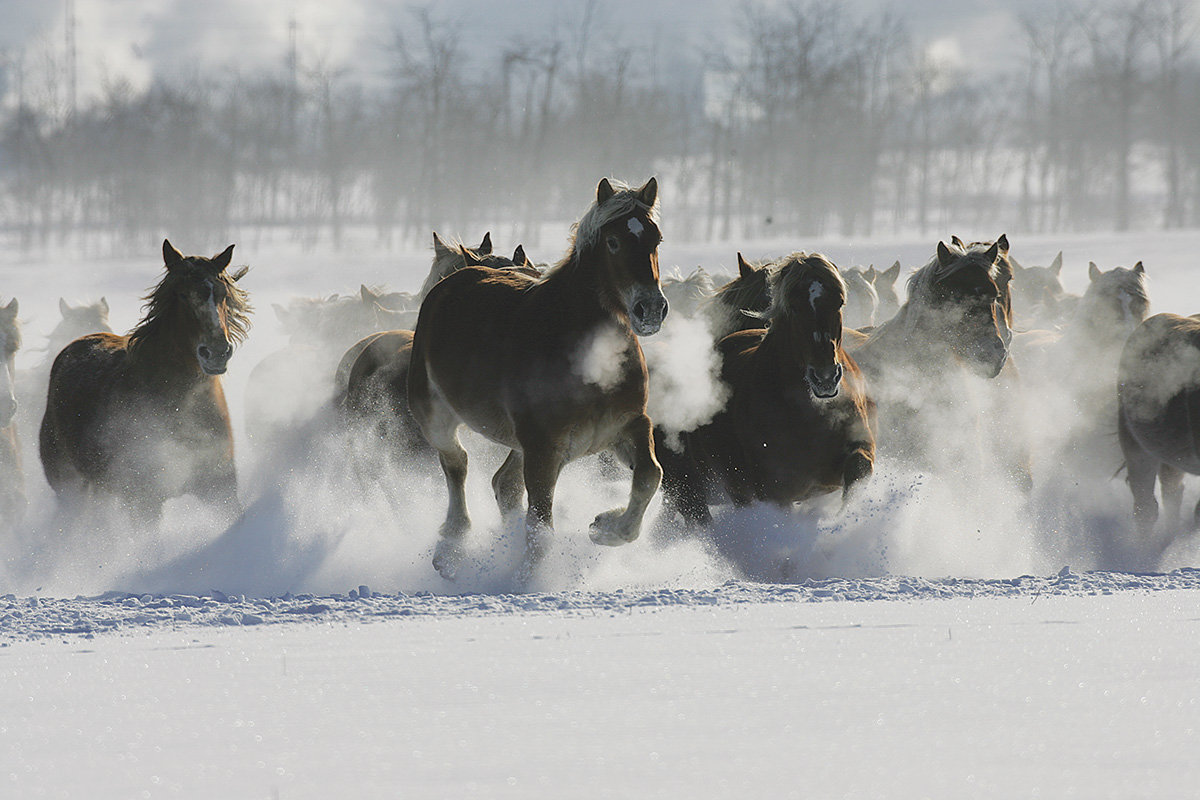
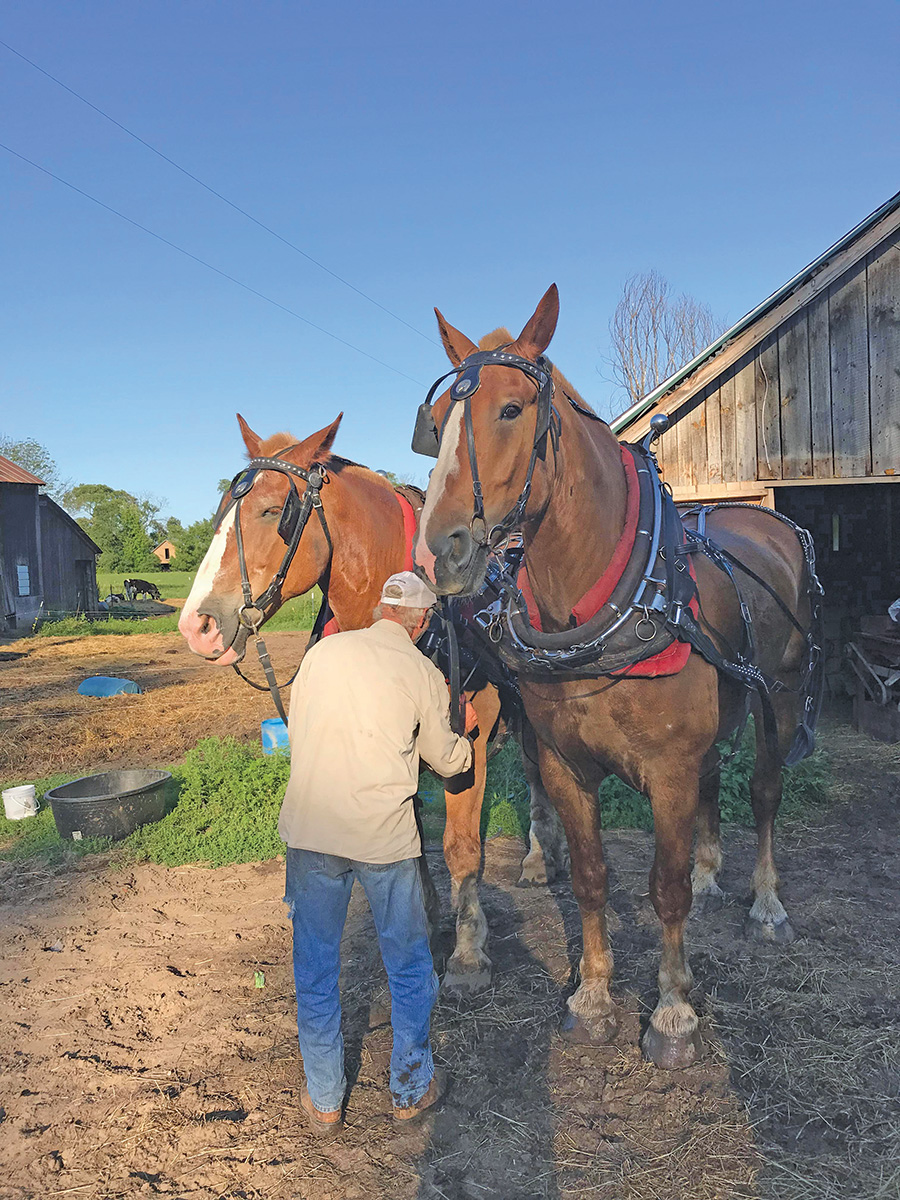
Developed in North America from Brabant stock, they were bred to be an all-round farm horse. Today, The Belgian Draft Horse Corporation of America remains the largest register for draft horses in America, according to Michelle Keaffaber, Belgian Draft Horse Corporation chief operating officer.
“Our office process approximately 3,500 registrations and 3,000 transfers per year, which has been consistent for the past five years,” says Keaffaber.
Belgian Horse Events and Highlights
The Corporation includes the Belgian Draft Horse Alliance, whose mission is to help foster continuous growth of the Belgian Draft Horse with programs, including a Hall of Fame, Merit program and a National Belgian Futurity and show.
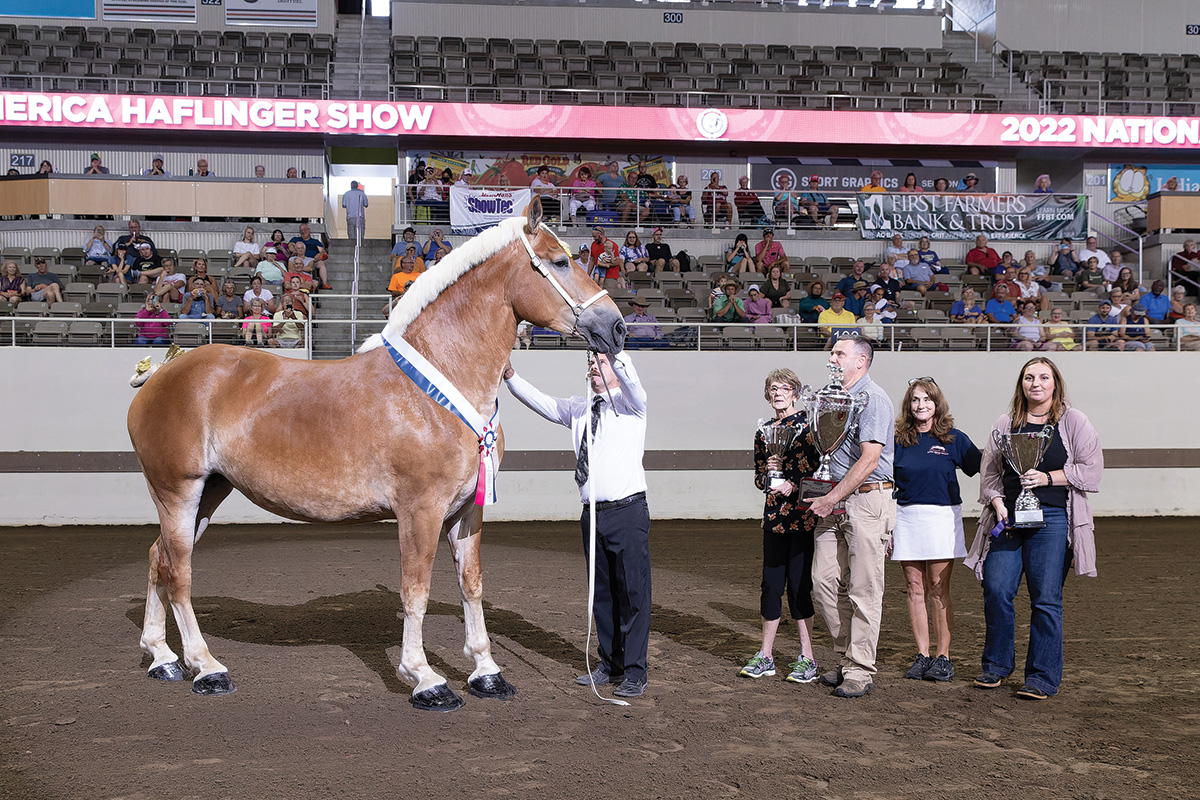
The Belgian Expo is held annually on the second Saturday in July, rotating between Ohio, Indiana, Illinois and Pennsylvania. The National Belgian Show, happening the third week in August, celebrated its 101st year in 2023.
Stoney Lake Cornelius wins best of breed at the 100th anniversary of the National Belgian Show in August 2022. Photo by Summit Professional Services
To promote youth involvement, the Corporation also has youth ambassadors that receive yearly training in social media conduct and how to run the Corporation booth at shows and sales. They also offer a Youth Merit Program and college scholarships.
The breed seems to enjoying a bit of a renaissance, with a 3-year-old Belgian gelding named Pleasant Country Supersonic selling for $137,500 at the Mid-America Draft horse Sale in February 2023, setting a world record.
The Belgian as a Therapy Horse
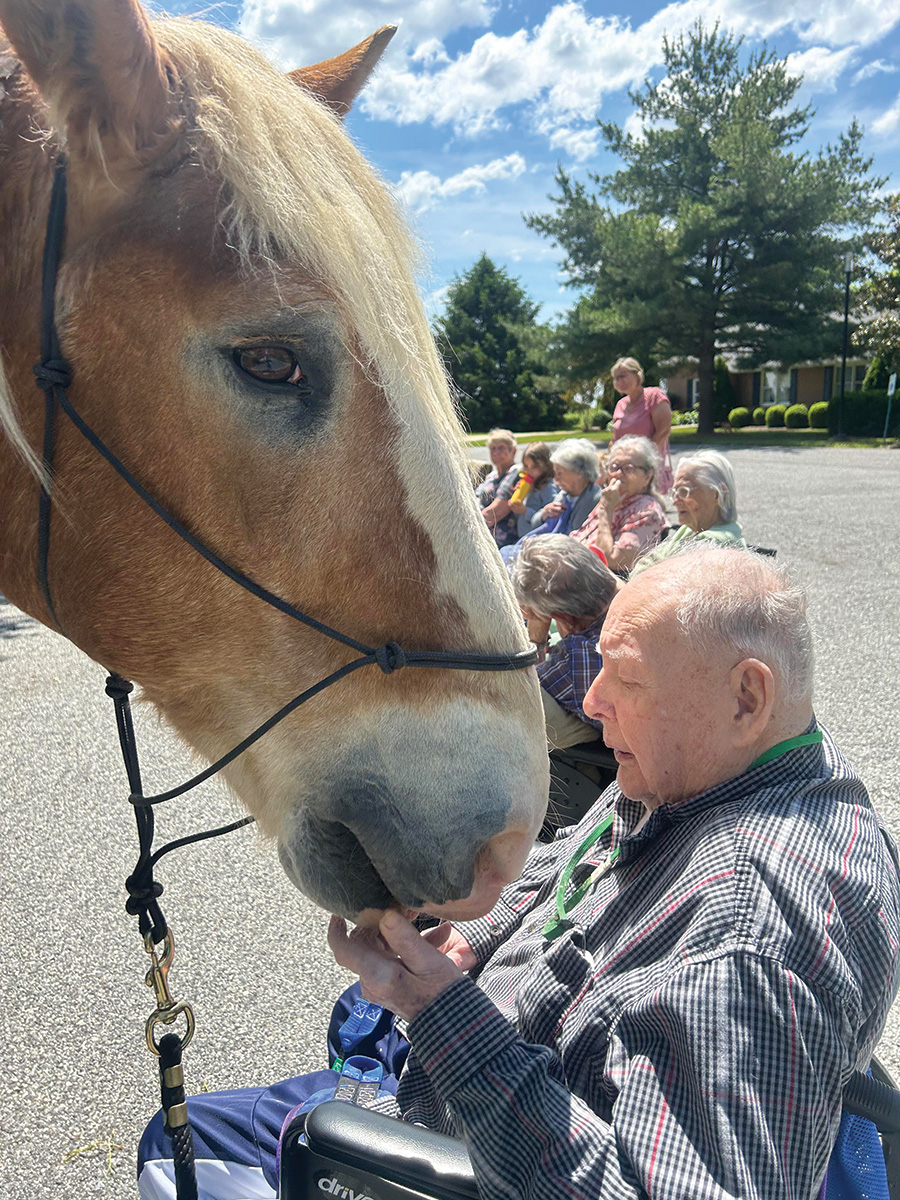
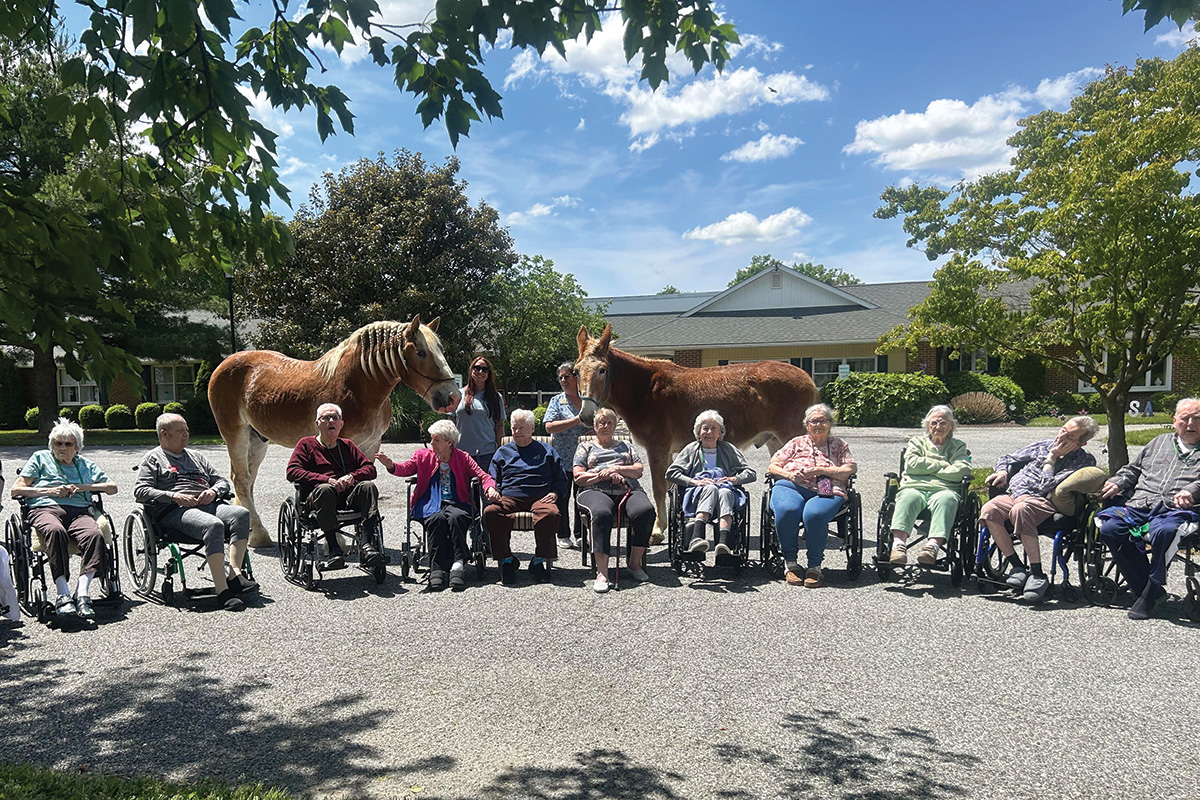
Danielle Scott of Stewartstown, Pa., has a passion for community service, so she decided to travel to assisted living facilities with therapy horses. But not just any therapy horses: Her team includes a 30-year-old Belgian Draft Horse named Clyde and a 20-year-old Belgian Draft mule named Everett.
Danielle Scott’s 30-year-old Belgian Draft, Clyde, works as a therapy horse in assisted living communities. Photo courtesy Danielle Scott
Scott adopted Clyde from Gentle Giants Horse Rescue. Originally, her two equines were just family pets.
“But they both enjoy spreading this type of joy,” she says. “And getting snacks and scratches is good, too! Clyde was a plow horse for 28 years. He’s known nothing but being a hard worker, and he has no desire to quit. He’s a prideful horse, and I think he loves living his life with purpose.”
Clyde’s buddy, a Belgian Draft mule named Everett, also helps out during therapy visits. Photo courtesy Danielle Scott
While such a large therapy horse may seem strange, Scott says it works well.
“Belgians are incredibly sensitive and sweet-natured,” she explains. “I think they really connect with the elderly. They are so patient, even when pats are heavy, and they take treats so gently, especially when hands can’t straighten all the way out to hold flat.”
Scott says hearing the people they visit talk about the horses and get excited is a huge reward. One woman with dementia started sharing stories of horses she used to ride. And a World War II vet told her about the horses they used during the war.
Clyde, a retired Amish plow horse, also does paper chases and shows. Paper chases are where riders follow a trail and are judged on obstacles and tasks along the route.
Preserving Their Past
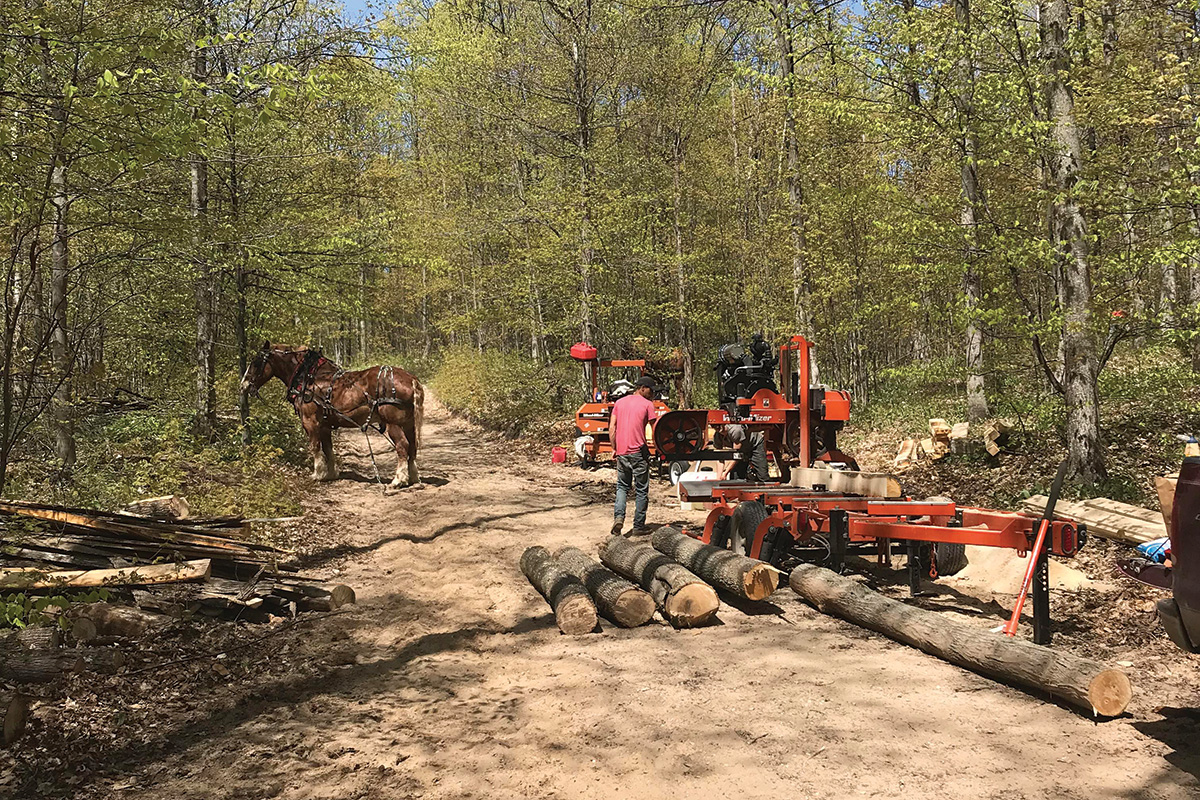
Meanwhile, Brent Brophy from Arcadia, Mich., still uses Belgian Draft Horses for logging. He has been using them for six years, and currently has three on his team.
“Horses are a lot more environmentally friendly than machines,” he says of why he still logs the old-fashioned way.
Brent Brophy finds Belgian Draft horses more environmentally friendly than machines, and says they have a great attitude and love the work. Photo courtesy Brent Brophy
“I have the big pulling-bred Belgians,” says Scott. “I chose them because of their size and attitude toward work. They love it.”
Like Scott, Brophy has found the Belgian to be a happy worker, enjoying whatever job they are doing. And these are no small pullers: Brophy’s large boy is 19.1 hands and weighs 2,780 pounds. His others are 19.2 and 18.2 hands.
Brophy’s logging Belgians are 18.2, 19.1 and 19.2 hands. The heaviest weighs 2,780 pounds. That’s some horsepower! Photo courtesy Brent Brophy
Key Takeaway
While the breed may have been developed out of necessity for the early American farmer, it has become a whole lot more. Whether pulling logs, providing therapy, enjoying a trail ride, running barrels at a fair or stepping out in front of a cart, one thing is for sure: the Belgian Draft Horse does it all willingly and sweetly. If you’re looking for something with lots of power, don’t let their size frighten you from giving them a try.
Opinions about blanketing can be as varied as the weather itself, and horse owners are often confused when confronted with that ultimate cold-weather conundrum: to blanket or not to blanket? Either way, winter is here. Below, experts share their advice to help you decide on the best blanketing practices and strategy for your horse this winter.
Professional equine grooms Cat Hill and Emma Ford believe there are no hard and fast rules about blanketing. The lifelong horsewomen have managed barns and horses for top riders in all disciplines, including Olympians. Together they run World-Class Grooming and share their expertise through clinics and books, including the top-selling equine title World-Class Grooming.
“The biggest rule is that you have to remember that horses are individuals just like people,” says Hill. “There are many horses that grow great coats and are really comfortable being unblanketed in many climates, all the way up to Alaska. But there are also horses that really struggle without being covered in some way.”
How Horses Stay Warm
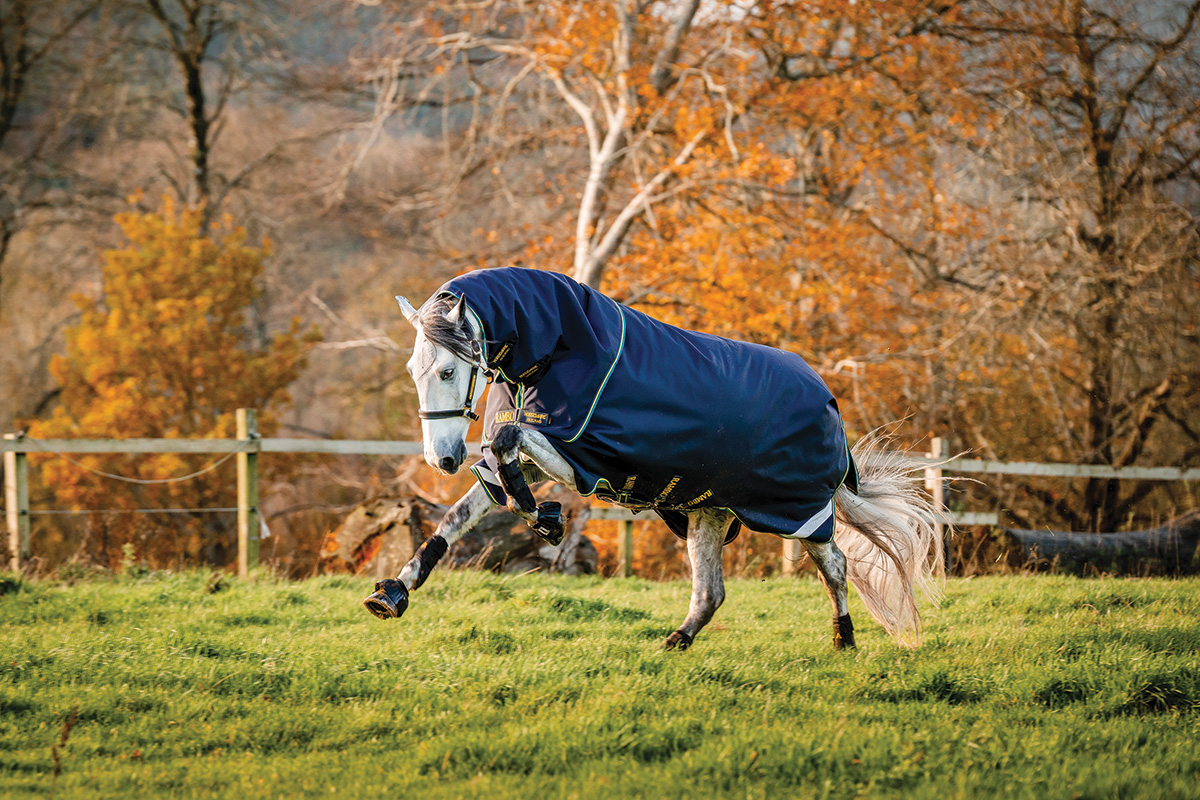
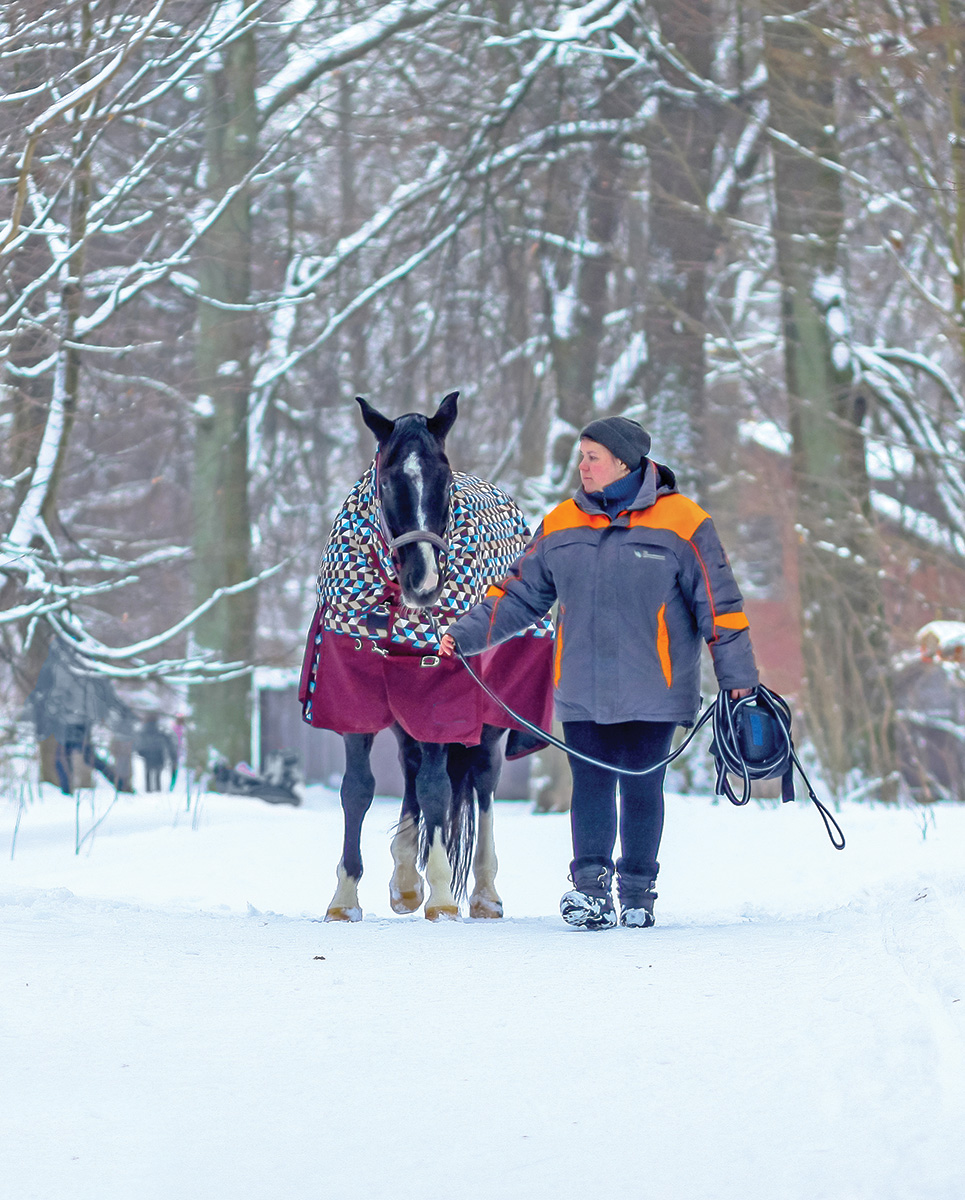
Horses can weather winter quite well in most situations.
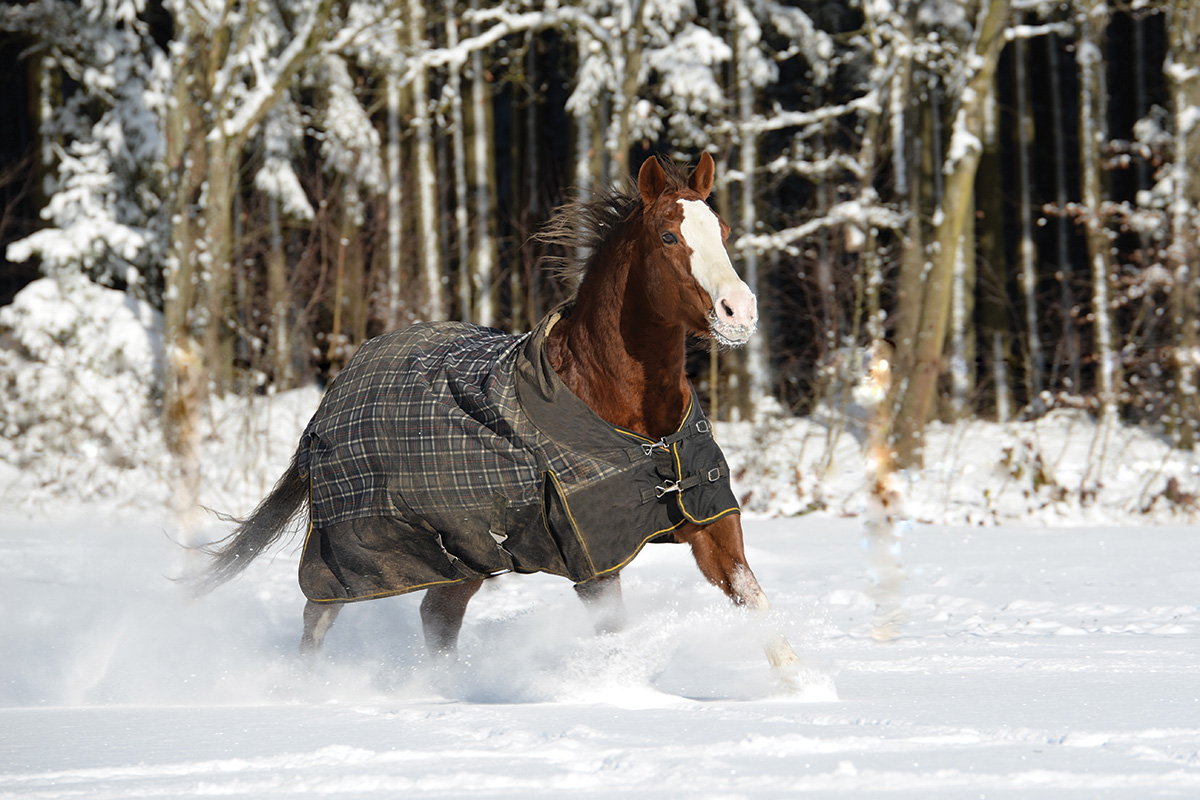
“Horses are well equipped to handle the cold, provided they are able to acclimate and stay dry enough to fluff the hair,” says Karen L. Waite, Ph.D., who serves as coordinator of the Michigan State University (MSU) Horse Management Program in East Lansing, Mich. She is also the director of undergraduate education in the MSU Department of Animal Science. “Horses stay warm in several ways: through the digestion of forages like hay, which produces body heat; by growing a thick winter haircoat, which starts to develop around August or September as day length starts to shorten; and by fluffing up their hair coat as the need arises.”
That “fluff factor” traps warm air against the skin, allowing the horse’s hair coat to provide natural insulation, much like a cozy down comforter. However, if the horse gets wet, that ability diminishes.
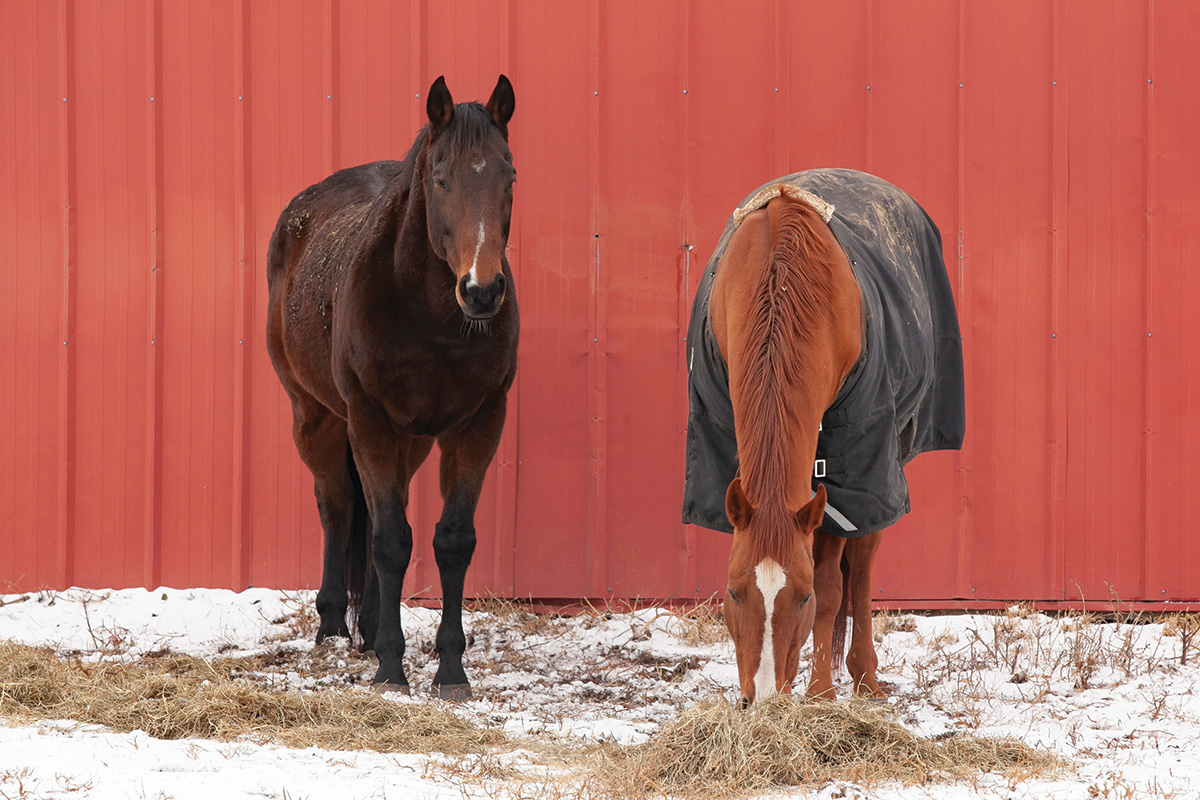
Many horses with natural coats don’t need blanketing in winter, while their older herd mates or those coming from warmer climates do. Photo by Margaret Burlingham/Adobe Stock
“A wet horse in 45-degree weather may be more uncomfortable than a dry horse with a full winter coat would be in sub-zero temperatures,” says Waite.
Additionally, a horse that moves from Florida to Minnesota in the middle of winter may not have a hair coat extensive enough to handle that level of cold.
“Most horses don’t actually need blankets to stay warm if they are allowed to develop a winter coat suitable to conditions,” says Waite. “The exception would be horses without adequate body condition or hair coat development, and occasionally older horses.”
Hill emphasizes the need to keep a close eye on senior horses.
“Just like older people, horses lose the ability to thermoregulate,” she says. “A horse who has lived without a blanket his entire life may suddenly need blanketing to retain condition when he gets into his 20s. He may not necessarily look cold. He may grow a huge, thick, heavy coat. But [some horses] really start to drop weight in the wintertime, and that’s because their body is burning energy to keep them warm.”
Hill recalls the story of an Arabian mare who lived at her family’s farm in upstate New York.
“Until she was in her mid-20s, she’d never worn a blanket and had always been very comfortable, happy, and hardy living out 24/7 with a run-in shed,” she says. “And then she got to a certain age where we really struggled with her weight in the winters. We bought her a heavyweight blanket that we put on her once it was consistently below freezing, and we had another 10 years of happy, healthy life with her. So as your horse ages, you may need to re-evaluate his blanketing needs.”
Why You May Consider Blanketing Your Horse
In addition to the weather and your horse’s age, coat and health status, there are a variety of other factors to consider in your blanketing decision.
An extreme temperature swing may warrant blanketing even for horses that normally go au naturel because they are not acclimated to that level of cold.
“If the horse has a full haircoat and is generally healthy, I would only blanket if temperatures were extreme, and outside the normal ranges for the area, unless he was old or had issues with body condition,” says Waite.
Access to shelter from wind and rain is another deciding factor in a horse’s blanketing needs.
“Rain is one of the hardest things for horses to handle without adequate shelter, because that squishes down the hair,” explains Hill. Even a healthy horse struggles when he can’t get away from the wet, she says.
Standing in wet or muddy conditions can also increase the need for blanketing, says Hill.
“When horses’ legs get wet, they struggle to bring their body temperature back up,” she says. “If a horse is standing out in a muddy field, you may need to put a warm blanket on him. Not just something to protect his back from the rain, but something with insulation as well.”
Horses that have been fully or partially body clipped will require blanketing. Hill and Ford firmly believe that if you have done any sort of partial clip, you still need to blanket. As Hill points out, the reason we clip particular areas such as the neck and chest is because they have underlying large veins, which help to cool the horse.
Horses that are body clipped, even partially, require blanketing. Another benefit of blankets is cleanliness if you have limited grooming time. Photo courtesy Dover Saddlery
“When you get a cold wind over those veins, you’re putting a lot of stress on the horse’s body. So even if you just clipped up his neck, you really need to put some sort of protection back over the horse to help keep him at a [warm] base temperature,” says Hill.
Another reason you might want to blanket in winter is cleanliness. There’s nothing wrong with blanketing for the convenience of keeping a horse tidy, say Hill and Ford. If you have limited time and you live in an area where mud is a real issue in the winter, blanketing can make things easier on both you and your horse.
Blanketing helps keep horses cleaner, which makes winter coats easier to groom if you plan to ride throughout the season. Photo by cascoly2/Adobe Stock
“Your horse is going to have a healthier and happier winter if you blanket him so that you can groom the areas that are exposed, but you’re not having to spend an enormous amount of time getting the mud or dirt out of his coat,” says Hill.
However, blanketing must be managed appropriately, which requires time and commitment. You’ll need to keep a close eye on the weather forecast, consider temperature fluctuations, and blanket accordingly.
“The biggest factor that people need to consider is that blankets need to be checked daily and changed as needed,” notes Waite.
It’s important not to just “set it and forget it” when it comes to blanketing. Blankets should be removed and inspected daily to check for rubs, sweat, and weight gain or loss. Photo Viktoria Suslova/Adobe Stock
Considering the Denier and Fill of Blankets
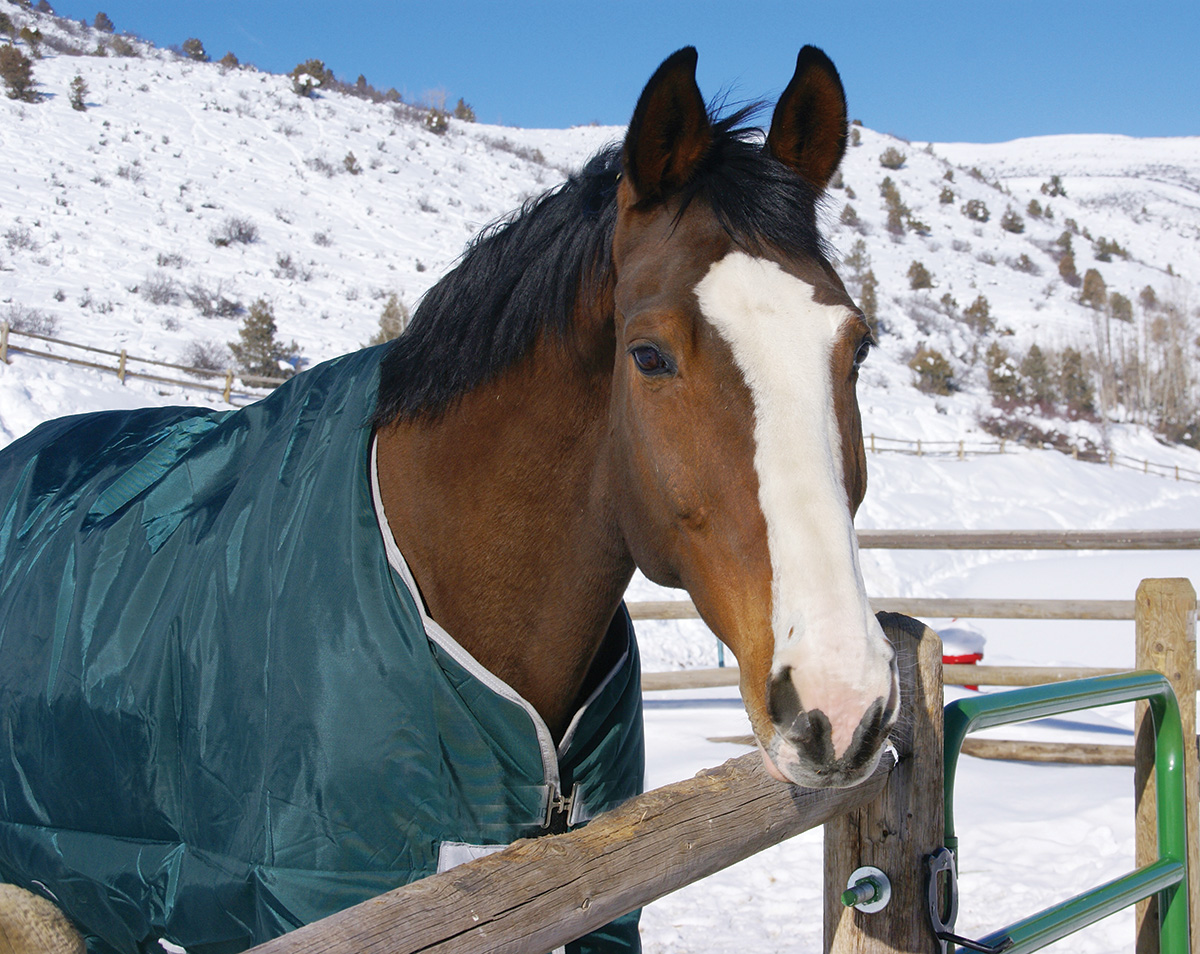
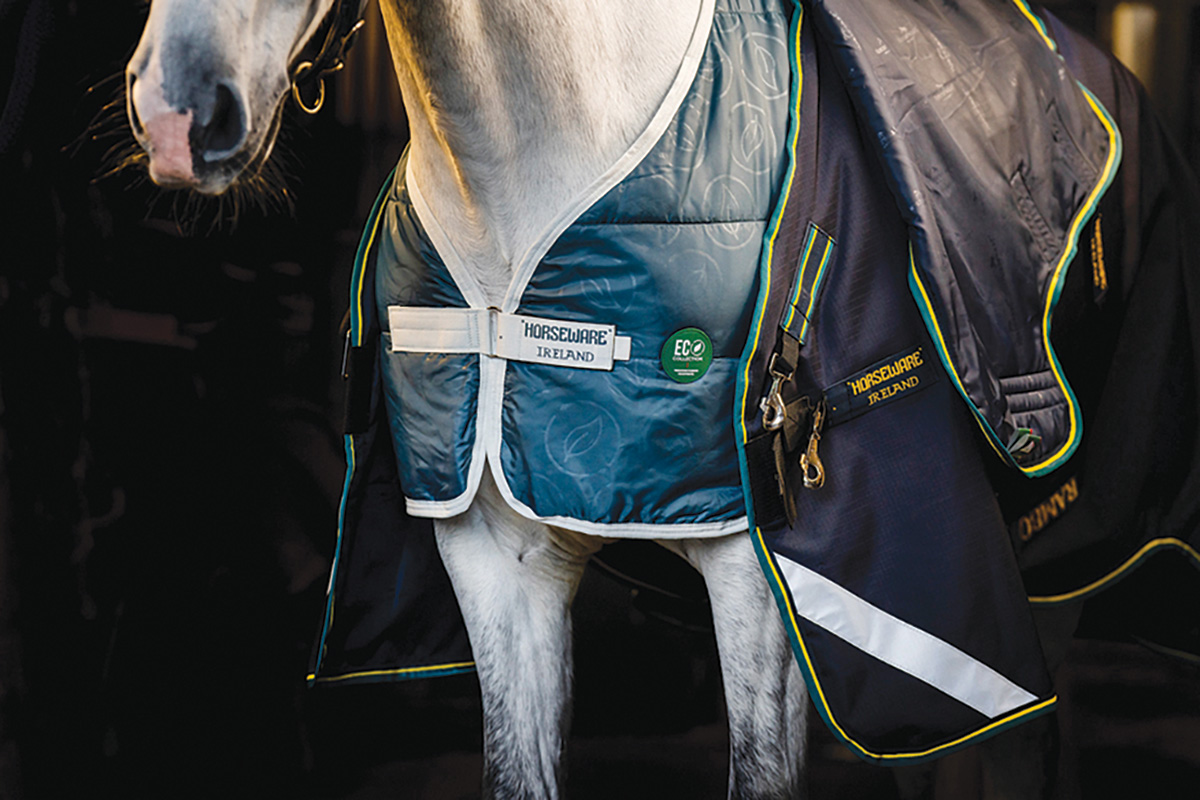
Blankets come in a mind-boggling variety. The first step is to select the right blanket type for your horse’s lifestyle. Any blanket that will be worn outdoors must be waterproof; wearing a soggy blanket is uncomfortable and will make your horse cold.
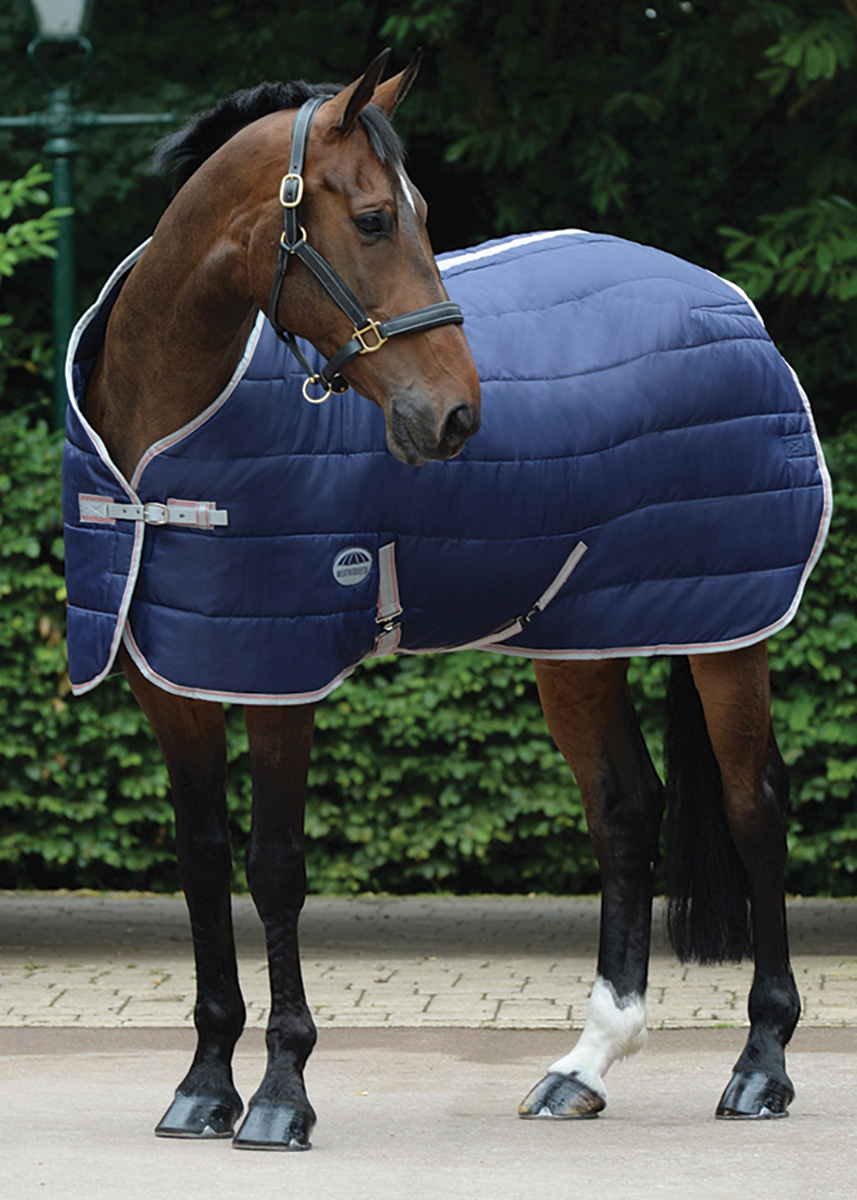
Turnout blankets are waterproof, durable and can be worn inside the barn or out in the elements. Stable blankets are not fully waterproof, and are meant to be worn indoors only.
Stable blankets are not waterproof and are meant to only be worn indoors. Photo courtesy Dover Saddlery
When it comes to blanket shopping, the technical terminology can get complicated, but to help clarify the basics, Lauren Donohue, assistant merchant and horse clothing product expert with Dover Saddlery headquartered in Littleton, Mass., says to start by understanding what denier, fill and material you need.
“Denier” refers to the toughness of the fabric, while “fill” refers to the weight and warmth a blanket offers, measured in grams (g).
“The highest standard denier we typically see on the market is 1680d, and that’s meant for horses that are really rough on their blanket; the higher the denier, the tougher the outer material is,” says Donohue. “Sheets with 0g fill won’t offer any insulation—it’s just like putting on a raincoat. The more fill a blanket has, the warmer it is.”
Outer material also affects the durability of the blanket, which can be made of polyester, polypropylene, or ballistic nylon.
When building a blanket wardrobe, horse owners should look for versatility that will keep most horses comfortable in most situations. Donohue recommends starting out with a turnout blanket, noting that the two most popular fill weights are 50g (lightweight) and 200g (medium or midweight).
“The 50g can be worn when it’s a little warmer, [such as if] you get a summer rain, and it can be nice for those fall days when a horse might be feeling excited in turnout,” she says. “The 200g can be worn in a lot of scenarios. I keep my horse’s 200g blanket on until deep winter in New England comes around.”
Because a blanket and even a sheet has weight to it, Hill points out that it can flatten the horse’s haircoat. For this reason, she is a fan of using a 150g turnout versus a turnout sheet with no insulation.
“Sometimes it can be counterintuitive that adding a lightweight rain sheet or blanket can actually make a horse colder because they can no longer ‘poof up’ their coat,” she says. “We’re huge fans of the 150g-weights as rain sheets, because the light insulation does a great job of keeping the horse warm and dry and reversing the effects of the flattening of the hair. That really hits the sweet spot for those horses that need just a little bit of blanketing.”
Hill and Donohue both recommend having a neck cover as well. For colder climates, adding a heavyweight blanket (300g-plus) should build a basic wardrobe.
Too Hot, Too Cold, Just Right
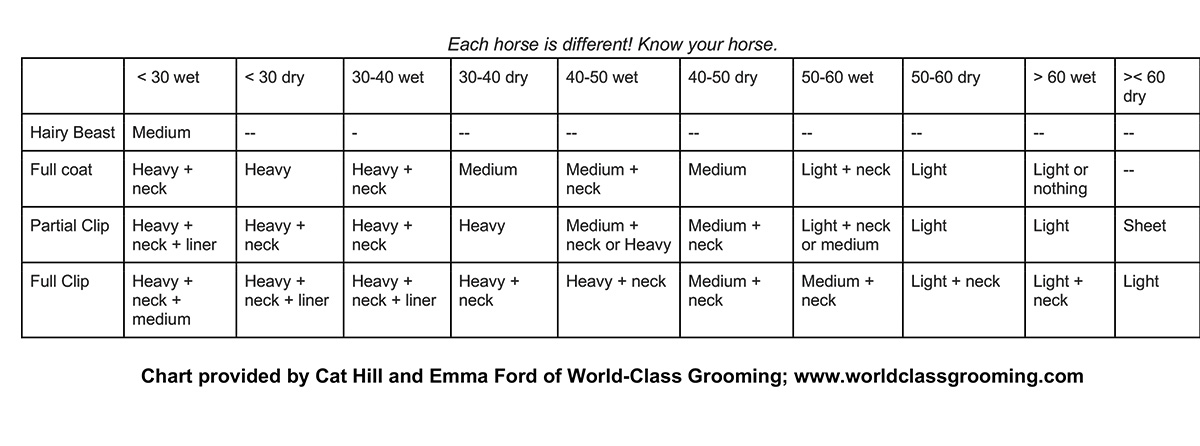
Knowing which blanket to put on your horse can be tricky. World-Class Grooming has a blanketing chart (see below) that goes from below 30 degrees Fahrenheit to above 60, for wet or dry conditions, from full body clip to hairy beast and everything in between. Still, it’s important to know your own horse and consider each horse’s needs individually to blanket appropriately.
How do you know if your horse is comfortable in his blanket? Shivering or sweating can be obvious signs that something is amiss. Putting your hand under the blanket can help tell you if a horse is overly warm (if you detect tackiness or sweat). However, a method Hill prefers to assess if a horse is warm enough is to feel his extremities: legs, ears and face.
“If those areas on his skin feel cool, then your horse is cold,” she says. “If the tips of his ears are cold under the hair, he’s cold. The tips of their ears and their legs should feel the same temperature as the rest of the horse if they are properly blanketed.”
If you’re unsure of the appropriate weight blanket for the weather conditions, Waite advises that you may want to err on the side of less, given that overheating and dehydration can also cause significant problems.
Healthy Blanketing for Your Horse
Improper blanketing can lead to a variety of health problems.
If blankets get wet, they need to be removed, as hypothermia or skin infections (such as rain rot) may develop, notes Waite.
“If horses or blankets get wet, that causes more issues than anything else,” she says.
Waite also emphasizes the importance of proper blanket fit, as sores may result from blankets rubbing. A blanket that is too small may result in the horse being unable to move about or rise normally, while a blanket that is too big can also cause injuries if the horse becomes tangled in it.
Because the constant weight of wearing a blanket can cause rubs and pressure points, Hill and Ford like to do what they call a daily reset. They take the blanket off and put it back on to make sure it’s sitting in the right place, while at the same time checking underneath for any sore spots, swelling or rubs.
“The most problematic areas are the withers, points of the hip, and points of the shoulders,” says Ford.
If you’re not careful, it’s possible to cause more harm than good with blankets.
“If you can let the horse grow a full haircoat and shed naturally, that causes the fewest issues in the long run,” says Waite.
If you opt to blanket your horse, she agrees that it’s critical to check underneath blankets daily, and to check body condition regularly. Consistent grooming is also needed to keep horses healthy.
While the main reason for blanketing should be for the horse’s health and wellbeing, Hill acknowledges that it can also be a horsekeeping issue—to keep the horse clean and make grooming and riding easier—and that’s OK if it’s done mindfully.
Safe Blanketing Procedure
Getting your horse properly dressed for winter weather requires some small but important details that are often overlooked.
There’s a correct “order of operations” to putting a blanket on and off safely. According to Cat Hill and Emma Ford, authors of World-Class Grooming, you should always secure a blanket from front to back: first chest straps, then belly straps, and finally leg straps. If there is a neck cover, secure this last.
When removing the blanket, reverse the process: neck cover; leg straps, if any, should be undone and hooked back up while not around the leg; then belly straps; and finally, chest fasteners.
“If the horse spooks or runs forward, you don’t want the belly or leg straps still on while the chest is undone, because the blanket can slide back and cause a panic situation,” says Hill. “A horse can get seriously injured from getting tangled in a blanket that way.”
Remember, too, that you must train a horse to wear a blanket, just like any other piece of equipment. Go slow, says Hill. If you don’t know that a horse has been blanketed before, having a helper halter him and hold the lead rope is beneficial.
One of Ford’s biggest safety concerns is leaving a blanket’s leg straps undone during the blanketing process. She emphasizes that you should always hook them back up so that they’re not dangling down when you’re putting the blanket on or off a horse.
“They basically turn into flying weapons,” she says. “Many of them are on elastic; when you go to put the blanket over the top of the horse they get caught on stuff, the horse can step on them, they can whack into the horse’s legs, and all sorts of things. They should always be connected to both rings, and the only time they come off is when you’re unclipping them and putting them around the leg and hooking them back on.”
Since horses like to itch and rub themselves against things, Hill and Ford warn that any snap on a blanket that is facing away from the horse has the potential to be caught on something. When the blanket is on, it’s important that the “trigger,” or opening part of the snap, should face inward toward the horse.
Best Blanket Fit
Fitting blankets is like buying jeans—every brand has its own fit and shape. Brands that work for some won’t work for others, says Lauren Donohue, assistant merchant and horse clothing product expert with Dover Saddlery. Here is her best advice on fitting a blanket.
The two major measurements to consider are the length and drop of the blanket. Horse blankets are usually sized based on the length of the horse’s side measurement, listed in inches or sometimes centimeters. To measure the length, start with a fabric tape measure from the middle of your horse’s chest. Go across the shoulder to the middle of the tail.
The drop on a blanket is measured from the middle of the spine to the bottom of the blanket (on one side).
“Each brand will have their own drop measurement for the blanket, and this will differ by brand. If your horse is [round and] well-sprung in the ribs, you will want to ensure the drop length of the blanket is sufficient coverage for your horse,” she says.
If your horse is on the line between sizes, Donohue says to consider whether you will be layering underneath the blanket at all, and if your horse is prone to rubs. If the answer is yes to either of these, she recommends sizing up.
It may take some trial and error to find the blanket that fits your horse the best.
“All of these tips for fit are helpful, but my biggest secret is to buy from a retailer with a return policy!” shares Donohue.
Blanketing Horses at Home vs. Boarding Barns
Hill and Ford have worked in barns large and small, with blanketing recommendations for each scenario. Blanketing options vary when it comes to keeping horses at home or at boarding barns, and for the policies a boarding barn may offer.
For people who care for their own horses and are not blanket-changing multiple times throughout the day, they recommend one of the interchangeable blanketing systems as a good cost-effective option. These typically include a waterproof outer layer with liners that clip in. The liners are usually less expensive than a blanket, and you can swap them out to keep them clean and dry.
A blanket system with liners will save money compared to a full wardrobe of blanket weights and is great for home horsekeepers, but is more difficult for boarding barn staffs to add and remove. Photo courtesy Dover Saddlery
“A clean blanket is really important to keep a horse warm, because if the polyfill absorbs oil from the horse’s coat and packs down, it no longer has air pockets and is no longer is warm,” explains Hill. “I always talk about ‘clean underpants’—we like to keep a sheet on the horse next to the skin. I keep two cheap cotton sheets that I can wash easily because then I don’t have to wash my big, heavy blankets as often.”
If barn staff are the ones blanketing and unblanketing your horse, it’s important to be considerate.
“If you keep your horse at a large boarding barn where somebody other than you is in charge of changing 20 horse blankets in a day, the blanketing systems are a pain for them because they have to take the whole thing off, change the layers, and put it back on,” says Ford.
In that situation, she recommends having a lightweight (100g or 150g fill weight), a medium, and a heavy because you can layer between those three. The barn worker can put these on or off as needed, and they can go in whatever order.
“At the end of the day, what is most convenient for the staff is going to mean your horse is blanketed appropriately if you’re not the one in charge of it,” says Ford. Ask them what they prefer and works best for them.
Key Takeaway
While there is no one-size-fits-all solution to blanketing, understanding your horse’s individual needs is key. Blanketing can be beneficial, but it certainly requires attention to detail. By following these best practices, blanketing can be a useful tool to help your horse thrive during the winter months.
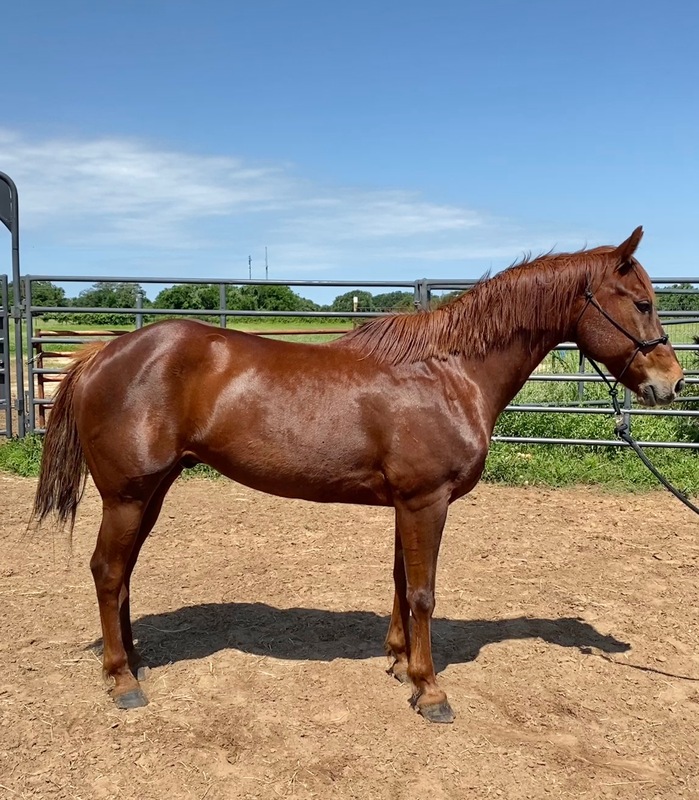
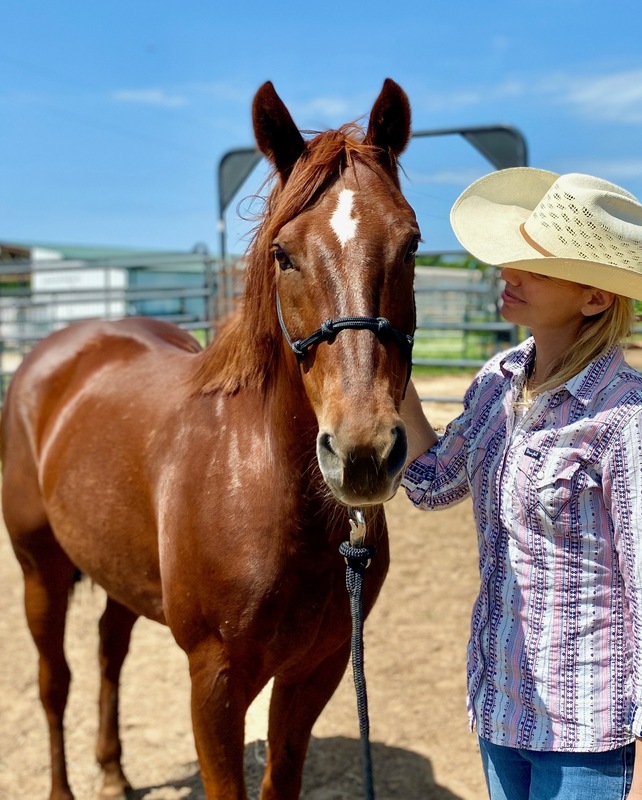
Meet Cat! This gorgeous, registered Quarter Horse gelding loves attention. He has such a great spirit and is a beauty to behold in the pasture when he moves. Cat is energetic and would do best with an intermediate to advanced handler. He has never been ridden.
Cat stands at 14.3 hands high. He is up-to-date on shots, Coggins, dental care, and is microchipped.
ASPCA Right Horse is the online adoption platform of The Right Horse Initiative, a collection of equine industry and welfare professionals and advocates working together to improve the lives of horses in transition. A program of the ASPCA, their goal is to massively increase horse adoption in the United States. To find more adoptable horses and foster horses, visit www.myrighthorse.org. To learn more about The Right Horse, a program of the ASPCA, visit www.aspcarighthorse.org.
While many experts agree that fleas are an uncommon parasite for horses, ticks can be prevalent and potentially present a danger to your horse’s health.
Ticks are becoming an increasingly significant problem for horse owners in many areas of the country. These parasites can invade your pasture, but they also hang out in places you might routinely ride, such as cool, shady areas near creek beds or among tall grass where they wait to hitch a ride.
Protect your equine by watching for signs of flea or tick problems and treating issues right away or preventing them altogether.
Ticks like to hang out in tall grasses or cool, shady areas along creek beds. Photo by Terri Cage/Adobe Stock
How Common Are Tick Infestations with Horses?
“Horses aren’t the preferred hosts for fleas like dogs, cats and foxes are,” says Laura Stern, DVM, DABVT, director of training and quality assurance for the ASPCA Animal Poison Control Center. “The reason horses aren’t commonly affected by fleas, but do get ticks, is simple: They’re in places where they commonly encounter ticks, but not fleas. Fleas like dark areas, like dens. Those aren’t the places where horses like to be. However, ticks like long grass and wooded areas—places where horses are commonly found—making them a common target for ticks.”
“Fleas don’t like horses,” agrees Garrett Metcalf, DVM, DACVS-LA, an equine veterinarian at Pine Ridge Equine Hospital in Glenpool, Okla. “Fleas are species-specific, and horses aren’t a suitable host for fleas, so it’s rare to have fleas on horses. Ticks are a common problem and rather good at transmitting diseases to horses.”
Signs of a Tick Problem with Your Horse
Horse owners are very protective of their animals, and typically attuned to changes in their behavior. However, a tick’s small size makes it easier for them to hide, so it’s essential to be aware of signs you might blame on something else that could indicate a tick issue.
The first step is to stay alert and physically look for ticks on your horse’s body while being aware of any potentially serious side effects of a tick bite. Besides the actual tick body, Stern says to look for a raised, hard bump where a tick was feeding. She says you might see your horse rubbing a particular spot where a tick is or was, and experience hair loss due to excessive rubbing.
“If your horse has a severe tick infestation or if he seems weak, wobbly or has pale gums, contact your veterinarian immediately before trying to remove any ticks, as you may cause damage to the skin or stress the horse in his weakened condition,” she cautions.
Metcalf advises looking around the groin, head, and region under the tail where ticks often like to accumulate. He says that you might notice swelling in areas where ticks have bitten a horse and edema around the bite site.
“If a horse is head-shy while haltering, lethargic, or has a fever, and ticks are present on the horse, it would be best to have the horse examined by a veterinarian,” he says. “Ticks are a common [cause of] swelling and pain around the ears, and most tick-borne diseases will cause fever and lethargy as the main clinical signs.”
Health Hazards of Infestation
Ticks infected with serious diseases don’t usually transmit those pathogens immediately. Instead, they usually must feed on the host—namely your horse—for a while before disease transmission occurs. This delay in disease transition makes it extremely important to remove ticks as soon as possible.
While less critical issues such as itchiness, hair loss, poor hair coat and local irritation can occur, Stern stresses that more serious problems such as infection at the site of tick attachment, anemia from blood loss in severe cases, and tick-transmitted disease could occur.
“Ticks can transmit a number of diseases to horses, including Lyme disease, equine granulocytic anaplasmosis and equine piroplasmosis,” says Stern. “Rarely, we may also see tick paralysis. There’s typically a delay of 24 hours between when the ticks attach and when they can transmit diseases, which makes it very important to find them quickly and remove them before they have the chance to transmit any diseases.”
An Ounce of Prevention
Prevention is always preferable to treatment, which is true of fleas and ticks. If you can keep your stable and pasture free of these parasites, you avoid having to remove ticks from your horse and could prevent potentially serious problems.
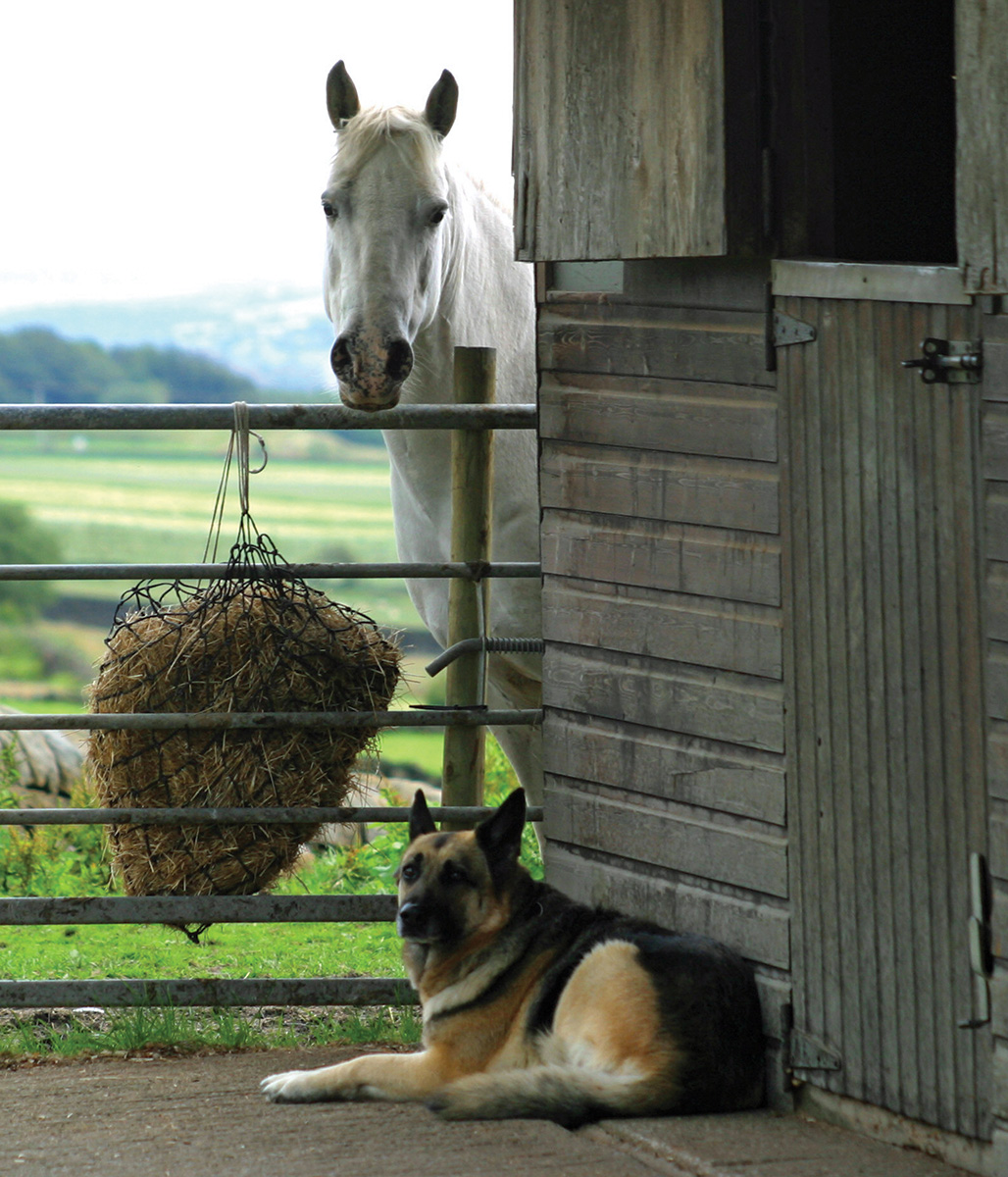
Make sure all pets that have access to the barn are current on their flea and tick treatments. Photo by FreeImages
Metcalf suggests using permethrin-based products, which he says are the best store-bought products to combat fleas or ticks on horses.
“It’s rather difficult to prevent ticks from getting onto horses,” he cautions. “Concentrated, topically applied permethrin products may be the best option at this time. Some of these products need to be applied every three weeks.
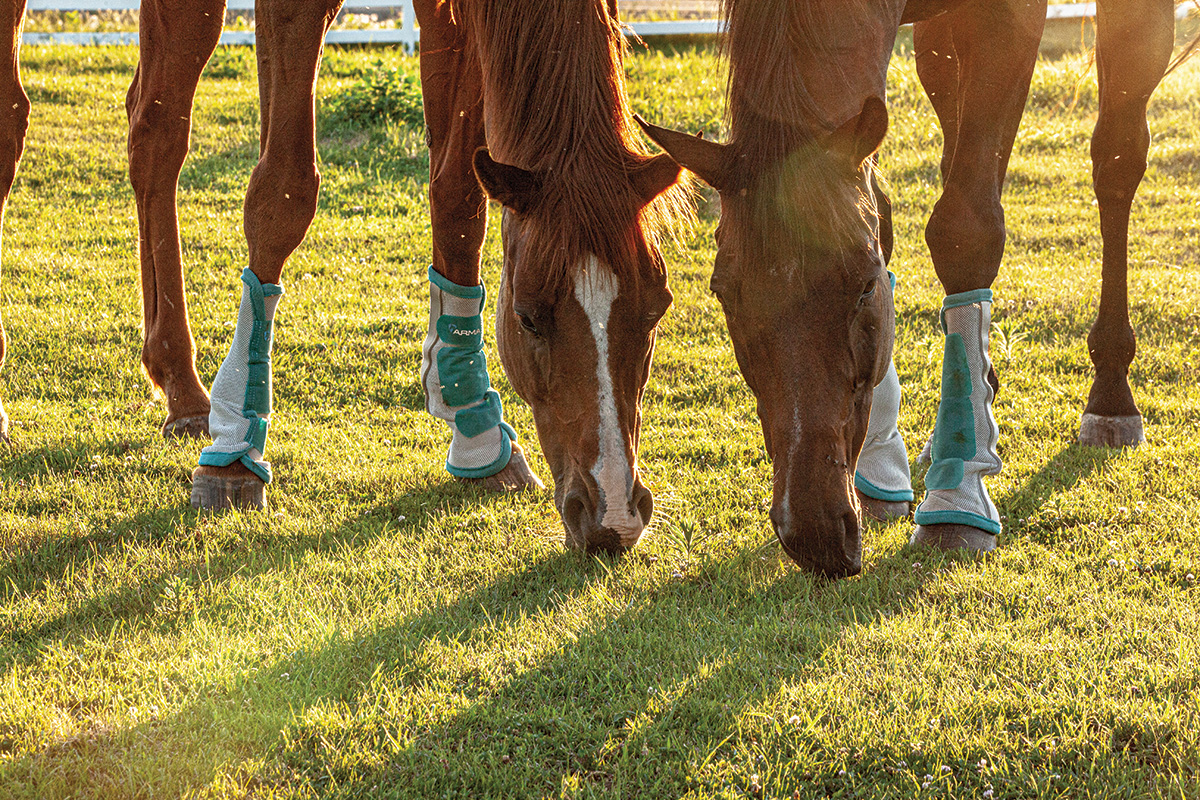
“Natural remedies aren’t very effective against reducing ticks on horses,” he continues. “Some essential oil recipes use geranium oil as a possible tick repellent. Physical barriers, such as fly boots, may help reduce ticks from getting onto the limbs of horses.”
Stern also touts various tick repellents and products that kill ticks. She says there are some sprays you can use before a ride and topical spot-on products that work longer for horses more consistently at risk of encountering ticks.
“You can use a repellent to help keep ticks off your horses,” says Stern. “Repellents often contain a pyrethroid insecticide, such as permethrin or cypermethrin. Repellents have the advantage of not requiring the ticks to bite and take a blood meal. Avermectins, such as moxidectin and ivermectin, can also kill ticks, but [the ticks] need to take a blood meal first.”
She cautions the importance of always reading the label of any flea and tick product you use to ensure it’s appropriate for use on horses.
“Some cattle products can cause significant toxicity in horses,” warns Stern. “[And] some products won’t be labeled for use on certain horses, especially foals under 3 months of age. Always apply per the labeled [instructions] to minimize the risk of side effects, as well. Your veterinarian can help you determine what product will be best, based on the risk of exposure to ticks, the risk of ticks carrying disease, and your horse’s lifestyle and health history.”
Other Remedies
Besides treating your horse, you should always pay attention to his surroundings. Stern says ticks are generally more of an issue outside of barns, so you don’t typically need tick control inside your barn.
“If fleas are present in the barn, it’s generally not an issue for horses,” she says. “But you can minimize risk by preventing wildlife from entering the barn and ensuring that cats and dogs who have access to the barn are treated with flea preventatives. Treating the environment may be needed for heavy flea infestations.”
One of the best all-natural ways of minimizing tick exposure is to keep horses out of areas that contain a lot of ticks. Of course, that isn’t always possible.
“Ticks are often found in tall grasses and wooded areas,” says Stern. “They dislike hot, sunny areas with no plant cover. An easy way to minimize the number of ticks your horses are exposed to is by mowing any tall grass, removing weeds, and preventing your horse from entering wooded areas or hanging around the boundaries between woods and pasture. Preventing wildlife, especially deer, from entering pastured areas is another important step you can take to decrease the number of ticks in your pasture.”
Physical means, such as mowing pastures and using fly boots, can help keep ticks from gaining a foothold. Photo by Margaret Burlingham/Adobe Stock
Metcalf also suggests using pasture insecticides to help reduce fleas or ticks in your pasture. He cautions that whenever a heavy amount of wildlife traffic is present, there’s more of a reservoir of future ticks or fleas to re-establish residency in the pasture.
Tick Removal Tips
Any time you’ve been out riding—or at least once a day if your horse is on pasture—you should check him for ticks. A visual inspection is an excellent first step, but using your fingers to feel around for small ticks that might not be easy to see is also important.
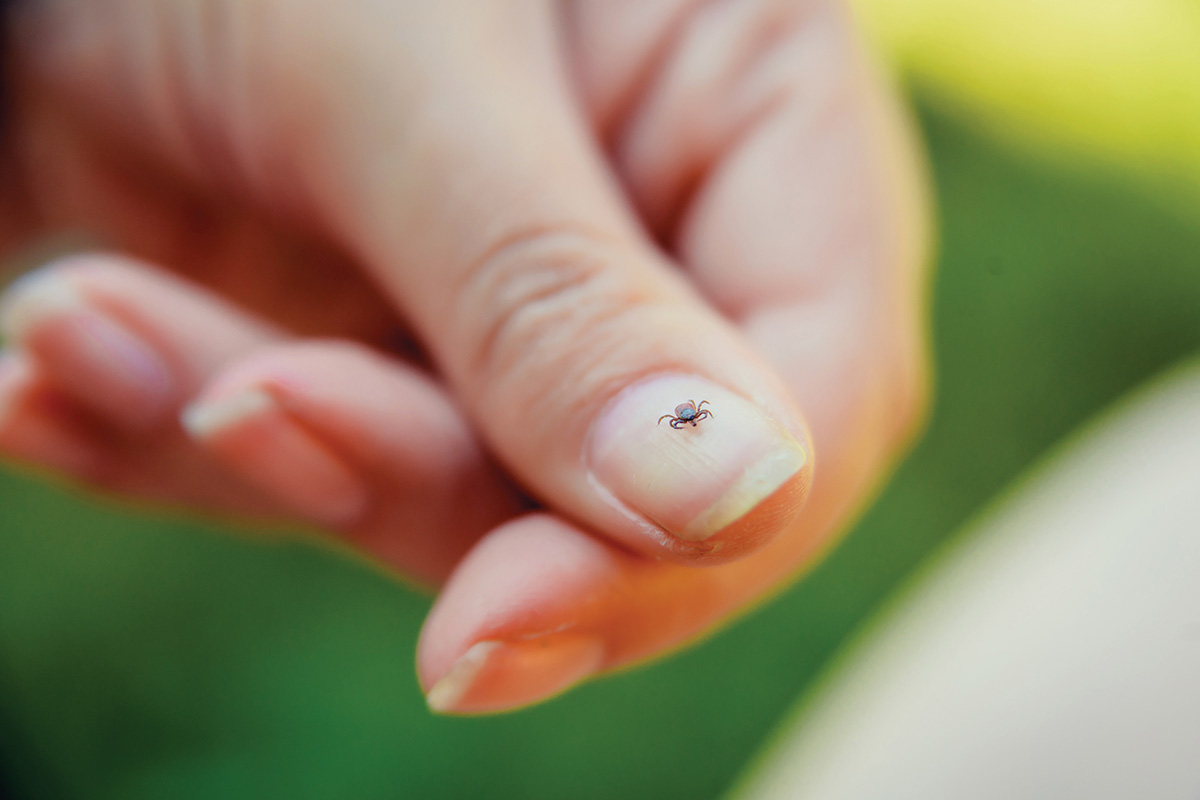
“Deer ticks that transmit Lyme disease only reach 3mm when fully grown and can be hard to see,” says Stern. “The most important areas to check your horse for ticks are the chest, belly, flanks, mane, tail and ears—places where the skin is thinner and ticks can more easily attach.”
Deer ticks that cause Lyme disease are only 3 mm in size; use your fingers to feel around areas of your horse that ticks most commonly attach to. Photo by Malykalexa/Adobe Stock
Even if you take precautions such as using tick repellents and keeping your horse out of areas ticks might frequently hang out, your horse will inevitably pick up a tick or several during tick season. Stern cautions that there are a lot of myths about the best way to remove a tick from a horse.
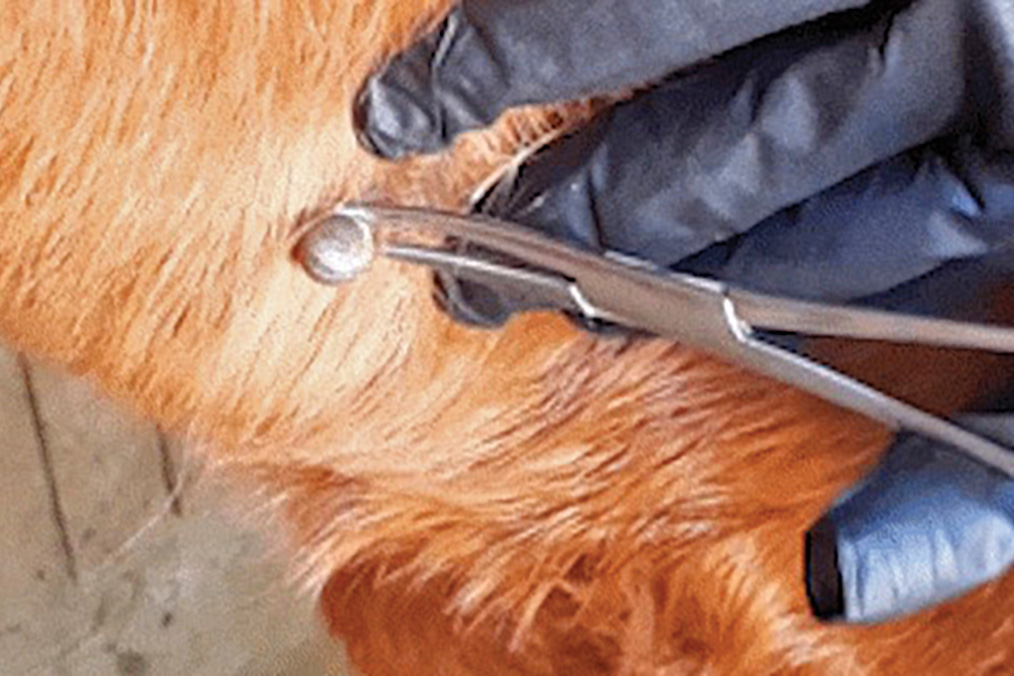
“You don’t want to crush the tick, use a hot match, or apply something like baby oil to try to smother it,” she says. “Instead, put on a pair of gloves and take tweezers and grasp the head of the tick close to the site of attachment to the horse. Then, slowly pull the tick away at a 90-degree angle from the horse. This will allow you to remove the entire tick.
“After you remove the tick, wash the skin in the area where the tick was attached with a mild soap and then wash your hands,” Stern continues. “Ticks should be placed in a jar of isopropyl alcohol, which can be disposed of when full. If you notice that the head of the tick wasn’t removed from the horse, contact your veterinarian, as the site can become infected.”
Use gloves and slowly tweeze the tick off the horse at a 90-degree angle. Wash the area with soap and water and deposit the tick into isopropyl alcohol. Photo by Pixabay
Metcalf agrees that physically removing ticks from horses with your fingers or a hemostat-like instrument is a safe removal method. However, he says some owners might want to kill the ticks first with a permethrin spray, then use physical removal methods.
“Your veterinarian is your best source of information about preventing or controlling ticks,” adds Stern. “They have knowledge of which products work best in your area and the best control strategy, given your horses and your facility. Having preventative measures in place before you have an issue is best. Scheduling a visit with your vet in the late winter or spring is an ideal time to get a holistic tick-control program set up for your horses, but it’s never too late in the year to reach out and get an expert opinion from your vet.”
Ticks and Horses: Key Takeaway
Because ticks can transmit serious diseases, it’s crucial for horse owners to stay vigilant by regularly checking their horses for ticks and taking preventive measures to reduce exposure. By staying informed and taking action early, you can minimize the risk of tick infestations and ensure your horse remains healthy and comfortable.
Horse owners who live in the United States, are 18 years of age and older, and currently own or manage at least one horse are invited to complete the survey. The survey, conducted every three years, will gauge participation trends and management practices in the U.S. equine industry, identify critical issues facing the equine industry as perceived by those who own or manage horses, and better understand issues on horse health.
The survey is sponsored by Zoetis™ and will launch in early 2025. Information will be available on the AHP and member media channels. For more information, visit www.americanhorsepubs.org.
The purpose of the AHP Equine Industry Survey is to gauge participation trends and management practices in the U.S. equine industry. In addition, it seeks to gather information regarding the most important issues facing the industry.
Those eligible to participate in the survey are men and women, 18 years of age and older, who currently own or manage at least one horse and live in the United States. This survey is anonymous. No one, not even members of the research team, will be able to associate information with responses. When the survey results are tallied, only aggregated results will be presented.
The survey is being conducted for American Horse Publications (AHP). AHP is a nonprofit association that promotes excellence in equine media; members include equine-related publishing media, media professionals, students, organizations, and businesses. Dr. C. Jill Stowe is providing consulting services for data collection and analysis to the AHP; Dr. Stowe is currently a professor of Agricultural Economics at the University of Kentucky. Zoetis, Dr. Stowe, and American Horse Publications have partnered on all six surveys in 2009-2020, 2015, 2018, 2021, and 2025.
The final report and survey supplemental data are only available to the sponsor and the current members of American Horse Publications.
Results of previous surveys are also available to current AHP members on request. Contact Amy Sales at amy.sales@easterassociates.com.
Is your horse cold in the winter? The following excerpt from Keeping Horses Outdoors by Iveta Jebáčková-Lažanská helps answer that question by addressing the science behind your horse’s temperature management.
Horses are naturally equipped to handle the colder months; summer heat tends to cause them more trouble than winter temperatures. As soon as the days begin to shorten in the fall, hormones responsible for coat growth kick into action by beginning to produce longer and thicker hair as well as a thicker undercoat. In addition to daylight, temperature plays a role: thermoreceptors will perceive a cold autumn and trigger the growth of a thicker coat. If a horse is kept indoors or blanketed, horses adapt by producing less winter fur.
As soon as the days begin to lengthen in December, horses will stop producing warmer coats, even if January brings extreme cold. This isn’t something to worry about, as horses who have spent the seasons in the same place will have a well-established coat—even a sudden hard frost won’t be an issue. (This is why it’s best to transition a horse from an indoor situation to your outdoor stabling in spring or summer.) However, it’s important to have well-fitting blankets on hand in case a horse develops a problem regulating his temperature due to illness. I’m not a fan of preventative blanketing for outdoor horses, but this doesn’t excuse irresponsibility. Each horse should have at least one insulated blanket and a waterproof sheet, even if they both gather dust for years. At the end of the day, it’s better to have an unnecessary blanket in your closet than to have a shivering, wet horse out in a blizzard. Calling a vet at night is a much greater inconvenience and expense than finding good blankets for your horses.
One of the most frequently asked questions in the early days of outdoor horse keeping was whether horses were cold living out in the winter, and the answer, more often than not, was: they’re horses, not people… they’re fine! But many caretakers, especially with purebred horses, saw the exact opposite: simply put, their horses were cold. It doesn’t always require the coldest temperatures, but sometimes just a quick drop from warm to cool. Cold, wet weather can really have an impact on a horse’s well-being. Wild animals have far more options when it comes to finding shelter from the wind and cold. They can find shrubs, tree cover, or uneven terrain to protect them from wind gusts.
Photo by Jana Sotonová
Maintaining an optimal body temperature is an absolute necessity for any warm-blooded organism. A constant body temperature ensures the normal functioning of bodily processes. The heat that a horse receives from his environment, together with the heat he produces, must be in equilibrium with output. If this equilibrium is disturbed, overheating or excessive cooling can make a horse very uncomfortable and even quite sick.
A horse’s muscle mass is excellent at retaining the heat produced by processes like digestion (fermentation of fiber in the intestines) and producing heat through exercise. A horse’s core isn’t subject to temperature changes based on his surroundings (because horses are warm-blooded), but the peripheral parts of the body (ears, hooves, skin) behave much like a cold-blooded animal’s would: they partially adjust to the ambient temperature, helping to maintain a stable core temperature. This is why you can’t tell whether a horse is cold by feeling his ears!
Temperature Management
Horses are excellent at regulating blood flow in the subcutaneous vascular network, which significantly influences temperature management of the entire body. Heat loss can be managed by vasoconstriction: blood flow is reduced in areas where blood would be cooled by being close to the surface of the skin. Horses are also able to cool off through vasodilation: by expanding these same blood vessels, surface contact is maximized and excess heat is transferred through the skin.
Skin, subcutaneous tissue, and fat act as powerful insulators. For this reason, it’s a good idea to have horses go into the winter season with a few fat reserves—they will be far less bothered by the cold than a skinny or underweight horse.
Photo by Marie Bulvová
Also, a well-made shelter can help protect a horse from the worst weather—an animal protected by a shelter can save up to 25 percent more energy reserves than an unprotected one. This is no small thing on difficult days! Horses that aren’t as cold on a windy, heat-robbing day will consume hay at a more relaxed pace as well, saving some strain on your wallet. A well-thought-out shelter, whether you build new or rebuild by converting an existing building, is an investment which will pay you back over time.
Shivering
Some take a shivering horse as the definitive signal that it’s time to blanket. Others believe that because shivering produces heat, the horses are warming themselves and are actually fine. So what’s the real story?
Peripheral thermoreceptors are activated by the skin becoming cold. As soon as a horse’s usual defenses fail to maintain a comfortable temperature—hair bristling (increasing the coats’ ability to insulate against the cold) and vasoconstriction (narrowing of the subcutaneous blood vessels)—the horse will begin to shiver. Using muscle tremors, the body will be able to increase heat production by about 30 percent. But there’s a catch—this only works for a short time, and it uses a great deal of energy.
Unfortunately, the first horses to begin shivering are usually somehow compromised: skinny, sick, old, or recovering from illness or injury. These horses are the ones with the smallest energy reserves, but even a fat, healthy horse can’t produce heat for long by shivering—the energy necessary for such demanding work is exhausted early. Although the body has other defenses against the cold as well (accelerated metabolism, for example), their effectiveness is limited. Shivering should be considered a sign that your horse is headed toward hypothermia—don’t take it lightly.
Tip: If you aren’t sure whether your horse is cold, place a hand by the elbow of a front leg. If this area is cold, your horse is cold enough that he’s uncomfortable.
Hali, a young, affectionate mare, arrived at Longmeadow alongside a large group of horses from a neglect situation. Although she was in the best condition in her group, it still took time to earn her trust.
Hali’s kind eyes and beautiful markings have melted several staff members’ hearts. Her sweet disposition and curious mindset have made her easy to handle on the ground.
However, prior to arriving at the Ranch, Hali was put into training and had severely injured the trainer while under saddle. Due to her previous history, Longmeadow took their time establishing a trust on the ground before attempting to evaluate her. While they gauged her level of knowledge under saddle, they found she was quite nervous and tense. They believe she still carries bad memories of her previous training, and thus she needs to be completely started over by a professional trainer. Hali gets along well with mares and geldings, and is easy to catch!
Hali has been diagnosed with recurrent uveitis but she is wonderful for her eye meds and at this time, her flare-ups are minor and easily managed.
Photo courtesy Longmeadow Rescue Ranch
Contact Longmeadow Rescue Ranch today about ASPCA Right Horse Adoptable Horse of the Week, Hali!
ASPCA Right Horse
ASPCA Right Horse is the online adoption platform of The Right Horse Initiative, a collection of equine industry and welfare professionals and advocates working together to improve the lives of horses in transition. A program of the ASPCA, their goal is to massively increase horse adoption in the United States. To find more adoptable horses and foster horses, visit www.myrighthorse.org. To learn more about The Right Horse, a program of the ASPCA, visit www.aspcarighthorse.org.
We use cookies to help personalize content, tailor and measure ads, and provide a safer experience. By navigating the site, you agree to the use of cookies to collect information. Read our Cookie Policy.