6 ITEMS
 
    • horse illustrated – june 2023 digital
    • Horse Illustrated – June 2023 Digital

    • $3.99
    • young rider july/august 2023
    • Young Rider July/August 2023

    • $5.99
    • young rider july/aug 2023 digital
    • Young Rider July/Aug 2023 Digital

    • $3.99
    • horse illustrated – july 2023 digital
    • Horse Illustrated – July 2023 Digital

    • $3.99
    • young rider may/june 2023 digital
    • Young Rider May/June 2023 Digital

    • $3.99
    • horse illustrated – may 2023 digital
    • Horse Illustrated – May 2023 Digital

    • $3.99
  • My Account
  • Holiday Gift Guide
  • Podcast
  • Webinar
Subscribe Combo
Enable cache13
Home Blog Page 636

Equine photography tips from John Hockensmith

3

Professional horse photographer John Hockensmith was the judge for the 2011 installment of our annual photo contest. We asked him to offer some advice for aspiring photographers. Click here to see the winners of the 2011 photo contest.

What advice do you have for amateur photographers?
There is no written matter that can substitute for experience. Get a camera and get busy. The empirical knowledge you gain from trial and error will supersede and validate all reading and theory.

What are some of the most common mistakes amateur photographers make?
Don’t expect that if you buy a better camera it will improve your photo skills or photography knowledge. “Camera envy” can stop you from being creative or effective. I’m often asked, “What kind of camera did you use?” The correct answer is, “It doesn’t matter.” I do what the camera requires to get the shot. The camera is just an instrument, like a guitar to a musician. You must learn your camera and explore its possibilities. A photographer is only as good as their experience and imagination. Don’t let “camera envy” be an obstacle.

What are some of the most important things to consider or think of before snapping a picture?
It is good to pre-visualize your assignment, asking yourself, “What do I really need to accomplish great results?” Ask yourself what lens you should use, what camera body, how much file storage or film is needed; should you take a monopod or a tripod? Furthermore, ask yourself what you don’t need. Try not to be bogged down like a pack mule. Photography is about exploring light, shadows, action and the moment of expression. Don’t carry around a camera store and suffer from “camera paralysis” or indecision when the perfect moment elapses.

What are your top tips for specifically taking photos of horses?
In equine photography, your photography plan should take into account typical horse behavior. Before beginning any equine photo shoot, I always have my selected camera settings in place. I go over a checklist of exposure, white balance, aperture, shutter speed, focus point and focusing mode, file size and frame per second selection. When the action begins, it usually is active for only a minute or two; then I can get all the grazing pictures I need.

Is there anything else that is important for people to know about when photographing horses?
Know all you can about equine behavior. It is also important to know the sun movements, the weather predictions, and the time of sunrise and sunset. Great light with long shadows is consistently in the early and late hours depending on the season and the latitude of the location. Ask yourself if your camera needs a rain coat. Some of the very best images I have ever taken have been in the rain. Not all photographers dare to capture that rainy mood.

Further Reading
Photo tips from Christina Handley
Photo tips from Bob Langrish
Photo tips from Sharon Fibelkorn
Photo tips from Shawn Hamilton

Young Paint Horse exhibitors compete in Fort Worth, Texas

1
American youth paint horse show
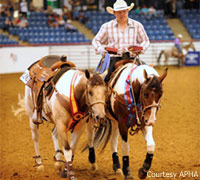
Marcus Banister took home the largest sum of jackpot money at the Youth World Championship Show. Photo courtesy APHA.

The dust has settled on the 2011 American Junior Paint Horse Association’s (AjPHA) Youth World Championship Paint Horse Show, which was held June 24 – July 2, 2011 in Fort Worth, Texas at Will Rogers Memorial Center.

The AjPHA Youth World Show showcased the talent of both the Paint Horse breed and the young people who exhibit them with 73 world-title classes in a full array of disciplines, in addition to a handful of assorted other classes specifically for the youth competitors. Youth are classified as competitors ages 18 and under showing a horse they own personally or owned by a family member.

In all, both the breed and the upcoming generation were well represented by 326 horses and 1,150 entries during the course of the nine days’ worth of activities where the Association presented over $100,000 in cash and prizes. World and Reserve World Champions received Gist trophy buckles, and top ten finishers received a variety of other valuable prizes from sponsors and APHA. Total payout in the six jackpot classes offered (barrel racing, pole bending, breakaway roping, heading, heeling, and steer stopping) reached $1,525, with the largest total sum of $333.75 going to Marcus Banister of Brighton, Colorado.

Top Finishers
The top youth were recognized for their culminated efforts at the completion of the show with the Youth Awards Presentation on July 2 that followed the Stickhorse Class, Parents’ Western Pleasure, and the Youth Versatility Challenge.

The overall division high-point and all-around standouts from the 2011 AjPHA Youth World Show are:

All-Around 14-18
Taylor Prince, Las Vegas, Nevada showing One Flashy Sensation
Western trophy saddle from Blue Ribbon Custom Tack; Saddle pad from Purina; Embroidered horse blanket from Big D; 16”x20” photograph courtesy from Montgomery Photographics; Insulated carryall from Paint Horse Journal (PHJ).

All-Around 13 & Under
Drew Rogers Bakersfield, California showing Shez Eye Candy
Western trophy saddle from Blue Ribbon Custom Tack; Saddle pad from Purina; Embroidered horse blanket from Big D; 16”x20” photograph courtesy from Montgomery Photographics; Insulated carryall from Paint Horse Journal (PHJ).

All-Around Novice Youth and Reserve All-Around 13 & Under
Alexandra Marlow Victoria, Texas showing Glowin Easy
Embroidered horse blanket and arena bag from Big D; Bronze statue from Cowboy Bronze; Splint boots from Purina; 11”x14” photograph from Montgomery Photographics. AND Western trophy saddle from Blue Ribbon Custom Tack; Saddle pad from Purina; Embroidered arena bag from Big D; 16”x20” photograph from Montgomery Photographics; Insulated carryall from PHJ.

High-Point Walk-Trot
Morgan Deuschle Bishop, California showing One Hot Machine
Western trophy saddle from Blue Ribbon Custom Tack; Saddle pad from Purina; Embroidered arena bag from Big D; 11”x14” photograph from Montgomery Photographics; Insulated carryall from PHJ.

High-Point Western
Marcus Banister Brighton, Colorado showing Sacreds Barbie Doll
Western trophy saddle from Blue Ribbon Custom Tack; Saddle pad from Purina; Embroidered arena bag from Big D; 11”x14” photograph from Montgomery Photography; Insulated carryall from PHJ.

High-Point English
Halley Armstrong Breckenridge, Colorado showing Brother Jack Daniels
English saddle package from Alliance by Lynn Palm; Embroidered arena bag from Big D; 11”x14” photograph by Montgomery Photographics; Insulated carryall from PHJ.
American youth paint horse show
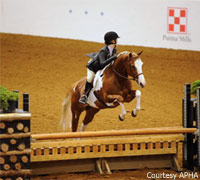
Lauren Spivey and her horse A Son Of A Zip, demonstrated excellence in the Youth Working Hunter 14-18 class by winning the World Championship. Photo courtesy APHA.

Elegant April Award
Lauren Spivey The Woodlands, Texas showing A Son Of A Zip
Trophy and $200 U.S. Savings Bond from Jennifer & Margie Chan.

Fun Activities
Although the intense competition in the arena was top priority, second on the list for show organizers was providing opportunities for fun interaction among the visiting youngsters and their families. In addition to shopping the vendors in the Colors of the West Gift Show, and a dedicated room set up with couches, a Wii and television called the “Youth Lounge,” AjPHA members, exhibitors and their families had 21 separate events in which they could participate.

The new Youth Boot Camp gave novices and first-timers a full day of hands-on instruction from three of the top trainers in the industry: Mason Lyons, Carly Veldman and Andrea Simons. The AjPHA Year-End Awards Banquet provided an opportunity for the Association to honor the top competitors from 2010. The third annual Paint For A Day youth open all-breed horse show gave local youth the chance to check out the Youth World Show with their own horses, while the Hart Youth Horse Judging Contest drew nearly 200 up-and-coming judgers. Event sponsor Hart Trailers awarded $500 scholarships to the top junior individual (Jayni Garrison—Gulf Coast Paint Horse Club) and top senior individual (Kelsey Ritchie—Tulsa County 4-H).

Other highlights of the 2011 AjPHA Youth World Show were the AjPHA National Convention, the new clue of the day contest, the ever-popular Youth Team Tournament, a boot scramble, youth welcome party with live band sponsored by Double C Acres-Jeffrey Gibbs-John Simon, horseless arena games and activities night, Metro Golf Car decorating contest, coloring contest, youth exhibitor social sponsored by The Fortenberry Family & Gillespie Show Horses, championship dog races, and an ice cream social sponsored by Purina.

About the AjPHA Youth World Show
The World Championship Paint Horse Shows feature the finest gathering of Paint Horses from around the globe. APHA hosts two annual World Shows to showcase the talents of American Paint Horses and their owners; the AjPHA Youth World Championship Show in the summer; and the Open/Amateur World Championship Show scheduled November 2-12, 2011.

The APHA, founded in 1962 and headquartered in Fort Worth, Texas, is the international breed registry for the American Paint Horse. In fulfillment of its mission to collect, record and preserve pedigrees of the breed, APHA recognizes and supports 111 regional and international clubs, produces championship shows, sponsors trail rides and creates and maintains programs that increase the value of American Paint Horses and enriches the members’ experiences with their horses.

APHA has registered over one million horses in 59 nations and territories since it was founded, and now serves approximately 64,000 active members around the world.

For more information about APHA and the AjPHA World Championship Show, including entry details, results and a list of competitors visit aphaworldshow.com or call APHA at (817) 834-2742.

Bit of Britain introduces Chase the Challenge Across America

2


John Nunn, owner of Bit of Britain, thought, “Shouldn’t the lower level event riders feel as though their efforts are rewarded?” It’s this thought that led Nunn to create the Chase the Challenge Across America.

In some disciplines, one may reap the benefits of money spent through winning a class with a cash prize. But in eventing, that doesn’t happen very often so what are the benefits?

For the rest of the 2011 season at recognized horse trials across the country, any horse and rider combination that wins two shows back-to-back in levels Beginner Novice through Training will win a $25 gift card to Bit of Britain and a pair of Nunn Finer Brushing Boots ($48.95 value).

“We know it’s not much, but it’s something,” said John Nunn, owner of Bit of Britain. “We wanted to offer a national challenge for the lower levels that would help motivate people to keep entering shows. In the horse world, every dollar counts, and that $25 gift card could go towards something this competitor needs to keep showing.”

In addition, this $25 amount was chosen in celebration of Bit of Britain’s 25 years in business.

This horse and rider combination may win by winning two shows back-to-back at the same level, or by winning a show at one level, and then advancing one level and winning at the next show (e.g. winning Beginner Novice and Novice or Novice and Training). If the horse and rider combination wins two shows while moving up a level, they will win an additional $10 ($35 gift card and Nunn Finer Brushing Boots).

You don’t have to win at the same venue to be eligible. You can compete at any show across the country, as long as your wins are back-to-back.

If you won before Chase the Challenge started in the 2011 season, as long as you win your second consecutive show in July you are eligible to win (i.e. you won in April and won your second show of the season in July).

What to do if you win two shows back-to-back? First, go online to www.useventing.com and verify that your scores are posted (amateur scoring excluded). When you’ve seen that your wins are posted, call up Bit of Britain at 888-442-5015 with your name and USEA number ready. Our Customer Service Representatives will verify your two wins and then send you your prizes!*

There are no strings attached! As one of the largest supporters of this sport, Bit of Britain, as always, wants to give something back to its competitors.

For more information regarding Chase the Challenge or Bit of Britain contact Molly Gasiewicz at molly@bitofbritain.com or by calling 610-998-0400×26.

*Winners will only receive their prizes by calling in; Bit of Britain will not be tracking scores. Verification could take up to two (2) weeks depending on when your scores are posted on the USEA website.

Horse Illustrated 35th Anniversary Memory Game

25

This page requires Adobe Flash Player

Get Adobe Flash player

Question of the Week: Fecal Egg Count

5


Q: I recently had a fecal egg count done for my horse, and after we got the results, it was recommended that I deworm him with fenbendazole for five consecutive days, then wait ten days to deworm him again. Is this safe? Are there side effects I should watch out for?

A: Fecal egg counts (FECs) are an extremely important tool in today’s equine parasite control programs. For decades, horse owners and veterinarians alike merely administered dewormers because it was understood this was part of the routine management of horses, whether the animals needed the medication or not. This, among other practices, has caused the rapid development of antiparasitic resistance whereby a certain drug may not work anymore on a particular population of parasites. Antiparasitic resistance is already a huge problem of international concern in the small ruminant (sheep and goats) industry and it is a matter of time before this problem reaches the horse world if proper scientific and pharmacological practices are not implemented on a routine basis. FECs are one such practice.

FECs are performed on a fairly fresh fecal sample that your veterinarian examines under the microscope. Parasite eggs are then counted and used to infer the approximate parasite load in your horse. FECs provide your vet an objective measurement of the parasite burden in your horse at a particular point in time. If the FEC reveals a certain level of eggs beyond which is acceptable, then it is appropriate to treat your horse with a dewormer. FECs prevent treating horses who are not infected at all or who only have a low acceptable number of parasites, keeping in mind that up to a certain level, some parasites are tolerable in your horse’s gut.

FECs can also identify, to an extent, what types of parasites are infecting your horse. Knowing both the amount of infection and what worms are involved greatly helps your vet decide on the appropriate dewormer to use since not all dewormers are created equal. Take a peek in the equine section of your local farm supply store or catalog and you may likely get overwhelmed by the myriad of different brands of dewormers. The worms that are sensitive to each drug are listed on the label, making it a little easier to narrow down the choices once you know what your horse is infected with.

The recommendation to treat your horse with fenbendazole in such a way has been marketed as a “PowerPac”. This is indicated for cases of small strongyles, a very common type of equine internal parasite, and is a common way to deworm horses.

Fenbendazole is an extremely safe antiparasitic and in fact one of the safest drugs you can give your horse. It has been demonstrated that fenbendazole is safe even when overdosed at one hundred times the appropriate dose. Aside from the safety of the drug, the level of parasite load being targeted may have an impact on a horse’s health. Occasionally, severely parasitized horses can suffer hypersensitivity reactions to the sudden kill of a large amount of parasites in their gut. A large parasite kill can also occasionally result in intestinal impaction, as the massive amount of dead parasites travels through the gut en route to be expelled. Each of these scenarios, however, is reserved in rare cases of extreme parasitism.

— Anna O’Brien, DVM

Ask your questions on the horseillustrated.com Forums >>

See more Expert Q&As >>

Submit your Ask the Expert question >>


Now in Session: Kindergarten

3

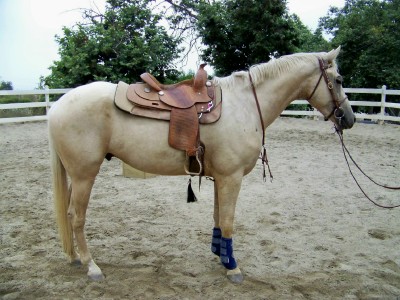
Summer usually means vacation time for school kids. But for young horses it’s often the season when they start school. Such is the case for Cowboy. He’s the palomino gelding that came to be when my mom and sister decided to breed the last of our family’s warmblood mares.

Cowboy was created with the idea that he’d turn out to be just a nice, general purpose riding horse. Both my sister and I figured he’d become the sort of creature that we could both ride, either English or western. However, with his elegant trot and flowing canter he seems better suited for someone hoping to compete in lower level dressage or hunters. Regardless of whether we keep him or sell him, the golden gelding must be trained, and neither my sister nor I have the time or motivation to put the first 20 rides on a 16-hand baby anymore. It’s a job best left to the professionals at this stage of our lives.

Cowboy got a good start last summer. I did several months of ground-driving with him. Then a local western trainer introduced him to the feel of a rider on his back. Because he was still growing, we decided to give him more time to mature. We turned him out at home until he officially turned three. Then, a couple of weeks ago, we shipped him off to boarding school.

It’s back to school for Cowboy, and here he is after just completing a workout in the round pen.

Cowboy is spending the summer with Molly, a trainer I met who impressed me with the way she handles and starts fresh-off-the-range BLM mustangs. She uses good, solid horsemanship fundamentals; there’s no nonsense and no foo-foo fluff in her approach. Yet she’s also kind and forgiving with insecure greenies. Beyond that, she spent decades on the show circuit, producing several national champion Arabians. I figure that if you can communicate effectively with sensitive, hyper-intelligent Arabians without losing your cool, training a warmblood should be a piece of cake. Plus Molly’s got a wicked sense of humor, a bonus when you’re working with both horses and humans.

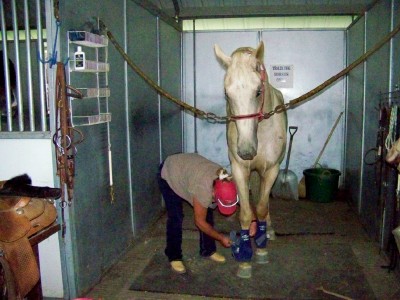
Part of becoming a civilized horse, as far as I’m concerned, is learning to stand patiently in the cross-ties.

Right now Molly is focusing on getting Cowboy to flex at the poll and yield or “give” to the bit. He’s also learning to move away from leg pressure. These are all major achievements, because without these skills the rider really has no way to communicate with the young horse.

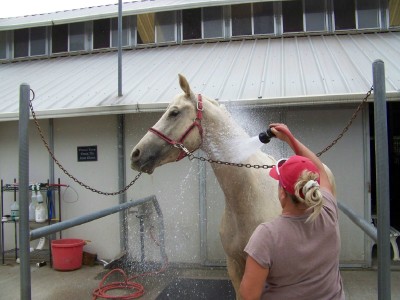
Of course we all need to take a shower after exercising, right?

After a few more rides Cowboy should graduate from the round pen to the arena. That’s a major step, because the view from the arena is polka dotted with distractions. There’s always something going on, from feed trucks delivering hay to boarders saddling up their horses and lesson kids bobbing up and down at the posting trot. Add a small herd of barn cats to that and you have quite a combustible commotion on any given day. Yet all of this will make Cowboy more desensitized—and more broke—by the time he comes home at the end of summer. So much for a young horse’s vacation time!

<< Previous Entry

Back to Life with Horses

American riders find success at the 2011 World Equestrian Festival

3
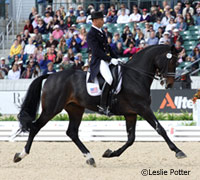
Steffen Peters and Ravel
Steffen Peters and Ravel, shown here at the 2010 Alltech FEI World Equestrian Games, finished a close second behind Matthias Rath and Totilas in the Grand Prix Freestyle at Aachen. Photo: Leslie Potter

Team USA wrapped up the 2011 World Equestrian Festival CHIO in Aachen, Germany with more strong performances, including a second place finish for Steffen Peters and Ravel in the Grand Prix Freestyle CDIO and a win for show jumper McLain Ward on Rothchild.

Peters and Ravel, owned by Akiko Yamazki and Four Winds Farm, stepped up their game today and gave the best dressage horse in the world a run for his money in the Grand Prix Freestyle CDIO for the Deutsche Bank Prize.

The judges gave Ravel and Peters technical scores of 77.25, 77.00, 80.50, 80.50, and 76.75, along with artistic scores of 86.00, 83.00, 83.00, 89.00, and 87.00 for an overall 82.000%, just .825% off the winning score set by Matthias Rath (GER) and Totilas.

According to Dressage-news.com, Peters said, “It felt fantastic. I’m still searching for words to describe it. The icing on the cake was the reaction of the crowd. That was a huge honor. I finished fifth in the Grand Prix and the Special, so to come within fractions of Totilas and Parzival in the freestyle is amazing.”

Win for Ward on Final Day
The American show jumpers were strong in one of the last classes in Aachen, the Yageo Prize speed class. McLain Ward and Rothchild, owned by Sagamore Farm, were the fastest of the day to take the win in 55.00 seconds. Just .85 seconds behind in second place were Margie Engle and Indigo, owned by Griese, Garber, Gladewinds Farm, and Hidden Creek Farm. Beezie Madden and Amadora, owned by Abigail Wexner, placed fourth.

In the final competition for driving, Chester Weber with four-in-hand team of Horus du Bois, Para, Splash, and Uniek, placed second with a time of 122.68 in the Obstacle Driving Competition with drive-off, Rating Competition for Team Classification for the Prize of Coca-Cola Erfrischungsgetränke AG. It was a solid finish for the American driver who placed third in the overall individual standings.

For full results, please visit www.chioaachen.de/en/starterlisten. For more information on the Team athletes in Aachen, please visit www.usef.org.

To see photos and videos from Aachen, click here.

Protect your horse from flies this summer

6

Flies on a foalShoo fly, don’t bother me! Summer time is prime time for increased numbers of various types of flies that can irritate your horse and you. Put away that fly swatter because there are better measures that can be taken to limit the number of flies.
“Stable flies, horse flies, black flies, deer flies, sand flies and biting midge flies — so many flies. They all can bite your horse, draw blood and possibly cause allergic reactions,” notes Dr. Glennon Mays, clinical associate professor at the Texas A&M College of Veterinary Medicine & Biomedical Sciences.

“Flies will probably not be completely eliminated from your horse stable,” states Mays. “But, there are control measures that can be put in place to decrease the fly population in your horse facilities. Since stable flies are one of the most common summer pests your horse will encounter, I’ll focus on this fly.”

Stable flies feed on the blood of warm blooded animals, explains Mays. They pierce the skin with their mouth parts, lacerate the skin and then inject saliva which contains an anticoagulant that keeps the blood flowing. The bite can be painful and irritating. Depending on your horse’s skin sensitivity, there could also be a reaction to the bite. Stable flies usually feed during the early morning hours and again in the late afternoon. They also feed selectively preferring the legs and belly to other areas of your horse’s body.

“The female stable fly requires blood meals to produce viable eggs and surprisingly, eggs are deposited in decaying animal and plant waste, generally not in fresh manure,” notes Mays. “Fly larvae can develop in stable waste that is a combination of damp straw and manure, or under hay bales that are in contact with moist soil. In the warm summer, the entire life cycle from egg to adult can be completed in three to six weeks.”

The hot summer temperatures promote increased fly numbers, but sound sanitation practices in conjunction with other controls can decrease fly populations, says Mays. Reduce larvae development by eliminating the environment where they can develop. Spread manure and stable bedding regularly so that it will dry out fast as possible. Modify drainage areas so that excess water is eliminated.

When stable flies finish feeding, they seek a place to rest and digest their blood meal. This instinctive habit makes way for control of adult flies with residual insecticides sprayed on stable surfaces, explains Mays. Sides of buildings (inside and outside), stall surfaces and fences are all areas where flies can be found resting. Residual insecticides can provide fly control over a period of time. Be sure to follow label recommendations for use, mixing and spraying.

“Sprays and dusts may be used to protect your horse, but these usually have short residual effect,” notes Mays. “Repellents containing DEET are better suited for mosquitoes rather than flies.”

The number of flies produced by a pair of stable flies and their offspring in the summer months is in the millions. Therefore, it is best to establish good fly control practices. A sound sanitation program is the first step needed to decrease stable fly populations at your horse facilities.

“It will take a combination of controls to decrease stable fly numbers. You need to implement measures to decrease fly breeding and larvae hatching. Any stable flies that make it through these stages should be chemically controlled with residual insecticides and direct animal applications,” explains Mays.

Knowledge of some basic stable fly facts in addition to good stable management practices will help you to have a winning chance against the pesky stable fly.

Further Reading
Shoo Fly
Fly Control

Horse Illustrated 35th Anniversary Jigsaw Puzzle

19

This page requires Adobe Flash Player

Get Adobe Flash player

0

Horse Illustrated Winter Warmup Giveaway

Enter the Horse Illustrated Winter Warmup Giveaway for a chance to win great prizes.


0FansLike
0SubscribersSubscribe
We use cookies to help personalize content, tailor and measure ads, and provide a safer experience. By navigating the site, you agree to the use of cookies to collect information. Read our Cookie Policy.
OK