0 ITEMS
  • My Account
  • Holiday Gift Guide
  • Podcast
  • Webinar
Subscribe Combo
Enable cache13
Home Blog Page 647

American Horse Council invites all equestrians to National Issues Forum

4

American Paint HorseThe American Horse Council’s 2011 Annual Meeting and National Issues Forum, “Congress on a Diet: What It Means for the Horse Industry,” is only a few weeks away. Have you registered for the meeting yet? Register Today!

In order to obtain the special meeting room rate, hotel reservations must be made at the Washington Court Hotel by May 27, 2011. Book your discounted hotel room today and you will find yourself greeted by a city rich with history, culture, and political influence in the heart of our nation’s capital. Only three blocks from the U.S. Capitol Building and National Mall, you will enjoy the only accommodations on Capitol Hill with a true view of the U.S. Capitol Building. Call 202-628-2100 to make your reservations today! Mention the AHC meeting to receive the discounted rate.

The 2011 National Issues Forum will be held June 21 in Washington, DC during the AHC’s annual meeting. The annual meeting will run from June 19 to 22 at the Washington Court Hotel and also include an update on the national Equine Health Initiative, the Congressional Reception and the annual Congressional Ride-In. This year’s meeting will also see the return of the AHC’s Breed Roundtable, a popular event that brings together leaders of horse associations to discuss common issues of importance to the industry. The AHC’s various committees, including the Unwanted Horse Coalition, will also meet to discuss issues affecting the equine community.

Some meeting topics that will be included are: A full meeting schedule can be seen on the Events Page on the AHC website.

“The highlight of this year’s forum will be presentations from Members of Congress, staff and federal regulatory agencies on the new fiscal realities in Washington. They will discuss how Congress’s efforts to deal with the country’s deficits may result in cut-backs to federal programs and spending that could affect the horse industry,” said AHC president Jay Hickey. “There is a new paradigm in Washington that will affect all American industries, including the horse industry.”

More information on the Forum and the entire AHC annual meeting, including registration and hotel information can be found on the Events Page on the AHC’s website or by contacting the AHC.

Question of the Week: My horse is eating tree bark

7

Q: I recently purchased a six-year-old gelding for trail riding. I’ve noticed that he drools when he is eating grain. I also noticed that he’s eaten the bark off two oak trees in his pasture. My other horse has been turned out in the same field for years and never touched the trees. Could the tree bark be harmful to him? Is he eating it because he’s lacking something in his diet? I feed him a senior feed mixed with beet pulp.

Horse and Tree


A: Drooling while eating grain is a common indicator of dental issues. Since you’ve recently purchased this horse, it’s likely you haven’t yet had a chance for your veterinarian to visit for a dental check up and you may not know the last time he’s had his teeth floated, if at all. Have your vet out for a dental visit soon. She will likely open your gelding’s mouth with a speculum, allowing her to take a good, detailed look at all his teeth, including the molars deep in the back of the mouth. Missing, broken, or otherwise unhealthy teeth frequently cause horses to drool while eating. Sharp edges on teeth created by uneven wear will create sores on the tongue and insides of the cheeks, resulting in excessive drool production. It may also be likely your horse injured the inside of his mouth by the bark that he’s munching on. Sometimes even bits can wear and cause oral injuries. All of these causes can be examined with a trusty mouth speculum, maybe some sedation, and of course a good flashlight!

Red clover in the pasture can also cause excessive drooling in horses (referred to as “slobbers”), but this type of drooling is usually seen constantly, not only when the horse is eating grain. The red clover that causes “slobbers” is infected with a fungus that produces an alkaloid toxin called slaframine. Other than causing a mess, this toxin is completely benign and the slobbers stops as soon as the horse is taken off the clover.

In terms of stripping bark off trees, your horse may be exhibiting what is called a stereotypic behavior, or vice, like cribbing. It is possible this is a bad habit your horse has brought with him to his new home, or a sign of boredom. You might consider supplying your gelding with some enrichment activities such as a HorseBall to play with in the pasture to occupy his time, his brain, and most importantly, his mouth.

Other than being destructive and annoying and eventually lethal for the trees, bark chewing isn’t typically “bad” for your horse. However, your horse may be more prone to choke, as a piece of hard bark may lodge in his esophagus. Intestinal impaction is also a risk.

Oak trees can be toxic to horses, although cattle seem to be more sensitive. Oak buds, leaves, and acorns contain chemicals called tannins which, when eaten and metabolized, can cause both renal and gastrointestinal damage. Fortunately, the bark of oak trees is non-toxic and horses generally don’t like the taste of acorns or oak leaves. Also, a few nibbles of the leaves or a mouthful of acorns is not enough to cause toxicity in your horse. Equine oak toxicosis is usually only seen in starvation cases where there is absolutely nothing else in the pasture for them to eat.

While eating bark can be considered a form of pica (a tendency to each substances other than normal food), unless this gelding came to you extremely malnourished, I wouldn’t think a mineral balance is to blame. However, your veterinarian may want to draw blood from your gelding and submit it for a mineral panel, just in case.

The senior feed you are giving him is very likely a complete, well-balanced ration that normally doesn’t require any supplementation. Make sure your gelding has access to plenty of roughage (in the form of pasture or hay), as sometimes horses will crave roughage when they aren’t getting enough. A good rule of thumb to remember is an average sized horse should consume about 1 to 2% of his body weight in roughage each day. Sometimes it’s difficult to visualize the true amount of roughage a horse needs on a daily basis – weighing hay flakes on a scale may help put the required amount in a better, more objective perspective.

Placing an equine salt/mineral block out in the field is another fairly easy tip to try. Some horses crave more salt in their diet than others and conversely, some horses do not touch a salt block at all. Of course, an old-fashioned fence around the trees may end up being the easiest method of all, that is, if all the trees are conveniently clustered together or if there are only a few!

And I Lived to Tell About It

5

*Disclaimer: The activities described in this blog, while truthful, are meant
for entertainment purposes only. Do not try these activities at home.

I am a big supporter of riding lessons for kids as well as adults. I think every rider can benefit from at least a basic introduction to safe horse handling and proper position in the saddle. While horseback riding is definitely one of those “learn by doing” sports, you can quite literally die or become permanently maimed during the educational process. That being said, when I got my first horse I was completely unsupervised. I was a feral child at the public boarding stable, left to figure out what worked—and what didn’t—when it came to sticking on the back of a horse and coercing it to follow my commands. So in retrospect, the fact that I lived to tell about some of my escapades is amazing.

Cindy's unsafe riding

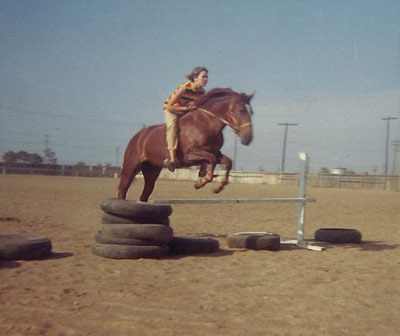
Photographic evidence of my misspent youth on horseback: No helmet, no saddle, no bridle and no instruction.

I’ll skip past my brief flirtation with barrel racing, because it was fairly unremarkable. Though my little sorrel mare, Honeybee, was spirited and nimble, she was also short-strided and slow. Gymkhana was pointless. So it was only natural that, in my pursuit of some other adrenaline infused riding endeavor, I’d try jumping. True, I didn’t have an English saddle or bridle. And I’d yet to take a single English riding lesson. But I did spend most of my afternoons riding Honeybee in the same arena as the professional hunter-jumper trainers and their students. And I observed carefully. Couldn’t I just sort of learn through the process of osmosis? Like maybe just absorb their expertise? Well, kind of.

Every afternoon, by about 5:00, the arena would clear out and the trainers would go home. That’s when my friends and I would scurry out to the arena like mice (or evil trolls, depending on your perspective) and re-arrange the jumps to our liking. Then we’d have our own free-for-all, leaping our half-broke horses over gaily painted poles and plywood boxes. To thwart these clandestine jumping derbies, the trainers would occasionally dismantle the jumps, wrap them in chains like hostages, and padlocked them together. But we’d simply improvise, creating jumps from salvaged obstacles like truck tires, hay bales and upturned wheelbarrows.

One time we found poles but nothing to support them. So we took turns functioning as human standards, cradling the poles in our hands while one of our cohorts, whose turn it was, galloped toward the suspended pole, aiming for the center in hopes of not trampling us. We’d raise the jump according to our anatomy. Connie, the eldest member of this wild bunch, gained great notoriety for riding her clunky bay gelding Bob, a horse she’d purchased for a few dollars from the rental stable, over a jump we held head-high. Fortunately, she was accurate and Bob was athletic, or I might’ve been decapitated.

If this wasn’t silly, scary, insane and potentially tragic enough, I yearned for even more daring adventures. But about the time I convinced my school chum, Laurie, to hide behind the jumps and then dart out and spook Honeybee as I approached, one of the resident trainers took me aside. Whether it was a charitable effort to save my life or a self-serving notion to get some free barnyard help, I’m still not sure. But she saw in me potential and a deep love for horses, and tapped into it. Aware that my parents couldn’t afford regular lessons, she offered to give me lessons in exchange for mucking stalls and longeing the school horses. I literally jumped at the chance.

In less than a year I was competing on the A-rated circuit and winning good ribbons in equitation. Some of the wealthy horse owners even let me show their fancy jumpers. My life with horses has been a series of adventures ever since. Without structured, professional guidance I probably wouldn’t have discovered all the opportunities that horsemanship provides. But those first few wild years, where I was forced to develop a natural seat and respect the power of a horse, had importance, too. I’m just lucky I lived to tell about them.

<< Previous Entry

Back to Life with Horses

Conserve gas when trailering your horse

6

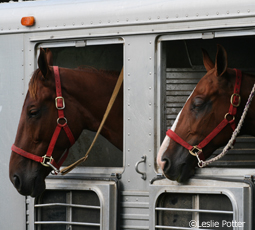
Horses in trailerCrude oil prices continue to remain over $100 a barrel in 2011, with resulting gasoline
prices reaching $4 per gallon. It will be more important than ever to conserve energy and
save fuel costs. You can improve your fuel economy – as well as your safety and the safety
of your horses – by following these simple tips:

  • Drive more efficiently.
  • Keep your vehicle properly tuned.
  • Plan and combine trips.
  • Choose a more efficient vehicle.

Horse owners can do their part to reduce their fuel consumption with practical travel
tips that actually work.

The energy market is extremely volatile and could increase, putting additional strain
on budgets.

USRider urges horse owners to take a multi-faceted approach to conserve energy and to
lower their overall fuel costs while traveling with their horses. Here are some
suggestions for conserving fuel while traveling. These tips work for most vehicles:

Vehicle Maintenance

  • Keep Engine Properly Tuned – Depending upon the kind of repair done, this can result
    in an average 4 percent increase in fuel efficiency. Replacing a faulty oxygen sensor can
    improve fuel mileage as much as 40 percent.
  • Check & Replace Air Filter – Replacing a clogged air filter can improve your vehicle’s
    mileage up to 10 percent.
  • Keep Tires Properly Inflated – Proper inflation can increase your mileage by around 3
    percent. An added benefit is that properly inflated tires are safer and last longer.*
    Use Recommended Grade of Motor Oil – Using the incorrect weight can increase fuel
    consumption by 1-2 percent. Look for motor oil that says “Energy Conserving” on the API
    performance symbol to be sure it contains friction-reducing additives.

Vehicle Operation

  • Drive Sensibly – Aggressive driving can lower your fuel mileage by one-third. Sensible
    driving is also safer for your horse(s).
  • Observe the Speed Limit – The Department of Energy says that each 5 mph you drive over
    60 mph is like paying an additional $0.21 for each gallon of fuel. An added benefit is
    that observing the speed limit is also safer for your horse(s).
  • Avoid Excessive Idling – Idling gets 0 miles per gallon.
  • Use Cruise Control – Using cruise control (where applicable) helps you maintain a
    constant speed and, in most cases, will save fuel. Do not use cruise control if you are
    tired or fatigued. In fact, if you are tired or fatigued, you shouldn’t be trailering
    horses.
  • Use Overdrive Gears – When your engine speed goes down, your mileage goes up. An added
    benefit is that using overdrive gears reduces engine wear.

Vehicle maintenance and safe operation also helps the environment. A properly tuned
vehicle with correct tire inflation, driven at the correct speed reduces the detrimental
impacts automobiles have on the environment.

“Another tip is to lower your fuel costs by shopping around,” said Bill Riss, general
manager for USRider. “Don’t wait until your tank is empty – shop for low prices.”

Numerous Internet resources are available to help in the hunt for cheaper fuel:

  • www.gaspricewatch.com
    This website uses volunteers to report prices at over 100,000 fuel prices all over the
    country. Simply enter your ZIP code.
  • www.gasbuddy.com
    The website also works with ZIP codes and compiles information from other websites that
    track local prices.

Additional fuel economy tips are posted on www.fueleconomy.gov. This site also has
links to local fuel prices and information about Wacky Wednesdays and other
promotions.

Through its Equestrian Motor Plan, USRider offers nationwide roadside assistance
especially for equestrians. The plan includes standard features such as flat-tire repair,
battery assistance and lockout services, plus towing up to 100 miles and roadside repairs
for tow vehicles and trailers with horses, emergency stabling, veterinary and farrier
referrals, and more.

*Additional information about air pressure: Underinflation is the leading reason for
early tire failure – tires can lose up to 50 percent of their air and not look flat or
low. Air pressure goes up in warm weather, down in cold weather – approximately 1-2 pounds
for every 10 degrees of temperature change. Don’t forget to check spares on both your
trailer and tow vehicle. USRider recommends carrying two mounted spares for your horse
trailer. For trailer tires, the recommended air pressure is stamped on the side of each
tire. For vehicles, air pressure recommendations are stamped on the vehicle door edge,
doorpost, glove box or fuel door – and owner’s manual. Check the pressure when tires are
cool – before you drive.

For more information about USRider and more equine trailer safety tips, visit the
USRider website at www.usrider.org, or call (800) 844-1409.

Further Reading
Towing Capacities
Safe Trailering
Trailering Checklist
Club Equestrian introduces ride share program

Richard Jeffery Rolex Course Walk

1


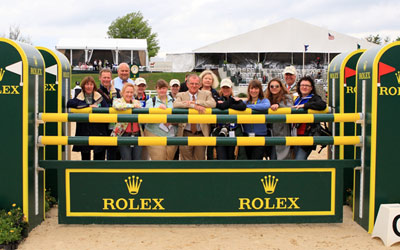
Participants in the Rolex course walk with course designer, Richard Jeffery

On Sunday morning, May 1, 2011, the media had a special invitation to walk the Rolex Kentucky Three-Day Event show jumping course with its famed designer, Richard Jeffery. Snappily dressed, as the British are known for, he patiently answered questions and told us about the course’s winding design.

Jeffery has been in this business a long time, and designed both the eventing show jump course and the “pure” show jumpers’ courses for the 2010 Alltech FEI World Equestrian Games last fall. Those were held in the same arena as Rolex at the Kentucky Horse Park in Lexington, Ky. Later this year, he will design the show jumping course for the four-star Burghley Horse Trials in England.

As we walked the course with Jeffery, we kept running into competitors walking their lines—but don’t worry, we stayed out of their way. Karen O’Connor approached to ask him if the jumbotron would have scores or live video feed (which is spookier to the horses); he told her he’d just gotten word that it would be live video. Other competitors seemed worried about that as well. Boyd Martin, William Fox-Pitt and other legends of the sport zig-zagged back and forth across the ring, intensely focused on how they would approach each fence, as well as coaching other riders.

As a (lower-level) eventer myself, I know that feeling of trying to memorize your course, walk the striding, and figure out how to give your specific horse the best ride possible. It’s a lot to think about! Mostly I was just awed by the size of the jumps; the oxers in particular were somewhere in the neighborhood of 5 or 6 feet wide (the jump height is a maximum of 4’1″ at the four-star level). That is a lot to jump after your horse just finished an 11-minute cross-country course over solid obstacles of even larger dimensions the day before!

Show jumping in eventing is not designed to test the fastest or highest jumper, as it is in Grand Prix show jumping, but rather to see if your horse has enough stamina left over after the previous day’s challenge to jump carefully. Each rail adds 4 points to the rider’s penalty score (lowest score wins, as in golf), and there are time penalties for exceeding the time allowed.

Mary King of Great Britain, who was in first and second on her two horses after cross-country, proved true mastery of the sport by jumping double-clear on both horses on Sunday to clinch first and second place at Rolex 2011—no easy feat!

See HorseChannel’s full coverage of the 2011 Rolex Kentucky Three-Day Event  here.

<< Previous Entry

Back to The Near Side

May 14 is National Animal Disaster Preparedness Day

4

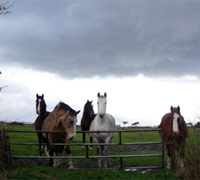
horses and storm cloudsDo you know what to do to keep yourself and your family safe in a flood, tornado, hurricane or other natural disaster? Do you know what to do with your horse in case of a major emergency? Make a plan now so that when the unexpected happens, you’ll be ready to protect your animals.
Be Prepared Now
Recent tornadoes and floods in the Southeast United States have drawn attention to the devastating effects that severe weather can have on homes and farmland. No one wants to leave their home, but staying there instead of evacuating won’t save your home and will only put you in danger. Here are some tips on planning ahead for a worst-case scenario.

  • Find a place to stay. When evacuations are called, the Red Cross and other organizations will usually open shelters in safe areas, but those shelters don’t always allow pets. Finding a safe haven for your horse is even more difficult. Make a plan with friends or family members who have accommodations for your animals and would be willing to put them up during emergencies. You can also network with your local or state equestrian organization or riding clubs to find other members who will provide emergency shelter. Make sure your emergency location is far enough away from your home that they won’t be victims of the same natural disaster that is displacing you and your horses.
  • Arrange transportation. If you have a truck and trailer, keep them tuned up and maintained even if you don’t use them regularly. When the threat of a disaster is looming, it’s a good idea to hitch up ahead of time so that you will have time to make sure everything is safe and functional. Most importantly, train your horses to load calmly and quietly so that when you need to leave in a hurry, you won’t find yourself struggling with an unwilling equine.

    If you don’t have a trailer of your own, talk to other local horse owners and find out if any of them would be able to transport your horses, or get recommendations for local commercial haulers that can come pick them up.

  • Create an emergency kit. Have a few days’ worth of feed, a travel-sized equine first aid kit, and copies of your horses’ up-to-date Coggins, proof of vaccinations and health certificate (if your state requires them) ready to go. Do the same for your pets.
  • Don’t wait it out. When an evacuation is called, you may be tempted to wait until the last second to leave, just in case things aren’t as bad as predicted. DON’T. If you wait, you may find that your trailer driver has already evacuated, your emergency shelter is out of space, and the roads to safety are backed up or closed.
  • Don’t trap your horses. If you can’t evacuate, such as in case of tornadoes, the best thing you can do for your horses is to let them out in your largest pasture. If the barn is hit by a tornado, high winds or lightning with your horses in their stalls, they could be trapped, injured, or even killed. Leaving them out in severe weather may seem counterintuitive, but they will at least have a chance of getting out of harm’s way. Just make sure to put halters on them and some form of identification that includes your phone number in case your fences are damaged in the storm.

Further Reading
Horse Emergency Information
Prepare your horse and barn for emergencies
Top 10 disaster readiness tips for horse owners from the ASPCA

New program encourages youth to volunteer with horse welfare and equestrian organizations

4

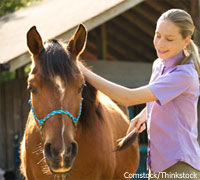
Young equestrian grooming a ponyEquestrian youth have a new opportunity to give back to the community – and a chance to
win a $1,500 grant.

The United States Equestrian Federation (USEF) Equestrians in Action program tracks
youth volunteer hours that are aimed at improving the welfare of the horse or positively
promoting equestrian sport. Sponsored by The EQUUS Foundation, the program encourages
youth to give back to equestrian sport – at horse shows, equine promotional events, equine
businesses or organizations, trade fairs, therapeutic riding clinics, horse rescue and 4-H
events.

The participant with the most volunteer hours in 2011 (minimum of 150 hours) will earn
a $1,500 grant for his or her education or training. All youth have the opportunity to
earn one of three certificates depending on their participation level. Those who volunteer
at least 50 hours will be awarded a Bronze certificate while youth who volunteer at least
100 hours will receive a Silver certificate. The highest level, the Gold certificate, will
go to those who volunteer 150 or more hours. In addition, the top 10 participants will
receive special “Top Ten” certificates.

Participants of USEF Equestrians in Action must be 21 years of age or younger at the
start of the award year, which began December 1, 2010, and need a current USEF membership.
In order to ensure a level playing field, volunteer hours must be given freely, without
payment or other compensation. Participants may create an account, which will track their
volunteer hours at www.usef.org. The website will
also show which participants are currently in the lead for Top Ten status.

For more information, contact Jennifer Mellenkamp at jmellenkamp@usef.org.

USEF Equestrians in Action is sponsored by The EQUUS Foundation. For volunteer
opportunities and ideas, visit their website at www.equusfoundation.org and join the
carrots4acause network.

Further Reading
Help horses by volunteering at an equine charity
Saddle seat equitation riders earn funds for St. Jude’s Children’s Research Hospital

Bureau of Land Management invites the public to visit wild horses

6
BLM Mustangs
Photo courtesy Bureau of Land Management

The Bureau of Land Management is hosting an all-day public tour of two wild horse long-term holding pastures in Hominy, Oklahoma, about an hour from Tulsa. The tour, which will take place on Saturday, June 4, 2011, from 8 a.m. – 5 p.m., will give the public an opportunity to observe wild horses roaming in a natural setting across thousands of acres.

The public must make reservations by May 20. Visitors will be shuttled to the pastures by the BLM from Tulsa; no personal vehicles will be allowed, as the pastures are on private property.

Lunch may be purchased during the tour for up to $10 per person. Attendees should wear casual clothes, comfortable shoes, and rain attire if needed. Cameras and video cameras are welcome.

Tour date and time:Saturday, June 4, 2011, from 8 a.m. – 5 p.m.
RSVP date:No later than May 20, 1011
RSVP phone number:866-468-7826
Pick up location:Bureau of Land Management, Tulsa District Office
7906 E. 33rd Street, Suite 101
Tulsa, OK 74145-1352

The BLM estimates that approximately 38,400 wild horses and burros are roaming on BLM-managed rangelands in 10 Western states, based on the latest data available. Wild horses and burros have virtually no natural predators and their herd sizes can double about every four years. As a result, the agency must remove thousands of animals from the range each year to control herd sizes.

Off the range, there are 41,200 other wild horses and burros that are fed and cared for at 23 short-term corrals and 21 long-term pastures. As of April 2011, there are approximately 12,600 wild horses and burros in short-term corrals and 28,600 wild horses in long-term holding pastures in the Midwest. Animals gathered off the ranges are taken to short-term corrals to be examined by a veterinarian, receive vaccinations and a freezemark, and prepared to enter the BLM’s adoption program or be sent to long-term pastures generally if they are over the age of six.

The long-term holding contracted ranches range in size from 1,100 acres to 46,000 acres on which the wild horses are free to roam. All wild horses and burros in holding, like those roaming the public rangelands, are protected by the BLM under the 1971 Wild Free-Roaming Horses and Burros Act.

For more information about the tour or about the program, please call 866-468-7826.

Resources available for horse owners in flooded areas of the South

3

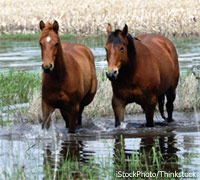
Horses in a floodFlooding in cities along the Mississippi River has forced many residents to evacuate, often abandoning their homes and belongings. In natural disasters such as this, horse and pet owners must make quick decisions about how to keep their animals safe.
Owners of small animals such as cats and dogs can pack up their pets in the car and take them along. However, not all shelters for evacuees allow animals. National organizations such as the ASPCA, HSUS and American Humane Association have stepped in to assist local animal shelters in affected areas to feed and house animals left behind or temporarily surrendered when their owners fled.

With horses and other large animals, evacuation becomes even more complicated. Horse owners are encouraged to make arrangements for housing and trailering and evacuate well ahead of time to prevent a last-second scramble.

In Memphis, the Agricenter International has offered 600 stalls for horse owners to use during the flooding. Owners must take care of their own horses but can use the stalls for only the charge of two bags of shavings. Some hay has been donated, but more is needed. To find out more, contact the Memphis/Shelby County EMA at 901-525-1515.

The Women’s Horse Industry Association is collecting donations for horses and horse owners in Tennessee affected by the flooding. For more information, contact Catherine Masters, Executive Director, at 615-730-7833 or visit WHIA’s website at www.womenshorseindustry.com

For horse owners in Louisiana, which is still bracing for the worst of the flooding, the Louisiana State Animal Response team has compiled a list of horse transport resources for evacuation on its website, www.lsart.org.

For rescources on preparing for emergencies, visit these sites:
Pet Disaster Preparedness from the ASPCA
Disaster Preparedness for Horses from HSUS

Further Reading
Is your barn prepared for emergencies?
Emergency Plan

A Romantic Cowboy

2

The other day I heard “Where Have All the Cowboys Gone?” by Paula Cole on the radio. I hadn’t heard that song since sometime in the 90s, and to be honest, I hadn’t missed it. If this song didn’t immediately spring into your head when you read the title, it’s the one where she is lamenting her one-sided relationship with an inattentive boyfriend/husband who doesn’t pull his weight around the house. In the chorus, she asks, “Where is my John Wayne?”

Uh, Paula? No offense to the cowboys out there, but I don’t think John Wayne would be your best candidate for a sensitive, caring husband and father. What kind of cowboy was she thinking of when she wrote that song?

Oh! This one.

This tender moment was caught by the videographers at the Intercollegiate Horse Show Association National Championship last weekend. Now, public proposals always make me cringe a little. I mean, what if she wants to say no but doesn’t want to be booed by a few hundred (or in some cases, thousand) strangers? Nevertheless, even a stone-hearted curmudgeon like me can recognize a romantic gesture when she sees one, and this most certainly was.

Mazel tov, you crazy kids!

<< Previous Entry

Back to The Near Side

0FansLike
0SubscribersSubscribe
We use cookies to help personalize content, tailor and measure ads, and provide a safer experience. By navigating the site, you agree to the use of cookies to collect information. Read our Cookie Policy.
OK