0 ITEMS
  • My Account
  • Holiday Gift Guide
  • Podcast
  • Webinar
Subscribe Combo
Enable cache13
Home Blog Page 646

Seven Signs You???re Stuck on a Terrible Trail Ride

2

Warm sunny weather has finally arrived, bringing with it prime trail riding weather. I‘ve noticed fliers posted around town inviting new members to a local horseback riding group. They meet once a month at different parks and campgrounds and go on all-day trail rides. At first it sounded tempting. I could see new territory, meet other horse crazy people and expand Wally and Danny’s social circle. But then I saw the notation, “170 members strong!” That spooked me. I’ve tried a few organized trail rides before. In my experience, once the group gets beyond a dozen riders the intimacy and relaxation components disappear and what I’m left with is a bored horse, a sore butt and not enough water to wash the dust down my throat. So before you tie a canteen to your saddle horn and sign up for a mass-produced trail ride, take a moment to heed these words: You could end up on the trail ride from hell. In case you’ve never had such an experience I’ve put together some warning signs.

Seven Signs You’re Stuck on a Terrible Trail Ride

  1. You park your trailer in your assigned spot, a sliver of bare earth recently hacked clear of chaparral by the machete-wielding trail boss.
  2. No one else seems concerned about the rugged terrain, however, you feel a little uneasy when see a sign posted at the trail head that reads:
    WARNING: DESIGNATED WILDERNESS AREA

    You are entering a natural habitat for ferocious beasts.

    Riding alone is not recommended.
    Stay on marked trails.
    Watch for bear paw tracks.
    Avoid riding into bear dens. Do not attempt to herd bears.

    Did we mention that this is a bear zone?
  3. Since you’re new to the group you pick out a woman who seems pleasant enough and introduce yourself. And that’s the end of your side of the conversation. During the next three miles you hear all about her recent divorce (from her fifth husband who, by the way, ran off with the horse trailer and the Appaloosa stud horse) and her foray into the Internet dating scene. She then recounts every dating disaster in graphic detail. When you reach the first water crossing you consider wrapping your saddle bags around your neck and drowning yourself.
  4. Based on courtesy and commonsense safety, there’s a designated “pace horse” that determines just how fast everyone travels. That way, no one’s straggling too far behind. Unfortunately, the pace horse is a shuffling, sleepy-eyed gelding appropriately named Pokey Joe.
  5. You begin to regret that last cup of indulgence at Starbuck’s this morning. There’s no way you’ll make it to the lunch break at the picnic grounds, where the port-o-potty awaits. You discreetly mention this problem to the trail boss. He reins his horse to a stop, turns around in his saddle and announces to the other 78 riders, “She needs to use the ladies room.” Everyone stops. And waits. You look around. You see nothing but thistles and poison ivy.
  6. The trail narrows as it winds through a ravine, cramping all the horses into a single-file line. Unfortunately you get wedged into the worst spot possible. In front is a grumpy mare ridden by an animated woman who keeps blurting out, “Don’t get too close! She’ll kick!” Directly behind you is a ditzy, prancing stallion that has suddenly developed a crush on your gelding.
  7. Your seat bones have gone numb. You begin to wonder if the odd sensations in your legs indicate that you’re a candidate for a hip replacement. Despite your best attempts to conceal your fatigue and the encroaching symptoms of what must surely be gangrene, the trail boss notices your displeasure. He tries to cheer you up. “Oh don’t worry little lady. You’ll make it. See that tree?” he says, pointing to a crooked, barren pine. “It’s the half-way marker.”

Sure, these warning signs are meant to be humorous. And I know there are some fun-loving clubs that organize some awesome trail rides. But at least now you know what can happen if you don’t choose your trail riding partners—and your destinations—carefully.

<< Previous Entry

Back to Life with Horses

Updated information on Equine Herpesvirus Myeloencephalopathy (EHM)

8

Stalled horsesUPDATE 6/29/11: The USDA has issued its final situation report on June 23, 2011. The outbreak has been contained. Click here to read more.
ORIGINAL ARTICLE:
As of noon EST on May 20, 2011 cases of Equine Herpesvirus Myeloencephalopathy (EHM) have been confirmed in eight states and in Canada. EHM is the neurological form of Equine Herpesvirus (EHV-1). Please use the state veterinarian in your state as a resource for information and guidance regarding this disease.

Please see the USDA situation report for updated information

Affected States’ State Veterinarian Contact Information:

California: https://www.cdfa.ca.gov/ahfss/animal_health/equine_herpes_virus.html

Phone: (916) 654-1447

Colorado: https://www.colorado.gov/cs/Satellite/Agriculture-Main/CDAG/1167928197091

Phone: (303) 239-4161

Idaho: https://www.agri.state.id.us/Categories/Animals/animalHealth/healthehv.php

Phone: (208) 332-8544

Oregon: https://www.oregon.gov/ODA/__news_449105797.shtml

Phone: (503) 986-4680

New Mexico: https://www.nmbvm.org/

Phone: (505) 841-6161

Texas: https://www.tahc.state.tx.us/

Utah: https://ag.utah.gov/news/EquineHerpesOutbreak.html

Phone: (801) 538-7162

Washington: https://agr.wa.gov/FoodAnimal/AnimalHealth/HotTopics.aspx

Phone: (360) 902-1881, (360) 902-1835

Additional Resources:

The United States Department of Agriculture (USDA) situation report, guidance document & new AAEP resources for horse owners is now available.

The USDA:APHIS:VS has recently posted on its website 2011 EHV-1/EHM incident information, including situation reports (listings of suspect and confirmed cases, locations, etc), recommendations for exposed horses and more here: https://www.aphis.usda.gov/vs/nahss/equine/ehv/. Please check this website weekly for updated situation reports.

In addition, the AAEP now has an updated web page for horse owners with a very informative FAQ targeted for horse owners located here: https://www.aaep.org/EHV_resourcesowner.htm.

Recommendations for show and event managers from UC Davis: https://www.vetmed.ucdavis.edu/whatsnew/article.cfm?id=2397

American Horse Council: https://www.horsecouncil.org.

Please refer back to these resources frequently to ensure you have the most current information.

Tom McCutcheon wins FEI Reining World Final

3
Tom McCutcheon at WEG
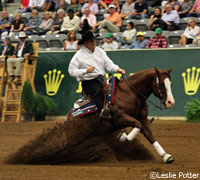
Tom McCutcheon, shown here with Gunners Special Nite at the World Equestrian Games, just added the FEI World Reining Final Gold Medal to his long list of accomplishments. Photo: Leslie Potter

Set in a beautiful arena and in front of a capacity crowd, the 2011 FEI World Reining Final was an electric atmosphere at Bökebergs Gård, Sweden, just outside of Malmö. The best reining horses in the world contested the highly coveted title and Tom McCutcheon of the United States was flawless in his effort to the top of the podium.

Riding Darlins Not Painted to an extraordinary score of 229.5, McCutcheon – the double-Gold medalist at the 2010 Alltech FEI World Equestrian Games – added another Gold medal to his impressive resume and continues his dominance of international high-performance reining events. Darlins Not Painted is owned by Turnabout Farm.

In the Silver medal position, also from the U.S., Craig Schmersal aboard Miss Lil Addy Tude, owned by KC Performance Horses, gave the crowd a thrill with an incredible score of 227.5. Schmersal, showing on the mare at only the second FEI Reining event, had nothing but praise for his mount, and the attractive American Quarter Horse was one of the crowd favorites from the first horse inspection.

Rounding out the medals podium was the always-strong Bernard Fonck, representing Belgium and riding Great Sunburst. The pair earned a Bronze position for their effort and a score of 226.5. Great Sunburst is an American Quarter Horse and is owned by Manuel Bonzano of Italy.

In the restricted division, it was Rieky Young of The Netherlands in the Gold medal position riding Brady Chex, owned by Brady Bunch, with a score of 220. In Silver, Nico Hörmann of Germany aboard Custom Blackberry, owned by Riccardo Abati, turned in a solid score of 217.5. And in Bronze, Fenna Elzinga of Denmark rode her own Smoking Kills to a score of 216.5.

Long lines of excited fans queued up outside Bökeberg arena and the reining athletes did not disappoint. Spotless runs and precise maneuvers made the scores very high and the crowd rewarded each rider with jubilant praise. The event was declared a success by organizers and has received very positive feedback from attendees, athletes and sponsors. The people of Sweden made each and every visitor feel welcome, and the facilities, field of play and event planning were lauded by the top riders.

Reining is a sport born of the American West with maneuvers similar to those a working ranch horse might have been asked to perform on day-to-day tasks. Today, the sport has exploded around the world as the level of technical sophistication and horsemanship style has evolved into an intricate and beautiful display of power and finesse.

Now represented on six continents and in more than 40 nations, the sport of reining is an internationally approved event under the FEI, the international governing body for equestrian sport. The incredible success of the sport at the recent 2010 Alltech FEI World Equestrian Games (WEG) gave Reining significant momentum for continued growth worldwide.

For full results and links to videos of the top runs, visit www.Malmo2011.com. For more information on the 2011 FEI Reining World Final, please contact Brad Ettleman of HorsePower, Inc., the official Organizing Committee, at Brad@HPowerInc.com or 720.982.3574.

International Equestrian Federation seeks nominations for annual awards

5
Edward gal and Moorlands Totilas
Edward Gal and Totilas won the FEI Best Athlete award in 2010. Photo: Leslie Potter

The Fédération Equestre Internationale (FEI), the governing body of equestrian sport, is pleased to announce that nominations for the FEI Awards 2011 are now open.

Members of the worldwide equestrian community are invited to make their nominations via the dedicated website www.feiawards.org.

The awards, which were launched in 2009, aim to acknowledge outstanding achievement in the following five categories:

  • Reem Acra Best Athlete, for the athlete (equine or human) or combination that, over the past year, has demonstrated exceptional skill in the arena and taken the sport to a new level;
  • HSBC Rising Star, for a rider aged 14-21 who has demonstrated significant talent and commitment;
  • Development, for a development project, individual or organisation demonstrating skill, dedication and energy in expanding the sport;
  • Against All Odds, to celebrate a disabled rider or an individual who has overcome extreme personal difficulties to achieve proficiency in equestrian sport;
  • Best Groom, for the often uncelebrated, yet important person who works behind the scenes.

Commenting on the awards, FEI President HRH Princess Haya said:

“The equestrian community is full of extraordinary people whose achievements in and out of the arena are the result of their outstanding ability to focus on their goals. The winners in the five categories of the FEI Awards share a deep love for the horse and the belief that equestrianism at any level is well worth the time and energy that they devote to it, as an athlete, a groom or as the initiator of a project that enhances the lives of others. Your nominations for the FEI Awards 2011 will help us to express our gratitude to and admiration of those people who deserve it.”

A jury presided by Princess Haya will select the winners, who will be flown to Rio de Janeiro, Brazil to attend the awards ceremony at a VIP gala dinner, which will take place during the FEI General Assembly in November.

The closing date for nominations is July 31, 2011.

Click here to see the 2010 FEI Award winners.

Apply now for the 2011 USEF Youth Sportsman’s Award

3

Young EquestrianThe search is underway for nominees for the 2011 United States Equestrian Federation (USEF) Youth Sportsman’s Award. Now in its sixth year, the award recognizes young equestrians who exhibit exceptional leadership potential, serve as a positive role models for their peers, demonstrate an ongoing commitment and dedication to the promotion of equestrian sport, are involved in their community and exemplify positive sportsmanship principles. Click here to read about last year’s Youth Sportsman’s Award winner Kelsey Kimbler.
All National Winners will be honored during the 2012 USEF Annual Meeting. Each will receive a $500.00 grant to be paid to the educational program of his or her choice and will be invited to attend the USEF Annual Meeting as the Federation’s guest, to attend committee and board meetings, a career opportunity session and awards banquet. Meals, accommodations and travel expenses (up to $500.00) will be provided for all who are invited to participate.

The overall winner of the 2011 USEF Youth Sportsman’s Award will receive a $1,000 grant payable to the educational program of choice and a USEF Life Membership valued at $2,500, a commemorative trophy, as well as an invitation to the USEF Annual Meeting and career session. The winner will also be one of the nominees for the USEF Junior Equestrian of the Year Award.

Applications are available online at www.usef.org or through any USEF Recognized Affiliate or International Discipline Association. A listing of contact information for these affiliates is available on the Youth Sportsman’s Award webpage. Required materials are to be submitted directly to the applicant’s respective USEF Recognized Affiliate or International Discipline Association and received by their respective office on or before October 1, 2011. Each USEF Recognized Affiliate may select a National Winner, who will be considered for the overall award.

To be considered for the 2011 USEF Youth Sportsman’s Award, applicants must:

  • Have a current membership in good standing with the USEF
  • Have a current membership in good standing with a USEF Recognized Affiliate or International Discipline Association (For affiliate contacts, visit www.usef.org)
  • Be 17 years of age or under, as of December 1, 2010
  • Demonstrate an ongoing commitment and dedication to the promotion of equestrian sport
  • Serve as a positive role model for peers
  • Participate at any level of competition, including local, regional or national events
  • Be involved with their community
  • Exhibit characteristics that exemplify positive sportsmanship principles

For more information regarding the USEF Youth Sportsman’s Award, please contact Jennifer Mellenkamp, Director, National Breed/Discipline Affiliates and Youth Programs, via e-mail at jmellenkamp@usef.org or call (859) 225-6955.

A Dumping Ground for Unwanted Horses

10

Life with Horses - A Dumping Ground for Unwanted Horses
Every now and then an unwanted horse is set loose at this park.

There’s an ugly side to living in a community where horsekeeping is allowed. Sure, we have bridle paths instead of sidewalks, hitching posts outside our fast-food joints and feed stores next to grocery stores. But just a few dusty streets from my house is a wide expanse of natural beauty where a river winds its way through meadows of wild oats and sunburned poppies. It’s a haven for local trail riders. But the park, officially called the Hidden Valley Nature Preserve, has a more sullied reputation. It’s the local dumping ground for unwanted horses.

Just a few days ago another horse was abandoned at the park, but this time the abusers were caught. According to the sheriff’s report, witnesses spotted two men riding horses into the park just after sunset. They were leading a third horse. Later the witnesses saw the two men ride out, minus the third horse. They called the sheriff and the guys were apprehended and arrested on charges of felony animal abuse. After county animal services agents searched the park on foot, aided by a police helicopter hovering overhead, the abandoned horse was found and retrieved.

It was described as being in its 20s and “malnourished and blind in one eye.”

These two guys thought it was okay to lead this skinny, half-blind equine senior citizen into the park, unfasten its halter and leave. I’m guessing they figured that there was plenty of free grass, shade and water for the horse. And I’m guessing they ignored the countless bogs and quicksand pits on the river’s edge, the rattlesnakes and the packs of coyotes.

Sadly, this is not a rare occurrence. This year alone, more than 20 horses in my area have been declared “strays” by county animal services. That means they were turned loose, left to wander and fend for themselves. Not all have been abandoned at the river park. But that’s the prime location.

While I’m well aware that horses are abused, neglected and abandoned throughout the country, when it happens so blatantly it’s time for some organized outrage. Maybe we’re too quick to encourage everyone who moves into horsekeeping property to slap together a pipe corral and buy a horse. Perhaps we put too much emphasis on all the fun aspects of horse ownership without also mentioning the less glamorous parts. We need to forewarn new horse owners about the unexpected vet bills, the rising cost of hay and the hard facts of manure disposal. Owning a horse is fun. But not always.

Responsible horse owners have a duty, I believe, to make sure newbies to our lifestyle understand that old, lame and ailing horses can’t be discarded like broken toys. They’ll be responsible for finding the horse a suitable home, surrendering it to an equine rescue facility, or paying a vet to humanely euthanize it. Turning an unwanted horse loose in the open countryside is not an option. In fact, it’s downright shameful.

<< Previous Entry

Back to Life with Horses

The Jockey Club launches new program to help find homes for retired Thoroughbreds

5

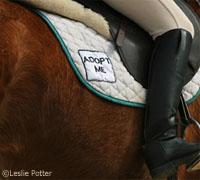
Adopt a ThoroughbredThe Jockey Club, the registry for Thoroughbreds in the United States, has announced a new service to help place ex-racehorses in new homes after their careers at the track have ended.

Called Thoroughbred Connect, the service allows customers to put their name and contact information in the database to let the current owner of a Thoroughbred that they are interested in providing a home should the horse ever need one. Current owners can log in to the system if they have decided to retire a horse to find contact information for anyone interested in that horse. This allows owners and prospective adopters to connect directly rather than going through a rescue or adoption organization.

“Thoroughbred Connect is a natural extension of our ongoing effort to enhance the safety and welfare of Thoroughbreds and leverages our database and easy-to-use technology platform,” says Jockey Club President James L. Gagliano. “We encourage owners to use Thoroughbred Connect and make others aware of it.”

The service is available at no charge and is open to all Thoroughbred enthusiasts, whether or not they are current owners. To register a free account, visit www.thoroughbredconnect.com

Horse owners advised to take caution in light of Equine Herpesvirus (EHV-1) outbreak

4

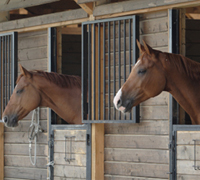
Horses in stalls

Several horses that attended the National Cutting Horse Association (NCHA) Western National Championships in Ogden, Utah from April 29-May 8 have been diagnosed with Equine Herpesvirus (EHV-1). Cases have since been reported in several western states and Canadian provinces.

According to the American Association of Equine Practitioners (AAEP), EHV-1 can cause respiratory disease, neurologic disease and abortion in pregnant mares.

Symptoms of respiratory infection may include fever, coughing and nasal discharge. Fever is typically the first sign of infection and is sometimes the only symptom. It is often undetected by owners and caretakers. Commonly called Rhino, most horses are vaccinated against this strain.

Symptoms of neurologic disease from EHV-1 include lack of coordination in the hind limbs, recumbency (frequent or constant lying down) and partial loss of bladder control. These symptoms sometimes follow respiratory symptoms. The neurologic strain of the disease is of highest concern as it has the potential to be fatal and there is no reliable vaccine to protect against it.

Most horse owners do not need to worry at this time as risk of infection is low. However, if your horse or other horses at his barn attended the NCHA Western National Championships, you should take your horse’s temperature regularly and tell your vet if he has a fever. Your vet will be able to test for EHV-1 and can give you anti-viral drugs if your horse is infected. Take extra biosecurity measures if your barn is at risk.

While the disease is harmless to humans, it is highly contagious between horses. It spreads via nose-to-nose contact between horses or inhalation of droplets from an infected horse snorting or coughing. The virus can also be transmitted indirectly on stall walls or clothing. For this reason, it is important for anyone in an at-risk area to change or thoroughly clean their clothes–including riding gloves, helmets and boots—when visiting different barns.

As a precaution, several upcoming NCHA competitions in the at-risk area have been canceled. Additionally, Colorado State University has temporarily closed its veterinary teaching hospital to nonemergency cases.

The NCHA is keeping up-to-date information on its website.

Get more information on the AAEP’s fact sheet.

Read more from the USDA.

0
0FansLike
0SubscribersSubscribe
We use cookies to help personalize content, tailor and measure ads, and provide a safer experience. By navigating the site, you agree to the use of cookies to collect information. Read our Cookie Policy.
OK