0 ITEMS
  • My Account
  • Holiday Gift Guide
  • Podcast
  • Webinar
Subscribe Combo
Enable cache13
Home Blog Page 645

Grid Exercises with Gina Miles

0
Grid Exercises with Gina Miles
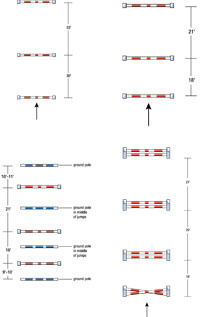
Click the image above to download a diagram of these grid exercises.

Olympic eventer Gina Miles provides tips on how to use grids to correct specific problems. Read more details on these exercises here.

1. If your horse has never jumped a grid, start very simply and keep the fences low.

Place to jumps 30 feet apart and trot in. This will give you two canter strides between the jumps plus take off and landing. Once your horse is easily handling that exercise, you can add a third jump 33 feet (two strides) from the second one.

2. Once your horse is comfortable with that exercise, try a more difficult one-stride grid.

Make the distance 18 feet between jumps two and three [to account for the longer canter stride as you progress through the grid]. A your horse gains more experience, you can canter into the grid, but inexperienced horses and riders should plan to trot in.

3. For horses that rush, use rails on the take off and landing. Miles recommends placing a take off rail 9 to 10 feet before the first jump, in the middle of the first and second jumps, in the middle of the second and third jumps, and again 10 to 11 feet after the last jump.

4. To help horses improve their jumping style and power if they tend to be flat and careless is to set three low, wide oxers.

Keep the distances a little shorter to encourage your hrose to get to the base of the oxers and jump up and round over them. An example exercise would be trotting in to a cross-rail set 18 feet (one stride) from the first oxer, then 20 feet (one stride) to the second oxer and 21 feet (one stride) to the third oxer.

Click here for more grid exercises.

New group formed to help provide health care to retired racehorses

3

Retired ThoroughbredThe Thoroughbred Retirement Foundation (TRF) is proud to announce the formation of the National Equine Veterinary Alliance, consisting of professionals who have agreed to provide pro bono veterinary care to Thoroughbred ex-racehorses from non-profit organizations that have been registered with, and approved by, the TRF.

The issue of Thoroughbred retirement remains a major area of concern to racing supporters, and the industry’s inability to get a handle on it is a frequent source of sharp criticism from the public. The Alliance’s mission is to promote a beneficial and cooperative outreach program to the rescue/adoption organizations providing aftercare to these deserving ex-racers.

Patricia Hogan, VMD, of Cream Ridge, NJ, is a TRF board member and chairman of its Veterinary Liaison Committee. “Rescue and adoption organizations are doing all that they can but are strictly limited in most cases to private monetary donations, and the goodwill of local veterinarians and vendors,” said Hogan. “The TRF would like to bring some structure and organization to this problem, provide an avenue for veterinary assistance for these organizations, and at the same time, shine a positive light on the veterinary professionals already working hard to help transition these horses.”

Hogan herself is a renowned equine orthopedic surgeon who has cared for some of the top racehorses in the country, including Smarty Jones. “I have thought about such a program for many years, and I am thrilled that an institution like TRF is implementing this cooperative concept of ‘giving’ to the horses on a national basis.”

The primary role of the TRF is that of organizer of the national program, and to act as a liaison between approved rescue/adoption groups and cooperating veterinary practices. The criteria for being an “approved” group in this program considers many factors such as reputation, registered 501(c)3 status, and dedication to transitioning Thoroughbred racehorses exclusively.

The other responsibility of the TRF is the promotion of the works of the Alliance. “Many veterinarians already contribute tirelessly to this cause without industry recognition,” Hogan explained. “Highlighting these works will serve to promote more awareness of the issue of Thoroughbred retirement, shine a spotlight on the veterinarians’ contributions to this cause, and showcase the good work that many independent organizations are doing to transition these horses into productive second careers.”

For more information about TRF’s National Equine Veterinary Alliance, contact Matthew Williams, MWilliams@thoroughbredretirement.org, (859) 246-3080.

Horse Camping: Pack it up

0

When it comes to packing for a camping trip, there are definitely some essentials you need
to bring. Here is a list of must-haves.

  • Sufficient supply of water for you and your horse. Even if the campground has a water source for horses, bring your own—about 10 to 12 gallons per day.
  • Horse blankets and rain sheets
  • Extra reins, girth, halter, lead rope and saddle pad
  • Tools for tack repairs
  • Fly spray and fly mask
  • Mosquito repellent and sunscreen for you
  • Enough hay for the days you will be camping, plus the drive to and from your destination.
  • Inquire if your hay needs to be certified weed-free.
  • Grain
  • Water and feed buckets
  • Hay bags
  • Grooming supplies and sponges
  • Gloves
  • Set of hoof boots
  • Duct tape
  • Flashlight and extra batteries
  • Muck fork and bucket
  • Matches
  • High-line rope, tree savers and carabiners
  • First-aid kit
  • Saddlebags packed with water bottles, sunscreen, lip balm, toilet paper, aspirin, a small
    flashlight, hoof pick, multipurpose tool, hoof boot, roll of self-adhesive veterinary wrap,
    spare straps, snacks and basic first-aid supplies.

Back to Camping with Horses

Camping with Horses

0

When life gets hectic and you just need to get away, what could be a better escape than a camping trip with your horse? No alarms jolting you awake, traffic jams making you late, no phones or emails to answer, and no rushing to business meetings. It’s just the peaceful sounds of nature, a crackling fire and a rippling stream, plus plenty of fresh air and, of course, your horse.

While taking a camping trip with horses can be a lot of work, it’s also rewarding. The work entails planning your trip, preparing your horse and packing—all of which can actually be part of the fun. The reward is being able to ride for as long as you want with friends and family. Here are some tips for getting the most out of your camping trip.

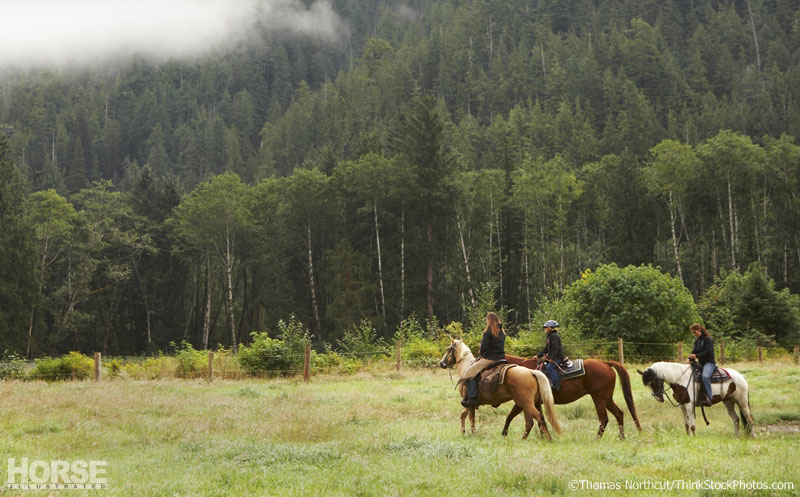
Camping with horses

Preparing Your Horse


Although a camping trip may be very relaxing for you, it can be quite strenuous for your horse if he’s not ready for it. Therefore, before you start poring over maps and searching for campgrounds online, determine if your horse is physically and mentally prepared. He needs to be fit enough to meet the demands of long trail rides for consecutive days, especially if you will be venturing into rugged, mountainous terrain. If he is already a veteran trail horse that you ride frequently, you are ahead of the game. If not, you’ve got some training and conditioning to do before your trip.

Your conditioning program will be determined by your horse’s current fitness level and the amount of riding you plan on doing during your camping trip. It may take several months of consistent riding to build your horse’s fitness. Spend as much time in the saddle as you can, and regularly assess his recovery parameters to monitor his improvement. Click here to read more about safely conditioning your horse.

In addition to being physically fit, your horse needs to possess basic skills that are vital to your safety, especially in a remote area. Fortunately, you can build your horse’s fitness level and brush up on his trail skills at the same time.

Here are the skills your horse should possess:

  • Halt, stand patiently, back up and leg-yield.
  • Negotiate obstacles such as gates, bridges,
    brush, logs and water crossings.
  • Negotiate steep ascents and descents.

Mental preparation is just as important as physical preparation. Your horse needs to be comfortable in unfamiliar surroundings and around other horses. He should accept being tied for long hours to the trailer or an overhead high-line. On the trail, he should tolerate passing and being passed by others, and he must not kick at or intimidate the other horses.

It’s no fun to ride a horse that is behaving badly, and it’s just as unpleasant to ride in the company of one. Build your horse’s confidence by desensitizing him to the many sights, sounds and obstacles he will encounter around camp and on the trail.

Plan Your Trip

Options for equestrian camping are numerous, and an online search will give you a wide variety of results. Once you pick a destination, thoroughly research its facilities and trails.

The amenities offered at equestrian campgrounds vary greatly—from nothing at all (primitive) to electrical and water hookups for RVs and trailers with living quarters. Some may have hitching posts, high-line poles or corrals, and a water source for horses. (If there is water available at the campsite, you should still bring your own and save it for emergencies.)

However, don’t feel like you are limited to designated equestrian campgrounds. If your idea of camping is to really get away from it all, choose a destination that offers open camping. Open camping is great, provided you are completely self-contained, including providing your own water for your horse.

When you’ve selected a destination, inquire as to whether or not the trails are
accessible from the campsite, and if the campground requires advance reservations and/or charges a fee, particularly over a holiday weekend or if your group is large.

Last but not least, as your departure date approaches, check the weather reports for the area and pack accordingly. Click here for a packing list for your horse camping trip.

Your Horse’s Home Away From Home

Even if you have reserved or plan to use a corral provided by the campground, be prepared to use alternate accommodations. You won’t know until you arrive if the corrals are actually usable. You may find another horse in your assigned corral or discover that it is too muddy, or too hot and lacking shade.

You have several options for your horse’s containment. These include overhead ties, portable corrals and electric fencing systems. Which one you choose depends on personal preference, portability and your horse’s temperament.

If your horse will stand tied for extended periods of time without pawing, pacing or fiddling with his rope, buckets or hay bag, then you can tie him to the trailer, a hitching post, an overhead tie arm or a high-line. If you tie your horse to the trailer or a hitching post, the rope should be long enough that he can touch his nose to the ground and reach his feed and water without having any slack in the rope, so he doesn’t get tangled.

If you hang your feed and water buckets on the side of the trailer, take precautions to ensure that your horse can’t get his rope hooked under the buckets or on any part of the trailer, particularly the rear door latches. If you tie more than one horse to the same side of the trailer, they should be far enough apart that they can’t get tangled in one another’s rope.

A safe and easy option is an overhead tie arm attached to your trailer. Horses can move around, lie down and even roll while tied to them. An overhead tie arm (also called a HiTie), which can cost from $300 to $500, is a good investment if you plan on doing a lot of camping.

A more inexpensive option is a high-line strung tightly between two trees, two posts or a combination of both. The best type of rope to use is a 3/4-inch to 1-inch cotton rope, which has a breaking strength of 2,600 to 3,000 pounds. Set your line high enough off the ground that it clears your horse’s head. If you are tying just one horse, you can tie a small loop knot in the center of the rope, or you can tie two knots, with each one at least 6 feet from your end post, and secure your horse between the two knots. You will then attach a carabiner or swivel hook to the rope or loop. If you tie two knots, the hook will slide along the rope, giving your horse some walking room. The knots at each end keep him from walking around the end post or tree. If you will be tying more than one horse to a single high-line, then tie loop knots approximately 10 to 12 feet apart and attach one lead rope to each loop.

When you tie your horse to the line, give him just enough length of rope that he can reach the ground. Put feed, hay and water buckets on the ground. Do not hang a hay bag from the high-line, as your horse’s rope may become tangled in it.

There are several caveats about tying horses: You can’t leave them unattended. If you go for a ride and leave one or more horses behind, have someone stay at the campsite to keep an eye on them. Make hay available at all times. This will alleviate boredom and keep your horse from trying to get morsels of grass that might be out of reach.

If tying your horse isn’t feasible, or is not your preference, consider bringing a portable corral made of steel, aluminum or PVC pipe. However, portable panels require extra space for storage and transportation. People who use them on a regular basis will typically store them in one of their trailer stalls, or on a specially designed rack on the side or top of the trailer.

Portable corral panels made of sturdy steel that are secured using pins or clamps are the safest option, but they are also the most expensive and cumbersome to store and transport. The advantages of this set-up are that it’s relatively secure and sturdy. You can hang feed buckets and hay bags on the panels, and horses have plenty of room to walk around and lie down.

Your other alternative is to set up an enclosure using electric tape or rope, plastic stakes and a battery-operated charger. This type of containment system should only be used with horses that are accustomed to and respect electric fencing. While it’s easy to set up and take down and requires minimal storage space, it’s also the type of enclosure horses most frequently escape from. Additionally, if a horse gets tangled in the electric tape or rope, it usually won’t break, which can result in significant injury.

If you use electric fencing, keep in mind that the only thing between your horse and freedom is your trust that he will respect his boundaries. Give your horse enough room to move around, lie down and even roll without risk of accidentally getting zapped.

Feed and water should be placed in the center of the enclosure to reduce the chance that he will touch the electric tape. Don’t make multiple pens with a single length of electric tape or rope, and don’t put several horses in together if one is dominant. If your horse is prone to pacing, choose another type of containment system.

The Great Escape

Once you arrive at your campsite and get set up, you will have all the time in the world to ride and relax. Take a few moments to review the site’s rules and double-check your maps.

Before you head out on the trail, tidy up your campsite so nothing gets blown around while you’re out riding. Stow your food chests, coolers and horse feed so curious critters can’t get into anything. And when it’s time to pack up and head home, thoroughly clean up your campsite for the next campers.

Camping has always been a great American pastime, and being able to bring your horse only adds to the fun. The time you get to spend bonding with your horse will be well worth themeffort it takes to plan the trip.

More on Camping with Horses:
Horse Camping: Pack it up
New CHA Trail Guide Manual Available
Packing For Your Horse Camping Trip


This article originally appeared in the July 2010 issue of Horse Illustrated. Click here to subscribe.

The historic Devon Horse Show and Country Fair begins today

6

One of the oldest and most prestigious horse shows in the United States begins its 2011 edition today in Pennsylvania. The Devon Horse Show has been in existence since its humble beginnings as a one-day show in 1896. Today it is an 11-day fair and horse show featuring hunters, jumpers, Saddlebreds, carriage driving and side saddle.

The county fair was added to the Devon Horse Show in 1919 and continues today with a midway, shopping and more. That same year, the organizers decided to donate some of the proceeds from the event to the Bryn Mawr Hospital. That tradition continues today, and the show has raised nearly $14 million for the cause.


Scenes from the 2010 Devon Horse Show

The horse show schedule includes the following events.

  • Platinum Performance/USEF Show Jumping Talent Search – May 26
  • Pony Hunters and Jumpers – May 26-29
  • Hunters – May 30-June 1; June 3-4
  • Jumpers – May 31-June 1; June 3-4
  • Saddlebreds, Hackneys, Friesians and Roadsters – June 1-4
  • Grand Prix of Devon – June 2
  • USHJA Hunter Derby

The fair features several special events throughout the schedule.

  • May 26 is Family Day #1. Kids 12 and under are admitted to the fair at no charge.
  • May 28 is Children’s Day. The first 700 kids 12 and under will be admitted for free.
  • May 29 features the Devon Doggie Parade. Dog owners can enter the Pup/Human Companion Lookalike and Devon Doggie Fashionista contests. Pre-registration is required.
  • June 1 is Ladies Day at Devon featuring the Devon Hat Contest with celebrity judges including TV star and longtime Saddlebred exhibitor Carson Kressley.

For ticketing info and more, visit TheDevonHorseShow.org

Latin Rhythms in the Bluegrass

1

One of my favorite things about working at Horse Illustrated is having the opportunity to visit different farms and meet horses and horse people that I would probably never meet otherwise. If you’ve received your July issue, you know that we featured horses of South America (and if not, you’ll be getting it soon!) In preparing that article and the related HorseChannel video, we had the opportunity to meet some wonderful ambassadors, human and equine, from the Paso Fino world.

On the day of the video shoot, Liz and I met Don Vizi and Catherine King from the Paso Fino Horse Association, Kay Chiappetta, one of the owners of Quinta Chiappetta Paso Finos, and Ricky Mendoza, the farm’s trainer. Kay is an expert on the breed as an owner, breeder and judge, so she was able to explain what we were seeing as Ricky worked the horses.

If you’ve never seen a Paso Fino in person, or maybe even if you have, they will definitely catch your eye. They have a sort of Baroque look, with long, thick manes and forelocks and gracefully arching necks held high. Once they start moving, you see what makes them one of a kind.

Campion the Paso Fino


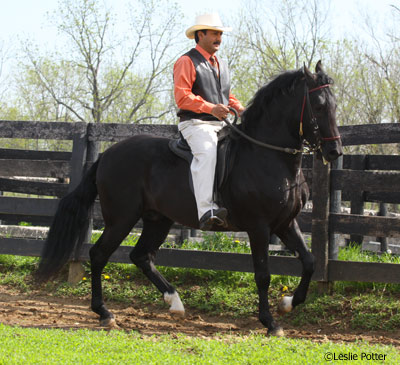
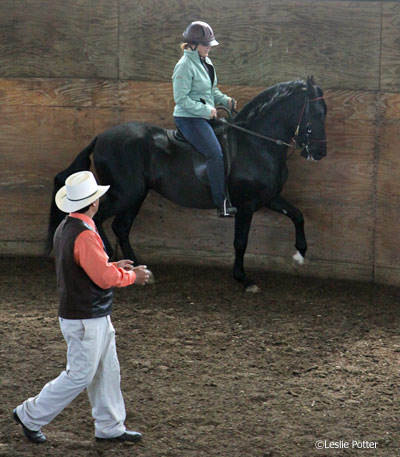
Trainer Ricky Mendoza and performance stallion Campion QC

The first horse Ricky brought out was a young mare named Milagra. She’s what’s called a Fino horse because she performs the Classic Fino. This gait requires a great deal of collection as the legs move very quickly, but with little forward motion. I have to admit that I can’t really tell the difference between most gaited horses’ gaits just by watching, but when Milagra appeared, there was no mistaking her gait. And yet, the rapid movement of her legs was in contrast to Ricky, who was perfectly still in the saddle.

The second horse was Campion QC, a big black colt who competes in the performance division. Performance Pasos exhibit the breed’s standard gaits, the Paso Corto and Paso Largo. While not as collected as the Fino, these gaits are still marked by quick footfalls and a smooth ride.

Campion the Paso Fino


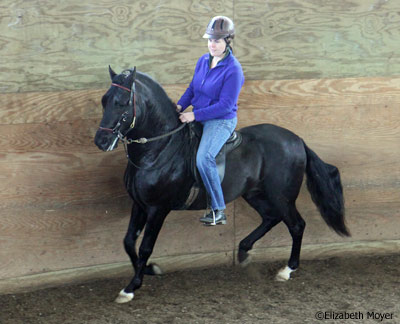
Liz gets pointers from Ricky

After the demonstration, Kay offered to let us take a test ride on Campion. Who could say no to that? Liz rode first, and when it was my turn I wondered if Campion would have any gas left in the tank. My concerns were unfounded. It turns out he’s just like the Energizer bunny.

My gaited horse experience is limited mostly to riding five-gaited Saddlebreds. It’s a similar experience in that the horses tend to be energetic and the ride is smooth, but that’s where the similarities end. Because gaited Saddlebreds also trot and the bonus gaits have to be developed through training, it can take some work to keep them in their gait. The Paso Fino’s gaits are all natural, and Campion seemed willing to Corto all day.

Once I got the hang of Campion’s buttons, riding him felt intuitive, almost like driving a car. It only took a little bit of leg to cue him to go. Slightly more leg pressure resulted in a bit more speed. But no matter how fast he went, the ride was always smooth as silk. With Ricky’s instruction, I learned how to transition through the gaits and how to make the tight turns that the agile Pasos are noted for.

Campion the Paso Fino

Campion was very patient with me while I learned how to correctly ride the Paso Corto.

We had an amazing time at Quinta Chiappetta. If you ever have the chance to take a test ride on a Paso Fino, I highly recommend it. It’s unlike any other equestrian experience.

Click here to watch the video of the Paso Fino’s gaits.

<< Previous Entry

Back to The Near Side

Video: Gaits of the Paso Fino

6

The Paso Fino is a unique, gaited breed known for its beauty and spirited temperament. These horses are compact and muscular with long, flowing manes and tails and are most noted for their naturally-occurring gaits. In the show ring, horses in performance and pleasure classes demonstrate the Paso Corto, a smooth, four-beat gait, and the Paso Largo, a similar but faster gait. The highest level of show-ring performance for the breed is the Fino division. These horses perform the Classic Fino, a highly collected gait with very fast footfalls but minimal forward motion.

Watch as trainer Ricky Mendoza of Quinta Chiappetta Paso Finos in Shelbyville, Ky demonstrates the gaits with Milagra, a Fino mare, and Campeon CQ, a performance stallion.

Video: Mangalarga Marchador

14

The Mangalarga Marchador is a unique gaited breed native to Brazil. They have similar features to Baroque breeds, such as an arched neck and thick, full mane and tail. They are prized for their abilities as ranch horses and for their endurance. Their most notable feature, however, is their smooth gait which is unique to the Marchadores.

The following short film produced by Tucura Films shows the horses working and at liberty.

Read more about what it’s like to ride the Mangalarga Marchador >>

Question of the Week: From Show Horse to Trail Horse

6

Q: My horse has spent his life in the show ring. I’d like to take a year off from competing and just ride on the trails. But even though my horse is very mellow, he’s never been on the trails. What are some ways to help make our trail time fun and safe?

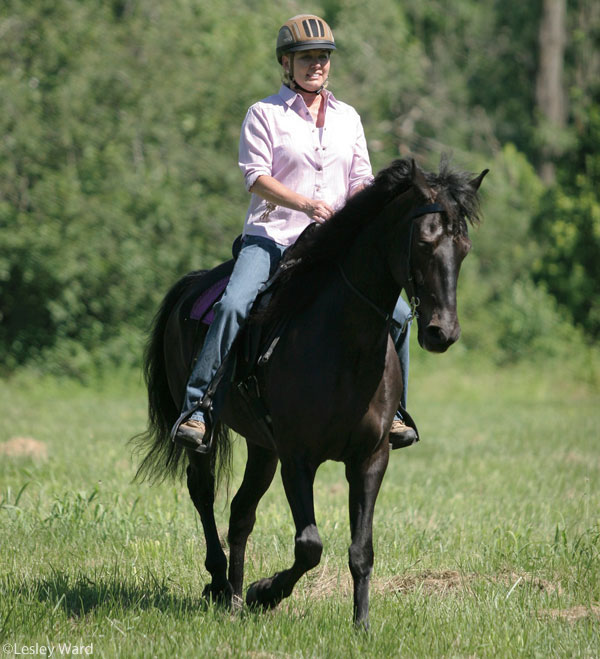
Rocky Mountain Horse on the trail


A: It’s a wonderful idea to let a show horse take a vacation from competition. It often improves their outlook on life and can reduce the wear and tear on their body. Riders also benefit, because they get a chance to connect with their horse on a different level. Yet not every show horse transitions easily to being a trail horse.

Though show horses get exposed to all sorts of stimuli, from banners and water trucks to loud speakers and golf carts, the environment is pretty consistent from showground to showground. Out on the trails, however, the scenery is constantly changing. And, unlike the show scene, there are very few other horses out on the trails. Many veteran show horses feel vulnerable without the comfort of “the herd”. With all this in mind, here are a few suggestions.

First, before you head off on the trails, make sure your horse doesn’t have a bundle of excess energy. A show horse used to regular work is a fit athlete, and if he’s been standing around for a few days he could become a handful out in the open. Consider giving him a turnout or a brief longe.

Second, keep your safety in mind. Wear a helmet and appropriate boots, choose sturdy tack and start out slowly. Don’t plan to circumnavigate the countryside on your initial adventure. Choose a short, uncomplicated trail (perhaps one leading from your stable) and buddy up with another rider who’s mounted on a calm, experienced trail horse that can serve as your horse’s mentor. Introduce challenges like crossing water or using a bridge in a step-by-step method. Don’t overwhelm your horse with new tasks. Next, watch for signs that your horse is beginning to meltdown mentally. If he begins to wind up, becoming anxious and tense (like jigging instead of walking or repeatedly spooking), then stop your ride and try again another day. Gradually build up the length of your trail rides as his confidence improves.

Finally, remember that each time you ride your horse you’re training him, even on the trails. If you allow him to pick up the wrong lead, trot too fast or otherwise ignore your aids, those acquired bad habits may come back to haunt you when you do return to showing.

Riders4Helmets announces International Helmet Awareness Day on June 11

6

Helmet Awareness Day
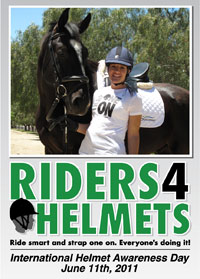
Building on the success of National Helmet Awareness Day 2010, the popular helmet awareness campaign Riders4Helmets.com has announced plans to host International Helmet Awareness Day 2011 on Saturday June 11th.

Riders4Helmets has teamed up with leading helmet manufacturers to offer discounts on
helmets to equestrians via participating retailers globally on this day. Over three hundred
retailers in the USA and 8 retailers Internationally offered discounts on helmets from
eight different manufacturers during last years’ event. It is anticipated that the 2011 event will attract participation from over 500 equestrian retailers globally.
Helmet brands that have committed involvement in the promotion to date include:
Samshield, Troxel, Charles Owen, GPA, Aegis (Devon-Aire), Pegasus, Tipperary,
Ovation, IRH and KEP Italia. Additional manufacturers are expected to commit to
participating and will be announced in due course.

Individuals or organizations wishing to hold an event to recognize International Helmet
Awareness Day may email admin@riders4helmets.com for helmet awareness graphics
and other support materials. “You can participate and show your support just by wearing
a helmet on June 11th, no matter whether you are trail riding, showing or competing”
said Lyndsey White, co-founder of the riders4helmets campaign. “Additionally,
Riders4Helmets logo wear is available for purchase at www.equestriancollections.com
for equestrians who wish to show their support for the campaign.”

Equestrians may visit www.riders4helmets.com to locate their nearest participating
retailer. Manufacturers or retailers wishing to participate in the event may visit the
International Helmet Awareness Day page on the website for details on how to become
involved and to download promotional support materials.

For more information on the Riders4Helmets campaign, visit www.riders4helmets.com
or contact Lyndsey White at lyndsey@riders4helmets.com. You can also follow the
campaign at Riders4Helmets’ facebook and twitter pages.
The campaign is officially endorsed by USEF, USEA, USDF, USHJA, AETA, ARIA,
EAF, CHA, PRO, EMSA and many leading equestrians.

Riders4Helmets was founded in early 2010 after Olympic dressage rider Courtney King
Dye was seriously injured in a riding accident
. King Dye, who remained in a coma for a
month following her accident, was not wearing a helmet at the time of the accident and is
currently undergoing rehabilitation. Jeri Bryant donated her helmet campaign t-shirts
(featuring the slogan “Strap One On–Everyone’s Doing it”) to an eBay store set up to
raise funds for King Dye, and a partnership was formed, resulting in the Riders4Helmets
campaign.

0FansLike
0SubscribersSubscribe
We use cookies to help personalize content, tailor and measure ads, and provide a safer experience. By navigating the site, you agree to the use of cookies to collect information. Read our Cookie Policy.
OK