0 ITEMS
  • My Account
  • Holiday Gift Guide
  • Podcast
  • Webinar
Subscribe Combo
Enable cache13
Home Blog Page 656

Horses on TV

5

A cowboy using a Blackberry to conduct business from horseback. It sounds like a lead in to the kind of joke you’d hear on A Prairie Home Companion. It turns out it might actually be a stroke of marketing genius.

Our friend Jonathan Field, a trainer and horsemanship clinician based in British Columbia, is featured in a new ad for Blackberry. The ad is quite a visual treat, and has a voiceover in which Jonathan explains the process of working with horses before continuing on to explain how his Blackberry is a valuable tool for what he does.

It’s quite a departure from the usual commercials for smartphones and similar gadgets. Typically they’re featured in an urban business or social setting (or in some fictional land populated by colorful little creatures.) Horse people aren’t exactly known for being early adopters of new technology, so a cowboy isn’t an obvious choice as a spokesperson. However, I think that makes this ad more compelling. After all, if a horse trainer can find a use for a Blackberry on his ranch, surely it will help YOU in your day-to-day life.

Moreover, it’s always exciting to see horses and riders featured in mainstream media. Sure, once a year we might get a new Budweiser Clydesdale ad, and thanks to the Internet we can watch some of the amusing equestrian-themed ads from across the pond, but this one features a real horseman working with real horses. The 75-second spot gives just enough info to show the average non-horseperson that there is much more to horsemanship than just sitting in the saddle and hanging on. In that respect, it seems almost as much a commercial for equestrianism as anything else.

What do you think of the ad? Even if it doesn’t compel you to run out and buy a Blackberry, would you be happy to see it during prime time TV?

<< Previous Entry

Back to The Near Side

Miniature Horses approved as service animals under new federal guidelines

8

Miniature HorseDon’t be surprised if you see a Miniature Horse boarding the subway, walking down a city street or inside an office building. Minis and dogs are now officially the only two types of animal approved as service animals under the Americans with Disabilities Act (ADA).

People living with disabilities have used a wide variety of animals to assist them in day-to-day life. For example, rats and even snakes have been used by epileptics to alert them to an impending seizure. However, under new federal guidelines released by the Department of Justice in March, these animals will no longer be officially accepted as service animals. States and cities may create local ordinances that will allow other animals, however.

While not common, Minis have earned a reputation as an alternative to the traditional service dogs. They are highly trainable and can even be housebroken—a requirement for service animals under the ADA. With a lifespan of 30 years, Minis have a much longer working life than dogs. Typically, people using dogs as service animals must find a new dog every ten years or so, which can be an emotionally trying experience.

Minis require more upkeep than dogs since they need more space and remain healthier if they are allowed to eat and go outside throughout the day, rather than just a few times like a dog. Although a handful of Minis are currently working as service animals in the U.S., not just any horse can make the cut. A docile, intelligent temperament is required to ensure the horse’s training is more powerful than its flight instinct, even in hectic urban environments.

To learn more about the Americans with Disabilities Act, visit www.ADA.gov

Helmet Replacement Strategy

1

Knowing when it’s time to replace a helmet is as critical to rider safety as wearing one. Even with limited use, a helmet’s hard foam lining can break down over time, says Drusilla Malavase, co-chair of the Equestrian Headgear Subcommittee for the American Society for Testing and Materials (ASTM).

A good rule of thumb is to replace your helmet every five or six years, and even sooner if you notice changes in the helmet’s foam lining.

To make the most of a helmet’s longevity, Malavase recommends storing it in an area where the temperature is moderate and consistent.

“I tell people to treat their helmets like a beloved dog or child,” she says. “Never store it in a hot car or in the tack room when it’s below zero [degrees Fahrenheit].”

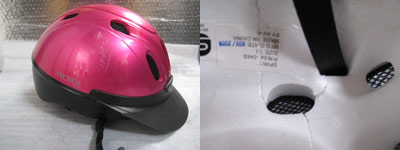
Damaged riding helmet
While the outside damage to this helmet that occurred during a fall appears minor, by looking at the interior foam that cushioned the blow, it is clear that it has cracked and the helmet must be replaced.

Helmets should also be replaced when they are involved in a serious fall or other hard blow. Some warranties require that damaged helmets be returned to the manufacturer in order for owners to qualify for discounted replacement costs. At Troxel, those damaged and returned helmets are put to good use.

“At Troxel, our technical staff carefully examines select helmets that have been sent to us after accidents,” Says Jorge Garcia, VP of engineering at Troxel. “The outer shell often doesn’t show any damage, but after we disassemble the helmet, we find hairline cracks or compressed areas in the protective foam that absorbed the impact. All that means is that the helmet did its job by giving up its structural integrity to absorb some of the energy of the impact. Once the structure is compromised, the helmet would not perform the same way again if involved in a second accident. That is why we at Troxel urge riders to immediately replace a helmet that has been involved in any accident, even if the helmet does not appear to be damaged.”

Death by Emu

10

Not every horse can cut it as a trail horse in my town. And that’s not just because most of our trails are set alongside neighborhood streets. Most horses, if ridden by a confident rider, can get used to cars, trucks and motorcycles. Even lawn mowers and leaf blowers become boring after a while. So what seems to cause psychotic breakdowns in otherwise lovely horses around here? It’s the prevalence of what I call “zoo stock.” These are animals that fit somewhere between typical farm livestock and exotic zoo creatures. I’ve written about some of these quirky characters before.

For example there’s the lady down the street who has one corral filled with bison and another one containing zebras. Then there’s the herd of hairy llamas that roam a rocky hillside behind my parents’ ranch. I’ve also shared my interactions with Bert the camel, who’s taken for weekly walkabouts by his owner, Nancy. Add this menagerie to the peacocks, pot-bellied pigs and gator-sized iguanas that populate some of the yards I ride past. Yet none of these critters seem to be as spook-inducing as the emu that lives in the backyard of an old farm house. I think every rider in town would like to just avoid the residence, but it’s inconveniently located where several of the main trails intersect. As luck would have it, this isn’t a shy emu, either. It’s quite aggressive and seems to take delight in stalking the horses as they unwittingly approach, and then rushing the fence with its wings unfurled. Trust me; there are few things more exhilarating on horseback than being ambushed by an emu.

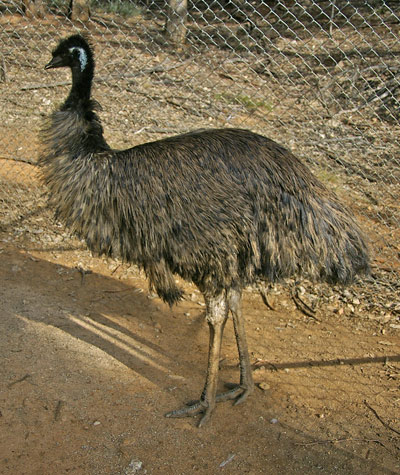
For those of you unfamiliar with the breathtaking beauty and refined elegance that is the common emu, I present this photographic image.

Emu

Lacking the fairytale coloring of the peacock or the pet-like charm of, say, a duck, the emu is remarkable for its mud-colored feathers resembling porcupine quills and a triangular beak that looks like a transplant from the world’s meanest rooster on steroids. Emus are flightless birds, just like their cousin the ostrich. But why bother to fly when you can run 35 mph? That’s about the speed of the average gallop. Maybe horses are instinctively aware of this disturbing piece of emu trivia.

Fortunately, after four years, Wally has accepted our town’s zoo stock, although his initial emu encounter sent him fleeing in the opposite direction so fast that it literally gave me whiplash. Now he’ll pass quietly by the emu house, though with some trepidation: His neck stiffens and his nostrils flare. I compromise, and allow him to give the emu a wide berth. Danny, on the other hand, is a much slower thinker than Wally. By the time he realizes he’s come upon the emu house he’s already past it. If I were to stop, show the emu to Danny, and make a big production over the frilly monstrosity, it’d be like telling Danny, “Hey, this is really something to be concerned about. SO LOOK AT IT. LOOK AT IT REALLY, REALLY GOOD, AND NOTICE HOW BIZARRE IT REALLY IS!”

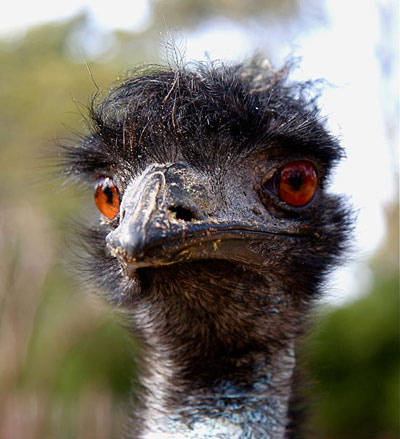
Then Danny would see this staring face back at him, and that’s probably not a good thing.

Emu face

I’m sure I’m not the only one who has to deal with zoo stock. If you trail ride then you probably have some strange sights that you and your horse encounter, too. I suppose that’s what makes riding outside of an arena both interesting and adventuresome. There’s always some sort of challenge ahead, with or without emus.

<< Previous Entry

Back to Life with Horses

Equine Canada announces helmet rule for dressage riders

8
Jacqueline Brooks
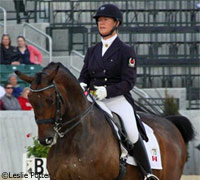
Canadian dressage rider Jacqueline Brooks wore a helmet in her grand prix freestyle at the 2010 Kentucky Cup competition. Photo: Leslie Potter

In response to increased safety concerns in the dressage community, Canada’s governing body of equestrian sport has announced a new rule mandating helmets for some dressage competitors.

Equine Canada announced the new rule in March and it will take effect on May 1, 2011. Under the rule, all riders competing at Fourth Level or below must wear ASTM/SEI or British Standards Institution (BSI) certified protective headgear while mounted at a recognized show. The rule also mandates helmets for any non-competing riders on the showgrounds as well as riders on non-competing horses. This would affect horses or riders schooling on the grounds of a show where they are not competing.

Equine Canada’s rule follows a similar rule change from the United States Equestrian Federation (USEF) that took effect earlier this year. Under the USEF’s rule, all riders are required to wear ASTM/SEI certified helmets while mounted with an exception for riders 18 and older competing only in FEI tests, Prix St. Georges and above.

Read more at EquineCanada.ca

As of May 1st, 2011, the following rule regarding safety headgear will be adopted by Dressage Canada: E4.0 Safety Headgear

1. ASTM/SEI or BSI approved headgear must be worn by all riders showing Fourth Level and below, regardless of age, when mounted on the showgrounds at EC Bronze, Silver and Gold competitions.

2. ASTM/SEI or BSI approved headgear must be worn by all non-competing riders mounted on any competing horse at EC Bronze, Silver and Gold competitions.

3. All riders of any age while on non-competing horses must wear protective headgear at all times while mounted on the competition grounds.

4. The penalty for contravening 4.0.1 is elimination.

5. Non-competing riders who contravene 4.0.2 and/or 4.0.3 will be instructed to dismount until wearing an ASTM/SEI or BSI approved helmet.

Note: At the tack check which follows the test, the steward may ask the rider to dismount so that the helmet may be inspected for the ASTM/SEI or BSI label.

Is your horse getting his minerals?

3

Horses grazingWhen it comes to enjoyment and quality of life, a horse’s true fitness may mean more than just a pasture and some oats. While most horses get the majority of their nutrients from pasture and grain, many may not be receiving the mineral nutrition needed for optimum health.

“It is important to remember that mineral content of forages and hay are determined by the mineral make-up of the soil where they are grown,” notes Dr. Glennon Mays, clinical associate professor at the Texas A&M College of Veterinary Medicine & Biomedical Sciences. “Therefore, if the soil lacks the mineral then the plant grown there will not have that mineral.”

Since soil types can vary from farm to farm and no one soil type has all minerals needed by a horse, mineral supplements are necessary, says Mays.

“Horses foremost need the minerals salt, calcium and phosphorus,” states Mays. “Salt is lost through sweat and urine so it should be available free choice to the horse at all times. Calcium and phosphorus are needed for healthy teeth and bones. Greatest need is in the first year of a horse’s life when it grows the majority of its height. Accordingly, lactating mares need higher amounts of calcium and phosphorus to keep elevated levels in their milk.”

“Calcium and phosphorus should be at least a 1 to 1 ratio,” explains Mays. “Since grains are low in calcium and high in phosphorus, some grains are adequate to meet phosphorus requirements but not calcium needs. Therefore, additional calcium is needed to develop the 1 to 1 ratio.”

Most hays have a high calcium to phosphorus ratio, but the nutritional value of the hay is dependent on the amount of fertilizer applied to the pasture and handling of the hay. By using a combination of grain and hay the proper calcium-phosphorus ratio can be obtained. Of course, poor quality forage could result in mineral deficiencies, notes Mays.

“The minerals magnesium and potassium are also important to a horse’s well being. Magnesium is needed for muscle and nervous tissue function, while potassium helps maintain the cell’s pH balance and internal cellular fluid pressure,” says Mays.

There are additional minerals (needed in very small amounts) that can make a difference in the health of a horse. The trace minerals cobalt, copper, iodine, iron, selenium, and zinc are needed to maintain healthy, productive horses.

Cobalt deficiency is rare but cobalt supplementation has been shown to enhance digestion and therefore increase energy from eaten forages, notes Mays. Copper is necessary to help the horse fight off bacteria and viruses as well as maintain connective tissue and hoof integrity. Iron is necessary for blood hemoglobin. Iodine is important to regulate metabolism and growth. Selenium is important to reproduction, growth, and the immune system. Zinc enhances bone development, healthy hooves and coat, and reproduction, explains Mays.

“Well balanced mineral supplements should be provided for your horse to insure quality health,” states Mays. “The horse is a grazing animal with a unique digestive system. It has a relatively small stomach and a large hindgut that holds fibrous matter which bacteria work to digest. Therefore, forage should be the first food of choice. However, forages do not provide sufficient amounts of minerals for horses, so supplements are necessary.”

Trace mineralized salt in block form will not meet the horse’s nutritional needs, notes Mays. These blocks are mostly salt and contain low levels of trace mineral. Because of their high salt content, the horse takes in small amounts of the supplement and even smaller amounts of trace minerals.

“Determine how much hay and grain your horse eats. Read the bag label for the analysis of the grain. Have the forage tested and nutritionally evaluated. Then determine which minerals and the amounts your horse is lacking,” explains Mays. “Purchase a mineral supplement that is closest to the needed nutrient requirements.”

Minerals are important ingredients necessary for your horse’s good health. Take the time to determine the amounts that your horse needs. When you do, you’ll enhance your horse’s performance and help prevent health problems.

Further Reading
Ten rules to feed by
Feed labels: Analyzing the nutritional guarantee
Supplements for horses

Video: Horse Show Hair

6

Ever wondered how some riders enter the arena without a single hair out of place? Learn how to get the polished, professional appearance that horse show judges appreciate. Sarah Coleman, Executive Director of the Equine Scholars Program at Georgetown College in Kentucky, and Georgetown student Marina Byrd demonstrate how to do your hair correctly for hunter and western shows.


english


Western


Thank you to the Equine Scholars Program at Georgetown College for their participation in this video.

The Equine Scholars Program at Georgetown College prepares students for successful, professional careers in or related to the horse industry while inspiring them to become more caring, passionate stewards of equines worldwide.

Back to Horse Show Preparation Videos >>

Bounce Back to Fitness

2


Gina Miles
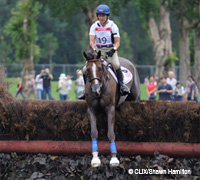
It can be tempting to saddle up your horse on the first warm day of spring and go for a long ride. However, assuming your horse has been out of work all winter, he’s not only lost muscle tone, but also tendon and ligament strength. Bringing him back gradually before placing rigorous athletic demands on him is the best way to prevent injuries all season long.

Olympic eventer Gina Miles describes how she gets her horses fit for the season. Miles rode the 17.2-hand Irish Sport Horse gelding, McKinlaigh, to an individual silver medal at the 2008 Beijing Olympic Games. But that doesn’t mean her equine fitness regimen needs to be all that different from yours, especially when it comes to early-season conditioning.

“The first thing I do is get my horse checked out by my vet,” advises Miles. “Usually the only time people get their horses looked at is during a pre-purchase exam, or when something has already gone wrong. Have the vet out to deworm, vaccinate and do a lameness evaluation with flexion tests. This can give you a heads-up for things you may need to watch for.”

Likewise, Miles feels dental concerns are all too often overlooked and can contribute to performance problems. “Have a good equine practitioner look at your horse’s teeth,” says Miles. “Your [regular] vet can do a great basic float, but a specialist can do more performance-type work.”

When you’ve gotten the all-clear to start back into your riding routine, give your horse enough time to prepare for your athletic goals. “Plan for it to take four to eight weeks for your horse to return to the level of fitness he was at before your break, depending on how long it was. If your horse was off more than three months, it may take even longer than that.

Trail Riding
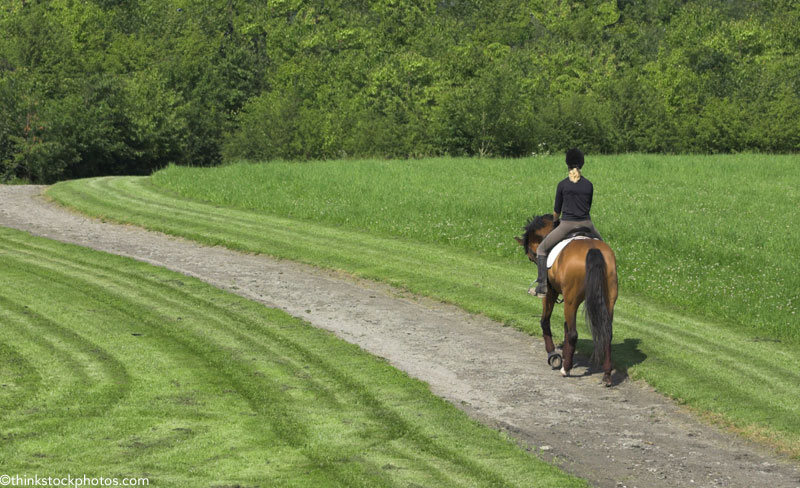
Walking is an important part of a conditioning program.

“Walking is a big part of my program,” continues Miles. Since slow work is so important at the beginning, take your watch along. “During the first week, I start with a 15- to 20-minute daily walk under tack, increasing it by five minutes per day until I’m walking for 45 minutes,” says Miles. “At this point, I start to introduce a three-minute trot. I increase trotting by two to three minutes each day until I am trotting for 15 minutes.”

However, Miles advises that you shouldn’t go by your watch alone, since every horse responds differently to conditioning depending on his age, breed, et cetera. “The most important thing is to listen to your horse,” she cautions. “If he’s really huffing and puffing or sweating, stay at the same level, and be sure to watch his legs carefully for any signs of heat or swelling. Cardiovascular fitness improves the quickest, then the muscles, and the tendons and ligaments take the longest, which is why I stress lots of walking [to strengthen tendons and ligaments].

“When your horse can trot comfortably for 15 minutes with a quick recovery, you can add the canter,” Miles continues. “Start with a two-minute interval, and eventually add a second and third short interval of cantering before increasing the duration.”

Although it’s more interesting to do conditioning work out in the field, Miles says that it’s not necessary. “All of this can be done in the arena if you don’t have access to fields. It may be boring to walk around the ring, so go out and walk around the barn!”

As you work on conditioning, keep in mind that the slower you start off your season, the more likely your horse is to stay sound all year long. While it may not be as much fun as getting in the saddle and going for a gallop, the long-term payoff is well worth it.

Liked this article? Here are others on conditioning your horse:
Start Your Horse’s Spring Training
Safe Conditioning
Hill Work for Conditioning

Horse Illustrated Managing Editor HOLLY CACCAMISE is an avid eventer.


This article originally appeared in the April 2011 issue of Horse Illustrated. Click here to subscribe.

American Horse Council announces the 2011 National Issues Forum

3

American horseThe American Horse Council has announced that the theme for this year’s National Issues Forum is “Congress on a Diet: What It Means for the Horse Industry.”
This year’s National Issues Forum will be held June 21 in Washington, DC during the AHC’s annual meeting. The annual meeting will run from June 19 to 22 at the Washington Court Hotel and also include an update on the national equine health initiative, the Congressional Reception and the annual Congressional Ride-In. This year’s meeting will also see the return of the AHC’s Breed Roundtable, a popular event that brings together leaders of horse associations to discuss common issues of importance to the industry.

Also Read: National Issues Forum This Week

The AHC’s various committees, including the Unwanted Horse Coalition, will also meet to discuss issues affecting the equine community.

“The highlight of this year’s forum will be presentations from Members of Congress, staff and federal regulatory agencies on the new fiscal realities in Washington. They will discuss how Congress’s efforts to deal with the country’s deficits may result in cut-backs to federal programs and spending that could affect the horse industry,” said AHC president Jay Hickey. “There is a new paradigm in Washington that will affect all American industries, including the horse industry.”

As part of this year’s annual meeting, the American Horse Council is hosting a Breed Roundtable. This event was an important part of previous AHC annual meetings and allowed leaders of horse organizations involved in various disciplines to visit with each other and discuss issues of common concern. The AHC Board of Trustees believes it is important to reinstitute the Breed Roundtable this year because of the important issues facing the horse industry.

Welfare issues, disease outbreaks, unwanted horses, and public relations are all concerns. The number of people purchasing horses and participating in the industry is down. As the country emerges from the economic downturn, many horse associations are wrestling not only with how to bring back people who have left the industry but also how to attract new owners, new participants, and new members. The Breed Roundtable will provide an opportunity for industry executives to discuss these issues across breeds and disciplines and learn from each other.

There will also be an update on the national equine health initiative. “This initiative resulted from the USDA-AHC hosted workshop at last year’s National Issues Forum, which provided an opportunity for the horse industry, key federal and state authorities, and others to discuss a coordinated approach to the handling of serious infectious equine diseases that threaten the health of our horses and the commercial health of the industry,” said Hickey.

These outbreaks affect the interstate and international movement of horses, which is critical to the horse industry. When barriers to movement are raised by states and foreign countries concerned about the spread of infectious diseases, this affects sales, breeding, racing, competitions and recreation.

The annual Congressional Ride-In will occur on Wednesday, June 22. The Ride-In allows members of the horse community to meet with their elected representatives and their federal officials to discuss important issues affecting them. All members of the horse community are encouraged to participate, even if you don’t attend the AHC convention. “The Ride-In puts a face on the $102 billion horse industry and the millions of Americans who are part of it,” said Hickey. “The most effective way to affect Congress is through the voters, the horse people from back home who can tell Congress first hand about the horse industry in their respective states and districts and the issues that impact them.”

The AHC will conduct a free briefing for Ride-In participants. Anyone wishing to participate in the Ride-In should contact AHC Legislative Director Ben Pendergrass at bpendergrass@horsecouncil.org or 202-296-4031.

More information on these Forums and the entire AHC annual meeting, including registration and hotel information can be found on the Events Page on the AHC’s website or by contacting the AHC.

0FansLike
0SubscribersSubscribe
We use cookies to help personalize content, tailor and measure ads, and provide a safer experience. By navigating the site, you agree to the use of cookies to collect information. Read our Cookie Policy.
OK