0 ITEMS
  • My Account
  • Holiday Gift Guide
  • Podcast
  • Webinar
Subscribe Combo
Enable cache13
Home Blog Page 101

Finding Love Through Equine Adoption

0

Whether you’re looking for your next show-ring champion, an endurance athlete, a trail horse, a therapeutic riding mount or a mellow companion, chances are you can find the perfect horse in an unexpected way: adoption. 
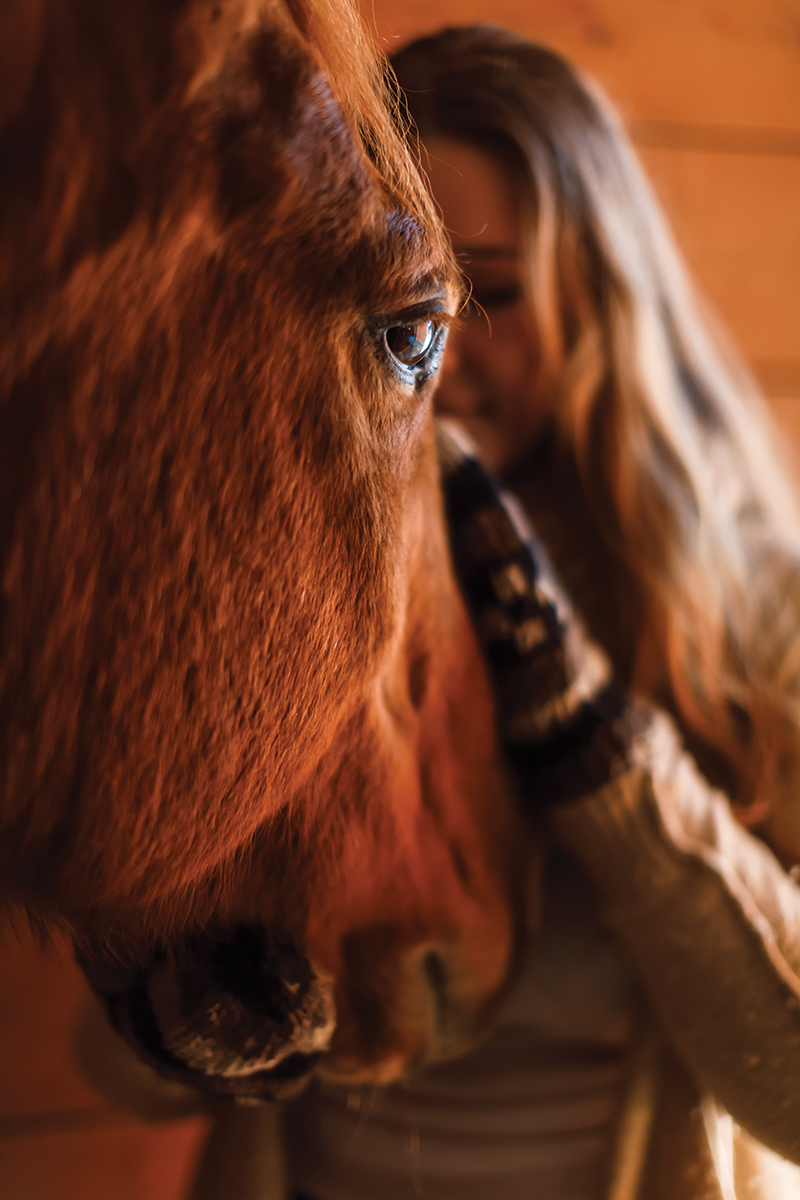
horse adoption
Photo by Shelley Paulson

“There are horses of all different shapes and sizes, ages, breeds, colors and disciplines,” says Emily Weiss, Ph.D., vice president of Equine Welfare for the American Society for the Prevention of Cruelty to Animals (ASPCA). 

Through The Right Horse, the ASPCA’s initiative, the organization is working to increase adoptions, improve the lives of horses in transition and collaborate with industry professionals, equine welfare organizations and advocates. On its online adoption platform, potential adopters can view hundreds of horses ready for many different careers. 

“There are horses that come from our rehoming partners who end up being champions at horse shows, great trail riding horses, and best friends,” Weiss says. “Some end up being therapy horses that make an incredible difference in the lives of humans.”

With research from the ASPCA identifying up to 1.2 million U.S. households with the interest and resources to adopt a horse in need, there is a promising amount of matchmaking to be done. We talked to five adopters who all found their perfect match through The Right Horse’s partner organizations. 

Daisia and Calypso

When Daisia Bartos’ mom sent her a link to Calypso at the Humane Society of North Texas, she knew she had to make the drive from San Antonio to Fort Worth to meet the gorgeous gelding. 

“He’s about 14.2 hands, and I thought he was so cute,” says Bartos. “I decided to get him on the spot, because I just fell in love.”
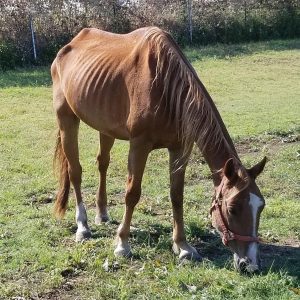
BEFORE: Calypso had been abandoned in a stall and was extremely malnourished when he arrived at the Humane Society of Texas. Photo Courtesy Daisia Bartos

Calypso, then named Flame, had been abandoned in a stall and malnourished before coming to the Humane Society. He’s now approximately 8 years old and spent a year getting healthy at the In The Irons Equestrian Center where Daisia works. There, he received some round pen training but needed a strong rider. At first, he would bolt when Bartos went to mount, and is still scared of anyone but her. However, the two have developed a strong bond. 

“His personality and mine—we’ve just clicked,” she says. “It’s beautiful. He’s taught me a lot. He’s so willing to learn. That’s why we’ve progressed so far in two months.”

Recently they began jumping, and the small horse has a big leap. 

“The other day I put him over a cross-rail, and he decided he wanted to jump 4 feet. That was awesome!” 
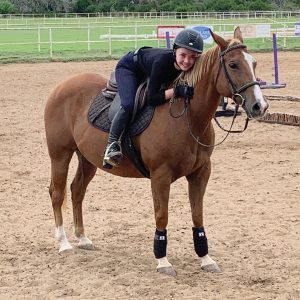
AFTER: Daisia Bartos spent a year getting Calypso healthy. The two bonded from the start, and he is very willing to learn under saddle. Photo Courtesy Daisia Bartos

Bartos plans to show him and keep him for the rest of his life. 

“We’ve created such a big bond in this short time,” she says. “If he’s anxious—head is up high, ears alert, eyes wide—and I walk up to him and put my hand on his head, he completely relaxes.”

Of adopting horses, Bartos recommends it. “If you’re willing to put in a great deal of time and patience, you get so many great things out of it.” 

Erin and Cuda

Erin Degnan of Bernardston, Mass., knew she wanted to adopt an off-track Thoroughbred and found After the Races, a Thoroughbred rehabilitation and rehoming center, in Elkton, Md. 

“I was impressed by the honest, detailed descriptions of each horse available, the videos of the horses, how content and relaxed they looked, and the amazing reviews,” she says. 

She fell in love with Cackle the Cuda and adopted him in October of 2019. Eight years old at the time, he had retired from racing after 43 starts. In their first year together, they tried dressage, jumping and trail riding.

“He has proven himself to be an amazing trail horse and has lovely ground-covering gaits,” says Degnan. “With this in mind, I decided to try out some distance riding with him—something I’ve never done before. We recently completed a 15-mile conditioning ride, and I am hoping to compete in a limited distance ride [25-30 miles] with him next year.”
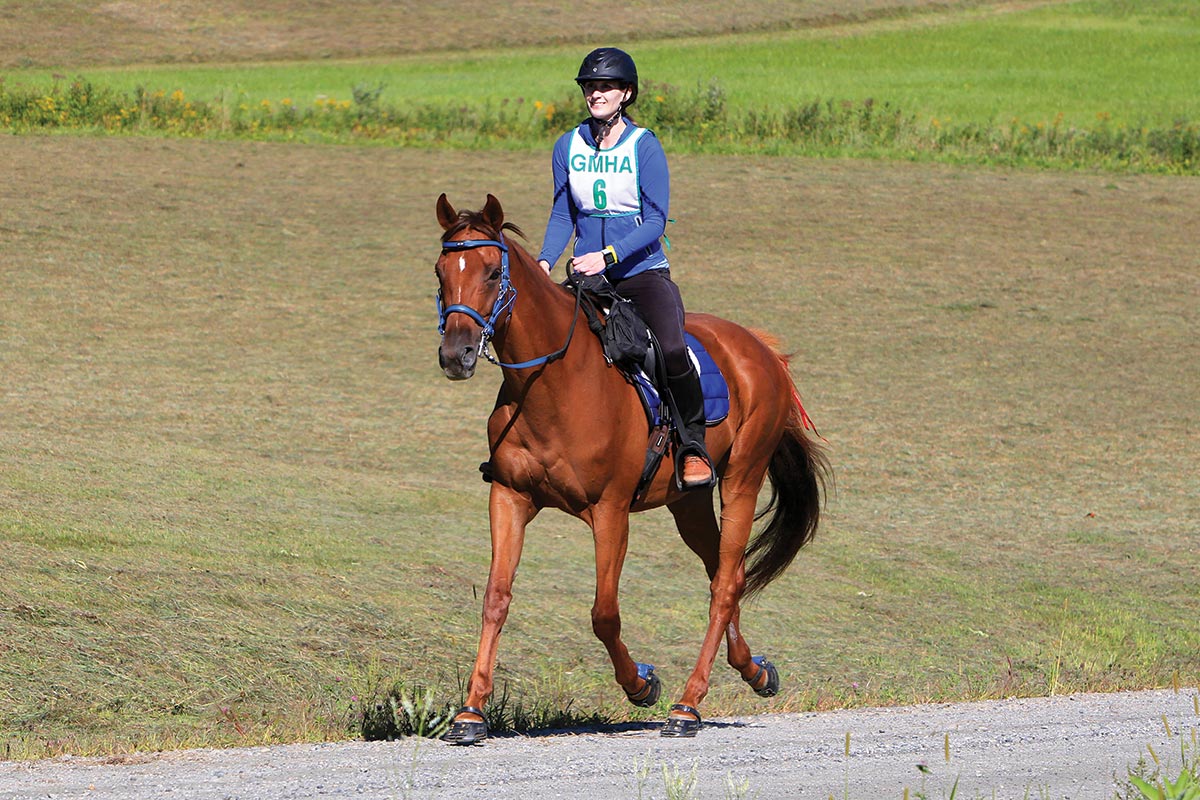
endurance horse
Cuda raced 43 times before Erin Dengan adopted him. He immediately showed an affinity for trail riding, and they now compete in distance rides. Photo Courtesy Erin Dengan

Degnan advises potential adopters not to judge horses by their breed stereotypes. 

“He is very brave; nothing fazes him out on the trail,” she says. “I feel completely safe going out with him alone, because I know he won’t freak out or do anything dangerous with me. He is excellent at finding the best path through tough terrain and always knows the way back on a trail.”

Degnan advises following your intuition when you meet the horse that you feel is the right match. 

“I knew as soon as I rode Cuda that he was the horse for me, and my intuition was correct,” she says. “He is my ‘heart horse,’ and I feel so incredibly lucky that I found him.”

Karlee and Hugo 

When Karlee Boots and her mom, Tiffany Smith, purchased a former racehorse ranch in Edmond, Okla.,to build a wedding venue, they knew they wanted to fill the acreage with rescue animals of all shapes and sizes. At Nexus Equine, an equine adoption center located in Oklahoma City, they discovered a 22-year-old Belgian Draft Horse named Hugo. 

“I fell in love,” Boots says. “We had to bring him to our ranch and let him live out his life.” 

He had come from an Amish farm in Pennsylvania with two other drafts. “All of their body conditions were very poor,” she adds. “He was the only one of the three that made it.”
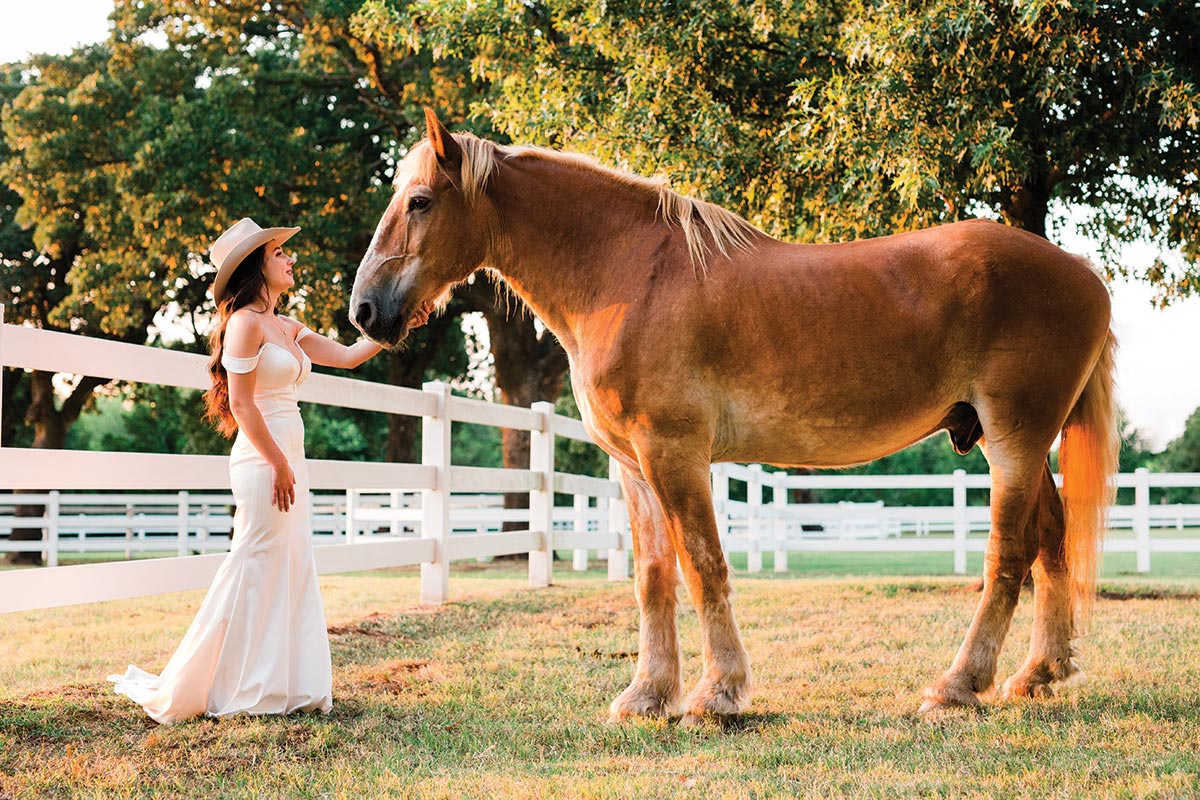
Karlee Boots adopted 22-year-old Hugo to live at her ranch, which is used as a wedding venue. Photo by Aaron Snow Photography

Just home a short time, Hugo is in great health now and enjoying a ranch retirement with other adopted horses, dogs and even a pig. 

“He’s the most gentle giant I’ve ever met,” she says. “Since he’s been working his whole life, I just want him to be comfortable and happy. He’ll trot up to the fence for treats. He’s such a gentleman. Pampering him is my favorite thing.”

Boots says there are many misconceptions about adopted animals in general. 

“People think they’re better if they’re bought from a breeder. But in actuality, there are so many amazing horses in rescue. You just have to find the perfect one.” 

Kelli and Esprit 

Kelli Sorg of Nicholasville, Ky., had her horses stolen in 2007, never to be found again. It took 10 years before she was ready to try horse ownership again. 

“I decided to look into horse rescues, because I wanted to give a horse a second chance the way I felt like I had been given a second chance over and over again in my life,” she says. 

She heard about the Kentucky Equine Adoption Center (KYEAC) in Nicholasville and originally intended to adopt just one horse. 

“When I went out to KYEAC to look at the horses, one mare appealed to me immediately,” Sorg says. “Of the nine horses I had stolen, the boss mare in that group was a large black-and-white Paint. When I walked up to Esprit for the first time, I looked closely because I wondered if this was my Paint mare. Of course she wasn’t, but the bond was already established. After walking around the farm and looking at other horses, I met Mandy, an almost solid black Rocky Mountain Horse with blue eyes who is a very in-your-pocket sort of horse. Then I realized what most horse people do: Two horses are just as easy as one.”

Esprit had been the longest resident at the center and adopted and returned more than once.
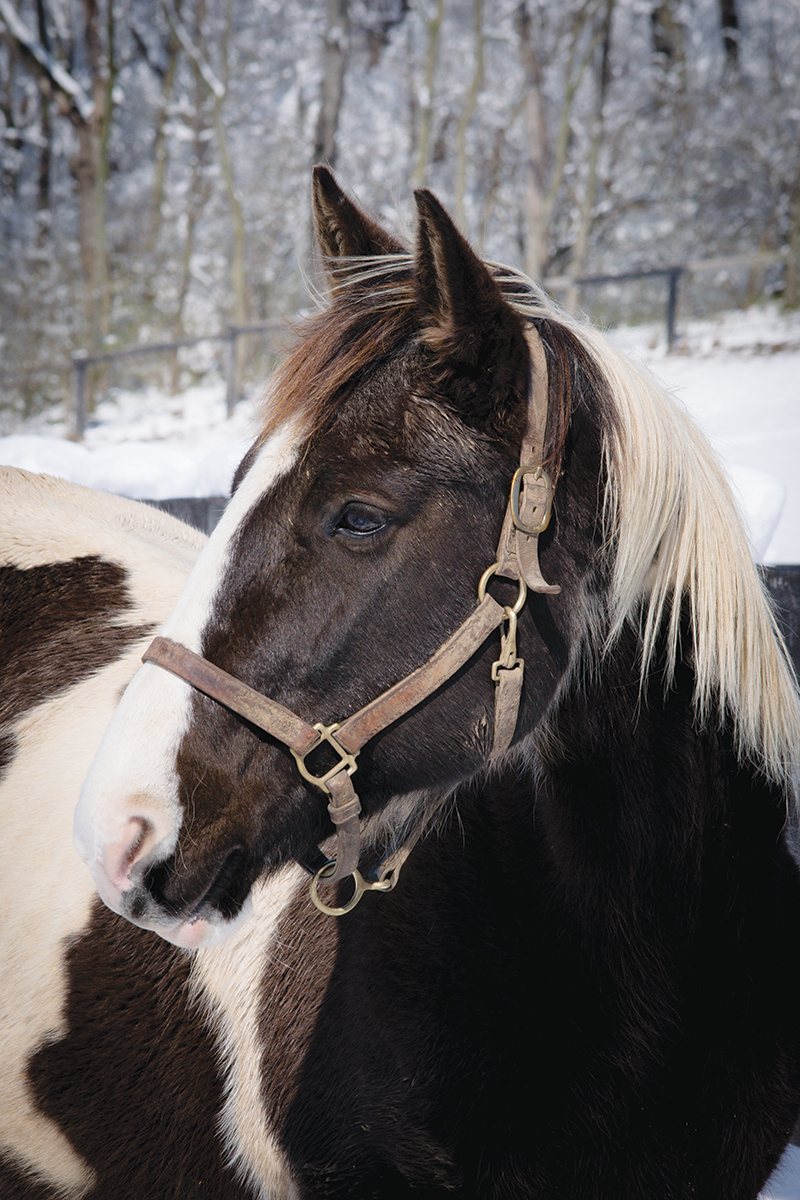
Esprit was the longest resident of the Kentucky Equine Adoption Center when Kelli Sorg took her in. Photo Courtesy Kelli Sorg

“I was Esprit’s person,” says Sorg. “That’s all she had ever been looking for: someone to provide security and consistency and a sense of purpose. She was already beginning to fight with heaves, so she and I didn’t do a lot of riding, but she restored my confidence in myself as a horse woman. We played ground games and worked on liberty work that felt like dancing.”

Esprit recently lost her battle with heaves, but Sorg still has Mandy and has adopted several other horses. Her positive experience with the center led to her dream job as their development director in 2019. 

“Now I get to help make connections between horses and people just the way someone helped me make the connection with my heart horse, Esprit.”

Kendra and Cinnabar

When PATH Intl. certified riding instructor Kendra Loring of Albuquerque, N.M., decided to start her therapeutic riding business, she wanted to use adopted horses and began volunteering at New Mexico Horse Rescue in Stanley. 

When some people think of “unwanted” horses, they may think of old, broken down horses with behavior issues that aren’t rideable, but often this is a misconception and definitely wasn’t the case for Loring. 

“They were amazing horses,” she says.

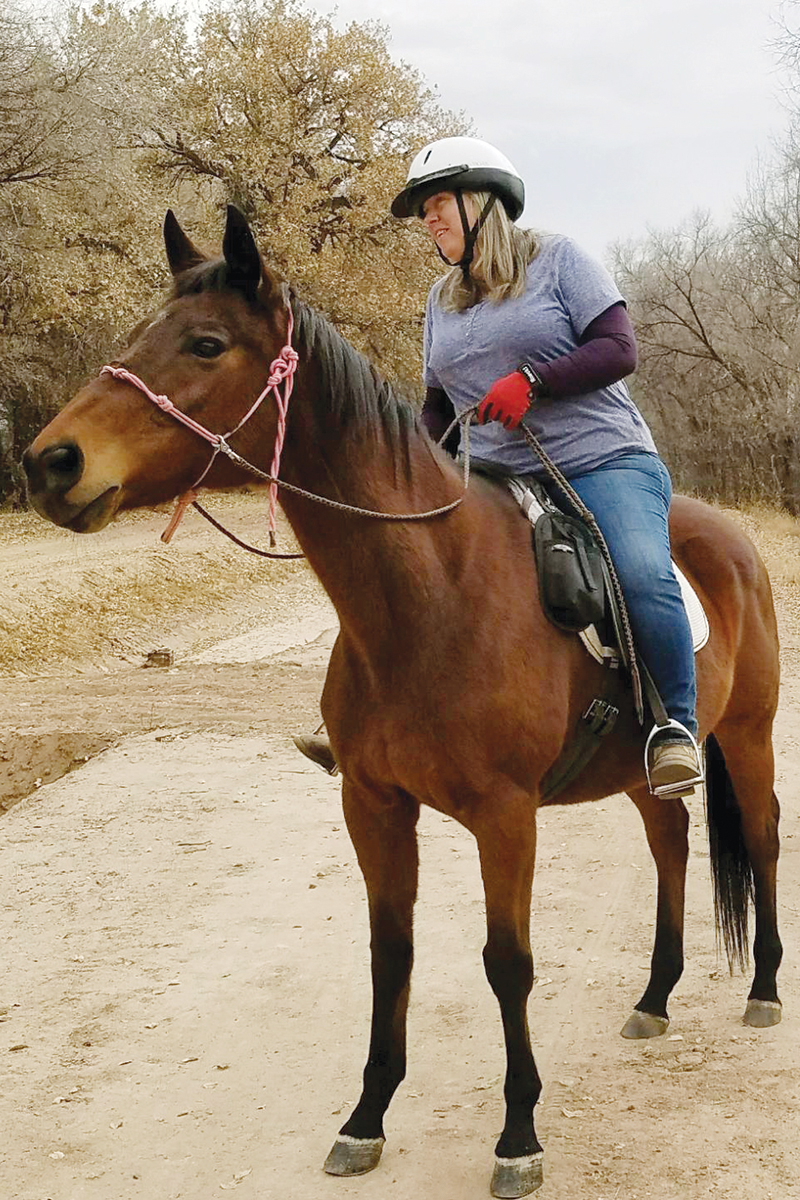
She ended up adopting two horses from the rescue in 2013: Cinnabar and a pregnant mare, Misty. Cinnabar was not one of the horses Loring originally considered, but the Thoroughbred mare had ideas of her own. 
adopted horse
Kendra Loring adopted Cinnabar, a 21-year-old Thoroughbred, to use for her therapeutic riding program. Photo Courtesy Kendra Loring

“When I went to meet a Quarter Horse in the pasture, Cinnabar was attached to me,” she says. “She wouldn’t leave me alone.”

She shares that Cinnabar enjoys being a lesson horse for both adults and especially for kids, whom she loves. Cinnabar is now 21 and lives a happy life at Loring’s equine facility. 

“She’s my heart horse—she’s a part of me,” she adds.

Kendra’s advice to potential equine adopters is to keep an open mind. 

“Just because you have it in your mind the breed, age, or type of horse you want, that may not be the horse that’s meant for you.” 

This article about equine adoption appeared in the January/February 2021 issue of Horse Illustrated magazine. Click here to subscribe!
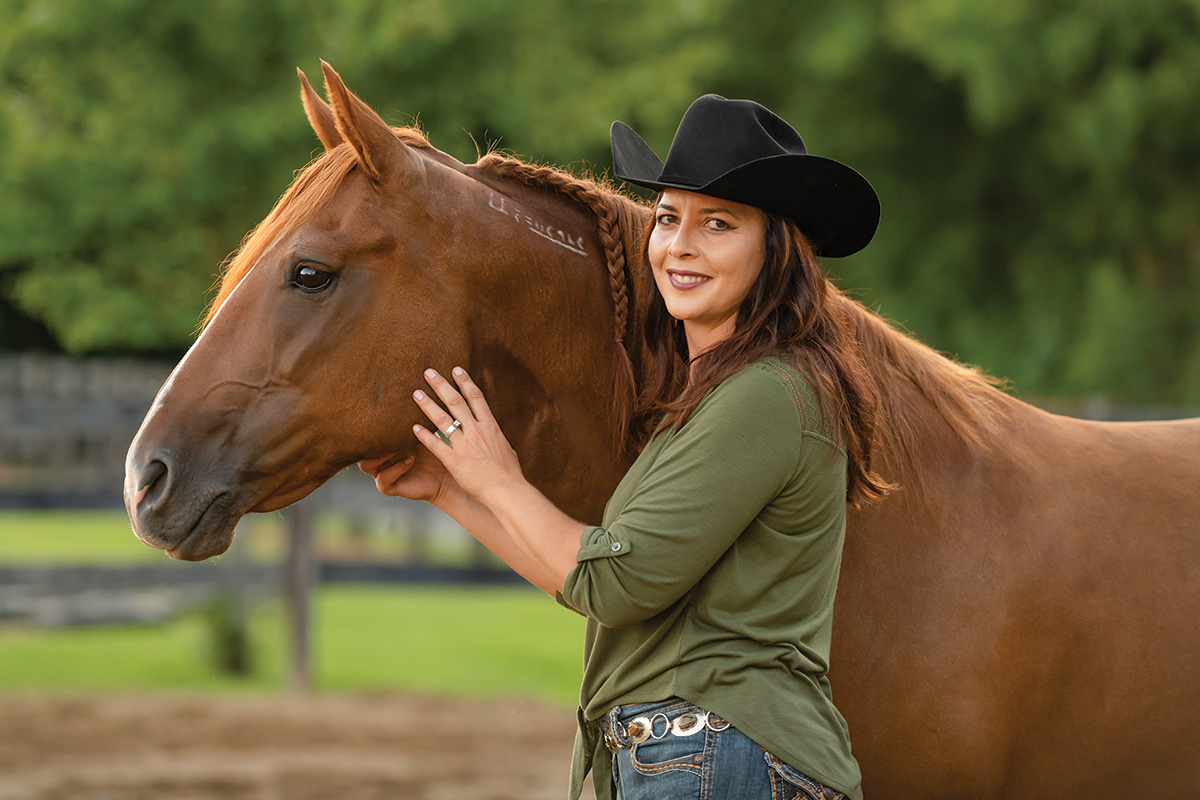
Healing with Horses for Challenged Riders

0

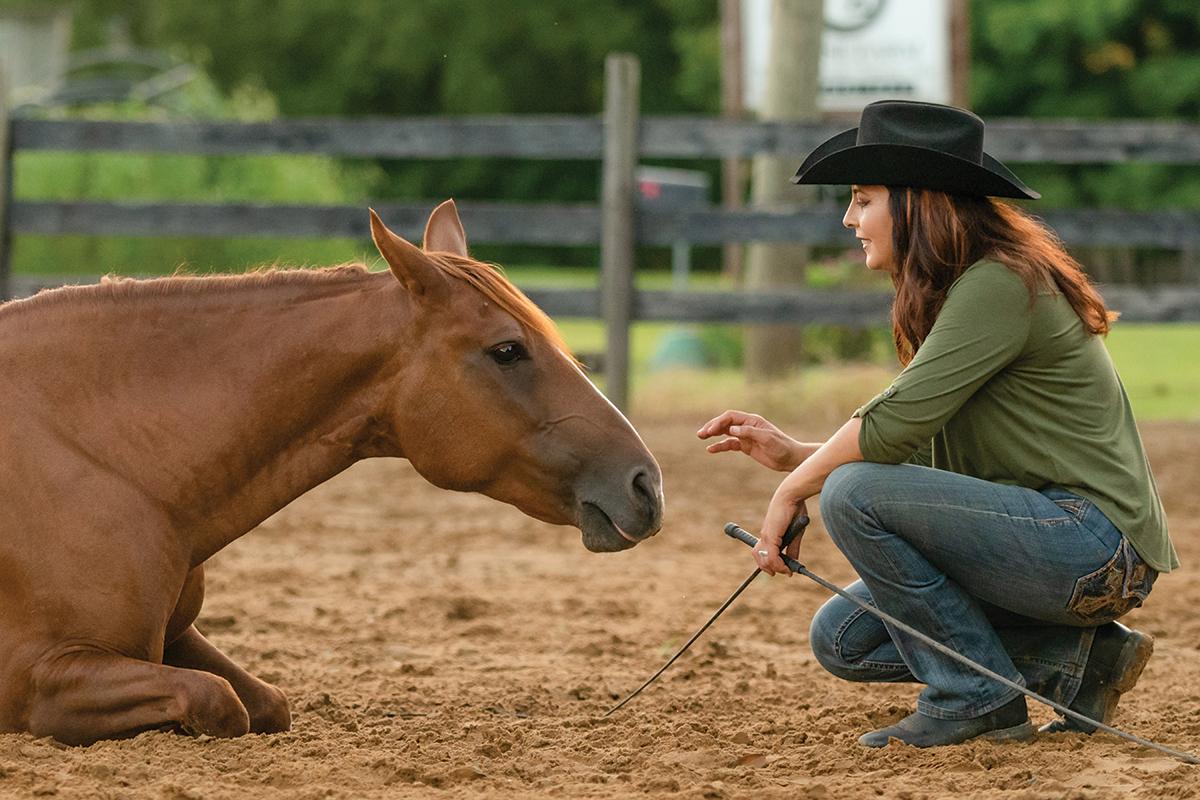
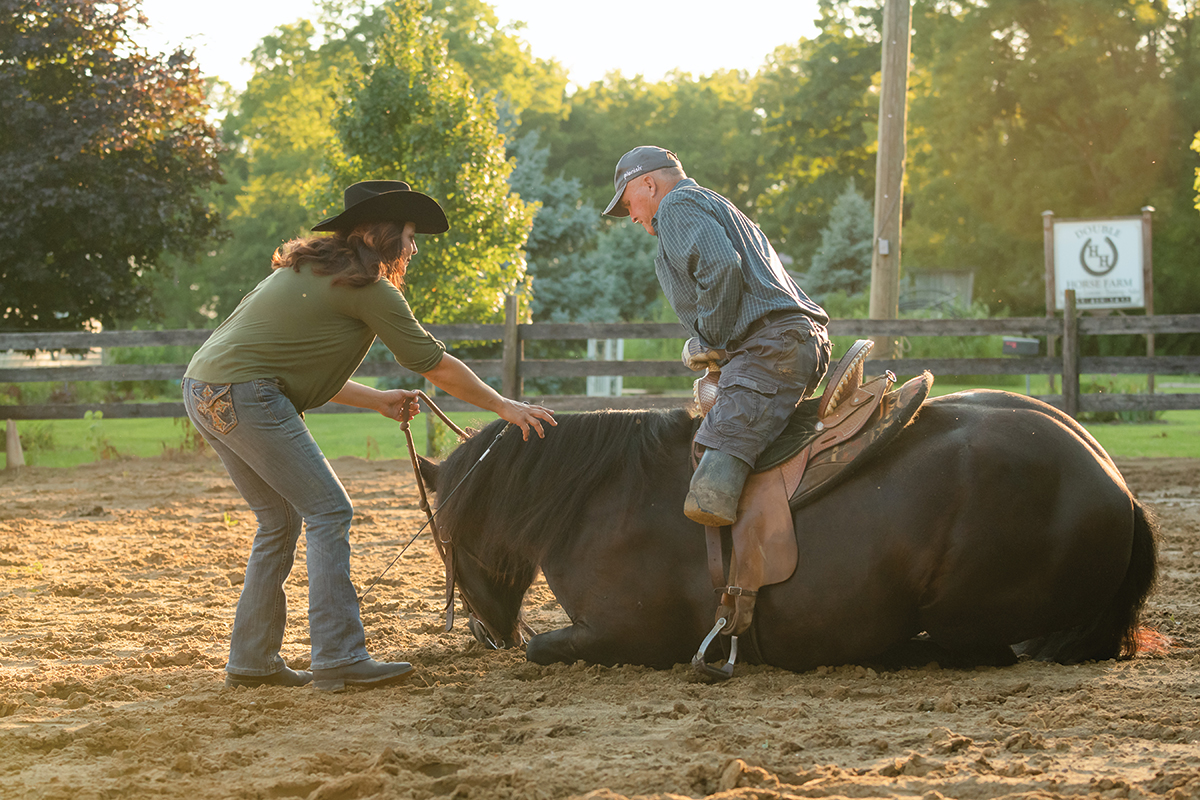
Horses don’t naturally lie down to be mounted, much less stand back up with a rider, on cue. But horse trainer Nadia Heffner has trained a couple of horses to perform this difficult maneuver. And the mobility this move offers disabled riders has allowed her to facilitate remarkable human healing with horses. 

mustang horse brings healing
Photo by Rachel Griffin

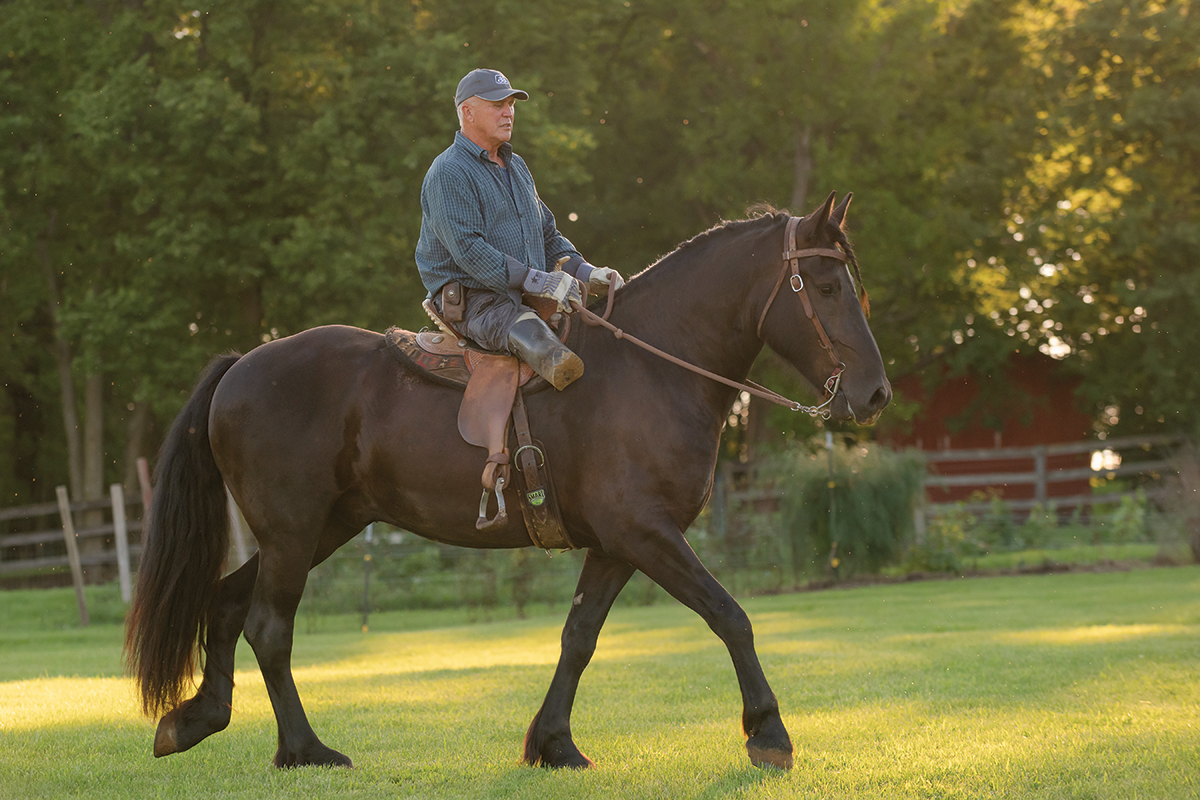
Lloyd Hayden, who is a double amputee, has been able to ride his Percheron-Friesian cross gelding, Bo, in the fields around his farm. For Cathy Florman, riding Heffner’s Mustang, Grace, gave her a wonderful escape from debilitating amyotrophic lateral sclerosis (ALS) symptoms.

Building a Foundation

Heffner grew up on a horse training farm in New Jersey. Passionate about horses, she started taking lessons at age 7 and got her first horse at age 9.

“I would ride all summer and learn how to ride all different types of horses,” says Heffner. “That was probably the best education I could have gotten—learning that every horse is different.”

Heffner learned from Dottie Orzechowski how to ride in a variety of disciplines, “learning something well before you skip to the next thing.” She’s done everything from western and English pleasure to barrel racing, pole bending, team penning and other events—many of them on her horse, Clay.

“I try to stay really well-rounded,” Heffner says.

When she moved to Indiana in 1996 at age 20, she immediately got plugged in with horse people, starting with a woman named Sandy Blackburn. Blackburn was pregnant and needed someone to get her horses ready for a youth to show at the local 4-H fair. Heffner was able to get the horse prepared, and it was the start of a great training relationship, as well as friendship.

Blackburn helped Heffner buy her first small property, and the former massage therapist soon started her horse training business. She has since moved to a bigger equine facility, called Double H Horse Farm.

Mustang Makeovers

In 2008, Heffner learned about Extreme Mustang Makeover events. Horsemen take an untrained Mustang, and within 100 days, train the horse to ride, go over trail courses, and load in a trailer. The top 10 finishers also perform reining maneuvers and a freestyle. Heffner was intrigued and saw it as a great way to promote her colt-starting training.

Nadia promotes healing with horses
Nadia Heffner taught Grace to lie down for the 2012 Extreme Mustang Makeover. Photo by Rachel Griffin

Heffner has now done three Mustang Makeovers. The mare she worked with for her second event in 2012 was Grace, who placed fourth. Thanks to the mare’s talent and temperament, Heffner says Grace is her training ambassador.

“She does all kinds of tricks,” Heffner says. “She’s done western, English, barrels and poles. She has been in my house—she’s just amazing. I trust her with a lot of things. She performs at liberty, too. She’s taught me a lot.”

Special Training Leads to Healing with Horses

Drawing on skills she gained as a massage therapist, Heffner’s intuition has helped her sense when a human or an animal is in pain—and help them find healing together.

“With horses, I can look in their eye or see the way they’re moving and try to fill in the holes of their backstory,” she says. “I can see when something isn’t right. It’s been a learning process. I used to think training maneuvers had to work if done right; now I know a horse has to be able to do them physically, just like we can’t all be gymnasts.”

Heffner believes groundwork and a good foundation set a horse up for success under saddle. Grace is a great example of the kinds of horses Heffner enjoys bringing along in her program.

“The horse has to be kind and forgiving, and gentle,” she says. “I’m not saying my Mustang doesn’t make mistakes, but if she knows that I’m calm too, she’ll stay that way.”

unique mounting tactic allows healing with horses
Heffner taught Lloyd Hayden’s Percheron-Friesian cross, Bo, to lie down so his owner could mount more easily. Photo by Rachel Griffin

Because of her experiences with the Extreme Mustang Makeover, Heffner also trains Mustangs and burros for the Bureau of Land Management.

“Through the makeovers, I saw what great horses the Mustangs really are, and how they need their stories to be told,” she adds.

Back in the Saddle

Lloyd Hayden has ridden horses and farmed all his life. After retiring from ironworking, for the last decade, he has managed his farm in Thornton, Ind. 

In October 2018, he lost both his legs below the knees in a combine harvester accident. But the loss has not kept Hayden from caring for his land—or from riding. He’s able to walk on his knees and use track vehicles around the farm. And by the following spring, he was back in the saddle, regularly trail riding in his fields or nearby state parks with his wife, Sue.

The Haydens raise Friesians and Friesian crosses. Four-year-old Percheron/Friesian Bo was bred and raised on their farm, and the couple trained him to ride prior to Hayden’s accident. He’s been able to ride Bo, but would need to get on from the bed of a truck, and it was difficult.

Knowing she’d taught Grace to lie down on command during the Extreme Mustang Makeover, Heffner was approached about training Bo to do the same thing. Because every horse is different, Heffner did not give a timeline and said the maneuver couldn’t be forced. 

It was a challenge for both horse and rider over 30 days of consistent training. Bo went home with the Haydens as they continued to practice, trying to get the mechanics right. Heffner worked with Bo a few more days, and finally, he was ready. She says the key is doing the maneuver in soft arena dirt.

“It’s a very vulnerable position for a horse to be in,” Heffner says. 

Heffner began training horses to lie down on command after watching John Lyons training videos; he told a story of how he taught his horse to lie down after breaking his leg on the trail when he couldn’t get back on. She thought it would be a neat trick—she didn’t realize it would be so helpful in allowing healing with horses.

“I always remember that story and how this skill may come in handy,” says Heffner. “Lying down has been mostly a novelty until now.”

challenged rider on his horse
Having Bo lie down for mounting meant Hayden could ride more easily and enjoy his horse. Photo by Rachel Griffin

Hayden says Bo’s new skill has made riding much more convenient.

“We’re thankful she did that for us, and we really enjoy riding,” he says. “[Bo lying down on command] really makes things easier for me.”

Amazing Grace 

Cathy Florman grew up on a farm and owned her own horse as a teenager. She got back into horses when her daughter, Rachel Griffin, became interested as a child, and last rode about six years ago. Griffin is a lifetime horsewoman and has taken lessons from Heffner in the past. 

When Florman began declining after her diagnosis with ALS—a progressive disease affecting the nervous system—Allison Sherrill, a Florman family friend and Heffner’s best friend, suggested a riding opportunity for Florman. Talking through mobility challenges (ALS depletes muscle strength and other important functions), Heffner knew that Grace’s ability to lie down and stand up on command would be essential.

“We made sure that [Cathy’s] head was safe, and we were supporting her,” Heffner says. “Once she was on, she couldn’t believe how much more mobile she felt than when she was walking on the ground. She had the greatest time.”

With Grace able to lay down, the last barrier to Florman being able to ride was removed.

“It was a great joy to go to the barn and see the horses,” says Florman. “It was so precious to me to be able to ride. I couldn’t believe it. I didn’t know I would be able to do it, and I didn’t know how wonderful it would be to ride.”

Once in the saddle, Florman remembered her years of riding and felt renewed, despite her debilitating illness.

“She just had that easy, familiar rhythm from walking,” Florman says of riding Grace. “There’s nothing that moves your body so naturally like moving with a horse. Before I got sick, one of my greatest pleasures was riding a horse. So being back [in the saddle], it felt normal. Like I wasn’t sick anymore. I could sit up taller. I could do it, just like I used to.”

Florman says her experience was truly life-changing.

“Something happens when you get on the back of a horse,” she continues. “Anybody that rides knows this. If you’ve had a bad day and you go ride, it transports you away from those problems. It’s just you and the horse at the rhythm of the walk. There’s something transformative about that.”

horses bring healing to older horse lovers
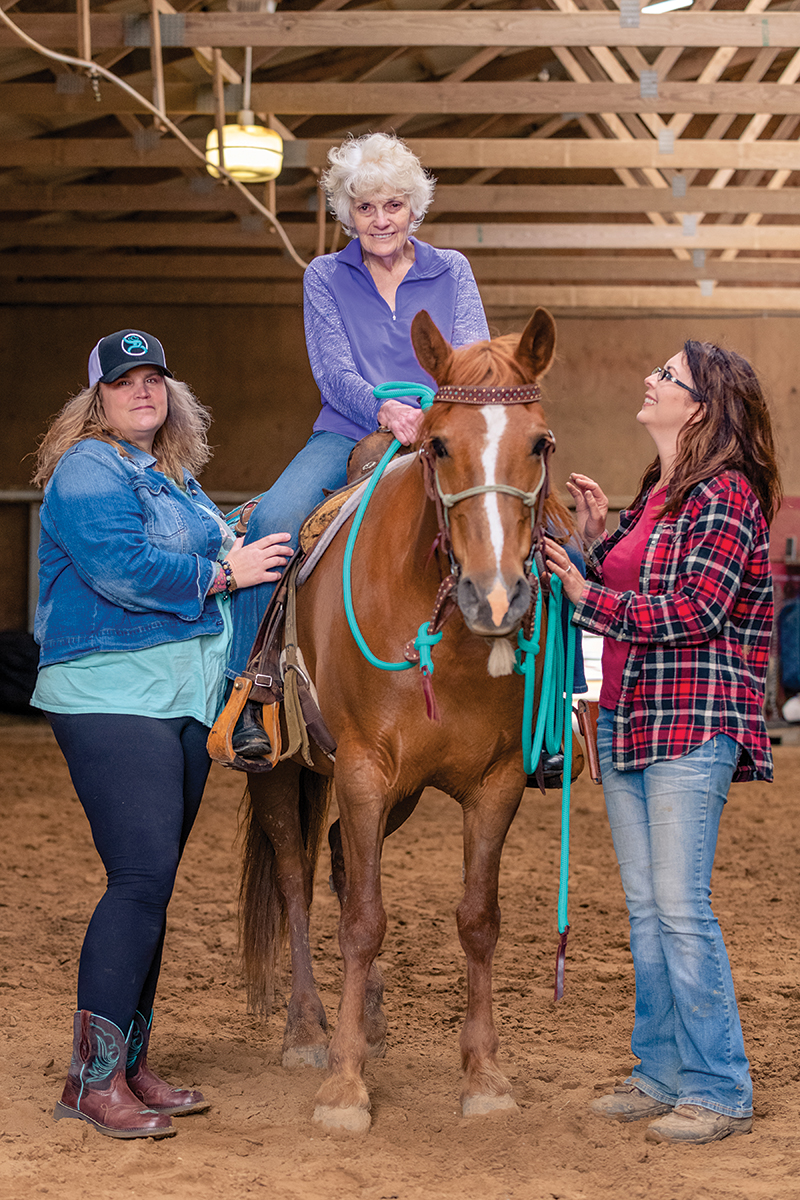
Cathy Florman got to feel the joy of being on horseback again due to Grace’s special training. Photo by Rachel Griffin

While she was on Grace, with Heffner and Sherrill beside her, Griffin rode another horse, and mother and daughter enjoyed each other’s company as they rode together.

“It was really nice to be above the ground, above my problems, riding beside Rachel, just walking and talking,” Florman says. “It was like life was how I wanted it to be.”

Dismounting was also a challenge, but Grace was up for it. Florman says Heffner’s calm personality helped her feel safe during the process. 

Florman also says training a horse to perform these maneuvers is an incredible gift for a disabled rider that can enable healing with horses.

“Teaching your horse to do this is one of the most loving and kind things you can do—it’s very much appreciated,” Florman adds. “There was no other way for me to be able to get on the horse. I am so grateful.”

This article about healing with horses appeared in the January/February 2021 issue of Horse Illustrated magazine. Click here to subscribe!
 

Destress and Make Barn Time Fun Again

0

Losing momentum due to life’s many energy and time drains is difficult enough to cope with—family demands, work stress and personal hardships can disrupt everything—but it’s even more heartbreaking when this happens to horse owners. The loss of dedication and interest can create guilt and emptiness for us, but it also impacts the horse, who is an innocent bystander. If this rings true for you, it might be time to take steps to make barn time fun again.

make barn time fun
Photo by Shelley Paulson

An honest evaluation gives insight into why the responsibilities of the barn, horse and other life stresses seem unbearable. Thinking about the strenuous duties, both mentally and physically, you can talk yourself out of just visiting your horse—let alone the energy to catch your horse and collect your gear, groom him, tack up, and ride.  

Finding Your Purpose

Mental skills coach, equine sport psychologist, and author Tonya Johnston, M.A., says that if we sit down and ask ourselves “why?”, we should be able to answer that question and find out what drives us to be an equestrian. 

“Your WHY can change depending on what your needs are at the time or perhaps for your future,” says Johnston. “Sometimes you need a more peaceful, less goal-orientated view when it comes to riding. Sometimes the social outlet to be with like-minded barn friends will help redefine your WHY. Answering your WHY will also shed light on other things that may be blurring your barn vision, such as feeling a bit depressed, having new aches and pains that make riding hurt, mental fatigue and trouble focusing during your ride, and problems communicating with your instructor and horse. It should trigger you to ask for help from a medical professional, a mental coach, or friend, or to find a new trainer or boarding facility before the issue becomes too big to handle.” 

She says that setting small, tangible weekly goals that make it easier to see your accomplishments will make your WHY more meaningful.

“I call these performance goals, remembering it’s fine to adjust these as you go through the ebb and flow of your busy life, allowing flexibility and making an effort to bring back the fun in and out of the barn,” says Johnston. “Take a step back and reframe your priorities—if you have family issues, you’re not sleeping well, or you have a big commitment at work—then change your goals to accommodate how horse time fits in best over these times.” 

For example, instead of spending five rushed evenings a week at the barn not being fully present, set the goal to three evenings with quality rides. Setting achievable goals can help make barn time fun rather than stressful.

Delegating Responsibilities 

Janet Sasson Edgette, PsyD, is an equestrian sport psychologist and author. She says that taking accountability for how you prioritize your time is crucial to making barn time fun. 

delegate chores
Delegating household tasks to other family members can help you feel freed up to spend time on your horse. Photo by Oliveromg/Shutterstock

“It’s important to look at the different facets of riding, horse ownership and life outside the barn separately so you can figure out what’s working and what’s not,” she says. “Going home at the end of a long day of work and riding and finding that you have hungry kids or trash that still needs to go out can make you wonder whether you have room in your life to ride. This would be the time to rally your family members together and hold them accountable for their role in keeping the household running without relying totally on you. It could mean less resentment for you, in addition to more barn time or guilt-free rides, because you know the housework and errands aren’t just sitting there waiting for you.”

People who struggle to set limits, worry about disappointing others, or like being the go-to person need to realize what those habits are costing them, she explains. 

“Not only does this give you unrealistic expectations for yourself, but it invites people to ask you and expect more of you,” says Sasson Edgette. “Boundaries remind you and others that there are limits to how available you are or how generous with your time and energy you want to be. Exercising your right to say ‘no,’ or ‘I’m sorry, I can’t help you this time,’ can be used in all life’s aspects—work, social life, family and the barn.”

Taking a Breather

Feeling depressed about the non-riding aspects of your life can bleed over and make it hard to muster the energy to enjoy barn time. However, concentrating on what you can change and developing a perspective on those things that you can’t may feel impossible. 

make barn time fun
Taking time off from show pressure to do other things with your horse can bring the fun back. Photo by Shelley Paulson

Sasson Edgette says finding a therapist and letting people who care about you know you’re struggling will help you with some of these decisions and choices. 

“Being kind and patient with yourself is the way you want to approach this,” she adds.

Performance Pressure

If the loss of the feel-good moments at the barn stems from a training problem, then it’s crucial to ask for help before you lose confidence and create bad habits that will take more time and energy to fix down the road. A fall or accident, a misbehaving horse, setting unrealistic training goals, not seeing eye-to-eye with your trainer, or feeling over-faced with a horse who is above your skill level can make barn time lose its magic.  

“Work with trainers who you and your horse communicate well with,” says Patrick Cohn, Ph.D., a mental game coach and sports psychologist who owns Peak Performance Sports. “Assess your relationship with your horse and how you both enjoy that relationship. Keep in mind that you are a person first and foremost. Riding is what you do, not who you are, and it shouldn’t define your life outside the barn.” 

4 Tips to Get the Fun Back

Janet Sasson Edgette, PsyD, an equestrian sport psychologist and author, offers her top four tips for getting you and your horse through whatever’s zapping the fun out of your barn time.

1. If you’re discouraged because your progress has hit a wall, it might be time to speak to your trainer—not to complain or blame your horse, but rather to ask what else you could be doing in order to get back on track.

2. If part of your drop in enthusiasm is the result of a fall or accident, don’t try to push your way through your anxiety or your fears—it will always make it worse. You might need to start back riding again under conditions in which you’re comfortable. If that means riding in the indoor after your horse has been turned out for a full day, and only walking and trotting, then that’s where you start!

make barn time fun
Turning your horse out to pasture for a lower-maintenance lifestyle can give you a breather temporarily. Photo by Kade D. Thomsen/Shutterstock

3. There are periods of our lives where things don’t work well or feel good or look promising. A break may help, such as leasing your horse out for six months, or hiring someone to keep your horse fit enough, or putting your horse out on pasture for a while. You can also try riding even though you don’t feel great, and it will just be a different kind of riding experience for a little while.

4. Ask yourself these questions and answer honestly: Are you over-faced? Is your barn too fancy or competitive for you? Do you need a different barn social environment with more people your age or skill level?


Pressure to excel will hurt your motivation and love for the animal and the sport, he adds. Getting overwhelmed with demands and putting the rest of life on the back burner can cause riders to get burned out. 

“An important factor for you to manage is the expectations of others, and the ones you put on yourself, to accomplish your horse and life goals,” says Cohn.

Finding your WHY and taking care of it keeps life from stealing your joy, passion, and bonds with those you care about. Having a clear approach to protect your WHY with horses can get you back in the saddle and experiencing more joy than ever.

This article about relieving stress to make barn time fun appeared in the January/February 2021 issue of Horse Illustrated magazine. Click here to subscribe!
My Right Horse Adoptable Horse of the Week: Wren — March 15, 2022

0
Adoptable Horse of the Week - Wren
Courtesy Wild at Heart Horse Rescue

Welcome to Horse Illustrated’s weekly installment of the My Right Horse Adoptable Horse of the Week, offered in partnership with The Right Horse. Wren is this week’s adoptable horse. Check back weekly for a new featured horse so you can find your #righthorse.

Adoptable Horse of the Week - Wren
Courtesy Wild at Heart Horse Rescue

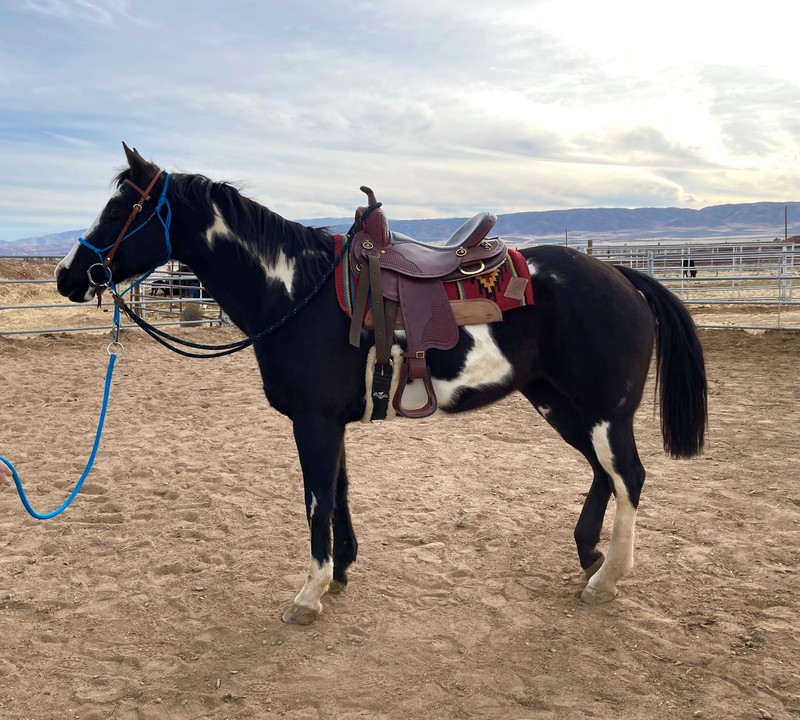
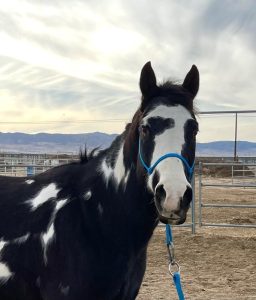
Horse: Wren, a 9-year-old 15.3-hand pinto mare in Lancaster, CA.
Organization: Wild at Heart Horse Rescue

This week’s Adoptable Horse, Wren, is a beautiful, flashy mare that has everything you could wish for. Not only is she absolutely stunning, but her training is superb. Her arena work is a sight to behold and her ground manners seal the deal. We will be trying her on trail next. Don’t miss out on this unicorn! Wren does it all! This My Right Horse Adoptable Horse of the Week will be the perfect horse for an intermediate rider.

Is she your #righthorse?

Click here for questions about Wren, the My Right Horse Adoptable Horse of the Week.

My Right HorseMy Right Horse is the online adoption platform of The Right Horse Initiative, a collection of equine industry and welfare professionals and advocates working together to improve the lives of horses in transition. A program of the ASPCA, their goal is to massively increase horse adoption in the United States. To find more adoptable horses and foster horses, visit www.myrighthorse.org. To learn more about The Right Horse, a program of the ASPCA, visit www.therighthorse.org.

Teaching an Older Horse New Tricks

0
Training Older Horse
Photo by Tanhu/Shutterstock

The classified ad read almost like a bad dream: “Unstarted 20-year-old grade palomino gelding for sale. Bought five years ago as a project but never had time to train. Could go in multiple disciplines. Ready to start your way.” For many would-be buyers, this ad would be a reason to keep scrolling. But experts agree that’s not necessarily the case.

While it’s important to remember that horses are considered “seniors” at age 15, age alone shouldn’t be the sole reason to pass up an otherwise suitable candidate. With improvements in care, many horses are now living into their 20s, 30s, and even 40s. With this in mind, deciding to purchase an untrained aged horse isn’t as outlandish an idea as it might seem.

Darlene Dixon-Bottorff is the owner and trainer at Genesis Equestrian Center in College Grove, Tenn. She has professionally trained horses for over 40 years, including multiple national and international champions. She’s also a graduate of the United States Dressage Federation “L” judge training program and has earned her USDF bronze and silver medals. Among her senior horse success stories, Dixon-Bottorff has trained a 17-year-old horse for an endurance career and started a group of older, untrained horses that were part of a herd dispersal for careers as pleasure mounts.

Benefits to Maturity

Unlike horses that have been started at the more traditional ages of 2, 3, and 4 years old, Dixon-Bottorff sees fewer health concerns in unstarted senior horses, because their bodies have been allowed to mature before starting training.

“I don’t think people are fully aware of the maturation process involving the growth plates,” she says. “They take a while to close. Horses aren’t fully mature until they are around 8 years old.”

Training Older Horse
As long as you carefully monitor an equine senior’s health, he can serve many purposes, both under saddle and on the ground. Photo by Gabriela Antosova/Shutterstock

Dixon-Bottorff is also not overly concerned about diseases more commonly seen in senior horses, such as pituitary pars intermedia dysfunction (PPID, or Cushing’s disease).

“As long as you are mindful of the horse’s condition, it doesn’t affect his ability to be trained,” she says.

Dixon-Bottorff has also found that unstarted senior horses are less likely to have experienced performance-type injuries that may lead to arthritis. She also feels that these horses tend to be more trusting during the training process and generally physically hold up better once the training begins.

Lauren Romanelli echoes her sentiments. Romanelli is a three-day-event rider, trainer, and instructor also based in College Grove, Tenn. She earned her degree in equine science from Murray State University and has been an industry professional since 2006.

Over the past four years, Romanelli has taken an interest in the sales part of the business that helps her to build on her natural talent of matching horses to riders. Her specialization is working with junior and adult amateur riders. Because of that, her sales focus tends to be more on horses under $10,000.

“Because I’m in that market, I get a lot of older horses that are a bit feral,” she explains.

Romanelli isn’t overly concerned about many of the health issues conventionally thought of as red flags in senior horses. She is more concerned about what the horse’s job is going to be and if there is anything present that might prevent him from being able to do that job.

“Since I’m in eventing, most of my [clients] are going to want a horse that jumps,” she says. “I’m more concerned about arthritis. Most horses that are older and have never done anything aren’t going to have a whole lot of work-related arthritis. I’m looking at how their hocks work. Basically, if they flex well, I’m not worried about it.”

Romanelli pays particular attention to the front feet and ankles.

“I’m always worried about ringbone,” she says. “But pretty much anything can be maintained.”

When evaluating behavior, Romanelli says that she seeks horses who are sweet, responsive, and interested in her.

“Horses don’t mature mentally until they are around 7 years old,” she says. “By the time you are starting an older horse, you pretty much know their personality. If they are jumpy and spooky, they are probably going to stay that way. If they are quiet and calm, they are probably going to stay that way, too.”

Both trainers agree that maturity, both mentally and physically, helps in more ways than one. Although some positive physical changes can be expected with training, you can already see the finished product in terms of height and build when evaluating an older horse.

Senior Horse Health

Meggan Graves, DVM, Clinical Assistant Professor, Large Animal Clinical Sciences at the University of Tennessee, Knoxville, College of Veterinary Medicine, supports the sentiments of both trainers that older horses can make good candidates for potential buyers.

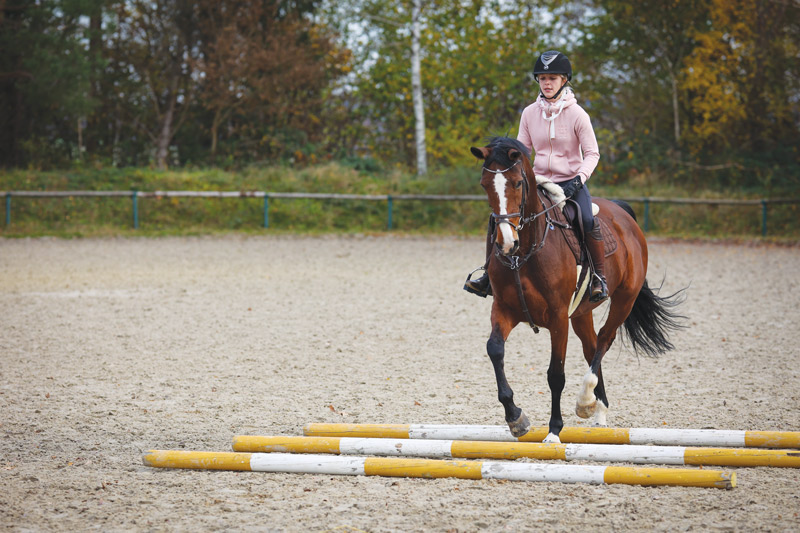
Riding over poles
Although you may run out of time to reach lofty goals with a senior horse, there’s no reason they can’t enjoy an amateur-level career for many years. Photo by Rolf Dannenberg/Shutterstock

With her specialty in ambulatory medicine, Graves tends to see many senior horses, many of whom are adopted from unknown past histories. She says that the age of the horse doesn’t change how she goes about making her assessments.

“I think at any age, for an athletic horse, we’re looking for lameness issues, but having them doesn’t eliminate a horse right away,” Graves says.

One condition not addressed by either trainer but very important to Graves is vision issues.

“We see a lot of deteriorations in the eyes as they get older,” she says. “Making sure that they are fully visual and don’t have any issues—such as uveitis—that could limit their performance ability and their safety is a central part of my evaluation process.” Graves notes that uveitis can be costly to treat and may be a bigger burden than some owners want to bear. Blindness, either complete or partial in one or both eyes, is a concern. She says that while some horses do well that are blind in one eye, it does help if the owner is aware of the animal’s limitations.

Another issue that Graves frequently sees in older horses is weight loss or the inability to maintain weight.

“It’s important to know what [the horse’s] dentition looks like,” she says. “In older horses, especially if they have never been started before, their teeth may have been neglected over the years. But sometimes that’s the one thing we can get back ahead of with routine dentistry. Then, with proper nutrition, that changes a lot.”

Like both trainers, she feels that this and many other health conditions can be managed.

Regarding overall behavior or ability to learn, Graves has found older horses to be more accepting and less reactive than their younger counterparts, making them ideal choices for training.

Minor Disadvantages

There are a few potential disadvantages.

“Sometimes there is a reason that horses are advertised as being unstarted,” Dixon-Bottorff says. “Maybe somebody tried to start them the first time and scared them. Then, when you pick them up and try to start the process yourself, they’ve had a bad experience that you have to work through. But that’s true for youngsters, too.”

The horse may also have had some type of injury that halted the training process. Getting as accurate a history as possible is very important.

Another disadvantage is that, by the very nature of the horse’s age, you may simply run out of time to accomplish your goals.

“If you’re looking for an upper-level sport horse, and the horse is already aged, you’re going to run out of time to get him fully going,” Romanelli says. “As far as the lower levels and pleasure riding, there’s no reason that you should discriminate against a horse because of age.”

Romanelli adds a final consideration to be on the lookout for.

“If he’s been turned out to pasture with one horse for a while, he may be herd-bound,” she says. “But that’s a very individual thing. And training can help.”

All things considered, physical issues and routine training problems can be successfully addressed, so that classified ad with the unstarted senior should not be passed over for age-related reasons alone. The cute senior palomino gelding may just be your next diamond in the rough.

This article about training older horses appeared in the November/December 2021 issue of Horse Illustrated magazine. Click here to subscribe!

Gift a Horse Book

0

Horse books claim their place in tween and teen personal libraries, but what happens when horse girls become women? Is the “horse bug” cured, or does it go into remission? If you’re looking for the perfect gift idea for the horsewomen in your life or are hungry for a horse book that retraces your own youth and childhood with an adult eye and perspective, take a look at the following three reads.

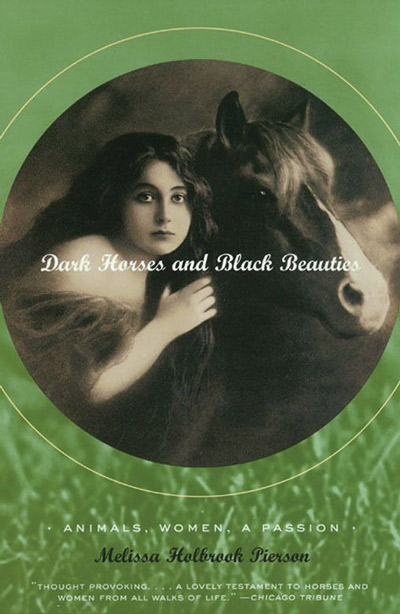
Dark Horses and Black Beauties: Animals, Women, a Passion

Horse Book for a Gift - Dark Horses and Black BeautiesDark Horses and Black Beauties: Animals, Women, and Passion resonates in its timelessness and holds secrets and gifts to last a lifetime. Opening the cover of Melissa Holbrook Pierson’s book is like discovering a secret chest in your grandmother’s attic. Antique photos sprinkled throughout the text excavate reasons why little girls worldwide fall under the spell of the horse.

Breyer horse collections pave the way to devouring books about the horse’s anatomy, evolution and history, dominating the lives of those obsessed with all things equine. Most horse owners in the United States and the United Kingdom continue to be female.

Influences of culture, economics, and relationships may blunt the fixation—but not the love of the horse itself.

Skillfully intertwining memoir, history, sociology, psychology and poetry, Pierson ruminates on why so many women connect with the horse. Her disclosure of her own return to riding and recapturing her relationship with the horse ignites the reader’s enthusiasm for this powerful bond that has spanned centuries.

How do the feminine and the equine fall naturally into partnership? What is it about the horse that bolsters a woman’s self-confidence and empowerment? Pierson’s questions resurrect memory in the reader and offer a peaceful contemplation about one’s passion for the horse.

Published in 2001. Available in paperback on Amazon for $19.95

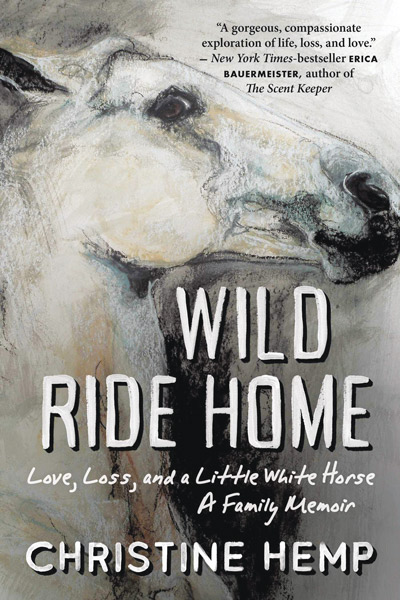
Wild Ride Home: Love, Loss, and a Little White Horse, a Family Memoir

Horse Book as a Gift - Wild Ride HomeBooks like Black Beauty place the horse in the center of the narrative, but in others, it serves as the framework for the writer to tell their own story. In Christine Hemp’s memoir, Wild Ride Home: Love, Loss, and a Little White Horse, a feisty Arabian named Buddy provides the structure for her to unwind her story of love, loss, illness and home.

Hemp, a celebrated poet and teacher, recounts how her calm, settled life on a New Mexico ranch and her love for Trey, a Scottish fly fisherman, unravels. Abandoning the ranch, her fiancé, and the desert life she always wanted turns out to be only the first blow to Hemp’s life. Two miscarriages and a rising threat of violence forces Hemp to flee back home to the Olympic peninsula.

Optimism and humor have always defined the Hemp family. Hemp believes that home should repair her damaged soul. Instead, Hemp realizes that her mother, the emotional stalwart of the family, is on her own journey with Alzheimer’s disease, living in another country for which no one has a passport.

Buddy enters Hemp’s life as her mother begins to exit. Owned by a neighbor, Buddy has shadows of his own history to overcome. With the help of a ground trainer, Hemp and Buddy face their fears and learn to trust each other and the future.

Though Hemp’s life continues to swerve between love and illness, Buddy opens a window to a deeper understanding of the world. In the end, Hemp concludes, “Maybe this is actually what we’re called upon to do in this little life: find home in the most elemental place possible, our own skin.”

Published Nov. 2, 2021. Available in paperback on Amazon for $16.99

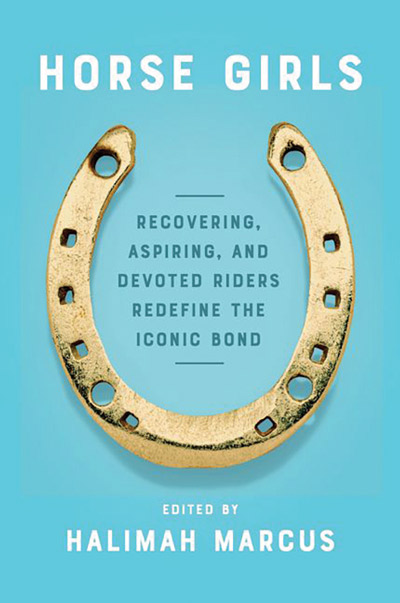
Horse Girls: Recovering, Aspiring, and Devoted Riders Redefine the Iconic Bond

Horse Girls BookEditor Halimah Marcus and 14 writers with a riding past excavate not only the meaning of the phrase “horse girl,” but ask bold questions about privilege, race, cultural identity, and resolution. In Horse Girls: Recovering, Aspiring, and Devoted Riders Redefine the Iconic Bond, the stereotypical image of a “horse girl”—white, rich, thin, beautiful, and straight—disintegrates on the page.

Emerging writers like Braudie Blais-Billie sit side by side with Pulitzer-prize winners like Jane Smiley. Horse Girls reframes the narrative about the relationship between girls and horses with a complexity that meets the reality of this time in history.

Marginalization in the equine world features prominently. Black barrel racer Sarah Enelow-Snyder opines about growing up in Spicewood, Texas, and unveils not only race-based bullying in the classroom that forced her into a home-schooling alternative, but also a father who values a blue ribbon as a path to self-worth.

Nur Nasreen Ibrahim writes about how colonialist influences in horse culture in Pakistan cast a permanent shadow on her relationship with Shakoor, a ghoray wala (horseman) hired to lead the writer, her brother, and cousins along the trails of Nathiagali, a small holiday community. Ibrahim came of age entrenched in an affluent neighborhood of lawyers, engineers, and military colonels. Still, she shuttled between upper-class guilt and a deep desire to bridge the gap of class and the stench of colonialization.

The thought-provoking horse book by Blais-Billie, a woman of Seminole and Quebecois heritage, navigates country and legacy that she both espouses and rebuffs, which makes it a perfect horse gift. Blais-Billie’s grandmother introduces her to the rodeo world, an integral part of rez (reservation) culture. Still, influences from her French-Canadian mother and grandparents educated her about the horse’s power in her inner life.

Released August 2021. Available in paperback on Amazon for $14.49

This article about horse books that make a good gift appeared in the November/December 2021 issue of Horse Illustrated magazine. Click here to subscribe!

Walking Exercises for Bad Weather

0
Mounted Walking Exercises with Your Horse
Practice several turns on the forehand to help polish your turns. Photo by Donna Stidolph

Work at the walk, practiced and touted by old classical dressage masters, is always better than letting a horse stand around when he is not able to perform a regular training schedule. Walking allows for full contraction of the long back muscles in a contraction-relaxation cycle that prevents tension. Further, the fine-tuned motor control that is possible at the walk enables you to help your horse find more range of motion and joint flexion.

Inactivity sometimes plays a larger role in creating poor muscle patterns than incorrect training or injuries. When a horse doesn’t move enough throughout the day as nature intended, circulation diminishes. This translates to sluggish muscles and dehydrated tissues surrounding them. Over time, this creates ingrained restrictions in range of motion. This is of particular concern for senior or injured horses.

Too many of us overlook the value of schooling at the walk, thinking that there is not much to accomplish. To be clear, walk workouts do not improve cardiovascular fitness, but—fear not—cardio plays a minimal role in your horse’s mechanics and movement patterns. However, workouts with mounted walking exercises mobilize the horse’s spinal joints and increase stimulation of postural muscles.

It’s also worth noting that the equine lymphatic system lacks a central pump. Lymph circulation relies instead on muscular contractions. The lymphatic system helps maintain fluid balances between blood vessels and tissues, which is crucial for not only movement but immunity and injury repair.

During any period of reduced exercise due to weather or time constraints, you can accomplish a great deal in 25 minutes with one of the following walk routines. Within each routine below, spend about two minutes on each exercise, then continue to cycle through them like a circuit until your time is up.

Walking on a horse
Ride transitions from working walk to extended walk in a long and low frame. Photo by Donna Stidolph

Walk Routine No. 1

For 25 minutes, do the following continuous circuit:

Long and Low Transitions: With the horse in a long-and-low stretched frame, ride transitions from working walk to extended walk; repeat. Aim to keep his head and neck reaching down low toward the ground into a light rein contact during these transitions. He will need to use his core muscles for balance.
Polish Your Turns: Interspersed with intervals of active, ground-covering walking, practice several turns-on-the-forehand and turns-on-the-haunches in each direction. Be sure to ride several energetic walk steps between each turn.
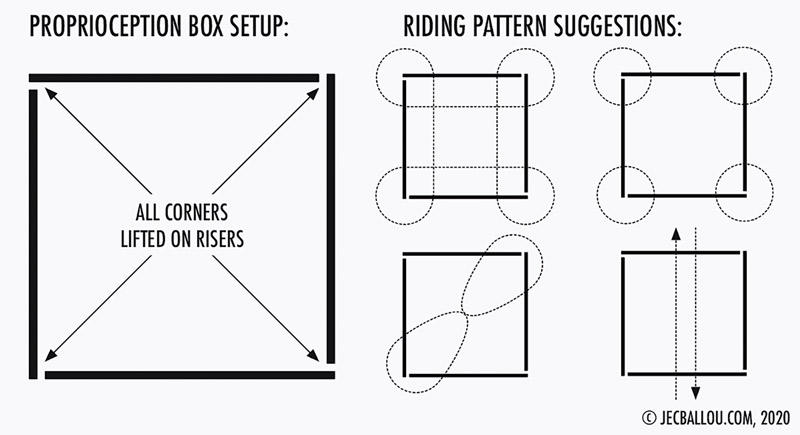
Proprioception Box: Arrange a box on the ground using four ground poles touching at the corners. Ride a variety of patterns over and through the box: cloverleaf, circle around each corner, figure eight, et cetera.

Mounted Walking Exercises with Your Horse
Spiral in from a 20-meter circle down to an 8-meter circle, then leg-yield back out again. Photo by Donna Stidolph

Walk Routine No. 2

For 25 minutes, do the following continuous circuit of mounted walking exercises with your horse:
Accordion Topline: Riding around the edge of your arena in a brisk, forward walk, as you practice lengthening and shortening the reins and asking your horse to change frames from longer to shorter.
Spiral In and Out: From a 20-meter circle, spiral in to an 8-meter circle, and then, maintaining inside bend, leg-yield back out to your original 20-meter circle, being careful not to lose energy.
Snowman: Ride once around a 20-meter circle to the left. Then, at the top, change bend and ride a 10-meter circle to the right. Resume the 20-meter circle to the left. Your figure should look like a snowman with a fat body and a smaller head on top.
Simple Ground Poles: Set up as many poles as you have available in a random fashion all around your arena. Proceed in a brisk walk over the poles, and creatively ride various turns and loops.

Diagram of Riding Patterns
Ride a variety of patterns over a simple box made of ground poles. Diagram by Jec Ballou

Walk Routine No. 3

For 25 minutes, do the following continuous circuit:
Speed Changes: Ride various figures in the arena while changing the speed of your walk. Aim for four distinct speeds (super slow, slow, medium and fast), and spend 20 strides at each speed. Repeat.
Cornerstone Transitions: Ride transitions to the halt every 10 strides. At every other halt transition, ask the horse to back up six to 10 steps, then carry on.
Wavy Lines: Ride a “scalloped” edge around the track of your arena. Maintaining a brisk, lively walk tempo, ride a wavy serpentine with approximately 3-meter loops back and forth from left to right, and so on.

When performed consistently (four to five days per week), purposeful walking routines can have a surprisingly beneficial impact on your horse’s body. Although it’s not as outwardly visible, their value is much greater than inactivity. Your horse will thank you!

This article that offers mounted walking exercises for your horse appeared in the November/December 2021 issue of Horse Illustrated magazine. Click here to subscribe!

Further Reading

Find Your Pocket in Barrel Racing

0
Fastern Barrel Racing Pattern
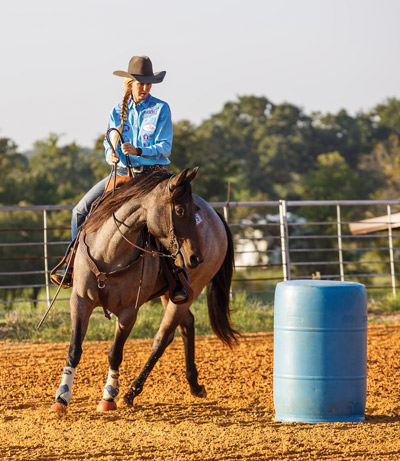
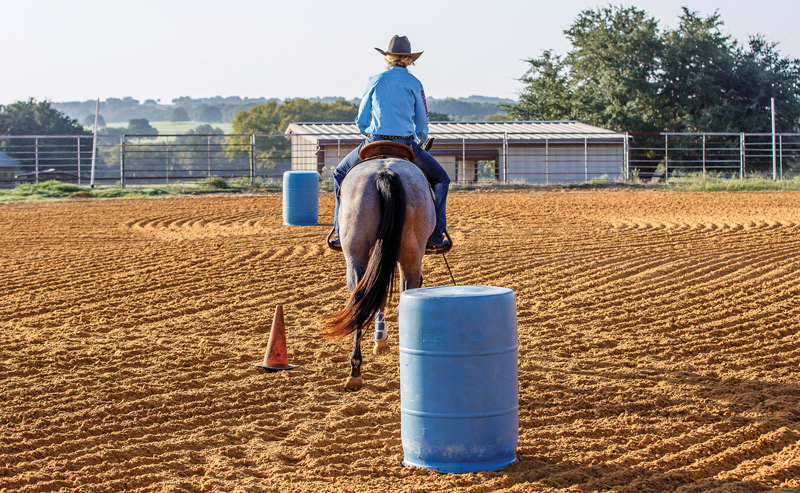
Building a pocket at the entrance of your barrel turn means you can close the turn tighter as you accelerate on to the next barrel. Photo by Abigail Boatwright

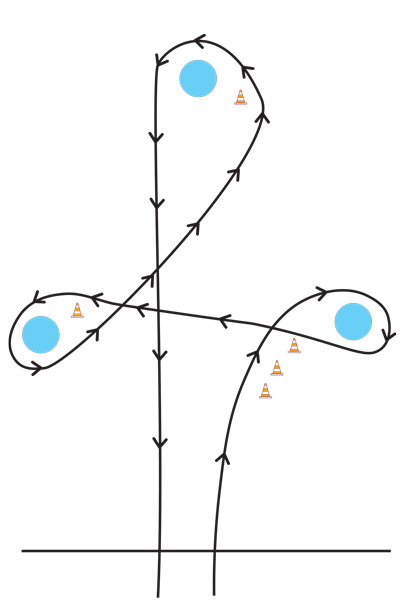
The shortest distance between two points may be a straight line, but it’s not always the fastest—especially in barrel racing. If you want to shave seconds off your time and leave the barrels standing when you cross the timer, you’ll need to perfect your pocket while you chart your cloverleaf path around the barrels in your barrel racing pattern. Veteran barrel racer Cheyenne Wimberley shares how.

Why Take the Long Way?

Think of it like driving a car or riding a bike, says Wimberley. When you approach a corner, you don’t want to turn too tightly, or you won’t make it.

“You have to keep the distance where your speed continues in a forward motion, but it’s easy for you and your horse to make the turn,” she says. “You need enough distance to turn but still remain upright.”

Barrel Racing PatternWithout this space, your horse will need to slow down to turn completely, and you risk knocking the barrel over in the struggle, automatically adding five seconds to your time, which can be devastating to your placing.

You’re not leaving space all the way around the barrel, however. You just need that space as you go into the barrel, cutting it tight on the backside of the turn as you exit.

A Good Rule of Thumb

So how far should you be from the barrel as you enter the turn? Wimberley aims for a point about a horse length, 6 to 8 feet, away from—and to the side—of the first barrel. This is also the spot she pinpoints for her downshift in speed to make the turn. For the second and third barrel, she sticks to about a 4-foot distance at the entrance of the turn.

Fastern Barrel Racing Pattern
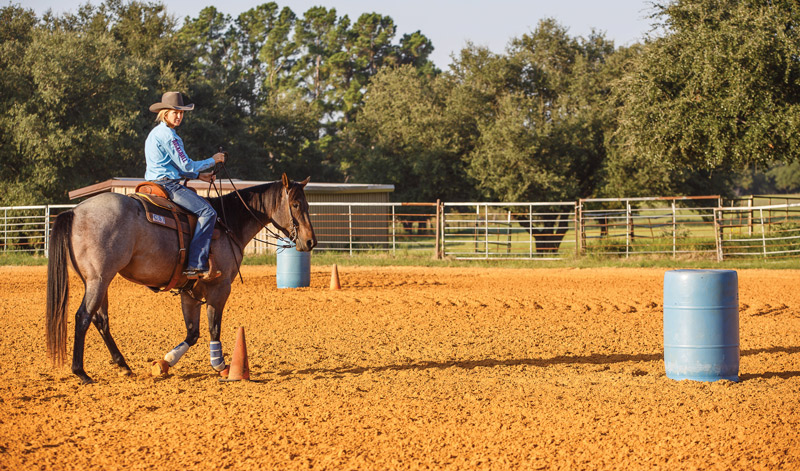
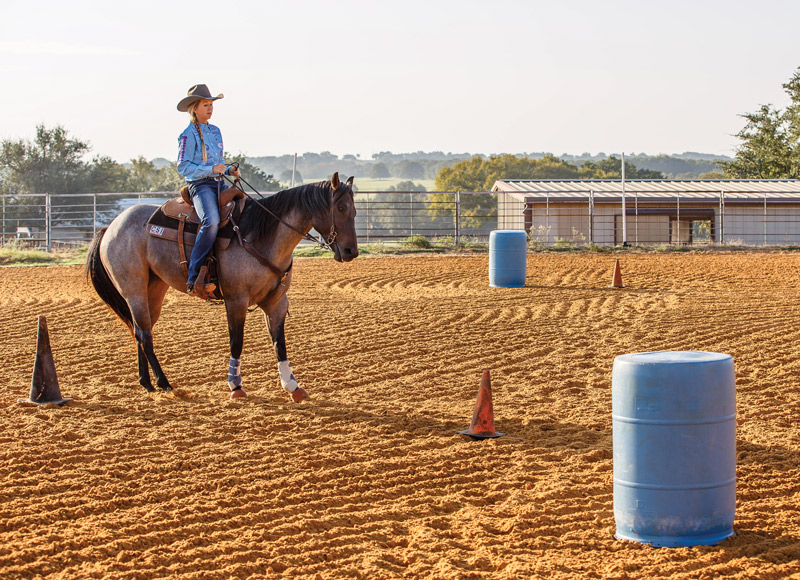
Eventually, you can move to a single cone at each barrel designating the pocket, where you need to slow your horse before the turn. When you can visualize your pocket every time, you can remove the cones. Photo by Abigail Boatwright
Fastern Barrel Racing Pattern
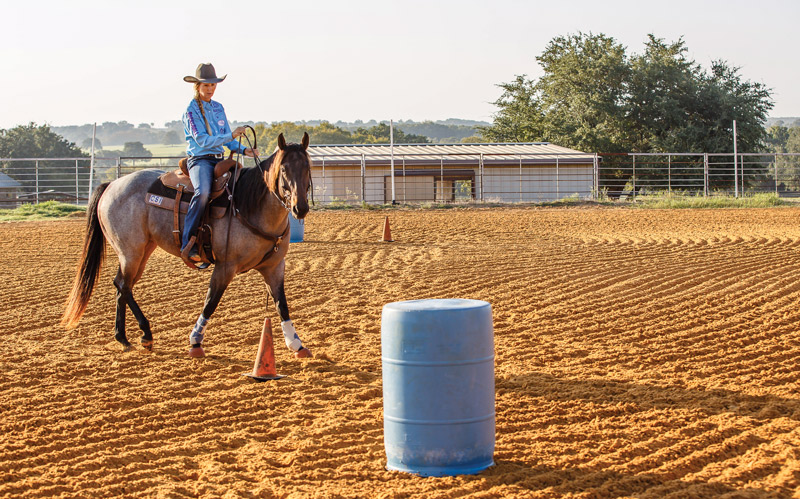
As you approach the barrel, point your horse straight to a spot 6 to 8 feet from the barrel, then ask your horse to stop with your body cues and reins when his shoulder is lined up with the barrel. Photo by Abigail Boatwright

“It’s like using a brake,” she says. “You learn to gauge the speed you’re going, and how hard you need to brake before you turn.”

Building Your Pocket in Barrel Racing

Beginning at the end of the arena by the in-gate, Wimberley lines up with the third barrel as she’s making her way toward the first barrel—usually, the one on the right. She says starting in the center makes for an easier approach.

She advises you to pick your pocket area before you get to the barrel. It’ll be the same every time, so with practice, your pocket will become automatic. Wimberley says the first barrel is the most difficult because you’re often coming up the alley and you have to get that angle to nail the first turn.

When you get to your chosen spot a horse length away from the barrel, ask your horse to stop. You’ll simply “rate” or slow for a moment while actually running the pattern, but in practice, you’ll come to a complete stop.

Wimberley aims her horse directly to the designated spot beside the barrel, avoiding over-shaping her horse’s head and body on the way.

“I feel like a horse runs faster when he’s going in a straight line, so I really just go to that spot,” she explains. “I don’t want him to run with his head cocked to the side. I just want to keep him in a natural, forward position.”

Her first cue at that spot will be to check her speed by sitting deep in the saddle and then picking up the inside rein. Once your horse has taken a moment to slow, he’ll be ready to turn the barrel and head to the next one.

Find Your Pocket
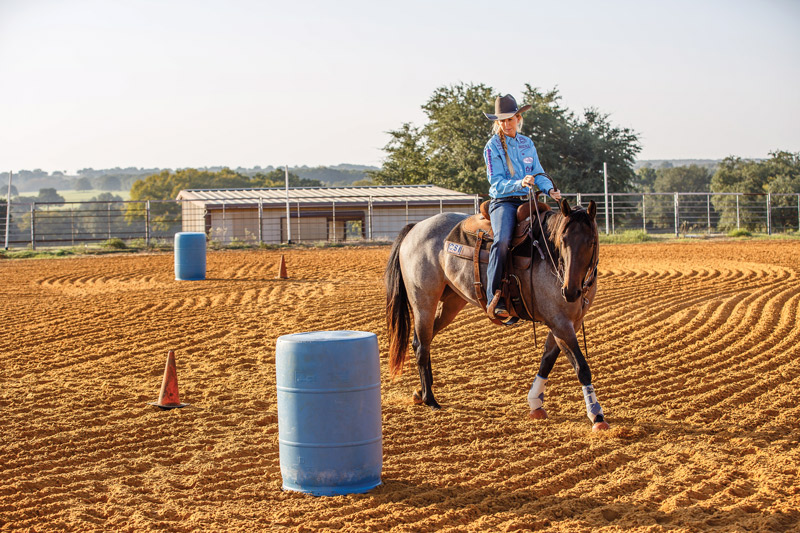
Next, shape your horse up for the turn while keeping that “pocket” as you go into the turn. Photo by Abigail Boatwright
Find Your Pocket
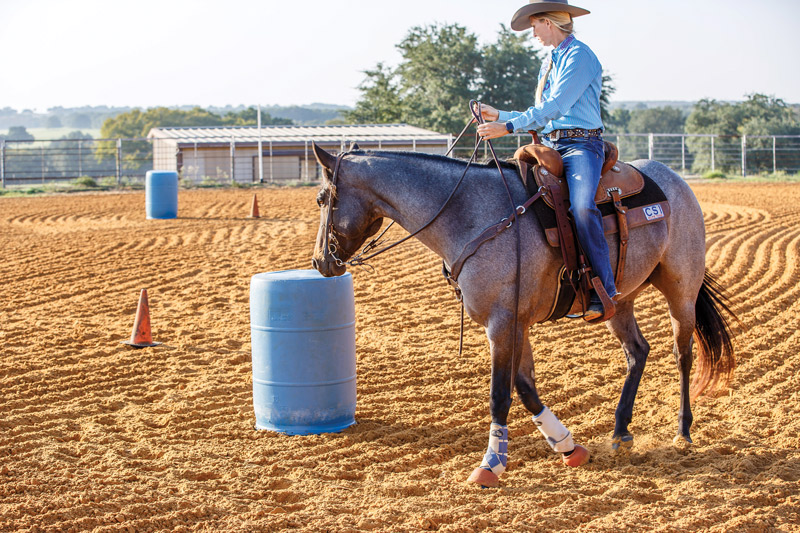
Continue to circle the barrel, leaving space as you go into the turn. Photo by Abigail Boatwright

Practice Tips

When you’re first mastering the pocket in barrel racing, Wimberley says it can be helpful to set out several cones in a line at the entrance to the barrel to guide your path. Practice at a walk, trot and slow lope.

Once you’ve gotten familiar with the exercise, you can remove all but one cone at the barrel at your rate point. Eventually, you can remove all your cones and focus on visualizing that spot every time you get ready to turn. Even at top speed, Wimberley says you’ll need a pocket and a slight shift in speed to make the turn and make your barrel racing patterns faster.

“Even now, I’m still doing the basics,” she adds. “I try not to make [barrel racing] any harder than what it is. Getting to the right spot and setting up your turn are really just simple fundamentals that a lot of people forget.”

Find Your Pocket
On the backside of the turn, tighten your circle to be closer to the barrel. Photo by Abigail Boatwright
Find Your Pocket
Close the turn tight, and head toward the pocket on your next barrel. Photo by Abigail Boatwright
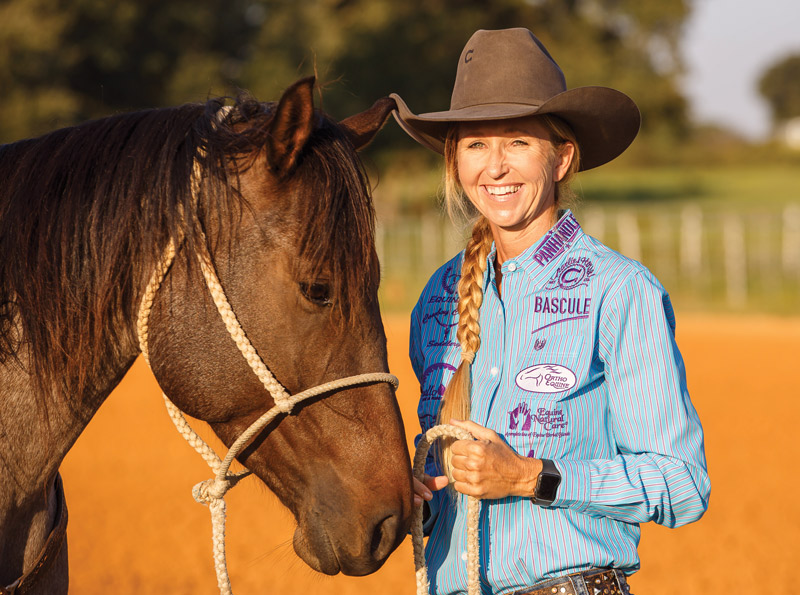
Cheyenne Wimberley
Cheyenne Wimberley. Photo by Abigail Boatwright

Meet the Trainer

Cheyenne Wimberley of Stephenville, Texas, has been a barrel racer and roper all her life, winning her first state championship at age 4. She began competing in professional rodeo at age 10 and was ranked 16th in the world at age 11. Cheyenne has won at the Calgary Stampede, Cheyenne Frontier Days, and is a four-time National Finals Rodeo competitor, most recently in 2019 and 2020.


This article about finding the pocket for a faster barrel racing pattern appeared
in the January/February 2021 issue of Horse Illustrated magazine. Click here to subscribe!
My Right Horse Adoptable Horse of the Week: Quick Dream — March 7, 2022

0
Adoptable Horse of the Week - Quick Dreams
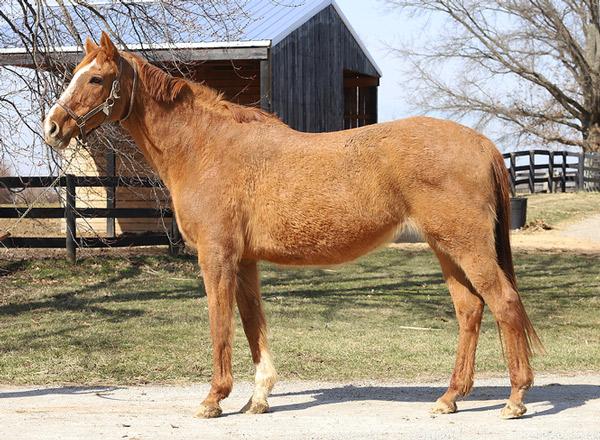
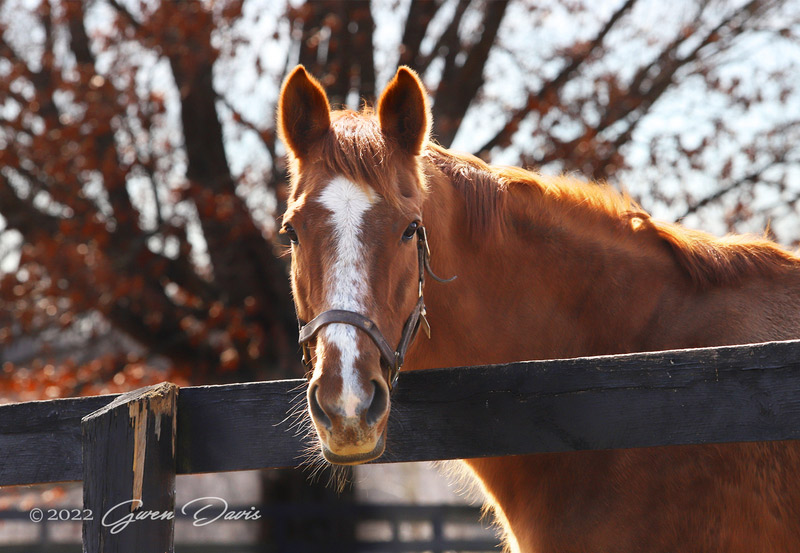
Courtesy Second Stride

Welcome to Horse Illustrated’s weekly installment of the My Right Horse Adoptable Horse of the Week, offered in partnership with The Right Horse. Quick Dream is this week’s adoptable horse. Check back weekly for a new featured horse so you can find your #righthorse.

Horse: Quick Dream, a 23-year-old 15.2-hand chestnut Thoroughbred mare in Prospect, Ky.
Organization: Second Stride

Adoptable Horse of the Week - Quick Dreams
Courtesy Second Stride

Quick Dream was bred in Kentucky and is by the stallion Jeune Homme (Nureyev) out of Sonada (CHI), by Quick Decision. She last raced December 4, 2002 at San Isidro in Buenos Aries, Argentina. She is now looking for her third career. She can no longer be a broodmare. This golden Argentina girl is currently sound. Dream is a kind, gentle mare looking for a home to live out her days and be loved on. She gets along well with other mares and enjoys being around people. She enjoys her grooming sessions and will stand quietly while you love on her. She loves being outside 24/7 and doesn’t seem to be bothered by anything. She has not shown any vices and seems to be a very patient, older girl. Dream is to be a companion or used for short trail rides only. She will also make a great babysitter and will be good for children to love on and groom as well. She is not a fan of peppermints but will take all the cookies in your pocket! Is she your #righthorse?

Click here for questions about Quick Dream, the My Right Horse Adoptable Horse of the Week

My Right HorseMy Right Horse is the online adoption platform of The Right Horse Initiative, a collection of equine industry and welfare professionals and advocates working together to improve the lives of horses in transition. A program of the ASPCA, their goal is to massively increase horse adoption in the United States. To find more adoptable horses and foster horses, visit www.myrighthorse.org. To learn more about The Right Horse, a program of the ASPCA, visit www.therighthorse.org.

Reversing Time: Seniors Adopting Senior Horses

0
Joni Miller - Senior Horse Adoption by Seniors
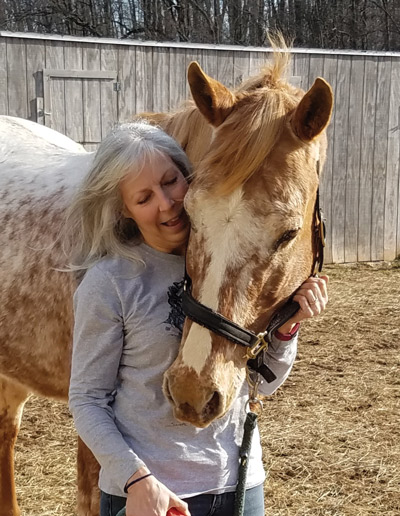
Joni Miller adopted a 20-year-old Appaloosa, Spud, from the Maryland Equine Transition Service. Photo Courtesy Joni Miller

When she was a girl, Joni Miller would save her lunch money to afford to ride at a local barn. Back then, she had no idea that she would credit her current horse, a 20-year-old Appaloosa named Spud, with helping her live out her girlhood dream and with inspiring her to do more at an age when many women are doing less. Horse Illustrated explores amazing stories of senior horse adoption by seniors.

“I don’t ride as much anymore, but I’m active,” says Miller, who adopted the registered Appaloosa from the Maryland Equine Transition Service (METS), an organization that helps potentially at-risk horses find new homes. “I’m out at the barn bathing, grooming. I’m problem solving every day. What would my retirement have been without him?”

Also Read: Adopting a Horse Poll

A Natural Fit

Since 2010, surveys conducted by American Horse Publications (AHP) that were prepared by Jill Stowe, Ph.D., of the Department of Agricultural Economics at the University of Kentucky, have revealed that women 45 to 65 years of age and older represent the fastest growing segment of those most likely to own horses.

Miller is squarely within that demographic, and according to gerontologist Nancy Schier Anzelmo, M.S., one reason why women like her are becoming horse owners is purely economic.

“Older women are retired and have more time and money to spend on keeping horses than they did when they were working and raising families,” says Anzelmo, who is the co-founder of The Connected Horse, a non-profit organization that sponsors therapeutic workshops that match horses to people coping with Alzheimer’s disease and other types of dementia.

Another reason has to do with a woman’s basic nature.

Older Horse and Debbie Drake
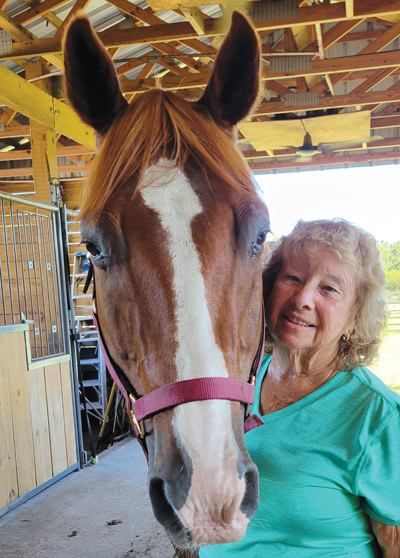
After losing her 32-year-old gelding, Debbie Drake took some time off before deciding to lease a 23-year-old Quarter Horse named Red (shown). Photo Courtesy Debbie Drake

“Women have been caregivers all their lives, and they need this,” she says. “Horses give women a sense of purpose, especially after they have retired and their children are grown. It’s a symbiotic relationship.”

There is a physical component, too. While younger women are more likely to adopt hotter, younger horses because of the physical riding, training, and performance challenges they represent, older women are more mindful of their physical limitations.

“It’s a different dynamic,” Anzelmo says. “The older horse might not perform the way he did when he was younger—he may be stiff, might have arthritis, and older women can relate to this.”

Finding Love After Loss

That’s why older horsewomen are unwilling to give up their animals despite their own limitations, says 68-year-old Debbie Murphy Drake. When she relocated to Florida from New Jersey, Drake had second thoughts about taking her 29-year-old Appaloosa gelding, Gus, with her.

“But I couldn’t bear to leave him behind,” recalls Drake. “I wanted to be sure about the kind of care that he would get at his age.”

Just before the move, Drake was diagnosed with melanoma, and even though she and Gus had long given up trail riding and performance, she credits him with helping her through the illness.

“Gus gave me a reason to get out of bed in the morning,” Drake says.

But the pair were not to be together long. Three years after their move, Gus was euthanized at the age of 32 due to age-related health issues.

“I was devastated,” Drake recalls. “I swore I would never have another horse.”
But it was missing that horse-human bond that finally prompted her to form a new relationship with another horse.

“I kept wanting to give my trainer my saddle, but she kept refusing, and said, ‘Keep it for four months,’” Drake recalls. “Finally, I missed having a horse so much that I said, ‘I have to at least sit on a horse.’”

A few months later, Drake leased Red, a 23-year-old Quarter Horse, from a boarder at her barn. Now she and Red are regulars on her trainer’s lesson schedule.

‘When I’m riding, the years just disappear,” Drake says. “I smile like a kid.”

A Win-Win Relationship

The fear that a beloved horse might outlive you is a main reason that senior women are using adoption of senior horses in the first place, according to Gabriela Rodriguez Quinn, 63, program director and founder of Blixx Horses, a non-profit organization that provides therapeutic riding and interactive education programs. Blixx Horses also advocates for the welfare of non-ridden horses, regardless of their age.

Gabriela Rodriguez - Seniors Adopting Senior Horses
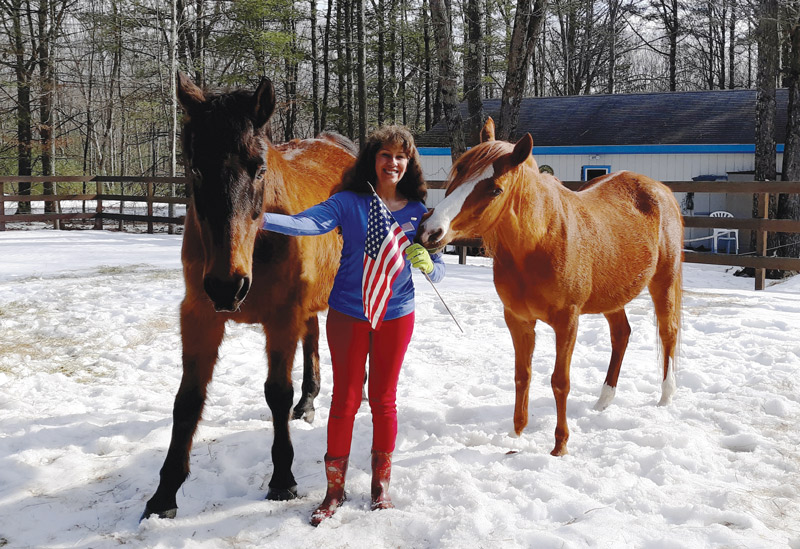
Gabriela Quinn owns a 21-year-old Arabian named Lexxi and a 26-year-old warmblood named Fritzie. Photo Courtesy Gabriela Quinn

“The truth is that [older] women are not looking for a young horse that is going to outlive them,” says Quinn, owner of a 21-year-old Arabian mare named Lexxi and Fritzie, a 26-year-old warmblood. “People who know the horse industry know that there are all kinds of things that can happen to a horse that is left behind by an owner, so they have a plan for their horses when they can no longer take care of them.”

Additionally, older women tend to be more aware that if they don’t provide older horses with caring homes, nobody else will.

“Horses have no choice when they get older and are no longer useful as riding or racing horses,” Quinn says, adding that they are less desirable to potential homes.

“People don’t realize that there’s a lot you can still do with an older horse, even if you don’t ride him,” she says. “Spud and I walk, I bathe and groom him, I talk to him, and he makes me laugh every day. It’s our buddy time.”

That’s the same feeling Miller wants other older horsewomen to experience as well.

“What would I say to an older woman interested in adopting an older horse? Just do it,” she says. “You’re not getting any younger, so give yourself this experience. It will open up a new world for you.”

This article about senior horse adoption by seniors appeared in the November/December 2021 issue of Horse Illustrated magazine. Click here to subscribe!
0FansLike
0SubscribersSubscribe
We use cookies to help personalize content, tailor and measure ads, and provide a safer experience. By navigating the site, you agree to the use of cookies to collect information. Read our Cookie Policy.
OK