Enter our 12 Days of Christmas Giveaways here!
0 ITEMS
  • My Account
  • Holiday Gift Guide
  • Podcast
  • Webinar
Subscribe Combo
Enable cache13
Home Blog Page 1043

Chincoteague/Assateague

0

Chincoteague/Assateague

Profile:
The Chincoteague pony was made famous in Marguerite Henry’s book Misty of Chincoteague. The ponies live on the barrier island of Assateague in Maryland and Virginia. It’s thought that their decedents were either from animals that swam to the islands from a shipwrecked Spanish boat in the 1600s or from animals turned out in the 1700s. Life on the island is hard, and the ponies have adapted to eating beach and marsh grasses. The ponies on the Virginian side are owned by the Chincoteague Volunteer Fire Department. Those on the Maryland side are owned by the Maryland Park Service. Each year the ponies in Virginia are swum across the channel; the foals are auctioned and the mares and stallions returned. The ponies are ridden English and western.

Characteristics:
The island environment shaped the pony into its modern appearance. They have strong hooves, thick manes and tales, and light fetlock feathering. The Chincoteague pony is seen in all colors but most common is a very colorful pinto; strawberry roan on white and palomino on white create some of the brighter patterns. They stand from 12 to 14.2 hands high.

For more information:
The Chincoteague Pony Association, www.chincoteaguechamber.com/map-assn.html; The National Chincoteague Pony Association www.pony-chincoteague.com

Cleveland Bay

0

Cleveland Bay

Profile:
The Cleveland Bay developed in the Cleveland area of Northern Yorkshire in northeast England. In medieval times, the Cleveland Bay was valued as a packhorse for the church, carrying goods to and from various monasteries and convents. When the first roads were developed, Cleveland Bays were coach horses. The Cleveland Bay is the oldest breed of native horse in the United Kingdom, and one of the rarest and endangered equine breeds in the world. The Royal Family has been breeding Cleveland Bays for the past 100 years. Her Majesty is the patron of the United Kingdom Cleveland Bay Society and currently breeds her own horses. Cleveland Bays are used throughout the world for general riding and driving.

Characteristics:
The Cleveland Bay stands 16 to 16.2 hands. The color is always bay with a black mane, tail and legs, but rare, chestnut horses are possible. Traditionally a draft horse, the Cleveland Bay isn’t high stepping like other coach horses. The motion can vary. Some have long, flowing movements and others are shorter in their strides.

For more information:
Cleveland Bay Horse Society of North America www.clevelandbay.org; Cleveland Bay Horse Society (United Kingdom), www.clevelandbay.com

Curly Horse

0

Curly Horse History

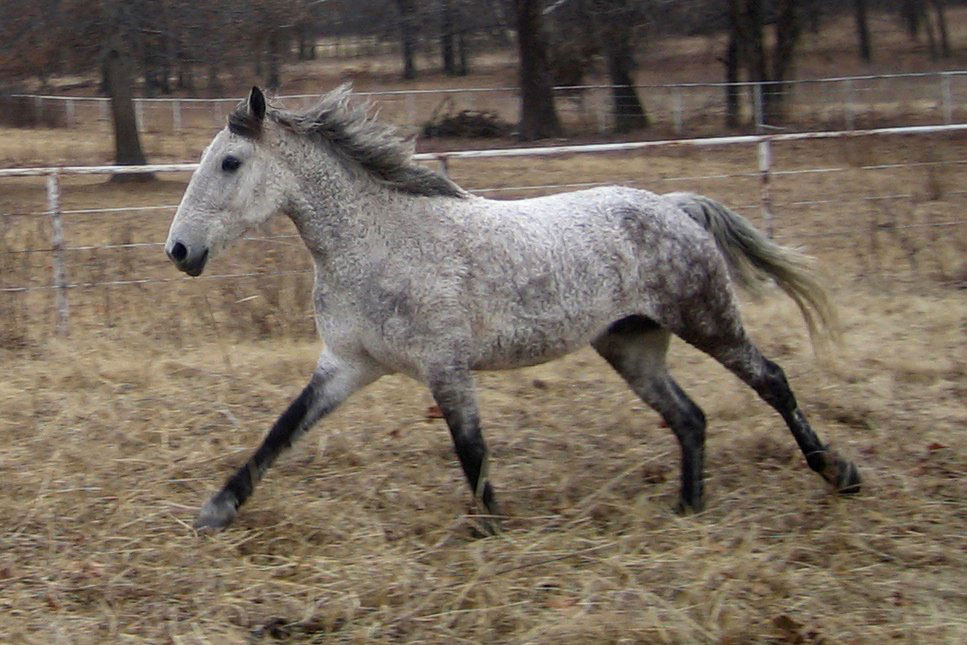
The majority of the Curly Horses, also known as the American Bashkir Curly Horse, descend from a herd of three horses found by the Damele family in 1898 roaming the mountain ranges of Nevada. How they came to be on the continent remains a mystery. Theories suggest the horses were brought with early settlers such as Spanish Conquistadors, Russians or Vikings.

Modern blood typing shows that the Curly Horse is not a distinct breed; its genes comprise many breeds, such as the Morgan and the Missouri Foxtrotter. Today, curly coated horses occur in many types: gaited, sport, draft, pony and even a few miniatures. The sure-footed and nimble Curly often participates in gymkhana and western sports.

Curly horse cantering
Curly Horse photo by Lindsayanne at English Wikipedia, CC BY 2.5 via Wikimedia Commons

Curly Horse Characteristics

Born with tight curls everywhere, even in its ears, a curly horse’s coat settles down as the horse matures. Some Curlies have a running walk. Nearly all colors and coat patterns are found and the height varies according to type. The Curly Horse saddle types are the most numerous and range in height from 14.1 to 15.1 hands high. Curly Horses are often hypo-allergenic, and the hair is suitable for spinning.

For more information:

Further Reading:

Danish Warmblood

0

Danish Warmblood

Profile:
The Danish Warmblood is the youngest of all the European warmblood breeds, beginning in 1962. There were two Danish saddle horse breed associations—the Danish Sport Horse Society and the Danish Light Horse Association. But these were later merged in 1978 to form the Dansk Varmblood (the Danish Warmblood Society) in Denmark. To create the perfect sport horses, breeding animals were carefully chosen from among European stallions of various breeds, including warmblood and Thoroughbred, and put to Danish mares. Although the studbook remains open, Denmark is very choosy with the inclusion of stallions. The stallions must be easily ridden and have a strong competitive aptitude. Prior to 2004, the goal of the Danish Warmblood Society has been to breed an all-around sporthorse, but now breeding is more specifically pinpointed to create a top show jumper or dressage horse.

Characteristics:
The Danish Warmblood is a large, elegant riding horse, very similar to the Thoroughbred but with a more substantial build. Horses are found in all solid colors, most predominately black, chestnut, bay and dark brown, and stand 15.3 to 17 hands high. Danish Warmbloods are branded with a wave topped by a crown.

For more information:
North American Danish Warmblood Association, www.danishwarmblood.org

Dutch Warmblood

0

Dutch Warmblood History

After World War II, Dutch farms were becoming mechanized and horses were no longer needed to work the land, but two lighter farm horses, the Gelderlander and the Groningen were used to help establish a new breed. Equestrian sports were on the rise, and the Dutch developed a sporthorse of their own called the Dutch Warmblood (KWPN).

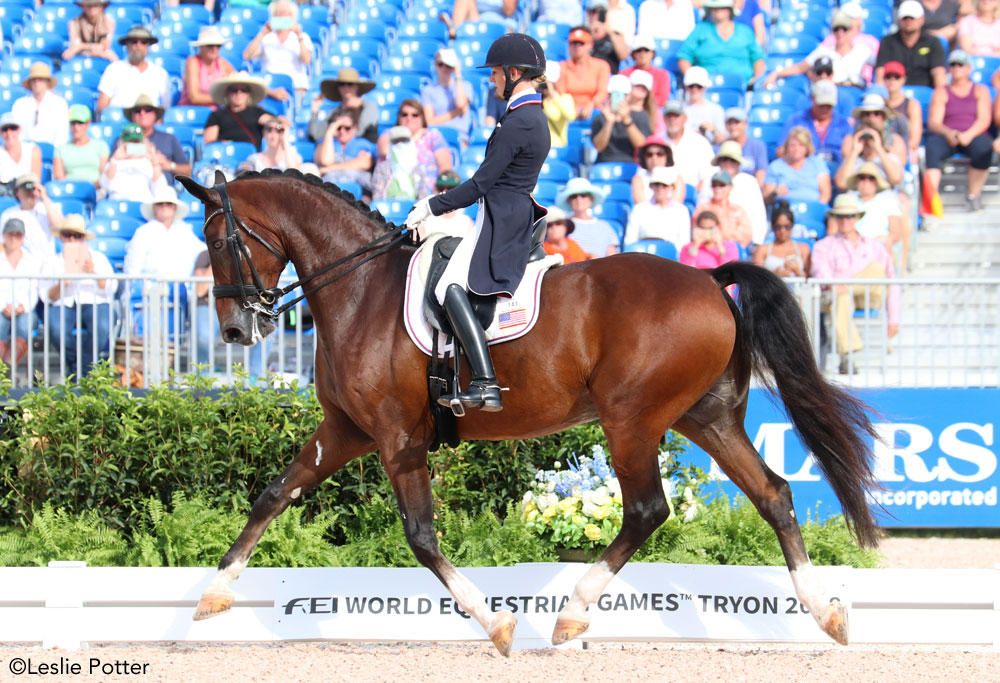
Laura Graves and Verdades
American rider Laura Graves and Dutch Warmblood Verdades

The Groningen had the impressively strong hindquarters needed for jumping and collection. The Gelderlander had a beautiful action highly desired for the basic movement for all sports. Thoroughbred blood was later added to give the horse speed and stamina.

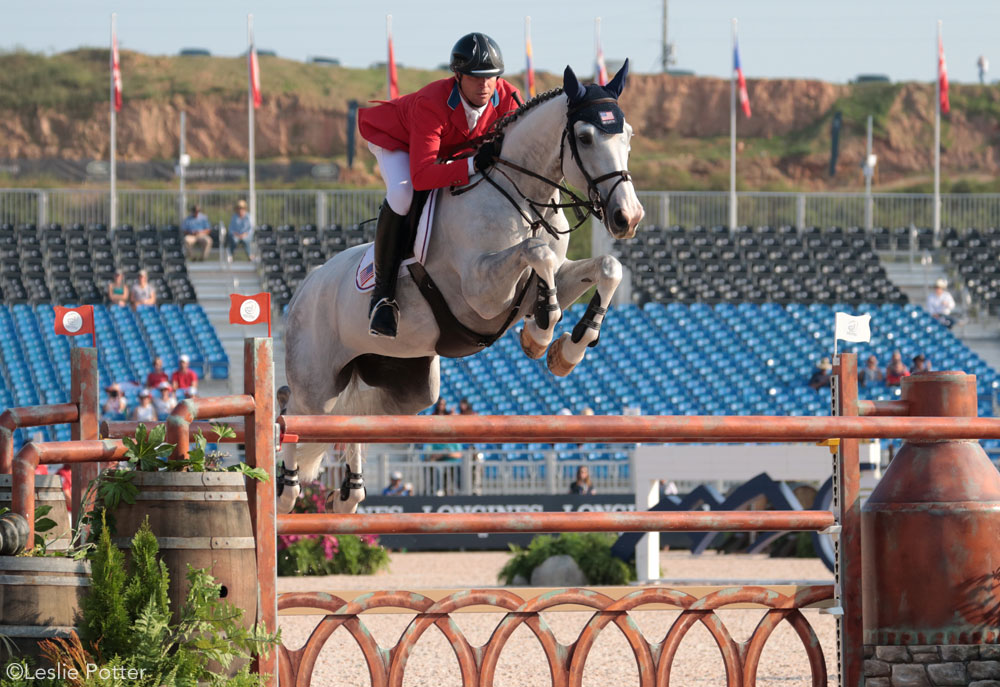
Devin Ryan and Eddie Blue
Devin Ryan and Dutch Warmblood Eddie Blue of the U.S.

Dutch Warmblood Characteristics:

There are three types of Dutch Warmbloods: Riding (dressage and jumping horses), harness (carriage horses) and Gelders (traditional Dutch horses used for harness and under saddle). Elegant, strong and possessing beautiful movement, the Dutch Warmblood stands 16 to 17 hand and is found in all solid colors.

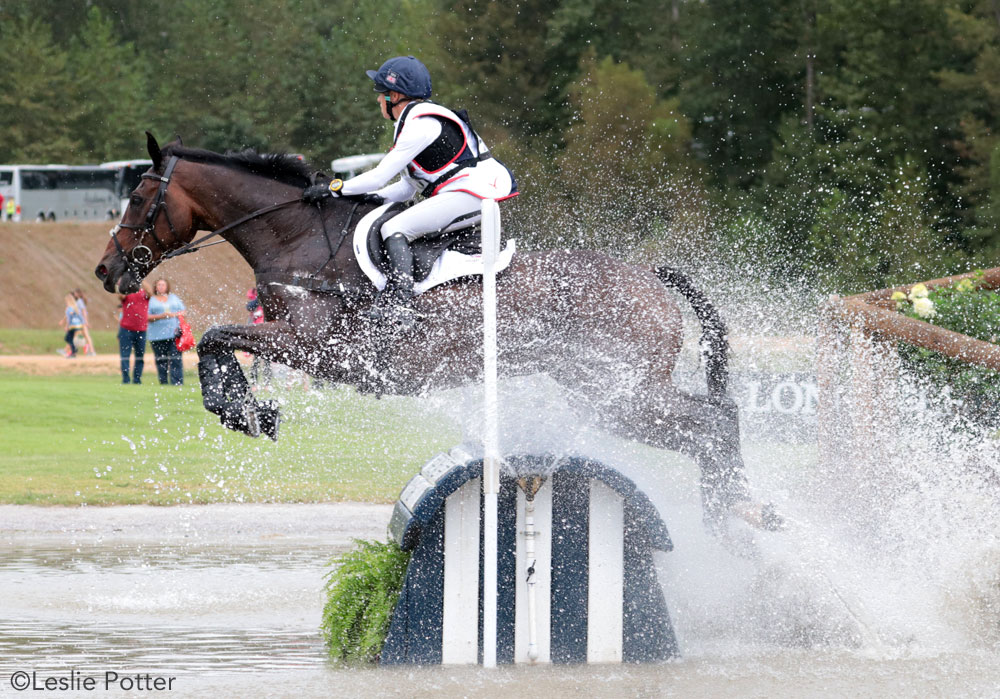
Rosalind Canter and Allstar B
Rosalind Canter of Great Britain rides Dutch Warmblood Allstar B to a clear round in the cross-country phase of eventing at Tryon 2018.

For more information:


Gallop and Hand Gallop

10

Galloping a horse

We spend much of our time in the saddle honing the walk, trot and canter, but there are two other speeds that are required in English disciplines: the hand gallop and the gallop. In the good old days of open countryside and huge hunt fields hacking out was a no-brainer to many riders. Since there was space to ride horses at speed, the hand gallop and gallop were part of a rider’s repertoire. Sadly today, open countryside has given way to housing developments and strip malls, and enclosed arenas replace show fields.

Fast riding is now a skill that must be learned by both horse and rider. And learn it you must if you want to compete in any of the jumping disciplines, keep your dressage horse moving forward, or condition your equine athlete.

Gait Analysis

The hand gallop and, in particular, the gallop differ from the canter in many ways. The canter comprises three beats: the outside foreleg and the inside hind leg hit the ground at the same time. The other two legs hit independently. This creates the three beats. The canter speed is an average 375 meters per minute. The hand gallop is a little bit more forward, clipping along at 400 to 450 mpm, but still maintaining the three beats of the canter.

Because the gallop requires a further extension of the limbs it is a four-beat gait, with every leg hitting the ground independently. The gallop is anything above 450 mpm, depending upon the ability of the horse.

“Some horses cannot gallop at all,” says Canadian Olympic event rider Mike Winter. “For example, top-level dressage horses can be loftier, with a bigger phase of suspension, and have a hard time galloping. It also depends upon a horse’s conformation.”

In the Sport

The hand gallop is used in lower levels of eventing and frequently in jumper competition. It is also used as a schooling exercise for dressage horses to create a more forward and expressive canter. The hand gallop is a good way to introduce the novice rider to the gallop.

Todd Karn, United States Equestrian Federation (USEF) “R” hunter and equitation judge, says that hand gallop on the flat isn’t required in under saddle hunter classes anymore.

“It used to be asked for to see which horse had a long smooth stride that would go forward and then pull up and be quiet,” he says. “It’s [typically] not asked for today because it incites riots and bucking. Riders aren’t comfortable working with pace anymore. In the old times, horse shows were out in the open and you had to gallop. Rings now are smaller and the courses demand a lot of control. You will see the hand gallop asked for in equitation-over-fences classes, usually toward the last fence to test if the rider’s eye can work with more pace than just the jumping canter. This is put in to keep up that old skill. Eventually after equitation, the riders go on to become show jumpers and must know how to jump against the clock. The hand gallop really teaches riders to be able to jump with extra pace.”

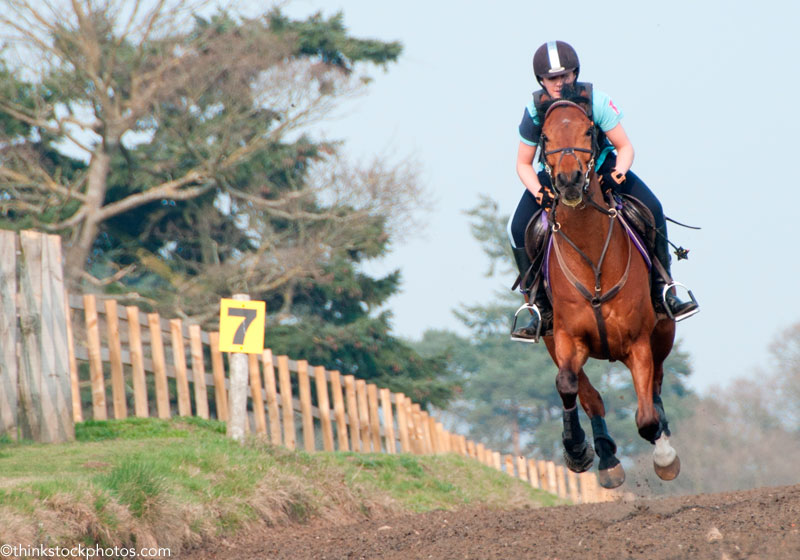
The gallop is where event riders shine. In fact, they do most of their cross-country work at the gallop.

“We are required to gallop at the high level of eventing,” Mike says. “Preliminary eventing speed is set at 520 mpm, Intermediate speed is at 550 and Advanced speed is 570.”

Proper training that incorporates galloping is also a great way to get horses fit. Sustained heart rate from galloping is necessary to prepare horses for eventing and other fast sports, such as endurance riding. Galloping, when done correctly, can also help develop stronger soft tissues.

The Correct Position

Both gaits are ridden in the two-point position, which requires a more closed hip angle, about 30 degrees, at all disciplines. But there are really no hard and fast rules on how closed the hip angle must be for eventing.

“To me it’s a very personal thing,” Mike says. “The galloping position is different for everybody. I stand higher and in a more open position than most riders do. Philip Dutton stays up quite straight, and Karen O’Connor is almost flat over her horse. I think this is because of different body types, whether they are long in the torso or long in the thigh. The most important thing is that your hands are low, that the foundation of the position is in your lower leg and that you’re not using the horse’s mouth for balance. The big difference between the galloping position and sitting is that your leg is the foundation of your position in the gallop and hand gallop. Your leg should be just underneath your body. This is because the technical aspect of eventing requires that we jump at great speed over different obstacles. If your leg is too much in front, you might fall back and catch the horse’s mouth. If your leg is under your body, you can create impulsion and steer; you have more control.”

The reins are held in the usual way in the hand gallop. In the gallop you can hold your reins in either the half bridge or the full bridge. In the half bridge you stretch one end of the rein across the horse’s neck so that you’re holding two pieces of leather in one hand. For the full bridge you stretch both ends of the rein across the horse’s neck so that both hands are holding two pieces of leather; the reins will be stretched across the horse’s crest instead of hanging in a loop alongside the neck.

“Riders who are inexperienced in their balance can push their hands into the full bridge. The bridges are also very useful tools in terms of safety,” Mike says. “If a horse were to stumble, the bridge can catch you from falling because your arms won’t collapse on either side of the horse’s neck. Instead, the bridge will catch you.”

Starting and Stopping—Keeping Control

We’ve all seen the way the cowboys start their gallop in the movies, with a “yee haw” and a kick, and away they go. This galloping style is a Hollywood urban myth. Racehorses aside, for the English rider, the best way to begin a gallop is to build it up slowly. This is because some horses can get high on the speed. A fast start can undo the hard work and training you’ve put in to get your horse obedient and listening to your aids.

“When we’re eventing and we leave the start box, I leave at a trot, then a canter, then a hand gallop and then a gallop. You make sure the horse is still listening and rideable,” Mike says. “Even within the gallop you need that control so that you can vary the speed and stride. Speed and length of stride are two different things. You can go very fast and jump the jump without slowing down very much. But if a horse can’t package (shorten or lengthen) his stride, he isn’t safe. Every kind of jump requires some kind of packaging of the stride. For instance, a steeplechase will not require the same as a downhill combination.”

Packaging of the stride goes back to your work on the flat. If your horse listens to your half-halts you can regulate his stride.

Stopping comes from control also learned during flat work. Hours spent over time training your horse to be responsive to the aids is going to pay off in safety, controllability and enjoyment.

“There isn’t any one skill or trick,” Mike says. “Don’t panic if you’re getting out of control, just relax and try to get your horse to slow down gradually.”

For the hand gallop, start from a normal canter on the flat, come out of the saddle in a two-point and encourage your horse to move forward.

“Close your lower leg and ask your horse to go smoothly forward, lengthen his stride and move his speed up a gear,” Todd says. “To come back, use your body and seat and try not to be rough with your hands. A quiet ‘whoa’ is fine in equitation, hunters and jumpers.”

Although the hand gallop is not normally used in hunter-under-saddle classes, it might be asked for in general schooling or breed shows. Remember, the judge isn’t looking for an all out gallop. Hand gallop means the horse is still “in hand” or in control. Lengthening the stride and slightly increasing the speed is what you’re shooting for.

“Look at it this way,” Todd says. “A canter is 10 mph. The hand gallop is about 14 to 16 mph. You’re not doubling the speed, you’re just adding half as much.”

When jumper riders gallop in a class against the time they treat the gallop the same as the hand gallop but a little bit quicker, yet not so fast that they pull the fence down. To practice this, Todd says to gallop toward the fence and then slow down or “balance up” a few strides in front of the fence to allow your horse to get his legs up underneath him to jump.

The bottom line is that your horse’s foundation must be solid before you start the hand gallop or gallop. Your horse must listen to your aids, be rideable and obedient. “Riding at speed does not mean running as fast as you can in gay abandon,” Mike says. “If you care about your horse, and are invested in his life with you and your harmonious relationship, then you should take these gaits very seriously and understand that they are exercises in communication, training and enjoyment.”

Hunter Bit Decision

4

Of course you should always ride your horse in the bit that lets him perform at his best. And you must be in control of your horse for that to happen. But while pelhams are common in equitation and medal classes where precision and boldness are rewarded, many judges believe that a show hunter, especially one ridden by a child or an amateur, should be able to jump his course in a snaffle. A snaffle gives the impression that a hunter has a soft mouth and a compliant disposition. True, it may all be an illusion, as the actual mouthpiece of a snaffle bit can range from soft rubber to double twisted wire. Yet in a division where manners are emphasized, the appearance of a kindly nature is important. So whenever possible, reach for some sort of snaffle when tacking up your hunter.

Use Yarn Reins for Gentler Hands

3

Are you too busy with your hands? Do you resort to grabbing the reins in an effort to force your horse on the bit? Here’s an exercise to help you develop a more sympathetic feel of your horse’s mouth. All you’ll need is some four-ply yarn.

Dressage on the trail
Do you need to work on having gentler hands? Photo: Skumer/Shutterstock

First, make a pair of reins from a strand of the yarn. Tie each end of the yarn securely to the rings of your horse’s bit. Next, tie your leather reins in a knot. They should be short enough so that the knot rests on your horse’s neck approximately where a martingale strap would sit. Now, hold the yarn “reins” in your hands and begin to ride. See how well you can communicate with your horse’s mouth using only the tension that the yarn will allow.

If you snatch and yank on the reins, you’ll break the yarn. That’s fine. Grab your knotted leather reins, settle down, and bring on some more yarn!

Of course, if your horse is a rambunctious puller, you’ll go through an entire skein of yarn in minutes. In that case, borrow a more suitable horse. This is an exercise for your benefit so that you can experience a kinder, gentler pair of hands.

0
St. Patrick’s Day E-Cards
St. Patrick's Day E-Cards
St.Patrick’s Day


Christmas E-Cards
Christmas E-Cards
Happy Holidays
Christmas E-Cards
Happy New Year!


Happy Birthday E-Cards
From Mr. Ed


Congratulations E-Cards
Your Success


Missing You E-Cards
Missing You E-Cards
Can’t Wait To Ride With You Again


Ride After the Jump

5

So much preparation is spent riding toward a jump that riders often neglect to continue riding after the jump. Whether it’s contemplating what just went wrong, mentally celebrating a wondrous effort or just plain old daydreaming, a lot can go wrong if active riding ceases when the horse’s front feet land.

When your horse lands after a jump, continue riding forward. Unless there’s a need for an immediate rollback turn, ride in a straight line. With each stride concentrate on your horse: Is his pace too fast or too slow; are you on the correct lead; is he falling in or drifting out; is he leaning on your hands? Now is your chance to fix any problems. If you wait until you’re in the middle of your turn, you’ll lose your length of stride and your horse’s impulsion. Usually what follows next is a sudden surge out of the turn, as you try to “send” your horse to the upcoming jump. The judge easily notices such erratic changes in pace. To win a ribbon in hunters, you need to keep your horse flowing around the course, and that is best achieved when you ride the entire trip, including those first few strides after each jump.

Further Reading
Exercise Your Way to an Effective Approach
How to Jump Better with Trot Poles
After Fence Fix

0FansLike
0SubscribersSubscribe
We use cookies to help personalize content, tailor and measure ads, and provide a safer experience. By navigating the site, you agree to the use of cookies to collect information. Read our Cookie Policy.
OK