</table< body>
| Latest Advice: | |||
Control Barrel Turns Marlene McRae, Champion barrel racer, advises how to control barrel turns. Click Here |
 Horse Illustrated Magazine
</table< body>
| Latest Advice: | |||
Control Barrel Turns Marlene McRae, Champion barrel racer, advises how to control barrel turns. Click Here |
Brazo County, Texas, is rural horse country and it’s often a wellspring of unusual horsey news stories. A case in point is the recent shooting of a Miniature Horse that had gotten loose from his own pasture and invaded a neighboring herd of full-sized equines. The randy little stallion then began attacking the horses. At least that’s the story from the horses’ owner, an off-duty cop who was tired of the scenario. This was the second time that the wayward, aggressive Miniature stallion had come calling at his ranch. The Mini, which stood just over 30 inches tall, was shot and killed by local police officer Damian Anderson. He claimed that he was simply protecting his livestock, and was prompted to take the action after his horses had been injured by the Mini, named Santi, eight months ago. Back then, Santi’s owner had offered to make amends by paying Anderson’s vet bills. The type of injuries Santi had inflicted, if any, were not revealed in news reports.
Brandi Hamlin, Santi’s distraught owner, told news sources that the Miniature stallion was a pet that ate carrots and treats out of her hand and was easily subdued. Law enforcement officials are investigating to see if Anderson violated animal cruelty laws. However, under Texas state law a citizen does have the right to protect their livestock from harm.
The United States Equestrian Federation has announced the nomination criteria for its Heroes for Horses Award, to be presented at the 2007 Pegasus Awards, Jan. 12, in Louisville, Ky. It is the second year that the prestigious award will be given. This award is presented to an individual(s) or organization(s) that have demonstrated an unwavering commitment to the protection and welfare of horses over a period of many years and/or have saved equines through an act of courage and resolve during a crisis situation.
Nominations will be taken from the members and staff of the USEF. Nominations must be submitted with a thorough description of the nominee’s efforts on behalf of the welfare of equines. This background information may include any published articles or other news coverage of that individual’s efforts. The nomination submission must include the names and contact information of other references to support this nomination.
Unfortunately, you must act fast, as nominations are due to USEF Awards Director Kristyn Kay no later than close of business on Friday, Dec. 8. The USEF awards committee and senior staff will review the nominations and select the recipient of the annual Heroes for Horses Award. For more information regarding the award, contact Kristyn Kay at kkay@usef.org.
It is the horse that binds all equestrians, and it is with sadness that the United States Equestrian Federation (USEF) announced the passing of one of the country’s most admired competition horses that not only inspired countless fans of show jumping, but left a legacy for generations to come. Gem Twist, highly-regarded as one of the world’s best show jumpers, was euthanized on Saturday, Nov. 18, due to “infirmities of old age.” Gem Twist, who was bred by Frank Chapot, was 27 years old.
In 1987, Gem Twist was ridden by veteran show jumper Greg Best to a Sslver-medal team victory at the Pan American Games in Indianapolis, In. That year, the pair also took the title of American Grandprix Association’s champion. In his long career, Gem Twist carried three riders in total to the title–Best in 1987, Leslie Burr Howard in 1993, and Laura Chapot in 1995.
The year following his first Pan American medal, Gem Twist shone at the 1988 Seoul Olympic Games, where Best again rode the gelding. The pairing would bring home two Olympic medals for their efforts–Individual and Team Silver medals. At the inaugural World Equestrian Games held in Stockholm, Sweden, in 1990, Gem Twist was honored with the “Best Horse in the World” award, jumping clear rounds with all four of his riders.
“He was like a pal that took me everywhere first class,” Frank Chapot says. “You don’t get many pals like that. He never let me down.”
The decision was made to euthanize the American Thoroughbred after he had sustained a pulled muscle, rendering him unable to stand. Gem Twist was cremated, and the Chapot family and longtime owner Michael Golden shared his ashes.
Just this month, Heidi Courneya was casually surfing the Internet when she made a startling discovery. She came upon www.netposse.com, the Internet website for Stolen Horse International (SHI), an organization for stolen and missing horses. Imagine her shock when she found Cheyenne, the pony she had recently purchased and named Chief, pictured there! Information posted on the website stated that Cheyenne had been stolen on Sept. 23, 2001. Despite her disbelief, Courneya picked up the phone and called Stolen Horse International Inc.
When Debi Metcalfe, founder of the nonprofit organization, received the call from Courneya, she was thrilled. “To get a call like this, and first thing in the morning … I cannot even describe how I felt. This is one of those moments that just reaffirms that what I do is worthwhile.”
More than five years since the theft, Cheyenne had been found. Ironically he was not in a pasture miles from home or at an auction in another state, but in the same city to which his real owners had moved. The black and white pony was almost right under their noses. “Chief” had been purchased only two months before by Courneya for her pony riding business. She had no idea she was in possession of a stolen horse.
When Metcalfe finally reached Alesha Tilley, Cheyenne’s owner, the news was met with more disbelief and then joy. Both she and her husband went to see the pony.
“Even though I saw the picture and I felt like it was him I had to see the two lines on each side of his neck to be sure. There was no way I could have prepared myself for how that moment felt,” Alesha said of her reunion with Cheyenne. “I still don’t know what to say about the last couple of days … I think I was in emotional overload.”
Cheyenne, now 20-years old, will be returning to the Tilley’s home. Alesha is thankful to Courneya for her honesty. To be certain, Cheyenne’s journey will be traced in an effort to find the thief so that he or she cannot scurry away with someone else’s beloved pony.
Is the gift-giving season galloping up on you? Here’s a fun, easy gift to make for your horse-owning friends. If you’re a creative type you can embellish it as much as you desire.
Visit your favorite craft store and buy a box of large plain glass Christmas tree balls. You’ll also need paint that is designed for use on glass. Suitable paint pens are handy to use. Then you’ll need something to place inside the glass ball that’s of a horsey nature: crimped oats, clean wood shavings (stall bedding) or even artificial pine garland that resembles hay. Finally, pick out some coordinating ribbon. Earth-toned raffia looks nice, too, as it resembles straw or hay. Now gently wash the outside of the glass balls with plain water and allow them to dry. Next, remove the metallic top of the ornament and set it aside. Using your paint, print the name of your friend’s favorite horse on the outside of the ornament. If you’re really talented–or brave–add a drawing of that special equine or some horse shoes, blue ribbons or even carrots and apples. Once the paint is dry, fill the inside of the glass ball with your choice of stuffing. Replace the top, add your ribbon and voila! You have made a Christmas tree ornament that doubles as a reminder that someone’s heart is filled with love for a special horse this season.
Read more ideas for a horsey holiday >>
When Tennessee resident Chad Crider was 18 he won the 1996 American Quarter Horse Association pole bending world championship; he’s also won the All American Quarter Horse Congress five times in barrel racing and pole bending. For the last ten years Chad’s been training barrel racing and pole bending horses and their riders, including teaching pole bending clinics for world champion barrel racer Martha Josey. Follow his 10 tips to improve your pole bending runs.
“You need to be able to lope a perfect circle before you can do barrels or poles,” Chad says. That’s because a good pole bending horse must bend and listen to your hands and legs. A perfect circle is one that’s perfectly round. Your horse should bend his body to match the arc of your turn. Tip his nose in so that you can see his inside eye—the eye closest to the middle of the circle. If your horse makes the circle smaller than you want, squeeze him with the calf of your inside leg to move him out. If he makes the circle too big, use your outside calf to push him in.
“You need to be able to first walk a perfect circle, and then trot a perfect circle, and then lope,” Chad says. After you’ve mastered perfect circles at all three gaits and in both directions, practice what Chad calls the tornado. Start out riding a small circle, and then spiral out, making your circles bigger and bigger. Next, spiral back in, making your circles smaller and smaller.
Besides bending, your horse needs to know how to run, and slow back down and stop when you ask him to. Chad likes to practice these things in a safe place, like a racetrack, large arena or pasture with good footing. If your horse doesn’t listen to you when you tell him to slow down, don’t try it!
Remember, you’re training your horse, so always stay in control. “If you run your horse out in pasture, and you’re racing him all the time, that’s going to make your horse crazy and want to run all the time,” Chad warns. He practices breezing, or running, his horses occasionally, but he doesn’t overdo it.
Even though your horse should be able to speed up when you ask him to, like on the straightaway home, going too fast through the pattern itself is the most common error Chad sees. “In the poles your main thing is to be smooth,” he says. “It’s a timed event, but your time will be a lot faster if you slow down and make everything right. If you make one mistake it’s going to cause four or five more. Slow down and make everything smooth.”
Chad also sees riders that try to go fast before they’re experienced enough. “Don’t speed up till you’re ready to speed up. We see a lot of people trying to go fast and trying to win when they’re not ready to. You need to be able to trot a perfect pattern before you can lope a perfect pattern. You need to be able to lope a perfect pattern before you run a perfect pattern. Don’t jump the gun and go too fast.”
“People will talk about weaving through the poles,” Chad says. But this is wrong; you don’t want to make big turns in and out of the poles because it will take you too much time. “I don’t really like to say weaving. I like to ride a straight line,” he explains. “I want my horse to stand up straight and barely miss each pole. If I’m going way out, I’ll hit the next pole, so I like to stay as close to them as I can and think about going in a straight line.” Chad says to miss each pole by just inches.
If you think about getting your leg past each pole, Chad says you won’t tip over as many poles or make such wide turns. “That’s the main thing,” Chad says. “If you ride through the pattern and you think, ‘Don’t go to the next pole until I get my leg past this one,’ then you won’t knock one down.”
“Going through the pattern I stay two-handed,” Chad says. Keep an even pressure on both reins. Don’t pull your horse’s head much in either direction as you do the pattern, or your turns will be too big. The end poles are the only turns you’ll need to really bend your horse for.
When you turn the end poles of your pattern, you’ll want to hold onto the horn with your outside hand, just like barrel racers do around the barrels. “You want to grab your saddle horn and push on the saddle horn, so you make sure you’re down in the saddle,” Chad says. Hold it so that you palm is on the back of the horn. “If you don’t grab your saddle horn you’re going to get thrown forward,” Chad warns.
Just like in barrel racing, you’ll want to pull straight back toward your hip bone or pant pocket with your inside hand—the hand closest to the pole. This will tip your horse’s nose in, and his body will bend around the pole. Don’t make the mistake of pulling your hand out or down.
As you weave the pattern, you should sit up straight in the saddle and stay as still as you can. “You don’t want to lean forward or be kicking a lot or moving, just sitting real still,” Chad says.
If your body and hands are too far forward you’ll only have control of your horse’s head. But if you sit down with your hands right above your horse’s withers, then you’ll have control over his whole body, Chad explains.
If you’re following all these tips, but your horse still knocks poles down, Chad says using a little more outside rein can help. A lot of people pull too hard, which gives the horse something to brace against—kind of like a tug-o-war. Instead, use just your fingertips when you put pressure on the reins, and try keeping enough feel of your outside rein that your horse doesn’t over bend and hit a pole.
Sometimes horses hit poles because they’re turning too soon. “If I have a horse that hits a lot of poles, I’ll skip every other one,” Chad explains. In other words, practice the pole bending pattern, but only turn every other pole. “If I’m running the pattern and my horse is anticipating or turning too soon, I’ll go straight on past that turn. You want your horse to wait on you and not move until you tell him to move,” Chad says.
Another way to practice the pattern and keep your horse on his toes is to go through the poles several times without running out. “I just keep going through the pattern at the walk, trot and lope, and that really teaches the horse,” Chad says. Go through the poles four or five times, and then come out and give your horse a break.
Walking and trotting the pattern is a good way to work on your timing, but don’t practice running the pattern too much once your horse does it well. “After you get your horse finished, and he knows the pattern, you don’t want to overdo it by running everyday,” Chad says.
With the right kind of practice and these tips from a champion, faster pole bending times are just around the corner.
It can be frustrating to ride a horse that “rushes” his jumps. Rushing is when a horse approaches a fence too quickly. Instead of heading towards the fence in a collected, bouncy canter, he sticks his nose out and gallops at it at top speed. You try to slow him down by putting pressure on the reins, but he just pulls against you and continues tearing towards the fence at 100 miles an hour.
It’s no fun riding a horse that rushes at fences. It can be scary because you feel out of control. It can also be dangerous because a speeding horse is often an unbalanced horse. He may find it difficult to jump a fence nicely at top speed and may knock down poles. He could crash through the fence!
And if you can’t slow a horse down in front of a fence, you probably won’t be able to slow him down after a fence. This can cause problems when you’re jumping a course and need to approach the next obstacle in a controlled and balanced way.
Some people will just put a stronger bit on their horse, but this won’t solve the problem—in fact, a severe bit, such as a three-ring elevator or a Kimberwicke, can sometimes be “too strong” and can cause your horse to stop in front of a fence or jump badly.
Let’s look at a few ways you can try to slow down a speedy jumper before resorting to a stronger bit.
Flatwork & Lots of Transitions!
You need to spend some time doing flatwork with your speedy horse. If you can’t control him at the trot and canter, you shouldn’t be jumping him!
Do loads of transitions every time you school on the flat. Stay in a 20-meter circle and work on transitions like trot to walk, trot to halt, canter to trot, canter to walk and canter to trot. Keep your horse thinking—and working! Doing lots of transitions helps to make your horse “lighter” and can make him pull against you less.
You need to be able to control your horse’s pace at the canter when jumping, so try this exercise. Pick up the canter and head around the arena. When you get to the short end of the arena, ask your horse to slow down and canter a 20-meter circle in a nice, bouncy, collected canter. Circle twice and then head out to the long side of the arena. Loosen your hold on the reins and really ask your horse to canter forward strongly. You want him to almost be galloping—but not quite. He should listen to your legs and move forward at a brisk pace.
When you reach the short side of the arena, take up your contact again on the reins, slow him down and put him back on a 20-meter circle. Once again he should circle with impulsion. After circling twice, loosen the reins and ask him to canter forward down the long side of the arena. Repeat this exercise one more time and then let your horse rest.
Set up three poles on the ground about nine feet apart (three big human strides) and then canter over them. The distances are a bit tight so your horse will have to shorten his stride to canter over them without breaking stride or knocking a pole. Really concentrate on keeping his canter bouncy—don’t let him get strung out and gallop over the poles.
Some horses rush fences because they have far too much energy. They’re hyper! Is your horse getting too much feed for the amount of work he’s doing? Does he eat high-energy alfalfa hay, when he’d probably be calmer on low-energy grass hay?
If you don’t know much about feeding a horse, ask your vet or an equine nutritionist at the local feed store to develop a diet that might give your horse less energy so he won’t be so fired-up when you jump.
Set up a small fence (two-feet high is fine.) If your horse begins to rush as you begin your approach, circle him a few times in front of the fence until you feel like you have control over his speed again. Try to stay relaxed and then approach the fence again. When you’re about 20 feet away from the fence, ask him to halt. Give him a pat and then walk him towards the tiny fence. Let him jump it from the walk and pick up the trot after you land. Most horses can jump about three feet high from a walk, so popping over a two-foot fence shouldn’t be too stressful for your horse!
If your horse just bolts off at top speed after you jump a fence, do your best to get him to halt two or three strides after he lands. You’ll have to be strong and it might not be pretty the first few times you do this exercise! Sit up straight and take a hold of the reins and say “Whoa.” Stop him! When he halts, back him up a step or two, pat him on the neck, and then trot off and approach the fence again. After you pop over the fence, once again, halt him two or three strides after the fence, back up a step or two then trot off calmly in the other direction.
Set up a placing pole about nine feet (three big human strides) away from the front of the fence, and another pole about nine feet after the fence. You can jump this exercise from both the trot and the canter. Placing poles encourage your horse to slow down and to think about where he puts his feet before and after a fence.
On-the-aids goes out the window when you ask for canter. Your horse trots faster and faster until he finally plunges into canter, which he maintains only for a few unbalanced moments before he falls back into that equally not-fun-at-all runaway trot. The whole exercise makes you feel bounced around, out of control and disheartened.
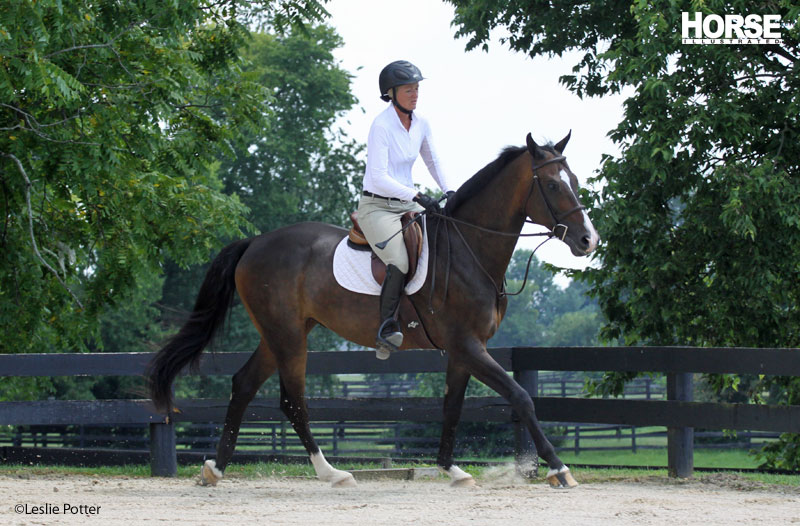
International three-day event rider and 2004 Olympic aspirant Ashley MacVaugh trains young horses, too, and she knows just how you feel. “Occasionally you’ll find a young horse that came out of the womb with a balanced canter, but most of the time this gait takes more schooling than any other,” she explains. “But hang in there—training will always improve your horse’s canter.”
Young or green horses simply don’t have the strength to hold themselves in a rhythmic canter, Ashley explains. A horse’s body easily maintains balance in trot since the horse moves in diagonal pairs in this gait. But canter is a three-beat gait. This means the horse’s entire body weight bears down upon the outside hind leg when it steps off into the first beat of canter.
“You’ve got to give a horse time to build the strength he needs to hold himself in canter,” explains Ashley. “It won’t happen overnight. And you’re not doing you or him any favors by allowing your horse to canter badly. Use transitions and schooling figures to improve the quality of your horse’s canter.”
“Be willing to accept the notion that you can’t fix the canter within the canter,” says Ashley. “Right now your green horse isn’t strong enough to sit down on his hocks and carry the weight of a balancing half-halt within canter.”
So, here’s the philosophy you’ll use to guide your canter work for the next few months. Use trot as your half-halt. Look for short moments of quality canter; as soon as the canter begins to deteriorate go back to trot, regroup, and then try canter again.
“There’s no better way to improve your canter than to focus on trot-canter-trot transitions for weeks and weeks, if not months, depending on your horse’s age and level of conditioning,” Ashley suggests.
To start, establish a large working trot circle in your arena—usually 20 meters, or the width of your arena, works fine. Most horses—like people—prefer one side to the other. Always start in the direction of your horse’s easier lead.
Now, ask for canter and remain on the circle. Staying on a circle will encourage your horse to carry himself, since he has to shift weight to his haunches in order to turn; bending him on the circle will also help your horse stay soft in the bridle. Keep your shoulders tall and stay centered in the saddle, even as your hips follow the motion of the canter. Don’t give your horse your arms to lean on by pulling back on the reins, Ashley warns. Keep a soft contact, and follow the motion of your horse’s head and neck at canter with pliable arms and elbows. Even if your horse seems heavy in the bridle, keep your contact light. The horse must learn to balance himself—you can’t do it for him.
The instant the canter gets unbalanced or hurried, go back to trot and immediately half-halt. Never allow your horse to run in trot after canter. If your horse rushes his trot, simply move onto a smaller circle to encourage him to slow down. Then move back onto the larger circle. At first you may only be able to canter halfway around your circle—that’s fine. Remember, you’re looking for quality canter work. This may be an entirely new concept to your horse; give him time to understand what you’re after.
It might take an entire circle to re-establish a rhythmic trot. That’s OK, too, for now. However, expect your horse to obey your corrections within trot—after all, this is something he already knows. Once you’ve repeated this exercise a few times, he should come back to a steady trot right after the downward transition. (If he doesn’t, consider adding a “wake-up call” correction, like a trot-halt transition.)
Once you’ve regrouped in trot, go back to canter and repeat the exercise. Try this several times in one direction, then repeat in the opposite direction on the horse’s other lead. For your first session, you may only succeed in riding half the circle in a quality canter, and you might need an entire circle in trot before you canter again.
Over time, repeat this exercise, gradually lengthening the time you stay in the canter and shortening the duration of your trot corrections.
As weeks pass and your canter work improves, your horse should be able to maintain several circles of quality canter before you go back to trot. By now your horse should also be quite sharp to these upward and downward transitions, easily moving back and forth between the two gaits.
Now, Ashley explains, it’s time to introduce some more exacting canter-trot-canter exercises, as a way of preparing your horse for an eventual half-halt within the canter.
First, add a change of direction into the scenario by riding a canter-trot-canter figure-eight. Ride a 20-meter trot circle at one end of your arena. Now canter the circle and return to trot, but change direction as you turn across the center of your arena. Trot the same-sized circle in the opposite direction, then canter it. Repeat the exercise, so you’re changing leads after a full circle of trot in each direction. Once you’ve mastered the figure-eight, see if you can eventually change leads through shorter and shorter periods of trot.
After several successful figure-eights, try a big, three-loop serpentine, using your entire arena. First trot this figure several times, so you’re comfortable riding these sweeping curves and changes of direction. Now trot a 20-meter circle at one end of your arena. Pick up the canter on the short side of the arena, and canter your first serpentine loop. Trot as you straighten out the curve across the center of your arena; then pick up the canter on the new lead as you make the turn into your next loop. Then repeat for the third loop, and return to trot once you’ve finished the figure. Again, gradually try to shorten the number of trot steps you need to change leads between the loops.
For the next exercise, you’ll use your entire arena. Establish a 20-meter working trot circle at one end of your arena, then canter the circle. After completing the circle, ride a downward transition to trot as you turn into the corner of your arena and trot a 10-meter circle in that corner. Then return to canter down the long side of the arena, and trot a 10-meter circle in the next corner. Repeat this around your entire arena. If you feel this is too difficult, you can ride each 10-meter trot circle twice in order to give yourself a little more time to regroup between the canter sessions.
After weeks, if not months, of progressive training, you should be able to introduce a half-halt within the canter.
Go back to your tried and true canter-trot-canter exercise on the 20-meter circle (Exercise 1), but this time, trot half the circle, then canter the other half. (By now your horse understands these transitions, and he should be able to easily handle this exercise.) Practice these precise transitions over and over, then gradually shorten your trot sections of the circle, so you are cantering for three-quarters of the circle, say, then trotting only for a quarter. Then work to the point where you trot for only three steps on the circle before returning to canter.
Now, stay on your circle, ride canter and prepare to trot. Maintain a soft supporting leg as you lift up your rib cage and brace your back to ask for the half-halt. At the same time let your elbows softly come back, and put a little drag on the reins as though you mean to trot. But at the instant you feel your horse respond to your downward request by shifting his weight behind as though he will trot, add more leg, soften your fingers and keep cantering. (You should feel like you’re asking your horse to canter in place for a step or two.) Continue in canter.
Make sure you intersperse these early canter half-halts with downward trot transitions, so you’re constantly reinforcing this new concept with one he already understands.
“Whether you plan to jump or ride dressage, the canter half-halt will become a very important tool in your future training,” Ashley explains. “Give your horse all the time he needs to understand this concept and gain the strength he needs to accomplish it. A 4-year-old probably won’t be strong enough for a canter half-halt, but if you spend a year working on canter-trot transitions, he’ll be well on his way to perfecting the canter half-halt as a 5- or 6-year-old.”
Further Reading
Learn to Roll with the Canter
In Transition
How to Sit the Canter
Annie Eldridge trains young event horses out of her Setter’s Run Farm in Duxbury, Mass., and is HI’s English Training Talk columnist.
This article originally appeared in the July 2004 issue of Horse Illustrated. Click here to subscribe.
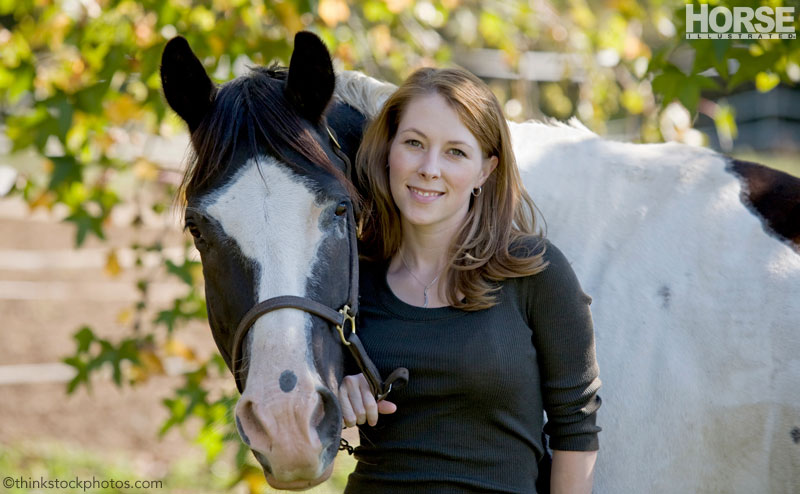
Has your horse become one big budget buster? Hold everything! Before you consider selling your horse and taking up goldfish farming, study these do’s and don’ts to see if you’re making some costly mistakes.
Don’t scrimp on basic boarding costs if it means sacrificing amenities like good footing in the arena and an ample, solid feeding program. Good footing helps to stave off soundness issues and injuries, which will not only hurt your horse but also lead to expensive vet bills. And a stable that feeds generous amounts of quality fare promotes good nutrition and health for your horse, extending his life and usefulness.
Do consider the luxury items you’re paying for that perhaps you’re not utilizing. If you don’t ride much at night, why are you boarding at a stable that lights up its arena after dark like a baseball stadium? Your board bill is helping to pay that utility bill.
Do plan well in advance for any show expenses, and begin saving your pennies. Before making a commitment, get a list of potential charges from your coach or trainer. Ask about rail fees, daycare charges and your share of the “splits.” These are potentially hidden costs you might not be aware of if you’re new to showing.
Don’t get yourself into credit card debt! Credit cards flow freely nowadays, and so do the opportunities for using them. Many horse shows now accept credit cards for entry fees. Some breeding farms even let you pay stud fees with the swipe of a card. Wouldn’t that be ironic if you were forced to sell your horse to pay off your equine-related credit card bill?
Do haunt the consignment stores for used tack and riding apparel. Even if an item needs a little TLC or some minor repair, it’s often far less expensive than buying the same thing brand new. On the flip side, consider holding your own version of a garage sale: a tackroom sale! You and your friends should gather up all those useful yet castoff items such as halters, bits, saddle pads, outgrown clothing and no-longer-needed horse blankets—do some local advertising and sell your lovable junk. Who knows, you might raise enough money to balance your busted budget!
Use our Horse Expense Calculator to find out what you’re really spending on your horse.
These are just a few ideas for saving money on horse ownership. Share your thoughts in the comments below.
Liked this article? Here are others you’ll enjoy:
7 Money-Saving Tips for Horse Owners
30 Time and Money Saving Tips
The author is considering lobbying the FBI task force to determine just where all the horse money DOES go!