Enter our 12 Days of Christmas Giveaways here!
0 ITEMS
  • My Account
  • Holiday Gift Guide
  • Podcast
  • Webinar
Subscribe Combo
Enable cache13
Home Blog Page 1058

Work Areas in the Barn

26

When you have horses, you also have a lot of stuff. Brooms and muck forks, tack, feed bins, grooming equipment, wheelbarrows … it all accumulates, and while you want it to be accessible, you don’t want it to be overflowing into the areas of your barn where you’ll be leading and housing your equine pals. 

Kelly Christiansen, general manager of Equi-Tech Inc., a Salt Lake City, Utah design firm specializing in equine housing, has some useful tips for creating effective,

convenient and safe work areas in your barn. For example:

  • Rather than using the central barn aisle for cross-tying horses to groom and tack up—thus blocking access to some of the stalls—Kelly suggests building a 12 by 24 foot grooming bay/washrack, divided into three stations, directly across the aisle from a tack room of about the same size. That way, he says, you just step across the aisle to retrieve or put away saddles and bridles.
  • Even if you didn’t plan on a washrack in your barn, Kelly says he designs grooming bays with access to water and a drain in the floor to facilitate clean-up. Most people find it’s very useful to have an area where they can tie horses up securely for bathing, he says. A concrete floor with rubber mats is the budget choice, but rubber paving bricks are “the ultimate” waterproof flooring, if you can afford them.
  • Many of Equi-Tech’s barns are equipped with a wonderfully clever feature: a lazy Susan tack wall with saddle and bridle racks. “The whole wall spins around so that your saddle and bridle are right there, and you can reach them without having to go into the tack room,” Kelly says. “Then you can spin it back out of the way when you’re finished in the barn. A lazy Susan tack wall will generally run you less than $1,000 and can hold up to nine saddles.
  • “With show horse people, there’s never enough storage,” says Kelly, “so we put an upper attic above the tack room in many barns. It’s great for getting bulky seasonal items—winter blankets, stall fans and so forth—out of the way.
  • To make tack-cleaning and wrap soaking a breeze, consider a sink with running water outside your barn. Hot water heaters are becoming a more realistic idea, and quite affordable now that there are ‘on-demand’ heaters that hook up to a regular cold-water faucet and provide a few gallons of hot water “pretty much immediately,” Kelly says.
  • Remember that horses are accidents looking for a place to happen, so keep things that project out of the walls to a minimum, and choose flexible plastic or rubber containers with no sharp corners or edges to organize your grooming equipment or anything else you need close at hand.

The author is a freelance equine journalist based inCanada.

Pasture Safety Checklist

16

Horse pasture
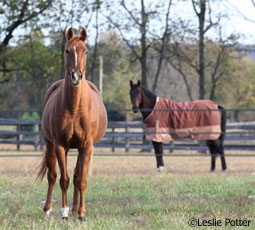
Pastures are like laundry—they’re never “done” and need to be kept up with. What may be intact in the spring may need repair by fall, so regular inspections should be part of your barn chores. And, even though your pasture may appear safe, it can harbor many hazards. Remember, if there’s one out there, your horse will find it.

1. Check your gates.
This is THE biggest safety concern. Never leave a gate unlatched thinking you’ll shut it later, or you’ll “be right back.” No horse is safe if he manages to get out of his pasture. If the gate is open, or is closed but not secured, your horse will gravitate toward it like iron to a magnet. Always double check.

2. Either remove halters or use “breakaways.”
If you keep halters on your horses when they are turned out, be sure they are leather or “breakaways.” You can buy them either ready made from a retailer, or make your own by cutting the halter’s buckle strap, boring a hole in the nylon which you cauterize with a match, and threading leather shoelaces through it and tying a tight knot.

3. Make a fencing hazard checklist and attend to any of the following:

  • Leaning posts or posts that have broken off at the base.
  • Hot wire that has shorted out until it breaks. Also look for newly exposed, previously buried electric wire under gates.
  • Weeds entangling lower electric fence rail (thus lowering or eliminating voltage).
  • Fencing that can’t be easily seen, such as white electrical tape on snow, black or brown tape at night (tie on flag tape for better visibility).
  • Any downed fence or weak endposts.
  • Hazardous objects that work their way up to the ground surface such as nails, glass or sharp-edged metal.
  • Protruding objects—nails that work their way out of posts, broken tree limbs, et cetera.
  • Uncovered T-post tops.
  • Animal burrows.
  • Toxic weeds or leaves that blow into the pasture.

Further Reading
Pasture Maintenance
Summer Pasture Rehab
Fencing Mistakes

    Louann Chaudier lives on a small farm in Wisconsin with her husbanc, three horses, two goats and six cats.

    Hot or Cold: Which Temperament is Best for You?

    47

    Hot HorseWhen purchasing a horse or choosing one to ride, we tend to be smitten by a horse’s appearance and abilities. Unfortunately, we often neglect to consider the horse’s basic temperament. If that doesn’t complement our own riding capabilities and comfort levels, riding may become a chore. Here’s how to decide which type of horse is best for you.

    A hot horse is one that is keenly aware of his environment, making him a little spooky out on the trails or tense amongst a group of other horses. If you’re a rider looking for a leisurely ride, a hot horse is probably not for you. Ditto if you’re a novice rider. Since a hot horse is very responsive to his rider, if your heel accidentally bumps against his side, you’re likely to get a response. Hence, a hot horse quickly becomes frustrated with a rider who asks for one thing but actually wants something else. Conversely, an experienced rider who wants a ready-set-go type of performer yearns for a horse that’s alert and responsive. Barrel racers, jumpers and endurance horses all have a tendency to be on the hot side.

    At the other extreme of the temperament spectrum is the cold horse. Sure, they’re a little lazy at times, but there’s something to be said for a horse that enjoys life at a slower pace. Colder horses are perfect for equestrians who view riding as a hobby. Novices enjoy colder horses because, since they’re less in a hurry to respond, they’re more forgiving of miscalculated cues. If a cold-blooded horse is frisky at a show, it’s easy to settle them down with a few minutes on the longe line or under saddle. They tend to reconsider whether it’s worth the effort to break a sweat. Moreover, if you’re nervous during competition, the cold horse is less likely to react to your emotions.

    Riding should be a rewarding, pleasant experience. Choose the horse whose temperament thermostat is set just for you.

    The author is a longtime hunt-seat competitor.

    Seven Feeding Myths Shattered

    74

    Despite the ability of many horse people to diagnose a strained suspensory at 30 paces, fix a faulty flying change with just a smidge more outside leg, or understand the intricacies involved in getting that recalcitrant tractor to start, a surprising number of us are baffled by the basic principles of equine nutrition. We’re content to believe the myths and misconceptions that flourished in our grandfather’s day, to feed whatever our neighbors are feeding … or to just plain get overwhelmed by the whole subject! The result is that a great many horses are fed more according to tradition than to sound scientific fact, and their overall health may suffer because of it.

    But feeding horses really isn’t rocket science. It’s pretty simple to understand, if you try. It’s time to debunk some of those pervasive nutrition myths, and replace them with solid facts on which you can base your feeding program.
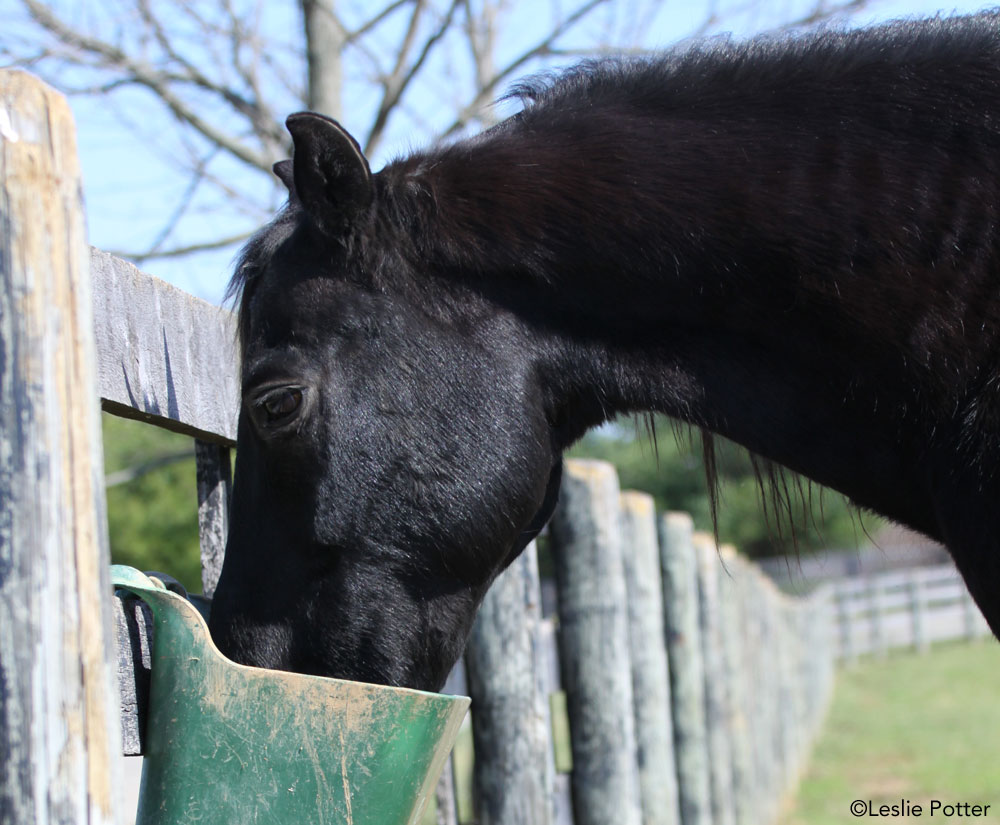
     

    Horse eating grain

    MYTH #1: Horses need grain in their diets.

    FACT: Horses evolved as grazing animals, and forage (pasture and/or hay) is still the basis of their dietary needs. The equine digestive system is designed to break down tough, stemmy plants and extract all the nutrition and energy they need from those materials. A great many horses get along very well on a forage-only diet; if your horse has finished growing and is only in light work, is an easy keeper, or is basically a happy pasture potato, he has no need for grain.

    So what’s the advantage of grain? It supplies concentrated energy, in the form of carbohydrates, which some horses need if they’re being asked to do more work than what they would normally do in the wild. Show horses, racehorses and nursing broodmares can all use the extra nutritional support of grain to help fuel their higher energy expenditure. But because the equine digestive system is poorly designed to digest large quantities of carbohydrates, there’s a limit to how much grain you can feed without risking dangerous conditions like colic and laminitis. As a rule of thumb, remember that every horse should consume between 1.5 and 3 percent of his body weight in feed every day, and at least half of that should be forage, by weight.

    MYTH #2: A horse in hard work needs higher levels of protein in his diet.

    FACT: In a pinch, protein can be used by the horse’s body as an energy source, but it’s a very poor way to fuel performance because molecule for molecule, protein doesn’t produce much energy, and the horse’s body has to go to great effort (chemically speaking) to extract it. Carbohydrates and fats are infinitely better energy sources—far more energy-packed than protein, and easier to break down and absorb.

    Protein does play a role in the diet, however: It provides amino acids, the “building blocks” for the construction and repair of muscles, bones, ligaments and all the other structures of the body. Young, growing horses, and those being used for breeding have higher protein demands because they are building new tissues. However, mature horses not being used for breeding only need about 8 to 11 percent crude protein in their overall diets to provide enough amino acids for the occasional tissue repair. The need for protein doesn’t really increase as a horse’s energy demands do, either, so there’s no need to switch to a higher protein feed if your horse is in high-intensity work.

    MYTH #3: Corn/oats/barley/sweet feed will make my horse “hot,” or high-spirited

    FACT: Various feeds have gotten a reputation for altering a horse’s temperament and turning him into an instant wingnut, much like sugar gets blamed for causing hyperactivity in children. To set the record straight, it’s true that horses naturally want to burn off their excess energy, so if the diet is supplying more than their current level of exercise demands, they’ll start bouncing off the walls. It’s also true that a very fit horse tends to feel really good, so his level of exuberance may increase. But no one type of feed is likely to be responsible; instead, it’s the amount of feed that’s at fault.

    Certain grains may have gained a reputation for being “hot” feeds because they’ve been substituted indiscriminately for a similar volume of a lower-energy feed. Corn and barley, which have no fibrous hull, are more concentrated energy sources than oats, which do have a hull. So if you substitute a coffee-can of corn for a coffee-can of oats, then you’ll have a problem! This is why it’s so important to feed your horses by weight, not by volume. If you want to make a feed substitution, weigh your coffee-can full of oats … and then measure out the same weight in corn, or barley, or sweet feed, or whatever. Chances are, your coffee-can won’t be full! But you’ll be providing your horse with a similar amount of energy, so you won’t end up with an equine who thinks he’s one of the Flying Walendas.

    Molasses, by the way, has gotten a bad rap. The amount of molasses in an average sweet feed only comes to about 1 to 2 percent of its total content—hardly enough to give your horse a “sugar buzz.” If your horse acts high when he’s fed sweet feed, it’s likely because he’s not used to the increased amount of concentrated carbohydrates.
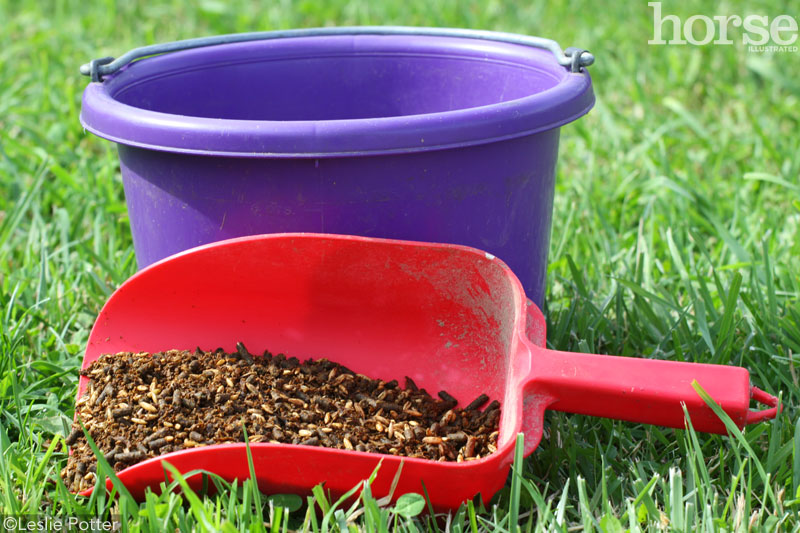
    Grain Scoop

    MYTH #4: When you feed a complete feed, you don’t have to feed hay.

    FACT: Well, sometimes. Definitions of “complete feeds” vary from manufacturer to manufacturer—sometimes the term is used to indicate a grain ration which is fortified with vitamins and minerals to make it “complete,” but is still designed to be fed with forage (hay or pasture). Sometimes it’s used to indicate the feed contains both concentrates (grain) and forage (chopped or pelleted hay, or another fiber source such as beet pulp), and is designed to make up 100 percent of your horse’s diet. Generally, it’s best if your horse does eat long-stemmed forage (hay or pasture) along with his grain ration, for two reasons: First, it will help keep his digestive system purring along as it should, and second, it will help satisfy his natural grazing urge. But if your horse suffers from severe allergies that prevent him from eating hay, seek out a “complete feed” with a high concentration of beet pulp (more on this ingredient below). Be aware, though, that if hay doesn’t make up part of the diet, your horse may get busy as a beaver, chewing his stall fixtures, the fencelines and anything else left within reach.

    MYTH #5: Sugar beet pulp is high in sugar. And if it’s not properly soaked in water, it will expand inside your horse’s gut and cause a horrible gastric rupture.

    FACT: Let’s explode the myths instead of the horse. Beet pulp is the fibrous substance that’s left over after the sugar has been extracted from sugar beets. It contains almost no sugar (unless the manufacturer has added a little dry molasses to improve the taste). Beet pulp is naturally quite high in moisture and thus prone to mold, so it’s dehydrated and made into pellets or “shreds” before it’s packaged.

    Beet pulp is an excellent source of digestible fiber. It’s relatively low in protein (about 8 percent) and high in calcium, which makes it an appropriate feed for almost all adult horses. If you are feeding supplements, top-dressing corn oil, or giving your horse medications, beet pulp can be an excellent place to hide the yucky ingredients. It’s a great addition to the diet if your hay is of poor quality, or if your horse has dental problems and can’t chew long-stemmed forage, or for horses recovering from an injury or illness. Plus, it’s usually quite inexpensive.

    The best way to feed beet pulp is to soak it in water a few hours before meal-time; use twice as much water as beet pulp, and leave it to swell and absorb the moisture. (Because it has a tendency to ferment in warm weather, you’ll only want to make up one day’s worth at a time.) The resulting brown, fluffy stuff can be mixed in with your horse’s grain or served on its own. But don’t worry if you’ve added a little too much liquid, or too little. You can’t actually explode a horse with unsoaked beet pulp. In a study referred to in Lon Lewis’ “Feeding and Care of the Horse, 2nd ed.”, ponies were fed dehydrated beet pulp, up to a level of 45 percent of their total diet, with no ill effects whatsoever. Not only did they not explode, but they also suffered no signs of colic, nor did the water content in their manure change. However, most people prefer to soak beet pulp—it’s more palatable that way and less likely to cause choke.

    MYTH #6: A weekly bran mash is good for my horse’s digestive health.

    FACT: Wheat bran is actually junk food for horses. Yes, they love the taste, but it’s not really good for them. First, as a fiber source it’s not that digestible, and second, bran contains about 13 times as much phosphorus as calcium, an imbalance which can eventually affect a horse’s bone structure. Third, its famous laxative effect doesn’t really exist. Horses are quite sensitive to sudden changes in their diets, so when you feed your horse a bran mash instead of his regular meal, it causes a mild digestive upset, and the result the next day is loose manure. An occasional bran mash on a cold winter’s night does no real harm, but your horse’s digestive system would prefer beet pulp (soaked in warm water has a similar effect). If you feed bran on a daily basis, try to make it no more than 10 percent of his total diet. Avoid bran if you’re feeding a young horse—the calcium/phosphorus imbalance can interfere with his growth. On the whole, there are better feeds than bran.
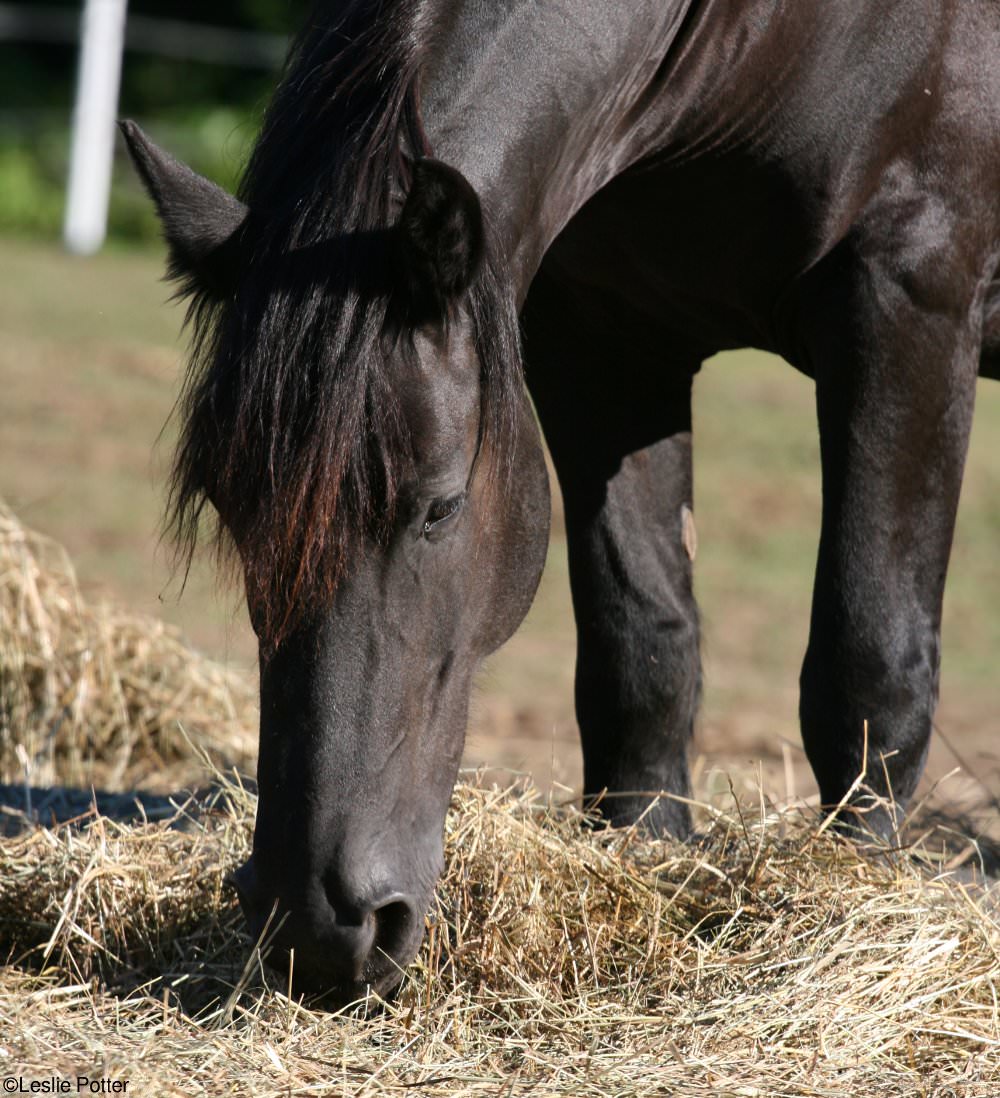
    Friesian Horse Eating Hay

    MYTH #7: Alfalfa hay is the best-quality choice for my horse.

    FACT: Though horses definitely seem to prefer alfalfa in a side-by-side taste test with grass hay, alfalfa is far too high in protein for most adult horses. Depending on when it’s harvested, it can range up to about 24 percent protein—too rich for any horse other than a young, growing one or a nursing broodmare. Though excess protein doesn’t do any major harm, the kidneys have to work overtime to excrete it—and the result is excess of urine with a strong ammonia smell, which means more mucking to do! Alfalfa is usually more costly, too, and in some parts of North America it may be infested with poisonous blister beetles.

    Grass hay is a better choice for most adult horses, with timothy being the most common variety; there’s also brome, bermuda and orchardgrass, among others. Though not quite as high in some vitamins, and not quite as sweet and tasty, it’s got a more appropriate protein level than alfalfa, doesn’t harbor blister beetles and is often less dusty. Mixed hays, which contain both legumes (alfalfa and/or clover or birdsfoot trefoil) and grasses, can be a good compromise too. You can get your local feed agent to do a hay analysis for about $20 to $40, which will tell you more about the nutrient content of your hay.

    If you have more feeding questions, don’t be afraid to ask your veterinarian or the horse-feed specialist at your local feed store. They’ll be able to provide you with common-sense advice and help you make the best feed choices for your particular horse.

    What’s In Natural Grooming Products?

    3

    The following plant-derivatives are frequently included in the ingredient lists of many natural products (and even some that are not). From fly sprays to shampoos, check them out to see what they can do for your horse.

    Aloe vera comes from the leaves of an African lily. Cleopatra regarded it as a fountain of youth and attributed her beauty to it. We use it to treat minor burns, cuts, sunburn, insect bites and other minor skin irritations.

    Cedarwood was used by North American Indians to treat a variety of ailments including arthritis and skin rashes. It is effective for repelling insects and vermin, including mosquitoes, moths and rats, and is used extensively in insect repellents and as a fragrance in soaps.

    Chamomile has long been used as a skin-care remedy due to its anti-inflammatory effects, and in soaps, cosmetics and detergents.

    Citronella, from citronella grass, has anti-inflammatory and sedative effects. Its long history of use as an insect repellent makes it a component in many natural fly sprays. Undiluted, it sometimes creates minor skin irritations so it is generally diluted in a vegetable oil base.

    Clove is not only a pungent spice, but is also effective as an antibiotic and antiseptic, antiviral, larvicide and insect repellent.

    Eucalyptus, native to Tasmania and Australia, occurs as more than 700 different species of which at least 500 produce a type of essential oil. The many actions include analgesic, antiseptic (for cuts, sores and wounds), parasiticide, fungicide and insecticide. It is used commercially as a fragrance component in soaps and as an active ingredient in insect repellents.

    Fennel was used traditionally to convey longevity, courage and strength, and to ward off evil spirits. Today it is valued as an antiseptic and antimicrobial, and its fragrance is pleasing in soaps and as a masking agent in insecticides.

    Geranium has been used since antiquity and is still employed today as an anti-inflammatory, antiseptic, astringent, deodorant, and fungicide, as well as a fragrance component in soaps.

    Lavender has long been used as a folk remedy and for its lovely fragrance. It still plays an important role as an analgesic, anitimicrobial, antiseptic and insect repellent.

    Marigold is highly regarded for its antiseptic and anti-inflammatory properties and is effective for the treatment of skin problems including wounds, rashes, infections. It has long been grown as a border in vegetable gardens to help with insect control and is now a prime ingredient in at least one equine fly repellent.

    Pennyroyal is a well-established herbal remedy with many uses today including that of antiseptic and insect repellent.

    Rose was widely used through the Middle Ages to treat complaints ranging from headaches to liver congestion. Today, it is recognized for many actions including that of an antiseptic and as an antiviral and bactericidal agent.

    Sage has a long history of use for its culinary and medicinal qualities. Its actions include that of antimicrobial, antiseptic, astringent and insecticide.

    Tea Tree Oil comes from a common Australian tree and has a long history of use by the Aborigines. It has proven effective against bacteria, fungi and viruses. It is currently used in some shampoos, conditioners and shines and has been employed for centuries as an insect repellent.

    Thyme, one of the earliest medicinal plants, was used by Hippocrates and Ancient Greeks as a fumigating agent against infectious diseases and by Ancient Egyptians in the embalming process. It is now known as an effective antimicrobial and fungicide and is used as a fragrance in soaps.

    Witch Hazel leaves and bark were used by Native Americans to make poultices to treat cuts, scrapes and insect bites. Today we know that it has distinct anti-inflammatory and astringent properties and is also effective in relieving sore muscles.

    Yarrow is an age-old herbal medicine. Current uses include that of anti-inflammatory, antiseptic, skin toner and hair rinse as it purportedly promotes hair growth.

    Natural Selection
    Producers of natural grooming products for horses come from a variety of backgrounds. Some are well established in the horse product world and have added a natural selection to their traditional line. Some make products for both humans and animals, while others are devoted exclusively to manufacturing a natural product line for animals. When selecting a natural grooming aid for your horse, read the labels and choose the product best suited for your horse and your purposes.

    Click here for more information on holistic horse care.

    Handling Draft Horses

    8

    Belgian draft horse
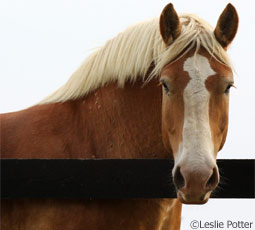
    The average horse outweighs the average human almost 10 to one, which is why safety is such an important element in horse handling. Even the smallest horses can easily overpower a human with his sheer bulk, if he is so inclined. So imagine what an 18-hand, 2,500-pound draft horse can do. Fortunately, draft horses tend to be exceptionally gentle and easy to handle—no accident, since horsemen have always bred larger horses with this trait.

    However, people who handle large horses still need to take precautions to ensure they’re safe around these massive equines. First and foremost, watch your feet. If
    a draft horse steps on you, he can easily crush the bones in your toes or foot, especially if he is wearing metal shoes. Always wear heavy-duty boots around draft horses to protect your feet should the horse accidentally come down on you but not steel toed boots—they can sever toes.

    Although draft horses tend to be mellow individuals, you should always demand respect from any large horse you handle. Don’t allow the horse to crowd you or to rub his head against your body. Teach your horse to stay out of your personal space, whether you are leading him, grooming him or approaching him in his stall.

    If you are raising a young draft horse, teach him manners from a very young age. Don’t allow nipping or any other rude behavior. While this might be cute or forgivable in a foal, don’t forget your draft baby is going to grow up to weigh nearly a ton. You don’t want a horse that big thinking he can push you around.

    Audrey Pavia is the author of Horses for Dummies.

    Grooming for Halter and Showmanship

    10

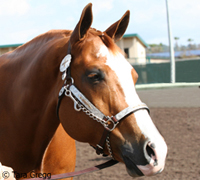
    Quarter Horse halterOne of the things that draws us to horses is their beauty. In halter classes, this attribute is center stage. Both grooming and health care play a role in creating an eye-pleasing picture.
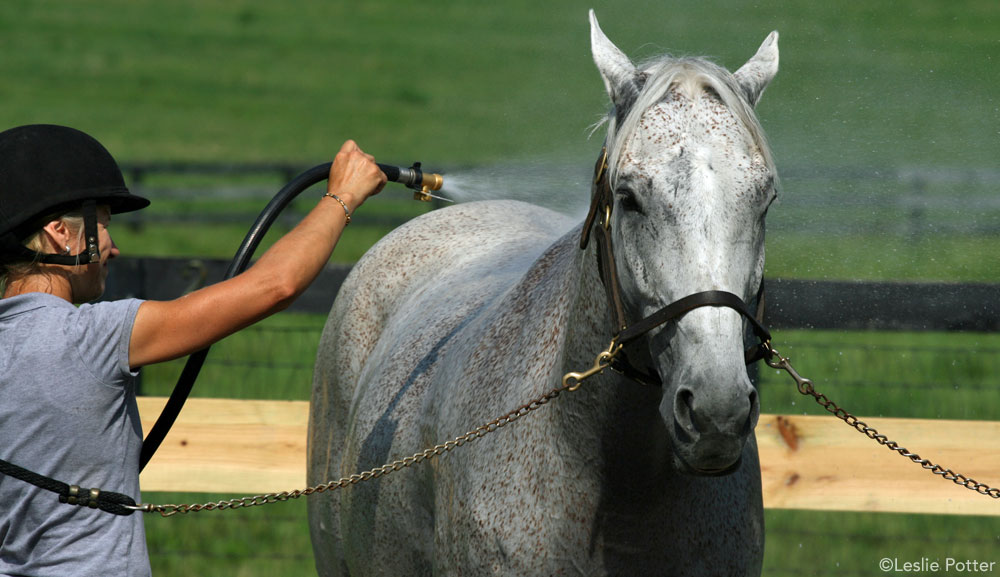
    • The single best thing you can do is grooming your horse from head to tail every day with a rubber curry. This promotes coat sheen, improves circulation for a long tail and mane, massages muscles and is a good way to check for sores, cuts and other problems needing attention.
    • Although not required, mane banding is still in fashion because it makes the mane lie still and pulls it down on the neck, giving the illusion of a longer, slender neck.
    • Over-shampooing dulls the coat. For an occasional wash, use your curry first to loosen dirt. Whatever product you use, the secret to success is using lots of water. If you think your horse is wet enough to shampoo, go over him one more time. Soap in a dry spot will cake there. Mix the soap with water rather than applying directly. Too much soap will wash out the natural oils. Rinse, rinse and rinse again, since soap residue is the dulling agent. Go over the coat with a towel in the direction of hair growth to finish up.
    • Clipping is a must—bridle path, ears, nose, under chin, around the fetlock and hoof area.
    • Too long a tail is detrimental, especially if it’s false. If your horse steps on it when backing, he’ll pull it out. Ankle length is a safe bet. If you bag your horse’s tail, take it down and groom it once a week to prevent knotting. Braiding should be done loosely (too tight damages hair) and start below the dock so you don’t interfere with circulation.
    • Check with your vet regarding any nutrients the hay in your area might lack and how to supplement accordingly. The best feed in the world is useless without routine deworming and teeth floating.
    • Use face shine products sparingly. After applying run a towel over it, especially when it’s hot. If you overdo it, the excess product will run and create a mess.
    • Daily exercise will help your horse build muscle, so he’ll look his very best come show day.

    Rhonda Quaid is a freelance writer based in California.

    Tips for Bathing Your Horse

    35
    Bathing a Horse

    It’s amazing that horses agree to our strange requests—and this includes wearing a flashing Rudolph nose and reindeer ears at Christmas. But every now and then horses draw the line at some sort of human behavior. Baths often fit into this no-go area. While most horses could care less about a shower, others fight it tooth and hoof. If your horse is one of these, he may have started to dread bathing due to bad experiences in the past—a slip and fall in the wash rack or maybe an unenlightened individual sprayed him straight in the face. Or he’s just one of those sensitive souls. Whatever his issue, here are some tips to help make bath time a more pleasant experience—for you and your horse.

    Attention to Safety

    • Concrete wash racks must be non-skid to avoid falls. If your concrete isn’t texturized, put down strong, texturized rubber matting or lining.
    • Have a friend hold your horse, or wrap the lead rope loosely around the wash rack railing. If your rack has cross-ties, make sure they are fitted with panic snaps (panic snaps should ideally be at the pole, not the halter end of the tie). If your horse should pull back, you want to be able to release him as quickly as possible.
    • Watch your hose. Never let your hose get under your horse’s feet, particularly the nozzle. If he steps on the nozzle and it breaks, a gush of water could suddenly spray up and startle him. If your horse is afraid of the hose, then it’s important to be extra diligent in keeping it off the ground and away from his legs. Overcoming a severe hose fear may require a lot of short sessions, with a great deal of praise and treats. Re-introduce the hose to your horse slowly. If the washrack causes added fear, pick a grassy area. Try spraying his front legs lightly at first, moving up and back as the horse’s comfort level increases.

    Attention to Comfort

    • Outfit your hose with an adjustable plant sprayer. Look for one that has several adjustments, including one for misting.
    • Start hosing at your horse’s legs to allow him to get used to the temperature slowly, like stepping into a pool.
    • Avoid spraying your horse directly in the face. Turn your nozzle to mist, start at his cheek and very slowly play the hose down along his face. Use a damp sponge to clean his ears and poll.
    • Purchase a heating coil. You can heat a bucket of water and use it for your rinse water. The warm water will help relax your horse and make for a more pleasant experience.
    • Be ready with an anti-sweat sheet or cooler to keep your horse warm and free of drafts.
    • Reward your horse with treats during and after the bath. If you make the time a pleasant experience he’ll begin to look forward to bath time.

    Attention to Time

    • Don’t wait until a day before the competition to teach your horse about baths. Give him a short wash every day (no longer than five minutes); it doesn’t have to be the works, you can wash his legs or tail. You can increase the time as he gets comfortable.

    Read on for more grooming tips.

    Sharon Biggs is a freelance writer based in England.

    Electrolytes for Horses

    1
    Horse Drinking Water
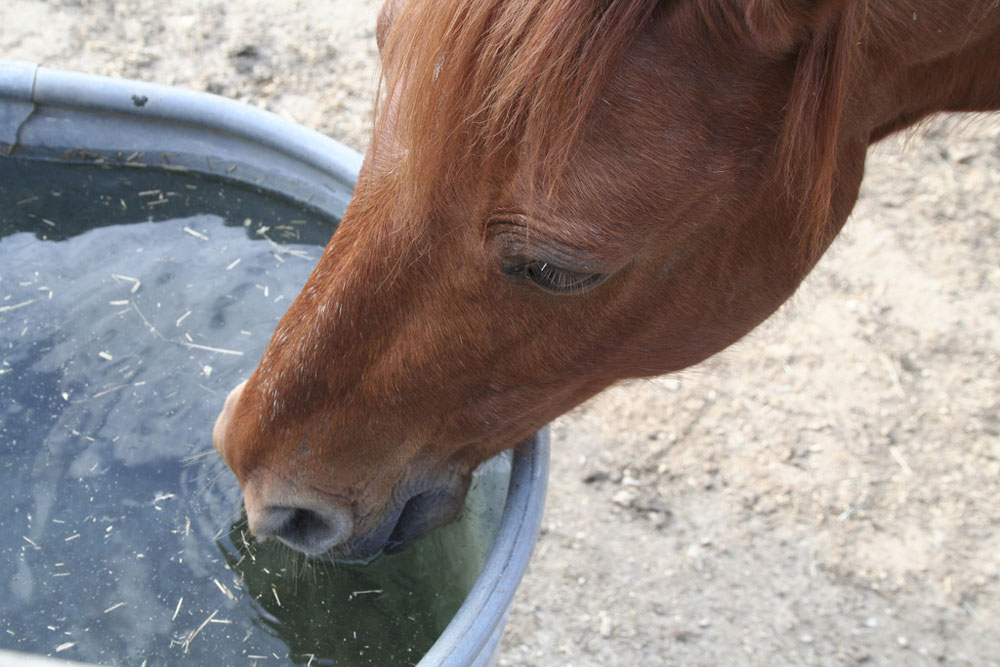
    It’s not just water that needs to be replenished during exercise in hot weather. Horses working for prolonged periods in hot weather lose electrolytes as well. Photo: horses by Amy the Nurse on flickr/CC BY-ND 2.0

    Ever wonder why sweat tastes salty? It’s because sweat contains dissolved body salts and minerals known as electrolytes. These invisible but important ingredients conduct the body’s electrical impulses and regulate vital internal functions such as heartbeat, smooth muscle contraction (needed for gut motility) and hydration.

    Electrolytes consist of sodium, chloride, potassium, calcium and magnesium, which are generally available in adequate quantities from a balanced diet. Under normal conditions, a horse or a person can replenish lost electrolytes by simply eating and drinking.

    But during prolonged activity, especially in hot weather, electrolyte loss can lead to fatigue, muscle weakness, cramping, dehydration, diarrhea and metabolic failure. That’s why it is important for both horse and rider to stay hydrated and nourished during extended summertime exercise. Riders can carry a sports drink and energy bars to keep their electrolytes up to par. Horses can also benefit from commercial electrolyte supplements if they are going to be ridden for more than a few hours at a time under hot or strenuous conditions. Get your vet’s advice on using supplemental electrolytes made just for horses.

    Prepackaged electrolyte pastes can be administered with a syringe at the back of the tongue, just like a dewormer. Some competitors prefer to prepare their own mix and stir it into a grain mixture, or a syringe full of applesauce or tapioca pudding. Generally, the electrolytes should be administered before activity begins, with subsequent doses given after each water break. The salty taste actually stimulates some horses to drink more, which further protects against dehydration.

    Administering electrolytes post workout will help the body’s functions return to normal, aid digestion and reduce muscle fatigue. This is particularly important in events that require multi-day exercise, such as an endurance ride or cross-country event. In these situations, your horse will not be able to recover lost electrolytes fast enough through regular food and drink. Always make sure that plenty of fresh water and hay is available after administering the electrolytes at the end of the day.

    Further Reading
    Seasonal Feeding
    Summer Sweat

    The author lives in hot and sunny California.

    Feeding Broodmares and Foals

    5

    Mares and foalsFrom birth to 2 years of age, a young horse reaches about 90 percent of his eventual adult weight and height. Also during a horse’s first two years, he develops the muscles, tendons, organs and bone he’ll need for a lifetime of activity. Good nutrition is critical during this growth phase of a horse’s life for the animal to reach his full genetic potential. This critical growth phase begins while the foal is developing in his dam’s uterus. Without it, growth may be stunted or orthopedic problems may result.

    During Pregnancy
    Good nutrition for foals starts with good nutrition for their dams. During the average 340 days between conception and foaling, the mare provides 100 percent of the nutrition needed by the growing fetus. The lactating mare then provides 100 percent of her suckling foal’s nutritional needs up to approximately 2 months of age. Adequate amounts of protein, energy (calories), vitamins and trace minerals are needed in the mare’s diet for both mare and baby to thrive.

    Through her 11-month pregnancy, the typical 1,200-pound mare gains between 175 and 225 pounds. Fluids, placental tissue and the fetus itself (120 pounds is a typical weight for a newborn foal) account for most of that weight, along with fat reserves the mare will need when she begins producing milk.

    Nutritional research has dispelled many myths about weight gain during pregnancy and about feeding pregnant mares. For example, unlike lactating mares whose calorie needs are enormous, nutritionists recommend that during the first trimester of pregnancy, mares without foals at their sides be fed according to their work level, as with any other mature horse. At this stage, the fetus weighs less than 5 pounds and makes the fewest demands on the mare’s body. In fact, overfeeding the mare with a vitamin/mineral-fortified grain mix, the best alfalfa hay and three or four vitamin/mineral supplements as “insurance” may actually harm the fetus’s early development by getting nutrients out of balance. A pregnant mare in light work that does not have a nursing foal needs a total daily ration (hay plus grain) equivalent to only 1.5 to 2 percent of her body weight during the first trimester, compared to the lactating mare, which requires a total daily ration equivalent to 3 percent of her body weight.

    Recent research indicates that there is more fetal growth in the second trimester than previously thought. This means that the 100- to 150-pound weight surge once thought to occur late in the mare’s pregnancy may actually occur sooner or over a longer period of time. During the second trimester, the mare needs a daily ration equal to 2 to 2.25 percent of her body weight to help her start building the critical fat reserves she will draw on when she begins nursing.

    Crude protein, vitamin and trace mineral levels need to be increased about midway through the second trimester to feed fetal tissue growth. Pay particular attention to the levels of calcium, phosphorous, copper, zinc, manganese and selenium. If the mare is fed alfalfa hay, be sure her diet is balanced for calcium and phosphorous, since the calcium:phosphorous ratio of alfalfa can be as high as 10:1. The mare’s total diet should contain at least .4 percent calcium and .3 percent phosphorous.

    There is less concern today than in the past about excessive weight gain in mares during late pregnancy. While surplus fat can stress the mare’s cardiovascular system, ligaments and joints, recent research indicates that excess weight is not necessarily harmful to the mare or fetus. Research has disproved long-held beliefs that excess fat affects rebreeding success or fetal weight.

    There is actually more potential harm in bringing a mare into late pregnancy in thin condition. Thin mares have a higher incidence of embryonic death and lower foal birth rates. They also have no energy reserves for themselves or the birth process. They may have lower resistance to infection and therefore fewer antibodies to pass on to their foals. Their milk production will be scanty, and their suckling foals will be hungrier. Conception rates for thinner mares at rebreeding are also lower. If a mare enters the last trimester of her pregnancy in thin condition, this is one time to pour on the grain to achieve a large weight gain before foaling. Add to 1 pound of a grain mix fortified for pregnant mares to her total ration every fourth day, but do not let grain exceed 40 percent of her total daily ration.

    The mare coming into late pregnancy in good flesh needs 2.25 to 2.5 percent of her body weight daily in feed, plus more protein, vitamins and minerals than she did during the first two trimesters. Look for grain mixes specially designed for pregnant mares that have high-quality protein sources, such as milk or soybean products, and fortification with extra calcium, phosphorous and trace minerals.

    Lactation
    Nursing makes the greatest nutritional demands on a mare in any phase in the reproductive cycle, and many mares are underfed while nursing. Lactating mares need as much or more energy in their diets as hardworking performance horses. However, compared to a performance horse whose energy needs increase gradually throughout his training regime, the lactating mare’s energy needs increase literally overnight.

    For the first four months of their lives, foals gain between 3 and 5 pounds daily, and in the first two months, a foal depends on its dam for 100 percent of his nutrition. The mare’s energy needs are double what they were in her second trimester and three times what they were in the first. Her protein, vitamin and mineral needs are at least 25 percent higher, too. Without sufficient calories in her diet, a lactating mare’s hipbones and ribs sometime seem to appear overnight. When that happens, it means she is breaking down her own body reserves to produce milk. This not only hurts the mare, but it can also jeopardize any new fetus she may be carrying if she was rebred.

    Give the lactating mare 3 percent of her body weight daily in feed. Since she can only eat a certain amount of hay daily, the best way to increase her calories is by increasing her grain intake. To avoid colic, begin switching to post-foaling grain levels about a week to 10 days before the mare’s expected foaling date, adding from .5 to 1 pound of grain every fourth day until reaching her new feeding level. Feed a grain mix fortified especially for broodmares to supply her protein, vitamin and mineral needs. This is also the time to splurge on the best-quality grass hay or alfalfa you can find so that the mare gets maximum nutrition from her forage.

    While it is difficult to influence the composition of a mare’s milk through her diet, the quantity of milk a mare produces can be influenced by her feeding level. More grain (increased calories) produces more milk. The size of a mare’s bag is a poor indicator of her overall milk production, but if the mare has a small udder and the foal is nursing constantly, the foal is probably hungry. If feeding the mare more calories does not increase her milk supply enough to satisfy the foal’s needs, the foal may need supplemental creep feeding.

    Milk is 98 percent water, and at peak lactation a mare produces about 4 gallons of milk daily. Lactating mares need ample supplies of water, about three times what a nonlactating mare requires. A 5-gallon bucket filled twice daily will notsupply her needs. Because grass contains 80 to 90 percent water, the pastured lactating mare can supply much of her increased water needs through grazing, although fresh water should always be available.

    Suckling Foals
    Because of their small digestive tracts, foals eat many small, frequent meals. It is normal for suckling foals to nurse for one to two minutes three to seven times an hour. Excessive bouts of nursing, a foal that is constantly butting the mare’s udder, a mare that is antagonistic because the foal is continually trying to nurse or below-normal weight gains all point to poor milk production.

    Before he is 2 or 3 months old, the foal’s immature digestive tract cannot break down and utilize grain-based creep feeds. His teeth are not equipped for chewing grains well, and his gut does not yet have a full complement of microbes and enzymes to process grain. Offering creep feeds based on high-quality milk-protein sources can help the suckling whose dam is not a good milker. On the whole, however, nutritionists advise creep feeding cautiously because excessive creep feeding pushes growth and risks developmental orthopedic disease (DOD).

    The rule is to creep feed conservatively. At various times, nutritionists have implicated high protein levels, excess calories and various minerals as the culprits responsible for various orthopedic problems in young, growing horses. Current research indicates the problem is not any one of these factors but rather the balance among them. For example, if high protein levels push growth but the minerals necessary for sound bone development are missing from the diet, DOD can result. Foals being pushed on high-protein creep feeds with low mineral levels are not the only ones at risk. However, weanlings on low-protein grass pastures that receive high-energy grain mixes that are not balanced for minerals can have problems, too.

    When creep feeding a nursing foal is necessary, the foal should get no more than .5 to .75 pound of creep feed per 100 pounds of body weight daily, plus top-quality hay fed free choice. Look for a creep feed especially blended for foals that is about 16 percent protein, .8 percent calcium and .6 percent phosphorous. The calcium:phosphorous ratio should be around 1:1 and never more than 3:1. Check the ingredients listing for high-quality protein sources, such as dried milk products or soybean meal, which provide the amino acids needed for growth.

    A 16-percent crude-protein grain mix intended for hardworking adult horses will not be suitable for creep feeding because the balance of its protein, energy and minerals may be unsuitable for good growth. While protein sources such as cottonseed meal, linseed meal or corn gluten meal may be acceptable in adult horse diets, they do not provide the amino acids needed for good growth in young horses.

    Weaning and Beyond
    By the time the foal is 4 to 5 months old, his digestive tract has developed sufficiently to process grain and he is psychologically ready to leave his dam. Start the weaning process by cutting the mare’s calories to reduce her milk production. About a week prior to weaning, cut calorie intake about 20 percent by halving the mare’s grain ration. Three days before weaning, cut calories about 20 percent again by removing all grain. This gradual tapering of the mare’s feed intake helps her begin drying up so she will be less likely to have problems with a swollen udder or mastitis at weaning time. Secondly, less milk means a hungrier foal that will become more interested in other sources of food and water.

    After the mare and foal are separated, keep the mare off grain for about three more days to help dry her udder. If she is carrying a new fetus, do not keep her off grain any more than a week after weaning, or the new foal she is carrying may suffer nutritionally. Add grain back into her diet at the rate of about ½ pound every three or four days until she is back at the desired maintenance level.

    The weanling needs about 3 percent of his body weight daily in feed. While some of this should be supplied by a 14- to 16percent crude-protein grain mix, do not feed grain free choice to weanlings. Foals easily overeat with the result being enterotoxemia or DOD. Good-quality hay, on the other hand, should be available free choice. Remember that the minerals in the grain mix or supplements fed should complement the grass or alfalfa hay offered so that overall protein, calories and minerals stay balanced in the total ration.

    The enormous daily weight gain during the foal’s first six months gradually tapers off as he approaches a year old. Continue to feed good-quality hay supplemented with a grain mix formulated to balance the minerals in the hay, but drop the crude protein level in the grain mix to 10 to 12 percent. As the yearling approaches 2 years of age, he will have gained more than 90 percent of his adult weight and height and, instead of growth, the animal’s work level will become the major determinant of his ideal feeding program.

    Further Reading
    Milk Alternatives for Foals

    0FansLike
    0SubscribersSubscribe
    We use cookies to help personalize content, tailor and measure ads, and provide a safer experience. By navigating the site, you agree to the use of cookies to collect information. Read our Cookie Policy.
    OK