Enter our 12 Days of Christmas Giveaways here!
0 ITEMS
  • My Account
  • Holiday Gift Guide
  • Podcast
  • Webinar
Subscribe Combo
Enable cache13
Home Blog Page 1064

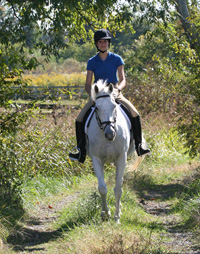
Perfect Your Haunches-In

8

Haunches-in (or travers) is the most advanced way to teach your horse inside bend. For a correct haunches-in, your horse must move with his front legs and shoulders on the track and his haunches off the track. It isn’t the easiest maneuver to master so keep things simple by breaking it down into steps.

Your Position

  • Sit facing straight ahead with your shoulders aligned with your horse’s shoulders.
  • Keep your inside leg at the girth (calf supports the bend and keeps the horse at the track) and your outside leg behind the girth (pressure from your calf asks the haunches to swing in).
  • Outside rein helps keep the horse’s neck straight and inside rein asks for a slight flexion to the inside.
  • Keep more weight on the inside sitting bone.

Your Horse’s Position

  • Your horse’s neck and shoulders should be parallel to the long side.
  • The rest of his body should be bent to the inside.

Top Three Mistakes in Riding Haunches-In

1. Your horse won’t respond to the outside leg.
Solution: Horses often lean to the wall so ask for the haunches-in on the centerline or quarterline instead. He also may not understand what you are asking for. Review your basics and make sure he responds to your lateral aids.

2. You get a lot of neck bend without much haunches-in.
Solution: This is caused when a rider uses her reins in place of proper leg aids. Check your aids, make sure you are asking properly and try again. Remember to keep the neck and shoulders straight.

3.You have trouble maintaining the bend.
Solution: Start the haunches-in from a circle to create the bend and then go straight ahead in haunches-in. Go back to the circle if you lose your bend.

Further Reading
Developing Shoulder-in
The Shoulder-Fore: Shoulder-in Training Wheels

Award-winning author Sharon Biggs is a freelance writer in England.

Could Your Horse’s Shoeing Pass Inspection?

5

Devoted equestrians spend hard-earned money to maintain their horses’ good physical condition. Regular veterinarian visits and a call from the farrier every six to eight weeks just scratch the surface of annual expenses.

Hooves


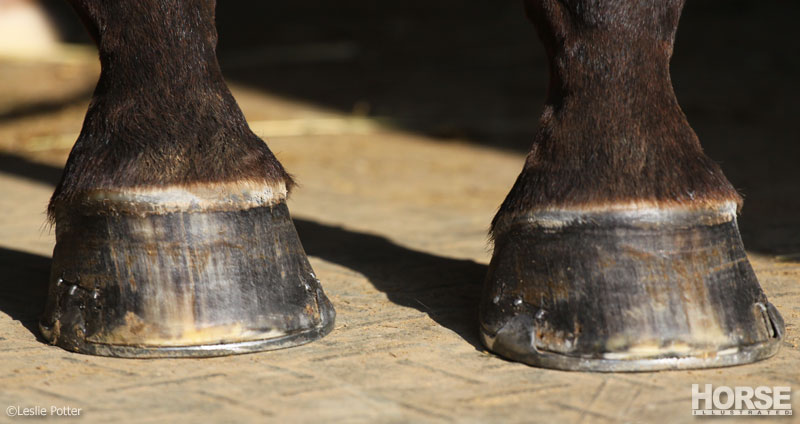
A farrier’s skill and level of expertise can impact whether a horse is sound for performance duties in the show arena or on the trail. But how many equestrians know if their companions are receiving a quality shoeing from their farrier? To rate a shoeing keep the following in mind the next time you pick up your horse’s hooves.

Southern California farrier Jesse Coker suggested the following evidence can help determine a good shoeing over a poor one.

Good Shoeing Components
1.  The foot should look clean and tidy. “There shouldn’t be any large cracks or splits. The hoof should not have any gouges from a farrier’s rasping of the foot.”

2.  The front feet and back feet should be the same length from the coronet band to the shoe. “The heels should be close to the same length, but keep in mind some horses have uneven heels so the farrier can only get so close.”

3.  Right after your horse is shod, observe him traveling at a walk. “The front feet should land flat on the ground. They should not hit first on one side before the other, outside or inside.

4.  Observe for correct size of shoes. “The shoe should fit the horse’s heels by allowing enough expansion room, about 1/8 of an inch on the outside.” The front angle of the hoof should line up with the pastern, so the horse doesn’t “knuckle over” or “break back” in its pastern.

5.  Inspect the nails for location. “The nails should be driven high enough so the hoof doesn’t split. A nail can’t be too high, but it can be too deep which can result in an extremely sore horse.”

Poor Quality Shoeing
Watch for these trouble signs:
   
1. Your equine companion is sore after a recent shoeing. Call the farrier first. “It might be something easy to resolve, even farriers are human and can make mistakes. Good farriers can almost always fix their own mistakes.” If the horse continues to be lame, contact your veterinarian.

2.  A poor shoe fit. Jesse reminds owners, “If a shoe fits too closely in the heels, it can cause corns and sore contracted heels.” If a the shoe is an improper size, too small for the foot, the animal could receive a “hot nail,” one that ends up positioned in the bottom of the hoof, that could cause soreness or splitting of the wall.

3.  A previously sure-footed horse that begins to trip regularly after a farrier visit. “Tripping generally means the toes are too long or the heels are sore.” In most situations, the shoes should be placed about 1 1/4 inches in front of the frog. “If the shoe is correctly placed on the toe, and they aren’t too tight on the heels, the horse might need something like bar shoes to give more support to the leg and heels.”

4. Your horse loses shoes on a frequent basis. “This sometimes can’t be avoided, but if the front shoes stick out behind the heels too far, the horse will be apt to pull them off.” Sometimes, if the front feet are too long in the toe, the animal can’t get his feet out the way quickly enough to avoid pulling one off. “Some horses just have poor conformation and are prone to pulling off shoes.”
   
“Properly trimmed hoofs, not too long or too short, with a shoe fitted properly to the conformation of the horse and hoof will make nailing of the shoe on the foot much easier,” said Melvin Reynolds, a farrier for 30 years located in Orange County, serves hunter, jumper, dressage and western reining clients. Hooves that are too long develop flares and cracking which result in driving the nails too low, with no integrity to the nailing. A foot trimmed too short will make nailing difficult because the sensitive parts of the hoof are more easily penetrated by a poorly driven nail.
   
“Poor shoeing is the result of lack of understanding of the characteristics of the hoof and how a horse moves as it performs,” Reynolds explained. Excessive knifing of the sole and frog leave feet too short. Conversely, leaving too much dead sole and frog results in hoofs being too long and excessive backing up of the toe to establish a better angle.

“Shoes that are too small or too big are often the result of not knowing where the sensitive structures of the foot are located within the hoof,” Reynolds said. “A bigger hoof is not necessarily a better hoof, but a hoof trimmed and shod with a proper sized shoe will be.” 

Shoes larger than appropriate will damage a hoof as much as those that are too small. A shoe fit to support and enhance a horse’s unique self is the goal of every quality shoe job. 

The next time you clean out your horse’s feet before a ride, take a few moments and check your horse’s feet for proper foot shoe size, trimming, nail placement, flaring, cracks or splits in the walls of the hoofs. Then saddle up and monitor him for soundness and way of going.

Any questions or concerns you have about your horse’s shoeing should be discussed with your farrier. A professional farrier will listen and make an honest attempt to resolve any shoeing issue. Most problems can be solved by not allowing small situations to become large.

Further Reading
8 Hoof Care Myths
The Right Shoer

Barbara J. Janesick, a lifetime Arabian horse owner for more than 40 years, owns an energetic 29-year-old Arabian gelding, who still performs pleasure trail duty.

Is Your Yearling a Longeline Candidate?

1

Yearling
The yearling longeline class provides a showcase for up-and-coming English and western pleasure horses and an opportunity for the owners of these young horses to participate in horse show events. In order to compete successfully, these immature horses must demonstrate a calm and willing attitude, trainability at a young age and quality of gait.  

When considering a longeline prospect, observe the young horse as he moves freely across the pen or arena. Do his gaits remain steady with a natural cadence, or does he tend to pick up speed or want to play excessively? While traveling at each gait, does he lift his knees and hocks up toward his body, or does he reach through from his hips and shoulders with a long, low and fluid stride?  Does he have natural eye appeal, or is his personality lackluster and his expression plain?

Proper training and preparation of the youngster is as important as his natural talents. Follow these tips and guidelines to help ready your yearling for shows:

  1. Consult your veterinarian in order to tailor a program that will provide the necessary training and level of fitness without putting excessive strain on immature legs and joints.
  2. Plan training sessions at a time when your yearling will be the most quiet and receptive, i.e. after a long turn-out or when activity around the barn is minimal. 
  3. Use a round-pen to help the young horse remain focused on his handler and to develop natural gaits. 
  4. On the longeline, avoid excessive pulling to protect the yearling from becoming unbalanced and causing possible injury.
  5. Haul the inexperienced horse to shows whenever possible to introduce him to the sights, sounds and smells of the show grounds before he has to deal with the pressure of performing.

With desirable attributes and solid training, your yearling longeline competitor can be a great success, and that success can continue throughout his career under saddle.

Dale Rudin is a CHA certified riding instructor and clinician with a mindful and balanced approach to horsemanship and
riding.
www.Un-Naturalhorsemanship.com.

Further Reading
Safe Longeing

Horses That Heal

3

Therapeutic riding is mentally and physically rewarding for those involvedTherapists did not recognize the advantages of horse-assisted therapy until Denmark’s Liz Hartel, a rider suffering from polio, won a silver medal for dressage at the 1952 Helsinki Olympic Games. Since that time, therapeutic riding has grown throughout Europe, Canada and the United States to become an accepted form of therapy for many disabilities, both physical and mental.

There are three basic classifications for therapeutic riding: sport, education and medicine.

The sport classification includes riding, driving and vaulting as forms of therapy. People with physical, mental or psychological impairment can participate in these adapted forms of equine activities. Sport helps disabled riders learn to control their bodies and their mounts in an enjoyable way.

The educational classification emphasizes incorporating goals to help the student think and reason, to improve behavior, to deal with psychological strengths and weaknesses and to improve physical condition.

In the third classification, medicine, therapists integrate principles of medical or psychological treatment into various abilities with the horse. The emphasis is on movement and not necessarily on the student controlling the horse. These students are often immobile and unable to leave their wheelchairs for regular abilities.

The Therapy Horse

The most important quality in a therapy horse is a calm and gentle temperament. The therapeutic mount must be level-headed and accept new experiences willingly.

The preferred size of the therapy mount is about 12 to 15 hands, which makes it easier for volunteers to assist the rider from the ground. The horse must have three good gaits, be no younger than 5 years old and should not be green. The horse should be trained to accept mounting and dismounting from mounting blocks, and must stand quietly for long periods of time. It must become accustomed to wheelchairs, crutches and walkers that sometimes will be used around it and occasionally bump into it. Also, it must learn to accept working with up to three people around them on the ground while the rider is mounted.

The horse must also become familiar with verbal commands as well as occasional spontaneous loud screams of joy from an excited rider.

Horses chosen for equine therapy programs seem to understand that their special riders are different than the normal riders they have carried previously. Some horses have been known to shift their body weight and balance to correct a rider who has moved off balance. They listen carefully to the riders who can use leg aids and seem to be able to understand and ignore flailing legs of other riders who have little or no control over their leg movements. Therapy horses seem to enjoy their work and the company of their human companions.

Therapy People

Volunteers range from young students to retirees. Some volunteers help tack up and groom the lesson horses. Some handle barn duties, such as feeding and cleaning. Many volunteers enjoy being involved with the students as leaders, teachers or sidewalkers, providing physical support for the disabled rider. Those volunteers whose skills lie in administration help perform office work, fundraising and committee work.

Getting Involved

People interested in a career in therapeutic riding may want to consider some of the educational opportunities in the field. There is a need for certified therapeutic riding instructors, therapists with horse experience and program directors. The North American Riding for the Handicapped Association (800-369-RIDE) is a nonprofit organization that provides operating-center accreditation, instructor-certification classes, operating-center insurance, public relations and workshops, among other things.

In addition to NARHA, CHA — The Certified Horsemanship Association (800-399-0138) — also offers programs for instructor certification and safety certificates. While not specifically designed for therapeutic riding, they offer valuable, informative classes for prospective instructors and volunteers.

If you decide to get involved with a therapeutic riding organization, the rewards are many. Both volunteers and riders recount the many miracles that happen daily. When you become a part of this, it may forever change the way you look at horses and life.

Real Benefits of Synthetic Tack

4

By Moira C. Harris


We had all finished bathing and spiffing up our horses for the show the next day. It was the time to make our saddles and bridles match our mounts. I watched wistfully as my friends carted off their luxurious leather saddles to go through the ritual of cleaning and conditioning tack. I then turned to my own saddle, plunked it on the ground by the washrack and began to hose it down, full blast. I was finished in minutes, and as I put my faux-leather saddle to dry in the shade, my riding pals were now envious of me.


Yes, synthetic saddles and bridles have certain advantages. Available in a wide array of styles, with as many accessories as colors, synthetic tack is long-lasting, low-maintenance and inexpensive.


True Values
Western riders will appreciate the lightweight properties of synthetic saddlery. For young riders who struggle to heft a 45-pound saddle over their horses’ backs without nailing the horse in the kidneys or withers, synthetic saddles can be ideal, as they weigh up to two-thirds less than traditional saddles. Endurance riders also prefer the lightweight saddlery. With horses covering long distances and riders logging in many hours in the saddle, any way to ease the weight burden is appreciated by both.


The saddles are comfortable and usually lack a break-in period. Some synthetic saddles incorporate wool-stuffed panels that conform to the horse’s back, and gel seats to make the rider comfortable, too.


Synthetics are correctly styled after traditional leather saddles. Dressage riders often feel quite at home in a synthetic, since many are black, which is the color of choice for the dressage ring. There is no stigma associated with synthetic tack in the realm of dressage, eventing, endurance or other demanding sports.


Synthetic saddles clean up easily. Eventers like the fact that they can splash into a water jump without this action taking its toll, as it might with leather. Synthetic saddles can look sharp again by just using plain soap and water, and no oil or dressing is required to make the saddle look great.


Biothane
Biothane bridle tack is used mainly by trail and endurance riders for a variety of reasons. Biothane, a plastic strapping which is a polyurethane-coated nylon strap, is durable and made to resist fading. Biothane does not tear, fray or soak up moisture the way woven material or leather can. It cleans up easily and is almost maintenance-free. It just needs to be swished around in a bucket of sudsy water to get it clean again.


Headstalls are available in a variety of convertible styles so trail riders can detach their horses’ bits, yet keep a halter on them for security. Endurance riders also appreciate the design of convertible biothane tack, as it makes vet stops quicker.


Nylon Tack
For riders who want something supple and versatile, nylon tack also has plenty of benefits. Nylon is strong and resists breakage. Halters can even be purchased with a replaceable leather crown so that the horse can break away in the event of an emergency. Nylon is durable and cleans up easily, and is also weather and mildew resistant. And you can’t beat the beautiful color combinations that nylon bridles, halters, breastplates and martingales come in.


Another type of woven halter is the polypropylene halter. Softer and more supple than nylon tack, this material is usually sewn together in two plys, and reinforced at stress points for added durability. Some halters are further padded at the crown and noseband with foam rubber to increase the horse’s comfort.


The Real Deal
One of the best aspects of synthetic tack is that it is affordable. For the novice who is just starting out, a synthetic saddle is ideal. Additionally, if a rider is thinking about adding a new riding style to their normal routine, such as jumping a career dressage horse, buying a synthetic saddleis a great way to invest in a saddle that can do the job right, but won’t cost an arm and a leg. Whatever the reason, we can all afford to have some synthetic in our lives.

Sheath Cleaning

22

As a horse owner, you’ve no doubt come to realize that there are three topics guaranteed to raise the eyebrows of your nonhorsey friends and relatives: 1) Flushing fly eggs from your horse’s eyes, 2) the productive effects of deworming agents, and 3) cleaning your gelding’s sheath.

Each of these subjects can bring polite chatter down to a hushed silence at Thanksgiving dinner or a wedding reception. But the idea of cleaning your gelding’s sheath can make even seasoned horse owners blush. It’s such a, well, sensitive concept to some people: getting that up close and personal with your male horse.

Get over it. Here are the blunt facts: Your gelding has a penis, it’s encased in a sheath, and to prevent irritation and infection it needs to be cleaned at least once every six months. There. Now that we’ve confronted the subject, here’s advice on how to tackle this touchy task.

The Bare Facts

The sheath surrounding the penis is also called the prepuce. The sheath is formed by a double layer of sliding skin, with the internal layer containing sebaceous glands that secrete lubricating oils. These secretions, together with flaking skin cells, form a thick, waxy material called smegma. Because srnegma collects in the folds of the sheath, it needs to be periodically removed or it can be a source of infection.

Another reason for regularly cleaning your gelding’s sheath is to look for any swellings or lesions that might require treatment. Here are several of the most common:

  • Summer sores. These are raw, ulcerated lesions that have a crusty covering and bleed easily. They are a source of intense itching. Summer sores are caused by the larvae of stomach worms, carried to the wound site by flies that harbor the parasite. The flies are drawn to the moistness around the penis. Because summer sores usually indicate that your horse is infested with stomach worms, a dose of ivermectin is necessary. Your vet will also treat the localized summer sore. If it doesn’t heal, it may have to be surgically removed.
  • Squamous cell carcinoma. This type of cancer can mimic summer sores, so a biopsy is usually required to tell the difference. Appaloosas, Paints, palominos and other geldings with pink or mottled skin are more prone to carcinoma of the penis and sheath. Like summer sores, you’ll notice a crusty, oozing sore that refuses to heal.
  • Melanomas. Gray horses in particular are victims of melanoma. The sheath is a common site for a melanoma, which appears as a lump or nodule, often dangling from the outer skin of the sheath. Your vet may recommend removing melanomas on the sheath before they become invasive or so enlarged that they threaten the flow of urine.
  • Swelling, odor or itching. These symptoms potentially signal an infection, or a build-up of smegma that is irritating the sheath. Persistent swelling of the entire sheath, or edema, can be a waning of congestive heart failure, especially in older horses.

If you notice any of these signs, don’t be shy. Call your vet.

Yes, Please Be Gentle With Him

The first time you clean your gelding’s sheath, or if you’re handling a young or green horse, enlist the help of your vet to perform the cleaning and explain the step-by-step process, or coach you through the job. Your vet will probably tranquilize your horse. Not only does this sedate or calm your horse, making it safer for everyone, but certain tranquilizers cause the penis to relax and extend, making sheath cleaning much easier.

Whether or not your vet is alongside for advice and assistance, make sure that you know your horse well before beginning. Is he easy to groom and fly spray, or is he ticklish under his belly? Does he let you lean against his flank, or does he get grumpy and pin his ears?

If he’s at all reluctant to let you handle him under his belly and around his flank, do not attempt to clean his sheath without him being tranquilized. Even if restrained, your horse will still be able to “cow kick” you. Plus, a tense gelding will simply draw his penis even further up into his sheath, making the cleaning job nearly impossible.

Once you and your gelding have come to an agreement that this personal bathing ritual will be completed, lead him somewhere that’s convenient for grooming activities, yet secure. Cross-ties, stocks or a wash rack are all possibilities.

How to Clean Your Horse’s Sheath

  1. Pour a small amount (about a tablespoon) of a very mild soap, such as Ivory, into a bucket of warm water and slosh it around to make light suds. There are also cleansers made especially for this purpose, such as Excalibur Sheath Cleaner. Never use an iodine or Betadine-based soap, or any medicinal shampoo. They are extremely irritating to the sheath and penis.

    You probably want to don a pair of disposable rubber gloves before you get going. Otherwise, black smegma may get under your fingernails.

  2. Next, soap up your hands. Then use your fingers to gently remove smegma that has accumulated in the folds of the sheath.
  3. Check the pouch at the end of the sheath, over the head of the penis, for a “bean,” a hardened, round ball of smegma.
  4. As the penis extends, wash it in the same manner, gently rubbing off any loose or flaking skin.
  5. Then rinse the sheath and penis with plain water, being sure to remove any soapy residue. You can use a clean, soft sponge to help. If you notice that the sheath or penis is swollen or red, your vet may prescribe a topical antibiotic ointment to clear up a possible low-grade skin infection.

There! You did it! Welcome to the world of hands-on horse care. You can now nonchalantly relate a story certain to shock ol’ Aunt Margaret at your next family reunion.

Training Your Horse Right the First Time

19

Behavior modification therapy for horses can fix multiple issuesIf you’ve been riding for awhile, chances are great that you’ve found yourself traveling down the wrong training path at some point in time. Perhaps you incorporated a training technique into your routine that resulted in horse behavior that wasn’t quite what you had in mind. Or maybe a few overzealous reprimands on your part resulted in some unforeseen, undesirable modes of misbehavior in your horse that you’d like to eliminate. If we hope to remedy the problems caused by our training misadventures, we need to learn the answers to a few key questions first: How lasting are the effects of our training mistakes on our horses? Can the damage ever truly be repaired?

I recently heard a profound statement that I think says it all: When treated unfairly, the horse will never forget the trespass, but it is within his capacity to forgive it. An Arabian gelding I once owned and started under saddle had a small problem with trailer loading; he’d simply plant his feet and refuse to get in for a long time. Sadly, since I seldom needed to haul him anywhere, I neglected this weakness in his training. He was eventually sold to an endurance rider, and the trouble started showing up during loading and hauling to and from their competitive meets. Some strong measures were employed to teach him to load, and he immediately developed a bucking problem he hadn’t had before. His owner decided to sell him, but sent him to me to resolve the behavior problems first. After a few months of patient and consistent under-saddle training, he was once again trustworthy to ride.

Two fundamentals of behavioral modification therapy, desensitization and counterconditioning, had been applied to retrain this horse with a successful outcome. Desensitization is the process of making an animal less reactive to a situation by accustoming him to the fearful stimulus. In this case, I habituated the horse to loading into the horse trailer by doing it so often that loading lost the power to upset him. This, coupled with counterconditioning, helped him to develop a positive association with the horse trailer. Counterconditioning is establishing a new response to a stimulus as a replacement for an undesirable behavior. In this case, the horse’s fear of the trailer was eventually replaced by anticipation of the food reward waiting within the manger. The bucking problem was resolved both as a consequence of alleviating the trailer-loading problems and as a result of employing the behavioral principles of positive reinforcement, negative reinforcement and punishment correctly in my under-saddle work. Praise and other reinforcers were delivered in abundance for appropriate behavior, while the potential for a swift correction kept inappropriate behavioral tendencies in check. Eventually, these two undesirable behaviors were dropped from the horse’s repertoire entirely.

The knowledge that consistent, appropriate training can eventually turn most of our mistakes around shouldn’t be taken as license to experiment with different training tactics. The fact is, it’s very difficult to undo a horse’s initial training, regardless of whether those early lessons were correct or incorrect. In a 1994 study, which was presented in the journal Applied Animal Behaviour Science, I taught 17 previously untrained yearlings and 2-year-old horses to discriminate between a black and a white feed bucket for a food reward. Once each horse had figured out which color was correct, I reversed the correct color to see if he could unlearn what he had been taught and replace it with something completely opposite. In other words, if black had always been correct for that horse, once he developed consistency at choosing the black bucket every time, I stopped giving food for choosing black and instead started giving food only for choosing the white bucket. Only about a third of the horses were able to unlearn theoriginal stimulus color and make the switch to the opposite color.

Think of the implications of the fact that most horses tested were not able to reverse their initial training. Therefore, the importance of getting the training right the first time cannot be overemphasized. In fact, in similar studies of other herbivorous species (such as cattle), similar results were obtained, lending support to the theory that first training experiences are of critical importance in the overall trainability of domestic prey species. Of course, in actual horse training the rider improves the potential for retraining by guiding the horse through the learning process, whereas in these studies the horses had to try to figure everything out by themselves.

Not only are the content and consistency of the horse’s training important, but so is the frequency at which the lessons are delivered. In a Cornell University study, 15 ponies were trained to clear a small hurdle on three different time schedules; group I ponies were trained seven days a week, group II ponies were trained two times a week, and group III ponies were trained just once a week. Surprisingly, the ponies trained just once a week learned to jump the obstacle in fewer total training sessions than the other two groups, while the ponies trained seven days a week required the most training sessions to learn the task. After this experiment, the ponies were reassigned to two different groups and taught to back up, and once again the ponies trained just once a week learned the task in fewer sessions. It appears that horses, like humans, don’t learn as efficiently when things are drilled into them as they do when they have adequate downtime between sessions. To train horses effectively, we should try to allow enough time between the lessons to maximize learning.

The results of these studies are supported by the popular advice of many leading trainers. In her book The Problem Horse, Karen Bush suggests that training should follow a steady, logical progression, as attempting to teach more in a session than the horse is mentally capable of learning can lead to resistance and confusion-based behavioral problems, and ultimately to vices and evasions. The rider should achieve dominance through an intelligent approach, rather than through force, which breeds distrust and increases the potential for violent behavior. She further states that horses have excellent and long memories, particularly for unpleasant experiences, and that many behavior problems can be traced back to past events. She emphasizes that horses should be trained through repetition, association and reward, and reminds her readers that it is just as easy for a horse to learn bad behavior as it is to learn good behavior.

Trainers should never consider it too late to repair the damage of a misdirected training attempt. If the training problem has been going on long enough for undesirable habits to be ingrained, it will just take more time and patience to undo the damage. Sometimes the assistance of a professional trainer may be required to help turn around a long-term behavior problem. Many errors, however, if detected by the trainer and reevaluated before unwanted responses become habitual, can be resolved with somewhat less effort. For example, one of my horses is normally willing to cross water on the trails. When we moved to a new barn, my husband and I rode the horses out together to explore the trails in the area. We had been told ahead of time by the barn owners where the best place to cross a 4-foot deep, 20-foot wide creek would be, and as we approached the area, we discovered that the banks descending to the creek were quite steep. Since the horses had many previous experiences with water crossings, I took the mare I was riding immediately into and across the creek. The mare Steve was on balked at the steep bank and deep, murky water below. As Steve grew more insistent, she suddenly jumped from an absolute standstill halfway across the creek, and then scrambled out and up the opposite bank. Steve attempted another three crossings with similar results. I decided to climb on and give the water crossing a try myself, planning to get the mare into the creek and then to steer her upstream until she finally relaxed. When I did attempt to do it, the mare struggled so hard against my efforts to turn her head upstream that the rein broke, I lost my balance and toppled into the creek. I rode on home with tadpoles in my pockets, did some research and devised a new strategy with the intent of keeping her calm and willing throughout. The next time I went back, the mare was lightly tranquilized and I walked into the creek alongside her. This approach restored her confidence, and after several entries into and out of the water, I climbed onto her back in the creek.

The next time we went back (this time without any sedatives on board), I once again led the mare into the creek and then climbed back on and rode her into and out of the creek. The next lesson was approached entirely from the horse’s back, and when this went well I knew we had repaired the damage.

Why did the new technique work when the first one did not? The new approach resulted in success because we recognized the initial training problem early (and rather dramatically), before bad habits were set in stone, and thought out an alternate approach that alleviated our horse’s anxiety and cultivated her trust. It pays to step back and reassess training situations where the horse’s behavior indicates that something in your approach just isn’t working. It’s never too late to try to rectify your training mistakes—some just take longer to resolve than others.

Further Reading
Getting a Rescued Horse to Trust You
When Horses Act Dangerously
Reasons for Behavior Problems

Graduating Your Western Horse From Snaffle to Curb Bit

8

Prominent Quarter Horse trainer Dana Hokana has a philosophy of thoroughly educating the young horse in the snaffle bit before moving him into a curb bridle. Just as a child must learn the basics in elementary school, Hokana believes the horse must be supple to the rider’s aids and learn to carry himself in a snaffle before graduating to the curb.

By starting slowly and training in a humane fashion, Hokana produces horses that accept the curb bit without tossing their heads or gaping their mouths, and who yield to the bit willingly when she picks up the reins.

Before her young horses enter her training program, Hokana has their teeth checked to make certain there are no physical problems that would cause the horse to not eagerly accept the bit.

The vestigial wolf teeth are usually pulled, as they may interfere with the placement of the bit and can irritate the gums. She also has all caps removed and sharp edges filed down.
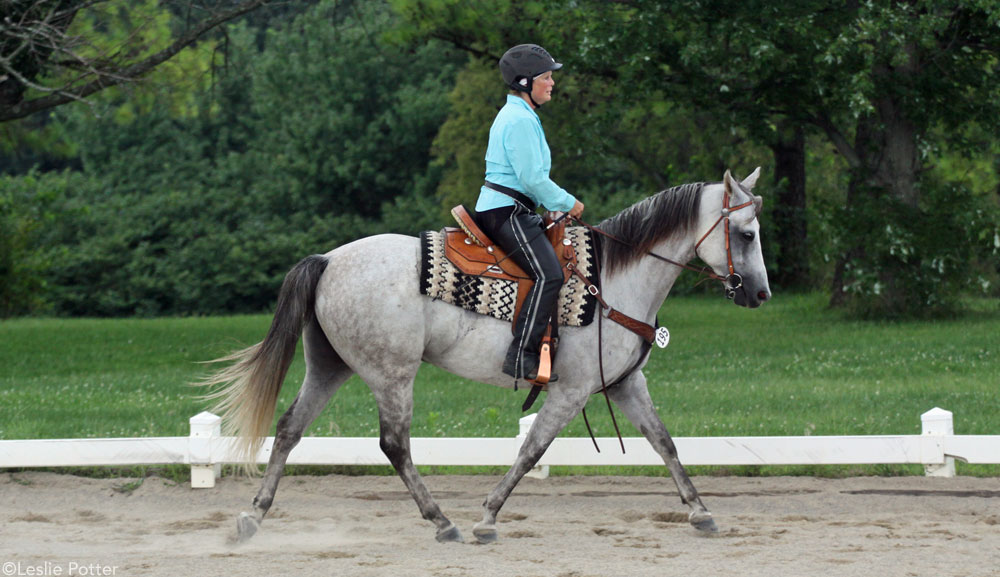
Western Dressage

Then, as the equine equivalent of kindergarten begins, Hokana starts her horses in a sidepull bridle. A sidepull is a sort of bitless headstall with reins that allows her to introduce the horse to the idea of turning and giving his head without directly working on his mouth. After 30 to 45 days in the sidepull, she switches to a smooth D-ring or loose-ring snaffle.

“I prefer a good quality sweet-iron snaffle,” Hokana says. “I have a few that I like with copper inlays set in the mouthpiece. I recommend getting a good-quality, well-made snaffle.”

The choice of a snaffle as a first bit on a young horse is a logical one. “A snaffle is an excellent first bit on a horse because it is a mild bit that works primarily on the corners of the mouth,” says Hokana. Even though, with increased pressure, the snaffle can work on the tongue and sensitive bars of the mouth, Hokana’s goal is to encourage the young horse to yield to her hand through just light pressure on the corners of the mouth. When she rides a horse in a snaffle and applies light pressure with a leading or direct rein, she connects first with the corners of the mouth, which enables her to turn the horse’s head from one side to the other, encouraging the horse to give or yield with his jaw, poll and neck.

“As the horse learns to give or bend with forward motion, he learns to follow his nose, making him steerable,” Hokana explains, which then permits the horse to become supple through his whole body.

As training progresses, Hokana uses very little additional equipment. “During the first stages of training I will use a long running martingale on some horses.” She emphasizes that the martingale is not used to pull the horse’s head down. “I don’t use a lot of gimmicks. I don’t like draw reins and tie-downs,” she says, “but I have found the martingale is effective because when the horse has his head in the correct position they don’t feel the martingale. It’s only there as a preventive measure.”

Just like evaluating any student, Hokana has a checklist of accomplishments for her young horses before moving into the curb bit. “I like to have my horses really broke before going into the curb bit. They should give or yield to the snaffle without any resistance. They should be able to execute turns on the haunches, turns on the forehand, sidepass and back up willingly.”

Hokana lays a foundation that will allow the horse to be a dependable show mount. As a successful competitor and frequent judge, she knows what is required of a top performance horse. “In our western classes, the current trend is not to hold a horse. They’re to go on a loose rein without resistance.” To this end, Hokana wants her horses to carry themselves in a snaffle at the walk, jog and lope without being held together by the rider’s hands.

Neck Reining

Of course, one more test the snaffle horse must pass before graduating to the curb bit is to respond to the neck rein. This is a major transition for the young horse. Whereas the early training in the sidepull and snaffle taught the horse to yield and turn to direct pulls of the rein, a fully broke horse in a curb bit responds to pressure of the rein on his neck. One of the ways of introducing this concept to the horse is by teaching him to move his shoulder over in response to subtle neck-rein pressure.

Hokana begins by starting the horse in a circle at the walk. For example, when riding on a circle to the left, she holds her hands approximately 10 to 12 inches apart and slightly above the saddle horn. She will pick up her direction of pull with her inside (left) rein, making certain that the pull is toward her belt buckle, not down toward the horse’s shoulder.

“I ask the horse to move his shoulder out and over, encouraging him to cross over in front and actually move over on the track of his circle. I’ll open my right (outside) hand out to the side to open a space or open a ‘door,’ and ask the horse’s shoulder to fill that door.”

As she works on this lateral movement, Hokana makes sure that she puts the left rein on the horse’s neck to send a clear message that when the rein is against the horse’s neck, he is to respond by moving over, away from the neck rein.

This movement alone can take hours of practice to perfect.

“I’ll take any ‘give,’ ” Hokana says. “I make it as simple as I can in the beginning. The quicker I give the horse a reward, the quicker the horse understands what my cue is.” Hokana rewards the horse by softening or releasing the reins.

Learning to neck rein is a long process.

“They’re not going to learn it overnight,” Hokana says. “The horse must graduate from a direct or leading rein, where they follow their noses, to an indirect rein cue.” She introduces the concept slowly, likening it to opening a space with her outside hand, tipping the horse’s nose in that direction with a slight leading rein, then reinforcing that cue with an outside or neck rein, and then rewarding the proper response.
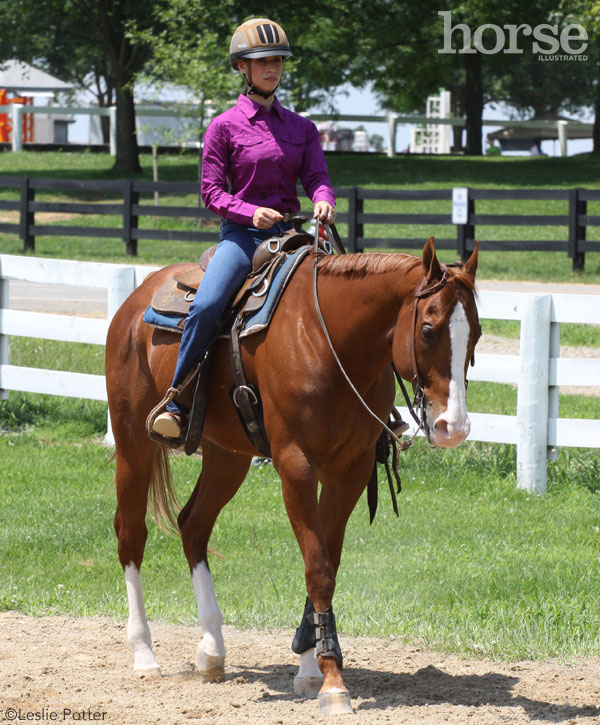
Western riding

Hands-On

The rider’s hand position is of vital importance. In a moment of frustration, some riders lower their hands toward their thighs or knees. This increases the snaffle’s pressure on the sensitive bars of the horse’s mouth, thereby giving the rider more leverage as they bump and pull the horse’s head down. Though such maneuvering may work temporarily, Hokana sees it as a bad habit for riders to develop. The end goal of training is to compete in a curb bit, and a rider can’t resort to such measures when riding one-handed in a bridle.

She teaches her riders, from the very beginning, to always ride with their hands in the correct position, so that the pull of their hands is the same in the snaffle as it will be later in the curb.

“I ride with my hands close to the saddle horn, with my pull directed toward my hips or waist, in an upward and backward motion. This closely simulates the rein position in the bridle, which again is my end goal.”

With her hands in this correct position, Hokana finds it easier to add neckrein cues while still in the snaffle because she’s better able to make rein contact with the withers and neck.

The Transition

When she believes her horses are ready to move on in their training, she allows them a transition period before going into a curb bit.

“When I graduate from the snaffle, I use an intermediate bit called a Tom Thumb snaffle. This bit is a broken-mouthpiece snaffle with shanks and a curb strap or chain.” Hokana believes that the Tom Thumb is a mild, nonintimidating bit that can acquaint the young horse to the different feel and leverage of a curb bit.

With a curb, “the horse will feel a tightening on their jaw from the chin strap. And depending on how high the port is on the curb, the horse might feel pressure in their mouth or on the roof of their mouth.” All of this is new to the horse, and Hokana proceeds slowly, repeating her basic exercises. When graduation day comes andshe deems the horse prepared for a true curb bit, she often starts with a grazer-style curb bit, one that’s lightweight and mild with a low port.

When she rides the horse in the curb, she’s very careful not to scare the horse by picking up the reins too quickly, as she asks him to give or yield to her hand. As riders, “we need to remember to use our hands accordingly,” Hokana cautions, reminding that, “the Tom Thumb will be more severe than the snaffle bit, and the curb bit will be move severe than the Tom Thumb.” She feels that being kind and patient will pay off in the long run. “I’ve seen horses that never, ever were confident or good bridle horses, and I feel like it was probably from how they were started in the bridle. Possibly they were scared early on.”

One of the exercises Hokana works on as her horses adapt to the curb is her “pick up,” which is how she picks up the reins, making light contact with the horse’s mouth.

“This builds the foundation for how well the horse will take the bridle. When I pick up on the reins and connect with the horse’s jaw and mouth, I want the horse to ‘give’ right away by flexing at the poll and dropping his head.” This is practiced at all gaits and at a standstill.

“I will ride one-handed, just like I would in the show-ring, and I’ll pick up my reins with my elbow down and my forearm up, until I connect with my horse’s mouth.”

If at first the horse doesn’t yield to the light pressure, Hokana moves on to step two, which could be to push the horse forward with some leg pressure and bump a little harder on the reins. But she always remains soft and patient, and teaches the horse that every time he feels her hand he is to give in response, and she immediately rewards him by softening the reins.

Hokana acknowledges that graduating to a curb bit takes time. “I might regress a little my first few rides in a bridle, but that’s why it’s important to ride a horse a lot in a bridle and not just plop it on them and show them when they’re not accustomed to it.”

She often finds that young horses have to be helped some as they transfer movements they learned in a snaffle to a curb bit. For example, a horse may not neck rein quite as readily in a curb as he did while in the snaffle.

If this occurs, Hokana helps reinforce the neck-rein cue by sliding her free hand down the asking rein, close to the withers, increasing her leverage position and adding a touch of a direct rein. But she immediately returns to holding the reins in one hand as soon as the horse responds. Since it may take up to six months for a young horse to comfortably accept and trust the curb bridle, Hokana urges riders to go slowly and be patient.

Warning signs of a horse that has been moved too quickly into the curb include one that gapes or opens his mouth, or overbridles, dropping behind the bit. Such habits can indicate that the horse is nervous about working in the curb or fears pain from his mouth being handled too roughly.

“There are horses that have ‘busy mouths.’ Their mouths may be shaped differently, they might have a little problem we don’t know about, and it may have nothing to do with training. But most of the time,” Hokana says. “It’s a nervous symptom of an irritated or uncomfortable horse.” Worse yet, a horse with a fidgety mouth or one that is over-bridled might be mentally preparing for a sudden painful jerk on the reins from an insensitive or frustrated rider.

Even after a horse is well-broke to a curb bridle, Hokana often returns to schooling in a snaffle. This keeps the horse from becoming dull to the curb, and rather than then moving on to an even tougher bit or one with a higher port, she can attack any problem areas in the snaffle, going back to basics in a mild bit so that the horse remains sensitive and responsive when returned to the curb. This philosophy of patience and an adherence to the basics help make Dana Hokana an excellent schoolmaster to her young equine students.

Further Reading
Neck Reining Made Simple
Steer Clear of Neck Reining Problems

Riding Off Into the Sunset Years

42

Trail ridingMy old grey mare just wasn’t what she used to be. At 28, Ginger’s lip and back had begun to droop. She was overweight. When I took her out, she groaned and took mincing little steps. She had been a delightful riding partner because of her calmness and her willing nature. But, past her prime, she seemed ready for retirement. I put her out to pasture.

Sound like your “mature” horse? Have you been considering a retirement plan for your old campaigner or trail buddy? Well, before you decide to send him off to Leisure World, listen to this. Some time later, I was reading about the positive effects of exercise on people who are aging and I’d been on two rides where the horses were older than my own Ginger. Both animals still had good conformation, were spirited and extremely happy. They had a purpose and they were active. As I looked at these two energetic horses, I thought, if people 50 and older can improve their physical performance, why can’t horses? So, with the thought of rejuvenating Ginger, I began to research the possibilities.

I found good news for Ginger and for your older horse, too. Dr. Karyn Malinowski, equine extension specialist at Rutger’s, the State University of New Jersey, and older-horse expert, says many horses continue to be active well beyond the age of 20. But to keep them active as their body condition, muscle tone and general well-being start to decline, Dr. Malinowski says, “You’ve got to change your older horse’s diet and lifestyle.” With that advice, I went to trainer Kim Sullivan, a graduate of University of California at Davis and former member of the Davis equestrian team, to learn what I could do.

Equine Checkup

Kim said the first step was to have Ginger evaluated by both my veterinarian and farrier. Once we knew Ginger’s limitations, we could set realistic goals and make modifications to our exercises that would allow her aging joints, bones and muscles to ease back into activity.

My vet, Dr. Jim Garfinkel, looked at Ginger’s overall condition and soundness, her respiratory and musculoskeletal systems, and found no significant problems except for her weight. Then he focused on her eyes, ears and mouth, and in particular her teeth, since decayed teeth and sharp points that grow on the older horse’s back molars can cause improper digestion. Ginger’s sight, hearing and teeth were good, but I was advised to watch for excessive salivating, which is an early sign of teeth problems. I then went to my farrier with Dr. Garfinkel’s diagnosis. Certified farrier Rick Williams pointed out that proper trimming and shoes are extremely important when starting any horse on an exercise routine because of the increased stress on the animal’s legs and hooves. But in the older horse, preventive shoeing and trimming can help minimize concussive shock, aid flexion and extension, and alleviate lameness or unevenness of gait due to arthritis or degenerative joint disease.

Ginger’s problem was flexion and extension, so Rick trimmed her toes as short as possible and applied rounded shoes. This, he explained, would cause her to break over easier in her stride and would lessen the tension on her stiff tendons and joints. Later, if needed, he said we could apply pads between shoe and hoof or use a coated shoe to minimize concussive shock to her legs and hooves.

At this point I realized Ginger probably could indeed be rejuvenated. Physically she was sound. And you may discover the same about your horse once you’ve spoken with your own veterinarian and farrier. But another aspect you’ll need to look at before beginning any “youth-enhancing” program is diet.

Senior Specials

According to Dr. Peter Gibbs of Texas A&M University, the large-intestinal function alters as a horse gets older. This creates an increased need for things like higher-quality protein, alternative forms of roughage and supplemental vitamin B. The commercially processed senior feeds are good for the older horse who cannot maintain weight, either because he’s unable to properly chew his feed or because his body is less efficient at utilizing the nutrients. On the other hand, lack of exercise and a diet rich in the wrong things can make older horses — just like people — put on unwanted pounds.

Excess weight is particularly bad for the older horse. It causes additional stress to old legs and joints as well as the cardiovascular system. This all translated into some major dietary changes for my overweight Ginger. Also, I’d been feeding her straight alfalfa, which taxes the liver and kidneys. Dr. Malinowski fed a ration of half grass/half alfalfa with a supplement of energy-dense grains plus a vitamin supplement to her study group of older mares. Gradually, over a 7- to 10-day period, I switched Ginger over to a similar diet and added a daily dose of 1 to 2 ounces of vegetable oil to improve her skin and coat. Within a short time, Ginger began to slim down and her coat took on an improved sheen.

On the other hand, you may find your once easy-keeper no longer seems to hold flesh. His intestines may have lost the capability to fully extract the calories and nutrients from his feed. You’ll need to work with your vet to ensure your senior gets a diet that supplies enough energy and nutrients without overloading him on harmful, unnecessary ingredients.

Conditioning

Finally, Ginger and I were ready to begin conditioning. Conditioning is the key to achieving and maintaining body tone and the appearance of youth, according to the UCD Book of Horses (Harper Collins, 1996). To start our conditioning program, my trainer advised me to get organized. This meant, for consistency, that I needed to develop a checklist to track Ginger’s progress. Because of her age, I was going to need to increase warm-up times, decrease the intensity level and duration of exercise periods, and increase the cool-down times.

We started each workout with stretching exercises to increase flexibility and range of motion and reduce the risk of injury. If Ginger was particularly stiff or sore, I massaged her first and warmed her up by briskly walking her for about 10 minutes to get blood to her muscles and loosen her joints.

Then we began our exercise, using long, slow periods of steady work to create a foundation of good muscle and tone and to condition tendons and ligaments. We worked through four stages over several months. In the first stage, we started slow. We walked 2 to 4 miles at a strong, steady pace, on level ground, completing our walk in 30 to 45 minutes. Because Ginger had been inactive, we stayed at this stage for more than 6 weeks, until she was able to perform the task comfortably. Gradually we increased our mileage and eventually worked up to stage two, walking hills in combination with our flat walking. When Ginger was able to do that comfortably, we added stage three, trotting at short intervals on soft, flat ground. When Ginger was able to trot for extended periods on flat ground, we moved onto the final stage, trotting hills.

In her book The Older Horse (Breakthrough Publishing Inc., 1986), Eleanor Kellon, DVM, says, “Keep in mind that the goal of interval training is to get the maximum benefit with the minimum stress on the horse.” So, during our training, I had to constantly be alert for pain that Ginger might be feeling. Pain might indicate I was moving her too quickly or that there might be undetected physical problems.

At this point, we work out only two to three days each week. The key to our progress has been to take it slowly and avoid shortcuts — whenever I tried to push Ginger too fast, we paid with lameness.

Ginger has begun to step out with renewed vigor since we have been doing our conditioning I think she’s feeling good, and that has been significantly helped by the final step:

Massage

The use of massage, just once a week, as part of your conditioning program can help your older horse by promoting healthy muscles. According to Nola, massaging before and after workouts improves circulation, helps keep muscles toned and brings nutrition into the muscles.

There are three basic massage techniques: effleurage, compression and direct pressure. To perform effleurage, you slide an open, flat hand over the horse’s skin and down the length of the muscle, feeling for tension, tightness and abnormalities. You follow this with compression, in which you target problem areas you found during effleurage. To compress, you press into the muscle and rotate the hand in a half-circle toward the horse’s tail with a rhythmic, pumping action. Finally you apply direct pressure to extremely knotted tissue using a thumb or finger pad. You push into the knot, hold the pressure for 30 seconds, release; repeat for 40 seconds, release; and repeat and hold for 60 seconds.

When massaging, you need to be constantly aware of your horse’s reaction. If a particular technique seems unduly painful, you need to back off. Also, you need to avoid hot areas (which might be infected), bony areas and swollen areas.

Massage has helped to loosen Ginger’s tight muscles and knotted tissue, and prevented muscle strains and tears as well as the loss of range of motion. In addition, through massage, I found I am immediately aware when muscles and joints are stressed and I can take preventive steps toward healing them before they become inflamed.

Rejuvenating your horse is a long-term proposition. It requires patience, awareness and commitment. But as Ginger and I continue working out and as we adventure farther and farther, with increased energy, I have no doubt it’s worth the effort. She has begun to kick up her heels in the pasture again, as she used to when she was young. She seems to feel better and enjoy life. I can feel it in her step. I hear it in her nicker. And I feel closer to her than ever before. I have rediscovered a partner with whom I can keep riding into the sunset.

Further Reading
Ten Ways to Add Years to Your Senior’s Life
Five Tips for Buying an Older Horse

When Horses Act Dangerously

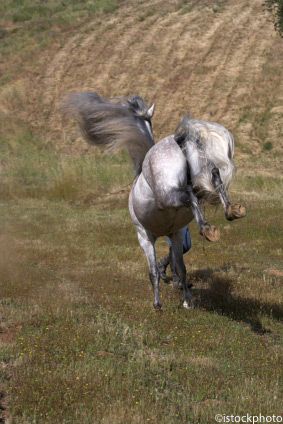
Bucking horseWith Nicholas Evans’ best-selling novel The Horse Whisperer and Robert Redford’s movie adaptation, “rogue” horses like the fictitious Pilgrim got quite a bit of attention. Pilgrim was described as a horse with such overwhelming psychological problems that it was dangerous to approach him for fear of attack. While there aren’t many real horses with such “in-your-face” aggressive tendencies, a few such creatures do exist, although generally they’re not created by a run-in with a semi truck. The point is that rogue is a label typically used to describe a horse with significant and potentially dangerous behavior problems, such as deliberate and consistent charging, kicking and biting on the ground, or intractable bucking, rearing or bolting while under saddle. What this all boils down to is that a rogue horse is a serious threat to human safety. And unfortunately, these horses often end up with novices in search of affordable horses, who don’t yet know how to evaluate a horse’s training. What can you do if you find yourself faced with this kind of an equine nightmare?

The good news for us is that domestic horses have been bred for centuries to be tractable and trainable. So, while a few cases of pathologic behavior do occur naturally, the vast majority of these rogue horses are created, not born.

Causes of Bad Horse Behavior

Just like in humans, there can be physiologic abnormalities associated with deranged behavior such as hormonal imbalances or brain and nervous system defects. Some of these problems tend to occur with greater frequency in horses that are the products of severely restricted gene pools (inbreeding), or in horses that develop tumors in hormone-producing tissues such as the ovaries.

High levels of naturally occurring reproduction hormones can make a few horses nearly impossible to deal with. This can be a particularly serious problem with certain stallions, since for them aggressive behavior serves many adaptive purposes in nature. Successful stallions utilize aggressive behavior to defend their harems against predators, to battle against other stallions for control of mares and to drive their juvenile offspring out of the harem (a natural defense against inbreeding). Likewise, hormonal signals can distract certain mares in heat to the point of aggressiveness and make others fiercely protective of their offspring.

How Humans Create Bad Behavior in Horses

But the vast majority of rogue behavior is not a consequence of nature. Instead, it results from severe mistreatment, the lack of human handling, or by realizing that bad behavior causes good things to happen—in other words, bad training. Abusive treatment brings out a horse’s fight-or-flight tendencies, so many horses cope by behaving desperately and often aggressively. Similarly, extreme fear in a “wild” horse unaccustomed to human handling can lead to desperate and dangerous behavior.

Finally, if a horse does something dangerous and finds it gets him out of an aversive situation (such as work), he may be inclined to try it again. As with people and in particular children, if inappropriate behavior has a rewarding outcome, it will stay in the animal’s behavioral repertoire. For example, as the director of the riding program at a children’s summer camp some time ago, I was responsible for the care and maintenance of the 50-horse riding string. Many of these horses were leased out to private homes over the winter, and I had to collect them and return them to the camp in preparation for the summer season. Frosty was one such horse who was being maintained by a family at a boarding stable a few miles away. There were beautiful riding trails connecting that boarding stable and the summer camp, so I had someone drop me off at the barn so I could ride the horse back to camp. Little did I know my charge had learned a few nasty tricks to avoid working for a living and was known as something of a terrorist around the barn.

Thinking I was dealing with a child’s horse who had been used in lessons all winter, I climbed on bareback and hit the trails. Ten or 15 minutes went by and all seemed well, when suddenly and without warning he spun out from under me and galloped back to the boarding stable. I hobbled back to the barn on foot and found him in his stall contentedly munching hay. I brought him out and climbed back on. Resenting this annoying interruption of the plan for the day, he pulled the old spinning trick and within 10 minutes had again returned to his meal. I hit the ground a little harder this time and ended up with a forehead that looked a bit like Gumby’s bump. Now I knew I was dealing with a horse who had learned to use nasty tricks to get his way, so I developed a plan to curb his self-rewarding behavior with some training. Unfortunately, his conditioned response had become ingrained and he proceeded to try his usual tricks the next time I rode him. This time, however, he did not achieve the desired effect of unloading me. He soon realized his reward was not forthcoming and stopped the inappropriate behavior.

Retraining the Rogue Horse

Unless there’s an underlying physical problem, most rogue behavior can eventually be turned around with patience and cautious, consistent training at a pace determined by the horse’s comfort level. As John Lyons states, proper training should leave the horse calmer at the end of a lesson than he was at the beginning of it. Recognize that in certain cases, reforming a rogue may be a dangerous undertaking best left to a calm, experienced and patient professional.

So what is the best course of action to take if your horse’s behavior qualifies him as a rogue? The first step is to rule out any physical causes for the behavior. This can best be achieved through a thorough examination by a veterinarian. The cause of many behavior problems can be identified by careful palpation and blood screening tests. Once the source of the problem is found, there may be a medical solution that your veterinarian can bring to your attention. If the cause of the dangerous behavior is related to reproductive hormones, the solution may be as simple as castration for non-breeding stallions or hormone therapy for mares.

If you’ve ruled out physiologic problems and you’re still left with a dangerous horse, try to figure out the cause. Can you uncover a history of abuse in your horse’s past? Has the horse been neglected? Was he a victim of training shortcuts and brought along too fast? Understanding the nature of the problem can help you form a successful training program to solve it. Honestly assess your own capabilities. Do you have the patience, knowledge base, physical ability and time to solve the problem yourself? If not, seek out a reputable trainer with the experience your horse needs. Don’t sell the horse until the problem is resolved, unless the buyer is completely aware of the horse’s problems and has both the experience and the commitment to work them through. Remember, “problem” horses usually get passed from hand to hand without getting fixed, ending up mistreated, put down or worse—killing someone.

It may be too late to change the events of a horse’s past, but you can certainly influence his future. The behavior you see today does not have to continue. Bad habits can be changed, training mistakes can be resolved. Believe in the ability of your horse to adapt and reform. Horses, like humans, are never too old to learn, and generally, unlike some humans, horses seem more willing to forgive.

Further Reading
Is Your Horse Unsafe
Reasons for Behavior Problems
Training Right the First Time

0FansLike
0SubscribersSubscribe
We use cookies to help personalize content, tailor and measure ads, and provide a safer experience. By navigating the site, you agree to the use of cookies to collect information. Read our Cookie Policy.
OK