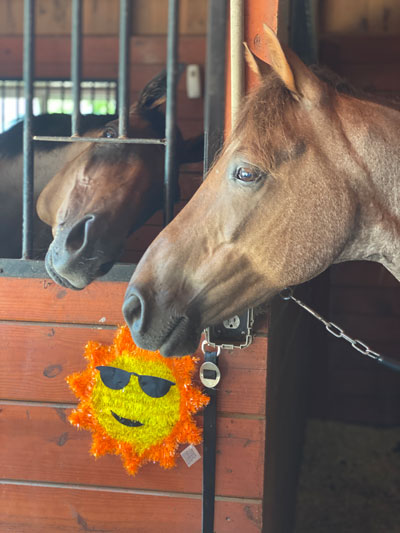
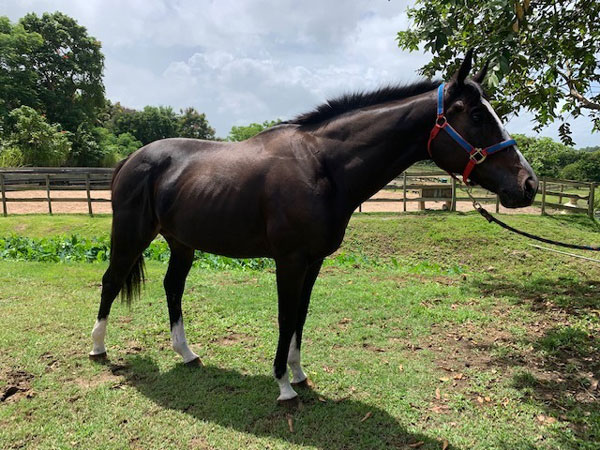
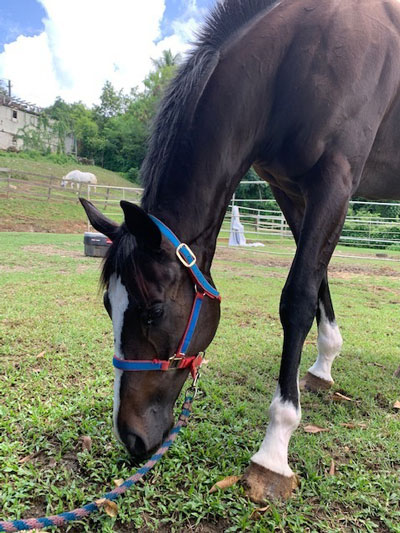
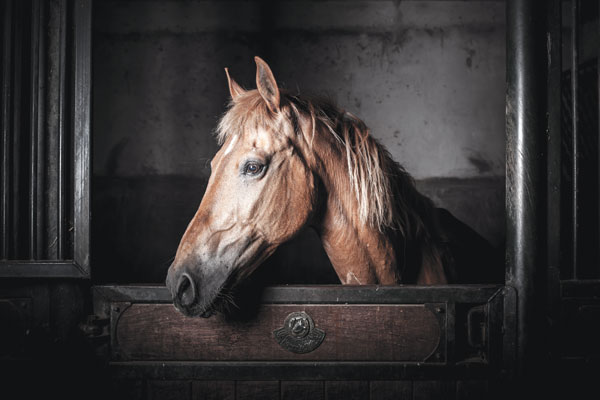
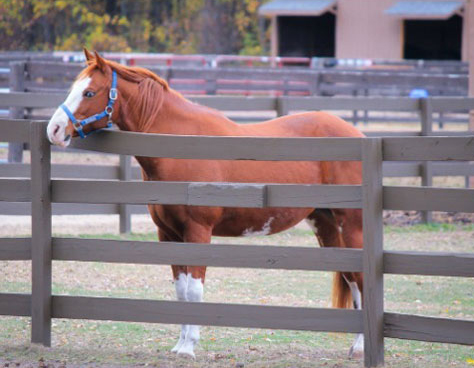
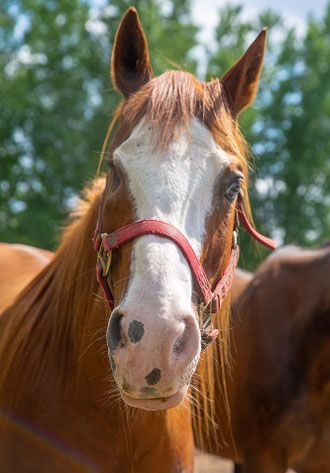
If you have a horse with anhidrosis, it’s advisable to stall your horse during the day, away from the heat and sun. Photo by Heather Wallace
When I bought my pony, Ferrous, the former owner disclosed that he had trouble sweating, but a supplement was all he needed to be healthy in the summer. In truth, I quickly realized how anhidrosis, the inability to sweat properly, affected my horse year-round despite supplements. I took him out of the show ring, kept exercise to a minimum, and largely took the summers off to keep him comfortable and healthy.
What is Anhidrosis?
Anhidrosis is a condition characterized by lack of perspiration or sweat. This is a potentially dangerous condition that, while rare, is seen often in hot or humid climates regardless of breed or gender. Working horses must sweat to regulate their body temperature adequately, so the inability to cool themselves down by sweating can greatly affect their health, resulting in heat stroke, dehydration and in some cases, death.
Signs of Anhidrosis
Generally, anhidrosis is diagnosed through clinical signs, although there are tests your veterinarian can perform to make an official diagnosis. Owners and trainers are the line of first defense as they are the ones untacking after exercise. While most horses may be quite lathered after work, a horse with anhidrosis or “no sweat” may have limited sweat marks under saddle that gradually decrease over time. For example, in spring my pony often shows sweat marks under the girth but not under the saddle pad. As the weather continues to warm and especially during heat waves, I begin to see zero sweat patterns at all. Additional clinical signs include panting or heaving, increased heart rate, dehydration of the skin, or increased body temperature over 104 degrees.
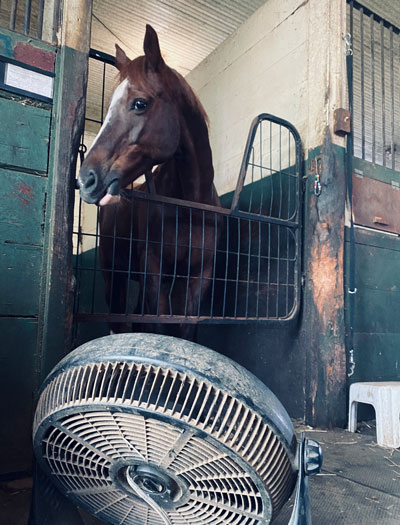
Provide access to fans or misters to keep your anhidrotic horse cool. Photo by Heather Wallace
How to Care for a Horse with No Sweat
The reality of anhidrosis is complicated but should not necessarily be something to prevent you from purchasing a horse. While many animals do well on a daily supplement, often they do not do enough to achieve the perspiration that is needed to properly regulate body temperature. Horses with mild signs may take the supplement during warmer months while animals that do not sweat well regardless of temperature should include this in their feed year-round. In addition to diet and nutrition, there are a few other things horse owners can do to keep a horse comfortable.
Stall your horse during the day, away from the heat and sun.
Provide access to fans or misters to keep him cool.
Hose down your horse during the hottest part of the day and allow him to naturally evaporate the water in his stall (don’t remove excess water!).
Feed electrolytes or salt mixtures.
Give him a lot of fresh water. I’ve recently found Hydration Hay by Forage Solutions, which is put in a bucket of water and expands to encourage them to eat and drink.
Avoid exercise during hot, summer months. If you intend to compete during that time, an anhidrotic horse may not be the choice for you.
Dr. Ian Baines, DVM, who is on the academic staff at the School of Veterinary Medicine, University of Namibia, and is a FEI 4* endurance vet, has dealt with two cases during his career, and both showed exercise intolerance and overheating after only moderate exercise.
“Namibia has a relatively hot and dry climate (low humidity), so symptoms in anhidrotic horses are easily exacerbated,” he says. “No treatment was attempted. Literature tells us most medical treatment is experimental at best and gives poor results. Managing these cases by exercising early in the morning, using cold water sprayers and regular hosing down proved futile and both cases retired from competition. I have reports of some pretty positive outcomes from regular acupuncture, which may be something worth investigating.”
While cases are relatively rare, the eastern United States and the southeastern United States are high in humidity and cases tend to be higher. If you see signs of limited sweating, please consult your veterinarian for a diagnosis.
I constantly worry about my pony’s comfort and health. While my friends go on hunter paces and long trail rides, we cannot join because it’s dangerous for us even during the fall because of his severe signs. We have limitations that other horses don’t, but I wouldn’t trade him for the world. I’m grateful that I can give Ferrous what he needs to live his most comfortable life. I haven’t had to move us to the Arctic yet, but I certainly won’t rule out the possibility.
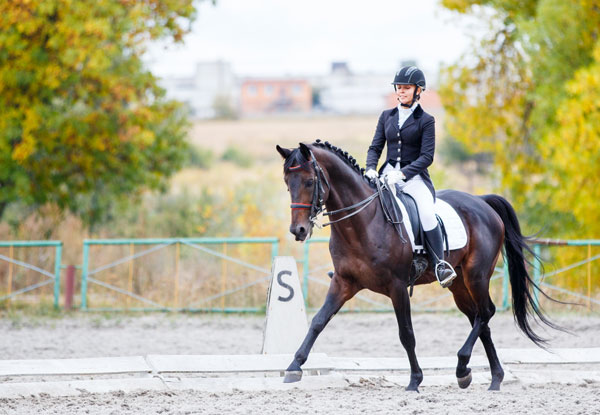
Maybe you’ve seen dressage in person or in photos and video. Perhaps you’ve even dabbled in it yourself with some lessons or a bit of experimentation guided by an online tutorial or a magazine article. Either way, you’re drawn to the grace and beauty of a horse and rider dancing together in harmony, and you wonder how they got there, and if you and your own horse could ever achieve something similar. And it’s quite possible that you can, but there are some must-haves—and you might be surprised to learn that they don’t include an expensive imported warmblood or the latest blinged-out bridle. Read on and let’s see if you and your horse have what it takes to advance in the discipline of dressage!
Three good—or at least decent—gaits. Note that I’m talking about traditional dressage here, not gaited or Western dressage or other offshoots, which are a subject for another day. The judging of dressage starts with—above all else—a correct walk, trot, and canter.What does that mean? The gaits are pure and in a clear rhythm: four-beat walk, two-beat trot, three-beat canter. There are umpteen reasons that a gait may lose its purity, ranging from lameness to tension to incorrect riding. A horse with a persistent hitch in its gitalong is going to struggle in dressage, and possibly not advance, unless that issue is successfully addressed.
Core strength and body control. These incorporate the concept of “independent seat and hands,” and refer to a rider whose balance is good enough not to rely on the reins to stay in the saddle. The sitting trot, which comes into every dressage rider’s life at some point, does not require sheer, brute strength. What it requires is enough tone in the core—the part of your body from waist to knees—to “stay with” the horse’s motion, and enough overall strength and suppleness to do things like allow your hips to move in time with your horse’s hind legs, or to simultaneously apply the touch of a calf, close a thigh, and give a squeeze with one rein while relaxing the opposite wrist. Yeah, it’s kind of like patting your head and rubbing your stomach at the same time. Body control. Core strength. Alignment. Flexibility. Symmetry. A tall order! No wonder these are things most dressage riders work on, pretty much forever.
A tolerance for repetition. I had an event horse—an off-the-track Thoroughbred—who really didn’t like dressage. He actually had talent for it, but he got bored with ring work and could easily have become sour. He needed the variety of jumping and hacking to make the dressage work palatable. My current mount is a mouse in a horse’s body. He is fearful, hates change, and gets security from knowing exactly what is expected of him. The clarity and repetition of dressage are right up his psychological alley. This is not to say that only insecure horses like dressage, but one that’s prone to becoming ring-sour may not enjoy the career. A good dressage horse also has to cede control to the rider, which is difficult for some independent-minded equine personalities to do.zLikewise, riders who are diehard adrenaline junkies may prefer jumping or some other type of “faster/higher/stronger” sport. Equestrian disciplines are called disciplines for a reason, in that they require patience, practice, and attention to detail in order to improve. A rider whose main objective in riding dressage is to perform “tricks,” like flying changes, isn’t really in it for the right reasons, which brings us to our next point.
A desire to deepen your relationship with your horse. Sound corny? Maybe it is, but when I was a teenager riding hunters and jumpers, I was getting tired of the same old “flatting” and schooling. Riding seemed sort of mechanical, and the horse didn’t feel much like a partner.Then I took my first dressage lesson. My instructor taught me how to feel the movements of my horse’s four legs and how to use my body to influence his movements. Eventually, I began to feel my horse’s entire body change in response to my aids. To feel him make a smooth transition from nothing more than a shift of my weight, or to glide into a floaty, big-strided lengthened trot—those were sensations I’d never felt on the back of a horse.
Those amazing dressage moments are intoxicating and addictive—and sometimes maddeningly elusive! But most dressage enthusiasts will tell you that even a glimmer of that kind of harmony is so exciting that they’ll happily keep at it, diligently practicing their 20-meter circles and their canter transitions, searching for the next moment when they feel themselves and their horse feeling and moving as one, and that dedication will also help one advance in the sport of dressage.
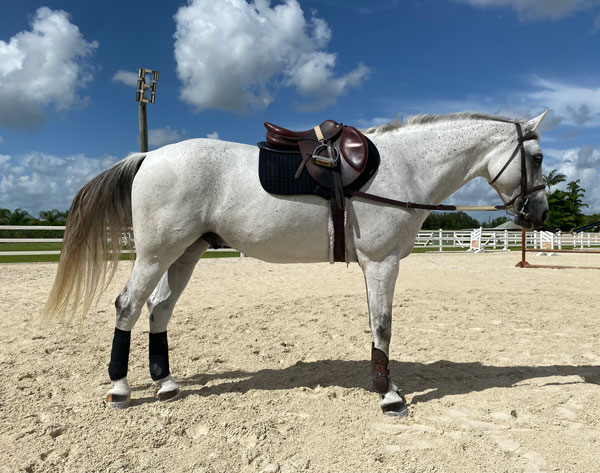
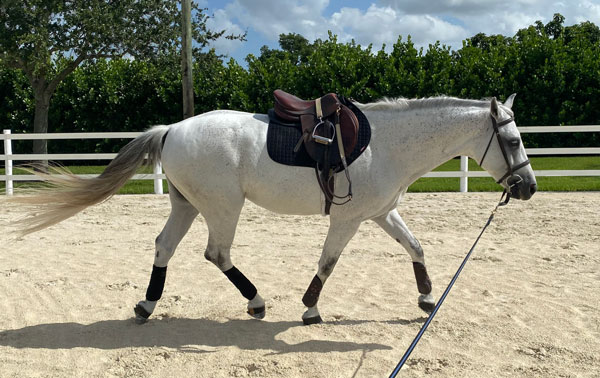
Figure 1: Properly adjusted side reins. Photo by Samantha Torcise
Side reins can be extremely beneficial, when used correctly, to improve a horse’s understanding of rein contact, as well as help him to correctly develop his topline. Of course, the key phrase here is “used correctly.”
Why side reins? The simplest answer is: because they are not a leverage tool. They are to be used with a snaffle bit, and the side reins I select all have a stretchy element to them, whether it be an elastic insert, rubber donut, etc. Because they are used when longeing, once adjusted there is little to no human error involved, which is why it also improves the horse’s learning experience. I begin working a horse in side reins when he is having trouble understanding contact. It could be because the rider is still learning and is inconsistent, or the horse just is generally tense, worried, or trying to anticipate the next request.
How to Use Side Reins with Your Horse
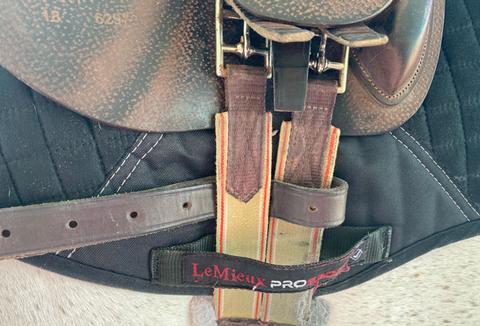
Side reins can be used with a horse that is tacked up with a saddle, or they can be connected to a longeing surcingle. I use my side reins with my regular tack set-up by opening the buckled loop at the end of the side rein, running it underneath both girth buckles/end straps, and then returning it over the girth buckle closer to the horse’s tail and under the one closer to the horse’s nose (see Figure 2 below). As you can see this works best with a girth with elastic at both ends.
Figure 2: Open the buckled loop at the end of the side rein, run it underneath both girth buckles/end straps, and then return it over the girth buckle closer to the horse’s tail and under the one closer to the horse’s nose. Photo by Samantha Torcise
When buckling the side rein after securing it through the girth, you will be determining the length of the side rein. This is one of the most important moments. Take the snap end of the side rein towards the horse’s head while they have a relaxed headset. Their head shouldn’t be high and alert nor tucked down towards their chest, think of the head carriage they have when hanging out on the crossties or in their stall. When the snap reaches the horse’s mouth, that is the proper starting adjustment. If it is their first time in side reins, you can even loosen it an extra hole.
Starting too loose just means you will need to stop the horse and tighten it, while too tight could result in an accident or bad experience for the horse. Once you have found the correct length, clip the side rein to the D-ring of the saddle or a higher ring on the longeing surcingle. Repeat on the other side, while ensuring both side reins are adjusted to the same hole on both sides (see Figure 1 above for properly adjusted side reins).
Starting with Side Reins
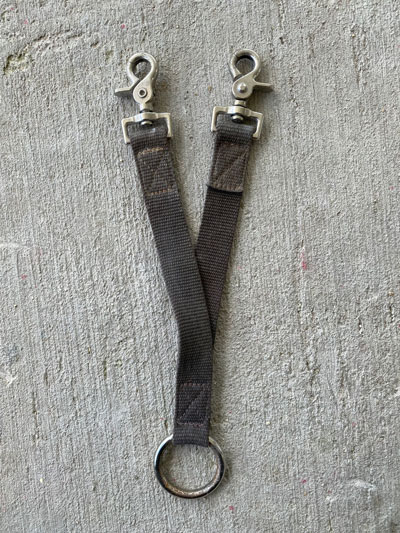
Figure 3: Bit attachment for a longe line. Photo by Samantha Torcise
When longeing with a bridle, I prefer to use a bit attachment (see Figure 3) with the longe line while the side reins are clipped out of the way on the saddle (see Figure 4 below). Allow your horse to longe normally for 5 minutes or so, going both ways to stretch and get any excitement or bucks out.
After that, bring him to a halt and clip the side reins to either side of the bit. Encourage him to walk on with a driving aid, such as the voice, whip, hand, or end of the longe line. You do not want to pull him forward and create tension between a forward pull and the side reins, which are holding backwards.
Once the horse is walking well, ask for the trot. Many times, this is when horses will object to the side reins for the first time. For example, a horse that is used to raising his head during every upwards gait transition will be surprised to find out that is no longer an option. Because of this, be ready for your horse to have a reaction in which he moves backwards or raises his head. Then immediately cue him forward. By doing this, you are showing him that going forward and relaxing through the topline is the answer for relief of pressure. This is why it is so important for the side reins to be on the looser side, so that the possible negative reaction doesn’t turn into more than his head shooting up and a few backwards steps.
Attach the side reins to the saddle during longing so they are out of the way. Photo by Samantha Torcise
As your horse figures out the side reins, continue to longe normally for 10-15 minutes. Be sure your horse continues to carry impulsion, pushing from behind and using his neck to fill out the side reins in a nice arc. You may find you need to tighten the side reins a hole or two, and/or you may choose to tighten the inside side rein one hole more than the outside in order to encourage an inside bend. Meanwhile, watch for signs of fatigue, such as the horse over flexing in the poll and dropping their poll below the withers. As soon as this happens, it is time to stop for the day, even if it has only been five minutes.
Incorporate this into your horse’s training program and you will see big differences in their understanding of the contact as well as their physical appearance. Just like anything, there can be too much of a good thing. For weaker or green horses short sessions once or twice a week are helpful, with more experienced, stronger horses only needing biweekly or monthly reminders.
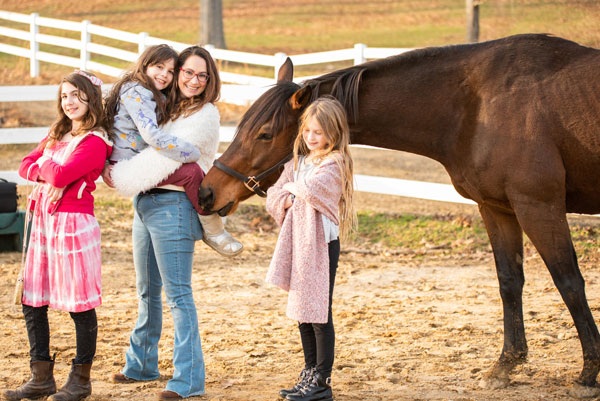
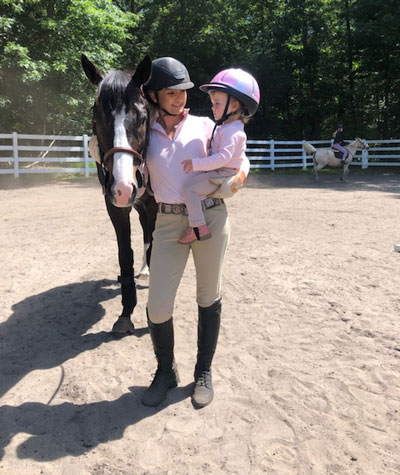
Author Heather Wallace at the barn with her three daughters. Photo by Jesse Conway Photography
As mothers, we can find it difficult to balance work and family. We often put everyone else’s needs first and think about ourselves last. But when those mothers are equestrians, the passion is still there, and it’s one more thing to juggle. It can seem impossible to get the time we need at the barn. So, how can we as equestrian moms manage to balance it all? Very carefully.
Some equestrian moms take time off from horseback riding to have children, others start spending time with horses as a way to have time for themselves, while others spend quality time with their children and horses together. Regardless of the “why” you are involved with horses for a mother, the “how” is more important.
Set Aside Time and Stick To It
There are only so many hours in the day. When do you have a little quiet time, if any? Set aside time in the morning before the house wakes or in the evenings when you have spousal support or a play date organized.
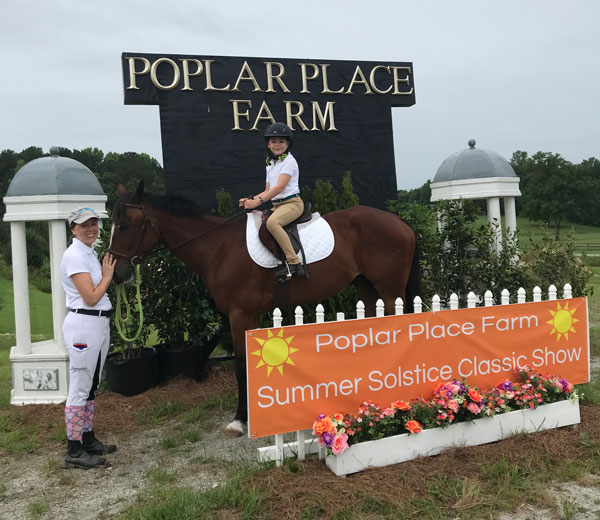
Equestrian mom and business owner Connie DeMaio and her daughter at the barn. Photo Courtesy Connie DeMaio
Connie DeMaio, co-founder of Redingote Equestrian, has learned the hard way to adjust expectations. “I am a mom, wife, business owner, realtor, horse trainer, and my home is also a small boarding facility,” she says. “My daughter Rose is now 3-years old. I struggle to find time to ride my horse but learned if I want to enjoy time in the saddle it is up to me to make it work. I used to squeeze in riding time while she napped, but now she doesn’t nap anymore! Recently, I have been waking up at 5 a.m. to ride, which has been great! I feel like my day is much more productive. But who knows how long that’ll last? It’s all up to my daughter’s schedule.”
Many of us can relate. When we figure it out, suddenly something shifts, and we have to change our routine. Finding the time to be alone with our horses is one of the most difficult things. So, what happens if we have to bring our kids with us?
Find a Child-friendly Barn
The barn environment is incredibly important for an equestrian mom. My first barn was so child-friendly I was encouraged to bring my daughters with me to play with others. When I moved my pony, I was told children were welcome when it was not really the case. I found out the hard way that bringing them with me created tension and disapproval from the barn owner. So, we moved facilities again. My children are a big part of my life, and they are all horse girls. It was important they felt welcome.
It’s a given that if you are an equestrian with children that you would want them to be accepted wherever you need to bring them, and the barn is no different.
“For us, the key was to find a kid-friendly barn with caring instructors and a supportive community around it,” said Amanda Bracewell Gallatin. “When I am riding, there is usually another child around for my daughter to play with in the field or barn.”
Amanda Gallatin and her daughter enjoying time together at a horse show. Photo Courtesy Amanda Gallatin
Look for a barn that teaches lessons and has a summer camp for kids, which is more open to young people and can mean having playmates. Although, parents can’t rely on there being other children to keep them distracted, and age-appropriate supervision is always advised. It’s important to note that many private farms or boarder-only facilities are often intended for adults.
Children should also learn the rules of the barn and to be safe at any equestrian facility. While I was a working student at my equestrian facility, my children learned that the barn owner and trainers were authority figures, and they were in charge. They also learned valuable horse sense.
“She is my special groom—brushing, applying fly spray, fetching tack,” says Gallatin about her daughter. “She also loves to play photographer and has gotten very good at taking pictures and videos of my ride that I can critique later.”
Get Your Children Involved
Including your child in your hobby can mean building horsemanship, empathy, and a strong work ethic while spending quality time with them. Yes, your focus is divided, but only while your children are young. Children can learn life skills and how to carry themselves in another setting away from home.
“I try to make it out to the barn for a bit every day, and I take my son with me,” says Leslie AJ Baumann, who is a graphic designer and author. “We do a lot of our school work there since it’s a fun setting. Then he enjoys some outdoor playtime and birdwatching in the pasture.
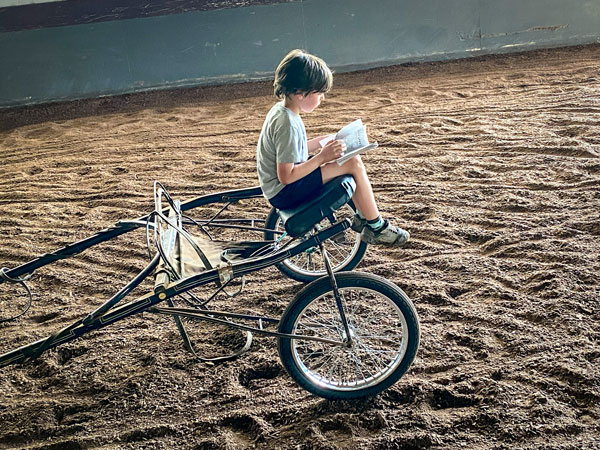
Lesley AJ Baumann’s son, Alex, quietly reading in the arena. Photo Courtesy Lesley AJ Baumann
“When I’m riding, I like for him to be in the arena with me,” she adds. “He keeps himself quietly entertained in a safe place. His current favorite activity for this time is to sit on the cart in the center of the arena while reading Captain Underpants books”.
Sit your child on the mounting block, hand them a camera to photograph you, or bring a favorite book of theirs. Don’t underestimate the power of time spent outdoors on their mental health. This can help them learn to sit quietly.
Remember, while it may be hard to balance work, family, and horses, it is not impossible to do that and be an equestrian and a mom. It just takes a little planning and a lot of patience. Soon your child will be growing up at the barn. Maybe they will be the future of the equestrian sport, or at least, learn valuable tools for adulthood. Most importantly, you get to spend time doing what you love!
Welcome to Horse Illustrated’s weekly installment of the My Right Horse Adoptable Horse of the Week, offered in partnership with The Right Horse. Paso is this week’s adoptable horse. Check back weekly for a new featured horse so you can find your #righthorse.
Paso is a stocky handsome chap. He is a Florida-bred with 47 starts that earned him $102,378 in his career. He came to Puerto Rico from Delaware Park racetrack in 2018. He last raced here in Puerto Rico on July 30, 2021, placing 10th. Paso was retired from racing with an old left front sesamoid fracture. Paso will be able to go on to be a low level pleasure riding horse. Could he be your #righthorse?
My Right Horse is the online adoption platform of The Right Horse Initiative, a collection of equine industry and welfare professionals and advocates working together to improve the lives of horses in transition. A program of the ASPCA, their goal is to massively increase horse adoption in the United States. To find more adoptable horses and foster horses, visit www.myrighthorse.org. To learn more about The Right Horse, a program of the ASPCA, visit www.therighthorse.org.
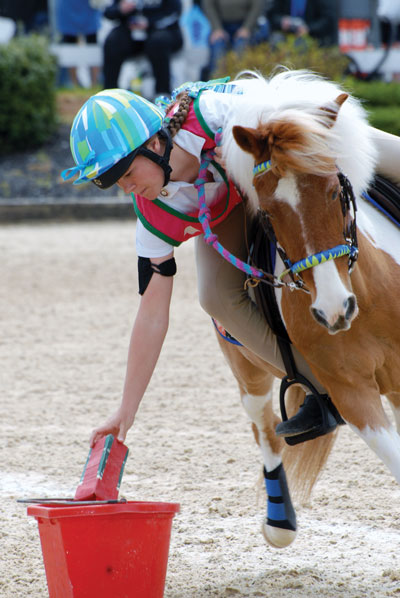
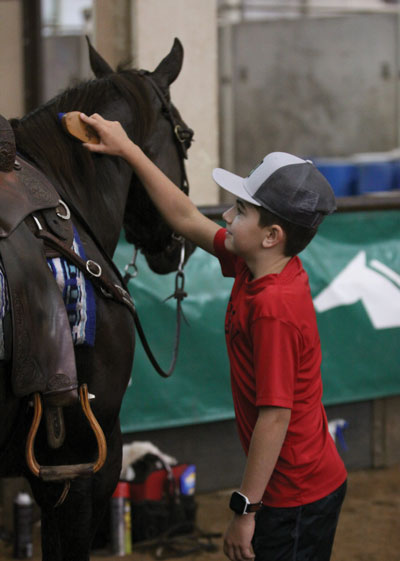
Nearly every breed and discipline organization in the United States has to address the issue of bringing youth back into equestrian sports.
Youth today face multiple pressures unique to this tech-friendly, ultra-digital generation: they are pressured to get the grades, play the sports, excel in multiple extracurricular activities, and then obtain scholarships, internships and good-paying jobs.
With all these pressures, it is no wonder that something as time-consuming as riding gets pushed to the wayside.
Unlike most team sports, where there’s a set practice time (usually right after school), riding generally exists on a more fluid schedule. Oftentimes getting to the farm, tacking up, riding or having a lesson, putting the horse away and driving home eats up multiple hours after the school day has ended. The shine comes off riding even more when parents find out there’s not a lot of scholarship money to be found for the college-bound equestrian.
As a result, many organizations are working diligently to draw kids into the equestrian fold, both on the back of a horse and in the professional realm.
Here’s what some of them are doing to ensure the future of equestrian activities.
4-H
4-H is America’s largest youth development organization; it has over 6 million members involved in everything from gardening and dog showing to creative writing and STEM.
The United States Eventing Association’s Young Riders program supports the sport of eventing for competitors 21 years of age and younger. Photo by Kate Lokey/Courtesy USEA
One of the first organizations many people think of when they think “horse club,” 4-H has a plethora of ag and equine-related projects that can be done by kids across the country. The organization even offers a “horseless horse project,” which allows youth to learn about horses without owning one, often a good segue into equine ownership for parents.
An added bonus? 4-H seeks to develop leadership, self-reliance and initiative, all traits that will serve young adults well, both inside and outside the riding arena. Find a local 4-H club by contacting your closest county extension agent.
United States Pony Clubs
Although show jumping, eventing and dressage are the most popular Pony Club sports, games and polocrosse offer extra excitement and fun. Photo Courtesy United States Pony Club, Inc.
Based off the model created by The Pony Club in England, United States Pony Clubs (USPC) teaches both riding and equine management to over 9,750 U.S. members. USPC focuses on education, safety, sportsmanship, stewardship and fun.
Pony Club participants should have their own horse or pony, or access to a horse or pony; “ratings” are awarded as members pass increasingly difficult riding and equine management tests.
Pony Club offers instruction in distance riding, dressage, driving, eventing, fox hunting, games, gymkhana, horse management, hunt seat equitation, polo, polocrosse, quiz (a knowledge-based competition), show jumping, tetrathlon, vaulting and western dressage.
Competition in some of these disciplines is available, as are educational opportunities throughout the year. To become a member of USPC, youth can join through their local Pony Club chapter or through a riding program that has been recognized by the USPC to administer the Pony Club program.
National FFA Organization
Formerly known as Future Farmers of America, the National FFA Organization is committed to agricultural education, offering students a path to achievement in leadership, personal growth and career success.
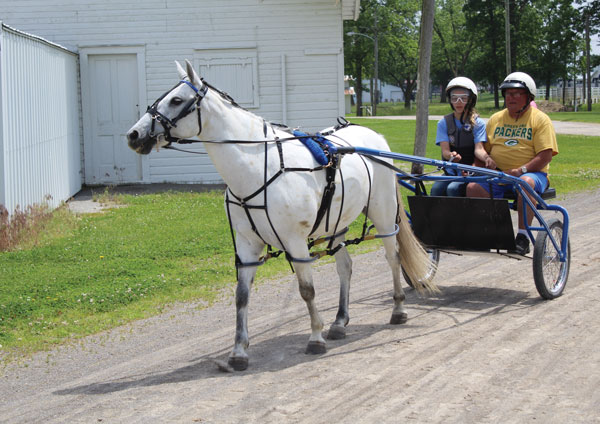
The Harness Horse Youth Foundation offers interactive learning experiences, scholarships and educational materials related to harness racing. Photo Courtesy Harness Horse Youth Foundation
FFA is for middle- and high-school students; the equine component focuses heavily on horse evaluation, where students learn to evaluate and rank horses based on breed characteristics, conformation and performance. Youth must then defend their decisions with oral reasons in front of a panel of judges.
FFA youth are also asked to solve a plethora of problems related to things such as nutrition, reproduction, tack and equipment, and more. An FFA member need not own a horse to be involved.
To get started with FFA, look for the nearest chapter organized at the local school level. This chapter is connected to your state’s association underneath the national organization.
American Youth Horse Council
The American Youth Horse Council (AYHC) has one goal: to unite kids and horses. Established in the 1970s, the AYHC works to promote communication between all breeds and disciplines, providing support to all youth and youth leaders in the equine industry.
The AYHC believes that youth who engage with horses grow in leadership and life skills. The organization focuses on providing leadership and resources that will serve and promote youth and the equine industry. The AYHC develops and distributes educational materials to promote equine education.
Interscholastic Equestrian Association
The Interscholastic Equestrian Association (IEA) was formed to promote and improve equestrian instruction and competition in hunt seat, western and dressage disciplines for students in grades 4 through 12. There is no need for riders to own a horse; the IEA supplies the horses and the tack needed to compete in a horse show.
The National Reining Horse Youth Association offers college scholarships, learning experiences from top reining trainers, and lifelong friendships. Photo Courtesy National Reining Horse Youth Association
Competition is open to public and private schools and barn teams. There are currently over 14,500 IEA members in the United States, with programs offered through public and private schools and through participating barns.
U.S. Equestrian
U.S. Equestrian, the national governing body for equestrian sports in the United States, offers their Athlete Letter Program for riders in junior high and high school.
Riders must ride or compete in one of U.S. Equestrian’s recognized breeds or disciplines to be recognized for their athletic achievements. The organization also offers grants and scholarships to youth members.
United States Dressage Federation
The United States Dressage Federation (USDF) offers a variety of programs and competitions for youth interested in the sport of dressage. An e-newsletter dedicated solely to younger enthusiasts disseminates information on youth-specific educational opportunities, awards, scholarships, grants, clinics and competitions.
American Quarter Horse Youth Association
The American Quarter Horse Youth Association (AQHYA) offers a diverse range of involvement to their junior members, encompassing the diversity of the Quarter Horse breed. Youth members can develop their horsemanship skills with a Ranching Heritage Young Horse Development Program, a Youth Racing Experience, and a youth-focused Horseback Riding Program.
For younger children, the Junior Master Horseman program uses fun and engaging activities to teach kids all about horses. The Take Me Riding program is a video series that encourages interest in equine ownership.
AQHYA also offers youth-only competitions that cater specifically to junior riders. However, equine ownership isn’t a requirement: horse judging is an excellent option for youth who don’t own their own horses. AQHYA members are also eligible to apply for a variety of Foundation scholarships.
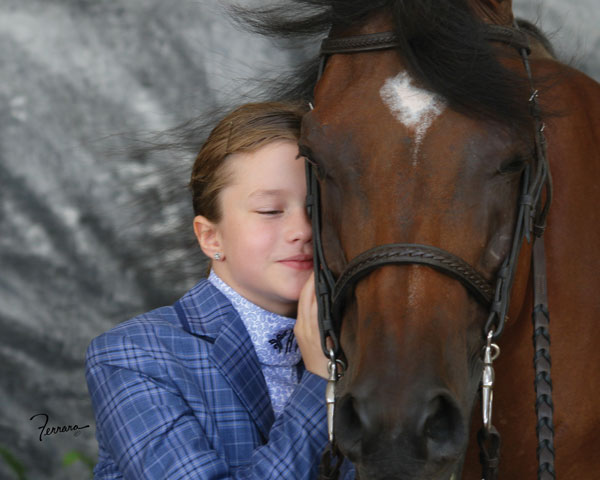
The Arabian Horse Association offers a full host of classes and programs for youth. Photo Courtesy Arabian Horse Association
American Junior Paint Horse Association
The American Junior Paint Horse Association (AjPHA) is open to anyone under the age of 18. The AjPHA offers activities geared specifically toward youth, including a youth leadership contest, an art and photography contest, a short story contest and a judging contest.
AjPHA members need not have a horse; if they do ride, they don’t have to show! The Youth Team Tournament is held during the AjPHA Youth World Championship Paint Horse Show; teams compete in a knowledge relay, a hippology contest and performance classes that test their knowledge of horses, horsemanship and teamwork.
Other breed organizations also have very active youth organizations, such as the Arabian Horse Youth Association, the Appaloosa Youth Association, the American Morgan Horse Association Youth, American Saddlebred Horse Association Youth Clubs, et cetera. In addition, other discipline associations have active youth programs, including the National Reining Horse Youth Association, the National Reined Cow Horse Association Youth, and the National Youth Cutting Horse Association, to name just a few.
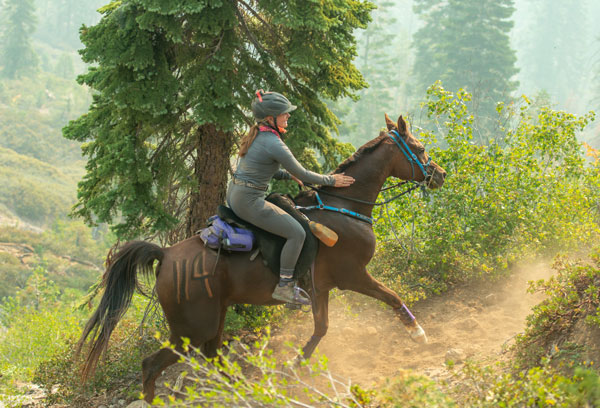
Preparing for a 100-mile horse ride is no small feat. I’ve trekked across Mongolia as an official for an endurance horse race, but that seems like a warm-up for The Tevis Cup, which spans across the Sierra Nevada mountains in Northern California. This is a true test of horse-and-rider athleticism and mental endurance. Recently, I attended my first Tevis, also known as the Western States Trail Ride, as a crew member for a friend’s first attempt.
Held annually during a full moon in late July or early August since 1955, the longest North American trail ride starts at Robie Park in Truckee, Calif., and runs 24 hours over mountains and through canyons to finish at McCann Stadium in Auburn.
The trail winds through canyons and a popular Western States Trail, which travels through a few small towns. For example, the town of Forest Hill, which is a one-hour hold, is lined with volunteers, crew, and the locals all cheering on riders as they pass through the neighborhoods on their journey. The annual event is celebrated, and it is hard work to coordinate 100 miles of public and private lands for this adventure.
Starting in the Tevis Cup
For many, competing for The Tevis Cup buckle is a lifelong goal. Horses must be six years old to enter. A horse that is able to complete 100 miles takes years to condition and train. While some equestrians bring their own horses, others lease proven animals that have been trained for this event. Riders must have completed 300 miles in sanctioned events to apply. Once you have competed in the event, you are welcome back. However, there is a maximum number of 210 riders at the starting line, and yet only 40% of riders usually cross the finish line.
Riders start in two groups before dawn the morning of the ride in Pen One and Pen Two. The early front-runners have to maintain that distance over the long haul. But remember, this is a marathon and not a sprint, so most riders prefer to start in the middle and slowly increase speed throughout the course of the day. Riders in the back often are slowed by other horses on the single-track trails. If there is an incidence on course like a downed rider or horse that needs assistance, this can slow the rest. Passing other horses may be difficult when the terrain is narrow or visibility is low.
The terrain is often battered by sun, and in recent years been troubled by drought, which has created dusty, dry conditions, and neighboring wildfires have affected air quality and made the footing more difficult.
“Tevis was hot, smoky, dirty, challenging, humbling and altogether awesome,” says first-time Tevis Cup rider Michelle Morges, DVM, who traveled to California in 2021 all the way from New Jersey to compete, “This was the ride I had hoped for from the start but quickly ended at mile 68 when my horse was pulled for lameness. I have never been so disappointed as we both had it in us to finish but also so grateful for the opportunity to even have started the race.”
Horse Health During The Tevis Cup
The horse’s health is of utmost importance to riders and organizers of the event. Horses must be vetted in before the event with a lameness check, dehydration check, and more. Just because you make it to the event doesn’t mean you will be at the starting line. From there, there are 19 checkpoints along the trail with water that are stationed with volunteers and veterinarians who track the health and welfare of horse-and-rider pairs. After crossing the finish line, the team must walk to the stadium and complete the final victory lap, and trot out as well.
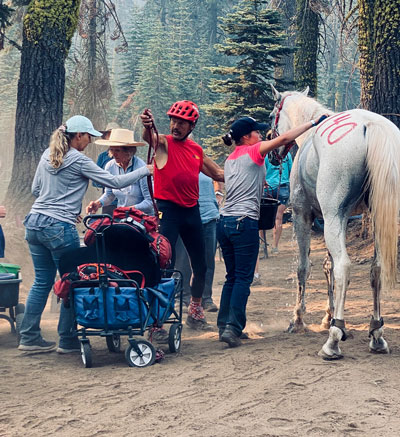
Christoph Schork during a Tevis Cup vet check. Photo by Heather Wallace
“During the various aid stations and vet checks along the trail, it is easy to lose a lot of time,” says Christoph Schork, owner of Global Endurance Riding Center. “Folks are friendly, lots of snacks are offered, but again it is easy to get distracted and get tight with cut-off times. So my advice would be for all riders: never hurry, never tardy. Keep moving down the trail with intent. I also might add that electrolytes are playing a bigger role at Tevis, horses just go through more electrolytes at Tevis than other rides. So, it is advisable to administer them more generously compared to other rides of equal length.”
Each rider is allowed two crew members to provide physical and emotional support at up to 9 checkpoints, including two one-hour holds at Robinson Flat and Forest Hill. The crew may strap (cooldown by sponging the horse), untack, give electrolytes, feed, and water the horse, and care for the pair along the route at designated holds. Because of the mountainous terrain, the checkpoints are difficult to access, and it is often hard to know where their rider is unless they check with an official or follow the optional GPS trackers, if an internet signal is available.
If a horse and rider are pulled, they are trailered to a hold where their crew can meet them. Some riders may choose to opt out of completing the ride for themselves or their horses, or a veterinarian may pull during a check because of lameness, dehydration, or metabolic issues (such as the horse’s heart rate not lowering to an acceptable level within an expected time frame). Horse wellness is the priority at all times.
To start the Tevis Cup is an incredible feat but to complete the ride is a huge point of pride for riders and horse owners.
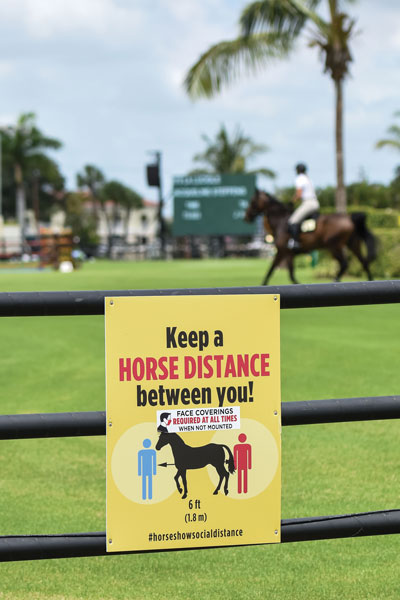
Signs at the Palm Beach International Equestrian Center in Wellington, Fla., warn riders to keep their distance. Photo Courtesy Equestrian Sports Productions
January 2020 showed promise as an eventful year for equestrians worldwide. It was to be an Olympic year, with many excited to visit Tokyo for the Summer Olympic Games, and the FEI World Cup Show Jumping and Dressage Finals were coming back to Las Vegas in April. The International Equestrian Federation (Fédération Equestre Internationale, FEI) and national equestrian federations around the globe were working on the final plans for these and other international competitions. Then, suddenly news agencies started reporting from Asia about a new coronavirus in humans, yet it seemed so far away to most in the horse industry. Shortly thereafter, COVID-19 cropped up on U.S. soil and rapidly spread across the continent and around the world, poised to affect all parts of life, including the horse industry.
In response to the mounting health crisis, the unthinkable happened. In mid-March, equestrian competition came to a screeching halt, along with the rest of the sports world. Not since the World Wars had so many equestrian events been cancelled or postponed. Many horse show venues scratched a third or more of their planned show season, and sadly at press time the list continues to grow.
Horse Industry Impact of COVID-19
While it’s too soon to have a complete handle on the impact of COVID-19 (the disease caused by the new coronavirus) on the horse industry, the simple answer is that it’s unprecedented. With the shutdowns of shows, racetracks, horse campgrounds and public stables, a broad spectrum of industry jobs were laid off or furloughed. Riding schools, trail barns and guest ranches were left caring for horses without any income to cover costs.
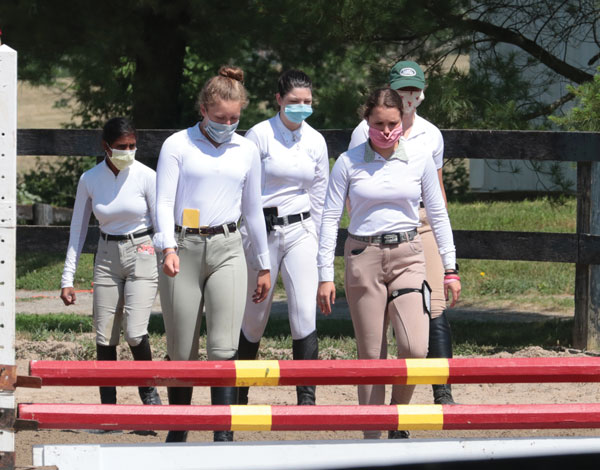
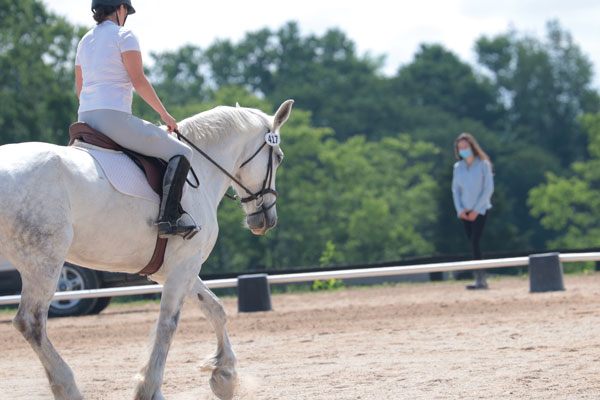
Riders walk their course at a schooling show in Lexington, Ky., wearing masks as required. Photo by Leslie Potter
Beyond the obvious effects on instructor and trainer jobs, peripheral workers such as show managers and staff, professional braiders, equestrian media and photographers, and vendors of golf carts, feed, bedding and food at shows had nowhere to work.
According to a representative of the United States Equestrian Federation (USEF), the national governing body for horse sports in the U.S., as of mid-May, 30 percent of all events originally scheduled on their 2020 show calendar had been cancelled.
On June 1, the USEF officially opened their sanctioned shows and clinics again where local and state governments allowed.
“While some USEF functions have decreased during the pandemic, other areas are experiencing increases in operations,” says Carly Weilminster, USEF director of public relations and communications. “We are assisting organizers in rescheduling their competitions, processing rule modifications and timeline extensions, regularly updating the USEF COVID-19 Licensed Competition Action Plan, and hosting a variety of webinars to ensure [our members] are receiving new updates and information as available.”
Even before the USEF resumed their competition year, the National Reining Horse Association (NRHA) lifted their ban on shows on May 1 where allowed by governmental mandates. According to Lindsay Humphrey, NRHA public relations and communications manager, there were three approved shows in May.
“There was excitement in the air from our members about getting back into the show pen,” says Humphrey. “According to management, entries were up significantly from last year at the [May] show in Arizona.”
The FEI, the international governing body for equestrian sport, estimated in mid-May that their organization alone would lose around $7.6 million due from uncollected fees and subscriptions, but added that because of long-term risk management planning, their overall position was solid. Many equine industry businesses and organizations do not have the luxury of that type of coverage, however.
COVID-19 Horse Industry Survey Says
The American Horse Council (AHC), a trade organization in Washington, D.C., representing the horse industry, circulated a COVID-19 impact survey beginning in March 2020 “to better understand how the equine industry has been affected by the pandemic and what possible downstream implications may result.”
As of June 5, 105 survey responses had been received representing 974 horses and 33 states. The data is very preliminary as of press time, but still shows cause for concern. The AHC reissued the survey in mid-June (after press time) and encourages additional participation by going to their website or Facebook page.
Julie M. Broadway, president of the AHC, explains the survey figures received so far.
“The net change in income/expenses in one month (March 2020) was $951 per horse represented,” she says. “If we model this on a national level (7.2 million horses in the U.S.), that would equate to $6.8 billion in losses for one month.”
Broadway cautions that this is a small sample population from which to make these types of projections. She states that a common theme among open responses was increased financial hardship and worry about long-term socioeconomic impacts on the industry.
Front Line Equestrian
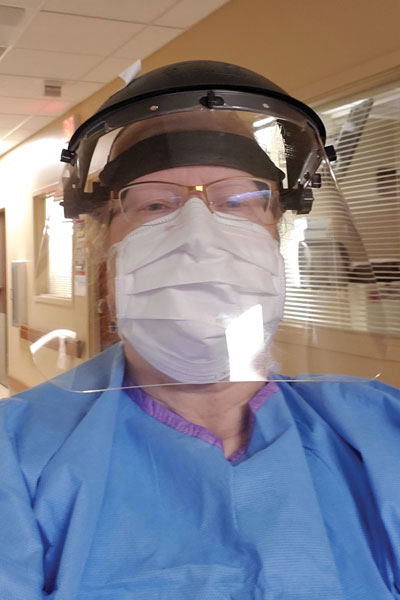
Nancy Bryant, RN, in her protective gear at work in the COVID-19 ward near Detroit, Mich. Her protective gear has to be changed between every patient. Photo Courtesy Nancy Bryant
Nancy Bryant, a United States Dressage Federation bronze and silver medalist and registered nurse from Oxford, Mich., is not only dealing with the disappointment of cancelled shows and separation from her horse during the pandemic, but also the stress and risk of a job on the front lines in health care.
She works at a small community hospital, which is part of a bigger system in Detroit where the virus hit especially hard. Since the earliest days of the pandemic, she has been caring for COVID-19 patients. Even with extreme safety protocols in place, Bryant eventually contracted the virus. “On April 19, I [tested positive], most likely from work exposure since I followed my governor’s directives of self-quarantining, only going to work and home.”
The virus led to two hospitalizations for Bryant.
“My first hospitalization was due to an excessive headache and temperature, which are two significant COVID-19 symptoms,” she says. “I was discharged four days later to go home and to continue to self-isolate. Unfortunately, respiratory difficulty caused me to return to the emergency center four days later for an additional stay.”
The recovery was difficult for Bryant.
“I’m normally an active person, but with the virus I was suddenly short of breath after doing things like washing dishes or vacuuming,” she explains. “I needed a nap after simply taking out the trash or showering. That was when the seriousness of the illness hit home. I couldn’t even stand for 10 minutes without my muscles shaking from fatigue. I was off work a total of six weeks, but as a frontline worker, I at least had a job to go back to.”
Bryant reports that her barn in Michigan was closed to boarders on March 16 and didn’t fully re-open until June 1. Even then, social distancing and wearing masks were deemed mandatory by the barn owner. The horses at her barn were all given an eight-week layoff, but Bryant says at some other barns in Michigan, trainers and staff kept horses exercised while owners were shut out.
A schooling show in late June in Lexington, Ky., required masks while not mounted and for any ground personnel. Photo by Leslie Potter
Back to Business
Experts predict that it won’t be business as usual for at least the rest of this year and probably longer, but a return to the show ring and the trails in any form is to be celebrated. Two representatives of the USEF offer their thoughts on how critical it is that a return to showing is done in the right way.
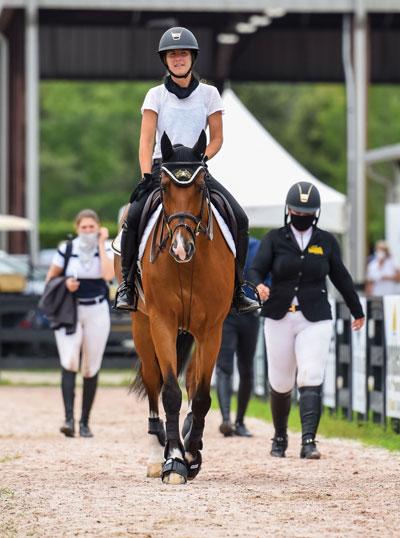
The United States Equestrian Federation rules do not require masks while riding, but they must be worn at all other times while on the show grounds. Photo Courtesy Equestrian Sport Productions
“As we reopen, our goal is to continue moving forward through this process,” states USEF CEO Bill Moroney. “Everyone needs to join together to make sure we are all doing our part. Complete commitment is essential to the future operations of our sport.”
Mark Hart, M.D., a practicing cardiologist and the U.S. Equestrian Team’s physician and chair of the FEI’s Medical Committee, emphasizes the need for everyone to take the pandemic seriously and to abide by the new rules.
“Our own individual actions to contain the spread of COVID-19 will have a significant impact on the overall societal outcome,” says Hart. “I can’t emphasize this enough.”
Equestrians should do their homework before venturing out to any show, clinic or trail ride to make sure that the event is still scheduled and that facilities are open. Anyone participating in any equestrian activity should expect to have their temperature monitored, to be asked to wear a mask when not riding and to continue to practice social distancing.
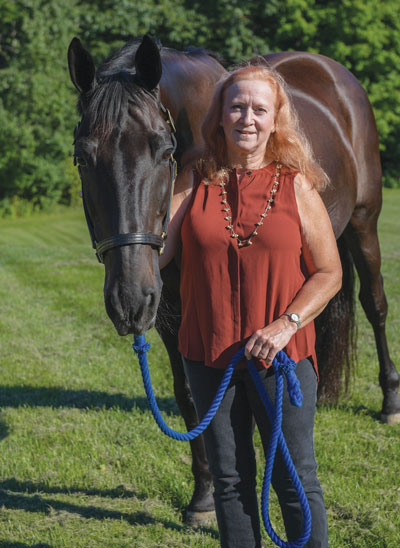
Registered nurse Nancy Bryant is also an accomplished dressage rider, having competed through FEI levels. She earned her USDF silver and bronze medals aboard her Trakehner gelding Handsel. Photo by Allen MacMillan
Hand sanitizer and/or a portable handwashing station, as well as cleaners and disinfectants, masks and plastic gloves should all be added to the packing list. Worldwide, virtually all equestrian organizations and show management businesses have posted useful information on their websites and social media to help prepare for a return to competition. Trainers stress that you should bring your horse back into full work using a careful conditioning program well ahead of hitting the show ring or trails.
Bryant shares advice from a nurse’s perspective.
“I suggest everyone be tested for active COVID-19,” she says. “If you come back positive, then you know you’re a carrier and can shed the virus, unknowingly exposing others, until you test negative. Don’t ignore the many potential signs and symptoms.”
If you’re showing your horse, Bryant has some advice. “I recommend you have your own tack stall, maintain safe distancing and wear a mask when in groups. And remember to wash, wash, wash your hands!”
Emergencies are a normal way of life for a mobile equine vet, but after 20 years of getting yanked away from things that I loved and activities that I looked forward to, it was getting a bit old. Earlier in my career, I was always running out on my beloved pets. Then it was my group of friends and a fun evening or weekend activity that I was missing. Next I was regularly ditching my fiancé at the time, who is now my husband, for various vet adventures and emergency calls.
Then it was my first baby. All the years of training to drop everything important in my life and rush out the door did not prepare me for abruptly handing off each of my infant daughters who’d been snuggled in my arms moments earlier. Those years were by far the hardest.
Now, my half-grown children barely blink when I rush from my bedroom in work clothing at 8 p.m. and hastily tell them goodnight. I tiptoe home to a silent house and a sleeping family and debate on whether or not to shower. Unless the call was unusually disgusting, I often just crawl into bed to grab whatever remnant of sleep I can, resolving to change the sheets later.
The worst nights are when the calls come in back to back. I’m still recovering from a miserable trifecta last week that probably took several years off my life.
Calling on Colic
It started with a late evening colic that had me out the door at 7:30 p.m. and home around 11. I’d seen some weird colics over the years, but this one was exceptionally strange.
The mare had torn badly during a rough foaling when she was young, and her insides were badly scarred. A portion of her large colon was actually adhered to the inside of her pelvis, and it took me a long time to figure out what on earth I was feeling in the rectal exam.
Needless to say, she survived, but I had to get creative with my treatment plan, and it took a long time.
A Mysterious Mare
At 1:15 a.m., the phone blared in my ear and another client’s name came up on the screen. I clutched the phone as my brain struggled to make sense of what she was saying. Her mare was apparently freaking out in her open-air stall, frantically biting and kicking the walls and running backwards into the doorway. She kept saying over and over, “Dr. Diehl, I’ve never seen a horse act like this!”
I figured I’d better quit talking and get out the door fast, because it didn’t sound good. It was a 45-minute drive to her place, and my brain was frantically running through and discarding all of the possible reasons for this frightening event as I stared blearily at the dim road lit by my headlights. Long drives usually gave me time to think, but when I pulled into her driveway, I still had absolutely no idea what was wrong with the horse.
I drove up to the barn to see the mare quietly eating hay in her stall. My client was apologetic.
“Dr. Diehl, I swear up until 10 minutes ago, this mare was trying to tear her stall apart!”
I studied the walls of the stall that were scored deeply with fresh toothmarks and deep kicks, and the mare’s hind legs had bloody scrapes on them. A thorough exam didn’t find much: no real signs of a seizure, and her vitals and color were mostly normal, but there were wood fragments in her mouth, and her temperature was elevated. I walked the run outside the stall, which had been wide open during the ordeal and studied the ground for any clues—lion or bear tracks, maybe—but found nothing.
When I rechecked my patient, I could see a faint outline of hives forming all over her torso and neck. By the time I had gotten a dose of antihistamine from my truck, they were even more pronounced, the hair starting to rise up in tufts.
I couldn’t see how hives and the violent behavior could be connected unless she’d been attacked by a late-night swarm of bloodthirsty insects, but I had no better ideas. I treated the hives, gave her some pain meds, drew a bunch of blood, and finally left, scratching my head.
A Sad Morning
After that vet adventure, I returned home close to 4 a.m. and fell asleep quickly, only to be woken again at 6:30 a.m. by another of the dreaded emergency calls. This time it was a good friend of my family and she was hysterical, having just found her son’s beloved pony standing on a shattered hind leg when she went down to feed.
I made it to her place in record time. When I saw the pony’s destroyed leg, I knew there was nothing that I could do except put him down quickly.
Whether it was because I knew the pony and the family so well, or that I couldn’t help picturing their little son receiving the awful news, or the fact that I was on no sleep and my defenses were completely down, I was a sobbing mess when I left their farm. I had to reassure myself over and over that I wasn’t the bad guy and it wasn’t my fault, which is an irrational brain hijack that sometimes hits after a rough situation.
As I was pulling into my driveway, my daughters rushed out to hug me tight. I didn’t yet trust myself to tell them about our friend’s pony, so I hugged them back, grabbed a travel mug of coffee and loaded the truck for the day’s calls.
My youngest looked at me sternly and shook a finger at me.
“You stayed up too late last night, young lady! You make sure you eat and drink plenty today, and tonight you’re coming home and going to bed early!”
After consuming an entire therapeutic pint of Ben and Jerry’s ice cream that evening, I did just that.
Welcome to Horse Illustrated’s weekly installment of the My Right Horse Adoptable Horse of the Week, offered in partnership with The Right Horse. Winnie is this week’s adoptable horse. Check back weekly for a new featured horse so you can find your #righthorse.
Horse:Winnie, a 22-year-old 15.2-hand American Paint Horse mare in Howell, Mich. Organization:Horses’ Haven
Photo Courtesy Horses’ Haven
Winnie is a 22-year-old sabino Paint Horse mare. She lost her right eye several years ago and has adjusted well. Her left eye is a beautiful blue. Although ridden in the past, she has an old stifle injury and suspensory issues that led to her retirement from riding, however she is pasture sound. Winnie is a wonderful companion horse who gets along very well with her other pasture mates and will follow humans around like a puppy dog. She is content living outside 24/7 or in a stall with daily turnout. Could she be your #righthorse?
My Right Horse is the online adoption platform of The Right Horse Initiative, a collection of equine industry and welfare professionals and advocates working together to improve the lives of horses in transition. A program of the ASPCA, their goal is to massively increase horse adoption in the United States. To find more adoptable horses and foster horses, visit www.myrighthorse.org. To learn more about The Right Horse, a program of the ASPCA, visit www.therighthorse.org.
We use cookies to help personalize content, tailor and measure ads, and provide a safer experience. By navigating the site, you agree to the use of cookies to collect information. Read our Cookie Policy.