0 ITEMS
  • My Account
  • Holiday Gift Guide
  • Podcast
  • Webinar
Subscribe Combo
Enable cache13
Home Blog Page 113

All About the Icelandic Horse

0
Icelandic Horse
Photo Jamen Percy/Shutterstock

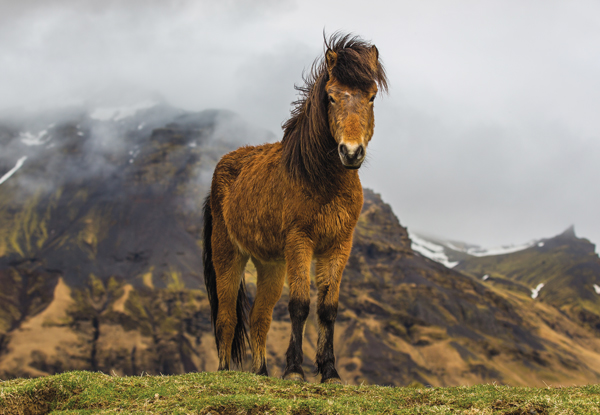
When Viking settlers first came to the island of Iceland in the late 800s, they must have been in awe of its staggering beauty. Huge glaciers, ancient volcanoes, roaring waterfalls and lush forests greeted the immigrant farmers, who brought their animals with them to their new home.
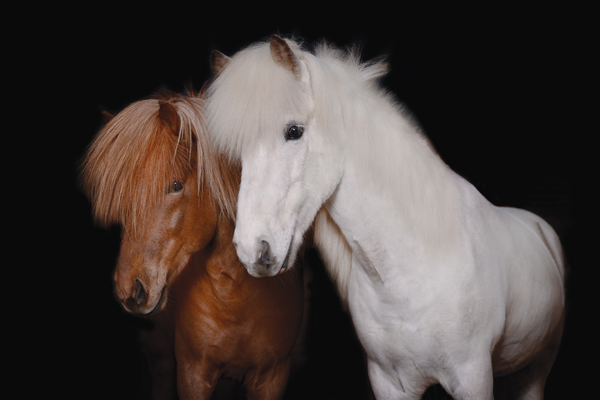
Icelandic Horse
Photo by ValerieDurbonPhotography.com

Among the livestock that made the trip from Norway were horses—ancestors of today’s Norwegian Fjord. Other settlers from the British Isles soon followed, bringing ponies carrying Shetland, Exmoor and Highland Pony blood.

Over the next 1,000 years, horses in Iceland remained isolated from the rest of the world. Without the infusion of outside blood, and with the need to adapt to Iceland’s severe climate and rugged terrain, a distinct breed of horse was formed. Small enough to survive on the sparse native grasses that grow in the coldest winter months, yet strong enough to work the farm and carry an adult rider, the Icelandic breed became an integral part of Icelandic life.

The Icelandic Horses of today are descendants of the horses that survived centuries in this harsh land. Through a law decreed in 982, no horses are allowed to enter Iceland, and horses that leave are never allowed to return. Thus the Icelandic equine gene pool has remained pure for 1,000 years.
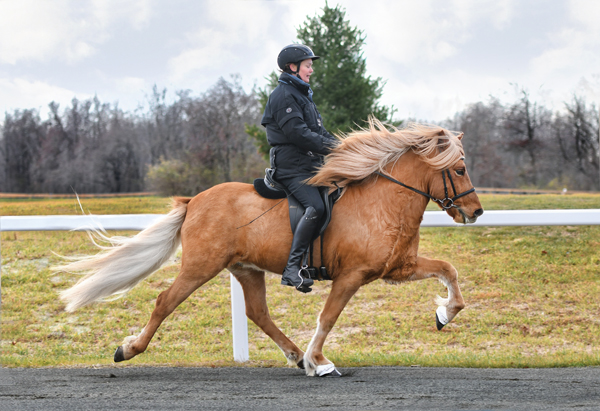
Icelandic Horse tölt
The tölt is the Icelandic’s signature four-beat smooth gait, where at least one foot is always on the ground. Pictured: Antje Freygang of Montaire Icelandic Horses on Vaskur Fra Kadarholi. Photo by ValerieDurbonPhotography.com

Unique Traits

Because of its distinctive history, the Icelandic Horse is truly unique in the equine world. Its long period of isolation, along with careful breeding by Icelanders, has allowed the breed to maintain a classic appearance, movement and temperament.

In addition to its compact form and shaggy mane and tail, the Icelandic possesses special gaits not seen in any other breed. Every Icelandic is born with the ability to walk, trot, canter and gallop like other breeds, and to also perform the four-beat tölt. Some are also born with another gait called the flying pace.
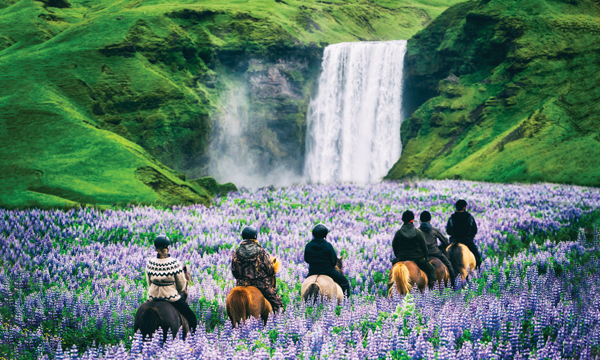
Horses in Iceland
Treks through Iceland on horseback are a part of many equestrians’ bucket lists. Photo by Blue Planet Studio/Shutterstock

The tölt, the most comfortable of the Icelandic’s gaits, is a lateral movement where at least one foot is always on the ground. The two-beat flying pace is the fastest of the Icelandic’s gaits, with speeds reaching 30 mph. In Iceland, horses are raced at this gait.

The Icelandic Horse’s temperament is as treasured as its distinctive look and special way of going. The ideal Icelandic has a very easy-going personality and is virtually bombproof. The breed’s lack of spookiness goes back to its isolation within its native land where horses have no natural predators.

In Iceland, these horses are an integral part of the country’s tourism industry, providing rides through the spectacular countryside during the warmer months. The horses carry visitors over lava fields and volcanic landscapes, giving a perspective of Iceland you can only get from the back of a horse.
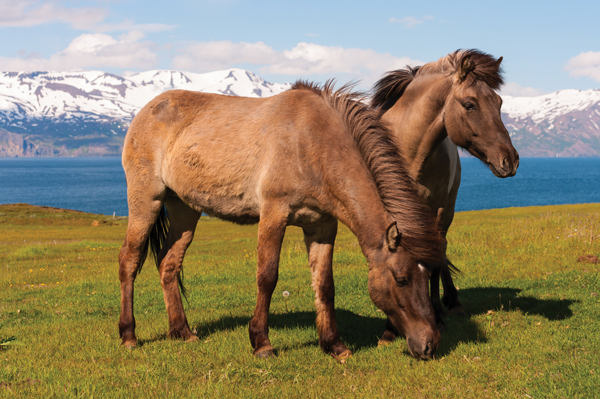
Two wild duns grazing with a snowy mountain backdrop
With no new horses allowed in for 1,000 years, the Icelandic horse has maintained its distinctive characteristics. Photo by Karel Cerny/Shutterstock

In the USA

Although Icelandic Horses are most numerous in their home country (around 80,000 currently reside in Iceland), 6,248 horses are registered with the United States Icelandic Horse Congress (USIHC). They are valued in the U.S. as pleasure, trail and family horses.

In USIHC-sponsored competitions around the country, the breed is judged at its five gaits using International Federation of Icelandic Horse Associations (FEIF) rules. The FEIF is an association of 19 different countries where the Icelandic Horse is represented, and is the international governing association for the breed.
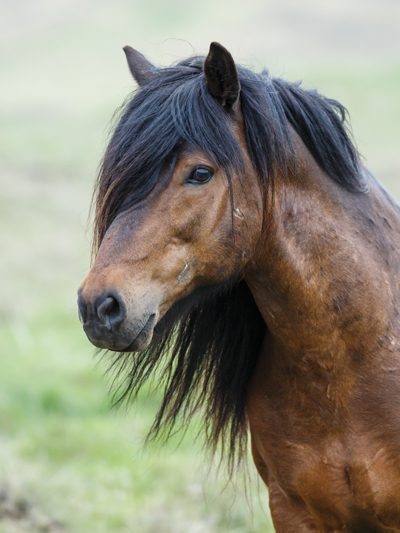
A wild bay with a long mane
The Icelandic Horse, while technically pony-sized, is still called a horse due to tradition, its weight-carrying ability and spirited disposition, and its ability to do all things horse. Photo by Menno Schaefer/Shutterstock

Every two years, a different FEIF member country hosts the World Championships for Icelandic Horses, where Icelandic Horses from around the globe compete against one another. Throughout the world, the Icelandic Horse is judged on the quality of its five gaits. Classes are organized by division, and include open, intermediate, novice, youth, beginning rider and green horse.

In the U.S., the United States Icelandic Horse Congress has a pleasure/leisure riding department that manages a Sea 2 Shining Sea Ride, which is a virtual ride where members log hours in the goal of traveling through regions of the U.S.
Another virtual competition for all levels of riders is currently being developed to help Icelandic Horse owners stay involved with showing during the COVID-19 shutdown.

The Icelandic is a rugged little horse with great strength, endurance and temperament. As its popularity continues to grow outside its native Iceland, more people are coming to appreciate the beauty and unique talents of this special breed.

Fast Facts about Icelandic Horses

Height: 13 to 14 hands

Color: Primarily brown, bay, black and chestnut; dun, cream, silver, roan and pinto are sometimes seen.

Overall Appearance: Rectangular and compact in shape; long, thick mane and tail. Head well-defined, proud and alert.


Icelandic Resources

United States Icelandic Horse Congress
International Federation of Icelandic Horse Associations
◆ For free educational training resources specific to Icelandics, visit:
www.hrimnir.shop/community/category/knowledge

This article about the Icelandic Horse breed appeared in the July 2020 issue of Horse Illustrated magazine. Click here to subscribe!
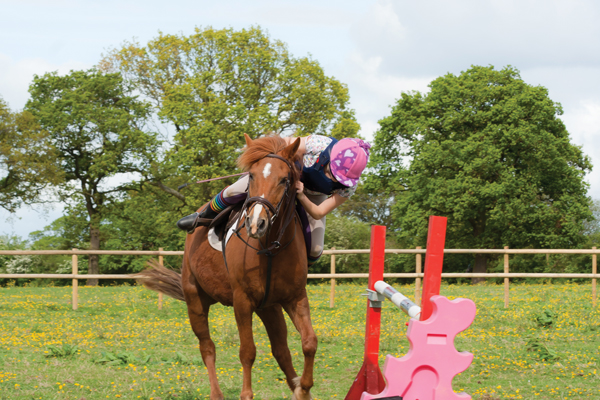
Overcoming Fear After Falling Off a Horse

0
Fear of Falling Off a Horse
Photo by Groomee/Shutterstock

Riding can be one of the most exciting and thrilling activities there is. There’s not much that can top galloping through the field on your horse’s back, soaring over a big jump, racing around a barrel, or gliding across the long side of the arena at a big, bouncy trot. But as most riders know, these thrills don’t come without a few spills. The time will come that you do hit the dirt, and this can really take a toll on your riding confidence. How do you regain confidence after falling off a horse? These five tips will help you to tackle your fear after falling off and get you back in the saddle with a smile in no time.

Young Rider Magazine Logo

1) If you’re not hurt (and your trainer gives you the OK), get right back on.

Many people wonder what to do after falling off a horse. After you fall off, the top of your pony’s back can feel taller than the Empire State Building, and the anticipation of swinging your leg back over the saddle can seem like the scariest thing in the world. As long as you aren’t hurt and your trainer gives you the all clear to get back in the saddle, do it right away. This will help guarantee that you don’t have any lingering anticipation about mounting up. You don’t have to go right back to the activity that you were doing when you took your spill, but a few laps around the ring at the trot after a fall can go a long way toward kick-starting your confidence.

2) Go back and do something you’ve already mastered.

If you took a tumble while working on a new skill, take a step back and do something you already feel great at. If you had a hiccup while working on perfecting your flying change, take some time and go back to the trot-to-canter transition. If you lost your balance galloping on the trails, take a few outings at a relaxing trot through the woods. Practicing something you already know how to do well will help boost your confidence and keep nerves at bay.

Young Rider Riding Western
After a fall, go back to doing a skill you’ve already mastered and feel comfortable with. Photo by Ahturner/Shutterstock

3) Talk with your trainer.

Losing your confidence and feeling afraid after a fall is completely natural. While it may feel embarrassing to admit your fear to your trainer, talking with him or her about it can actually help keep your nerves from getting even worse.

Having an open communication going between you and your trainer will help him or her assess what you need to work on to get your riding and confidence back on track. This helps you to refocus and keeps you from getting sucked deeper into your post-fall worries. It is your trainer’s job to make sure you and your pony stay safe and to help you to achieve your riding goals, so keep anyone you work with in the loop on how you are feeling in the saddle.

4) Challenge yourself in other ways.

After a fall it can be tempting to start obsessing over exactly what, how, and why you fell off the horse. However, concentrating so heavily on the fall can start to take a toll on other physical and mental aspects of your riding.

In your rides following your spill, try to keep your mind busy and challenge yourself in different ways. Make a goal to try to do the first 10 minutes of your ride without stirrups, or ask your trainer for a longe line lesson where you ride the whole time without your reins.

Setting attainable goals that challenge your mind and body will help keep your focus centered on the ride you’re currently having, instead of the fall that happened last weekend.

5) Remember, falls happen to all riders.

Falling off a horse is just one step along the way in your journey to becoming the best rider you can be. Every great rider has fallen off—lots and lots of times. Riding is a fun and challenging sport that will definitely come with a few bobbles along the way. Don’t beat yourself up and don’t give up, and you’ll be back to feeling like a superstar in the irons before you know it.

Fear of Falling Off a Horse
Remember, everyone falls off. Professionals have probably fallen many, many times! Photo by Au_Cr/shutterstock

Falling off can be scary and can definitely take your confidence down a few pegs. While it’s a normal part of riding, it’s also normal to feel some fear after you hit the ground. These five tips will help ease your worries and help improve your riding confidence until it’s better than ever!

This article about getting over fear of falling off a horse appeared in the Spring 2020 issue of Young Rider magazine. Click here to subscribe!

My Right Horse Adoptable Horse of the Week: Brownie — October 11, 2021

0
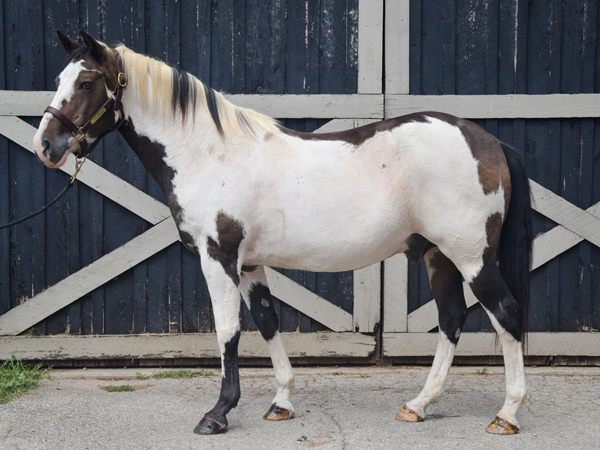
My Right Horse Adoptable Horse of the Week - Brownie
Photo Courtesy Animal Rescue League of Iowa

Welcome to Horse Illustrated’s weekly installment of the My Right Horse Adoptable Horse of the Week, offered in partnership with The Right Horse. Brownie is this week’s adoptable horse. Check back weekly for a new featured horse so you can find your #righthorse.

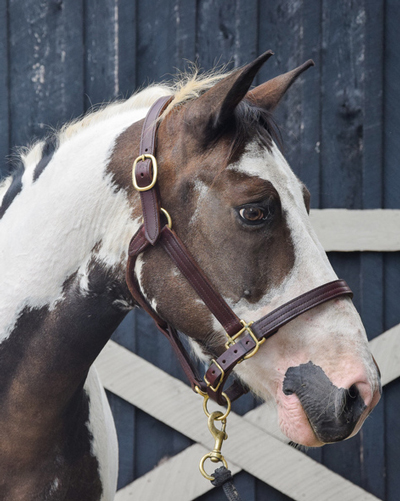
My Right Horse Adoptable Horse of the Week - Brownie
Photo Courtesy Animal Rescue League of Iowa

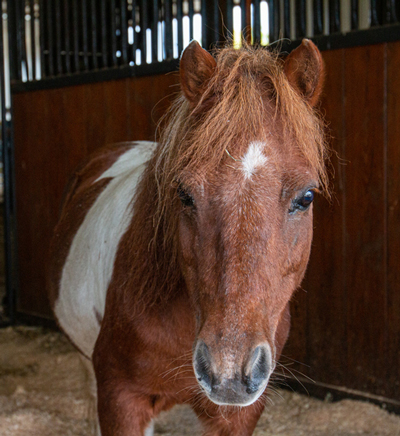
Horse: Brownie, a 12-year-old 9-hand pinto Miniature Horse mare in Des Moines, IA
Organization: Animal Rescue League of Iowa

Brownie is curious about people, but will need continued work in her new home to help her build trust around new people and new situations. Interested in adopting this horse or other equines at the Animal Rescue League of Iowa? To get started, please contact rescueranch@arl-iowa.org or (515) 473-9112.

Click here for questions about Brownie, the My Right Horse Adoptable Horse of the Week

My Right HorseMy Right Horse is the online adoption platform of The Right Horse Initiative, a collection of equine industry and welfare professionals and advocates working together to improve the lives of horses in transition. A program of the ASPCA, their goal is to massively increase horse adoption in the United States. To find more adoptable horses and foster horses, visit www.myrighthorse.org. To learn more about The Right Horse, a program of the ASPCA, visit www.therighthorse.org.

The Wild Ponies of Chincoteague and Assateague Islands

2
Chincoteague Island Ponies
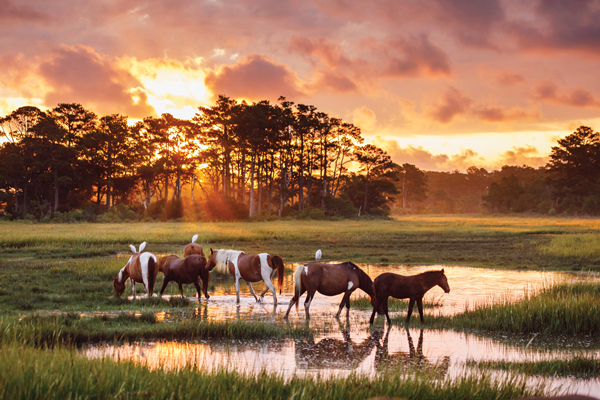
I invited several friends to join me on this adventure. We planned to spend one day in Chincoteague and take a boat tour to get better access to the ponies. We talked the boat captain of Salt Water Pony Tours into taking us out before sunrise, and I’m glad we did, as the sunrise that morning was nothing short of spectacular! Photo by Shelley Paulson
Chincoteague Island Ponies
A herd heads back to the dunes from the beach. The ponies often go to the beach midday to get a break from the flies. Photo by Shelley Paulson

In recent years, I have taken several trips to photograph wild horses. These trips have taken me west, where horses roam free and cowboys and cowgirls still ride the range. But last year, I wanted to do something different and head east to a place I’ve only visited in the pages of a favorite childhood book: Misty of Chincoteague. When most of us think of wild horses, we think of the American West, with its iconic herds of Mustangs. But wild horses and ponies can be found all across the U.S., including the coastlines of Virginia and Maryland on Chincoteague and Assateague Islands.

Chincoteague Island Ponies
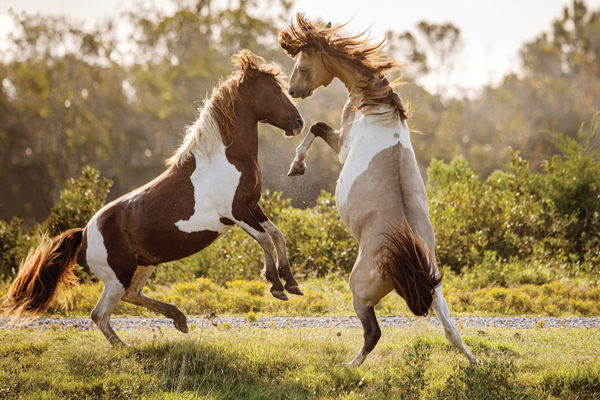
After photographing the sunrise, we moved on and found an area where two herds were grazing close to each other. We got there just in time to see and photograph a stallion confrontation. The skirmish was fairly mild compared to the violence you see between Mustang stallions, but still exciting to watch and photograph. The tour guide told us that seeing this kind of interaction is rare, which made it even more special. Photo by Shelley Paulson

These wild horses are believed to have been on a galleon ship, bound for America from Spain. The ship wrecked in a storm, and the horses were able to swim to safety to the shores of Chincoteague and Assateague Islands, where they learned to survive on their own. A recent discovery of a shipwreck off of Assateague Island supports this theory.

While they are proportioned like horses, people most often refer to them as ponies due to their small stature, caused by a less-than-ideal diet of salt marsh plants and brush.

Chincoteague Island Ponies
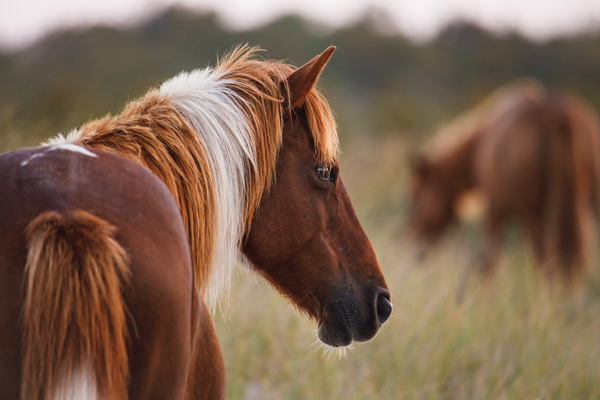
These wild ponies are more accustomed to people, so they were easier to photograph than wild Mustangs, who often run when they see people. They are still cautious, and we were careful to keep a proper distance from them. Photo by Shelley Paulson

Seeing the ponies of Chincoteague and Assateague with my own eyes was a childhood dream come true. Getting to photograph them and come home with memories in the form of photographs was an unforgettable experience.

Chincoteague Island Ponies
These are colorful herds, with many pinto-colored like Misty and Stormy. Photo by Shelley Paulson
Assateague Island Ponies
During the tourist season, the ponies roam the campgrounds, rummaging for food. We visited after Labor Day, so while some ponies were still in the public areas, we also got a special Over Sand Vehicle (OSV) pass, which allowed us access to the full length of the beach to search for ponies. Photo by Shelley Paulson
Assateague Island Ponies
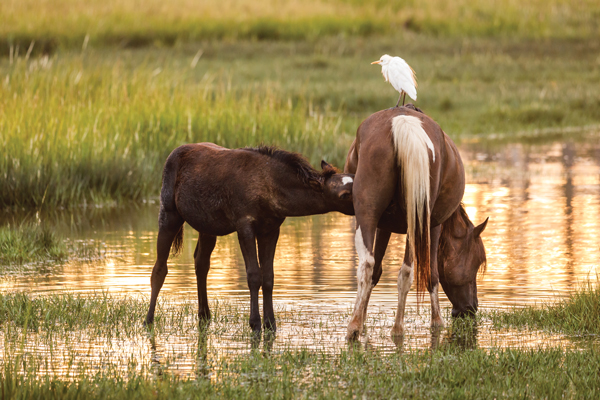
A foal nurses while his mother grazes in the swamp with an egret perching on her back. The egrets have a symbiotic relationship with the ponies, feasting on flies and ticks that are irritating them and that are also a potential health hazard. Photo by Shelley Paulson
Assateague Island Ponies
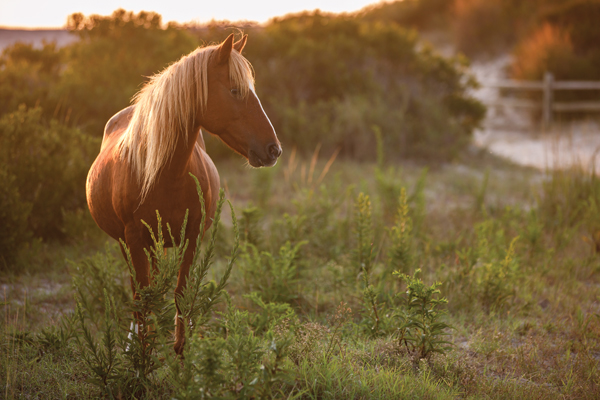
After our time in Chincoteague, we headed north to Assateague where more ponies roam a long stretch of the island. Photo by Shelley Paulson
Assateague Island Ponies
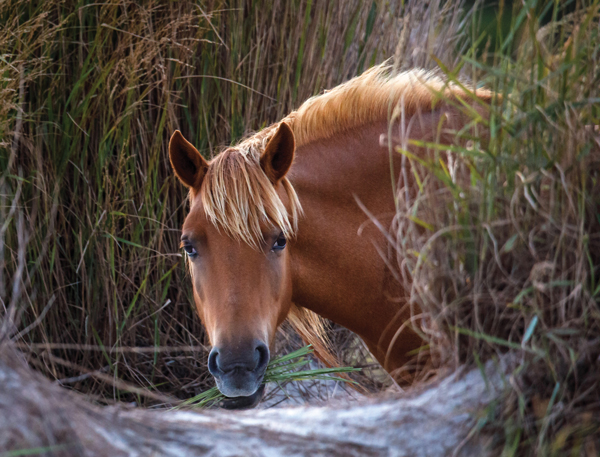
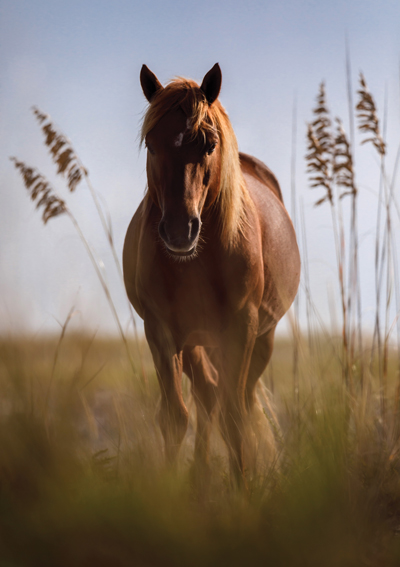
A pony stallion resting in the tall grasses of Assateague Island. Photo by Shelley Paulson
Assateague Island Ponies
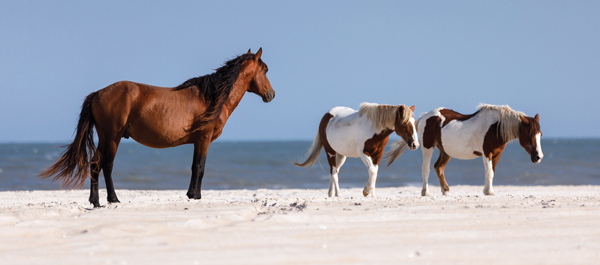
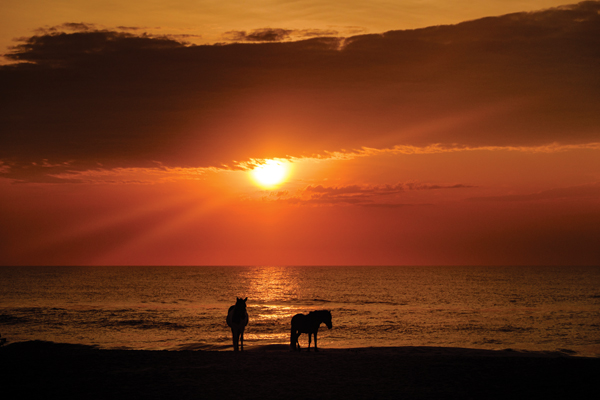
Every morning, we would arrive at the park around sunrise and go straight to the first beach we could access to look for ponies. The last morning, this ritual bore fruit when we found a lone pair snoozing as the sun rose between the clouds. Photo by Shelley Paulson

Managing The Ponies on Chincoteague and Assateague Islands

There are actually two herds on Assateague Island, which are genetically identical. The major difference between the herds is in how they are managed. A fence on the Maryland/Virginia border keeps the herds separated.

The Virginia herd is managed by the Chincoteague Volunteer Fire Department, who organize a yearly pony penning event. Some of the ponies are rounded up, driven across the channel on to Chincoteague Island, and auctioned off to raise money for the continued care of the herd, whose numbers are kept at around 150.

The Maryland herd is managed by the National Park Service. They use birth control to manage the herd size, which is kept at around 90.


This photo portfolio about the Chincoteague Ponies
appeared in the July 2020 issue of Horse Illustrated magazine. Click here to subscribe!

Riata Ranch Cowboy Girls

0
Riata Ranch Cowboy Girls
Photo Courtesy Riata Ranch

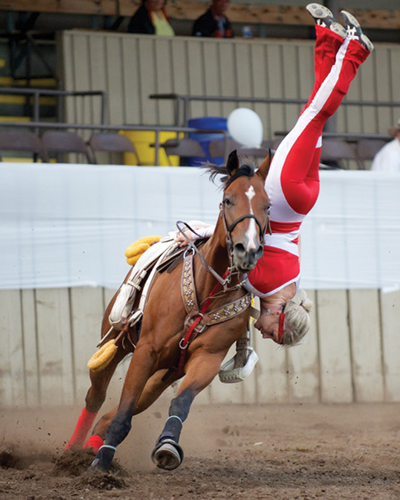
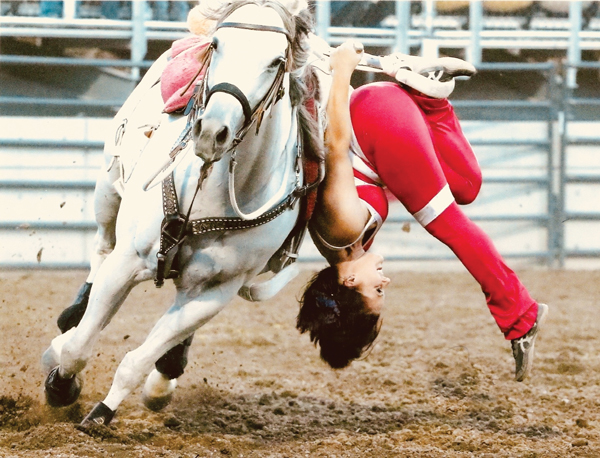
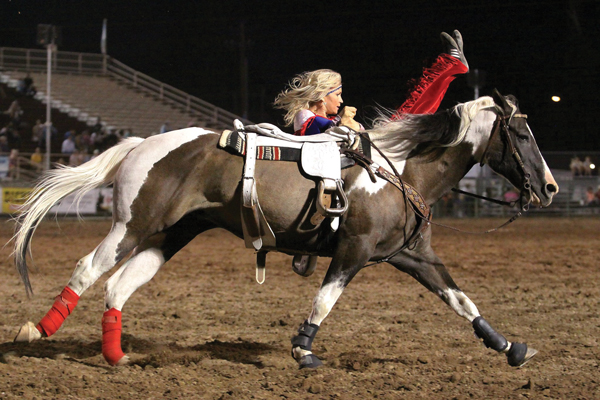
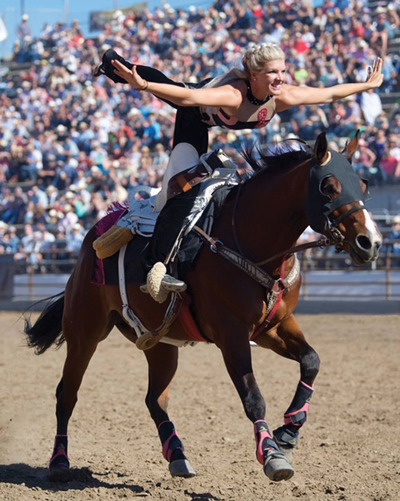
Trick riders at work are a sight to behold. Watching them swing around, perform handstands, and dangle inches from the ground, all from the back of galloping horse, is a rush. For those of us who work hard just to stay upright in the saddle, watching riders hang upside down at top speed is mind-blowing.

Most trick riders are on the younger side, and it’s no wonder. This pastime requires both courage and athleticism. And when learned in the context of a nurturing environment, it can help teens develop life skills and confidence they can take with them into adulthood.

The History Behind Riata Ranch

One such environment is the Riata Ranch in Three Rivers, Calif. A non-profit organization whose mission is to enrich and enlighten young people by building positive life skills in a safe environment—which in turn changes lives by allowing good kids to become great citizens—the Riata Ranch is home to the Riata Ranch Cowboy Girls, a rope-spinning, trick-riding troupe that has been performing hair-raising stunts on horseback around the world since 1976.

In the 1940s, a cowboy named Tom Maier got a job as a performer in a drill team troupe, which led to an opportunity to become a Hollywood stunt rider. He appeared in a number of westerns alongside actor Ronald Reagan. He also doubled for Elizabeth Taylor in “National Velvet.”

Preferring ranch work to making movies, Maier became a horse trainer and ranch hand in California, roping and branding cattle. After honing his skills in the field, he went on to become a professional rodeo cowboy.

Maier’s rodeo career was cut short by a car accident one night after an event. His knee was crushed, and he could no longer compete as a professional roper. In need of money to support his wife and two young sons, Maier accepted a job teaching a local district attorney’s daughter how to ride. Word got out, and in a short time, other Los Angeles-area parents were asking Maier to teach horsemanship to their children. Maier soon found himself the head of an unofficial riding school for kids.

In 1956, Maier went on to buy his own ranch in Southern California. The Riata Ranch was formed, and Maier began teaching horsemanship, western values, cowboy skills and rodeo stunts to kids. His goal was to make students into top-notch cowboys and cowgirls. Their lessons included roping and riding, and they began to compete in rodeos and horse shows throughout the area.

Riata Ranch Cowboy Girls
Photo by James Fain/Courtesy Riata Ranch

The Riata Ranch Cowboy Girls Trick Riders

By 1976, it became apparent to Maier that girls had far fewer opportunities for athletic activities than boys. Choosing four 13-year-old girls to form the first Riata Ranch Cowboy Girls, he arranged for the trick-riding troupe to begin performing at rodeos and events.

After learning to ride and making the Riata Ranch show team, current ranch Executive Director Jennifer Nicholson bought her first horse and competed in reined cow horse events.

“Tommy Maier decided to start a western performance team to complement his award-winning horse show team,” says Nicholson. “In between training days for the show team, I was also learning to trick ride, along with my teammates.”

Soon the girls had the opportunity to perform at some of the most noted rodeos in the West and were able to meet some of the biggest names that the world of rodeo has produced.

“We then began international travel, building western riding in Europe in the early 1980s,” says Nicholson. “It was an exciting time to be on the forefront of the explosion of the western horse in Europe and abroad. We spent more time in Belgium, Germany France, Italy and Switzerland than we did in our own country.”

While the Riata Ranch Cowboy Girls quickly achieved acclaim as trick riders, their lives at Riata Ranch were not all glamour and adrenaline. Part of the program at the ranch included upkeep of the facility, taking care of the horses and maintaining the tack. Learning responsibility and building confidence are an essential part of the Riata curriculum, and working at the ranch is part of the program.

Over the past 44 years, the Riata Ranch Cowboy Girls have performed at rodeos and events around the world, including Queen Elizabeth II’s Diamond Jubilee in 2012 in London, England.

“Besides performing for Her Majesty, I actually got to meet her and talk about Riata Ranch,” says Nicholson. “What a thrill to meet one of the most well-known world leaders in our modern era—and it’s all because I learned how to spin a trick rope on horseback.”

Trick Rider
Horses need defined withers, a sound mind, and a height of 14 to 15 hands to be suitable for trick riding. Photo by James Fain/Courtesy Riata Ranch

Learning the Craft

To do trick riding feats, you need a good foundation in physical fitness. According to Nicholson, Riata Ranch Cowboy Girls learn vaulting first, a sport that is often referred to as gymnastics on horseback. Vaulting helps build core strength and flexibility, along with balance and confidence. It also teaches participants to trust the horse’s movement, along with their own seat.

The Riata Ranch Cowboy Girls also train for upper body strength, since many of the tricks they perform involve pulling their weight up into the saddle from close to the ground. Work around the ranch helps them develop this ability, and includes raking, stall cleaning, lifting loaded pitchforks, shoveling manure, sweeping, moving hay bales and a variety of other activities that help maintain the ranch while also increasing their physical abilities.

Tricks that will eventually be performed on horseback are practiced on the ground first, using a trampoline and vaulting barrel. Participants develop position, posture and control in the legs and arms while working on stationary equipment. Once a girl is ready, she moves on to performing the stunts on a horse.

In order to learn the rhythm and timing needed to eventually do tricks on horseback, each girl practices running beside a horse in a 70-foot round pen. The horse learns to rate his speed and keep a consistent pace. At the same time, the girl develops the ability to move in time with the horse.

When the horse and rider are synced on the ground, the work moves onto the horse’s back. The same stunts that were performed using the trampoline and vaulting barrel are now transferred onto the horse in the confines of the round pen. It takes considerable practice before a Riata Ranch rider is ready to perform in front of an audience in a full-sized arena.

Riata Ranch Cowboy Girls are taught both strap tricks and ground tricks. Strap tricks take place on the horse and use leather anchor straps placed at various spots on the saddle. Tricks that require standing, hanging, dragging and layouts (where the rider is stretched out parallel to the ground) are all performed with the help of a strap.

Ground tricks, on the other hand, require touching the ground from horseback. These tricks require the most upper body strength because the trick rider must pull herself back up onto the horse’s back after getting very close to the ground.

Trick Rider
Straps on the saddle help propel the Riata riders to amazing tricks. Photo by Matt Cohen/Courtesy Riata Ranch

Horses for the Job

Of course, plenty of work goes into teaching the ropes to a performing trick horse, too. Horses must not only maintain a consistent pace while riders are dangling from the saddle or standing on their backs, they must also stay calm when performing in front of roaring crowds. To build a bond of trust, the Riata Ranch team works with each trick horse in training to help that horse get used to riders vaulting on and off while traveling at high speed.

When choosing a potential trick horse, the Riata team looks for certain qualities. Horses are chosen for their age (around 8 years old is preferred), height (14 to 15 hands) and conformation (balanced, with defined withers). They also want a horse with experience under saddle and a sound mind.

Today’s Riata Ranch Cowboy Girls

More than 45 years after the Riata Ranch Cowboy Girls first came into existence, the famed trick-riding troupe is still performing regularly throughout North America, with their next performances tentatively scheduled for rodeos and horse events through the West this summer.

Maier is no longer here to see his girls in action; he passed away in 2002. Yet his dream of the Riata Ranch Cowboy Girls continues in the hands of Nicholson.

“In 2002, we were faced with the question: ‘Do we shut the doors or do we continue?’” she says. “The obstacle was that the company was bankrupt due to Tom’s years of major medical issues. But I took the reins and decided to forge ahead. With a lot of uncertainty, grit and determination, here we are.”

With the support of parents who continue to send their horse-loving children to the riding school and donors who believe in the program, girls who aspire to become expert trick riders and horsewomen still have a home at Riata Ranch.

This article about the Riata Ranch Cowboy Girls appeared in the July 2020 issue of Horse Illustrated magazine. Click here to subscribe!
Zebra Stripes: Are They a Natural Fly Repellent?

0
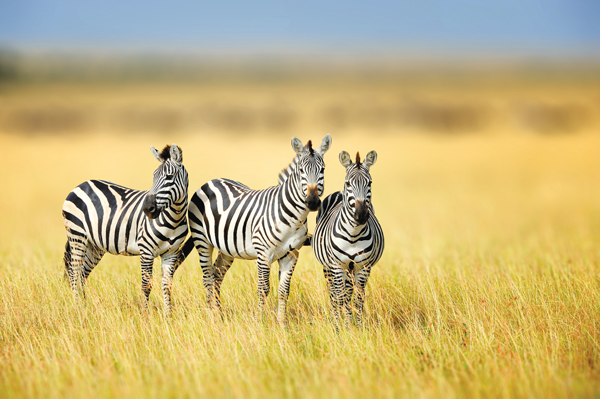
Zebra Stripes Effects on Flies
Photo by Volodymyr Burdiak/Shutterstock

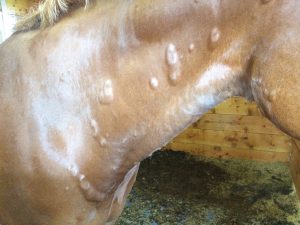
Gotta Be Him, aka “Jaxson,” needed three bottles of Zyrtec allergy medication to survive summer. Bug bites caused welts, some golf-ball sized. The swelling lasted three days or more, and the sorrel gelding developed soreness in his front feet from excessive stomping. Supplements and fly sheets didn’t work. Owner Deborah Klotzbach was skeptical of zebra-striped fly sheets and hesitant to spend money on another failed solution, but she decided to give it a try after her daughter tried one on another horse.

“The first day Jaxson wore it was a happy day for both of us,” she says. “Observing him in the pasture, I saw he wasn’t swatting or stomping at flies nearly as much. When he came to the gate, he had one fly around his head.”

The real test was when she removed the sheet: there were no bug bites. It was a relief. Flies had been able to get under other sheets and bite him, but not the zebra-striped sheet.

Animal print patterns on support boots, saddle pads and blankets are trendy. However, research has shown that zebra stripes, at least on fly sheets, are more than fashionable—they’re functional, too.

Zebra Stripes Effects on Flies
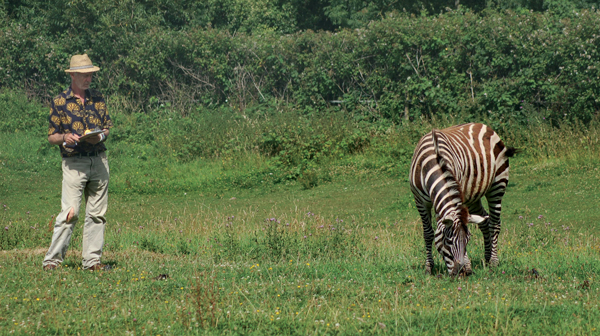
Tim Caro (pictured) and a team of researchers observed flies landing on zebras and horses to monitor the difference in fly landing patterns. Photo Courtesy Tim Caro

The Science of Zebra Stripes

As early as the 1940s, scientists theorized a zebra’s striped coat pattern has advantages over solid-colored coats to help the animals survive. Three studies published in the 1980s confirmed that zebras are less afflicted by flies than horses. Although scientists knew flies were less likely to land on zebras than horses, the degree to which this occurred was unknown.

“It seemed like an obvious choice to explore the extent to which the zebra’s stripes thwart flies,” says Tim Caro, Ph.D., a professor of biology at the University of Bristol in the United Kingdom. He studies the evolution of coloration in mammals and once worked at Katavi National Park in Tanzania, a national park with 35,000 zebras.

In 2016, he was working on a horse farm in the United Kingdom that also owned three zebras, the ideal setting to determine how effective zebra stripes are at warding off flies.

Testing Horse Sheets as Bug Repellent
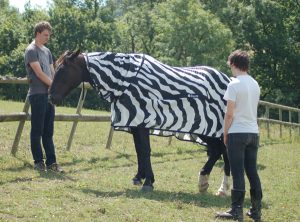
Caro’s team used a zebra-striped blanket to monitor the effect on fly landing (this is a commercially available fly sheet by Bucas). Photo Courtesy Tim Caro

Caro and a team of researchers observed and recorded flies landing on the backs of both horses and zebras at the UK farm. They used solid black, all-white and striped blankets on both groups of animals to measure the rate at which flies were attracted to each.

Watching videos allowed them to quantify the frequency at which flies landed on the different coat colorings.

“The flies were just as attracted to the zebras as horses from a distance, but when they got up close, the flies kind of got confused, bumping off the zebras or zebra-covered horses, looking for areas without stripes,” says Caro. “Flies landed on horses’ naked heads, and the flies were attracted to horses regardless of what they were wearing, but avoided striped surfaces and switched to the horse’s head.”

Why It Works

Insects have poor eyesight, and the stripes are like a shock to their vision, Caro explains. Flies can’t see the coloration until they are a little more than a foot away, at which point the stripes disorient the bugs.

“This causes them to fly away or bump into the coat and not land properly,” he says.

Welts from bug bites
Jaxson experienced welts from bug bites all summer. A zebra-striped sheet proved to be a lifesaver. Photo Courtesy Deborah Klotzbach

During the study, Caro also observed that horses and zebras react differently to flies. Horses periodically twitch or swish their tail to remove flies, but often continue grazing, tolerating the annoyance. Zebras, on the other hand, swish their tails all day. When bothered by bugs, they stop eating and run from persistent pests, dislodging the pests more than horses.

Because flies have a harder time landing on stripes than solid coats, the coloration is a natural defense. In Africa, horseflies carry diseases that are deadly to equids and zebras, a fact confirmed by scientists, according to Caro.

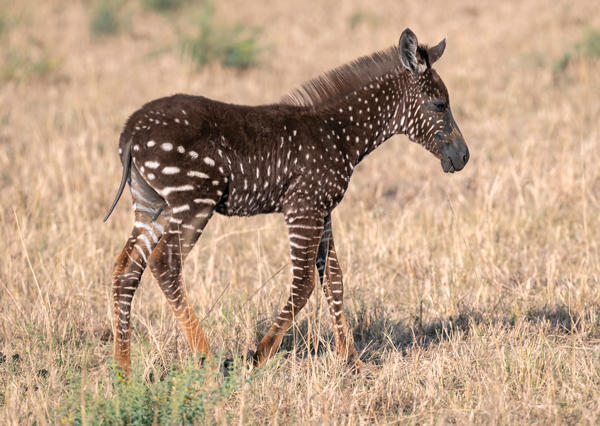
In 2019, a spotted zebra foal named Tira was born in Kenya with a sooty coat flecked with white spots, rather than the usual stripes, due to a mutation known as a pseudomelanism. Only time will tell if the otherwise healthy foal will be pestered by flies and more susceptible to disease than his striped herd mates.

“This is just a mutation that happens from time to time,” says Caro. “Because the majority of zebras are striped, there is a strong natural selection for being striped because of the diseases carried by biting flies.”

Baby Zebra
In 2019, a zebra foal named Tira was born without the usual stripes, but instead a pattern of spots. Photo Lori Ellis/Shutterstock

Next up on Caro’s to-do list is designing additional zebra-striped sheet patterns that more closely mimic a zebra’s coloration for enhanced defense against flies.

“We think we will be able to devise a very good coat for keeping horseflies off horses at the end of this coming summer, because we are altering the pattern of stripes on coats systematically,” he says.

This article about zebra stripes effects on flies appeared in the July 2020 issue of Horse Illustrated magazine. Click here to subscribe!
Breed Spotlight: Arabian Horse

1
Breed - Arabian Horse
Photo by Alexia Khruscheva/Shutterstock

Envision this scene: a glorious black Arabian stallion swims powerfully through the ocean in the aftermath of a shipwreck, pulling you to the safety of a deserted island where you later learn to ride him.

That might happen if you’re Alec Ramsey in The Black Stallion movie and book, but even if you’re not shipwrecked on an island with a wild stallion, you’ve probably seen Arabian horses at the stable or at horse shows. The Arabian is a beautiful breed capable of many different jobs.

What Are Arabian Horses Known For?

A light horse breed that stands between 14.1 and 15.3 hands (although 15.1 is more common on the tall end), Arabian horses have been prized for centuries for their stamina and versatility. But Arabians are also famous for their distinctive beauty and presence. What is it about the Arabian’s appearance that sets it apart from other breeds?

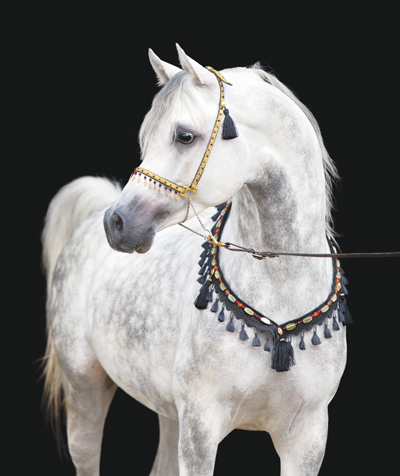
Young Rider Magazine LogoPart of the reason is surely the Arabian’s sculpted head, which sports a heavily dished face and large eyes that are prominently set on the sides of the face. The Arabian’s muzzle is small, but the nostrils are flared, which also adds to this breed’s dramatic look. There is an unmistakable elegance about the Arabian that contributes to its distinctive type, stemming from its arched neck and graceful body.

You’ll find Arabians in four different coat colors: bay, black, chestnut and gray, sometimes with occasional roaning caused by coat patterns like rabicano. Gray is something of a classic Arabian color, and many foundation stallions were gray, including the imported Raffles and Skowronek.

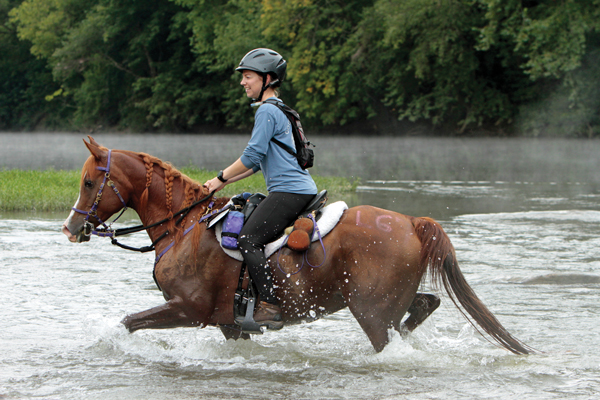
Breed - Arabian Horse; Discipline - Endurance
Arabians are well-known for excelling in endurance. Photo Courtesy Arabian Horse Youth Association

How is an Arabian’s Skeleton Different?

If you study the conformation of many horse breeds, you might notice that the Arabian tends to have a shorter back than other breeds, as well as a high-set tail and a level croup. There is a good reason for this: most Arabians actually have a slightly different skeletal structure than other horse breeds.

In addition to having a higher bone density than other breeds, Arabians usually have one less rib and only have five lumbar vertebrae in their backs instead of six, which results in a shorter back. Additionally, their tails are missing two vertebrae, which might contribute to the Arabian’s tendency to lift their tails high when excited.

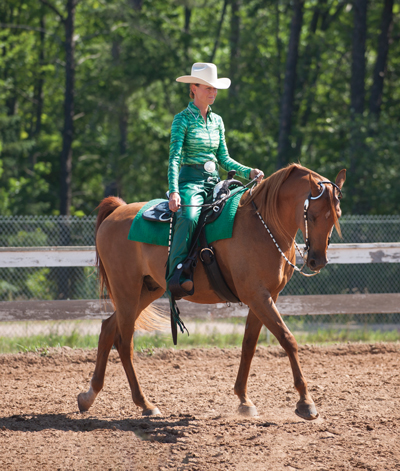
Arabian Western Pleasure
The versatile Arabian makes a great partner for western or English riding. Photo by Paulette Johnson

How Versatile is an Arabian Horse?

The spirited Arabian has no shortage of talent when it comes to competing or performing. Arabians are used in racing, and also compete in endurance riding, where horse and rider complete long-distance rides of 50 or 100 miles.

And whether it’s a local open show or an Arabian breed show, you’ll find Arabians competing in hunters, western pleasure, English pleasure, dressage, jumping, saddle seat, reining, cutting, and many other disciplines, in addition to in-hand conformation and showmanship classes. Even though you might first think of Arabians as riding horses, you’ll also find some that compete in pleasure driving.

Arabians excel outside of competition too, whether it’s a quiet ride down a trail or a low-key ride around the outdoor arena.

Arabian Horse
Arabians are easily recognized by their dished faces and graceful movement. Photo by Robert Peek/Shutterstock

Are Arabian Horses Good for Beginners?

If you’re interested in Arabian horses and would like to learn more about them, you might be interested in the Arabian Horse Association’s Discovery Farm program. This program is an opportunity for beginning riders to meet Arabian horses and learn from informative farm owners who are willing to share their knowledge of Arabians.

For thousands of years, people have cherished their alliance with the Arabian horse. And when you ride or watch an Arabian, remember that you’re participating in that connection and helping to write the latest chapter in the Arabian’s story.

Arabians and Scholarships

The Arabian Horse Association
◆ National Arabian Horse Judging Contest scholarships
◆ Arabian Horse Youth Association Board of Directors scholarships
◆ Club and affiliate scholarships

The Arabian Horse Foundation

In a convenient one-stop site, the Arabian Horse Foundation allows students to fill out a single application that automatically makes them eligible for all memorial and regional scholarships.

The Foundation awards scholarships to high school students that have represented the Arabian breed in a positive manner, performed well in their studies, and been excellent members of their communities. The research arm of the Foundation is committed to supporting equine research directed toward improving the health of the Arabian breed.


Important Dates in Arabian History

Approx. 2500 B.C.: The ancestors of Arabian horses reside in the deserts of the Middle East and are beloved by the Bedouin people.

1724: The Godolphin Arabian is born. He will later become one of the most influential stallions in Thoroughbred history.

1770s: George Washington rides Blueskin, a half-Arabian, throughout the Revolutionary War.

1888: The first breeding program for purebred Arabians is established in the United States.

1908: The Arabian Horse Club of America (now the Arabian Horse Association) is established, and 71 purebred Arabians are registered. Over one million Arabian horses have been registered as of 2020.

1926: W.K. Kellogg (of Kellogg’s cereal fame) imports Arabians and establishes the Kellogg Ranch.

1926: The stallion *Raffles is born at Lady Wentworth’s Crabbet Arabian Stud in Sussex, England. He arrives in the United States in the 1930s and begins his influential contribution to Arabian breeding in the United States.

1941: Walter Farley’s The Black Stallion is published.

1948: Marguerite Henry’s King of the Wind: The Story of the Godolphin Arabian is published, and it wins the Newbery Medal in 1949 for its distinguished contribution to children’s literature.

1956: The stallion *Bask++ is born in Poland. He is later imported to the United States, where he subsequently sires more than 1,000 foals.

1993: An Arabian stallion named JB Kobask debuts as “Thunder,” an official mascot of the Denver Broncos football team. Two other Arabian geldings have also served as Thunder II and Thunder III, respectively.

2003: The Arabian Horse Association is formed by a merger between the International Arabian Horse Association (IAHA) and the Arabian Horse Registry of America (AHRA). It becomes the official breed registry.

This article about the Arabian horse breed appeared in the Spring 2020 issue of Young Rider magazine. Click here to subscribe!

Attendees Enjoy Equitana’s First American Entertainment and Education Expo in 2021

0
Shawna Karrasch and positive reinforcement training
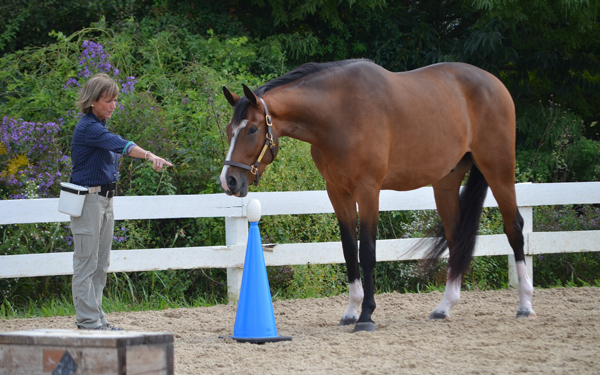
Shawna Karrasch showcasing positive reinforcement training during Equitana. Photo by Sarah Evers Conrad


Shawna Karrasch and positive reinforcement training
During her presentation, Karrasch sent a young horse between herself and the owner over a pole and then a small jump. Photo by Sarah Evers Conrad

Equitana USA, produced by Reed Expositions, debuted at the Kentucky Horse Park the first weekend in October, welcoming horse lovers with a premier mix of equestrian instruction, education, shopping and entertainment. After going virtual in 2020, the long-awaited event finally greeted fans in person October 1–3, 2021, as the first hints of fall began to arrive in Kentucky.

Shawna Karrasch and positive reinforcement training
Owner of this young horse was able to have this colt touch a target and jump a jump off lead using positive reinforcement techniques taught by Shawna Karrasch. Photo by Sarah Evers Conrad

The legendary Kentucky Horse Park was the perfect setting for the all-breed, all-discipline exhibition to begin in North America. Located in the heart of Kentucky’s Bluegrass horse country, Lexington, Kentucky, is known as the horse capital of the world.

Equitana USA Education

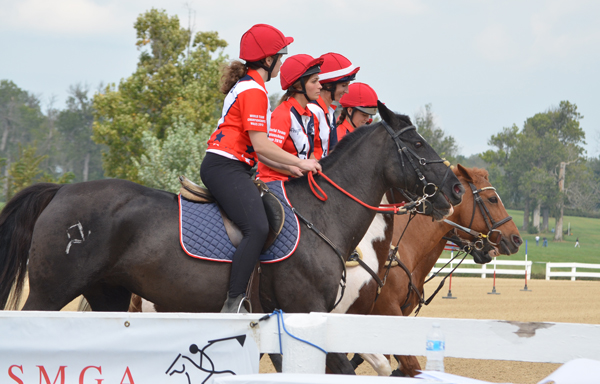
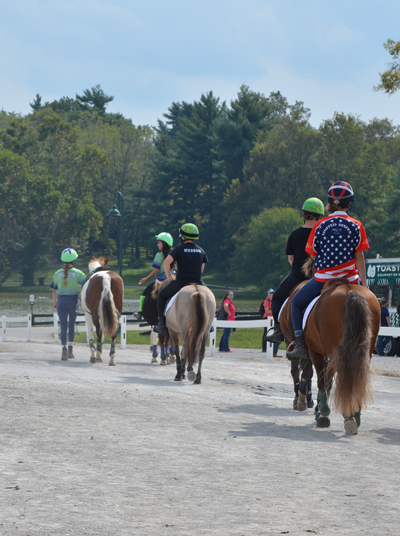
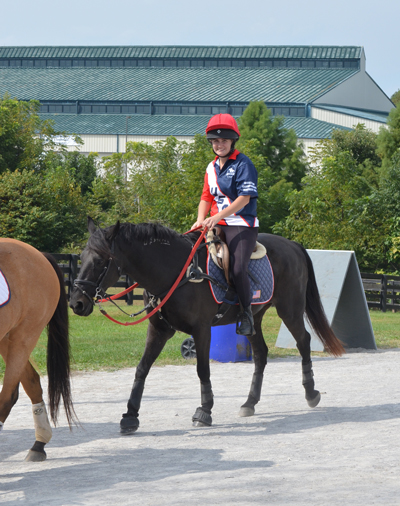
With over 40 daily sessions, there was plenty to experience at Equitana USA. The education program brought trainers of all types into one space, from natural horsemanship to dressage, show jumping and eventing. polo, vaulting, mounted games, trail sports, and other disciplines also had a moment in the spotlight.

Christy Landwehr, Certified Horsemanship Association
Christy Landwehr, CEO of the Certified Horsemanship Association, during her talk on Teaching Techniques for Riding Instructors. Photo by Sarah Evers Conrad

The opportunity to audit clinics with U.S. Olympians Phillip Dutton and Laura Graves was high on the list for many equestrians. Clinician and horseman Pat Parelli drew an enthusiastic crowd as he presented the fundamentals of Horse Psychology 101.
Cross-training with Lynn Palm, yoga for equestrians, and the Masterson Method equine bodywork with Jim Masterson were all part of the exciting lineup.

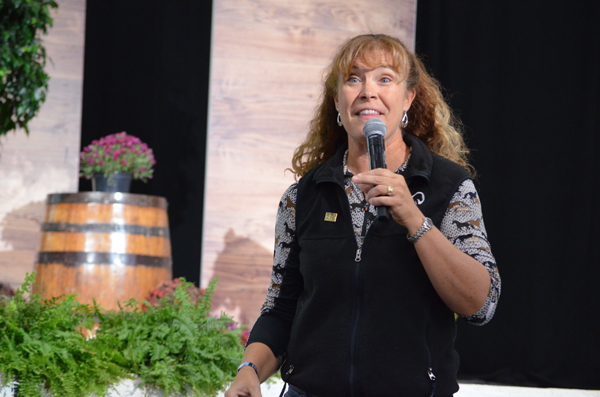
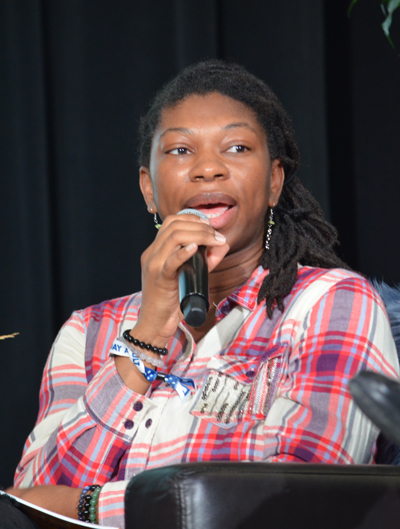
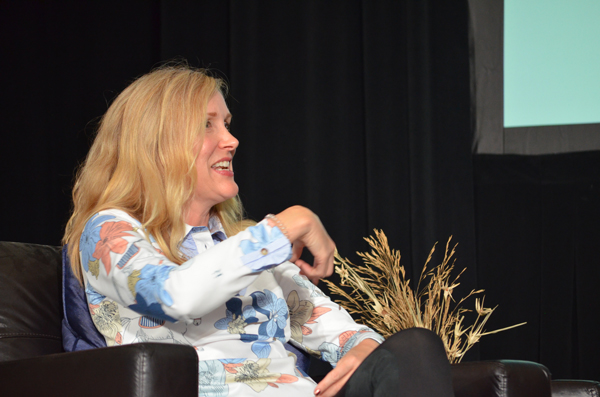
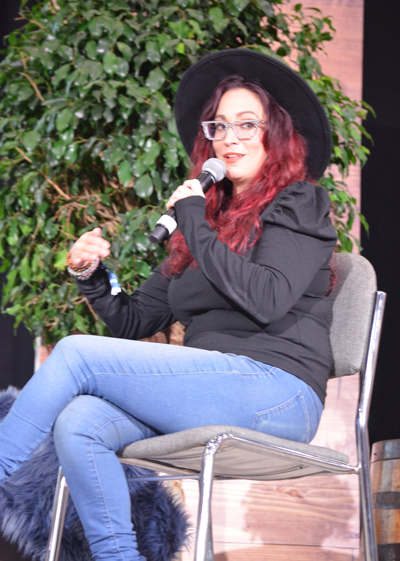
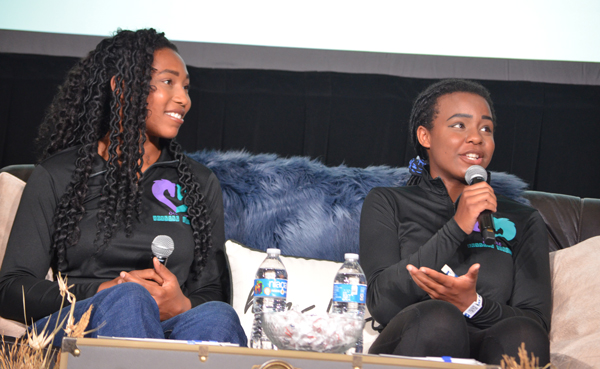
Caitlin Gooch of Saddle Up and Read during Social Responsibility of Equestrian Influencers
Caitlin Gooch of Saddle Up and Read during Social Responsibility of Equestrian Influencers. Photo by Sarah Evers Conrad
Susan Friedland of Saddle Seeks Horse during Social Responsibility of Equestrian Influencers
Susan Friedland of Saddle Seeks Horse during Social Responsibility of Equestrian Influencers. Photo by Sarah Evers Conrad
Heather Wallace of The Timid Rider
Heather Wallace of The Timid Rider moderated the panel called Social Responsibility of Equestrian Influencers. Photo by Sarah Evers Conrad

Equitana USA Entertainment

No celebration of horses is complete without a showcase of breeds, and the event featured equines of all shapes and sizes, from Arabians to Akhal-Tekes. Morgans displayed multi-discipline talents and temperament with youth riders, while smooth-gaited breeds, including the Rocky Mountain Horse and Tennessee Walking Horse, showed off their easy, natural gaits. Ex-racehorses were well represented with performances by an all-Standardbred drill team.

Emily and Sarah Harris of Sisters Horseing Around
Emily and Sarah Harris of Sisters Horseing Around during their panel, Social Responsibility of Equestrian Influencers. Photo by Sarah Evers Conrad

Emily and Sarah Harris of Sisters Horsing Around shared the versatility of their Irish Cob, demonstrating dressage, jumping, barrels and poles all in one session. Meanwhile, Miniature Horses strolling around were perfect equine ambassadors attracting fans of all ages. Celebrity horse appearances included fan favorites Patrick the Mini Horse and Lynn Palm’s Rugged Painted Lark.

Dan James of Double Dan Horsemanship wowed the crowd with his liberty demonstrations while sharing the secrets behind liberty training and new ways to participate through the International Liberty Horse Association.

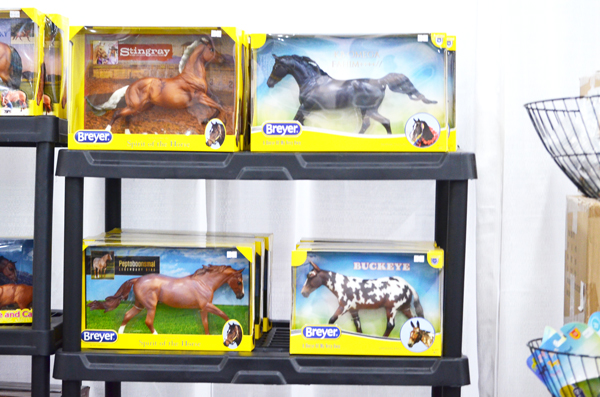
Fun zones for kids included a horseless horse show, a Breyer horse painting station, and a hands-on educational display from the United States Pony Clubs where kids could learn about horse colors and markings, brush a horse, measure their height in hands, and more.

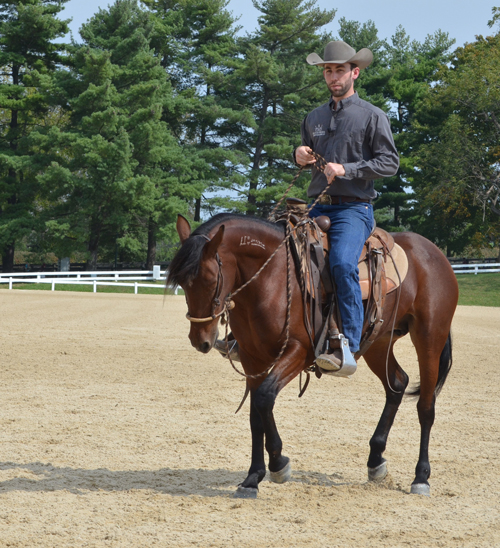
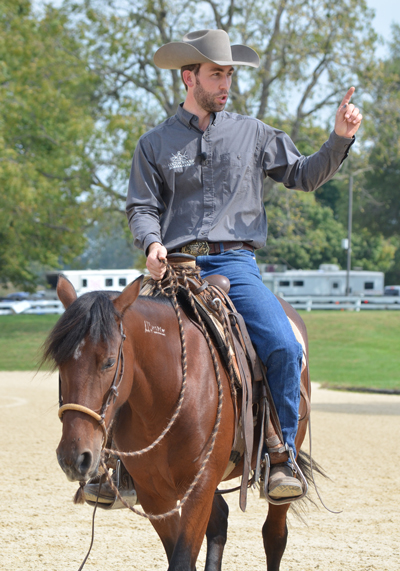
Colton Woods
Colton Woods taught several demos with a young Mustang and a Warmblood. Photo by Sarah Evers Conrad
Colton Woods
Wood’s demos were quite popular. Photo by Sarah Evers Conrad
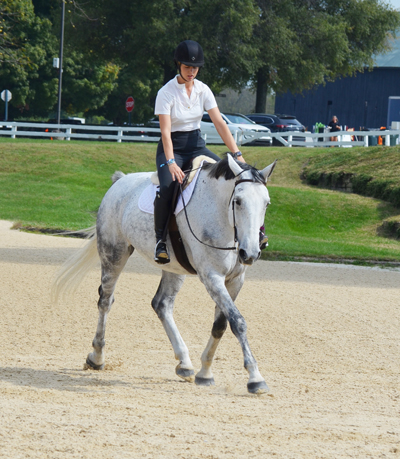
Wood's wife, Maredith, rode her Warmblood to demonstrate several of his techniques.
Wood’s wife, Maredith, rode her Warmblood to demonstrate several of his techniques. Photo by Sarah Evers Conrad

The Equitana Experience

Equitana USA felt open, welcoming and easy to navigate. Action centered around the covered arena, with three rings of action going strong right outside all day long, in addition to the main stage indoors. Up the hill, the Rolex Stadium and Pegasus arenas accommodated bigger clinics. Local food trucks helped elevate the dining options above the typical horse show and fair food, while bright potted mums and seasonal décor were small touches that contributed to the top-level event atmosphere.

The trade fair offered shopping and resources for equestrians to explore, including equine representatives of various breeds. You could feed treats to a Morgan, get friendly with a Fjord, say hello to an American Saddlebred or get acquainted with an Arabian horse.

Polo team
Several polo teams were on hand to showcase this exciting equestrian sport. Photo by Sarah Evers Conrad
Polo team
Photo by Sarah Evers Conrad
Polo team
Photo by Sarah Evers Conrad

Exchanging Ideas and Information

One of the goals of Equitana USA is to promote the exchange of ideas and information. Thought-provoking panel discussions on the main stage addressed topics, including traditions and change in the horse industry, how to make a positive impact, and ways to improve accessibility to horses for everyone.

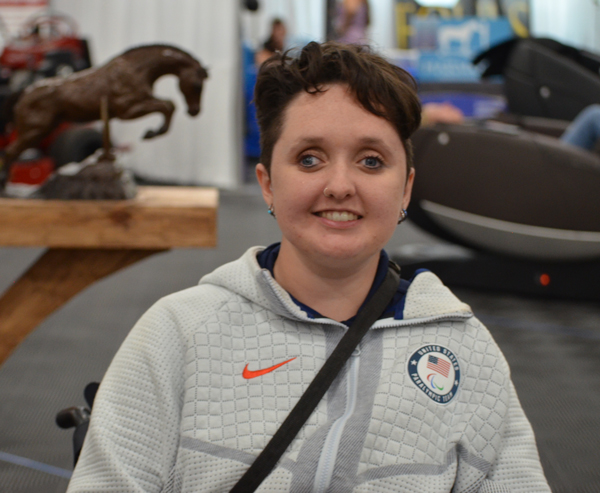
Paralympian Sydney Collier closed out the weekend with a compelling closing keynote talk. “Let’s face it, there are no improvements to be made without taking that initial leap of faith, in starting the process,” she explained. “That’s where it’s so intimidating … to take that first step in whatever you’re trying to do.”

Paralympian Sydney Collier. Photo by Sarah Evers Conrad

Equitana USA offered ways for equine enthusiasts of all levels to take that step, from meeting a horse for the first time to learning how to become a better partner for your horse. Most of all, the event brought a feeling of community through a shared passion for horses, in addition to how we can all find ways to be part of the horse industry and make it better.

Equitana USA is scheduled to return to the Kentucky Horse Park in September 2022, with dates to be announced soon.

Equitana USA Vendor Village

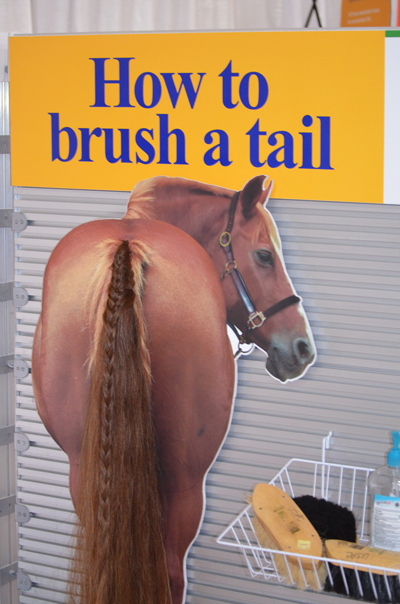
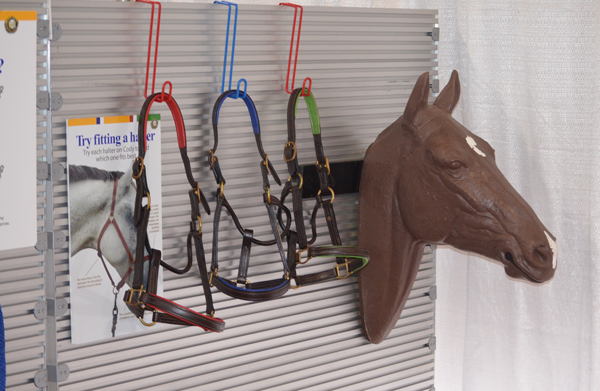
1. U.S. Pony Clubs Interactive Booth

U.S. Pony Clubs had a display to teach attendees about horses. Photo by Sarah Evers Conrad

2. U.S. Pony Clubs Interactive Booth

The interactive U.S. Pony Clubs display allowed attendees to get hands on in learning about horses. Photo by Sarah Evers Conrad

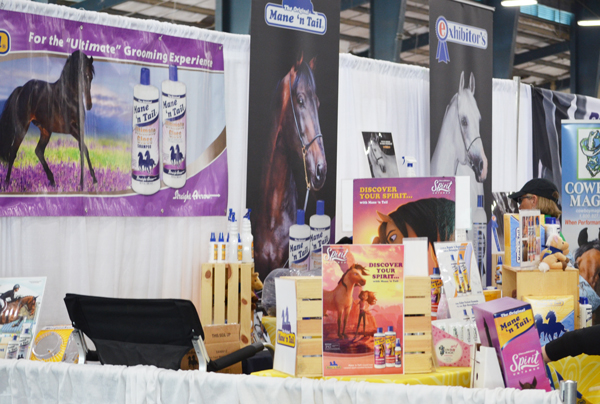
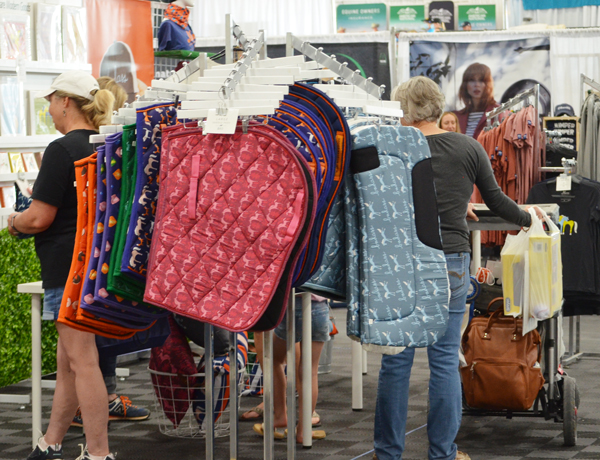
3. Straight Arrow’s Mane ‘N Tail and Exhibitor Booths

The shopping and vendor village were definitely a fan favorite. Photo by Sarah Evers Conrad

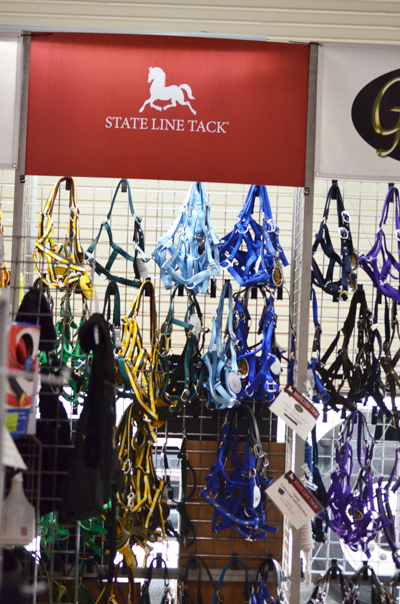
4. State Line Tack Booth

Photo by Sarah Evers Conrad

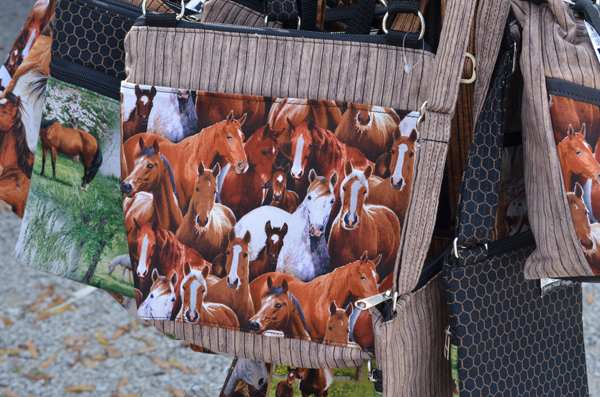
5. Fun Horse Purses

Photo by Sarah Evers Conrad

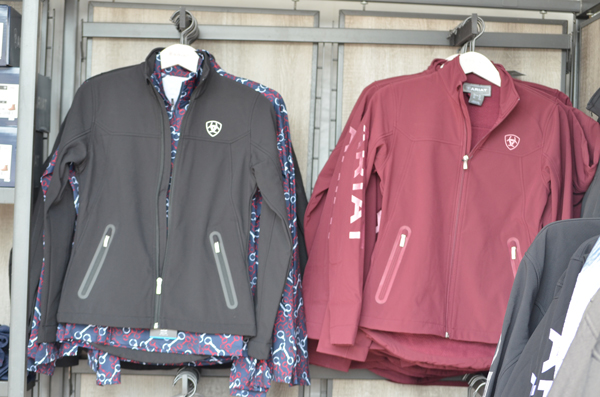
6. Ariat Booth

Photo by Sarah Evers Conrad

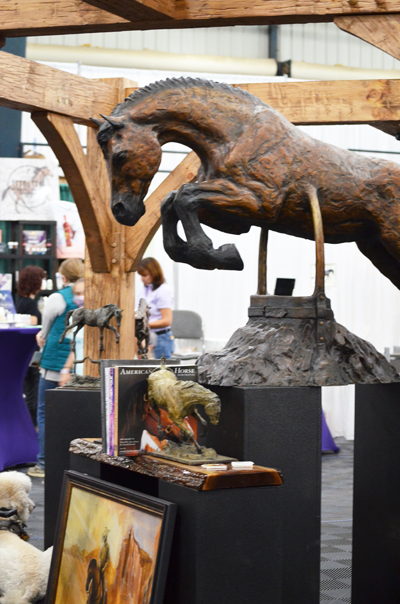
7. Amazing Equestrian Artwork

Photo by Sarah Evers Conrad

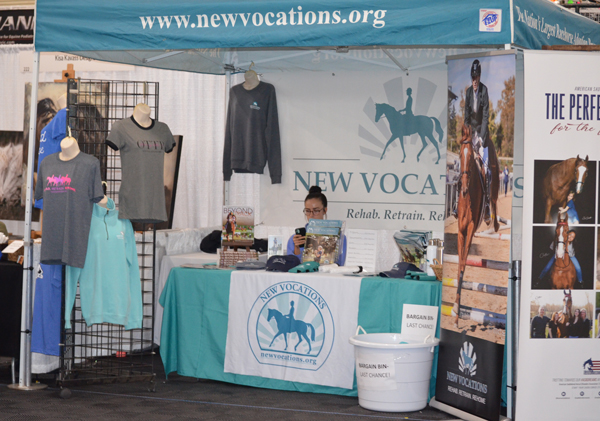
8. New Vocations Booth

Photo by Sarah Evers Conrad

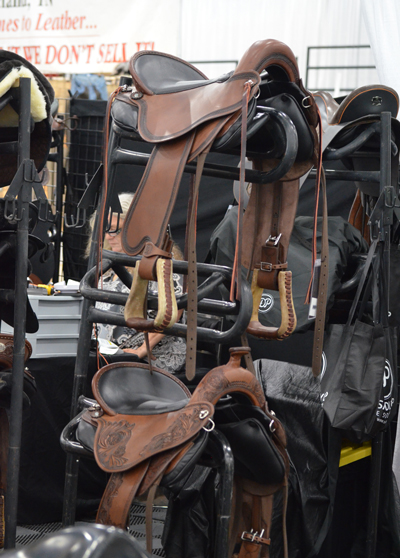
9. Saddles for Sale

Photo by Sarah Evers Conrad

10. Mare Modern Goods Booth

Photo by Sarah Evers Conrad

Santa Anita Announces Santana Mile to be Renamed John Shear Mile for Recently Retired 100-Year-Old Paddock Captian John Shear

0
John Shear Santa Anita Mile Race
Photo Courtesy Santa Anita

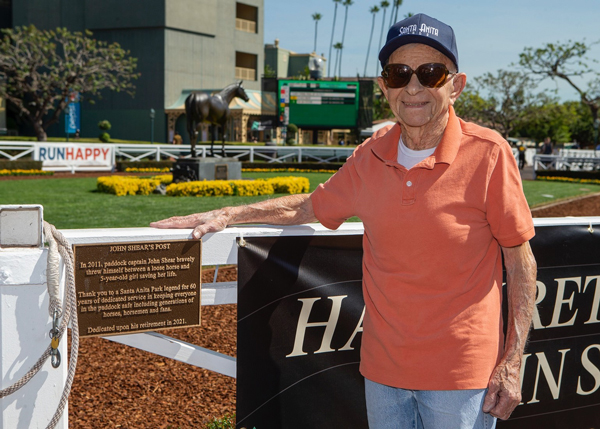
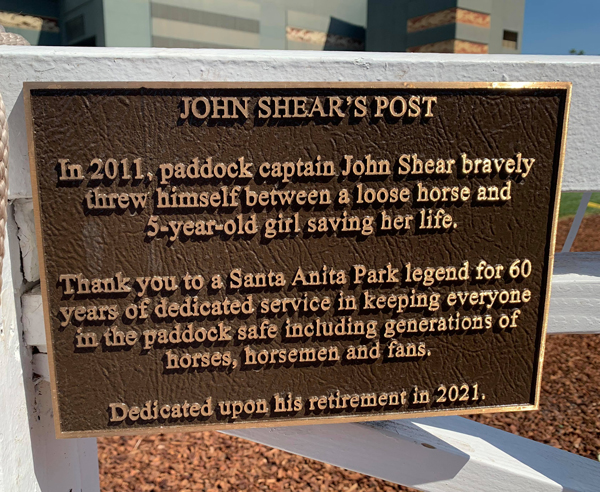
On the day Santa Anita unveiled a plaque commemorating six decades of dedicated service to its recently retired 100-year-old paddock captain, John Shear, the track has also announced that it will further honor him by renaming the Santana Mile the “John Shear Mile.”

For older horses, the $75,000 John Shear Mile will be run on Sunday, April 10, 2022.

Employed by Santa Anita since 1961, Shear, who retired this past June, gained national recognition when on March 12, 2011, he sustained life threatening injuries as he threw himself between an onrushing loose horse and a 5-year-old girl just outside Santa Anita’s Seabiscuit Walking Ring.

John Shear Plaque
Photo Courtesy Mike Shear

“John Shear is a legend among all of us here at Santa Anita, fans, jockeys, horsemen and employees,” said Chris Merz, Santa Anita’s Director of Racing and Racing Secretary. “We are proud to rename this race in his honor and to help share his legacy of kindness, compassion and dedication to the well-being of our sport with many generations of future racegoers.”

Orphaned at a young age in his native England, Shear aspired to be a jockey as a young man but emigrated to Canada as an exercise rider who later worked as an assistant trainer. Asked in the fall of 1954 if he’d like to accompany a group of horses from Vancouver, B.C., to Santa Anita, Shear leapt at the chance and the rest as could be said, is history.

“I was exercising horses for a guy in Vancouver, and he asked me if I’d like to go with him to Santa Anita that fall,” said Shear in an interview prior to his 99th birthday in January 2020. “I said ‘Sure,’ and as soon as I stepped off that van in the stable area here, I said ‘Lord, this is where I want to be.’ The place was so incredibly beautiful, and I’ve never gotten tired of it.”

A diminutive 5’4″, Shear checks in at about 115 pounds. “I’m gonna get to 120,” he quipped in the paddock ceremony in which he posed with many fellow employees, fans and Hall of Fame trainer Richard Mandella.

With birthday number 101 looming on Jan. 17, Shear, who still participates in a daily exercise regimen that includes push-ups, will certainly hope to be on hand to present the John Shear Mile trophy on April 10.


My Right Horse Adoptable Horse of the Week: Hawk — October 4, 2021

0
My Right Horse Adoptable Horse of the Week - Hawk
Photo Courtesy Equine Adoption Center

Welcome to Horse Illustrated’s weekly installment of the My Right Horse Adoptable Horse of the Week, offered in partnership with The Right Horse. Hawk is this week’s adoptable horse. Check back weekly for a new featured horse so you can find your #righthorse.

My Right Horse Adoptable Horse of the Week - Hawk
Photo Courtesy Equine Adoption Center

Horse: Hawk, a 21-year-old 15.1-hand pinto American Saddlebred gelding in Lexington, Ky.
Organization: Kentucky Equine Adoption Center

Hawk is a lovely gentleman who staff at the Kentucky Equine Adoption Center does not think has ever been ridden before. He is very easy to handle and learns best when given time and patience. We have started introducing him to a rider’s weight and to a saddle and bridle. Hawk is a very calm horse, and after a little time, he could make a nice riding horse.

Click here for questions about Hawk, the My Right Horse Adoptable Horse of the Week

My Right HorseMy Right Horse is the online adoption platform of The Right Horse Initiative, a collection of equine industry and welfare professionals and advocates working together to improve the lives of horses in transition. A program of the ASPCA, their goal is to massively increase horse adoption in the United States. To find more adoptable horses and foster horses, visit www.myrighthorse.org. To learn more about The Right Horse, a program of the ASPCA, visit www.therighthorse.org.

0FansLike
0SubscribersSubscribe
We use cookies to help personalize content, tailor and measure ads, and provide a safer experience. By navigating the site, you agree to the use of cookies to collect information. Read our Cookie Policy.
OK