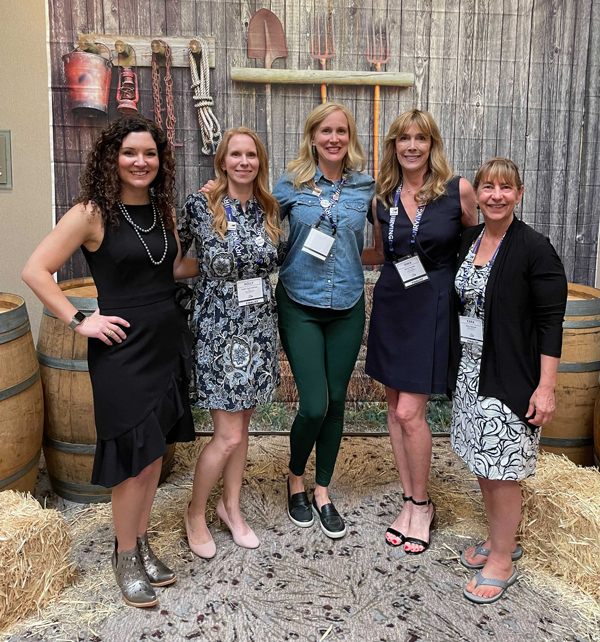
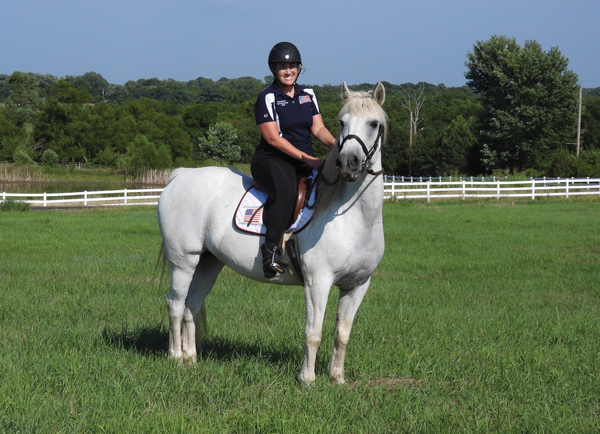
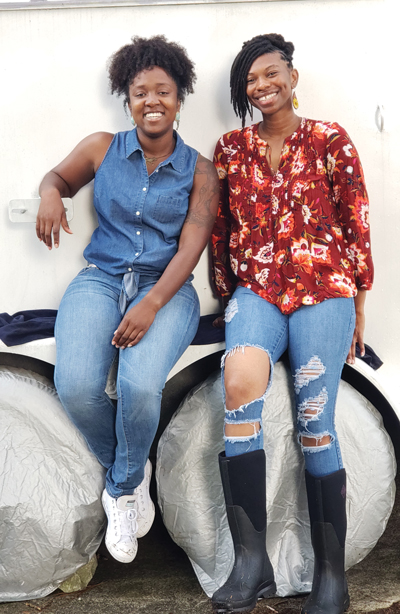
Horse Illustrated Editor Holly Caccamise (2nd from left) and EG Media Business Lead Rima Dorsey (2nd from right) with Horse Illustrated freelancers Abigail Boatwright, Susan Friedland, and Kara Stewart at the 2021 AHP Conference.
Horse Illustrated and Young Rider magazines have a lot to be proud of in 2021 after the American Horse Publications (AHP) Equine Media Awards were doled out at the 2021 AHP Back in the Saddle Conference in Irving, Texas on September 18, 2021. The AHP Equine Media Awards are the premier awards within the equine media industry. It was the first in-person AHP conference since the pandemic started, but it was a repeat performance of last year for both publications as they picked up awards yet again in editorial and photography categories, and the biggest award for Horse Illustrated was Honorable Mention in the General Excellence Self-Supported Publication (circulation 15,000 and over). Horse Illustrated captured the top honor in this category in 2019.
“It takes a lot of work in conjunction with our fantastic freelancers to pull together each issue, and being recognized with AHP awards is truly an honor that makes it all worthwhile,” said Editor Holly Caccamise. “Receiving the runner-up award for General Excellence, especially after winning this category in 2019, tells us we are on the right track in delivering a high-quality product to our subscribers.”
The judges shared the following comments about Horse Illustrated’s entry in the General Excellence category: “Horse Illustrated is a magazine that is inclusive of all breeds of horses and all disciplines of horsemanship…The introductory covers are luminous through splendidly sunlit images. The powerful masthead and colorful groups of cover lines add excitement. Inside, the magazine design has a refreshing cohesive feel; it is the stylized typography in the headlines, along with the black-and-brown color pallet and skillful use of white space that create this good experience. The photos that complement the stories are narrative and well-positioned.”
Horse Illustrated captured the following awards out of entries that were submitted by the publication:
Honorable Mention in General Excellence Self-Supported Publication (circulation 15,000 and over) for the January 2020 and June 2020 issues of Horse Illustrated (out of 10 entries)
2nd place in Editorial Action Photograph for “Horses From Above” by Shelley Paulson (out of 7 entries)
3rd place in Self-Supported Publication Feature Single Article for “Shining a Light” by Amy Hempe in the October 2020 issue (out of 34 entries)
3rd place in the Instructional Single Article for “Clicks and Flicks” by Daniel Johnson in the June 2020 issue (out of 16 issues)
Freelance contributors received the following honors for their work published in Horse Illustrated and Young Rider:
2nd place in Freelance Wrtier Equine-Related Journalism Article for “Becoming a Trainer” by Jennifer Bryant in the Summer 2020 issue of Young Rider magazine (out of 6 entries)
2nd place in Freelance Editorial Action Photograph for “Horses From Above” by Shelley Paulson (out of 6 entries)
Honorable Mention in Self-Supported Publication Horse Care Single Article for “The Retiree’s Workout Regimen” by Kara Stewart in the October 2020 issue of Horse Illustrated (out of 24 entries)
Honorable Mention in Self-Supported Publication Horse Care Single Article for “Scratch That” by Allison Rehnborg in the September 2020 issue of Horse Illustrated (out of 24 entries)
The 2021 Equine Media Awards competition for material published in 2020 included a total of 643 entries in 56 classes by 98 members, 33 Publishing Media members, 19 Media Professional members, and 14 Business members. The complete results are available online in the awards program (PDF format) and video of the winning entries at www.americanhorsepubs.org/ahp-awards-contest.
Believe it or not, skin is the body’s largest organ, so it makes sense that untreated skin funk can make your horse miserable in a hurry, especially when exacerbated by heat and biting insects. some skin conditions are also contagious—spreading from horse to horse—as well as zoonotic, meaning they spread from horses to humans.
That’s why it’s crucial for horse owners to learn to identify the causes and clinical signs of common skin issues. By educating yourself about them, you can quickly and correctly treat the problem. Your horse will thank you!
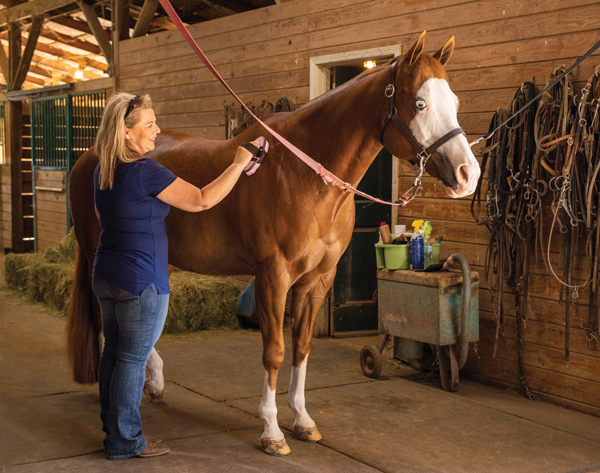
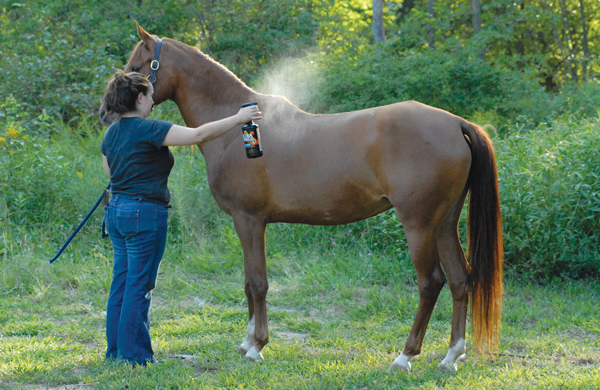
Regular use of fly repellent helps keep the skin’s barrier intact from bites, preventing many possible skin conditions. Photo by Dusty Perin
A Healthy Skin Barrier
According to Rosanna Marsella, DVM, a veterinary dermatologist at the University of Florida
in Gainesville, Fla., the key to preventing many problematic skin conditions is to protect your horse’s skin from trauma.
Grooming your horse on a daily basis can help keep your horse’s skin and hair healthy, but it’s also important to provide horses with adequate shelter from the elements, as well as protection from biting insects. When trauma occurs to the skin, your horse becomes more susceptible to bacterial or fungal infections.
“Animals who are immunosuppressed, or out in the rain day in and day out, or getting bitten by bugs, experience more trauma to the skin,” Marsella explains. “If the skin has no insect bites and the horse isn’t itchy and rubbing himself on a tree, for example, then the integrity of the skin barrier remains intact.”
Fight Flies
In addition to practicing good grooming habits to keep your horse’s skin and hair healthy, invest in a good fly product to prevent bites.
“Use of effective fly repellent is key, and that’s actually a topic that frequently confuses many people,” says Marsella. “The labels on some products may make them sound like repellents when they’re actually insecticides. If you spray an insecticide directly on an insect, it dies. But insecticide doesn’t prevent the insect from actually landing on the horse. That’s why you need to use repellent.”
When you’re looking for fly repellent, Marsella recommends checking the active ingredient listed as well as the percentage of the active ingredient.
“One example is permethrin,” she says. “In order to be a repellent, a fly spray product has to be at least 0.5 or 1 percent permethrin. But if a product only has 0.1 percent permethrin, then it’s not a repellent.”
For horses who may be allergic to chemicals, Marsella recommends trying botanical products, such as neem oil.
“Neem oil is a demonstrated repellent against mosquitos and no-see-ums,” says Marsella.
There’s another benefit to a daily routine of grooming and using fly repellent. By laying your hands on your horse every day, you’ll learn what’s normal for him and what’s not. Then you can spot skin issues in the making before they ever become full-blown problems.
There are many different skin conditions in horses, often with multiple contributing factors. Some horses can develop secondary issues, such as staph infections, which may require prolonged medical treatment from a veterinarian. If you suspect your horse is developing a skin condition, call your vet immediately.
Rain Rot
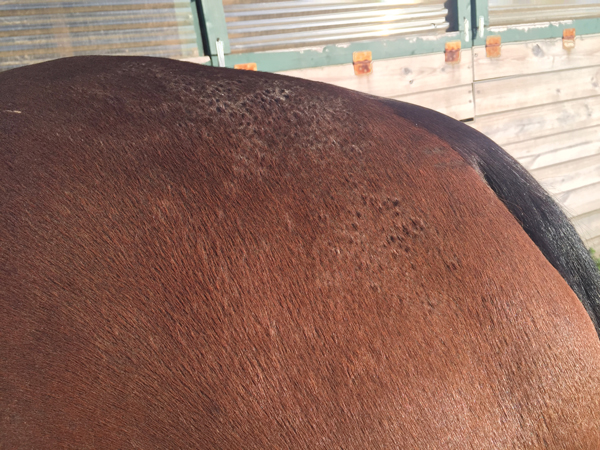
Rain rot is caused by the bacterium Dermatophilus congolensis. Characterized by small, round scabs crowned with matted hair, rain rot lesions typically develop along the topline of the horse.
Rain rot shows as tufted scabs, usually along the horse’s topline, exacerbated by moisture. Photo by Holly Caccamise
“The development of the disease is precipitated by moisture, which is why we call it ‘rain rot,’” says Marsella. “It’s common in animals who are immunosuppressed or out in the rain and bitten by insects. Dermatophilus can access the skin when there’s trauma. Don’t pick at the scabs, because it’s painful for your horse and also delays healing. When the scabs are ready and the skin underneath is healthy, the scabs will come off on their own. But pulling a scab off and leaving a raw spot is never the answer.”
Rain rot is contagious and zoonotic, which means that other horses and humans can contract the condition. Marsella recommends treating rain rot with an antimicrobial shampoo, such as chlorhexidine or benzoyl peroxide.
“People can be overzealous and like to scrub at the lesions, because they think it will speed up the recovery, but the single most important thing is contact time,” says Marsella. “Apply the shampoo, gently massage it in, and then set your clock for 10 minutes and go do something else. Then come back and rinse. Contact time is what really makes the difference.”
Scratches
Pastern dermatitis, or scratches, is a name for a clinical syndrome, rather than a specific disease. Another common name for scratches is “dew poisoning.” Pastern dermatitis refers to the development of scabby areas on or near the pasterns. Two of the most common causes of pastern dermatitis include bacterial infections and mange.
Pastern dermatitis, also known as “scratches,” is common on white legs. It can be treated with anti-bacterial shampoo and prevented with socks or coverings on the legs. Photo by Anjajul/Shutterstock
“Pastern dermatitis can be caused by a lot of different things, including allergies, auto-immune diseases, staph infections or vasculitis,” Marsella explains. “It’s common on horses with white legs or horses with feathers. When an owner has a horse with pastern dermatitis, they can use an antimicrobial shampoo because there’s probably an overgrowth of bacteria.”
In addition to treating for bacteria, owners can protect horses with white legs from pastern dermatitis by covering the legs with socks or wraps.
“Products like antimicrobial silver socks may help, but more importantly, the sock also protects the skin from UV exposure,” says Marsella. “Vasculitis is triggered by UV rays. You can either put socks on your horse or keep him inside during the day and turned out at night. Many cases of pastern dermatitis also have an insect component, so it’s important to use repellent.”
Mites can also cause pastern dermatitis in horses with feathers. Mites can spread from horse to horse and can also survive in the environment for several weeks.
“Feathered horses are prone to mites, and they get very itchy legs as a result,” says Marsella. “Some horses may become itchier than others because they develop allergies to the mites. When you have mites, you’ve got mange.
To treat mange, you have to kill the mites with a treatment like a lime sulfur dip. If a horse is diagnosed with mites, everybody in contact has to get treated whether they’re symptomatic or not. The life cycle of the mite is three weeks, so treatment has to be at least that long.”
Ringworm
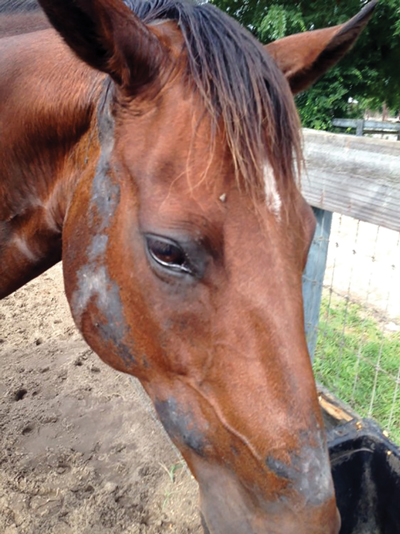
Ringworm is a common skin infection caused by a fungus, not a parasite. Ringworm presents as round, raised lesions on the skin that may be itchy.
Ringworm is a common skin infection caused by a fungus. It’s easily passed between horses, so use a clean set of separate grooming tools on any infected horses. Photo Courtesy Dr. Rosanna Marsella
“They call it ‘ringworm’ because it will develop a round lesion on the skin, but it’s actually caused by a fungus,” Marsella explains. “It is transmissible, so you need to treat the horse for it.”
Ringworm can be transmitted from horse to horse by direct contact or by sharing infected tack, brushes, clothing or other equipment between horses. Marsella recommends using an antifungal treatment, such as a lime sulfur dip, to treat ringworm. Pastern dermatitis, also known as “scratches,” is common on white legs.
“Lime sulfur is very effective at killing fungi and helps with the itching,” says Marsella. “It
will also kill mites.” Dealing with any kind of skin condition— especially before it gets out of hand—not only allows your horse to look his best, but it helps him stay comfortable, happy, and itch-free.
Allison Armstrong Rehnborg is a freelance equine writer and photographer who lives in Lebanon, Tenn. With her master’s degree in horse science, she writes about all aspects of horse care and management, including health, training and breeding.
Stop the Spread
To stop the spread of a condition like rain rot or ringworm, follow these
simple rules:
◆ Don’t share equipment between horses. Each horse should have his own grooming equipment, tack, halters, saddle pads and blankets.
◆ Disinfect your horse’s equipment on a regular basis. Bleach and wash saddle pads at high temperatures. Dip brushes in a dilute bleach solution, rinse thoroughly, and let them dry in the sun.
◆ Advise barn staff or visitors to wash their hands in between tending to or petting horses.
◆ If you suspect a horse has a contagious skin condition, isolate him in a stall or small pen until the veterinarian arrives.
Horses with compromised immune systems are more likely to develop skin conditions like ringworm or rain rot. Practice good preventative maintenance on all horses, but especially geriatric horses or horses that travel frequently.
“Preventative care is a big part of taking care of your horse’s immune system,” notes Rosanna Marsella, DVM, a veterinary dermatologist at the University of Florida in Gainesville, Fla. “Make sure your horse is fed properly, dewormed and vaccinated, and decrease stressors, like frequent transportation. Going from show to show isn’t ideal, so if the horse’s lifestyle can be a little more relaxed, that goes a long way toward keeping him healthy.”
Cannon Crud
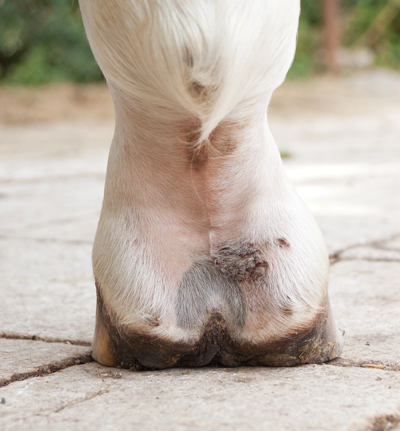
To keep the non-genetic form of cannon keratosis at bay, regularly groom the area and wash with a keratolytic shampoo. Photo by Allison Armstrong Rehnborg
Cannon keratosis is often used to refer to “cannon crud,” or the development of flaky skin and oily build-up of keratin on the front of the cannon bones. But there’s also a genetic condition known as primary cannon keratosis.
“Primary cannon keratosis is not common,” says Rosanna Marsella, DVM, a veterinary dermatologist at the University of Florida in Gainesville, Fla. “There are some horses that are genetically prone to this disease. The skin has a different way of maturing in some body areas, including on the cannon bone. This is not an infection. Horses with primary cannon keratosis will be genetically prone to it, and they will always have a little bit of crusty skin in that area. The treatment is management using shampoos to soften and loosen up the scabs. These horses can also get keratosis on their sides or chest.”
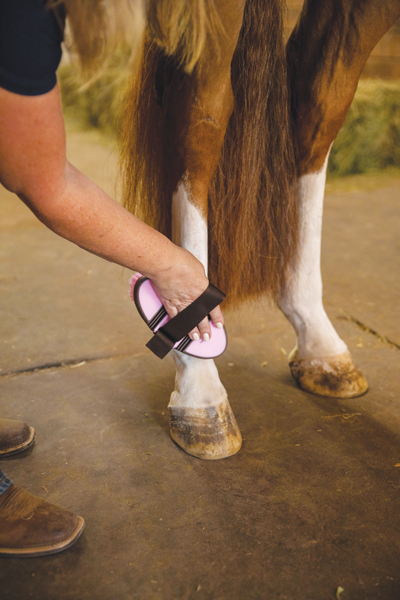
For the non-genetic form of cannon keratosis, gently groom your horse’s legs with a curry comb and wash with an keratolytic shampoo to help manage crusty scabs and flaky skin.
To keep the non-genetic form of cannon keratosis at bay, regularly groom the area and wash with a keratolytic shampoo.
This article about common horse skin conditions appeared in the September 2020 issue of Horse Illustrated magazine. Click here to subscribe!
Ozzie required an experienced rider and some special maintenance, but Cathie Chiccine has been a trainer for 20 years and fell in love with his potential. Photo by Katie Gulley
Audrey was not the most likely candidate for adoption when she arrived at This Old Horse in Hastings, Minn. The small, 6-year-old Appaloosa mare had a newborn foal at her side and was in foal for 2020 when she came to the organization. She was not only severely neglected—she was also blind. Experts debated on a prognosis for her recovery and quality of life. It was going to be hard to find someone to adopt this horse.
And yet, by the end of 2020, both of Audrey’s healthy foals were adopted into loving homes—and so was Audrey. The little blind mare found her way into the heart of one of the long-term volunteers who had been caring for her.
The path to “happily ever after” may be a little more challenging for horses like Audrey, but innovative new programs are helping a number of equine adoption organizations find homes for hard-to-adopt horses.
Online Matchmaking
The Right Horse Initiative, a program of the American Society for Prevention of Cruelty to Animals (ASPCA), is working to increase equine adoption numbers through a national network of partner organizations, including This Old Horse and more than 30 others. The group’s online adoption platform, MyRightHorse.org, helps bring adoptable horses to a broader audience, while the ASPCA Horse Adoption Express helps transfer horses between facilities to locations where there is a greater demand or to trainers who can work with the horses to make them more adoptable.
“The ‘hard-to-adopt’ horses often have to be here longer for that right person to find them,” says Amanda Mullen, director of Longmeadow Rescue Ranch, a Right Horse partner organization in Union, Mo. “We’ve found that we need to make sure to market that animal through social media, website listings, awesome photos and videos, and take them to local horse shows, if possible. There is an owner out there for every horse, and our job is to get that horse in front of as many eyes as possible.”
Ozzie is one success story from Longmeadow Rescue Ranch who benefited from increased exposure through MyRightHorse.org. Cathie Chiccine and her sister were browsing the site looking for a horse for Cathie’s sister. They filled out an application for Ozzie, a 13-year-old gelding at Longmeadow Rescue Ranch, who had been there for quite a few months waiting for his right match. Chiccine’s sister ended up falling in love with a different horse from the website, but Chiccine decided she wanted to go ahead and meet Ozzie herself, as she had recently retired her all-around horse.
The trainer at Longmeadow Rescue Ranch let Chiccine know about some of Ozzie’s behaviors and management needs that made him best suited for an experienced rider. A rider for 30 years and trainer for 20, Chiccine quickly fell in love with Ozzie and immediately recognized his potential.
As soon as she rode him, she says they fit together perfectly. The trainer and staff at Longmeadow noticed how relaxed Ozzie was with Chiccine. The pair has gone on to success in mounted games competition, where the forward-thinking Ozzie has found the perfect job for his busy mind and occasional “pony zoomies.”
“Our biggest challenge is finding adoptive homes with experienced riders,” says Mullen. “We find that a lot of people think they are experienced riders or perhaps were at some time in their lives but haven’t ridden in a very long time.”
To help remedy this, Longmeadow created a riding lesson program that helps both riders and horses gain experience, and Mullen reports that many of the lesson students go on to adopt Longmeadow horses.
Non-Riding Adopters
Redefining the market of potential adopters to be more inclusive increases the odds of placing a hard-to-adopt horse even further.
“If we target riders as our only market for adopters, unrideable horses will never be adopted,” says Nancy Turner, president and founder of This Old Horse. “But if we target horse lovers—an endless audience—then all horses are adoptable. There are lots of ways to love horses, and riding them is just one.”
By welcoming volunteers with no equestrian experience, This Old Horse has created a path that often leads to adoption. People come because they feel welcome even if they’ve never been around horses before, says Turner. And while volunteers gain experience, the horses draw them in. With education and support from the organization, they become enthusiastic about adopting a special horse of their own.
A volunteer with no previous horse experience, Patrick Metzger fell in love with Gypsy, a blind 30-year-old horse who helped alleviate his depression. He decided to adopt her. Photo by Brenda Teter/Courtesy This Old Horse
One of those volunteers that had no previous horse experience is Patrick Metzger, who adopted Gypsy, a mare who is over 30 years old, blind, and has survived a lifetime of abuse and neglect.
“I fell in love with her,” says Metzger. “I was depressed when I first came here, and she really helped. She’s a loveable horse and helps me every time I come out. In my daily life I think about Gypsy. I think of how she endures, and that gives me strength to keep going.”
Astrid, a 10-year-old Norwegian Fjord Horse with a seizure disorder, was adopted by the Teter family. They became volunteers at This Old Horse when daughter Mara participated in the organization’s 4-H Horseless Horse program.
“I don’t think the fact that she has a seizure disorder matters,” says Brenda Teter. “She’s a horse that our whole family can share and love on, and we learned a lot about how to work with her and work with the seizures. She has a great quality of life, and our family’s quality of life has improved because of her.”
When it comes to small animal adoption, no one is asked what they “do” with their pets, as Turner points out.
Astrid, a 10-year-old Norwegian Fjord with a seizure disorder was adopted by the Teter family. Photo by Brenda Teter/Courtesy This Old Horse
“It’s understood that it’s a relationship,” she says. “Our adopters are as quirky, unsound and imperfect as our horses, and we create a community based on kindness and compassion.”
Preparing for Ownership
Companion equines provide great opportunities to learn about horses outside of the traditional path of lessons, riding and shows, paving the way for horse lovers to become horse owners.
The Kentucky Equine Adoption Center (KyEAC) in Nicholasville, Ky., is another Right Horse partner welcoming new people to the horse world. They recently introduced an eight-week education program called Support a Special Horse (SASH) for people who are interested in becoming horse owners. Participants work with KyEAC’s companion horses and learn the basics to prepare for horse ownership: how to halter and lead a horse, care and feeding, and what you need to have a horse on your own property.
Through this program, KyEAC has already seen success for the hard-to-place horse. An older Quarter Horse gelding named Butternut who had badly foundered and takes medication daily was adopted by Katie Blair and Michael Schmitt.
“Through the SASH program he found a couple to adopt him, and he has gone on to a new home where he is taken care of and loved on and has a new purpose being a friend for this family,” says Kelli Sorg, development director at KyEAC. “They were not horse owners to begin with, but always wanted to be.”
Butternut, an older Quarter Horse with special medical needs, was adopted by Katie Blair and Michael Schmitt through an ownership preparation course at the Kentucky Equine Adoption Center. Photo by Meghan Adelman
Sorg believes that non-riding horses excel at making connections, perhaps because they don’t have the stress of being in traditional work or training. One of the reasons she started the SASH program at KyEAC was to help people interested in adopting a companion horse find acceptance in the horse community—especially since most boarding barns focus on showing or riding. She wants people to know that it’s OK to just hang out with your horse or do groundwork and obstacles or play games.
“It’s calling for a change in the horse world itself to see this as not a step down,” says Sorg. “There’s just as much value being nose to nose as there is to getting up on the back of a horse.”
The Perfect Marketers
Turner believes providing access is what makes the biggest difference for hard-to-place horses so that potential adopters can get to know them. They don’t have to be the perfect horse to be the perfect horse for you, she says.
“For a horse that is old, blind, needs medication—it’s not much of a selling point!” acknowledges Turner. “But if we provide access to horses, they do their own marketing just by being wonderful. When you see them and work with them and volunteer with them, they become so endearing. There is an old saying, ‘Give a horse its head and it will find its way home.’ We create a space for it to happen, and the horses do the rest.”
This article about hard-to-adopt horses appeared in the October 2021 issue of Horse Illustrated magazine. Click here to subscribe!
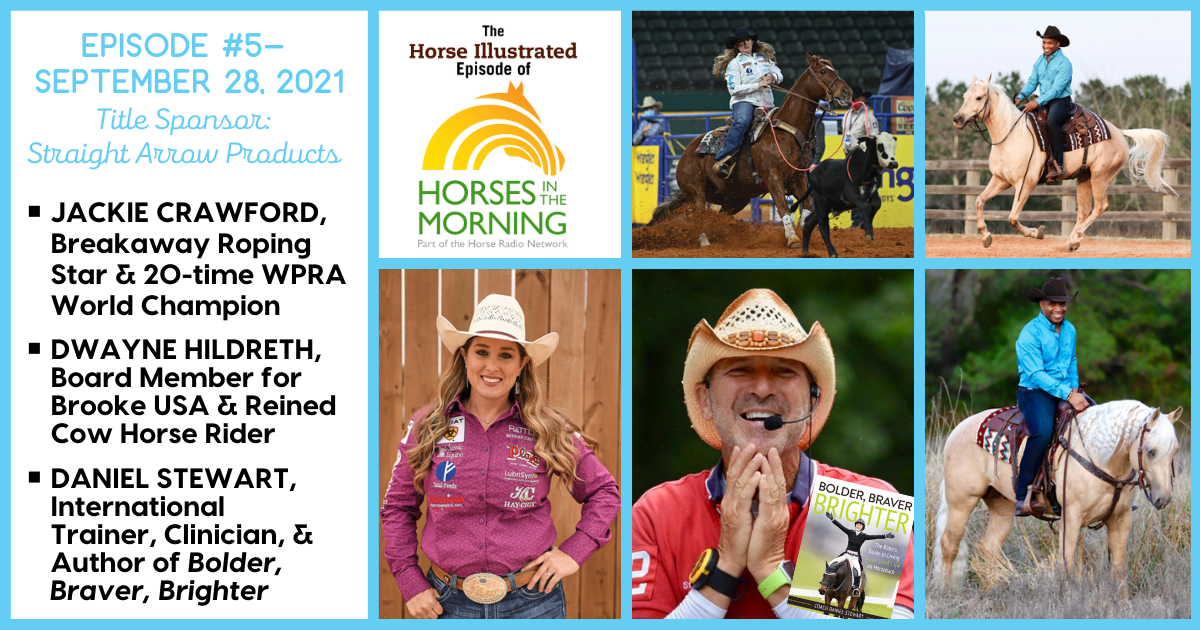
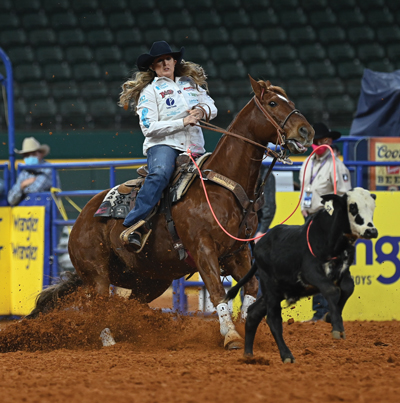
In the fifth episode of The Horse Illustrated Episode of Horses in the Morning, sponsored by Title Sponsor Straight Arrow Products, hosts Glenn the Geek and Sarah Evers Conrad talk to breakaway roping superstar Jackie Hobbs-Crawford about her illustrious competitive career and being a mom, Dwayne Hildreth about his work on the board of Brooke USA, and to international trainer Daniel Stewart about equestrian sports psychology and how to be bolder, braver, and brighter.
Hosts: Sarah Conrad, Digital Content Editor of Horse Illustrated & Young Rider and Glenn the Geek, host of Horses in the Morning
Twenty-time Women’s Professional Rodeo Association World Champion Jackie Hobbs-Crawford of Jackie Crawford Roping has a lifetime in speed events and roping. She was the Oklahoma High School Breakaway Roping Champion, won her first National Intercollegiate Rodeo Association (NIRA) national breakaway roping title as well as a national women’s team title at Vernon College, and was part of a second national champion women’s team and was Reserve National Champion Breakaway Roper at Tarleton State University. By the time Jackie graduated with her business degree, she had three consecutive NIRA Southwest Region champion breakaway roping titles under her belt.
Since then, Jackie Hobbs-Crawford has continued to excel on the rodeo and roping scene. In addition to training top-level horses, she continues to ride horses for some of the best cowboys in the business. In 2017, Jackie married Charly Crawford, a 10-time National Finals Rodeo qualifier in heading. Together they have three children: 16-year-old Kaydence, 4-year-old Creed, and a new baby girl named Journey. Along with balancing being a wife, mother, competitor and trainer, Jackie Hobbs-Crawford has played a key role in the exploding trend of breakaway roping. She continues to further the sport of rodeo by conducting clinics throughout the year and giving private lessons at the Crawford’s training facility in Stephenville.
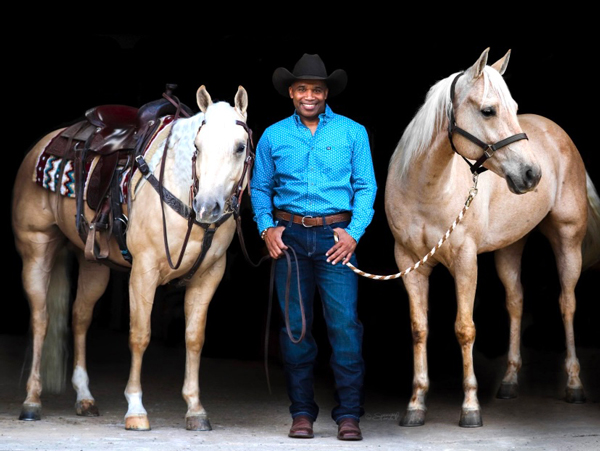
Dwayne Hildreth, is on the board of Brooke USA. He is an owner of two performance Quarter Horses and has been competing in reined cow horse and stock horse competitions for just over a year. The mission of Brooke USA is to significantly improve the welfare of 100 million working horses, donkeys, and mules who are helping to support 600 million of the poorest people throughout Asia, Africa, the Middle East, the Americas, and the Caribbean. They do this by raising funds and responsibly directing them to the areas of greatest need. But rather than just handing out money and leaving an area, Brooke also provides education, supplies and assistance not only to animal owners, but also to locally based veterinarians, veterinary technicians, farriers, feed suppliers, and those who make and repair tack and horse-drawn vehicles. They have also expanded into university research and community projects, as well as working to influence governmental policy. After all, healthy animals work better, live longer and thus can support their humans in a more sustainable way.
For the article about Brooke and Brooke USA in the July 2021 issue of Horse Illustrated, click here.
Daniel Stewart and His New Horse Book Called Bolder, Braver, Brighter
Photo Courtesy Daniel StewartPhoto Courtesy Trafalgar Square Books
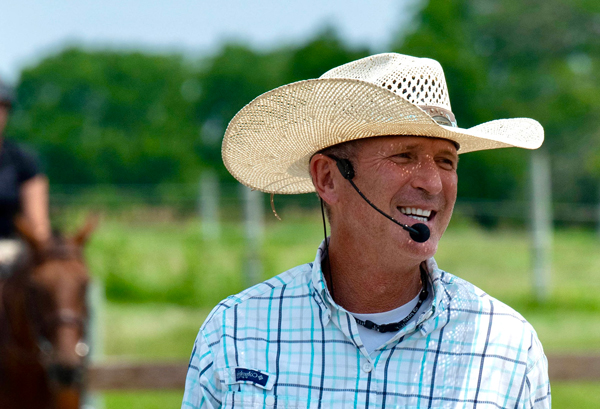
Daniel Stewart has been an equestrian for more than 35 years and has coached horse riders all over the world for the past 25 of those. Combining his knowledge as an equestrian with a degree in physical education, he created an empowering and inspiring clinic series that helps riders develop equally strong minds and bodies. As the internationally acclaimed author of Pressure Proof Your Riding;Ride Right; and Fit and Focused in 52; he talked about his latest book—Bolder, Braver, Brighter, available through Trafalgar Square Publishing. Daniel Stewart is widely considered one of the world’s leading experts on horse sport psychology, athletics, and performance. He teaches clinics and seminars to thousands of riders each year, including an annual summer clinic tour that includes 50 clinics in more than 30 cities over a span of 60 days. He’s a sought-after keynote speaker, has published countless magazine articles, and is an equestrian sport psychology and rider fitness contributor for many other equestrian associations. A father of two, when he’s not teaching his jumping, cross-country, and dressage clinics; he runs four-day equestrian athlete training camps at various athlete training centers around the country. He also produces weekly mental coaching and rider fitness videos for riders of all levels, ages, and disciplines.
For the article from Daniel Stewart’s book—Bolder, Braver, Brighter—from the October 2021 issue of Horse Illustrated, click here.
Title Sponsor
We want to thank our Title Sponsor, the Straight Arrow Family of Brands, makers of Mane ‘n Tail, Cowboy Magic & Exhibitor’s, with over 100 years of grooming excellence. For more information about your favorite products, please visit www.straightarrowinc.com and find Straight Arrow Products at a tack shop near you!
Premier Sponsor
Farnam is showing you their appreciation with a very special 75th anniversary giveaway. Visit www.farnam.com/75-giveaway for a chance to win a custom, special edition Farnam 75th anniversary John Deere Gator. This Gator is gorgeous, and it is filled with $1,000 worth of Farnam horse care products! Somebody is going to win all of this, so it might as well be you! Farnam, Your Partner in Horse Care!
An excerpt from “Bolder, Braver, Brighter” by Coach Daniel Stewart
Few things will stand between you and successfully training your horse more than you and your thoughts when those thoughts are defeating and doubtful.
Limiting Yourself
Negative thoughts are often called limiting beliefs because they limit how much you believe you can achieve or succeed. It’s not because you’re incapable of successfully training your horse, it’s simply because unintended (and unwelcome) thoughts might convince you otherwise.
For example, there’s little chance you’ll ever be able to teach your horse flying lead changes if you continually tell yourself you can’t and he can’t. It’s not because either of you are incapable of it, it’s because your belief has placed a self-imposed limit on what you and your horse can achieve together.
Tell yourself that you can train your horse to do a flying change (and work hard to make it happen) and you’ll remove the limit that once stood between you and that training goal. In other words, when you remove limiting beliefs, you remove your limits.
I can’t cook. I’m not good at math. I’m not a morning person.
I can’t sit his trot. I’m not as good as everyone else. I crumble under pressure.
Limiting beliefs are common, and it’s possible you’ve even used a few already today. They’re the sneaky negative thoughts you don’t think you’re thinking, even though you’re thinking them!
The good news is that becoming mindful of them is the key to stopping them. Sometimes they’re just hiding in a kind of mental blind spot and need to be brought out into the light.
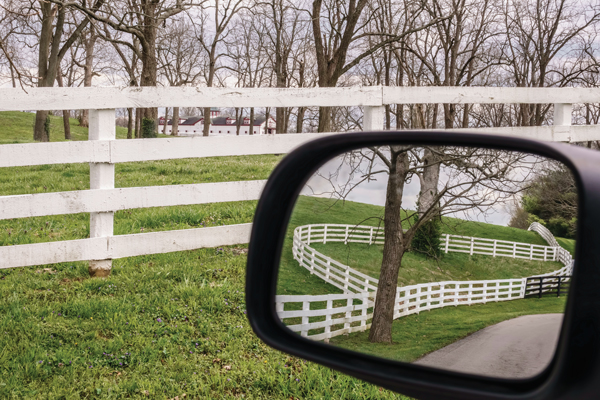
Car side mirrors are small compared to windshields, because what lies behind you isn’t as important as what lies in front of you. Photo Courtesy Trafalgar Square Books
Your Blind Spot
Blind-spot biases are a unique form of limiting belief that lie just below the surface of your awareness (the negative thoughts you don’t think you’re thinking even though you’re thinking them).
They’re called “blind-spot biases” because, like a car hidden in your blind spot, they pose a threat to you because you’re unaware of them. When a car leaves your blind spot, however, the threat it creates leaves too.
Likewise, when negative thoughts leave your mental blind spot (because you become mindful of them), the threat they create also leaves.
I want to introduce you to one kind of blind-spot bias that can negatively impact your ability to train your horse fairly and successfully. If you are aware of this blind-spot bias, you can work to remove it from your mental blind spot.
Confirmation bias is one kind of blind-spot bias that exists at the barn and when you are working with your horse. It occurs when you form an opinion and then alter your thoughts and behaviors so you can make your opinion appear correct (thereby confirming your bias).
For example, people who believe flying in airplanes is dangerous (even though studies disagree) often spend hours performing online searches of all the airplane crashes in history, and each time they read of another, they confirm their own bias a little more. Not surprisingly, these people rarely search the safety records of airlines because that would contradict their bias.
Once you find your blind spot, you can work to remove it and take your riding to the next level. Photo Courtesy Trafalgar Square Books
A Real-World Example
How does this translate to the barn and riding arena?
A rider in a recent clinic entered my arena on a very forward and unmanageable horse. After observing the horse, I asked, “How long have you been trying to slow your horse?” to which she replied, “Four years!”
So, I suggested she try something new. “Instead of slowing your horse,” I said, “Try calming your horse.” After all, doing the same thing over and over and expecting a different result is a bit insane.
I then instructed her to give her horse five calming aids: soften her hands, use a calming voice, relax her hips, use calming circles, and take her weight off his back (she was in a chair seat).
To this, she simply replied, “It’ll never work,” to which I replied, “Never tell yourself what you can’t do until you at least try.”
Unconvinced it would work, she picked up the canter, but as soon as her horse sped up, she thought about it for a second, then abruptly threw her reins away and thrust herself forward, causing her horse to bolt and run away with her.
After a few minutes of leaning back and yanking on her horse’s mouth to bring him back under control, she rode up to me and said the five words I knew she’d say, “See? I told you so!”
Avoiding Confirmation Bias
Moral of the story: This rider had a belief that you can only slow horses by leaning back and pulling, and she confirmed it by acting in a way that would ensure it happened.
But here’s the sad part: When she confirmed her bias, she missed the opportunity to begin to solve a training problem that had plagued her and her horse for years. In the end, her desire to be right was stronger than her desire to improve the relationship with her horse and her horse’s training.
So, what could she have done instead?
You can avoid confirmation bias by reminding yourself that it’s all right to be wrong about the reasons for your horse’s behavior or how to solve a training problem. The next time you’re given the chance to try something new when facing a challenge with your horse, remember that being right all the time isn’t worth making a wrong decision even one time.
Photo Courtesy Trafalgar Square Books
Adapted from Bolder, Braver, Brighter: The Rider’s Guide to Living Your Best Life by Coach Daniel Stewart and reprinted with permission from Trafalgar Square Books. Purchase a copy
This excerpt from Bolder, Braver, Brighter by Daniel Stewart appeared in the October 2021 issue of Horse Illustrated magazine. Click here to subscribe!
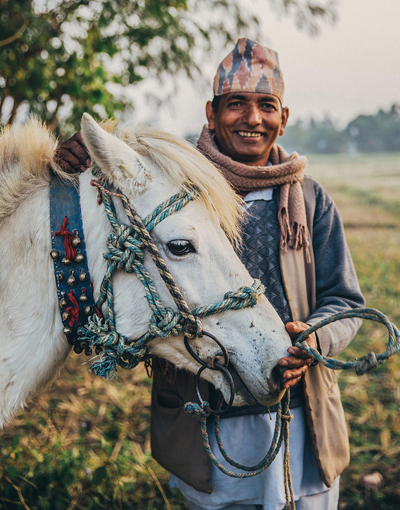
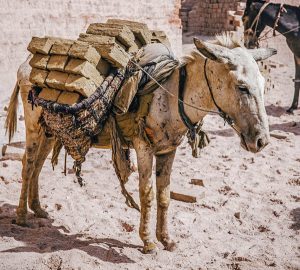
A horse owner in Nepal; many working equines in Nepal earn a living for their owners by transporting goods to remote villages in the mountains. Photo by FDowsonPhotography/Courtesy Brooke USA
A Pakistani man pours jet-black lumps of coal into oversized sacks strapped to the back of his little white donkey as they prepare to haul coal out of a mine. He shares how much he depends on his equine partner: “If I lose my donkey, I lose everything.”
Elba, a wife and mother living in a village of Guatemala, owns two donkeys, Joaquin and Seforina. Since there is no water in her community, Elba walks with her donkeys 45 minutes to a stream to gather water and carry it home.
The area has one of the world’s highest drought levels, and Elba and her husband struggle not only to feed their children, but also to grow enough forage for their donkeys.
“The only thing that matters to me is that my animals have enough food for the summer; that season is hard and it’s extremely difficult to find food for them,” says Elba.
A family in Kenya keeps a small male donkey. He hauls water, food, and supplies and helps them till the soil. Without him, the family will be severely challenged, and they don’t have the money to purchase another equine.
This donkey is just one of tens of thousands of equines who work in the brick kilns of India. Photo by FDowsonPhotography/Courtesy Brooke USA
They wake one morning to find their donkey gone—likely stolen to be slaughtered for his hide, which will be traded on the black market in Asia. The family is devastated beyond words.
These and hundreds of thousands of similar stories are a way of life in Africa, Asia, Latin America and the Middle East. While working equines in the U.S., Canada and Western Europe are more of a novelty than the norm today, there are still many areas of the world in which humans rely heavily on their four-legged helpers to earn a subsistence living.
An estimated 100 million working horses, donkeys and mules around the world support approximately 600 million people. These animals toil under the harshest conditions in some of the poorest countries on the planet. The international equine charity Brooke and its affiliate organizations, including Brooke USA, have been helping these hard-working animals—and the humans that depend on them—for over 80 years.
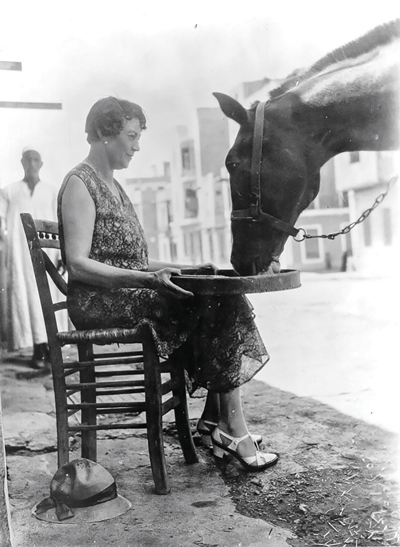
When Dorothy Brooke and her husband arrived in Cairo in 1930, they found around 5,000 remaining ex-British Army horses suffering from overwork, malnutrition and ill health. She went to work raising funds and buying back these horses, and by 1934, founded the Old War Horse Memorial Hospital in Cairo. Photo Courtesy Brooke/Brooke USA
The Origin of Brooke
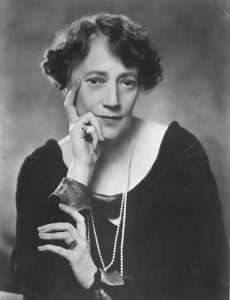
Brooke, which is based in Great Britain, is now the leading global welfare organization for working equines. It was established due to the efforts of the charity’s namesake, Dorothy Brooke.
In 1930, her husband, British Army Major General Geoffrey Brooke, was sent for duty in Egypt. She accompanied him, and they arrived in Cairo to find hundreds of ex-military horses from the British, Australian and American Armies had been left behind after World War I. These horses had been sold to locals and were enduring incredibly difficult working conditions, with most being of advanced age, emaciated and infirm.
Brooke set out to buy back these horses so that they could be either rehabilitated or humanely euthanized, depending on the individual horse’s best interest. In 1931, she raised the equivalent of 20,000 British pounds in today’s money (about $28,000 USD) through public fundraising spurred by writing a letter to the editor of The Morning Post in London (now The Daily Telegraph). By 1934, she had purchased the freedom of 5,000 ex-war horses.
Dorothy Brooke, circa 1930s. Courtesy Brooke/Brooke USA
Realizing that there were still thousands of other working horses, donkeys and mules in Egypt, that same year she established Old War Horse Memorial Hospital in Cairo (later called the Brooke Hospital for Animals), with the promise of free veterinary care. Brooke also worked to establish shade shelters and watering stations for Cairo’s working animals, and by 1938, the hospital also had a motorized equine ambulance.
Over the next 80-plus years, Brooke expanded their mission to many other countries and opened more hospitals and shelters, although they do not set up traditional clinics now. Today they continue to provide training and support to animal owners and equine industry service providers.
Additionally, Brooke and Brooke USA assist during national disasters such as floods, droughts, earthquakes and wildfires. In 2016, Brooke passed the milestone of reaching two million working equines thus far.
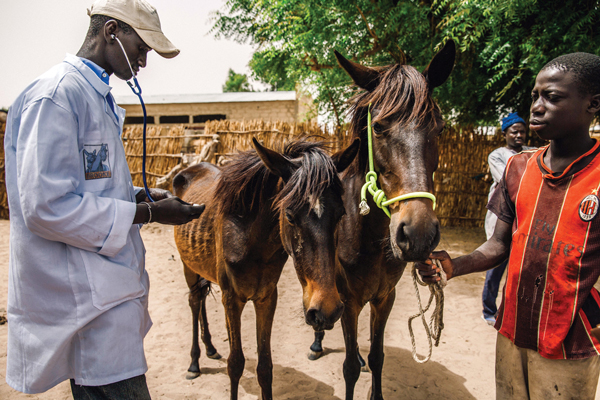
A member of the Brooke West Africa team examines an undernourished mare and foal in Senegal. Photo by FDowsonPhotography/Courtesy Brooke USA
They have also expanded into university research and community projects, as well as working to influence governmental policy. In the summer of 2019, Brooke was officially recognized by the United Nations as an accredited UN Environment Program.
Helping Animals & Their People
The overriding principle that guides Brooke and Brooke USA charitable work is to teach the people in a particular country the value of keeping animals healthy, and to help those human caretakers understand that healthy animals work better, live longer and thus can support their humans in a more sustainable way.
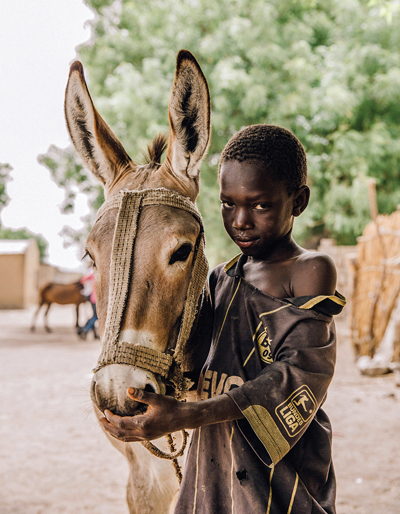
A boy in Senegal, Africa, with the donkey that his family uses in agriculture work. Photo by FDowsonPhotography/Courtesy Brooke USA
This often requires doing away with traditional practices, which are ineffective and occasionally cruel, and unlocking the underlying human compassion for animals that can be lost in the difficulty of subsistence living and geopolitical struggles.
Rather than just handing out money and leaving an area, Brooke provides education, supplies and assistance not only to animal owners, but also to locally based veterinarians, paraveterinary workers (veterinary technicians), farriers, feed suppliers, and those who make and repair tack and horse-drawn vehicles.
By utilizing these in-country professionals, who are known by the local population, positive change is more likely to take hold and last in the lives of working animals and their owners. It’s a win-win for everyone; not only do the equine owners earn a better living and the animals lead happier lives, but industry service providers learn new, valuable skills. Brooke has also learned that targeting education about animal care toward women and children in a community is an effective tool.
The Launch of Brooke USA
In 2008, Brooke USA was originally chartered as American Friends of the Brooke and then relaunched in 2015 as Brooke USA. With their main offices in Lexington, Ky., Brooke USA’s mission is to help equines in Africa, Asia, the Middle East, the Americas and the Caribbean.
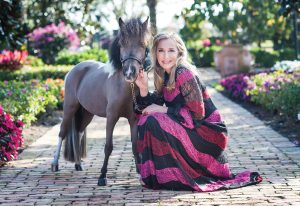
Brooke USA Board of Directors Chairperson Katherine Kaneb with one of her adopted Miniature Horses, Starsky. Starsky was an ambassador for the 2018 FEI World Equestrian Games in Tryon, North Carolina. Photo by Elena Lusenti for Brooke USA
Katherine Kaneb, current Brooke USA Board of Directors Chair, feels it is their responsibility to make sure funds received from donors are put to good use, and explains they are careful in the selection of programs to fund.
“We know that healthy, cared-for equines lead to a better life for humans,” says Kaneb. “In addition to our ability to initiate and fund our own programming and advocacy efforts within the Americas, our business model focuses on granting funds to nonprofit organizations that are already making a difference so we can magnify their impact, or supporting nonprofits that present us unique, well thought-out programs that creatively reach underserved communities.”
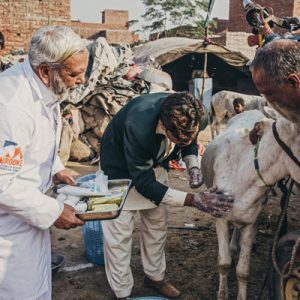
A Brooke Pakistan vet; this veterinary team from one of Brooke Pakistan’s mobile veterinary clinics is treating the harness wounds of a working donkey. Photo by FDowsonPhotography/Courtesy Brooke USA
One current project is fundraising to purchase small plots of land in Nicaragua that will serve as training units for forage production and storage. In addition to work in other countries, Brooke USA has recently worked in the U.S. on COVID-19 relief funding and helped with natural disasters in Texas and on the West Coast.
Notable Ambassadors
Allison Brock. Photo by Allen MacMillan
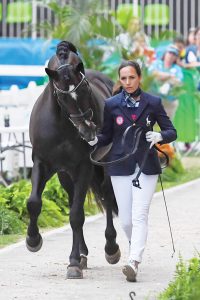
A number of top equestrians from many disciplines work as Brooke USA ambassadors; three shared why they decided to join: Olympic dressage rider Allison Brock, champion show jumper Hannah Selleck, and five-star eventer Allison Springer.
Brock rode the stallion Rosevelt on the bronze medal-winning U.S. Olympic Team in 2016.
“I became involved with Brooke USA through my employers, who are huge contributors and advocates of Brooke USA. It’s a charity that any equestrian can get behind wholeheartedly, because when you take care of donkeys, you take care of people.”
Hannah Selleck. Photo by Elena Lusenti/Courtesy Brooke USA
Selleck, who competes in top-level jumping and breeds sport horses, shares her story.
“I was introduced to Brooke USA by a friend, and I immediately fell in love with the mission of helping working equines in the developing world and the people who depend on them. More importantly, I thought I could help by bringing awareness to their projects.”
Allison Springer. Photo by MacMillan Photography
Springer, who with long-time partner Arthur served as an alternate for the U.S. Eventing Team for the 2012 London Olympic Games, also believes deeply in Brooke USA’s mission.
“I joined forces with Brooke USA as a celebrity bartender for an event at the Tryon International Equestrian Center in 2017. This gave me an opportunity to learn more about the mission. Many of my friends are deeply involved too. I was very honored when asked to become a Brooke USA ambassador.”
How to Help
If your interest is piqued and you’d like to find ways to further Brooke USA’s mission, here are some ways you can help.
◆ Donate to the cause. Donations to recognize a loved one, favorite equine or business are a fulfilling way to gift and give back at the same time.
◆ Host a fundraiser. Brooke USA will provide brochures, donation boxes and ideas for hosting an event.
◆ Spread the word in the equestrian community and beyond.
◆ Be an advocate for Brooke USA’s mission to legislators.
◆ Teach humane treatment for all living creatures to the next generation.
Visit the Brooke USA website at www.brookeusa.org for more information on ways to support their efforts to help the world’s working equines.
This article about Brooke and Brooke USA appeared in the July 2021 issue of Horse Illustrated magazine. Click here to subscribe!
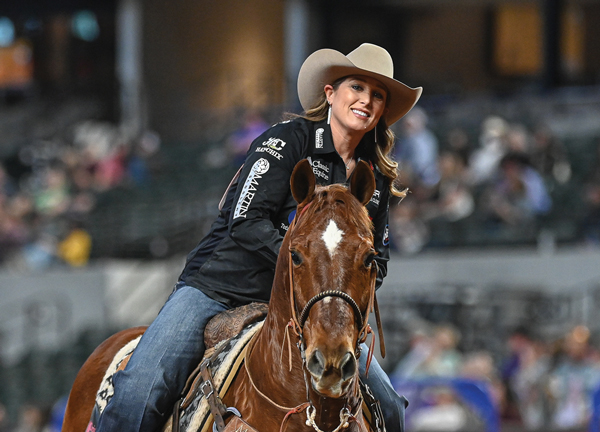
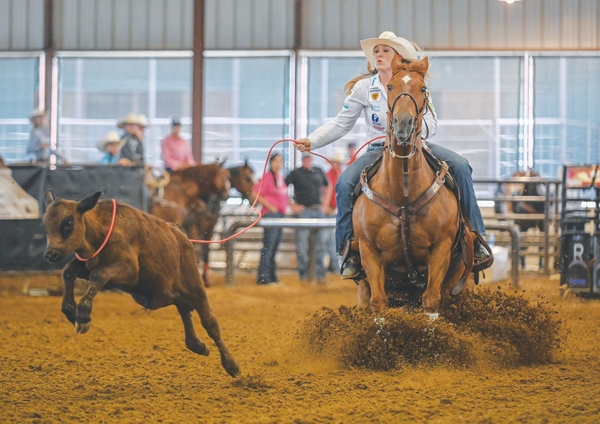
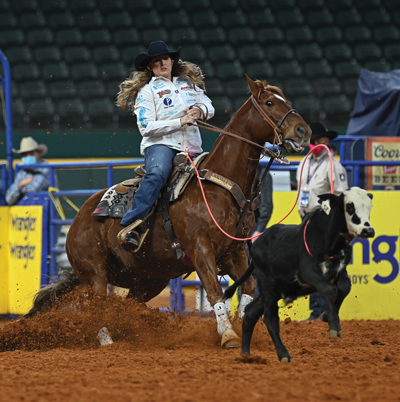
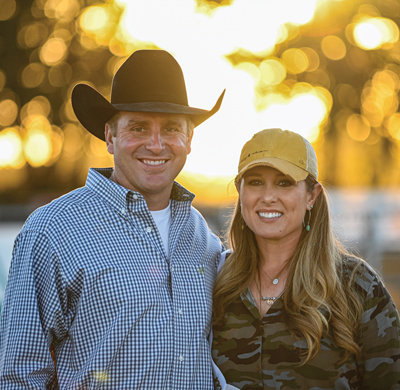
Along the short end of the arena sits an enclosed play area filled with toys, a small trampoline, Tonka tractors and trucks. For any parent who rides horses, it’s a dream space to let kids play while still being supervised. It’s one of the many ways Jackie Crawford makes room in her life to continue roping.
And when Crawford won the inaugural Wrangler National Finals of Breakaway Roping world title in 2020 while six months pregnant with her second child, women rejoiced. Being a female roper is challenging enough, and to compete while pregnant was next-level.
Motherhood aside, Crawford’s roping career has been defined by optimism, hard work and perseverance. It’s how she’s earned 20 world titles in breakaway, team roping and all-around, and at the time of publication, ranked first in breakaway in the Women’s Professional Rodeo Association with more than $520,000 in career earnings.
There’s a reason why Crawford’s social media posts go viral. She’s proof that with sweat equity and determination, you can rise to the top.
Early Learning
A self-proclaimed tomboy, Crawford grew up in Illinois playing basketball and riding in speed events like poles and barrels. She didn’t have an arena, so she either rode in the pasture or hauled her horse to local trainers for lessons and advice.
“Riding and being around horses was our way of life,” says Crawford. “When I was little, my mom, Annette, cut a hole in a piece of Styrofoam and set it over her saddle horn, and that’s where I rode. I was always in tow.
Jackie Crawford has racked up countless buckles for breakaway roping, team roping, and all-around titles. Photo by RC Photography
“We trained barrel horses, and my mom would haul me to a bunch of barrel races. She was also an outrider at the racetrack in St. Louis, so I grew up on the track. As I got older, team penning was big in Illinois, and I started to do that. It’s what my mom did, and she’s well known for being a horsewoman up there.”
Crawford didn’t start roping until her family moved to Oklahoma when she was 11 years old.
“When I moved to Oklahoma, they had junior rodeos—a lot more than what they had in Illinois,” she says. “As I started going to those, running barrels and poles, I saw girls roping in a ‘guys’ event,’ and I was like, ‘I want to do that! It looks so cool and fun.’ That’s where I fell in love with the roping.”
At the time, Crawford was riding a “ratty little barrel horse” named Cowgirl.
“She was really gritty and a cute mare,” Crawford recalls. “She was little, so she wasn’t a barn burner in the barrels, but she tried her heart out. When I turned her into a roping horse, I remember riding laps and laps trying to get her to let me swing a rope on her. It took forever. She was scared of it and prancing and champing on the bit. But once she figured out what it was, she was the most phenomenal horse ever. She never took my throw away, ever.”
A Career is Born
Crawford remembers entering her first roping event, despite her horse never being ridden through the barrier.
“By pure accident I caught and actually won,” she says. “After that, my mom said that when rodeo season starts, if I roped the dummy enough and worked at it enough, she would let me enter all the rodeos.”
Although team roping was seen as a “guy’s sport,” Jackie was inspired when she saw other women doing it. Photo by RC Photography
Natural ability only gets you so far, and Crawford’s mom recognized the importance of a good work ethic. When rodeo season came back around, Crawford’s mom said she didn’t practice enough on roping the dummy and wouldn’t let her enter.
“It made me so mad, and I said I would never let it happen again,” says Crawford. “From then on, I worked so hard. I would rope a bale of hay plumb in two.”
She competed in rodeo her sophomore year of high school, which is when she started tracking the National Finals rodeo and seeing people like JJ Hampton and Lari Dee Guy achieve lofty goals.
In 2000, her junior year of high school, Crawford was the Oklahoma State Breakaway Champion, and she won second place her senior year. She chose to attend Vernon College in Wichita Falls, Texas, for its college rodeo opportunities.
“Once I got to Vernon, I got my butt kicked. I mean, I got it trampled,” says Crawford. “I don’t think I was in the top 10 that year. It was so disappointing. I learned from that year and got better. I learned the different situations and studied. My sophomore year I actually won the region and won the nation for Vernon [in breakaway].”
After earning two associate degrees from Vernon, she transferred to Tarleton State University in Stephenville, Texas. While studying for her business degree, she won three National Intercollegiate Rodeo Association individual titles and two team titles, earning her a place in the college’s hall of fame.
And although Crawford was becoming a well-known name in the roping world, she was uncertain about her future. She loved the horses and the sport, but she was lost as to what her future held.
Fulfilling Dreams
Crawford went to work for professional roper Lari Dee Guy following college. She trained rope horses for Guy and other pro-rodeo athletes. It was there she met what would become her all-time favorite horse, DS Sassy Shiner, fondly known as “T-Boy.”
T-Boy was a “silly horse” that stood out to Crawford and that she “just had to have.” She finally called him her own after trading out riding and some money for the colt. He would end up carrying Crawford to win her first National Finals Breakaway Roping (NFBR) championship and her 20th world title in 2020.
Crawford eventually struck out on her own to train rope horses. She started hosting roping clinics and gaining a strong following.
Jackie’s first date with husband and professional team roper Charly was, fittingly, at the National Finals Rodeo in Las Vegas. Photo by RC Photography
In 2012, Jackie Crawford started dating a longtime acquaintance and professional team roper Charly Crawford. Their first date was at the National Finals Rodeo in Las Vegas, Nev., and they were married a year later. Now, they live in Stephenville with their son Creed, 4, and Charly’s daughter Kaydence, 16. The family welcomed their baby girl, Journey, in March 2021.
Rodeo life functions differently with kids, but it’s not to say it can’t be done. Juggling the responsibilities of kids, horses and a business is nonstop.
“There’s no balancing it—it’s pure chaos,” says Crawford. “You can’t have a schedule, you just roll with it. You better be someone who can laugh in the chaos of it, because if you can’t, it ain’t for you.”
As she’s done before, Crawford not only rises but thrives given the challenge.
“There are some days when I’ve been tired and the weather is bad and it crosses my mind to skip a day of riding,” she says. “And Charly will say, ‘Oh it’s fine, but I bet so-and-so is out there getting better.’ And I’m like, ‘Oh, hell no.’ I’m so competitive.
“I remember I’ve been given this talent,” she continues. “I’ve been given this opportunity. I don’t want to look back and regret not using every single ounce of it. I know this time will pass, and I want to give it all I have.”
The Goal That Stands Out
Giving it her all has landed Crawford countless silver buckles for breakaway roping, team roping, and all-around titles. The one that stands out to her most is her most recent victory at the NFBR.
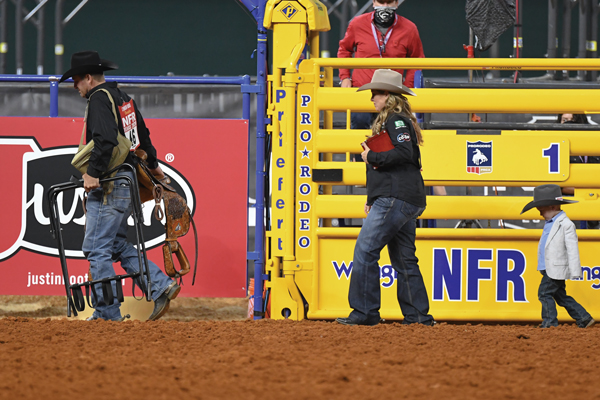
At the 2020 NFBR, Jackie walks with her husband Charly in front of her and their son, Creed, behind them to accept her 20th world title. She was six months pregnant with their daughter. Photo by RC Photography
“There’s so much packed into that one little buckle; so much emotion,” says Jackie Crawford. “It’s years and years of work. That buckle represents dreams. It represents hard work. It represents perseverance. It represents going against the grain and doing what you love. It was surreal. Now my biggest goal for the breakaway is for [that event] to be in the NFR in the Thomas & Mack Center. And I’d love to be there.”
Still, she stresses that she’s not in the business to win, and no one involved with horses or roping should have it as their sole goal.
“Any time you’re fulfilling your passion, you’re not losing,” she says. “Here’s the thing I’ve learned: You can’t just enjoy the end product or reward. That’s not what this business is about. You can’t just find happiness in the end result. If you don’t enjoy putting the puzzle together and working the horse, then you’re in the wrong business. I see a lot of people who don’t have the skill, but their will is a lot stronger. It’s not all about natural ability.”
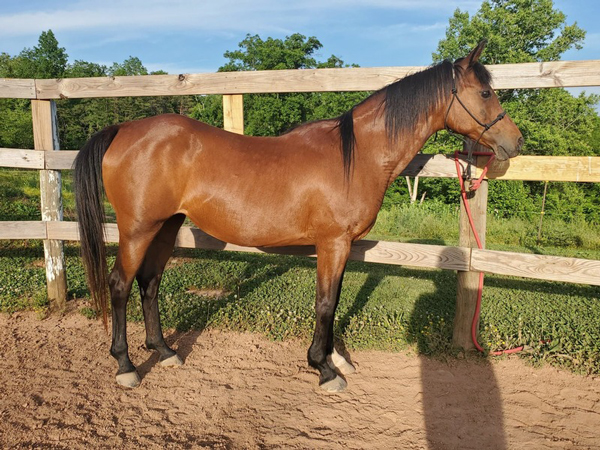
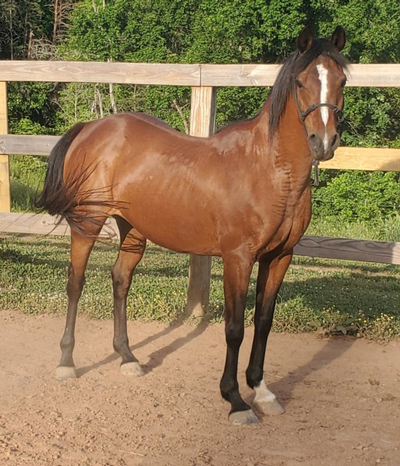
Welcome to Horse Illustrated’s weekly installment of the My Right Horse Adoptable Horse of the Week, offered in partnership with The Right Horse. Cupcake is this week’s adoptable horse. Check back weekly for a new featured horse so you can find your #righthorse.
Cupcake is as sweet as her name and loves ALL food. She would love for someone to bake her some homemade horsie cupcakes—she promises to be the best taste-tester ever! She loves people and other horses, and will become very attached to her herd mates. She will come to your whistle when loose in the field, especially if she knows you’re going to feed her. Her foster has started saddle training with her, and Cupcake is showing willingness and promise. If you want a horse that will turn heads as she prances around your field and will make people stop to take pictures, then she’s your girl. She is easy to catch and easy to lead, and an easy keeper in the stall or in the field. She is extremely intelligent and is your typical Arabian. She is still a little worried about the farrier, but is getting better. She loves to be groomed and will stand all day for you to brush her and braid her mane. She will not be for a beginner but would be just fine for anyone with horse experience. If you would like to learn more about Cupcake and follow her progress, staff at the West Virginia Horse Network can connect you with her trainer for a chat. Please contact them today if you are interested in bringing this beauty home.
My Right Horse is the online adoption platform of The Right Horse Initiative, a collection of equine industry and welfare professionals and advocates working together to improve the lives of horses in transition. A program of the ASPCA, their goal is to massively increase horse adoption in the United States. To find more adoptable horses and foster horses, visit www.myrighthorse.org. To learn more about The Right Horse, a program of the ASPCA, visit www.therighthorse.org.
Author Kara Stewart with her horse Eddie during his retirement. Photo by Sharon P. Fibelkorn
The day may come when it’s time to retire your senior horse from riding, perhaps due to arthritis or an old injury that would prevent you from being able to exercise him like before. Or perhaps he’s developed neurological issues and can’t safely carry anyone. Or he’s developed an allergy or breathing issue that would make riding painful or stressful. But just as with human seniors, our equine golden oldies still benefit from activity and movement to maintain muscle tone and flexibility and a level of fitness. While most of us may not be up for running a marathon when we’re 75, we’ll likely benefit from walking, a little dancing, tai chi, yoga, and light weight training.
Jeanette Mero, DVM, owns a private equine practice in Mariposa, Calif., and is an accomplished endurance rider. From her experiences working with clients’ senior horses, she shares exercise options that can give your unrideable horse the benefit of exercise without being under saddle.
“In many ways, designing an exercise program for an unrideable senior horse can mimic how we work with a horse that’s too young to be ridden,” says Mero. The primary difference is that the senior has decades of life experience and usually a foundation of training.
Instead of training a lot of new concepts, you’ll focus on maintaining overall fitness, but with a caveat.“I’m not advocating working a horse that’s very arthritic, in pain or lame,” says Mero. “To me, that’s cruel. This program is for horses who are otherwise sound but can’t be ridden for some reason.”
Turnout Time
The ideal solution for an unrideable horse is what nature intended: turnout.
“Having a senior horse on full-time turnout in a pasture or large area will provide the exercise he needs,” says Mero. “It’s especially important for horses with mild arthritis.”
Being able to move around for hours a day, preferably in the company of a herd with similar temperaments, promotes gentle fitness and helps a senior horse maintain muscle tone and interest in his surroundings.
Full-time pasture with compatible herd mates is the ideal form of gentle, continual exercise. Photo by Sudarshan Mondal/Shutterstock
But in reality, maybe your horse is boarded at a facility where he’s in a stall or pen with a run. Or he requires a special diet that means he has to be separated from other horses. Perhaps you’ve tried keeping him on pasture with a herd, but he was pushed away from the hay or he’s being bullied by younger and more dominant herd members.
In these situations, your horse will likely do better in an individual pen and will rely on you for adequate exercise.
“For horses who live in smaller pens, I highly recommend daily turnout in a large area and preferably with a companion or two,” says Mero. “This helps them get gentle exercise and have social time with other horses.”
One solution is to work with owners of other senior horses where you board and coordinate turnout times so your horses can go out together.
In-Hand Work
There are still in-hand exercises that a retiree can do, but don’t forget to consult with your veterinarian to ensure there aren’t any health issues that could cause pain or discomfort.
“Working your horse over ground poles or cavalletti increases his neuroplasticity and proprioception—his ability to know where his body is in space,” says Mero.
Set up patterns of ground poles or 8-foot lengths of sturdy PVC pipe; elevate some of the poles so your horse will need to lift his feet higher. You can walk your horse over and around the poles, ask him to back up through two parallel poles or in an “L” pattern, or make a circle inside a frame of poles. Get creative!
Ten to 15 minutes of light longeing or roundpen work helps keep up your horse’s cardio fitness. Photo by CCTM/Shutterstock
Light longeing or round pen work for 15 to 20 minutes is good for cardio fitness.
“But remember the young horse approach when working on a small circle,” says Mero. “Running in a small pen or in deep sand can cause stress on the horse’s joints.”
Instead, use the session to work quietly and practice voice commands or responses to your body language.
Walking, Hiking and Ponying
“A lot of my clients with older horses go on walks and hikes together,” says Mero. “They both enjoy the scenery and each other’s company, and it keeps both horse and human fit.”
She adds that ponying your senior horse is a good alternative to hand-walking.
“Just be sure that the horse being ridden can go at a pace that’s comfortable for the senior, who may need to walk more slowly and for shorter distances than a younger horse,” she adds.
Aim for walks at least three to four times a week; a daily walk is even better.
Guide your horse with long lines as you would from the saddle, starting in an enclosed area. Eventually, you can head out on quiet roads or trails. Photo by Crissi MacDonald
Long-Lining or Harness Work
Working your horse from the ground in two reins can provide exercise and mental stimulation—for both of you.
“You don’t need a full harness, or even a cart,” says Mero.
Start with two long lines or a pair of driving reins, attaching each rein to the side ring of the halter, and start in a pen or arena. Walk slightly to the inside of the circle, and guide your horse as you would from the saddle. Navigate around poles or cones to give more context for turning.
“Once you’re comfortable in the enclosed area, and you can turn, change directions, and stop, head outside for a long-line walk on trails or quiet roads,” she says.
If you both really enjoy the long-lining work, think about learning how to drive. Find an experienced trainer with the equipment who can teach you.
Games and Trick Training
You actually can teach an older horse new tricks, and trick training can give you both something fun to learn. Find a book or video with simple tricks, like picking up a hat or rolling a large ball, and go from there.
Trick training provides movement and mental stimulation to the retiree; just keep it fun! Photo by Anastasija Popova/Shutterstock
Trick training provides movement as well as mental stimulation. Just be sure to not overtrain or drill, and keep it fun. And remember that some tricks, such as teaching a horse to paw or rear, may appear when you don’t necessarily want them to.
Just Be Together
“Senior horses can be a lot like older people,” says Mero. “While they may have been successful competitors or working horses, now they may prefer a life of quiet companionship with horses and their person.”
Now you can enjoy time with no agenda other than being together. Taking long walks together, going for groom-and-graze sessions where you brush him a bit as he’s grazing, or just hanging out in the pasture or turnout while your horse moseys around can bring you both happiness.
Adding Light to Golden Years
Just because your senior horse can’t be ridden, there are many ways to help keep him fit and vibrant.
There’s one more added benefit of walks, hikes, ground driving and other gentle exercises: You both stay younger and more agile, and the bond you’ve shared over the years gets even stronger.
Senior Care and Feeding
When a horse is retired from riding, that doesn’t mean his care stops.
“Putting a horse out to pasture can be good for his physical and mental well-being as long as there is adequate food and shelter, and he’s not being bullied by the herd,” says Jeanette Mero, dVM, who owns a private equine practice in Mariposa, calif., and is an accomplished endurance rider.
Photo by Dusty Perin
“It’s vital to continue caring for your horse’s needs: hoof care, dental care, wellness checkups, deworming and vaccinations as needed. these go a very long way in helping a senior horse live well in his older years.”
One of the biggest needs to keep the senior going strong is the right feeding program.
“Older horses need good nutrition,” says Mero. “trying to get all the nutrition from pasture may no longer work. Find good-quality hay and a good senior feed that’s low in sugar, and feed adequate amounts to keep your horse at the right weight.”
Supplements and ration builders can round out the diet.
“Work with your vet on the best supplements for your area, since soils, hay nutrients and other factors differ by region,” Mero adds. if your horse is diagnosed with pituitary pars intermedia dysfunction (PPID), aka Cushing’s, or metabolic issues, work with your vet on the right treatment protocol.
“Just as important as nutrition is paying attention to your horse’s spirit and emotional needs,” says Mero. “Visiting often so you can gauge changes in weight, personality, mobility and interest in life are crucial to the older horse’s well-being, just like frequent visits with an older family member who lives in a nursing facility.”
That’s not to say quality of life will go downhill over time, however.
“A horse who’s approaching 30 or beyond can still have energy, bright eyes, a shiny coat, and a joy of life if he’s cared for,” Mero says.
This article about how to exercise a senior horse appeared in the October 2020 issue of Horse Illustrated magazine. Click here to subscribe!
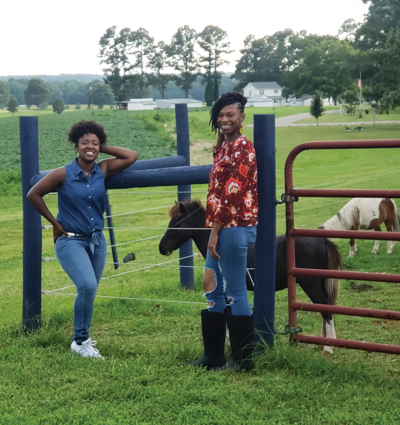
Abriana Johnson (left) and Caitlin Gooch both grew up trail riding in North Carolina. Photo by Amaris Saint-Lot
Editor’s note: Since this article’s original publish date, Caitlin Gooch no longer co-hosts the Young Black Equestrians podcast.
In the opening seconds, you instantly feel the vibe. The percussive beats that mark the baseline, punctuated by different voices saying “I am…,” tell you that this is not going to be your average equestrian podcast.
For starters, there is a definite hip element, even though trendiness or edginess are not markers of the horse world, which tends to revere 19th century fox hunting and cowboy iconography. It’s clear that this is for an audience that appreciates a few modern touches. Secondly, and far more importantly, there is the announcement that it’s a podcast for and about Black equestrians.
Highlighting Black Equestrians
The equestrian world is blessed with an enormous array of breeds and disciplines, but its sense of diversity generally ends there. It is a startlingly white place without much representation from racial minorities. This can make the horse world feel insular, and regardless of intention, it can even feel unwelcoming to people of color.
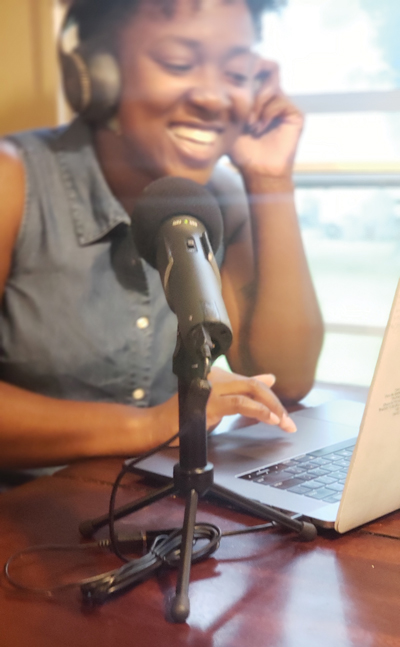
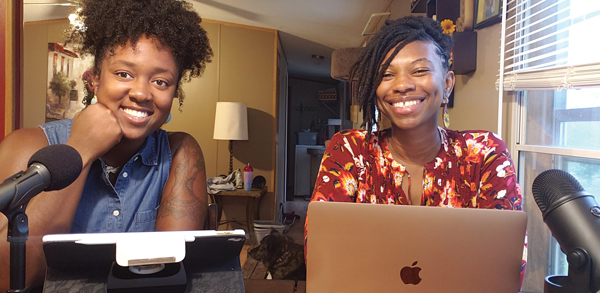
This is an uncomfortable truth that many people in various equine niches are unsure of how to rectify. However, Caitlin Gooch and Abriana Johnson, the vibrant hosts of the Young Black Equestrians podcast, aspire to do just that. With each episode, they endeavor to spotlight significant Black people who live and work in assorted areas of the equine world. Whether it’s a veterinarian, a Grand Prix competitor or a barrel racer, Gooch and Johnson want to have a long conversation—quite often filled with both thoughtfulness and humor—as they learn about how their podcast guests found their place in the equestrian world.
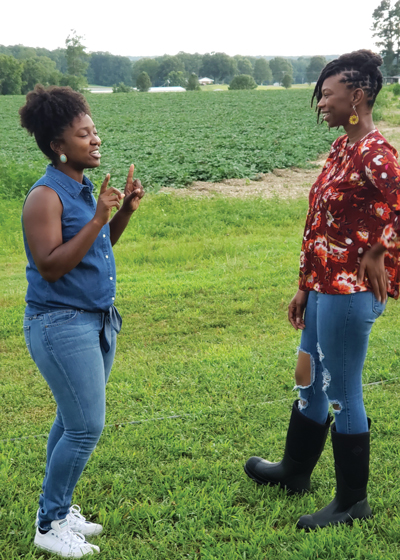
Interviewees were originally located through social media and google alerts, but soon people started contacting the hosts about appearing on the show. Photo by Amaris Saint-Lot
Getting Started
Johnson says that when she and Gooch began the Young Black Equestrians podcast, their goal was simply to highlight these voices and show that there were a variety of disciplines inclusive of Black people.
“I don’t know what we expected when we started,” she says. “We just sort of jumped in.”
They began locating interview subjects through social media, Google alerts, and searches in various disciplines’ Halls of Fame. Once their podcast gained traction, people started contacting them about getting spots on their show. This led them to interview an impressively varied list of horse people: endurance rider Michelle Rosemond, polo player Brandon Rease, cutting horse champion Raven Benjamin, Olympic hopeful Ranee James, and Compton Cowboy Randy Savvy, just to name a few.
“It’s really fun to learn about others’ stories, and we’re trying to show many aspects of this industry,” says Johnson. “To us, the word ‘equestrian’ isn’t just about English riding. It’s anyone who is involved with horses.”
Meet Your Hosts of the Young Black Equestrians Podcast
Both women are young themselves at 27. Each began riding horses as children. Gooch grew up on a farm in Wendell, N.C., and developed a love of trail riding with her father. They became involved with Black saddle clubs that held trail riding events throughout the South.
“I never knew a Black woman who showed,” says Gooch. “I only knew trail riders. I’m interested in learning much more.”
Balancing Gooch’s calm demeanor, the outgoing Johnson emits a serious ants-in-the-pants sensibility. A vet tech in Zebulon, N.C., she gets straight to the point.
While Johnson began riding at age 7, she didn’t discover trail riding until high school. This is when her paradigm shifted as she attended trail rides with “literally hundreds of Black cowboys.”
Johnson and Gooch wanted to showcase the many equestrian disciplines that are inclusive of Black riders. Photo by Amaris Saint-Lot
Johnson’s riding life has been dominated by her love of Tennessee Walking Horses. Coco, her first horse, is still around and kicking at age 26. But trail rides can be arduous, so for those, she enlists her other Walking Horse named Maestro, a gelding she trained “from the ground up.”
Gooch, on the other hand, prefers Arabians. She still has a gray mare named Goat whom she rode as a child.
“I could never, ever leave her,” she says.
She loves trail riding, but as a busy mother with an infant and two young children, she is short on time. Her older children love riding and are busy with 4-H, so while she’s pulled in different directions, horses are still involved.
Giving Back
As a mother, Gooch has been dedicated to increasing access to the equestrian world for children. She developed the non-profit organization Saddle Up and Read, which aims to achieve two things: increase literacy rates among Black and minority children and expose these children to the joy of horses.
“I’d been wondering, ‘What can I do to give back?’” she says. “And then I stayed up late one night after a news segment about the gap in literacy rates. I went on the internet to learn more about how these children fall behind. That’s when I decided to use horses to motivate these children, and I called a local librarian.”
As a mom of three, Gooch (right) decided to start the non-profit saddle up and read to help improve literacy rates and introduce minority children to a love of horses. Photo by Amaris Saint-Lot
With her program, children check out books and have a competition to see who can read the most. Five winners are then given the opportunity to visit her farm to learn about horses.
“Many kids have never seen a horse,” Gooch says. “Many parents have never seen a horse! I’m passionate about opening that door.” Johnson, like Gooch, has also created projects to help children discover horses with her book series, Cowgirl Camryn, which she wrote and illustrated, and then self-published. The two books follow the adventures of a young Black cowgirl as she works with her herd of Miniature Horses. Johnson says more books are still to come.
Representation
Representation in the horse industry is paramount to both of them. The heart of Black Lives Matter lies in asserting that Black lives matter as much as anyone else’s life. Nobody is preaching superiority; certainly nobody is saying that only Black lives matter. What Gooch and Johnson want is the ability to carve out a space for themselves and other people of color in the equine world.
“We need to address visual aspects in the media,” she says. “Let’s look at catalogues: the models are almost always all white. Look at interviews with other professions in the industry, and you don’t see Black people. We need to normalize the idea of Black people with horses.”
While Gooch prefers Arabians, Johnson’s breed of choice is the Tennessee Walking Horse. Photo by Amaris Saint-Lot
“From the comments we get, people will ask ‘Why do you have to make it known that you’re Black?’” Johnson said on a recent podcast. “‘Why does it have to be Young BLACK Equestrians?’ And I’m like, ‘OK, Mr. All Lives Matter, you have no issue using that descriptor, Black, when you have a problem. So if I want to embrace that descriptor, I’m gonna be like, I am Black, and you’re going to see how much I can ride!’”
Gooch agreed. “And if we aren’t going to advocate for ourselves, then who is going to do it?”
The Future
Their goals for Young Black Equestrians include eventually creating a franchise. They dream of meet-ups and retreats where minority equestrians can network and learn from one another. They also want to continue working with children, hopefully taking kids to Grand Prix events to meet Olympic hopefuls.
“Without diversity, the horse industry will grow smaller,” says Gooch. “Who will carry on then? There has to be a push for more inclusion.”
This article about Abriana Johnson and Caitlin Gooch, hosts of the Young Black Equestrians podcast appeared in the October 2020 issue of Horse Illustrated magazine. Click here to subscribe!
We use cookies to help personalize content, tailor and measure ads, and provide a safer experience. By navigating the site, you agree to the use of cookies to collect information. Read our Cookie Policy.