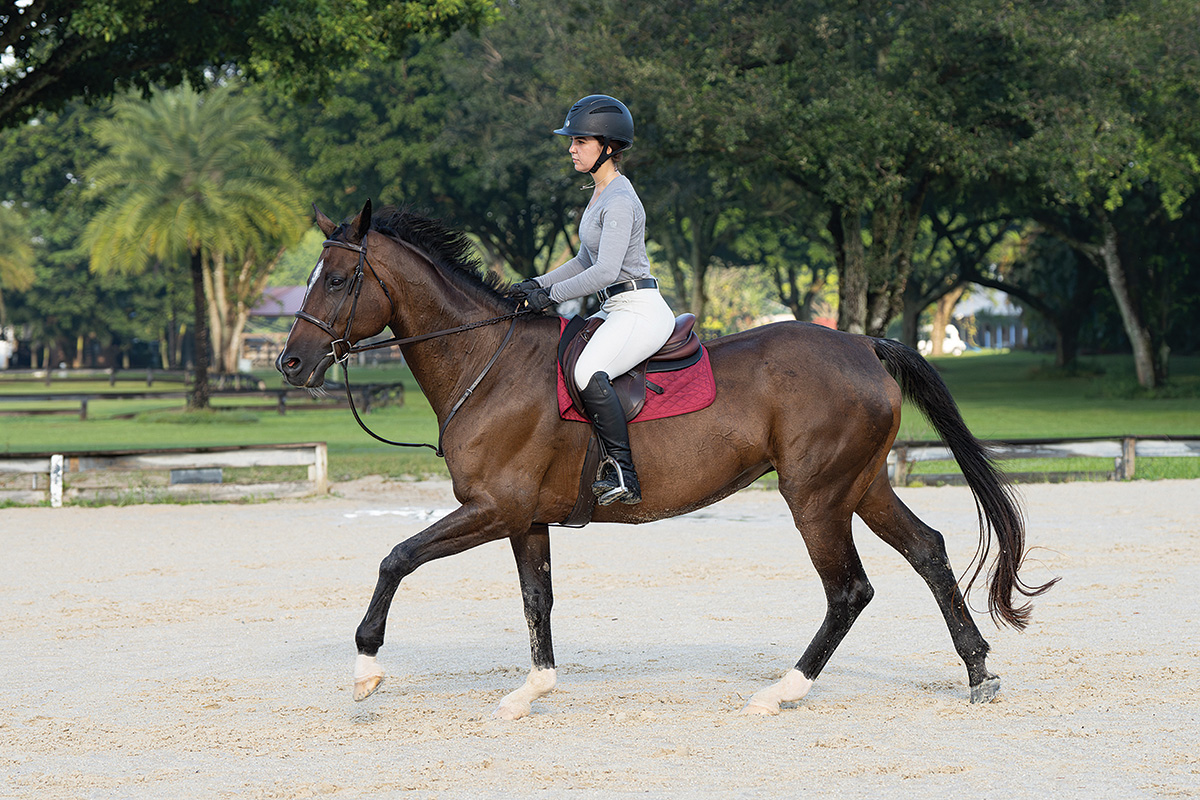
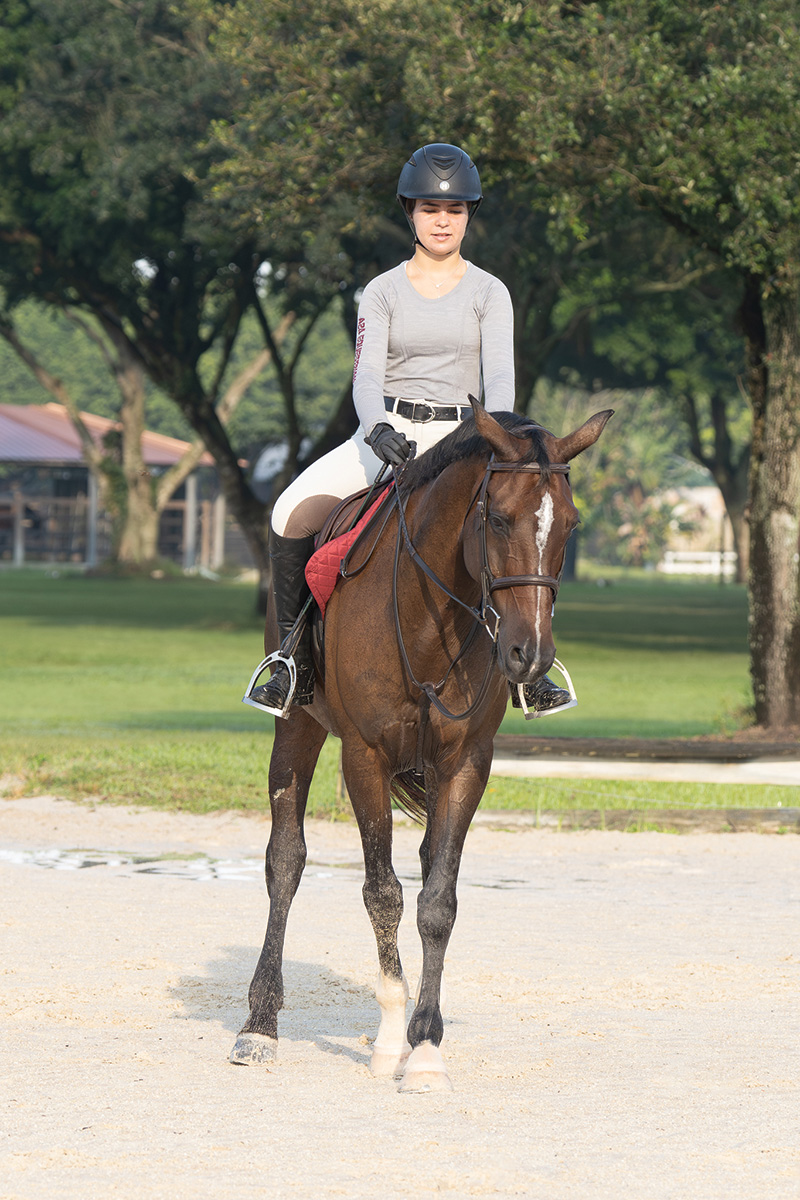
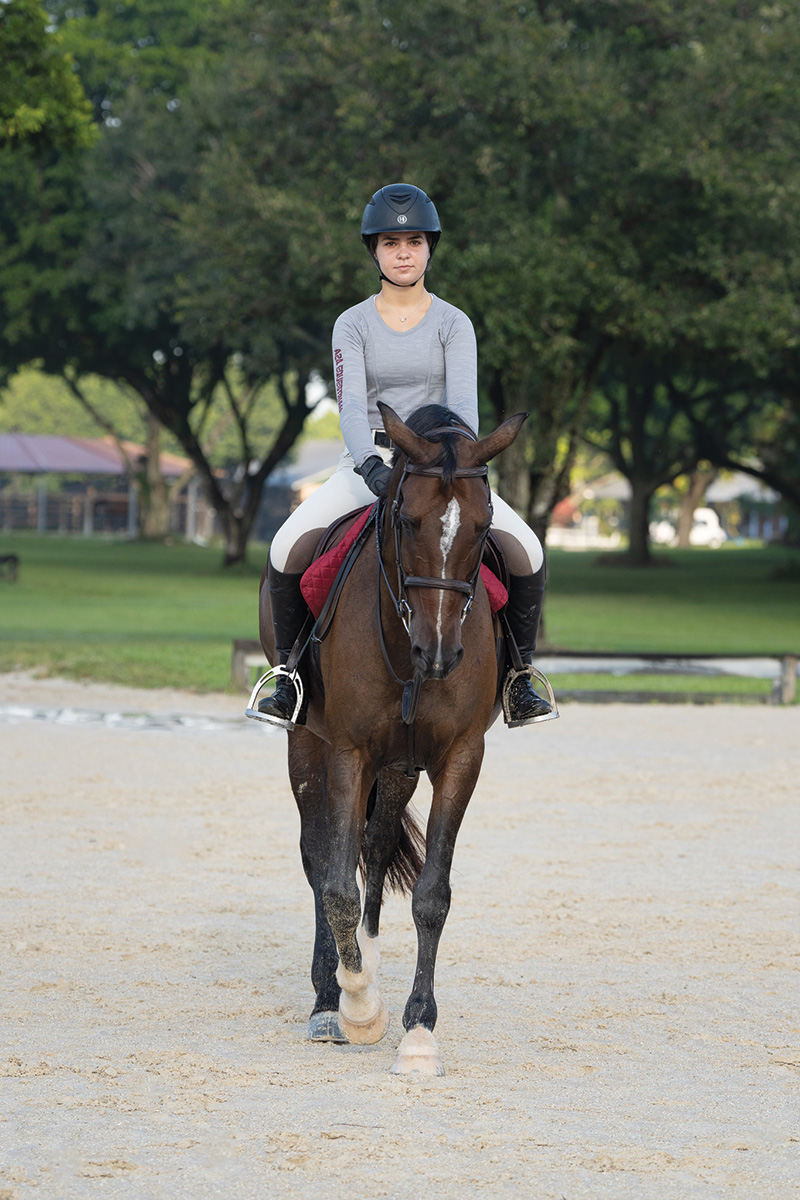
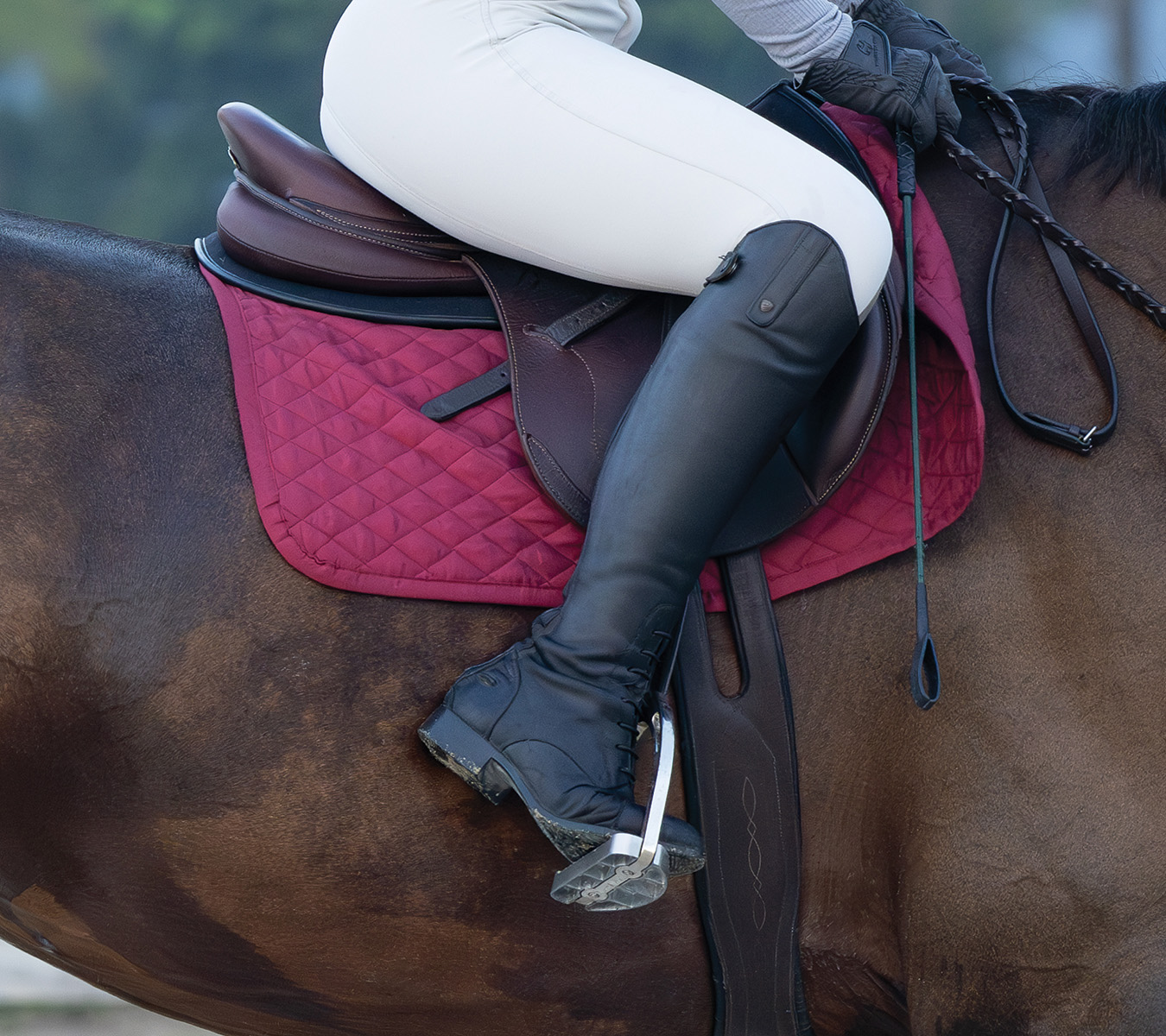
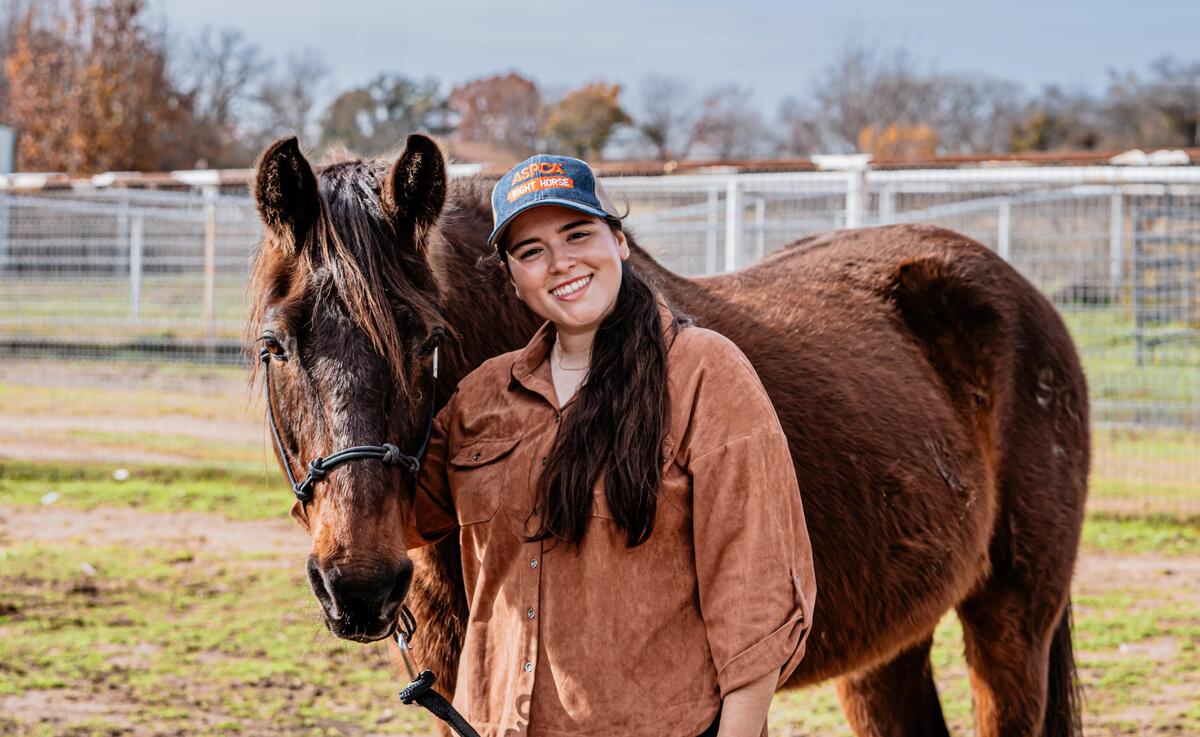
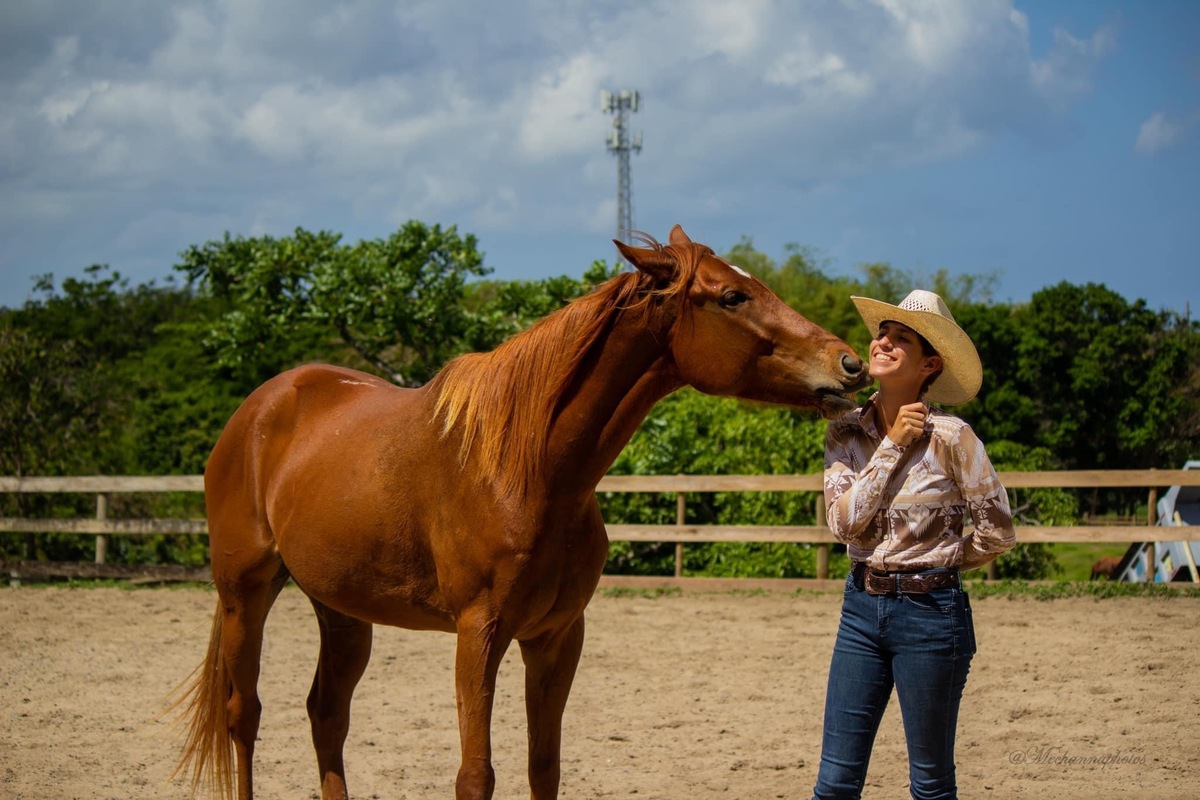
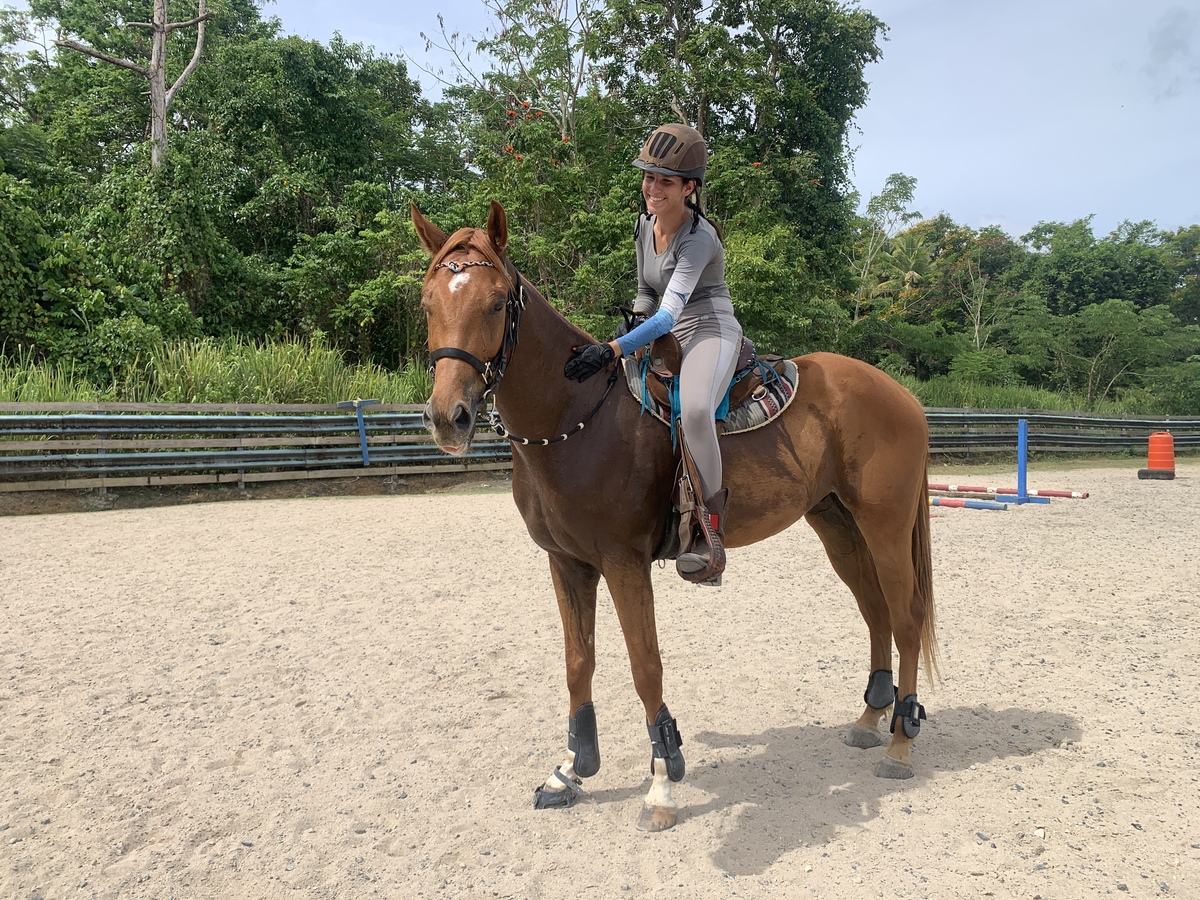
Once upon a time, there was a horse named Tairaterces (Secretariat backwards) affectionately called Tai, who had a tough start in life. When Tai arrived at Caribbean Thoroughbred Aftercare, he was barely approachable and seemed to be carrying a heavy weight on his shoulders. Tai was a local Puerto Rico-bred racehorse with only four starts to his name and earnings of $2,180. To make matters worse, he had Piroplasmosis, which meant he couldn’t travel outside of Puerto Rico.
Despite his struggles, Tai was retired sound, but not without some behavioral issues and trouble working from the starting gate. He had a long way to go, but with time and patience, he started back under saddle in July 2024. As he began to trust those around him, his playful and loving nature shone through. Tai had no vices other than being overly playful and loved spending time with other horses in the field.
It’s amazing to see how far Tai has come from the day he arrived. He has transformed into a stunning horse, both inside and out. Tai still faces challenges with Piroplasmosis and the inability to travel outside of Puerto Rico, but that doesn’t stop him from living his best life. He enjoys spending his days exploring the beautiful island and galloping around with his friends.
Tai has so much love and potential to offer, and he deserves a chance to find his forever home. He’s goofy and willing to please. He does anything you ask if you take it slow and be kind. Caribbean Thoroughbred Aftercare would love to find that special person that wants an athletic beauty to add to their family. They are searching for a special person who can give Tai the love, care, and attention he needs.
Are you that special someone? Adopting Tai isn’t just a decision to add a new member to your family, but also an opportunity to make a positive difference in a horse’s life.
Please help us spread the word and find Tai his forever home!
Photo courtesy Caribbean Thoroughbred Aftercare Inc.
ASPCA Right Horse is the online adoption platform of The Right Horse Initiative, a collection of equine industry and welfare professionals and advocates working together to improve the lives of horses in transition. A program of the ASPCA, their goal is to massively increase horse adoption in the United States. To find more adoptable horses and foster horses, visit www.myrighthorse.org. To learn more about The Right Horse, a program of the ASPCA, visit www.aspcarighthorse.org.
One of the truths I learned from Bobbi Steele was that the longer you take to train a horse, the longer he will last. The more shortcuts you try, the longer it will actually take to train him. We all get in a hurry. It’s a natural human impulse, and it’s probably more common now in today’s hectic world.
When I was learning from Ms. Steele, I would go home and try all the lessons on my ponies and horses. When I asked them to do something sooner than they were capable, it would set them back and it would ultimately take me longer to train them.
What I had to learn was that when you improve something even by small amounts, you are making progress. By taking your time, you may not be teaching the horse “more,” but you are developing the horse’s body, joints, and athleticism to eventually be able to perform more challenging tasks with ease and balance.
Knowing When to Slow Down
When I called Carol Harris, owner of Rugged Lark and other horses I had the honor of training, most of the time I was excited to tell her about her horses’ progress. I learned from her, too—to be honest and tell of difficult times, as she understood the process and would always have valuable suggestions.
When I told her that Lark was not doing something so well and I wasn’t sure why, Carol always said that when faced with challenges, “Do nothing! Just spend time with him, graze him, turn him out, trail ride, and just let it go.”
A few days later, I would return to training with Lark, ask him the same questions and try the same tasks, and he would do them willingly.
There were other times that this was different: Lark retained lessons like no other horse I ever had. I had to be careful to go slowly so he would learn to relax, be confident, and most importantly, trust me. I had to say to Rugged Lark, “You are not supposed to do this so well yet …” and, like during the challenging times, I would stop my lesson and go trail ride or put him away for the day. Just “doing nothing,” taking a break, and coming back and sticking to basics was always the best advice.
I had the privilege of training Rugged Lark as a 2- and 3-year-old, and in 1985 we had a great year showing. He was 4 years young and won his first AQHA World Championship Show Superhorse title.
With a foundation of classical dressage training principles, Rugged Lark was becoming exceptional, and he was in training for eight different disciplines. He competed in reining, western riding, trail, hunter under saddle, working hunter, hunter hack, western pleasure, and pleasure driving. He was a true example of the AQHA motto: The World’s Most Versatile Horse.
The second Superhorse title was not as easy as in 1985, as “it is always harder to stay on the top than it is reaching it.” After winning the second title, I surprised Carol during the presentation of the Superhorse award.
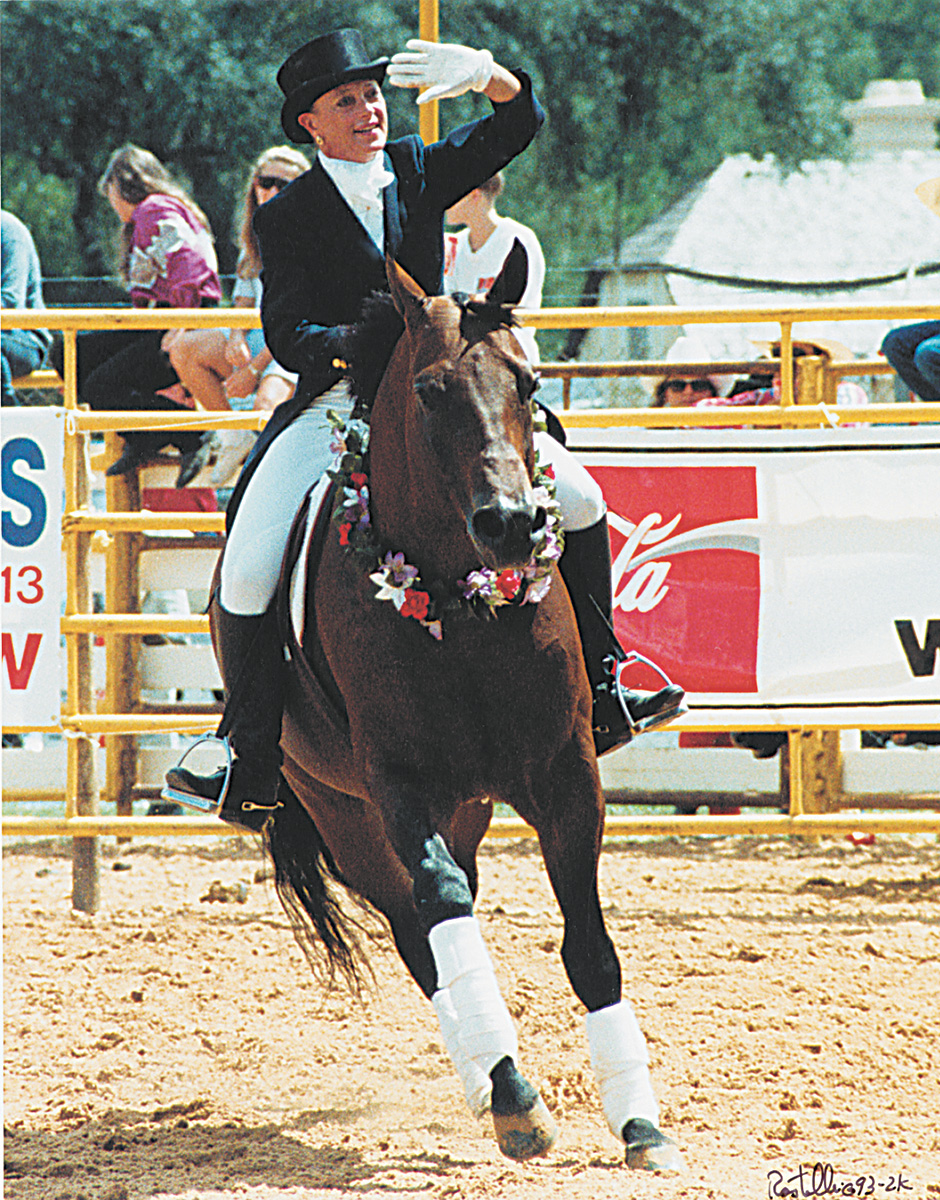
By that time, I had played a little with riding bridleless, which Ms. Steele had taught me back in Sarasota, but Carol didn’t know yet. I rode Lark into the arena without a bridle and trotted, cantered, did flying lead changes and a reining spin, and the crowd went crazy!
Palm and Rugged Lark giving a bridleless dressage exhibition at the Shriner’s Ocala Livestock Pavilion. The pair performed together for many happy years. Photo courtesy of Palm Equestrian Academy
Our spontaneous performance led to 10 fabulous years of bridleless exhibitions at all the major equine events in the United States.
The Art of Doing Nothing
I can’t emphasize enough the importance of knowing when to “do nothing” when working with horses.
To me, this means turnout. All my horses, all my life have had turnout time that allowed them to be themselves in their natural environment. Horses have to graze, move around in an open area, and have room to buck and play. And, most importantly, they need to have lots of room to roll.
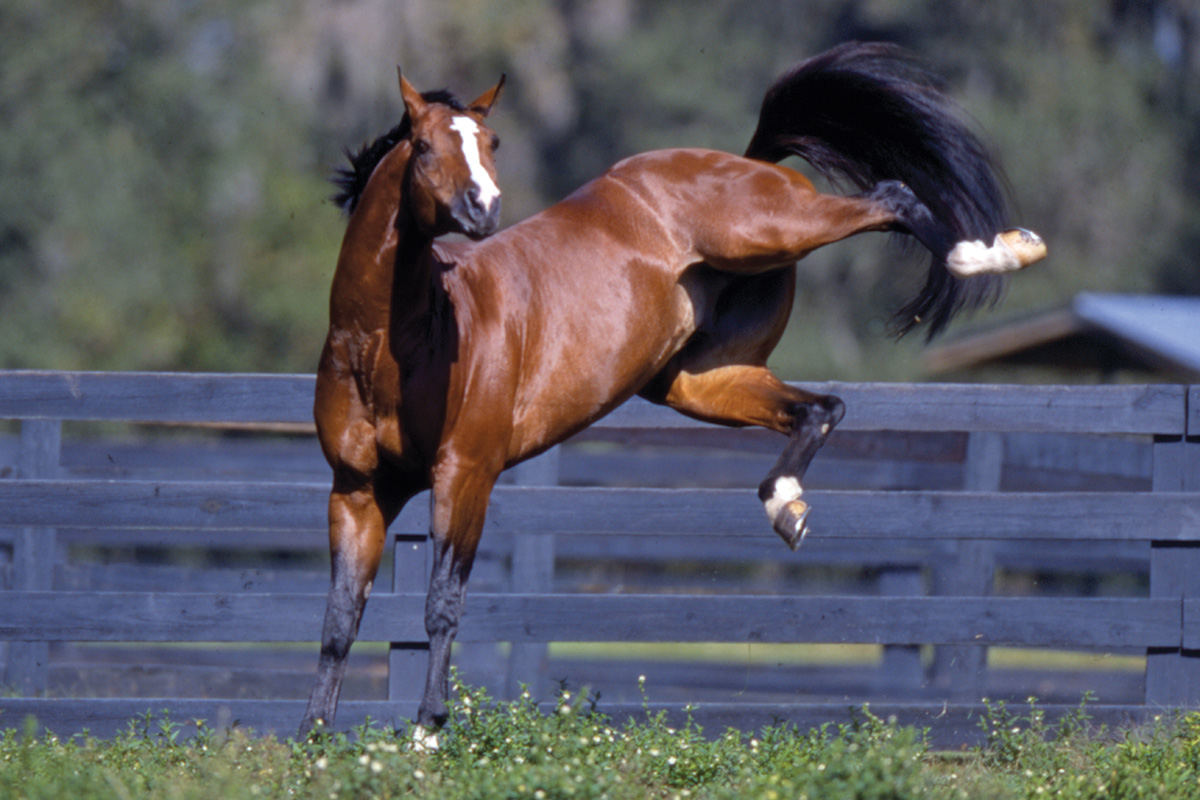
My Royal Lark playing and having fun and demonstrating his amazing athleticism! Turnout is a necessity for the horse’s well-being. Photo by Cappy Jackson
Keeping a horse in a stall most of his life will always bring out habits, many likely unwanted, that under “normal horse circumstances” he would not have. Ms. Steele impressed upon me, again and again, “How would you act if you were put in a room with four walls and a small window and had to stay in there for hours, days, weeks?” All of us would be thinking about how to get out of that room. The horse, too!
Even when my horses have had lameness issues or sickness, they are turned out if at all possible. When a horse has surgery and has to be confined for some time for healing, I am a stickler for finding out how many times a day and for how long the horse can be hand-walked.
“Downtime”—in the form of turnout—is necessary for a young horse in training who seems fatigued or needs fewer training days and more “free-play” days. Turnout is also the answer for the horse who is making lots of mistakes or is inconsistent in his training (not retaining his lessons).
Turnout is for the horse who has just traveled a lot, been competed over a number of weeks or months, or ridden on the trail for many miles. Turnout will help the horse who has lameness or sickness issues.
How long should a horse in one of these scenarios have off with nothing but turnout? The horse will tell you. It may be, in the case of a trainable horse, just a few days. In other situations, it may be a week, two weeks, a month, or even longer.
How do you know if the downtime has been long enough? When you start the horse back in work, how does he feel? Does he have good energy? Is he willing? Is he trying?
When the answer is yes, the amount of downtime was good for that horse. If you start back in work and your horse seems frustrated, resistant, or unwilling, the horse needs more time as you figure out what you need to do differently.
Consult your trainer, veterinarian, and farrier—your “team” players. Have a friend record a video of you working with your horse and share it with your team to get their help finding possible answers to any problems, as well as guidance as to what you can do differently. This is how you can accomplish positive training.
Remember, it never always goes perfectly! You have to have challenges to have success.
Time Together That’s Not “Work Time”
Turnout isn’t the only way to rest the horse and “do nothing.” Other “nothings” are ways you spend valuable time in your horse’s company, free of the expectations of training and showing.
I call this my list of “justs”—because we always want to do more, but sometimes, we should just do this:
Just hand-graze your horse and spend time with him. (And that doesn’t mean making phone calls or scrolling through social media. Really be with him.)
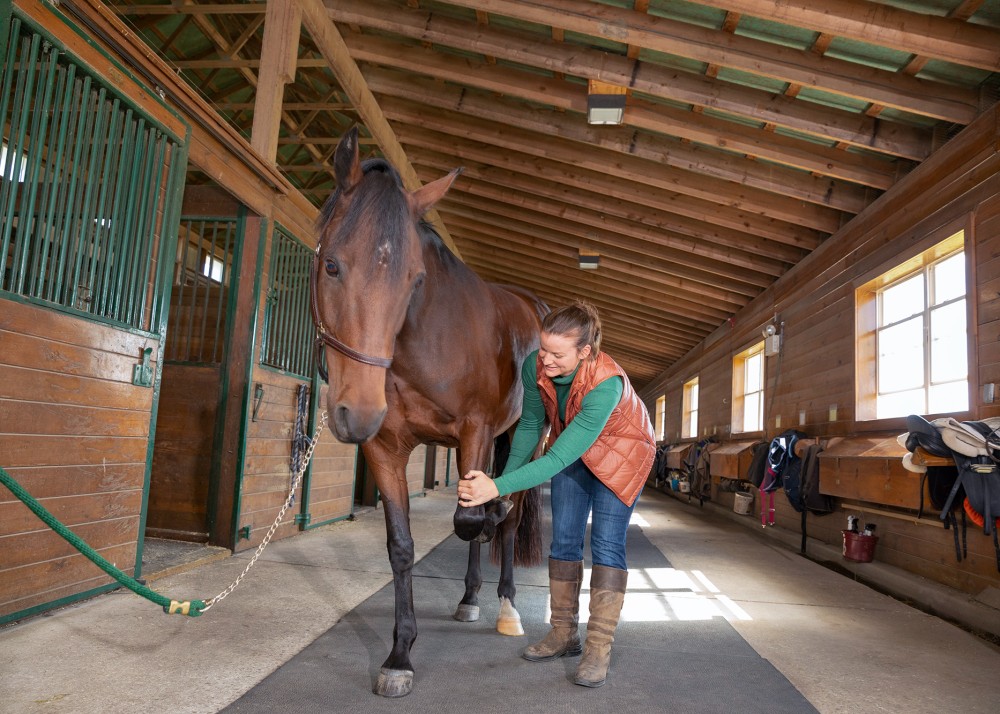
Just give your horse a thorough grooming session and treats.
Just bathe your horse.
Just take your horse on a relaxed, walk-only trail ride.
Just do something different with your horse. Take him swimming!
Just take him for a ride in the trailer to somewhere new and hand-graze him when you get there. (No riding!)
Just take your horse on a walk in-hand around your property or on the trail.
Just ground-drive your horse, or teach him how to pull a cart.
Just let your horse be a horse!
Cross-Training for Longevity
Rugged Painted Lark (“Bruce”) arrived at Palm Equestrian Academy at Fox Grove Farm as a very bold yearling colt in 1998. After he began his training in dressage principles and groundwork, he traveled with us to summer at our farm in Michigan each year while also beginning reining and roping training with Ted Chancey in Florida, Sandy Collier on the West Coast, and Bobby Lewis in Texas. In between, he was jumping and learning to drive.
Because he was such a macho stallion, we focused on working cow horse and roping. He did well as he came along and never forgot the dressage basics that I started him with.
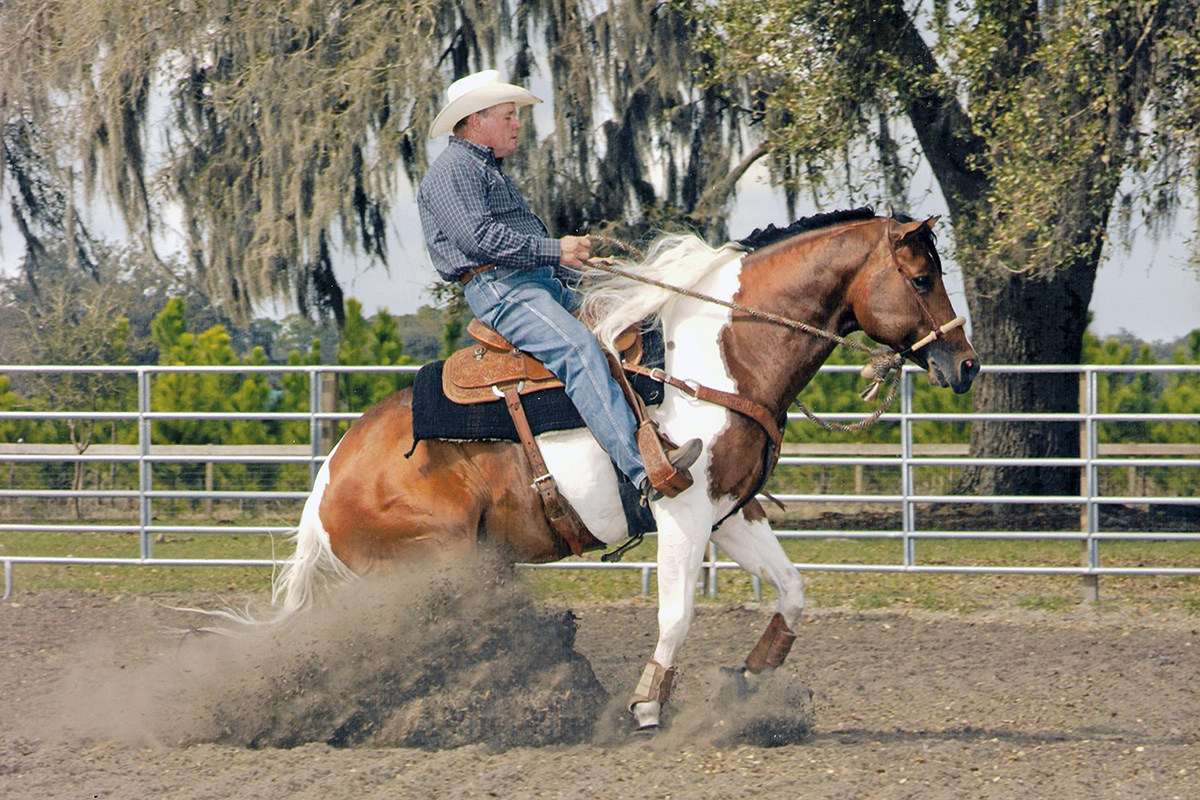
As a young, strong stallion, Rugged Painted Lark (“Bruce”) showed a lot of ability as a stock horse in roping and reining events. Palm had him spend time in training with various professionals (shown with Ted Chancey) that she trusted to build out the horse’s natural abilities. Photo by Waltenberry
Even though I moved more quickly than I might have with another young horse, I didn’t take shortcuts. He was a horse with smarts and confidence, and so was able to quickly master lessons.
Bruce was soon doing canter pirouettes and tempi lead changes, and being ridden bridleless. His looks and performances got him featured on book and magazine covers, in television shows and commercials, and as an entertainer at numerous equine events.
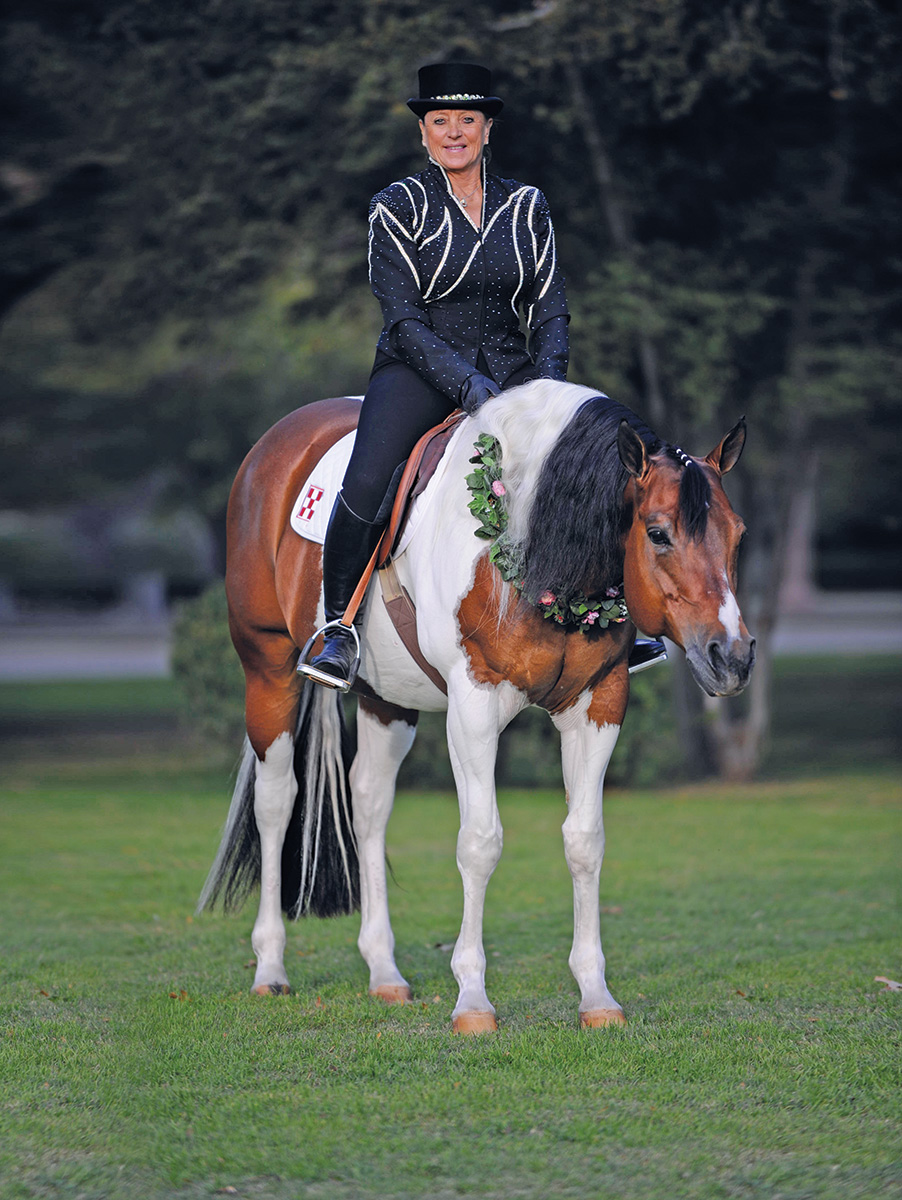
At the American Paint Horse Association (APHA) World Show, Rugged Painted Lark (“Bruce”) and Lynn Palm did a bridleless exhibition to music. Photo by Paint Horse Journal
At the age of 22, Bruce got to show off his years of dressage training with a fabulous freestyle at the 2019 Western Dressage Association of America World Show. In his last appearance at age 23, he could still delight audiences, appearing at Equitana USA.
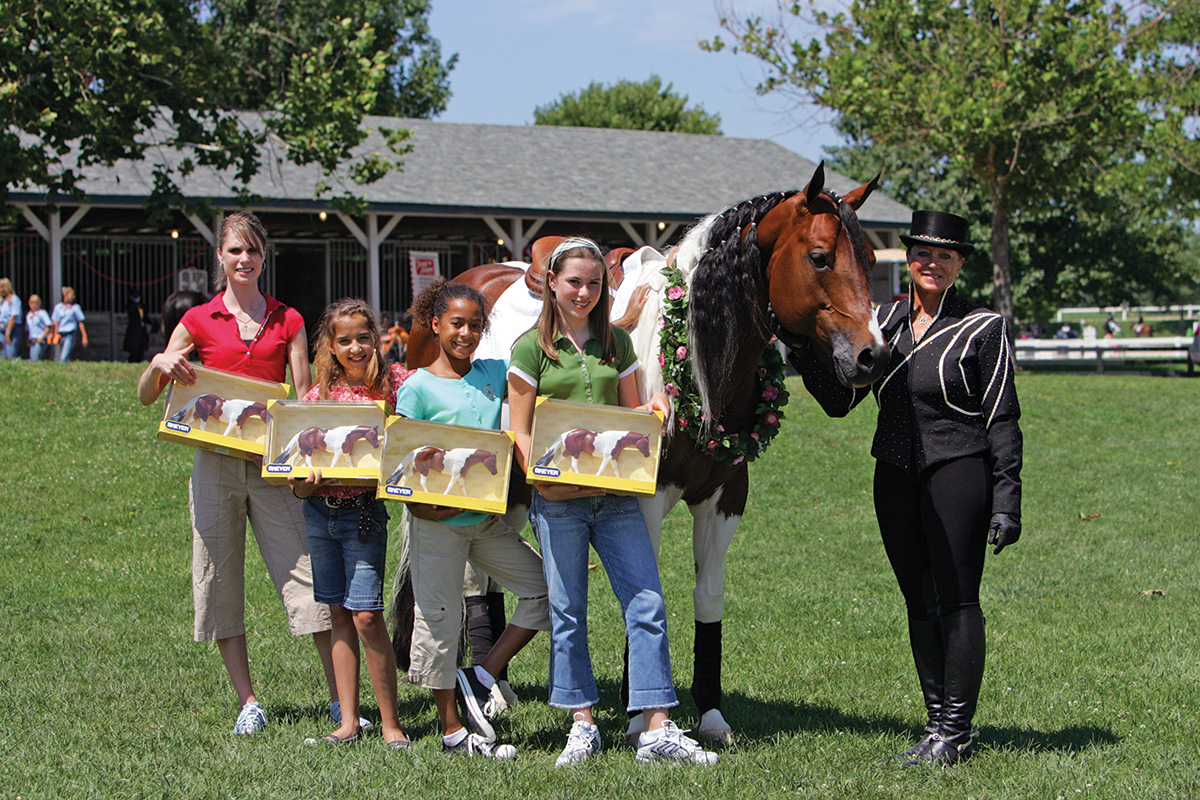
Breyer® model horse was created in Rugged Painted Lark’s honor. He and Palm performed at BreyerFest in Lexington, Ky., many times. (Shown here in 2007 with some of his biggest fans.) Photo by Breyer®
Longevity Training
What these horses, and others, have proven to me is that training for longevity is always worth it in the long run. And it doesn’t have to be hard. Just keep these principles in mind:
1. Vary your training each day or two. Cross-train with under-saddle training aimed toward the goals for the horse: groundwork, riding bridleless, trail obstacles, hill training for fitness, and swimming, if possible. I like to teach my horses to drive, too.
2. Don’t drill your horse. It’s true that horses learn through repetition; however, if you drill (for example, ride 20 circles without stopping), you will eventually lose the willingness of your horse. Horses hate drilling! Keep your horse interested in his lesson by changing directions (lateral suppleness) and doing transitions (longitudinal suppleness). Minding this Golden Rule will also help you develop your horse’s concentration for longer sessions over a period of time. Changing direction and doing transitions often teaches the rider to think: Think “in front of the horse,” think about being confident, and think about riding with accuracy and precision.
3. Train “outside the box.” An arena or a confined area is the place to teach the horse something for the first time. When he understands and can manage the skill, do it “outside the box” where there are new challenges, as the horse’s instincts kick in and he becomes more aware of his environment and on high alert. I learned over time that it was harder to have a horse do the same task well outside an arena. I trained my first National and World Champion in the woods of northern Wisconsin for the three months leading up to the competition. My horse was very confident in the ring!
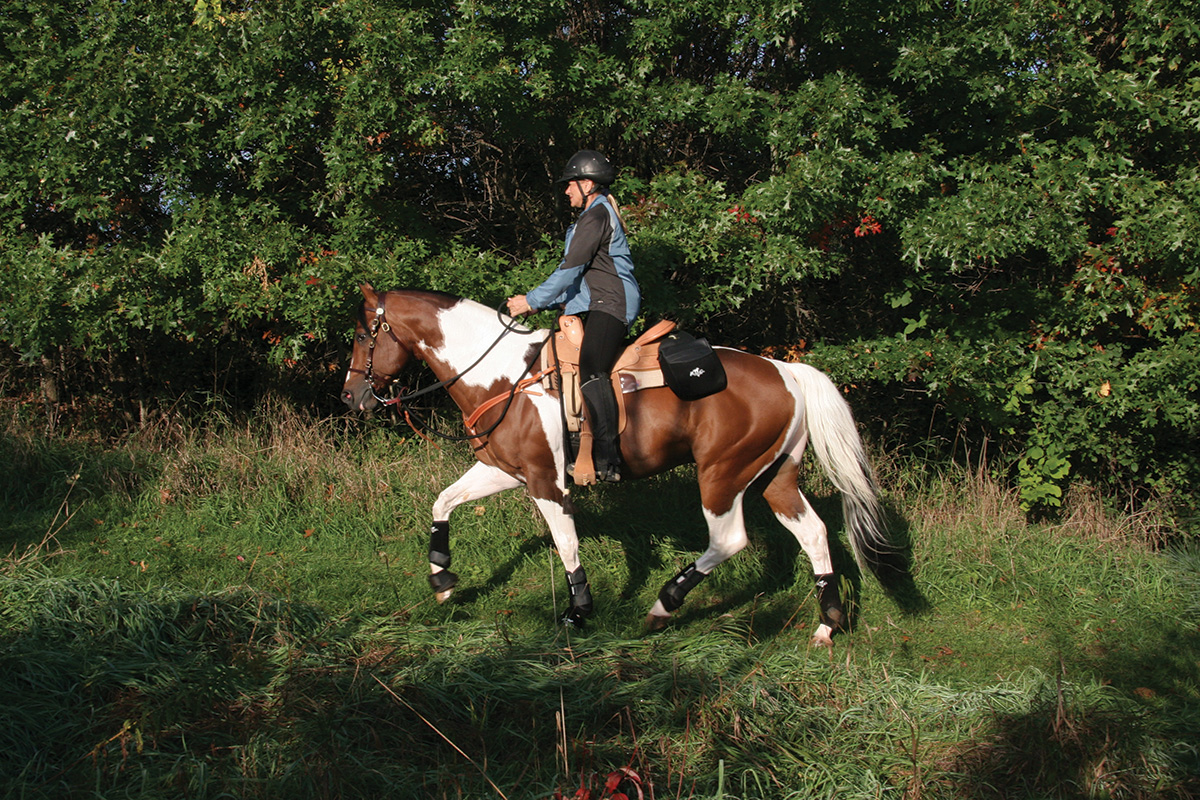
Rugged Painted Lark and Palm trot uphill. She’s a proponent of training show horses outside the arena at least twice a week. This change keeps horses from getting bored and encourages them to be forward-thinking. Photo by Daniel Deweese
4. Listen to your horse. If your horse challenges you, he is trying to tell you something. Use your common sense and try to understand what he could be saying. Figure out what you can try to do differently to get a better result. I always start with a check-in with correct rider position. I know my position weaknesses and try to stop them from happening. Position problems can be as simple as looking down at your horse—when you do this, you will be late to direct him with your aids, and this will frustrate him.
5. Turn your horse out dailyand give him at least one day off per week.
Lessons in Longevity
To me, longevity is about the length of time a horse has quality of life and you have quality of life together. Horses don’t need to be “fried” mentally by the age of 3 or broken down physically by the age of 5.
We have the experience and the veterinary, farrier, and bodywork care that should ensure many years of active partnership in whatever disciplines we choose.
My understanding of how important the “big picture” is in a horse’s training (rather than just immediate goals) has built over a lifetime of experience with many different horses. These are just a few of the lessons I’ve learned about variety in training, patience, and listening to each individual horse.
This excerpt from Finding Your Superhorse: 8 Keys to Developing the Horse That’s Just Right for You by Lynn Palm with Rebecca M. Didier and Marie-Frances Davis appeared in the January/February 2024 issue of Horse Illustrated magazine. Click here to subscribe!
There’s been a lot of chatter recently about vesicular stomatitis outbreaks among horses in the United States. While it might seem on its face that the disease could affect a very limited portion of equines in the United States, there’s actually much more at stake, says Angela Pelzel-McCluskey, DVM, national epidemiologist for equine diseases for the USDA Animal and Plant Health Inspection Service (APHIS) Veterinary Services.
Vesicular stomatitis (VS) is a viral disease that primarily affects horses and cattle, though it can also affect pigs, sheep, goats, llamas and alpacas. It’s not a new disease; it’s been referenced in texts as far back as the mid-1800s.
VS is found only in the Western Hemisphere; it’s considered an endemic disease of the Americas, occurring in the warmer regions of North, Central and South America. Even though it’s old, there is no vaccination that can protect horses from contracting the disease.
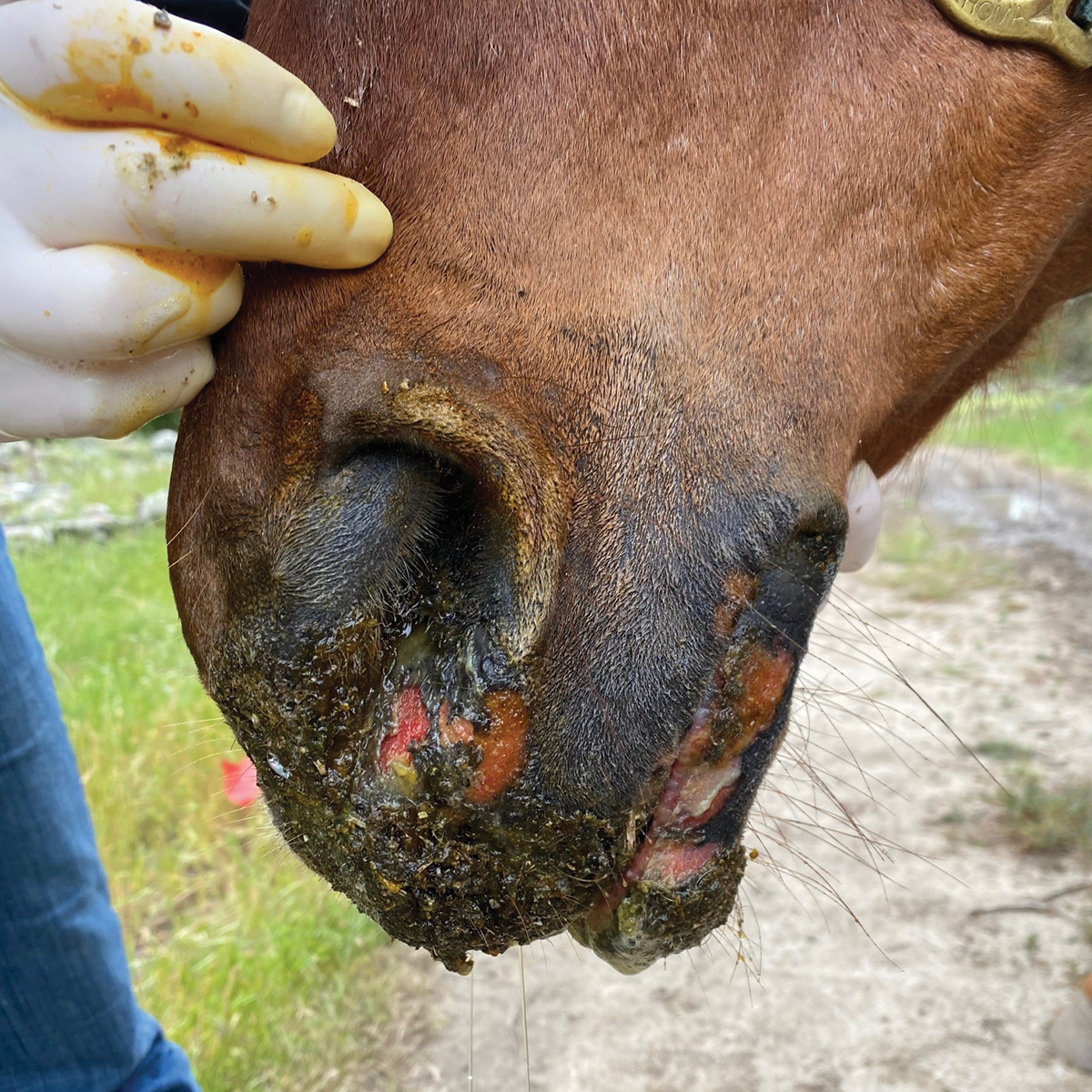
Horses affected by VS may have a fever or salivate excessively and go off their feed. However, the most tell-tale sign of the disease is blister-like lesions (vesicles) on areas of the horse’s body that have minimal hair, like around the mouth, nostrils, coronary bands, sheath or teats.
The most tell-tale sign of VS is blister-like lesions (vesicles) on areas of the horse’s body that have minimal hair, like around the mouth, nostrils, coronary bands, sheath or teats. Photo courtesy Temeku Equine
Blisters can also form in the mouth and on the tongue. When these blisters break, they leave behind raw, exposed, painful skin. Horses with VS will often be reluctant to eat or move.
Age or Underlying Conditions
While often quite painful, most horses heal in a few weeks with nothing more than supportive care, which can include the administration of non-steroidal anti-inflammatories to treat pain.
However, older horses or those with an underlying condition may have a more difficult time recovering from a VS infection; these are the horses Pelzel-McCluskey is particularly concerned about.
For these horses, she recommends conferring with the horse’s treating veterinarian about the possibility of feeding a beet pulp instead of hay or grain, or considering the administration of intravenous fluids. Oral lesions can cause enough pain to stop a horse from eating or drinking enough to keep him healthy, putting him at risk of dehydration or colic.
Even horses that become significantly lame from lesions on their coronet bands often heal with no complications other than a defect demarcation in the hoof wall when it grows out.
Why Is Vesicular Stomatitis Concerning?
It’s been established that VS isn’t particularly deadly, and it’s only found in a small geographic area relative to the size of the world.
Why then, is it a disease horse owners need to worry about? Because the impact on the economy—both within the United States and abroad—can be substantial. VS is an international trade issue, explains Pelzel-McCluskey.
The lesions common in VS infections look disturbingly similar to the lesions caused by foot-and-mouth disease (FMD), which can affect sheep, goats, pigs and cows (FMD does not affect horses, cats or dogs). FMD spreads rapidly, and just one case can shut down international trade completely and have massive economic consequences. FMD is one of the most-feared livestock diseases: In some countries, a FMD diagnosis carries a slaughter mandate.
This means that livestock owners in countries where animals can contract FMD (which doesn’t include the United States; FMD was eradicated here in 1929) will do anything it takes to not have animals present with something that even looks like the dreaded disease—which includes VS.
Mandatory Reporting
Like most things in life, open lines of communication are key. All VS cases are “reportable,” meaning that a veterinarian is required to report suspected cases to state and federal animal health officials, who then have to notify trade partners if cases are confirmed.
To ensure that international trade of livestock continues (even if there is a VS outbreak), the U.S. agrees to quarantine all horses affected by VS and report all VS situations to countries with which they trade. If these pieces are in place, equine trade can continue even in the face of an outbreak.
If these things are not adhered to, however, international trade can come to an immediate halt. This causes huge economic impacts, as horses cannot be imported or exported for showing, racing or sales. Shipping of frozen or cooled semen can continue, though some countries may require a stallion test negative before the semen will be accepted for importation.
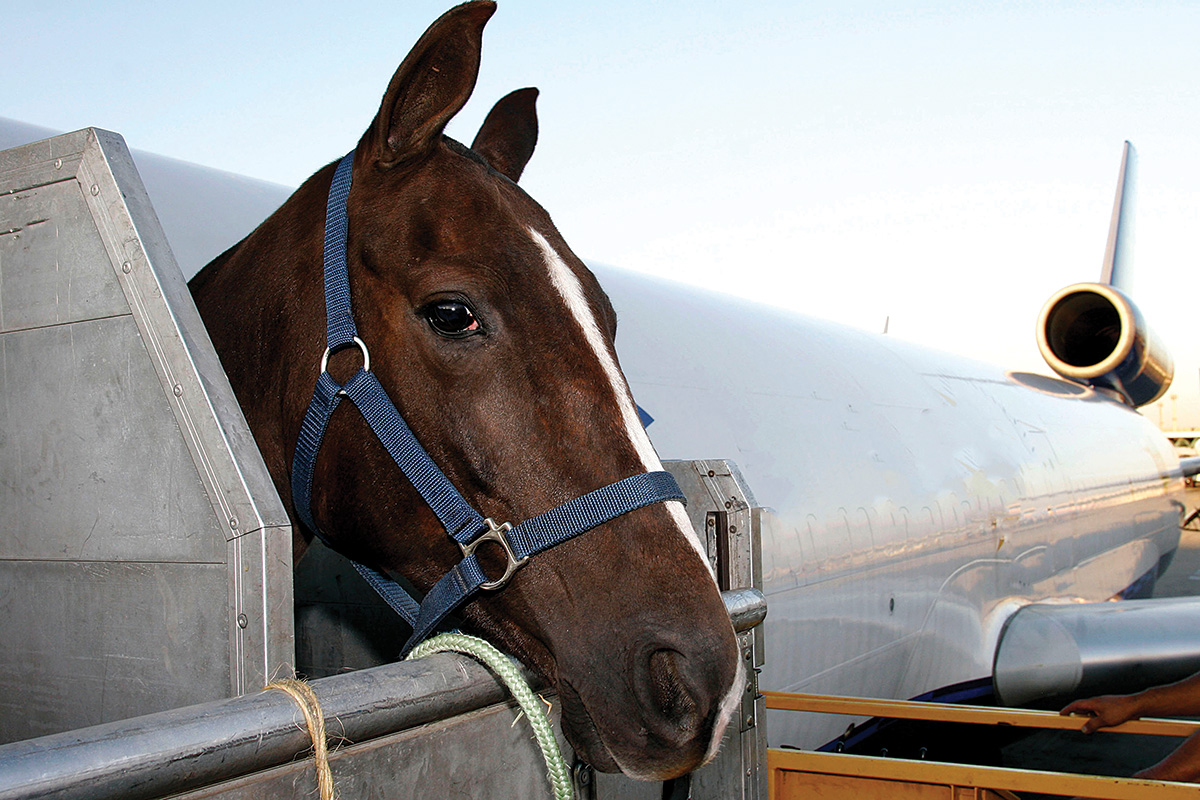
While there are no exact figures available, it’s estimated that 30,000 horse are shipped by air each year, the majority internationally. So, while you personally might not be sending your horse to an overseas competition, you may have contact with someone who will be around horses that plan to travel abroad—and they may unintentionally spread the disease.
While your horse may not travel by airplane, it’s increasingly common he will be exposed to horses that have. Photo by casa.de.photo/Adobe Stock
How Vesicular Stomatitis is Transmitted
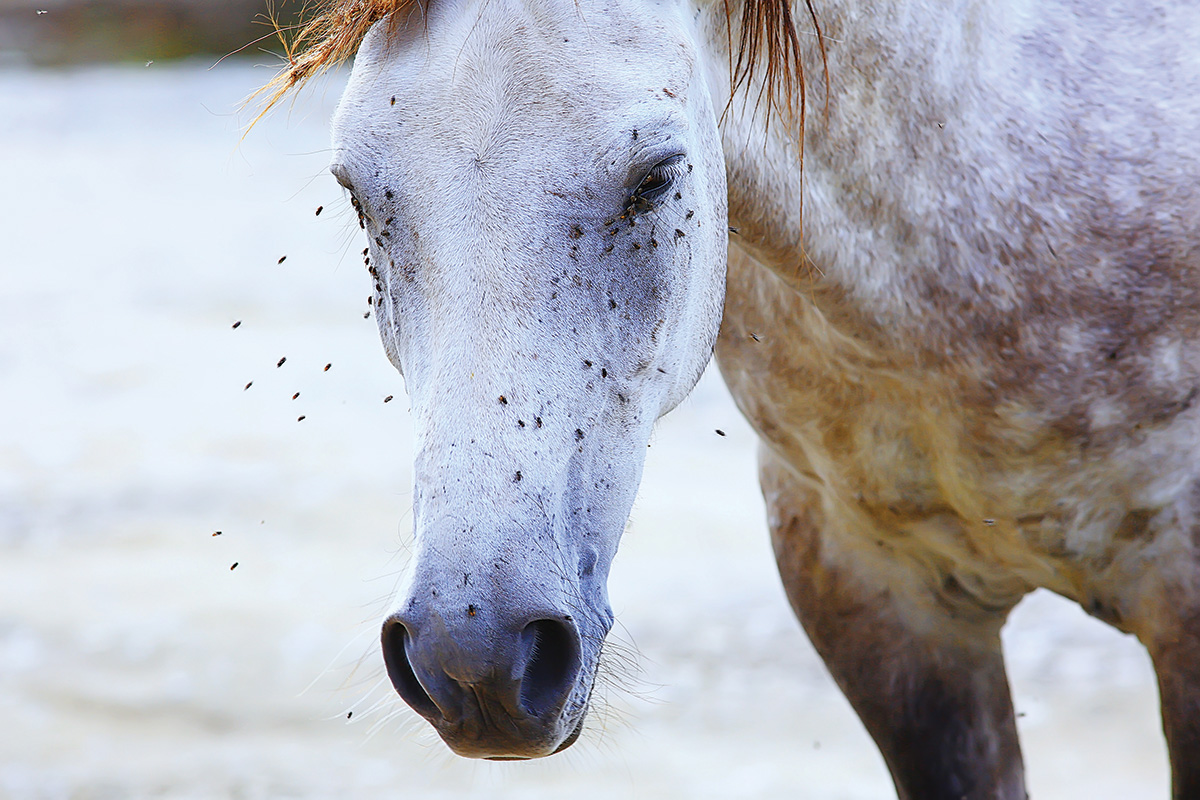
There are three main VS insect vectors: black flies, sand flies and biting midges, explains Pelzel-McCluskey.
“Both the black flies and the Culicoides [midges] drive most of the VS outbreaks in the United States, though there may be some other insects that can spread the disease as well,” she says.
Interestingly, if a VS-carrying insect bites a horse where he has hair, the horse will not develop the outward lesions associated with VS, but he will create antibodies to the virus. The lesions develop only if an infected insect bites a horse where he has little hair cover.
If a VS-infected fly bites an area without hair, such as the muzzle or ears, the horse is more likely to develop the lesions. Photo by kichigin19/Adobe Stock
While this seems like the stars must align for the disease to spread, it can also be transmitted from horse to horse via direct contact or on items that have had contact with the ruptured lesions of an infected animal, like buckets, shared troughs and feed bins; even eating out of the same round bale or sharing communal salt blocks can spread the disease, says Pelzel-McCluskey.
Stopping the Spread
VS can spread rapidly, so quarantining affected horses is imperative. The virus can remain active for seven to 10 days once lesions appear on the horse; quarantine lasts for “14 days from the onset of lesions in the last infected animal on the premise.”
If a horse on your farm is diagnosed with VS, the entire farm must be quarantined while the affected horse is isolated. Photo Mark J. Barrett/Adobe Stock
Local geography affects how VS vectors move and lay their eggs: black flies like flowing water, while Culicoides prefer damp, muddy areas like those around water troughs and riverbanks.
Black flies’ preference for moving water explains how infected insects can often end up miles from original outbreaks. VS most often enters the United States from Mexico.
“We have a series of historically expected cases because of the way water moves,” explains Pelzel-McCluskey. “It’s often seen in the Southwestern United States and the Rocky Mountain area.”
While it would be expected for VS to appear only in the late spring and summer when biting insects are at their peak, it’s not unusual to have VS outbreaks in the dead of winter in Colorado or Wyoming, according to Pelzel-McCluskey.
These outbreaks are almost always the result of Culicoides, which can withstand cooler weather than black flies. These insects become inactive in cold weather, but one warm day—even in the dead of winter—can reinvigorate them. Culicoides lay their eggs in wet areas, like around water troughs and on riverbanks, the very places livestock go when the weather warms.
Keep manure piles as far as possible from fields and stables
Investigate the use of parasitic wasps or guinea hens to keep insect populations in check
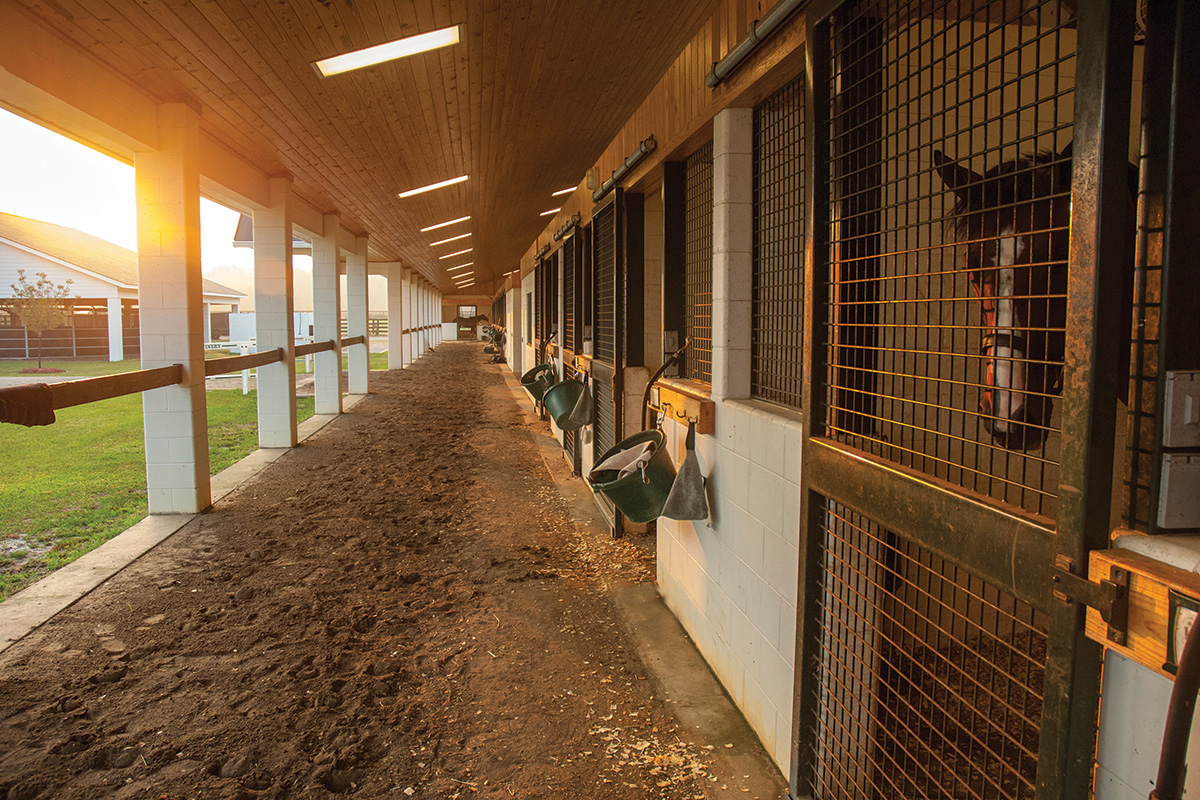
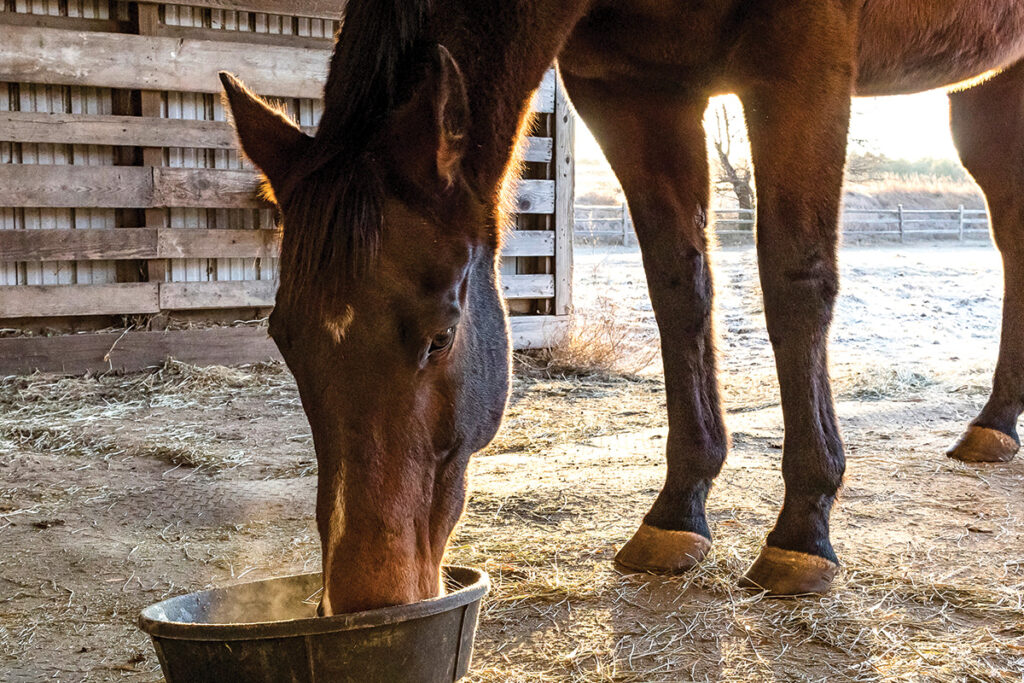
In addition to keeping stalls and equipment clean and disinfected, feed horses from individual feeders to prevent VS transmission. Photo by Margaret Burlingham/Adobe Stock
How to Handle an Outbreak
Controlling a VS outbreak must be a multi-pronged approach, says Pelzel-McCluskey.
First, the owner must isolate a VS-infected animal to minimize disease spread in the horse’s home herd. Additionally, the farm itself must be quarantined to limit the movement of possibly infected animals.
Second, an aggressive vector control program to reduce the fly population must begin. “Owners need to remove manure and standing water,” says Pelzel-McCluskey. “They also need to get rid of tall weeds where insects tend to hide.”
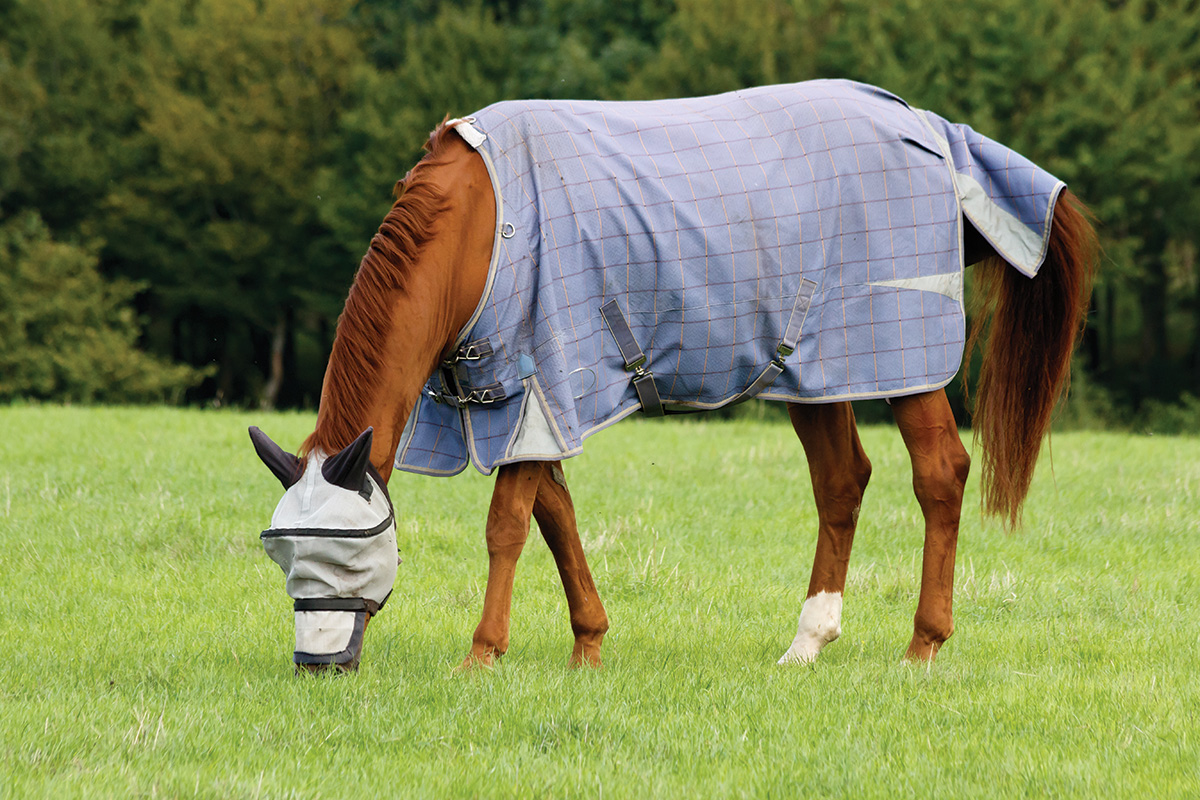
Third, fly-control measures need to be implemented or ramped up. This includes daily application of fly spray to horses (including all particularly vulnerable areas like under the belly, sheath or teats and on the face) and the implementation of tools like parasitic wasps that feed on fly larvae, fans (to keep air flowing), or equine fly gear.If you choose to use things like fly sheets, fly masks or fly boots, it’s critical that they cover areas that are most at risk, including muzzles (think fly masks with nose coverings), bellies (fly sheets with bellybands may help) or ears (fly masks with ear coverings).
Fly gear should cover vulnerable areas, such as the belly, ears and muzzle. Photo Dpullman/Adobe Stock
“Think hard about biosecurity and vector mitigation for disease reasons,” says Pelzel-McCluskey. Both play a part in halting the spread of VS. “The horse doesn’t need to be living in a screened stall,” she clarifies. “We have so many infectious diseases that can be prevented by good biosecurity practices and vector control. No one can do it all, but you do want to have a [fly-control] program in place.”
Additionally, owners who implement new fly-control measures should keep a close eye on whether those measures are working. If they are not working at all or don’t seem to be working well, consider trying another, says Pelzel-McCluskey.
Key Takeaway
Pelzel-McCluskey advises horse owners and caretakers to take vesicular stomatitis seriously.
“It’s not just your individual horse that is affected by the disease,” she says. “Good care means you’re improving the lives of all horses on the property,” which has a ripple effect into the entire population of horses worldwide.
Hooked on horses for as long as she could remember, Renee Genther grew up on the move, following her dad’s career in the Air Force. Still, she managed to always find horses or ponies to ride wherever she lived.
Her love for horses never faded even into adulthood. After Genther’s husband retired from the Coast Guard in 2001, the family decided to call Florida home, relocating to be near both of their parents with their two children, Emily and Kyle.
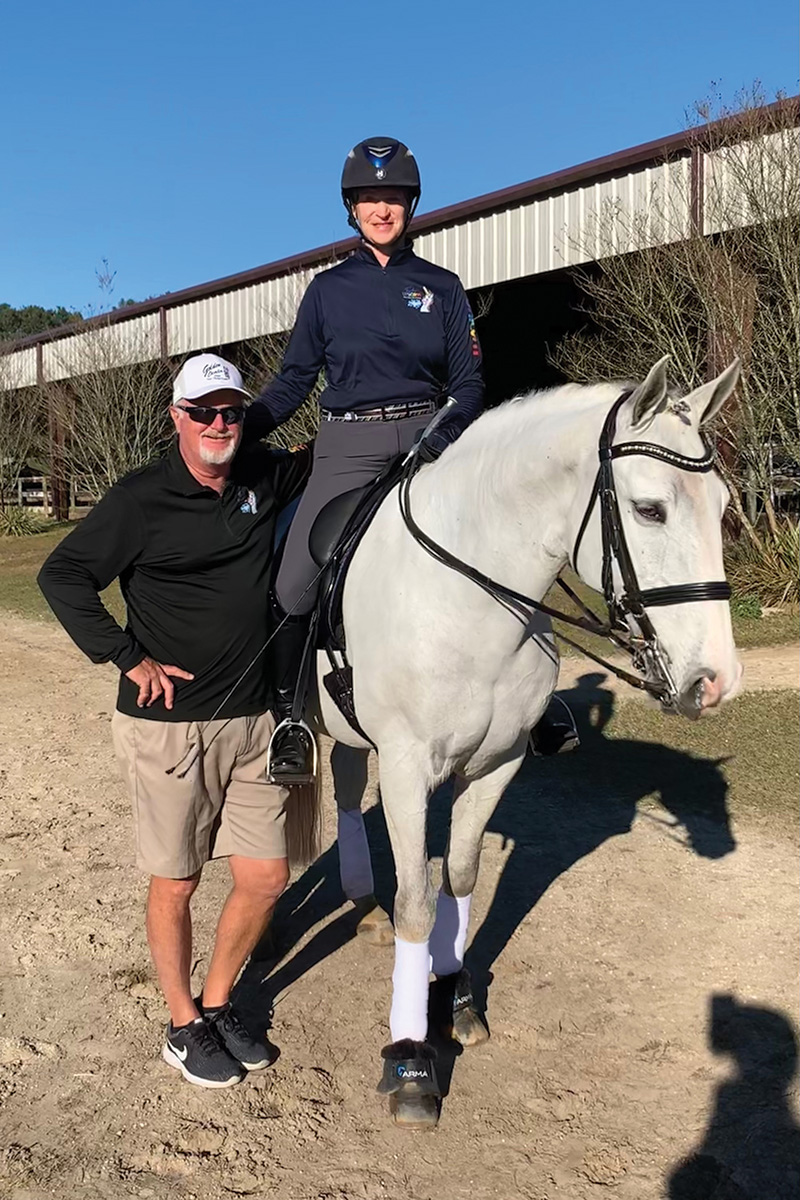
Genther set her sights on horse-friendly Ocala, Fla. A dressage rider, Genther competes at the FEI level with Hector, an imported Lusitano from Brazil with a “puppy personality.” The pair is working on advancing their skills enough to show at the Grand Prix level.
Renee Genther aboard Hector with her husband, Doug. Her family has helped support and grow her business venture.
By day, Genther supports her equestrian lifestyle as a full-time oncology nurse practitioner. And now, she’s also an entrepreneur.
Inventing Something New
When the pandemic hit in 2020, Genther and her adult daughter, Emily, started making their own sugar cubes for their horses. Covid was causing issues with the supply chain, and there wasn’t a cube in sight for the horses.
Hector is a notoriously a picky drinker. When planning to travel to a horse show, Genther was concerned when she saw that temperatures were going to drop. It felt like a perfect storm for colic. She considered scratching from the show.
When a friend suggested adding electrolytes to their sugar cubes, the mother-daughter duo decided to give it a try. She passed out a surplus of extra cubes to fellow riders, also concerned about water intake at the show. The horses drank.
The next day, riders started approaching Genther, requesting more sugar cubes and wanting to know where to purchase them.
“Then it just kind of took on a life of its own,” she says. “We did some research and didn’t see anything out there that was similar, so we started making them in our kitchen at 4 a.m. before work.”
The cubes were poured into molds before the sun came up and distributed into tubs after work, ready to sell.
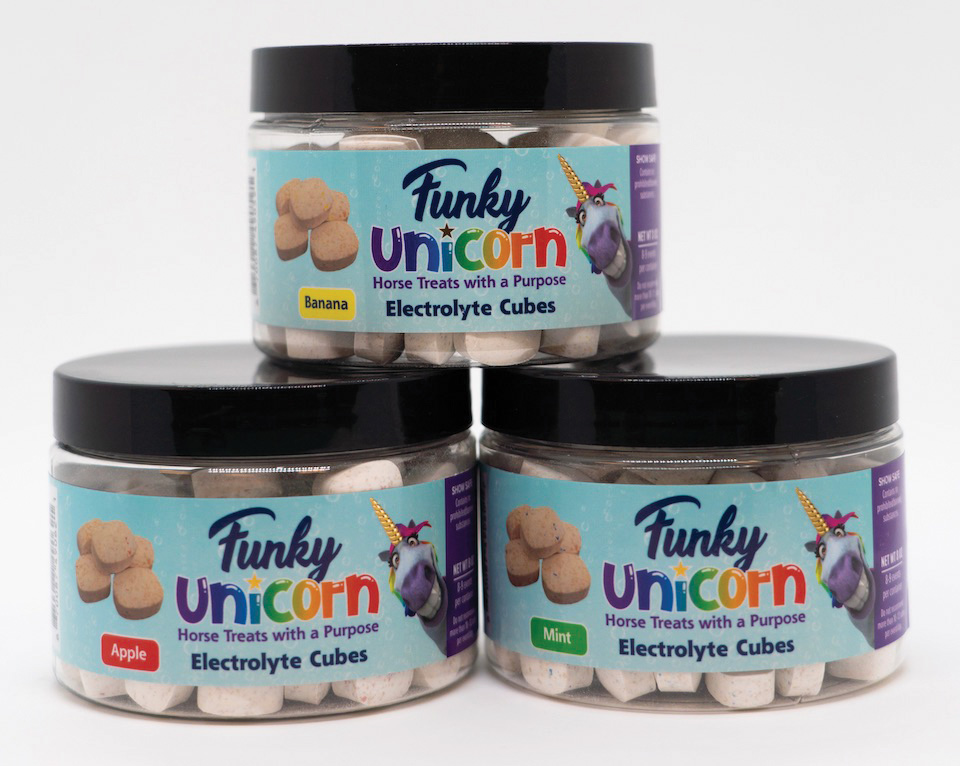
“We started selling them locally to tack stores, and an owner of a store at the World Equestrian Center [in Ocala] gave us a big break,” says Genther. “The cubes were a hit. The motto for our products is ‘Horse treats with purpose,’ because we all want to reward our horses, but we want it to be with something that’s going to benefit them.”
Meeting a Demand
Once the electrolyte cubes gained popularity, Genther realized her kitchen was no longer going to be able to make enough for their customers. She was encouraged by fellow riders and friends to keep the business going, ultimately starting her quest for mass production.
After reaching out to several candy and pharmaceutical companies about making the sugar cubes, it was proving to be a daunting task. The goal was always to create a human-grade product, fed to horses. As soon as a manufacturer heard the product was for a horse, they said no.
After striking out, Genther connected with Courtney Varney, DVM, an FEI veterinary delegate and competitor, who has competed through the Grand Prix level in dressage. Impressed by the product, Varney helped formulate the recipe into a cold, compressed form—a sugar cube made into a fine powder and compressed, like an Altoid.
Genther’s creation, officially monikered Funky Unicorn Treats, finally found a medical director and a pharmaceutical company in the United States to make their treats. The treats are available in three flavors: apple, banana and mint.
“Every single cube has a precise amount [of electrolyte] in it, so there’s no question about the dosage,” says Genther. “It’s made the same way you would create Tylenol.”
Wholesale accounts have been quickly picking up Funky Unicorn Treats, and direct online sales are steadily growing as customers begin to learn about them.
“Every opportunity I get to educate people and tell people about them, I do,” Genther says. “I’m a horrible salesperson, but because I know they’re going to help horses, it’s easy. It’s something I believe in, so I can do it.”
Emily helps with the business when it comes to social media, and she enjoys interacting with new customers at events. Occasionally, Genther’s husband Doug helps with shipping or some heavy lifting, making it a family affair.
A Rewarding Product
Genther’s unplanned journey to create electrolyte cubes has brought on a new level of learning and challenges. But she loves hearing about how much this product helps her customers’ horses.
“I’ve had veterinary schools tell me that they’ve ended up with our product somehow, and it’s really made a difference for the horses in their care,” Genther says. “That’s the goal for us; that’s everything. I did it for my horse to make sure he was safe and happy.”
This article about Renee Genther’s Funy Unicorn Treats business appeared in the November/December 2023 issue of Horse Illustrated magazine. Click here to subscribe!
A flurry of business-wear-clad people filled the meeting rooms and banquet halls of the Central Bank Convention Center in Lexington, Ky., for the US Equestrian (USEF) Annual Meeting January 23-25, 2025. They came together not only to conduct the business of operating the United States Equestrian Federation, but with the central focus of ensuring the welfare of equines. Safeguarding human athletes and celebrating horse and human accomplishments from 2024 were also at the forefront at the gathering.
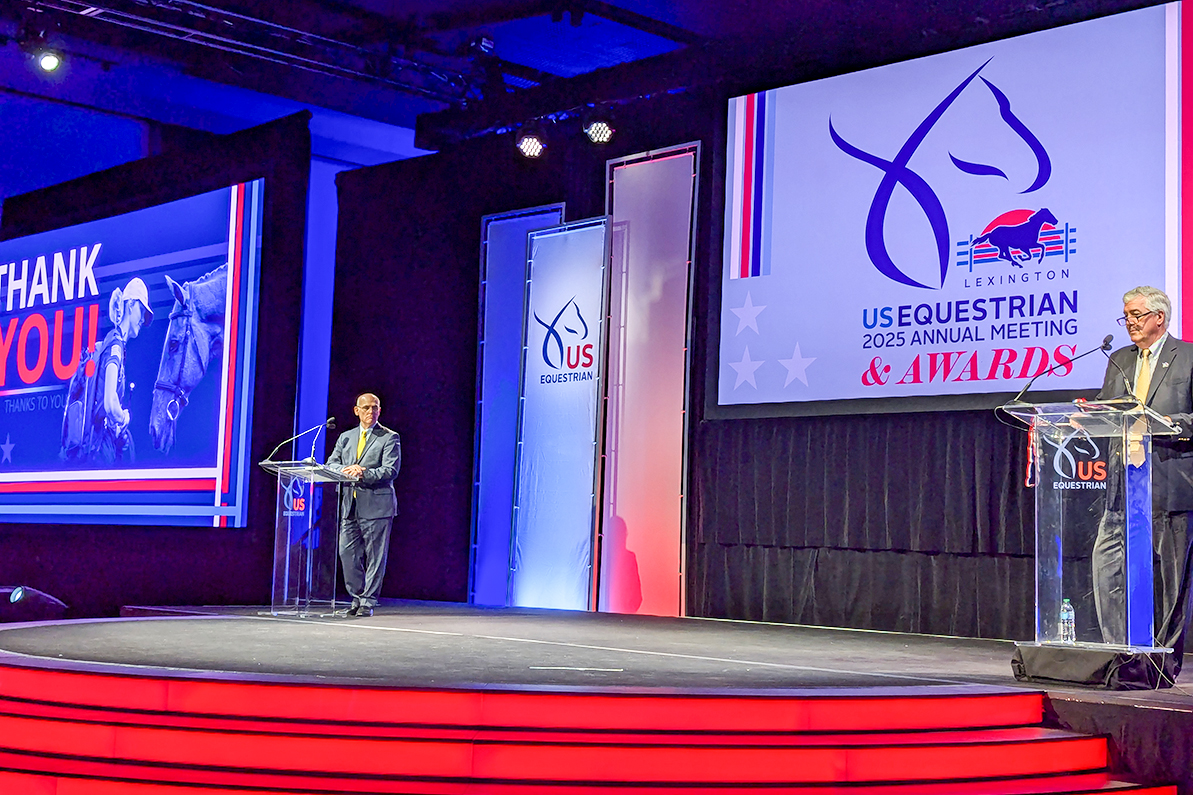
Bill Moroney, US Equestrian Chief Executive Officer (left), and Tom O’Mara, US Equestrian President address the audience during the 2025 US Equestrian Annual Meeting General Session. Photo by Kim MacMillan
As he opened the 2025 Annual Meeting general session, President Tom O’Mara explained why the horse should be put above all else as the focus. “The theme of this year’s Annual Meeting is quite simple, but also quite powerful. It’s all about the horse,” he stated. “Our industry is completely dependent on the horse. It is the reason we are all here, and the reason we were all drawn to this sport.”
In today’s social-media-filled world, a righteous and very public spotlight shines on the treatment of equines by their owners, riders, trainers and caretakers. It was reported in a recent Fédération Équestre Internationale (FEI, the international governing body for equestrian sports) Ethics and Well-Being Survey that 52 percent of the non-equestrian public believes that the welfare of horses used in sports needs improving. When asked the same question, 78 percent of equestrian stakeholders stated that they think horse welfare standards need to be higher. View the study here.
So, while the general public definitely thinks that horse welfare should be better, those in the horse world are even more passionate that change needs to happen. “There is no question that horses, horse welfare, and safety need to be our top priorities,” stated Bill Moroney, US Equestrian Chief Executive Officer during the general session.
Education & Horse Welfare Sessions
Prominent on the 2025 US Equestrian Annual Meeting agenda were two days of “It’s All About the Horse” workshops moderated by Olympic gold medalist and US Equestrian Chief of Sport David O’Connor. Day one of the workshop included an insightful panel discussion on sympathetic training methods with FEI dressage competitor Katherine Bateson-Chandler, noted horsemanship trainer Dana Glass (and husband of Olympic dressage rider Kasey Perry-Glass), and Olympic jumper Beezie Madden.
Each equestrian on the panel shared stories of how they have approached training challenges using ethical methods designed to fit the way a horse thinks. Tidbits of wisdom filled the room as they spoke. These ranged from Madden’s “The slower you go, the faster you get there” to Glass’s “The reward side [of training] for me is the ability to get there together; the horse seeks out that reward and any try they make gets rewarded” to Bateson-Chandler’s sharing that she regularly uses groundwork with the horse wearing a simple rope halter to establish trust and communication.
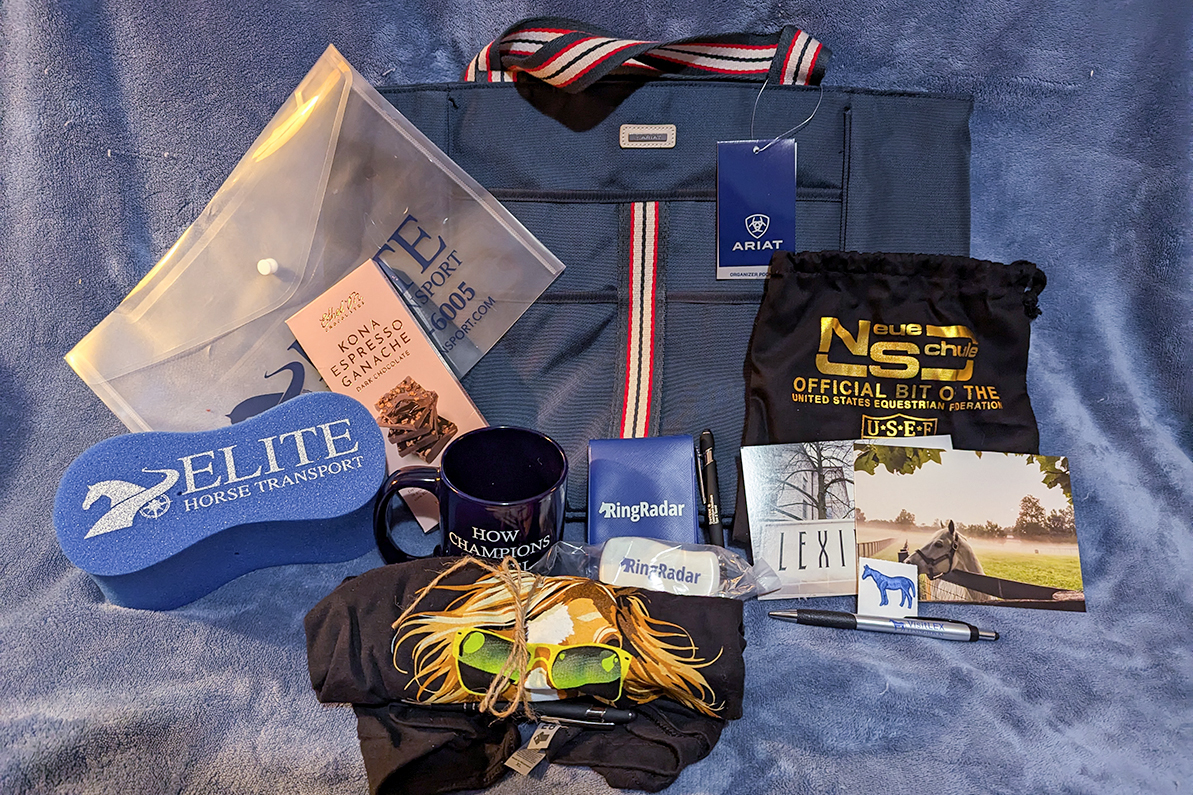
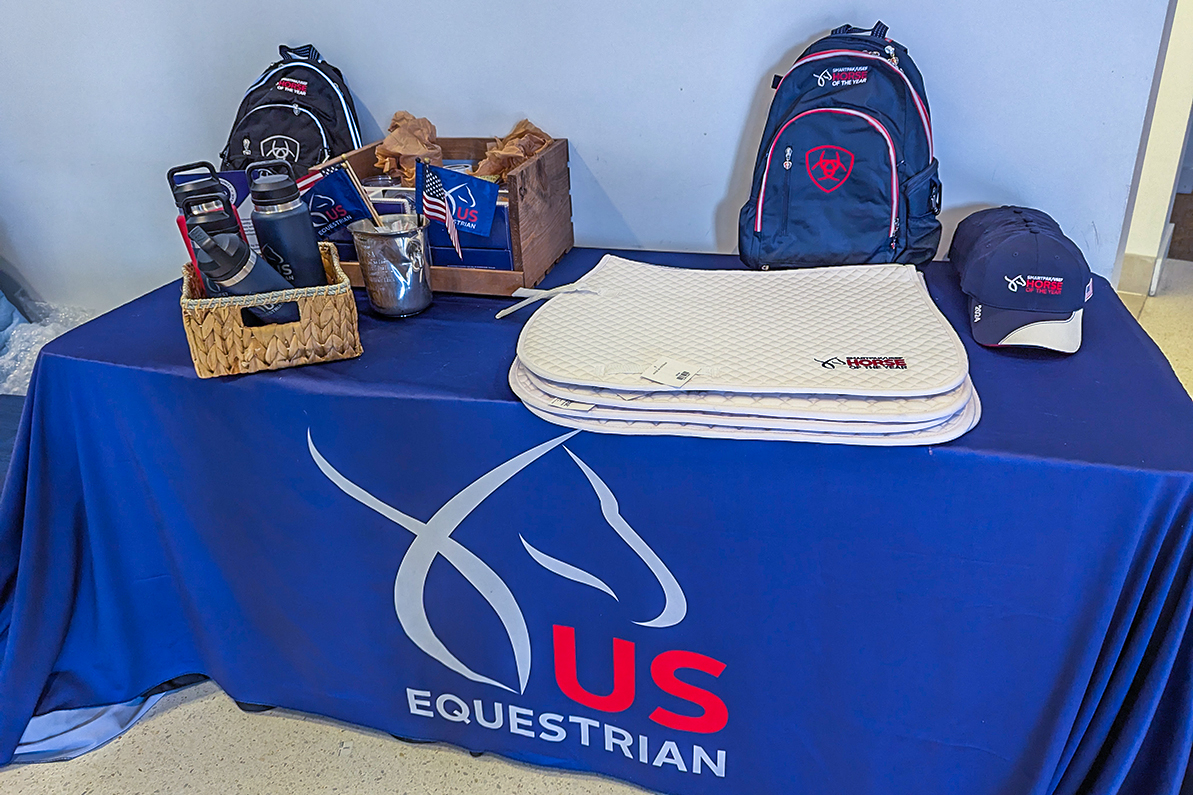
Attendees of the 2025 US Equestrian Annual Meeting were showered with gifts from US Equestrian and sponsors when they checked in. Photo by Kim MacMillan
Day one of the “About the Horse” workshop ended with a report by Keith Dane of the Humane Society of the United States in regards to the United States Department of Agriculture (USDA) Horse Protection Act requirement changes for 2025. The HPA is federal law prohibiting “soring” (the applying of mechanical devices or caustic substances to an animal with the intent to artificially enhancing performance) of horses at shows. The act was created to prohibit these practices at Tennessee Walking and racking horse shows.
During the second day of the “About the Horse” workshop, O’Connor challenged the various breed and sports discipline representatives in the room to outline what their groups are doing to promote equine welfare and humane training practices. One by one spokespersons from the Western Dressage of America, the Arabian Horse Association, the United States Dressage Federation, the American Morgan Horse Association, the United States Hunter Jumper Association, the Welsh Pony and Cob Society of America, and others, stood and listed their action points.
Eventually the workshop discussion led to certification of equestrian trainers and coaches. “I’m a full-on believer that our coaches should be educated and licensed, but how do we get that done?” posed O’Connor as he invited attendees back later that day for a presentation on how to be an effective coach by Dr. Cam Kiosoglous, Assistant Professor at Drexel University and long-time U.S. Rowing National Team and Olympic coach.
Other engaging educational sessions during the first two days of the convention included:
◆ “Pictures (and video) say 1,000 words―and they all matter. Viral news, social license, and the importance of communications” by Sarah Hamilton, a specialist in political campaign management and strategy, crisis communications, media relations, and message and policy development. View her full presentation here and here.
◆ “Biosecurity and medications, an explanation of microchipping and the new biometric-measuring microchips and how they safeguard horses by aiding in biosecurity and health care” by Dr. Katie Flynn, US Equestrian Senior Staff Veterinarian Equine Health and Biosecurity. Watch her presentation here.
◆ “Biosecurity and medications, a presentation on the use of pharmacology (the science of drugs and medications, including a substance’s origin, composition, pharmacokinetics, pharmacodynamics, therapeutic use, and toxicology) to improve the health of equines” by Dr. Stephen Schumacher, US Equestrian Chief Veterinary Officer. View his presentation here.
Watch for posting of additional videos from the 2025 US Equestrian Annual Meeting workshops and educational sessions as they become available here.
Nuts & Bolts Review
A statistics-packed general session, chock-full of colorful slides and upbeat videos and led by President O’Mara and CEO Moroney, rocked the house on the second afternoon. Among the impressive growth measurements cited from 2023 to 2024 were an 8 percent increase (to over 500,000) in memberships (a combination of competing, subscriber and fan membership categories), and the total number of followers on US Equestrian social media platforms (Facebook, TikTok, Instagram, YouTube, and X) passing the 1.65 million mark, up 22 percent. Another impressive increase was the more than 73 million video views across all US Equestrian platforms, up more than 189 percent.
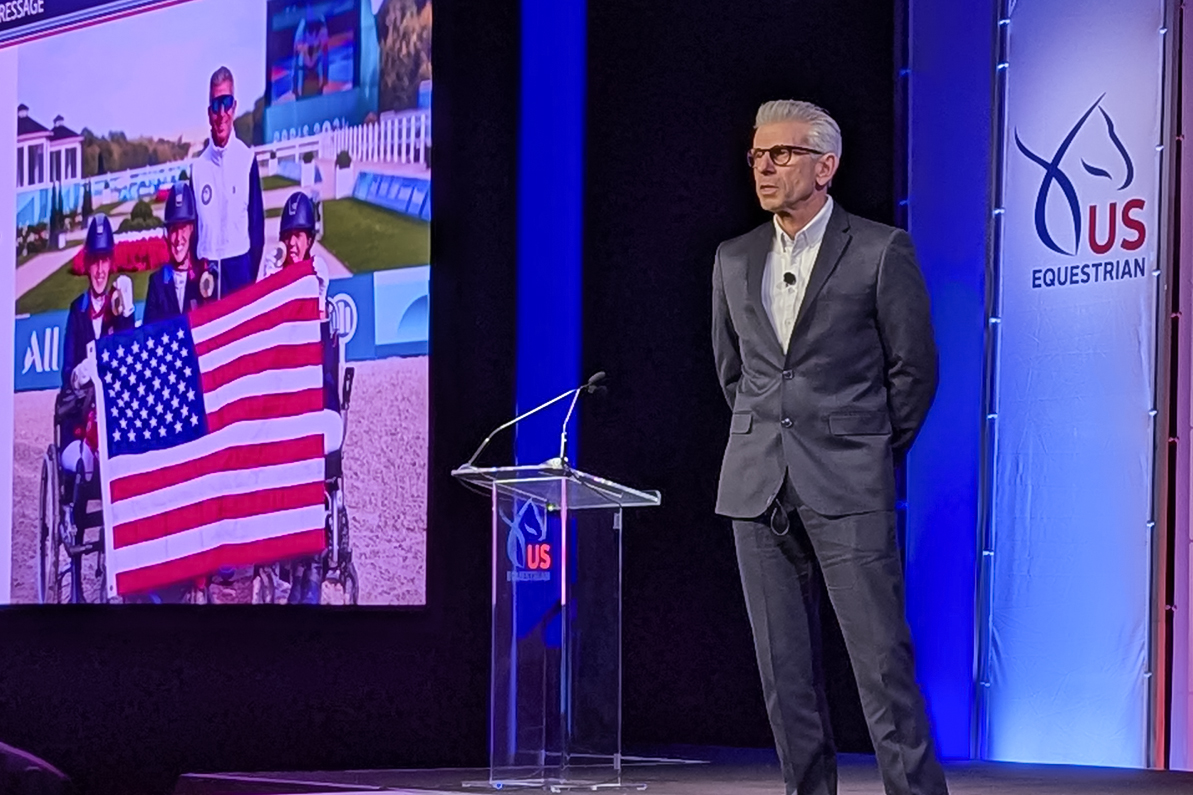
Also included in the general session was a “Journey to Gold” presentation by the US Para Dressage Team Chef d’Equipe and Technical Advisor Michel Assouline about the team’s unprecedented success at the 2024 Paris Paralympic Games (their first team gold and four individual golds, plus an individual silver and bronze). The depth of the seven-year strategic plan for the U.S. Para Dressage Team leading to Paris was stellar. His “Midas touch” is well-worth noting since he guided not only the U.S. team to gold in Paris last year, but before that the British Para Dressage Team to gold in all the other Paralympics offering para equestrian competition. Thankfully, Assouline’s contract to lead the U.S. Para Equestrian Team has been extended through the 2028 Los Angeles Paralympic Games.
U.S. Para Dressage Team Chef d’Equipe and Technical Advisor Michel Assouline talked about the plan behind the team’s unprecedented success at the 2024 Paris Paralympic Games during the 2025 US Equestrian Annual Meeting. Photo by Kim MacMillan
Catch up on other 2024 US Equestrian benchmarks, and Assouline’s entire “Journey to Gold” presentation included in the US Equestrian USEF General Session video here or read the US Equestrian General Session news release here.
Additionally, a PDF document of the US Equestrian’s Strategic Plan for 2025-2028 may be downloaded here.
The International Disciplines Council meeting (which includes representatives from all of the FEI sports), held on the first day, also highlighted the U.S. Equestrian Team’s performance from Paris 2024, and other world championships from last year. Hallye Griffin, US Equestrian Director of FEI/High Performance Sport, opened with an overview of 2024 accomplishments and plans for the 2026 FEI World Championships in Aachen, Germany, the 2027 Pan American Games in Lima, Peru, and the 2028 Olympic and Paralympic Games in Los Angeles, plus upcoming world championships in driving, endurance and vaulting.
US Equestrian Managing Director, Sports Logistics, Steven Morrissey followed with an explanation of, among other tasks, the logistics of booking athlete and staff lodging and transportation for upcoming Games. Then, individual reports for the various FEI disciplines for the coming four-year competition cycle were delivered by the US Equestrian Managing Directors for dressage, driving, endurance, eventing, show jumping and vaulting and by Assouline for para dressage. Will Faudree, U.S. athlete representative to the FEI Eventing Forum, also gave a quick report. A National Breeds and Disciplines Council meeting was held the same day.
The final session on day two of the Annual Meeting was a rule change forum allowing attendees to weigh in on the proposed rule changes before they were presented at the Board of Directors meeting the next day. Most of the rule changes were either horse welfare or human athlete safety related.
US Equestrian Paris 2024 Media Campaign Skyrockets
Another presentation jam-packed with impressive accomplishments was “Measuring Media Success from the Paris 2024 Olympic & Paralympic Games” presented by Griffin and Carly Weilminster, US Equestrian Senior Director of Sport Communications and Social Media. During their presentation they displayed the tools and media platforms used to engage and inform the public about the US Equestrian Teams competing in France. The fan participation and views stats for Paris 2024 easily topped previous Games. One example was that US Equestrian TikTok video views increased by a whopping 965 percent.
In addition to clever use of behind-the-scenes reports and athlete spotlights, US Equestrian was able to take advantage of several celebrity visits and endorsements for their Paris media campaign. The fact that NBC sent Martha Stewart and Snoop Dogg to the equestrian venue at Versailles gave a huge, positive boost to the sport. And when NFL football great Tom Brady and his daughter Vivian visited the U.S. stabling in France, US Equestrian benefitted from Brady’s huge fan base as well (95.7 percent of Brady’s followers were not US Equestrian members, so this exposed horse sports to a whole new audience). Another NFL player, Devin White who is a horse owner, sent well wishes to the the team via his social media, bringing more attention and his fans on board too.
Shopper’s delight, US Equestrian offered branded merchandise for sale at the 2025 US Equestrian Annual Meeting. Photo by Kim MacMillan
Board Embraces New Technology
A US Equestrian Board of Directors meeting capped the convention on the final day with two sessions open to the public. Along with the normal business of running the Federation, these four newly adopted technology tools were introduced:
◆ EquiRatings: A comprehensive data analytics and content plan focused on the fan experience for the new US Equestrian Open competition.
◆ Black Horse One: A US Equestrian platform of sports data designed to give breeders, buyers, sellers, and fans information on performance and bloodlines.
◆ EZ Entry: Currently in development for proposed rollout in 2026; designed to provide a free, user-friendly, centralized entry system for organizers and members to use.
◆ USEF App: New features will be included in a rebranded US Equestrian mobile app this year.
Find an expanded report of the Board of Directors meeting actions, including adopted rule changes, and these new tech tools here.
2024 US Equestrian Equine & Human Honorees
The US Equestrian Annual Meeting features two awards banquets, one to honor the accomplishments of human equestrian athletes called the Pegasus Awards on Thursday, and the other to recognize outstanding equine athletes called the Horse of the Year Awards on Saturday. Evening wear and a festive atmosphere were the order of the day for both events. Check out this brief, very cool video review of the 2024 US Equestrian breed and sports discipline group National Champions here.
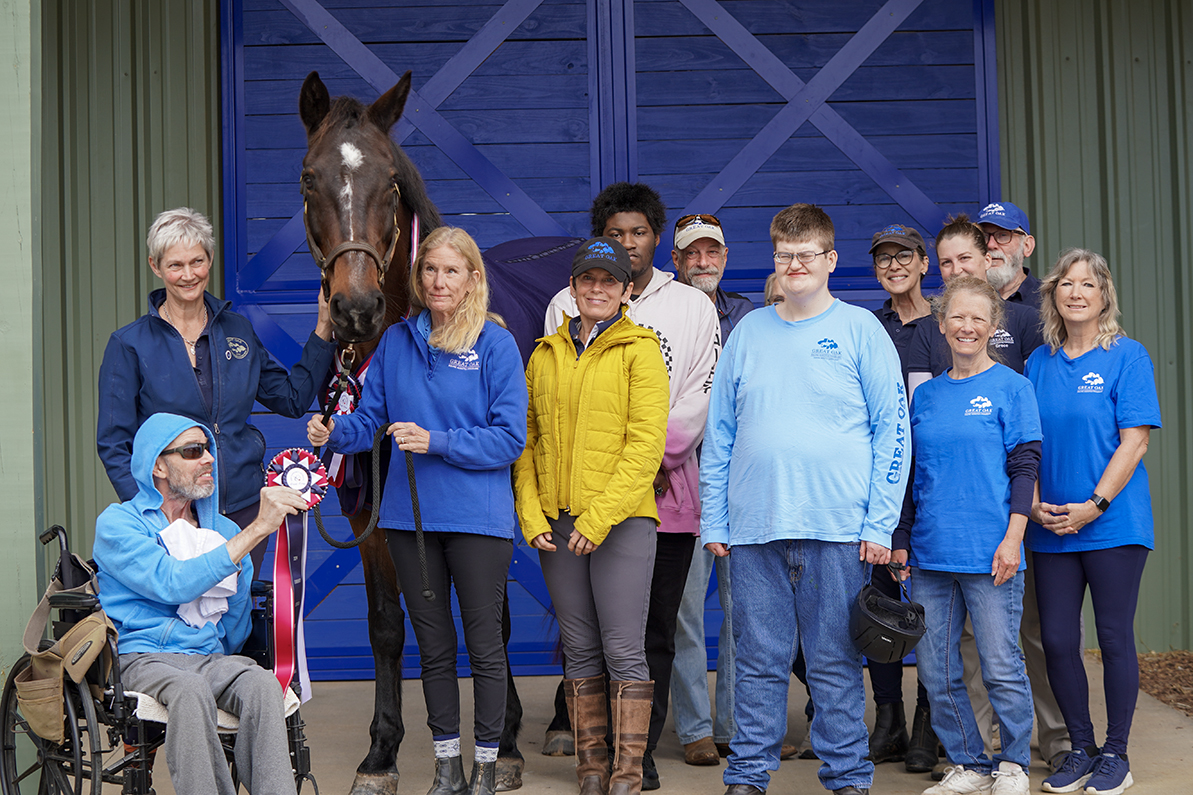
US Equestrian’s newest equine honor, the Heart Horse Award presented to a horse serving the public at one of the US Equestrian’s community outreach partners, was bestowed during the Pegasus dinner. The winner of that inaugural award, sponsored by Neue Schule, was Kilcarna French Fancy “Arnie”, a 2008 Irish Sport Horse gelding from Great Oak Equine Assisted Programs in Aiken, S.C. Learn more about Arnie in this video and read more about him here.
Winner of the USEF’s inaugural Heart Horse Award, sponsored by Neue Schule USA, was Kilcarna French Fancy, a.k.a. “Arnie”, a 2008 Irish Sport Horse gelding from Great Oak Equine Assisted Programs in Aiken, S.C. Photo by Mikhail Proctor/US Equestrian
Mette Larsen from Neue Schule Bits USA, explained why they decided to sponsor the award, “We are all about the connection between horse and rider. I have known many service horses in therapeutic programs and I’m always amazed how much they give to people, both physically and mentally. Recognizing our Heart Horse nominees, and of course, our winner, just seemed like a good fit. It’s our way of saying thanks to these amazing animals.”
Other 2024 US Equestrian Heart Horse finalists were: Bear, a 1996 Haflinger gelding from Special Equestrians, Warrington, Pa., Buck, a 1998 Paint gelding from Prancing Horse Center for Therapeutic Horsemanship, Southern Pines, N.C., and Tigerlily, a 2002 Welsh Pony from Ride On Therapeutic Horsemanship, Chatsworth, Calif.
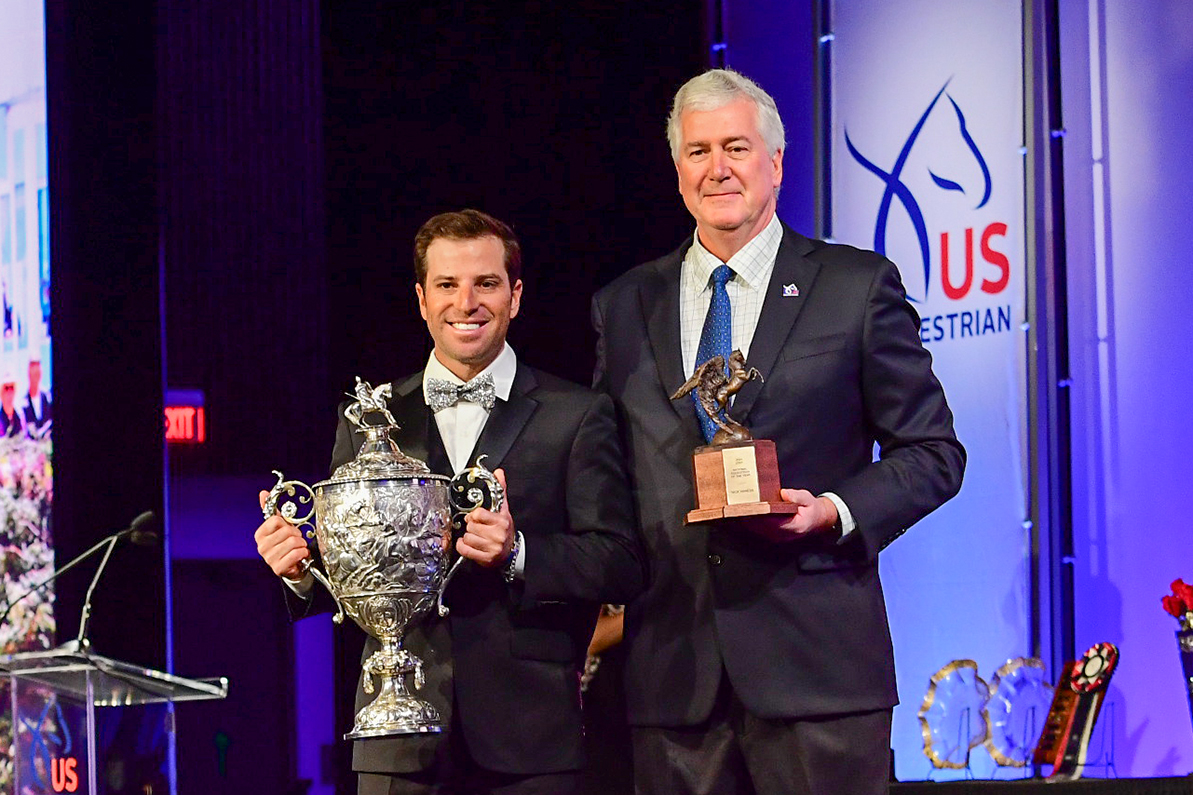
During the Pegasus banquet, among the many award recipients, US Equestrian recognized 11 Equestrians of Honor and from that pool a National Equestrian of the Year and International Equestrian of the Year were chosen. Winner of the National Equestrian of the Year was hunter rider Nick Haness of San Clemente, Calif., and of the International Equestrian of the Year was Olympic eventer Liz Halliday of Lexington, Ky.
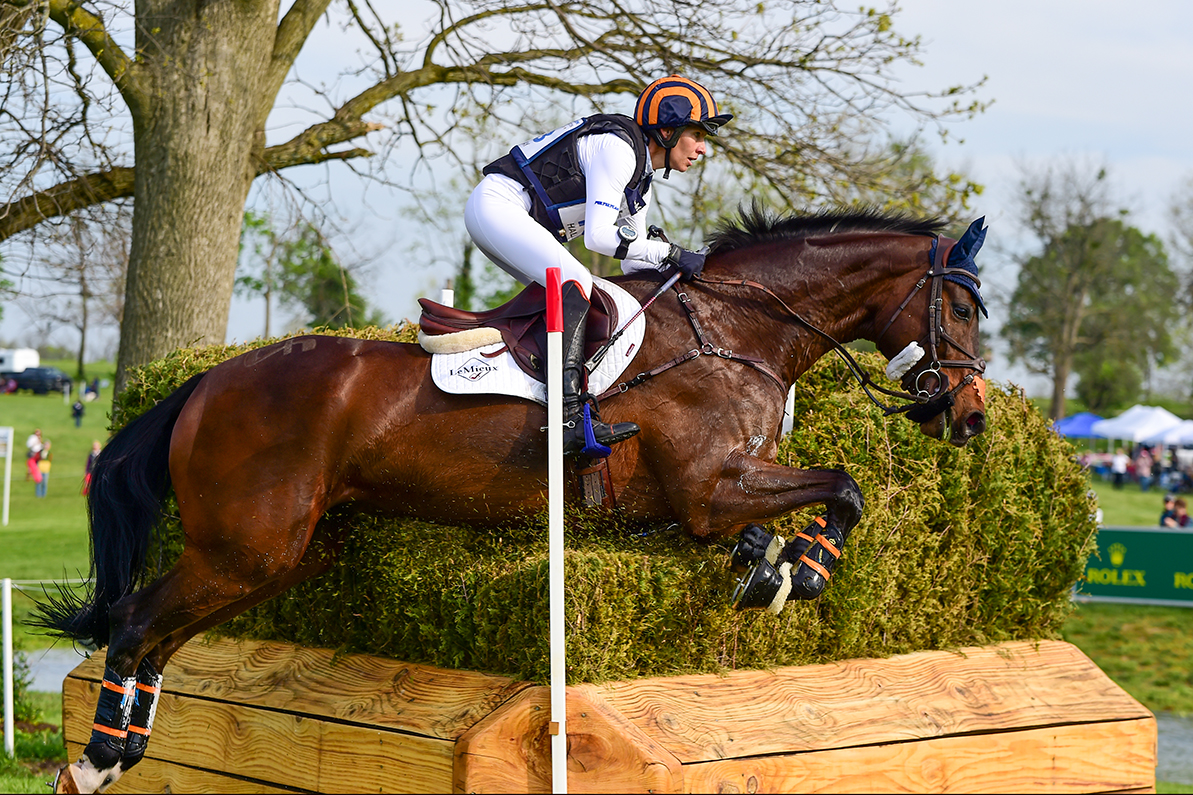
Hunter rider Nick Haness (left) walked away with USEF National Equestrian of the Year honors presented by USEF President Tom O’Mara. Photo by Kim MacMillanEventer Liz Halliday (shown here riding Shanroe Cooley in the 2024 Defender Kentucky Three-Day Event CCI4*-S) won USEF International Equestrian of the Year. Photo by Kim MacMillan
Among the many other top honors given during the Pegasus banquet, notable were the USEF/Equus Foundation Humanitarian Award won by Mary Elena Moran, the Junior Equestrian of the Year won by hunter rider Paige Walkenbach, and the USEF Lifetime Achievement Award presented to Lendon Gray.
For more about the Pegasus Award winners, visit here and see a video from the Pegasus banquet here.
For Saturday’s Horse of the Year dinner, riders, trainers, horse breeders and owners turned out in droves to celebrate the accomplishments of their favorite horses with a treasure trove of trophies. Chief among these prizes were the two National Horses of Honor, with one of those being named the National Horse of the Year, and the four International Horses of Honor, from which the International Horse of the Year was chosen.
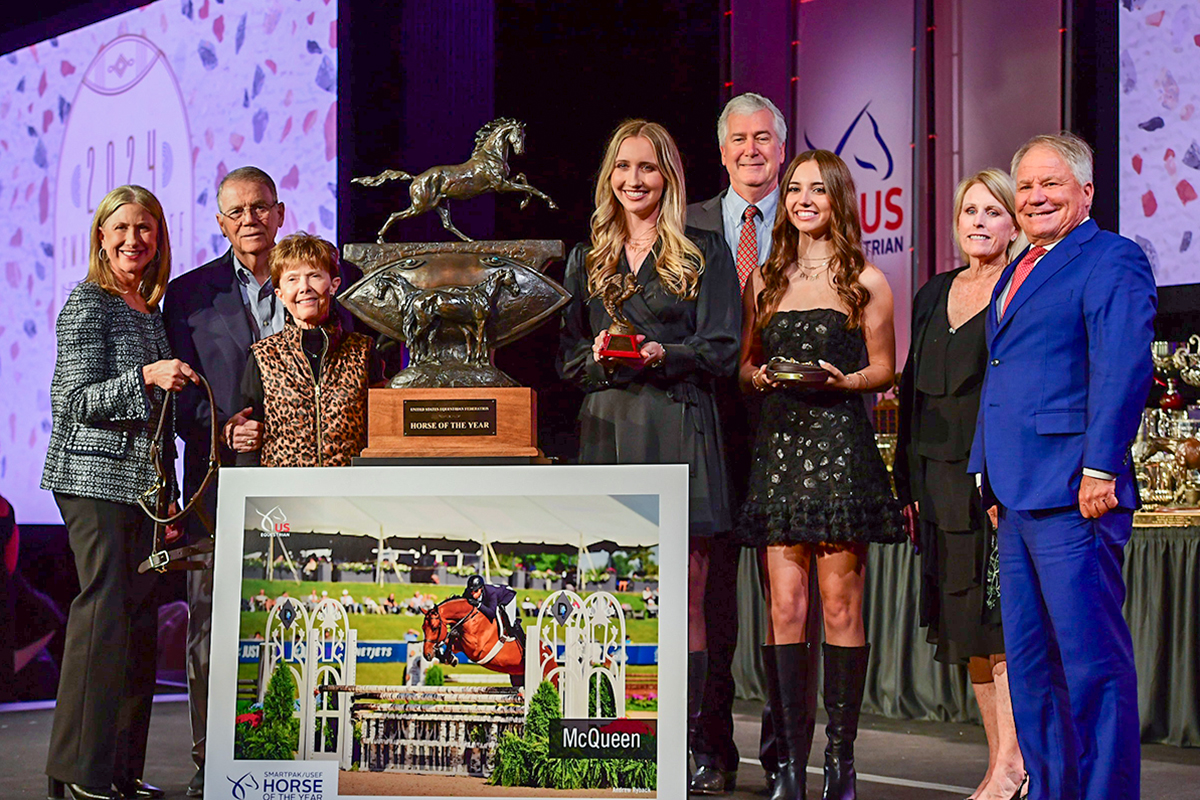
National Horse of the Year was McQueen, a 10-year-old KWPN hunter gelding ridden by Lanie Walkenbach and Nick Haness. “There is no horse quite like him,” Walkenbach remarked, “[He] has without a doubt created a special place in my heart and I am so thankful to be his owner.”
Winner of the USEF National Horse of the Year was McQueen, a 10-year-old KWPN hunter gelding ridden by Lanie Walkenbach and Nick Haness and owned by Walkenbach (center holding small trophy). Photo by Kim MacMillan
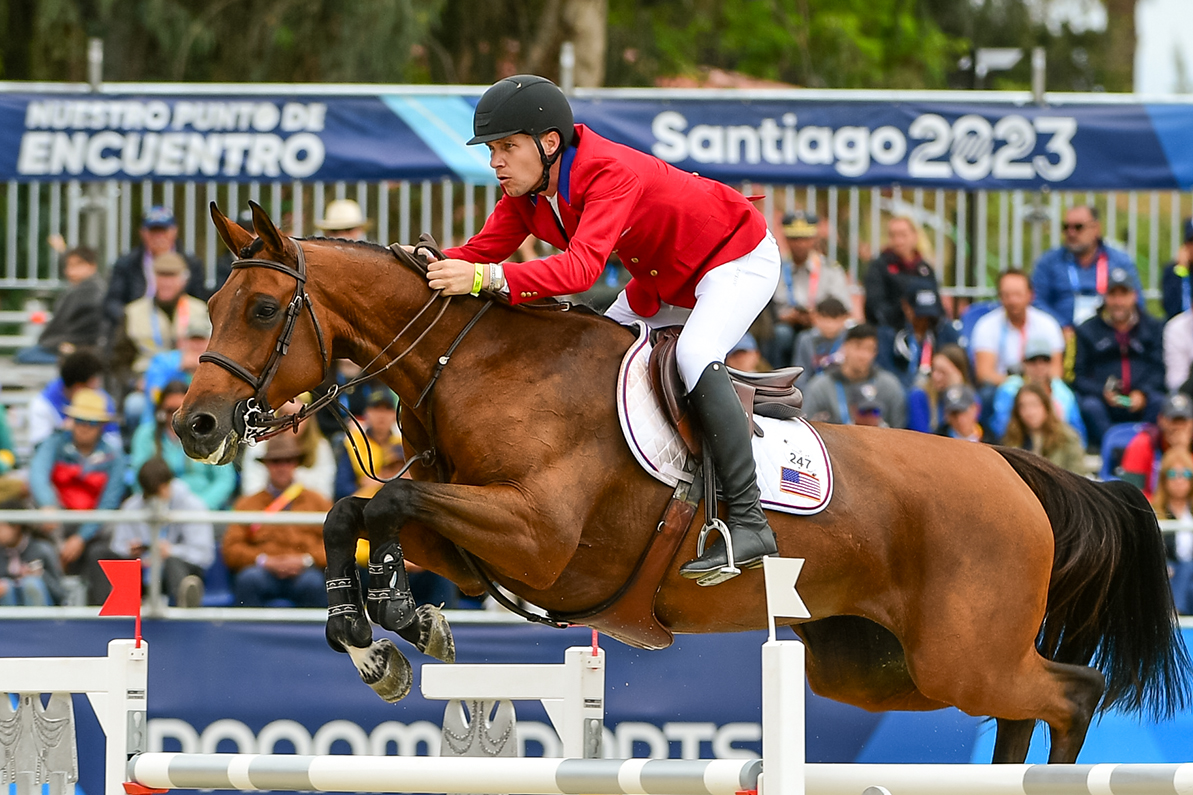
The final award of the evening, the International Horse of the Year, went to the 2024 Olympic jumper Caracole de la Roque, a 12-year-old Selle Français mare owned by Signe Ostby and ridden for the U.S. Jumping Team by Karl Cook of Rancho Santa Fe, Calif. In her acceptance speech, Ostby shared that the mare is known as “Roly Poly” around the barn and, as feisty as she is in competition, she is the opposite at home, often laying down in her stall or pasture for naps.
Winner of the USEF International Horse of the Year was Caracole de la Roque, a 12-year-old Selle Français mare owned by Signe Ostby and ridden for the U.S. Jumping Team at the Paris 2024 Olympic Games by Karl Cook, Rancho Santa Fe, Calif. (Shown here at the 2023 Pan American Games.) Photo by Allen MacMillan
She said that Caracole normally jumps barefoot, but they had to use custom-made 3D-printed, glue-on plastic shoes and titanium studs milled by Cook for some pre-Olympic competitions which were held in grass arenas. She also explained that the mare competes in a bitless hackamore after warming up in a bitted bridle. “It’s an incredible honor to own a horse like Caracole,” Ostby remarked, “I am full of joy and thrilled to be her owner.”
See more about the 2024 USEF Horse of the Year winners here and watch a video of the awards program here.
2026 US Equestrian Annual Meeting Dates
Next year’s US Equestrian Annual Meeting will be held January 15-18, 2026 at the Omni Hotel in Louisville, Ky. For more information, visit here.
Ten More Things to Know & Love About US Equestrian
2. While they select and support top equestrian athletes to represent the USA in international competition, their vision is “To bring the joy of horse sports to as many people as possible.”
3. They promote human athlete safety (helmet rules, body protector survey and more) and offer well-being programs such as group rates for health insurance and free mental health counseling, as well as the U.S. Center for SafeSport education.
6. Multiple membership level choices are offered, including free Fan and affordable Subscriber memberships in addition to Competing memberships. (Check out the great benefits offered with each membership option.)
7. They offer free access to the USEF Learning Center library of dozens of educational videos with any membership type.
8. Extensive USEF Network television programing (via ClipMyHorse.TV) and digital e-news is available to all members (see details of television access for each membership type).
9. All three US Equestrian membership levels have access to the MemberPerks goods and services discounts available from the MemberPerks sponsor businesses.
10. The new US Equestrian Open dressage, eventing and show jumping competition offers over $1 million in prize money and has extensive coverage on ESPN and USEF Network. Currently, US Equestrian is offering a Winter Sweepstakes (the prize is a trip to the US Equestrian Open Jumping Final in Wellington, Florida, in March 2025). For entry information, visit here.
If you love horses, EquiFest of Kansas is the place to be! As the largest equine expo in the state, this annual event—now in its 28th year—brings top-tier shopping, delicious food trucks, world-renowned clinicians, and thrilling competitions to Salina, Kansas from March 21-23.
Exciting New Additions
This year, EquiFest is adding a special treat for collectors and model horse enthusiasts—the Breyer Midwest event! A show within a show, this new feature is sure to delight attendees of all ages.
Competitions & Clinics
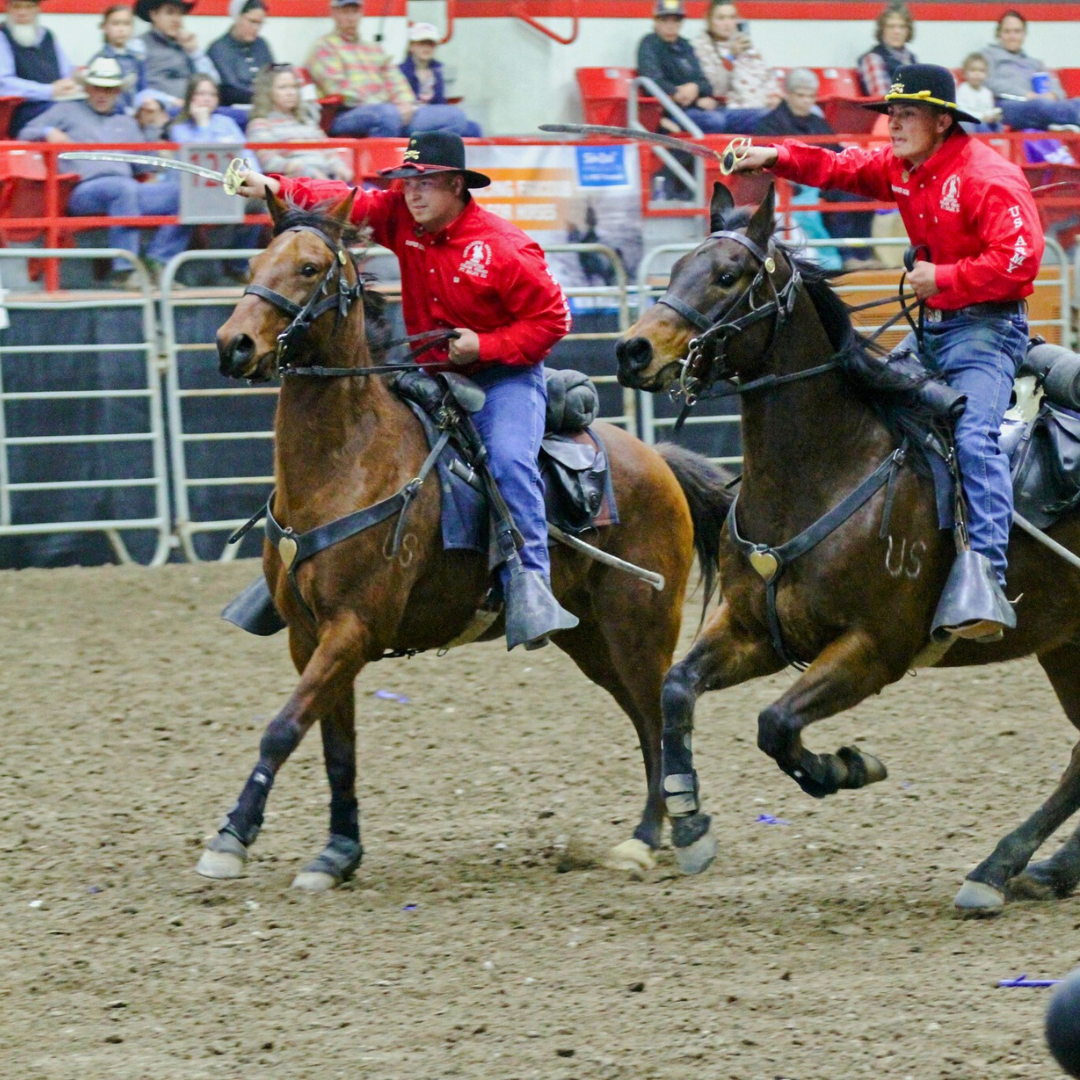
Love competition? EquiFest has it all, including mounted shooting, draft races, team challenges, youth horse judging, a silversmith contest, and a farrier contest. Educational clinics and demos will cover everything from colt starting and trick riding to working equitation and mulemanship. Plus, don’t miss a special performance by the Fort Riley Commanding General’s Mounted Color Guard.
World-Class Lineup
EquiFest 2025 is bringing in Tik Maynard (winner of last year’s Road to the Horse), Ty Evans, Jay & Gena Henson, Liberty Cunningham, Daniel Dauphin, and Ifa Simmonds, who is offering personal fitness training for equestrians. Live cowboy music, interviews, and panel discussions will round out the entertainment.
Workshops & More
Workshops will feature bits & bitting, trail riding strategies, saddle club leadership tips, and advanced equine therapies from the Veterinary Health Center at Kansas State University. And for a meaningful close to the weekend, enjoy Cowboy Church, free coffee and donuts on Sunday morning.
Get Involved!
Want to experience the event from behind the scenes? Volunteer for a 3-4 hour shift and earn a free day of admission, a t-shirt, and EquiBucks rewards!
Doors open daily at 9 AM at the Saline County Expo Center and Tony’s Pizza Events Center in Salina, KS. Tickets are $25/day or $60 for a three day pass, with kids 12 & under free. For more details, visit www.equifestofks.com or follow EquiFest of KS on Facebook and Instagram.
Mark your calendars—this is an equine event you won’t want to miss!
Some of the safest horses you can ride are also the least responsive to the aids. These quiet types are often the go-to for use as school horses or privately purchased mounts for beginner riders. So how do you improve a “lazy” horse’s responsiveness?
Part of what makes these horses so safe for beginners is that they “tune out” some of the aids that lower level riders give by accident, meaning that they won’t go cantering off if a rider’s leg accidentally slides back too far. Most of the riders mounted on these horses also do not have the education to be able to influence the horse to carry themselves correctly through their hind end, core, and topline. However, once a rider becomes more advanced, they will need their horse to be more responsive to aids given the first time, and properly use his body to perform more athletic movements.
In some cases, the horse may have lapsed in his training after being ridden by beginners or riders using unclear aids for an extended period of time. In any case, the remedy is to use exercises that engage the horse’s mind and body while giving clear and consistent aids.
After tuning Annie up with lots of transitions, Gigi is able to demonstrate a prompt and balanced transition up into the canter. Photo by Rachel Korthals
How to Fix a Horse’s Responsiveness
The most important thing is always to have the horse traveling forward and straight. If a horse is crooked in his gaits and movements, this means that there is energy wasted traveling laterally that could be available to be funneled straight ahead if the crookedness were corrected.
DON”T: Gigi is letting Annie travel naturally crooked without correction. Photo by Rachel Korthals
Once the horse is straight, you can start asking for transitions from halt to walk. You will want to carry a short crop, and you may choose to carry a longer dressage whip or wear spurs (particularly during these initial stages of retraining), depending on the horse.
DO: Here, Gigi encourages Annie to travel forward and straight. Photo by Rachel Korthals
In the halt, make sure to begin with your legs hanging loose by the horse’s sides. While trying to get horses to go forward, we often tighten the muscles in our bottom, hips, and legs without realizing it. Draw up through your core so that your abdominal muscles support the upper half of your body, rather than sitting heavily in the saddle.
DON’T: An incorrect and ineffective clenching leg. Photo by Rachel Korthals
When your pelvis is following the horse’s motion in the walk (and later the canter), it should feel as though you are gliding across the saddle, rather than grinding into it.
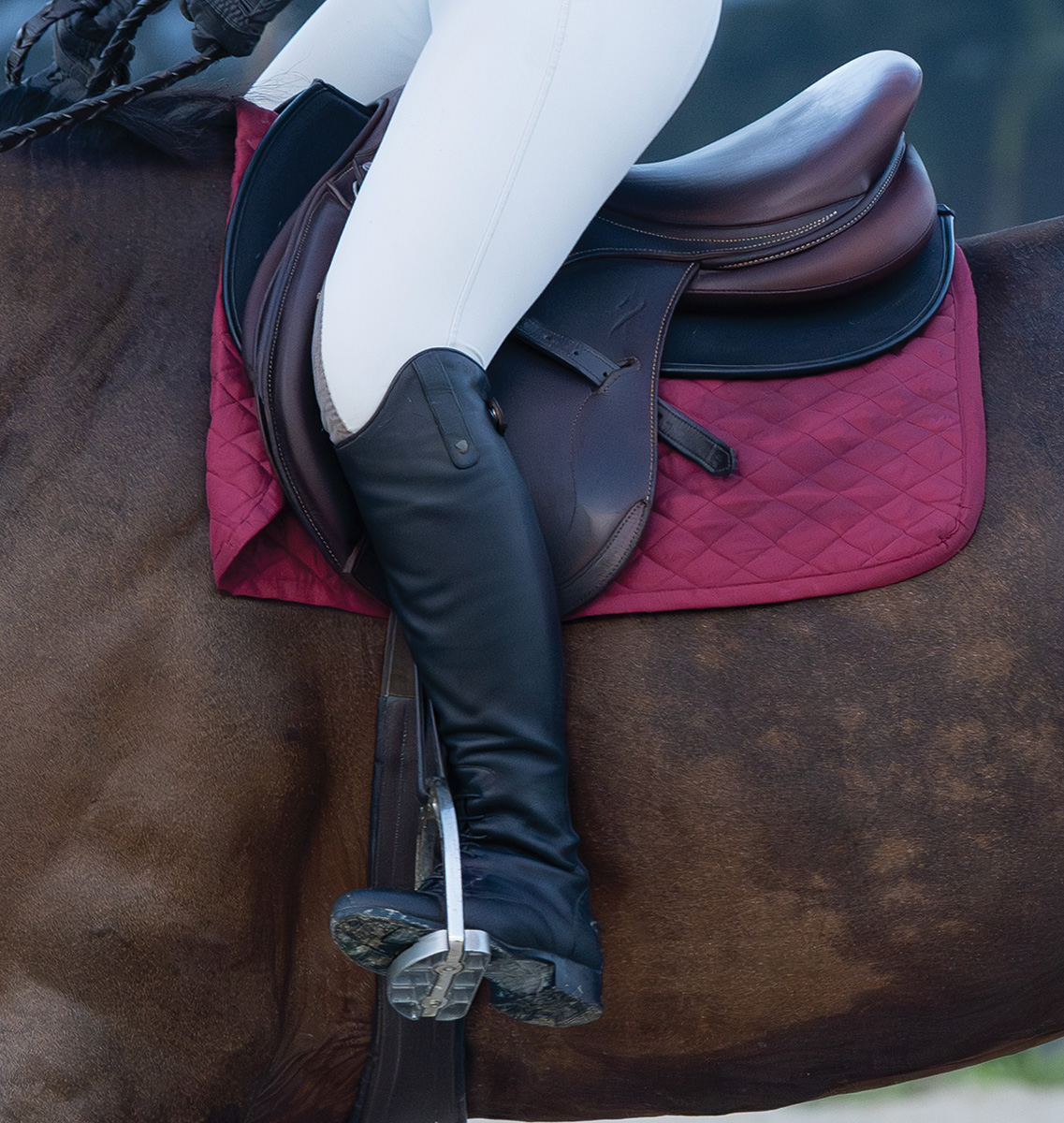
Push your heels down and close your calves in a squeeze against the horse’s sides. If a sustained squeeze with moderate to strong pressure does not entice the horse to walk forward, add a kick. During the kick, your hips and bottom should remain loose, and your legs shouldn’t come more than 6 to 8 inches off of your horse’s sides.
DO: A leg held long, applying pressure only at the calf in order to give a clear aid. Photo by Rachel Korthals
If this still doesn’t elicit a response, tap the horse with a crop just behind your leg until he walks forward. As soon as there is any forward movement, the horse must be rewarded by taking the pressure off (stopping the tapping).
The halt-to-walk transition should be repeated until your horse is moving off from just the squeeze.
Correct Canter
Once your horse is recalibrated to the meaning of the leg squeeze, repeat the same exercise between the walk and trot and then halt and trot. Straightness should still be emphasized, using your seat bones to feel if the horse is pushing evenly with both hind legs.
All horses have their own natural rhythm that’s comfortable for them, then a rhythm that’s a little more forward and a little more work for the rider, but helps them to build fitness. That second rhythm is where you want to be working your horse.
After your horse is working through halt/walk/trot transitions in good rhythm and balance, the canter can be added. In the walk and trot, horses can get away with moving into the gait by dragging themselves forward from the shoulder, even though this is incorrect.
However, in the canter, it’s absolutely required that the horse engage his hind end and push off of his hocks, otherwise he will end up in a rushed trot rather than a canter. If any part of your work up to this point has been ineffective, it will show in the canter. Transitions should now include all three gaits plus the halt.
Additional Tips For Improving the Responsiveness of a Seemingly Lazy Horse
If a horse has been experiencing unclear or conflicting aids for a while, it may take some time to re-educate him fully.
In future training sessions, it will be valuable to add collection and extension of the gaits, turn on the haunches, 10- and 20-meter circles, and pole work. All of these exercises encourage and improve proper engagement of the hind end, building fitness and adding power to all three gaits.
Key Takeaway
It’s important to teach even beginner riders how to use their aids effectively and to expect a prompt reaction from their horse so that those nice, quiet schoolmasters don’t slip into bad habits. The same exercises that build strength in the horse will build the education of the next generation of riders. Correcting a “lazy” horse is as much the rider’s responsibility as it is the horse.
From veterinarians to trainers to farriers, everyone in your stable of people helps make the ride more enjoyable—and longer-lasting.
Imagine a dream team. A group of people who always support you and your horse. It likely includes fellow riders who celebrate and commiserate with you. A trainer may be on the roster as someone who walks alongside you every step of the way. You also can’t do without a farrier to keep your horse well shod and a veterinarian to help maintain your horse’s health and wellness.
Each plays a crucial role in your horse’s soundness, especially when it comes to managing degenerative joint disease (DJD). Also called arthritis, DJD causes up to 60% of lameness in horses.1 It can affect horses of any age or breed, which is why proactive collaboration between your team of trainers, farriers and veterinarians is essential to keeping you and your horse moving together.
All for One
The horse is at the center of this joint care team. With all eyes on the horse, everyone can watch for these common signs of DJD:1
• Swelling due to inflammation
• Lameness that can preclude comfort and athleticism
• Decreased range of motion
• Stiffness when emerging from the stall or starting work
• Deformation caused by bony changes
• Crepitus—the popping, grinding, and crackling sound and sensation in an affected joint.
Catching the signs early means that management can begin as early as possible. This is crucial to help slow the effects of DJD.
Rider’s Role
You are the manager of your horse’s joint care team. You know your horse better than anyone else, so freely share any concerns and observations about how your horse moves with everyone on your horse’s care team.
Pay attention to your horse’s movements and behaviors, taking note of when they’re not what you’d normally expect. Notice what is different, as well as when the differences take place. Then let your veterinarian know, because the more time-based information you provide, the better the veterinarian can determine what may be happening.
Remember, lameness may not always present with obvious limping. In early stages of DJD, subtle changes in gait, performance or willingness to work may be the only indication.1
Trainer’s Role
Trainers know you and your horse well, which may allow them to notice signs of lameness, including DJD, even earlier than you or your veterinarian. Their insights and observations can help prepare you to engage in a more insightful conversation with your veterinarian about the joint care your horse needs.
As coaches, trainers also will help you decide whether your horse’s joints could use a rest or adjusted exercise or work. For example, an extended warm-up or cooldown may be in order to help your horse move more easily.
Farrier’s Role
Your farrier may notice some early signs of arthritis that could warrant a conversation with your veterinarian. For example, your horse may resist when your farrier tries to pick up a hoof, or your farrier may see hoof or shoe wear patterns that could indicate stumbling or may notice swelling or sensitivity around the joints that might not jump out at you on an average day. To be most effective in managing joint issues, shoeing should be based on a veterinarian’s recommendation when possible. It has been recommended that the average performance horse have a twice-a-year soundness exam with podiatry films used to advise the horse’s farrier.
Veterinarian’s Role
In addition to guiding the farrier, regular soundness exams allow your veterinarian to better diagnose an issue if it arises. They also help guide the treatment plan if DJD is diagnosed.
To help keep an arthritic horse moving comfortably, veterinarians may recommend a combination of therapies and medications. The ideal situation is to help reduce the symptoms of DJD, such as lameness, while also slowing the disease progression.
Adequan® i.m. (polysulfated glycosaminoglycan) can help. As the only FDA-approved polysulfated glycosaminoglycan (PSGAG) for DJD, Adequan® i.m. helps treat DJD in multiple ways.2,3 With no generic equivalent, Adequan® i.m. is the only product proven to:2,3
• Reduce inflammation
• Restore synovial joint lubrication
• Repair joint cartilage
• Reverse the disease process
Please see Brief Summary Information for Adequan® i.m. below.
With the right treatments and team members, your horse can enjoy more mobility over a lifetime. Not unlike horse riding, managing joint health and DJD takes some practice. That’s why surrounding your horse with an all-star team is so important. What are you waiting for? Start recruiting your horse’s dream team. And if you already have a great team in place, consider your horse’s joint health to be in the winner’s circle.
How conformation affects joints
Conformation can greatly influence the degree of wear and tear that a joint undergoes. Conformational abnormalities alter forces applied to a joint and can lead to instability, injury and DJD. Address conformational abnormalities as early as possible through proper nutrition, balanced farriery, adequate training and muscle development and, in some cases, surgical intervention.
BRIEF SUMMARY: Prior to use please consult the product insert, a summary of which follows: CAUTION: Federal law restricts this drug to use by or on the order of a licensed veterinarian. INDICATIONS: Adequan® i.m. (polysulfated glycosaminoglycan) is recommended for the intramuscular treatment of non-infectious degenerative and/or traumatic joint dysfunction and associated lameness of the carpal and hock joints in horses. CONTRAINDICATIONS: There are no known contraindications to the use of intramuscular Polysulfated Glycosaminoglycan. WARNINGS: Do not use in horses intended for human consumption. Not for use in humans. Keep this and all medications out of the reach of children. PRECAUTIONS: The safe use of Adequan® i.m. in horses used for breeding purposes, during pregnancy, or in lactating mares has not been evaluated. For customer care, or to obtain product information, visit www.adequan.com. To report an adverse event, please contact American Regent Animal Health, Inc. at 1-888-354-4857 or email pv@americanregent.com.
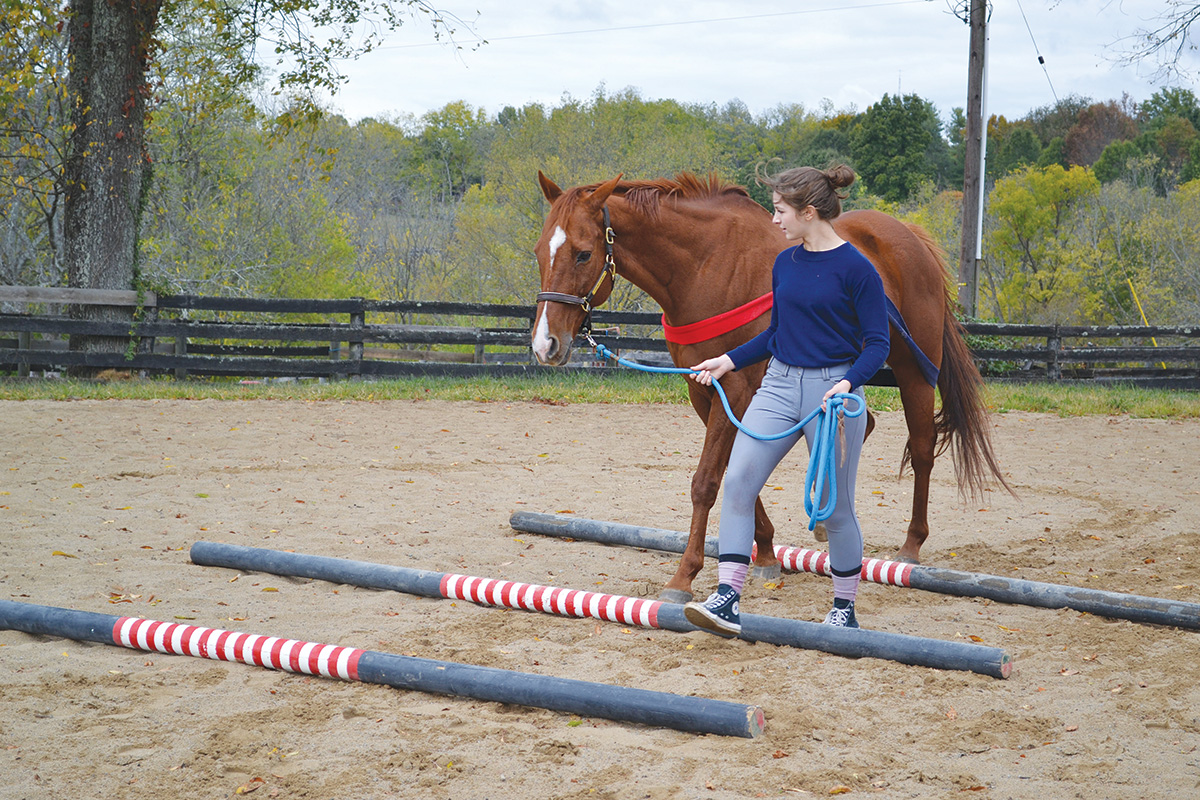
You don’t have to ride your horse to give him a good workout. Groundwork is an effective alternative that’s loaded with a wide range of benefits: You can boost your horse’s strength, endurance, balance, posture, and more. The following five groundwork exercises are super versatile and customizable to suit your horse’s needs. You don’t need specialized or costly equipment or a lot of time either. As few as three 15-minute sessions per week generate positive results.
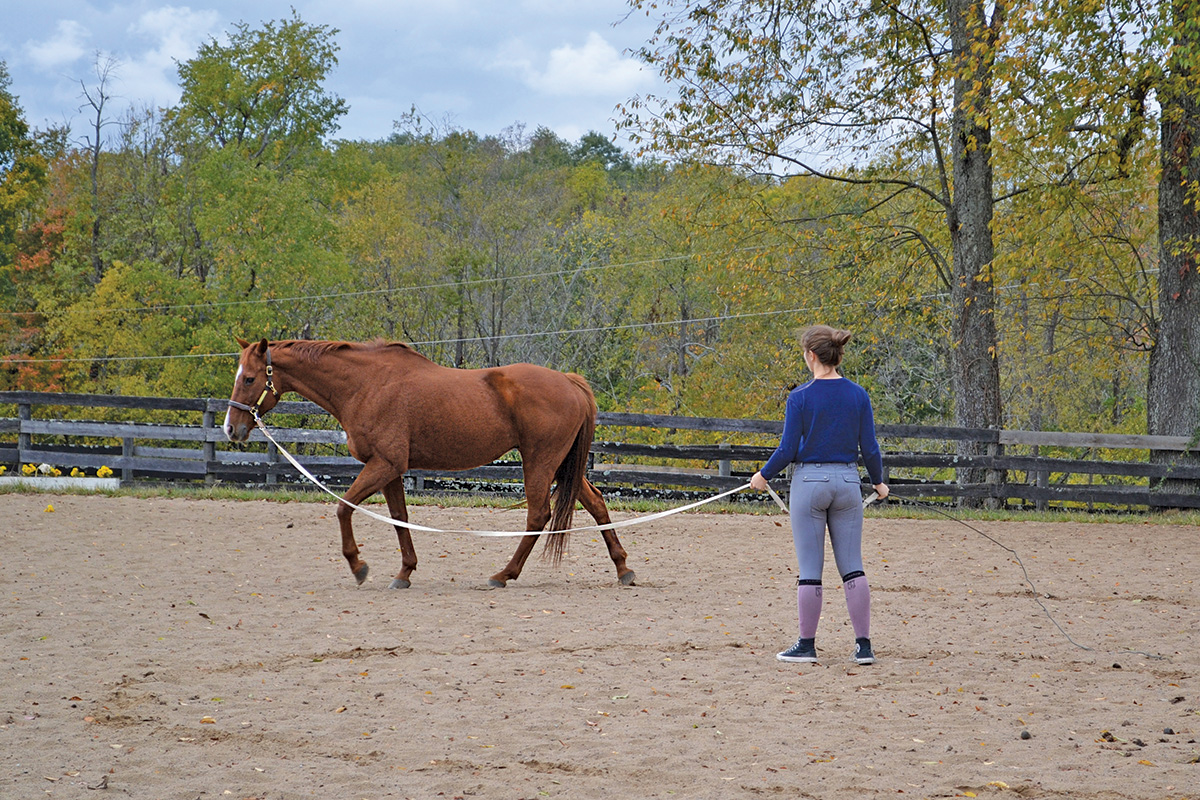
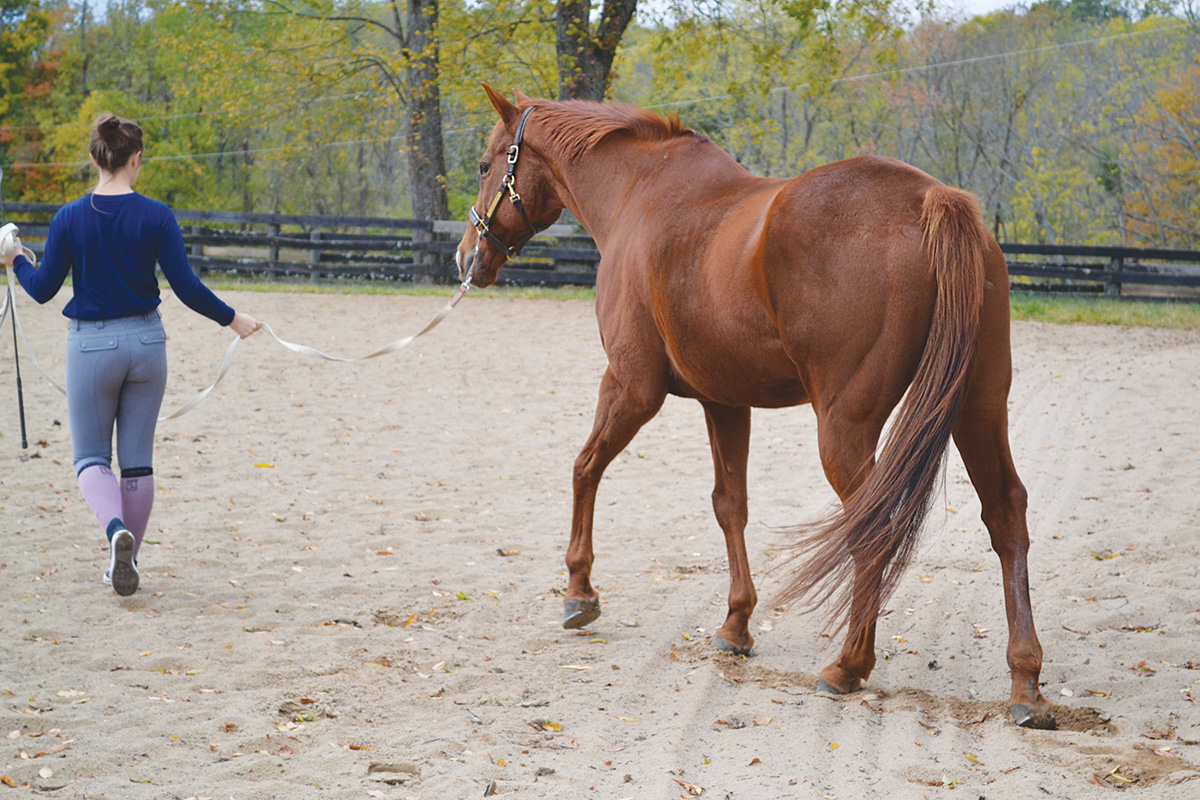
Longeing can be used to develop engagement, build stamina, and enhance your horse’s range of motion. To longe your horse correctly, follow these steps.
Longeing can be used to develop engagement, build stamina, and enhance your horse’s range of motion. Photo by Shoshana Rudski
1. Clip your line to the side of a halter or use a longeing cavesson.
Note: For safety reasons, avoid attaching a longe line directly to a bit. The line can pull too harshly on the bit, potentially causing harm to the horse’s mouth.
2. Avoid a continuous hard hold on the line whenever possible. Too much tugging and contact creates tension and unbalances your horse.
3. Make your circle as large as possible to reduce strain on your horse’s joints. Break up the circle with straight lines occasionally by letting your horse travel slightly ahead of you while you walk forward and parallel to him.
Break up the circle with straight lines occasionally by letting your horse travel slightly ahead of you while you walk forward and parallel to him. Photo by Shoshana Rudski
4. Your horse’s body should mirror the shape of the path he’s following. If he’s on a straight line, his spine should be straight from poll to tail. Conversely, he’s only able to travel in comfort and balance on a bend if the arc of his body is uniform.
If your horse isn’t able to maintain proper alignment, he may not understand the concept or be balanced enough. Give him a hand by leading him on a straight line until he can walk with his body in alignment for several strides on a loose lead.
Next, switch back to longeing for a few strides, then back to straight-line leading and so on, until he can hold it on his own.
Groundwork Exercise 2: Ground Poles
To develop impulsion, improve posture, and increase flexibility, try laying down some ground poles. Better yet, use landscape timbers (square-shaped poles) because they won’t roll if your horse bumps or steps on them.
Ground poles help develop your horse’s impulsion, improve his posture, and increase his flexibility. Photo by Shoshana Rudski
1. Start with one pole to introduce your horse’s brain and body to the idea of stepping over something on the ground. Any new movement needs to be introduced slowly to avoid causing emotional stress or physical strain.
2. Build up to two or three evenly spaced poles at a distance that is comfortable for your horse. A 3-foot span works for most horses at the walk, and 4 feet for the trot.
3. Take your horse over the center of the poles. Again, it’s important that his head, neck, and body are in alignment so he’s using his muscles symmetrically.
4. When your horse is ready for a greater challenge, increase the number of poles. You can also add height by alternately elevating the ends of the poles slightly.
Groundwork Exercise 3: Backing Up
Backing up is a deceptively simple yet useful exercise for activating your horse’s hindquarters, core, and back.
1. Back your horse with his head straight and his neck in a neutral position. Cue him by applying light alternating pressure on the lead, rocking his weight back and forth until he takes a step.
2. If he moves his head toward his chest instead of moving his feet, rhythmically press your fingertips against his chest at the same time.
3. Start with one or two steps at a time, slowly building to eight to 10 steps.
4. Once your horse can easily back several strides without crookedness, increase the intensity by reversing him on a slight incline.
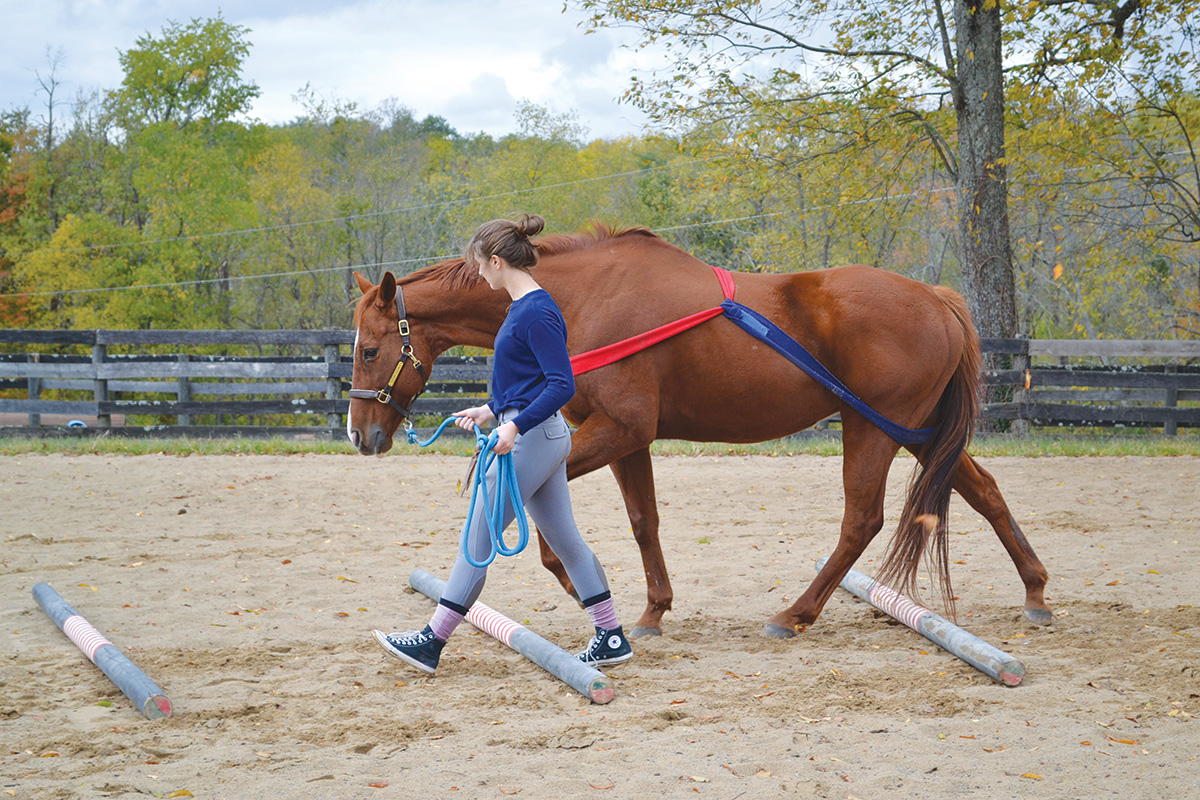
Groundwork Exercise 4: Bands
Proprioception bands help restore healthy patterns of movement by bringing awareness to the areas of the body that they are in contact with. These bands are strips of slightly stretchy fabric that do wonders for developing engagement, symmetry, and range of motion.
Proprioception bands help restore healthy patterns of movement by bringing awareness to the areas of the body that they are in contact with. Photo by Shoshana Rudski
There are bands available that are specifically made to use on horses, or you can stop by your local pharmacy and purchase long, wide elastic bandages. Standing or polo wraps work too.
To activate the hindquarters, a band can be placed behind your horse’s rear legs, while his core can be engaged by wrapping a band around his midsection.
Proprioception bands may feel odd to your horse, so introduce them slowly. Use them for short periods of time at first to give his body a chance to acclimate to them.
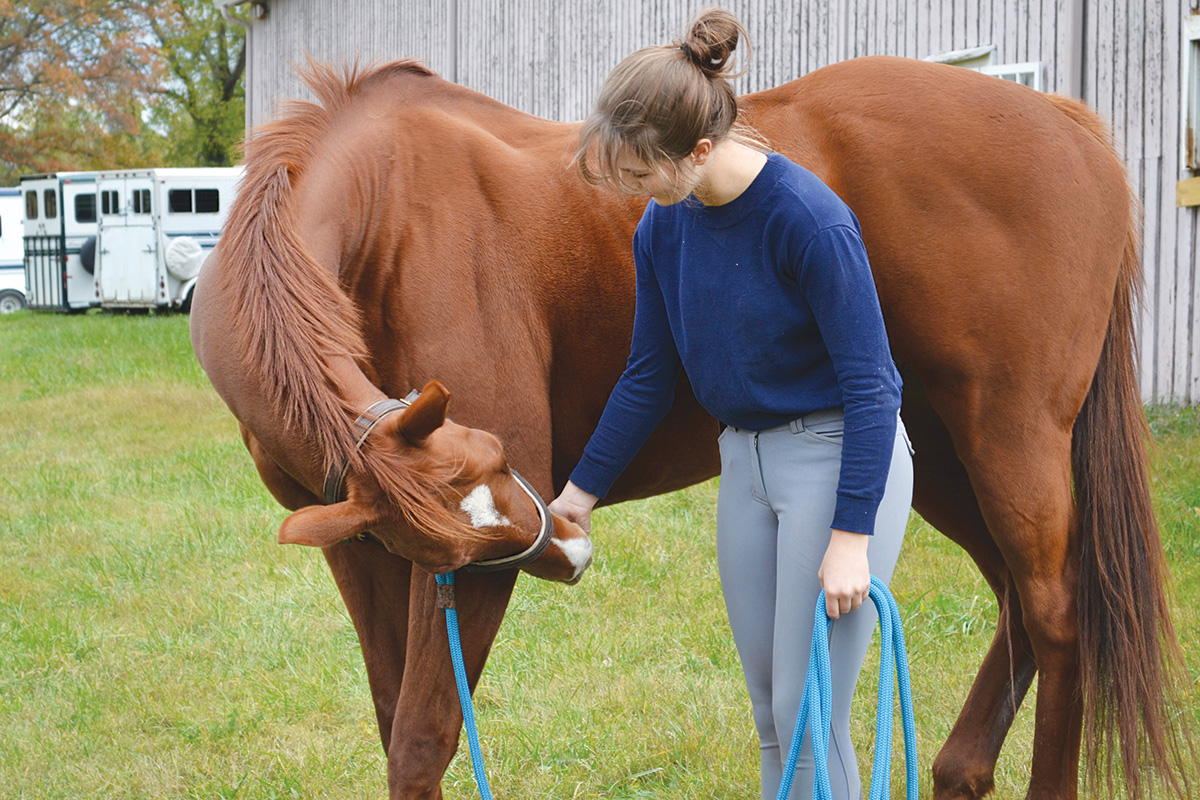
Groundwork Exercise 5: Carrot Stretches
Stationary mobility exercises, AKA carrot stretches, are great for developing stabilization and core muscles. They also loosen tight fascia for better comfort and improved flexibility.
Stationary mobility exercises, aka carrot stretches, are great for developing stabilization and core muscles. They also loosen tight fascia for better comfort and improved flexibility. Photo by Shoshana Rudski
These exercises don’t require a lot of time or space. A routine of three to five movements can be completed in 10 minutes.
Useful stretches include chin to chest, nose to knees, and nose to fetlocks. Flexing the head and neck to the side activates muscles that stabilize spinal vertebrae so your horse can have a stronger more comfortable back.
Key Takeaway
Next time you don’t want to tack up, turn to groundwork to improve your horse’s fitness and quality of life. These five exercises may seem simple, but remember: the basics are the cornerstone of your horse’s training.
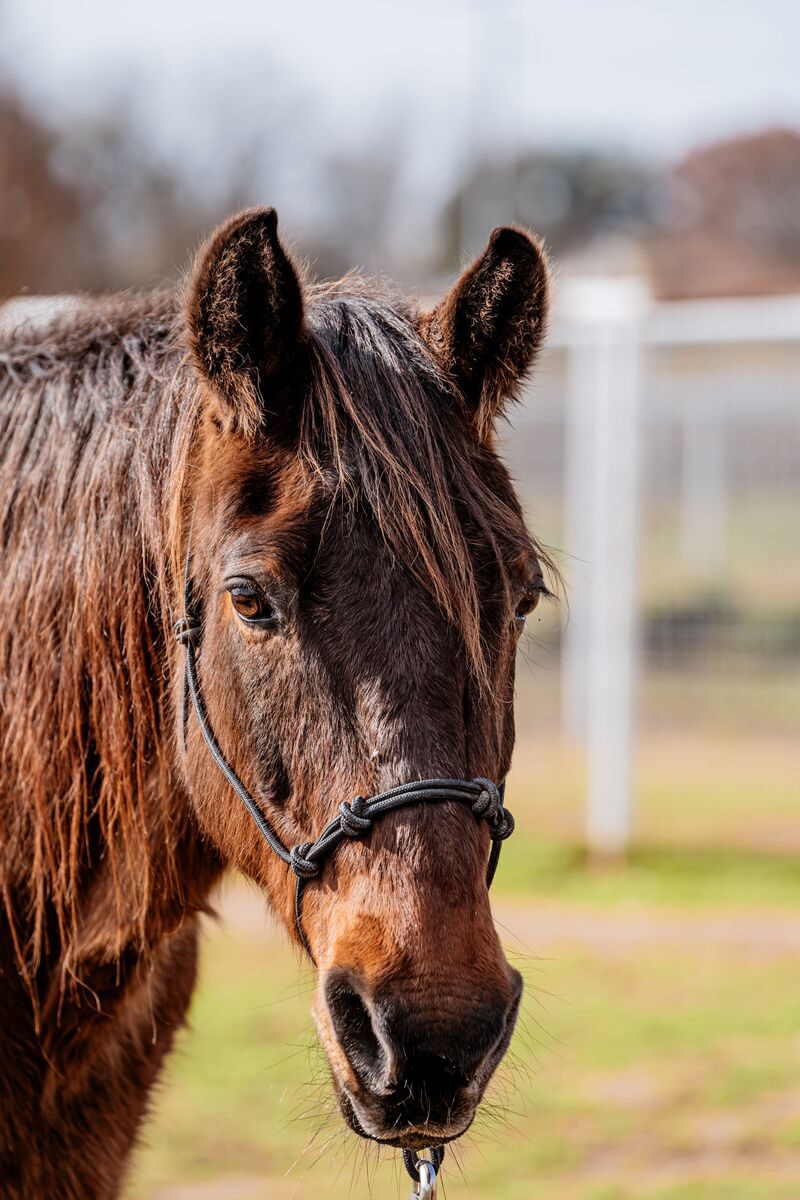
Meet Draco Malfoy! This handsome gelding wants to be loved by a wonderful, magical family. He is a fantastic companion horse that will need an adopter to provide the special care he needs. Draco has great ground manners for the vet.
Draco is approximately 15.2 hands and is up-to-date on shots, Coggins, dental care, farrier work, and is microchipped. Age is an estimate. Please fill out an interest in adoption form on HSNT’s website to learn more and schedule an appointment here.
ASPCA Right Horse is the online adoption platform of The Right Horse Initiative, a collection of equine industry and welfare professionals and advocates working together to improve the lives of horses in transition. A program of the ASPCA, their goal is to massively increase horse adoption in the United States. To find more adoptable horses and foster horses, visit www.myrighthorse.org. To learn more about The Right Horse, a program of the ASPCA, visit www.aspcarighthorse.org.
We use cookies to help personalize content, tailor and measure ads, and provide a safer experience. By navigating the site, you agree to the use of cookies to collect information. Read our Cookie Policy.



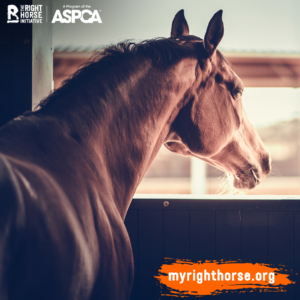 ASPCA Right Horse is the online adoption platform of The Right Horse Initiative, a collection of equine industry and welfare professionals and advocates working together to improve the lives of horses in transition. A program of the ASPCA, their goal is to massively increase horse adoption in the United States. To find more adoptable horses and foster horses, visit www.myrighthorse.org. To learn more about The Right Horse, a program of the ASPCA, visit www.aspcarighthorse.org.