0 ITEMS
  • My Account
  • Holiday Gift Guide
  • Podcast
  • Webinar
Subscribe Combo
Enable cache13
Home Blog Page 633

Petey the Pigeon

4

We’ve had a visitor this summer and truly, it’s time for him to leave. He’s over-stayed his welcome. His name is Petey the Pigeon.
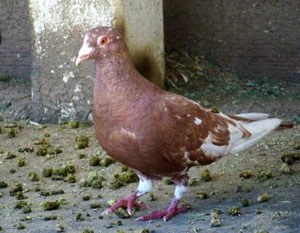
Petey the Pigeon
Meet Petey the Pigeon. Isn’t he cute, the way he munches on leftover pellets and carrots? Now please make him leave.

There are all sorts of critters that coexist with Ron, the horses and me on and around this property, from coyotes to hawks, bats, rabbits and assorted snakes. But pigeons are especially messy and when one in particular becomes a pest by repeatedly pooping in my horses’ water troughs, thereby fouling the water, then I have to take action.

Plus, Petey refuses to sleep in the barn rafters like a regular pigeon or hang out in the paddock, perched in one of the pepper trees. Instead, he prefers to sit atop the canvas awning outside my kitchen window. And quite frankly, after scooping horse manure several times a day the last thing I want to do is scoop pigeon poop off an awning or scrape it off my kitchen window.

At first, I thought Petey was a wayward homing pigeon. He’s a unique coppery color, and he seems remarkably friendly. So when he first arrived I looked for a band on one of his legs. Twice since we’ve lived here, homing pigeons have stopped by our house and I’ve caught them, read the phone number on their leg bands, and returned them to their owners. But regardless whether Petey lost his ID band or he’s just a really sociable feral pigeon, he has to go. And he won’t.

How can I blame him? Each afternoon, when I feed Wally and Danny their pellets and carrots, Petey is right there under their noses, pecking up every morsel and tidbit the horses happen to drop. It’s a veritable pigeon feast.

Finally, last week, I came up with a plan. I decided to catch him, figuring that surely he would be better off living his pigeon lifestyle someplace else. You know, someplace else where a husband and wife weren’t on the verge of attempting to strangle him.

So early one morning, before the sun had risen above the hills, I went out in my pajamas (which, for the purposes of creating the visual image necessary for this tale, I must explain are wildly colored and mismatched in both fabric and pattern) and began walking toward the feed room. Sure enough, in anticipation of an early morning meal, here came Petey, swooping down at my feet. I decided to treat him like a half-tamed chicken: I held out my arms and shushed him forward, herding him into the feed room. And then I followed him inside and closed the door.

He had nowhere to go. Aha! So I scooped him up and ran inside the house and grabbed the closest thing I could think of that would work as a pigeon carrier: a paper shopping bag! I folded up the top, snatched my truck keys, and drove Petey out of my neighborhood.

I headed all the way up a series of long, winding roads that lead to a golf course nestled behind the hills. I kept going past the country club until I reached field filled with scrub brush and willows, and then parked my truck. I got out and started walking through the chaparral in my foam bedroom slippers. I’m sure I looked like a deranged homeless woman, wandering around a field with a grocery bag in her hand. But I was on a mission. I opened the bag and out plopped Petey. He turned and looked at me and I told him to be a good pigeon, pointed toward the sparrows, pigeons and mockingbirds in the surrounding trees, and instructed him to make some new feathered friends. And then I left.

When I got home Petey was there, waiting for me in the driveway.

The very next day I called my sister and told her the tale of Petey. She promised to take him if I could catch him again. She lives on the other end of the canyon, in a different county, in fact, and has raised plenty of birds before.

“He can live in one of our coops in the backyard,” she said.

So Jill and I tossed out some horse pellets and lured Petey into the barn. With a little bit of pigeon wrangling we caught him. And then he got stuffed back into yet another grocery bag and deposited onto the front seat of Jill’s car.

“Before I head home I have to stop by Mom’s and pick up my dogs,” she said as she was driving away.

That should’ve been a clue that Petey’s travel plans were about to change.

About half an hour later the phone rang. It was my sister. All she said was, “Is he there yet?”

I dropped the phone and ran to look out the kitchen window. There was Petey, bobbing around Wally’s paddock, looking a little bit tired but otherwise perfectly content to be back at the Hale horse ranch.

“What the heck happened?” I yelled into the phone.

“Well,” my sister began, “I got the dogs into the car and started down Mom’s driveway. And then the pigeon started wrestling around inside that bag and my dogs heard him. All I could think of was, ‘Here I am, driving a car with Jack Russell terriers in the back seat, and a pigeon that’s about to get loose in the front seat. What’s wrong with this picture?’ So I stopped the car and let him go.”

I understood why she did what she did—the last thing I needed was to be responsible for my sister’s demise due to a poorly planned pigeon transport—but I was speechless nonetheless.

“It was pretty amazing, actually,” my sister continued. “Petey got out of the bag, sort of looked around, and then took off. He flew around in one, maybe two little circles overhead, and then whoosh! He made a beeline right back in the direction of your house.”

Needless to say, Petey is now a little bit more wary of me than before. But over time I’m going to win back his confidence. And then I’m going to catch him and deliver him to one of the homing pigeon hobbyists in town. I’ll beg them to brainwash Petey into joining a different brood. I’ll relate that whole birds of a feather flocking together scenario.

In the meantime I have to get outside and give Wally and Danny their pellets and carrots. I know it’s lunchtime because I have a fat red pigeon sitting on the awning, staring at me through my kitchen window.

<< Previous Entry

Back to Life with Horses

Bureau of Land Management postpones Wyoming Mustang round-up

7
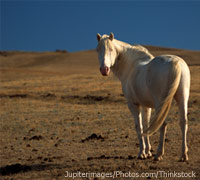
American Mustang horse
The BLM routinely rounds up wild horses and burros throughout the year and makes some available for public adoption.

The Bureau of Land Management (BLM) announced on August 2 that it would not move forward with a plan to round up nearly 900 horses in Wyoming. The BLM had intended to geld the stallions captured in the round up and release 177 of them back to the range as geldings to help curb population growth. They will revisit the plan later this month.

Several advocacy groups that work to prevent any interference with American wild horses filed a lawsuit alleging that the round up was illegal. The 1971 Wild Free-Roaming Horses and Burros Act requires the BLM to protect and manage the Mustang herds in the west. Opponents of the BLM’s wild horse and burro management say that their tactics are pushing the animals toward extinction.

One of the groups involved in the lawsuit is the American Wild Horse Preservation Campaign. On their website, they describe the actions they support in Mustang management.

  • A suspension of roundups in all but verifiable emergency situations while the entire BLM wild horse program undergoes objective and scientific review;
  • Higher Appropriate Management Levels (AML) for wild horses on those rangelands designated for them;
  • Implementation of in-the-wild management, which would keep wild horses on the range and save taxpayers millions annually by avoiding the mass removal and stockpiling wild horses in government holding facilities.

The BLM counters claims that the round ups are causing irreparable harm to wild horse and burro populations. On its website, the BLM states:

The current on-the-range population of wild horses and burros (approximately 38,500) is greater than the number found roaming in 1971 (about 25,300). The BLM is seeking to achieve the appropriate management level of 26,600 wild horses and burros on Western public rangelands, or nearly 12,000 fewer than the current West-wide population.

Further Reading
Wild horses arrive at Madeleine Pickens’ eco-sanctuary in Nevada

Wild Corolla Horses get increased protection from beach patrols

5
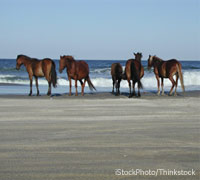
North Carolina Corolla Horses
The protected herd of wild horses on North Carolina’s outer banks often wander to the beach for relief from heat and biting insects farther inland.

Tourists come to North Carolina’s Currituck Outer Banks to enjoy the sandy beaches, ocean breezes, and the unique sight of wild horses wandering the shoreline. Preservationists of these horses, known Corolla Horses, are concerned that increasing interaction with these tourists is putting the horses at risk.

Earlier this summer, a young Corolla foal was found suffering from apparent malnutrition. Veterinarians intervened and tried to nourish the foal back to health, but he died after only two days in their care. A necropsy revealed that the foal suffered from an impaction and infected intestine. A resident reported that she had seen someone feeding the foal and its mother just days earlier.

The Currituck Wild Horse Ordinance prohibits anyone from getting closer than 50 feet to a wild horse. Petting or feeding the horses can result in a $500 fine. However, many tourists either aren’t aware of the rules or simply ignore them, putting the humans and horses at risk.

In response to the foal incident, the Corolla Wild Horse Fund has hired three people to patrol the beach to help prevent future violations of the ordinance. Previously, most of the policing was done by volunteers. Additionally, a proposed new ordinance would require wild-horse tour operators to obtain a license, reducing the number of vehicles trailing the horses on the beach.

The stepped-up enforcement for the Corolla Horses follows a similar scenario on Assateague Island, Va., where interactions between tourists and wild ponies have resulted in dangerous situations for people and equines.

For more information on the Corolla Horses, visit www.corollawildhorses.com

FEI Reining Committee completes inquiry into possible rule violations at 2011 World Reining Final

5
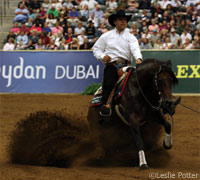
Craig Schmersal
Craig Schmersal competed with 12-year-old stallion Mister Montana Nic at the 2010 Alltech FEI World Equestrian Games. Photo: Leslie Potter

In May of this year, Danish website Epona.tv released video from the warm-up arena at the World Reining Final in Sweden that showed what appeared to be some very heavy-handed riding by top competitors.

Epona.tv’s videos included footage of Americans Craig Schmersal and Tom McCutcheon as well as German reining champion Nico Horman and others. The videos show riders jerking on the reins, bringing horses to a point of hyperflexion, and repeatedly “fencing,” or running the horses nearly into the wall while practicing sliding stops. They also show the International Equestrian Federation (FEI) stewards present in the warm-up area, apparently not responding to or taking action on the harsh riding.

McCutcheon and Schmersal placed first and second, respectively, at the event.

The videos are still available at Epona.tv, but most require a paid subscription to view. The video of Schmersal, which went viral after Epona.tv posted it to YouTube, caused outrage across the equestrian world. In response, the FEI launched an internal inquiry into the event. Click here to watch the video on YouTube. 

On August 2, the FEI released an announcement stating that the inquiry had been completed. According to the statement, no yellow cards were issued at the event, but verbal warnings were given to several riders for violations including overly aggressive use of hands, overly aggressive use of spurs, and running the horse into the wall. Findings from the inquiry were used in the FEI’s seven-month review of the rules structure for international reining competition, including regulation of training and warm-up methods.

However, the FEI’s statement also said, “…due to the lack of authenticated evidence such as original unedited video footage, no further action can be taken against any individuals.”

The FEI had previously requested Epona.tv’s original footage from the practice session. Epona.tv has stated that they will not release this footage or any past or future footage for several reasons, primarily because, “…handing over our un-published raw footage…would constitute active participation in a legal matter, and undermine our independence.”

Additionally, Epona.tv says, “…we couldn’t care less if the riders we have filmed at a single event are investigated or even sanctioned by the FEI. That won’t help the thousands of horses who are trained this way—and worse—partly because the FEI turns a blind eye, and passively perpetuates the general acceptance of such methods.”

“We absolutely understand the importance of learning from this alleged incident”, FEI Director Non-Olympic Sports Ian Williams said in the news release. “Our work over the last seven months has been to ensure that we put new Reining Rules in place that protect the welfare of the horse, as well as systems that empower our Stewards to enforce those Rules.”

Further Reading
Epona.tv: Reining Scandal
Epona.tv: Raw Footage 

FEI News Release on New Reining Rules

Horsemanship How-to: Count Strides Between Jumps

0
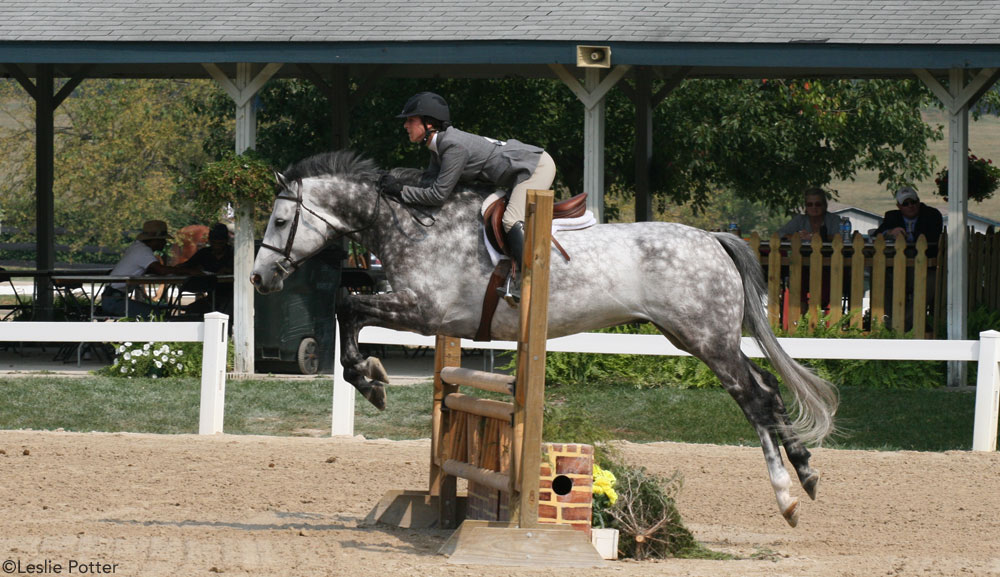
Hunter Horse


Are you an English rider who’s learning to jump a course? Sooner or later you’ll face the challenge of getting the right number of strides in a line. But before you can finesse your horse’s performance to that point, you must be able to count strides as you ride from one jump to the next. Although it sounds like rudimentary arithmetic, it’s not as easy as it sounds. Counting strides can leave even the most enthusiastic novice completely bewildered. Here are some basic exercises that will simplify the learning process.

  1. Begin by establishing a steady working canter, and maintain it as you continue on the rail around the arena. Concentrate on your horse’s rhythm at the canter. You’ll notice there’s a natural “one, two” cadence as his hind end pushes him forward and then his front feet strike the ground.
  2. To help put you in sync with your horse’s strides, count out loud, “One, two” in time with his canter.
  3. Once you’re comfortably in rhythm with your horse’s canter, refine your counting to merely saying, “One,” each time you feel his front feet strike the ground. (Actually you’re hearing and feeling the hoof beat of whichever front leg he’s leading with at the canter. So if he’s on the left lead, you’re hearing and feeling your horse’s left front hoof).
  4. Next, choose a focal point, like a tree or fence post, and as you canter past it begin counting for ten strides, from one to ten, in sync with your horse. This prepares you for counting strides from one jump to the next.
  5. Then it’s time to progress. Instead of starting with the number one at your focal point, make your initial declaration the word, “land.” (It doesn’t make sense right now, but it’s important to start the habit). Then continue on with, “one, two, three, four,” etc.
  6. Now when you ride over two or more jumps in a line you can use the same method to count the strides in between. As soon as your horse’s front feet strike the ground after the first jump, say, “land.” Then continue with, “one, two, three, four,” and so on, counting out loud in time with your horse’s front feet striking the ground, until he takes off for the next jump.
  7. Since you’re counting strides, it may seem strange to say “land” when your horse’s front feet hit the ground instead of immediately starting with “one.” But here’s the reason: You only count strides between jumps, not just hoof beats. When your horse’s front feet land after the first jump, he hasn’t yet taken a true stride; he’s merely touched down.

Knowing how many strides your horse will take between jumps will give you confidence. Your horse’s performance will seem more predictable and your jumping rounds will flow more smoothly. You can count on it.

Further Reading
Stop Horse Jumping Refusals

See more Horsemanship How-tos >>

Equine Lab at Colorado State University destroyed in fire

3

Early in the morning on July 26, firefighters responded to reports of a fire at the Equine Reproduction Laboratory at Colorado State University’s Fort Collins campus. The fire did not spread to the barn areas and no horses or humans were injured in the blaze, but the office and some laboratories were demolished. Current reports put the damage at $12 million.
Horses in barns close to the damaged buildings were moved as a precaution, but the university stated that the horses were not in serious danger.

The fire is being investigated by several agencies, including the FBI and Northern Colorado Bomb Squad. According to an article published in the Denver Post, the intense investigation does not necessarily mean that the fire was a case of arson. The agencies are frequently called in for large or expensive buildings with costly damage.

The ERL will continue to have its regular services available during the rebuilding process.

CSU is home to one of the top equine research facilities in the United States. The ERL is responsible for many advances in modern equine reproduction as well as treating rare and difficult veterinary cases in broodmares and foals.

To read the most recent updates and learn how to contribute to the rebuilding fund, visit /redirect.php?location=http%3a%2f%2fwww.cvmbs.colostate.edu%2fbms%2ferl%2f

Further Reading
Extinguish the Threat of Barn Fires
Be Prepared for a Barn Fire

Question of the Week: Floating Patella

1

Q: I have a 2-year-old mini stud with a left hind leg that locks up on him at times. If we walk him backwards, it lets go and he walks and runs fine. The vet diagnosed him with floating patella. We have never heard of it, and she also said it could be passed on to any colts. Could you please explain what floating patella is, and if it would be passed on to my horse’s foals? Can it be treated?

A: A floating patella is also known as a luxating patella, or “upward fixation of the patella”, and is a condition seen in equines, canines, and humans, where the patella (or kneecap) is moved out of its patellar grove, the anatomical location at the end of the femur where the patella normally sits in the stifle joint. Normally, the patella is held in place by three patellar ligaments and when these become somewhat slack, they are unable to hold the patella in its natural place, allowing it to slip out. While this sounds painful, it really isn’t, but it does severely hamper the horse’s ability to move his hind leg in a normal fashion. What results with a luxated patella is a leg that looks “locked up” and stiff. When the patella is outside of its normal position, the stifle joint loses its flexing capabilities but normal locomotion resumes as soon as the patella pops back in place, which is usually within seconds or minutes.

Luxating patellas are most commonly seen in younger horses and can be the result of weak quadriceps. This large group of muscles in the hind leg is responsible for holding the patellar ligaments tight so when these muscles are weak, the ligaments that hold the patella in place are weak as well, pre-disposing the horse to a mobile patella. Some horses only suffer from a floating patella in one hind leg, while others have bilateral, or two-sided, luxating patellas.

The most commonly recommended treatment for luxating patellas is strength conditioning with focus on the hind legs. An emphasis on hill work can help strength your horse’s quadriceps, which in turn will help keep those patellar ligaments tight. A more invasive procedure involves surgically tightening one of the patellar ligaments by nicking it to create the formation of scar tissue, which is tighter and less elastic than normal tissue. In recent decades this has fallen out of favor, but may be the only option for a horse, particularly a riding horse, that has severe laxity in those ligaments.

Unfortunately, luxating patellas are a genetic defect and these genes will be passed from your stud to his offspring. Studies have shown luxating patellas to be a recessive trait, meaning not all offspring will exhibit the clinical problem, but will still harbor the gene and therefore silently pass the trait on to their offspring.

— Anna O’Brien, DVM

Ask your questions on the horseillustrated.com Forums >>

See more Expert Q&As >>

Submit your Ask the Expert question >>

America’s Favorite Trail Horse

4

Here’s a preview of America’s Favorite Trail Horse, a new reality TV series from the American Competitive Trail Horse Association and HRTV.

Click here to learn more about America’s Favorite Trail Horse.


Watch more horse videos >>

Equine Diseases and Vaccinations: AAEP Core Vaccines

8

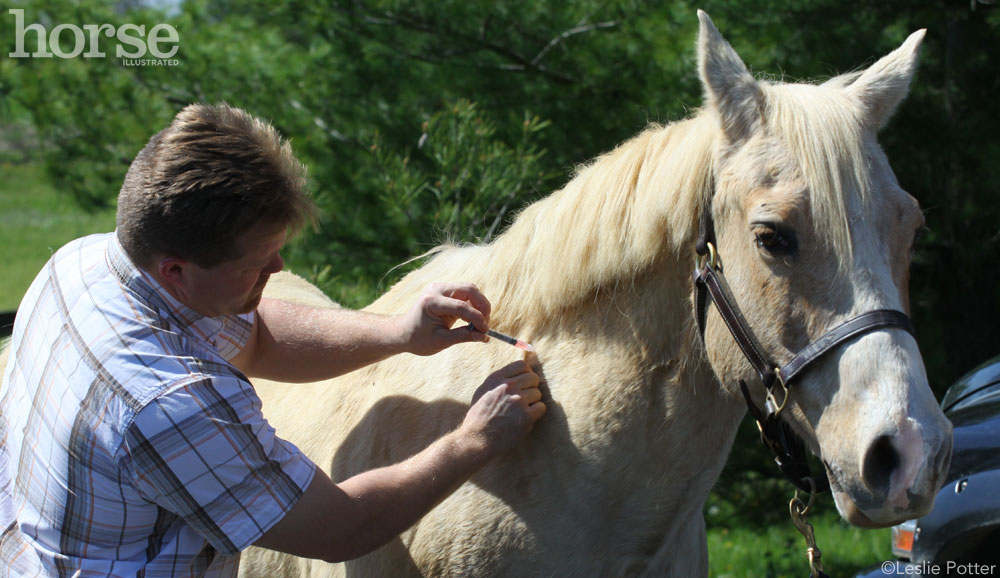
Vaccinations can protect your horse against diseases that can be serious or even fatal. There are many different types of vaccinations available, but most horses don’t need all of them. However, the American Association of Equine Practitioners recommends that all horses receive “core vaccinations” against eastern and western equine encephalomyelitis, West Nile virus, tetanus and rabies. Some horses (for example, those exposed to large numbers of horses at shows/events or traveling to an area experiencing an outbreak of a specific disease) may also need “non-core vaccinations,” such as those for equine herpesvirus, strangles and Potomac horse fever.

Eastern/Western Equine Encephalomyelitis


Eastern equine encephalomyelitis (EEE) and western equine encephalomyelitis (WEE), commonly referred to as “sleeping sickness,” are viral diseases spread primarily by mosquitoes. Symptoms include fever, lethargy and various neurological abnormalities, including incoordination, vision deficits, circling, paralysis and convulsions. Death occurs in up to 50 percent of WEE cases and 90 percent of EEE cases, usually within two to three days.

West Nile Virus


West Nile virus infection (WNV) is also spread by mosquitoes. Wild birds are an important source of the virus and often show no signs of disease. The symptoms of WNV are quite variable. In general, they resemble those of EEE/WEE, but may also include colic, lameness and appetite loss. Most infected horses show some incoordination and paralysis. Muscle tremors of the face or neck muscles often occur, along with weakness or paralysis of the muscles of the face and tongue. The disease can cause behavioral abnormalities ranging from nervousness to hyperexcitability. Death occurs in about 30 to 40 percent of the cases.

Tetanus


Tetanus is caused by a toxin produced by Clostridium tetani, bacteria found in the intestinal tract and soil. Infection occurs when the bacteria enter a wound that provides a suitable environment for growth, such as a puncture wound. The likelihood of infection is not related to the severity of the wound. Initial symptoms include muscle stiffness in the jaw, neck, hind legs and the area of the infected wound. More extensive stiffness, along with muscle spasms and hyperexcitability in response to external stimuli, occurs within 24 hours. A horse with tetanus has a characteristic facial expression: flared nostrils, tensed lips pulled back, prolapsed third eyelid and erect ears. Eating becomes difficult. The horse resists movement and adopts a “sawhorse” stance, with front legs extended forward and rear legs extended back. Relatively minor motions or sounds can trigger violent muscle contractions. Increased heart rate, arrhythmias (abnormalities of the heartbeat) and high blood pressure also occur. Involvement of the muscles of respiration can lead to death. The survival rate for tetanus averages about 20 percent.

Horse Vaccine


Rabies


Rabies is a viral disease that can affect any mammal. It occurs when a rabid animal (usually a skunk, raccoon, fox or bat) bites the horse and virus-containing saliva enters the bloodstream. The wound often occurs on the muzzle or face (because the horse extends its muzzle to investigate the odd behavior of the rabid animal), but can occur anywhere on the body. The symptoms of rabies, which are caused by encephalitis (inflammation of the brain), include behavioral changes and unexplained paralysis. The affected horse may become hyperexcitable, vicious and unpredictable, attacking other animals, humans, or even itself. In some cases, the major symptom is paralysis of the throat and jaw muscles, which rapidly progresses to the rest of the body. These horses may show no signs of aggression. The incidence of rabies is relatively low in horses, but the disease is invariably fatal.

DIY or Not?


Taking care of vaccinations isn’t just a matter of picking up some vaccine at the feed or supply store and getting it into your horse. Even if you know how to give an intramuscular injection, there are some good reasons why you shouldn’t take a do-it-yourself approach to your horse’s vaccination program:

  • The right choice. Vaccines for the same disease can have different formulations, depending on how they’re prepared. The local supply store vaccine may not be the best formulation for your horse.
  • Quality control. If the vaccine hasn’t been shipped and stored under proper conditions, the protection it provides may be inadequate.
  • Program planning. The accompanying tables are guidelines only. Your veterinarian can assess your horse’s needs and recommend the best vaccination schedule.
  • Peace of mind. Your veterinarian has the training and experience to vaccinate your horse and treat adverse reactions, which, although rare, can be life-threatening.

2011 Adequan/FEI North American Junior & Young Rider Championships wrap up

3

After a week of intense heat and one suspenseful afternoon of strong thunderstorms, the 2011 Adequan/FEI North American Junior & Young Rider Championships presented by Gotham North wrapped up on Sunday, July 31 under sunny skies at the Kentucky Horse Park. The competition in all five disciplines – dressage, endurance, eventing, reining, and show jumping – was intense, and the approximately 250 riders from six countries showed that they had come to win.

A member of the Team USA Southeast cools her horse before exiting the vet check area. Team USA Southeast took home Silver in the CEI2*.
A member of the Team USA Southeast cools her horse before exiting the vet check area. Team USA Southeast took home Silver in the CEI2*. Photo: Leslie Potter

Endurance
The first competition to wrap up this year was the inaugural North American Young Rider Endurance Championship. Friday’s 75-mile ride featured both CEI2* and CEI4* divisions. The United States brought home four Gold medals, three Silvers, and two Bronze medals in the endurance competition.

In the CEI4* divisions, Team USA took home the Gold after accruing a collective ride time of 25 hours, 25 minutes, and 31 seconds.

Also Read: 2009 Adequan NAJYRC Kicks Off in Kentucky

Individually in the CEI4*, Kelsey Russell and My Wild Irish Gold (USA) took home the Gold, Lindsay Bean and Tektonic (USA) the Silver, and Kyle Gibbon and Missu Koran (USA) the Bronze.

Also in the CEI4* division, Tektonic received the Best Conditioned Horse Award.

In the CEI2* class, the Team Gold medal was awarded to Team USA Northeast A, whose collective ride time totaled 25 hours, 40 minutes, and 57 seconds.

The Silver was awarded to Team USA Southeast with a collective ride time of 25 hours, 49 minutes, and 19 seconds.

Individually in the CEI2*, the Gold medal was awarded to Sophia Bashir and Dazed and Amazed (USA) , the Silver was presented to Cassandra Roberts and SA Belshazarr (USA), and the Bronze to Steven Hay and Khalil Asam (USA).

Sir Valient, who represented Colombia in partnership with Camilo Andres-Villa, received the Best Conditioned Horse Award in the CEI2* division.

Jesus Arturo Leal was part of the silver-medal winning reining team from Mexico with Smart Little Elan.
Jesus Arturo Leal was part of the silver-medal winning reining team from Mexico with Smart Little Elan. Photo: Leslie Potter

Reining

The SmartPak North American Junior Reining Championship concluded Saturday morning with the individual championships at the Alltech Arena. Canada secured two Gold medals and three Bronze medals, the United States won a Gold and two Silver medals, and Mexico received a Silver.

The individual Young Rider Gold medal was awarded to Will Letner and A Genuine Diamond (USA) for a score of 218.5 from the judges. A ride-off was needed to break a tie of 217.5 for second place, but in the end the Silver went to Laura Sumrall and Einstein’s Fancy Pine (USA). Taking home the Bronze were Shelbie Friesen and Golden Lena Chex (CAN).

In the team competition, Team Canada Alberta and Manitoba loped away with the Gold on a score of 632. The team from Mexico – consisting of a group of cousins – took home the Team Silver with a score of 619.5. Taking home the Team Bronze was Canada Saskatchewan with 615 points.

In the Junior division – included in the competition for the first time – Lane Wilson (CAN) rode No Finer Shiner to a Gold medal, scoring 207. Tiffany Wynn (USA) won the Silver on I Gotta Whiz with 187.5, and Emily Wilson (CAN) earned 182.5 on Miss Cielo Chex for the Bronze.

Julia Burtt and Aaron IV earned Individual Bronze for the Junior Rider division and helped Region 1 win Team Gold.
Julia Burtt and Aaron IV earned Individual Bronze for the Junior Rider division and helped Region 1 win Team Gold. Photo: Leslie Potter

Dressage
The competition at this year’s USDF/Platinum Performance North American Junior and Young Rider Dressage Championship was stellar, and upon completion of the event, judge and President of the Young Rider Ground Jury Linda Zang praised the competitors for the quality of riding they displayed.

The United States brought home three Gold medals, two Silvers, and four Bronze medals in dressage. Canada secured one Gold medal and two Silvers.

The Gold medal in the Young Riders Freestyle competition was awarded to Isabelle Leibler and Watson 108 (USA). The pair turned in a brilliant test and received a score of 74.00%. The Individual Silver went to Chase Hickok and Palermo (USA), who received a score of 70.725%. Rounding out the top three and taking home the Individual Bronze were Mackinzie Pooley and Jonkara (USA) with a score of 70.004%.

In the team competition, the Young Riders from Region 5 took home the Gold with a score of 198.104. The Silver medal was awarded to Team Canada British Columbia/Quebec, who amassed a score of 197.027. The team from Area 8 took home the Bronze with a score of 196.132.

In the Junior division, Sarah Loewen (CAN) turned in an expressive performance aboard Ricardo to receive a 69.675% from the judges, which was enough to clinch the Individual Gold medal. Monica Houweling and Stentano (CAN) earned a 67.70% from the judges, which was good enough to take home the Individual Silver medal, and taking home the Individual Bronze medal with a score of 67.15%, were Julia Burtt and Aaron IV (USA).

In the team competition, Region 1 ran away with the Gold with a score of 199.189. The Team Silver was awarded to Region 5 with a score of 195.856. Taking home the Bronze was Region 8 with a score of 194.297.

Katherine Dinan riding Vancouver won the Individual Gold in the Young Rider division. Photo: Leslie Potter

Jumping
Teams from the same zones took home Gold medals in the Junior and Young rider divisions in the show jumping competition. The United States was awarded four Gold medals, four Silvers, and four Bronze medals.

Taking home the Individual Gold medal in the Young Rider division was Katherine Dinan (USA), who piloted Vancouver quickly and carefully around the courses to finish with a score of 10.14. Finishing just behind Dinan in Silver-medal position were Samantha Senft and Early Morning (USA), who amassed a total score of 10.24. Finishing in the Bronze-medal position were Danielle Korsh and San Diego (USA). The pair finished with a score of 16.57.

In the Young Rider team competition, the Gold medal went to the riders from Zone 4, who finished the week with a team total of 12. The Silver was awarded to the team from Zone 10 with a total of 15. The team from Zone 2 took home the Bronze with a score of 16.

Taking home the Individual Gold in the Junior class was Samantha Schaefer and Trezebees (USA), a 15-year-old Belgian-bred mare, with a score of 4. The Silver medal was awarded to Frances Land (USA) and the 11-year-old British Warmblood, Merlin, who also had a score of 4 but was slightly slower in the jump-off than Schaefer. The Bronze went to Hayley Barnhill and Toucan Tango (USA), who dropped one rail in the jump-off to bring her total score to 8.

In the Junior team competition, the top two medals were decided by a jump-off. But in the end, the Gold went to the riders from Zone 4, who had a team total of 12 and added nothing in the jump-off. Finishing in the Silver-medal position – also with a team total of 12, but with 16 in the jump-off – was the team from Zone 2. Finishing in Bronze-medal position with a score of 16 was the team from Zones 1 and 6.

Eventing
The last championship to wrap up Sunday was the USEA North American Junior Eventing Championship. The United States secured four Gold medals, three Silvers and one Bronze medal during eventing. Canada took home one Silver and four Bronze medals.

Devon Brown and Dynamic Image (USA) led the CCI2* from start to finish and secured the Individual Gold after posting a flawless show jumping round to finish on their dressage score of 50.5. Jumping all the way from seventh to take home the Individual Silver medal were Jacob Fletcher and Falcon Splash (USA) with a score of 57.2. Dropping down one position to finish with the Bronze medal were Joelle Baskerville and Malibu (CAN) with a score of 58.4.

In the team standings, Area III’s team regained their lead to finish with the Team Gold medal and 168.6 points. The team from Areas V & IX slid to the Silver-medal position with a total of 178.2. Canada remained solidly in third to secure the Bronze with a score of 233.2.

In the Junior division, Alyssa Phillips and Sundance Bay (USA), had a brilliant and quick round to finish on the score of 52.7, which was enough to clinch the Individual Gold. Overnight leaders Sable Geisler and Evil Munchkin (CAN) pulled the first rail of a double combination on course, bringing her total to 56.3 and dropping her to the Silver-medal position. Edging up into Bronze-medal position with a speedy clear round were Brooke Pickering and Abbey Rhode (CAN).

In the team competition, Area V led from start to finish and finished the competition with a score 184.4 to clinch the Gold. Holding on to second in the team standings was the team from Area VI, finishing with a score of 205.2 to take home the Silver. Rounding out the top three, the Bronze-medal position was presented to the team from Ontario with a total of 219.8 points.

To watch videos and see photos from all the NAJYRC events, visit /redirect.php?location=www.usefnetwork.com%2ffeatured%2fNAJYRC2011.

See complete scores at /redirect.php?location=http%3a%2f%2fyoungriders.org%2fResults.aspx.

0FansLike
0SubscribersSubscribe
We use cookies to help personalize content, tailor and measure ads, and provide a safer experience. By navigating the site, you agree to the use of cookies to collect information. Read our Cookie Policy.
OK