0 ITEMS
  • My Account
  • Holiday Gift Guide
  • Podcast
  • Webinar
Subscribe Combo
Enable cache13
Home Blog Page 634

A Look Back at Humble Beginnings

7

In the September issue of Horse Illustrated there’s an article I wrote that’s a retrospective of riding apparel from the last few decades. According to my editor, I was the perfect choice for that assignment. Somehow during my years on the show circuit I earned a reputation as a hunt seat fashion diva. My sister and my longtime riding pals tell me this is so, as if my horse show wardrobe concerns were remarkably different than everyone else’s.

Honestly, didn’t everyone spend hours deliberating over which precise shade of tan breeches looked best with a navy blue coat? Wasn’t everyone contemplating the ramifications inherent in selecting light fawn over willow bark or green-beige?

Maybe I was simply over-compensating for my humble start in the horse show world. As a kid I was absolutely impassioned about competing yet I lacked one thing: money. My parents could hardly afford the horse and a handful of bucks for some entry fees. Custom made shotgun chaps or a tailored hunt coat? Forget about it. I was forced to scrape together whatever clothes I could find that were remotely appropriate. For those of you who doubt I came from modest means, I offer you photographic proof.
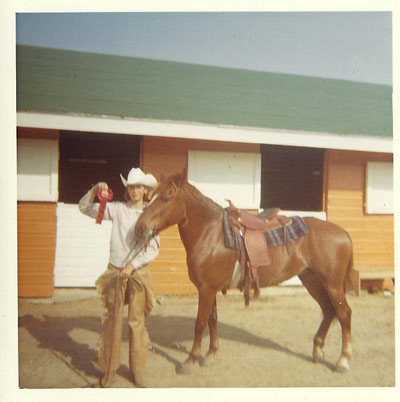
My first forays into the horse show world were western. I distinctly remember coloring my straw hat white by using a can of spray paint I found in the garage. Those stiff, too-short chaps were made from a fake leather fabric. I added the fringe by scissoring the excess material that overlapped the zipper. With all that effort put toward my appearance you’d think that I would’ve thought to tidy myself up by tucking in my shirt tails.
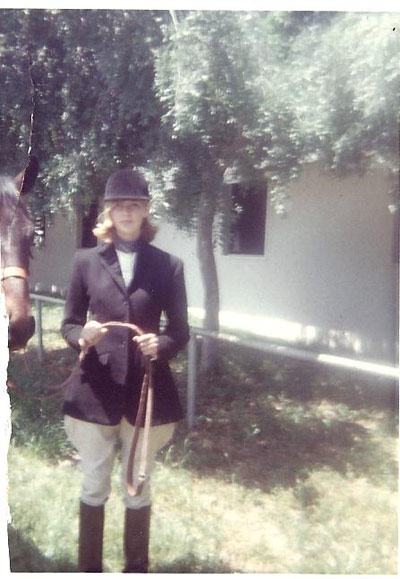
Once I discovered the daredevil possibilities of jumping, I was determined to switch to English riding. For my first few shows I had to borrow clothes from a friend of my mom’s who belonged to an East Coast hunt club. I’m sure she dredged them out of an old, mothball-filled trunk, because they look horribly dated, even back then. By the way, don’t I look like a petulant teenager? Yes, they had hairnets in those days, but apparently I was too cool to wear one.

Once I got out of college and started my career as a school teacher, I could finally afford some stylish outfits for showing. The term “hunter princess” didn’t sound so disparaging anymore. But in my defense, at least I wasn’t a mall zombie like a lot of women. I wasn’t stalking the latest designer stiletto heels or amassing a closet full of designer handbags. No, I was drooling over the sale catalogs from Dover Saddlery.

Yet oddly enough, while I gained an appreciation for fineries like tropical weight wool hunt coats and show shirts made from Egyptian cotton, I never got past my compulsion to fiddle around with my riding apparel. Just as I painted my cowgirl hat I had to tinker with my English outfits. One time I bought grosgrain ribbon and used it to trim the cuffs of my long-sleeved show shirts. Then I went through a phase where I attached tiny silver charms to all of my spurs. Another impulsive act was buying several white show shirts and then bathing them in various hues of Ritz dye. The periwinkle blue experiment turned out lovely, but the yellow one was a bit… breathtaking. I wore it once to a show and several complete strangers said to me, “Wow, that’s a really yellow shirt!”

So I never wore that one again.
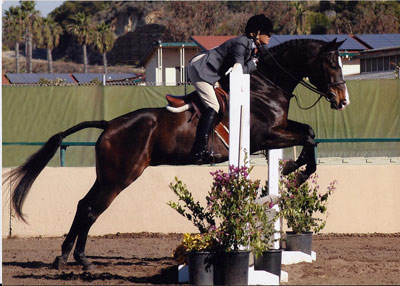
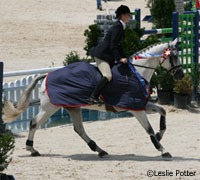
My transformation from waifish, horse show ragamuffin to fashionably attired hunt seat princess was complete long before this photo was taken of me competing at Del Mar in a hunter class. Yet don’t look too closely. I’m sure that somewhere in that photo I’m wearing some sort of handmade or glue-gun embellished adornment.

Whether I was truly a hunt seat fashion diva or merely an artistic soul in need of a craft project, I’m not sure. But at least my tale should serve to reassure those of you who are also of humble beginnings. There’s a snazzy riding outfit in your future, too, even if you do have to add a few of your own little details.

<< Previous Entry

Back to Life with Horses

HI Spy: What item of tack or barn gear would you invent?

86
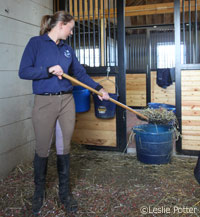
Life improved for stall-muckers everywhere with the invention of the lightweight manure fork. What invention would you create to revolutionize the horse world? Photo: Leslie Potter

As a horseperson, you’ve likely come to depend on certain items of tack or barn equipment. If you’ve ever mucked a stall with a heavy, metal shovel, you understand the beauty of lightweight manure forks. Battling moldy leather in a humid climate might lead you to celebrate synthetic tack. For those in the northern climates, what could be better than heated buckets to keep your horse’s water in a liquid state through the coldest nights?

Riding and horsekeeping have come a long way since the dawn of equine domestication, but there are still headaches that all riders and horse owners deal with every day. If you could invent one item to make your life as a rider or horse caretaker better, what would it be? It doesn’t even have to be completely realistic. Use your imagination, and come up with the horse world’s next must-have product.

Share your invention by clicking “Submit a Comment” below. Some responses may be selected for publication in a future issue of Horse Illustrated!

One selected response may be selected by the editors to win a monthly prize! If you would like to be eligible for the prize, please include your email address in the comment form (email addresses are not publicly displayed.)

See all HI Spy questions >>

Learn the Basics of Lameness in Horses

5

As your horse trots out to pasture to catch up with his equine buddies, you notice something not quite right with how he is moving. It’s hard to put your finger on it, but you are sure you hadn’t noticed his peculiar trot before. Your mind is spinning as you grab a halter and head out to retrieve him so you can take a closer look.

Where to Start

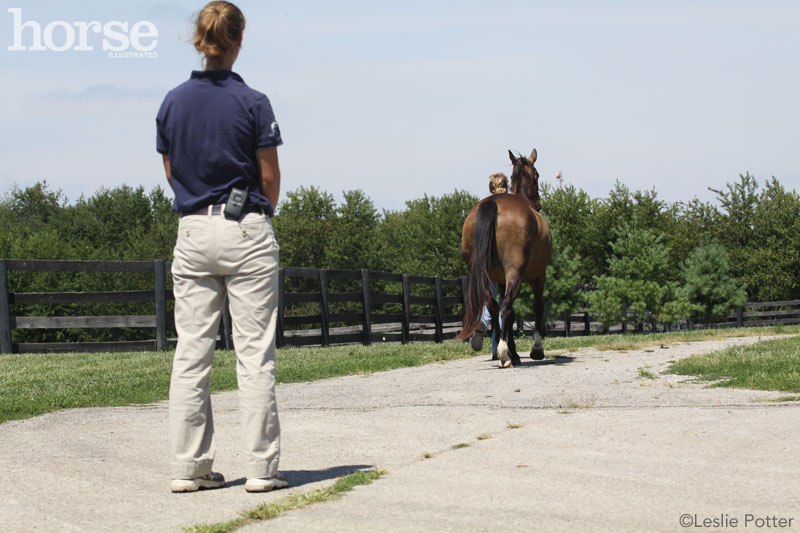
Once your horse is in hand, the first thing to do is check his feet for a rock or nail before asking him for forced movement. Also, run your hand carefully down each leg to look and feel for swelling, bumps, scabs or lacerations. If you don’t discover any foreign material in a hoof or any obvious swelling or injury, then put him on a longeline or in a round pen. Move him out at a trot, which is the best gait for evaluating if there is truly a problem and, if so, to help identify which leg. You might want to observe him from outside the circle while a friend does the longeing so you can watch closely for subtle clues.

It may not be as important to define which leg is lame as it is to determine if there is a problem that would prompt you to call your vet.

Which Leg is Lame?

The trick to determining which leg is lame is to look at the overall picture of your horse’s movement. It helps to do this periodically when he is sound so you have a visual memory to compare to when there is a problem. Identification of lameness takes practice, and the more horses you watch, the better you’ll get.

Do the shoulders swing evenly as he trots? Is the pelvic swing consistent and fluid from side to side? Or, is there a shortening of his stride and/or a noticeable head bob?

On a straight line, watch him trot toward and away from you. His forelimb strides should look even when trotting toward you. If he ducks his head or is obviously limping, then there is clearly a problem. Typically, a horse will raise his head and shoulder when the lame front leg strikes the ground.

From behind, do both hips rise evenly to the same height? If not, then typically the hip of the lame leg will rise up higher (hip hike) as he tries to unload it more quickly. There are exceptions to every rule when it comes to lameness, but these general tendencies give you a starting point for evaluation.

What Causes Lameness?

Lameness comes in all forms, from acute (sudden and severe) onset to slowly progressing and chronic. Abrupt injuries can happen when a horse simply takes a bad step or slips on wet ground, or from a traumatic blow from another horse’s kick. Such injuries are often related to soft tissue strain of a ligament or tendon, bruising of deep tissue or bone, or a
laceration.

Hoof bruising or a hoof abscess often causes acute-onset lameness; in some cases, a horse may appear to have a fracture, failing to put any weight on a throbbing foot. Laminitis is also quite evident, as a horse stands with his front feet camped out, often shifting weight from foot to foot. When asked to turn, a laminitic horse is reluctant to do so and turns with
great difficulty.

More insidious problems develop due to degenerative joint disease, or osteoarthritis. Lameness in these cases tends to come on slowly, perhaps escaping your notice until the disease progression reaches the point of significantly painful joint degeneration. To improve your horse’s outcome, it is always best to identify such problems early—this maximizes the
available therapeutic options.

Flexion Test

When to Call Your Vet

The best approach to managing any lameness in your horse is to include your veterinarian immediately. Early identification of a problem helps to avert a more serious progression of an injury. It is best not to waste time troubleshooting for a variety of possibilities or to mask a significant problem with anti-inflammatory medications. Instead, your knowledgeable vet can zero in on the location of the injury by performing a thorough clinical exam with useful diagnostic tools, like flexion tests, hoof testers, nerve blocks, and radiographs (x-rays) or ultrasound.

Once an accurate diagnosis is achieved, appropriate remedies can be implemented. A team effort with your veterinarian quickly gets your horse on the road to recovery, and you back in the saddle.

Further Reading
Inside a Lameness Exam
Pre-Purchase Exam: Better Quality Assurance

Courtney King Dye’s Riders4Helmets Safety Symposium video address

8
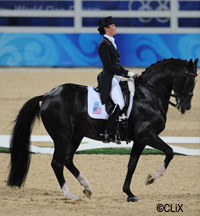
Courtney King Dye and Harmony’s Mythilus competed at the 2008 Olympics in Hong Kong
Courtney King Dye and Harmony’s Mythilus competed at the 2008 Olympics in Hong Kong. Photo: www.clixphoto.com

Olympic dressage rider Courtney King Dye suffered traumatic brain injury (TBI) in March of 2010 when a horse she was schooling tripped and fell. She was not wearing a helmet at the time. Dye’s accident inspired to the creation of Riders4Helmets, an Internet-based campaign to educate equestrians about TBI and helmet use for riders of all disciplines.

On July 23, Riders4Helmets held its 2nd Helmet Safety Symposium in Lexington, Ky. which featured presentations and panel discussions with riders, physicians and helmet manufacturers. One of the most anticipated features of the symposium was an address from Courtney King Dye. Although she was unable to attend the symposium in person as she was attending a show with her riding students, she submitted her address via video. The video is now available on the Riders4Helmets YouTube channel.

Click here to watch the video on YouTube.

In her address, Dye describes the accident that led to her month-long coma and ongoing recovery that leaves her unable to perform many basic tasks by herself nearly a year and a half later.

“Sixteen months ago, I was riding a six-year-old horse who I normally rode in a helmet on principle because he was young. On this day, I was in a hurry to get to the show and because he’d never done anything naughty, I didn’t bother to go get my helmet. We were cantering nicely down the long side, and he just tripped over his own feet and fell.

“I’ve learned…to expect the unexpected. Safety has nothing to do with level of skill. It’s a shame that it took my accident to exemplify that, but I intend to make a terrible brain injury into something great by increasing helmet use and enhance safety.”

Upper-level dressage riders have traditionally not worn helmets in competition or even while schooling. In her video address, Dye explains why her attitude toward helmet choice has changed.

“I used to think that it should be the individual’s choice if they wanted to risk the suffering of themselves and their loved ones. At first I thought this accident was hard on me and my loved ones and didn’t affect anyone else. Then I went to [the World Equestrian Games] and saw how I was mistaken. So many people recognized me and so many were idolizing the team. This made me deeply consider the impact top riders have on all of the individuals watching them. Then I thought, it doesn’t have to be a team rider or a top rider. Everyone is a role model for someone.”

Keep up with Courtney King Dye, visit her new website at www.ckddressage.com. Learn more about the helmet safety campaign at /redirect.php?location=www.Riders4Helmets.com.

Bathing Basics Slideshow

8

The Bathing Basics slideshow is a flash feature. In order to see the entire slideshow, please download Flash.

Bathing a horse

See all course materials

See all course materials

Equine Bathing Basics

0

•  Bathing Basics – Classes

Reading Assignment: Read step-by-step instructions on how to bathe your horse and avoid bathing pitfalls.
Slideshow: View a slideshow demonstrating proper horse bathing techniques.
Quiz: Test your knowledge about bathing basics.


Instructors:  Leslie Potter holds a Bachelor of Science degree in Equestrian Science from William Woods University. She has competed with Morgans, Saddlebreds and Arabians as well as in hunters and dressage.


Back to class schedule>>

New rules in place to protect ponies and tourists on Assateague Island

4
Chincoteague Ponies
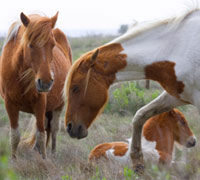
Ponies are rounded up on the Virginia side of Assateague Island each year to help control the population and as a fundraiser for the Chincoteague Volunteer Fire Department.

Viewing the annual Assateague Island pony swim is on the top of many horse lovers’ bucket lists thanks in large part to Marguerite Henry’s classic novel Misty of Chincoteague. Each year, the Chincoteague, Va. Volunteer Fire Department herds the Chincoteague Ponies from the island across the channel to the mainland where the younger ponies are auctioned off. This serves as population control and as a fundraiser for the department. This year’s swim took place on Wednesday.

Assateague Island is divided by the Virginia/Maryland state line. The horses on the Maryland side are not rounded up or sold.

Tourists visit the Assateague Island National Seashore throughout the year, hoping to catch a glimpse of the famous ponies. Many attempt to feed or pet the ponies, and over time, this has caused the ponies to become accustomed to humans, which is potentially dangerous for both people and ponies.

In response to the increasing interaction between ponies and people on the island, the National Park Service has tightened the rules for visitors. There has been a longstanding rule prohibiting people from touching the horses, but the rule has now been extended to mandate visitors stay at least 10 feet away from the ponies and to prohibit them doing anything to entice the ponies to come close to humans, such as offering them food.

Additionally, visitors now must lock away their food where ponies can’t access it instead of leaving it unattended in tents or at picnic areas. Ponies on the island have been known to invade campsites in search of tasty treats. This is not only dangerous for campers, but put ponies at risk of colic or other illness.

As horse owners know, feeding horses by hand can lead to undesirable behaviors, such as biting or pushing. This problem increases with feral equines that are completely untrained, but have become habituated to humans. Additionally, ponies have been reported to approach humans both on foot and in cars, increasing the risk of ponies wandering on to roadways.

Click here to read the National Park Service’s information on safely visiting Assateague Island and viewing the resident ponies.

Equine Core Vaccines

6

•  Equine Core Vaccines

Reading Assignment: Learn about the core equine vaccines recommended for every horse by the American Association of Equine Practitioners.
Video: A vet answers common questions about vaccinating your horse.
Quiz: Take these 10 questions to test your knowledge on equine vaccines.


EXTRA CREDIT

Learn about disease descriptors and take a quiz to earn bonus points toward your Club account.

Disease Descriptors | Download ISG Certificate

Take the quiz now »

Sponsored By

Immunization Support Guarantee


Instructor: Karla Rugh, D.V.M., Ph.D., of Rocheport, Missouri, has been a veterinarian for more than 35 years. She has experience in equine/food animal practice, companion animal practice, academia and research. She has written three books and more than 50 articles about pet care. Dr. Rugh owns five horses, who reside at Sycamore Hollow, her family’s farm

Back to class schedule>>

Equine Diseases and Vaccinations Video

5

Woodrow Friend, DVM of Rood & Riddle Equine Hospital in Lexington, Kentucky, explains the basics of vaccinating your horse.

Click here to see all materials for this course

North American Junior & Young Rider Championships begin today

3
Laura Roberts at the 2009 NAJYRC
Laura Roberts won individual eventing gold with Galway Blazer at the 2009 North American Junior & Young Rider Championships. Photo: Leslie Potter

Up-and-coming riders from dressage, endurance, eventing, show jumping and reining are competing today through Sunday at the Adequan/FEI North American Junior & Young Rider Championships presented by Gotham North (NAJYRC). Teams and individuals between the ages of 14 and 21 come from Canada, Mexico, Bermuda, the Caribbean Islands and all regions on the United States.

The NAJYRC began as a Canadian/American eventing competition in 1974. Dressage and show jumping were added in the early 1980s and reining joined the competition in 2008. This year marks the first NAJYRC that includes an endurance championship. Para-dressage is also featured this year as a non-championship event.

Watch highlights from the 2009 NAJYRC reining competition.

Many Olympic equestrians and other top riders are NAJYRC alumni, including Karen O’Connor, McLain Ward, Chris Kappler and Greg Best. The NAJYRC offers talented young riders the chance to experience top international equestrian sport while competing with their peers.

Spectators are welcome at all events, which are included with Kentucky Horse Park admission. To learn more and view a schedule of events, visit www.youngriders.org

0FansLike
0SubscribersSubscribe
We use cookies to help personalize content, tailor and measure ads, and provide a safer experience. By navigating the site, you agree to the use of cookies to collect information. Read our Cookie Policy.
OK