0 ITEMS
  • My Account
  • Holiday Gift Guide
  • Podcast
  • Webinar
Subscribe Combo
Enable cache13
Home Blog Page 643

First Aid for Abrasions, Punctures and Cuts on Your Horse

6
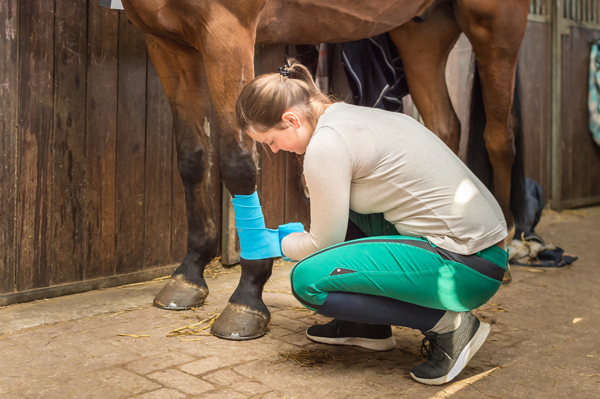
Wrapping a Horse Leg for an Injury
Photo by Tanja Esser/Shutterstock

Sooner or later, it’s bound to happen. Your horse comes in with a wound that needs attention. Do you know the best first aid for your horse’s needs?

“A wound to your horse’s body can take the form of an abrasion, puncture or full thickness skin cut,” notes Dr. Glennon Mays, clinical associate professor at the Texas A&M College of Veterinary Medicine & Biomedical Sciences.

“The body has its own marvelous mechanisms for healing injured tissue,” states Mays. “Following the trauma, the body sends white blood cells to the injured site to clean up the damaged cells and fight infection. These white blood cells rid the wound of dead cells and bacteria. This expelling of non-viable cells can be seen as either a clear or slightly yellow discharge.”

The first thought at the sight of this oozing is to dry it up, however, the white blood cells need moisture to continue their healing work, explains Mays. If additional moisture is needed, an antibiotic topical ointment can be applied.

“The body also responds to the wound with inflammation,” notes Mays. “The cells that respond to the injured tissue do so to increase blood flow which facilitates clean up and repair of the wound. This extra flow of blood brings swelling, redness and heat to the injured area. Therefore, inflammation should be controlled but not suppressed.”

The body continues to remove contaminants while there is inflammation, explains Mays. As decontamination continues, cells that produce repair material move into the wound area. Then granulation tissue forms. Excessive granulation can result in “proud flesh” when the new tissue extends beyond the surface of the wound margins. Moisture does stimulate granulation and excessive moisture often results in “proud flesh” which prohibits continuation of the healing process. If the wound appears to have excessive granulation tissue, the aid of veterinary care is often needed.

“Wound treatment may include a combination of antibiotics to control infection, anti-inflammatory injections for pain management and ointments for wound medication,” notes Mays.

In treating any wound, the first step should be to clean the injured flesh, states Mays. Flushing the wound with water or saline solution will help remove dirt and bacteria from the cut. Saline solution can be made by dissolving two tablespoons of table salt in one gallon of distilled water. Wounds that are exceptionally dirty may need an antimicrobial wash which contains iodine. This wash will kill surface bacteria while cleansing the wound.

“Call your veterinarian if the wound is over a joint, involves bone/ligaments or pulls apart when your horse moves,” explains Mays. “A wound to your horse’s leg, especially near a joint where there is motion, should be referred to your veterinarian. If your horse receives a below-the-knee leg wound, it is best to seek medical assistance since leg tissue mass is limited and there can be contamination from dirt.”

Bandaging may not be necessary for some cuts and abrasions. However, leg wounds may need bandaging to reduce dirt contamination and skin motion so that healing can occur, notes Mays. A bandage keeps topical medication on the wound. Also, the light pressure of the bandage suppresses excess outgrowth of skin and promotes less scaring.

Small wounds may go undetected, cautions Mays. They may not be seen before contamination and infection occur. Since tetanus is always a threat, be sure that your horse receives a tetanus vaccination and stays current.

Horses are prone to injury. Knowing basic first aid treatments for healing their wounds will allow you to assess the situation and determine the best treatment for your horse. The right medication administered at the proper time by the proper person can facilitate the natural healing process of your horse’s body.

Further Reading
Wound Care Chart
Look Ma, No Stirrups!

2

Hunters and dressage riders often don’t see eye to eye, but surprisingly in this case we do. Rising trot without stirrups is a fine thing—if and only if, a rider has mastered basic position. This is because riding without stirrups is meant to increase the rider’s balance. Scott Hofstetter, top hunter rider, coach and judge from Ocala, Fla., points out that in the Medal and Maclay classes, riders are asked to jump a course without stirrups to show that they have good balance. So for someone who lacks good balance, working without stirrups is exhausting and difficult. Unbalanced riders will compensate and balance on the horse’s mouth and/or grip tightly with their legs. Therefore, make sure you can check off the following before you cross your stirrups over:

  • Do you have good hands?
  • Can you balance without using your hands?
  • Do you have a steady, well-balanced seat?

When you do ride without stirrups, make sure that you stretch your leg down as much as possible. “I try to get a student to make their legs look like a dressage rider’s-long, relaxed and wrapped around the horse’s barrel,” says Scott. Riding with scrunched-up legs will actually cause you to grip and hold on with your leg, rather than rely upon your seat for balance.

Back to Perfecting the Posting Trot >>

Question of the Week: Fear of the Farrier

2

Q: I recently bought a three-year-old mare. The first time we had the farrier out, she immediately became nervous and wouldn’t cooperate with them. The farrier’s assistant put a chain over her nose, which didn’t help at all. Now she doesn’t seem to trust me anymore and if I bring out a lead rope, she runs away and won’t let me get anywhere near her. How can I regain her trust, and what can I do to get her to be calmer for the farrier?

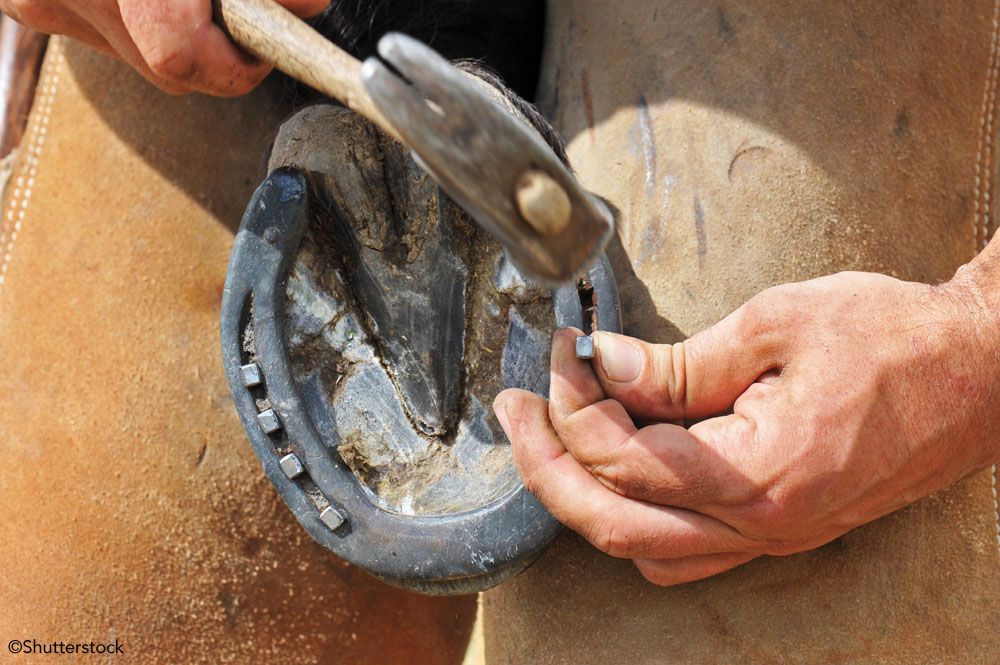
Farrier nailing on a horse show

A: Let’s assume that this was an uneducated horse before you bought her. Because the mare then became accustomed to you, you gained each other’s trust. But then any time you put any pressure on her, regardless of the source — like the chain over the nose or a farrier approaching her differently than you do — the horse couldn’t tolerate that kind of pressure. The reason is because the horse hasn’t had any foundation work that would prepare her for different kinds of pressure. We have to teach the horse to accept pressure from more than just the owner. We need to teach the horse how to accept handling from a farrier, veterinarian, a handler in the barn, etc.

When teaching foundation work, I like to start in the round pen. Once you start teaching the horse to go forward and start controlling its feet, the horse will start to look to you for direction. That’s the key. When you control the horse’s feet, you control the horse’s mind.

This is not a round pen running exercise, but you need to have at least a nice forward trot in the horse; not a tiny choppy trot, but a ground-reaching forward trot. The horse may even move into a comfortable canter. You need the horse to have that forward movement and elevated energy. Most people want the horse to just jog along, thinking it’s adequate. The problem with that is that you’re not utilizing the horse’s potential, and that jog isn’t going to create enough ‘try’ in the horse.

When the horse is moving, I will ask the horse to turn and face me. The way that’s accomplished is to watch for the horse to have one ear on you, and then move backward away from horse’s shoulder and nose. Move in a spiral backward motion away from the horse until you gradually move toward the rail and the horse has stopped its feet and looks at you. You’re actually teaching the horse to come to you on cue. It’s sort of like opening a ‘gate’ toward yourself. The horse should be willing to turn into you. Remember, the horse doesn’t trust you any more, so you have to take enough pressure off her by stepping backward and opening that space. If you only open that ‘gate’ a little bit for the horse, you won’t be successful. But by opening up a large space (stepping back in an arc formation), the horse will be much more willing to step through that space, turn and face you.

This exercise is simply moving back and allowing the horse to come through —it may take two or three tries. When the horse changes direction toward you, release the pressure. Go back to neutral by returning to the center of the round pen. Get the horse to move forward again at a rigorous trot or slow canter or lope, then ask again for the horse to turn and face you. The whole idea of the exercise is to get the horse to start listening to you and for her to realize that you’re not a predator. You’re merely asking the horse to do something by controlling its feet and space.

Interacting with new people is a great way to help your horse mature

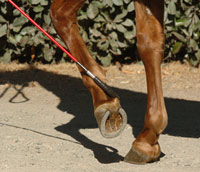
Once you’ve accomplished this exercise and the horse will stop and look at you consistently, then attach a halter and lead. Take a dressage stick and quietly stroke the horse all over with that stick. If she moves away while stroking a certain area, maintain contact until the horse stops moving. When she stops moving for even for a moment, take the stick away. The moment the horse stops moving, take off the pressure immediately. I used to use my hand for this exercise, but it’s much safer to use the dressage stick as an extension of my arm.

When the horse is comfortable with this stroking all over her body, it’s time to raise the pressure level. Try lightly bumping the horse with the dressage stick (don’t cause alarm, just up the pressure). Then stroke her again. She needs to get used to objects and pressure around her legs and body. You might get a reaction like kicking out with the hind legs. But keep doing this until the leg is quiet. Once you’ve accomplished this, then you can start picking up the horse’s feet and putting them down. Then progress to picking up the feet and holding them for a few seconds, then holding for longer periods of time once the horse is not resistant.

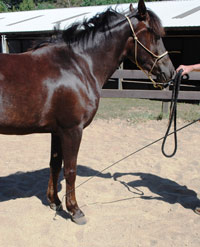
Gaining control of your horse's feet

Next take a hoof pick which is light and non-threatening and just start tapping on the horse’s hoof, simulating a farrier’s action until there’s no resistance. Then do the same motion with a block of wood, then graduate to a small hammer, allowing the mare to become accustomed to each action. This will really help the horse get ready for the farrier. It’s very likely that your mare never had any experience with a farrier before and simply wasn’t prepared for what was going to happen. What follows is that we allow the farrier to train the horse, which rarely works out very well for anyone, including the horse. I’ve seen this happen many, many times.

I hope this helps, and the best of luck with you and your horse.

Charles Wilhelm is a highly-regarded trainer who resides in Northern California. For more information about his program, clinics, DVDs, etc., visit www.CharlesWilhelm.com or call 877.886.9001.

Outbreak Alert is a resource for equine disease prevention

5

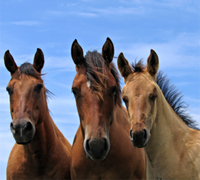
Three horsesSupporting horse owners and veterinarians in their efforts to keep their horses healthy, animal health company Merial launched its “Outbreak Alert” program, which will be used to notify horse owners about reports of equine disease throughout the country, as well as build a greater awareness of those diseases and the importance of prevention.
Disease poses a significant threat to the health and well-being of horses. Eastern Equine Encephalitis (EEE) has a mortality rate estimated to be as high as 90 percent.1,2 Every case of rabies presents a death sentence to the infected horse – and a risk of infection for other horses.3 Potomac horse fever (PHF) can lead to severe complications or death, which occur in up to 30 percent of infected horses.4,5 One out of three horses that gets sick from West Nile virus (WNV) dies or must be euthanized.6 While these statistics are alarming, horse owners can help minimize the risk of disease by being armed with information.

“The primary focus of the program is to help keep horse owners, like myself, informed about the threat of disease in the area where they live or where they may be traveling,” says Beckie Peskin, Product Manager, Equine Vaccines and Dewormers, Merial. “Owners want the best for their horses, and knowing where the threat of disease exists will help them take the appropriate preventive measures to help protect their horse – whether it is in their own barn or competing halfway across the country.”

Horse owners can sign up for free alerts via the program’s website, www.outbreak-alert.com. When a disease report occurs, those who have signed up for the notification and live within a 250-mile radius of where the report occurred will receive a text and/or e-mail message to alert them of the potential disease threat. Owners who travel with their horses and want to stay abreast of disease threats in other parts of the country can enter multiple ZIP codes in the site’s search field. They will then be able to receive alerts for all areas they have selected. Owners are also encouraged to share details of the Outbreak Alert program with other horse owners through e-mail, text, Twitter and Facebook.

“We want to spread the word about this program because we feel it is critical to give horse owners as much information as possible,” says Peskin. “Armed with information, horse owners can work with their veterinarian to make sound health care decisions based on the risk of disease and the potential for exposure.”

Through outbreak-alert.com, horse owners will also have access to consumer-focused information about equine diseases, their transmission, signs to look for and disease prevention, including the importance of vaccination.

“The American Association of Equine Practitioners (AAEP) recommends all horses in the United States be vaccinated against core diseases, including WNV, EEE, Western equine encephalitis (WEE), tetanus and rabies,”7 says Peskin. “And if you travel with your horse or there is a disease threat in your area, there are other non-core vaccines that may be needed to help protect your horse’s health, including those for equine influenza and PHF.7

“While there are many steps you can take to protect the well-being of your horse, vaccination should be a critical component of your equine health care program, and MERIAL® Brand Equine vaccines help prevent some of the most common and most serious equine diseases.”

Veterinarians are the best source for quality vaccines and vaccine information. A good rule of thumb is to communicate with your veterinarian at least twice a year – usually in the spring and fall – to identify the area’s disease threats, assess your horse’s level of risk and discuss potential travel plans – all of which will help enable you and your veterinarian to develop a vaccination program that specifically addresses the needs of your horse.

References

  1. Eastern/Western equine encephalomyelitis. American Association of Equine Practitioners. Available at: https://www.aaep.org/eee_wee.htm. Accessed August 3, 2009.
  2. Mosquito Borne Diseases: Eastern and Western Equine Encephalomyelitis and West Nile Virus – Prevention is Just a Vaccine Away. Department of Animal Science. University of Connecticut. Available at: https://animalscience.uconn.edu/extension/publications/mosquito.htm. Accessed February 28, 2011.
  3. Marteniuk J. Rabies in horses. Michigan State University, College of Veterinary Medicine. Available at: https://old.cvm.msu.edu/extension/equine/RabiesinHorses.pdf. Accessed June 11, 2009.
  4. Palmer JE. Potomac horse fever. University of Pennsylvania. Lecture notes and slides. 2008. Available at: https://nicuvet.com/nicuvet/lam/index.html. Accessed January 15, 2009.
  5. Merck Veterinary Manual. Ninth edition. 2005:236-237.
  6. Guidelines for the vaccination of horses: West Nile virus. American Association of Equine Practitioners. Available at: https://www.aaep.org/wnv.htm. Accessed March 1, 2011.
  7. Guidelines for Vaccination of Horses. American Association of Equine Practitioners. Available at: https://www.aaep.org/vaccination_guidelines.htm. Accessed July 12, 2010.

America’s oldest horse show celebrates 157 years

2

JumperSince 1853, equestrians, horse breeders and spectators have gathered under the Grafton oaks in Upperville, VA, to admire some of the nation’s most talented horses and riders. The Upperville Colt & Horse Show (UCHS) is the oldest horse show in America. It was founded to encourage better breeding of horses.
The one-day show, which began with a few breeding classes, has grown into a week-long tradition with classes for children, adults and families. Each year beneath the oaks at Grafton Farm, more than 2,000 horse and rider combinations compete throughout the week. The show raises funds for the Upperville Volunteer Fire Department and other area charities.

Once again, the event will recognize outstanding individuals and horses that have contributed to the UCHS goals through participation, horsemanship, leadership or service. Individuals and horses will be named to the Wall of Honor that remains on display on the show grounds during the entire event. The wall itself was made from a fallen oak tree from the show grounds property. “This is our opportunity to recognize the many individuals and horses who have made this unique event so spectacular,” states Tommy Jones, the show’s organizer.

The 158th Upperville Colt & Horse Show takes place June 6-12. The week culminates with the $100,000 Upperville Jumper Classic, which draws top riders from across the nation. The Jumper Classic will be held on Sunday, June 12, at 2:30 p.m.

Prior to the Jumper Classic, the Pedigree Country Fair will take place on Sunday from 11 a.m. to 2 p.m. with pony rides and games for the kids. Other entertaining events include the Jack Russell Terrier races, Basset Hound demonstrations, and horse drawn carriages. Plan to bring the family, be entertained, browse and shop the food and retail vendors – just spend the day in some of Virginia’s most beautiful countryside.

Gates open at 8 am throughout the week. Admission is $10 per person. Children under 12 are free when accompanied by an adult. Classes throughout the week are fun to watch especially the Ladies Side Saddle and young children’s classes on Saturday. Bring a picnic or purchase food on the grounds. A variety of food vendors and retailers will be on site.

Viewers can also catch the excitement via a live webcast of the hunter and jumper rings. Classes will start each day at 8 a.m. and continue through 5 p.m.

To get there, from Washington, DC take I-66 west to Route 50 West (Exit 57B) toward Winchester, Va. Drive approximately 25 miles to Middleburg and continue on Route 50 to Upperville and the show grounds. Also located just 30 minutes from Dulles International Airport. Take Route 28 from the airport to Route 50 west and follow as above. Follow signs for parking. For information, call 540-687-5740 or 540-592-3858.

For complete schedules and up-to-the-minute results, visit the web site at www.upperville.com. The Upperville Colt and Horse Show is a 501(c)3 charitable organization

It???s Only Fun Until the Rodeo Starts

10

One of the problems inherent with living in a horsekeeping community is literally living in a horsekeeping community. Honestly, sometimes I envy those of you who board your horses at a rigidly supervised stable or live with your horses on a ranch out in the wide open country. Then you aren’t constantly rubbing stirrups with other riders who, for lack of a better term, disrupt your horseback riding mojo.

Over the last couple of months I’ve had a few instances where I began to wonder what exactly is going on with the commonsense courtesy and horsemanship skills (or lack thereof) with some of the riders out here. Basically I’m talking about riders who are somewhere between careless and clueless. They tend to ride at one speed: Gallop. Their horses seem to fit in one of two categories: Barely broke youngsters outfitted in makeshift tack, or prancing stallions with an eye on procreation. If this is what these people call “fun” on horseback, so be it. I’d just appreciate it if their craziness doesn’t spill over into my life.

Just in case you’ve had some of the same experiences, I’ve formulated two theories about these wango tango riders. I’m not sure which one is correct. Maybe both are.

A) They honestly don’t mean any harm. No one ever explained to them that running their horse at warp speed is not a good thing, especially not on crowded public bridle paths or up the tail end of another horse that’s casually cruising around an arena.

B) They really don’t care how their riding and the behavior of their horse adversely affects you, your riding and the behavior of YOUR horse. If you can’t control your horse while theirs is zipping around like Zenyatta on crack, too bad.

Want a specific example? Just the other day, my friends Natalie and Julie were riding with me in the public arena behind my house. Natalie was on Dunzy, her grulla gelding who amicably travels in slow motion. Julie was on Junior, her teenaged, semi-retired western pleasure show horse. And I was riding Danny, whose concept of being frisky is typically expressed with nothing more than a brisk trot for three minutes. The three of us were having a good time, chatting while leisurely working our horses through circles and leg yields and side-passes. At some point, we began talking about how much we enjoy working with our horses; even though we trail ride, we also like spending time getting our horses supple and relaxed and listening to our aids. One of us (I’m not sure who) said, “Unfortunately, all you ever see on TV or in the movies are people running their horses at full speed, so that’s what a lot of folks want to do as soon as they get a horse or start to ride. They just want to go fast.”

Right on cue here came a young guy on a half-broke, little gray filly. Her tail was short and stubby, as if it’d been chewed off by another baby in the pasture, and her head was flipped skyward, snubbed in place by the nylon rope tie-down that ran between her narrow front legs. He approached the arena at a dead run, galloping down the long, steep hill, a wake of red dust kicked up by the filly’s heels. He careened around the tight turn without slowing down. When he reached the gate the filly halted splay-legged at the barrier in her path.

Fearing a rodeo, Natalie, Julie and I picked up our reins and headed for the gate to leave. Like a chorus, all three of us said to the guy on the revved up filly, “Wait! Before you come in, just let us get out of here, okay?”

We couldn’t seem to file out of the gate quickly enough. The young man waited politely. In fact, he seemed perplexed that none of us wanted to stay in the arena while he joined us. But our horses, the sedate, mannerly nags that they usually are, were becoming amped up and energized by some kind of hyperkinetic aura emanating from the wiry little filly. She was rigid with anticipation, ready to spring into the arena like a race horse out of a starting gate. That animated our three geldings, so much that they began to lift their tails and arch their necks. Oh joy.

Natalie looked back over her shoulder and said to the guy, “Just please let us get around the corner before you take off, okay?”

He nodded, smiled, and tipped the brim of his cowboy hat. He truly didn’t seem to comprehend that his rowdy riding and his filly’s wild-eyed body language was unnerving our horses. In keeping with his character, however, he slapped the ends of his reins across the gray’s neck and shot into the arena, barely squeezing past us as she bolted forward. We all heard him exclaim cheerfully to his filly, “Come on, Chica! Let’s ride!”

And off they went at the gallop.

And off we went with our horses, each of our geldings a little puffed up at the walk.

See? It’s rarely a dull moment living in a horsekeeping community. But since much of it is beyond my control, I try to make light of a potentially calamitous event. Every now and then, when I see Natalie or Julie on the trails, it’s a contest to see which one of us is the first to say, “Come on, (insert the name of our horse here), let’s ride!”

At the end of the day, I realize that not everyone agrees on the best, right way to ride a horse. Plus, there’s a wide spectrum of what each of us defines as fun, challenging, rewarding or productive when it comes to riding. But I do think that every rider has a responsibility to make their horse’s welfare a top priority. After that, maybe keeping in mind the safety and serenity of other horses and riders might be nice, too.

<< Previous Entry

Back to Life with Horses

Celebrate National Trails Day with your horse on June 4

4

Trail ridingThis Saturday is the 19th annual National Trails Day, and all equestrians, hikers, and outdoor enthusiasts are encouraged to get outside and celebrate. The day is spearheaded by the American Hiking Society, but all non-motorized trail activities can be included as recognized NTD events.
National Trails Day was created to inspire Americans to discover and enjoy outdoor activities. Since its inception in 1993, it has spread to include events in Canada and the United Kingdom.

Why Trail Ride?

  • Studies have shown that being outdoors, particularly in green environments, can improve a person’s mental health, mood, and physical condition.
  • Getting out of the arena and taking a break from schooling is good for your horse’s mental health, too. Taking a trail ride can combat boredom and ring-sourness and increase your horse’s fitness by adding hill work and natural obstacles to your ride.
  • Time on the trail could be a healing agent. Researchers have found that children with ADHD are able to focus better after spending time outdoors in the wilderness, moreso than when spending time outdoors in green, natural environments than in cities or residential neighborhoods. Other studies have shown that surgery patients recover faster and with less pain if they have more exposure to natural light.
  • While hikers, cyclists and equestrians may not always get along on mixed use trails, all three groups share a common goal: Preserving wilderness and public access to wild lands. Coming together to maintain trails and preserve natural landscapes today means there will still be somewhere to ride tomorrow.

Tips for Trail Riding
These articles can help you plan a successful trail ride.

Ultralight Horse Packing
Take leave-no-trace camping trips easily with these ultralight horse packing techniques.

Evaluating Equine Fitness
If you plan to take your horse with you on vacation–camping and trail riding–make sure he’s fit to go.

30 Tips for Better Trail Riding
Improve your trail rides with our best collection of tips.

Finding your Perfect Trail Horse
Advice for finding your perfect trail match.

Barn Sour Behavior
Follow these tips for handling barn sour behavior on the trail.

Organized events to mark National Trails Day are planned across the United States. Visit americanhiking.org/ntd.aspx to find one near you.

My Day as a Dressage Scribe

2
Holly and Dexter dressage
Holly and Dexter showing in March 2011. Photo: Tom Werner

For a long while, I’ve been interested in learning to scribe for a dressage judge. As a rider who competes, I spend long hours pouring over the scores and comments on my tests, so what could be better than sitting with the judge as she evaluates dozens of riders right in front of you?

The opportunity finally came together this past weekend at an eventing show. I had decided to skip competing myself, and was excited to find a volunteer position and give back to the sport. To my delight, I was “hired” as a dressage scribe, even though I had no previous experience at this post. It always seemed to be a hard gig to come by, as they prefer you to have past experience to get the job.

I ended up scribing the Novice level test, the one I am currently doing in competitions, so it was even more interesting. The judge I scribed for was a very experienced dressage trainer, and I learned tons just by listening to her comments for each horse. Here are some of the things I came away with:

  1. Forward, forward forward. All other things being equal, a more forward horse will score higher. As my judge put it, “They should be booking it at this level!” It makes sense, since Novice horses aren’t asked for collection, so going too slow is likely to mean dragging along on the forehand.
  2. Steady Eddie: Speeding up and slowing down within a gait is a definite no-no at this level as well. Don’t try to extend the trot across the diagonal, just stay steady as a rock in your horse’s working gaits.
  3. A good walk is born that way: The only movement in the Novice test with a coefficient of 2 is the free walk. One gorgeous-walking got a 9, and as she put it, “That’s like getting two 9’s! You can’t teach them to walk like that—they have to be born with it. Some horses will never have better than a 5 or a 6 walk.” That said, you can always improve your horse’s walk score to the best it can be by going forward, showing overstride, and preferably a bit of downward stretch in the neck.
  4. A fussy head is the kiss of death. Some horses, whether they were just green or having a bad day, continually tossed their heads throughout most of the movements. These horses received the worst scores—worse than horses with short strides, horses that were too overflexed (behind the bit), et cetera. If your horse is fussing with his head, get his teeth checked and re-evaluate your training program back to square one.
  5. Keep your rein contact steady. Nothing seemed to bother my judge more than “baggy/tight” reins. “You need a consistent line of communication to your horse, or he won’t know what you’re asking of him,” she said. You can soften with your inside rein to praise your horse, but he must always know what you want to do if he’s going to do it!
  6. Don’t cut corners—literally. Your score will probably be 1 point lower than it would otherwise if you cut off a corner. Go as deep as your horse will let you to really show the judge that you understand the geometry of the test.
  7. Rack up points on the centerline. Since you’re going toward the judge at C, all she can see is whether your horse is carrying his body straight. Ride that line straight as an arrow, and you’ll probably get a nice 8!

I hope these tips help anyone who rides or competes in dressage (or eventing). I was truly grateful for the opportunity to scribe, and had a blast learning so much. I can’t wait to do it again!

<< Previous Entry

Back to The Near Side

English Show Grooming Video – Part 1

9


« Watch English Show Grooming – Part 2 »

In this video, Lisa Bac, farm manager at Scheffelridge Farm in Paris, Ky, shows you how to clip your horse in preparation for a hunter show.

Click here to see all materials for this course

English Show Grooming Video – Part 2

8


« Watch English Show Grooming – Part 1 »

In this video, Lisa Bac, farm manager at Scheffelridge Farm in Paris, Ky shows you how to groom your horse’s mane, clean up his white markings and put on some finishing touches before entering the hunter show ring.

Click here to see all materials for this course

0FansLike
0SubscribersSubscribe
We use cookies to help personalize content, tailor and measure ads, and provide a safer experience. By navigating the site, you agree to the use of cookies to collect information. Read our Cookie Policy.
OK