Horse College – Horse Health Jigsaw Puzzle
This page requires Adobe Flash Player

 Horse Illustrated Magazine
Horse College – Horse Health Jigsaw Puzzle
 The popular helmet awareness campaign Riders4Helmets has partnered with generous sponsors to offer the largest ever giveaway of riding helmets with a combined value of over $6,500, in addition to a highly sought after iPad2. Visitors to the Rolex KY 3DE (April 28-May 1) may visit the Riders4Helmets area at the trade show in the covered arena to register for the giveaway, receive helmet safety literature, and, have the opportunity to participate in helmet fitting demonstrations (times available online). Equestrians who are unable to attend Rolex may register for the giveaway by visiting www.riders4helmets.com (see giveaway tab on website). The giveaway closes midnight on May 1st, 2011.
Riders4Helmets would like to offer sincere appreciation to all of the sponsors who have made this giveaway possible. The iPad2 giveaway is kindly sponsored by: Riders4Helmets.com, EquestrianCollections.com, Horseshoes by Design, Triple Try Farm, Rise Systems LLC, Equestrian Aid Foundation, Broadstone Equine Insurance, New York State Horse Council, Rancho Los Ecuestres, Evadi Farm. The helmet giveaway is kindly sponsored by: GPA, Samshield, Troxel, Charles Owen, International Riding Supply (IRH), Tipperary, Ovation, Devon-Aire, Pegasus and KEP Italia.
Riders4Helmets horse and rider logo wear will also be available for purchase at Rolex, the proceeds of which will be used to fund educational events such as helmet safety symposiums. The logo wear collection is sold exclusively online by EquestrianCollections.com who are donating 100% of all proceeds from sales of logo wear to the Riders4Helmets campaign, in support of their efforts to increase the use of helmets by the world-wide community of equestrians.
The Riders4Helmets campaign has rapidly gained the support of equestrians around the globe. In the United States it was the organizer of National Helmet Awareness Day in 2010 and hosted the Riders4Helmets Helmet Safety Symposium in January 2011. Plans are already in the works for International Helmet Awareness Day 2011, and the 2nd Riders4Helmets Helmet Safety Symposium, both to be held summer 2011. “We are delighted at the support the equestrian world has shown Riders4Helmets,” said White.
For more information on the Riders4Helmets campaign, visit www.riders4helmets.com or contact Lyndsey White at lyndsey@riders4helmets.com.
Riders4Helmets was founded in early 2010 after Olympic dressage rider Courtney King Dye was seriously injured in a riding accident. King Dye, who remained in a coma for a month following her accident, was not wearing a helmet at the time of the accident and is currently undergoing rehabilitation. Jeri Bryant donated her helmet campaign t-shirts (featuring the slogan “Strap One On–Everyone’s Doing it”) to an eBay store set up to raise funds for King Dye, and a partnership was formed, resulting in the Riders4Helmets campaign.
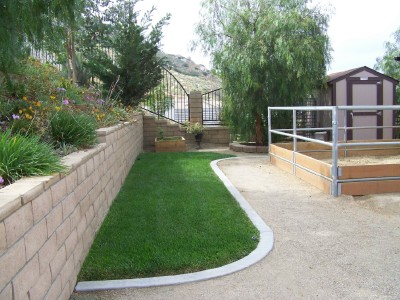
In defiance of Horsekeeping Logic, my husband planted a tiny sliver of manicured meadow just outside the corral fence.
I’ve learned there are certain secrets a horsewoman should keep from her non-horsey husband for fear of sending him into a tizzy of apprehension and dread. One is the date of the upcoming sale at the local tack store. Another is the advent of the vet’s truck sitting in our driveway. But the thing that drives my husband into a tailspin of turmoil is this: Wally getting loose and eating the grass.
You see, my husband has never accepted that one cannot seamlessly meld horsekeeping with landscaping. He continues to hold on to the dream that mankind can, indeed, house equines in close proximity to lush sod without incurring any consequences. He doesn’t get that putting what surely looks like a finely trimmed miniature meadow smack dab in front of Wally’s face is like dangling a slab of sirloin before a lion. Something, eventually, is going to be eaten. It’s just a matter of when.
You’ll notice I keep invoking Wally’s name here and not Danny’s. That could be because Danny is so dull he hasn’t yet noticed the strips of lawn intersecting our backyard stable. But it’s probably because he’s not conniving enough to figure out how to unlatch a gate and then bolt directly to the grass and begin munching. That’s what Wally does. I swear, if I do not use a snap plus a stud chain wrapped around the gate latch, Wally notices. He doesn’t make a big deal out of it at first. He just slowly moseys over to the gate and then suddenly flips the latch up with his upper lip (it functions like a thumb at the end of his nose), mouths the snap open, and then charges straight to the mini-meadow.
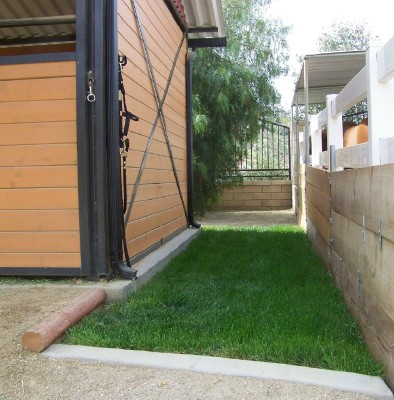
There’s another strip of emerald bliss next to the box stall, forever tempting my horses’ taste buds.
It’s amazing how much damage a fat Paint gelding can do in just a few bites. Since he knows he’s going to be apprehended he gobbles it up in frothy mouthfuls, eating as he trots, a motion which also rips out huge chunks of sod. I am able to describe this scenario so clearly because it’s happened twice.
Well, three times. But the last time I kept it a secret from my husband Ron.
The first two times Ron was so upset that I was half afraid Wally and I were going to be hitchhiking our way to the nearest boarding stable with a bunkhouse. Ron also contemplated tearing out the whole lawn and starting over again. But fortunately he simmered down, I promised to keep a closer eye on Wally and the gate, and the grass grew back in place.
Yet like I said, it happened again. Last week. Honestly, I had just wheeled the muck cart into Wally’s paddock when the fat red horse snuck behind me and in one quick move flipped the latch on the gate and darted out. He went right to the strip of lawn next to the barn and began eating. He got a few mouthfuls before I caught him and dragged him back into captivity, but the damage was done. Several green tufts were sticking up in the air like little bouquets and horse shoe prints were indelibly stamped into the soft earth.
After I put Wally away (do horses snicker?) I got down on my hands and knees and began pushing roots back into the dirt. I kept consoling myself by thinking, “Hey, I’ve watched tons of show jumping classes held on grass derby fields. All that grass grows back in, right?” Emboldened with such faith, I added a few handfuls of bagged soil from the garden shed and watered it all in heavily. Because, you know, dousing everything planted in the ground with water makes it magically all better. Sure.
I did everything possible to keep Ron from venturing out to the backyard barn for several days. Meanwhile, I’d stand over that section of lawn and coax it to grow. Mentally, I’d wish it to sprout new shoots and flourish.
By yesterday I was convinced that every smattering of evidence from Wally’s incursion was gone. The grass was green and fluffy and the hoof prints had disappeared. I was confident that my unavoidable date with destiny would be alright. Right around noon, about the time the morning dew had evaporated, Ron walked out to the garden shed and fired up the lawn mower. Once I heard it humming away I was relieved. Victory! And then…. It stopped. Pause. Silence. I could hear birds chirping, it was so still.
Then, the sound of Ron’s voice above the springtime melody: “Cindy? Did Wally get out again?”
I thought furiously. Should I ask him to define “again”?
He repeated, calling over the fence, “Did Wally get out again? Did he get on the lawn?”
“No,” I said, adding a little flourish of puzzlement to the tone of my voice, “not since the last time.”
Of course I wasn’t about to define what I meant by “since the last time.” It’ll be just another little secret.
Another few seconds past, then the lawn mower started up again. And all was well with the world once more.
Back to Life with Horses
Some horses are high maintenance critters while other horses seem indestructible. They’re never lame and don’t know the meaning of a belly ache or an open wound. But most horses fall someplace in between. And the average horse is more likely to experience a problem when you first bring him home or make a change in his lifestyle. He is learning a new physical environment. He is experiencing a new feeding routine and regimen. He may be meeting new horse friends. All of this has to be sorted out – and during the transition cuts happen, bellyaches happen. And the new horse owner may be getting a first glimpse into the realities of horse ownership.
How can you prepare well to minimize the health risks for your new horse?
In Good Company
If you only have one horse, your job will be easier in some ways. That is unless he is lonely, and then you have another set of problems. If he is pining, pacing and hollering call an experienced horseperson for advice. This may be a transient event or you may end up having to get a goat or a little donkey or another horse for Prince. Horses are social animals.
If you are bringing your new horse home to another horse or a boarding stable, I would suggest you keep him separated initially. One reason is infectious disease. Let your new horse eye up his new pals from a distance for ten days or so until you are sure he isn’t going to come down with influenza or strangles (strep equi). When he remains healthy you may then put him out with others. I realize not all of us have the luxury of separate, non-adjoining pastures. In the absence of such a resource be certain that your new horse has been vaccinated against the most common infectious diseases. And if he hasn’t, then have him vaccinated and dewormed where you found him and ask if he can stay there for another two weeks.
Another reason for allowing the two horses to eye each other up for some period of time is many of those new horse lacerations and injuries come from the initial period of establishing a pecking order. It is during this time when horses are run into fences, and are kicked or bitten. Once they’ve sorted that out the two are typically best friends from that day forth.
And while we are on the topic of pecking order, don’t let your horse get away with poor stable manners. Establish the rules and adhere to them. Some horses, once they’ve gotten the upper hand, can turn into regular bullies. If you don’t know what the rules should be then go to a horse farm and watch the horsemen lead the horses in and out of the field. Watch how they navigate a gate. Study how they interact with the horses in the stall or at the mounting block. Become a good student of horsemanship.
Warning Signs
Once the transition is complete, do not let down your guard. Learn what is normal behavior for your horse. When he is behaving in a way that you haven’t seen before, it is time to investigate. If you see him pawing or rolling he may have colic (bellyache). If you suspect he may be colicking, phone your veterinarian immediately. It will cost you less both financially and in terms of emotional wear and tear if you have a colic treated sooner rather than later.
If your normally voracious horse does not finish his grain, take his temperature (have your vet or horseman friend show you how). Keep a thermometer on hand and learn what is normal for him. If he develops a fever this is another time to phone the vet.
If you notice your horse standing stretched out like a sawhorse and he is reluctant to move, this indicates laminitis, a serious and painful inflammation of the internal structures of the hoof that requires an immediate call to the vet.
Check your horse’s pulse, temperature and respiration when he is healthy and at rest so you know what is normal for him. Then if he is exhibiting unusual behavior, you will be able to check his vital signs and know if they are out of whack.
In general, an adult horse should have a pulse of 35-40 beats per minute. When you check the pulse, count the beats for 15 seconds and multiply your count by four to get your result. You can check the pulse several different locations:
For a normal, adult horse, the rate or respiration should be eight to 16 breaths per minute. Measure by watching or feeling your horse’s sides and counting for 15 seconds, then multiply by four. You can also feel in front of your horse’s nose for breaths, but if you do that, he will probably take a few quick sniffs, so don’t start counting until he has figured out that you are not feeding him a treat and goes back to normal breathing.
Good luck with your new horse. And remember, when in doubt err on the side of caution. Your veterinarian is always happy to field questions – and of course you’ve got that experienced horseperson on your team so you should be in good shape.
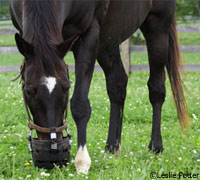 “Now that spring is here, we need to take it slowly when transitioning any of our horses from hay to pasture,” says equine nutritionist Juliet M. Getty, Ph.D. “And for those of us with insulin resistant horses,” she adds, “we may also need a dose of patience.”
The first spring sprouts are actually lower in sugars and starch (non-structural carbohydrates—NSC) because they use all that energy to promote their own rapid growth. But horses crave fresh grass and will eat volumes of it, making their overall NSC consumption really high—dangerously high for horses who are overweight, cushinoid, or who have experienced insulin-related laminitis.
To be safe, here are the rules:
There is no exact “best time” to turn out your horses on pasture. Generally speaking, it’s safest before dawn, until approximately 10:00 am, and then again at night, starting at around 11:00 pm. Start slowly, offering hay when horses are not on fresh grass.
Finally, test your pasture! Yes, testing is not only for hay. It will take the guesswork out of knowing which times are best.
Further Reading
Spring Grass Safety
Looking for more advice on optimal nutrition for your horse? For more than 20 years, Dr. Juliet Getty has taught and consulted on equine nutrition. Her comprehensive book, Feed Your Horse Like A Horse: Optimizing your horse’s nutrition for a lifetime of vibrant health, is available in hardcover and CD (PDF) through her website or at Amazon.com.
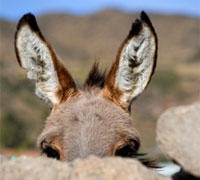 An intense international effort involving the Turkish Minister of Agriculture and Rural Affairs, the U.S. Embassy and SPCA International will allow an Iraqi donkey to relocate to the United States next month. SPCA International thanks the many donors and supporters who petitioned the Turkish authorities allow Smoke the donkey passage to the U.S. through Turkey. The animal was rescued in 2008 by Col. John Folsom and his Marines at Camp Taqaddum, brought back to good health and soon became the unit’s mascot and friend.
After a brief period of quarantine in New York’s JFK airport, Smoke will settle in Nebraska where he will be trained as a rehabilitation therapy animal for Wounded Warriors Family Support, a nonprofit that provides support to families of military personnel wounded, injured or killed during combat operations.
Thanks to the efforts of SPCA International and the U.S. Embassy working with authorities in Turkey, Smoke will become the first animal allowed official transport from Iraq into Turkey since the Iraq war began.
“We are so excited and thankful to have gained the approval needed to bring Smoke to his new loving home with John Folsom and the Wounded Warriors group,” said Stephanie Scott of SPCA International. “We worked closely with the USDA and multiple veterinarians in Iraq to ensure Smoke has all the proper immunizations, has cleared the proper tests, and is healthy and safe for travel to the United States. It has been a long journey so far and we are grateful to the many people and officials who helped make this happen so Smoke can be reunited with his Marine friends and serve an important therapy role helping veterans and their families.”
Ret. Col. John Folsom is providing a safe and loving home for Smoke in Nebraska. Folsom says he has not stopped thinking about his friend since he left Iraq and is looking forward to giving him the kind of life and home he deserves.
For daily updates on Smoke’s progress and to view the petition that helped secure Smoke’s passage, visit www.spcai.org.
It may sound overly simple, but a dressage test is truly a test of geometry. Judges will score an average mover that makes accurate figures higher than a fancy mover that drifts off the rail and makes egg-shaped circles. Knowing this, you can pick up a lot of points just by being the most accurate rider at the show.
Download these diagrams of the two sizes of dressage competition arenas to help visualize how your test should look.
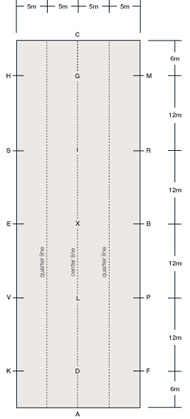 Large Arena | 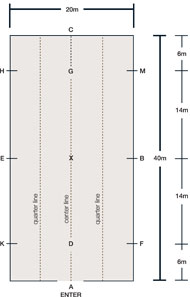 Small Arena |
The image of the shifty horse dealer is an enduring icon, given new life with Internet technology. Instead of operating out of a shantytown boarding stable, these wily purveyors of horse flesh have begun wheeling and dealing online, emboldened by the anonymity that comes with conducting commerce by computer. Fortunately, we finally caught one, and if she’s made to pay as a sort of message to other horse sale scammers, so be it.
Trina Kenney, 32, whose place of residence is less than two hours from me, has agreed to a plea deal that gives her 41 months in federal prison and requires her to pay $200,000 in restitution. Her admission of guilt on one count of mail fraud is the result of an undercover investigation by FBI and US Postal agents. They acted as online buyers of a Friesian mare that Kenney sold to them for $5,000 yet never produced. But this was just one example of Kenney’s handiwork. In court she admitted she’d ripped off over 60 buyers from the U.S. and Canada from 2004-2008. Her modus operandi was to post ads on sites we all browse through, like dreamhorse.com and horsetopia.com, and entice buyers with money-back guarantees (which of course were useless). Her lowball prices were usually paired with a need to sell the horse quickly, and if buyers balked she’d invoke the old standby that there were other interested parties, so they needed to decide hastily. Once a cash payment was sent, then the horse would arrive. Invariably it would be: dyed with hair color; lame due to a lack of hoof care; ill due to an untreated case of strangles; unruly and unsafe once a tranquilizer wore off; an entirely different horse than the one purchased. Sometimes no horse would arrive at all.
Thanks to the multitude of equestrian message boards and the power of mass emailings, Kenney’s notoriety quickly spread. Undeterred, she developed aliases and created several phantom farm names, and went back to work. I can’t help but think that when federal agents got involved they were amazed at the chutzpah of this 32-year-old woman. She was gleefully ripping off horse lovers with wild abandon.
Yet I have to point out that part of my enduring fascination with this story is the incredible gullibility (dare I say stupidity?) on the part of her victims. I’m sure they were looking for the horse of their dreams and they thought they’d found a good deal. Maybe the type or quality of horse they sought didn’t exist in their region of the country, and buying long-distance via their laptop seemed like a prudent choice. But buying a horse—especially one for riding purposes—based on (misrepresented) ad text and a couple of snapshots (copied and pasted from someone else’s ad or website) is asking to be disappointed. And also asking to be relieved of several thousand dollars. I mean, this isn’t eBay, folks. We’re not talking about firing up PayPal to buy a slightly used Brighton purse or a set of Seinfeld DVDs. It’s a horse. Either you have a connection with the animal, based on some face-to-face interaction, or you don’t. And either you get a good vibe from the seller or you get the creeps and leave. I just can’t get past the idea that some people gladly forked over a considerable amount of money to a complete stranger just because she’d mastered the art of hucksterism.
So here I go again: Buying a horse, and paying for its continued upkeep, is an expensive proposition. Few things are more heartbreaking than realizing the horse of your dreams is more like a nightmare that you now have to unload. Please take your time before you plunk down money on a horse, especially if you’re trolling those online sale sites. Don’t feel rushed. Don’t be swayed by money-back guarantees, because they’re generally worthless. Visit the horse in person, even if that requires a road trip and dipping into your horse budget. Then make sure any registration papers match the horse you’re looking at. Finally, consider having a vet evaluate the horse to make sure it’s not ill, lame or drugged.
I’ve heard from several shoppers who have bought wonderful horses online, and I know there are indeed plenty of reputable sellers, including breeders, trainers and agents, who market their stock primarily through websites. But you have to realize that the horse world, unfortunately, has been rife with scammers and grifters for eons. They’re out there, just waiting to take your money. And it’s going to be a while before the FBI drags them all to the hoosegow.
Back to Life with Horses
If you’re primarily traveling to one-day shows, you don’t need to schlep around every horse item you own. You just need to assemble a few necessities and keep them handy in a tote tray, crate or gym bag. Here are a dozen show essentials:
Download a full horse show checklist >>
Back to Horse Show Top 10 >>
Watch as trainer Anita Howe explains the Tennessee Walking Horse’s rocking chair canter.
The rocking chair canter of the Tennessee Walking Horse is a collected and elevated, three-beat gait where the diagonal pairs must land together for correctness. Unbalanced and over-ridden canters produce a lateral, four-beat gait that is incorrect.
Of note is how their natural looseness combines with the use of their head and neck to add loft and elevation to their collected canter. This combines to produce a notable headnodding action that is completely natural and fluid.
The collected canter takes tremendous strength for upward lift that is best developed over weeks and months to avoid over-strain or injury.
Learn more at HowTheyWalk.com
Watch a video of the flat foot walk
Watch a video of the running walk
Watch more horse videos